This document discusses equations of motion for higher-order Legendre transforms in quantum field theory. It begins by introducing Legendre transforms and their use in expressing potentials in terms of Green's functions. It then:
1) Derives Schwinger's equation and constraint equations for the generating functional of Green's functions. These determine the Green's functions uniquely.
2) Shows that iterating the equations expresses the generating functional as the sum of all vacuum loops, demonstrating the connected Green's functions are generated.
3) Notes that generalizing this proof to higher-order Legendre transforms would demonstrate their m-irreducibility properties, in line with previous work.
![EQUATIONS OF MOTION FOIl A
OF AIIB[T1RAIIY OP, DEII
A. N. Vasil'ev and A. K.
LEGENDRE TIIANSFORM
Kazanskii
A study is made of the field analogs of the higher Legendre transforms introduced by de Dom-
inieis and Martin in the framework of the functional formulation of quantum statistics [1, 2].
Equations of motion are constructed for these entities, the resulting equations being similar
to the Schwinger ,equations for Green's functions.
1. Introduction
In the present paper we construct equations of motion for the Legendre transform of any order in the
ease of an arbitrary polynomial interaeti0n.
Legendre functional transformations of higher orders (to fourth inclusive) were introduced by de Dora-
inlets and Martin in the framework of quantum statistics [1, 2]. Jona-Lasinio immediately noted [3, 4]
that the technique developed in [1, 21 can be transferred directly to quantum field theory and that the Lan-
guage of the first Legendre transformation is the most natural when one poses the problem of anomalous
Green's functions (spontaneous symmetry breaking) of the "tadpole" type, in the subsequent papers of
Dahmen and Jona-Lasinio [5, 6] it is asserted that Legendre transformations provide a natural Language
for formulating dynamics quite generally.
To explain the idea of [5, 6], let us briefly describe the method and aim of introducing Legendre
transformations. The main problem in field theory consists of finding Green's functions from a given in-
teraction. Restricting ourselves for simplicity to the case of a single scalar field ~0(x), we write down an
arbitrary polynomial action (classical) of the field ~9:
5"
Here and in what follows, expressions of the type Anrfi are an abbreviated notation of the integral
A, ,~,~--- S 9~ d~, E~x,,A ,,(x ...... ~ ,,) ,c (,,,).. ~ (~ ~,).
The functions (possibly, generalized) An(x 1..... Xn) are symmetric with respect to permutations of xl,
.... Xn; following de Domintcis and Martin. we shah call them potentials and regard them as the indepen-
dent variables of the theory [for example, to the ordinary theory X~ there correspond the potentials A2
= (- ~- - m~)O(x1 -- x2) , A4 = 3,6(xt - x2)6(x 2 - x3)6(x 3 - x4) , the remaining vanishing].
Standard methods of perturbation theory enable us to express any connected Green's function Wk(x,,
.... Xk) as a functional of the potentials:
Wk=W~(A,, A,.), k=0. 1, 9. . . . . . . . . . . (2)
(we mean by this a representation of Wk as a sum of Feynman diagrams).
Suppose that we wish to eliminate from the theory the first m (m <_ N) potentials A1..... Am by ex-
pressing them in terms of the first (not counting W0) connected Green's functions WI..... Wm; in other
words, to solve the first m equations (2) (k = 1..... m) for A1..... Am:
A. A. Zhdanov Leningrad State University. Translated from Teoreticheskaya i Matematieheskaya
Fizika, Vol. 14, No. 3, pp. 289-305, March, 1973. Original article submitted December 28, 1971.
9 1974 Consultants Bureau, a division of Plenum Publishing Corporation, 227 [['est ]7th Street, ;ew York, Y. Y. lO0]l.
No part of this publication may be reproduced, stored in a retrieval system, or transmitted, in any (orm or by any means,
electronic, mechanical, photocopying, microfilming, recording or otherwise, without written permission oft/It publisher. ,I
copy of this article is available from the publisher .(or $15.00.
215](https://image.slidesharecdn.com/w8ypyc3qnqiwewhw3zyw-signature-dd6c4cbd0b6257b3398e2b024a9a58fb3128aa4aa0f6d5dc1262e99a726ba8ef-poli-160712065243/85/513-1-320.jpg)
![EQUATIONS OF MOTION FOIl A
OF AIIB[T1RAIIY OP, DEII
A. N. Vasil'ev and A. K.
LEGENDRE TIIANSFORM
Kazanskii
A study is made of the field analogs of the higher Legendre transforms introduced by de Dom-
inieis and Martin in the framework of the functional formulation of quantum statistics [1, 2].
Equations of motion are constructed for these entities, the resulting equations being similar
to the Schwinger ,equations for Green's functions.
1. Introduction
In the present paper we construct equations of motion for the Legendre transform of any order in the
ease of an arbitrary polynomial interaeti0n.
Legendre functional transformations of higher orders (to fourth inclusive) were introduced by de Dora-
inlets and Martin in the framework of quantum statistics [1, 2]. Jona-Lasinio immediately noted [3, 4]
that the technique developed in [1, 21 can be transferred directly to quantum field theory and that the Lan-
guage of the first Legendre transformation is the most natural when one poses the problem of anomalous
Green's functions (spontaneous symmetry breaking) of the "tadpole" type, in the subsequent papers of
Dahmen and Jona-Lasinio [5, 6] it is asserted that Legendre transformations provide a natural Language
for formulating dynamics quite generally.
To explain the idea of [5, 6], let us briefly describe the method and aim of introducing Legendre
transformations. The main problem in field theory consists of finding Green's functions from a given in-
teraction. Restricting ourselves for simplicity to the case of a single scalar field ~0(x), we write down an
arbitrary polynomial action (classical) of the field ~9:
5"
Here and in what follows, expressions of the type Anrfi are an abbreviated notation of the integral
A, ,~,~--- S 9~ d~, E~x,,A ,,(x ...... ~ ,,) ,c (,,,).. ~ (~ ~,).
The functions (possibly, generalized) An(x 1..... Xn) are symmetric with respect to permutations of xl,
.... Xn; following de Domintcis and Martin. we shah call them potentials and regard them as the indepen-
dent variables of the theory [for example, to the ordinary theory X~ there correspond the potentials A2
= (- ~- - m~)O(x1 -- x2) , A4 = 3,6(xt - x2)6(x 2 - x3)6(x 3 - x4) , the remaining vanishing].
Standard methods of perturbation theory enable us to express any connected Green's function Wk(x,,
.... Xk) as a functional of the potentials:
Wk=W~(A,, A,.), k=0. 1, 9. . . . . . . . . . . (2)
(we mean by this a representation of Wk as a sum of Feynman diagrams).
Suppose that we wish to eliminate from the theory the first m (m <_ N) potentials A1..... Am by ex-
pressing them in terms of the first (not counting W0) connected Green's functions WI..... Wm; in other
words, to solve the first m equations (2) (k = 1..... m) for A1..... Am:
A. A. Zhdanov Leningrad State University. Translated from Teoreticheskaya i Matematieheskaya
Fizika, Vol. 14, No. 3, pp. 289-305, March, 1973. Original article submitted December 28, 1971.
9 1974 Consultants Bureau, a division of Plenum Publishing Corporation, 227 [['est ]7th Street, ;ew York, Y. Y. lO0]l.
No part of this publication may be reproduced, stored in a retrieval system, or transmitted, in any (orm or by any means,
electronic, mechanical, photocopying, microfilming, recording or otherwise, without written permission oft/It publisher. ,I
copy of this article is available from the publisher .(or $15.00.
215](https://image.slidesharecdn.com/w8ypyc3qnqiwewhw3zyw-signature-dd6c4cbd0b6257b3398e2b024a9a58fb3128aa4aa0f6d5dc1262e99a726ba8ef-poli-160712065243/75/513-1-2048.jpg)
![A,~=An(W, ..... Win; A.......... A~.), n=l, 2.... m, (3)
and then, using (2) and (3), obtain
W~=W~(W ...... W,,; A,,~ ...... A,-), k=0, re+t, m+2 .... (4)
This statement of the problem is not new in field theory. For the ~ theory (and other theories with
three-end vertex, for example, eleetrodynamics) the problem ean be solved by going over to skeleton
graphs, but this procedure does not permit a direct generalization to the @ interaction and higher inter-
actions.
It is shown in [1, 2] that the solution of this problem in the general ease reduces to finding a eertatn
functional F(m) 0eVt ..... Wm; Am+t ..... AN); this functional is the Legendre transform of order m of the
functional W o (At ..... AN) (see See. 3 for detailed definitions). In [1, 2] the explieit form of r(m) is rep-
resented as a sum of graphs of the same type as the graph W 0 (but with "dressed" potentials W1.... , Win) ;
at the same time, F(m) does not contain all the graphs of W 0 but only the m-irreducible ones (for m <_ 3 a
graph is said to be m-irreducible if it does not split up into two nontrivia[ parts when m lines are broken;
a part is said to be nontrivial if it does not reduce to a simple vertex. For m = 4, the definition of m-ir-
reducibility becomes somewhat more eomplieated [2].) The proof that F(m) reduees to m-irreducible
graphs is not at all trivial and requires a eomplieated eonbinatorial analysis of diagrams [2].
To find F(m) in the general ease we must write down for it an equation of motion (an analog of Sehwin-
ger's equations [9] for Wo). Iterative solutions of these equations will represent F(m) as a sum of dia-
grams.
We return now to [5, 6]. The basie idea is expounded in the first of these papers and consists of the
following: the authors consider the ~3 theory (i. e., a theory with the potentials At, A2, A3); they intro-
duee the third Legendre transform F(3) (Wi, W2, W3) and obtain for it an equation of motion. Having con-
structed these equations, they note that the fundamental problem of field theory (i. e., the finding of the
Green's functions from the potentials) can be split up naturally into two parts.
First Part. Solution of the equations of motion for F(3) (Wt, W2, W3). In this stage, Wt, W2, and W3
are regarded as independent variables.
As we have already noted, given F(3), one ean find explicit expressions for the potentials Ai, i = 1,
2, 3, and the remaining Green's functions Wk, k = 0, 4, 5 ..... as funetionals of Wi, i = 1, 2, 3.
Second Part. The aetual values of W[ ~ i = 1, 2, 3, are found from the given potentials AI~ i = 1. 2,
3, by solving the equations
A?'=Z,(W~~ ' w~~ ~=l,a,3,
for W[~ i = 1, 2, 3.
In [5, 6J it is assumed that the most important quaiitativeproperties of the theory under considera-
tion are already manifested when the first part of the problem has been solved. In [6], an equation in va-
riational derivatives is investigated and is reduced to a system of ordinary partial differential equations.
The investigated equation (Eq. (2.14) in [5] - it is the same as Eq. (1.1) in [6]) is, exeept for the notation,
identieal with the equation of the second Legendre transform of the ~p3 theory (the transition to the seeond
transform amounts to only a partial implementation of the above program and ean be regarded as a first
atte rapt).
The equations of motion of F(m) can also be used to reproduce in a simple manner the results of de
Dominieis and Martin concerning the properties of m-irredueibilityof the F(m) diagrams. For this it is
necessary to investigate the iterative solution of these equations andto show that in the proeess of iteration
one eneounters only diagrams that have theneeessary [rredueibilityproperty. Sueh aprogram has been
realized in [10] for the first and the second Legendre transform for an arbitrary interaction.
Finally, Legendre transforms have an interesting stationarity property [1-5] (for more detail see
See. 3), the diseussion of which would go beyond the seope of the present paper.
To summarize: there is no doubt that Legendre transforms are interesting and useful entities de-
serving of careful study.
216](https://image.slidesharecdn.com/w8ypyc3qnqiwewhw3zyw-signature-dd6c4cbd0b6257b3398e2b024a9a58fb3128aa4aa0f6d5dc1262e99a726ba8ef-poli-160712065243/85/513-2-320.jpg)
![2. Equations of Motion for Green's Functions
Suppose that the classical action of the field ~#(x) has the form (1).
I , ~o) z
So(m) = TA_~ ~p
and the interaction
We spilt it into the free action,
(s)
s, n~(cp) = s (~p) - ,s0 ~,q~.'
In field theory the total (unconnected, together with vacuum loops) Green's functions Gn (x1..... Xn)
are defined by [7]
G,,(x ...... x~) = <0[T(q)(x0 ... q~(x,0 exp iS,,t(q))) [0>. (6)
In this relation, qo(x) is the now quantized field in the interaction representation [which is determined by
S0(@] , and the symbol T denotes the Wick chronological ordering.
Repeated differentiation of (6) with respeet to A1 gives (here and in what follows we omit the argu-
ments xi, ..., Xn)
G,, = (-0 ~ ~~176 (7)
6A,,~
We shall work consistently in the framework of'the functional formulation of field theory, in which the
Green's functions Gn are ealeulated not by means of (6) but by means of the Feynman path integral [8]
G,,(x ...... x,) = c ~Dcp q~(~,)... (p(x,,) exp iS(q,). (8)
Here fD~o denotes integration with respect to all the classical fields q0(x), S(@ is the classical action (1),
and e is a normalization constant defined by
c-* = f D(p exp iSo({p). (9)
The Green's functions Gn depend functionally on the potentials Ai ..... AN and on the free potential A~~
(the entire dependence on the latter is concentrated in c).
ff exp iSint(@ in the integral (8) is expanded in a series, each term of this expansion generates an in-
tegral of Gaussian type. These integrals are taken; the result of such ealeulations is the ordinary repre-
sentation of Gn as a sum of Feynman diagrams.
The equation of motion for GOis obtained from the relation
fD{f 66-7-pexp iS(~)= 0. (10)
which expresses the translational invarianee of the measure in the function space. Equation (10) is equiva-
lent to the assertion that the terms outside the integral can be ignored in the functional integration by parts.
Taking the derivative, we reduce (10) to the form
fDq) 58(q,)_6_q.___(,.xpiS(T) = fD,,:(s (k -] I), :l,,{,j~ ~) (,xp *S(~p)= 0. (11)
If we now note that multiplication by ig) in the integrand is equivalent to differentiation of the integral with
respect to A1, we obtain
5
A,, ~)'. C;o= (I. (12)
{A,+~'(/~_,), ( 6 ..... }
Equation (12) is Schwinger's equation [9] for the generating functional of the total Green's functions [the re-
lation (7) enables us to assume that GOis the generating functional of all the Gn].
Sehwinger's equation (12) does not determine Go uniquely but only to within an arbitrary factor that
does not depend on A1 but does depend in an arbitrary manner on A2..... AN. This ambiguity affects only
the vacuum loops: the ratios Gn/G 0 are determined uniquely.
217](https://image.slidesharecdn.com/w8ypyc3qnqiwewhw3zyw-signature-dd6c4cbd0b6257b3398e2b024a9a58fb3128aa4aa0f6d5dc1262e99a726ba8ef-poli-160712065243/85/513-3-320.jpg)
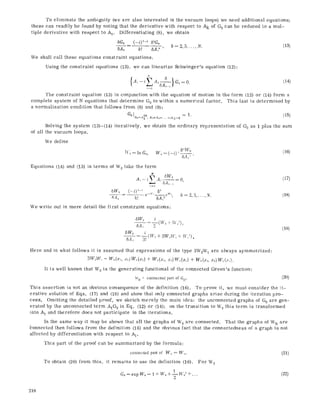
![and therefore
connected part of Go = connected part of W0, (23)
since it is obvious that all the terms Wn, n > 1, generate only unconnected graphs.
Differentiating Eq. (22) a total of n times with respect to A1, we conclude similarly that connected
graphs are generated by only the term W 0 in the expansion (22), and hence
connected part of G,~= connected part of W,~, n = 1, 2..... (24)
The relations (23) and (24) in conjunction with (21) give (20).
We have proved the eonneetedness of Wn in this detail only because the idea behind this proof can be
generalized to Legendre transformations. The result of such a generalization must be the proof of the m-
irreducibility of the Legendre transform of order m [for m = 1, 2 this generalization is made in [10]].
Note that from the terminological point of view it is convenient to assume that W0 is the Legendre
transform of zeroth order, and the argument given above can be regarded as the proof of its 0-irreducibil-
ity (0-irreducibility means that a graph remains eonDected when 0 lines are broken, in other words, the
graph is simply connected).
3. Legendre Transforms
The Legendre transform of order m is constructed as follows [1, 2, 5]: first, one introduces new
variables c~l, ..., c~m,
6Wo
ic~- k = t, 2 ..... ra. (25)
5A~, '
It is assumed that these equations can be solved for A1..... Am (here Am+ t ..... AN are regarded as
fixed parameters), i.e., that one can find A1.... , Am as functionals of oq, ..., c~m and Am+1 ..... AN.
One then introduces the funetional
ri~('~)(a ...... a,,~;A,,+ ...... Ax)~ W0(A~,..., Ax)- 6A~-A~ = Wo- i ~kA~: (26)
k=t h~t
wh[eh is called the Legendre transform of order m of the functional W0 (A1, . .., AN) [we use the notation
f.(m) as we wish to retain r(m) for the same functional expressed in terms of different variab!es; see
See. 4].
In Eq. (26) one can assume that either A1..... Am or c~1..... ~m are the independent variables.
For k s m we have (assuming that the c~I..... c~m are independent)
6I~'('~) ~ 6W0 5A~ ~, 6Wo 6A~ iA~=. iA~. (27)
5a~ 6A,, 6ct~ 6A,~ 6c~
In writing down the variational derivatives one should specify which variables are assumed fixed for a given
differentiation. So as not to encumber the formulas, we shall not do this, assuming that the precise mean-
tng of the derivatives can be established without difficulty in each case from the procedure by which the for-
mula is obtained.
The meaning of the variables c~k can be established from the definitions (25), (16), (7) and the con-
straint equations (13):
6 ~u 6Go (-i) ~ 6~G0 t
a~, = --i iGo-I -- Go-~ -- Go-~ G,. (28)
5A~ 6A~ k! 6A,k k!
This shows that ~k is equal to within the factor l/k! to the unconnected Green's function without vacuum
loops.
The stationarity property mentioned in the introduetion is this: suppose we are interested in a theory
with the actual potentials A~~ ..... A~ ) The expression
m
(o) . A (o)~ ~( )/ __ (o) ~ ~(o)
q)(~) (a ...... am; A........ j = t " ~a..... ccm;Am+...... A~ ) ) + i~.~ a~A~ ,
2i9](https://image.slidesharecdn.com/w8ypyc3qnqiwewhw3zyw-signature-dd6c4cbd0b6257b3398e2b024a9a58fb3128aa4aa0f6d5dc1262e99a726ba8ef-poli-160712065243/85/513-5-320.jpg)
![regarded as a functional of the arbitrary ce1..... cem
5(D(m) _ (o) _ (o)
6ct,~ = O,
(11--(11 .... (11'?1--(1IR
which follows from (27). The stationarity point oe~~ .... ,
sponding to the given potentials.
for fixed potentials has the property
k = 1, 2, ..., m,
Oe(m~ is the value of the Green's functions eorre-
For the first transformation it has been shown that the stationarity point corresponds to a minimum
(see, for example, Appendix B in [5]) but in the general ease it is not known whether the stationarity point
is an extremum (at the end of [2] this question is listed among the problems deserving further investiga-
tion).
We note a further useful relation. We write down
6a~ ~-~ 5< 6A~ ~el 5~FI/o 6~F'....
(2~)
6ak ff--a6A,, 6~ 7, 5Ai6A.,~ ~
[we have used (25) and (27)]. Equation (29) means that the matrices of the second derivatives 52W0/SAi(3Ak
and 5=F(m)/6ceifOek are the inverses of one another.
Note also that the Legendre transforms can be constructed recursively, namely: ~(m+t) (% .....
Oem+t; Am+2, ..., AN) is the first Legendre transform of the functional ~(m) (cq ..... Cem; Am+ 1..... AN)
with respect to the variable Am+l. This means that the new variable Cem+ t and the functional P(mq) can
be determined by the equations
6i~'"" (30)
fv~,,,+,l(<,..., a,,,.l; A,,,+...... A.,)
l~(m)(cq, , a< Am+i,...,AN) 5i=('")= ... -- -A.~+i (31)
6A,,+~
Let us show first that the definitions (25) and (30) of the variable Cem+ 1 are identical. To this end let
us consider the derivative of ~(m) with respect to the variable Ak (k > m) for fixed cq ..... cem and Am+z,
..., AN:
5]7('~) 6 ( X-~ 6Wo, 5Wo +~, 5Wo 5A,, ~ 6Wo 6A.~ 6I'Vo (k>m) (32,
5A~, 5 [ Iu 2.~ ~ A,~) = 6Ah 5A,, 5Ak 5A,~ 5A~ -- 6A,, "
r,=l ~2=1 n=~_
In the derivation of this relation At . . . . . Am are regarded as [unetionals of ce; ..... cem and Am+1 ..... AN.
On the right-hand side of (32) we have the partial derivative of W 0 with respect to Ak for fixed As.... , AN,
i. e., the same entity that occurs in the definition (25).
This proves the equivalence of (25) and (30); it then follows that the definitions (26) and (31) of the
funetmnal P(m+t) are equivalent.
Using (32), we conclude that for k > m, k > m'
5Ak
~I~(m ' )
(33)
5A~ '
At the same time the derivative on
and Arn+l ..... AN, while on the right it is taken
since each side of this equation is equal to the right-hand side of (32).
the left-hand side of (33) is taken for fixed ce1.... , cem
for fixed % ..... cem, and Am,+t ..... AN.
4. Transition to Natural Variables
It is shown in [2] that the functionals I'(m) have simple topological properties (m-irreducibility) not
in the variables ce, ..... cem but in other variables, which have the meaning of connected Green's functions.
We shall denote these new variables by Pl ..... /3m and define them by
(*2 1
9 = T(f~ + ~2),
220](https://image.slidesharecdn.com/w8ypyc3qnqiwewhw3zyw-signature-dd6c4cbd0b6257b3398e2b024a9a58fb3128aa4aa0f6d5dc1262e99a726ba8ef-poli-160712065243/85/513-6-320.jpg)
![t
(34)
Comparing (28) and (34) we see that ill, ..., tim are connected Green's functions of the theory with the po-
tentials A1..... AN.
In what follows we shah require explicit expressions for the derivatives of a with respect to ft. To
calculate them, it is convenient to use the following device: we introduce an auxiliary variable q~(x) and
define the funetionals
~(q~)--: __E-~ ~q5, c,.(qo)--~exp ~(q0). (35)
If we now define the coefficient functions of the functional a (q~)without division by the factorial:
a (q~)= ~ c~q~h, (36)
h~0
it is obvious that the first functions ce1.... , c~m obtained from (35) and (36) agree with the ~ determined in
accordance with (34). In other words, the relations (35) and (36) give a compact expression of the change
of variable (34). Note also that the relations (35) and (36) give a meaning to ~k when k = 0 (ce0 = I) and also
when k > m.
Using (35) and (36), we calculate the derivatives of the c~ with respee~ to the ft. To this end we dif-
ferentiate Eq. (35) with respect to Pk, assuming that fil.... ,Pm are independent variables:
6~,, ~"= ~(~p) 6~ (~)-= ~,~ - ~(~)-~-~.
Equating now the coefficients of each power of q~, we obtain
65,~ [ O, n < k,
61%,:= ] (37)
[,
These relations also remain true when n > m.
Differentiating (37) once more, we obtain
62a~ 1
.... ~. (38)
613,, 6~,~ r! M
This form of expression presupposes that the right-hand side must be replaced by zero if the index a is
negative.
Note also a consequence of (37):
6a~ _ t. 5.... for n ~<m. (39)
513,~, m!
The inverse derivatives 6fl/5~ do not have a simple form. To calculate them, we must invert the
matrix (37). For what follows we require only 6fin/5~ m of the inverse derivatives. It is not difficult to
calculate this derivative because the matrix (37) is triangular. We write
6,3~ 5a~_ V~k
6 ,o- _ ___i
Setting k = i, k = 2, etc. successively in this equation, we obtain
= m! 6~,~, n <~m.
6~m
Using (37), we obtahl a further useful relation:
6~,, 6fs 6~,, k! 6a,~
n~l n~h
(40)
(41)
22I](https://image.slidesharecdn.com/w8ypyc3qnqiwewhw3zyw-signature-dd6c4cbd0b6257b3398e2b024a9a58fb3128aa4aa0f6d5dc1262e99a726ba8ef-poli-160712065243/85/513-7-320.jpg)
![in conclusion, we note that the equality that we have already proved between ~1..... /?m and the con-
neeted Green's functions enables us to give a different definition (16) for these variables:
6hW~ (42)[~h= W~=(--i) ~ 6A? ' k=~ ..... m.
When the functional ~.(m) is expressed in terms of the variables ~1..... /3m and Am+ ~..... AN we
shall denote it by F (m).
5. Equations of Motion for F(m)
The equations of motion for F(m) are obtained from the equations for W0 [Eqs. (17) and (18)]. The
problem consists of going over from the variables A1..... AN to the variables 171..... /?m and Am+l .....
AN and from the unknown functional W0 to the unknown F(m).
Let us first consider Sehwinger's equation (17). Using the definition (25) and (27) and (32), we obtain
"+ L~a'-~-iAm+~ct'- L A~--~O.
?r h~m+2
Comparing this with (41), we see that all the derivatives of ~(m) with respect to cek can be collected in the
derivative with respect to/71; on the other hand, it is clear that the derivatives with respect to Ak, k > m,
of F(m) and ~(m) coincide. The upshot is
(34).
The variable cem
6F("l ~, 5F('~)
61~---~- iA,~+lct,,- A~- = O.
5A,~-i
h~J*[+2
(43)
in (43) is assumed to be expressed in terms of/?t ..... /3m by means of the relations
Equation (43) is the final form of the linear equation of motion (17) in terms of F(m).
We now turn to the constraint equations (18). We spilt them into two groups: k = 2, 3 ..... m and
k = m + 1..... N (for m = 1 all the constraint equations belong in the second group).
Let us first consider the equations of the first group. Their right-hand sides contain the derivatives
of Wk of order not higher than m. If we use Eq. (42), these derivatives can be expressed directly in terms
of 13k. On the other hand, the left-hand sides of these equations can be reduced to o~k in terms of (25) and
then to Pk in terms of (34); it is readily seen that in this manner we arrive at identities.
At the first glance, this seems a strange conclusion, since it is obvious that the original equations
(18) are nontrivial, and it is equally obvious that the changes of variable and the unknown functions cannot
transform nontrtvial equations into identities.
The seeming contradiction is readily resolved; for in deriving (42) we have used the well-known fact
that Pk are connected Green's functions. This information was obtained, in its turn, from the definitions
(25) and (34) and the relation (28), in the derivation of which we have already used the constraint equations
(13), which are equivalent to Eqs. (18). It follows that the relations (42) already contain the information
that is in the constraint equations of the first group, and it is therefore not suprising that identities are
obtained when (42) is substituted into the constraint equations (18).
Thus, we have arrived at the conclusion that Eqs. (42) are equivalent to the constraint equations of
the first group. The problem is to represent the information contained in (42) in the form of equations that
the F (m) must satisfy.
To do this, we write down the identities
6A,, ~ 6[~,, 6Ak
61,~--~ --~6A~ 6~,~ ' k=t,2 ..... m. (44)
n= 1
We emphasize once more that these equations do not contain any information about the form of the function-
al [W0 or F(m)] - they are identities, which merely express the fact that the variables A1.... , Am are
replaced by the variables /31..... t3m.
222](https://image.slidesharecdn.com/w8ypyc3qnqiwewhw3zyw-signature-dd6c4cbd0b6257b3398e2b024a9a58fb3128aa4aa0f6d5dc1262e99a726ba8ef-poli-160712065243/85/513-8-320.jpg)
![But if, exploiting (44), we use Eqs. (42), we then introduce into the system (44) the desired informa-
tion and we obtain nontrivial equations.
Namely, we proceed thus, noting that with allowance for (42)
6~. 6'~+' W0
6A-'-'-7= (-i)" 6A, "+' i[3,,+,, n = l, 2.... , m- I.
The derivative 6fim/SAi can be found from the last equation of the system (44):
(45)
and hence
(46)
Substituting (45) and (46) into the first equations (44), we obtain
m-~ [ 6Ak 6A.~ 5A~ -~
We express the variables Ak in terms of F(m):
A~ i.
{}(~k
In the special case k = m, we obtain, using (40),
m
= is 6[L 6F ('')
6An ] (47)
(48)
6FI,,,/ (49)
A,,, : ira!---
In what follows, we shall abbreviate the notation by writing
From (48) and (49)
5F~,,,/ 5-Ti,,,,
--i ]',,, +1"~
5[~,~ .=, ,, 6f4,, &~,< ] j "
m
..... t ...... ' - (51)
It is clear from (34) that the ~s can be expressed in terms of C~k, k = 1..... s; therefore, 5/?s/SCe k can be ex-
pressed in terms of C~n, n = 1..... s-k. If we now go over again to the fi, we conclude that the derivative
6/?s/6Oe k can be expressed in terms of Pn, n = 1..... s-k < m, and therefore 5/6fim(6fis/SCek) = O. This
shows that the last term in Eq. (51) can be omitted.
Using (50) and (51), we rewrite (47):
m -- l m
,,~-, ~=~' L {')(t.~ * 5',3,, 5eta ] J "
We have introduced the noCation
(52)
The system (52) contains m-1 independent equations (k = 1, ..., m-l), i.e., as many as there are
constraint equations of the first group [for k = m, gq. (52) becomes an identity].
To simplify (52), we multiply it by 60~k/6/?r and sum over k from 1 to m. On the left we obtain /with
allowance for (37)1
6cq
6Jr.
6j~,.
223](https://image.slidesharecdn.com/w8ypyc3qnqiwewhw3zyw-signature-dd6c4cbd0b6257b3398e2b024a9a58fb3128aa4aa0f6d5dc1262e99a726ba8ef-poli-160712065243/85/513-9-320.jpg)
![On the right-hand side we have the sums
To calculate the second of these we transfer the derivative 5/5fin to the first factor:
The first term on the right-hand side makes no contribution, since the expression in the square brackets
reduces to 6sr. To calculate the second term, we use (38) and (41):
P ~h
51L,5j3~"Sct~ nF.rla..,a ...... 6ctk n!r!
h=l h~l
Using these calculations, we reduce Eqs. (52) to the final form
.... (n + r)! ~-~-q
,. - - ~ ~, r~+,. -~ ~,,+, O,,,. (54)6,,-
Y~:/ ;
The system (54) expresses the constraint equations of the first group in terms of F (m).
We now turn to the second group of constraint equations, i. e., to Eqs. (18) for k = m + 1..... N.
In accordance with (32), the left-hand sides of these equations can be written in the form 5F(m)/hAk, k
> m. On the right-hand side we have the derivatives 6kw0/hAk, k = 1..... N. The first of these (k -- 1,
.... m} can be expressed directly in terms of/9 by means of (42); to obtain the higher derivatives in terms
of F (m), /31.... , /?m, and Am+ 1..... AN, we must find an expression for 6/5A1 in terms of these quanti-
ties [from the definition (16) it can be seen that we mean 6/5A 1 for fixed A2.... , AN].
We have
6 ~ 6t1~ 6
6A[= 6A, 6{3,,'
(55)
The further treatment of this equation is different for the cases m = 1 and m > 1. For the first Legendre
transform (25), (34)
6~, _ 5~ _ i 6~w~ (56)
6A~ 6A, 8A~~
It remains to use (29), which in the special case m = 1 has the simple form
Using (56) and (57), we obtain
t 6q4"0 6@(" 6q'V~ F,. (57)
8AI 6Al 6ai 8aL 5Ai 6A,
6 5
"hAl= iD(,) = -- iF,l-I 6[~1'
where iD(m) here and in what follows stands for 5/6A1 expressed in terms of the Legendre transform of
order m.
(58)
For the higher transformations we obtain, using (45), (46), and (49),
m--i
-- hrn mm
6A~ ~- iD(,~) = i f%+~ 6[:b, 613m] "
k=l
(59)
Using the operator D(m), we can express any derivative Wk in (16) in terms of the first: W1 = /91.
The relations (45) are then satisfied automatically:
D(,.)~,~ ~ ~,,+~, n = 1, 2..... ra - t. (60)
224](https://image.slidesharecdn.com/w8ypyc3qnqiwewhw3zyw-signature-dd6c4cbd0b6257b3398e2b024a9a58fb3128aa4aa0f6d5dc1262e99a726ba8ef-poli-160712065243/85/513-10-320.jpg)
![The constraint equations of the second group take the form
6F('0 i
6Ah k!
9 vr h
e- oD(,~)e~o, k=m+t ..... N, (61)
where it is understood that D(m)W 0 = /?~ by definition, and for the repeated application of the operator D(m )
one must use its explicit form (59) [(58) for the first Legendre transformation].
The Schwinger equation (48) in conjunction with the constraint equations of the first group (54) and the
constraint equations of the second group (61) form a complete system of N equations for the Legendre trans-
form of order m of a theory with the potentials A1..... AN.
These equations determine F(m) to within an additive constant. The latter can be fixed by rewriting
the normalization condition (15) in terms of F (m).
By the condition (15), GOis normalized to unity at the point
Az=A~ ~ A~=Aa=...=Ax=0. (62)
The values of the connected Green's functions fi corresponding to the potentials (62) are known:
~0= ~0), ~,=s .... L,~ = o.
Here (63)
[3~~= iA~~ "
The corresponding values of ce are obtained by substituting (63) in to the right-hand side of (34).
tieular,
(o) i
In par-
The normalization condition is expressed differently for the cases m = 1 and m > 1.
transform we obtain, using (15), (16), (26), and (63).
r(" (0, A, (~ 0, 0,...) = 0.
For the higher transforms
~~ 0P~(0,p2 , ,0 .... )=tTrt,
2
For the first
(64)
(65)
where Tr 1 is a divergent constant equal to the trace of the identity operator [which is understood as an in-
tegral operator with the kernel 6(xl-x2)]:
6. Conetusions
Tr 1 = ~d~ 6(x -~)= 6(0) ~d~ = (2~)"~(0)-'.
We write down the complete system of equations for F(m):
the Sehwinger equation:
61"v") ~ 6P("~>
6T - zA,,,,,~ ,,, - ,l,, ~ = 0.
h~m+2
(66)
The constraint equations of the first group:
where r = 1, 2..... m- 1;
6.... (n+r)! r,
n! r! "~'~+~F,,+,. - [%+~Q,~,,
(67)
8[% ; F,,~
62In(m)
[, -1
225](https://image.slidesharecdn.com/w8ypyc3qnqiwewhw3zyw-signature-dd6c4cbd0b6257b3398e2b024a9a58fb3128aa4aa0f6d5dc1262e99a726ba8ef-poli-160712065243/85/513-11-320.jpg)
![The constraint equations of the second group:
l-e-~~176 k re+t,..,N,
6Ak k!
(68)
where
m-- t
-- " F m m - -D~,, P'-'-a-g' D..,, =-- ~,~+, - r~ ,
D(k,,)li'0 = ~k, k = i, 2..... ra.
The Sehwinger equation is a linear tnhomogeneous (for m ~ N) equation of first order; all the con-
straint equations are nonlinear. For the complete transformation (i. e., m = N) all the constraint equa-
tions belong to the first group, and the first of these equations becomes linear [using (66), we can readily
see that Qm = Qnl = 0 for the complete transformationJ.
For linear equations it is not difficult to construct a general solution as a sum of a particular solu-
tion of the inhomogeneous equation and the general solution of the homogeneous equation; this last, in its
turn, is an arbitrary functional of the first integrals of the homogeneous equation, and these can always
be found without difficulty.
If we wish to consider the higher potentials Am+ 1..... AN not as variables, but as ltxed parameters,
we must eliminate from Eqs. (66)-(68) the derivatives with respect to these potentials; this is done by sub-
stituting the constraint equations of the second group into the 8ehwinger equation (which then becomes non-
linear), after which Eqs. (68) are ignored.
Equations (66)-(68) allow an iterative solution, which is a sum of graphs without external lines (vacu-
um loops). In these graphs the total propagator ~2 (for m _> 2) is a line. The vertices are of two kinds:
lower vertices (for which the number of ends does not exceed m, the order of the Legendre transforma-
tion) are complete, i.e., they are associated with pk(fi2) -k (connected Green's function without external
lines), while the higher vertices (k > m) remain bare, being associated with the unrenormalized potentials
Ak (k > m). The graphs of the complete Legendre transformation (m = N) do not contain unrenormaltzed
vertices. The graphs F(m) have the nontriviaI topological property of m-irreducibility (in statistics this
is proved for m <_ 4 [2]; in field theory it is proved by a different method for m = 1, 2 in [10]).
Note that (27) and (59) enable one to represent the lower potentials (A1..... Am) and the higher
Green's lime[ions (/3k, k > m) as graphs of a given type (but then with the necessary number of external
lines). From this, in its turn, we readily obtain the following representation: the total vertex is a bare
vertex plus a sum of skeleton graphs. The derivation of such a representation is a nontrivial topological
problem if the number of ends is greater then three: the technique of Legendre transformations solves it
automatically.
LITERATURE CITED
1. C. de Domintcis and P. C. Martin, g. Math. Phys., 5, 14 (1964).
2. C. de Dominicis and P. C. Martin, J. Math. Phys., 5, 31 (1964).
3. G. Jona-Lasinio, Nuovo Cim., 34, 1790 (1964).
4. G. Jona-Lasinio, Acta Phys. Hung., 19, 139 (1965).
5. H.D. Dahmen and G. Jona-Lasinio, Nuovo Cim., 52A, 807 (1967).
6. H.D. Dahmen and G. Jona-Lasinio; Nuovo Cim., 62A, 889 (1969).
7. N.N. Bogotyubov and D. V. Shirkov, Introduction to the Theory of Quantized Fields,
(1959).
8. R.P. Fenmna, Rev. Mod. Phys., 20, 376 (1947).
9. J. Schwinger, Proc. Nat. Acad. Sc[~-~, 37, 452 (1951).
i0. A.N. Vasil'ev and A. K. Kazanskii, Teor. Mat. Fiz., 12, 352 (1972).
Interseienee
226](https://image.slidesharecdn.com/w8ypyc3qnqiwewhw3zyw-signature-dd6c4cbd0b6257b3398e2b024a9a58fb3128aa4aa0f6d5dc1262e99a726ba8ef-poli-160712065243/85/513-12-320.jpg)


