СИБИРСКИЙ ГОСУДАРСТВЕННЫЙ УНИВЕРСИТЕТ
ПУТЕЙ СООБЩЕНИЯ (НИИЖТ)
Новосибирск 2011
Е.Г. ЖАРИКОВА, О.В. КОНОНЫХИНА
ВВЕДЕНИЕ В БУХГАЛТЕРСКИЙ УЧЕТ
INTRODUCTION INTO ACCOUNTING
УДК 802.0 (075.8)
Ж345
Ж а р и к о в а Е . Г . , К о н о н ы х и н а О . В . Введение в бухгалтерский учет.
Introduction into Accounting: Учеб. пособие. – Новосибирск: Изд-во СГУПСа, 2011. – 112 с.
ISBN 5-93461-485-1
Учебное пособие «Введение в бухгалтерский учет. Introduction into Accounting» предназначено для
обучения английскому языку студентов экономического профиля по специальности «Бухгалтерский учет
и аудит». Учебный материал пособия направлен на формирование навыков профессиональной коммуни-
кации и развитие умений быстрого и точного понимания профессиональных текстов.
Пособие состоит из 5 уроков (5 Units), содержащих основной и дополнительные тексты из ориги-
нальной профессионально-ориентированной англоязычной литературы, а также упражнения, подобран-
ные на основе тщательно отобранной терминологии.
Рекомендовано редакционно-издательским советом Сибирского государственного уни-
верситета путей сообщения в качестве учебного пособия.
О т в е т с т в е н н ы й р е д а к т о р
канд. пед. наук, доц. кафедры «Иностранные языки» СГУПСа Е.Т. Китова
Р е ц е н з е н т ы:
кафедра иностранных языков Новосибирской государственной академии водного транспорта
(зав. кафедрой канд. фил. наук, доц. Е.И. Мартынова)
кафедра иностранных языков Новосибирского государственного архитектурно-строитель-
ного университета (завкафедрой доц. Т.С. Полищук)
Учебное издание
Жарикова Елена Геннадьевна
Кононыхина Ольга Витальевна
ВВЕДЕНИЕ В БУХГАЛТЕРСКИЙ УЧЕТ
INTRODUCTION INTO ACCOUNTING
Учебное пособие
Печатается в авторской редакции
Компьютерная верстка А.С. Петренко
Изд. лиц. ЛР № 021277 от 06.04.98
Подписано в печать 01.02.2011
14,0 печ. л. 8,4 уч.-изд. л. Тираж 120 экз. Заказ № 2340
Издательство Сибирского государственного университета
путей сообщения
630049, Новосибирск, ул. Д. Ковальчук, 191
Тел./факс: (383) 328-03-81. E-mail: press@stu.ru
© Жарикова Е.Г., Кононыхина О.В., 2011
© Сибирский государственный
университет путей сообщения, 2011
ISBN 5-93461-485-1
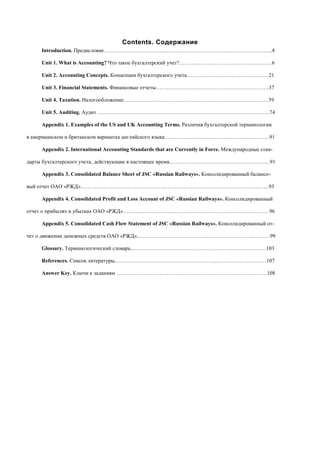
Contents. Содержание
Introduction. Предисловие……………………………………………………….….………………….…..4
Unit 1. What is Accounting? Что такое бухгалтерский учет?……………………………………….……6
Unit 2. Accounting Concepts. Концепции бухгалтерского учета………………………………….……21
Unit 3. Financial Statements. Финансовые отчеты………………………………………………………37
Unit 4. Taxation. Налогообложение………………………………………………………………………59
Unit 5. Auditing. Аудит ……………………………………………………………………………………74
Appendix 1. Examples of the US and UK Accounting Terms. Различия бухгалтерской терминологии
в американском и британском вариантах английского языка ………………………………………….………91
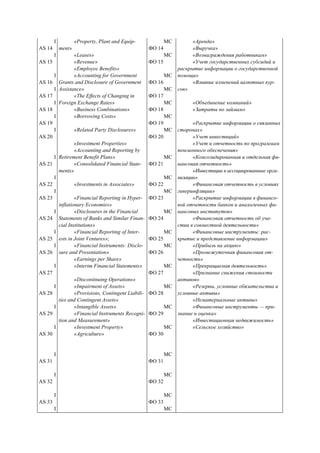
Appendix 2. International Accounting Standards that are Currently in Force. Международные стан-
дарты бухгалтерского учета, действующие в настоящее время..……………………………………………….91
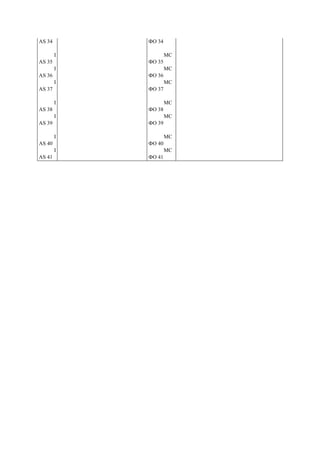
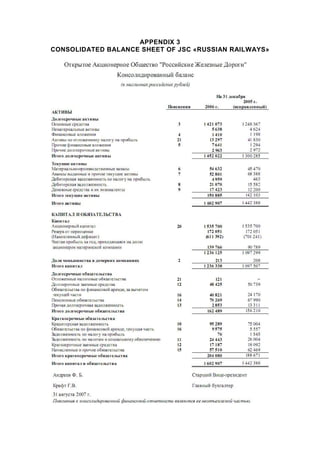
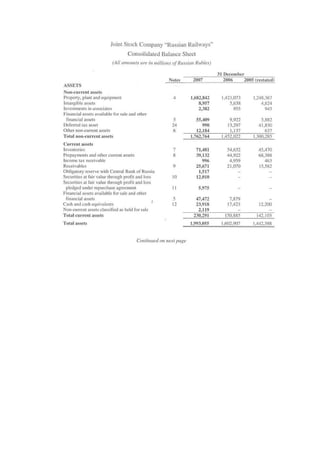
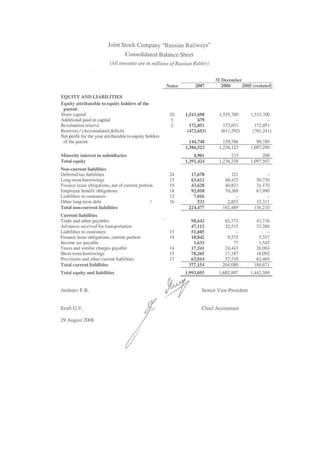
Appendix 3. Consolidated Balance Sheet of JSC «Russian Railways». Консолидированный балансо-
вый отчет ОАО «РЖД»…………………………..…………………………………………………………..……93
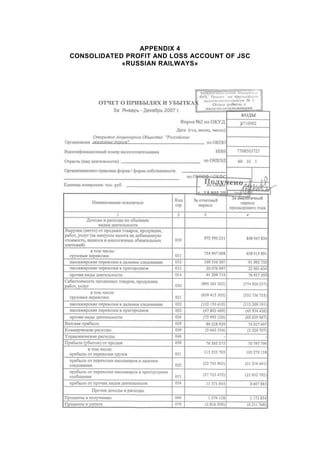
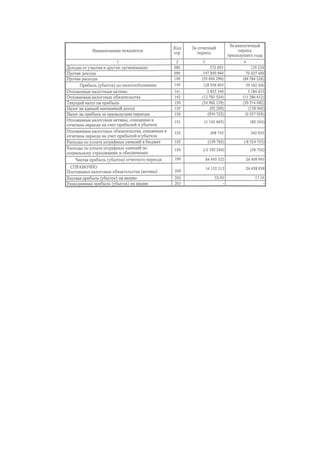
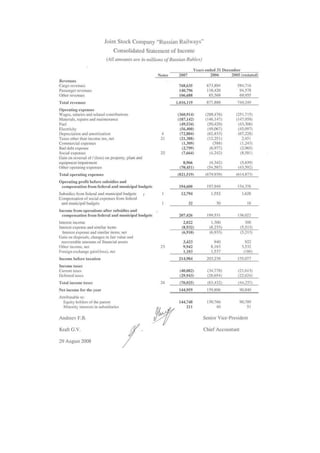
Appendix 4. Consolidated Profit and Loss Account of JSC «Russian Railways». Консолидированный
отчет о прибылях и убытках ОАО «РЖД»…………………………………………………………….…………96
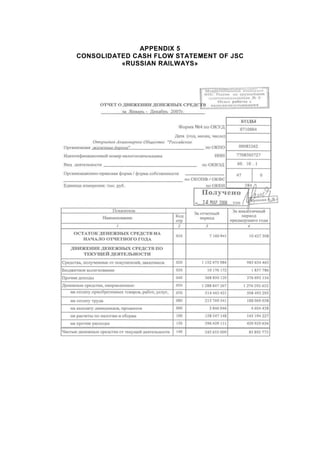
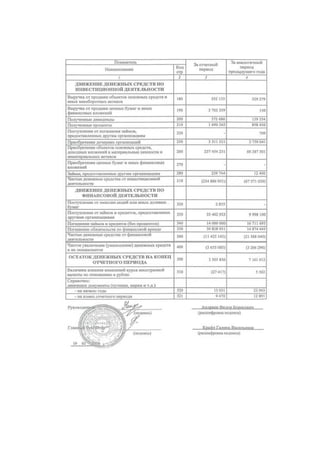
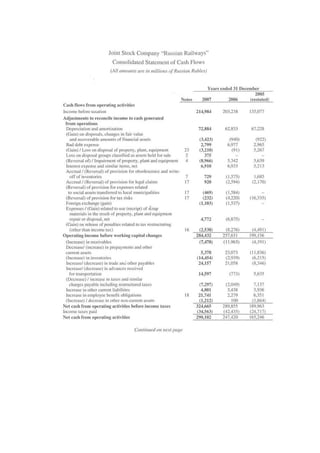
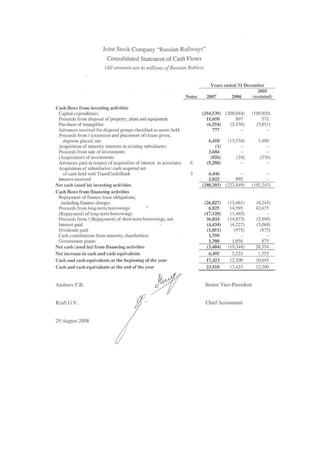
Appendix 5. Consolidated Cash Flow Statement of JSC «Russian Railways». Консолидированный от-
чет о движении денежных средств ОАО «РЖД»..………………………………...……………………..………99
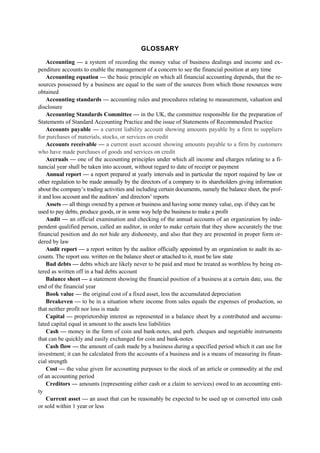
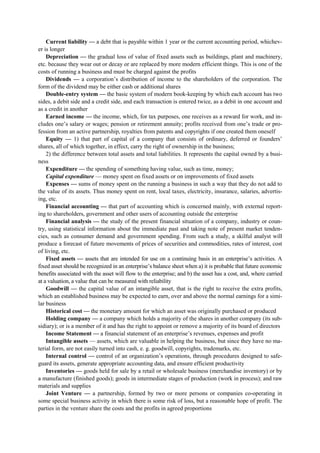
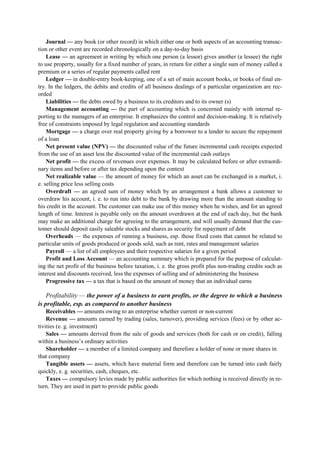
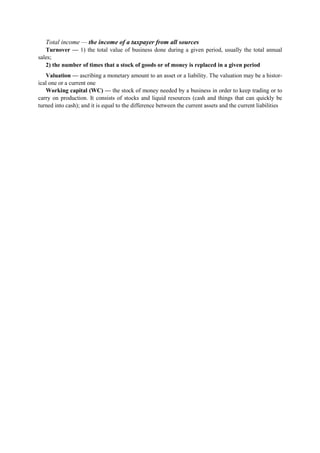
Glossary. Терминологический словарь..………………………………………………...………………103
References. Список литературы..………………………………………………...………………………107
Answer Key. Ключи к заданиям …………………………………………………………………………108
INTRODUCTION. ПРЕДИСЛОВИЕ
Расширение и качественные изменения характера международных связей нашего государства де-
лает английский язык востребованным в практической деятельности человека. Владение основным
языком международного общения является залогом удачной карьеры и становится дополнительным
ресурсом специалиста.
Целью учебного пособия «Введение в бухгалтерский учет. Introduction into Accounting» является
развитие профессиональной иноязычной коммуникативной компетенции.
Данное пособие предназначено для формирования навыков профессиональной коммуникации
на английском и русском языках у студентов экономических специальностей, а также для развития
умений быстрого и точного понимания профессиональных текстов и расширения профессиональ-
ного кругозора будущих специалистов в сфере бухгалтерского учета.
При составлении учебного пособия авторы руководствовались следующими принципами:
– предоставить преподавателю возможность обучения студентов с различным уровнем зна-
ний;
– подавать материал с учетом возникающих языковых трудностей;
– обеспечивать как самостоятельную работу обучаемых, так и контроль уровня усвоения ма-
териала преподавателем.
Текстовый материал пособия отобран из оригинальной профессионально-ориентированной анг-
лоязычной литературы в соответствии с темами лекций по дисциплине «Введение в специаль-
ность», также использованы официальные документы и печатные издания, опубликованные в на-
шей стране и за рубежом.
Учебное пособие состоит из 5 уроков (Units), 5 приложений (Appendices), глоссария (Glos-
sary) и ключей к упражнениям (Answer Key).
Каждый урок состоит из основного и дополнительных текстов, а также упражнений, подоб-
ранных по принципу нарастания профессиональной информации на основе тщательно ото-
бранной терминологии. Повторяемость употребления терминов на английском языке после
прослушивания лекций на русском языке способствует более быстрому их запоминанию и
осознанному употреблению на двух языках, что соответствует целям обучения, облегчает по-
нимание англоязычных профессиональных текстов и снимает лексические затруднения при
коммуникации.
Для облегчения работы с данным учебным пособием все уроки имеют единую структуру.
Основные тексты в разделе «Reading» отражают тематику соответствующего урока и являются
описательными текстами. Перед каждым основным текстом дается определенная коммуникативная
установка по теме урока («Pre-Reading»), а после текста предлагается список слов и словосочетаний
(«Words and Expressions for Reading Comprehension») для активного усвоения. В подавляющем
большинстве они носят тематический характер и облегчают понимание текста. Основные тексты
рекомендуется проходить в режиме изучающего чтения.
Содержащаяся в текстах смысловая информация и лингвистический материал используются
в системе упражнений, тренирующих иноязычное профессиональное общение. Следующие за
текстом упражнения в разделах «Reading Comprehension» и «Vocabulary Practice» являются
коммуникативными заданиями, направленными на:
– понимание и осмысление текстовой информации;
– активизацию словаря;
– развитие лингвистической компетенции и языковой догадки;
– формирование умений монологической речи.
В разделе «Supplementary Reading Practice» представлены дополнительные тексты, дающие
дополнительную профессиональную информацию по теме урока с различными заданиями, на-
правленными на развитие навыков чтения, перевода и говорения. Наряду с вопросно-
ответными заданиями, требующими расширенного ответа или выражения мнения, предлагают-
ся задания проблемного характера, развивающие умение творчески мыслить.
Разделы «Assignment» и «Discussion» содержат упражнения творческого характера и предна-
значены для развития языковой и профессиональной компетенций.
Обучение письму как самостоятельному виду речевой деятельности не входит в цели посо-
бия, однако в нем представлены упражнения, тренирующие формулирование собственных
мыслей на английском языке.
Уроки могут изучаться в предлагаемой последовательности или выборочно. Это же касается и
выполнения заданий в рамках урока: выбор заданий определяется практическими задачами и
конкретными условиями. Лексические упражнения и текстовой материал направлены на обеспе-
чение вариативности и мобильности в адаптации к нуждам и возможностям каждой конкретной
группы обучающихся.
В пособие включены 5 Приложений.
В Приложении 1 (Appendix 1) представлена таблица соответствия бухгалтерских терминов в
американском и британском вариантах английского языка.
В Приложении 2 (Appendix 2) предлагаются действующие международные стандарты бухгал-
терского учета и их эквиваленты в Российской бухгалтерской практике.
Приложения 3, 4, 5 (Appendices 3, 4, 5) содержат финансовые отчеты ОАО «Российские же-
лезные дороги» на русском и английском языках.
Для облегчения работы по закреплению и активизации профессиональной лексики в посо-
бие включен терминологический словарь (Glossary).
Упражнения уроков сопровождаются ответами, которые приведены в конце учебного посо-
бия.
Авторы выражают благодарность коллективу кафедры иностранных языков Новосибирской госу-
дарственной академии водного транспорта, кандидату филологических наук, доценту Е.И. Мартыно-
вой, коллективу кафедры иностранных языков Новосибирского государственного архитектурно-
строительного университета, доценту Т.С. Полищук, кандидату экономических наук, доценту В.Е.
Текутьеву (СГУПС), кандидату педагогических наук, доценту Е.Т. Китовой (СГУПС) и начальнику
финансовой службы Западно-Сибирской железной дороги Д.Л. Седых за ряд практических советов и
замечаний по улучшению пособия. Все предложения по дальнейшему совершенствованию работы
будут приняты с заинтересованностью и чувством признательности.
UNIT 1. WHAT IS ACCOUNTING?
PRE-READING
Discuss these questions.
1. What do you think the main purposes of accounting are?
2. Is accountancy totally objective or does it involve subjective judgements?
READING
Scan the text and find the answers to the following questions:
What role does an accounting system play in an economy?
What is the difference between accounting and book-keeping?
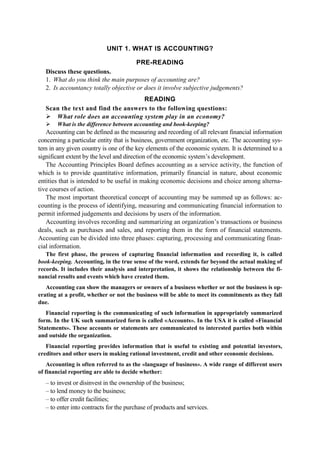
Accounting can be defined as the measuring and recording of all relevant financial information
concerning a particular entity that is business, government organization, etc. The accounting sys-
tem in any given country is one of the key elements of the economic system. It is determined to a
significant extent by the level and direction of the economic system’s development.
The Accounting Principles Board defines accounting as a service activity, the function of
which is to provide quantitative information, primarily financial in nature, about economic
entities that is intended to be useful in making economic decisions and choice among alterna-
tive courses of action.
The most important theoretical concept of accounting may be summed up as follows: ac-
counting is the process of identifying, measuring and communicating financial information to
permit informed judgements and decisions by users of the information.
Accounting involves recording and summarizing an organization’s transactions or business
deals, such as purchases and sales, and reporting them in the form of financial statements.
Accounting can be divided into three phases: capturing, processing and communicating finan-
cial information.
The first phase, the process of capturing financial information and recording it, is called
book-keeping. Accounting, in the true sense of the word, extends far beyond the actual making of
records. It includes their analysis and interpretation, it shows the relationship between the fi-
nancial results and events which have created them.
Accounting can show the managers or owners of a business whether or not the business is op-
erating at a profit, whether or not the business will be able to meet its commitments as they fall
due.
Financial reporting is the communicating of such information in appropriately summarized
form. In the UK such summarized form is called «Accounts». In the USA it is called «Financial
Statements». These accounts or statements are communicated to interested parties both within
and outside the organization.
Financial reporting provides information that is useful to existing and potential investors,
creditors and other users in making rational investment, credit and other economic decisions.
Accounting is often referred to as the «language of business». A wide range of different users
of financial reporting are able to decide whether:
– to invest or disinvest in the ownership of the business;
– to lend money to the business;
– to offer credit facilities;
– to enter into contracts for the purchase of products and services.
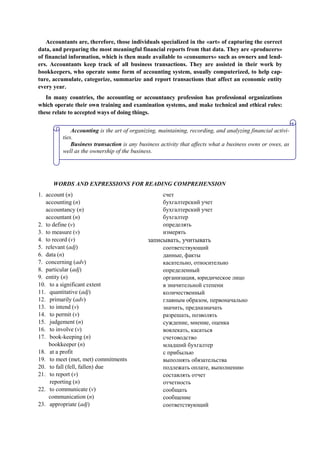
Accountants are, therefore, those individuals specialized in the «art» of capturing the correct
data, and preparing the most meaningful financial reports from that data. They are «producers»
of financial information, which is then made available to «consumers» such as owners and lend-
ers. Accountants keep track of all business transactions. They are assisted in their work by
bookkeepers, who operate some form of accounting system, usually computerized, to help cap-
ture, accumulate, categorize, summarize and report transactions that affect an economic entity
every year.
In many countries, the accounting or accountancy profession has professional organizations
which operate their own training and examination systems, and make technical and ethical rules:
these relate to accepted ways of doing things.
WORDS AND EXPRESSIONS FOR READING COMPREHENSION
1. account (n)
accounting (n)
accountancy (n)
accountant (n)
2. to define (v)
3. to measure (v)
4. to record (v)
5. relevant (adj)
6. data (n)
7. concerning (adv)
8. particular (adj)
9. entity (n)
10. to a significant extent
11. quantitative (adj)
12. primarily (adv)
13. to intend (v)
14. to permit (v)
15. judgement (n)
16. to involve (v)
17. book-keeping (n)
bookkeeper (n)
18. at a profit
19. to meet (met, met) commitments
20. to fall (fell, fallen) due
21. to report (v)
reporting (n)
22. to communicate (v)
communication (n)
23. appropriate (adj)
счет
бухгалтерский учет
бухгалтерский учет
бухгалтер
определять
измерять
записывать, учитывать
соответствующий
данные, факты
касательно, относительно
определенный
организация, юридическое лицо
в значительной степени
количественный
главным образом, первоначально
значить, предназначать
разрешать, позволять
суждение, мнение, оценка
вовлекать, касаться
счетоводство
младший бухгалтер
с прибылью
выполнять обязательства
подлежать оплате, выполнению
составлять отчет
отчетность
сообщать
сообщение
соответствующий
Accounting is the art of organizing, maintaining, recording, and analyzing financial activi-
ties.
Business transaction is any business activity that affects what a business owns or owes, as
well as the ownership of the business.
24. appropriately (adv)
25. statement (n)
26. party (n)
27. a wide range of
28. to lend (v) (lent, lent)
lender (n)
29. credit facilities
30. to capture (v)
capturing
31. meaning (n)
meaningful (adj)
meaningfully (adv)
32. available (adj)
33. consumer (n)
34. owner (n)
35. to keep track (v)
36. transaction (n)
37. to assist (v)
38. to affect (v)
39. to accept (v)
соответственно
отчет, заявление
сторона
широкий круг
давать кредит
кредитор
источники кредитования, кредиты
подбирать, получать (зд.)
подборка, получение (информации)
значение
значимый
многозначительно
имеющийся в наличии, доступный
покупатель, потребитель
владелец
отслеживать
сделка
помогать
влиять
принимать, соглашаться
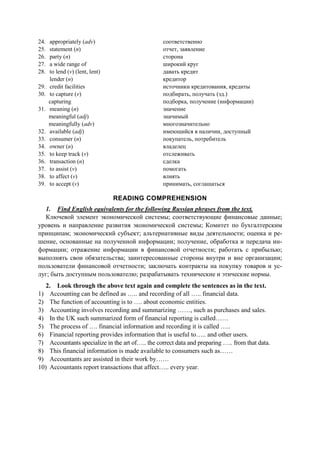
READING COMPREHENSION
1. Find English equivalents for the following Russian phrases from the text.
Ключевой элемент экономической системы; соответствующие финансовые данные;
уровень и направление развития экономической системы; Комитет по бухгалтерским
принципам; экономический субъект; альтернативные виды деятельности; оценка и ре-
шение, основанные на полученной информации; получение, обработка и передача ин-
формации; отражение информации в финансовой отчетности; работать с прибылью;
выполнять свои обязательства; заинтересованные стороны внутри и вне организации;
пользователи финансовой отчетности; заключать контракты на покупку товаров и ус-
луг; быть доступным пользователю; разрабатывать технические и этические нормы.
2. Look through the above text again and complete the sentences as in the text.
1) Accounting can be defined as ….. and recording of all ….. financial data.
2) The function of accounting is to …. about economic entities.
3) Accounting involves recording and summarizing ……, such as purchases and sales.
4) In the UK such summarized form of financial reporting is called……
5) The process of …. financial information and recording it is called …..
6) Financial reporting provides information that is useful to….. and other users.
7) Accountants specialize in the art of….. the correct data and preparing ….. from that data.
8) This financial information is made available to consumers such as……
9) Accountants are assisted in their work by……
10) Accountants report transactions that affect….. every year.
3. Match English and Russian equivalents.
1) Accounting is often referred to as the
language of business.
a) Бухгалтеры отвечают за выборку точной
информации.
2) A wide range of users of financial report-
ing
b) Они также занимаются подготовкой отче-
тов.
3) Accountants are responsible for captur-
ing the correct data.
c) Бухгалтерский учет часто называют дело-
вым языком.
4) They are also specialized in preparing
reports.
d) Бухгалтеры делают выборку, подбирают,
классифицируют, суммируют и составляют
отчет по огромному множеству сделок.
5) Their financial reporting is made availa-
ble to different users.
e) Обычно каждая экономическая единица
осуществляет огромное количество сделок
ежегодно.
6) Accountants capture, accumulate, cate-
gorize, summarize and report thousands
of transactions.
f) Их финансовая информация предоставляет-
ся различным пользователям.
7) Every economic entity accomplishes a
great number of transactions every year.
g) Широкий круг пользователей финансовой
информации
4. Translate the following sentences from Russian into English.
1) Бухгалтерский учет является необходимым инструментом управления.
2) Бухгалтерский учет представляет собой систему сбора, регистрации и обобщения
информации в денежном выражении об имуществе, обязательствах организаций и
их движении.
3) Пользователь информации должен решить несколько существенных вопросов, свя-
занных с регистрацией фактов хозяйственной жизни.
4) Первая попытка сформулировать принципы учета была предпринята в США в 1936
году, когда Американская ассоциация бухгалтеров разработала первые стандарты уче-
та.
5) Конечная цель работы бухгалтера — снабжать пользователей качественной ин-
формацией, которую можно использовать при принятии решений.
5. Present the main ideas of the text in a few sentences. Give your comments. Use
the following phrases:
• The text looks at the problem of …;
• The text deals with the issue of …;
• It is clear from the text that …;
• Among other things the text raises the issue of …;
• One of the main points to be singled out is …;
• Great importance is also attached to …;
• In this connection I’d like to say …;
• It further says that …;
• I find the question of … very important because …;
• The problem of … is of great importance.
VOCABULARY PRACTICE
1. Give derivatives of the following verbs using suffixes:
e.g. – ment / — tion / — ance / — ency / — sion / — ability
Verb Noun
com-
pare
per-
form
manage
consist
consult
inform
act
assume
provide
eva-
luate
meas-
ure
2. Think of the nouns that are often used with the following verbs.
to measure, to ensure, to communicate, to prepare, to debit, to credit, to draw up, to dis-
close, to report
3. Match the verbs from (A) with the nouns from (B) below.
A B
1) to meet
2) to ensure
3) to harmonize
4) to develop
5) to provide
6) to give
7) to measure
8) to grant
9) to achieve
10) to assess
a) provision of information
b) the performance
c) services
d) needs
e) targets
f) accounting
g) standards
h) a boost
i) a license
j) financial data
4. Fill in the blanks using the phrases in the box.
such details as the interest paid
can be distributed to shareholders
and expenditure on advertising
to give reliable information
he calculates profits
the value of capital assets
would not know where it stood fi-
nancially
is an absolute necessity
An accountant is employed by a business 1)________________ about the costs of
production, the cash balance, the value of sales, and 2)______________. He also provides
figures to show 3)______________ on borrowed money, the cost of new equipment pur-
chased, 4)______________. At the end of the financial year, 5)_____________ before and
after taxes, and the amount of profit that 6)______________. All this shows that a satisfactory
accounting system 7)______________; and without it management 8)____________, and
would not be able to make intelligent decisions affecting its profit-making activities.
5. Read the definitions of the following words and complete the sentences using one of them.
Accountancy (noun) is the theory of keeping financial records.
Accounting (noun / adjective) refers to the activity of keeping financial records.
Account (noun) is a record of money received and spent.
Accountant (noun) is a person who keeps and works with financial records.
1) Can you check that the figures have been entered correctly in the bank
_____________?
2) He’s at university studying ______________.
3) The management of the company have not decided on their ______________ policies.
4) A bookkeeper writes details of financial transactions in the ______________.
5) Most people in the profession read ______________ magazines and journals in order to stay in-
formed.
6) She’s been working as an _____________ with this firm for several years now.
7) The directors of the company approve the _______________ at the end of the ___________ year.
8) The chief _____________ has completed the draft _____________ for this year.
9) Each branch maintains its own full _______________ system.
10) _______________ is really not an exact science.
11) A business manager needs some ________________ knowledge in order to understand what he
reads in the company _____________.
6. Scan the text and number the statements after the text so that they are in the
same order as the ideas in the text.
Accounting is also concerned with reporting on the effects of past decisions. But one should
consider whether this is done for its own sake or whether it is done in order to provide information
which it is hoped will prove helpful in current and future decisions. We contend that knowledge
of the past is relevant only if it can be used to help in making appropriate decisions but we cannot
redo the past. Thus, the measurement of the past results is a subsidiary role, but because of the
historical development of accounting and, perhaps, because of the limitations of the present state
of the art, «backward looking» accounting sometimes appears to be an end in itself and not as a
means that will help in achieving a more fundamental objective.
«Foundation in Accounting», R. Lewis and I. Gillespie
Statement Order
a) Financial information about the past is only useful if it helps future decisions.
b) The history of accountancy has made it appear to concentrate on the past.
c) Accounting can indicate the results of past actions.
d) Showing the financial results of past actions can be an aid to decision-making.
e) Showing the financial results of past actions can be just to record what happened.
f) Describing the past is a less important role of accountancy.
g) We can affect the future but we cannot change the past.
1
7. Complete the scheme with the words below. Give your comments on the Account-
ing Information System.
There are four sequential stages of an accounting information system. The first two stages
are concerned with preparation, whereas the last two stages are concerned with using the in-
formation collected.
Inform ation
__ ____ ___ __ _
In form ation
_ __ __ _ __ ___
In form ation
__ ___ ____ __
In form ation
__ ____ __ ___ _
(analysis identification recording reporting)
8. Decide whether the statements below are true (T) or false (F). Comment your answers.
1) Companies are told which accounting policies to use. ____
2) Companies can change their accounting policies whenever they like, as long as they disclose this
in their Annual Report. _____
3) Companies could produce several profit figures, depending on how they depreciated their assets,
valued their inventory, etc. ____
4) There is only one correct interpretation of a company's financial position, and company accounts
must show this. _____
5) In a lot of countries, companies do not record the current value of their assets. ____
6) In countries with high inflation, companies value their assets at their current replacement cost.
_____
9. Translate the following extract from Russian into English.
Что такое бухгалтерский учет?
Почему множество предпринимателей попадает в беду? Причин много, но важнейшая
состоит в том, что они недооценивают в своей работе бухгалтерский учет и бухгалтера.
Если на предприятии учет поставлен хорошо, а бухгалтер обладает необходимой
информацией, то у менеджера всегда будет полноценная и достаточная информация
для принятия действенных управленческих решений.
Зная, как меняется объем и состав имущества предприятия, каковы его обязательства,
возрастают ли они или наоборот уменьшаются, администратор всегда будет иметь пред-
ставление о том, работает ли его предприятие с прибылью или в убыток, сможет ли оно
вовремя погасить долги, надо ли думать о банкротстве или для этого нет никаких осно-
ваний.
Все это делает бухгалтерский учет необходимым инструментом управления. Управ-
ление — это умение принимать решения, а их нельзя принимать без знания об участни-
ках хозяйственных процессов. Эти знания называются информацией. Такая бухгалтер-
ская информация охватывает всю экономическую жизнь, и ее регулирование попадает
под действие специального законодательства, которое дает следующее определение:
«Бухгалтерский учет представляет собой упорядоченную систему сбора, регистрации
и обобщения информации в денежном выражении об имуществе, обязательствах ор-
ганизаций и их движении путем сплошного, непрерывного и документального учета
всех хозяйственных операций».
SUPPLEMENTARY READING PRACTICE
1. Read the following text and:
(a) fill each gap with a suitable word from the box;
accountants
principles
organized
back
profession
creation
number
role
organizations
members
throughout
functions
Accountancy Profession
The organization of the accountancy profession dates 1)____________ to January 1853 when
eight accountants in Edinburgh, Scotland met for the purpose of seeking recognition of their
2)______________ as a separate and distinct profession. The discussion of their professional
situation resulted in the 3)__________ of the Institute of Chartered Accountants of Scotland.
Since that time numerous professional accountancy organizations have been established
4)_____________ the world. The process is going on. In 1977 the International Federation of
Accountants (IFAC) was established. Its initial membership was 63 organizations representing 49
countries, but within a decade, the 5)_______________ grew to 105 organizations from 79 coun-
tries. The establishment of the IFAC recognized the need for international coordination of the
objectives of professional accountancy organizations and means of achieving those objectives.
Accountancy is an international profession. Under the conditions of global interdependence of
countries through trade, finance, and crossborder investments, the 6)______________ of the
IFAC is becoming more important. The size and principles of accountancy 7)________________
vary. Some organizations comprise accountants working in commerce, industry, and government
organizations, as well as in public practice (auditing), others consist solely of members in public
practice.
The main 8)_________________ of the accountancy profession may be summarized as fol-
lows:
– to protect the public by ensuring the observance by its members of the highest
9)______________ of professional and ethical conduct;
– to promote and increase the knowledge, skills, and proficiency of members of the organiza-
tion and students;
– to preserve the professional independence of 10)________________ in whatever capacities
they may be serving;
– to maintain the legitimate rights of its 11)______________. IFAC was
12)_________________ in recognition of the growing changes towards internationalization
of the world economy, business and trade.
Words you may need:
Institute of Chartered Accountants of Scotland — Институт Присяжных Бухгалтеров Шотлан-
дии
observance (n) — соблюдение
conduct (n) — поведение
proficiency (n) — (зд.) опыт
to preserve (v) — сохранять
(b) sum up the text in 5–7 sentences and present your summary;
(c) name the most important events in the development of the accountancy profes-
sion in the world.
2. Read the text and give its key idea. Discuss the following question:
Why has accounting become too interesting?
In recent years, accounting has become front-page news both in the USA and Europe and has become a
major talking point among those connected with the world of business. Unfortunately, the attention that
accounting has attracted has been for all the wrong reasons. We have seen that investors rely on financial
reports to help to keep an eye on both their investment and the managers. However, what if the managers
provide misleading financial reports to investors? Recent revelations suggest that the managers of some
large companies have been doing just this.
Two of the most notorious cases have been those of Enron, an energy-trading business based in Texas,
which was accused of entering into complicated financial arrangements in order to obscure losses and to
inflate profits, and WorldCom, a major long-distance telephone operator in the US, which was accused of
reclassifying $3.9 billion of expenses so as to falsely inflate the profit figure that the business reported to its
owners (shareholders) and to others. In the wake of these scandals, there was much closer scrutiny by in-
vestment analysts and investors of the financial reports that businesses produce. This has led to further
businesses, in both the US and Europe, being accused of using dubious accounting practices to bolster prof-
its.
Various reasons have been put forward to explain this spate of scandals. Some may have been
caused by the pressures on managers to meet unrealistic expectations of investors for continually ris-
ing profits, others by the greed of unscrupulous executives whose pay is linked to financial perfor-
mance. However, they may all reflect a particular economic environment.
The US authorities have made it plain that they view the actions of unscrupulous executives with
some hostility. In July 2005, Bernie Ebbers, the former chief executive of WorldCom was sentenced to
25 years in prison for his part in the fraud.
Whatever the causes, the result of these accounting scandals has been to undermine the
credibility of financial statements and to introduce much stricter regulations concerning the
quality of financial information.
There are some comments suggesting that when all appears to be going well with a busi-
ness, people can be quite gullible and over-trusting.
3. Read the text and say what it is about. Think about the title of the text and be
ready to describe professional responsibilities of the Accountant.
Twenty years ago Accountants were seen as respectable but boring people who did something
complex with figures.
Today, things have changed. With the beginning of the world economic revolution, the devel-
opment of market relations between countries with different economies, financial expertise has
The thoughts of Warren Buffett
Warren Buffett is one of the world's shrewdest and most successful investors. He believes that
the accounting scandals mentioned above were perpetrated during the ‘new economy boom’ of the
late 1990s when confidence was high and exaggerated predictions were being made concerning the
future. He states that during that period:
You had an erosion of accounting standards. You had an erosion, to some extent, of executive
behaviour. But during a period when everybody ‘believe’, people who are inclined to take advan-
tage of other people can get away with a lot.
He believes that the worst is now over and that the ‘dirty laundry’ created during this heady pe-
riod is being washed away and that the washing machine is now in the ’rinse cycle’. However, he
points out that: “It's only in the rinse cycle that you find out how dirty the laundry has been.”
Source: The Times, Business Section, 26 September 2002
become necessary. New styles of management are now running both new and traditional types of
business and more than ever before, enterprises require the guidance of a professional highly-
qualified Accountant.
Nowadays, the Accountant’s job is not only to do books and to make a balance sheet but also
to solve real financial problems, create effective business solutions.
The knowledge in financial management and financial analysis together with an analytical
mind enables the Accountant to make up a business plan and to find sources for funding a com-
pany’s early development. As organizations grow, an understanding of business law is essential.
In ongoing business management Accountants are required to minimize tax liabilities and re-
view major policy decisions. When businesses begin to go off track it is the Accountant who is
called in. His skills and abilities for practical problem solving are at premium. The Accountant
can redirect valuable assets to more profitable areas, identify and isolate unprofitable opera-
tions, limit the financial impact of collapsed company and ensure that suppliers and associated
organizations suffer as little as possible.
The bottom line of any successful business is profit. Therefore, an understanding of the indi-
vidual factors, which make a company profitable, or unprofitable, is essential. The Accountant
can help to run a company towards greater profitability.
As recognized specialists in business development, business law and business management, au-
diting and taxation, Accountants are highly-marketable people.
Many Accountants move into the fields of industry, government and commerce. Some of
them choose banking and financial services, other oil and transport companies or manufactur-
ing industries. Some choose management consultancy, others start their own companies.
4. Read the text and say what the Chart of Accounts in Russia is and what it pro-
vides. Open the brackets putting the verbs in the correct form.
In the West each company (to have) a certain freedom in the design of its own set of ac-
counts so as to reflect the nature of its business and the needs of its management in directing
that business. In Russia this process (to regulate) centrally, there (to be) a tradition of using a
uniform Chart of Accounts.
The first uniform Chart of Accounts (to appear) in Russia in the 1920s. It (to intend) for in-
dustries only and was revised periodically. In 1961 the first national uniform Chart of Accounts
(to create) and put into operation. With only insignificant changes, this chart (to use) in account-
ing practice until 1992. In 1992 the transition to a new chart (to make). The current Chart of
Accounts (to consist) of about 100 accounts and 60 subaccounts grouped into 10 main sections.
All accounts included in this uniform chart (to call) «synthetic» (main or summary) accounts.
On the basis of this chart, each enterprise also may create a set of «analytic» (supporting) ac-
counts if needed to supplement the synthetic accounts. The Chart of Accounts can be considered
the most important element of the accounting system in Russia because it (to determine) the ac-
counting practice and other elements of the system.
The Chart (to provide) for the following: an interrelated classification, grouping, and generali-
zation of information about business activities of enterprises, a unified methodological basis for the
organization of accounting in the whole national economy, an effective system of control of indica-
tors for business activities, comparability of accounting procedures used and information generat-
ed in the accounting systems of different enterprises, etc.
Words you may need:
set of accounts — перечень счетов
synthetic account — синтетический счет
analytic account — аналитический счет
interrelated classification — взаимосвязанная классификация
grouping — группировка
indicator (n) — показатель
5. Make a free translation of the following text into English and:
(a)write down key statements (7–10 sentences);
(b) give a presentation on International Accounting Standards.
Значение международных стандартов финансовой отчётности
в формировании системы бухгалтерского учета
Международные стандарты финансовой отчетности (МСФО) разрабатываются независимой
международной организацией — Советом по международным стандартам финансовой отчетности
(International Accounting Standards Board), который расположен в Лондоне.
Совет по международным стандартам финансовой отчетности — независимая организация, чле-
ны которой утверждаются Комитетом по назначению. Члены Комитета, в свою очередь, номини-
руются на должность в процессе широкого обсуждения Международной федерацией бухгалтеров
(МФБ) с компаниями и академическими кругами. МФБ насчитывает 156 бухгалтерских ассоциа-
ций, в которые входят 2 млн. членов, в том числе из России. Деятельность Совета по международ-
ным стандартам поддерживается и финансируется на добровольных началах аудиторскими фирма-
ми, ассоциациями и коммерческими организациями.
Совет проводит консультации по всем своим проектам. Аудиторские фирмы, компании, академиче-
ские круги и любой желающий могут представить письмо-комментарий в поддержку или с критикой
будущего стандарта. При недостаточной поддержке нового стандарта со стороны будущих пользовате-
лей и после анализа конструктивной критики новый стандарт может претерпеть значительные измене-
ния или вообще не быть принят. Для одобрения решения о принятии, корректировке или аннулировании
стандарта МСФО необходимы голоса восьми членов Совета из четырнадцати.
Наиболее известными национальными стандартами являются Общепринятые принципы бухгалтер-
ского учета США (US GAAP).
Считается, что МСФО являются наиболее разработанными бухгалтерскими стандартами в мире. В
большинстве стран отчетность по МСФО должны составлять все крупные предприятия.
В отличие от МСФО национальные стандарты многих стран, как правило, представляют собой
свод подробных правил, детально описывающих порядок учета хозяйственных операций и исключений
из этих правил. Однако следует отметить, что российские стандарты становятся все более близкими к
МСФО, а действующие в настоящее время Принципы Бухгалтерского Учета почти полностью соответст-
вуютмеждународнымстандартам,хотянекоторыеразличиясохраняются до сих пор.
6. Scan the text and single out the main facts. Present them in a short review.
For many years the accounting system in Russia was criticized by Western academicians
for its failure to adhere to Western accounting principles. Such criticism is no longer valid.
Since the early 1990s, accounting in the Russian Federation has changed significantly.
The year 1991 was crucial in accounting development in Russia due to the following three
events:
1) publication of the new Chart of Accounts;
2) production of a new set of financial statements similar to those used in Western account-
ing;
3) beginning of preparations for radical change in accounting and auditing regulation.
In 1992, Regulation on Accounting and Reporting in the Russian Federation was approved
by decree of the Government of Russia. The document diminished the control function of ac-
counting and declared the following equal objectives of accounting:
a) maintenance of control over the availability, movement, and use of material, manpow-
er and monetary resources according to approved norms and estimates;
b) provision of full and reliable information about the performance and financial results
of an enterprise, which is indispensable for operational management as well as for investors,
suppliers, customers and creditors, tax, financial, and bank authorities, and others interested in
the financial and business activity of the enterprise.
It would not be an exaggeration to say that an essentially new Russian accounting system has
come into being with the introduction of the new Chart of Accounts, which includes greater co-
hesion to international accounting norms.
The essential elements of accounting methodology are as follows:
• Documents form the legal foundation for recording transactions according to the approved
rules of bookkeeping. No entry should be made unless the bookkeeper has the primary document.
• Taking inventory is the sole means of controlling the physical safety of assets and their val-
uation. It is the main method of supervising persons who are financially responsible for assets.
The safeguarding of assets is always entrusted to a financially responsible person.
• The uniform Chart of Accounts, which provides the nomenclature of accounts and corres-
pondence among them, must be used by all types of enterprises.
• Double entry is a traditional accounting concept that is accepted in Russia as it is in all de-
veloped countries.
• Internal reporting includes the general ledger, summary (principal) account registers, prima-
ry documents, inventory data, etc. External reporting includes the Balance Sheet, Statement of
Financial Results and Their Uses, and supplementary forms that are uniform and obligatory for all
types of enterprises. Non-profit organizations and banks have their own uniform charts of ac-
counts and financial reporting forms. Reporting is carried out according to the statutory regulation
and presented within strictly prescribed time limits.
• Information generated by the accounting system must be timely, reliable, full, accurate, and
objective.
• Historical cost accounting is the only method of internal and external reporting permitted.
Words you may need:
valid (adj) — имеющий силу, юридически действительный
indispensable (adj) — необходимый, незаменимый
cohesion (n) — связь
primary document — первичный документ
taking inventory — инвентаризация
sole (adj) — единственный
financially responsible person — материально-ответственное лицо
nomenclature (n) — номенклатура (перечень наименований)
correspondence (n) — корреспонденция (счетов)
internal reporting — внутренняя отчетность
external reporting — внешняя отчетность
general ledger — главная бухгалтерская книга
summary account register — сводный журнал
Statement of Financial Results and Their Uses — Отчет о финансовых результатах и их ис-
пользовании
financial reporting form — бланк финансовой отчетности
historical cost accounting — учет на основе стоимости приобретения
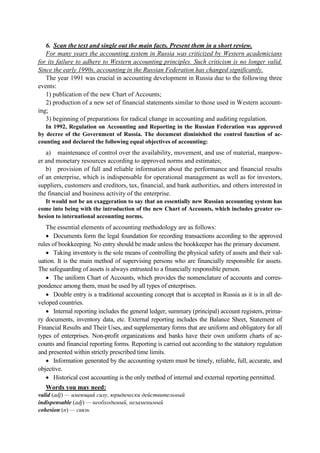
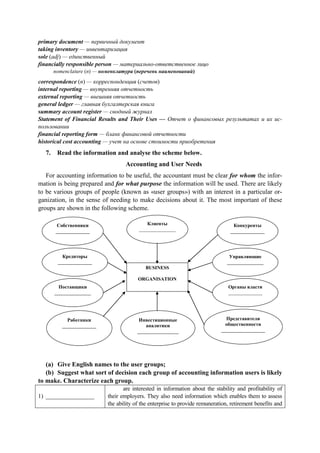
7. Read the information and analyse the scheme below.
Accounting and User Needs
For accounting information to be useful, the accountant must be clear for whom the infor-
mation is being prepared and for what purpose the information will be used. There are likely
to be various groups of people (known as «user groups») with an interest in a particular or-
ganization, in the sense of needing to make decisions about it. The most important of these
groups are shown in the following scheme.
Собственники
______________
Кредиторы
______________
Работники
______________
Инвестиционные
аналитики
_________________
____________
Представители
общественности
__________________
Органы власти
______________
Управляющие
_______________
Конкуренты
______________
Клиенты
_______________
Поставщики
_______________
BUSINESS
ORGANISATION
(a) Give English names to the user groups;
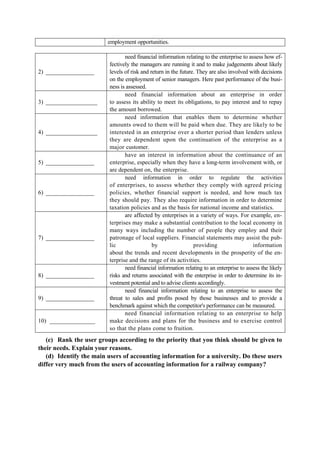
(b) Suggest what sort of decision each group of accounting information users is likely
to make. Characterize each group.
1) ________________
are interested in information about the stability and profitability of
their employers. They also need information which enables them to assess
the ability of the enterprise to provide remuneration, retirement benefits and
employment opportunities.
2) ________________
need financial information relating to the enterprise to assess how ef-
fectively the managers are running it and to make judgements about likely
levels of risk and return in the future. They are also involved with decisions
on the employment of senior managers. Here past performance of the busi-
ness is assessed.
3) _________________
need financial information about an enterprise in order
to assess its ability to meet its obligations, to pay interest and to repay
the amount borrowed.
4) _________________
need information that enables them to determine whether
amounts owed to them will be paid when due. They are likely to be
interested in an enterprise over a shorter period than lenders unless
they are dependent upon the continuation of the enterprise as a
major customer.
5) ________________
have an interest in information about the continuance of an
enterprise, especially when they have a long-term involvement with, or
are dependent on, the enterprise.
6) ________________
need information in order to regulate the activities
of enterprises, to assess whether they comply with agreed pricing
policies, whether financial support is needed, and how much tax
they should pay. They also require information in order to determine
taxation policies and as the basis for national income and statistics.
7) ________________
are affected by enterprises in a variety of ways. For example, en-
terprises may make a substantial contribution to the local economy in
many ways including the number of people they employ and their
patronage of local suppliers. Financial statements may assist the pub-
lic by providing information
about the trends and recent developments in the prosperity of the en-
terprise and the range of its activities.
8) ________________
need financial information relating to an enterprise to assess the likely
risks and returns associated with the enterprise in order to determine its in-
vestment potential and to advise clients accordingly.
9) ________________
need financial information relating to an enterprise to assess the
threat to sales and profits posed by those businesses and to provide a
benchmark against which the competitor's performance can be measured.
10) _______________
need financial information relating to an enterprise to help
make decisions and plans for the business and to exercise control
so that the plans come to fruition.
(c) Rank the user groups according to the priority that you think should be given to
their needs. Explain your reasons.
(d) Identify the main users of accounting information for a university. Do these users
differ very much from the users of accounting information for a railway company?
8. Make a free translation of the text below. Interpret ideas!
4 октября 2008 в редакции газеты «Гудок» главный бухгалтер
ОАО «РЖД» Галина Крафт ответила на вопросы сотрудников
компании, а также посетителей транспортного портала «Гудок».
Вопрос: Кто будет участвовать в подготовке и обработке первичной документации
на линейных предприятиях?
Ответ: Согласно закону «О бухгалтерском учете» за организацию бухгалтерского уче-
та отвечает руководитель, а за подготовку первичных документов — соответствующие
ответственные лица предприятия. Первичный документ не должен быть в отрыве от про-
изводственного процесса
Вопрос: Каким образом можно соединить бухгалтерскую отчетность различных
служб в едином центре обслуживания (ОЦО) (Shared Service Centre) без знания бух-
галтерами особенностей хозяйств?
Ответ: А какие особенности? Весь учет компании строится на основании её учетной
политики. Кроме того, сегодня происходят существенные изменения в методологии уче-
та: формируется учетная политика, план счетов, разрабатываются типовые формы пер-
вичных документов и отчетов, типовые рабочие места в автоматизированной системе
учета, единый автоматизированный консалтинговый центр, разрабатываются типовые
курсы согласно программе повышения квалификации бухгалтеров. Все эти проекты ве-
дутся параллельно. Кроме того, обработка первичных документов — это типовой бизнес-
процесс. Бухгалтерия отражает факты хозяйственной деятельности. Особенности могут
быть только во внутреннем документообороте и технологическом процессе предприятия,
соответственно в формате отчетной информации для соответствующего хозяйства, кото-
рая также должны быть регламентированы.
Вопрос: Насколько оперативно сможет получить необходимую информацию из но-
вой структуры руководитель железнодорожного предприятия?
Ответ: Одной из основных целей проекта является повышение оперативности и
достоверности бухгалтерской и налоговой отчетности, и данных учета, используемых в
управленческих целях. Соответственно и одним из показателей качества работы ОЦО
будет своевременность предоставления необходимой информации руководителям
предприятий. Обособление бухгалтерской функции лишь упорядочит работу по фор-
мированию отчетов и ответов на запросы.
ASSIGNMENT
Test your knowledge by choosing the best answer.
1. Which of the following is an important reason for studying accounting?
a) The information provided by accountants is useful in making many economic decisions.
b) Accounting plays an important role in society.
c) The study of accounting could lead to a challenging career.
d) All the above are important reasons.
2. Which of the following groups uses accounting information for planning a company’s
profitability and liquidity?
a) Management
b) Investors
c) Creditors
d) Economic planners
DISCUSSION
Discuss the following questions and present your ideas.
1. Are accountants generally conservative or open-minded, in regard to accepting new ideas
and methods?
2. Will accountants always be necessary? What skills do accountants need to be successful in
this profession?
3. Is accountancy equally important for all types of economic systems?
4. What is the purpose of producing accounting information?
5. Think of the various groups of users of financial information. Suggest the information that
each is likely to need from accounting statements and reports.
UNIT 2. ACCOUNTING CONCEPTS
PRE-READING
Discuss these questions:
1. Is accountancy an exact science?
2. Was progress in accountancy quick or slow in the past?
READING
Scan the text and find the answers to the following questions:
What types of accounting can you distinguish?
What is the accounting equation?
Accounting is the system that business uses to measure its financial performance. It does this
by recording and classifying sales, purchases and other transactions and by providing ways to
present these data so that company performance can be evaluated.
There are two distinct types of accounting: financial accounting and management accounting.
Financial accounting deals with preparing information for the outside world, e.g. suppliers,
banks, shareholders, creditors (people and organizations who have lent money to a company).
Since users of such information must compare it to similar data from other sources, financial
accounting statements are prepared according to generally accepted accounting principles
(GAAP). In contrast, management accounting deals with the internal needs of a particular busi-
ness and helps managers evaluate results, make plans and decisions. The job of management
accounting includes the preparation of budgets (a financial plan for a given time period) and the
analysis of production costs.
Accounting is not an exact science. Using the same data, different accountants could legiti-
mately come up with a range of results. Some firms maintain two sets of records: one for share-
holders and one for tax purpose. However, most accountants do adhere to the generally accepted
accounting principles.
Accounting theory is based upon the accounting equation. Assets (what the firm owns) must
equal liabilities (what the firm owes) plus owners’ equity (the investment of the owners in the
business and their claim on the assets).
The system in accounting is known as double-entry bookkeeping. This principle made its appear-
ance in the 13th
century in Northern Italy. It was improved and disseminated at the end of the 14th
century by the work of Luca Pacioli, a monk and a university teacher. This principle states that each
transaction must be recorded on the balance sheet as two separate entries so that the accounting
equation will hold at all times. The totals of each side will always equal one another, and this will
always be true no matter how many transactions are entered into.
If, for example, a business borrowed $10,000 from a bank, $10,000 would be added to assets
(cash) on the left side of the accounting equation and $10,000 would be also added to liabilities
(bank loans) on the right side.
The double entry system divides each page into two halves. The left-hand side is called the de-
bit side, while the right-hand side is called the credit side.
WORDS AND EXPRESSIONS FOR READING COMPREHENSION
1. financial performance
2. sales (n)
3. purchase (n)
4. to provide (v)
5. to evaluate (v)
evaluation (n)
6. distinct (adj)
7. to deal (dealt, dealt) with (v)
8. supplier (n)
9. shareholder (n)
10. similar (adj)
similarity (n)
11. source (n)
12. according to (prep)
13. internal (adj)
14. to include (v)
15. legitimately (adv)
16. to maintain (v)
17. tax (n)
taxation (n)
18. purpose (n)
19. to adhere (v)
20. accounting equation
21. assets (n)
22. liabilities (n)
23. to owe (v)
финансовая картина
продажи, сбыт
покупка, приобретение
проводить, обеспечивать
оценивать
оценка
отдельный, особый
иметь дело с
поставщик
акционер, держатель акций
схожий, подобный
сходство
источник
согласно, в соответствии с
внутренний
включать
законно, правильно
поддерживать, сохранять
налог
налогообложение
цель
придерживаться, твердо держаться
бухгалтерское тождество
активы
обязательства, пассивы
быть должным
Accounting equation is the relationship between assets, liabilities, and capital of a busi-
ness organization. The equation states:
Assets = Liabilities + Capital
Asset is anything that is owned and has money value.
Liabilities are amounts due creditors and other interested parties; also, the ownership of
the assets of an organization by its creditors.
24. double-entry bookkeeping
25. to disseminate (v)
26. entry (n)
27. to require (v)
28. to borrow (v)
29. in addition to (prep)
30. cash (n)
31. loan (n)
32. debit side
33. credit side
34. cash basis
35. accrual basis
учет по системе двойной записи
распространять
запись, проводка
требовать
занимать, одалживать
в дополнении к
денежные средства, касса
ссуда, заем
левая сторона баланса, дебет счета
правая сторона баланса, кредит счета
метод записи доходов и издержек на счетах
только при их поступлении и выплате; кассовая база
метод начислений при учете доходов и издержек
на счетах; запись доходов и издержек в момент завер-
шения операции
READING COMPREHENSION
1. Find English equivalents for the following Russian phrases from the text.
Классификация затрат и покупок; предоставлять данные; управленческий бухгалтерский
учет; данные из других источников; составить в соответствии с; внутренние потребности
конкретной компании; прийти к различным результатам; общепризнанные принципы бух-
галтерского учета; анализ производственных затрат; оценить результаты; составление бюд-
жета; система двойной записи; две отдельные проводки; вне зависимости от; делить на две
части.
2. Look through the above text again and complete the sentences as in the text.
1) Accounting is the system business uses to measure …..
2) Financial accounting deals with ……
3) Financial accounting standards are prepared according to ……
4) Management accounting deals with ……
5) Accounting theory is based upon ……
6) The system in accounting is known as ……
3. Use the information in the text to answer the following questions.
1) What are the two main types of accounting?
2) What does financial accounting deal with?
3) What does management accounting deal with?
4) Why could different accountants legitimately come up with different results?
5) What is accounting theory based upon?
6) When did the double-entry system appear?
7) Will you give an example of the accounting equation?
4. Translate the following sentences from Russian into English.
1) Принцип бухгалтерского учета двойной записи используется для контроля финан-
сового положения предприятия.
2) Задача наблюдения в бухгалтерском учете сводится к получению информации, по-
зволяющей оценить успешность хозяйственной деятельности.
3) Собственный акционерный капитал — это разность между активами и пассивами.
4) Основой процесса бухгалтерского учета является бухгалтерское тождество.
5) Согласно бухгалтерскому тождеству активы равны пассивами плюс собственный
акционерный капитал.
6) Данная информация дает картину доходности фирмы, ее финансового положения и
деятельности в области дебиторской задолженности, товарных запасов и долгового
финансирования.
5. Make up a list of key words and phrases and give a short summary of the text.
Use the following phrases:
• I would like to begin with…;
• The main important points seem to be…;
• In short, …;
• I might add that…;
• From my point of view…;
• On the one hand … on the other hand…;
• Whereas…;
• In conclusion, ….
VOCABULARY PRACTICE
1. Match the opposites.
1) borrow
2) include
3) supplier
4) purchase
5) similar
6) assets
7) debit side
8) add
9) internal
10) appearance
a) sales
b) different
c) disappearance
d) liabilities
e) subtract
f) external
g) exclude
h) lend
i) credit side
j) buyer
2. Match the synonyms.
1) deal with
2) purpose
3) maintain
4) transaction
5) require
6) evaluate
7) similar
8) various
9) keep
10) purchase
a) estimate
b) same
c) buy
d) adhere
e) demand
f) do business with
g) different
h) deal
i) objective
j) save
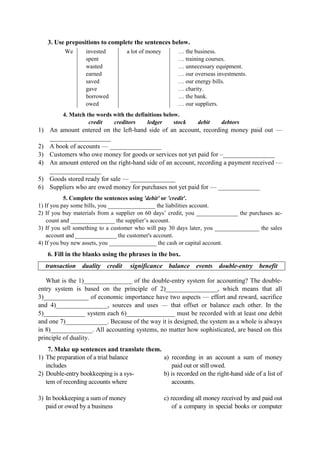
3. Use prepositions to complete the sentences below.
We invested
spent
wasted
earned
saved
gave
borrowed
owed
a lot of money … the business.
… training courses.
… unnecessary equipment.
… our overseas investments.
… our energy bills.
… charity.
… the bank.
… our suppliers.
4. Match the words with the definitions below.
credit creditors ledger stock debit debtors
1) An amount entered on the left-hand side of an account, recording money paid out —
___________________
2) A book of accounts — ________________
3) Customers who owe money for goods or services not yet paid for –________________
4) An amount entered on the right-hand side of an account, recording a payment received —
________________
5) Goods stored ready for sale — ______________
6) Suppliers who are owed money for purchases not yet paid for — _____________
5. Complete the sentences using 'debit' or 'credit'.
1) If you pay some bills, you ________________ the liabilities account.
2) If you buy materials from a supplier on 60 days’ credit, you ______________ the purchases ac-
count and _______________ the supplier’s account.
3) If you sell something to a customer who will pay 30 days later, you _______________ the sales
account and _______________ the customer's account.
4) If you buy new assets, you ________________ the cash or capital account.
6. Fill in the blanks using the phrases in the box.
transaction duality credit significance balance events double-entry benefit
What is the 1)_______________ of the double-entry system for accounting? The double-
entry system is based on the principle of 2)________________, which means that all
3)______________ of economic importance have two aspects — effort and reward, sacrifice
and 4)________________, sources and uses — that offset or balance each other. In the
5)_____________ system each 6)_______________ must be recorded with at least one debit
and one 7)_____________. Because of the way it is designed, the system as a whole is always
in 8)_____________. All accounting systems, no matter how sophisticated, are based on this
principle of duality.
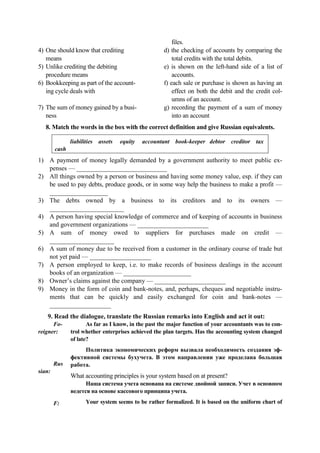
7. Make up sentences and translate them.
1) The preparation of а trial balance
includes
2) Double-entry bookkeeping is а sys-
tem of recording accounts where
3) In bookkeeping а sum of money
paid or owed by а business
a) recording in an account а sum of money
paid out or still owed.
b) is recorded on the right-hand side of а list of
accounts.
c) recording all money received by and paid out
of а company in special books or computer
4) One should know that crediting
means
5) Unlike crediting the debiting
procеdure means
6) Bookkeeping as part of the account-
ing cycle deals with
7) The sum of money gained by a busi-
ness
files.
d) the checking of accounts by comparing the
total credits with the total debits.
e) is shown on the left-hand side of a list of
accounts.
f) each sale or purchase is shown as having an
effect on both the debit and the credit col-
umns of an account.
g) recording the payment of a sum of money
into an account
8. Match the words in the box with the correct definition and give Russian equivalents.
liabilities assets equity accountant book-keeper debtor creditor tax
cash
1) A payment of money legally demanded by a government authority to meet public ex-
penses — ____________________________
2) All things owned by a person or business and having some money value, esp. if they can
be used to pay debts, produce goods, or in some way help the business to make a profit —
__________________
3) The debts owned by a business to its creditors and to its owners —
_______________________
4) A person having special knowledge of commerce and of keeping of accounts in business
and government organizations — ______________________
5) A sum of money owed to suppliers for purchases made on credit —
____________________
6) A sum of money due to be received from a customer in the ordinary course of trade but
not yet paid — ___________________
7) A person employed to keep, i.e. to make records of business dealings in the account
books of an organization — _____________________
8) Owner’s claims against the company — ______________________
9) Money in the form of coin and bank-notes, and, perhaps, cheques and negotiable instru-
ments that can be quickly and easily exchanged for coin and bank-notes —
___________________
9. Read the dialogue, translate the Russian remarks into English and act it out:
Fo-
reigner:
Rus
sian:
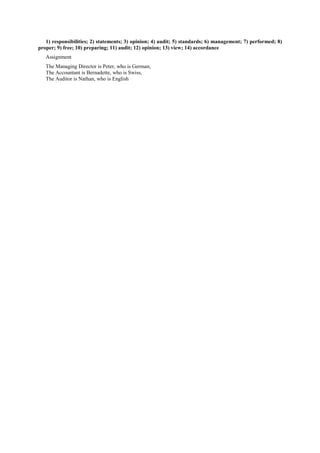
F:
As far as I know, in the past the major function of your accountants was to con-
trol whether enterprises achieved the plan targets. Has the accounting system changed
of late?
Политика экономических реформ вызвала необходимость создания эф-
фективной системы бухучета. В этом направлении уже проделана большая
работа.
What accounting principles is your system based on at present?
Наша система учета основана на системе двойной записи. Учет в основном
ведется на основе кассового принципа учета.
Your system seems to be rather formalized. It is based on the uniform chart of
R:
F:
R:
F:
R:
F:
accounts and forms of record keeping and reporting.
Стремясь способствовать прямым иностранным инвестициям путем соз-
дания совместных предприятий, наше правительство поставило задачу внедре-
ния системы учета, сопоставимой с международными стандартами. Была разра-
ботана процедура составления ежегодной финансовой отчетности, одобрен план
счетов для совместных предприятий.
It is also important to recognize that the development of accounting in any coun-
try is impossible without developing the accounting profession. Is anything being done
in this direction?
Да, мы разрабатываем и внедряем новые стандарты, организуем про-
фессиональную подготовку и переподготовку бухгалтеров.
I am glad to hear that the full potential of accounting is appreciated in your
country now.
10. Render the following extract in English.
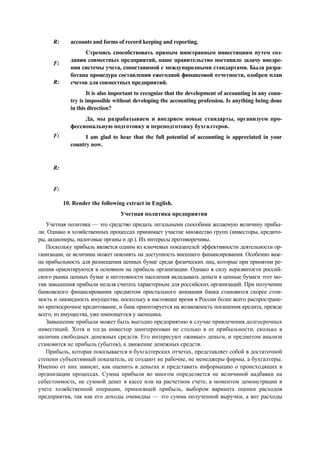
Учетная политика предприятия
Учетная политика — это средство придать легальными способами желаемую величину прибы-
ли. Однако в хозяйственных процессах принимает участие множество групп (инвесторы, кредито-
ры, акционеры, налоговые органы и др.). Их интересы противоречивы.
Поскольку прибыль является одним из ключевых показателей эффективности деятельности ор-
ганизации, ее величина может повлиять на доступность внешнего финансирования. Особенно важ-
на прибыльность для размещения ценных бумаг среди физических лиц, которые при принятии ре-
шения ориентируются в основном на прибыль организации. Однако в силу неразвитости россий-
ского рынка ценных бумаг и неготовности населения вкладывать деньги в ценные бумаги этот мо-
тив завышения прибыли нельзя считать характерным для российских организаций. При получении
банковского финансирования предметом пристального внимания банка становится скорее стои-
мость и ликвидность имущества, поскольку в настоящее время в России более всего распростране-
но краткосрочное кредитование, и банк ориентируется на возможность погашения кредита, прежде
всего, из имущества, уже имеющегося у заемщика.
Завышение прибыли может быть выгодно предприятию в случае привлечения долгосрочных
инвестиций. Хотя и тогда инвестор заинтересован не столько в ее прибыльности, сколько в
наличии свободных денежных средств. Его интересуют «живые» деньги, и предметом анализа
становится не прибыль (убыток), а движение денежных средств.
Прибыль, которая показывается в бухгалтерских отчетах, представляет собой в достаточной
степени субъективный показатель, ее создают не рабочие, не менеджеры фирмы, а бухгалтеры.
Именно от них зависит, как оценить в деньгах и представить информацию о происходящих в
организации процессах. Сумма прибыли во многом определяется не величиной надбавки на
себестоимость, не суммой денег в кассе или на расчетном счете, а моментом демонстрации в
учете хозяйственной операции, приносящей прибыль, выбором варианта оценки расходов
предприятия, так как его доходы очевидны — это сумма полученной выручки, а вот расходы
всегда сомнительны, так как определяются методологией бухгалтерского учета и конкретными
способами его ведения.
SUPPLEMENTARY READING PRACTICE
1. Read the text and:
(a)give the definitions to the key terms:
business transaction, account, journal, ledger, trial balance;
Recording Business Transactions
A business transaction is any business activity that affects what a business owns and owes, as well as
the ownership of the business. If we were to acquire the asset equipment and give in payment the asset cash, we
can see that both records would be affected. This is known as «double entry». If we were to acquire the asset
supplies and at the same time also acquire the asset equipment as a result of paying cash, this would also be con-
sidered double entry because the total value of the two assets obtained would be equal to the value of the asset
cash given up. Business transactions are recorded in a record known as an account. The standard form of the
account is shown below.
Title of account
Debit Credit
Each asset, liability, and capital record that is maintained is kept on a separate account page. The purpose of
the account is to facilitate the recording of the essential information generated by the business transaction. These
individual account pages are kept in a bound or loose-leaf-type binder known as a ledger. The standard form of
the ledger account is very similar to the basic account form of the balance sheet. In its simplest form the ledger
account is known as the T account because it looks like the capital letter "T," just as the account form of the bal-
ance sheet does.
For every debit entry, there must be a corresponding credit entry of the same amount. For a simple business
transaction, such as an investment of $1,000 in the business by the proprietor, the following entries in the ledger
accounts would be recorded: debit the asset cash for $1,000; credit the permanent proprietor's capital account for
$1,000.
All business transactions are first recorded in the journal. The journal has three basic advantages over the
ledger:
1. It shows the complete business transaction in one place. Regardless of the number of debits or credits to a particu-
lar business transaction, all parts of the transaction are shown together.
2. All business transactions are recorded in the journal in chronological order. This is the reason that it is
known as the businessperson's diary. Like a diary that records events in dated order, the journal records business
transactions in dated order.
3. The journal provides for an adequate explanation of what took place. Regardless of the nature of the trans-
action being recorded, provision is made for as detailed an explanation as the accountant considers necessary.
The following represents the typical form of the journal. It is sometimes referred to as the «general journal»
because all business transactions are first recorded in it.
GeneralJournal
Date Explanation PR Debit Credit
200_ 1 Furniture and Fixtures 150 1,200.00
Jan. Office supplies 105 75.00
Cash 101 1,275.00
Sent check No.345 to Green
Office Equipment and Supply Co
Although it may appear that recording transactions in both the journal and the ledger duplicates
work, there are important reasons for doing so. The journal is the book of original entry; all business
transactions are first recorded in it. All parts of the transaction are recorded together, and an adequate
explanation is provided. The ledger contains various records called accounts. Each account represents
individual asset, liability, or form of capital. At any time, the accountant can easily determine the bal-
ance of the account. From the account found in the ledger, the accountant can prepare a trial balance
which is the basis for various financial statements as needed by the organization and other interested
parties.
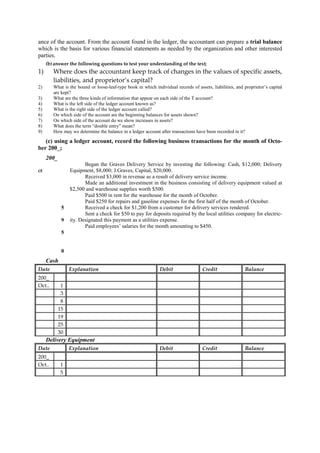
(b)answer the following questions to test your understanding of the text;
1) Where does the accountant keep track of changes in the values of specific assets,
liabilities, and proprietor’s capital?
2) What is the bound or loose-leaf-type book in which individual records of assets, liabilities, and proprietor’s capital
are kept?
3) What are the three kinds of information that appear on each side of the T account?
4) What is the left side of the ledger account known as?
5) What is the right side of the ledger account called?
6) On which side of the account are the beginning balances for assets shown?
7) On which side of the account do we show increases in assets?
8) What does the term “double entry” mean?
9) How may we determine the balance in a ledger account after transactions have been recorded in it?
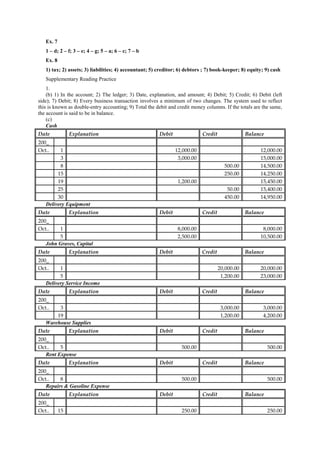
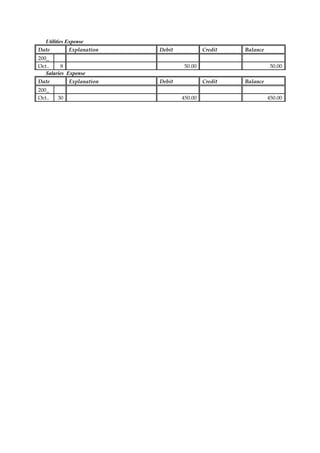
(с) using a ledger account, record the following business transactions for the month of Octo-
ber 200_;
200_
O
ct.
5
9
5
0
Began the Graves Delivery Service by investing the following: Cash, $12,000; Delivery
Equipment, $8,000; J.Graves, Capital, $20,000.
Received $3,000 in revenue as a result of delivery service income.
Made an additional investment in the business consisting of delivery equipment valued at
$2,500 and warehouse supplies worth $500.
Paid $500 in rent for the warehouse for the month of October.
Paid $250 for repairs and gasoline expenses for the first half of the month of October.
Received a check for $1,200 from a customer for delivery services rendered.
Sent a check for $50 to pay for deposits required by the local utilities company for electric-
ity. Designated this payment as a utilities expense.
Paid employees’ salaries for the month amounting to $450.
Cash
Date Explanation Debit Credit Balance
200_
Oct.. 1
3
8
15
19
25
30
Delivery Equipment
Date Explanation Debit Credit Balance
200_
Oct.. 1
5
John Graves, Capital
Date Explanation Debit Credit Balance
200_
Oct.. 1
5
Delivery Service Income
Date Explanation Debit Credit Balance
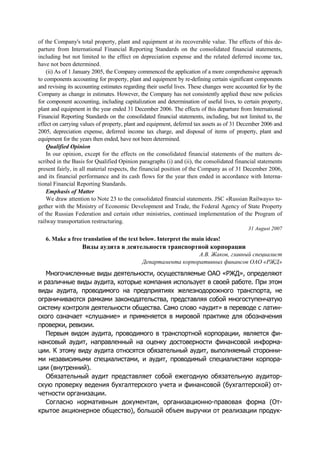
200_
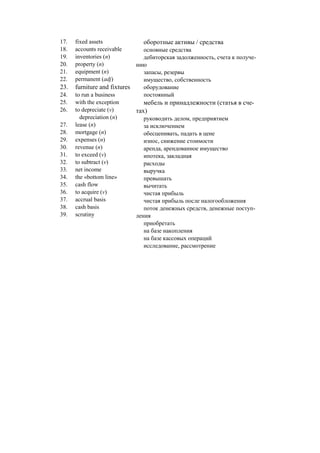
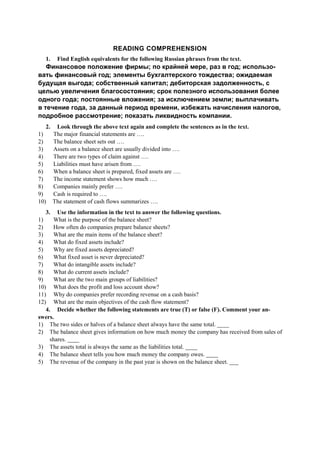
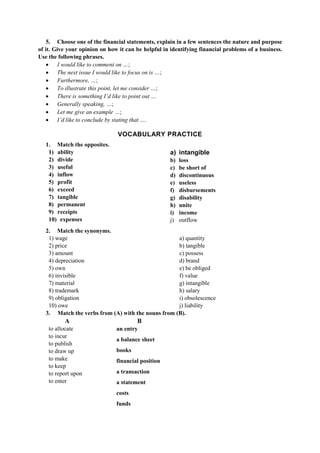
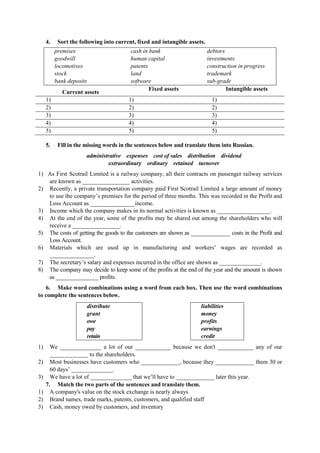
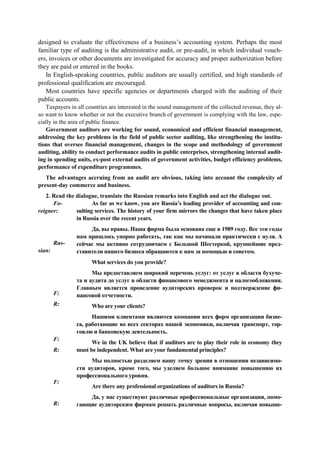
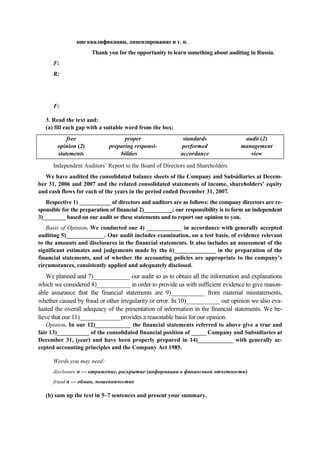
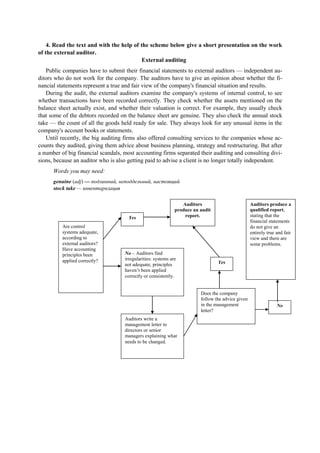
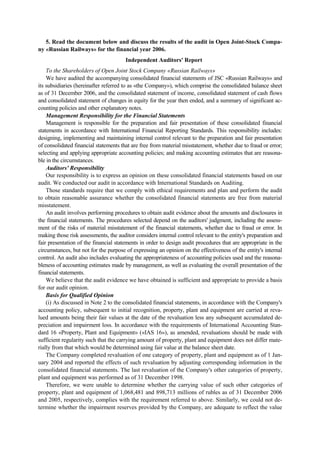
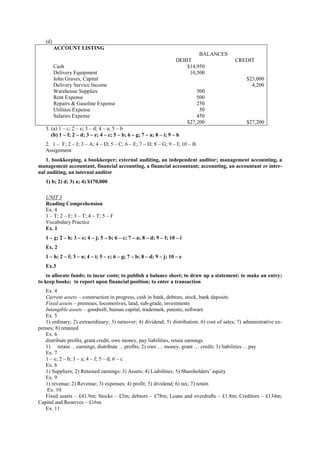
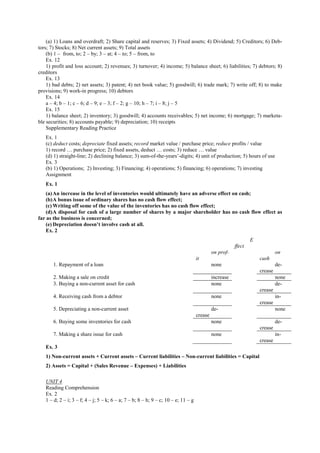
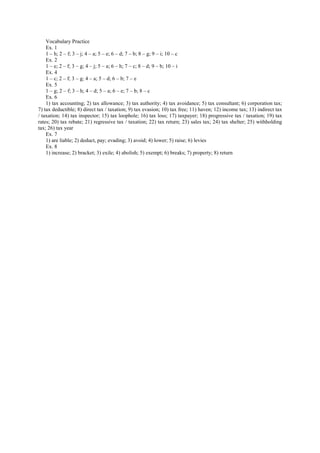
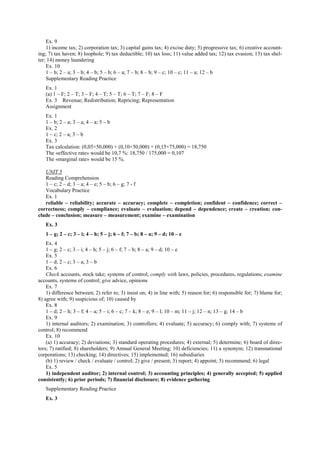
Oct.. 3
19
Warehouse Supplies
Date Explanation Debit Credit Balance
200_
Oct.. 5
Rent Expense
Date Explanation Debit Credit Balance
200_
Oct.. 8
Repairs & Gasoline Expense
Date Explanation Debit Credit Balance
200_
Oct.. 15
Utilities Expense
Date Explanation Debit Credit Balance
200_
Oct.. 8
Salaries Expense
Date Explanation Debit Credit Balance
200_
Oct.. 30
(d) after recording the business transactions in the various ledger accounts, prepare a listing
of the accounts and their various balances. If the total debit balances equal the total credit bal-
ances, this should indicate that the transactions were recorded correctly in the various ledger
accounts:
ACCOUNT LISTING
BALANCES
DEBIT CREDIT
Cash
Delivery Equipment
John Graves, Capital
Delivery Service Income
Warehouse Supplies
Rent Expense
Repairs & Gasoline Expense
Utilities Expense
Salaries Expense
2. Read the following text and:
(a)be ready to characterize principle qualitative characteristics of financial information;
(b) complete the chart with the English equivalents;
Accounting as a Service Function
One way of viewing accounting is as a form of service. Accountants provide economic information
to their 'clients', who are the various users. The quality of the service provided would be determined by
the extent to which the information needs of the various user groups have been met. To be useful, ac-
counting information should possess certain key qualities, or characteristics. These are:
Relevance. Accounting information must have the ability to influence decisions. Unless this cha-
racteristic is present, there is really no point in producing the information. The information may be
relevant to the prediction of future events (for example, in predicting how much profit is likely to be
earned next year) or relevant in helping confirm past events (for example, in establishing how much
profit was earned last year). The role of accounting in confirming past events is important because
users often wish to check on the accuracy of earlier predictions that they have made.
Reliability. Accounting should be free from significant error or bias. It should be capable of being
relied upon by users to represent what it is supposed to represent. Though both relevance and reliability
are very important, the problem that we often face in accounting is that information that is highly rele-
vant may not be very reliable, and that which is reliable may not be very relevant.
Where a choice has to be made between providing information that has either more relevance or
more reliability, the maximisation of relevance tends to be the guiding rule.
Comparability. This quality will enable users to identify changes in the business overtime (for ex-
ample, the trend in sales over the past five years). It will also help users evaluate the performance of
the business in relation to other similar businesses. Comparability is achieved by treating items that are
basically the same in the same manner for accounting purposes. Comparability tends also to be en-
hanced by making clear the policies that have been adopted in measuring and presenting the informa-
tion.
Understandability. Accounting reports should be expressed as clearly as possible and should be
understood by those at whom the information is aimed.
The qualities, or characteristics, that have just been described will help us to decide if a particular piece
of financial information is potentially useful. However, in order to make a final decision, we also have to
consider whether the information is material, or significant. This means that we should ask whether its
omission or misrepresentation in the financial reports would really alter the decisions that users make.
Thus, in addition to possessing the characteristics mentioned above, financial information must also
achieve a threshold of materiality. If the information is not regarded as material, it should not be included
within the reports as it will merely clutter them up and, perhaps, interfere with the users' ability to interpret
the financial results. The type of information and amounts involved will normally determine whether it is
material.
A piece of financial information may still be excluded from the financial reports even when it is
considered to be useful. In theory, financial information should only be produced if the costs of pro-
viding a particular item of information are less than the benefits, or value, to be derived from its use.
Characteristics
that make
financial information
useful
________________
(Сопоставимость)
________________
(Понятность)
________________
(Надежность)
________________
(Релевантность)
Materiality
Necessary for including
information in the
financial statements
Cost / Benefit
Limitation to the
application of the
qualitative
characteristics
(c)consider the situations below. Do you agree with the suggested answers? Present the an-
swers in English and express your opinion.
По всей вероятности, управляющий, прежде всего, попытается узнать текущую рыноч-
ную стоимость (current market value) станка. Эти данные будут релевантными для принятия
окончательного решения, но они могут быть не совсем надежными, поскольку станок уникален
и, скорее всего, управляющий не сможет собрать достаточно информации, чтобы точно оце-
нить его рыночную стоимость.
Конечно, было бы очень хорошо, если бы любой пользователь финансовой информации,
даже не знакомый с бухгалтерским учетом, мог понять финансовую отчетность. Однако в реаль-
ной жизни финансовые события и сделки так сложны, что отчетность о них не может быть про-
стой. Финансовую отчетность можно уподобить произведениям современного искусства, — что-
бы их понять, нужно иметь определенную подготовку. Вообще говоря, финансовая отчетность
предполагает, что пользователь не только обладает достаточными знаниями в области экономики
и бухгалтерского учета, но и готов потратить определенное время на изучение отчетности.
• Suppose an item of information is capable of being provided. It is relevant to a particular
decision, it is also reliable, comparable, understandable and material. Can you think of a reason
why, in practice, you might choose not to produce the information?
• A manager has to sell a custom-built machine owned by the business and has recently re-
ceived a bid for it. What information would be relevant to the manager when deciding whether
to accept the bid? How reliable would that information be?
• Do you think that accounting reports should be understandable to those who have not
studied accounting?
Такой причиной может быть то, что затраты (costs) на подготовку этой инфор-
мации превысят потенциальные выгоды (benefits) от ее использования. Поэтому всегда
нужно сравнивать затраты на подготовку информации с ожидаемыми выгодами от этой
работы.
2. Read the text and be ready to speak on generally accepted accounting principles that ac-
countants must follow in order to present «a true and fair view» of a company's finances.
When writing accounts and financial statements, accountants have to follow a number of assump-
tions, principles and conventions. An assumption is something that is generally accepted as being true.
The following are the main assumptions used by accountants:
The separate entity or business entity assumption is that a business is an accounting unit sepa-
rate from its owners, creditors and managers, and their assets. These people can all change, but the
business continues as before.
The time-period assumption states that the economic life of the business can be divided into
(artificial) time periods such as the financial year, or a quarter of it.
The continuity or going concern assumption says that a business will continue into the future,
so the current market value of its assets is not important.
The unit-of-measure assumption is that all financial transactions are in a single monetary unit
or currency. Companies with subsidiaries — that is, other companies that they own — in different
countries have to convert their results into one currency in consolidated financial statements for the
whole group of companies.
The following are the most important accounting principles:
The full-disclosure principle states that financial reporting must include all significant informa-
tion: anything that makes a difference to the users of financial statements.
The principle of materiality, however, says that very small and unimportant amounts do not
need to be shown.
The principle of conservatism is that where different accounting methods are possible, you
choose the one that is least likely to overstate or over-estimate assets or income.
The objectivity principle says that accounts should be based on facts and not on personal opi-
nions or feelings. Accounts, therefore, should be verifiable: it should be possible for internal and ex-
ternal auditors to show that they are true. This isn't always possible, however: depreciation or amorti-
zation, and provisions for bad debts, for example, are necessarily subjective — based on opinions.
The revenue recognition principle is that revenue is recognized in the accounting period in
which it is earned. This means the revenue is recorded when a service is provided or goods delivered,
not when they are paid for.
The matching principle, which is related to revenue recognition, states that each cost or ex-
pense related to revenue earned must be recorded in the same accounting period as the revenue it
helped to earn.
The consistency principle states that although businesses can choose among different account-
ing policies, they have to be consistent, which means using he same methods every year, unless there
is a good reason to change a policy.
The historical cost principle is that companies record the original purchase price of assets, and
not their current selling price.
(a) Match the two parts of the sentences and translate them.
1) Companies’ managers, investors, creditors and the tax authorities all
2) There are different ways of doing accounting but companies have to be consistent,
3) Companies have to disclose or make known
4) The historical cost principle is that the price paid to buy assets,
5) A going concern usually doesn’t
a) not their current value, is recorded in accounts.
b) need to know the current market value of its assets.
c) need to know about the size of profits or losses.
d) which accounting methods they are using.
e) which means regularly using the same methods.
(b) Match the accounting assumptions and principles to the activities they prevent.
1) conservatism principle (prudence principle);
2) matching principle;
3) separate entity assumption;
4) revenue recognition principle;
5) time-period assumption;
6) unit-of-measure assumption;
7) objectivity principle;
8) consistency principle;
9) full-disclosure principle.
a) recording all data that are verifiable and free from bias;
b) publishing financial statements for a 15-month period, because this will
show better profits;
c) waiting until customers pay before recording revenue;
d) waiting until customers pay before recording expenses;
e) listing the owners' personal assets in a company's financial statements;
f) valuing assets and estimating future revenue at the highest possible fig-
ures;
g) showing a profit divided into US dollars, euros, Swiss francs, etc.;
h) including all significant information in financial reporting;
i) using the same methods (of inventory valuation, depreciation, etc.) from
one period to the next.
3. Read the text and:
(a) number the paragraphs according to their chronological order;
A ___ In 1939, archaeological excavation at Pylos, Greece (the possible site of the palace of Nestor
of Trojan War fame) recovered hundreds of clay tablets written in Minoan script. Scholars have con-
cluded that a Cretan scribe had been carried off by Mycenaean raiders and set to work keeping the ac-
counting records of the Grecian king (1400 BC). With the growth of governmental revenues, particularly
in Athens, accounting and auditing became more important. In the golden age of Pericles (461–429 BC),
each citizen became an auditor through the custom of requiring contractors of public buildings to report
their receipts and expenditures on tablets chiselled in stone on the walls of the building. One such tablet
indicates that the Parthenon cost 469 talents of silver.
B ____ Since the early 1900s, the rapidity of change and the increasing complexity of the world's indus-
trial economies necessitated still more changes in accounting. Mergers, acquisitions, and the growth of
multinational corporations fostered new internal and external reporting and control systems. With wide-
spread ownership of modem corporations new audit and reporting procedures came and new agencies be-
came involved in promulgating accounting standards.
C ____ In the Middle Ages accounting suffered a decline because of the general disorganised condi-
tion of government and the economy throughout Europe. Gradually, however, accounting was re-
established.
D ___ Roman civilisation was forward-thinking enough to have laws requiring taxpayers to prepare
statements of their financial position. In fact, the Roman Empire made effective use of accounting and
auditing to control the generals of conquered territories. The quaestors, who came into being about 200
BC, were financial officers responsible to Rome, who had custody of the treasury, supervised the scribes in
their duties of recording treasury receipts and disbursements, and examined the accounts of the governors
of subjugated countries. The quaestors were required to report periodically to Rome.
E ___ Double-entry bookkeeping (a system which records two aspects of every transaction) pro-
gressed in Italy around the thirteenth and fourteenth centuries as a result of the growth of mari-
time trade and banking institutions. Merchants required details of voyages to be kept, in order to
calculate and share profits from overseas trading. The first bank with customer facilities opened in
Venice in 1149.
F 1 The precise origins of accountancy are difficult to trace. However, there is certainly evidence
of some sort of record-keeping in many civilisations such as the Babylonian, Assyrian and Egyptian. The
Sumerian, an early Mesopotamian civilisation, recorded commercial transactions on stone dating back to
3600 BC and on clay tablets beginning about 3200 BC.
G ___ Luca Pacioli, a Franciscan monk, is widely believed to be the inventor of double-entry
bookkeeping. However, a rudimentary system of double-entry bookkeeping was used in Genoa
around 1340. In 1494, Pacioli documented the double-entry system being practised at the time by
merchants in Venice in his famous book «Summa de arithmetica, geometria, proportioni et proportiona-
lit» (The Collected Knowledge of Arithmetic, Geometry, Proportion and Proportionality). The Sum-
ma made Pacioli «The Father of Accounting».
H ___ Balance sheets were evident from around 1400 and the Medici family had accounting
records of 'cloth manufactured and sold'. Regular audits of the records of the Medici Bank were per-
formed during the period 1397 to 1494. The main office in Florence required that an annual bal-
ance sheet be submitted by each branch. The general manager and his assistants audited these
statements which are still found in the archives of Florence.
I ___ Development of accounting theory began in that period and has continued to the present
day. The influence of Pacioli's Summa continues to be felt in the double-entry bookkeeping we use
today.
J ___ In ancient Egypt, accountants were scribes who also practised law. In the Pharaoh's central finance
department, scribes prepared records of receipts and disbursements of silver, corn and other commodities.
One recorded on papyrus the amount brought to the warehouse and another checked the emptying of the
containers on the roof as the contents were poured into the storage building. Audit was performed by a
third scribe who compared these two records.
Words you may need:
scribe (n) — писец, переписчик (документов, рукописей)
warehouse (n) — склад
storage (n) — хранение, хранилище
inventory (n) — запасы
contractor (n) — подрядчик
quaestor (n) — квестор (помощник консула в финансовых и судебных делах в Древнем Риме)
treasury (n) — казна, казначейство
prerequisite (n) — предпосылка, предварительное условие
emergence (n) — появление
maritime trade — морская торговля
rudimentary (adj) — элементарный
merchant (n) — купец, торговец
merger (n) — поглощение
acquisition (n) — приобретение
(b) single out the main stages in the history of accounting;
(c) make up the outline and give a presentation on the development of accountancy.
4. Make a free translation of the text below. Interpret the main ideas!
ОАО «РЖД» ведет и раскрывает финансовую отчетность в соответствии с рос-
сийскими (РСБУ) и международными (МСФО) стандартами.
Следуя принципу прозрачности, Компания также раскрывает дополнительную
информацию о своей деятельности, которая может представлять интерес или
быть существенной для акционера, инвесторов и иных заинтересованных лиц, за
исключением информации, составляющей государственную или коммерческую
тайну. Компания имеет самостоятельный баланс, а также составляет сводную
(консолидированную) отчетность, включая балансы, по филиалам и представи-
тельствам Компании.
Баланс, отчеты о прибылях и об убытках Компании составляются в рублях.
Баланс, отчеты о прибылях и об убытках, а также иные финансовые и статистические
отчетные документы составляются в соответствии с законодательством Российской Фе-
дерации.
Первый финансовый год ОАО «РЖД» начинается с даты его государственной реги-
страции и завершается 31 декабря года государственной регистрации Компании. По-
следующие финансовые годы совпадают с календарными годами.
Компания осуществляет учет результатов своей деятельности, ведет оперативный,
бухгалтерский, налоговый и статистический учет в соответствии с законодательством
Российской Федерации.
Ответственность за организацию, состояние и достоверность бухгалтерского учета в
компании, своевременное представление ежегодного отчета и другой финансовой от-
четности в соответствующие органы, а также сведений о деятельности компании, пред-
ставляемых акционеру, кредиторам и в средства массовой информации, несет прези-
дент ОАО «РЖД» в соответствии с Федеральным законом «Об акционерных общест-
вах» и иными нормативными правовыми актами Российской Федерации.
ASSIGNMENT
1. What type of work does each person do? What is the name of each job?
«I record all the purchases and sales made by this department.»
«This month, I'm examining the accounts of a large manufacturing company.»
«I analyse the sales figures from the different departments and make decisions about our fu-
ture activities.»
«I am responsible for preparing our annual balance sheet.»
«When the accounts are complete, I check them before they are presented to the external audi-
tors.»
2. Choose the best answer for the items below.
1) A company has liabilities of $19,000 and owner’s equity of $57,000.
The assets of the company are
(a) $38,000
(b) $57,000
(c) $76,000
(d) $19,000
2) The payment of a liability will
(a) increase both assets and liabilities;
(b) increase assets and decrease liabilities;
(c) decrease assets and increase liabilities;
(d) decrease both assets and liabilities.
3) The purchase of an asset for cash will
(a) increase and decrease assets at the same time;
(b) increase both assets and liabilities;
(c) increase assets and owner’s equity;
(d) increase assets and decrease liabilities.
4) At the beginning of the year Gilbert Company’s assets were $180,000 and its owner’s
equity was $100,000. During the year assets increased $60,000 and liabilities decreased
$10,000. What was the owner’s equity at the end of the year? Use the accounting equation to
answer the question.
DISCUSSION
Discuss the following questions and present your ideas.
1. «Debits are bad; credits are good». Comment on this statement.
2. Why is the system of recording entries called the double-entry system? What is special about it?
3. Give the rules of debits and credits for a) assets, b) liabilities, and c) owner’s equity.
4. Outline the relative benefits to users of financial reports relating to:
(a) information about the past;
(b) information about the present;
(c) information about the future.
UNIT 3. FINANCIAL STATEMENTS
PRE-READING
Discuss these questions.
1. Do financial statements always give a true picture of a company? For whom are finan-
cial statements important?
2. Is the purpose of financial statements to make companies appear as well-run as possible?
READING
Scan the text and find the answers to the following questions:
What are the major financial statements?
How do the financial statements differ?
The objective of the major financial accounting statements is to provide a picture of the over-
all financial position and performance of the business. To achieve this objective, the business’s
accounting system will normally produce three particular statements on a regular basis. These
three are concerned with answering the following questions:
– What cash movements (that is, cash in and out) took place over a particular period?
– How much wealth (that is profit) was generated, or lost, by the business over that period?
– What is the accumulated wealth of the business at the end of that period?
The financial statements are:
the Balance Sheet (see Appendix 3);
the Income Statement also known as the Profit and Loss Account (see Appendix 4);
the Cash Flow Statement (see Appendix 5).
Taken together, they provide an overall picture of the financial health of the business. At least
once a year, all companies prepare financial statements. This is commonly done at the end of the
calendar year, but some firms use a fiscal year, which may be any twelve consecutive months.
* * * * *
The balance sheet is a statement of a firm’s financial position at a specified point in time and
includes all the elements of the accounting equation. The balance sheet reveals the forms in
which the wealth of the business is held and how much wealth is held in each form. The balance
sheet sets out the assets of the business on the one hand, and the claims against the business on
the other.
An asset is essentially a resource held by the business. Assets that have a physical substance
and can be touched are referred to as tangible assets. Assets that have no physical substance but,
nevertheless, provide expected future benefits (such as patents, trademarks and goodwill) are
referred to as intangible assets.
A claim is an obligation on the part of the business to provide cash, or some other form of
benefit, to an outside party. A claim will normally arise as a result of the outside party providing
funds in the form of assets for use by the business. There are two types of claim against a busi-
ness: capital (the claim of the owner (s) against the business that is usually referred as the own-
er’s equity) and liabilities (the claims of other individuals and organizations, apart from the own-
er (s)). Liabilities must have arisen from past transactions or events such as supplying goods or
lending money to the business.
Assets on a balance sheet are usually divided into non-current and current assets.
Current assets are basically assets that are held for a short term. The most common current
assets are inventories (or stock) customers who owe money for goods or services supplied on
credit (known as trade receivables or debtors), and cash.
Non-current assets (also called fixed assets) are held for the long-term operations of the business.
Essentially, they are the «tools» of the business and are held with the objective of generating wealth.
They are sometimes called property and consist of permanent investment in building, equipment,
furniture and fixtures, transportation equipment, land, and any other tangible property used in
running a business. They have a useful life of more than a year and are not expected to be converted
into cash. With the exception of land, fixed assets depreciate yearly.
Liabilities may be also either current or non-current. Current liabilities are debts that will have
to be paid within a year of the date of the balance sheet. Debts falling due a year or more after
the date of the balance sheet are long-term liabilities, such as leases and mortgages.
* * * * *
Businesses exist for the primary purpose of generating wealth, or profit, and it is the profit
generated during a period that is the main concern of many users of financial information. The
income statement (or profit and loss account) shows how much profit (wealth) the business has
generated over a given period of time. When expenses (the outflow of economic benefits arising
from the ordinary activities of a business) are subtracted from revenue (the inflow of economic
benefits arising from the ordinary activities of a business), the resulting profit or loss of a com-
pany is known as net income — the «bottom line».
The difference between the total revenue and total expenses will represent either profit (if
revenue exceeds expenses) or loss (if expenses exceed revenue)
Balance Sheet is a financial statement that shows the financial position of a business at a
particular moment in time — a detailed presentation of all assets, liabilities, and owner’s eq-
uity. Actually, it is a detailed accounting equation, in which the total value of assets is equal to
the total liabilities plus proprietor’s capital.
Revenue may be recorded on either an accrual basis (recorded as soon as the sale is made) or
cash basis (recorded only when money from a sale is actually received). Companies generally prefer
recording revenue on a cash basis to avoid being taxed on money not as yet collected.
* * * * *
Cash is a vital resource that is necessary for any business to function effectively. Cash is re-
quired to meet debts that may become due and to acquire other resources (such as stock). If a
business wants to employ people, it must pay them in cash. If it wants to buy new equipment, the
seller of the asset will normally insist on being paid in cash, probably after a short period on
credit. When businesses fail, it is their inability to find the cash to pay creditors that really
drives them down. Cash can be described as the «lifeblood» of a business, and movements in
cash are usually given close scrutiny by users of financial statements.
Most businesses prepare a statement of cash flows in addition to the income statement and the
balance sheet. This statement summarizes the company’s receipts and disbursements for the
areas of operations, investments, and financing over a particular period. It also serves to indicate
a firm’s liquidity (i.e. its ability to pay short-term obligations).
Tracking the sources and uses of cash over several years could show financing trends and
help to make predictions about the likely future behaviour of the company. A successful business
is one which actively manages the cash flow.
WORDS AND EXPRESSIONS FOR READING COMPREHENSION
1. objective (n)
2. wealth (n)
3. at least
4. fiscal year
5. consecutive (adj)
6. to reveal (v)
7. claim (n)
8. essentially (adv)
9. substance (n)
10. to refer
11. nevertheless
12. tangible assets
13. intangible assets
14. goodwill (n)
15. non-current assets
16. current assets
цель
благосостояние
по крайней мере
финансовый год
последовательный
показывать, обнаруживать
требование, право на активы
существенно, главным образом
вещество, материя, реально существую-
щее
указывать, ссылаться
тем не менее
материальные / осязаемые активы
нематериальные / неосязаемые активы
цена фирмы, гудвилл
внеоборотные активы
Statement of Cash Flows is a financial statement that presents a detailed explanation of the
balance of the cash account as reported in the balance sheet of an organization. This statement
presents cash receipts and disbursements from operating activities, investing activities and
financing activities.
Income Statement is a financial statement that presents revenue and expenses and the
net income or loss for a specific period of time.
17. fixed assets
18. accounts receivable
19. inventories (n)
20. property (n)
21. equipment (n)
22. permanent (adj)
23. furniture and fixtures
24. to run a business
25. with the exception
26. to depreciate (v)
depreciation (n)
27. lease (n)
28. mortgage (n)
29. expenses (n)
30. revenue (n)
31. to exceed (v)
32. to subtract (v)
33. net income
34. the «bottom line»
35. cash flow
36. to acquire (v)
37. accrual basis
38. cash basis
39. scrutiny
оборотные активы / средства
основные средства
дебиторская задолженность, счета к получе-
нию
запасы, резервы
имущество, собственность
оборудование
постоянный
мебель и принадлежности (статья в сче-
тах)
руководить делом, предприятием
за исключением
обесценивать, падать в цене
износ, снижение стоимости
аренда, арендованное имущество
ипотека, закладная
расходы
выручка
превышать
вычитать
чистая прибыль
чистая прибыль после налогообложения
поток денежных средств, денежные поступ-
ления
приобретать
на базе накопления
на базе кассовых операций
исследование, рассмотрение
READING COMPREHENSION
1. Find English equivalents for the following Russian phrases from the text.
Финансовое положение фирмы; по крайней мере, раз в год; использо-
вать финансовый год; элементы бухгалтерского тождества; ожидаемая
будущая выгода; собственный капитал; дебиторская задолженность, с
целью увеличения благосостояния; срок полезного использования более
одного года; постоянные вложения; за исключением земли; выплачивать
в течение года, за данный период времени, избежать начисления налогов,
подробное рассмотрение; показать ликвидность компании.
2. Look through the above text again and complete the sentences as in the text.
1) The major financial statements are ….
2) The balance sheet sets out ….
3) Assets on a balance sheet are usually divided into ….
4) There are two types of claim against ….
5) Liabilities must have arisen from ….
6) When a balance sheet is prepared, fixed assets are ….
7) The income statement shows how much ….
8) Companies mainly prefer ….
9) Cash is required to ….
10) The statement of cash flows summarizes ….
3. Use the information in the text to answer the following questions.
1) What is the purpose of the balance sheet?
2) How often do companies prepare balance sheets?
3) What are the main items of the balance sheet?
4) What do fixed assets include?
5) Why are fixed assets depreciated?
6) What fixed asset is never depreciated?
7) What do intangible assets include?
8) What do current assets include?
9) What are the two main groups of liabilities?
10) What does the profit and loss account show?
11) Why do companies prefer recording revenue on a cash basis?
12) What are the main objectives of the cash flow statement?
4. Decide whether the following statements are true (T) or false (F). Comment your an-
swers.
1) The two sides or halves of a balance sheet always have the same total. ____
2) The balance sheet gives information on how much money the company has received from sales of
shares. ____
3) The assets total is always the same as the liabilities total. ____
4) The balance sheet tells you how much money the company owes. ____
5) The revenue of the company in the past year is shown on the balance sheet. ___
5. Choose one of the financial statements, explain in a few sentences the nature and purpose
of it. Give your opinion on how it can be helpful in identifying financial problems of a business.
Use the following phrases.
• I would like to comment on …;
• The next issue I would like to focus on is …;
• Furthermore, …;
• To illustrate this point, let me consider …;
• There is something I’d like to point out …
• Generally speaking, …;
• Let me give an example …;
• I’d like to conclude by stating that ….
VOCABULARY PRACTICE
1. Match the opposites.
1) ability
2) divide
3) useful
4) inflow
5) profit
6) exceed
7) tangible
8) permanent
9) receipts
10) expenses
a) intangible
b) loss
c) be short of
d) discontinuous
e) useless
f) disbursements
g) disability
h) unite
i) income
j) outflow
2. Match the synonyms.
1) wage
2) price
3) amount
4) depreciation
5) own
6) invisible
7) material
8) trademark
9) obligation
10) owe
a) quantity
b) tangible
c) possess
d) brand
e) be obliged
f) value
g) intangible
h) salary
i) obsolescence
j) liability
3. Match the verbs from (A) with the nouns from (B).
A B
to allocate
to incur
to publish
to draw up
to make
to keep
to report upon
to enter
an entry
a balance sheet
books
financial position
a transaction
a statement
costs
funds
4. Sort the following into current, fixed and intangible assets.
premises cash in bank debtors
goodwill human capital investments
locomotives patents construction in progress
stock land trademark
bank deposits software sub-grade
Current assets
Fixed assets Intangible assets
1) 1) 1)
2) 2) 2)
3) 3) 3)
4) 4) 4)
5) 5) 5)
5. Fill in the missing words in the sentences below and translate them into Russian.
administrative expenses cost of sales distribution dividend
extraordinary ordinary retained turnover
1) As First Scotrail Limited is a railway company, all their contracts on passenger railway services
are known as ________________ activities.
2) Recently, a private transportation company paid First Scotrail Limited a large amount of money
to use the company’s premises for the period of three months. This was recorded in the Profit and
Loss Account as _______________income.
3) Income which the company makes in its normal activities is known as __________________.
4) At the end of the year, some of the profits may be shared out among the shareholders who will
receive a ________________.
5) The costs of getting the goods to the customers are shown as ______________ costs in the Profit and
Loss Account.
6) Materials which are used up in manufacturing and workers’ wages are recorded as
_______________.
7) The secretary’s salary and expenses incurred in the office are shown as ______________.
8) The company may decide to keep some of the profits at the end of the year and the amount is shown
as _______________ profits.
6. Make word combinations using a word from each box. Then use the word combinations
to complete the sentences below.
distribute
grant
owe
pay
retain
liabilities
money
profits
earnings
credit
1) We ______________ a lot of our ____________ because we don't ____________ any of our
_____________ to the shareholders.
2) Most businesses have customers who _____________, because they _____________ them 30 or
60 days’ ______________.
3) We have a lot of ______________ that we’ll have to _____________ later this year.
7. Match the two parts of the sentences and translate them.
1) A company's value on the stock exchange is nearly always
2) Brand names, trade marks, patents, customers, and qualified staff
3) Cash, money owed by customers, and inventory
4) Companies record inventory at the cost of buying or making the items,
5) Companies write off bad debts, and make provisions
6) Land, buildings, factories and equipment
a) are current assets.
b) are examples of intangible assets.
c) are examples of tangible, fixed assets.
d) by deducting the amount from profits.
e) higher than the value of its net assets.
f) or the current market price, whichever is lower.
8. Read the definitions and give the appropriate terms.
1) ____________ are companies that provide other companies with materials, components, etc.
2) ____________ are profits that the company has not distributed to shareholders.
3) ____________ are things a company owns and uses in its business.
4) ____________ consist of everything a company owes.
5) ____________ consists of money belonging to a company's owners.
9. Study the diagram and complete the text.
E xp en ses
C om p an y
R even u e
P rofit
R etain ed earn in gs
T ax
D ivid en d s
All the money coming into a company during a given period is 1)___________. 2)___________
minus the cost of sales and operating 3)_____________, such as rent and salaries, is known as
4)___________ or net income. The part of its profit that a company pays to its shareholders is a
5)____________. Companies pay a proportion of their profits to the government as 6)___________, to
finance government spending. They also 7)___________, or keep, some of their earnings for future
use.
10. Study the Balance Sheet of a British Transportation Company. Using the addi-
tional information complete the company’s balance sheet.
First Scotrail Limited Balance Sheet at 31 March 2007
2007
£ m
2006
£ m
Fixed assets 26.0
Current assets
stocks 3.3
debtors 51.2
cash at bank and in hand 42.5
123.4
39.7
94.2
Current liabilities
loans and overdrafts 30.9
creditors (86.8)
Net current assets (10.6) 7.4
Total assets less current liabilities 31.23 33.5
Liabilities falling due after one year (11.0) (3.6)
Capital and reserves 21.4
1) The amount the company owed their suppliers increased to £134m in 2007.
2) The value of spare parts and consumables decreased slightly by £300,000 to stand at
£3m.
3) Investment in the business increased sharply to £16m.
4) The value of the company’s property, plant and equipment, leased assets and assets
under construction rose by £15.9m to stand at £41.9m.
5) The company’s short-term borrowing from the bank amounted to £1.8m in 2006.
6) The amount customers owed the company increased to £78m.
Add up the totals. Does it balance?
11. Study the Consolidated Balance Sheet of Open Joint Stock Company «Russian Rail-
ways».
Consolidated Balance Sheet Year Ended 31 December 2006
(all amounts are in millions of Russian Rubles)
31 De-
cember
2006
200
5
(Restated)
ASSETS
Non-current assets
Property, plant and equipment 1,421,0
73
1,24
8,367
Intangible assets 5,638 4,62
4
Investments 1.410 1,19
8
Deferred tax asset 13,297 41,8
30
Other non-current assets 7,641 1,29
4
Total non-current assets 1,452,0
22
1,30
0,285
Current assets
Inventories 54,632 45,4
70
Prepayments and other current assets 52,801 68,3
88
Income tax receivable 4,959 463
Receivables 21,070 15,5
82
Cash and cash equivalents 17,423 12,2
00
Total current assets 150,88
5
142,
103
Total assets 1,602,9
07
1,44
2,388
EQUITY AND LIABILITIES
Equity
Share capital 1,535,7
00
1,53
5,700
Revaluation reserve 172,05
1
172,
051
Accumulated deficit (611,3
92)
(70
1,241)
Net profit for the year attributable to equity holders of the
parent
139,76
6
90,7
89
1,236,1
25
1,09
7,299
Minority interest in subsidiaries 213 208
Total equity 1,236,3
38
1,09
7,507
Non-current liabilities
Deferred tax liabilities 121 -
Long-term borrowings 48,425 50,7
39
Finance lease obligations, net of current portion 40,821 24,1
70
Employee benefit obligations 70,269 67,9
90
Other long-term debt 2,853 13,3
11
Total non-current liabilities 162,48
9
156,
210
Current liabilities
Payables 95,289 75,0
04
Finance lease obligations, current portion 9,575 5,55
7
Income tax payable 76 1,54
5
Taxes and similar charges payable 24,443 26,0
04
Short-term borrowings 17,187 18,0
92
Accrued and other liabilities 57,510 62,4
69
Total current liabilities 204,08
0
188,
671
Total equity and liabilities 1,602,9
07
1,44
2,388
(a) Match these explanations to items on the balance sheet and present the re-
sults for the year 2006
1) Amount JSC «Russian Railways» owe the bank;
2) Total investments of the company;
3) Fixed assets of JSC «Russian Railways»;
4) Amount of share capital of JSC «Russian Railways»;
5) Amount they owe their suppliers;
6) Amount their customers owe them;
7) Current assets minus (-) current liabilities;
8) Non-current assets plus (+) net current assets.
(b) Complete these sentences about JSC «Russian Railways» consolidated balance
sheet. Use a preposition to / from / by / at
1) The amount they owed their creditors increased … 75,004m rubles … 96,289m rubles.
2) The dividend decreased … £28m.
3) Share capital and reserves remained steady… 1,707,751m rubles.
4) Taxation decreased… 24,443m rubles.
5) The amount their debtors owed them rose… 15,582m rubles… 21,070m rubles.
12. Read the following text and fill each gap with a suitable word from the box.
turnover debtors profit and loss account income
balance revenues creditors liabilities
The 1)_____________(GB) or income statement (US) shows 2)______________ and expendi-
ture. It usually gives the figures for total sales or 3)_______________, and costs and
4)______________. The first figure should obviously be higher than the second, i. e. there should
be a profit. Part of the profit goes to the government in taxation, apart is usually distributed to
shareholders as a dividend, and part is retained by the company.
The 5)______________ shows a company’s financial situation on a particular date, generally
the last day of the financial year. It lists the company’s assets, its 6)_____________, and share-
holders’ funds. A business’s assets include 7)_______________ as it is assumed that these will be
paid. Liabilities include 8)__________________, as these will have to be paid. Negative items on
financial statements, such as creditors, taxation, and dividends paid, are usually enclosed in
brackets.
13. Find the accounting terms corresponding to the following meanings and give their Rus-
sian equivalents.
1) An amount of money that is owed but probably won't be paid;
2) The accounting value of a company (assets minus liabilities);
3) A legal right to produce and sell a newly invented product for a certain period of time;
4) The historical cost of an asset minus depreciation charges;
5) The amount a company pays for another one, in excess of the net value of its assets;
6) A legally protected word, phrase, symbol or design used to identify a product;
7) To accept that a debt will not be paid;
8) To deduct money from profits because of debts that will not be paid;
9) Products that are not complete or ready for sale;
10) The amount of money owed by customers who have bought goods but not yet paid for them.
14. Match the items with the entries in a Profit and Loss Account.
Profit and Loss Account
£000’s
£ £
__
(
a)
Turnover 9
00
__
(
b)
Cost of sales 5
50
Gross profit 3
50
__
(
c)
Distribution costs 6
0
__
(
d)
Administrative expenses 4
5
1
05
2
45
Other operating income 5
5
3
00
__
(
e)
Income from shares in related companies 1
5
Income from other fixed asset investment 2
0
Other interest receivable 1
0
4
5
3
45
__
(
f)
Interest payable 1
8
Profit on ordinary activities before taxation 3
27
Tax on profit on ordinary activities 1
09
__
(
g)
Profit on ordinary activities after taxation 2
18
Extraordinary income 1
8
__
(
h)
Tax on ordinary profit 6
1
2
Profit for the financial year 2
30
Retained profits from last year 4
0
2
70
Transfer to general reserve 6
0
__
(
i)
Proposed ordinary dividend 1
30
1
90
__
(
j)
Retained profits carried to next year 8
0
1) The value of stock at the end of the year has been deducted to arrive at this figure;
2) Bank interest on the overdraft;
3) Dividends from investments in shares with voting rights in other companies;
4) Net invoiced amounts for sales;
5) This year’s profits which will not be paid out to investors;
6) The delivery drivers’ wages;
7) Money received for rent on buildings which have been let for a short time as they are not being
used;
8) This money will probably be paid out to shareholders;
9) Telephone, stationery and legal fees;
10) An overprovision for corporation tax from last year.
15. Match the words in the box with the correct definitions and give Russian equiva-
lents.
depreciation balance sheet accounts receivable goodwill mort-
gage
receipts net income inventory accounts payable marketable securities
1) A statement showing the financial position of a business at a certain date, usu. the end of the fi-
nancial year — _____________________________
2) Stocks held by a business for sale to its customers — __________________________
3) The capital value of an intangible asset, that is the right to receive the extra profits which an es-
tablished business may be expected to earn, over and above the normal earnings for a similar
business — ____________________________
4) A sum of money due to be received from a customer in the ordinary course of trade but not yet
paid — ______________________________
5) A taxpayer’s total income that remains after paying direct taxes and social security contributions
— ______________________________
6) A contract by which the owner of land borrows money, giving the lender an interest in the land as
security for the loan — ____________________________
7) Any securities that can be bought or sold on a stock exchange, esp. those that can easily and
quickly be sold — ___________________________
8) An invoice that has yet to be paid, and therefore represents money owed by the business to some-
body else — ___________________________
9) The gradual loss of value of fixed assets such as buildings, plant and machinery because they
wear out or decay or are replaced by more modern and efficient things —
___________________________
10) A formal acknowledgement that money due has been paid or that goods have been received —
_____________________________
16. Make a free translation of the following text into English and make a presentation on the
purpose of the Profit and Loss Account. Give your explanation of the equation:
Отчет о прибылях и убытках
Компания существует, прежде всего, для того, чтобы приносить прибыль, поэтому многих поль-
зователей финансовой отчетности интересует в первую очередь именно прибыль, генерированная
компанией в течение того или иного периода. Конечно, больше всего величина этой прибыли инте-
ресует ее владельцев, но и других пользователей информации, например управляющих, служащих
Profit (loss) for the period = Total revenue for the period less
Total expenses incurred in generating the revenue
и поставщиков, интересует, способна ли компания приносить прибыль. Цель составления отчета о
прибылях и убытках — оценить, сколько прибыли (материальных ценностей) компания получила
за период, и информировать об этом пользователей финансовой отчетности.
Оценка прибыли требует выявления всех доходов компании, полученных ею за тот или иной пе-
риод. Доход компании — это показатель роста активов в результате осуществленных торговых опе-
раций (например, денежных средств или сумм, причитающихся компании от дебиторов) или умень-
шения обязательств. У разных компаний разные формы доходов. Например, производственные ком-
пании обычно получают выручку от продажи товаров, юридические фирмы — плату за услуги, ком-
пании, инвестиционные фонды — проценты.
Необходимо определить и общие расходы за каждый отчетный период. Расходы — это
уменьшение активов (или рост обязательств). Виды расходов компании также зависят от ее
профиля. Обычно компании несут следующие расходы:
затраты на покупку продукции для последующей перепродажи, которые называют себе-
стоимостью реализованной продукции (cost of sales);
заработная плата и оклады;
арендные платежи;
расходы на содержание и эксплуатацию автотранспорта;
страховые расходы;
типографские и канцелярские расходы;
расходы на отопление и освещение;
почтовые расходы, расходы на телефон и т.д.
Отчет о прибылях и убытках за данный период показывает все доходы, генерированные за этот
период, уменьшенные на все понесенные при этом расходы. Разница между всеми доходами и все-
ми расходами представляет собой либо прибыль (если доходы превысили расходы), либо убытки
(если доходы оказались ниже расходов).
SUPPLEMENTARY READING PRACTICE
1. Scan the text and:
(a) answer the following question:
What type of depreciation are the following items subject to: computers, combines, farm
buildings?
(b) give the title to each paragraph;
Depreciation of Assets
In accounting, the process of allocating in а systematic and rational manner the cost of cer-
tain items of the assets (these are mainly capital assets) over the period of its useful life is known
as depreciation. There are three main types of depreciation causing the decrease in value of an
asset: 1) physical depreciation, 2) moral depreciation, 3) deterioration.
In the process of production the capital assets gradually wear out, thus after а definite period
of time they have to be replaced. This is known as their physical depreciation.
However, capital assets are also subject to moral depreciation, that is after serving for some
period of time, they may become obsolete before they are physically worn out and have to be
replaced by more up-to-date means of production. Such obsolescence of the assets is caused by
technological changes and by the introduction of new and better machinery and methods of pro-
duction. Obsolescence can also be caused by the commodity produced by the asset, for example,
if it goes out of fashion. In the latter case, the degree of obsolescence will depend on the specific
nature of the asset. Sometimes assets can be easily adapted to alternative uses while others may
have only one application.
Deterioration means а change in value of an asset because of the effects of nature, for exam-
ple, for machinery this might be rust, for buildings it is connected with decadence, for farmlands
it is caused by erosion.
In accounting, it is important to know depreciation of the capital assets as it increases the
company’s expenses, so two main methods are used by accountants in calculating periodic de-
preciation. The most widely used is the straight-line method, in which the rate of depreciation is
constant for the entire working life of the capital assets. According to the second method known
as accelerated depreciation method, the depreciation rate in the first years of asset use is greater
than in the later years.
Words you may need:
deterioration (n) — порча, повреждение, износ
obsolete (adj) — устаревший
obsolescence (n) — изношенность
rust (n) — ржавчина
decadence (n) — ухудшение
(c) finish the following sentences using the information from the text.
1) Most capital assets have а limited life due to…
2) Depreciation results from such causes as…
3) In the case of machinery one should take into account …
4) Obsolescence can be caused either …
5) The effects of nature decrease the value of capital assets because …
6) The choice of depreciation method is particularly important …
7) In practice we often use the following methods of calculating depreciation …
(d) match the nouns with the verbs below to make word combinations. Use some of
them to complete the sentences.
costs / fixed assets / market value / profits / value / purchase price
______________
____________ ______________
______________
_____________ ______________
record
reducedepreciate
deduct
1) Because we ____________ the ___________ ___________, we don’t have worry about the mar-
ket value of fixed assets.
2) To depreciate __________ __________, we ___________ part of their _________ from profits
each year.
3) Because land usually appreciates, companies do not generally __________ its ____________ on
the balance sheet.
(e) there are several methods that accountants use to write fixed assets off. Read the following
definitions and match them with the methods of depreciation.
hours of use unit of production straight line
declining balance sum-of-the-year’-digits
1) ___________________: The asset is depreciated by a constant amount every year. The deprecia-
tion expense for each year is calculated by subtracting the salvage value from the acquisition cost,
and then dividing the difference by the useful life of the asset.
2) __________________: The depreciation expense is calculated by first subtracting the salvage
value from the acquisition cost. The difference is multiplied by a fractional amount, where the
denominator and numerator are based on the addition of the figures in the asset's useful life.
3) __________________: The depreciation is «accelerated» by this method, so that the expense is
greater in the first years. The salvage value is ignored in the calculation, but the asset will not be
depreciated below this value.
4) __________________: The expected usage of the asset is taken into account in determining the
rate of depreciation.
5) __________________: The expected output of the asset is taken into account in determining the
rate of depreciation.
What are depreciation methods that are commonly used by Russian companies?
(f) study the scheme and give your comments.
less
equals
C ost (fair valu e)
R esid u al valu e
D ep reciab le a m ou n t
A sset life (N u m b er of years)
Y ear 1
D ep reciation
Y ear 2
D ep reciation
Y ear 3
D ep reciation
Y ear 4
D ep reciation
2. Read the text and give the title of it. Single out the main facts and present them in a short re-
view. Give your viewpoint.
From an international perspective, it is important to remember that while based on similar
principles, Russian accounting does not fully meet international accounting standards (IAS).
The main differences are as follows:
• Sales. Sales are usually recorded on a cash basis. The cost of goods/services delivered but
not yet paid for remains on the balance sheet until payment is received. Most Russian taxes are
sales-based. As a result, companies try to minimize sales in their accounts. When sales are record-
ed on a cash basis, allowances are not made for bad debt, in spite of the fact that bad debts may
represent a considerable share of accounts receivable. Sales figures for Russian companies tend to
be understated compared with the accrual sales of Western companies.
• Cost of goods sold. Russian companies report the full cost of goods sold, which includes
production costs, transportation, depreciation, marketing, and financial expenses. No cost items
are disclosed separately. Social costs are not included in the cost of goods sold.
• Depreciation. Only a straight-line depreciation method is allowed. The depreciation rates
are fixed by the government and are as a rule significantly lower than in the West. Accelerated
straight-line depreciation has been permitted since January 1, 1995 but is still rarely used.
• Fixed assets. Fixed assets pose the most serious problem. Fixed assets are accounted for at
historical cost and cover property, plant and equipment. Land is not treated as a fixed asset and
does not appear on the balance sheet at all. Even if depreciation rates are lower than in the West,
fixed assets are generally undervalued compared with Western practice.
• Accounts receivable. Since most Russian companies record sales when they receive pay-
ment, the sales margin is not accrued until that time. Therefore accounts receivable are unders-
tated given that the sales margin is not reflected. Overdue accounts receivable are not disclosed
separately.
• Consolidation of accounts. Russian companies, including holding companies, are not re-
quired to submit consolidated reports. No consolidation standards have been established yet.
Some of the holding companies prepare aggregated reports, summing up 100 % of all subsidiaries
and associates without accounting for intragroup transactions and minorities.
• Consequently, the reported results of Russian holding companies are usually significantly
overstated.
All other aspects of Russian accounting are basically in line with IAS. The Russian govern-
ment is taking measures to eliminate the most serious divergences.
Words you may need:
bad debts — безнадежные долги
accounts receivable — дебиторская задолженность
straight-line depreciation method — метод равномерного начисления износа
accelerated straight-line depreciation method — метод ускоренного начисления
sales margin — доход от продаж
overdue (adj) — просроченный
consolidation of accounts — консолидация счетов
IAS — International Accounting Standards
divergence (n) — отклонение
3. Study the standard layout of the cash flow statement. Read the explanation of the terms
and give key ideas.
plu s or m inus
plu s or m inus
equals
C ash flow s from op eratin g activities
C a sh flow s from in vestin g activities
C ash flow s from fin an cin g activities
N et in crease (or d ecrease) in cash an d
cash eq u ivalen ts over th e p eriod
Cash flows from operating activities
This is the net inflow or outflow from trading operations, after tax and financing costs. It is equal to
the sum of cash receipts from trade receivables, and cash receipts from cash sales where relevant, less
the sums paid to buy inventories, to pay rent, to pay wages and so on. From this are also deducted
payments for interest on the business's borrowings, corporation tax and dividends paid.
The tax and dividend payments that appear in the cash flow statement are those made in the period
of the statement. Companies normally pay tax on their profits in four equal installments. Two of these
are during the year concerned, and the other two are during the following year. Thus by the end of
each accounting year, one half of the tax will have been paid and the remainder will be a current liabil-
ity at the end of the year, to be paid off during the following year. During any particular year, there-
fore, the tax payment would normally equal 50 per cent of the previous year's tax charge and 50 per
cent of that of the current year.
The net figure for this section is intended to indicate the net cash flows for the period that arose
from normal day-to-day trading activities after taking account of the tax that has to be paid on them
and the cost of servicing the finance (equity and loans) needed to support them.
Cash flows from investing activities
This section of the statement is concerned with cash payments made to acquire additional non-current
assets and with cash receipts from the disposal of non-current assets. These non-current assets will tend to
be the usual non-current assets such as buildings, machinery and so on. They might also be loans made by
the business or shares in another business bought by the business.
This section also includes receipts from investments (loans and equity investments) made outside
the business. These receipts are interest on loans made by the business and dividends from shares in
other businesses that are owned by the business.
This section shows the net cash flows from making new investments and/or disposing of existing
ones.
Cash flows from financing activities
This part of the statement is concerned with the long-term financing of the business. So we are con-
sidering borrowings (other than very short term) and finance from share issues. This category is con-
cerned with repayment/redemption of finance as well as with the raising of it.
This section shows the net cash flows from raising and/or paying back long-term finance.
Net increase or decrease in cash and cash equivalents
The total of the statement must, of course, be the net increase or decrease in cash and cash equiva-
lents over the period covered by the statement.
The effect on a business's cash and cash equivalents of its various activities is shown below. The
arrows in the figure show the normal direction of cash flow for the typical healthy, profitable business
in a typical year.
Cash and cash
equivalent
balances
Financing
activities
Operating
activities
Investing
activities
Normally 'operating activities' provide positive cash flows: that is, they help to increase the
business's cash resources. Cash generated from day-to-day trading, even after deducting tax,
interest and dividends, is overwhelmingly the most important source of new finance for most
businesses in most time periods.
Investing activities typically cause net negative cash flows. This is because most types of non-
current assets wear out, and because businesses tend to seek to expand their asset base. When a busi-
ness sells some non-current assets, this will give rise to positive cash flows, but in net terms the cash
flows are normally negative with cash spent on new assets outweighing that received from disposal of
old ones.
Financing can go in either direction, depending on the financing strategy at the time. Since busi-
nesses seek to expand, there is a general tendency for this area to lead to cash coming into the business
rather than leaving it.
(a)Study the cash flow statement below and interpret it. Think of possible future manage-
ment actions.
The published, summarised cash flow statement for the British transportation company Forth Ports
PLC for the year 2006 shows the cash flows of the business under each of the headings described
above.
Summarised cash flow statement for the year ended 31 December 2006
2006
£m
2005
£m
Net cash inflow from operating activities 17.6 21.6
Net cash outflow from investing activities 4.0 (14.7
)
Net cash (outflow) inflow from financing activities (22.8
)
(9.0)
Increase in cash and cash equivalents (1.2) (2.1)
Cash and cash equivalents at start of year 4.0 6.1
Cash and cash equivalents at end of year 2.8 4.0
(b) Complete the text with words: financing / investing / operations. You will need to use
each word more than once.
1) ______________ means making money by selling goods and services. (2)_____________ is
spending cash, for the business's future growth, including cash acquired by selling assets. (3)
_____________ involves raising money by issuing stocks and bonds (and also paying dividends and
interest and repaying bonds). It is better for the company if it can pay for future growth out of money
from (4) ______________, without having to use (5) ______________ So a 'healthy' cash flow means
that the amount of cash provided by (6) _____________ is greater than the cash used for (7)
_______________.
4. Read the text and:
(a) define advantages and disadvantages of the methods used for recognizing bad
debts;
(b) describe each method for recognizing bad debts;
Recognizing Bad Debts
Goods and services may be sold by a business organization for cash or on credit. Most organiza-
tions, if given a choice, would probably prefer to sell their products or services for cash. Because of
competition and other factors, however, many businesses have to offer their products or services to
customers on credit.
When sales are made without the immediate receipt of cash, a small portion of the outstanding accounts
receivable may prove to be uncollectible regardless of a credit department's efforts or the credit service
used. When this happens, provision must be made to match expenses and revenue by recognizing a bad
debt. A bad debt is an expense that was caused by a customer's failure to pay an obligation arising out of a
prior credit sale. The recognition of this uncollectible account receivable is handled in different ways de-
pending on the nature of the business.
Three methods are used to recognize customer obligations that have proved to be uncollectible:
1. Direct write-off method;
2. Net sales method;
3. Aging of accounts receivable method.
The direct write-off method is used by businesses when it is possible to determine that an account
will prove to be uncollectible within the same accounting period as the original sale took place. When
a business sells most of its products or services for cash, the direct write-off method may be appropri-
ate, since the amount of credit sales will be very low. Since the credit period offered by the seller is
probably rather short, any uncollectible accounts can be ascertained quickly, probably within the same
accounting period.
Although the direct write-off method is an accurate means of writing off uncollectibles, it is less
desirable than other methods because of its failure to match expenses and revenue within the same
accounting period. Also, it does not accrue or show the net realizable value of accounts receivable.
For the direct write-off method to be effective, the volume of credit sales should be small and the
write-off should take place during the same accounting period as the original sale. Since these re-
quirements cannot be met by most businesses, the net sales method is more appropriate for them. We
have stated that a bad debts expense results from credit sales to customers who later fail to pay their
obligations. Since the accountant's primary concern is to match costs and revenue within an account-
ing period, an adjusting entry is made to recognize the anticipated uncollectible accounts. At the end
of the accounting period, the net sales method is used to estimate the amount of net sales that will be-
come uncollectible in subsequent accounting periods. This estimate is usually expressed as a percen-
tage of net sales.
The net sales method is simple to use and provides a good means for charging bad debts expense to
the period in which the related sales were made.
Although the net sales method is certainly superior to the direct write-off method, it too has some limita-
tions. If there is a credit balance in the allowance for bad debts each year before the adjusting entry is made,
the balance in the account will continuously increase. No provision is usually made for this situation with
the result that the bad debts expense recognized each year will tend to be overstated. To remedy this situa-
tion, another method can be used that provides a greater degree of control over the recognition of the bad
debts expense, as well as providing for the proper amount to appear in the allowance for bad debts at the
beginning of a new accounting period. The aging of accounts receivable method provides for a more
realistic presentation of the bad debts expense and the allowance for bad debts account.
This method involves analyzing the accounts found in the accounts receivable ledger. Customer ac-
counts are recorded in an analysis chart according to the due date of the receivables. Past-due accounts
are listed according to the number of days they are past due, such as 1–30 days, 31–60 days, and 61–
90 days. A percentage based on past experience is then applied to the balance not due as well as the
balances past due. As the number of days past due increases, so does the percentage of uncollectibles.
The amount of the estimated uncollectibles is then determined and used as a basis for the adjusting
entry. The adjusting entry is the same as that for the net sales method, except that the balance in the
allowance for bad debts account is considered in arriving at the adjusting entry. The recovery entry is
identical for the net sales and aging of accounts methods.
(c)discuss the following question.
What methods are commonly used by large companies in Russia? Give an example.
5. Make a free translation of the text below. Interpret the main ideas!
Концепция развития бухгалтерского учета и отчетности
в Российской Федерации на среднесрочную перспективу
Опубликовано 20 июля 2004 г.
В конце 1990-х – начале 2000-х гг. в области бухгалтерского учета и отчетности
в Российской Федерации произошли значительные изменения, во многом предо-
пределенные Программой реформирования бухгалтерского учета в соответствии с
Международными стандартами финансовой отчетности, утвержденной постанов-
лением Правительства Российской Федерации.
Изменения в системе бухгалтерского учета и отчетности были направлены на
обеспечение формирования информации о финансовом положении и финансовых
результатах деятельности хозяйствующих субъектов, полезной заинтересованным
пользователям. В качестве основного инструмента реформирования бухгалтерско-
го учета и отчетности были приняты Международные стандарты финансовой от-
четности (МСФО).
Хозяйствующие субъекты используют в бухгалтерском учете и отчетности спо-
собы оценки активов и обязательств, ориентированные на условия рыночной
экономики. Крупнейшие хозяйствующие субъекты (нефтяной, газовой, электро-
энергетической, металлургической, автомобилестроительной, химической про-
мышленности, банковского сектора) подготавливают консолидированную финан-
совую отчетность по МСФО или иным международно признаваемым стандартам.
Получил развитие рынок аудиторских услуг. Возрос престиж бухгалтерской про-
фессии, возникла аудиторская профессия. Появился ряд профессиональных об-
щественных объединений, отдельные из которых стали членами Международной
федераций бухгалтеров.
Современный бухгалтерский учет представляет собой информационную базу,
на основе которой хозяйствующие субъекты подготавливают бухгалтерскую от-
четность и консолидированную финансовую отчетность. Кроме того, информа-
ция, формируемая в бухгалтерском учете, используется для составления управ-
ленческой, налоговой, статистической отчетности, отчетности перед надзорными
органами. При необходимости на основе данной информации должны состав-
ляться также другие виды отчетности.
ASSIGNMENT
1. How will each of the following events ultimately affect the amount of cash?
(a) An increase in the level of inventories.
(b) A bonus issue of ordinary shares.
(c) Writing off part of the value of some inventories.
(d) The disposal of a large number of the business’s shares by a major shareholder.
(e) Depreciating a non-current asset.
2. The following is a list of business / accounting events. In each case, state the effect (in-
crease, decrease or no effect) on both cash and profit.
E
ffect
on
profit
on
cash
1. Repayment of a loan
2. Making a sale on credit
3. Buying a non-current asset for cash
4. Receiving cash from a debtor
5. Depreciating a non-current asset
6. Buying some inventories for cash
7. Making a share issue for cash
The following information will help you to define the effect:
1) Repaying the loan requires that cash be paid to the lender. Thus two figures in the balance sheet
will be affected, but not the income statement.
2) Making a sale on credit will increase the sales revenue figure (and a profit or a loss — unless the
sale was made for a price that precisely equalled the expenses involved). No cash will change
hands at this point, however.
3) Buying a non-current asset for cash obviously reduces the cash balance of the business, but the
profit figure is not affected.
4) Receiving cash from a receivable (debtor) increases the cash balance and reduces the receiva-
ble's balance. Both of these figures are on the balance sheet. The income statement is unaffected.
5) Depreciating a non-current asset means that an expense is recognised. This causes the value of
the asset, as it is recorded on the balance sheet, to fall by an amount equal to the amount of the
expense. No cash is paid or received.
6) Buying some inventories for cash means that the value of the inventories will increase and the
cash balance will decrease by a similar amount. Profit is not affected.
7) Making a share issue for cash increases the owners' claim and increases the cash balance; profit
is unaffected.
3. Complete the accounting equations and explain how they represent financial statements.
1) + - - =
Non-current assets / Non-current liabilities / Current assets / Current liabilities
2) = + ( - ) +
Liabilities / Expenses / Capital / Sales revenue
Capital
Assets
DISCUSSION
Discuss the following questions and present your ideas.
1. Why is it necessary to be knowledgeable about financial statements?
2. Would you say that the balance sheet, the income statement and the cash flow statement
complement each other? Support your answer.
3. How can we use financial statements to evaluate the company’s performance?
4. How can you explain the relationship between the balance sheet, the income statement and
the cash flow statement? Use the following scheme.
Balance sheet
at the start of the
accounting period
Balance sheet
at the end of the
accounting period
Owners’
claim
Income statement
Cash and cash
equivalents
Cash and cash
equivalents
Owners’
claim
Cash flow statement
UNIT 4. TAXATION
PRE-READING
Discuss these questions.
1. What is the tax climate in Russia? How are businesses and individuals taxed?
2. Is taxation system closely connected with the financial reporting requirements?
READING
Scan the text and find the answers to the following questions:
What are the functions of taxation?
Are taxation systems different throughout the countries?
The first known system of taxation was in Ancient Egypt around 3000 BC. Records
from that time say that the pharaoh would conduct a biennial tour of the kingdom,
collecting tax revenues from the people. Early taxation is also described in the Bible. It
states: «But when the crop comes in, give a fifth of it to Pharaoh. The other four-fifths
you may keep as seed for the fields and as food for yourselves and your households and
your children.» A share (20 %) of the crop was the tax.
Funds provided by taxation have been used by states throughout history to carry out
many functions. Some of these include expenditures on war, the enforcement of law
and public order, protection of property, economic infrastructure (roads), public works,
social engineering, and the operation of government itself. Most modern governments
also use taxes to fund welfare and public services. These services can include education
systems, health care systems, pensions for the elderly, unemployment benefits, and
public transportation. In economic terms, taxation transfers wealth from households or
businesses to the government of a nation. The side-effects of taxation and theories
about how best to tax are an important subject in microeconomics. Taxation is almost
never a simple transfer of wealth. Economic theories of taxation approach the question
of how to minimize the loss of economic welfare through taxation and also discuss how
a nation can perform redistribution of wealth in the most efficient manner.
Taxes are a compulsory financial contribution by a person or a business towards the expenditure of
a public authority. In modern economies taxes are the most important source of government revenues.
Taxes are considered to have three functions:
fiscal or budgetary, to cover government expenditure, to provide the public authorities with the
revenue required for meeting the cost of defence, social services, interest payments on the national
debt, municipal services, etc.;
economic, to give effect to economic policy, to promote stable economic growth, to influence
the rate of economic growth of the nation;
social, to increase the economic welfare of the community, to lessen inequalities in the distribu-
tion of income and wealth.
Businesses and individuals are subject to many forms of taxes. Taxes on income (i. e. on wages,
salaries, profits, dividends, rent and interest) and on capital are known as «direct» taxes. Taxes on
commodities or services are known as «indirect» taxes.
In the USA nearly all of the federal government's revenues come from taxes. By far the most important
source of tax revenue is the personal income tax. Gross receipts from corporate income taxes yield a far
smaller percentage of total federal receipts. Individual states levy their own taxes. As a result, for example,
the profits of a corporation are liable to federal and sometimes state corporate income taxes. This often
imposes a double tax burden. When the after-tax income is paid out to stockholders as dividends, it is then
taxed again as personal income.
In the United Kingdom there is no single code of tax law. Tax assessments are normally based on
returns issued by the Board of Inland Revenue for completion by the taxpayer. While companies may
receive tax returns, they normally submit instead a copy of their annual accounts together with a com-
putation of taxable profits.
Under Russian law, all Russian legal entities, whether they have foreign investment or not, are sub-
ject to the profit tax law.
Russian taxes provide revenue for three tiers of the budget: federal, regional and local. The major taxes
paid to the budget are: profit tax; value-added tax (VAT); securities tax; withholding tax.
Tax returns for Russian legal entities are audited by the tax authorities at the time they are submit-
ted.
When a company resident in one country receives income or capital gains from a source in another,
or when shareholders and company are domiciled in different countries it is possible that incomes
arising will be taxable in each country, i. e. taxed twice. Many countries seek to mitigate the potential-
ly harmful effects of double taxation by entering with other countries into double tax treaties, or ar-
rangements preventing the same income being taxed twice.
Along with cases of illegal evasion of tax obligations there are entirely legal ways of avoidance by
which a person may so arrange his affairs as to minimize, or even eliminate, tax liability on his proper-
ty and income.
WORDS AND EXPRESSIONS FOR READING COMPREHENSION
1. taxation (n)
2. tax (n)
3. tax revenue
4. direct taxes
5. indirect taxes
6. biennial (adj)
7. household (n)
8. enforcement of law
9. public order
10. welfare (n)
11. unemployment benefit
12. to transfer (v)
13. to approach (v)
14. compulsory (adj)
15. to lessen (v)
16. inequality (n)
17. receipts (n)
18. to yield (v)
19. to levy (v)
20. liable to taxes
21. to impose (v)
налогообложение, взимание налогов
налог
доход от налогов, налоговые поступления
прямые налоги
косвенные налоги
двухлетний, двухгодичный
домашнее хозяйство, семья
соблюдение закона
общественный порядок
благосостояние
пособие по безработице
переводить, передавать
приближаться
всеобщий
уменьшать, сокращать
неравенство
денежные поступления
давать результат, приводить
облагать налогом
подлежащий обложению налогами
облагать, налагать
налоговое бремя
сумма обложения, установление налоговых
A tax is a compulsory financial contribution imposed by a government to raise revenue,
levied on the income or property of persons or organizations, on the production costs or
sales prices of goods and services, etc.
22. tax burden
23. tax assessments
24. tax return
25. board of inland revenue
26. completion (n)
27. tier (n)
28. value added tax (vat)
29. tax authorities
30. to submit (v)
31. capital gains
32. to domicile (v)
33. to seek (v) (sought, sought)
34. to mitigate (v)
35. double taxation
36. double tax treaties
37. arrangements (n)
38. to prevent (v)
39. evasion (n)
40. avoidance (n)
41. to eliminate (v)
42. tax liability
ставок
(зд.) налоговая декларация
Налоговая служба Великобритании
завершение, окончание
уровень, ярус
налог на добавленную стоимость (НДС)
налоговые органы
представлять
доход от прироста капитала
поселиться на постоянное место жительства
искать стремиться
смягчать, уменьшать
двойное налогообложение
договор об избежании двойного налогооб-
ложения
меры, мероприятия
препятствовать, предупреждать
уклонение
отмена, исключение, уклонение
устранять, исключать
обязательства по уплате налогов
READING COMPREHENSION
1. Find English equivalents for the following Russian phrases from the text.
Получать доходы от сбора налогов; включать военные расходы; соблюдение закона и
общественного порядка; защита собственности; общественные работы; социальное
строительство; система здравоохранения; побочное действие налогообложения; миними-
зировать потери экономического благосостояния; орган государственной власти; покры-
вать расходы государства; влиять на темп экономического роста; экономическое благо-
состояние общества; важный источник налоговых поступлений; бремя двойного налого-
обложения; вместе с расчетом налогооблагаемой прибыли; незаконное уклонение от на-
логовых обязательств.
2. Match English and Russian equivalents.
1) tax on wages
2) tax on salary
3) tax on profit
4) tax on dividend
5) tax on rent
6) tax on interest
7) tax on capital
8) value added tax
9) income tax
10) securities tax
11) withholding tax
a) налог на процентный доход
b) налог на капитал
c) подоходный налог
d) налог на заработную плату
e) налог на ценные бумаги
f) налог на прибыль
g) подоходный налог с заработной платы в соц. фонды
h) налог на добавленную стоимость
i) налог на жалование служащих
j) налог на дивиденды
k) налог на рентные платежи
3. Use the information in the text to answer the following questions.
1) What were the first records of taxes?
2) What public expenditures are covered with funds raised through taxation?
3) Do issues of taxation refer to macroeconomics or microeconomics?
4) How can you define the term «a tax»?
5) What are the three key functions of taxes?
6) What are the purposes of direct and indirect taxation?
7) What is the major source of government’s revenue in the USA?
8) Who controls tax rates in the UK?
9) Do taxes in Russia provide revenue only for the federal budget?
10) In what situations can incomes be taxed twice?
11) What is the difference between tax evasion and tax avoidance?
4. Make up a plan of the text and be ready to speak about the role of taxation. Use
the following phrases:
• I’d like to speak on the problem of …;
• To illustrate this point I could give an example …;
• Despite the fact that…;
• In addition,…;
• In general, …;
• The main advantage of … is that …;
• I’d like to conclude by highlighting the fact that ….
VOCABULARY PRACTICE
1. Match the opposites.
1) tax burden
2) facilitate
3) indirect
4) progressive
5) optional
6) enlarge
7) eliminate
8) minimize
9) major
10) break
a) regressive
b) include
c) enforce
d) lessen
e) compulsory
f) prevent
g) maximize
h) tax heaven
i) minor
j) direct
2. Match the synonyms.
1) welfare
2) compulsory
3) lessen
4) seek
5) levy
6) prevent
7) avoidance
8) domicile
9) liable
10) completion
a) tax
b) responsible
c) abolition
d) dwell
e) prosperity
f) obligatory
g) mitigate
h) guard
i) end
j) look for
3. (a) Think of the nouns that are often used with the following verbs.
to levy, to collect, to tax, to impose, to introduce, to pay, to reduce, to avoid, to evade, to
exempt
Make your own sentences.
(b) Think of the verbs that are most commonly used with.
tax, taxation, profits, revenue, claim, effects, noncompliance, tax rate, burden of taxation, privilege,
income,
Make your own sentences.
4. Match the verbs from (A) with the nouns from (B) below.
A B
1) to reduce
2) to improve
3) to correct
4) to increase
5) to check
6) to withhold
7) to tax
a) economic welfare
b) taxes
c) inequality
d) revenue
e) imports
f) business
g) adverse balance of payments
5. Match these expressions with tax to their definitions.
1) tax avoidance
2) tax bracket
3) tax evasion
4) tax exempt
5) tax exile
6) to abolish tax
7) to impose tax
8) to increase tax
a) someone who lives in another country for tax reasons
b) to introduce a new tax on something
c) to make the tax go up
d) when you don't have to pay tax on certain income
e) to cancel a tax
f) tells you what amount of tax to pay based on income
g) trying not to pay tax (legal)
h) to increase tax
6. All the words below can be combined with ‘tax’ or ‘taxation’ in a two-word partnership
(e.g. tax accounting, progressive taxation). Add ‘tax’ and/or ‘taxation’ before or after the following
words. Translate the phrases.
1) __________ accounting _________
2) __________ allowance _________
3) __________ authority __________
4) __________ avoidance _________
5) __________ consultant _________
6) __________ corporation ________
7) __________ deductible _________
8) __________ direct __________
9) __________ evasion __________
10) __________ free __________
11) __________ haven __________
12) __________ income __________
13) __________ indirect _________
14) ________ inspector _________
15) ________ loophole __________
16) ________ loss __________
17) ________ payer __________
18) ________ progressive ________
19) ________ rates __________
20) ________ rebate __________
21) ________ regressive _________
22) ________ return __________
23) ________ sale __________
24) ________ shelter _________
25) ________ withholding _______
26) ________ year _________
7. Complete the sentences with proper verb. Use the correct form.
avoid levy be liable lower deduct pay evade raise
1) If you inherit a lot of money, you _____________for capital transfer tax.
2) In some countries, employers have to ____________ tax from your pay and ______________ it
directly to the tax authorities, so employees have no possibility of ____________ income tax.
3) Some people hire expensive accountants to tell them how to ____________ taxes — legally, of
course!
4) The government always tries to _____________ taxes in the year before elections.
5) The government has a huge deficit and is going to have to _____________ either the rate of VAT
or income tax.
6) The government ____________ special taxes on petrol, alcohol and tobacco.
8. Use the following words to fill in the gaps. Translate the sentences.
abolish bracket breaks exempt exile increase property return
1) The government needs more money, so it is planning to ____________ taxes.
2) He earns a lot of money — he must be in the highest tax ______________.
3) She lives there because she has to — she's a tax _______________.
4) They are planning to ______________the tax on large company cars, and replace it with a tax on
all company cars.
5) She is a student, so she is tax _______________.
6) The government is planning to introduce new tax ______________ for IT companies.
7) Don't buy a house this year — the ______________taxes are being abolished next March.
8) A tax _______________ is the same as a tax declaration — it's a list of income and tax deductible
expenditure for the tax authority.
9. Match each definition on the right with a term from the box. Write the English term and its
Russian equivalent for each definition.
capital gains tax corporation tax creative accounting excise
duty
income tax loophole money laundering progressive tax tax loss
tax deductable tax evasion tax haven tax shelter value added tax
)
People pay this tax on the money they earn.
)
Companies pay this tax on their profits.
)
Profits from the sale of assets may be subject to this tax.
)
Government tax on things such as cigarettes, alcohol and petrol.
)
This kind of tax means that the more money you earn, the higher
the rate of tax you have to pay.
)
A clever but still legal way of reducing the amount of tax to an
absolute minimum.
)
A country such as Liechtenstein and the Bahamas where tax is low.
)
A mistake in the law which allows people to avoid paying tax.
)
These payments are not subject to tax.
0)
In the accounts the company is seen to make this if capital ex-
penditure is brought forward to use up profits.
1)
This tax is added to the price of goods and services.
2)
Avoiding paying tax by giving false information to the authorities.
3)
Investment schemes which allow people to postpone paying tax.
4)
Handling money made from illegal activity.
10. Choose the correct words to complete each sentence.
1) The tax on wages and salaries is called _______________. In Britain the tax on business profits is
called corporation tax.
a) direct tax b) income tax c) wealth tax
2) A tax that is levied at a higher rate on higher incomes is called a ____________...........tax.
a) progressive b) regressive c) value-added
3) Property taxes, sales taxes, customs duties on imports, and excise duties on tobacco, alcoholic
drinks, petrol, etc. are _____________ taxes.
a) direct b) indirect c) value-added
4) Most sales taxes are slightly ______________ because poorer people need to spend a larger pro-
portion of their income on consumption than the rich.
a) progressive b) regressive c) repressive
5) A sales tax collected at each stage of production, excluding the already-taxed costs from previous
stages, is called a ______________.
a) sales tax b) value-added tax c) added-value tax
6) Profits made from the sale of assets are liable to a _____________ tax.
a) capital gains b) capital transfer c) wealth
7) Gifts and inheritances are usually liable to ______________ tax.
a) capital gains b) capital transfer c) wealth
8) Reducing the amount of tax you pay to a legal minimum is called _________.
a) fiscal policy b) tax avoidance c) tax evasion
9) Making false declarations is called _____________ and is obviously illegal.
a) creative accounting b) tax avoidance c) tax evasion
10) Bringing forward capital expenditure (on new factories, machines, and so on) so that at the end of
the year all profits have been used up is known as making a ______________.
a) mistake b) tax haven c) tax loss
11) Multinational companies often set up their head offices in low-tax countries such as Liechtens-
tein, Monaco, the Cayman Islands, and the Bahamas, known as ____________.
a) tax haven b) tax heavens c) tax shelters
12) Criminal multinationals such as the Mafia tend to pass money through a series of companies in
very complicated transactions in order to disguise its origin from tax inspectors and the police;
this is known as _____________ money.
a) cleaning b) laundering c) washing
11. Make a free translation of the following text into English and make a presentation on the
purposes of taxation.
Налоги
Налоги возникли вместе с товарным производством, разделением общества на классы и по-
явлением государства, которому требовались средства на содержание армии, судов, чиновни-
ков и другие нужды.
В эпоху становления и развития капиталистических отношений значение налогов стало уси-
ливаться: для содержания армии и флота, обеспечивающих завоевание новых территорий —
рынков сырья и сбыта готовой продукции, казне нужны были дополнительные средства.
Изъятие государством в пользу общества определенной части стоимости валового внутреннего
продукта в виде обязательного взноса и составляет сущность налога. Взносы осуществляют основ-
ные участники производства валового внутреннего продукта: работники, своим трудом создающие
материальные и нематериальные блага и получающие определенный доход; хозяйствующие субъ-
екты, владельцы капитала, действующие в сфере предпринимательства.
За счет налоговых взносов, сборов, пошлин и других платежей формируются финансовые ре-
сурсы государства. Экономическое содержание налогов выражается, таким образом, взаимоотно-
шениями хозяйствующих субъектов и граждан, с одной стороны, и государства, с другой стороны,
по поводу формирования государственных финансов.
Законодательством установлено, что объектами налогообложения являются:
• прибыль (доход);
• стоимость определенных товаров;
• добавленная стоимость продукции, работ и услуг;
• имущество юридических и физических лиц;
• передача имущества (дарение, наследование);
• операции с ценными бумагами;
• отдельные виды деятельности;
• другие объекты установленные законом.
Один и тот же объект облагается налогом данного вида только один раз за установленный
период налогообложения (месяц, квартал, полугодие, год).
Общее количество налогоплательщиков определяется количеством юридических лиц (ком-
мерческих и некоммерческих), численностью граждан, зарегистрированных в налоговых орга-
нах в качестве предпринимателей без образования юридического лица, численностью граждан,
уплачивающих подоходный налог по месту получения заработной платы.
Налоговая система РФ представлена совокупностью налогов, сборов, пошлин и других плате-
жей, взимаемых в установленном порядке с плательщиков — юридических и физических лиц на
территории страны. Все налоги, сборы, пошлины и другие платежи «питают» бюджетную систе-
му РФ.
SUPPLEMENTARY READING PRACTICE
1. Scan the text and answer the following question:
What are the taxes paid on the following?
alcoholic drinks and tobacco products company profits goods bought in stores
money received from relatives after their death salaries and wages
goods made in other countries money made by selling stocks at a profit
Direct taxes are collected by the government from the income of individuals and businesses.
Individuals pay income tax on their wages or salaries, and most other money they receive.
Most countries have a capital gains tax on profits made from the sale of assets such as stocks or
shares. This is usually imposed or levied at a much lower rate than income tax.
A capital transfer tax (commonly called death duty in Britain) is usually imposed on inherited
money or property. Other names for this tax are inheritance tax or estate tax.
Companies pay corporation tax on their profits. Business profits are generally taxed twice, be-
cause after the company pays tax on its profits, the shareholders pay income tax on any dividends re-
ceived from these profits.
Companies and their employees also have to pay taxes (called national insurance in Britain)
which the government uses to finance social security spending — unemployment pay, sick pay, etc.
Indirect taxes are levied on the production or sale of goods and services. They are included in the
price paid by the final purchaser.
In most European countries, companies pay VAT or value-added tax, which is levied at each
stage of production, based on the value added to the product at that stage. The whole amount is added
to the final price paid by the consumer. In Canada, Australia, New Zealand and Singapore, this tax is
called goods and services tax or GST.
In the USA, there are sales taxes, collected by retailers, levied on the retail price of goods.
Governments also levy excise taxes or excise duties — additional sales taxes on commodities
like tobacco products, alcoholic drinks and petrol.
Special taxes, called tariffs, are often charged on goods imported from abroad.
Income tax for individuals is usually progressive: people with higher incomes pay a higher rate of
tax (and therefore a higher percentage of their income) than people with lower incomes. Indirect taxes
such as sales tax and VAT are called proportional taxes, imposed at a fixed rate. But indirect taxes
are actually regressive: people with a low income pay a proportionally greater part of their income
than people with a high income.
To reduce the amount of income tax that employees have to pay, some employers give their staff
advantages instead of taxable money, called perks, such as company cars and free health insurance.
Multinational companies often register their head offices in tax havens — small countries where
income taxes for foreign companies are low, such as Liechtenstein, Monaco, the Cayman Islands, and
the Bahamas.
Using legal methods to minimize your tax burden — the amount of tax you have to pay is called tax
avoidance. This often involves using loopholes — ways of getting around the law, because of an error or a
technicality in the law itself. Using illegal methods — such as not declaring your income, or reporting it
inaccurately — is called tax evasion, and can lead to big penalties.
(a)Decide whether the following statements are true (T) or false (F). Find reasons for your
answers.
1) Capital gains are generally taxed at a higher rate than income. ____
2) The same sum of money can be taxed more than once. ____
3) Sales taxes can be both proportional and progressive at the same time. ____
4) Excise duties are extra sales taxes on selected products. ____
5) Many international companies have their registered headquarters in small countries where they
do only a small proportion of their business. ____
6) Employees will generally pay less tax if their employer reduces their salary a little and pro-
vides them with a car. ____
7) Tax avoidance is illegal. ____
8) Perks and loopholes are forms of tax evasion. ____
2. Read the text and:
(a) Sum up the text in 5-7 sentences and present your summary;
(b) Giveyouropinionon«taxhavens».
Tax Havens Explained
What do the Bahamas, Bermuda, Hong Kong, Liberia, the Netherlands, the New Hebrides, Pana-
ma, and Switzerland have in common? They are all «tax havens».
Essentially, a tax haven is a place where foreigners may receive income or own assets without paying
high rates of tax upon them. Although, strictly speaking, not all tax havens are countries, we can refer to
them as such here for the sake of convenience. In some havens the tax relief that foreigners enjoy stems
from the absence of the chief forms of direct taxation — income, estate, and gift taxes; but in most coun-
tries the relief stems from special features of the tax system that result in a very low effective tax rate on
certain forms of foreign investment.
Even though the list of tax havens includes several developed countries, most are developing countries.
It is precisely their example that other developing countries are tempted to follow, in the hope that becom-
ing a tax haven will help them solve some of their economic problems.
Tax haven operations consist fundamentally in establishing within a tax haven country one or more
legal entities, such as trusts, personal holding companies, or corporate subsidiaries, and attributing to
them income earned elsewhere in order that it should be taxed at the country's low rates-or perhaps not
taxed at all. This objective is usually accomplished by either
(1) accumulating income in the tax haven country at low rates of tax to be withdrawn later and in-
vested elsewhere according to the investor's wishes; or
(2) artificially shifting business profits from high-tax countries to a tax haven country.
Low tax rates are perhaps the principal attraction offered by tax havens. Usually these low rates are
associated with income taxation; in fact, what springs to mind immediately upon hearing the words «tax
haven» is the absence of income taxation that exempts foreign investors. Though it is true that many of
the advantages offered by tax haven countries are income tax advantages, these are by no means the only
benefit that these countries offer to foreign investors.
Within the tax field, the absence of other taxes such as estate, inheritance, and gift taxes may be as
important to certain investors as the absence of an income tax. Bilateral tax treaties between a tax ha-
ven country and some of the major developed countries are another feature that may attract investors.
The existence of a tax treaty allows third-country investors to base their holding companies in tax ha-
vens and obtain a reduction in withholding taxes applied to the dividends and interest they receive from
developed countries with which the tax haven country has the tax treaty.
Strict and well-enforced rules of banking secrecy and, in general, the possibility of doing business
without close supervision by government agencies are additional attractions usually offered by tax ha-
ven countries. Other factors, such as the low cost of doing business, the existence of liberal banking
regulations, and the absence of exchange controls are also important. Finally, a good communications
service, a well-developed legal system with an abundance of legal and accounting expertise, and, above
all, a high degree of political and financial stability also help to make a country successful as a tax ha-
ven.
Words you may need:
for the sake of convenience — из соображений удобства
tax relief — налоговая льгота
to enjoy (v) — (зд.) пользоваться
to stem from — происходить, проистекать из
gift tax — налог на дарение
to be tempted — испытывать соблазн
trust (n) — траст
holding company — холдинговая компания
subsidiary (n) — дочерняя компания
to attribute (v) — приписывать {кому-л.), относить (за счет/на счет чего-л.)
to accomplish (v) — осуществлять
what springs to mind — первое, что приходит в голову
exempt (v) — освобождать от уплаты налогов
bilateral (adj) — двусторонний
well-enforced — (зд.) действенный
abundance(n)— изобилие,избыток
3. Study the scheme below and complete the text.
Purposes of Taxation — the Four «R»s
Taxation
Revenue
Redistribution Representation
Repricing
The main purpose is_______________: taxes raise money to spend on roads, schools and
hospitals, and on more indirect government functions like market regulation or justice systems. This is
the most widely known function.
The second is _________________. Normally, this means transferring wealth from
the richer sections of society to poorer sections.
The third purpose of taxation is_______________. Taxes are levied to address
externalities: tobacco is taxed, for example, to discourage smoking, and many people
advocate policies such as implementing a carbon tax.
The fourth, consequential effect of taxation in its historical setting has been
_________________. The American revolutionary slogan «No taxation without
_________________» implied this: rulers tax citizens, and citizens demand
accountability from their rulers as the other part of this bargain. Several studies have
shown that direct taxation (such as income taxes) generates the greatest degree of
accountability and better governance, while indirect taxation tends to have smaller
effects.
4. Read the texts and:
(a) single out the main facts of each text. Present them in a short
review;
(Text A) What is Payroll?
One of the largest expenses that most businesses incur on a regular, ongoing basis is payroll. Payroll
represents the compensation that is regularly paid to the employees of a business organization. Labor costs
and the related payroll taxes represent a large and constantly increasing portion of the total cost of operating
most business organizations. Based on the dollar expenditures and the governmental regulations relating to
payroll, it is one of the most important accounting activities. Although the worker tends to think in terms of
his or her payroll check at the end of the particular payroll period, there is more to payroll than just take-
home pay. All employees of a business organization receive compensation for the activities they perform
within the organization. The compensation is known as salary, wages, commissions or piecework earnings.
The amount earned by an employee, whether paid on an hourly, weekly, monthly, piecework, or com-
mission basis, is the employee's gross pay. Gross pay is the total earnings of the employee for the particu-
lar payroll period. The amount of money the employee actually takes home is known as take-home pay or
net pay. Net pay is arrived at by subtracting certain deductions from the gross pay. Deductions consist of
various taxes that the employer is required to withhold from the employee's pay or a regular basis that coin-
cides with the payroll period in use.
The typical deductions made by the employer from the employee's gross pay include:
Social Security Tax (FICA)/Medicare Tax.
Federal Income Taxes Withheld.
State and Local Income Taxes Withheld (where applicable).
State Disability Insurance (where applicable).
Other Voluntary Deductions.
(Text B) Social Security Tax
The Social Security tax is the result of the Federal Insurance Contributions Act (FICA). This act pro-
vides for monthly pension benefits to be paid to retirees, for survivor benefits, and for disability bene-
fits. The Social Security tax is levied on all employees, the funds received going to support the pre-
viously mentioned programs.
This tax is known as a non-progressive tax because every individual has withheld from his or her
salary the same percentage, regardless of the amount of the earnings for the pay period. The tax rate
for 1990 was 7,65 % of the gross pay of the employee. There was a ceiling on the amount of gross pay
subject to this tax. For 1990 the employee was taxed on the first $51,300 earned during the calendar
year. In 1990, the Social Security rate actually consisted of two components, 6,20 % was the actual
Social Security tax rate. The 1,45 % balance represented the Medicare tax rate. As far as the taxpayer
and the employer were concerned the total Social Security tax rate amounted to 7,65 %.
Beginning in 1991, the federal government separated the Social Security tax rate from the Medi-
care tax rate. Both rates remain the same today, but the ceiling for social security was increased to
$94,200 for tax year 2006. In 1992, the Medicare ceiling was eliminated, thus all wages earned were
subject to the 1,45 % Medicare tax. Obviously, a person who earns $50,000 during calendar year 2006
will have Social Security tax and Medicare tax withheld only up to that amount earned. In 2006 a
wage earner who earned wages totalling $100,000 would pay Medicare tax on the entire amount, while
paying Social Security tax on the first $94,200, which is the Social Security tax ceiling for 2006.
(Text C) Federal Income Tax
The federal income tax is a pay-as-you-go tax. The amount withheld from the employee's salary
every pay period is not actually a tax, but rather is income withheld in anticipation of the federal in-
come tax. All employees (individuals) are considered to be calendar-year taxpayers, that is, calculation
of their federal income taxes is based on earnings from January 1 through December 31 of any calen-
dar year. By the following April 15, each taxpayer is required to prepare and submit an income tax
return covering the preceding calendar year. The tax liability of the individual is determined on the
basis of the income tax return, and the funds withheld by the employer are matched against the tax
liability. If the amount withheld during the year is in excess of the actual tax liability, the taxpayer is
entitled to a refund. If the tax liability is greater than the total federal income tax withheld, the taxpay-
er owes the balance, known as balance due, which must accompany the income tax return. The calcu-
lation of the payroll period federal income tax withheld is based on three factors:
1) earnings for the pay period;
2) marital status;
3) number of allowances claimed by the taxpayer.
Since the federal income tax is a progressive tax, the more money the taxpayer earns, the greater will be
the percentage of his or her income paid in taxes. A single individual is considered to have lower expenses
than a married person and thus has a somewhat greater amount withheld.
For example, an individual who is single and earns $170 per week, claiming one withholding allow-
ance, will have $6 withheld from his or her wages. If that same individual earned $180 a week, $7
would be withheld; earnings of $190 result in withholding $8.
A married individual earning $180 a week will have $3 withheld if zero allowance is claimed. The same
earnings with one allowance claimed will result in no money being withheld.
(b) compare the social security tax and federal income tax in the USA
with similar taxes in the Russian Federation.
5. Make a free translation of the text below. Interpret the main ideas!
Налоговая нагрузка
В соответствии с учетной политикой для целей налогообложения ОАО «РЖД» определяет
доходы и расходы по методу начисления. Практически каждый пятый заработанный рубль
Компании направляется на уплату налогов. За 2007 г. начислено к уплате в бюджет налогов и
обязательных платежей в общей сумме 174,4 млрд р., c ростом к 2006 г. на 2,4 %. В счет оплаты
налогов направлено денежных средств в бюджеты всех уровней в размере 179,2 млрд р.
Суммы налогов, уплаченных денежными средствами в 2007 г., снизились по сравнению с
2006 г. на 1,4 млрд р., или на 0,8 %, что обусловлено уменьшением уплаты налогов в федераль-
ный бюджет на 11,7 млрд р., или на 22,2 %.
НДС. Снижение налоговых платежей по налогу на добавленную стоимость по сравнению с пре-
дыдущими периодами вызвано, прежде всего, изменением российского налогового законодатель-
ства. С 1 января 2007 г. отменена специальная процедура возмещения НДС по экспортным опера-
циям с представлением отдельной налоговой декларации по НДС по ставке 0 %, по которой реше-
ние о возмещении входного НДС по экспортным операциям выносилось налоговыми органами
после проведения камеральной проверки в течение 3 месяцев со дня сдачи налоговой декларации. С
1 января 2007 г. экспортный НДС (по ставке 0 %) отражается вместе с внутренним НДС (по став-
кам 10 %, 18 %) в единой налоговой декларации, и его возмещение носит заявительный характер.
Кроме того, в 2007 г. увеличились налоговые вычеты по налогу в связи с увеличением ввода в экс-
плуатацию объектов основных средств, предусмотренных инвестиционной программой ОАО
«РЖД».
Также в 2007 г. из федерального бюджета был возмещен НДС по налоговой ставке 0 % за
2006 г. в размере 5,5 млрд р. В 2007 г. внесено в бюджет денежными средствами по налогу на
добавленную стоимость 17,1 млрд р. Таким образом, всего в 2007 г. зачтено в счет оплаты НДС
32,6 млрд р.
Налог на прибыль, подлежащий уплате в федеральный бюджет и бюджеты субъектов Россий-
ской Федерации, за 2007 г. составил 35,0 млрд р., что больше, чем в 2006 г., на 4,2 млрд р., или на
13,6 %. Фактически внесено налога на прибыль в консолидированный бюджет в 2007 г. 30,8 млрд р.
Уменьшение уплаченной суммы налога на прибыль за отчетный период связано со снижением на-
логооблагаемой базы по налогу на прибыль за 2007 г., что обусловлено увеличением суммы амор-
тизационной премии на 4,3 млрд р. в связи с вводом в эксплуатацию объектов основных средств,
предусмотренных к вводу в 2006 г. Кроме того, в 2007 г. авансовые платежи по налогу на прибыль,
внесенные в IV квартале 2006 г. в сумме 4,7 млрд р., были зачтены в уплату текущего налога.
При номинальной ставке 24 % по налогу на прибыль в 2007 г. в соответствии с Налоговым
кодексом Российской Федерации эффективная ставка по налогу на прибыль ОАО «РЖД» со-
ставила 35,5 %.
В бюджеты субъектов Российской Федерации и муниципальных образований в 2007 г. внесено
75,8 млрд р. Рост налоговых платежей в региональные и местные бюджеты по сравнению с 2005–
2006 гг. составил соответственно 29,0 % (уплачено 58,8 млрд р.) и 1,2 % (уплачено 74,9 млрд р.).
Рост платежей произошел за счет роста платежей по налогу на имущество, земельному налогу,
налогу на доходы физических лиц.
Рост налога на имущество в 2007 г. по сравнению с 2005–2006 гг. составил 38,7 % и 15,3 %
соответственно. Увеличение суммы налога за 2007 г. на 252 млрд р. произошло из-за переоцен-
ки основных средств по состоянию на 1 января 2007 г., ввода в эксплуатацию и модернизации
объектов основных средств.
Сумма перечисленного в бюджет земельного налога за 2007 г. увеличилась по сравнению с
2005 г. на 48,2 %, с 2006 г. — на 36,2 % за счет принятия на баланс новых участков земли, из-
менения ставки налога в сторону увеличения по некоторым муниципальным образованиям, а
также увеличения стоимости земельных участков по некоторым регионам.
Также в 2007 г. увеличилась сумма внесенных платежей в фонды обязательного социального
страхования, по сравнению с 2005 г. — на 23,8 %, с 2006 г. — на 17,7 %.
Give a short presentation on tax accounting policy in JSC RZD.
ASSIGNMENT
1. Classify each of the following as (a) an involuntary deduction or (b) a voluntary
deduction:
1) Charitable contributions;
2) Federal income tax;
3) Disability insurance tax;
4) FICA tax;
5) Payroll savings plan.
2. Classify each of the following as (a) paid entirely by an employee, (b) paid entire-
ly by an employer, or (c) paid jointly by the employer and the employee:
1) FICA tax;
2) Federal income tax;
3) Unemployment compensation tax.
3. Calculate the income tax using the following information:
*** Taxes are most often levied as a percentage, called the tax rate. An important
distinction when talking about tax rates is to distinguish between the marginal rate and
the effective (average) rate. The effective rate is the total tax paid divided by the total
amount the tax is paid on, while the marginal rate is the rate paid on the next dollar of
income earned.***
If income is taxed on a formula of 5 % from $0 up to $50,000, 10 % from
$50,000 to $100,000, and 15 % over $100,000, how much will a taxpayer with
income of $175,000 pay?
DISCUSSION
Discuss the following questions and present your ideas.
1. How do taxes in Russia compare with taxes in other countries?
2. What is difference between tax evasion and tax avoidance?
3. Are people beginning to understand that paying taxes is in their interest?
4. What measures could improve tax collection in Russia?
5. Is there a need to soften the burden of taxation in our country?
UNIT 5. AUDITING
PRE-READING
Discuss these questions.
1. What is the difference between auditing and accounting?
2. For which groups of people is the work of the auditor important?
READING
Scan the text and find the answers to the following questions:
What is the function of the auditor?
Is it important for auditors to be completely independent?
Auditing is the process in which an independent and competent accountant — auditor ex-
amines a firm’s accounting records and financial statements and offers an opinion on their accu-
racy and reliability. An auditor accumulates and evaluates evidence about information related
to a specific economic entity for the purpose of determining and reporting on the degree of cor-
respondence between the quantifiable information and established criteria.
There are different types of audits, for example, financial statements audits, income tax au-
dits, «value for money» audits, environmental audits, administrative audits, financial manage-
ment audits, etc.
The accountancy profession has built up a significant amount of expertise in performing fi-
nancial statements audits.
Accounts audits were established as an instrument to protect third parties, the users of ac-
counts, since the auditor’s opinion helps establish credibility of financial statements.
Special bodies of users, such as supervisory boards, employee representatives, government
agencies may sometimes need an indepth audit report, which is usually confidential.
It should be stressed that auditors do not monitor, they offer an opinion, and the audit
process and audit procedures are complicated and manifold. The auditor’s opinion is gradually
being built up from a mass of detailed work to the final judgement through the planning and
testing stages. The auditor normally starts with a study of the business environment the audited
company is working in and performs a preliminary analytical review.
Then he should direct his attention to the financial statements. Interestingly enough, howev-
er, the auditor’s attention is not directed towards the financial statements’ elements as such, but
towards the correctness of various assumptions made by the management for their preparation.
For instance, the auditor needs to know if figures are complete and accurate and reflect what
they should reflect, if income and expenses are recorded in the proper periods and if the legal
position is reflected adequately.
The auditor should focus on any misstatement whether it is intentional or unintentional. The
management is responsible for the reliability of financial information. If the management is not pre-
pared to take the responsibility it may be hard to complete the audit. In such situations the auditor
should seek his own evidence by means of independent audit procedures.
Although the financial statements are the ultimate objectives of an audit, normally such au-
dits cannot be completed without a proper study and evaluation of the accounting system and
assessment of the internal accounting controls.
Defining the audit strategy the auditor has to decide whether to rely on internal controls or to
resort to substantive testing applying analytical review procedures, such as tests in totals, com-
parison with budgets or even statistical analysis of figures.
In the planning stage as well as during the performance of audit procedures and, finally, in
forming conclusions, «materiality» and «audit risk» are critical elements in the auditor’s judge-
ment. «Materiality» refers to the magnitude or nature of a misstatement (including an omission)
of financial information.
«Audit risk» (including three different components — inherent risk, control risk, detection
risk) is the risk that an auditor may give an inappropriate opinion on financial information that
is materially misstated.
The natural finalization of the audit process is the auditor’s report, reflecting the auditor’s opi-
nion on the financial statements. Unfortunately, audits do not always end up in an approval of the
financial statements. Any deviation from the unqualified opinion should be explained in the auditor’s
report, including the uncertainty or the disagreement that caused the auditor to qualify his opinion.
In order to protect the public interests and the profession’s integrity an individual must be
sufficiently educated and adequately trained before being certified to act as an auditor.
Auditing is an examination conducted by auditors which involves checking the physi-
cal existence and valuation of assets and examining the internal control’s system to en-
sure the correct recording of transactions. The objective of an audit of financial state-
ments is to enable the auditor to express an opinion whether the financial statements are
prepared, in all material respects, in accordance with an applicable financial reporting
framework.
WORDS AND EXPRESSIONS FOR READING COMPREHENSION
1. auditing (n)
auditor (n)
audit (n)
2. to examine (v)
3. to offer an opinion
4. accuracy (n)
5. reliability (n)
6. quantifiable (adj)
7. to build up (v)
8. auditor’s opinion
9. credibility (n)
10. supervisory board
11. indepth audit report
12. audit procedures
13. manifold (adj)
14. judgement (n)
15. planning stage
16. testing stage
17. preliminary analytical
review
18. assumption (n)
19. legal position
20. misstatement (n)
21. (un) intentional (adj)
22. to seek evidence
23. ultimate objective
24. substantive testing
25. tests in totals
26. to form a conclusion
27. materiality (n)
28. audit risk
29. critical (adj)
30. magnitude (n)
31. omission (n)
32. inherent risk
33. control risk
34. detection risk
35. approval
36. deviation (n)
37. unqualified opinion
38. to qualify the opinion
39. integrity (n)
40. to certify (v)
аудит
аудитор
аудит, аудиторская проверка, ревизия
проверять, проводить ревизию
сделать заключение (по результатам аудиторской проверки)
точность
достоверность, надежность
поддающийся количественному определению
наращивать, накапливать
заключение аудитора, аудиторское заключение
вероятность, достоверность
наблюдательный совет
детальный аудиторский отчет
методика проведения ревизии / аудиторской проверки
разнообразный, многосторонний
суждение, оценка
стадия (этап) планирования
стадия (этап) проверки
предварительный анализ финансово-хозяйственной дея-
тельности
предположение допущение, предпосылка
юридическое положение, юридический статус
сообщение неверных (неправильных) сведений, искаже-
ние сведений
(не) преднамеренный
искать доказательства
конечная цель
независимая проверка
проверка итоговых чисел
сделать вывод
«существенность» (искажения)
риск некачественного контроля
(зд.) решающий
величина, размер
пропуск
(зд.) присущий (виду деятельности) риск
риск контроля
риск (не) обнаружения
(зд.) подтверждение
отклонение
безусловное мнение (оценка, заключение)
дать аудиторское заключение с оговорками
добросовестность, профессиональная честность
выдавать свидетельство
READING COMPREHENSION
1. Find English equivalents for the following Russian phrases from the text.
Проверять (подвергать ревизии) учетную документацию; давать заключение в отношении
точности и достоверности финансовой отчетности; аудит финансовой отчетности; ревизия
правильности начисления подоходного налога; аудит оптимального использования денежных
средств; аудит мероприятий по защите окружающей среды; ревизия правильности действий
руководства; проверка эффективности финансовой деятельности руководства; деловая среда,
в которой работает проверяемая компания; аудиторы обращают свое внимание на правиль-
ность предположений руководства; преднамеренное или непреднамеренное искажение данных;
брать на себя ответственность за…; процедура проведения аудиторской проверки; оценка сис-
темы внутреннего контроля; прибегать к независимым проверкам; анализ финансово-
хозяйственной деятельности; подтвердить финансовую отчетность; безусловное заключение
2. Match English and Russian equivalents.
1) Supervisory boards and govern-
ment agencies may sometimes
need an indepth audit report,
which is usually confidential.
a) Аудит счетов является инструментом за-
щиты интересов пользователей финансо-
вой отчетности.
2) «Materiality» and «audit risk»
are critical elements in the audi-
tor’s judgement.
b) Учетные работники накопили значи-
тельный опыт в проведении аудита фи-
нансовой отчетности.
3) Accounts audits were established
as an instrument to protect the us-
ers of accounts.
c) Наблюдательным советам и ведомствам
иногда нужен глубокий аудиторский от-
чет, который является, как правило, кон-
фиденциальным.
4) Audit was conducted in accordance
with generally accepted auditing
standards.
d) «Материальность» и «риск некачествен-
ного контроля» являются исключительно
важными факторами при формировании
заключения аудитора.
5) The accountancy profession has
built up a significant amount of
expertise in performing financial
statements audits.
e) Аудиторская проверка была проведена в
соответствии с общепринятыми стандар-
тами аудита.
6) Auditors do not monitor, they
offer an opinion on their accu-
racy and reliability.
f)Заключение аудитора делает финансовую
отчетность надежной.
7) The auditor’s opinion helps
establish credibility of finan-
cial statements.
g) Аудиторы не контролируют, они дают
заключение в отношении точности и
достоверности финансовой отчетности.
3. Use the information in the text to answer the following questions.
1) What is auditing?
2) What audits are practised nowadays?
3) What does the auditor’s opinion help establish?
4) How is an audit planned?
5) What do auditors normally start with?
6) What do auditors direct their attention to when they analyse financial statements?
7) What responsibilities do managers (directors) undertake with regard to the audit?
8) What are the responsibilities of auditors?
9) Do auditors study and evaluate the accounting system and the internal accounting control
during the audit? Do they rely on internal controls?
10) What are the most critical elements in the auditor’s judgement?
11) Do all audits end up in the approval of the financial statements? Why do auditors some-
times disclaim or qualify their opinions?
12) Who has the right to act as an auditor?
4. Identify the main ideas of the text. Present the summary of it. Use the following
phrases:
• I’d like to give a brief overview of …;
• Turning to …;
• A case in point is …;
• I’d like to highlight the fact that …;
• Moreover, …;
• And to complete the picture …;
• Although …, we must bear in mind …;
• All in all…;
• Basically …;
• So, to go over the main points again ….
VOCABULARY PRACTICE
Give derivatives of the following verbs using suffixes:
adjective noun verb noun
reliable compl
y
accurate evalua
te
complete depen
d
confiden
t
create
correct concl
ude
objective measu
re
consisten
t
exami
ne
2. (a) Think of the nouns that are often used with the following verbs.
to complete, to perform, to misstate, to omit, to approve, to audit, to conduct, to examine,
to prepare, to carry out, to obtain
Make your own sentences.
(b) Think of the verbs that are most commonly used with.
opinion, audit, auditor’s report, internal controls, substantive testing, payments, evidence
Make your own sentences.
3. Match the verbs from (A) with the nouns from (B) below.
A B
1) to share
2) to take
3) to foster
4) to seek
5) to submit
6) to give
7) to make
8) to obtain
9) to find
10) to render
a) certificate
b) assumption
c) responsibility
d) faults
e) services
f) advice
g) point of view
h) evidence
i) standards
j) financial statements
4. Fill in the blanks using the phrases in the box.
evidence gathering
accounting principles
prior periods
internal control
independent auditor
generally accepted
financial disclosure
applied consistently
The Auditing Framework
When the 1)_____________ begins an audit assignment, he assumes that the
2)____________ system of the enterprise is appropriate and effective; generally ac-
cepted 3)_________________ have been applied in all accounting processes underly-
ing the financial principles; the 4)_______________ accounting principles utilized
have been 5)______________ between the current and 6)_________________; there is
an adequate amount of informative 7)________________ in the financial statements
and footnotes. 8)_______________ and its evaluation enable the auditors to reject or
confirm these a priori assumption. We are thus in a position to define the main respon-
sibility of auditors:
AUDITORS: Professional accountants whose main duty is to prepare a
report for shareholders stating whether, in their opinion, the financial state-
ments of a business show true and fair view of financial position and perfor-
mance
5. Match the job titles (1-4) with the descriptions (a-d).
1) bookkeepers
2) accountants
3) internal auditors
4) external auditors
a) company employees who check the financial statements
b) expert accountants working for independent firms who review
companies' financial statements and accounting records
c) people who prepare financial statements
d) people who prepare a company's day-to-day accounts
6. Match the nouns in the box with the verbs below to make word combinations. Some words
can be used twice.
accounts
systems of control
stock take
procedures
regulations
advice
opinions
policies
laws
______________ _____________
______________ _____________
______________
______________ _______________
______________ _______________
______________
check examine
comply with give
7. Fill in the missing prepositional phrases in the following sentences. Choose from the box.
agree with blame for caused by difference between in
line
with insist on reason for refer to responsible for suspi-
cious of
1) The auditor discovered that there was a _______________ the cash book and the bank balance.
2) If the entries in the accounts are not clear, he can ______________ the original invoices.
3) You must _______________ an official signature on all large orders.
4) The auditor must check that the records are ________________ the company requirements.
5) The auditor must ask the _______________ any large discounts or allowances.
6) The auditor is _______________ checking the reason for any changes in the accounts.
7) The authorities will _____________ the auditor _____ any mistakes in the accounts.
8) The auditor must check that the purchase invoices ______________ the entries in the Purchases
Journal.
9) The auditor should be _______________ any short-cut methods of correcting errors.
10) Mistakes may be _______________ the wrong steps used in the original accounting process.
8. Match the following terms (1–14) with the correct definition (a-n) on the right and write your
answers in the grid below.
1) statutory audit
2) continuous audit
3) Memorandum of Association
4) Articles of Association
5) walk through test
6) compliance test
7) substantive test
8) teeming and lading
9) auditor
10) prior period
11) audit assignment
12) corroborate
13) statistical sampling
14) consecutive numbers
a) official document stating the internal rules of the
company
b) following one after the other without a break
c) this checks that controls are operating effectively
d) required by law
e) money received from one debtor is wrongly recorded
to another
f) regulates the company's relationship with the public
g) testing a small number of representative items
h) carried out all the time
i) following documents or transactions through the sys-
tem
j) piece of work you are given to do
k) careful study of all the details
l) accountant who examines a firm’s accounts
m) previous length of time
n) make sure it's true with more information
0 1 2 3 4
9. Read the following text and fill each gap with a suitable word.
internal auditors systems of control accuracy recommend
controllers evaluate comply with examination
Internal auditing
After bookkeepers complete their accounts, and accountants prepare their financial statements, these are
checked by 1) internal auditors. An internal audit is an 2)______________ of a company's accounts by its
own internal auditors or 3)_______________. They 4)______________ the 5)______________ or correct-
ness of the accounts, and check for errors. They make sure that the accounts 6)________________, or follow,
established policies, procedures, standards, laws and regulations. The internal auditors also check the compa-
ny's 7)_______________, related to recording transactions, valuing assets and so on. They check to see that
these are adequate or sufficient and, if necessary, 8)______________ changes to existing policies and proce-
dures.
10. Read the text and:
(a) number the following words or expressions with their underlined equivalents.
accuracy (1) determine shareholders
Annual Meeting MeetinGeneral deviations implemented
board of directors directives subsidiaries
checking external a synonym
deficiencies ratified standard operating proce-
dures
transnational corporations
The traditional definition of auditing is a review and an evaluation of financial records by a second
set of accountants. An internal audit is a control by a company's own accountants, checking for com-
pleteness, (1) exactness and reliability. Among other things, internal auditors are looking for (2) de-
partures from a firm's (3) established methods for recording business transactions. In most coun-
tries, the law requires all firms to have their accounts audited by an outside company. An (4) indepen-
dent audit is thus a review of financial statements and accounting records by an accountant not belong-
ing to the firm. The auditors have to (5) judge whether the accounts give what in Britain is known as a
«true and fair view» and in the US as a «fair presentation» of the company's [corporation's] financial
position. Auditors are appointed by a company's (6) most senior executives and advisors, whose
choice has to be (7) approved by the (8) owners of the company's equity at the company's (9) yearly
assembly. Auditors write an official audit report. They may also address a «management letter» to the
directors, outlining (10) inadequacies and recommending improved operating procedures. This leads
to the more recent use of the word «audit» as (11) an equivalent term for «control»: (12) multination-
al companies, for example, might undertake inventory, marketing and technical audits. Auditing in
this sense means (13) verifying that general management (14) instructions are being (15) executed in
branches, (16) companies which they control, etc.
(b) add appropriate words to these phrases:
1) Auditors _____________ companies' accounts.
2) Accounts have to ______________ a fair presentation.
3) Auditors write a ______________.
4) It's the directors who _____________ the auditors.
5) Auditors sometimes ______________ better accounting procedures.
6) Using external auditors is a _____________requirement.
11. Translate the following definitions of the economic terms relating to audit.
Auditor — ревизор, сотрудник аудиторской фирмы, контролирующий и анализирующий фи-
нансовую деятельность предприятий, а также дающий заключение по годовым бухгалтерским
отчетам и балансам;
External audit — проверка годовой отчетности организации независимым квалифицирован-
ным специалистом (аудиторской службой, аудитором), который должен определить степень дос-
товерности и правдивости информации, содержащейся в бухгалтерской отчетности и ее соответ-
ствие требованиям закона;
Internal audit — проверка годовой отчетности организации внутренним аудитором или специ-
ально подготовленным служащим организации с целью информирования менеджмента об эффектив-
ности и надежности применяемых компанией систем и выработки рекомендаций по их улучшению;
Inaudit — хозрасчетное акционерное общество, задачей которого является консультирова-
ние отечественных и иностранных партнеров совместных предприятий и осуществление кон-
троля за бухгалтерским учетом и финансовой отчетностью совместных предприятий;
Accounting — функциональная сфера бизнеса, связанная со сбором, обработкой, классифицировани-
ем, анализом и оформлением различных видов финансовой информации;
Auditor’sopinion—заключениеназначенныхаудиторов о проверке отчетности организации;
Reporting — периодическое составление предприятиями, организациями отчетов о своей деятельности,
представляемыхв государственные органы.
12. Make a free translation of the following extract from Russian into English.
Аудиторское заключение
Цель аудитора подтвердить правильность бухгалтерской отчетности, И собственникам
и кредиторам важно знать: можно ли доверять числам, с которыми их знакомит админи-
страция предприятия.
У аудитора почти никогда не может быть точного убеждения в том, что отчетность
составлена правильно, и поэтому заключение аудитора имеет своим следствием только
мнение, имеющее ту или иную степень убедительности.
Результаты аудиторской проверки, так называемое мнение аудитора, представляется в
форме аудиторского заключения — документа, имеющего юридическое значение для всех
юридических и физических лиц, органов государственной власти и управления, органов
местного управления и судебных органов. Аудиторское заключение составляется для
пользователей (учреждений, акционеров, банков, потенциальных инвесторов, поставщиков
и покупателей), которых интересуют данные экономического субъекта, гарантии полноты
и правильности годового отчета.
В отличие от аудиторского отчета, аудиторское заключение составляется в краткой
форме, должно быть четким и содержать недвусмысленное описание результатов про-
верки. В нем должны быть сделаны точно обоснованные выводы о достоверности бух-
галтерской отчетности, ее соответствия действующему законодательству и типовым
положениям по вопросам организации и ведения бухгалтерского учета.
Выделяют четыре вида аудиторского заключения: безусловно положительное, ус-
ловно положительное, отрицательное и отказ от выражения мнения.
К аудиторскому заключению должна быть приложена бухгалтерская отчетность хо-
зяйствующего субъекта, в отношении которой проводился аудит.
Заключение аудитора должно состоять из трех частей: вводной, аналитической и
итоговой.
После подписания заключения и предоставления его заинтересованным пользователям
аудитор не несет ответственности за имевшие место события.
За правильность своего мнения, за степень найденной очевидности, аудитор несет от-
ветственность, оговоренную в договоре с клиентом. Так как всегда есть сомнение в пра-
вильности бухгалтерской отчетности, которую предоставляет администрация, то появле-
ние посредника в лице аудитора становится необходимым, именно он может подтвердить,
что эта отчетность составлена правильно или, что более точно, достаточно правильно. От-
сюда возникает неизбежность возникновения аудита как гаранта рыночных отношений.
SUPPLEMENTARY READING PRACTICE
1. Scan the text, single out the main facts and present them in a short review.
Describe the two main functions of auditing;
Discuss how public accountants (auditors) and government auditors perform these
functions;
Explain the importance of internal auditing.
Audit is an examination of the records and reports of an enterprise by accounting special-
ists other than those responsible for their preparation. Public auditing by independent accoun-
tants has acquired professional status and become increasingly common with the rise of large
business units and the separation of ownership from control. The public accountant performs
tests to determine whether the management’s statements were prepared in accordance with
acceptable accounting principles and fairly present the firm’s financial position and operating
results. Such independent evaluations of management reports are of interest to actual and
prospective shareholders, bankers, suppliers, lessors, and government agencies. Generally
speaking, auditing has two functions: to reveal undesirable practices and, as far as possible, to
prevent their recurring in the future. A relatively new type of auditing is internal auditing. It is
designed to evaluate the effectiveness of a business’s accounting system. Perhaps the most
familiar type of auditing is the administrative audit, or pre-audit, in which individual vouch-
ers, invoices or other documents are investigated for accuracy and proper authorization before
they are paid or entered in the books.
In English-speaking countries, public auditors are usually certified, and high standards of
professional qualification are encouraged.
Most countries have specific agencies or departments charged with the auditing of their
public accounts.
Taxpayers in all countries are interested in the sound management of the collected revenue, they al-
so want to know whether or not the executive branch of government is complying with the law, espe-
cially in the area of public finance.
Government auditors are working for sound, economical and efficient financial management,
addressing the key problems in the field of public sector auditing, like strengthening the institu-
tions that oversee financial management, changes in the scope and methodology of government
auditing, ability to conduct performance audits in public enterprises, strengthening internal audit-
ing in spending units, ex-post external audits of government activities, budget efficiency problems,
performance of expenditure programmes.
The advantages accruing from an audit are obvious, taking into account the complexity of
present-day commerce and business.
2. Read the dialogue, translate the Russian remarks into English and act the dialogue out.
Fo-
reigner:
Rus-
sian:
F:
R:
F:
R:
F:
R:
As far as we know, you are Russia’s leading provider of accounting and con-
sulting services. The history of your firm mirrors the changes that have taken place
in Russia over the recent years.
Да, вы правы. Наша фирма была основана еще в 1989 году. Все эти годы
нам пришлось упорно работать, так как мы начинали практически с нуля. А
сейчас мы активно сотрудничаем с Большой Шестеркой, крупнейшие пред-
ставители нашего бизнеса обращаются к нам за помощью и советом.
What services do you provide?
Мы предоставляем широкий перечень услуг: от услуг в области бухуче-
та и аудита до услуг в области финансового менеджмента и налогообложения.
Главным является проведение аудиторских проверок и подтверждение фи-
нансовой отчетности.
Who are your clients?
Нашими клиентами являются компании всех форм организации бизне-
са, работающие во всех секторах нашей экономики, включая транспорт, тор-
говлю и банковскую деятельность.
We in the UK believe that if auditors are to play their role in economy they
must be independent. What are your fundamental principles?
Мы полностью разделяем вашу точку зрения в отношении независимо-
сти аудиторов, кроме того, мы уделяем большое внимание повышению их
профессионального уровня.
Are there any professional organizations of auditors in Russia?
Да, у нас существуют различные профессиональные организации, помо-
гающие аудиторским фирмам решать различные вопросы, включая повыше-
F:
R:
F:
ние квалификации, лицензирование и т. п.
Thank you for the opportunity to learn something about auditing in Russia.
3. Read the text and:
(а) fill each gap with a suitable word from the box;
free
opinion (2)
statements
proper
preparing responsi-
bilities
standards
performed
accordance
audit (2)
management
view
Independent Auditors’ Report to the Board of Directors and Shareholders
We have audited the consolidated balance sheets of the Company and Subsidiaries at Decem-
ber 31, 2006 and 2007 and the related consolidated statements of income, shareholders’ equity
and cash flows for each of the years in the period ended December 31, 2007.
Respective 1) ___________ of directors and auditors are as follows: the company directors are re-
sponsible for the preparation of financial 2)__________; our responsibility is to form an independent
3)________ based on our audit or these statements and to report our opinion to you.
Basis of Opinion. We conducted our 4) ____________ in accordance with generally accepted
auditing 5)_____________. Our audit includes examination, on a test basis, of evidence relevant
to the amounts and disclosures in the financial statements. It also includes an assessment of the
significant estimates and judgements made by the 6)______________ in the preparation of the
financial statements, and of whether the accounting policies are appropriate to the company’s
circumstances, consistently applied and adequately disclosed.
We planned and 7)____________ our audit so as to obtain all the information and explanations
which we considered 8)___________ in order to provide us with sufficient evidence to give reason-
able assurance that the financial statements are 9)___________ from material misstatements,
whether caused by fraud or other irregularity or error. In 10)___________ our opinion we also eva-
luated the overall adequacy of the presentation of information in the financial statements. We be-
lieve that our 11)_____________ provides a reasonable basis for our opinion.
Opinion. In our 12)____________ the financial statements referred to above give a true and
fair 13)___________ of the consolidated financial position of _____ Company and Subsidiaries at
December 31, (year) and have been properly prepared in 14)____________ with generally ac-
cepted accounting principles and the Company Act 1985.
Words you may need:
disclosure n — отражение, раскрытие (информации в финансовой отчетности)
fraud n — обман, мошенничество
(b) sum up the text in 5–7 sentences and present your summary.
4. Read the text and with the help of the scheme below give a short presentation on the work
of the external auditor.
External auditing
Public companies have to submit their financial statements to external auditors — independent au-
ditors who do not work for the company. The auditors have to give an opinion about whether the fi-
nancial statements represent a true and fair view of the company's financial situation and results.
During the audit, the external auditors examine the company's systems of internal control, to see
whether transactions have been recorded correctly. They check whether the assets mentioned on the
balance sheet actually exist, and whether their valuation is correct. For example, they usually check
that some of the debtors recorded on the balance sheet are genuine. They also check the annual stock
take — the count of all the goods held ready for sale. They always look for any unusual items in the
company's account books or statements.
Until recently, the big auditing firms also offered consulting services to the companies whose ac-
counts they audited, giving them advice about business planning, strategy and restructuring. But after
a number of big financial scandals, most accounting firms separated their auditing and consulting divi-
sions, because an auditor who is also getting paid to advise a client is no longer totally independent.
Words you may need:
genuine (adj) — подлинный, неподдельный, настоящий
stock take — инвентаризация
Auditors
produce an audit
report.
Are control
systems adequate,
according to
external auditors?
Have accounting
principles been
applied correctly?
Auditors write a
management letter to
directors or senior
managers explaining what
needs to be changed.
No – Auditors find
irregularities: systems are
not adequate, principles
haven’t been applied
correctly or consistently.
Does the company
follow the advice given
in the management
letter?
No
Auditors produce a
qualified report,
stating that the
financial statements
do not give an
entirely true and fair
view and there are
some problems.
Yes
Yes
5. Read the document below and discuss the results of the audit in Open Joint-Stock Compa-
ny «Russian Railways» for the financial year 2006.
Independent Auditors' Report
To the Shareholders of Open Joint Stock Company «Russian Railways»
We have audited the accompanying consolidated financial statements of JSC «Russian Railways» and
its subsidiaries (hereinafter referred to as «the Company»), which comprise the consolidated balance sheet
as of 31 December 2006, and the consolidated statement of income, consolidated statement of cash flows
and consolidated statement of changes in equity for the year then ended, and a summary of significant ac-
counting policies and other explanatory notes.
Management Responsibility for the Financial Statements
Management is responsible for the preparation and fair presentation of these consolidated financial
statements in accordance with International Financial Reporting Standards. This responsibility includes:
designing, implementing and maintaining internal control relevant to the preparation and fair presentation
of consolidated financial statements that are free from material misstatement, whether due to fraud or error;
selecting and applying appropriate accounting policies; and making accounting estimates that are reasona-
ble in the circumstances.
Auditors' Responsibility
Our responsibility is to express an opinion on these consolidated financial statements based on our
audit. We conducted our audit in accordance with International Standards on Auditing.
Those standards require that we comply with ethical requirements and plan and perform the audit
to obtain reasonable assurance whether the consolidated financial statements are free from material
misstatement.
An audit involves performing procedures to obtain audit evidence about the amounts and disclosures in
the financial statements. The procedures selected depend on the auditors' judgment, including the assess-
ment of the risks of material misstatement of the financial statements, whether due to fraud or error. In
making those risk assessments, the auditor considers internal control relevant to the entity's preparation and
fair presentation of the financial statements in order to design audit procedures that are appropriate in the
circumstances, but not for the purpose of expressing an opinion on the effectiveness of the entity's internal
control. An audit also includes evaluating the appropriateness of accounting policies used and the reasona-
bleness of accounting estimates made by management, as well as evaluating the overall presentation of the
financial statements.
We believe that the audit evidence we have obtained is sufficient and appropriate to provide a basis
for our audit opinion.
Basis for Qualified Opinion
(i) As discussed in Note 2 to the consolidated financial statements, in accordance with the Company's
accounting policy, subsequent to initial recognition, property, plant and equipment are carried at reva-
lued amounts being their fair values at the date of the revaluation less any subsequent accumulated de-
preciation and impairment loss. In accordance with the requirements of International Accounting Stan-
dard 16 «Property, Plant and Equipment» («IAS 16»), as amended, revaluations should be made with
sufficient regularity such that the carrying amount of property, plant and equipment does not differ mate-
rially from that which would be determined using fair value at the balance sheet date.
The Company completed revaluation of one category of property, plant and equipment as of 1 Jan-
uary 2004 and reported the effects of such revaluation by adjusting corresponding information in the
consolidated financial statements. The last revaluation of the Company's other categories of property,
plant and equipment was performed as of 31 December 1998.
Therefore, we were unable to determine whether the carrying value of such other categories of
property, plant and equipment of 1,068,481 and 898,713 millions of rubles as of 31 December 2006
and 2005, respectively, complies with the requirement referred to above. Similarly, we could not de-
termine whether the impairment reserves provided by the Company, are adequate to reflect the value
of the Company's total property, plant and equipment at its recoverable value. The effects of this de-
parture from International Financial Reporting Standards on the consolidated financial statements,
including but not limited to the effect on depreciation expense and the related deferred income tax,
have not been determined.
(ii) As of 1 January 2005, the Company commenced the application of a more comprehensive approach
to components accounting for property, plant and equipment by re-defining certain significant components
and revising its accounting estimates regarding their useful lives. These changes were accounted for by the
Company as change in estimates. However, the Company has not consistently applied these new policies
for component accounting, including capitalization and determination of useful lives, to certain property,
plant and equipment in the year ended 31 December 2006. The effects of this departure from International
Financial Reporting Standards on the consolidated financial statements, including, but not limited to, the
effect on carrying values of property, plant and equipment, deferred tax assets as of 31 December 2006 and
2005, depreciation expense, deferred income tax charge, and disposal of items of property, plant and
equipment for the years then ended, have not been determined.
Qualified Opinion
In our opinion, except for the effects on the consolidated financial statements of the matters de-
scribed in the Basis for Qualified Opinion paragraphs (i) and (ii), the consolidated financial statements
present fairly, in all material respects, the financial position of the Company as of 31 December 2006,
and its financial performance and its cash flows for the year then ended in accordance with Interna-
tional Financial Reporting Standards.
Emphasis of Matter
We draw attention to Note 23 to the consolidated financial statements. JSC «Russian Railways» to-
gether with the Ministry of Economic Development and Trade, the Federal Agency of State Property
of the Russian Federation and certain other ministries, continued implementation of the Program of
railway transportation restructuring.
31 August 2007
6. Make a free translation of the text below. Interpret the main ideas!
Виды аудита в деятельности транспортной корпорации
А.В. Жаков, главный специалист
Департамента корпоративных финансов ОАО «РЖД»
Многочисленные виды деятельности, осуществляемые ОАО «РЖД», определяют
и различные виды аудита, которые компания использует в своей работе. При этом
виды аудита, проводимого на предприятиях железнодорожного транспорта, не
ограничиваются рамками законодательства, представляя собой многоступенчатую
систему контроля деятельности общества. Само слово «аудит» в переводе с латин-
ского означает «слушание» и применяется в мировой практике для обозначения
проверки, ревизии.
Первым видом аудита, проводимого в транспортной корпорации, является фи-
нансовый аудит, направленный на оценку достоверности финансовой информа-
ции. К этому виду аудита относятся обязательный аудит, выполняемый сторонни-
ми независимыми специалистами, и аудит, проводимый специалистами корпора-
ции (внутренний).
Обязательный аудит представляет собой ежегодную обязательную аудитор-
скую проверку ведения бухгалтерского учета и финансовой (бухгалтерской) от-
четности организации.
Согласно нормативным документам, организационно-правовая форма (От-
крытое акционерное общество), большой объем выручки от реализации продук-
ции и значительная сумма активов считаются такими обстоятельствами, кото-
рые требуют установления повышенных гарантий достоверности финансовой
(бухгалтерской) отчетности проверяемых лиц в целях защиты прав и законных
интересов других лиц и государства, что достигается привлечением для еже-
годной проверки и подтверждения годовой финансовой отчетности аудитора,
не связанного имущественными интересами с обществом или его акционерами.
При проведении обязательного аудита в организациях, в уставных капиталах
которых доля государственной собственности или собственности субъекта РФ
составляет не менее 25 %, договоры на оказание аудиторских услуг заключа-
ются по итогам проведения открытого конкурса. Обязательный аудит ОАО
«РЖД» за 2007 г. проводился аудиторской компанией БДО «ЮНИКОН» — по
российским стандартам бухгалтерского учета и «Эрнст&Янг» — по МСФО.
Наряду с этим, в соответствии с нормами законодательства, существуют такие
контролирующие органы, как ревизионные комиссии, функции которых сводятся
именно к обеспечению внутреннего контроля за финансово-хозяйственной дея-
тельностью общества. Так, государство, являясь собственником ОАО «РЖД», фор-
мирует состав Ревизионной комиссии из представителей различных министерств и
ведомств.
Внутренний аудит проводится специалистами организации (аудиторами, кон-
тролерами, ревизорами) с целью оценки ее работы в собственных интересах. По-
лученная при проверке информация, как правило, предназначается для удовле-
творения потребностей управленческого персонала. Деятельность по организации
и проведению внутреннего аудита и финансового контроля на всех уровнях
управления ОАО «РЖД» и во всех сферах его финансово-экономической деятель-
ности осуществляет структурное подразделение Центр контроля и внутреннего
аудита «Желдорконтроль».
ASSIGNMENT
1. Look at the following activities and decide which ones are normally done internally or ex-
ternally.
What does an auditor do?
An auditor …
1) spends time getting to know the business as well as the environment and the in-
dustry in which it operates __
___
2) analyses the internal business and financial systems used to make and record
transactions __
___
3) gathers evidence on the financial control systems and the figures in the financial
statements __
___
4) gives advice on the business methods and transactions of the company __
___
5) examines financial statements to determine whether they conform to generally
accepted accounting principles __
___
6) prepares the financial statements in accordance with the generally accepted ac-
counting principles of the country where the enterprise operates __
___
7) examines the management report and determines whether it conforms to the fi-
nancial statements __
___
8) guarantees the correctness of the figures presented in the accounts __
___
9) provides consulting services __
___
10) presents a written report to the management of the company, describing whether
the accounting records, financial statements and management reports conform to
legal requirements __
___
11) maintains confidentiality and independence __
___
2. How can you explain the relationship between the shareholders, the directors and the audi-
tors? Use the following scheme.
elect a ccount review
report
elect A ud itorsShareholders
D irectors
3. Do the following puzzle.
Three business people are at a meeting. One of them is Swiss, one of them is German, and one is
English. Their names are Peter, Bernardette, and Nathan. One is the Managing Director, another is
an auditor, and the other is an accountant.
From the information below, work out everyone’s name, nationality, job, and where they
are sitting.
The Managing Director is at the head of the table.
The Accountant is on the Managing Director’s left hand side.
The English man is opposite Bernerdette.
Nathan is an Auditor.
Bernardette is Swiss.
DISCUSSION
Discuss the followingquestions and present your ideas.
1. How could the work of auditors could be made more effective?
2. Should the government pay auditors, not the companies they audit?
3. Do many young people want to make a career in auditing? Why?
4. If you want to be an auditor, what sort of personal characteristics do you think are most impor-
tant for auditors? Compare them with the personal features necessary for other financial professions.
APPENDIX 1
EXAMPLES OF THE US AND UK ACCOUNTING TERMS
British Eng-
lish
American English Russian
Chairman
Managing Di-
rector
Stock
Shares
Shareholders’
equity
Ordinary
shares
Preference
shares
Debtors
Creditors
Turnover
Fixed assets
Profit and loss
account
Net profit
Depreciation
A true and fair
view
Financial year
Stock take
Corporation tax
President
Chief Executive Officer
(CEO)
Inventory
Stock
Stockholders’ equity
Common stock
Preferred stock
Accounts receivable
Accounts payable
Sales/Revenue
Property, plant and
equipment
Income statement
Net income
Deprecia-
tion/Amortization
A fair presentation
Fiscal year
Count of the inventory
Income tax
председатель правления акционерного
общества
главный управляющий
запасы
акции
акционерный капитал
обыкновенные акции
привилегированные акции
дебиторская задолженность
кредиторская задолженность
выручка/товарооборот
основные средства
отчет о прибылях и убытках
чистая прибыль
амортизация/износ
достоверное и объективное представле-
ние
финансовый год
инвентаризация
налог на прибыль
APPENDIX 2
INTERNATIONAL ACCOUNTING STANDARDS
THAT ARE CURRENTLY IN FORCE
IAS МСФО
I
AS I
I
AS 2
I
AS 4
I
AS 7
«Presentation of Financial
Statements»
«Inventories»
«Depreciation Accounting»
«Cash Flow Statements»
МС
ФО 1
МС
ФО 2
МС
ФО 4
МС
ФО 7
«Представление финансовой отчет-
ности»
«Запасы»
«Учет амортизации»
«Отчеты о движении денежных
средств»
I
AS 8
I
AS 10
I
AS 11
I
AS 12
«Net Profit or Loss for the Pe-
riod, Fundamental Errors and Changes
in Accounting Policies»
«Events After the Balance Sheet
Date»
«Construction Contracts»
«Income Taxes»
«Segment Reporting»
«Information Reflecting the Ef-
fects of Changing Prices»
МС
ФО 8
МС
ФО 10
МС
ФО 11
МС
ФО 12
«Чистая прибыль или убыток за пе-
риод, фундаментальные ошибки и измене-
ния в учетной политике»
«События после отчетной даты»
«Договоры подряда»
«Налоги на прибыль»
«Сегментная отчетность»
«Информация, отражающая влияние
изменения цен»
«Основные средства»
I
AS 14
I
AS 15
I
AS 16
I
AS 17
I
AS 18
I
AS 19
I
AS 20
I
AS 21
I
AS 22
I
AS 23
I
AS 24
I
AS 25
I
AS 26
I
AS 27
I
AS 28
I
AS 29
I
AS 30
I
AS 31
I
AS 32
I
AS 33
I
«Property, Plant and Equip-
ment»
«Leases»
«Revenue»
«Employee Benefits»
«Accounting for Government
Grants and Disclosure of Government
Assistance»
«The Effects of Changing in
Foreign Exchange Rates»
«Business Combinations»
«Borrowing Costs»
«Related Party Disclosures»
«Investment Properties»
«Accounting and Reporting by
Retirement Benefit Plans»
«Consolidated Financial State-
ments»
«Investments in Associates»
«Financial Reporting in Hyper-
inflationary Economies»
«Disclosures in the Financial
Statements of Banks and Similar Finan-
cial Institutions»
«Financial Reporting of Inter-
ests in Joint Ventures»;
«Financial Instruments: Disclo-
sure and Presentation»
«Earnings per Share»
«Interim Financial Statements»
«Discontinuing Operations»
«Impairment of Assets»
«Provisions, Contingent Liabili-
ties and Contingent Assets»
«Intangible Assets»
«Financial Instruments Recogni-
tion and Measurement»
«Investment Property»
«Agriculture»
МС
ФО 14
МС
ФО 15
МС
ФО 16
МС
ФО 17
МС
ФО 18
МС
ФО 19
МС
ФО 20
МС
ФО 21
МС
ФО 22
МС
ФО 23
МС
ФО 24
МС
ФО 25
МС
ФО 26
МС
ФО 27
МС
ФО 28
МС
ФО 29
МС
ФО 30
МС
ФО 31
МС
ФО 32
МС
ФО 33
МС
«Аренда»
«Выручка»
«Вознаграждения работникам»
«Учет государственных субсидий и
раскрытие информации о государственной
помощи»
«Влияние изменений валютных кур-
сов»
«Объединение компаний»
«Затраты по займам»
«Раскрытие информации о связанных
сторонах»
«Учет инвестиций»
«Учет и отчетность по программам
пенсионного обеспечения»
«Консолидированная и отдельная фи-
нансовая отчетность»
«Инвестиции в ассоциированные орга-
низации»
«Финансовая отчетность в условиях
гиперинфляции»
«Раскрытие информации в финансо-
вой отчетности банков и аналогичных фи-
нансовых институтов»
«Финансовая отчетность об уча-
стии в совместной деятельности»
«Финансовые инструменты: рас-
крытие и представление информации»
«Прибыль на акцию»
«Промежуточная финансовая от-
четность»
«Прекращаемая деятельность»
«Признание снижения стоимости
активов»
«Резервы, условные обязательства и
условные активы»
«Нематериальные активы»
«Финансовые инструменты — при-
знание и оценка»
«Инвестиционная недвижимость»
«Сельское хозяйство»
AS 34
I
AS 35
I
AS 36
I
AS 37
I
AS 38
I
AS 39
I
AS 40
I
AS 41
ФО 34
МС
ФО 35
МС
ФО 36
МС
ФО 37
МС
ФО 38
МС
ФО 39
МС
ФО 40
МС
ФО 41
APPENDIX 3
CONSOLIDATED BALANCE SHEET OF JSC «RUSSIAN RAILWAYS»
APPENDIX 4
CONSOLIDATED PROFIT AND LOSS ACCOUNT OF JSC
«RUSSIAN RAILWAYS»
APPENDIX 5
CONSOLIDATED CASH FLOW STATEMENT OF JSC
«RUSSIAN RAILWAYS»
GLOSSARY
Accounting — a system of recording the money value of business dealings and income and ex-
penditure accounts to enable the management of a concern to see the financial position at any time
Accounting equation — the basic principle on which all financial accounting depends, that the re-
sources possessed by a business are equal to the sum of the sources from which those resources were
obtained
Accounting standards — accounting rules and procedures relating to measurement, valuation and
disclosure
Accounting Standards Committee — in the UK, the committee responsible for the preparation of
Statements of Standard Accounting Practice and the issue of Statements of Recommended Practice
Accounts payable — a current liability account showing amounts payable by a firm to suppliers
for purchases of materials, stocks, or services on credit
Accounts receivable — a current asset account showing amounts payable to a firm by customers
who have made purchases of goods and services on credit
Accruals — one of the accounting principles under which all income and charges relating to a fi-
nancial year shall be taken into account, without regard to date of receipt or payment
Annual report — a report prepared at yearly intervals and in particular the report required by law or
other regulation to be made annually by the directors of a company to its shareholders giving information
about the company’s trading activities and including certain documents, namely the balance sheet, the prof-
it and loss account and the auditors’ and directors’ reports
Assets — all things owned by a person or business and having some money value, esp. if they can be
used to pay debts, produce goods, or in some way help the business to make a profit
Audit — an official examination and checking of the annual accounts of an organization by inde-
pendent qualified person, called an auditor, in order to make certain that they show accurately the true
financial position and do not hide any dishonesty, and also that they are presented in proper form or-
dered by law
Audit report — a report written by the auditor officially appointed by an organization to audit its ac-
counts. The report usu. written on the balance sheet or attached to it, must be law state
Bad debts — debts which are likely never to be paid and must be treated as worthless by being en-
tered as written off in a bad debts account
Balance sheet — a statement showing the financial position of a business at a certain date, usu. the
end of the financial year
Book value — the original cost of a fixed asset, less the accumulated depreciation
Breakeven — to be in a situation where income from sales equals the expenses of production, so
that neither profit nor loss is made
Capital — proprietorship interest as represented in a balance sheet by a contributed and accumu-
lated capital equal in amount to the assets less liabilities
Cash — money in the form of coin and bank-notes, and perh. cheques and negotiable instruments
that can be quickly and easily exchanged for coin and bank-notes
Cash flow — the amount of cash made by a business during a specified period which it can use for
investment; it can be calculated from the accounts of a business and is a means of measuring its finan-
cial strength
Cost — the value given for accounting purposes to the stock of an article or commodity at the end
of an accounting period
Creditors — amounts (representing either cash or a claim to services) owed to an accounting enti-
ty
Current asset — an asset that can be reasonably be expected to be used up or converted into cash
or sold within 1 year or less
Current liability — a debt that is payable within 1 year or the current accounting period, whichev-
er is longer
Depreciation — the gradual loss of value of fixed assets such as buildings, plant and machinery,
etc. because they wear out or decay or are replaced by more modern efficient things. This is one of the
costs of running a business and must be charged against the profits
Dividends — a corporation’s distribution of income to the shareholders of the corporation. The
form of the dividend may be either cash or additional shares
Double-entry system — the basic system of modern book-keeping by which each account has two
sides, a debit side and a credit side, and each transaction is entered twice, as a debit in one account and
as a credit in another
Earned income — the income, which, for tax purposes, one receives as a reward for work, and in-
cludes one’s salary or wages; pension or retirement annuity; profits received from one’s trade or pro-
fession from an active partnership, royalties from patents and copyrights if one created them oneself
Equity — 1) that part of capital of a company that consists of ordinary, deferred or founders’
shares, all of which together, in effect, carry the right of ownership in the business;
2) the difference between total assets and total liabilities. It represents the capital owned by a busi-
ness
Expenditure — the spending of something having value, such as time, money;
Capital expenditure — money spent on fixed assets or on improvements of fixed assets
Expenses — sums of money spent on the running a business in such a way that they do not add to
the value of its assets. Thus money spent on rent, local taxes, electricity, insurance, salaries, advertis-
ing, etc.
Financial accounting — that part of accounting which is concerned mainly, with external report-
ing to shareholders, government and other users of accounting outside the enterprise
Financial analysis — the study of the present financial situation of a company, industry or coun-
try, using statistical information about the immediate past and taking note of present market tenden-
cies, such as consumer demand and government spending. From such a study, a skilful analyst will
produce a forecast of future movements of prices of securities and commodities, rates of interest, cost
of living, etc.
Fixed assets — assets that are intended for use on a continuing basis in an enterprise’s activities. A
fixed asset should be recognized in an enterprise’s balance sheet when a) it is probable that future economic
benefits associated with the asset will flow to the enterprise; and b) the asset has a cost, and, where carried
at a valuation, a value that can be measured with reliability
Goodwill — the capital value of an intangible asset, that is the right to receive the extra profits,
which an established business may be expected to earn, over and above the normal earnings for a simi-
lar business
Historical cost — the monetary amount for which an asset was originally purchased or produced
Holding company — a company which holds a majority of the shares in another company (its sub-
sidiary); or is a member of it and has the right to appoint or remove a majority of its board of directors
Income Statement — a financial statement of an enterprise’s revenues, expenses and profit
Intangible assets — assets, which are valuable in helping the business, but since they have no ma-
terial form, are not easily turned into cash, e. g. goodwill, copyrights, trademarks, etc.
Internal control — control of an organization’s operations, through procedures designed to safe-
guard its assets, generate appropriate accounting data, and ensure efficient productivity
Inventories — goods held for sale by a retail or wholesale business (merchandise inventory) or by
a manufacture (finished goods); goods in intermediate stages of production (work in process); and raw
materials and supplies
Joint Venture — a partnership, formed by two or more persons or companies co-operating in
some special business activity in which there is some risk of loss, but a reasonable hope of profit. The
parties in the venture share the costs and the profits in agreed proportions
Journal — any book (or other record) in which either one or both aspects of an accounting transac-
tion or other event are recorded chronologically on a day-to-day basis
Lease — an agreement in writing by which one person (a lessor) gives another (a lessee) the right
to use property, usually for a fixed number of years, in return for either a single sum of money called a
premium or a series of regular payments called rent
Ledger — in double-entry book-keeping, one of a set of main account books, or books of final en-
try. In the ledgers, the debits and credits of all business dealings of a particular organization are rec-
orded
Liabilities — the debts owed by a business to its creditors and to its owner (s)
Management accounting — the part of accounting which is concerned mainly with internal re-
porting to the managers of an enterprise. It emphasizes the control and decision-making. It is relatively
free of constraints imposed by legal regulation and accounting standards
Mortgage — a charge over real property giving by a borrower to a lender to secure the repayment
of a loan
Net present value (NPV) — the discounted value of the future incremental cash receipts expected
from the use of an asset less the discounted value of the incremental cash outlays
Net profit — the excess of revenues over expenses. It may be calculated before or after extraordi-
nary items and before or after tax depending upon the context
Net realizable value — the amount of money for which an asset can be exchanged in a market, i.
e. selling price less selling costs
Overdraft — an agreed sum of money which by an arrangement a bank allows a customer to
overdraw his account, i. e. to run into debt to the bank by drawing more than the amount standing to
his credit in the account. The customer can make use of this money when he wishes, and for an agreed
length of time. Interest is payable only on the amount overdrawn at the end of each day, but the bank
may make an additional charge for agreeing to the arrangement, and will usually demand that the cus-
tomer should deposit easily saleable stocks and shares as security for repayment of debt
Overheads — the expenses of running a business, esp. those fixed costs that cannot be related to
particular units of goods produced or goods sold, such as rent, rates and management salaries
Payroll — a list of all employees and their respective salaries for a given period
Profit and Loss Account — an accounting summary which is prepared for the purpose of calculat-
ing the net profit of the business before taxation, i. e. the gross profit plus non-trading credits such as
interest and discounts received, less the expenses of selling and of administering the business
Progressive tax — a tax that is based on the amount of money that an individual earns
Profitability — the power of a business to earn profits, or the degree to which a business
is profitable, esp. as compared to another business
Receivables — amounts owing to an enterprise whether current or non-current
Revenue — amounts earned by trading (sales, turnover), providing services (fees) or by other ac-
tivities (e. g. investment)
Sales — amounts derived from the sale of goods and services (both for cash or on credit), falling
within a business’s ordinary activities
Shareholder — a member of a limited company and therefore a holder of none or more shares in
that company
Tangible assets — assets, which have material form and therefore can be turned into cash fairly
quickly, e. g. securities, cash, cheques, etc.
Taxes — compulsory levies made by public authorities for which nothing is received directly in re-
turn. They are used in part to provide public goods
Total income — the income of a taxpayer from all sources
Turnover — 1) the total value of business done during a given period, usually the total annual
sales;
2) the number of times that a stock of goods or of money is replaced in a given period
Valuation — ascribing a monetary amount to an asset or a liability. The valuation may be a histor-
ical one or a current one
Working capital (WC) — the stock of money needed by a business in order to keep trading or to
carry on production. It consists of stocks and liquid resources (cash and things that can quickly be
turned into cash); and it is equal to the difference between the current assets and the current liabilities
References
1. Kothari J., Barone E. Financial Accounting. An International Approach. Pearson Education Limited, FT
Prentice Hall, 2006. 408 p.
2. Atrill P., McLaney E. Accounting and Finance for Non-Specialists. Pearson Education Limited, FT Pren-
tice Hall, 2006. 538 p.
3. Nobes C., Parker R.H. Comparative International Accounting. Prentice Hall International LTD, 1991. 520 p.
4. Sneyd M.R. Accounting. Prentice Hall International LTD, 1994. 118 p.
5. Rachman D.J., Mescon M.H., Bovee C.L., Thill J.V. Study Guide. Business Today, 1996. 270 p.
6. Mackenzie J. Financial English. Thomson Heinle, 2002. 159 p.
7. Mackenzie J. Professional English in Use Cambridge University Press, 2007.140 p.
8. Любимцева С.Н., Коренева В.Н. Курс английского языка для финансистов: Учебник. М.: ГИС,
2000. 380 с.
9. Быков В.С., Горбунова Т.В., Обласов М.В. Бухгалтерский учет себестоимости перевозок (продукции,
работ). Новосибирск: Изд-во СГУПСа, 2001. 270 с.
10. Соколов Я.В., Пятов М.Л. Бухгалтерский учет для руководителя. М.: ПБОЮЛ Гриженко Е.М.,
2000. 282 с.
11. Parker R.H. The Macmillan Dictionary of Accounting. The Macmillan Press LTD, 1992. 272 p.
12. Adam J.H. Longman Dictionary of Business English. Longman Group Limited, Relod, 1993. 492 p.
13. Hollett V. Business Objectives. Oxford University Press, 1993. 174 p.
14. Англо-русский словарь по бухгалтерскому учету, аудиту и финансам / Сост. Терехов Д.Ю. М.:
Аскери, 1994. 508 с.
ANSWER KEY
UNIT 1
Reading Comprehension
Ex. 3
1 – c; 2 – g; 3 – a; 4 – b; 5 – f; 6 – d; 7 – e
Vocabulary Practice
Ex.1
Compare – comparability, comparison; perform - performance; manage - management, manager; consist -
consistency; consult – consultancy, consultant; inform - information; act - action, activity; assume - assumption;
provide - provision, provider; evaluate - evaluation; measure - measurement
Ex. 3
1 – d; 2 – a; 3 – g; 4 – f; 5 – c; 6 – h; 7 – j; 8 – i; 9 – e; 10 – b
Ex. 4
1) to give reliable information; 2) the value of capital assets; 3) such details as the interest paid; 4) and
expenditure on advertising; 5) he calculates profits; 6) can be distributed to shareholders; 7) is an absolute
necessity; 8) would not know where it stood financially
Ex. 5
1) account; 2) accountancy; 3) accounting; 4) accounts; 5) accountancy; 6) accountant; 7) accounts, ac-
counting; 8) accountant, accounts; 9) accounting; 10) accountancy; 11) accounting, accounts
Ex. 6
C – E – D – A – G – F – B
Ex. 7
identification → recording → analysis → reporting
Ex. 8
1 – F; 2 – F; 3 – T; 4 – F; 5 – T; 6 – T
Supplementary Reading Practice
Ex. 1
1) back; 2) profession; 3) creation; 4) throughout; 5) number; 6) role; 7) organizations; 8) functions; 9) prin-
ciples; 10) accountants; 11) members; 12) organized
Ex. 4
has; is regulated; is / has been; appeared; was intended; was created; was used; was made; consists; are
called; is determined; is provided / has provided
Ex. 7 (b)
1) Employees; 2) Owners (or Investors); 3) Lenders; 4) Suppliers; 5) Customers; 6) Government; 7) Mem-
bers of the public; 8) Investment analysts; 9) Competitors; 10) Managers
Assignment
1 – d; 2 – a
UNIT 2
Vocabulary Practice
Ex. 1
1 – h; 2 – g; 3 – j; 4 – a; 5 – b; 6 – d; 7 – i; 8 – e; 9 – f; 10 – c
Ex. 2
1 – f; 2 – i; 3 – d; 4 – h; 5 – e; 6 – a; 7 – b; 8 – g; 9 – j; 10 – c
Ex. 4
1) debit; 2) ledger; 3) debtors; 4) credit; 5) stock; 6) creditors
Ex. 5
1) debit; 2) debit, credit; 3) credit, debit; 4) debit
Ex. 6
1) significance; 2) duality; 3) events; 4) benefit; 5) double-entry; 6) transaction; 7) credit; 8) balance
Ex. 7
1 – d; 2 – f; 3 – e; 4 – g; 5 – a; 6 – c; 7 – b
Ex. 8
1) tax; 2) assets; 3) liabilities; 4) accountant; 5) creditor; 6) debtors ; 7) book-keeper; 8) equity; 9) cash
Supplementary Reading Practice
1.
(b) 1) In the account; 2) The ledger; 3) Date, explanation, and amount; 4) Debit; 5) Credit; 6) Debit (left
side); 7) Debit; 8) Every business transaction involves a minimum of two changes. The system used to reflect
this is known as double-entry accounting; 9) Total the debit and credit money columns. If the totals are the same,
the account is said to be in balance.
(c)
Cash
Date Explanation Debit Credit Balance
200_
Oct.. 1 12,000.00 12,000.00
3 3,000.00 15,000.00
8 500.00 14,500.00
15 250.00 14,250.00
19 1,200.00 15,450.00
25 50.00 15,400.00
30 450.00 14,950.00
Delivery Equipment
Date Explanation Debit Credit Balance
200_
Oct.. 1 8,000.00 8,000.00
5 2,500.00 10,500.00
John Graves, Capital
Date Explanation Debit Credit Balance
200_
Oct.. 1 20,000.00 20,000.00
5 1,200.00 23,000.00
Delivery Service Income
Date Explanation Debit Credit Balance
200_
Oct.. 3 3,000.00 3,000.00
19 1,200.00 4,200.00
Warehouse Supplies
Date Explanation Debit Credit Balance
200_
Oct.. 5 500.00 500.00
Rent Expense
Date Explanation Debit Credit Balance
200_
Oct.. 8 500.00 500.00
Repairs & Gasoline Expense
Date Explanation Debit Credit Balance
200_
Oct.. 15 250.00 250.00
Utilities Expense
Date Explanation Debit Credit Balance
200_
Oct.. 8 50.00 50.00
Salaries Expense
Date Explanation Debit Credit Balance
200_
Oct.. 30 450.00 450.00
(d)
ACCOUNT LISTING
BALANCES
DEBIT CREDIT
Cash $14,950
Delivery Equipment 10,500
John Graves, Capital $23,000
Delivery Service Income 4,200
Warehouse Supplies 500
Rent Expense 500
Repairs & Gasoline Expense 250
Utilities Expense 50
Salaries Expense 450
$27,200 $27,200
3. (a) 1 – c; 2 – e; 3 – d; 4 – a; 5 – b
(b) 1 – f; 2 – d; 3 – e; 4 – c; 5 – b; 6 – g; 7 – a; 8 – i; 9 – h
2. 1 – F; 2 – J; 3 – A; 4 – D; 5 – C; 6 – E; 7 – H; 8 – G; 9 – I; 10 – B
Assignment
1. bookkeeping, a bookkeeper; external auditing, an independent auditor; management accounting, a
management accountant, financial accounting, a financial accountant; accounting, an accountant or inter-
nal auditing, an internal auditor
1) b; 2) d; 3) a; 4) $170,000
UNIT 3
Reading Comprehension
Ex. 4
1 – T; 2 – F; 3 – T; 4 – T; 5 – F
Vocabulary Practice
Ex. 1
1 – g; 2 – h; 3 – e; 4 – j; 5 – b; 6 – c; 7 – a; 8 – d; 9 – f; 10 – i
Ex. 2
1 – h; 2 – f; 3 – a; 4 – i; 5 – c; 6 – g; 7 – b; 8 – d; 9 – j; 10 – e
Ex.3
to allocate funds; to incur costs; to publish a balance sheet; to draw up a statement; to make an entry;
to keep books; to report upon financial position; to enter a transaction
Ex. 4
Current assets – construction in progress, cash in bank, debtors, stock, bank deposits
Fixed assets – premises, locomotives, land, sub-grade, investments
Intangible assets – goodwill, human capital, trademark, patents, software
Ex. 5
1) ordinary; 2) extraordinary; 3) turnover; 4) dividend; 5) distribution; 6) cost of sales; 7) administrative ex-
penses; 8) retained
Ex. 6
distribute profits, grant credit, owe money, pay liabilities, retain earnings
1) retain …earnings, distribute …profits; 2) owe … money, grant … credit; 3) liabilities …pay
Ex. 7
1 – e; 2 – b; 3 – a; 4 – f; 5 – d; 6 – c
Ex. 8
1) Suppliers; 2) Retained earnings; 3) Assets; 4) Liabilities; 5) Shareholders’ equity
Ex. 9
1) revenue; 2) Revenue; 3) expenses; 4) profit; 5) dividend; 6) tax; 7) retain
Ex. 10
Fixed assets – £41.9m; Stocks – £3m; debtors – £78m; Loans and overdrafts – £1.8m; Creditors – £134m;
Capital and Reserves – £16m
Ex. 11
(a) 1) Loans and overdraft; 2) Share capital and reserves; 3) Fixed assets; 4) Dividend; 5) Creditors; 6) Deb-
tors; 7) Stocks; 8) Net current assets; 9) Total assets
(b) 1 – from, to; 2 – by; 3 – at; 4 – to; 5 – from, to
Ex. 12
1) profit and loss account; 2) revenues; 3) turnover; 4) income; 5) balance sheet; 6) liabilities; 7) debtors; 8)
creditors
Ex. 13
1) bad debts; 2) net assets; 3) patent; 4) net book value; 5) goodwill; 6) trade mark; 7) write off; 8) to make
provisions; 9) work-in progress; 10) debtors
Ex. 14
a – 4; b – 1; c – 6; d – 9; e – 3; f – 2; g – 10; h – 7; i – 8; j – 5
Ex. 15
1) balance sheet; 2) inventory; 3) goodwill; 4) accounts receivables; 5) net income; 6) mortgage; 7) marketa-
ble securities; 8) accounts payable; 9) depreciation; 10) receipts
Supplementary Reading Practice
Ex. 1
(c) deduct costs; depreciate fixed assets; record market value / purchase price; reduce profits / value
1) record … purchase price; 2) fixed assets, deduct … costs; 3) reduce … value
(d) 1) straight-line; 2) declining balance; 3) sum-of-the-years’-digits; 4) unit of production; 5) hours of use
Ex. 3
(b) 1) Operations; 2) Investing; 3) Financing; 4) operations; 5) financing; 6) operations; 7) investing
Assignment
Ex. 1
(a)An increase in the level of inventories would ultimately have an adverse effect on cash;
(b)A bonus issue of ordinary shares has no cash flow effect;
(c) Writing off some of the value of the inventories has no cash flow effect;
(d)A disposal for cash of a large number of shares by a major shareholder has no cash flow effect as
far as the business is concerned;
(e) Depreciation doesn’t involve cash at all.
Ex. 2
E
ffect
on prof-
it
on
cash
1. Repayment of a loan none de-
crease
2. Making a sale on credit increase none
3. Buying a non-current asset for cash none de-
crease
4. Receiving cash from a debtor none in-
crease
5. Depreciating a non-current asset de-
crease
none
6. Buying some inventories for cash none de-
crease
7. Making a share issue for cash none in-
crease
Ex. 3
1) Non-current assets + Current assets – Current liabilities – Non-current liabilities = Capital
2) Assets = Capital + (Sales Revenue – Expenses) + Liabilities
UNIT 4
Reading Comprehension
Ex. 2
1 – d; 2 – i; 3 – f; 4 – j; 5 – k; 6 – a; 7 – b; 8 – h; 9 – c; 10 – e; 11 – g
Vocabulary Practice
Ex. 1
1 – h; 2 – f; 3 – j; 4 – a; 5 – e; 6 – d; 7 – b; 8 – g; 9 – i; 10 – c
Ex. 2
1 – e; 2 – f; 3 – g; 4 – j; 5 – a; 6 – h; 7 – c; 8 – d; 9 – b; 10 – i
Ex. 4
1 – c; 2 – f; 3 – g; 4 – a; 5 – d; 6 – b; 7 – e
Ex. 5
1 – g; 2 – f; 3 – h; 4 – d; 5 – a; 6 – e; 7 – b; 8 – c
Ex. 6
1) tax accounting; 2) tax allowance; 3) tax authority; 4) tax avoidance; 5) tax consultant; 6) corporation tax;
7) tax deductible; 8) direct tax / taxation; 9) tax evasion; 10) tax free; 11) haven; 12) income tax; 13) indirect tax
/ taxation; 14) tax inspector; 15) tax loophole; 16) tax loss; 17) taxpayer; 18) progressive tax / taxation; 19) tax
rates; 20) tax rebate; 21) regressive tax / taxation; 22) tax return; 23) sales tax; 24) tax shelter; 25) withholding
tax; 26) tax year
Ex. 7
1) are liable; 2) deduct, pay; evading; 3) avoid; 4) lower; 5) raise; 6) levies
Ex. 8
1) increase; 2) bracket; 3) exile; 4) abolish; 5) exempt; 6) breaks; 7) property; 8) return
Ex. 9
1) income tax; 2) corporation tax; 3) capital gains tax; 4) excise duty; 5) progressive tax; 6) creative account-
ing; 7) tax haven; 8) loophole; 9) tax deductible; 10) tax loss; 11) value added tax; 12) tax evasion; 13) tax shel-
ter; 14) money laundering
Ex. 10
1 – b; 2 – a; 3 – b; 4 – b; 5 – b; 6 – a; 7 – b; 8 – b; 9 – c; 10 – c; 11 – a; 12 – b
Supplementary Reading Practice
Ex. 1
(a) 1 – F; 2 – T; 3 – F; 4 – T; 5 – T; 6 – T; 7 – F; 8 – F
Ex. 3 Revenue; Redistribution; Repricing; Representation
Assignment
Ex. 1
1 – b; 2 – a; 3 – a; 4 – a; 5 – b
Ex. 2
1 – c; 2 – a; 3 – b
Ex. 3
Tax calculation: (0,05×50,000) + (0,10×50,000) + (0,15×75,000) = 18,750
The «effective rate» would be 10,7 %: 18,750 / 175,000 = 0,107
The «marginal rate» would be 15 %.
UNIT 5
Reading Comprehension
1 – c; 2 – d; 3 – a; 4 – e; 5 – b; 6 – g; 7 - f
Vocabulary Practice
Ex. 1
reliable – reliability; accurate – accuracy; complete – completion; confident – confidence; correct –
correctness; comply – compliance; evaluate – evaluation; depend – dependence; create – creation; con-
clude – conclusion; measure – measurement; examine – examination
Ex. 3
1 – g; 2 – c; 3 – i; 4 – h; 5 – j; 6 – f; 7 – b; 8 – a; 9 – d; 10 – e
Ex. 4
1 – g; 2 – c; 3 – i; 4 – h; 5 – j; 6 – f; 7 – b; 8 – a; 9 – d; 10 – e
Ex. 5
1 – d; 2 – c; 3 – a; 3 – b
Ex. 6
Check accounts, stock take; systems of control; comply with laws, policies, procedures, regulations; examine
accounts, systems of control; give advice, opinions
Ex. 7
1) difference between; 2) refer to; 3) insist on; 4) in line with; 5) reason for; 6) responsible for; 7) blame for;
8) agree with; 9) suspicious of; 10) caused by
Ex. 8
1 – d; 2 – h; 3 – f; 4 – a; 5 – i; 6 – c; 7 – k; 8 – e; 9 – l; 10 – m; 11 – j; 12 – n; 13 – g; 14 – b
Ex. 9
1) internal auditors; 2) examination; 3) controllers; 4) evaluate; 5) accuracy; 6) comply with; 7) systems of
control; 8) recommend
Ex. 10
(a) 1) accuracy; 2) deviations; 3) standard operating procedures; 4) external; 5) determine; 6) board of direc-
tors; 7) ratified; 8) shareholders; 9) Annual General Meeting; 10) deficiencies; 11) a synonym; 12) transnational
corporations; 13) checking; 14) directives; 15) implemented; 16) subsidiaries
(b) 1) review / check / evaluate / control; 2) give / present; 3) report; 4) appoint; 5) recommend; 6) legal
Ex. 5
1) independent auditor; 2) internal control; 3) accounting principles; 4) generally accepted; 5) applied
consistently; 6) prior periods; 7) financial disclosure; 8) evidence gathering
Supplementary Reading Practice
Ex. 3
1) responsibilities; 2) statements; 3) opinion; 4) audit; 5) standards; 6) management; 7) performed; 8)
proper; 9) free; 10) preparing; 11) audit; 12) opinion; 13) view; 14) accordance
Assignment
The Managing Director is Peter, who is German,
The Accountant is Bernadette, who is Swiss,
The Auditor is Nathan, who is English

586

  • 1.
    СИБИРСКИЙ ГОСУДАРСТВЕННЫЙ УНИВЕРСИТЕТ ПУТЕЙСООБЩЕНИЯ (НИИЖТ) Новосибирск 2011 Е.Г. ЖАРИКОВА, О.В. КОНОНЫХИНА ВВЕДЕНИЕ В БУХГАЛТЕРСКИЙ УЧЕТ INTRODUCTION INTO ACCOUNTING
  • 2.
    УДК 802.0 (075.8) Ж345 Жа р и к о в а Е . Г . , К о н о н ы х и н а О . В . Введение в бухгалтерский учет. Introduction into Accounting: Учеб. пособие. – Новосибирск: Изд-во СГУПСа, 2011. – 112 с. ISBN 5-93461-485-1 Учебное пособие «Введение в бухгалтерский учет. Introduction into Accounting» предназначено для обучения английскому языку студентов экономического профиля по специальности «Бухгалтерский учет и аудит». Учебный материал пособия направлен на формирование навыков профессиональной коммуни- кации и развитие умений быстрого и точного понимания профессиональных текстов. Пособие состоит из 5 уроков (5 Units), содержащих основной и дополнительные тексты из ориги- нальной профессионально-ориентированной англоязычной литературы, а также упражнения, подобран- ные на основе тщательно отобранной терминологии. Рекомендовано редакционно-издательским советом Сибирского государственного уни- верситета путей сообщения в качестве учебного пособия. О т в е т с т в е н н ы й р е д а к т о р канд. пед. наук, доц. кафедры «Иностранные языки» СГУПСа Е.Т. Китова Р е ц е н з е н т ы: кафедра иностранных языков Новосибирской государственной академии водного транспорта (зав. кафедрой канд. фил. наук, доц. Е.И. Мартынова) кафедра иностранных языков Новосибирского государственного архитектурно-строитель- ного университета (завкафедрой доц. Т.С. Полищук) Учебное издание Жарикова Елена Геннадьевна Кононыхина Ольга Витальевна ВВЕДЕНИЕ В БУХГАЛТЕРСКИЙ УЧЕТ INTRODUCTION INTO ACCOUNTING Учебное пособие Печатается в авторской редакции Компьютерная верстка А.С. Петренко Изд. лиц. ЛР № 021277 от 06.04.98 Подписано в печать 01.02.2011 14,0 печ. л. 8,4 уч.-изд. л. Тираж 120 экз. Заказ № 2340 Издательство Сибирского государственного университета путей сообщения 630049, Новосибирск, ул. Д. Ковальчук, 191 Тел./факс: (383) 328-03-81. E-mail: press@stu.ru © Жарикова Е.Г., Кононыхина О.В., 2011 © Сибирский государственный университет путей сообщения, 2011 ISBN 5-93461-485-1
  • 3.
    Contents. Содержание Introduction. Предисловие……………………………………………………….….………………….…..4 Unit1. What is Accounting? Что такое бухгалтерский учет?……………………………………….……6 Unit 2. Accounting Concepts. Концепции бухгалтерского учета………………………………….……21 Unit 3. Financial Statements. Финансовые отчеты………………………………………………………37 Unit 4. Taxation. Налогообложение………………………………………………………………………59 Unit 5. Auditing. Аудит ……………………………………………………………………………………74 Appendix 1. Examples of the US and UK Accounting Terms. Различия бухгалтерской терминологии в американском и британском вариантах английского языка ………………………………………….………91 Appendix 2. International Accounting Standards that are Currently in Force. Международные стан- дарты бухгалтерского учета, действующие в настоящее время..……………………………………………….91 Appendix 3. Consolidated Balance Sheet of JSC «Russian Railways». Консолидированный балансо- вый отчет ОАО «РЖД»…………………………..…………………………………………………………..……93 Appendix 4. Consolidated Profit and Loss Account of JSC «Russian Railways». Консолидированный отчет о прибылях и убытках ОАО «РЖД»…………………………………………………………….…………96 Appendix 5. Consolidated Cash Flow Statement of JSC «Russian Railways». Консолидированный от- чет о движении денежных средств ОАО «РЖД»..………………………………...……………………..………99 Glossary. Терминологический словарь..………………………………………………...………………103 References. Список литературы..………………………………………………...………………………107 Answer Key. Ключи к заданиям …………………………………………………………………………108
  • 4.
    INTRODUCTION. ПРЕДИСЛОВИЕ Расширение икачественные изменения характера международных связей нашего государства де- лает английский язык востребованным в практической деятельности человека. Владение основным языком международного общения является залогом удачной карьеры и становится дополнительным ресурсом специалиста. Целью учебного пособия «Введение в бухгалтерский учет. Introduction into Accounting» является развитие профессиональной иноязычной коммуникативной компетенции. Данное пособие предназначено для формирования навыков профессиональной коммуникации на английском и русском языках у студентов экономических специальностей, а также для развития умений быстрого и точного понимания профессиональных текстов и расширения профессиональ- ного кругозора будущих специалистов в сфере бухгалтерского учета. При составлении учебного пособия авторы руководствовались следующими принципами: – предоставить преподавателю возможность обучения студентов с различным уровнем зна- ний; – подавать материал с учетом возникающих языковых трудностей; – обеспечивать как самостоятельную работу обучаемых, так и контроль уровня усвоения ма- териала преподавателем. Текстовый материал пособия отобран из оригинальной профессионально-ориентированной анг- лоязычной литературы в соответствии с темами лекций по дисциплине «Введение в специаль- ность», также использованы официальные документы и печатные издания, опубликованные в на- шей стране и за рубежом. Учебное пособие состоит из 5 уроков (Units), 5 приложений (Appendices), глоссария (Glos- sary) и ключей к упражнениям (Answer Key). Каждый урок состоит из основного и дополнительных текстов, а также упражнений, подоб- ранных по принципу нарастания профессиональной информации на основе тщательно ото- бранной терминологии. Повторяемость употребления терминов на английском языке после прослушивания лекций на русском языке способствует более быстрому их запоминанию и осознанному употреблению на двух языках, что соответствует целям обучения, облегчает по- нимание англоязычных профессиональных текстов и снимает лексические затруднения при коммуникации. Для облегчения работы с данным учебным пособием все уроки имеют единую структуру. Основные тексты в разделе «Reading» отражают тематику соответствующего урока и являются описательными текстами. Перед каждым основным текстом дается определенная коммуникативная установка по теме урока («Pre-Reading»), а после текста предлагается список слов и словосочетаний («Words and Expressions for Reading Comprehension») для активного усвоения. В подавляющем большинстве они носят тематический характер и облегчают понимание текста. Основные тексты рекомендуется проходить в режиме изучающего чтения. Содержащаяся в текстах смысловая информация и лингвистический материал используются в системе упражнений, тренирующих иноязычное профессиональное общение. Следующие за текстом упражнения в разделах «Reading Comprehension» и «Vocabulary Practice» являются коммуникативными заданиями, направленными на: – понимание и осмысление текстовой информации; – активизацию словаря; – развитие лингвистической компетенции и языковой догадки; – формирование умений монологической речи. В разделе «Supplementary Reading Practice» представлены дополнительные тексты, дающие дополнительную профессиональную информацию по теме урока с различными заданиями, на- правленными на развитие навыков чтения, перевода и говорения. Наряду с вопросно-
  • 5.
    ответными заданиями, требующимирасширенного ответа или выражения мнения, предлагают- ся задания проблемного характера, развивающие умение творчески мыслить. Разделы «Assignment» и «Discussion» содержат упражнения творческого характера и предна- значены для развития языковой и профессиональной компетенций. Обучение письму как самостоятельному виду речевой деятельности не входит в цели посо- бия, однако в нем представлены упражнения, тренирующие формулирование собственных мыслей на английском языке. Уроки могут изучаться в предлагаемой последовательности или выборочно. Это же касается и выполнения заданий в рамках урока: выбор заданий определяется практическими задачами и конкретными условиями. Лексические упражнения и текстовой материал направлены на обеспе- чение вариативности и мобильности в адаптации к нуждам и возможностям каждой конкретной группы обучающихся. В пособие включены 5 Приложений. В Приложении 1 (Appendix 1) представлена таблица соответствия бухгалтерских терминов в американском и британском вариантах английского языка. В Приложении 2 (Appendix 2) предлагаются действующие международные стандарты бухгал- терского учета и их эквиваленты в Российской бухгалтерской практике. Приложения 3, 4, 5 (Appendices 3, 4, 5) содержат финансовые отчеты ОАО «Российские же- лезные дороги» на русском и английском языках. Для облегчения работы по закреплению и активизации профессиональной лексики в посо- бие включен терминологический словарь (Glossary). Упражнения уроков сопровождаются ответами, которые приведены в конце учебного посо- бия. Авторы выражают благодарность коллективу кафедры иностранных языков Новосибирской госу- дарственной академии водного транспорта, кандидату филологических наук, доценту Е.И. Мартыно- вой, коллективу кафедры иностранных языков Новосибирского государственного архитектурно- строительного университета, доценту Т.С. Полищук, кандидату экономических наук, доценту В.Е. Текутьеву (СГУПС), кандидату педагогических наук, доценту Е.Т. Китовой (СГУПС) и начальнику финансовой службы Западно-Сибирской железной дороги Д.Л. Седых за ряд практических советов и замечаний по улучшению пособия. Все предложения по дальнейшему совершенствованию работы будут приняты с заинтересованностью и чувством признательности.
  • 6.
    UNIT 1. WHATIS ACCOUNTING? PRE-READING Discuss these questions. 1. What do you think the main purposes of accounting are? 2. Is accountancy totally objective or does it involve subjective judgements? READING Scan the text and find the answers to the following questions: What role does an accounting system play in an economy? What is the difference between accounting and book-keeping? Accounting can be defined as the measuring and recording of all relevant financial information concerning a particular entity that is business, government organization, etc. The accounting sys- tem in any given country is one of the key elements of the economic system. It is determined to a significant extent by the level and direction of the economic system’s development. The Accounting Principles Board defines accounting as a service activity, the function of which is to provide quantitative information, primarily financial in nature, about economic entities that is intended to be useful in making economic decisions and choice among alterna- tive courses of action. The most important theoretical concept of accounting may be summed up as follows: ac- counting is the process of identifying, measuring and communicating financial information to permit informed judgements and decisions by users of the information. Accounting involves recording and summarizing an organization’s transactions or business deals, such as purchases and sales, and reporting them in the form of financial statements. Accounting can be divided into three phases: capturing, processing and communicating finan- cial information. The first phase, the process of capturing financial information and recording it, is called book-keeping. Accounting, in the true sense of the word, extends far beyond the actual making of records. It includes their analysis and interpretation, it shows the relationship between the fi- nancial results and events which have created them. Accounting can show the managers or owners of a business whether or not the business is op- erating at a profit, whether or not the business will be able to meet its commitments as they fall due. Financial reporting is the communicating of such information in appropriately summarized form. In the UK such summarized form is called «Accounts». In the USA it is called «Financial Statements». These accounts or statements are communicated to interested parties both within and outside the organization. Financial reporting provides information that is useful to existing and potential investors, creditors and other users in making rational investment, credit and other economic decisions. Accounting is often referred to as the «language of business». A wide range of different users of financial reporting are able to decide whether: – to invest or disinvest in the ownership of the business; – to lend money to the business; – to offer credit facilities; – to enter into contracts for the purchase of products and services.
  • 7.
    Accountants are, therefore,those individuals specialized in the «art» of capturing the correct data, and preparing the most meaningful financial reports from that data. They are «producers» of financial information, which is then made available to «consumers» such as owners and lend- ers. Accountants keep track of all business transactions. They are assisted in their work by bookkeepers, who operate some form of accounting system, usually computerized, to help cap- ture, accumulate, categorize, summarize and report transactions that affect an economic entity every year. In many countries, the accounting or accountancy profession has professional organizations which operate their own training and examination systems, and make technical and ethical rules: these relate to accepted ways of doing things. WORDS AND EXPRESSIONS FOR READING COMPREHENSION 1. account (n) accounting (n) accountancy (n) accountant (n) 2. to define (v) 3. to measure (v) 4. to record (v) 5. relevant (adj) 6. data (n) 7. concerning (adv) 8. particular (adj) 9. entity (n) 10. to a significant extent 11. quantitative (adj) 12. primarily (adv) 13. to intend (v) 14. to permit (v) 15. judgement (n) 16. to involve (v) 17. book-keeping (n) bookkeeper (n) 18. at a profit 19. to meet (met, met) commitments 20. to fall (fell, fallen) due 21. to report (v) reporting (n) 22. to communicate (v) communication (n) 23. appropriate (adj) счет бухгалтерский учет бухгалтерский учет бухгалтер определять измерять записывать, учитывать соответствующий данные, факты касательно, относительно определенный организация, юридическое лицо в значительной степени количественный главным образом, первоначально значить, предназначать разрешать, позволять суждение, мнение, оценка вовлекать, касаться счетоводство младший бухгалтер с прибылью выполнять обязательства подлежать оплате, выполнению составлять отчет отчетность сообщать сообщение соответствующий Accounting is the art of organizing, maintaining, recording, and analyzing financial activi- ties. Business transaction is any business activity that affects what a business owns or owes, as well as the ownership of the business.
  • 8.
    24. appropriately (adv) 25.statement (n) 26. party (n) 27. a wide range of 28. to lend (v) (lent, lent) lender (n) 29. credit facilities 30. to capture (v) capturing 31. meaning (n) meaningful (adj) meaningfully (adv) 32. available (adj) 33. consumer (n) 34. owner (n) 35. to keep track (v) 36. transaction (n) 37. to assist (v) 38. to affect (v) 39. to accept (v) соответственно отчет, заявление сторона широкий круг давать кредит кредитор источники кредитования, кредиты подбирать, получать (зд.) подборка, получение (информации) значение значимый многозначительно имеющийся в наличии, доступный покупатель, потребитель владелец отслеживать сделка помогать влиять принимать, соглашаться READING COMPREHENSION 1. Find English equivalents for the following Russian phrases from the text. Ключевой элемент экономической системы; соответствующие финансовые данные; уровень и направление развития экономической системы; Комитет по бухгалтерским принципам; экономический субъект; альтернативные виды деятельности; оценка и ре- шение, основанные на полученной информации; получение, обработка и передача ин- формации; отражение информации в финансовой отчетности; работать с прибылью; выполнять свои обязательства; заинтересованные стороны внутри и вне организации; пользователи финансовой отчетности; заключать контракты на покупку товаров и ус- луг; быть доступным пользователю; разрабатывать технические и этические нормы. 2. Look through the above text again and complete the sentences as in the text. 1) Accounting can be defined as ….. and recording of all ….. financial data. 2) The function of accounting is to …. about economic entities. 3) Accounting involves recording and summarizing ……, such as purchases and sales. 4) In the UK such summarized form of financial reporting is called…… 5) The process of …. financial information and recording it is called ….. 6) Financial reporting provides information that is useful to….. and other users. 7) Accountants specialize in the art of….. the correct data and preparing ….. from that data. 8) This financial information is made available to consumers such as…… 9) Accountants are assisted in their work by…… 10) Accountants report transactions that affect….. every year.
  • 9.
    3. Match Englishand Russian equivalents. 1) Accounting is often referred to as the language of business. a) Бухгалтеры отвечают за выборку точной информации. 2) A wide range of users of financial report- ing b) Они также занимаются подготовкой отче- тов. 3) Accountants are responsible for captur- ing the correct data. c) Бухгалтерский учет часто называют дело- вым языком. 4) They are also specialized in preparing reports. d) Бухгалтеры делают выборку, подбирают, классифицируют, суммируют и составляют отчет по огромному множеству сделок. 5) Their financial reporting is made availa- ble to different users. e) Обычно каждая экономическая единица осуществляет огромное количество сделок ежегодно. 6) Accountants capture, accumulate, cate- gorize, summarize and report thousands of transactions. f) Их финансовая информация предоставляет- ся различным пользователям. 7) Every economic entity accomplishes a great number of transactions every year. g) Широкий круг пользователей финансовой информации 4. Translate the following sentences from Russian into English. 1) Бухгалтерский учет является необходимым инструментом управления. 2) Бухгалтерский учет представляет собой систему сбора, регистрации и обобщения информации в денежном выражении об имуществе, обязательствах организаций и их движении. 3) Пользователь информации должен решить несколько существенных вопросов, свя- занных с регистрацией фактов хозяйственной жизни. 4) Первая попытка сформулировать принципы учета была предпринята в США в 1936 году, когда Американская ассоциация бухгалтеров разработала первые стандарты уче- та. 5) Конечная цель работы бухгалтера — снабжать пользователей качественной ин- формацией, которую можно использовать при принятии решений. 5. Present the main ideas of the text in a few sentences. Give your comments. Use the following phrases: • The text looks at the problem of …; • The text deals with the issue of …; • It is clear from the text that …; • Among other things the text raises the issue of …; • One of the main points to be singled out is …; • Great importance is also attached to …; • In this connection I’d like to say …; • It further says that …; • I find the question of … very important because …; • The problem of … is of great importance. VOCABULARY PRACTICE 1. Give derivatives of the following verbs using suffixes:
  • 10.
    e.g. – ment/ — tion / — ance / — ency / — sion / — ability Verb Noun com- pare per- form manage consist consult inform act assume provide eva- luate meas- ure 2. Think of the nouns that are often used with the following verbs. to measure, to ensure, to communicate, to prepare, to debit, to credit, to draw up, to dis- close, to report 3. Match the verbs from (A) with the nouns from (B) below. A B 1) to meet 2) to ensure 3) to harmonize 4) to develop 5) to provide 6) to give 7) to measure 8) to grant 9) to achieve 10) to assess a) provision of information b) the performance c) services d) needs e) targets f) accounting g) standards h) a boost i) a license j) financial data 4. Fill in the blanks using the phrases in the box. such details as the interest paid can be distributed to shareholders and expenditure on advertising to give reliable information he calculates profits the value of capital assets would not know where it stood fi- nancially is an absolute necessity An accountant is employed by a business 1)________________ about the costs of production, the cash balance, the value of sales, and 2)______________. He also provides
  • 11.
    figures to show3)______________ on borrowed money, the cost of new equipment pur- chased, 4)______________. At the end of the financial year, 5)_____________ before and after taxes, and the amount of profit that 6)______________. All this shows that a satisfactory accounting system 7)______________; and without it management 8)____________, and would not be able to make intelligent decisions affecting its profit-making activities. 5. Read the definitions of the following words and complete the sentences using one of them. Accountancy (noun) is the theory of keeping financial records. Accounting (noun / adjective) refers to the activity of keeping financial records. Account (noun) is a record of money received and spent. Accountant (noun) is a person who keeps and works with financial records. 1) Can you check that the figures have been entered correctly in the bank _____________? 2) He’s at university studying ______________. 3) The management of the company have not decided on their ______________ policies. 4) A bookkeeper writes details of financial transactions in the ______________. 5) Most people in the profession read ______________ magazines and journals in order to stay in- formed. 6) She’s been working as an _____________ with this firm for several years now. 7) The directors of the company approve the _______________ at the end of the ___________ year. 8) The chief _____________ has completed the draft _____________ for this year. 9) Each branch maintains its own full _______________ system. 10) _______________ is really not an exact science. 11) A business manager needs some ________________ knowledge in order to understand what he reads in the company _____________. 6. Scan the text and number the statements after the text so that they are in the same order as the ideas in the text. Accounting is also concerned with reporting on the effects of past decisions. But one should consider whether this is done for its own sake or whether it is done in order to provide information which it is hoped will prove helpful in current and future decisions. We contend that knowledge of the past is relevant only if it can be used to help in making appropriate decisions but we cannot redo the past. Thus, the measurement of the past results is a subsidiary role, but because of the historical development of accounting and, perhaps, because of the limitations of the present state of the art, «backward looking» accounting sometimes appears to be an end in itself and not as a means that will help in achieving a more fundamental objective. «Foundation in Accounting», R. Lewis and I. Gillespie Statement Order a) Financial information about the past is only useful if it helps future decisions. b) The history of accountancy has made it appear to concentrate on the past. c) Accounting can indicate the results of past actions. d) Showing the financial results of past actions can be an aid to decision-making. e) Showing the financial results of past actions can be just to record what happened. f) Describing the past is a less important role of accountancy. g) We can affect the future but we cannot change the past. 1
  • 12.
    7. Complete thescheme with the words below. Give your comments on the Account- ing Information System. There are four sequential stages of an accounting information system. The first two stages are concerned with preparation, whereas the last two stages are concerned with using the in- formation collected. Inform ation __ ____ ___ __ _ In form ation _ __ __ _ __ ___ In form ation __ ___ ____ __ In form ation __ ____ __ ___ _ (analysis identification recording reporting) 8. Decide whether the statements below are true (T) or false (F). Comment your answers. 1) Companies are told which accounting policies to use. ____ 2) Companies can change their accounting policies whenever they like, as long as they disclose this in their Annual Report. _____ 3) Companies could produce several profit figures, depending on how they depreciated their assets, valued their inventory, etc. ____ 4) There is only one correct interpretation of a company's financial position, and company accounts must show this. _____ 5) In a lot of countries, companies do not record the current value of their assets. ____ 6) In countries with high inflation, companies value their assets at their current replacement cost. _____ 9. Translate the following extract from Russian into English. Что такое бухгалтерский учет? Почему множество предпринимателей попадает в беду? Причин много, но важнейшая состоит в том, что они недооценивают в своей работе бухгалтерский учет и бухгалтера. Если на предприятии учет поставлен хорошо, а бухгалтер обладает необходимой информацией, то у менеджера всегда будет полноценная и достаточная информация для принятия действенных управленческих решений. Зная, как меняется объем и состав имущества предприятия, каковы его обязательства, возрастают ли они или наоборот уменьшаются, администратор всегда будет иметь пред- ставление о том, работает ли его предприятие с прибылью или в убыток, сможет ли оно вовремя погасить долги, надо ли думать о банкротстве или для этого нет никаких осно- ваний. Все это делает бухгалтерский учет необходимым инструментом управления. Управ- ление — это умение принимать решения, а их нельзя принимать без знания об участни- ках хозяйственных процессов. Эти знания называются информацией. Такая бухгалтер- ская информация охватывает всю экономическую жизнь, и ее регулирование попадает под действие специального законодательства, которое дает следующее определение: «Бухгалтерский учет представляет собой упорядоченную систему сбора, регистрации и обобщения информации в денежном выражении об имуществе, обязательствах ор- ганизаций и их движении путем сплошного, непрерывного и документального учета всех хозяйственных операций». SUPPLEMENTARY READING PRACTICE 1. Read the following text and:
  • 13.
    (a) fill eachgap with a suitable word from the box;
  • 14.
    accountants principles organized back profession creation number role organizations members throughout functions Accountancy Profession The organizationof the accountancy profession dates 1)____________ to January 1853 when eight accountants in Edinburgh, Scotland met for the purpose of seeking recognition of their 2)______________ as a separate and distinct profession. The discussion of their professional situation resulted in the 3)__________ of the Institute of Chartered Accountants of Scotland. Since that time numerous professional accountancy organizations have been established 4)_____________ the world. The process is going on. In 1977 the International Federation of Accountants (IFAC) was established. Its initial membership was 63 organizations representing 49 countries, but within a decade, the 5)_______________ grew to 105 organizations from 79 coun- tries. The establishment of the IFAC recognized the need for international coordination of the objectives of professional accountancy organizations and means of achieving those objectives. Accountancy is an international profession. Under the conditions of global interdependence of countries through trade, finance, and crossborder investments, the 6)______________ of the IFAC is becoming more important. The size and principles of accountancy 7)________________ vary. Some organizations comprise accountants working in commerce, industry, and government organizations, as well as in public practice (auditing), others consist solely of members in public practice. The main 8)_________________ of the accountancy profession may be summarized as fol- lows: – to protect the public by ensuring the observance by its members of the highest 9)______________ of professional and ethical conduct; – to promote and increase the knowledge, skills, and proficiency of members of the organiza- tion and students; – to preserve the professional independence of 10)________________ in whatever capacities they may be serving; – to maintain the legitimate rights of its 11)______________. IFAC was 12)_________________ in recognition of the growing changes towards internationalization of the world economy, business and trade. Words you may need: Institute of Chartered Accountants of Scotland — Институт Присяжных Бухгалтеров Шотлан- дии observance (n) — соблюдение conduct (n) — поведение proficiency (n) — (зд.) опыт to preserve (v) — сохранять (b) sum up the text in 5–7 sentences and present your summary; (c) name the most important events in the development of the accountancy profes- sion in the world. 2. Read the text and give its key idea. Discuss the following question: Why has accounting become too interesting?
  • 15.
    In recent years,accounting has become front-page news both in the USA and Europe and has become a major talking point among those connected with the world of business. Unfortunately, the attention that accounting has attracted has been for all the wrong reasons. We have seen that investors rely on financial reports to help to keep an eye on both their investment and the managers. However, what if the managers provide misleading financial reports to investors? Recent revelations suggest that the managers of some large companies have been doing just this. Two of the most notorious cases have been those of Enron, an energy-trading business based in Texas, which was accused of entering into complicated financial arrangements in order to obscure losses and to inflate profits, and WorldCom, a major long-distance telephone operator in the US, which was accused of reclassifying $3.9 billion of expenses so as to falsely inflate the profit figure that the business reported to its owners (shareholders) and to others. In the wake of these scandals, there was much closer scrutiny by in- vestment analysts and investors of the financial reports that businesses produce. This has led to further businesses, in both the US and Europe, being accused of using dubious accounting practices to bolster prof- its. Various reasons have been put forward to explain this spate of scandals. Some may have been caused by the pressures on managers to meet unrealistic expectations of investors for continually ris- ing profits, others by the greed of unscrupulous executives whose pay is linked to financial perfor- mance. However, they may all reflect a particular economic environment. The US authorities have made it plain that they view the actions of unscrupulous executives with some hostility. In July 2005, Bernie Ebbers, the former chief executive of WorldCom was sentenced to 25 years in prison for his part in the fraud. Whatever the causes, the result of these accounting scandals has been to undermine the credibility of financial statements and to introduce much stricter regulations concerning the quality of financial information. There are some comments suggesting that when all appears to be going well with a busi- ness, people can be quite gullible and over-trusting. 3. Read the text and say what it is about. Think about the title of the text and be ready to describe professional responsibilities of the Accountant. Twenty years ago Accountants were seen as respectable but boring people who did something complex with figures. Today, things have changed. With the beginning of the world economic revolution, the devel- opment of market relations between countries with different economies, financial expertise has The thoughts of Warren Buffett Warren Buffett is one of the world's shrewdest and most successful investors. He believes that the accounting scandals mentioned above were perpetrated during the ‘new economy boom’ of the late 1990s when confidence was high and exaggerated predictions were being made concerning the future. He states that during that period: You had an erosion of accounting standards. You had an erosion, to some extent, of executive behaviour. But during a period when everybody ‘believe’, people who are inclined to take advan- tage of other people can get away with a lot. He believes that the worst is now over and that the ‘dirty laundry’ created during this heady pe- riod is being washed away and that the washing machine is now in the ’rinse cycle’. However, he points out that: “It's only in the rinse cycle that you find out how dirty the laundry has been.” Source: The Times, Business Section, 26 September 2002
  • 16.
    become necessary. Newstyles of management are now running both new and traditional types of business and more than ever before, enterprises require the guidance of a professional highly- qualified Accountant. Nowadays, the Accountant’s job is not only to do books and to make a balance sheet but also to solve real financial problems, create effective business solutions. The knowledge in financial management and financial analysis together with an analytical mind enables the Accountant to make up a business plan and to find sources for funding a com- pany’s early development. As organizations grow, an understanding of business law is essential. In ongoing business management Accountants are required to minimize tax liabilities and re- view major policy decisions. When businesses begin to go off track it is the Accountant who is called in. His skills and abilities for practical problem solving are at premium. The Accountant can redirect valuable assets to more profitable areas, identify and isolate unprofitable opera- tions, limit the financial impact of collapsed company and ensure that suppliers and associated organizations suffer as little as possible. The bottom line of any successful business is profit. Therefore, an understanding of the indi- vidual factors, which make a company profitable, or unprofitable, is essential. The Accountant can help to run a company towards greater profitability. As recognized specialists in business development, business law and business management, au- diting and taxation, Accountants are highly-marketable people. Many Accountants move into the fields of industry, government and commerce. Some of them choose banking and financial services, other oil and transport companies or manufactur- ing industries. Some choose management consultancy, others start their own companies. 4. Read the text and say what the Chart of Accounts in Russia is and what it pro- vides. Open the brackets putting the verbs in the correct form. In the West each company (to have) a certain freedom in the design of its own set of ac- counts so as to reflect the nature of its business and the needs of its management in directing that business. In Russia this process (to regulate) centrally, there (to be) a tradition of using a uniform Chart of Accounts. The first uniform Chart of Accounts (to appear) in Russia in the 1920s. It (to intend) for in- dustries only and was revised periodically. In 1961 the first national uniform Chart of Accounts (to create) and put into operation. With only insignificant changes, this chart (to use) in account- ing practice until 1992. In 1992 the transition to a new chart (to make). The current Chart of Accounts (to consist) of about 100 accounts and 60 subaccounts grouped into 10 main sections. All accounts included in this uniform chart (to call) «synthetic» (main or summary) accounts. On the basis of this chart, each enterprise also may create a set of «analytic» (supporting) ac- counts if needed to supplement the synthetic accounts. The Chart of Accounts can be considered the most important element of the accounting system in Russia because it (to determine) the ac- counting practice and other elements of the system. The Chart (to provide) for the following: an interrelated classification, grouping, and generali- zation of information about business activities of enterprises, a unified methodological basis for the organization of accounting in the whole national economy, an effective system of control of indica- tors for business activities, comparability of accounting procedures used and information generat- ed in the accounting systems of different enterprises, etc.
  • 17.
    Words you mayneed: set of accounts — перечень счетов synthetic account — синтетический счет analytic account — аналитический счет interrelated classification — взаимосвязанная классификация grouping — группировка indicator (n) — показатель 5. Make a free translation of the following text into English and: (a)write down key statements (7–10 sentences); (b) give a presentation on International Accounting Standards. Значение международных стандартов финансовой отчётности в формировании системы бухгалтерского учета Международные стандарты финансовой отчетности (МСФО) разрабатываются независимой международной организацией — Советом по международным стандартам финансовой отчетности (International Accounting Standards Board), который расположен в Лондоне. Совет по международным стандартам финансовой отчетности — независимая организация, чле- ны которой утверждаются Комитетом по назначению. Члены Комитета, в свою очередь, номини- руются на должность в процессе широкого обсуждения Международной федерацией бухгалтеров (МФБ) с компаниями и академическими кругами. МФБ насчитывает 156 бухгалтерских ассоциа- ций, в которые входят 2 млн. членов, в том числе из России. Деятельность Совета по международ- ным стандартам поддерживается и финансируется на добровольных началах аудиторскими фирма- ми, ассоциациями и коммерческими организациями. Совет проводит консультации по всем своим проектам. Аудиторские фирмы, компании, академиче- ские круги и любой желающий могут представить письмо-комментарий в поддержку или с критикой будущего стандарта. При недостаточной поддержке нового стандарта со стороны будущих пользовате- лей и после анализа конструктивной критики новый стандарт может претерпеть значительные измене- ния или вообще не быть принят. Для одобрения решения о принятии, корректировке или аннулировании стандарта МСФО необходимы голоса восьми членов Совета из четырнадцати. Наиболее известными национальными стандартами являются Общепринятые принципы бухгалтер- ского учета США (US GAAP). Считается, что МСФО являются наиболее разработанными бухгалтерскими стандартами в мире. В большинстве стран отчетность по МСФО должны составлять все крупные предприятия. В отличие от МСФО национальные стандарты многих стран, как правило, представляют собой свод подробных правил, детально описывающих порядок учета хозяйственных операций и исключений из этих правил. Однако следует отметить, что российские стандарты становятся все более близкими к МСФО, а действующие в настоящее время Принципы Бухгалтерского Учета почти полностью соответст- вуютмеждународнымстандартам,хотянекоторыеразличиясохраняются до сих пор.
  • 18.
    6. Scan thetext and single out the main facts. Present them in a short review. For many years the accounting system in Russia was criticized by Western academicians for its failure to adhere to Western accounting principles. Such criticism is no longer valid. Since the early 1990s, accounting in the Russian Federation has changed significantly. The year 1991 was crucial in accounting development in Russia due to the following three events: 1) publication of the new Chart of Accounts; 2) production of a new set of financial statements similar to those used in Western account- ing; 3) beginning of preparations for radical change in accounting and auditing regulation. In 1992, Regulation on Accounting and Reporting in the Russian Federation was approved by decree of the Government of Russia. The document diminished the control function of ac- counting and declared the following equal objectives of accounting: a) maintenance of control over the availability, movement, and use of material, manpow- er and monetary resources according to approved norms and estimates; b) provision of full and reliable information about the performance and financial results of an enterprise, which is indispensable for operational management as well as for investors, suppliers, customers and creditors, tax, financial, and bank authorities, and others interested in the financial and business activity of the enterprise. It would not be an exaggeration to say that an essentially new Russian accounting system has come into being with the introduction of the new Chart of Accounts, which includes greater co- hesion to international accounting norms. The essential elements of accounting methodology are as follows: • Documents form the legal foundation for recording transactions according to the approved rules of bookkeeping. No entry should be made unless the bookkeeper has the primary document. • Taking inventory is the sole means of controlling the physical safety of assets and their val- uation. It is the main method of supervising persons who are financially responsible for assets. The safeguarding of assets is always entrusted to a financially responsible person. • The uniform Chart of Accounts, which provides the nomenclature of accounts and corres- pondence among them, must be used by all types of enterprises. • Double entry is a traditional accounting concept that is accepted in Russia as it is in all de- veloped countries. • Internal reporting includes the general ledger, summary (principal) account registers, prima- ry documents, inventory data, etc. External reporting includes the Balance Sheet, Statement of Financial Results and Their Uses, and supplementary forms that are uniform and obligatory for all types of enterprises. Non-profit organizations and banks have their own uniform charts of ac- counts and financial reporting forms. Reporting is carried out according to the statutory regulation and presented within strictly prescribed time limits. • Information generated by the accounting system must be timely, reliable, full, accurate, and objective. • Historical cost accounting is the only method of internal and external reporting permitted. Words you may need: valid (adj) — имеющий силу, юридически действительный indispensable (adj) — необходимый, незаменимый cohesion (n) — связь
  • 19.
    primary document —первичный документ taking inventory — инвентаризация sole (adj) — единственный financially responsible person — материально-ответственное лицо nomenclature (n) — номенклатура (перечень наименований) correspondence (n) — корреспонденция (счетов) internal reporting — внутренняя отчетность external reporting — внешняя отчетность general ledger — главная бухгалтерская книга summary account register — сводный журнал Statement of Financial Results and Their Uses — Отчет о финансовых результатах и их ис- пользовании financial reporting form — бланк финансовой отчетности historical cost accounting — учет на основе стоимости приобретения 7. Read the information and analyse the scheme below. Accounting and User Needs For accounting information to be useful, the accountant must be clear for whom the infor- mation is being prepared and for what purpose the information will be used. There are likely to be various groups of people (known as «user groups») with an interest in a particular or- ganization, in the sense of needing to make decisions about it. The most important of these groups are shown in the following scheme. Собственники ______________ Кредиторы ______________ Работники ______________ Инвестиционные аналитики _________________ ____________ Представители общественности __________________ Органы власти ______________ Управляющие _______________ Конкуренты ______________ Клиенты _______________ Поставщики _______________ BUSINESS ORGANISATION (a) Give English names to the user groups; (b) Suggest what sort of decision each group of accounting information users is likely to make. Characterize each group. 1) ________________ are interested in information about the stability and profitability of their employers. They also need information which enables them to assess the ability of the enterprise to provide remuneration, retirement benefits and
  • 20.
    employment opportunities. 2) ________________ needfinancial information relating to the enterprise to assess how ef- fectively the managers are running it and to make judgements about likely levels of risk and return in the future. They are also involved with decisions on the employment of senior managers. Here past performance of the busi- ness is assessed. 3) _________________ need financial information about an enterprise in order to assess its ability to meet its obligations, to pay interest and to repay the amount borrowed. 4) _________________ need information that enables them to determine whether amounts owed to them will be paid when due. They are likely to be interested in an enterprise over a shorter period than lenders unless they are dependent upon the continuation of the enterprise as a major customer. 5) ________________ have an interest in information about the continuance of an enterprise, especially when they have a long-term involvement with, or are dependent on, the enterprise. 6) ________________ need information in order to regulate the activities of enterprises, to assess whether they comply with agreed pricing policies, whether financial support is needed, and how much tax they should pay. They also require information in order to determine taxation policies and as the basis for national income and statistics. 7) ________________ are affected by enterprises in a variety of ways. For example, en- terprises may make a substantial contribution to the local economy in many ways including the number of people they employ and their patronage of local suppliers. Financial statements may assist the pub- lic by providing information about the trends and recent developments in the prosperity of the en- terprise and the range of its activities. 8) ________________ need financial information relating to an enterprise to assess the likely risks and returns associated with the enterprise in order to determine its in- vestment potential and to advise clients accordingly. 9) ________________ need financial information relating to an enterprise to assess the threat to sales and profits posed by those businesses and to provide a benchmark against which the competitor's performance can be measured. 10) _______________ need financial information relating to an enterprise to help make decisions and plans for the business and to exercise control so that the plans come to fruition. (c) Rank the user groups according to the priority that you think should be given to their needs. Explain your reasons. (d) Identify the main users of accounting information for a university. Do these users differ very much from the users of accounting information for a railway company?
  • 21.
    8. Make afree translation of the text below. Interpret ideas! 4 октября 2008 в редакции газеты «Гудок» главный бухгалтер ОАО «РЖД» Галина Крафт ответила на вопросы сотрудников компании, а также посетителей транспортного портала «Гудок». Вопрос: Кто будет участвовать в подготовке и обработке первичной документации на линейных предприятиях? Ответ: Согласно закону «О бухгалтерском учете» за организацию бухгалтерского уче- та отвечает руководитель, а за подготовку первичных документов — соответствующие ответственные лица предприятия. Первичный документ не должен быть в отрыве от про- изводственного процесса Вопрос: Каким образом можно соединить бухгалтерскую отчетность различных служб в едином центре обслуживания (ОЦО) (Shared Service Centre) без знания бух- галтерами особенностей хозяйств? Ответ: А какие особенности? Весь учет компании строится на основании её учетной политики. Кроме того, сегодня происходят существенные изменения в методологии уче- та: формируется учетная политика, план счетов, разрабатываются типовые формы пер- вичных документов и отчетов, типовые рабочие места в автоматизированной системе учета, единый автоматизированный консалтинговый центр, разрабатываются типовые курсы согласно программе повышения квалификации бухгалтеров. Все эти проекты ве- дутся параллельно. Кроме того, обработка первичных документов — это типовой бизнес- процесс. Бухгалтерия отражает факты хозяйственной деятельности. Особенности могут быть только во внутреннем документообороте и технологическом процессе предприятия, соответственно в формате отчетной информации для соответствующего хозяйства, кото- рая также должны быть регламентированы. Вопрос: Насколько оперативно сможет получить необходимую информацию из но- вой структуры руководитель железнодорожного предприятия? Ответ: Одной из основных целей проекта является повышение оперативности и достоверности бухгалтерской и налоговой отчетности, и данных учета, используемых в управленческих целях. Соответственно и одним из показателей качества работы ОЦО будет своевременность предоставления необходимой информации руководителям предприятий. Обособление бухгалтерской функции лишь упорядочит работу по фор- мированию отчетов и ответов на запросы. ASSIGNMENT Test your knowledge by choosing the best answer. 1. Which of the following is an important reason for studying accounting? a) The information provided by accountants is useful in making many economic decisions. b) Accounting plays an important role in society. c) The study of accounting could lead to a challenging career. d) All the above are important reasons. 2. Which of the following groups uses accounting information for planning a company’s profitability and liquidity?
  • 22.
    a) Management b) Investors c)Creditors d) Economic planners DISCUSSION Discuss the following questions and present your ideas. 1. Are accountants generally conservative or open-minded, in regard to accepting new ideas and methods? 2. Will accountants always be necessary? What skills do accountants need to be successful in this profession? 3. Is accountancy equally important for all types of economic systems? 4. What is the purpose of producing accounting information? 5. Think of the various groups of users of financial information. Suggest the information that each is likely to need from accounting statements and reports. UNIT 2. ACCOUNTING CONCEPTS PRE-READING Discuss these questions: 1. Is accountancy an exact science? 2. Was progress in accountancy quick or slow in the past? READING Scan the text and find the answers to the following questions: What types of accounting can you distinguish? What is the accounting equation? Accounting is the system that business uses to measure its financial performance. It does this by recording and classifying sales, purchases and other transactions and by providing ways to present these data so that company performance can be evaluated. There are two distinct types of accounting: financial accounting and management accounting. Financial accounting deals with preparing information for the outside world, e.g. suppliers, banks, shareholders, creditors (people and organizations who have lent money to a company). Since users of such information must compare it to similar data from other sources, financial accounting statements are prepared according to generally accepted accounting principles (GAAP). In contrast, management accounting deals with the internal needs of a particular busi- ness and helps managers evaluate results, make plans and decisions. The job of management accounting includes the preparation of budgets (a financial plan for a given time period) and the analysis of production costs. Accounting is not an exact science. Using the same data, different accountants could legiti- mately come up with a range of results. Some firms maintain two sets of records: one for share- holders and one for tax purpose. However, most accountants do adhere to the generally accepted accounting principles. Accounting theory is based upon the accounting equation. Assets (what the firm owns) must equal liabilities (what the firm owes) plus owners’ equity (the investment of the owners in the business and their claim on the assets).
  • 23.
    The system inaccounting is known as double-entry bookkeeping. This principle made its appear- ance in the 13th century in Northern Italy. It was improved and disseminated at the end of the 14th century by the work of Luca Pacioli, a monk and a university teacher. This principle states that each transaction must be recorded on the balance sheet as two separate entries so that the accounting equation will hold at all times. The totals of each side will always equal one another, and this will always be true no matter how many transactions are entered into. If, for example, a business borrowed $10,000 from a bank, $10,000 would be added to assets (cash) on the left side of the accounting equation and $10,000 would be also added to liabilities (bank loans) on the right side. The double entry system divides each page into two halves. The left-hand side is called the de- bit side, while the right-hand side is called the credit side. WORDS AND EXPRESSIONS FOR READING COMPREHENSION 1. financial performance 2. sales (n) 3. purchase (n) 4. to provide (v) 5. to evaluate (v) evaluation (n) 6. distinct (adj) 7. to deal (dealt, dealt) with (v) 8. supplier (n) 9. shareholder (n) 10. similar (adj) similarity (n) 11. source (n) 12. according to (prep) 13. internal (adj) 14. to include (v) 15. legitimately (adv) 16. to maintain (v) 17. tax (n) taxation (n) 18. purpose (n) 19. to adhere (v) 20. accounting equation 21. assets (n) 22. liabilities (n) 23. to owe (v) финансовая картина продажи, сбыт покупка, приобретение проводить, обеспечивать оценивать оценка отдельный, особый иметь дело с поставщик акционер, держатель акций схожий, подобный сходство источник согласно, в соответствии с внутренний включать законно, правильно поддерживать, сохранять налог налогообложение цель придерживаться, твердо держаться бухгалтерское тождество активы обязательства, пассивы быть должным Accounting equation is the relationship between assets, liabilities, and capital of a busi- ness organization. The equation states: Assets = Liabilities + Capital Asset is anything that is owned and has money value. Liabilities are amounts due creditors and other interested parties; also, the ownership of the assets of an organization by its creditors.
  • 24.
    24. double-entry bookkeeping 25.to disseminate (v) 26. entry (n) 27. to require (v) 28. to borrow (v) 29. in addition to (prep) 30. cash (n) 31. loan (n) 32. debit side 33. credit side 34. cash basis 35. accrual basis учет по системе двойной записи распространять запись, проводка требовать занимать, одалживать в дополнении к денежные средства, касса ссуда, заем левая сторона баланса, дебет счета правая сторона баланса, кредит счета метод записи доходов и издержек на счетах только при их поступлении и выплате; кассовая база метод начислений при учете доходов и издержек на счетах; запись доходов и издержек в момент завер- шения операции READING COMPREHENSION 1. Find English equivalents for the following Russian phrases from the text. Классификация затрат и покупок; предоставлять данные; управленческий бухгалтерский учет; данные из других источников; составить в соответствии с; внутренние потребности конкретной компании; прийти к различным результатам; общепризнанные принципы бух- галтерского учета; анализ производственных затрат; оценить результаты; составление бюд- жета; система двойной записи; две отдельные проводки; вне зависимости от; делить на две части. 2. Look through the above text again and complete the sentences as in the text. 1) Accounting is the system business uses to measure ….. 2) Financial accounting deals with …… 3) Financial accounting standards are prepared according to …… 4) Management accounting deals with …… 5) Accounting theory is based upon …… 6) The system in accounting is known as …… 3. Use the information in the text to answer the following questions. 1) What are the two main types of accounting? 2) What does financial accounting deal with? 3) What does management accounting deal with? 4) Why could different accountants legitimately come up with different results? 5) What is accounting theory based upon? 6) When did the double-entry system appear? 7) Will you give an example of the accounting equation? 4. Translate the following sentences from Russian into English. 1) Принцип бухгалтерского учета двойной записи используется для контроля финан- сового положения предприятия. 2) Задача наблюдения в бухгалтерском учете сводится к получению информации, по- зволяющей оценить успешность хозяйственной деятельности. 3) Собственный акционерный капитал — это разность между активами и пассивами. 4) Основой процесса бухгалтерского учета является бухгалтерское тождество.
  • 25.
    5) Согласно бухгалтерскомутождеству активы равны пассивами плюс собственный акционерный капитал. 6) Данная информация дает картину доходности фирмы, ее финансового положения и деятельности в области дебиторской задолженности, товарных запасов и долгового финансирования. 5. Make up a list of key words and phrases and give a short summary of the text. Use the following phrases: • I would like to begin with…; • The main important points seem to be…; • In short, …; • I might add that…; • From my point of view…; • On the one hand … on the other hand…; • Whereas…; • In conclusion, …. VOCABULARY PRACTICE 1. Match the opposites. 1) borrow 2) include 3) supplier 4) purchase 5) similar 6) assets 7) debit side 8) add 9) internal 10) appearance a) sales b) different c) disappearance d) liabilities e) subtract f) external g) exclude h) lend i) credit side j) buyer 2. Match the synonyms. 1) deal with 2) purpose 3) maintain 4) transaction 5) require 6) evaluate 7) similar 8) various 9) keep 10) purchase a) estimate b) same c) buy d) adhere e) demand f) do business with g) different h) deal i) objective j) save
  • 26.
    3. Use prepositionsto complete the sentences below. We invested spent wasted earned saved gave borrowed owed a lot of money … the business. … training courses. … unnecessary equipment. … our overseas investments. … our energy bills. … charity. … the bank. … our suppliers. 4. Match the words with the definitions below. credit creditors ledger stock debit debtors 1) An amount entered on the left-hand side of an account, recording money paid out — ___________________ 2) A book of accounts — ________________ 3) Customers who owe money for goods or services not yet paid for –________________ 4) An amount entered on the right-hand side of an account, recording a payment received — ________________ 5) Goods stored ready for sale — ______________ 6) Suppliers who are owed money for purchases not yet paid for — _____________ 5. Complete the sentences using 'debit' or 'credit'. 1) If you pay some bills, you ________________ the liabilities account. 2) If you buy materials from a supplier on 60 days’ credit, you ______________ the purchases ac- count and _______________ the supplier’s account. 3) If you sell something to a customer who will pay 30 days later, you _______________ the sales account and _______________ the customer's account. 4) If you buy new assets, you ________________ the cash or capital account. 6. Fill in the blanks using the phrases in the box. transaction duality credit significance balance events double-entry benefit What is the 1)_______________ of the double-entry system for accounting? The double- entry system is based on the principle of 2)________________, which means that all 3)______________ of economic importance have two aspects — effort and reward, sacrifice and 4)________________, sources and uses — that offset or balance each other. In the 5)_____________ system each 6)_______________ must be recorded with at least one debit and one 7)_____________. Because of the way it is designed, the system as a whole is always in 8)_____________. All accounting systems, no matter how sophisticated, are based on this principle of duality. 7. Make up sentences and translate them. 1) The preparation of а trial balance includes 2) Double-entry bookkeeping is а sys- tem of recording accounts where 3) In bookkeeping а sum of money paid or owed by а business a) recording in an account а sum of money paid out or still owed. b) is recorded on the right-hand side of а list of accounts. c) recording all money received by and paid out of а company in special books or computer
  • 27.
    4) One shouldknow that crediting means 5) Unlike crediting the debiting procеdure means 6) Bookkeeping as part of the account- ing cycle deals with 7) The sum of money gained by a busi- ness files. d) the checking of accounts by comparing the total credits with the total debits. e) is shown on the left-hand side of a list of accounts. f) each sale or purchase is shown as having an effect on both the debit and the credit col- umns of an account. g) recording the payment of a sum of money into an account 8. Match the words in the box with the correct definition and give Russian equivalents. liabilities assets equity accountant book-keeper debtor creditor tax cash 1) A payment of money legally demanded by a government authority to meet public ex- penses — ____________________________ 2) All things owned by a person or business and having some money value, esp. if they can be used to pay debts, produce goods, or in some way help the business to make a profit — __________________ 3) The debts owned by a business to its creditors and to its owners — _______________________ 4) A person having special knowledge of commerce and of keeping of accounts in business and government organizations — ______________________ 5) A sum of money owed to suppliers for purchases made on credit — ____________________ 6) A sum of money due to be received from a customer in the ordinary course of trade but not yet paid — ___________________ 7) A person employed to keep, i.e. to make records of business dealings in the account books of an organization — _____________________ 8) Owner’s claims against the company — ______________________ 9) Money in the form of coin and bank-notes, and, perhaps, cheques and negotiable instru- ments that can be quickly and easily exchanged for coin and bank-notes — ___________________ 9. Read the dialogue, translate the Russian remarks into English and act it out: Fo- reigner: Rus sian: F: As far as I know, in the past the major function of your accountants was to con- trol whether enterprises achieved the plan targets. Has the accounting system changed of late? Политика экономических реформ вызвала необходимость создания эф- фективной системы бухучета. В этом направлении уже проделана большая работа. What accounting principles is your system based on at present? Наша система учета основана на системе двойной записи. Учет в основном ведется на основе кассового принципа учета. Your system seems to be rather formalized. It is based on the uniform chart of
  • 28.
    R: F: R: F: R: F: accounts and formsof record keeping and reporting. Стремясь способствовать прямым иностранным инвестициям путем соз- дания совместных предприятий, наше правительство поставило задачу внедре- ния системы учета, сопоставимой с международными стандартами. Была разра- ботана процедура составления ежегодной финансовой отчетности, одобрен план счетов для совместных предприятий. It is also important to recognize that the development of accounting in any coun- try is impossible without developing the accounting profession. Is anything being done in this direction? Да, мы разрабатываем и внедряем новые стандарты, организуем про- фессиональную подготовку и переподготовку бухгалтеров. I am glad to hear that the full potential of accounting is appreciated in your country now. 10. Render the following extract in English. Учетная политика предприятия Учетная политика — это средство придать легальными способами желаемую величину прибы- ли. Однако в хозяйственных процессах принимает участие множество групп (инвесторы, кредито- ры, акционеры, налоговые органы и др.). Их интересы противоречивы. Поскольку прибыль является одним из ключевых показателей эффективности деятельности ор- ганизации, ее величина может повлиять на доступность внешнего финансирования. Особенно важ- на прибыльность для размещения ценных бумаг среди физических лиц, которые при принятии ре- шения ориентируются в основном на прибыль организации. Однако в силу неразвитости россий- ского рынка ценных бумаг и неготовности населения вкладывать деньги в ценные бумаги этот мо- тив завышения прибыли нельзя считать характерным для российских организаций. При получении банковского финансирования предметом пристального внимания банка становится скорее стои- мость и ликвидность имущества, поскольку в настоящее время в России более всего распростране- но краткосрочное кредитование, и банк ориентируется на возможность погашения кредита, прежде всего, из имущества, уже имеющегося у заемщика. Завышение прибыли может быть выгодно предприятию в случае привлечения долгосрочных инвестиций. Хотя и тогда инвестор заинтересован не столько в ее прибыльности, сколько в наличии свободных денежных средств. Его интересуют «живые» деньги, и предметом анализа становится не прибыль (убыток), а движение денежных средств. Прибыль, которая показывается в бухгалтерских отчетах, представляет собой в достаточной степени субъективный показатель, ее создают не рабочие, не менеджеры фирмы, а бухгалтеры. Именно от них зависит, как оценить в деньгах и представить информацию о происходящих в организации процессах. Сумма прибыли во многом определяется не величиной надбавки на себестоимость, не суммой денег в кассе или на расчетном счете, а моментом демонстрации в учете хозяйственной операции, приносящей прибыль, выбором варианта оценки расходов предприятия, так как его доходы очевидны — это сумма полученной выручки, а вот расходы
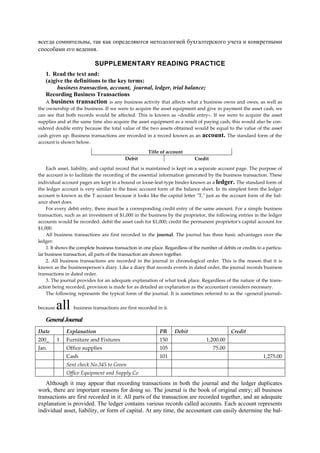
  • 29.
    всегда сомнительны, таккак определяются методологией бухгалтерского учета и конкретными способами его ведения. SUPPLEMENTARY READING PRACTICE 1. Read the text and: (a)give the definitions to the key terms: business transaction, account, journal, ledger, trial balance; Recording Business Transactions A business transaction is any business activity that affects what a business owns and owes, as well as the ownership of the business. If we were to acquire the asset equipment and give in payment the asset cash, we can see that both records would be affected. This is known as «double entry». If we were to acquire the asset supplies and at the same time also acquire the asset equipment as a result of paying cash, this would also be con- sidered double entry because the total value of the two assets obtained would be equal to the value of the asset cash given up. Business transactions are recorded in a record known as an account. The standard form of the account is shown below. Title of account Debit Credit Each asset, liability, and capital record that is maintained is kept on a separate account page. The purpose of the account is to facilitate the recording of the essential information generated by the business transaction. These individual account pages are kept in a bound or loose-leaf-type binder known as a ledger. The standard form of the ledger account is very similar to the basic account form of the balance sheet. In its simplest form the ledger account is known as the T account because it looks like the capital letter "T," just as the account form of the bal- ance sheet does. For every debit entry, there must be a corresponding credit entry of the same amount. For a simple business transaction, such as an investment of $1,000 in the business by the proprietor, the following entries in the ledger accounts would be recorded: debit the asset cash for $1,000; credit the permanent proprietor's capital account for $1,000. All business transactions are first recorded in the journal. The journal has three basic advantages over the ledger: 1. It shows the complete business transaction in one place. Regardless of the number of debits or credits to a particu- lar business transaction, all parts of the transaction are shown together. 2. All business transactions are recorded in the journal in chronological order. This is the reason that it is known as the businessperson's diary. Like a diary that records events in dated order, the journal records business transactions in dated order. 3. The journal provides for an adequate explanation of what took place. Regardless of the nature of the trans- action being recorded, provision is made for as detailed an explanation as the accountant considers necessary. The following represents the typical form of the journal. It is sometimes referred to as the «general journal» because all business transactions are first recorded in it. GeneralJournal Date Explanation PR Debit Credit 200_ 1 Furniture and Fixtures 150 1,200.00 Jan. Office supplies 105 75.00 Cash 101 1,275.00 Sent check No.345 to Green Office Equipment and Supply Co Although it may appear that recording transactions in both the journal and the ledger duplicates work, there are important reasons for doing so. The journal is the book of original entry; all business transactions are first recorded in it. All parts of the transaction are recorded together, and an adequate explanation is provided. The ledger contains various records called accounts. Each account represents individual asset, liability, or form of capital. At any time, the accountant can easily determine the bal-
  • 30.
    ance of theaccount. From the account found in the ledger, the accountant can prepare a trial balance which is the basis for various financial statements as needed by the organization and other interested parties. (b)answer the following questions to test your understanding of the text; 1) Where does the accountant keep track of changes in the values of specific assets, liabilities, and proprietor’s capital? 2) What is the bound or loose-leaf-type book in which individual records of assets, liabilities, and proprietor’s capital are kept? 3) What are the three kinds of information that appear on each side of the T account? 4) What is the left side of the ledger account known as? 5) What is the right side of the ledger account called? 6) On which side of the account are the beginning balances for assets shown? 7) On which side of the account do we show increases in assets? 8) What does the term “double entry” mean? 9) How may we determine the balance in a ledger account after transactions have been recorded in it? (с) using a ledger account, record the following business transactions for the month of Octo- ber 200_; 200_ O ct. 5 9 5 0 Began the Graves Delivery Service by investing the following: Cash, $12,000; Delivery Equipment, $8,000; J.Graves, Capital, $20,000. Received $3,000 in revenue as a result of delivery service income. Made an additional investment in the business consisting of delivery equipment valued at $2,500 and warehouse supplies worth $500. Paid $500 in rent for the warehouse for the month of October. Paid $250 for repairs and gasoline expenses for the first half of the month of October. Received a check for $1,200 from a customer for delivery services rendered. Sent a check for $50 to pay for deposits required by the local utilities company for electric- ity. Designated this payment as a utilities expense. Paid employees’ salaries for the month amounting to $450. Cash Date Explanation Debit Credit Balance 200_ Oct.. 1 3 8 15 19 25 30 Delivery Equipment Date Explanation Debit Credit Balance 200_ Oct.. 1 5
  • 31.
    John Graves, Capital DateExplanation Debit Credit Balance 200_ Oct.. 1 5 Delivery Service Income Date Explanation Debit Credit Balance 200_ Oct.. 3 19 Warehouse Supplies Date Explanation Debit Credit Balance 200_ Oct.. 5 Rent Expense Date Explanation Debit Credit Balance 200_ Oct.. 8 Repairs & Gasoline Expense Date Explanation Debit Credit Balance 200_ Oct.. 15 Utilities Expense Date Explanation Debit Credit Balance 200_ Oct.. 8 Salaries Expense Date Explanation Debit Credit Balance 200_ Oct.. 30 (d) after recording the business transactions in the various ledger accounts, prepare a listing of the accounts and their various balances. If the total debit balances equal the total credit bal- ances, this should indicate that the transactions were recorded correctly in the various ledger accounts: ACCOUNT LISTING BALANCES DEBIT CREDIT Cash Delivery Equipment John Graves, Capital Delivery Service Income Warehouse Supplies Rent Expense Repairs & Gasoline Expense Utilities Expense Salaries Expense
  • 32.
    2. Read thefollowing text and: (a)be ready to characterize principle qualitative characteristics of financial information; (b) complete the chart with the English equivalents; Accounting as a Service Function One way of viewing accounting is as a form of service. Accountants provide economic information to their 'clients', who are the various users. The quality of the service provided would be determined by the extent to which the information needs of the various user groups have been met. To be useful, ac- counting information should possess certain key qualities, or characteristics. These are: Relevance. Accounting information must have the ability to influence decisions. Unless this cha- racteristic is present, there is really no point in producing the information. The information may be relevant to the prediction of future events (for example, in predicting how much profit is likely to be earned next year) or relevant in helping confirm past events (for example, in establishing how much profit was earned last year). The role of accounting in confirming past events is important because users often wish to check on the accuracy of earlier predictions that they have made. Reliability. Accounting should be free from significant error or bias. It should be capable of being relied upon by users to represent what it is supposed to represent. Though both relevance and reliability are very important, the problem that we often face in accounting is that information that is highly rele- vant may not be very reliable, and that which is reliable may not be very relevant. Where a choice has to be made between providing information that has either more relevance or more reliability, the maximisation of relevance tends to be the guiding rule. Comparability. This quality will enable users to identify changes in the business overtime (for ex- ample, the trend in sales over the past five years). It will also help users evaluate the performance of the business in relation to other similar businesses. Comparability is achieved by treating items that are basically the same in the same manner for accounting purposes. Comparability tends also to be en- hanced by making clear the policies that have been adopted in measuring and presenting the informa- tion. Understandability. Accounting reports should be expressed as clearly as possible and should be understood by those at whom the information is aimed. The qualities, or characteristics, that have just been described will help us to decide if a particular piece of financial information is potentially useful. However, in order to make a final decision, we also have to consider whether the information is material, or significant. This means that we should ask whether its omission or misrepresentation in the financial reports would really alter the decisions that users make. Thus, in addition to possessing the characteristics mentioned above, financial information must also achieve a threshold of materiality. If the information is not regarded as material, it should not be included within the reports as it will merely clutter them up and, perhaps, interfere with the users' ability to interpret the financial results. The type of information and amounts involved will normally determine whether it is material. A piece of financial information may still be excluded from the financial reports even when it is considered to be useful. In theory, financial information should only be produced if the costs of pro- viding a particular item of information are less than the benefits, or value, to be derived from its use.
  • 33.
    Characteristics that make financial information useful ________________ (Сопоставимость) ________________ (Понятность) ________________ (Надежность) ________________ (Релевантность) Materiality Necessaryfor including information in the financial statements Cost / Benefit Limitation to the application of the qualitative characteristics (c)consider the situations below. Do you agree with the suggested answers? Present the an- swers in English and express your opinion. По всей вероятности, управляющий, прежде всего, попытается узнать текущую рыноч- ную стоимость (current market value) станка. Эти данные будут релевантными для принятия окончательного решения, но они могут быть не совсем надежными, поскольку станок уникален и, скорее всего, управляющий не сможет собрать достаточно информации, чтобы точно оце- нить его рыночную стоимость. Конечно, было бы очень хорошо, если бы любой пользователь финансовой информации, даже не знакомый с бухгалтерским учетом, мог понять финансовую отчетность. Однако в реаль- ной жизни финансовые события и сделки так сложны, что отчетность о них не может быть про- стой. Финансовую отчетность можно уподобить произведениям современного искусства, — что- бы их понять, нужно иметь определенную подготовку. Вообще говоря, финансовая отчетность предполагает, что пользователь не только обладает достаточными знаниями в области экономики и бухгалтерского учета, но и готов потратить определенное время на изучение отчетности. • Suppose an item of information is capable of being provided. It is relevant to a particular decision, it is also reliable, comparable, understandable and material. Can you think of a reason why, in practice, you might choose not to produce the information? • A manager has to sell a custom-built machine owned by the business and has recently re- ceived a bid for it. What information would be relevant to the manager when deciding whether to accept the bid? How reliable would that information be? • Do you think that accounting reports should be understandable to those who have not studied accounting?
  • 34.
    Такой причиной можетбыть то, что затраты (costs) на подготовку этой инфор- мации превысят потенциальные выгоды (benefits) от ее использования. Поэтому всегда нужно сравнивать затраты на подготовку информации с ожидаемыми выгодами от этой работы. 2. Read the text and be ready to speak on generally accepted accounting principles that ac- countants must follow in order to present «a true and fair view» of a company's finances. When writing accounts and financial statements, accountants have to follow a number of assump- tions, principles and conventions. An assumption is something that is generally accepted as being true. The following are the main assumptions used by accountants: The separate entity or business entity assumption is that a business is an accounting unit sepa- rate from its owners, creditors and managers, and their assets. These people can all change, but the business continues as before. The time-period assumption states that the economic life of the business can be divided into (artificial) time periods such as the financial year, or a quarter of it. The continuity or going concern assumption says that a business will continue into the future, so the current market value of its assets is not important. The unit-of-measure assumption is that all financial transactions are in a single monetary unit or currency. Companies with subsidiaries — that is, other companies that they own — in different countries have to convert their results into one currency in consolidated financial statements for the whole group of companies. The following are the most important accounting principles: The full-disclosure principle states that financial reporting must include all significant informa- tion: anything that makes a difference to the users of financial statements. The principle of materiality, however, says that very small and unimportant amounts do not need to be shown. The principle of conservatism is that where different accounting methods are possible, you choose the one that is least likely to overstate or over-estimate assets or income. The objectivity principle says that accounts should be based on facts and not on personal opi- nions or feelings. Accounts, therefore, should be verifiable: it should be possible for internal and ex- ternal auditors to show that they are true. This isn't always possible, however: depreciation or amorti- zation, and provisions for bad debts, for example, are necessarily subjective — based on opinions. The revenue recognition principle is that revenue is recognized in the accounting period in which it is earned. This means the revenue is recorded when a service is provided or goods delivered, not when they are paid for. The matching principle, which is related to revenue recognition, states that each cost or ex- pense related to revenue earned must be recorded in the same accounting period as the revenue it helped to earn. The consistency principle states that although businesses can choose among different account- ing policies, they have to be consistent, which means using he same methods every year, unless there is a good reason to change a policy. The historical cost principle is that companies record the original purchase price of assets, and not their current selling price. (a) Match the two parts of the sentences and translate them. 1) Companies’ managers, investors, creditors and the tax authorities all 2) There are different ways of doing accounting but companies have to be consistent, 3) Companies have to disclose or make known 4) The historical cost principle is that the price paid to buy assets, 5) A going concern usually doesn’t a) not their current value, is recorded in accounts.
  • 35.
    b) need toknow the current market value of its assets. c) need to know about the size of profits or losses. d) which accounting methods they are using. e) which means regularly using the same methods. (b) Match the accounting assumptions and principles to the activities they prevent. 1) conservatism principle (prudence principle); 2) matching principle; 3) separate entity assumption; 4) revenue recognition principle; 5) time-period assumption; 6) unit-of-measure assumption; 7) objectivity principle; 8) consistency principle; 9) full-disclosure principle. a) recording all data that are verifiable and free from bias; b) publishing financial statements for a 15-month period, because this will show better profits; c) waiting until customers pay before recording revenue; d) waiting until customers pay before recording expenses; e) listing the owners' personal assets in a company's financial statements; f) valuing assets and estimating future revenue at the highest possible fig- ures; g) showing a profit divided into US dollars, euros, Swiss francs, etc.; h) including all significant information in financial reporting; i) using the same methods (of inventory valuation, depreciation, etc.) from one period to the next. 3. Read the text and: (a) number the paragraphs according to their chronological order; A ___ In 1939, archaeological excavation at Pylos, Greece (the possible site of the palace of Nestor of Trojan War fame) recovered hundreds of clay tablets written in Minoan script. Scholars have con- cluded that a Cretan scribe had been carried off by Mycenaean raiders and set to work keeping the ac- counting records of the Grecian king (1400 BC). With the growth of governmental revenues, particularly in Athens, accounting and auditing became more important. In the golden age of Pericles (461–429 BC), each citizen became an auditor through the custom of requiring contractors of public buildings to report their receipts and expenditures on tablets chiselled in stone on the walls of the building. One such tablet indicates that the Parthenon cost 469 talents of silver. B ____ Since the early 1900s, the rapidity of change and the increasing complexity of the world's indus- trial economies necessitated still more changes in accounting. Mergers, acquisitions, and the growth of multinational corporations fostered new internal and external reporting and control systems. With wide- spread ownership of modem corporations new audit and reporting procedures came and new agencies be- came involved in promulgating accounting standards. C ____ In the Middle Ages accounting suffered a decline because of the general disorganised condi- tion of government and the economy throughout Europe. Gradually, however, accounting was re- established. D ___ Roman civilisation was forward-thinking enough to have laws requiring taxpayers to prepare statements of their financial position. In fact, the Roman Empire made effective use of accounting and auditing to control the generals of conquered territories. The quaestors, who came into being about 200 BC, were financial officers responsible to Rome, who had custody of the treasury, supervised the scribes in
  • 36.
    their duties ofrecording treasury receipts and disbursements, and examined the accounts of the governors of subjugated countries. The quaestors were required to report periodically to Rome. E ___ Double-entry bookkeeping (a system which records two aspects of every transaction) pro- gressed in Italy around the thirteenth and fourteenth centuries as a result of the growth of mari- time trade and banking institutions. Merchants required details of voyages to be kept, in order to calculate and share profits from overseas trading. The first bank with customer facilities opened in Venice in 1149. F 1 The precise origins of accountancy are difficult to trace. However, there is certainly evidence of some sort of record-keeping in many civilisations such as the Babylonian, Assyrian and Egyptian. The Sumerian, an early Mesopotamian civilisation, recorded commercial transactions on stone dating back to 3600 BC and on clay tablets beginning about 3200 BC. G ___ Luca Pacioli, a Franciscan monk, is widely believed to be the inventor of double-entry bookkeeping. However, a rudimentary system of double-entry bookkeeping was used in Genoa around 1340. In 1494, Pacioli documented the double-entry system being practised at the time by merchants in Venice in his famous book «Summa de arithmetica, geometria, proportioni et proportiona- lit» (The Collected Knowledge of Arithmetic, Geometry, Proportion and Proportionality). The Sum- ma made Pacioli «The Father of Accounting». H ___ Balance sheets were evident from around 1400 and the Medici family had accounting records of 'cloth manufactured and sold'. Regular audits of the records of the Medici Bank were per- formed during the period 1397 to 1494. The main office in Florence required that an annual bal- ance sheet be submitted by each branch. The general manager and his assistants audited these statements which are still found in the archives of Florence. I ___ Development of accounting theory began in that period and has continued to the present day. The influence of Pacioli's Summa continues to be felt in the double-entry bookkeeping we use today. J ___ In ancient Egypt, accountants were scribes who also practised law. In the Pharaoh's central finance department, scribes prepared records of receipts and disbursements of silver, corn and other commodities. One recorded on papyrus the amount brought to the warehouse and another checked the emptying of the containers on the roof as the contents were poured into the storage building. Audit was performed by a third scribe who compared these two records. Words you may need: scribe (n) — писец, переписчик (документов, рукописей) warehouse (n) — склад storage (n) — хранение, хранилище inventory (n) — запасы contractor (n) — подрядчик quaestor (n) — квестор (помощник консула в финансовых и судебных делах в Древнем Риме) treasury (n) — казна, казначейство prerequisite (n) — предпосылка, предварительное условие emergence (n) — появление maritime trade — морская торговля rudimentary (adj) — элементарный merchant (n) — купец, торговец merger (n) — поглощение acquisition (n) — приобретение (b) single out the main stages in the history of accounting; (c) make up the outline and give a presentation on the development of accountancy. 4. Make a free translation of the text below. Interpret the main ideas! ОАО «РЖД» ведет и раскрывает финансовую отчетность в соответствии с рос- сийскими (РСБУ) и международными (МСФО) стандартами.
  • 37.
    Следуя принципу прозрачности,Компания также раскрывает дополнительную информацию о своей деятельности, которая может представлять интерес или быть существенной для акционера, инвесторов и иных заинтересованных лиц, за исключением информации, составляющей государственную или коммерческую тайну. Компания имеет самостоятельный баланс, а также составляет сводную (консолидированную) отчетность, включая балансы, по филиалам и представи- тельствам Компании. Баланс, отчеты о прибылях и об убытках Компании составляются в рублях. Баланс, отчеты о прибылях и об убытках, а также иные финансовые и статистические отчетные документы составляются в соответствии с законодательством Российской Фе- дерации. Первый финансовый год ОАО «РЖД» начинается с даты его государственной реги- страции и завершается 31 декабря года государственной регистрации Компании. По- следующие финансовые годы совпадают с календарными годами. Компания осуществляет учет результатов своей деятельности, ведет оперативный, бухгалтерский, налоговый и статистический учет в соответствии с законодательством Российской Федерации. Ответственность за организацию, состояние и достоверность бухгалтерского учета в компании, своевременное представление ежегодного отчета и другой финансовой от- четности в соответствующие органы, а также сведений о деятельности компании, пред- ставляемых акционеру, кредиторам и в средства массовой информации, несет прези- дент ОАО «РЖД» в соответствии с Федеральным законом «Об акционерных общест- вах» и иными нормативными правовыми актами Российской Федерации. ASSIGNMENT 1. What type of work does each person do? What is the name of each job? «I record all the purchases and sales made by this department.» «This month, I'm examining the accounts of a large manufacturing company.» «I analyse the sales figures from the different departments and make decisions about our fu- ture activities.» «I am responsible for preparing our annual balance sheet.» «When the accounts are complete, I check them before they are presented to the external audi- tors.» 2. Choose the best answer for the items below. 1) A company has liabilities of $19,000 and owner’s equity of $57,000. The assets of the company are (a) $38,000 (b) $57,000 (c) $76,000 (d) $19,000 2) The payment of a liability will (a) increase both assets and liabilities; (b) increase assets and decrease liabilities; (c) decrease assets and increase liabilities; (d) decrease both assets and liabilities. 3) The purchase of an asset for cash will (a) increase and decrease assets at the same time; (b) increase both assets and liabilities;
  • 38.
    (c) increase assetsand owner’s equity; (d) increase assets and decrease liabilities. 4) At the beginning of the year Gilbert Company’s assets were $180,000 and its owner’s equity was $100,000. During the year assets increased $60,000 and liabilities decreased $10,000. What was the owner’s equity at the end of the year? Use the accounting equation to answer the question. DISCUSSION Discuss the following questions and present your ideas. 1. «Debits are bad; credits are good». Comment on this statement. 2. Why is the system of recording entries called the double-entry system? What is special about it? 3. Give the rules of debits and credits for a) assets, b) liabilities, and c) owner’s equity. 4. Outline the relative benefits to users of financial reports relating to: (a) information about the past; (b) information about the present; (c) information about the future. UNIT 3. FINANCIAL STATEMENTS PRE-READING Discuss these questions. 1. Do financial statements always give a true picture of a company? For whom are finan- cial statements important? 2. Is the purpose of financial statements to make companies appear as well-run as possible? READING Scan the text and find the answers to the following questions: What are the major financial statements? How do the financial statements differ? The objective of the major financial accounting statements is to provide a picture of the over- all financial position and performance of the business. To achieve this objective, the business’s accounting system will normally produce three particular statements on a regular basis. These three are concerned with answering the following questions: – What cash movements (that is, cash in and out) took place over a particular period? – How much wealth (that is profit) was generated, or lost, by the business over that period? – What is the accumulated wealth of the business at the end of that period? The financial statements are: the Balance Sheet (see Appendix 3); the Income Statement also known as the Profit and Loss Account (see Appendix 4); the Cash Flow Statement (see Appendix 5). Taken together, they provide an overall picture of the financial health of the business. At least once a year, all companies prepare financial statements. This is commonly done at the end of the calendar year, but some firms use a fiscal year, which may be any twelve consecutive months. * * * * *
  • 39.
    The balance sheetis a statement of a firm’s financial position at a specified point in time and includes all the elements of the accounting equation. The balance sheet reveals the forms in which the wealth of the business is held and how much wealth is held in each form. The balance sheet sets out the assets of the business on the one hand, and the claims against the business on the other. An asset is essentially a resource held by the business. Assets that have a physical substance and can be touched are referred to as tangible assets. Assets that have no physical substance but, nevertheless, provide expected future benefits (such as patents, trademarks and goodwill) are referred to as intangible assets. A claim is an obligation on the part of the business to provide cash, or some other form of benefit, to an outside party. A claim will normally arise as a result of the outside party providing funds in the form of assets for use by the business. There are two types of claim against a busi- ness: capital (the claim of the owner (s) against the business that is usually referred as the own- er’s equity) and liabilities (the claims of other individuals and organizations, apart from the own- er (s)). Liabilities must have arisen from past transactions or events such as supplying goods or lending money to the business. Assets on a balance sheet are usually divided into non-current and current assets. Current assets are basically assets that are held for a short term. The most common current assets are inventories (or stock) customers who owe money for goods or services supplied on credit (known as trade receivables or debtors), and cash. Non-current assets (also called fixed assets) are held for the long-term operations of the business. Essentially, they are the «tools» of the business and are held with the objective of generating wealth. They are sometimes called property and consist of permanent investment in building, equipment, furniture and fixtures, transportation equipment, land, and any other tangible property used in running a business. They have a useful life of more than a year and are not expected to be converted into cash. With the exception of land, fixed assets depreciate yearly. Liabilities may be also either current or non-current. Current liabilities are debts that will have to be paid within a year of the date of the balance sheet. Debts falling due a year or more after the date of the balance sheet are long-term liabilities, such as leases and mortgages. * * * * * Businesses exist for the primary purpose of generating wealth, or profit, and it is the profit generated during a period that is the main concern of many users of financial information. The income statement (or profit and loss account) shows how much profit (wealth) the business has generated over a given period of time. When expenses (the outflow of economic benefits arising from the ordinary activities of a business) are subtracted from revenue (the inflow of economic benefits arising from the ordinary activities of a business), the resulting profit or loss of a com- pany is known as net income — the «bottom line». The difference between the total revenue and total expenses will represent either profit (if revenue exceeds expenses) or loss (if expenses exceed revenue) Balance Sheet is a financial statement that shows the financial position of a business at a particular moment in time — a detailed presentation of all assets, liabilities, and owner’s eq- uity. Actually, it is a detailed accounting equation, in which the total value of assets is equal to the total liabilities plus proprietor’s capital.
  • 40.
    Revenue may berecorded on either an accrual basis (recorded as soon as the sale is made) or cash basis (recorded only when money from a sale is actually received). Companies generally prefer recording revenue on a cash basis to avoid being taxed on money not as yet collected. * * * * * Cash is a vital resource that is necessary for any business to function effectively. Cash is re- quired to meet debts that may become due and to acquire other resources (such as stock). If a business wants to employ people, it must pay them in cash. If it wants to buy new equipment, the seller of the asset will normally insist on being paid in cash, probably after a short period on credit. When businesses fail, it is their inability to find the cash to pay creditors that really drives them down. Cash can be described as the «lifeblood» of a business, and movements in cash are usually given close scrutiny by users of financial statements. Most businesses prepare a statement of cash flows in addition to the income statement and the balance sheet. This statement summarizes the company’s receipts and disbursements for the areas of operations, investments, and financing over a particular period. It also serves to indicate a firm’s liquidity (i.e. its ability to pay short-term obligations). Tracking the sources and uses of cash over several years could show financing trends and help to make predictions about the likely future behaviour of the company. A successful business is one which actively manages the cash flow. WORDS AND EXPRESSIONS FOR READING COMPREHENSION 1. objective (n) 2. wealth (n) 3. at least 4. fiscal year 5. consecutive (adj) 6. to reveal (v) 7. claim (n) 8. essentially (adv) 9. substance (n) 10. to refer 11. nevertheless 12. tangible assets 13. intangible assets 14. goodwill (n) 15. non-current assets 16. current assets цель благосостояние по крайней мере финансовый год последовательный показывать, обнаруживать требование, право на активы существенно, главным образом вещество, материя, реально существую- щее указывать, ссылаться тем не менее материальные / осязаемые активы нематериальные / неосязаемые активы цена фирмы, гудвилл внеоборотные активы Statement of Cash Flows is a financial statement that presents a detailed explanation of the balance of the cash account as reported in the balance sheet of an organization. This statement presents cash receipts and disbursements from operating activities, investing activities and financing activities. Income Statement is a financial statement that presents revenue and expenses and the net income or loss for a specific period of time.
  • 41.
    17. fixed assets 18.accounts receivable 19. inventories (n) 20. property (n) 21. equipment (n) 22. permanent (adj) 23. furniture and fixtures 24. to run a business 25. with the exception 26. to depreciate (v) depreciation (n) 27. lease (n) 28. mortgage (n) 29. expenses (n) 30. revenue (n) 31. to exceed (v) 32. to subtract (v) 33. net income 34. the «bottom line» 35. cash flow 36. to acquire (v) 37. accrual basis 38. cash basis 39. scrutiny оборотные активы / средства основные средства дебиторская задолженность, счета к получе- нию запасы, резервы имущество, собственность оборудование постоянный мебель и принадлежности (статья в сче- тах) руководить делом, предприятием за исключением обесценивать, падать в цене износ, снижение стоимости аренда, арендованное имущество ипотека, закладная расходы выручка превышать вычитать чистая прибыль чистая прибыль после налогообложения поток денежных средств, денежные поступ- ления приобретать на базе накопления на базе кассовых операций исследование, рассмотрение
  • 42.
    READING COMPREHENSION 1. FindEnglish equivalents for the following Russian phrases from the text. Финансовое положение фирмы; по крайней мере, раз в год; использо- вать финансовый год; элементы бухгалтерского тождества; ожидаемая будущая выгода; собственный капитал; дебиторская задолженность, с целью увеличения благосостояния; срок полезного использования более одного года; постоянные вложения; за исключением земли; выплачивать в течение года, за данный период времени, избежать начисления налогов, подробное рассмотрение; показать ликвидность компании. 2. Look through the above text again and complete the sentences as in the text. 1) The major financial statements are …. 2) The balance sheet sets out …. 3) Assets on a balance sheet are usually divided into …. 4) There are two types of claim against …. 5) Liabilities must have arisen from …. 6) When a balance sheet is prepared, fixed assets are …. 7) The income statement shows how much …. 8) Companies mainly prefer …. 9) Cash is required to …. 10) The statement of cash flows summarizes …. 3. Use the information in the text to answer the following questions. 1) What is the purpose of the balance sheet? 2) How often do companies prepare balance sheets? 3) What are the main items of the balance sheet? 4) What do fixed assets include? 5) Why are fixed assets depreciated? 6) What fixed asset is never depreciated? 7) What do intangible assets include? 8) What do current assets include? 9) What are the two main groups of liabilities? 10) What does the profit and loss account show? 11) Why do companies prefer recording revenue on a cash basis? 12) What are the main objectives of the cash flow statement? 4. Decide whether the following statements are true (T) or false (F). Comment your an- swers. 1) The two sides or halves of a balance sheet always have the same total. ____ 2) The balance sheet gives information on how much money the company has received from sales of shares. ____ 3) The assets total is always the same as the liabilities total. ____ 4) The balance sheet tells you how much money the company owes. ____ 5) The revenue of the company in the past year is shown on the balance sheet. ___
  • 43.
    5. Choose oneof the financial statements, explain in a few sentences the nature and purpose of it. Give your opinion on how it can be helpful in identifying financial problems of a business. Use the following phrases. • I would like to comment on …; • The next issue I would like to focus on is …; • Furthermore, …; • To illustrate this point, let me consider …; • There is something I’d like to point out … • Generally speaking, …; • Let me give an example …; • I’d like to conclude by stating that …. VOCABULARY PRACTICE 1. Match the opposites. 1) ability 2) divide 3) useful 4) inflow 5) profit 6) exceed 7) tangible 8) permanent 9) receipts 10) expenses a) intangible b) loss c) be short of d) discontinuous e) useless f) disbursements g) disability h) unite i) income j) outflow 2. Match the synonyms. 1) wage 2) price 3) amount 4) depreciation 5) own 6) invisible 7) material 8) trademark 9) obligation 10) owe a) quantity b) tangible c) possess d) brand e) be obliged f) value g) intangible h) salary i) obsolescence j) liability 3. Match the verbs from (A) with the nouns from (B). A B to allocate to incur to publish to draw up to make to keep to report upon to enter an entry a balance sheet books financial position a transaction a statement costs funds
  • 44.
    4. Sort thefollowing into current, fixed and intangible assets. premises cash in bank debtors goodwill human capital investments locomotives patents construction in progress stock land trademark bank deposits software sub-grade Current assets Fixed assets Intangible assets 1) 1) 1) 2) 2) 2) 3) 3) 3) 4) 4) 4) 5) 5) 5) 5. Fill in the missing words in the sentences below and translate them into Russian. administrative expenses cost of sales distribution dividend extraordinary ordinary retained turnover 1) As First Scotrail Limited is a railway company, all their contracts on passenger railway services are known as ________________ activities. 2) Recently, a private transportation company paid First Scotrail Limited a large amount of money to use the company’s premises for the period of three months. This was recorded in the Profit and Loss Account as _______________income. 3) Income which the company makes in its normal activities is known as __________________. 4) At the end of the year, some of the profits may be shared out among the shareholders who will receive a ________________. 5) The costs of getting the goods to the customers are shown as ______________ costs in the Profit and Loss Account. 6) Materials which are used up in manufacturing and workers’ wages are recorded as _______________. 7) The secretary’s salary and expenses incurred in the office are shown as ______________. 8) The company may decide to keep some of the profits at the end of the year and the amount is shown as _______________ profits. 6. Make word combinations using a word from each box. Then use the word combinations to complete the sentences below. distribute grant owe pay retain liabilities money profits earnings credit 1) We ______________ a lot of our ____________ because we don't ____________ any of our _____________ to the shareholders. 2) Most businesses have customers who _____________, because they _____________ them 30 or 60 days’ ______________. 3) We have a lot of ______________ that we’ll have to _____________ later this year. 7. Match the two parts of the sentences and translate them. 1) A company's value on the stock exchange is nearly always 2) Brand names, trade marks, patents, customers, and qualified staff 3) Cash, money owed by customers, and inventory
  • 45.
    4) Companies recordinventory at the cost of buying or making the items, 5) Companies write off bad debts, and make provisions 6) Land, buildings, factories and equipment a) are current assets. b) are examples of intangible assets. c) are examples of tangible, fixed assets. d) by deducting the amount from profits. e) higher than the value of its net assets. f) or the current market price, whichever is lower. 8. Read the definitions and give the appropriate terms. 1) ____________ are companies that provide other companies with materials, components, etc. 2) ____________ are profits that the company has not distributed to shareholders. 3) ____________ are things a company owns and uses in its business. 4) ____________ consist of everything a company owes. 5) ____________ consists of money belonging to a company's owners. 9. Study the diagram and complete the text. E xp en ses C om p an y R even u e P rofit R etain ed earn in gs T ax D ivid en d s All the money coming into a company during a given period is 1)___________. 2)___________ minus the cost of sales and operating 3)_____________, such as rent and salaries, is known as 4)___________ or net income. The part of its profit that a company pays to its shareholders is a 5)____________. Companies pay a proportion of their profits to the government as 6)___________, to finance government spending. They also 7)___________, or keep, some of their earnings for future use.
  • 46.
    10. Study theBalance Sheet of a British Transportation Company. Using the addi- tional information complete the company’s balance sheet. First Scotrail Limited Balance Sheet at 31 March 2007 2007 £ m 2006 £ m Fixed assets 26.0 Current assets stocks 3.3 debtors 51.2 cash at bank and in hand 42.5 123.4 39.7 94.2 Current liabilities loans and overdrafts 30.9 creditors (86.8) Net current assets (10.6) 7.4 Total assets less current liabilities 31.23 33.5 Liabilities falling due after one year (11.0) (3.6) Capital and reserves 21.4 1) The amount the company owed their suppliers increased to £134m in 2007. 2) The value of spare parts and consumables decreased slightly by £300,000 to stand at £3m. 3) Investment in the business increased sharply to £16m. 4) The value of the company’s property, plant and equipment, leased assets and assets under construction rose by £15.9m to stand at £41.9m. 5) The company’s short-term borrowing from the bank amounted to £1.8m in 2006. 6) The amount customers owed the company increased to £78m. Add up the totals. Does it balance? 11. Study the Consolidated Balance Sheet of Open Joint Stock Company «Russian Rail- ways». Consolidated Balance Sheet Year Ended 31 December 2006 (all amounts are in millions of Russian Rubles) 31 De- cember 2006 200 5 (Restated) ASSETS Non-current assets Property, plant and equipment 1,421,0 73 1,24 8,367 Intangible assets 5,638 4,62 4 Investments 1.410 1,19 8
  • 47.
    Deferred tax asset13,297 41,8 30 Other non-current assets 7,641 1,29 4 Total non-current assets 1,452,0 22 1,30 0,285 Current assets Inventories 54,632 45,4 70 Prepayments and other current assets 52,801 68,3 88 Income tax receivable 4,959 463 Receivables 21,070 15,5 82 Cash and cash equivalents 17,423 12,2 00 Total current assets 150,88 5 142, 103 Total assets 1,602,9 07 1,44 2,388 EQUITY AND LIABILITIES Equity Share capital 1,535,7 00 1,53 5,700 Revaluation reserve 172,05 1 172, 051 Accumulated deficit (611,3 92) (70 1,241) Net profit for the year attributable to equity holders of the parent 139,76 6 90,7 89 1,236,1 25 1,09 7,299 Minority interest in subsidiaries 213 208 Total equity 1,236,3 38 1,09 7,507 Non-current liabilities Deferred tax liabilities 121 - Long-term borrowings 48,425 50,7 39 Finance lease obligations, net of current portion 40,821 24,1 70 Employee benefit obligations 70,269 67,9 90 Other long-term debt 2,853 13,3 11 Total non-current liabilities 162,48 9 156, 210 Current liabilities Payables 95,289 75,0
  • 48.
    04 Finance lease obligations,current portion 9,575 5,55 7 Income tax payable 76 1,54 5 Taxes and similar charges payable 24,443 26,0 04 Short-term borrowings 17,187 18,0 92 Accrued and other liabilities 57,510 62,4 69 Total current liabilities 204,08 0 188, 671 Total equity and liabilities 1,602,9 07 1,44 2,388 (a) Match these explanations to items on the balance sheet and present the re- sults for the year 2006 1) Amount JSC «Russian Railways» owe the bank; 2) Total investments of the company; 3) Fixed assets of JSC «Russian Railways»; 4) Amount of share capital of JSC «Russian Railways»; 5) Amount they owe their suppliers; 6) Amount their customers owe them; 7) Current assets minus (-) current liabilities; 8) Non-current assets plus (+) net current assets. (b) Complete these sentences about JSC «Russian Railways» consolidated balance sheet. Use a preposition to / from / by / at 1) The amount they owed their creditors increased … 75,004m rubles … 96,289m rubles. 2) The dividend decreased … £28m. 3) Share capital and reserves remained steady… 1,707,751m rubles. 4) Taxation decreased… 24,443m rubles. 5) The amount their debtors owed them rose… 15,582m rubles… 21,070m rubles. 12. Read the following text and fill each gap with a suitable word from the box. turnover debtors profit and loss account income balance revenues creditors liabilities The 1)_____________(GB) or income statement (US) shows 2)______________ and expendi- ture. It usually gives the figures for total sales or 3)_______________, and costs and 4)______________. The first figure should obviously be higher than the second, i. e. there should be a profit. Part of the profit goes to the government in taxation, apart is usually distributed to shareholders as a dividend, and part is retained by the company. The 5)______________ shows a company’s financial situation on a particular date, generally the last day of the financial year. It lists the company’s assets, its 6)_____________, and share- holders’ funds. A business’s assets include 7)_______________ as it is assumed that these will be paid. Liabilities include 8)__________________, as these will have to be paid. Negative items on
  • 49.
    financial statements, suchas creditors, taxation, and dividends paid, are usually enclosed in brackets. 13. Find the accounting terms corresponding to the following meanings and give their Rus- sian equivalents. 1) An amount of money that is owed but probably won't be paid; 2) The accounting value of a company (assets minus liabilities); 3) A legal right to produce and sell a newly invented product for a certain period of time; 4) The historical cost of an asset minus depreciation charges; 5) The amount a company pays for another one, in excess of the net value of its assets; 6) A legally protected word, phrase, symbol or design used to identify a product; 7) To accept that a debt will not be paid; 8) To deduct money from profits because of debts that will not be paid; 9) Products that are not complete or ready for sale; 10) The amount of money owed by customers who have bought goods but not yet paid for them.
  • 50.
    14. Match theitems with the entries in a Profit and Loss Account. Profit and Loss Account £000’s £ £ __ ( a) Turnover 9 00 __ ( b) Cost of sales 5 50 Gross profit 3 50 __ ( c) Distribution costs 6 0 __ ( d) Administrative expenses 4 5 1 05 2 45 Other operating income 5 5 3 00 __ ( e) Income from shares in related companies 1 5 Income from other fixed asset investment 2 0 Other interest receivable 1 0 4 5 3 45 __ ( f) Interest payable 1 8 Profit on ordinary activities before taxation 3 27 Tax on profit on ordinary activities 1 09 __ ( g) Profit on ordinary activities after taxation 2 18 Extraordinary income 1 8 __ ( h) Tax on ordinary profit 6 1 2 Profit for the financial year 2 30 Retained profits from last year 4 0 2 70 Transfer to general reserve 6 0 __ ( i) Proposed ordinary dividend 1 30 1 90 __ ( j) Retained profits carried to next year 8 0
  • 51.
    1) The valueof stock at the end of the year has been deducted to arrive at this figure; 2) Bank interest on the overdraft; 3) Dividends from investments in shares with voting rights in other companies; 4) Net invoiced amounts for sales; 5) This year’s profits which will not be paid out to investors; 6) The delivery drivers’ wages; 7) Money received for rent on buildings which have been let for a short time as they are not being used; 8) This money will probably be paid out to shareholders; 9) Telephone, stationery and legal fees; 10) An overprovision for corporation tax from last year. 15. Match the words in the box with the correct definitions and give Russian equiva- lents. depreciation balance sheet accounts receivable goodwill mort- gage receipts net income inventory accounts payable marketable securities 1) A statement showing the financial position of a business at a certain date, usu. the end of the fi- nancial year — _____________________________ 2) Stocks held by a business for sale to its customers — __________________________ 3) The capital value of an intangible asset, that is the right to receive the extra profits which an es- tablished business may be expected to earn, over and above the normal earnings for a similar business — ____________________________ 4) A sum of money due to be received from a customer in the ordinary course of trade but not yet paid — ______________________________ 5) A taxpayer’s total income that remains after paying direct taxes and social security contributions — ______________________________ 6) A contract by which the owner of land borrows money, giving the lender an interest in the land as security for the loan — ____________________________ 7) Any securities that can be bought or sold on a stock exchange, esp. those that can easily and quickly be sold — ___________________________ 8) An invoice that has yet to be paid, and therefore represents money owed by the business to some- body else — ___________________________ 9) The gradual loss of value of fixed assets such as buildings, plant and machinery because they wear out or decay or are replaced by more modern and efficient things — ___________________________ 10) A formal acknowledgement that money due has been paid or that goods have been received — _____________________________ 16. Make a free translation of the following text into English and make a presentation on the purpose of the Profit and Loss Account. Give your explanation of the equation: Отчет о прибылях и убытках Компания существует, прежде всего, для того, чтобы приносить прибыль, поэтому многих поль- зователей финансовой отчетности интересует в первую очередь именно прибыль, генерированная компанией в течение того или иного периода. Конечно, больше всего величина этой прибыли инте- ресует ее владельцев, но и других пользователей информации, например управляющих, служащих Profit (loss) for the period = Total revenue for the period less Total expenses incurred in generating the revenue
  • 52.
    и поставщиков, интересует,способна ли компания приносить прибыль. Цель составления отчета о прибылях и убытках — оценить, сколько прибыли (материальных ценностей) компания получила за период, и информировать об этом пользователей финансовой отчетности. Оценка прибыли требует выявления всех доходов компании, полученных ею за тот или иной пе- риод. Доход компании — это показатель роста активов в результате осуществленных торговых опе- раций (например, денежных средств или сумм, причитающихся компании от дебиторов) или умень- шения обязательств. У разных компаний разные формы доходов. Например, производственные ком- пании обычно получают выручку от продажи товаров, юридические фирмы — плату за услуги, ком- пании, инвестиционные фонды — проценты. Необходимо определить и общие расходы за каждый отчетный период. Расходы — это уменьшение активов (или рост обязательств). Виды расходов компании также зависят от ее профиля. Обычно компании несут следующие расходы: затраты на покупку продукции для последующей перепродажи, которые называют себе- стоимостью реализованной продукции (cost of sales); заработная плата и оклады; арендные платежи; расходы на содержание и эксплуатацию автотранспорта; страховые расходы; типографские и канцелярские расходы; расходы на отопление и освещение; почтовые расходы, расходы на телефон и т.д. Отчет о прибылях и убытках за данный период показывает все доходы, генерированные за этот период, уменьшенные на все понесенные при этом расходы. Разница между всеми доходами и все- ми расходами представляет собой либо прибыль (если доходы превысили расходы), либо убытки (если доходы оказались ниже расходов). SUPPLEMENTARY READING PRACTICE 1. Scan the text and: (a) answer the following question: What type of depreciation are the following items subject to: computers, combines, farm buildings? (b) give the title to each paragraph; Depreciation of Assets In accounting, the process of allocating in а systematic and rational manner the cost of cer- tain items of the assets (these are mainly capital assets) over the period of its useful life is known as depreciation. There are three main types of depreciation causing the decrease in value of an asset: 1) physical depreciation, 2) moral depreciation, 3) deterioration. In the process of production the capital assets gradually wear out, thus after а definite period of time they have to be replaced. This is known as their physical depreciation. However, capital assets are also subject to moral depreciation, that is after serving for some period of time, they may become obsolete before they are physically worn out and have to be replaced by more up-to-date means of production. Such obsolescence of the assets is caused by technological changes and by the introduction of new and better machinery and methods of pro- duction. Obsolescence can also be caused by the commodity produced by the asset, for example, if it goes out of fashion. In the latter case, the degree of obsolescence will depend on the specific nature of the asset. Sometimes assets can be easily adapted to alternative uses while others may have only one application.
  • 53.
    Deterioration means аchange in value of an asset because of the effects of nature, for exam- ple, for machinery this might be rust, for buildings it is connected with decadence, for farmlands it is caused by erosion. In accounting, it is important to know depreciation of the capital assets as it increases the company’s expenses, so two main methods are used by accountants in calculating periodic de- preciation. The most widely used is the straight-line method, in which the rate of depreciation is constant for the entire working life of the capital assets. According to the second method known as accelerated depreciation method, the depreciation rate in the first years of asset use is greater than in the later years. Words you may need: deterioration (n) — порча, повреждение, износ obsolete (adj) — устаревший obsolescence (n) — изношенность rust (n) — ржавчина decadence (n) — ухудшение (c) finish the following sentences using the information from the text. 1) Most capital assets have а limited life due to… 2) Depreciation results from such causes as… 3) In the case of machinery one should take into account … 4) Obsolescence can be caused either … 5) The effects of nature decrease the value of capital assets because … 6) The choice of depreciation method is particularly important … 7) In practice we often use the following methods of calculating depreciation … (d) match the nouns with the verbs below to make word combinations. Use some of them to complete the sentences. costs / fixed assets / market value / profits / value / purchase price ______________ ____________ ______________ ______________ _____________ ______________ record reducedepreciate deduct 1) Because we ____________ the ___________ ___________, we don’t have worry about the mar- ket value of fixed assets. 2) To depreciate __________ __________, we ___________ part of their _________ from profits each year. 3) Because land usually appreciates, companies do not generally __________ its ____________ on the balance sheet. (e) there are several methods that accountants use to write fixed assets off. Read the following definitions and match them with the methods of depreciation. hours of use unit of production straight line declining balance sum-of-the-year’-digits
  • 54.
    1) ___________________: Theasset is depreciated by a constant amount every year. The deprecia- tion expense for each year is calculated by subtracting the salvage value from the acquisition cost, and then dividing the difference by the useful life of the asset. 2) __________________: The depreciation expense is calculated by first subtracting the salvage value from the acquisition cost. The difference is multiplied by a fractional amount, where the denominator and numerator are based on the addition of the figures in the asset's useful life. 3) __________________: The depreciation is «accelerated» by this method, so that the expense is greater in the first years. The salvage value is ignored in the calculation, but the asset will not be depreciated below this value. 4) __________________: The expected usage of the asset is taken into account in determining the rate of depreciation. 5) __________________: The expected output of the asset is taken into account in determining the rate of depreciation. What are depreciation methods that are commonly used by Russian companies?
  • 55.
    (f) study thescheme and give your comments. less equals C ost (fair valu e) R esid u al valu e D ep reciab le a m ou n t A sset life (N u m b er of years) Y ear 1 D ep reciation Y ear 2 D ep reciation Y ear 3 D ep reciation Y ear 4 D ep reciation 2. Read the text and give the title of it. Single out the main facts and present them in a short re- view. Give your viewpoint. From an international perspective, it is important to remember that while based on similar principles, Russian accounting does not fully meet international accounting standards (IAS). The main differences are as follows: • Sales. Sales are usually recorded on a cash basis. The cost of goods/services delivered but not yet paid for remains on the balance sheet until payment is received. Most Russian taxes are sales-based. As a result, companies try to minimize sales in their accounts. When sales are record- ed on a cash basis, allowances are not made for bad debt, in spite of the fact that bad debts may represent a considerable share of accounts receivable. Sales figures for Russian companies tend to be understated compared with the accrual sales of Western companies. • Cost of goods sold. Russian companies report the full cost of goods sold, which includes production costs, transportation, depreciation, marketing, and financial expenses. No cost items are disclosed separately. Social costs are not included in the cost of goods sold. • Depreciation. Only a straight-line depreciation method is allowed. The depreciation rates are fixed by the government and are as a rule significantly lower than in the West. Accelerated straight-line depreciation has been permitted since January 1, 1995 but is still rarely used. • Fixed assets. Fixed assets pose the most serious problem. Fixed assets are accounted for at historical cost and cover property, plant and equipment. Land is not treated as a fixed asset and does not appear on the balance sheet at all. Even if depreciation rates are lower than in the West, fixed assets are generally undervalued compared with Western practice. • Accounts receivable. Since most Russian companies record sales when they receive pay- ment, the sales margin is not accrued until that time. Therefore accounts receivable are unders- tated given that the sales margin is not reflected. Overdue accounts receivable are not disclosed separately. • Consolidation of accounts. Russian companies, including holding companies, are not re- quired to submit consolidated reports. No consolidation standards have been established yet. Some of the holding companies prepare aggregated reports, summing up 100 % of all subsidiaries and associates without accounting for intragroup transactions and minorities. • Consequently, the reported results of Russian holding companies are usually significantly overstated.
  • 56.
    All other aspectsof Russian accounting are basically in line with IAS. The Russian govern- ment is taking measures to eliminate the most serious divergences. Words you may need: bad debts — безнадежные долги accounts receivable — дебиторская задолженность straight-line depreciation method — метод равномерного начисления износа accelerated straight-line depreciation method — метод ускоренного начисления sales margin — доход от продаж overdue (adj) — просроченный consolidation of accounts — консолидация счетов IAS — International Accounting Standards divergence (n) — отклонение 3. Study the standard layout of the cash flow statement. Read the explanation of the terms and give key ideas. plu s or m inus plu s or m inus equals C ash flow s from op eratin g activities C a sh flow s from in vestin g activities C ash flow s from fin an cin g activities N et in crease (or d ecrease) in cash an d cash eq u ivalen ts over th e p eriod Cash flows from operating activities This is the net inflow or outflow from trading operations, after tax and financing costs. It is equal to the sum of cash receipts from trade receivables, and cash receipts from cash sales where relevant, less the sums paid to buy inventories, to pay rent, to pay wages and so on. From this are also deducted payments for interest on the business's borrowings, corporation tax and dividends paid. The tax and dividend payments that appear in the cash flow statement are those made in the period of the statement. Companies normally pay tax on their profits in four equal installments. Two of these are during the year concerned, and the other two are during the following year. Thus by the end of each accounting year, one half of the tax will have been paid and the remainder will be a current liabil- ity at the end of the year, to be paid off during the following year. During any particular year, there- fore, the tax payment would normally equal 50 per cent of the previous year's tax charge and 50 per cent of that of the current year. The net figure for this section is intended to indicate the net cash flows for the period that arose from normal day-to-day trading activities after taking account of the tax that has to be paid on them and the cost of servicing the finance (equity and loans) needed to support them.
  • 57.
    Cash flows frominvesting activities This section of the statement is concerned with cash payments made to acquire additional non-current assets and with cash receipts from the disposal of non-current assets. These non-current assets will tend to be the usual non-current assets such as buildings, machinery and so on. They might also be loans made by the business or shares in another business bought by the business. This section also includes receipts from investments (loans and equity investments) made outside the business. These receipts are interest on loans made by the business and dividends from shares in other businesses that are owned by the business. This section shows the net cash flows from making new investments and/or disposing of existing ones. Cash flows from financing activities This part of the statement is concerned with the long-term financing of the business. So we are con- sidering borrowings (other than very short term) and finance from share issues. This category is con- cerned with repayment/redemption of finance as well as with the raising of it. This section shows the net cash flows from raising and/or paying back long-term finance. Net increase or decrease in cash and cash equivalents The total of the statement must, of course, be the net increase or decrease in cash and cash equiva- lents over the period covered by the statement. The effect on a business's cash and cash equivalents of its various activities is shown below. The arrows in the figure show the normal direction of cash flow for the typical healthy, profitable business in a typical year. Cash and cash equivalent balances Financing activities Operating activities Investing activities Normally 'operating activities' provide positive cash flows: that is, they help to increase the business's cash resources. Cash generated from day-to-day trading, even after deducting tax, interest and dividends, is overwhelmingly the most important source of new finance for most businesses in most time periods. Investing activities typically cause net negative cash flows. This is because most types of non- current assets wear out, and because businesses tend to seek to expand their asset base. When a busi- ness sells some non-current assets, this will give rise to positive cash flows, but in net terms the cash flows are normally negative with cash spent on new assets outweighing that received from disposal of old ones. Financing can go in either direction, depending on the financing strategy at the time. Since busi- nesses seek to expand, there is a general tendency for this area to lead to cash coming into the business rather than leaving it.
  • 58.
    (a)Study the cashflow statement below and interpret it. Think of possible future manage- ment actions. The published, summarised cash flow statement for the British transportation company Forth Ports PLC for the year 2006 shows the cash flows of the business under each of the headings described above. Summarised cash flow statement for the year ended 31 December 2006 2006 £m 2005 £m Net cash inflow from operating activities 17.6 21.6 Net cash outflow from investing activities 4.0 (14.7 ) Net cash (outflow) inflow from financing activities (22.8 ) (9.0) Increase in cash and cash equivalents (1.2) (2.1) Cash and cash equivalents at start of year 4.0 6.1 Cash and cash equivalents at end of year 2.8 4.0 (b) Complete the text with words: financing / investing / operations. You will need to use each word more than once. 1) ______________ means making money by selling goods and services. (2)_____________ is spending cash, for the business's future growth, including cash acquired by selling assets. (3) _____________ involves raising money by issuing stocks and bonds (and also paying dividends and interest and repaying bonds). It is better for the company if it can pay for future growth out of money from (4) ______________, without having to use (5) ______________ So a 'healthy' cash flow means that the amount of cash provided by (6) _____________ is greater than the cash used for (7) _______________. 4. Read the text and: (a) define advantages and disadvantages of the methods used for recognizing bad debts; (b) describe each method for recognizing bad debts; Recognizing Bad Debts Goods and services may be sold by a business organization for cash or on credit. Most organiza- tions, if given a choice, would probably prefer to sell their products or services for cash. Because of competition and other factors, however, many businesses have to offer their products or services to customers on credit. When sales are made without the immediate receipt of cash, a small portion of the outstanding accounts receivable may prove to be uncollectible regardless of a credit department's efforts or the credit service used. When this happens, provision must be made to match expenses and revenue by recognizing a bad debt. A bad debt is an expense that was caused by a customer's failure to pay an obligation arising out of a prior credit sale. The recognition of this uncollectible account receivable is handled in different ways de- pending on the nature of the business. Three methods are used to recognize customer obligations that have proved to be uncollectible: 1. Direct write-off method; 2. Net sales method; 3. Aging of accounts receivable method. The direct write-off method is used by businesses when it is possible to determine that an account will prove to be uncollectible within the same accounting period as the original sale took place. When a business sells most of its products or services for cash, the direct write-off method may be appropri- ate, since the amount of credit sales will be very low. Since the credit period offered by the seller is
  • 59.
    probably rather short,any uncollectible accounts can be ascertained quickly, probably within the same accounting period. Although the direct write-off method is an accurate means of writing off uncollectibles, it is less desirable than other methods because of its failure to match expenses and revenue within the same accounting period. Also, it does not accrue or show the net realizable value of accounts receivable. For the direct write-off method to be effective, the volume of credit sales should be small and the write-off should take place during the same accounting period as the original sale. Since these re- quirements cannot be met by most businesses, the net sales method is more appropriate for them. We have stated that a bad debts expense results from credit sales to customers who later fail to pay their obligations. Since the accountant's primary concern is to match costs and revenue within an account- ing period, an adjusting entry is made to recognize the anticipated uncollectible accounts. At the end of the accounting period, the net sales method is used to estimate the amount of net sales that will be- come uncollectible in subsequent accounting periods. This estimate is usually expressed as a percen- tage of net sales. The net sales method is simple to use and provides a good means for charging bad debts expense to the period in which the related sales were made. Although the net sales method is certainly superior to the direct write-off method, it too has some limita- tions. If there is a credit balance in the allowance for bad debts each year before the adjusting entry is made, the balance in the account will continuously increase. No provision is usually made for this situation with the result that the bad debts expense recognized each year will tend to be overstated. To remedy this situa- tion, another method can be used that provides a greater degree of control over the recognition of the bad debts expense, as well as providing for the proper amount to appear in the allowance for bad debts at the beginning of a new accounting period. The aging of accounts receivable method provides for a more realistic presentation of the bad debts expense and the allowance for bad debts account. This method involves analyzing the accounts found in the accounts receivable ledger. Customer ac- counts are recorded in an analysis chart according to the due date of the receivables. Past-due accounts are listed according to the number of days they are past due, such as 1–30 days, 31–60 days, and 61– 90 days. A percentage based on past experience is then applied to the balance not due as well as the balances past due. As the number of days past due increases, so does the percentage of uncollectibles. The amount of the estimated uncollectibles is then determined and used as a basis for the adjusting entry. The adjusting entry is the same as that for the net sales method, except that the balance in the allowance for bad debts account is considered in arriving at the adjusting entry. The recovery entry is identical for the net sales and aging of accounts methods. (c)discuss the following question. What methods are commonly used by large companies in Russia? Give an example. 5. Make a free translation of the text below. Interpret the main ideas! Концепция развития бухгалтерского учета и отчетности в Российской Федерации на среднесрочную перспективу Опубликовано 20 июля 2004 г. В конце 1990-х – начале 2000-х гг. в области бухгалтерского учета и отчетности в Российской Федерации произошли значительные изменения, во многом предо- пределенные Программой реформирования бухгалтерского учета в соответствии с Международными стандартами финансовой отчетности, утвержденной постанов- лением Правительства Российской Федерации. Изменения в системе бухгалтерского учета и отчетности были направлены на обеспечение формирования информации о финансовом положении и финансовых результатах деятельности хозяйствующих субъектов, полезной заинтересованным
  • 60.
    пользователям. В качествеосновного инструмента реформирования бухгалтерско- го учета и отчетности были приняты Международные стандарты финансовой от- четности (МСФО). Хозяйствующие субъекты используют в бухгалтерском учете и отчетности спо- собы оценки активов и обязательств, ориентированные на условия рыночной экономики. Крупнейшие хозяйствующие субъекты (нефтяной, газовой, электро- энергетической, металлургической, автомобилестроительной, химической про- мышленности, банковского сектора) подготавливают консолидированную финан- совую отчетность по МСФО или иным международно признаваемым стандартам. Получил развитие рынок аудиторских услуг. Возрос престиж бухгалтерской про- фессии, возникла аудиторская профессия. Появился ряд профессиональных об- щественных объединений, отдельные из которых стали членами Международной федераций бухгалтеров. Современный бухгалтерский учет представляет собой информационную базу, на основе которой хозяйствующие субъекты подготавливают бухгалтерскую от- четность и консолидированную финансовую отчетность. Кроме того, информа- ция, формируемая в бухгалтерском учете, используется для составления управ- ленческой, налоговой, статистической отчетности, отчетности перед надзорными органами. При необходимости на основе данной информации должны состав- ляться также другие виды отчетности. ASSIGNMENT 1. How will each of the following events ultimately affect the amount of cash? (a) An increase in the level of inventories. (b) A bonus issue of ordinary shares. (c) Writing off part of the value of some inventories. (d) The disposal of a large number of the business’s shares by a major shareholder. (e) Depreciating a non-current asset. 2. The following is a list of business / accounting events. In each case, state the effect (in- crease, decrease or no effect) on both cash and profit. E ffect on profit on cash 1. Repayment of a loan 2. Making a sale on credit 3. Buying a non-current asset for cash 4. Receiving cash from a debtor 5. Depreciating a non-current asset 6. Buying some inventories for cash 7. Making a share issue for cash The following information will help you to define the effect: 1) Repaying the loan requires that cash be paid to the lender. Thus two figures in the balance sheet will be affected, but not the income statement.
  • 61.
    2) Making asale on credit will increase the sales revenue figure (and a profit or a loss — unless the sale was made for a price that precisely equalled the expenses involved). No cash will change hands at this point, however. 3) Buying a non-current asset for cash obviously reduces the cash balance of the business, but the profit figure is not affected. 4) Receiving cash from a receivable (debtor) increases the cash balance and reduces the receiva- ble's balance. Both of these figures are on the balance sheet. The income statement is unaffected. 5) Depreciating a non-current asset means that an expense is recognised. This causes the value of the asset, as it is recorded on the balance sheet, to fall by an amount equal to the amount of the expense. No cash is paid or received. 6) Buying some inventories for cash means that the value of the inventories will increase and the cash balance will decrease by a similar amount. Profit is not affected. 7) Making a share issue for cash increases the owners' claim and increases the cash balance; profit is unaffected. 3. Complete the accounting equations and explain how they represent financial statements. 1) + - - = Non-current assets / Non-current liabilities / Current assets / Current liabilities 2) = + ( - ) + Liabilities / Expenses / Capital / Sales revenue Capital Assets DISCUSSION Discuss the following questions and present your ideas. 1. Why is it necessary to be knowledgeable about financial statements? 2. Would you say that the balance sheet, the income statement and the cash flow statement complement each other? Support your answer. 3. How can we use financial statements to evaluate the company’s performance? 4. How can you explain the relationship between the balance sheet, the income statement and the cash flow statement? Use the following scheme. Balance sheet at the start of the accounting period Balance sheet at the end of the accounting period Owners’ claim Income statement Cash and cash equivalents Cash and cash equivalents Owners’ claim Cash flow statement
  • 62.
    UNIT 4. TAXATION PRE-READING Discussthese questions. 1. What is the tax climate in Russia? How are businesses and individuals taxed? 2. Is taxation system closely connected with the financial reporting requirements? READING Scan the text and find the answers to the following questions: What are the functions of taxation? Are taxation systems different throughout the countries? The first known system of taxation was in Ancient Egypt around 3000 BC. Records from that time say that the pharaoh would conduct a biennial tour of the kingdom, collecting tax revenues from the people. Early taxation is also described in the Bible. It states: «But when the crop comes in, give a fifth of it to Pharaoh. The other four-fifths you may keep as seed for the fields and as food for yourselves and your households and your children.» A share (20 %) of the crop was the tax. Funds provided by taxation have been used by states throughout history to carry out many functions. Some of these include expenditures on war, the enforcement of law and public order, protection of property, economic infrastructure (roads), public works, social engineering, and the operation of government itself. Most modern governments also use taxes to fund welfare and public services. These services can include education systems, health care systems, pensions for the elderly, unemployment benefits, and public transportation. In economic terms, taxation transfers wealth from households or businesses to the government of a nation. The side-effects of taxation and theories about how best to tax are an important subject in microeconomics. Taxation is almost never a simple transfer of wealth. Economic theories of taxation approach the question of how to minimize the loss of economic welfare through taxation and also discuss how a nation can perform redistribution of wealth in the most efficient manner. Taxes are a compulsory financial contribution by a person or a business towards the expenditure of a public authority. In modern economies taxes are the most important source of government revenues. Taxes are considered to have three functions: fiscal or budgetary, to cover government expenditure, to provide the public authorities with the revenue required for meeting the cost of defence, social services, interest payments on the national debt, municipal services, etc.; economic, to give effect to economic policy, to promote stable economic growth, to influence the rate of economic growth of the nation; social, to increase the economic welfare of the community, to lessen inequalities in the distribu- tion of income and wealth. Businesses and individuals are subject to many forms of taxes. Taxes on income (i. e. on wages, salaries, profits, dividends, rent and interest) and on capital are known as «direct» taxes. Taxes on commodities or services are known as «indirect» taxes. In the USA nearly all of the federal government's revenues come from taxes. By far the most important source of tax revenue is the personal income tax. Gross receipts from corporate income taxes yield a far smaller percentage of total federal receipts. Individual states levy their own taxes. As a result, for example, the profits of a corporation are liable to federal and sometimes state corporate income taxes. This often
  • 63.
    imposes a doubletax burden. When the after-tax income is paid out to stockholders as dividends, it is then taxed again as personal income. In the United Kingdom there is no single code of tax law. Tax assessments are normally based on returns issued by the Board of Inland Revenue for completion by the taxpayer. While companies may receive tax returns, they normally submit instead a copy of their annual accounts together with a com- putation of taxable profits. Under Russian law, all Russian legal entities, whether they have foreign investment or not, are sub- ject to the profit tax law. Russian taxes provide revenue for three tiers of the budget: federal, regional and local. The major taxes paid to the budget are: profit tax; value-added tax (VAT); securities tax; withholding tax. Tax returns for Russian legal entities are audited by the tax authorities at the time they are submit- ted. When a company resident in one country receives income or capital gains from a source in another, or when shareholders and company are domiciled in different countries it is possible that incomes arising will be taxable in each country, i. e. taxed twice. Many countries seek to mitigate the potential- ly harmful effects of double taxation by entering with other countries into double tax treaties, or ar- rangements preventing the same income being taxed twice. Along with cases of illegal evasion of tax obligations there are entirely legal ways of avoidance by which a person may so arrange his affairs as to minimize, or even eliminate, tax liability on his proper- ty and income. WORDS AND EXPRESSIONS FOR READING COMPREHENSION 1. taxation (n) 2. tax (n) 3. tax revenue 4. direct taxes 5. indirect taxes 6. biennial (adj) 7. household (n) 8. enforcement of law 9. public order 10. welfare (n) 11. unemployment benefit 12. to transfer (v) 13. to approach (v) 14. compulsory (adj) 15. to lessen (v) 16. inequality (n) 17. receipts (n) 18. to yield (v) 19. to levy (v) 20. liable to taxes 21. to impose (v) налогообложение, взимание налогов налог доход от налогов, налоговые поступления прямые налоги косвенные налоги двухлетний, двухгодичный домашнее хозяйство, семья соблюдение закона общественный порядок благосостояние пособие по безработице переводить, передавать приближаться всеобщий уменьшать, сокращать неравенство денежные поступления давать результат, приводить облагать налогом подлежащий обложению налогами облагать, налагать налоговое бремя сумма обложения, установление налоговых A tax is a compulsory financial contribution imposed by a government to raise revenue, levied on the income or property of persons or organizations, on the production costs or sales prices of goods and services, etc.
  • 64.
    22. tax burden 23.tax assessments 24. tax return 25. board of inland revenue 26. completion (n) 27. tier (n) 28. value added tax (vat) 29. tax authorities 30. to submit (v) 31. capital gains 32. to domicile (v) 33. to seek (v) (sought, sought) 34. to mitigate (v) 35. double taxation 36. double tax treaties 37. arrangements (n) 38. to prevent (v) 39. evasion (n) 40. avoidance (n) 41. to eliminate (v) 42. tax liability ставок (зд.) налоговая декларация Налоговая служба Великобритании завершение, окончание уровень, ярус налог на добавленную стоимость (НДС) налоговые органы представлять доход от прироста капитала поселиться на постоянное место жительства искать стремиться смягчать, уменьшать двойное налогообложение договор об избежании двойного налогооб- ложения меры, мероприятия препятствовать, предупреждать уклонение отмена, исключение, уклонение устранять, исключать обязательства по уплате налогов READING COMPREHENSION 1. Find English equivalents for the following Russian phrases from the text. Получать доходы от сбора налогов; включать военные расходы; соблюдение закона и общественного порядка; защита собственности; общественные работы; социальное строительство; система здравоохранения; побочное действие налогообложения; миними- зировать потери экономического благосостояния; орган государственной власти; покры- вать расходы государства; влиять на темп экономического роста; экономическое благо- состояние общества; важный источник налоговых поступлений; бремя двойного налого- обложения; вместе с расчетом налогооблагаемой прибыли; незаконное уклонение от на- логовых обязательств. 2. Match English and Russian equivalents. 1) tax on wages 2) tax on salary 3) tax on profit 4) tax on dividend 5) tax on rent 6) tax on interest 7) tax on capital 8) value added tax 9) income tax 10) securities tax 11) withholding tax a) налог на процентный доход b) налог на капитал c) подоходный налог d) налог на заработную плату e) налог на ценные бумаги f) налог на прибыль g) подоходный налог с заработной платы в соц. фонды h) налог на добавленную стоимость i) налог на жалование служащих j) налог на дивиденды k) налог на рентные платежи
  • 65.
    3. Use theinformation in the text to answer the following questions. 1) What were the first records of taxes? 2) What public expenditures are covered with funds raised through taxation? 3) Do issues of taxation refer to macroeconomics or microeconomics? 4) How can you define the term «a tax»? 5) What are the three key functions of taxes? 6) What are the purposes of direct and indirect taxation? 7) What is the major source of government’s revenue in the USA? 8) Who controls tax rates in the UK? 9) Do taxes in Russia provide revenue only for the federal budget? 10) In what situations can incomes be taxed twice? 11) What is the difference between tax evasion and tax avoidance? 4. Make up a plan of the text and be ready to speak about the role of taxation. Use the following phrases: • I’d like to speak on the problem of …; • To illustrate this point I could give an example …; • Despite the fact that…; • In addition,…; • In general, …; • The main advantage of … is that …; • I’d like to conclude by highlighting the fact that …. VOCABULARY PRACTICE 1. Match the opposites. 1) tax burden 2) facilitate 3) indirect 4) progressive 5) optional 6) enlarge 7) eliminate 8) minimize 9) major 10) break a) regressive b) include c) enforce d) lessen e) compulsory f) prevent g) maximize h) tax heaven i) minor j) direct 2. Match the synonyms. 1) welfare 2) compulsory 3) lessen 4) seek 5) levy 6) prevent 7) avoidance 8) domicile 9) liable 10) completion a) tax b) responsible c) abolition d) dwell e) prosperity f) obligatory g) mitigate h) guard i) end j) look for 3. (a) Think of the nouns that are often used with the following verbs.
  • 66.
    to levy, tocollect, to tax, to impose, to introduce, to pay, to reduce, to avoid, to evade, to exempt Make your own sentences. (b) Think of the verbs that are most commonly used with. tax, taxation, profits, revenue, claim, effects, noncompliance, tax rate, burden of taxation, privilege, income, Make your own sentences. 4. Match the verbs from (A) with the nouns from (B) below. A B 1) to reduce 2) to improve 3) to correct 4) to increase 5) to check 6) to withhold 7) to tax a) economic welfare b) taxes c) inequality d) revenue e) imports f) business g) adverse balance of payments 5. Match these expressions with tax to their definitions. 1) tax avoidance 2) tax bracket 3) tax evasion 4) tax exempt 5) tax exile 6) to abolish tax 7) to impose tax 8) to increase tax a) someone who lives in another country for tax reasons b) to introduce a new tax on something c) to make the tax go up d) when you don't have to pay tax on certain income e) to cancel a tax f) tells you what amount of tax to pay based on income g) trying not to pay tax (legal) h) to increase tax 6. All the words below can be combined with ‘tax’ or ‘taxation’ in a two-word partnership (e.g. tax accounting, progressive taxation). Add ‘tax’ and/or ‘taxation’ before or after the following words. Translate the phrases. 1) __________ accounting _________ 2) __________ allowance _________ 3) __________ authority __________ 4) __________ avoidance _________ 5) __________ consultant _________ 6) __________ corporation ________ 7) __________ deductible _________ 8) __________ direct __________ 9) __________ evasion __________ 10) __________ free __________ 11) __________ haven __________ 12) __________ income __________ 13) __________ indirect _________ 14) ________ inspector _________ 15) ________ loophole __________ 16) ________ loss __________ 17) ________ payer __________ 18) ________ progressive ________ 19) ________ rates __________ 20) ________ rebate __________ 21) ________ regressive _________ 22) ________ return __________ 23) ________ sale __________ 24) ________ shelter _________ 25) ________ withholding _______ 26) ________ year _________
  • 67.
    7. Complete thesentences with proper verb. Use the correct form. avoid levy be liable lower deduct pay evade raise 1) If you inherit a lot of money, you _____________for capital transfer tax. 2) In some countries, employers have to ____________ tax from your pay and ______________ it directly to the tax authorities, so employees have no possibility of ____________ income tax. 3) Some people hire expensive accountants to tell them how to ____________ taxes — legally, of course! 4) The government always tries to _____________ taxes in the year before elections. 5) The government has a huge deficit and is going to have to _____________ either the rate of VAT or income tax. 6) The government ____________ special taxes on petrol, alcohol and tobacco. 8. Use the following words to fill in the gaps. Translate the sentences. abolish bracket breaks exempt exile increase property return 1) The government needs more money, so it is planning to ____________ taxes. 2) He earns a lot of money — he must be in the highest tax ______________. 3) She lives there because she has to — she's a tax _______________. 4) They are planning to ______________the tax on large company cars, and replace it with a tax on all company cars. 5) She is a student, so she is tax _______________. 6) The government is planning to introduce new tax ______________ for IT companies. 7) Don't buy a house this year — the ______________taxes are being abolished next March. 8) A tax _______________ is the same as a tax declaration — it's a list of income and tax deductible expenditure for the tax authority. 9. Match each definition on the right with a term from the box. Write the English term and its Russian equivalent for each definition. capital gains tax corporation tax creative accounting excise duty income tax loophole money laundering progressive tax tax loss tax deductable tax evasion tax haven tax shelter value added tax ) People pay this tax on the money they earn. ) Companies pay this tax on their profits. ) Profits from the sale of assets may be subject to this tax. ) Government tax on things such as cigarettes, alcohol and petrol. ) This kind of tax means that the more money you earn, the higher the rate of tax you have to pay. ) A clever but still legal way of reducing the amount of tax to an absolute minimum. ) A country such as Liechtenstein and the Bahamas where tax is low.
  • 68.
    ) A mistake inthe law which allows people to avoid paying tax. ) These payments are not subject to tax. 0) In the accounts the company is seen to make this if capital ex- penditure is brought forward to use up profits. 1) This tax is added to the price of goods and services. 2) Avoiding paying tax by giving false information to the authorities. 3) Investment schemes which allow people to postpone paying tax. 4) Handling money made from illegal activity. 10. Choose the correct words to complete each sentence. 1) The tax on wages and salaries is called _______________. In Britain the tax on business profits is called corporation tax. a) direct tax b) income tax c) wealth tax 2) A tax that is levied at a higher rate on higher incomes is called a ____________...........tax. a) progressive b) regressive c) value-added 3) Property taxes, sales taxes, customs duties on imports, and excise duties on tobacco, alcoholic drinks, petrol, etc. are _____________ taxes. a) direct b) indirect c) value-added 4) Most sales taxes are slightly ______________ because poorer people need to spend a larger pro- portion of their income on consumption than the rich. a) progressive b) regressive c) repressive 5) A sales tax collected at each stage of production, excluding the already-taxed costs from previous stages, is called a ______________. a) sales tax b) value-added tax c) added-value tax 6) Profits made from the sale of assets are liable to a _____________ tax. a) capital gains b) capital transfer c) wealth 7) Gifts and inheritances are usually liable to ______________ tax. a) capital gains b) capital transfer c) wealth 8) Reducing the amount of tax you pay to a legal minimum is called _________. a) fiscal policy b) tax avoidance c) tax evasion 9) Making false declarations is called _____________ and is obviously illegal. a) creative accounting b) tax avoidance c) tax evasion 10) Bringing forward capital expenditure (on new factories, machines, and so on) so that at the end of the year all profits have been used up is known as making a ______________. a) mistake b) tax haven c) tax loss 11) Multinational companies often set up their head offices in low-tax countries such as Liechtens- tein, Monaco, the Cayman Islands, and the Bahamas, known as ____________. a) tax haven b) tax heavens c) tax shelters 12) Criminal multinationals such as the Mafia tend to pass money through a series of companies in very complicated transactions in order to disguise its origin from tax inspectors and the police; this is known as _____________ money. a) cleaning b) laundering c) washing
  • 69.
    11. Make afree translation of the following text into English and make a presentation on the purposes of taxation. Налоги Налоги возникли вместе с товарным производством, разделением общества на классы и по- явлением государства, которому требовались средства на содержание армии, судов, чиновни- ков и другие нужды. В эпоху становления и развития капиталистических отношений значение налогов стало уси- ливаться: для содержания армии и флота, обеспечивающих завоевание новых территорий — рынков сырья и сбыта готовой продукции, казне нужны были дополнительные средства. Изъятие государством в пользу общества определенной части стоимости валового внутреннего продукта в виде обязательного взноса и составляет сущность налога. Взносы осуществляют основ- ные участники производства валового внутреннего продукта: работники, своим трудом создающие материальные и нематериальные блага и получающие определенный доход; хозяйствующие субъ- екты, владельцы капитала, действующие в сфере предпринимательства. За счет налоговых взносов, сборов, пошлин и других платежей формируются финансовые ре- сурсы государства. Экономическое содержание налогов выражается, таким образом, взаимоотно- шениями хозяйствующих субъектов и граждан, с одной стороны, и государства, с другой стороны, по поводу формирования государственных финансов. Законодательством установлено, что объектами налогообложения являются: • прибыль (доход); • стоимость определенных товаров; • добавленная стоимость продукции, работ и услуг; • имущество юридических и физических лиц; • передача имущества (дарение, наследование); • операции с ценными бумагами; • отдельные виды деятельности; • другие объекты установленные законом. Один и тот же объект облагается налогом данного вида только один раз за установленный период налогообложения (месяц, квартал, полугодие, год). Общее количество налогоплательщиков определяется количеством юридических лиц (ком- мерческих и некоммерческих), численностью граждан, зарегистрированных в налоговых орга- нах в качестве предпринимателей без образования юридического лица, численностью граждан, уплачивающих подоходный налог по месту получения заработной платы. Налоговая система РФ представлена совокупностью налогов, сборов, пошлин и других плате- жей, взимаемых в установленном порядке с плательщиков — юридических и физических лиц на территории страны. Все налоги, сборы, пошлины и другие платежи «питают» бюджетную систе- му РФ. SUPPLEMENTARY READING PRACTICE 1. Scan the text and answer the following question: What are the taxes paid on the following? alcoholic drinks and tobacco products company profits goods bought in stores money received from relatives after their death salaries and wages goods made in other countries money made by selling stocks at a profit Direct taxes are collected by the government from the income of individuals and businesses. Individuals pay income tax on their wages or salaries, and most other money they receive.
  • 70.
    Most countries havea capital gains tax on profits made from the sale of assets such as stocks or shares. This is usually imposed or levied at a much lower rate than income tax. A capital transfer tax (commonly called death duty in Britain) is usually imposed on inherited money or property. Other names for this tax are inheritance tax or estate tax. Companies pay corporation tax on their profits. Business profits are generally taxed twice, be- cause after the company pays tax on its profits, the shareholders pay income tax on any dividends re- ceived from these profits. Companies and their employees also have to pay taxes (called national insurance in Britain) which the government uses to finance social security spending — unemployment pay, sick pay, etc. Indirect taxes are levied on the production or sale of goods and services. They are included in the price paid by the final purchaser. In most European countries, companies pay VAT or value-added tax, which is levied at each stage of production, based on the value added to the product at that stage. The whole amount is added to the final price paid by the consumer. In Canada, Australia, New Zealand and Singapore, this tax is called goods and services tax or GST. In the USA, there are sales taxes, collected by retailers, levied on the retail price of goods. Governments also levy excise taxes or excise duties — additional sales taxes on commodities like tobacco products, alcoholic drinks and petrol. Special taxes, called tariffs, are often charged on goods imported from abroad. Income tax for individuals is usually progressive: people with higher incomes pay a higher rate of tax (and therefore a higher percentage of their income) than people with lower incomes. Indirect taxes such as sales tax and VAT are called proportional taxes, imposed at a fixed rate. But indirect taxes are actually regressive: people with a low income pay a proportionally greater part of their income than people with a high income. To reduce the amount of income tax that employees have to pay, some employers give their staff advantages instead of taxable money, called perks, such as company cars and free health insurance. Multinational companies often register their head offices in tax havens — small countries where income taxes for foreign companies are low, such as Liechtenstein, Monaco, the Cayman Islands, and the Bahamas. Using legal methods to minimize your tax burden — the amount of tax you have to pay is called tax avoidance. This often involves using loopholes — ways of getting around the law, because of an error or a technicality in the law itself. Using illegal methods — such as not declaring your income, or reporting it inaccurately — is called tax evasion, and can lead to big penalties. (a)Decide whether the following statements are true (T) or false (F). Find reasons for your answers. 1) Capital gains are generally taxed at a higher rate than income. ____ 2) The same sum of money can be taxed more than once. ____ 3) Sales taxes can be both proportional and progressive at the same time. ____ 4) Excise duties are extra sales taxes on selected products. ____ 5) Many international companies have their registered headquarters in small countries where they do only a small proportion of their business. ____ 6) Employees will generally pay less tax if their employer reduces their salary a little and pro- vides them with a car. ____ 7) Tax avoidance is illegal. ____ 8) Perks and loopholes are forms of tax evasion. ____ 2. Read the text and: (a) Sum up the text in 5-7 sentences and present your summary; (b) Giveyouropinionon«taxhavens». Tax Havens Explained
  • 71.
    What do theBahamas, Bermuda, Hong Kong, Liberia, the Netherlands, the New Hebrides, Pana- ma, and Switzerland have in common? They are all «tax havens». Essentially, a tax haven is a place where foreigners may receive income or own assets without paying high rates of tax upon them. Although, strictly speaking, not all tax havens are countries, we can refer to them as such here for the sake of convenience. In some havens the tax relief that foreigners enjoy stems from the absence of the chief forms of direct taxation — income, estate, and gift taxes; but in most coun- tries the relief stems from special features of the tax system that result in a very low effective tax rate on certain forms of foreign investment. Even though the list of tax havens includes several developed countries, most are developing countries. It is precisely their example that other developing countries are tempted to follow, in the hope that becom- ing a tax haven will help them solve some of their economic problems. Tax haven operations consist fundamentally in establishing within a tax haven country one or more legal entities, such as trusts, personal holding companies, or corporate subsidiaries, and attributing to them income earned elsewhere in order that it should be taxed at the country's low rates-or perhaps not taxed at all. This objective is usually accomplished by either (1) accumulating income in the tax haven country at low rates of tax to be withdrawn later and in- vested elsewhere according to the investor's wishes; or (2) artificially shifting business profits from high-tax countries to a tax haven country. Low tax rates are perhaps the principal attraction offered by tax havens. Usually these low rates are associated with income taxation; in fact, what springs to mind immediately upon hearing the words «tax haven» is the absence of income taxation that exempts foreign investors. Though it is true that many of the advantages offered by tax haven countries are income tax advantages, these are by no means the only benefit that these countries offer to foreign investors. Within the tax field, the absence of other taxes such as estate, inheritance, and gift taxes may be as important to certain investors as the absence of an income tax. Bilateral tax treaties between a tax ha- ven country and some of the major developed countries are another feature that may attract investors. The existence of a tax treaty allows third-country investors to base their holding companies in tax ha- vens and obtain a reduction in withholding taxes applied to the dividends and interest they receive from developed countries with which the tax haven country has the tax treaty. Strict and well-enforced rules of banking secrecy and, in general, the possibility of doing business without close supervision by government agencies are additional attractions usually offered by tax ha- ven countries. Other factors, such as the low cost of doing business, the existence of liberal banking regulations, and the absence of exchange controls are also important. Finally, a good communications service, a well-developed legal system with an abundance of legal and accounting expertise, and, above all, a high degree of political and financial stability also help to make a country successful as a tax ha- ven. Words you may need: for the sake of convenience — из соображений удобства tax relief — налоговая льгота to enjoy (v) — (зд.) пользоваться to stem from — происходить, проистекать из gift tax — налог на дарение to be tempted — испытывать соблазн trust (n) — траст holding company — холдинговая компания subsidiary (n) — дочерняя компания to attribute (v) — приписывать {кому-л.), относить (за счет/на счет чего-л.) to accomplish (v) — осуществлять what springs to mind — первое, что приходит в голову exempt (v) — освобождать от уплаты налогов bilateral (adj) — двусторонний
  • 72.
    well-enforced — (зд.)действенный abundance(n)— изобилие,избыток 3. Study the scheme below and complete the text. Purposes of Taxation — the Four «R»s Taxation Revenue Redistribution Representation Repricing The main purpose is_______________: taxes raise money to spend on roads, schools and hospitals, and on more indirect government functions like market regulation or justice systems. This is the most widely known function. The second is _________________. Normally, this means transferring wealth from the richer sections of society to poorer sections. The third purpose of taxation is_______________. Taxes are levied to address externalities: tobacco is taxed, for example, to discourage smoking, and many people advocate policies such as implementing a carbon tax. The fourth, consequential effect of taxation in its historical setting has been _________________. The American revolutionary slogan «No taxation without _________________» implied this: rulers tax citizens, and citizens demand accountability from their rulers as the other part of this bargain. Several studies have shown that direct taxation (such as income taxes) generates the greatest degree of accountability and better governance, while indirect taxation tends to have smaller effects. 4. Read the texts and: (a) single out the main facts of each text. Present them in a short review; (Text A) What is Payroll? One of the largest expenses that most businesses incur on a regular, ongoing basis is payroll. Payroll represents the compensation that is regularly paid to the employees of a business organization. Labor costs and the related payroll taxes represent a large and constantly increasing portion of the total cost of operating most business organizations. Based on the dollar expenditures and the governmental regulations relating to payroll, it is one of the most important accounting activities. Although the worker tends to think in terms of his or her payroll check at the end of the particular payroll period, there is more to payroll than just take- home pay. All employees of a business organization receive compensation for the activities they perform within the organization. The compensation is known as salary, wages, commissions or piecework earnings. The amount earned by an employee, whether paid on an hourly, weekly, monthly, piecework, or com- mission basis, is the employee's gross pay. Gross pay is the total earnings of the employee for the particu- lar payroll period. The amount of money the employee actually takes home is known as take-home pay or net pay. Net pay is arrived at by subtracting certain deductions from the gross pay. Deductions consist of
  • 73.
    various taxes thatthe employer is required to withhold from the employee's pay or a regular basis that coin- cides with the payroll period in use. The typical deductions made by the employer from the employee's gross pay include: Social Security Tax (FICA)/Medicare Tax. Federal Income Taxes Withheld. State and Local Income Taxes Withheld (where applicable). State Disability Insurance (where applicable). Other Voluntary Deductions. (Text B) Social Security Tax The Social Security tax is the result of the Federal Insurance Contributions Act (FICA). This act pro- vides for monthly pension benefits to be paid to retirees, for survivor benefits, and for disability bene- fits. The Social Security tax is levied on all employees, the funds received going to support the pre- viously mentioned programs. This tax is known as a non-progressive tax because every individual has withheld from his or her salary the same percentage, regardless of the amount of the earnings for the pay period. The tax rate for 1990 was 7,65 % of the gross pay of the employee. There was a ceiling on the amount of gross pay subject to this tax. For 1990 the employee was taxed on the first $51,300 earned during the calendar year. In 1990, the Social Security rate actually consisted of two components, 6,20 % was the actual Social Security tax rate. The 1,45 % balance represented the Medicare tax rate. As far as the taxpayer and the employer were concerned the total Social Security tax rate amounted to 7,65 %. Beginning in 1991, the federal government separated the Social Security tax rate from the Medi- care tax rate. Both rates remain the same today, but the ceiling for social security was increased to $94,200 for tax year 2006. In 1992, the Medicare ceiling was eliminated, thus all wages earned were subject to the 1,45 % Medicare tax. Obviously, a person who earns $50,000 during calendar year 2006 will have Social Security tax and Medicare tax withheld only up to that amount earned. In 2006 a wage earner who earned wages totalling $100,000 would pay Medicare tax on the entire amount, while paying Social Security tax on the first $94,200, which is the Social Security tax ceiling for 2006. (Text C) Federal Income Tax The federal income tax is a pay-as-you-go tax. The amount withheld from the employee's salary every pay period is not actually a tax, but rather is income withheld in anticipation of the federal in- come tax. All employees (individuals) are considered to be calendar-year taxpayers, that is, calculation of their federal income taxes is based on earnings from January 1 through December 31 of any calen- dar year. By the following April 15, each taxpayer is required to prepare and submit an income tax return covering the preceding calendar year. The tax liability of the individual is determined on the basis of the income tax return, and the funds withheld by the employer are matched against the tax liability. If the amount withheld during the year is in excess of the actual tax liability, the taxpayer is entitled to a refund. If the tax liability is greater than the total federal income tax withheld, the taxpay- er owes the balance, known as balance due, which must accompany the income tax return. The calcu- lation of the payroll period federal income tax withheld is based on three factors: 1) earnings for the pay period; 2) marital status; 3) number of allowances claimed by the taxpayer. Since the federal income tax is a progressive tax, the more money the taxpayer earns, the greater will be the percentage of his or her income paid in taxes. A single individual is considered to have lower expenses than a married person and thus has a somewhat greater amount withheld. For example, an individual who is single and earns $170 per week, claiming one withholding allow- ance, will have $6 withheld from his or her wages. If that same individual earned $180 a week, $7 would be withheld; earnings of $190 result in withholding $8.
  • 74.
    A married individualearning $180 a week will have $3 withheld if zero allowance is claimed. The same earnings with one allowance claimed will result in no money being withheld. (b) compare the social security tax and federal income tax in the USA with similar taxes in the Russian Federation.
  • 75.
    5. Make afree translation of the text below. Interpret the main ideas! Налоговая нагрузка В соответствии с учетной политикой для целей налогообложения ОАО «РЖД» определяет доходы и расходы по методу начисления. Практически каждый пятый заработанный рубль Компании направляется на уплату налогов. За 2007 г. начислено к уплате в бюджет налогов и обязательных платежей в общей сумме 174,4 млрд р., c ростом к 2006 г. на 2,4 %. В счет оплаты налогов направлено денежных средств в бюджеты всех уровней в размере 179,2 млрд р. Суммы налогов, уплаченных денежными средствами в 2007 г., снизились по сравнению с 2006 г. на 1,4 млрд р., или на 0,8 %, что обусловлено уменьшением уплаты налогов в федераль- ный бюджет на 11,7 млрд р., или на 22,2 %. НДС. Снижение налоговых платежей по налогу на добавленную стоимость по сравнению с пре- дыдущими периодами вызвано, прежде всего, изменением российского налогового законодатель- ства. С 1 января 2007 г. отменена специальная процедура возмещения НДС по экспортным опера- циям с представлением отдельной налоговой декларации по НДС по ставке 0 %, по которой реше- ние о возмещении входного НДС по экспортным операциям выносилось налоговыми органами после проведения камеральной проверки в течение 3 месяцев со дня сдачи налоговой декларации. С 1 января 2007 г. экспортный НДС (по ставке 0 %) отражается вместе с внутренним НДС (по став- кам 10 %, 18 %) в единой налоговой декларации, и его возмещение носит заявительный характер. Кроме того, в 2007 г. увеличились налоговые вычеты по налогу в связи с увеличением ввода в экс- плуатацию объектов основных средств, предусмотренных инвестиционной программой ОАО «РЖД». Также в 2007 г. из федерального бюджета был возмещен НДС по налоговой ставке 0 % за 2006 г. в размере 5,5 млрд р. В 2007 г. внесено в бюджет денежными средствами по налогу на добавленную стоимость 17,1 млрд р. Таким образом, всего в 2007 г. зачтено в счет оплаты НДС 32,6 млрд р. Налог на прибыль, подлежащий уплате в федеральный бюджет и бюджеты субъектов Россий- ской Федерации, за 2007 г. составил 35,0 млрд р., что больше, чем в 2006 г., на 4,2 млрд р., или на 13,6 %. Фактически внесено налога на прибыль в консолидированный бюджет в 2007 г. 30,8 млрд р. Уменьшение уплаченной суммы налога на прибыль за отчетный период связано со снижением на- логооблагаемой базы по налогу на прибыль за 2007 г., что обусловлено увеличением суммы амор- тизационной премии на 4,3 млрд р. в связи с вводом в эксплуатацию объектов основных средств, предусмотренных к вводу в 2006 г. Кроме того, в 2007 г. авансовые платежи по налогу на прибыль, внесенные в IV квартале 2006 г. в сумме 4,7 млрд р., были зачтены в уплату текущего налога. При номинальной ставке 24 % по налогу на прибыль в 2007 г. в соответствии с Налоговым кодексом Российской Федерации эффективная ставка по налогу на прибыль ОАО «РЖД» со- ставила 35,5 %. В бюджеты субъектов Российской Федерации и муниципальных образований в 2007 г. внесено 75,8 млрд р. Рост налоговых платежей в региональные и местные бюджеты по сравнению с 2005– 2006 гг. составил соответственно 29,0 % (уплачено 58,8 млрд р.) и 1,2 % (уплачено 74,9 млрд р.). Рост платежей произошел за счет роста платежей по налогу на имущество, земельному налогу, налогу на доходы физических лиц. Рост налога на имущество в 2007 г. по сравнению с 2005–2006 гг. составил 38,7 % и 15,3 % соответственно. Увеличение суммы налога за 2007 г. на 252 млрд р. произошло из-за переоцен- ки основных средств по состоянию на 1 января 2007 г., ввода в эксплуатацию и модернизации объектов основных средств. Сумма перечисленного в бюджет земельного налога за 2007 г. увеличилась по сравнению с 2005 г. на 48,2 %, с 2006 г. — на 36,2 % за счет принятия на баланс новых участков земли, из- менения ставки налога в сторону увеличения по некоторым муниципальным образованиям, а также увеличения стоимости земельных участков по некоторым регионам.
  • 76.
    Также в 2007г. увеличилась сумма внесенных платежей в фонды обязательного социального страхования, по сравнению с 2005 г. — на 23,8 %, с 2006 г. — на 17,7 %. Give a short presentation on tax accounting policy in JSC RZD. ASSIGNMENT 1. Classify each of the following as (a) an involuntary deduction or (b) a voluntary deduction: 1) Charitable contributions; 2) Federal income tax; 3) Disability insurance tax; 4) FICA tax; 5) Payroll savings plan. 2. Classify each of the following as (a) paid entirely by an employee, (b) paid entire- ly by an employer, or (c) paid jointly by the employer and the employee: 1) FICA tax; 2) Federal income tax; 3) Unemployment compensation tax.
  • 77.
    3. Calculate theincome tax using the following information: *** Taxes are most often levied as a percentage, called the tax rate. An important distinction when talking about tax rates is to distinguish between the marginal rate and the effective (average) rate. The effective rate is the total tax paid divided by the total amount the tax is paid on, while the marginal rate is the rate paid on the next dollar of income earned.*** If income is taxed on a formula of 5 % from $0 up to $50,000, 10 % from $50,000 to $100,000, and 15 % over $100,000, how much will a taxpayer with income of $175,000 pay? DISCUSSION Discuss the following questions and present your ideas. 1. How do taxes in Russia compare with taxes in other countries? 2. What is difference between tax evasion and tax avoidance? 3. Are people beginning to understand that paying taxes is in their interest? 4. What measures could improve tax collection in Russia? 5. Is there a need to soften the burden of taxation in our country? UNIT 5. AUDITING PRE-READING Discuss these questions. 1. What is the difference between auditing and accounting? 2. For which groups of people is the work of the auditor important? READING Scan the text and find the answers to the following questions: What is the function of the auditor? Is it important for auditors to be completely independent? Auditing is the process in which an independent and competent accountant — auditor ex- amines a firm’s accounting records and financial statements and offers an opinion on their accu- racy and reliability. An auditor accumulates and evaluates evidence about information related to a specific economic entity for the purpose of determining and reporting on the degree of cor- respondence between the quantifiable information and established criteria. There are different types of audits, for example, financial statements audits, income tax au- dits, «value for money» audits, environmental audits, administrative audits, financial manage- ment audits, etc. The accountancy profession has built up a significant amount of expertise in performing fi- nancial statements audits. Accounts audits were established as an instrument to protect third parties, the users of ac- counts, since the auditor’s opinion helps establish credibility of financial statements. Special bodies of users, such as supervisory boards, employee representatives, government agencies may sometimes need an indepth audit report, which is usually confidential.
  • 78.
    It should bestressed that auditors do not monitor, they offer an opinion, and the audit process and audit procedures are complicated and manifold. The auditor’s opinion is gradually being built up from a mass of detailed work to the final judgement through the planning and testing stages. The auditor normally starts with a study of the business environment the audited company is working in and performs a preliminary analytical review. Then he should direct his attention to the financial statements. Interestingly enough, howev- er, the auditor’s attention is not directed towards the financial statements’ elements as such, but towards the correctness of various assumptions made by the management for their preparation. For instance, the auditor needs to know if figures are complete and accurate and reflect what they should reflect, if income and expenses are recorded in the proper periods and if the legal position is reflected adequately. The auditor should focus on any misstatement whether it is intentional or unintentional. The management is responsible for the reliability of financial information. If the management is not pre- pared to take the responsibility it may be hard to complete the audit. In such situations the auditor should seek his own evidence by means of independent audit procedures. Although the financial statements are the ultimate objectives of an audit, normally such au- dits cannot be completed without a proper study and evaluation of the accounting system and assessment of the internal accounting controls. Defining the audit strategy the auditor has to decide whether to rely on internal controls or to resort to substantive testing applying analytical review procedures, such as tests in totals, com- parison with budgets or even statistical analysis of figures. In the planning stage as well as during the performance of audit procedures and, finally, in forming conclusions, «materiality» and «audit risk» are critical elements in the auditor’s judge- ment. «Materiality» refers to the magnitude or nature of a misstatement (including an omission) of financial information. «Audit risk» (including three different components — inherent risk, control risk, detection risk) is the risk that an auditor may give an inappropriate opinion on financial information that is materially misstated. The natural finalization of the audit process is the auditor’s report, reflecting the auditor’s opi- nion on the financial statements. Unfortunately, audits do not always end up in an approval of the financial statements. Any deviation from the unqualified opinion should be explained in the auditor’s report, including the uncertainty or the disagreement that caused the auditor to qualify his opinion. In order to protect the public interests and the profession’s integrity an individual must be sufficiently educated and adequately trained before being certified to act as an auditor. Auditing is an examination conducted by auditors which involves checking the physi- cal existence and valuation of assets and examining the internal control’s system to en- sure the correct recording of transactions. The objective of an audit of financial state- ments is to enable the auditor to express an opinion whether the financial statements are prepared, in all material respects, in accordance with an applicable financial reporting framework.
  • 79.
    WORDS AND EXPRESSIONSFOR READING COMPREHENSION 1. auditing (n) auditor (n) audit (n) 2. to examine (v) 3. to offer an opinion 4. accuracy (n) 5. reliability (n) 6. quantifiable (adj) 7. to build up (v) 8. auditor’s opinion 9. credibility (n) 10. supervisory board 11. indepth audit report 12. audit procedures 13. manifold (adj) 14. judgement (n) 15. planning stage 16. testing stage 17. preliminary analytical review 18. assumption (n) 19. legal position 20. misstatement (n) 21. (un) intentional (adj) 22. to seek evidence 23. ultimate objective 24. substantive testing 25. tests in totals 26. to form a conclusion 27. materiality (n) 28. audit risk 29. critical (adj) 30. magnitude (n) 31. omission (n) 32. inherent risk 33. control risk 34. detection risk 35. approval 36. deviation (n) 37. unqualified opinion 38. to qualify the opinion 39. integrity (n) 40. to certify (v) аудит аудитор аудит, аудиторская проверка, ревизия проверять, проводить ревизию сделать заключение (по результатам аудиторской проверки) точность достоверность, надежность поддающийся количественному определению наращивать, накапливать заключение аудитора, аудиторское заключение вероятность, достоверность наблюдательный совет детальный аудиторский отчет методика проведения ревизии / аудиторской проверки разнообразный, многосторонний суждение, оценка стадия (этап) планирования стадия (этап) проверки предварительный анализ финансово-хозяйственной дея- тельности предположение допущение, предпосылка юридическое положение, юридический статус сообщение неверных (неправильных) сведений, искаже- ние сведений (не) преднамеренный искать доказательства конечная цель независимая проверка проверка итоговых чисел сделать вывод «существенность» (искажения) риск некачественного контроля (зд.) решающий величина, размер пропуск (зд.) присущий (виду деятельности) риск риск контроля риск (не) обнаружения (зд.) подтверждение отклонение безусловное мнение (оценка, заключение) дать аудиторское заключение с оговорками добросовестность, профессиональная честность выдавать свидетельство
  • 80.
    READING COMPREHENSION 1. FindEnglish equivalents for the following Russian phrases from the text. Проверять (подвергать ревизии) учетную документацию; давать заключение в отношении точности и достоверности финансовой отчетности; аудит финансовой отчетности; ревизия правильности начисления подоходного налога; аудит оптимального использования денежных средств; аудит мероприятий по защите окружающей среды; ревизия правильности действий руководства; проверка эффективности финансовой деятельности руководства; деловая среда, в которой работает проверяемая компания; аудиторы обращают свое внимание на правиль- ность предположений руководства; преднамеренное или непреднамеренное искажение данных; брать на себя ответственность за…; процедура проведения аудиторской проверки; оценка сис- темы внутреннего контроля; прибегать к независимым проверкам; анализ финансово- хозяйственной деятельности; подтвердить финансовую отчетность; безусловное заключение 2. Match English and Russian equivalents. 1) Supervisory boards and govern- ment agencies may sometimes need an indepth audit report, which is usually confidential. a) Аудит счетов является инструментом за- щиты интересов пользователей финансо- вой отчетности. 2) «Materiality» and «audit risk» are critical elements in the audi- tor’s judgement. b) Учетные работники накопили значи- тельный опыт в проведении аудита фи- нансовой отчетности. 3) Accounts audits were established as an instrument to protect the us- ers of accounts. c) Наблюдательным советам и ведомствам иногда нужен глубокий аудиторский от- чет, который является, как правило, кон- фиденциальным. 4) Audit was conducted in accordance with generally accepted auditing standards. d) «Материальность» и «риск некачествен- ного контроля» являются исключительно важными факторами при формировании заключения аудитора. 5) The accountancy profession has built up a significant amount of expertise in performing financial statements audits. e) Аудиторская проверка была проведена в соответствии с общепринятыми стандар- тами аудита. 6) Auditors do not monitor, they offer an opinion on their accu- racy and reliability. f)Заключение аудитора делает финансовую отчетность надежной. 7) The auditor’s opinion helps establish credibility of finan- cial statements. g) Аудиторы не контролируют, они дают заключение в отношении точности и достоверности финансовой отчетности. 3. Use the information in the text to answer the following questions. 1) What is auditing? 2) What audits are practised nowadays? 3) What does the auditor’s opinion help establish? 4) How is an audit planned? 5) What do auditors normally start with? 6) What do auditors direct their attention to when they analyse financial statements? 7) What responsibilities do managers (directors) undertake with regard to the audit? 8) What are the responsibilities of auditors?
  • 81.
    9) Do auditorsstudy and evaluate the accounting system and the internal accounting control during the audit? Do they rely on internal controls? 10) What are the most critical elements in the auditor’s judgement? 11) Do all audits end up in the approval of the financial statements? Why do auditors some- times disclaim or qualify their opinions? 12) Who has the right to act as an auditor? 4. Identify the main ideas of the text. Present the summary of it. Use the following phrases: • I’d like to give a brief overview of …; • Turning to …; • A case in point is …; • I’d like to highlight the fact that …; • Moreover, …; • And to complete the picture …; • Although …, we must bear in mind …; • All in all…; • Basically …; • So, to go over the main points again …. VOCABULARY PRACTICE Give derivatives of the following verbs using suffixes: adjective noun verb noun reliable compl y accurate evalua te complete depen d confiden t create correct concl ude objective measu re consisten t exami ne 2. (a) Think of the nouns that are often used with the following verbs. to complete, to perform, to misstate, to omit, to approve, to audit, to conduct, to examine, to prepare, to carry out, to obtain Make your own sentences. (b) Think of the verbs that are most commonly used with. opinion, audit, auditor’s report, internal controls, substantive testing, payments, evidence Make your own sentences. 3. Match the verbs from (A) with the nouns from (B) below.
  • 82.
    A B 1) toshare 2) to take 3) to foster 4) to seek 5) to submit 6) to give 7) to make 8) to obtain 9) to find 10) to render a) certificate b) assumption c) responsibility d) faults e) services f) advice g) point of view h) evidence i) standards j) financial statements 4. Fill in the blanks using the phrases in the box. evidence gathering accounting principles prior periods internal control independent auditor generally accepted financial disclosure applied consistently The Auditing Framework When the 1)_____________ begins an audit assignment, he assumes that the 2)____________ system of the enterprise is appropriate and effective; generally ac- cepted 3)_________________ have been applied in all accounting processes underly- ing the financial principles; the 4)_______________ accounting principles utilized have been 5)______________ between the current and 6)_________________; there is an adequate amount of informative 7)________________ in the financial statements and footnotes. 8)_______________ and its evaluation enable the auditors to reject or confirm these a priori assumption. We are thus in a position to define the main respon- sibility of auditors: AUDITORS: Professional accountants whose main duty is to prepare a report for shareholders stating whether, in their opinion, the financial state- ments of a business show true and fair view of financial position and perfor- mance
  • 83.
    5. Match thejob titles (1-4) with the descriptions (a-d). 1) bookkeepers 2) accountants 3) internal auditors 4) external auditors a) company employees who check the financial statements b) expert accountants working for independent firms who review companies' financial statements and accounting records c) people who prepare financial statements d) people who prepare a company's day-to-day accounts 6. Match the nouns in the box with the verbs below to make word combinations. Some words can be used twice. accounts systems of control stock take procedures regulations advice opinions policies laws ______________ _____________ ______________ _____________ ______________ ______________ _______________ ______________ _______________ ______________ check examine comply with give 7. Fill in the missing prepositional phrases in the following sentences. Choose from the box. agree with blame for caused by difference between in line with insist on reason for refer to responsible for suspi- cious of 1) The auditor discovered that there was a _______________ the cash book and the bank balance. 2) If the entries in the accounts are not clear, he can ______________ the original invoices. 3) You must _______________ an official signature on all large orders. 4) The auditor must check that the records are ________________ the company requirements. 5) The auditor must ask the _______________ any large discounts or allowances. 6) The auditor is _______________ checking the reason for any changes in the accounts. 7) The authorities will _____________ the auditor _____ any mistakes in the accounts. 8) The auditor must check that the purchase invoices ______________ the entries in the Purchases Journal. 9) The auditor should be _______________ any short-cut methods of correcting errors. 10) Mistakes may be _______________ the wrong steps used in the original accounting process.
  • 84.
    8. Match thefollowing terms (1–14) with the correct definition (a-n) on the right and write your answers in the grid below. 1) statutory audit 2) continuous audit 3) Memorandum of Association 4) Articles of Association 5) walk through test 6) compliance test 7) substantive test 8) teeming and lading 9) auditor 10) prior period 11) audit assignment 12) corroborate 13) statistical sampling 14) consecutive numbers a) official document stating the internal rules of the company b) following one after the other without a break c) this checks that controls are operating effectively d) required by law e) money received from one debtor is wrongly recorded to another f) regulates the company's relationship with the public g) testing a small number of representative items h) carried out all the time i) following documents or transactions through the sys- tem j) piece of work you are given to do k) careful study of all the details l) accountant who examines a firm’s accounts m) previous length of time n) make sure it's true with more information 0 1 2 3 4 9. Read the following text and fill each gap with a suitable word. internal auditors systems of control accuracy recommend controllers evaluate comply with examination Internal auditing After bookkeepers complete their accounts, and accountants prepare their financial statements, these are checked by 1) internal auditors. An internal audit is an 2)______________ of a company's accounts by its own internal auditors or 3)_______________. They 4)______________ the 5)______________ or correct- ness of the accounts, and check for errors. They make sure that the accounts 6)________________, or follow, established policies, procedures, standards, laws and regulations. The internal auditors also check the compa- ny's 7)_______________, related to recording transactions, valuing assets and so on. They check to see that these are adequate or sufficient and, if necessary, 8)______________ changes to existing policies and proce- dures. 10. Read the text and: (a) number the following words or expressions with their underlined equivalents. accuracy (1) determine shareholders Annual Meeting MeetinGeneral deviations implemented board of directors directives subsidiaries checking external a synonym deficiencies ratified standard operating proce- dures transnational corporations
  • 85.
    The traditional definitionof auditing is a review and an evaluation of financial records by a second set of accountants. An internal audit is a control by a company's own accountants, checking for com- pleteness, (1) exactness and reliability. Among other things, internal auditors are looking for (2) de- partures from a firm's (3) established methods for recording business transactions. In most coun- tries, the law requires all firms to have their accounts audited by an outside company. An (4) indepen- dent audit is thus a review of financial statements and accounting records by an accountant not belong- ing to the firm. The auditors have to (5) judge whether the accounts give what in Britain is known as a «true and fair view» and in the US as a «fair presentation» of the company's [corporation's] financial position. Auditors are appointed by a company's (6) most senior executives and advisors, whose choice has to be (7) approved by the (8) owners of the company's equity at the company's (9) yearly assembly. Auditors write an official audit report. They may also address a «management letter» to the directors, outlining (10) inadequacies and recommending improved operating procedures. This leads to the more recent use of the word «audit» as (11) an equivalent term for «control»: (12) multination- al companies, for example, might undertake inventory, marketing and technical audits. Auditing in this sense means (13) verifying that general management (14) instructions are being (15) executed in branches, (16) companies which they control, etc. (b) add appropriate words to these phrases: 1) Auditors _____________ companies' accounts. 2) Accounts have to ______________ a fair presentation. 3) Auditors write a ______________. 4) It's the directors who _____________ the auditors. 5) Auditors sometimes ______________ better accounting procedures. 6) Using external auditors is a _____________requirement. 11. Translate the following definitions of the economic terms relating to audit. Auditor — ревизор, сотрудник аудиторской фирмы, контролирующий и анализирующий фи- нансовую деятельность предприятий, а также дающий заключение по годовым бухгалтерским отчетам и балансам; External audit — проверка годовой отчетности организации независимым квалифицирован- ным специалистом (аудиторской службой, аудитором), который должен определить степень дос- товерности и правдивости информации, содержащейся в бухгалтерской отчетности и ее соответ- ствие требованиям закона; Internal audit — проверка годовой отчетности организации внутренним аудитором или специ- ально подготовленным служащим организации с целью информирования менеджмента об эффектив- ности и надежности применяемых компанией систем и выработки рекомендаций по их улучшению; Inaudit — хозрасчетное акционерное общество, задачей которого является консультирова- ние отечественных и иностранных партнеров совместных предприятий и осуществление кон- троля за бухгалтерским учетом и финансовой отчетностью совместных предприятий; Accounting — функциональная сфера бизнеса, связанная со сбором, обработкой, классифицировани- ем, анализом и оформлением различных видов финансовой информации; Auditor’sopinion—заключениеназначенныхаудиторов о проверке отчетности организации; Reporting — периодическое составление предприятиями, организациями отчетов о своей деятельности, представляемыхв государственные органы. 12. Make a free translation of the following extract from Russian into English. Аудиторское заключение Цель аудитора подтвердить правильность бухгалтерской отчетности, И собственникам и кредиторам важно знать: можно ли доверять числам, с которыми их знакомит админи- страция предприятия.
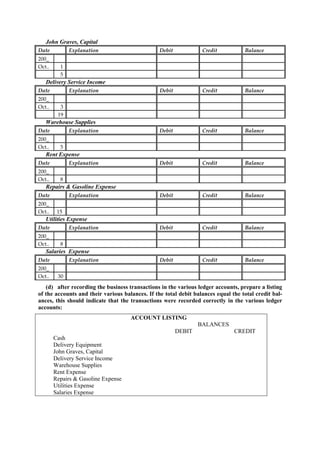
  • 86.
    У аудитора почтиникогда не может быть точного убеждения в том, что отчетность составлена правильно, и поэтому заключение аудитора имеет своим следствием только мнение, имеющее ту или иную степень убедительности. Результаты аудиторской проверки, так называемое мнение аудитора, представляется в форме аудиторского заключения — документа, имеющего юридическое значение для всех юридических и физических лиц, органов государственной власти и управления, органов местного управления и судебных органов. Аудиторское заключение составляется для пользователей (учреждений, акционеров, банков, потенциальных инвесторов, поставщиков и покупателей), которых интересуют данные экономического субъекта, гарантии полноты и правильности годового отчета. В отличие от аудиторского отчета, аудиторское заключение составляется в краткой форме, должно быть четким и содержать недвусмысленное описание результатов про- верки. В нем должны быть сделаны точно обоснованные выводы о достоверности бух- галтерской отчетности, ее соответствия действующему законодательству и типовым положениям по вопросам организации и ведения бухгалтерского учета. Выделяют четыре вида аудиторского заключения: безусловно положительное, ус- ловно положительное, отрицательное и отказ от выражения мнения. К аудиторскому заключению должна быть приложена бухгалтерская отчетность хо- зяйствующего субъекта, в отношении которой проводился аудит. Заключение аудитора должно состоять из трех частей: вводной, аналитической и итоговой. После подписания заключения и предоставления его заинтересованным пользователям аудитор не несет ответственности за имевшие место события. За правильность своего мнения, за степень найденной очевидности, аудитор несет от- ветственность, оговоренную в договоре с клиентом. Так как всегда есть сомнение в пра- вильности бухгалтерской отчетности, которую предоставляет администрация, то появле- ние посредника в лице аудитора становится необходимым, именно он может подтвердить, что эта отчетность составлена правильно или, что более точно, достаточно правильно. От- сюда возникает неизбежность возникновения аудита как гаранта рыночных отношений. SUPPLEMENTARY READING PRACTICE 1. Scan the text, single out the main facts and present them in a short review. Describe the two main functions of auditing; Discuss how public accountants (auditors) and government auditors perform these functions; Explain the importance of internal auditing. Audit is an examination of the records and reports of an enterprise by accounting special- ists other than those responsible for their preparation. Public auditing by independent accoun- tants has acquired professional status and become increasingly common with the rise of large business units and the separation of ownership from control. The public accountant performs tests to determine whether the management’s statements were prepared in accordance with acceptable accounting principles and fairly present the firm’s financial position and operating results. Such independent evaluations of management reports are of interest to actual and prospective shareholders, bankers, suppliers, lessors, and government agencies. Generally speaking, auditing has two functions: to reveal undesirable practices and, as far as possible, to prevent their recurring in the future. A relatively new type of auditing is internal auditing. It is
  • 87.
    designed to evaluatethe effectiveness of a business’s accounting system. Perhaps the most familiar type of auditing is the administrative audit, or pre-audit, in which individual vouch- ers, invoices or other documents are investigated for accuracy and proper authorization before they are paid or entered in the books. In English-speaking countries, public auditors are usually certified, and high standards of professional qualification are encouraged. Most countries have specific agencies or departments charged with the auditing of their public accounts. Taxpayers in all countries are interested in the sound management of the collected revenue, they al- so want to know whether or not the executive branch of government is complying with the law, espe- cially in the area of public finance. Government auditors are working for sound, economical and efficient financial management, addressing the key problems in the field of public sector auditing, like strengthening the institu- tions that oversee financial management, changes in the scope and methodology of government auditing, ability to conduct performance audits in public enterprises, strengthening internal audit- ing in spending units, ex-post external audits of government activities, budget efficiency problems, performance of expenditure programmes. The advantages accruing from an audit are obvious, taking into account the complexity of present-day commerce and business. 2. Read the dialogue, translate the Russian remarks into English and act the dialogue out. Fo- reigner: Rus- sian: F: R: F: R: F: R: As far as we know, you are Russia’s leading provider of accounting and con- sulting services. The history of your firm mirrors the changes that have taken place in Russia over the recent years. Да, вы правы. Наша фирма была основана еще в 1989 году. Все эти годы нам пришлось упорно работать, так как мы начинали практически с нуля. А сейчас мы активно сотрудничаем с Большой Шестеркой, крупнейшие пред- ставители нашего бизнеса обращаются к нам за помощью и советом. What services do you provide? Мы предоставляем широкий перечень услуг: от услуг в области бухуче- та и аудита до услуг в области финансового менеджмента и налогообложения. Главным является проведение аудиторских проверок и подтверждение фи- нансовой отчетности. Who are your clients? Нашими клиентами являются компании всех форм организации бизне- са, работающие во всех секторах нашей экономики, включая транспорт, тор- говлю и банковскую деятельность. We in the UK believe that if auditors are to play their role in economy they must be independent. What are your fundamental principles? Мы полностью разделяем вашу точку зрения в отношении независимо- сти аудиторов, кроме того, мы уделяем большое внимание повышению их профессионального уровня. Are there any professional organizations of auditors in Russia? Да, у нас существуют различные профессиональные организации, помо- гающие аудиторским фирмам решать различные вопросы, включая повыше-
  • 88.
    F: R: F: ние квалификации, лицензированиеи т. п. Thank you for the opportunity to learn something about auditing in Russia. 3. Read the text and: (а) fill each gap with a suitable word from the box; free opinion (2) statements proper preparing responsi- bilities standards performed accordance audit (2) management view Independent Auditors’ Report to the Board of Directors and Shareholders We have audited the consolidated balance sheets of the Company and Subsidiaries at Decem- ber 31, 2006 and 2007 and the related consolidated statements of income, shareholders’ equity and cash flows for each of the years in the period ended December 31, 2007. Respective 1) ___________ of directors and auditors are as follows: the company directors are re- sponsible for the preparation of financial 2)__________; our responsibility is to form an independent 3)________ based on our audit or these statements and to report our opinion to you. Basis of Opinion. We conducted our 4) ____________ in accordance with generally accepted auditing 5)_____________. Our audit includes examination, on a test basis, of evidence relevant to the amounts and disclosures in the financial statements. It also includes an assessment of the significant estimates and judgements made by the 6)______________ in the preparation of the financial statements, and of whether the accounting policies are appropriate to the company’s circumstances, consistently applied and adequately disclosed. We planned and 7)____________ our audit so as to obtain all the information and explanations which we considered 8)___________ in order to provide us with sufficient evidence to give reason- able assurance that the financial statements are 9)___________ from material misstatements, whether caused by fraud or other irregularity or error. In 10)___________ our opinion we also eva- luated the overall adequacy of the presentation of information in the financial statements. We be- lieve that our 11)_____________ provides a reasonable basis for our opinion. Opinion. In our 12)____________ the financial statements referred to above give a true and fair 13)___________ of the consolidated financial position of _____ Company and Subsidiaries at December 31, (year) and have been properly prepared in 14)____________ with generally ac- cepted accounting principles and the Company Act 1985. Words you may need: disclosure n — отражение, раскрытие (информации в финансовой отчетности) fraud n — обман, мошенничество (b) sum up the text in 5–7 sentences and present your summary.
  • 89.
    4. Read thetext and with the help of the scheme below give a short presentation on the work of the external auditor. External auditing Public companies have to submit their financial statements to external auditors — independent au- ditors who do not work for the company. The auditors have to give an opinion about whether the fi- nancial statements represent a true and fair view of the company's financial situation and results. During the audit, the external auditors examine the company's systems of internal control, to see whether transactions have been recorded correctly. They check whether the assets mentioned on the balance sheet actually exist, and whether their valuation is correct. For example, they usually check that some of the debtors recorded on the balance sheet are genuine. They also check the annual stock take — the count of all the goods held ready for sale. They always look for any unusual items in the company's account books or statements. Until recently, the big auditing firms also offered consulting services to the companies whose ac- counts they audited, giving them advice about business planning, strategy and restructuring. But after a number of big financial scandals, most accounting firms separated their auditing and consulting divi- sions, because an auditor who is also getting paid to advise a client is no longer totally independent. Words you may need: genuine (adj) — подлинный, неподдельный, настоящий stock take — инвентаризация Auditors produce an audit report. Are control systems adequate, according to external auditors? Have accounting principles been applied correctly? Auditors write a management letter to directors or senior managers explaining what needs to be changed. No – Auditors find irregularities: systems are not adequate, principles haven’t been applied correctly or consistently. Does the company follow the advice given in the management letter? No Auditors produce a qualified report, stating that the financial statements do not give an entirely true and fair view and there are some problems. Yes Yes
  • 90.
    5. Read thedocument below and discuss the results of the audit in Open Joint-Stock Compa- ny «Russian Railways» for the financial year 2006. Independent Auditors' Report To the Shareholders of Open Joint Stock Company «Russian Railways» We have audited the accompanying consolidated financial statements of JSC «Russian Railways» and its subsidiaries (hereinafter referred to as «the Company»), which comprise the consolidated balance sheet as of 31 December 2006, and the consolidated statement of income, consolidated statement of cash flows and consolidated statement of changes in equity for the year then ended, and a summary of significant ac- counting policies and other explanatory notes. Management Responsibility for the Financial Statements Management is responsible for the preparation and fair presentation of these consolidated financial statements in accordance with International Financial Reporting Standards. This responsibility includes: designing, implementing and maintaining internal control relevant to the preparation and fair presentation of consolidated financial statements that are free from material misstatement, whether due to fraud or error; selecting and applying appropriate accounting policies; and making accounting estimates that are reasona- ble in the circumstances. Auditors' Responsibility Our responsibility is to express an opinion on these consolidated financial statements based on our audit. We conducted our audit in accordance with International Standards on Auditing. Those standards require that we comply with ethical requirements and plan and perform the audit to obtain reasonable assurance whether the consolidated financial statements are free from material misstatement. An audit involves performing procedures to obtain audit evidence about the amounts and disclosures in the financial statements. The procedures selected depend on the auditors' judgment, including the assess- ment of the risks of material misstatement of the financial statements, whether due to fraud or error. In making those risk assessments, the auditor considers internal control relevant to the entity's preparation and fair presentation of the financial statements in order to design audit procedures that are appropriate in the circumstances, but not for the purpose of expressing an opinion on the effectiveness of the entity's internal control. An audit also includes evaluating the appropriateness of accounting policies used and the reasona- bleness of accounting estimates made by management, as well as evaluating the overall presentation of the financial statements. We believe that the audit evidence we have obtained is sufficient and appropriate to provide a basis for our audit opinion. Basis for Qualified Opinion (i) As discussed in Note 2 to the consolidated financial statements, in accordance with the Company's accounting policy, subsequent to initial recognition, property, plant and equipment are carried at reva- lued amounts being their fair values at the date of the revaluation less any subsequent accumulated de- preciation and impairment loss. In accordance with the requirements of International Accounting Stan- dard 16 «Property, Plant and Equipment» («IAS 16»), as amended, revaluations should be made with sufficient regularity such that the carrying amount of property, plant and equipment does not differ mate- rially from that which would be determined using fair value at the balance sheet date. The Company completed revaluation of one category of property, plant and equipment as of 1 Jan- uary 2004 and reported the effects of such revaluation by adjusting corresponding information in the consolidated financial statements. The last revaluation of the Company's other categories of property, plant and equipment was performed as of 31 December 1998. Therefore, we were unable to determine whether the carrying value of such other categories of property, plant and equipment of 1,068,481 and 898,713 millions of rubles as of 31 December 2006 and 2005, respectively, complies with the requirement referred to above. Similarly, we could not de- termine whether the impairment reserves provided by the Company, are adequate to reflect the value
  • 91.
    of the Company'stotal property, plant and equipment at its recoverable value. The effects of this de- parture from International Financial Reporting Standards on the consolidated financial statements, including but not limited to the effect on depreciation expense and the related deferred income tax, have not been determined. (ii) As of 1 January 2005, the Company commenced the application of a more comprehensive approach to components accounting for property, plant and equipment by re-defining certain significant components and revising its accounting estimates regarding their useful lives. These changes were accounted for by the Company as change in estimates. However, the Company has not consistently applied these new policies for component accounting, including capitalization and determination of useful lives, to certain property, plant and equipment in the year ended 31 December 2006. The effects of this departure from International Financial Reporting Standards on the consolidated financial statements, including, but not limited to, the effect on carrying values of property, plant and equipment, deferred tax assets as of 31 December 2006 and 2005, depreciation expense, deferred income tax charge, and disposal of items of property, plant and equipment for the years then ended, have not been determined. Qualified Opinion In our opinion, except for the effects on the consolidated financial statements of the matters de- scribed in the Basis for Qualified Opinion paragraphs (i) and (ii), the consolidated financial statements present fairly, in all material respects, the financial position of the Company as of 31 December 2006, and its financial performance and its cash flows for the year then ended in accordance with Interna- tional Financial Reporting Standards. Emphasis of Matter We draw attention to Note 23 to the consolidated financial statements. JSC «Russian Railways» to- gether with the Ministry of Economic Development and Trade, the Federal Agency of State Property of the Russian Federation and certain other ministries, continued implementation of the Program of railway transportation restructuring. 31 August 2007 6. Make a free translation of the text below. Interpret the main ideas! Виды аудита в деятельности транспортной корпорации А.В. Жаков, главный специалист Департамента корпоративных финансов ОАО «РЖД» Многочисленные виды деятельности, осуществляемые ОАО «РЖД», определяют и различные виды аудита, которые компания использует в своей работе. При этом виды аудита, проводимого на предприятиях железнодорожного транспорта, не ограничиваются рамками законодательства, представляя собой многоступенчатую систему контроля деятельности общества. Само слово «аудит» в переводе с латин- ского означает «слушание» и применяется в мировой практике для обозначения проверки, ревизии. Первым видом аудита, проводимого в транспортной корпорации, является фи- нансовый аудит, направленный на оценку достоверности финансовой информа- ции. К этому виду аудита относятся обязательный аудит, выполняемый сторонни- ми независимыми специалистами, и аудит, проводимый специалистами корпора- ции (внутренний). Обязательный аудит представляет собой ежегодную обязательную аудитор- скую проверку ведения бухгалтерского учета и финансовой (бухгалтерской) от- четности организации. Согласно нормативным документам, организационно-правовая форма (От- крытое акционерное общество), большой объем выручки от реализации продук-
  • 92.
    ции и значительнаясумма активов считаются такими обстоятельствами, кото- рые требуют установления повышенных гарантий достоверности финансовой (бухгалтерской) отчетности проверяемых лиц в целях защиты прав и законных интересов других лиц и государства, что достигается привлечением для еже- годной проверки и подтверждения годовой финансовой отчетности аудитора, не связанного имущественными интересами с обществом или его акционерами. При проведении обязательного аудита в организациях, в уставных капиталах которых доля государственной собственности или собственности субъекта РФ составляет не менее 25 %, договоры на оказание аудиторских услуг заключа- ются по итогам проведения открытого конкурса. Обязательный аудит ОАО «РЖД» за 2007 г. проводился аудиторской компанией БДО «ЮНИКОН» — по российским стандартам бухгалтерского учета и «Эрнст&Янг» — по МСФО. Наряду с этим, в соответствии с нормами законодательства, существуют такие контролирующие органы, как ревизионные комиссии, функции которых сводятся именно к обеспечению внутреннего контроля за финансово-хозяйственной дея- тельностью общества. Так, государство, являясь собственником ОАО «РЖД», фор- мирует состав Ревизионной комиссии из представителей различных министерств и ведомств. Внутренний аудит проводится специалистами организации (аудиторами, кон- тролерами, ревизорами) с целью оценки ее работы в собственных интересах. По- лученная при проверке информация, как правило, предназначается для удовле- творения потребностей управленческого персонала. Деятельность по организации и проведению внутреннего аудита и финансового контроля на всех уровнях управления ОАО «РЖД» и во всех сферах его финансово-экономической деятель- ности осуществляет структурное подразделение Центр контроля и внутреннего аудита «Желдорконтроль». ASSIGNMENT 1. Look at the following activities and decide which ones are normally done internally or ex- ternally. What does an auditor do? An auditor … 1) spends time getting to know the business as well as the environment and the in- dustry in which it operates __ ___ 2) analyses the internal business and financial systems used to make and record transactions __ ___ 3) gathers evidence on the financial control systems and the figures in the financial statements __ ___ 4) gives advice on the business methods and transactions of the company __ ___ 5) examines financial statements to determine whether they conform to generally
  • 93.
    accepted accounting principles__ ___ 6) prepares the financial statements in accordance with the generally accepted ac- counting principles of the country where the enterprise operates __ ___ 7) examines the management report and determines whether it conforms to the fi- nancial statements __ ___ 8) guarantees the correctness of the figures presented in the accounts __ ___ 9) provides consulting services __ ___ 10) presents a written report to the management of the company, describing whether the accounting records, financial statements and management reports conform to legal requirements __ ___ 11) maintains confidentiality and independence __ ___ 2. How can you explain the relationship between the shareholders, the directors and the audi- tors? Use the following scheme. elect a ccount review report elect A ud itorsShareholders D irectors 3. Do the following puzzle. Three business people are at a meeting. One of them is Swiss, one of them is German, and one is English. Their names are Peter, Bernardette, and Nathan. One is the Managing Director, another is an auditor, and the other is an accountant. From the information below, work out everyone’s name, nationality, job, and where they are sitting. The Managing Director is at the head of the table. The Accountant is on the Managing Director’s left hand side. The English man is opposite Bernerdette. Nathan is an Auditor. Bernardette is Swiss. DISCUSSION Discuss the followingquestions and present your ideas. 1. How could the work of auditors could be made more effective? 2. Should the government pay auditors, not the companies they audit? 3. Do many young people want to make a career in auditing? Why?
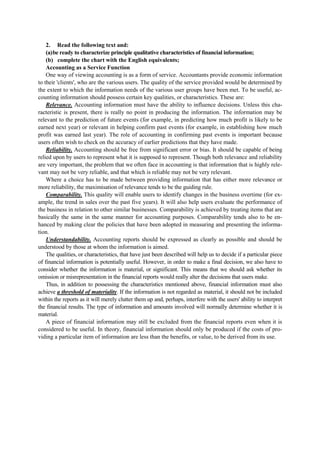
  • 94.
    4. If youwant to be an auditor, what sort of personal characteristics do you think are most impor- tant for auditors? Compare them with the personal features necessary for other financial professions.
  • 95.
    APPENDIX 1 EXAMPLES OFTHE US AND UK ACCOUNTING TERMS British Eng- lish American English Russian Chairman Managing Di- rector Stock Shares Shareholders’ equity Ordinary shares Preference shares Debtors Creditors Turnover Fixed assets Profit and loss account Net profit Depreciation A true and fair view Financial year Stock take Corporation tax President Chief Executive Officer (CEO) Inventory Stock Stockholders’ equity Common stock Preferred stock Accounts receivable Accounts payable Sales/Revenue Property, plant and equipment Income statement Net income Deprecia- tion/Amortization A fair presentation Fiscal year Count of the inventory Income tax председатель правления акционерного общества главный управляющий запасы акции акционерный капитал обыкновенные акции привилегированные акции дебиторская задолженность кредиторская задолженность выручка/товарооборот основные средства отчет о прибылях и убытках чистая прибыль амортизация/износ достоверное и объективное представле- ние финансовый год инвентаризация налог на прибыль APPENDIX 2 INTERNATIONAL ACCOUNTING STANDARDS THAT ARE CURRENTLY IN FORCE IAS МСФО I AS I I AS 2 I AS 4 I AS 7 «Presentation of Financial Statements» «Inventories» «Depreciation Accounting» «Cash Flow Statements» МС ФО 1 МС ФО 2 МС ФО 4 МС ФО 7 «Представление финансовой отчет- ности» «Запасы» «Учет амортизации» «Отчеты о движении денежных средств» I AS 8 I AS 10 I AS 11 I AS 12 «Net Profit or Loss for the Pe- riod, Fundamental Errors and Changes in Accounting Policies» «Events After the Balance Sheet Date» «Construction Contracts» «Income Taxes» «Segment Reporting» «Information Reflecting the Ef- fects of Changing Prices» МС ФО 8 МС ФО 10 МС ФО 11 МС ФО 12 «Чистая прибыль или убыток за пе- риод, фундаментальные ошибки и измене- ния в учетной политике» «События после отчетной даты» «Договоры подряда» «Налоги на прибыль» «Сегментная отчетность» «Информация, отражающая влияние изменения цен» «Основные средства»
  • 96.
    I AS 14 I AS 15 I AS16 I AS 17 I AS 18 I AS 19 I AS 20 I AS 21 I AS 22 I AS 23 I AS 24 I AS 25 I AS 26 I AS 27 I AS 28 I AS 29 I AS 30 I AS 31 I AS 32 I AS 33 I «Property, Plant and Equip- ment» «Leases» «Revenue» «Employee Benefits» «Accounting for Government Grants and Disclosure of Government Assistance» «The Effects of Changing in Foreign Exchange Rates» «Business Combinations» «Borrowing Costs» «Related Party Disclosures» «Investment Properties» «Accounting and Reporting by Retirement Benefit Plans» «Consolidated Financial State- ments» «Investments in Associates» «Financial Reporting in Hyper- inflationary Economies» «Disclosures in the Financial Statements of Banks and Similar Finan- cial Institutions» «Financial Reporting of Inter- ests in Joint Ventures»; «Financial Instruments: Disclo- sure and Presentation» «Earnings per Share» «Interim Financial Statements» «Discontinuing Operations» «Impairment of Assets» «Provisions, Contingent Liabili- ties and Contingent Assets» «Intangible Assets» «Financial Instruments Recogni- tion and Measurement» «Investment Property» «Agriculture» МС ФО 14 МС ФО 15 МС ФО 16 МС ФО 17 МС ФО 18 МС ФО 19 МС ФО 20 МС ФО 21 МС ФО 22 МС ФО 23 МС ФО 24 МС ФО 25 МС ФО 26 МС ФО 27 МС ФО 28 МС ФО 29 МС ФО 30 МС ФО 31 МС ФО 32 МС ФО 33 МС «Аренда» «Выручка» «Вознаграждения работникам» «Учет государственных субсидий и раскрытие информации о государственной помощи» «Влияние изменений валютных кур- сов» «Объединение компаний» «Затраты по займам» «Раскрытие информации о связанных сторонах» «Учет инвестиций» «Учет и отчетность по программам пенсионного обеспечения» «Консолидированная и отдельная фи- нансовая отчетность» «Инвестиции в ассоциированные орга- низации» «Финансовая отчетность в условиях гиперинфляции» «Раскрытие информации в финансо- вой отчетности банков и аналогичных фи- нансовых институтов» «Финансовая отчетность об уча- стии в совместной деятельности» «Финансовые инструменты: рас- крытие и представление информации» «Прибыль на акцию» «Промежуточная финансовая от- четность» «Прекращаемая деятельность» «Признание снижения стоимости активов» «Резервы, условные обязательства и условные активы» «Нематериальные активы» «Финансовые инструменты — при- знание и оценка» «Инвестиционная недвижимость» «Сельское хозяйство»
  • 97.
    AS 34 I AS 35 I AS36 I AS 37 I AS 38 I AS 39 I AS 40 I AS 41 ФО 34 МС ФО 35 МС ФО 36 МС ФО 37 МС ФО 38 МС ФО 39 МС ФО 40 МС ФО 41
  • 98.
    APPENDIX 3 CONSOLIDATED BALANCESHEET OF JSC «RUSSIAN RAILWAYS»
  • 101.
    APPENDIX 4 CONSOLIDATED PROFITAND LOSS ACCOUNT OF JSC «RUSSIAN RAILWAYS»
  • 104.
    APPENDIX 5 CONSOLIDATED CASHFLOW STATEMENT OF JSC «RUSSIAN RAILWAYS»
  • 108.
    GLOSSARY Accounting — asystem of recording the money value of business dealings and income and ex- penditure accounts to enable the management of a concern to see the financial position at any time Accounting equation — the basic principle on which all financial accounting depends, that the re- sources possessed by a business are equal to the sum of the sources from which those resources were obtained Accounting standards — accounting rules and procedures relating to measurement, valuation and disclosure Accounting Standards Committee — in the UK, the committee responsible for the preparation of Statements of Standard Accounting Practice and the issue of Statements of Recommended Practice Accounts payable — a current liability account showing amounts payable by a firm to suppliers for purchases of materials, stocks, or services on credit Accounts receivable — a current asset account showing amounts payable to a firm by customers who have made purchases of goods and services on credit Accruals — one of the accounting principles under which all income and charges relating to a fi- nancial year shall be taken into account, without regard to date of receipt or payment Annual report — a report prepared at yearly intervals and in particular the report required by law or other regulation to be made annually by the directors of a company to its shareholders giving information about the company’s trading activities and including certain documents, namely the balance sheet, the prof- it and loss account and the auditors’ and directors’ reports Assets — all things owned by a person or business and having some money value, esp. if they can be used to pay debts, produce goods, or in some way help the business to make a profit Audit — an official examination and checking of the annual accounts of an organization by inde- pendent qualified person, called an auditor, in order to make certain that they show accurately the true financial position and do not hide any dishonesty, and also that they are presented in proper form or- dered by law Audit report — a report written by the auditor officially appointed by an organization to audit its ac- counts. The report usu. written on the balance sheet or attached to it, must be law state Bad debts — debts which are likely never to be paid and must be treated as worthless by being en- tered as written off in a bad debts account Balance sheet — a statement showing the financial position of a business at a certain date, usu. the end of the financial year Book value — the original cost of a fixed asset, less the accumulated depreciation Breakeven — to be in a situation where income from sales equals the expenses of production, so that neither profit nor loss is made Capital — proprietorship interest as represented in a balance sheet by a contributed and accumu- lated capital equal in amount to the assets less liabilities Cash — money in the form of coin and bank-notes, and perh. cheques and negotiable instruments that can be quickly and easily exchanged for coin and bank-notes Cash flow — the amount of cash made by a business during a specified period which it can use for investment; it can be calculated from the accounts of a business and is a means of measuring its finan- cial strength Cost — the value given for accounting purposes to the stock of an article or commodity at the end of an accounting period Creditors — amounts (representing either cash or a claim to services) owed to an accounting enti- ty Current asset — an asset that can be reasonably be expected to be used up or converted into cash or sold within 1 year or less
  • 109.
    Current liability —a debt that is payable within 1 year or the current accounting period, whichev- er is longer Depreciation — the gradual loss of value of fixed assets such as buildings, plant and machinery, etc. because they wear out or decay or are replaced by more modern efficient things. This is one of the costs of running a business and must be charged against the profits Dividends — a corporation’s distribution of income to the shareholders of the corporation. The form of the dividend may be either cash or additional shares Double-entry system — the basic system of modern book-keeping by which each account has two sides, a debit side and a credit side, and each transaction is entered twice, as a debit in one account and as a credit in another Earned income — the income, which, for tax purposes, one receives as a reward for work, and in- cludes one’s salary or wages; pension or retirement annuity; profits received from one’s trade or pro- fession from an active partnership, royalties from patents and copyrights if one created them oneself Equity — 1) that part of capital of a company that consists of ordinary, deferred or founders’ shares, all of which together, in effect, carry the right of ownership in the business; 2) the difference between total assets and total liabilities. It represents the capital owned by a busi- ness Expenditure — the spending of something having value, such as time, money; Capital expenditure — money spent on fixed assets or on improvements of fixed assets Expenses — sums of money spent on the running a business in such a way that they do not add to the value of its assets. Thus money spent on rent, local taxes, electricity, insurance, salaries, advertis- ing, etc. Financial accounting — that part of accounting which is concerned mainly, with external report- ing to shareholders, government and other users of accounting outside the enterprise Financial analysis — the study of the present financial situation of a company, industry or coun- try, using statistical information about the immediate past and taking note of present market tenden- cies, such as consumer demand and government spending. From such a study, a skilful analyst will produce a forecast of future movements of prices of securities and commodities, rates of interest, cost of living, etc. Fixed assets — assets that are intended for use on a continuing basis in an enterprise’s activities. A fixed asset should be recognized in an enterprise’s balance sheet when a) it is probable that future economic benefits associated with the asset will flow to the enterprise; and b) the asset has a cost, and, where carried at a valuation, a value that can be measured with reliability Goodwill — the capital value of an intangible asset, that is the right to receive the extra profits, which an established business may be expected to earn, over and above the normal earnings for a simi- lar business Historical cost — the monetary amount for which an asset was originally purchased or produced Holding company — a company which holds a majority of the shares in another company (its sub- sidiary); or is a member of it and has the right to appoint or remove a majority of its board of directors Income Statement — a financial statement of an enterprise’s revenues, expenses and profit Intangible assets — assets, which are valuable in helping the business, but since they have no ma- terial form, are not easily turned into cash, e. g. goodwill, copyrights, trademarks, etc. Internal control — control of an organization’s operations, through procedures designed to safe- guard its assets, generate appropriate accounting data, and ensure efficient productivity Inventories — goods held for sale by a retail or wholesale business (merchandise inventory) or by a manufacture (finished goods); goods in intermediate stages of production (work in process); and raw materials and supplies Joint Venture — a partnership, formed by two or more persons or companies co-operating in some special business activity in which there is some risk of loss, but a reasonable hope of profit. The parties in the venture share the costs and the profits in agreed proportions
  • 110.
    Journal — anybook (or other record) in which either one or both aspects of an accounting transac- tion or other event are recorded chronologically on a day-to-day basis Lease — an agreement in writing by which one person (a lessor) gives another (a lessee) the right to use property, usually for a fixed number of years, in return for either a single sum of money called a premium or a series of regular payments called rent Ledger — in double-entry book-keeping, one of a set of main account books, or books of final en- try. In the ledgers, the debits and credits of all business dealings of a particular organization are rec- orded Liabilities — the debts owed by a business to its creditors and to its owner (s) Management accounting — the part of accounting which is concerned mainly with internal re- porting to the managers of an enterprise. It emphasizes the control and decision-making. It is relatively free of constraints imposed by legal regulation and accounting standards Mortgage — a charge over real property giving by a borrower to a lender to secure the repayment of a loan Net present value (NPV) — the discounted value of the future incremental cash receipts expected from the use of an asset less the discounted value of the incremental cash outlays Net profit — the excess of revenues over expenses. It may be calculated before or after extraordi- nary items and before or after tax depending upon the context Net realizable value — the amount of money for which an asset can be exchanged in a market, i. e. selling price less selling costs Overdraft — an agreed sum of money which by an arrangement a bank allows a customer to overdraw his account, i. e. to run into debt to the bank by drawing more than the amount standing to his credit in the account. The customer can make use of this money when he wishes, and for an agreed length of time. Interest is payable only on the amount overdrawn at the end of each day, but the bank may make an additional charge for agreeing to the arrangement, and will usually demand that the cus- tomer should deposit easily saleable stocks and shares as security for repayment of debt Overheads — the expenses of running a business, esp. those fixed costs that cannot be related to particular units of goods produced or goods sold, such as rent, rates and management salaries Payroll — a list of all employees and their respective salaries for a given period Profit and Loss Account — an accounting summary which is prepared for the purpose of calculat- ing the net profit of the business before taxation, i. e. the gross profit plus non-trading credits such as interest and discounts received, less the expenses of selling and of administering the business Progressive tax — a tax that is based on the amount of money that an individual earns Profitability — the power of a business to earn profits, or the degree to which a business is profitable, esp. as compared to another business Receivables — amounts owing to an enterprise whether current or non-current Revenue — amounts earned by trading (sales, turnover), providing services (fees) or by other ac- tivities (e. g. investment) Sales — amounts derived from the sale of goods and services (both for cash or on credit), falling within a business’s ordinary activities Shareholder — a member of a limited company and therefore a holder of none or more shares in that company Tangible assets — assets, which have material form and therefore can be turned into cash fairly quickly, e. g. securities, cash, cheques, etc. Taxes — compulsory levies made by public authorities for which nothing is received directly in re- turn. They are used in part to provide public goods
  • 111.
    Total income —the income of a taxpayer from all sources Turnover — 1) the total value of business done during a given period, usually the total annual sales; 2) the number of times that a stock of goods or of money is replaced in a given period Valuation — ascribing a monetary amount to an asset or a liability. The valuation may be a histor- ical one or a current one Working capital (WC) — the stock of money needed by a business in order to keep trading or to carry on production. It consists of stocks and liquid resources (cash and things that can quickly be turned into cash); and it is equal to the difference between the current assets and the current liabilities
  • 112.
    References 1. Kothari J.,Barone E. Financial Accounting. An International Approach. Pearson Education Limited, FT Prentice Hall, 2006. 408 p. 2. Atrill P., McLaney E. Accounting and Finance for Non-Specialists. Pearson Education Limited, FT Pren- tice Hall, 2006. 538 p. 3. Nobes C., Parker R.H. Comparative International Accounting. Prentice Hall International LTD, 1991. 520 p. 4. Sneyd M.R. Accounting. Prentice Hall International LTD, 1994. 118 p. 5. Rachman D.J., Mescon M.H., Bovee C.L., Thill J.V. Study Guide. Business Today, 1996. 270 p. 6. Mackenzie J. Financial English. Thomson Heinle, 2002. 159 p. 7. Mackenzie J. Professional English in Use Cambridge University Press, 2007.140 p. 8. Любимцева С.Н., Коренева В.Н. Курс английского языка для финансистов: Учебник. М.: ГИС, 2000. 380 с. 9. Быков В.С., Горбунова Т.В., Обласов М.В. Бухгалтерский учет себестоимости перевозок (продукции, работ). Новосибирск: Изд-во СГУПСа, 2001. 270 с. 10. Соколов Я.В., Пятов М.Л. Бухгалтерский учет для руководителя. М.: ПБОЮЛ Гриженко Е.М., 2000. 282 с. 11. Parker R.H. The Macmillan Dictionary of Accounting. The Macmillan Press LTD, 1992. 272 p. 12. Adam J.H. Longman Dictionary of Business English. Longman Group Limited, Relod, 1993. 492 p. 13. Hollett V. Business Objectives. Oxford University Press, 1993. 174 p. 14. Англо-русский словарь по бухгалтерскому учету, аудиту и финансам / Сост. Терехов Д.Ю. М.: Аскери, 1994. 508 с.
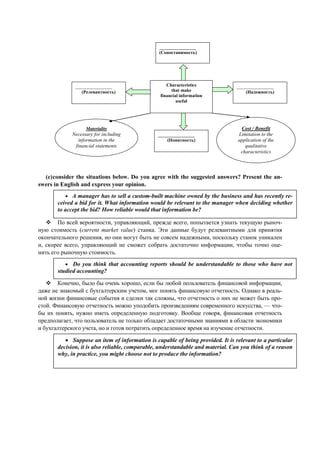
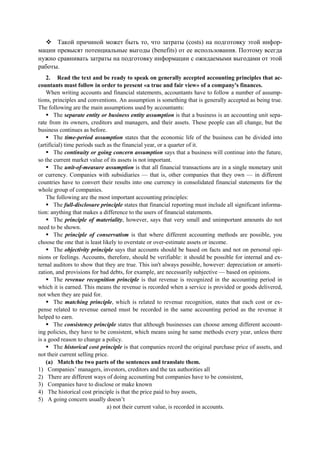
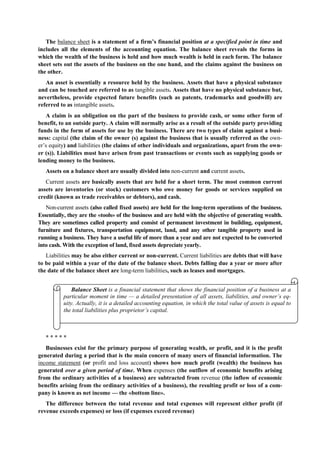
  • 113.
    ANSWER KEY UNIT 1 ReadingComprehension Ex. 3 1 – c; 2 – g; 3 – a; 4 – b; 5 – f; 6 – d; 7 – e Vocabulary Practice Ex.1 Compare – comparability, comparison; perform - performance; manage - management, manager; consist - consistency; consult – consultancy, consultant; inform - information; act - action, activity; assume - assumption; provide - provision, provider; evaluate - evaluation; measure - measurement Ex. 3 1 – d; 2 – a; 3 – g; 4 – f; 5 – c; 6 – h; 7 – j; 8 – i; 9 – e; 10 – b Ex. 4 1) to give reliable information; 2) the value of capital assets; 3) such details as the interest paid; 4) and expenditure on advertising; 5) he calculates profits; 6) can be distributed to shareholders; 7) is an absolute necessity; 8) would not know where it stood financially Ex. 5 1) account; 2) accountancy; 3) accounting; 4) accounts; 5) accountancy; 6) accountant; 7) accounts, ac- counting; 8) accountant, accounts; 9) accounting; 10) accountancy; 11) accounting, accounts Ex. 6 C – E – D – A – G – F – B Ex. 7 identification → recording → analysis → reporting Ex. 8 1 – F; 2 – F; 3 – T; 4 – F; 5 – T; 6 – T Supplementary Reading Practice Ex. 1 1) back; 2) profession; 3) creation; 4) throughout; 5) number; 6) role; 7) organizations; 8) functions; 9) prin- ciples; 10) accountants; 11) members; 12) organized Ex. 4 has; is regulated; is / has been; appeared; was intended; was created; was used; was made; consists; are called; is determined; is provided / has provided Ex. 7 (b) 1) Employees; 2) Owners (or Investors); 3) Lenders; 4) Suppliers; 5) Customers; 6) Government; 7) Mem- bers of the public; 8) Investment analysts; 9) Competitors; 10) Managers Assignment 1 – d; 2 – a UNIT 2 Vocabulary Practice Ex. 1 1 – h; 2 – g; 3 – j; 4 – a; 5 – b; 6 – d; 7 – i; 8 – e; 9 – f; 10 – c Ex. 2 1 – f; 2 – i; 3 – d; 4 – h; 5 – e; 6 – a; 7 – b; 8 – g; 9 – j; 10 – c Ex. 4 1) debit; 2) ledger; 3) debtors; 4) credit; 5) stock; 6) creditors Ex. 5 1) debit; 2) debit, credit; 3) credit, debit; 4) debit Ex. 6 1) significance; 2) duality; 3) events; 4) benefit; 5) double-entry; 6) transaction; 7) credit; 8) balance
  • 114.
    Ex. 7 1 –d; 2 – f; 3 – e; 4 – g; 5 – a; 6 – c; 7 – b Ex. 8 1) tax; 2) assets; 3) liabilities; 4) accountant; 5) creditor; 6) debtors ; 7) book-keeper; 8) equity; 9) cash Supplementary Reading Practice 1. (b) 1) In the account; 2) The ledger; 3) Date, explanation, and amount; 4) Debit; 5) Credit; 6) Debit (left side); 7) Debit; 8) Every business transaction involves a minimum of two changes. The system used to reflect this is known as double-entry accounting; 9) Total the debit and credit money columns. If the totals are the same, the account is said to be in balance. (c) Cash Date Explanation Debit Credit Balance 200_ Oct.. 1 12,000.00 12,000.00 3 3,000.00 15,000.00 8 500.00 14,500.00 15 250.00 14,250.00 19 1,200.00 15,450.00 25 50.00 15,400.00 30 450.00 14,950.00 Delivery Equipment Date Explanation Debit Credit Balance 200_ Oct.. 1 8,000.00 8,000.00 5 2,500.00 10,500.00 John Graves, Capital Date Explanation Debit Credit Balance 200_ Oct.. 1 20,000.00 20,000.00 5 1,200.00 23,000.00 Delivery Service Income Date Explanation Debit Credit Balance 200_ Oct.. 3 3,000.00 3,000.00 19 1,200.00 4,200.00 Warehouse Supplies Date Explanation Debit Credit Balance 200_ Oct.. 5 500.00 500.00 Rent Expense Date Explanation Debit Credit Balance 200_ Oct.. 8 500.00 500.00 Repairs & Gasoline Expense Date Explanation Debit Credit Balance 200_ Oct.. 15 250.00 250.00
  • 115.
    Utilities Expense Date ExplanationDebit Credit Balance 200_ Oct.. 8 50.00 50.00 Salaries Expense Date Explanation Debit Credit Balance 200_ Oct.. 30 450.00 450.00
  • 116.
    (d) ACCOUNT LISTING BALANCES DEBIT CREDIT Cash$14,950 Delivery Equipment 10,500 John Graves, Capital $23,000 Delivery Service Income 4,200 Warehouse Supplies 500 Rent Expense 500 Repairs & Gasoline Expense 250 Utilities Expense 50 Salaries Expense 450 $27,200 $27,200 3. (a) 1 – c; 2 – e; 3 – d; 4 – a; 5 – b (b) 1 – f; 2 – d; 3 – e; 4 – c; 5 – b; 6 – g; 7 – a; 8 – i; 9 – h 2. 1 – F; 2 – J; 3 – A; 4 – D; 5 – C; 6 – E; 7 – H; 8 – G; 9 – I; 10 – B Assignment 1. bookkeeping, a bookkeeper; external auditing, an independent auditor; management accounting, a management accountant, financial accounting, a financial accountant; accounting, an accountant or inter- nal auditing, an internal auditor 1) b; 2) d; 3) a; 4) $170,000 UNIT 3 Reading Comprehension Ex. 4 1 – T; 2 – F; 3 – T; 4 – T; 5 – F Vocabulary Practice Ex. 1 1 – g; 2 – h; 3 – e; 4 – j; 5 – b; 6 – c; 7 – a; 8 – d; 9 – f; 10 – i Ex. 2 1 – h; 2 – f; 3 – a; 4 – i; 5 – c; 6 – g; 7 – b; 8 – d; 9 – j; 10 – e Ex.3 to allocate funds; to incur costs; to publish a balance sheet; to draw up a statement; to make an entry; to keep books; to report upon financial position; to enter a transaction Ex. 4 Current assets – construction in progress, cash in bank, debtors, stock, bank deposits Fixed assets – premises, locomotives, land, sub-grade, investments Intangible assets – goodwill, human capital, trademark, patents, software Ex. 5 1) ordinary; 2) extraordinary; 3) turnover; 4) dividend; 5) distribution; 6) cost of sales; 7) administrative ex- penses; 8) retained Ex. 6 distribute profits, grant credit, owe money, pay liabilities, retain earnings 1) retain …earnings, distribute …profits; 2) owe … money, grant … credit; 3) liabilities …pay Ex. 7 1 – e; 2 – b; 3 – a; 4 – f; 5 – d; 6 – c Ex. 8 1) Suppliers; 2) Retained earnings; 3) Assets; 4) Liabilities; 5) Shareholders’ equity Ex. 9 1) revenue; 2) Revenue; 3) expenses; 4) profit; 5) dividend; 6) tax; 7) retain Ex. 10 Fixed assets – £41.9m; Stocks – £3m; debtors – £78m; Loans and overdrafts – £1.8m; Creditors – £134m; Capital and Reserves – £16m Ex. 11
  • 117.
    (a) 1) Loansand overdraft; 2) Share capital and reserves; 3) Fixed assets; 4) Dividend; 5) Creditors; 6) Deb- tors; 7) Stocks; 8) Net current assets; 9) Total assets (b) 1 – from, to; 2 – by; 3 – at; 4 – to; 5 – from, to Ex. 12 1) profit and loss account; 2) revenues; 3) turnover; 4) income; 5) balance sheet; 6) liabilities; 7) debtors; 8) creditors Ex. 13 1) bad debts; 2) net assets; 3) patent; 4) net book value; 5) goodwill; 6) trade mark; 7) write off; 8) to make provisions; 9) work-in progress; 10) debtors Ex. 14 a – 4; b – 1; c – 6; d – 9; e – 3; f – 2; g – 10; h – 7; i – 8; j – 5 Ex. 15 1) balance sheet; 2) inventory; 3) goodwill; 4) accounts receivables; 5) net income; 6) mortgage; 7) marketa- ble securities; 8) accounts payable; 9) depreciation; 10) receipts Supplementary Reading Practice Ex. 1 (c) deduct costs; depreciate fixed assets; record market value / purchase price; reduce profits / value 1) record … purchase price; 2) fixed assets, deduct … costs; 3) reduce … value (d) 1) straight-line; 2) declining balance; 3) sum-of-the-years’-digits; 4) unit of production; 5) hours of use Ex. 3 (b) 1) Operations; 2) Investing; 3) Financing; 4) operations; 5) financing; 6) operations; 7) investing Assignment Ex. 1 (a)An increase in the level of inventories would ultimately have an adverse effect on cash; (b)A bonus issue of ordinary shares has no cash flow effect; (c) Writing off some of the value of the inventories has no cash flow effect; (d)A disposal for cash of a large number of shares by a major shareholder has no cash flow effect as far as the business is concerned; (e) Depreciation doesn’t involve cash at all. Ex. 2 E ffect on prof- it on cash 1. Repayment of a loan none de- crease 2. Making a sale on credit increase none 3. Buying a non-current asset for cash none de- crease 4. Receiving cash from a debtor none in- crease 5. Depreciating a non-current asset de- crease none 6. Buying some inventories for cash none de- crease 7. Making a share issue for cash none in- crease Ex. 3 1) Non-current assets + Current assets – Current liabilities – Non-current liabilities = Capital 2) Assets = Capital + (Sales Revenue – Expenses) + Liabilities UNIT 4 Reading Comprehension Ex. 2 1 – d; 2 – i; 3 – f; 4 – j; 5 – k; 6 – a; 7 – b; 8 – h; 9 – c; 10 – e; 11 – g
  • 118.
    Vocabulary Practice Ex. 1 1– h; 2 – f; 3 – j; 4 – a; 5 – e; 6 – d; 7 – b; 8 – g; 9 – i; 10 – c Ex. 2 1 – e; 2 – f; 3 – g; 4 – j; 5 – a; 6 – h; 7 – c; 8 – d; 9 – b; 10 – i Ex. 4 1 – c; 2 – f; 3 – g; 4 – a; 5 – d; 6 – b; 7 – e Ex. 5 1 – g; 2 – f; 3 – h; 4 – d; 5 – a; 6 – e; 7 – b; 8 – c Ex. 6 1) tax accounting; 2) tax allowance; 3) tax authority; 4) tax avoidance; 5) tax consultant; 6) corporation tax; 7) tax deductible; 8) direct tax / taxation; 9) tax evasion; 10) tax free; 11) haven; 12) income tax; 13) indirect tax / taxation; 14) tax inspector; 15) tax loophole; 16) tax loss; 17) taxpayer; 18) progressive tax / taxation; 19) tax rates; 20) tax rebate; 21) regressive tax / taxation; 22) tax return; 23) sales tax; 24) tax shelter; 25) withholding tax; 26) tax year Ex. 7 1) are liable; 2) deduct, pay; evading; 3) avoid; 4) lower; 5) raise; 6) levies Ex. 8 1) increase; 2) bracket; 3) exile; 4) abolish; 5) exempt; 6) breaks; 7) property; 8) return
  • 119.
    Ex. 9 1) incometax; 2) corporation tax; 3) capital gains tax; 4) excise duty; 5) progressive tax; 6) creative account- ing; 7) tax haven; 8) loophole; 9) tax deductible; 10) tax loss; 11) value added tax; 12) tax evasion; 13) tax shel- ter; 14) money laundering Ex. 10 1 – b; 2 – a; 3 – b; 4 – b; 5 – b; 6 – a; 7 – b; 8 – b; 9 – c; 10 – c; 11 – a; 12 – b Supplementary Reading Practice Ex. 1 (a) 1 – F; 2 – T; 3 – F; 4 – T; 5 – T; 6 – T; 7 – F; 8 – F Ex. 3 Revenue; Redistribution; Repricing; Representation Assignment Ex. 1 1 – b; 2 – a; 3 – a; 4 – a; 5 – b Ex. 2 1 – c; 2 – a; 3 – b Ex. 3 Tax calculation: (0,05×50,000) + (0,10×50,000) + (0,15×75,000) = 18,750 The «effective rate» would be 10,7 %: 18,750 / 175,000 = 0,107 The «marginal rate» would be 15 %. UNIT 5 Reading Comprehension 1 – c; 2 – d; 3 – a; 4 – e; 5 – b; 6 – g; 7 - f Vocabulary Practice Ex. 1 reliable – reliability; accurate – accuracy; complete – completion; confident – confidence; correct – correctness; comply – compliance; evaluate – evaluation; depend – dependence; create – creation; con- clude – conclusion; measure – measurement; examine – examination Ex. 3 1 – g; 2 – c; 3 – i; 4 – h; 5 – j; 6 – f; 7 – b; 8 – a; 9 – d; 10 – e Ex. 4 1 – g; 2 – c; 3 – i; 4 – h; 5 – j; 6 – f; 7 – b; 8 – a; 9 – d; 10 – e Ex. 5 1 – d; 2 – c; 3 – a; 3 – b Ex. 6 Check accounts, stock take; systems of control; comply with laws, policies, procedures, regulations; examine accounts, systems of control; give advice, opinions Ex. 7 1) difference between; 2) refer to; 3) insist on; 4) in line with; 5) reason for; 6) responsible for; 7) blame for; 8) agree with; 9) suspicious of; 10) caused by Ex. 8 1 – d; 2 – h; 3 – f; 4 – a; 5 – i; 6 – c; 7 – k; 8 – e; 9 – l; 10 – m; 11 – j; 12 – n; 13 – g; 14 – b Ex. 9 1) internal auditors; 2) examination; 3) controllers; 4) evaluate; 5) accuracy; 6) comply with; 7) systems of control; 8) recommend Ex. 10 (a) 1) accuracy; 2) deviations; 3) standard operating procedures; 4) external; 5) determine; 6) board of direc- tors; 7) ratified; 8) shareholders; 9) Annual General Meeting; 10) deficiencies; 11) a synonym; 12) transnational corporations; 13) checking; 14) directives; 15) implemented; 16) subsidiaries (b) 1) review / check / evaluate / control; 2) give / present; 3) report; 4) appoint; 5) recommend; 6) legal Ex. 5 1) independent auditor; 2) internal control; 3) accounting principles; 4) generally accepted; 5) applied consistently; 6) prior periods; 7) financial disclosure; 8) evidence gathering Supplementary Reading Practice Ex. 3
  • 120.
    1) responsibilities; 2)statements; 3) opinion; 4) audit; 5) standards; 6) management; 7) performed; 8) proper; 9) free; 10) preparing; 11) audit; 12) opinion; 13) view; 14) accordance Assignment The Managing Director is Peter, who is German, The Accountant is Bernadette, who is Swiss, The Auditor is Nathan, who is English