Proprietary & Confidential
@GoCyberSec | January 2020
Chapter 4
Securing Your Network
CompTIA Security +
Proprietary & Confidential
@GoCyberSec | January 2020
Introduction
• Exploring advanced security devices
• Securing wireless networks
• Understanding wireless attacks
• Using VPNs for remote access
Proprietary & Confidential
@GoCyberSec | January 2020
Understanding IDSs and IPSs
• Intrusion Detection System (IDS)
–Detective control
–Attempts to detect attacks after they occur
• Firewall is a preventive control
–Attempts to prevent the attacks before they occur
• Intrusion Prevent System (IPS)
–A preventive control
–Will stop an attack in progress.
Proprietary & Confidential
@GoCyberSec | January 2020
Packet Sniffing
• Also called protocol analyzer
• Captures and analyzes network traffic
• Wireshark – free packet sniffer
• IDSs and IPSs include packet sniffing capabilities
Proprietary & Confidential
@GoCyberSec | January 2020
Host- and Network-Based IDS
HIDS
• Additional software on a workstation or server
• Can detect attacks on the local system
• Protects local resources on the host such as operating system
files
• Cannot monitor network traffic
Proprietary & Confidential
@GoCyberSec | January 2020
Host- and Network-Based IDS
NIDS
• Installed on network devices, such as routers or firewalls
• Monitors network traffic
• Can detect network-based attacks such as smurf attacks
• Cannot monitor encrypted traffic and cannot monitor traffic on
individual hosts.
Proprietary & Confidential
@GoCyberSec | January 2020
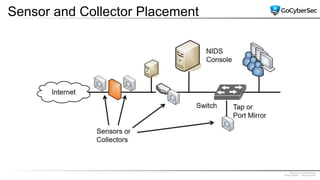
Sensor and Collector Placement
Proprietary & Confidential
@GoCyberSec | January 2020
IDS Detection Methods
Signature-Based
• Also called definition-based
• Use a database of predefined traffic patterns (such as CVE list)
• Keep signature files up-to-date
• Most basic form of detection
• Easiest to implement
Proprietary & Confidential
@GoCyberSec | January 2020
IDS Detection Methods
Heuristic-, behavior-based
• Also called anomaly-based
• Starts with a performance baseline of normal behavior
• IDS compares activity against this baseline
• Alerts on traffic anomalies
• Update the baseline if the environment changes
https://www.youtube.com/watch?v=RwWM0srLSg0
Proprietary & Confidential
@GoCyberSec | January 2020
IDS Considerations
• Data sources and trends
• Reporting
• IDS thresholds
• False positives
• Increase administrator’s workload
• False negatives
• No report during an incident
Proprietary & Confidential
@GoCyberSec | January 2020
IDS Considerations
Passive
• Notifies
• Pop-up window
• Central monitor
• E-mail
• Page
• Text message
Active
• Notifies
• Modifies environment
–Modify ACLs
–Close processes
–Divert the attack
Counterattacks
• Don’t do it
–Attackers are dedicated
–Attackers have unlimited time
Proprietary & Confidential
@GoCyberSec | January 2020
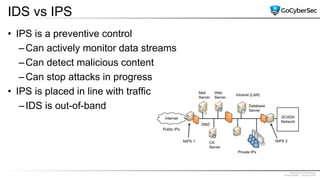
IDS vs IPS
• IPS is a preventive control
–Can actively monitor data streams
–Can detect malicious content
–Can stop attacks in progress
• IPS is placed in line with traffic
–IDS is out-of-band
Proprietary & Confidential
@GoCyberSec | January 2020
SSL / TLS Tools
• SSL decryptors
–Placed in DMZ between users and Internet
–Allows inspection of content
Proprietary & Confidential
@GoCyberSec | January 2020
Other Tools
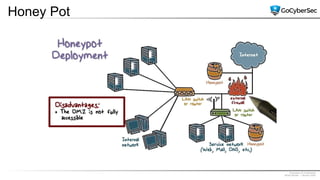
• Honeypots and Honeynets
–Used to divert an attacker
–Allow IT administrators an opportunity to observe
methodologies
–Can be useful to observe zero day exploits
• 802.1x port security
–Provides port-based authentication
–Prevents rogue devices from connecting
Proprietary & Confidential
@GoCyberSec | January 2020
Honey Pot
Proprietary & Confidential
@GoCyberSec | January 2020
Securing Wireless Networks
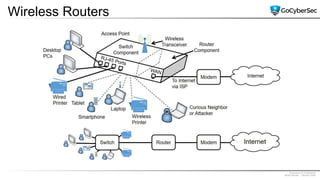
• WAPS and wireless routers
• All wireless routers are WAPs
• Not all WAPs are wireless routers
Proprietary & Confidential
@GoCyberSec | January 2020
Wireless Routers
Proprietary & Confidential
@GoCyberSec | January 2020
Access Point SSID
• Network name
• Change default SSID
• Disabling SSID broadcast
– Hides from some devices
– Does not hide from attackers
Proprietary & Confidential
@GoCyberSec | January 2020
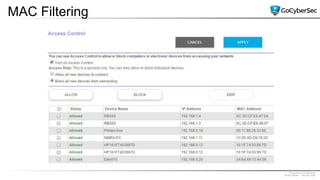
MAC Filtering
Proprietary & Confidential
@GoCyberSec | January 2020
Network Architecture and Zones
• Wireless
–Provides wireless devices access to wired networks
• Guest
–Typically provides Internet access to guests
–Rarely gives access to network resources
• Ad hoc
–Network between two or more wireless networks
–As needed
Proprietary & Confidential
@GoCyberSec | January 2020
Wireless Cryptographic Protocols
• WPA – Interim replacement for WEP
–Deprecated
• WPA2 – Current standard
–Provides best security when used with CCMP
• TKIP
–Older encryption protocol used with WPA
• CCMP
–Based on AES
–Recommended to be used with WPA2
Proprietary & Confidential
@GoCyberSec | January 2020
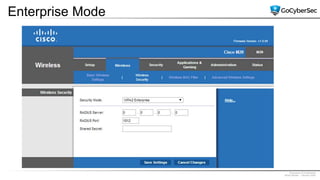
Enterprise Mode
• Adds strong authentication
• Uses an 802.1X server (implemented as a RADIUS server) to add
authentication
• RADIUS server
– RADIUS port
– Shared secret
– Similar to a password
Proprietary & Confidential
@GoCyberSec | January 2020
Enterprise Mode
Proprietary & Confidential
@GoCyberSec | January 2020
Wireless Attacks
• Disassociation attack
– Removes a wireless client from a wireless network
• WPS
– Streamlines process of configuring wireless clients
• WPS attack
– Brute force method to discover WPS PIN
– Reaver
Proprietary & Confidential
@GoCyberSec | January 2020
Wireless Attacks
• Rogue access points
– Unauthorized AP
• Evil twins
– Rogue AP with same SSID as legitimate AP
Proprietary & Confidential
@GoCyberSec | January 2020
Bluetooth Wireless
• Bluejacking
– Unauthorized sending of text messages from a Bluetooth device
• Bluesnarfing
– Unauthorized access to or theft of information from a Bluetooth
device
• Bluebugging
– Allows an attacker to take over a mobile phone
Proprietary & Confidential
@GoCyberSec | January 2020
Wireless Attacks
• Wireless replay attacks
– Captures data
– Attempts to use to impersonate client
• RFID attacks
– Sniffing or eavesdropping
– Replay
– DoS
• Misconfigured Access Points
– Use WPA2 with CCMP
– Disable WPS
Proprietary & Confidential
@GoCyberSec | January 2020
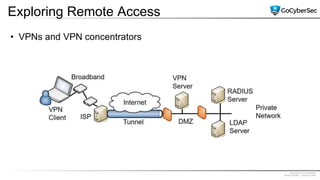
Exploring Remote Access
• VPNs and VPN concentrators
Proprietary & Confidential
@GoCyberSec | January 2020
VPN Tunnel Comparisons
• Split tunnel
– Encrypts only some traffic (such as traffic going to private network)
• Full tunnel
– Encrypts all traffic from client
– Can route client traffic through UTM in private network for
monitoring and protection
Proprietary & Confidential
@GoCyberSec | January 2020
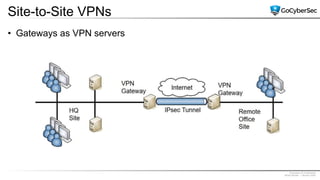
Site-to-Site VPNs
• Gateways as VPN servers
Proprietary & Confidential
@GoCyberSec | January 2020
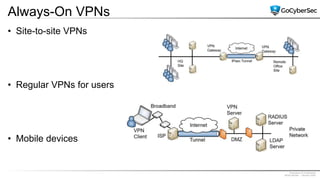
Always-On VPNs
• Site-to-site VPNs
• Regular VPNs for users
• Mobile devices
Proprietary & Confidential
@GoCyberSec | January 2020
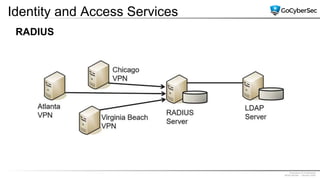
Identity and Access Services
RADIUS
Proprietary & Confidential
@GoCyberSec | January 2020
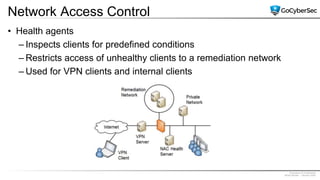
Network Access Control
• Health agents
– Inspects clients for predefined conditions
– Restricts access of unhealthy clients to a remediation network
– Used for VPN clients and internal clients
Proprietary & Confidential
@GoCyberSec | January 2020
AAA Protocols
• Provide authentication, authorization, and accounting
– Authentication verifies a user’s identification
– Authorization provides access
– Accounting tracks user access with logs
Proprietary & Confidential
@GoCyberSec | January 2020
Chapter 4 Summary
• Exploring advanced security devices
• Securing wireless networks
• Understanding wireless attacks
• Using VPNs for remote access

501 ch 4 securing your network

  • 1.
    Proprietary & Confidential @GoCyberSec| January 2020 Chapter 4 Securing Your Network CompTIA Security +
  • 2.
    Proprietary & Confidential @GoCyberSec| January 2020 Introduction • Exploring advanced security devices • Securing wireless networks • Understanding wireless attacks • Using VPNs for remote access
  • 3.
    Proprietary & Confidential @GoCyberSec| January 2020 Understanding IDSs and IPSs • Intrusion Detection System (IDS) –Detective control –Attempts to detect attacks after they occur • Firewall is a preventive control –Attempts to prevent the attacks before they occur • Intrusion Prevent System (IPS) –A preventive control –Will stop an attack in progress.
  • 4.
    Proprietary & Confidential @GoCyberSec| January 2020 Packet Sniffing • Also called protocol analyzer • Captures and analyzes network traffic • Wireshark – free packet sniffer • IDSs and IPSs include packet sniffing capabilities
  • 5.
    Proprietary & Confidential @GoCyberSec| January 2020 Host- and Network-Based IDS HIDS • Additional software on a workstation or server • Can detect attacks on the local system • Protects local resources on the host such as operating system files • Cannot monitor network traffic
  • 6.
    Proprietary & Confidential @GoCyberSec| January 2020 Host- and Network-Based IDS NIDS • Installed on network devices, such as routers or firewalls • Monitors network traffic • Can detect network-based attacks such as smurf attacks • Cannot monitor encrypted traffic and cannot monitor traffic on individual hosts.
  • 7.
    Proprietary & Confidential @GoCyberSec| January 2020 Sensor and Collector Placement
  • 8.
    Proprietary & Confidential @GoCyberSec| January 2020 IDS Detection Methods Signature-Based • Also called definition-based • Use a database of predefined traffic patterns (such as CVE list) • Keep signature files up-to-date • Most basic form of detection • Easiest to implement
  • 9.
    Proprietary & Confidential @GoCyberSec| January 2020 IDS Detection Methods Heuristic-, behavior-based • Also called anomaly-based • Starts with a performance baseline of normal behavior • IDS compares activity against this baseline • Alerts on traffic anomalies • Update the baseline if the environment changes https://www.youtube.com/watch?v=RwWM0srLSg0
  • 10.
    Proprietary & Confidential @GoCyberSec| January 2020 IDS Considerations • Data sources and trends • Reporting • IDS thresholds • False positives • Increase administrator’s workload • False negatives • No report during an incident
  • 11.
    Proprietary & Confidential @GoCyberSec| January 2020 IDS Considerations Passive • Notifies • Pop-up window • Central monitor • E-mail • Page • Text message Active • Notifies • Modifies environment –Modify ACLs –Close processes –Divert the attack Counterattacks • Don’t do it –Attackers are dedicated –Attackers have unlimited time
  • 12.
    Proprietary & Confidential @GoCyberSec| January 2020 IDS vs IPS • IPS is a preventive control –Can actively monitor data streams –Can detect malicious content –Can stop attacks in progress • IPS is placed in line with traffic –IDS is out-of-band
  • 13.
    Proprietary & Confidential @GoCyberSec| January 2020 SSL / TLS Tools • SSL decryptors –Placed in DMZ between users and Internet –Allows inspection of content
  • 14.
    Proprietary & Confidential @GoCyberSec| January 2020 Other Tools • Honeypots and Honeynets –Used to divert an attacker –Allow IT administrators an opportunity to observe methodologies –Can be useful to observe zero day exploits • 802.1x port security –Provides port-based authentication –Prevents rogue devices from connecting
  • 15.
  • 16.
    Proprietary & Confidential @GoCyberSec| January 2020 Securing Wireless Networks • WAPS and wireless routers • All wireless routers are WAPs • Not all WAPs are wireless routers
  • 17.
    Proprietary & Confidential @GoCyberSec| January 2020 Wireless Routers
  • 18.
    Proprietary & Confidential @GoCyberSec| January 2020 Access Point SSID • Network name • Change default SSID • Disabling SSID broadcast – Hides from some devices – Does not hide from attackers
  • 19.
    Proprietary & Confidential @GoCyberSec| January 2020 MAC Filtering
  • 20.
    Proprietary & Confidential @GoCyberSec| January 2020 Network Architecture and Zones • Wireless –Provides wireless devices access to wired networks • Guest –Typically provides Internet access to guests –Rarely gives access to network resources • Ad hoc –Network between two or more wireless networks –As needed
  • 21.
    Proprietary & Confidential @GoCyberSec| January 2020 Wireless Cryptographic Protocols • WPA – Interim replacement for WEP –Deprecated • WPA2 – Current standard –Provides best security when used with CCMP • TKIP –Older encryption protocol used with WPA • CCMP –Based on AES –Recommended to be used with WPA2
  • 22.
    Proprietary & Confidential @GoCyberSec| January 2020 Enterprise Mode • Adds strong authentication • Uses an 802.1X server (implemented as a RADIUS server) to add authentication • RADIUS server – RADIUS port – Shared secret – Similar to a password
  • 23.
    Proprietary & Confidential @GoCyberSec| January 2020 Enterprise Mode
  • 24.
    Proprietary & Confidential @GoCyberSec| January 2020 Wireless Attacks • Disassociation attack – Removes a wireless client from a wireless network • WPS – Streamlines process of configuring wireless clients • WPS attack – Brute force method to discover WPS PIN – Reaver
  • 25.
    Proprietary & Confidential @GoCyberSec| January 2020 Wireless Attacks • Rogue access points – Unauthorized AP • Evil twins – Rogue AP with same SSID as legitimate AP
  • 26.
    Proprietary & Confidential @GoCyberSec| January 2020 Bluetooth Wireless • Bluejacking – Unauthorized sending of text messages from a Bluetooth device • Bluesnarfing – Unauthorized access to or theft of information from a Bluetooth device • Bluebugging – Allows an attacker to take over a mobile phone
  • 27.
    Proprietary & Confidential @GoCyberSec| January 2020 Wireless Attacks • Wireless replay attacks – Captures data – Attempts to use to impersonate client • RFID attacks – Sniffing or eavesdropping – Replay – DoS • Misconfigured Access Points – Use WPA2 with CCMP – Disable WPS
  • 28.
    Proprietary & Confidential @GoCyberSec| January 2020 Exploring Remote Access • VPNs and VPN concentrators
  • 29.
    Proprietary & Confidential @GoCyberSec| January 2020 VPN Tunnel Comparisons • Split tunnel – Encrypts only some traffic (such as traffic going to private network) • Full tunnel – Encrypts all traffic from client – Can route client traffic through UTM in private network for monitoring and protection
  • 30.
    Proprietary & Confidential @GoCyberSec| January 2020 Site-to-Site VPNs • Gateways as VPN servers
  • 31.
    Proprietary & Confidential @GoCyberSec| January 2020 Always-On VPNs • Site-to-site VPNs • Regular VPNs for users • Mobile devices
  • 32.
    Proprietary & Confidential @GoCyberSec| January 2020 Identity and Access Services RADIUS
  • 33.
    Proprietary & Confidential @GoCyberSec| January 2020 Network Access Control • Health agents – Inspects clients for predefined conditions – Restricts access of unhealthy clients to a remediation network – Used for VPN clients and internal clients
  • 34.
    Proprietary & Confidential @GoCyberSec| January 2020 AAA Protocols • Provide authentication, authorization, and accounting – Authentication verifies a user’s identification – Authorization provides access – Accounting tracks user access with logs
  • 35.
    Proprietary & Confidential @GoCyberSec| January 2020 Chapter 4 Summary • Exploring advanced security devices • Securing wireless networks • Understanding wireless attacks • Using VPNs for remote access