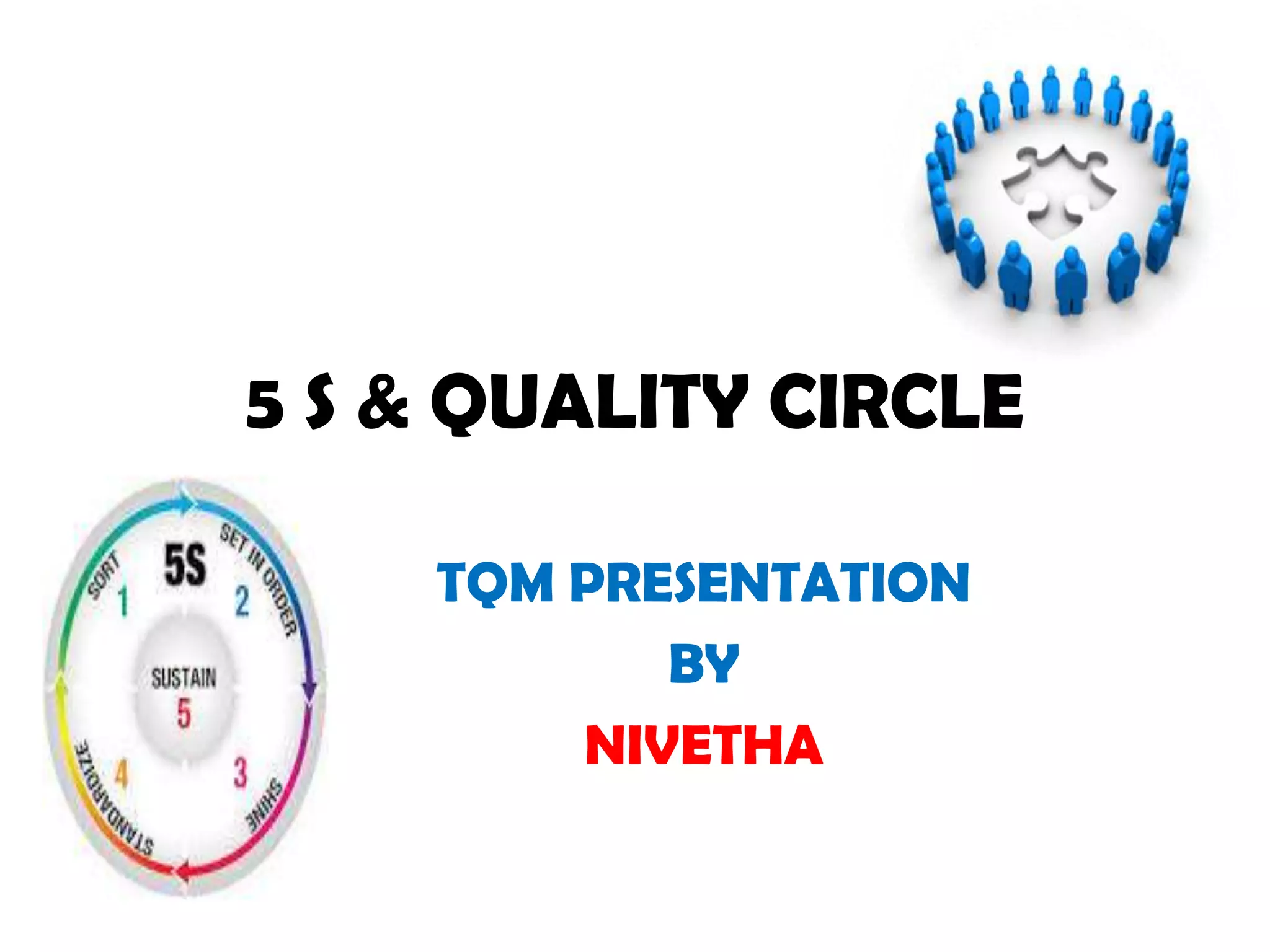
5 S & QUALITY CIRCLE
TQM PRESENTATION
BY
NIVETHA
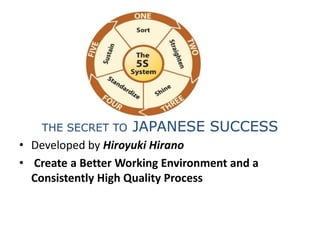
THE SECRET TO JAPANESE SUCCESS
• Developed by Hiroyuki Hirano
• Create a Better Working Environment and a
Consistently High Quality Process
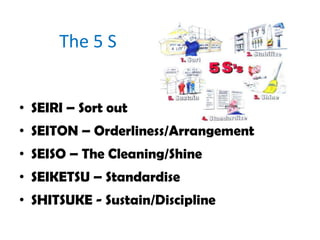
The 5 S
• SEIRI – Sort out
• SEITON – Orderliness/Arrangement
• SEISO – The Cleaning/Shine
• SEIKETSU – Standardise
• SHITSUKE - Sustain/Discipline
SEIRI – Sort out
• Decide what you need (necessary) and remove unnecessary items
(RED TAG TECHNIQUE )
• All tools, gauges, materials, classified and then stored
• Fights the habit to keep things because the may be useful
SOMEDAY
• The idea is to ensure that everything left at the workplace is related
to work
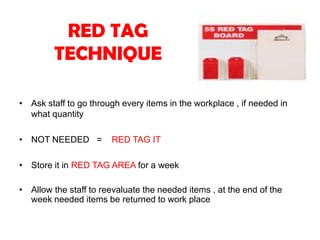
RED TAG
TECHNIQUE
• Ask staff to go through every items in the workplace , if needed in
what quantity
• NOT NEEDED = RED TAG IT
• Store it in RED TAG AREA for a week
• Allow the staff to reevaluate the needed items , at the end of the
week needed items be returned to work place
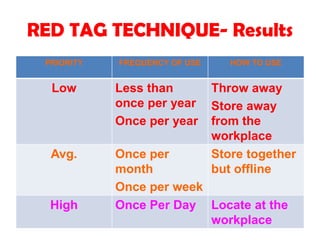
RED TAG TECHNIQUE- Results
PRIORITY FREQUENCY OF USE HOW TO USE
Low Less than
once per year
Once per year
Throw away
Store away
from the
workplace
Avg. Once per
month
Once per week
Store together
but offline
High Once Per Day Locate at the
workplace
SEITON –
Orderliness/Arrangement
• Arrange the necessary items in order
• This step is all about putting things to its assigned place so that it
can be accessed easily & quickly
– Designated locations
– Use tapes and labels
– Ensure everything is available as it is needed and at the “point of
use”
– PLACE FOR EVERYHTING AND EVERYTHING ON ITS PLACE
SEISO – The
Cleaning/Shine
• After the first cleaning when implementing 5 S , daily follow up
cleaning is necessary in order to sustain the improvement
• Divide areas into zones and Define responsibilities for cleaning
• Tools and equipment must be owned by an individual
• CREATE A SPOTLESS WORLPLACE BY VEIWING THROUGH
THE EYES OF VISITORS
SEIKETSU – Standardise
• Once the 3 S are in place , it should be set as an standard so as to
keep best practices in place
• Develop procedures, schedules
• Continue to assess the use and disposal of items
• Regularly audit using checklists and measures of housekeeping
• TURN IT TO NATURAL, STANDARD BEHAVIOUR AND HABIT
SHITSUKE -
Sustain/Discipline
• Develop an attitude to maintain other 4 S alive create discipline in
whatever you are doing
• The effect of continuous improvement leads to less waste , better
quality and high morale, cleaner workplace & faster leads times
TEST FOR 5S
• 30 SECOND RULE
• ONE MUST LOCATE THE ITEM WITH IN 30 SECOND IF 5S IS
PROPERLY IMPLEMENTED
• ALSO APPLIES TO THE ELECTRONIC RECORDS RETRIEVAL
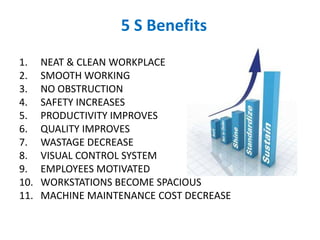
5 S Benefits
1. NEAT & CLEAN WORKPLACE
2. SMOOTH WORKING
3. NO OBSTRUCTION
4. SAFETY INCREASES
5. PRODUCTIVITY IMPROVES
6. QUALITY IMPROVES
7. WASTAGE DECREASE
8. VISUAL CONTROL SYSTEM
9. EMPLOYEES MOTIVATED
10. WORKSTATIONS BECOME SPACIOUS
11. MACHINE MAINTENANCE COST DECREASE
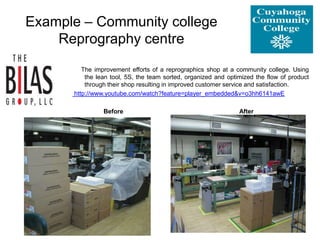
Example – Community college
Reprography centre
The improvement efforts of a reprographics shop at a community college. Using
the lean tool, 5S, the team sorted, organized and optimized the flow of product
through their shop resulting in improved customer service and satisfaction.
http://www.youtube.com/watch?feature=player_embedded&v=o3hh6141awE
Before After
Before After
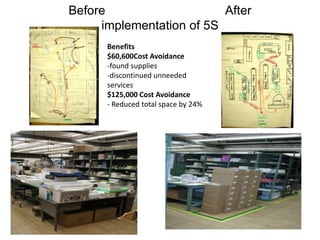
implementation of 5S
Benefits
$60,600Cost Avoidance
-found supplies
-discontinued unneeded
services
$125,000 Cost Avoidance
- Reduced total space by 24%
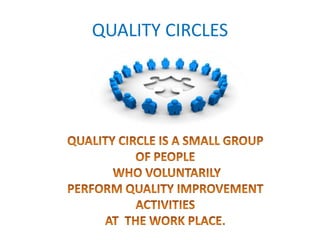
QUALITY CIRCLES
QUALITY CIRCLES
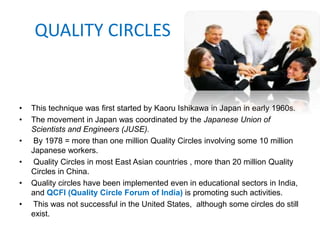
• This technique was first started by Kaoru Ishikawa in Japan in early 1960s.
• The movement in Japan was coordinated by the Japanese Union of
Scientists and Engineers (JUSE).
• By 1978 = more than one million Quality Circles involving some 10 million
Japanese workers.
• Quality Circles in most East Asian countries , more than 20 million Quality
Circles in China.
• Quality circles have been implemented even in educational sectors in India,
and QCFI (Quality Circle Forum of India) is promoting such activities.
• This was not successful in the United States, although some circles do still
exist.
3 MAJOR ATTRIBUTES
 Quality Circle is a form of participation management.
 Quality Circle is a human resource development technique.
 Quality Circle is a problem solving technique.
Objectives
A) Change in Attitude.
B) Self Development
C) Development of Team Spirit
D) Improved Organizational Culture
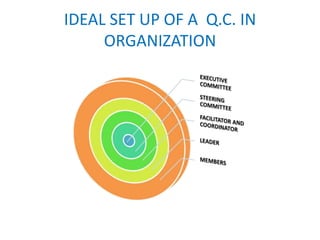
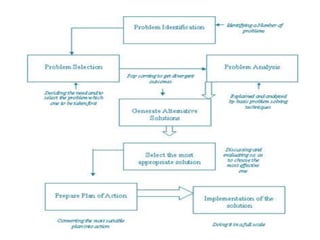
IDEAL SET UP OF A Q.C. IN
ORGANIZATION
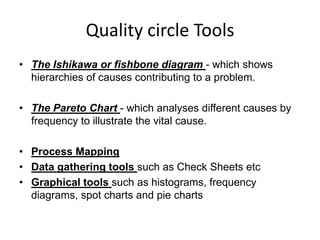
Quality circle Tools
• The Ishikawa or fishbone diagram - which shows
hierarchies of causes contributing to a problem.
• The Pareto Chart - which analyses different causes by
frequency to illustrate the vital cause.
• Process Mapping
• Data gathering tools such as Check Sheets etc
• Graphical tools such as histograms, frequency
diagrams, spot charts and pie charts
Benefits of Q.C
 Reduce errors and enhance quality and productivity
 Inspire more effective teamwork
 Promote job involvement ,participation and employee motivation
 Build an attitude of problem prevention / problem solving capacity
 Improve communication in the organization
 Develop worker relationship
 Promote personal and leadership development.
 Develop a greater safety awareness/quality of work life
 cost reduction
Limitations
• Inadequate Training
• Not truly Voluntary
• Lack of Management Interest
• Quality Circles are not really empowered to make decisions.
Example

5 s and quality circle

  • 1.
    5 S &QUALITY CIRCLE TQM PRESENTATION BY NIVETHA
  • 2.
    THE SECRET TOJAPANESE SUCCESS • Developed by Hiroyuki Hirano • Create a Better Working Environment and a Consistently High Quality Process
  • 3.
    The 5 S •SEIRI – Sort out • SEITON – Orderliness/Arrangement • SEISO – The Cleaning/Shine • SEIKETSU – Standardise • SHITSUKE - Sustain/Discipline
  • 4.
    SEIRI – Sortout • Decide what you need (necessary) and remove unnecessary items (RED TAG TECHNIQUE ) • All tools, gauges, materials, classified and then stored • Fights the habit to keep things because the may be useful SOMEDAY • The idea is to ensure that everything left at the workplace is related to work
  • 5.
    RED TAG TECHNIQUE • Askstaff to go through every items in the workplace , if needed in what quantity • NOT NEEDED = RED TAG IT • Store it in RED TAG AREA for a week • Allow the staff to reevaluate the needed items , at the end of the week needed items be returned to work place
  • 6.
    RED TAG TECHNIQUE-Results PRIORITY FREQUENCY OF USE HOW TO USE Low Less than once per year Once per year Throw away Store away from the workplace Avg. Once per month Once per week Store together but offline High Once Per Day Locate at the workplace
  • 7.
    SEITON – Orderliness/Arrangement • Arrangethe necessary items in order • This step is all about putting things to its assigned place so that it can be accessed easily & quickly – Designated locations – Use tapes and labels – Ensure everything is available as it is needed and at the “point of use” – PLACE FOR EVERYHTING AND EVERYTHING ON ITS PLACE
  • 8.
    SEISO – The Cleaning/Shine •After the first cleaning when implementing 5 S , daily follow up cleaning is necessary in order to sustain the improvement • Divide areas into zones and Define responsibilities for cleaning • Tools and equipment must be owned by an individual • CREATE A SPOTLESS WORLPLACE BY VEIWING THROUGH THE EYES OF VISITORS
  • 9.
    SEIKETSU – Standardise •Once the 3 S are in place , it should be set as an standard so as to keep best practices in place • Develop procedures, schedules • Continue to assess the use and disposal of items • Regularly audit using checklists and measures of housekeeping • TURN IT TO NATURAL, STANDARD BEHAVIOUR AND HABIT
  • 10.
    SHITSUKE - Sustain/Discipline • Developan attitude to maintain other 4 S alive create discipline in whatever you are doing • The effect of continuous improvement leads to less waste , better quality and high morale, cleaner workplace & faster leads times
  • 11.
    TEST FOR 5S •30 SECOND RULE • ONE MUST LOCATE THE ITEM WITH IN 30 SECOND IF 5S IS PROPERLY IMPLEMENTED • ALSO APPLIES TO THE ELECTRONIC RECORDS RETRIEVAL
  • 12.
    5 S Benefits 1.NEAT & CLEAN WORKPLACE 2. SMOOTH WORKING 3. NO OBSTRUCTION 4. SAFETY INCREASES 5. PRODUCTIVITY IMPROVES 6. QUALITY IMPROVES 7. WASTAGE DECREASE 8. VISUAL CONTROL SYSTEM 9. EMPLOYEES MOTIVATED 10. WORKSTATIONS BECOME SPACIOUS 11. MACHINE MAINTENANCE COST DECREASE
  • 13.
    Example – Communitycollege Reprography centre The improvement efforts of a reprographics shop at a community college. Using the lean tool, 5S, the team sorted, organized and optimized the flow of product through their shop resulting in improved customer service and satisfaction. http://www.youtube.com/watch?feature=player_embedded&v=o3hh6141awE Before After
  • 14.
    Before After implementation of5S Benefits $60,600Cost Avoidance -found supplies -discontinued unneeded services $125,000 Cost Avoidance - Reduced total space by 24%
  • 15.
  • 16.
    QUALITY CIRCLES • Thistechnique was first started by Kaoru Ishikawa in Japan in early 1960s. • The movement in Japan was coordinated by the Japanese Union of Scientists and Engineers (JUSE). • By 1978 = more than one million Quality Circles involving some 10 million Japanese workers. • Quality Circles in most East Asian countries , more than 20 million Quality Circles in China. • Quality circles have been implemented even in educational sectors in India, and QCFI (Quality Circle Forum of India) is promoting such activities. • This was not successful in the United States, although some circles do still exist.
  • 17.
    3 MAJOR ATTRIBUTES Quality Circle is a form of participation management.  Quality Circle is a human resource development technique.  Quality Circle is a problem solving technique.
  • 18.
    Objectives A) Change inAttitude. B) Self Development C) Development of Team Spirit D) Improved Organizational Culture
  • 19.
    IDEAL SET UPOF A Q.C. IN ORGANIZATION
  • 21.
    Quality circle Tools •The Ishikawa or fishbone diagram - which shows hierarchies of causes contributing to a problem. • The Pareto Chart - which analyses different causes by frequency to illustrate the vital cause. • Process Mapping • Data gathering tools such as Check Sheets etc • Graphical tools such as histograms, frequency diagrams, spot charts and pie charts
  • 22.
    Benefits of Q.C Reduce errors and enhance quality and productivity  Inspire more effective teamwork  Promote job involvement ,participation and employee motivation  Build an attitude of problem prevention / problem solving capacity  Improve communication in the organization  Develop worker relationship  Promote personal and leadership development.  Develop a greater safety awareness/quality of work life  cost reduction
  • 23.
    Limitations • Inadequate Training •Not truly Voluntary • Lack of Management Interest • Quality Circles are not really empowered to make decisions.
  • 24.

Editor's Notes

  • #15 Video /document mailed
  • #20 Executive committee: senior- level management committee empowered to make and implement major organizational decisions.A steering committee: This is at the top of the structure. It is headed by a senior executive and includes representatives from the top management personnel and human resources development people. It establishes policy, plans and directs the program and meets usually once in a month. Co-coordinator: He may be a Personnel or Administrative officer who co-ordinates and supervises the work of the facilitators and administers the program me. Facilitator:He may be a senior supervisory officer. He co-ordinates the works of several quality circles through the Circle leaders. Circle leader: Leaders may be from lowest level workers or Supervisors. A Circle leader organizes and conducts Circle activities. Circle members: They may be staff workers. Without circle members the programme cannot exist. They are the lifeblood of quality circles.