Prof. Amr Goneid, AUC 1
Analysis & Design of
Algorithms
(CSCE 321)
Prof. Amr Goneid
Department of Computer Science, AUC
Part 5. Recursive Algorithms
Prof. Amr Goneid, AUC 2
Recursive Algorithms
Prof. Amr Goneid, AUC 3
Recursive Algorithms
 Modeling Recursive Algorithms
 Examples of Recurrences
 Exclude & Conquer
 General Solution of 1st Order Linear
Recurrences
 2nd Order Linear Recurrence
Prof. Amr Goneid, AUC 4
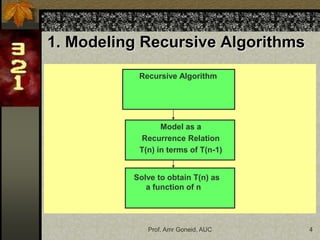
1. Modeling Recursive Algorithms
Recursive Algorithm
Model as a
Recurrence Relation
T(n) in terms of T(n-1)
Solve to obtain T(n) as
a function of n
Prof. Amr Goneid, AUC 5
Recurrence Relations
 A recurrence relation is an equation describing a
function in terms of its value for smaller instances.
 Many algorithms, particularly exclude & conquer
and divide and conquer algorithms, have time
complexities which are naturally modeled by
recurrence relations.
 Many counting problems can be modeled as
recurrences. Solving the recurrence relation
solves the problem.
Prof. Amr Goneid, AUC 6
Recurrence Relations
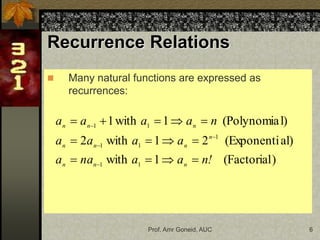
 Many natural functions are expressed as
recurrences:
)
(Factorial
1
with
al)
(Exponenti
2
1
with
2
l)
(Polynomia
1
with
1
1
1
1
1
1
1
1
!
n
a
a
na
a
a
a
a
a
n
a
a
a
a
n
n
n
n
n
n
n
n
n
n

















Prof. Amr Goneid, AUC 7
Recurrence Relations
To derive the recurrence relation:
 Identify the problem size (n).
 Find the base case size n0
(usually n0 = 0 ,1 or 2) and find T(n0)
 The general case consists of “a” recursive
calls to do smaller sub-problems (usually of
size n-1) plus a cost “b” for all the work
needed other than in the recursive calls.
Prof. Amr Goneid, AUC 8
Recurrence Relations
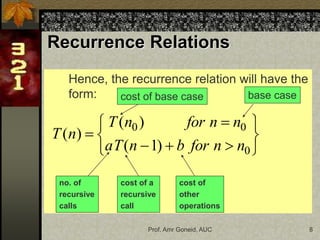
Hence, the recurrence relation will have the
form:











0
0
0
)
1
(
)
(
)
(
n
n
for
b
n
aT
n
n
for
n
T
n
T
base case
cost of base case
no. of
recursive
calls
cost of a
recursive
call
cost of
other
operations
Prof. Amr Goneid, AUC 9
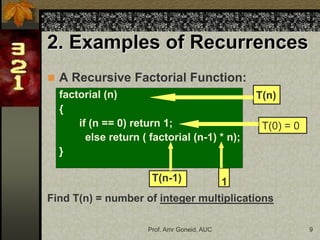
T(0) = 0
 A Recursive Factorial Function:
factorial (n)
{
if (n == 0) return 1;
else return ( factorial (n-1) * n);
}
Find T(n) = number of integer multiplications
2. Examples of Recurrences
T(n)
T(n-1) 1
Prof. Amr Goneid, AUC 10
Examples
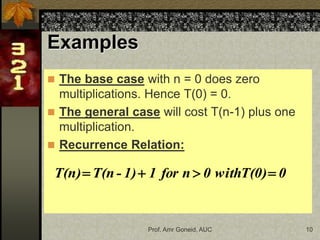
 The base case with n = 0 does zero
multiplications. Hence T(0) = 0.
 The general case will cost T(n-1) plus one
multiplication.
 Recurrence Relation:
0
T(0)
0 with
n
for
1
1)
-
T(n
T(n) 



Prof. Amr Goneid, AUC 11
Examples
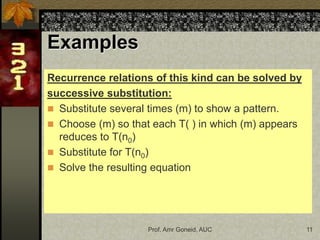
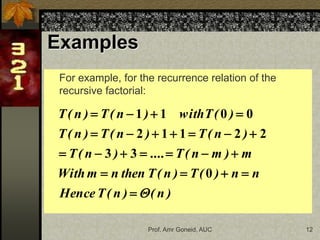
Recurrence relations of this kind can be solved by
successive substitution:
 Substitute several times (m) to show a pattern.
 Choose (m) so that each T( ) in which (m) appears
reduces to T(n0)
 Substitute for T(n0)
 Solve the resulting equation
Prof. Amr Goneid, AUC 12
Examples
For example, for the recurrence relation of the
recursive factorial:
)
n
(
)
n
(
T
Hence
n
n
)
(
T
)
n
(
T
then
n
m
With
m
)
m
n
(
T
....
)
n
(
T
)
n
(
T
)
n
(
T
)
n
(
T
)
(
T
with
)
n
(
T
)
n
(
T
























0
3
3
2
2
1
1
2
0
0
1
1
Prof. Amr Goneid, AUC 13
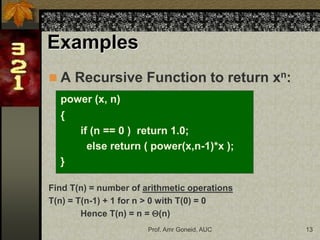
 A Recursive Function to return xn:
power (x, n)
{
if (n == 0 ) return 1.0;
else return ( power(x,n-1)*x );
}
Find T(n) = number of arithmetic operations
T(n) = T(n-1) + 1 for n > 0 with T(0) = 0
Hence T(n) = n = (n)
Examples
Prof. Amr Goneid, AUC 14
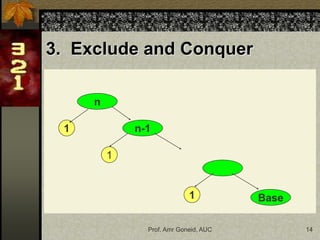
3. Exclude and Conquer
n
1 n-1
Base
1
1
Prof. Amr Goneid, AUC 15
// Assume the data are in locations s….e of array a[0..n-1]
// A problem of size (n) arises when the function is invoked as
// selectsort(a,0,n-1), i.e. with s = 0 and e = n-1
Selectsort (a[ ], s, e)
{
if (s < e) {
m = minimum (a , s , e) ;
swap (a[s] , a[m]);
Selectsort (a,s+1,e); }
}
Example: Recursive Selection Sort
T(s,e)
T(s+1,e)
comp
s
e )
( 
swap
1
Prof. Amr Goneid, AUC 16
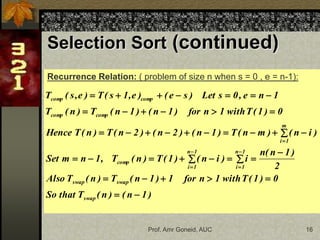
Selection Sort (continued)
Recurrence Relation: ( problem of size n when s = 0 , e = n-1):
)
1
n
(
)
n
(
T
that
So
0
)
1
(
T
with
1
n
for
1
)
1
n
(
T
)
n
(
T
Also
2
)
1
n
(
n
i
)
i
n
(
)
1
(
T
)
n
(
T
,
1
n
m
Set
)
i
n
(
)
m
n
(
T
)
1
n
(
)
2
n
(
)
2
n
(
T
)
n
(
T
Hence
0
)
1
(
T
with
1
n
for
)
1
n
(
)
1
n
(
T
)
n
(
T
1
n
e
,
0
s
Let
)
s
e
(
)
e
,
1
s
(
T
)
e
,
s
(
T
swap
swap
swap
1
n
1
i
1
n
1
i
comp
m
1
i
comp
comp
comp
comp











 




 



























Prof. Amr Goneid, AUC 17
4. General Solution of 1st Order
Linear Recurrences
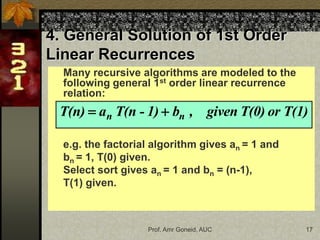
Many recursive algorithms are modeled to the
following general 1st order linear recurrence
relation:
e.g. the factorial algorithm gives an = 1 and
bn = 1, T(0) given.
Select sort gives an = 1 and bn = (n-1),
T(1) given.
T(1)
or
T(0)
given
,
b
1)
-
T(n
a
T(n) n
n 

Prof. Amr Goneid, AUC 18
General Solution of 1st Order
Linear Recurrences
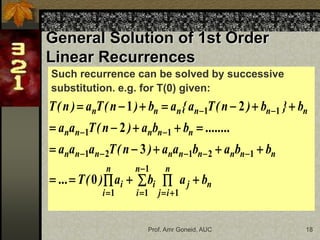
Such recurrence can be solved by successive
substitution. e.g. for T(0) given:
n
n
i
j
j
n
i
i
n
i
i
n
n
n
n
n
n
n
n
n
n
n
n
n
n
n
n
n
n
n
n
b
a
b
a
)
(
T
...
b
b
a
b
a
a
)
n
(
T
a
a
a
........
b
b
a
)
n
(
T
a
a
b
}
b
)
n
(
T
a
{
a
b
)
n
(
T
a
)
n
(
T






































1
1
1
1
1
2
1
2
1
1
1
1
1
0
3
2
2
1
Prof. Amr Goneid, AUC 19
General Solution of 1st Order
Linear Recurrences
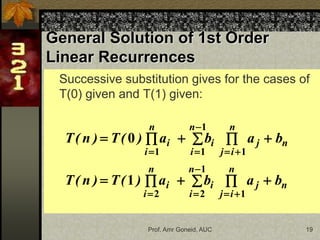
Successive substitution gives for the cases of
T(0) given and T(1) given:
n
n
i
j
j
n
i
i
n
i
i
n
n
i
j
j
n
i
i
n
i
i
b
a
b
a
)
(
T
)
n
(
T
b
a
b
a
)
(
T
)
n
(
T






















1
1
2
2
1
1
1
1
1
0
Prof. Amr Goneid, AUC 20
Examples
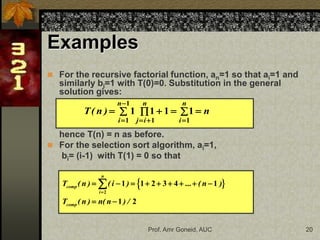
 For the recursive factorial function, an=1 so that ai=1 and
similarly bi=1 with T(0)=0. Substitution in the general
solution gives:
hence T(n) = n as before.
 For the selection sort algorithm, ai=1,
bi= (i-1) with T(1) = 0 so that
n
)
n
(
T
n
i
n
i
n
i
j




 



 
 1
1
1 1
1
1
1
1


n
comp
i
comp
T ( n ) ( i ) ... ( n )
T ( n ) n( n ) /

        
 

2
1 1 2 3 4 1
1 2
Prof. Amr Goneid, AUC 21
Examples
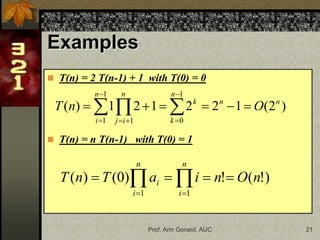
 T(n) = 2 T(n-1) + 1 with T(0) = 0
 T(n) = n T(n-1) with T(0) = 1
)
2
(
1
2
2
1
2
1
)
(
1
0
1
1 1
n
n
n
k
k
n
i
n
i
j
O
n
T 




 
 



 

)
!
(
!
)
0
(
)
(
1
1
n
O
n
i
a
T
n
T
n
i
n
i
i 


 
 

Prof. Amr Goneid, AUC 22
Exercise(1): Exclude & Conquer
with a Linear Process
int FOO (int a[ ], int n)
{
if (n > 0)
{
int m = 5 * Process (a, n);
return m * FOO(a,n-1);
}
}
Show that the number of integer multiplications if Process
makes 2n such operations is:
)
n
(
O
n
n
)
n
(
T 2
2
3 


Prof. Amr Goneid, AUC 23
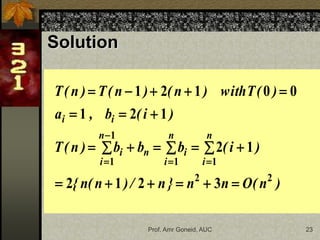
Solution
)
n
(
O
n
n
}
n
/
)
n
(
n
{
)
i
(
b
b
b
)
n
(
T
)
i
(
b
,
a
)
(
T
with
)
n
(
)
n
(
T
)
n
(
T
n
i
n
i
i
n
n
i
i
i
i
2
2
1
1
1
1
3
2
1
2
1
2
1
2
1
0
0
1
2
1






 


















Prof. Amr Goneid, AUC 24
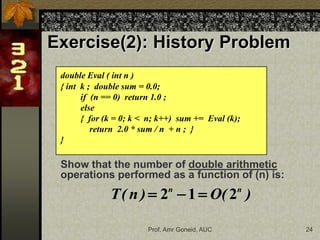
Exercise(2): History Problem
double Eval ( int n )
{ int k ; double sum = 0.0;
if (n == 0) return 1.0 ;
else
{ for (k = 0; k < n; k++) sum += Eval (k);
return 2.0 * sum / n + n ; }
}
Show that the number of double arithmetic
operations performed as a function of (n) is:
)
(
O
)
n
(
T n
n
2
1
2 


Prof. Amr Goneid, AUC 25
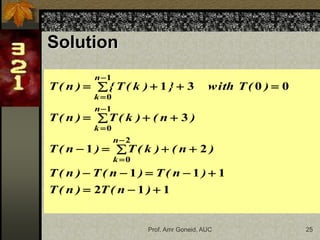
Solution
1
1
2
1
1
1
2
1
3
0
0
3
1
2
0
1
0
1
0




























)
n
(
T
)
n
(
T
)
n
(
T
)
n
(
T
)
n
(
T
)
n
(
)
k
(
T
)
n
(
T
)
n
(
)
k
(
T
)
n
(
T
)
(
T
with
}
)
k
(
T
{
)
n
(
T
n
k
n
k
n
k
Prof. Amr Goneid, AUC 26
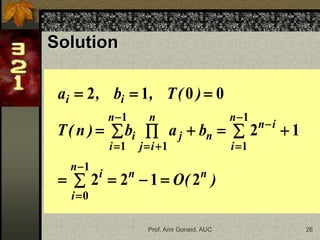
Solution
)
(
O
b
a
b
)
n
(
T
)
(
T
,
b
,
a
n
n
n
i
i
n
i
i
n
n
n
i
j
j
n
i
i
i
i
2
1
2
2
1
2
0
0
1
2
1
0
1
1
1
1
1
























Prof. Amr Goneid, AUC 27
Exercise (3): Hanoi Towers Game
Find the number of moves required for a Tower of
Hanoi with n discs. An animation is available at:
http://www.cosc.canterbury.ac.nz/people/mukundan/dsal
/ToHdb.html
Prof. Amr Goneid, AUC 28
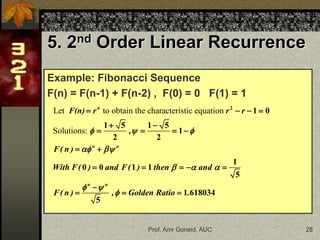
5. 2nd Order Linear Recurrence
Example: Fibonacci Sequence
F(n) = F(n-1) + F(n-2) , F(0) = 0 F(1) = 1
Let to obtain the characteristic equation
Solutions:
n
n n
n n
F(n) r r r
,
F( n )
With F( ) and F( ) then and
F( n ) , Golden Ratio .
  
 
  
 

   
 
   
 
    

  
2
1 0
1 5 1 5
1
2 2
1
0 0 1 1
5
1 618034
5

5. Recursive.ppt

  • 1.
    Prof. Amr Goneid,AUC 1 Analysis & Design of Algorithms (CSCE 321) Prof. Amr Goneid Department of Computer Science, AUC Part 5. Recursive Algorithms
  • 2.
    Prof. Amr Goneid,AUC 2 Recursive Algorithms
  • 3.
    Prof. Amr Goneid,AUC 3 Recursive Algorithms  Modeling Recursive Algorithms  Examples of Recurrences  Exclude & Conquer  General Solution of 1st Order Linear Recurrences  2nd Order Linear Recurrence
  • 4.
    Prof. Amr Goneid,AUC 4 1. Modeling Recursive Algorithms Recursive Algorithm Model as a Recurrence Relation T(n) in terms of T(n-1) Solve to obtain T(n) as a function of n
  • 5.
    Prof. Amr Goneid,AUC 5 Recurrence Relations  A recurrence relation is an equation describing a function in terms of its value for smaller instances.  Many algorithms, particularly exclude & conquer and divide and conquer algorithms, have time complexities which are naturally modeled by recurrence relations.  Many counting problems can be modeled as recurrences. Solving the recurrence relation solves the problem.
  • 6.
    Prof. Amr Goneid,AUC 6 Recurrence Relations  Many natural functions are expressed as recurrences: ) (Factorial 1 with al) (Exponenti 2 1 with 2 l) (Polynomia 1 with 1 1 1 1 1 1 1 1 ! n a a na a a a a a n a a a a n n n n n n n n n n                 
  • 7.
    Prof. Amr Goneid,AUC 7 Recurrence Relations To derive the recurrence relation:  Identify the problem size (n).  Find the base case size n0 (usually n0 = 0 ,1 or 2) and find T(n0)  The general case consists of “a” recursive calls to do smaller sub-problems (usually of size n-1) plus a cost “b” for all the work needed other than in the recursive calls.
  • 8.
    Prof. Amr Goneid,AUC 8 Recurrence Relations Hence, the recurrence relation will have the form:            0 0 0 ) 1 ( ) ( ) ( n n for b n aT n n for n T n T base case cost of base case no. of recursive calls cost of a recursive call cost of other operations
  • 9.
    Prof. Amr Goneid,AUC 9 T(0) = 0  A Recursive Factorial Function: factorial (n) { if (n == 0) return 1; else return ( factorial (n-1) * n); } Find T(n) = number of integer multiplications 2. Examples of Recurrences T(n) T(n-1) 1
  • 10.
    Prof. Amr Goneid,AUC 10 Examples  The base case with n = 0 does zero multiplications. Hence T(0) = 0.  The general case will cost T(n-1) plus one multiplication.  Recurrence Relation: 0 T(0) 0 with n for 1 1) - T(n T(n)    
  • 11.
    Prof. Amr Goneid,AUC 11 Examples Recurrence relations of this kind can be solved by successive substitution:  Substitute several times (m) to show a pattern.  Choose (m) so that each T( ) in which (m) appears reduces to T(n0)  Substitute for T(n0)  Solve the resulting equation
  • 12.
    Prof. Amr Goneid,AUC 12 Examples For example, for the recurrence relation of the recursive factorial: ) n ( ) n ( T Hence n n ) ( T ) n ( T then n m With m ) m n ( T .... ) n ( T ) n ( T ) n ( T ) n ( T ) ( T with ) n ( T ) n ( T                         0 3 3 2 2 1 1 2 0 0 1 1
  • 13.
    Prof. Amr Goneid,AUC 13  A Recursive Function to return xn: power (x, n) { if (n == 0 ) return 1.0; else return ( power(x,n-1)*x ); } Find T(n) = number of arithmetic operations T(n) = T(n-1) + 1 for n > 0 with T(0) = 0 Hence T(n) = n = (n) Examples
  • 14.
    Prof. Amr Goneid,AUC 14 3. Exclude and Conquer n 1 n-1 Base 1 1
  • 15.
    Prof. Amr Goneid,AUC 15 // Assume the data are in locations s….e of array a[0..n-1] // A problem of size (n) arises when the function is invoked as // selectsort(a,0,n-1), i.e. with s = 0 and e = n-1 Selectsort (a[ ], s, e) { if (s < e) { m = minimum (a , s , e) ; swap (a[s] , a[m]); Selectsort (a,s+1,e); } } Example: Recursive Selection Sort T(s,e) T(s+1,e) comp s e ) (  swap 1
  • 16.
    Prof. Amr Goneid,AUC 16 Selection Sort (continued) Recurrence Relation: ( problem of size n when s = 0 , e = n-1): ) 1 n ( ) n ( T that So 0 ) 1 ( T with 1 n for 1 ) 1 n ( T ) n ( T Also 2 ) 1 n ( n i ) i n ( ) 1 ( T ) n ( T , 1 n m Set ) i n ( ) m n ( T ) 1 n ( ) 2 n ( ) 2 n ( T ) n ( T Hence 0 ) 1 ( T with 1 n for ) 1 n ( ) 1 n ( T ) n ( T 1 n e , 0 s Let ) s e ( ) e , 1 s ( T ) e , s ( T swap swap swap 1 n 1 i 1 n 1 i comp m 1 i comp comp comp comp                                              
  • 17.
    Prof. Amr Goneid,AUC 17 4. General Solution of 1st Order Linear Recurrences Many recursive algorithms are modeled to the following general 1st order linear recurrence relation: e.g. the factorial algorithm gives an = 1 and bn = 1, T(0) given. Select sort gives an = 1 and bn = (n-1), T(1) given. T(1) or T(0) given , b 1) - T(n a T(n) n n  
  • 18.
    Prof. Amr Goneid,AUC 18 General Solution of 1st Order Linear Recurrences Such recurrence can be solved by successive substitution. e.g. for T(0) given: n n i j j n i i n i i n n n n n n n n n n n n n n n n n n n n b a b a ) ( T ... b b a b a a ) n ( T a a a ........ b b a ) n ( T a a b } b ) n ( T a { a b ) n ( T a ) n ( T                                       1 1 1 1 1 2 1 2 1 1 1 1 1 0 3 2 2 1
  • 19.
    Prof. Amr Goneid,AUC 19 General Solution of 1st Order Linear Recurrences Successive substitution gives for the cases of T(0) given and T(1) given: n n i j j n i i n i i n n i j j n i i n i i b a b a ) ( T ) n ( T b a b a ) ( T ) n ( T                       1 1 2 2 1 1 1 1 1 0
  • 20.
    Prof. Amr Goneid,AUC 20 Examples  For the recursive factorial function, an=1 so that ai=1 and similarly bi=1 with T(0)=0. Substitution in the general solution gives: hence T(n) = n as before.  For the selection sort algorithm, ai=1, bi= (i-1) with T(1) = 0 so that n ) n ( T n i n i n i j             1 1 1 1 1 1 1 1   n comp i comp T ( n ) ( i ) ... ( n ) T ( n ) n( n ) /              2 1 1 2 3 4 1 1 2
  • 21.
    Prof. Amr Goneid,AUC 21 Examples  T(n) = 2 T(n-1) + 1 with T(0) = 0  T(n) = n T(n-1) with T(0) = 1 ) 2 ( 1 2 2 1 2 1 ) ( 1 0 1 1 1 n n n k k n i n i j O n T                ) ! ( ! ) 0 ( ) ( 1 1 n O n i a T n T n i n i i        
  • 22.
    Prof. Amr Goneid,AUC 22 Exercise(1): Exclude & Conquer with a Linear Process int FOO (int a[ ], int n) { if (n > 0) { int m = 5 * Process (a, n); return m * FOO(a,n-1); } } Show that the number of integer multiplications if Process makes 2n such operations is: ) n ( O n n ) n ( T 2 2 3   
  • 23.
    Prof. Amr Goneid,AUC 23 Solution ) n ( O n n } n / ) n ( n { ) i ( b b b ) n ( T ) i ( b , a ) ( T with ) n ( ) n ( T ) n ( T n i n i i n n i i i i 2 2 1 1 1 1 3 2 1 2 1 2 1 2 1 0 0 1 2 1                          
  • 24.
    Prof. Amr Goneid,AUC 24 Exercise(2): History Problem double Eval ( int n ) { int k ; double sum = 0.0; if (n == 0) return 1.0 ; else { for (k = 0; k < n; k++) sum += Eval (k); return 2.0 * sum / n + n ; } } Show that the number of double arithmetic operations performed as a function of (n) is: ) ( O ) n ( T n n 2 1 2   
  • 25.
    Prof. Amr Goneid,AUC 25 Solution 1 1 2 1 1 1 2 1 3 0 0 3 1 2 0 1 0 1 0                             ) n ( T ) n ( T ) n ( T ) n ( T ) n ( T ) n ( ) k ( T ) n ( T ) n ( ) k ( T ) n ( T ) ( T with } ) k ( T { ) n ( T n k n k n k
  • 26.
    Prof. Amr Goneid,AUC 26 Solution ) ( O b a b ) n ( T ) ( T , b , a n n n i i n i i n n n i j j n i i i i 2 1 2 2 1 2 0 0 1 2 1 0 1 1 1 1 1                        
  • 27.
    Prof. Amr Goneid,AUC 27 Exercise (3): Hanoi Towers Game Find the number of moves required for a Tower of Hanoi with n discs. An animation is available at: http://www.cosc.canterbury.ac.nz/people/mukundan/dsal /ToHdb.html
  • 28.
    Prof. Amr Goneid,AUC 28 5. 2nd Order Linear Recurrence Example: Fibonacci Sequence F(n) = F(n-1) + F(n-2) , F(0) = 0 F(1) = 1 Let to obtain the characteristic equation Solutions: n n n n n F(n) r r r , F( n ) With F( ) and F( ) then and F( n ) , Golden Ratio .                                 2 1 0 1 5 1 5 1 2 2 1 0 0 1 1 5 1 618034 5