Rationality of
Charaka ‘Indriya-sthana’
at present scenario
Dr. K. Shiva Rama Prasad, at http://www.technoayurveda.com/
Keynote address delivered at CAME on Rationale of Indriyasthan
in Modern era on 25-04-2014 at MHACH&RC
Introduction
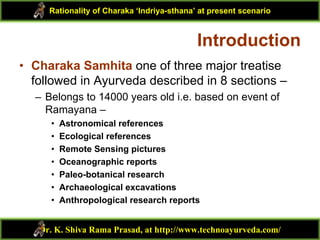
• Charaka Samhita one of three major treatise
followed in Ayurveda described in 8 sections –
– Belongs to 14000 years old i.e. based on event of
Ramayana –
• Astronomical references
• Ecological references
• Remote Sensing pictures
• Oceanographic reports
• Paleo-botanical research
• Archaeological excavations
• Anthropological research reports
Dr. K. Shiva Rama Prasad, at http://www.technoayurveda.com/
Rationality of Charaka ‘Indriya-sthana’ at present scenario
See www.technoayurveda.com for further details
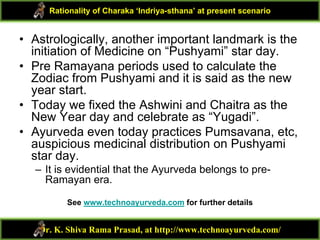
• Astrologically, another important landmark is the
initiation of Medicine on “Pushyami” star day.
• Pre Ramayana periods used to calculate the
Zodiac from Pushyami and it is said as the new
year start.
• Today we fixed the Ashwini and Chaitra as the
New Year day and celebrate as “Yugadi”.
• Ayurveda even today practices Pumsavana, etc,
auspicious medicinal distribution on Pushyami
star day.
– It is evidential that the Ayurveda belongs to pre-
Ramayan era.
Dr. K. Shiva Rama Prasad, at http://www.technoayurveda.com/
Rationality of Charaka ‘Indriya-sthana’ at present scenario
Indriya Sthana
• Indriya sthana is described after Shareera and
before affirming Chikitsa in 12 chapters.
• The Indriya means –
– “rista” (indriyam ristam) = lingam
– Avyakta lingam (unexpressive symptom)
– Sadhya – Sadhaka hetu
• The main motto of this section is –
– To determine the disease prognosis
– To understand the complications of the disease
Dr. K. Shiva Rama Prasad, at http://www.technoayurveda.com/
Rationality of Charaka ‘Indriya-sthana’ at present scenario
What does the 12 chapters say?
1) Varna swariyam
colour, Speech
2) Pushpitaka
smell, taste
3) Parimarsha
touch
4) Indriyaaneeka
senses
5) Poorvaroopeeya
pre-disease symptoms
6) Katamaani
bad prognostic condition
7) Pannaroopeeya
eye (pupil) examination
8) Avakshirashiya
prognostic symptoms
9) Yasya Shyavanitteya
eye examination
10) Sadyomaraneeya
symptoms of death
11) Anujyoteeya
eye examination
12) Gomayachurneeya
symptoms of death
Dr. K. Shiva Rama Prasad, at http://www.technoayurveda.com/
Rationality of Charaka ‘Indriya-sthana’ at present scenario
Rationality in 21st C
• An old prognostic observational documentations
of Charaka in 12 chapters are not fit to the
present circumstances and becomes the
“History”
• History is not considered as Science
• The clinical observations based on the past
exampling are to be omitted
• The applicable and expandable areas of
Charaka is re-explained with relevance and
reference to present circumstances
• Examples of rationality observed are -
Dr. K. Shiva Rama Prasad, at http://www.technoayurveda.com/
Rationality of Charaka ‘Indriya-sthana’ at present scenario
How to examine a patient?
• Ayurveda describes many methods of
examinations in different occasions.
• The “Symptoms of Prognosis” to evaluate the
“Expected death time” is through the “Rista
pareeksha”
• It examines the patient for –
– Indriya – Indriyartha –
– Manas – Buddhi – Suchi –
– Swabhava (Shareera, Ahara & Achara) –
– Upasthambha (Swapna, Ahara & Brahmacharya)
– Vyadhi (Upaya & Apaya) – Nidana Panchaka –
– Sthaana – Doota (messenger) – Aushadha, etc.
Dr. K. Shiva Rama Prasad, at http://www.technoayurveda.com/
Rationality of Charaka ‘Indriya-sthana’ at present scenario
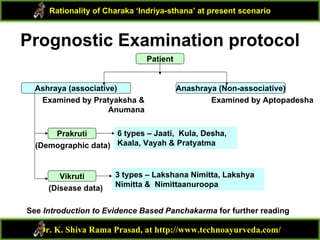
Prognostic Examination protocol
Dr. K. Shiva Rama Prasad, at http://www.technoayurveda.com/
Rationality of Charaka ‘Indriya-sthana’ at present scenario
Patient
Prakruti
Ashraya (associative) Anashraya (Non-associative)
Vikruti
6 types – Jaati, Kula, Desha,
Kaala, Vayah & Pratyatma
3 types – Lakshana Nimitta, Lakshya
Nimitta & Nimittaanuroopa
Examined by AptopadeshaExamined by Pratyaksha &
Anumana
(Demographic data)
(Disease data)
See Introduction to Evidence Based Panchakarma for further reading
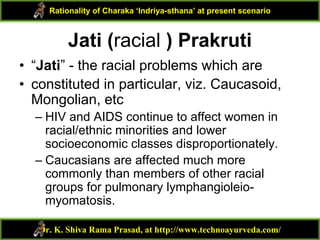
Jati (racial ) Prakruti
• “Jati” - the racial problems which are
• constituted in particular, viz. Caucasoid,
Mongolian, etc
– HIV and AIDS continue to affect women in
racial/ethnic minorities and lower
socioeconomic classes disproportionately.
– Caucasians are affected much more
commonly than members of other racial
groups for pulmonary lymphangioleio-
myomatosis.
Dr. K. Shiva Rama Prasad, at http://www.technoayurveda.com/
Rationality of Charaka ‘Indriya-sthana’ at present scenario
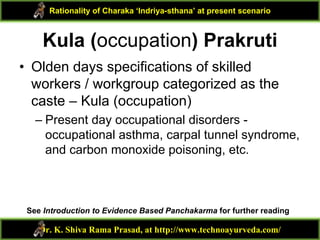
Kula (occupation) Prakruti
• Olden days specifications of skilled
workers / workgroup categorized as the
caste – Kula (occupation)
– Present day occupational disorders -
occupational asthma, carpal tunnel syndrome,
and carbon monoxide poisoning, etc.
Dr. K. Shiva Rama Prasad, at http://www.technoayurveda.com/
Rationality of Charaka ‘Indriya-sthana’ at present scenario
See Introduction to Evidence Based Panchakarma for further reading
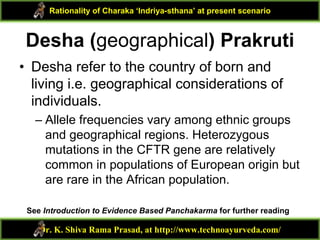
Desha (geographical) Prakruti
• Desha refer to the country of born and
living i.e. geographical considerations of
individuals.
– Allele frequencies vary among ethnic groups
and geographical regions. Heterozygous
mutations in the CFTR gene are relatively
common in populations of European origin but
are rare in the African population.
Dr. K. Shiva Rama Prasad, at http://www.technoayurveda.com/
Rationality of Charaka ‘Indriya-sthana’ at present scenario
See Introduction to Evidence Based Panchakarma for further reading
Kaala (season) Prakruti
• “Kaala” the season and circadian rhythmus
influences the human by all means and always.
– Seasonal changes, the daily occurrence of the light-
dark cycle, sleep, meals, and stress are examples of
the many environmental events that affect hormonal
rhythms.
– Angina pectoris may be atypical in location and may
not be strictly related to provoking factors. Its
occurrence can be seasonal, being more frequent in
the winter in temperate climates.
Dr. K. Shiva Rama Prasad, at http://www.technoayurveda.com/
Rationality of Charaka ‘Indriya-sthana’ at present scenario
See Introduction to Evidence Based Panchakarma for further reading
Vaya (age) Prakruti
• “Vaya” is Age - relations in the
pathological manifestations that occur
specifically.
– Susceptibility to noise-induced hearing loss or
age related hearing loss (presbycusis) may
also be genetically determined.
– As in the case for streptococcal sore throat,
acute rheumatic fever most often occurs in
children; the peak age-related incidence is
between 5 and 15 years.
Dr. K. Shiva Rama Prasad, at http://www.technoayurveda.com/
Rationality of Charaka ‘Indriya-sthana’ at present scenario
See Introduction to Evidence Based Panchakarma for further reading
Pratyatma Niyata (genotic)
• Pratyatma Niyata has to understand it as a
fundamental (genetical) physiological
constitution which is based upon the
genes of the individual.
• These individuals have either normal or
above-average stature, owing to failure of
estrogen-mediated epiphyseal closure in
the presence of a normal chromosomal
constitution.
Dr. K. Shiva Rama Prasad, at http://www.technoayurveda.com/
Rationality of Charaka ‘Indriya-sthana’ at present scenario
See Introduction to Evidence Based Panchakarma for further reading
Sleep (Nidra)
• Sleep is the index of health
• Charaka classifieds 7 types of sleep
– Drusta
– Shruta
– Anubhoota
– Prardhita
– Kalpita
– Bhavita
– Doshaja
Dr. K. Shiva Rama Prasad, at http://www.technoayurveda.com/
Rationality of Charaka ‘Indriya-sthana’ at present scenario
Chaya (complexion)
• Chaya & Varna are associative of Prabha
(luminaries)
• Luminaries is dependent on Agni
• Panchabhoota interpretation / attribution in
Ayurveda is fundamental expression. They are -
– Akasha
– Vayu – hazardous
– Teja
– Jala
– Pruthvi
Dr. K. Shiva Rama Prasad, at http://www.technoayurveda.com/
Rationality of Charaka ‘Indriya-sthana’ at present scenario
Gomaya churna
• A person who have dust resembling cow-
dung on his head will die in a month
– Explanation: (dict) powdery deposits on the
skin, especially the face, of urea and uric acid
salts due to excretion of nitrogenous
compounds in the sweat; seen in severe
uremia
• The complex of symptoms due to severe persisting
renal failure that can be relieved by dialysis if not
patient will die.
Dr. K. Shiva Rama Prasad, at http://www.technoayurveda.com/
Rationality of Charaka ‘Indriya-sthana’ at present scenario
Conclusion
• Many explanations can be made from the
ancient historical observations
• Most of the symptoms dealt in Charaka Indriya
are as bad prognosis discussed belongs to –
– Examination of Eye
– Colour & complexion
– Audible sounds & speech
– Symptoms of Death
– Omens & Messenger
– they require re-emphasis as many symptoms of that
time are manageable at present
Dr. K. Shiva Rama Prasad, at http://www.technoayurveda.com/
Rationality of Charaka ‘Indriya-sthana’ at present scenario
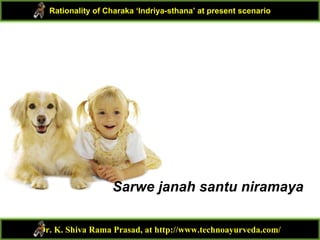
Sarwe janah santu niramaya
Dr. K. Shiva Rama Prasad, at http://www.technoayurveda.com/
Rationality of Charaka ‘Indriya-sthana’ at present scenario
Dr. K. Shiva Rama Prasad, at http://www.technoayurveda.com/
Rationality of Charaka ‘Indriya-sthana’ at present scenario
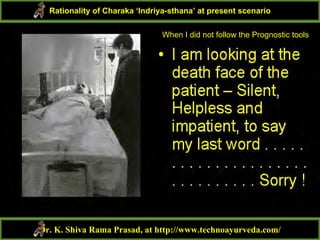
When I did not follow the Prognostic tools

Charaka indriya mgach&rc

  • 1.
    Rationality of Charaka ‘Indriya-sthana’ atpresent scenario Dr. K. Shiva Rama Prasad, at http://www.technoayurveda.com/ Keynote address delivered at CAME on Rationale of Indriyasthan in Modern era on 25-04-2014 at MHACH&RC
  • 2.
    Introduction • Charaka Samhitaone of three major treatise followed in Ayurveda described in 8 sections – – Belongs to 14000 years old i.e. based on event of Ramayana – • Astronomical references • Ecological references • Remote Sensing pictures • Oceanographic reports • Paleo-botanical research • Archaeological excavations • Anthropological research reports Dr. K. Shiva Rama Prasad, at http://www.technoayurveda.com/ Rationality of Charaka ‘Indriya-sthana’ at present scenario
  • 3.
    See www.technoayurveda.com forfurther details • Astrologically, another important landmark is the initiation of Medicine on “Pushyami” star day. • Pre Ramayana periods used to calculate the Zodiac from Pushyami and it is said as the new year start. • Today we fixed the Ashwini and Chaitra as the New Year day and celebrate as “Yugadi”. • Ayurveda even today practices Pumsavana, etc, auspicious medicinal distribution on Pushyami star day. – It is evidential that the Ayurveda belongs to pre- Ramayan era. Dr. K. Shiva Rama Prasad, at http://www.technoayurveda.com/ Rationality of Charaka ‘Indriya-sthana’ at present scenario
  • 4.
    Indriya Sthana • Indriyasthana is described after Shareera and before affirming Chikitsa in 12 chapters. • The Indriya means – – “rista” (indriyam ristam) = lingam – Avyakta lingam (unexpressive symptom) – Sadhya – Sadhaka hetu • The main motto of this section is – – To determine the disease prognosis – To understand the complications of the disease Dr. K. Shiva Rama Prasad, at http://www.technoayurveda.com/ Rationality of Charaka ‘Indriya-sthana’ at present scenario
  • 5.
    What does the12 chapters say? 1) Varna swariyam colour, Speech 2) Pushpitaka smell, taste 3) Parimarsha touch 4) Indriyaaneeka senses 5) Poorvaroopeeya pre-disease symptoms 6) Katamaani bad prognostic condition 7) Pannaroopeeya eye (pupil) examination 8) Avakshirashiya prognostic symptoms 9) Yasya Shyavanitteya eye examination 10) Sadyomaraneeya symptoms of death 11) Anujyoteeya eye examination 12) Gomayachurneeya symptoms of death Dr. K. Shiva Rama Prasad, at http://www.technoayurveda.com/ Rationality of Charaka ‘Indriya-sthana’ at present scenario
  • 6.
    Rationality in 21stC • An old prognostic observational documentations of Charaka in 12 chapters are not fit to the present circumstances and becomes the “History” • History is not considered as Science • The clinical observations based on the past exampling are to be omitted • The applicable and expandable areas of Charaka is re-explained with relevance and reference to present circumstances • Examples of rationality observed are - Dr. K. Shiva Rama Prasad, at http://www.technoayurveda.com/ Rationality of Charaka ‘Indriya-sthana’ at present scenario
  • 7.
    How to examinea patient? • Ayurveda describes many methods of examinations in different occasions. • The “Symptoms of Prognosis” to evaluate the “Expected death time” is through the “Rista pareeksha” • It examines the patient for – – Indriya – Indriyartha – – Manas – Buddhi – Suchi – – Swabhava (Shareera, Ahara & Achara) – – Upasthambha (Swapna, Ahara & Brahmacharya) – Vyadhi (Upaya & Apaya) – Nidana Panchaka – – Sthaana – Doota (messenger) – Aushadha, etc. Dr. K. Shiva Rama Prasad, at http://www.technoayurveda.com/ Rationality of Charaka ‘Indriya-sthana’ at present scenario
  • 8.
    Prognostic Examination protocol Dr.K. Shiva Rama Prasad, at http://www.technoayurveda.com/ Rationality of Charaka ‘Indriya-sthana’ at present scenario Patient Prakruti Ashraya (associative) Anashraya (Non-associative) Vikruti 6 types – Jaati, Kula, Desha, Kaala, Vayah & Pratyatma 3 types – Lakshana Nimitta, Lakshya Nimitta & Nimittaanuroopa Examined by AptopadeshaExamined by Pratyaksha & Anumana (Demographic data) (Disease data) See Introduction to Evidence Based Panchakarma for further reading
  • 9.
    Jati (racial )Prakruti • “Jati” - the racial problems which are • constituted in particular, viz. Caucasoid, Mongolian, etc – HIV and AIDS continue to affect women in racial/ethnic minorities and lower socioeconomic classes disproportionately. – Caucasians are affected much more commonly than members of other racial groups for pulmonary lymphangioleio- myomatosis. Dr. K. Shiva Rama Prasad, at http://www.technoayurveda.com/ Rationality of Charaka ‘Indriya-sthana’ at present scenario
  • 10.
    Kula (occupation) Prakruti •Olden days specifications of skilled workers / workgroup categorized as the caste – Kula (occupation) – Present day occupational disorders - occupational asthma, carpal tunnel syndrome, and carbon monoxide poisoning, etc. Dr. K. Shiva Rama Prasad, at http://www.technoayurveda.com/ Rationality of Charaka ‘Indriya-sthana’ at present scenario See Introduction to Evidence Based Panchakarma for further reading
  • 11.
    Desha (geographical) Prakruti •Desha refer to the country of born and living i.e. geographical considerations of individuals. – Allele frequencies vary among ethnic groups and geographical regions. Heterozygous mutations in the CFTR gene are relatively common in populations of European origin but are rare in the African population. Dr. K. Shiva Rama Prasad, at http://www.technoayurveda.com/ Rationality of Charaka ‘Indriya-sthana’ at present scenario See Introduction to Evidence Based Panchakarma for further reading
  • 12.
    Kaala (season) Prakruti •“Kaala” the season and circadian rhythmus influences the human by all means and always. – Seasonal changes, the daily occurrence of the light- dark cycle, sleep, meals, and stress are examples of the many environmental events that affect hormonal rhythms. – Angina pectoris may be atypical in location and may not be strictly related to provoking factors. Its occurrence can be seasonal, being more frequent in the winter in temperate climates. Dr. K. Shiva Rama Prasad, at http://www.technoayurveda.com/ Rationality of Charaka ‘Indriya-sthana’ at present scenario See Introduction to Evidence Based Panchakarma for further reading
  • 13.
    Vaya (age) Prakruti •“Vaya” is Age - relations in the pathological manifestations that occur specifically. – Susceptibility to noise-induced hearing loss or age related hearing loss (presbycusis) may also be genetically determined. – As in the case for streptococcal sore throat, acute rheumatic fever most often occurs in children; the peak age-related incidence is between 5 and 15 years. Dr. K. Shiva Rama Prasad, at http://www.technoayurveda.com/ Rationality of Charaka ‘Indriya-sthana’ at present scenario See Introduction to Evidence Based Panchakarma for further reading
  • 14.
    Pratyatma Niyata (genotic) •Pratyatma Niyata has to understand it as a fundamental (genetical) physiological constitution which is based upon the genes of the individual. • These individuals have either normal or above-average stature, owing to failure of estrogen-mediated epiphyseal closure in the presence of a normal chromosomal constitution. Dr. K. Shiva Rama Prasad, at http://www.technoayurveda.com/ Rationality of Charaka ‘Indriya-sthana’ at present scenario See Introduction to Evidence Based Panchakarma for further reading
  • 15.
    Sleep (Nidra) • Sleepis the index of health • Charaka classifieds 7 types of sleep – Drusta – Shruta – Anubhoota – Prardhita – Kalpita – Bhavita – Doshaja Dr. K. Shiva Rama Prasad, at http://www.technoayurveda.com/ Rationality of Charaka ‘Indriya-sthana’ at present scenario
  • 16.
    Chaya (complexion) • Chaya& Varna are associative of Prabha (luminaries) • Luminaries is dependent on Agni • Panchabhoota interpretation / attribution in Ayurveda is fundamental expression. They are - – Akasha – Vayu – hazardous – Teja – Jala – Pruthvi Dr. K. Shiva Rama Prasad, at http://www.technoayurveda.com/ Rationality of Charaka ‘Indriya-sthana’ at present scenario
  • 17.
    Gomaya churna • Aperson who have dust resembling cow- dung on his head will die in a month – Explanation: (dict) powdery deposits on the skin, especially the face, of urea and uric acid salts due to excretion of nitrogenous compounds in the sweat; seen in severe uremia • The complex of symptoms due to severe persisting renal failure that can be relieved by dialysis if not patient will die. Dr. K. Shiva Rama Prasad, at http://www.technoayurveda.com/ Rationality of Charaka ‘Indriya-sthana’ at present scenario
  • 18.
    Conclusion • Many explanationscan be made from the ancient historical observations • Most of the symptoms dealt in Charaka Indriya are as bad prognosis discussed belongs to – – Examination of Eye – Colour & complexion – Audible sounds & speech – Symptoms of Death – Omens & Messenger – they require re-emphasis as many symptoms of that time are manageable at present Dr. K. Shiva Rama Prasad, at http://www.technoayurveda.com/ Rationality of Charaka ‘Indriya-sthana’ at present scenario
  • 19.
    Sarwe janah santuniramaya Dr. K. Shiva Rama Prasad, at http://www.technoayurveda.com/ Rationality of Charaka ‘Indriya-sthana’ at present scenario
  • 20.
    Dr. K. ShivaRama Prasad, at http://www.technoayurveda.com/ Rationality of Charaka ‘Indriya-sthana’ at present scenario When I did not follow the Prognostic tools