Fundamentals of Nasya Karma
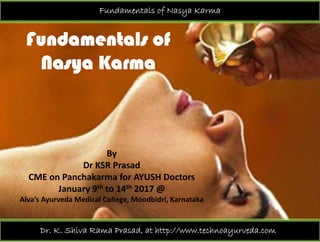
Fundamentals of
Nasya KarmaNasya Karma
BBy 
Dr KSR Prasad
CME on Panchakarma for AYUSH Doctors 
January 9th to 14th 2017 @ 
Alva’s Ayurveda Medical College, Moodbidri, Karnataka
Dr. K. Shiva Rama Prasad, at http://www.technoayurveda.com/
Fundamentals of Nasya Karma
Learning Objectives 
R i f N k ith d fi iti• Review of Nasya karma with definition, 
classification and advantages of Nasya by 
different acharyasdifferent acharyas
• Knowledge of Anatomy of nose and para‐nasal 
sinusessinuses. 
• Pharmacological action of modern drugs 
administered through nose.administered through nose. 
• Standardization of the dose of various types of 
Nasyas. y
• Standardization of Bindu Pramana.
Dr. K. Shiva Rama Prasad, at http://www.technoayurveda.com/
Fundamentals of Nasya Karma
Introduction
• “Nasya” with a synonym “Navana” – is 
defined as “Nasa Graahya Aushadham” i.e. y
the medicine administered/ received through 
nosenose 
• For the medicine administration different 
b h hroutes are used in Ayurveda but to reach the 
“shiras”, the Head it is difficult with other 
routes there by the “Nasya” is developed
Dr. K. Shiva Rama Prasad, at http://www.technoayurveda.com/
Fundamentals of Nasya Karma
Nasal administration
• Nasal administration is a route of administration inNasal administration is a route of administration in 
which drugs are insufflated through the nose. It can 
be a form of either topical administration orbe a form of either topical administration or 
systemic administration, as the drugs thus locally 
delivered can go on to have either purely local ordelivered can go on to have either purely local or 
systemic effects.
• The nasal cavity is covered by a well vascularised thin• The nasal cavity is covered by a well vascularised thin 
mucosa,  therefore, a drug molecule can be 
transferred quickly across the single epithelial celltransferred quickly across the single epithelial cell 
layer directly within 5 min for smaller drug 
moleculesmolecules.
Dr. K. Shiva Rama Prasad, at http://www.technoayurveda.com/
Fundamentals of Nasya Karma
Routes of Medicine Administration 
d d h l• Ayueveda used the most common route – Oral 
and the alternative routes are – Rectal, 
transurethral, trans‐dermal, Nasal, etc.
• The mucosa of either external (Skin) or ( )
internal (GI tract) or even the nasal mucosa 
are comfortably used with ionized bioactive y
isotonic solutions or nano to micro fined 
power dustings as medicines to pacify thepower dustings as medicines to pacify the 
pathologic conditions 
Dr. K. Shiva Rama Prasad, at http://www.technoayurveda.com/
Fundamentals of Nasya Karma
Synonyms of Nasya
• Shiro Virechana
• Shiro Vireka Virechana word is used as it 
Shiro Vireka
• Moordha Virechana
is propelling out 
Chardana ord is sed as it
• Nasthah Prachhardhana
• Navana
Chardana word is used as it 
is spurts out 
Navana
• Nastha Karma These terms are used as it is 
administered per nasa
• Nasya karma 
p
Dr. K. Shiva Rama Prasad, at http://www.technoayurveda.com/
Fundamentals of Nasya Karma
Dr. K. Shiva Rama Prasad, at http://www.technoayurveda.com/
Fundamentals of Nasya Karma
Dr. K. Shiva Rama Prasad, at http://www.technoayurveda.com/
Fundamentals of Nasya Karma
Surface Anatomy
P t i i l t l l l th• Posterior superior lateral nasal nerves supply the 
nasal cavity lateral wall
• Posterior superior medial nasal nerves cross the roofPosterior superior medial nasal nerves cross the roof 
to the nasal septum
• Nasopalatine nerve, supply to medial wall of the nasal p pp y
cavity
• Posterior inferior nasal nerves innervate the lateral 
wall of the nasal cavitywall of the nasal cavity
• a small nasal nerve also originates from the anterior 
superior alveolar branch of the infra‐orbital nerve andsuperior alveolar branch of the infra orbital nerve and 
supply the lateral wall near the anterior end of the 
inferior concha. 
Dr. K. Shiva Rama Prasad, at http://www.technoayurveda.com/
Fundamentals of Nasya Karma
Dr. K. Shiva Rama Prasad, at http://www.technoayurveda.com/
Fundamentals of Nasya Karma
Surface Anatomy
P th ti i ti i S t t• Parasympathetic innervation – i.e. Secretomotor
innervation of glands in the mucosa of the nasal 
cavitycavity
• Sympathetic innervation (T1), mainly involved 
with regulating blood flow in the nasal mucosawith regulating blood flow in the nasal mucosa
• Lymph from anterior regions of the nasal cavities 
drains and connect with the submandibulardrains and connect with the submandibular
nodes
• Lymph from posterior regions of the nasal cavity y p p g y
and the paranasal sinuses drains into upper deep 
cervical nodes. 
Dr. K. Shiva Rama Prasad, at http://www.technoayurveda.com/
Fundamentals of Nasya Karma
Applied Physiology
S ll d ll l ifi d i l• Smell and taste are generally classified as visceral 
senses because of their close association with 
t i t ti l f ti Ph i l i ll thgastrointestinal function. Physiologically, they are 
related to each other.
• Both taste and smell receptors are 
chemoreceptors that are stimulated by 
l l i l i i i h dmolecules in solution in mucus in the nose and 
saliva in the mouth. 
• However, these two senses are anatomically 
quite different.
Dr. K. Shiva Rama Prasad, at http://www.technoayurveda.com/
Fundamentals of Nasya Karma
Applied Physiology
Th lf ll l d i i li d• The olfactory receptor cells are located in a specialized 
portion of the nasal mucosa, the yellowish‐pigmented 
olfactory mucous membraneolfactory mucous membrane
• It covers an area of 5 cm2 in the roof of the nasal cavity 
near the septum It contains supporting cells andnear the septum. It contains supporting cells and 
progenitor cells for the olfactory receptors.
• Interspersed between these cells are 10‐20 millionInterspersed between these cells are 10 20 million 
receptor cells. Each olfactory receptor is a neuron, and 
the olfactory mucous membrane is said to be the place 
in the body where the nervous system is closest to the 
external world.
Dr. K. Shiva Rama Prasad, at http://www.technoayurveda.com/
Fundamentals of Nasya Karma
Applied Physiology
• The olfactory neurons, like the taste receptor 
cells (see below) but unlike most other ( )
neurons, are constantly being replaced with a 
half‐time of a few weeks The olfactoryhalf time of a few weeks. The olfactory 
renewal process is carefully regulated, and 
there is evidence that in this situation a bonethere is evidence that in this situation, a bone 
morphogenic protein (BMP) exerts an 
inhibitory effect. 
Dr. K. Shiva Rama Prasad, at http://www.technoayurveda.com/
Fundamentals of Nasya Karma
Applied Physiology
h lf b i l• The olfactory mucous membrane is constantly 
covered by mucus. This mucus is produced by 
B ' l d hi h j t d th b lBowman's glands, which are just under the basal 
lamina of the membrane. 
• The axons of the mitral and tufted cells pass 
posteriorly through the intermediate olfactory 
i d h l l lf i hstria and the lateral olfactory stria to the 
olfactory cortex.
• The axons terminate on the apical dendrites of 
pyramidal cells in the olfactory cortex. 
Dr. K. Shiva Rama Prasad, at http://www.technoayurveda.com/
Olfactory cortex
Fundamentals of Nasya Karma
Olfactory cortex
• In humans, sniffing activates the piriform cortex, g p
but smells with or without sniffing activate the 
lateral and anterior orbitofrontal gyri of the 
frontal lobe. 
• The orbitofrontal activation is generally greater g y g
on the right side than the left. Thus, the cortical 
representation of olfaction is asymmetric. 
• Other fibers project to the amygdala, which is 
probably involved with the emotional responses p y p
to olfactory stimuli, and to the entorhinal cortex, 
which is concerned with olfactory memories. y
Dr. K. Shiva Rama Prasad, at http://www.technoayurveda.com/
Fundamentals of Nasya Karma
Dose determination of Sneha Nasya
• Snehana Nasya (Sushruta) 
– Pradhama Matra (Avara) = 8 Bindu (Drops)( ) ( p )
– Dwiteeya Matra (Madhyama) = 1 Shukti = 32 Bindu
Truteeya Matra (Uttama) 1 Pani 64 Bindu– Truteeya Matra (Uttama) = 1 Pani = 64 Bindu
• Charaka Nasya (Sneha) ‐ Ardha Pala (2 tola)
• Bhoja Nasya (Sneha) – 16 Bindu in progressive 
till 64 drops (4 times)till 64 drops (4 times) 
Dr. K. Shiva Rama Prasad, at http://www.technoayurveda.com/
Fundamentals of Nasya Karma
Dose determination of Virechanika Nasya
h (f i di id l )• Sushruta (for individual nose) 
– Heena Matra = 4 Bindu
– Madhyama Matra = 6 Bindu
– Uttama Matra = 8 Bindu
• Duration of Virechana Nasya (Sushruta) 
Alternative day or once in two days– Alternative day or once in two days 
– 7 – 21 days of total duration or till required with in 
F f l t d t i d il ( h h )– For  few selected twice daily (muhurmuhu) 
– Restriction of duration 7 days by Arunadatta
Dr. K. Shiva Rama Prasad, at http://www.technoayurveda.com/
Fundamentals of Nasya Karma
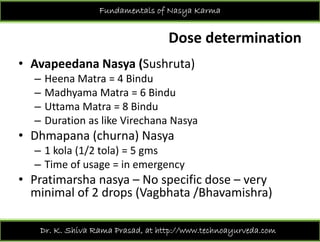
Dose determination
A d N (S h t )• Avapeedana Nasya (Sushruta)
– Heena Matra = 4 Bindu
Madhyama Matra 6 Bindu– Madhyama Matra = 6 Bindu
– Uttama Matra = 8 Bindu
– Duration as like Virechana Nasya– Duration as like Virechana Nasya
• Dhmapana (churna) Nasya
– 1 kola (1/2 tola) = 5 gms– 1 kola (1/2 tola) = 5 gms
– Time of usage = in emergency 
• Pratimarsha nasya – No specific dose – veryPratimarsha nasya No specific dose  very 
minimal of 2 drops (Vagbhata /Bhavamishra)
Dr. K. Shiva Rama Prasad, at http://www.technoayurveda.com/
Fundamentals of Nasya Karma
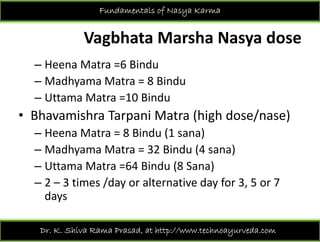
Vagbhata Marsha Nasya dose
H M 6 Bi d– Heena Matra =6 Bindu
– Madhyama Matra = 8 Bindu
– Uttama Matra =10 Bindu
• Bhavamishra Tarpani Matra (high dose/nase)p ( g / )
– Heena Matra = 8 Bindu (1 sana)
– Madhyama Matra = 32 Bindu (4 sana)Madhyama Matra = 32 Bindu (4 sana)
– Uttama Matra =64 Bindu (8 Sana)
2 3 times /day or alternative day for 3 5 or 7– 2 – 3 times /day or alternative day for 3, 5 or 7 
days 
Dr. K. Shiva Rama Prasad, at http://www.technoayurveda.com/
Fundamentals of Nasya Karma
i l d i iFinal Dose determination
Nasya Type Heena Madhyama Uttama
Snehana 8 32 64
Rechana 4 6 8
Avapeedana 
(Kalka)
4 6 8
( )
Pratimarsha 2 2 2
Marsha 6 8 10Marsha  6 8 10
Dhmapana 
(churna)
125mg
(2 gunja)
3gms 
(churna) (2 gunja)
1 bindu is defined as the oil collected by dipping the finger till first phalagi
Dr. K. Shiva Rama Prasad, at http://www.technoayurveda.com/
Fundamentals of Nasya Karma
Timing & seasons for Nasya
Dr. K. Shiva Rama Prasad, at http://www.technoayurveda.com/
Fundamentals of Nasya Karma
Olfactory Thresholds & Discrimination
Olf d l b• Olfactory receptors respond only to substances 
that are in contact with the olfactory epithelium 
d di l d i th thi l f th tand are dissolved in the thin layer of mucus that 
covers it. 
• Eg: Methyl mercaptan, one of the substances in 
garlic, can be smelled at a concentration of less 
h 500 /L f ithan 500 pg/L of air.
• Olfactory discrimination is remarkable; 
• Humans can recognize more than 10,000 
different odors. 
Dr. K. Shiva Rama Prasad, at http://www.technoayurveda.com/
Fundamentals of Nasya Karma
Signal Transduction
• Olfactory mucosa and its brain representation canOlfactory mucosa and its brain representation can 
mediate discrimination of more than 10,000 different 
odors. 
• Question is how 10,000 different odors can be 
detected lies in the neural organization of thedetected lies in the neural organization of the 
olfactory pathway. 
• 2 million olfactory sensory neurons and each• 2 million olfactory sensory neurons, and each 
expresses only one of the thousand different odorant 
receptorsreceptors.
• In the olfactory glomeruli, there is lateral inhibition 
mediated by periglomerular cells and granule cellsmediated by periglomerular cells and granule cells.
Dr. K. Shiva Rama Prasad, at http://www.technoayurveda.com/
Fundamentals of Nasya Karma
Signal Transduction
• Each neuron expressing a given receptor projects to twoEach neuron expressing a given receptor projects to two 
of the 1800 glomeruli. This provides a distinct two‐
dimensional map in the olfactory bulb that is unique to p y q
the odorant. The mitral cells with their glomeruli
project to different parts of the olfactory cortex. 
• This sharpens and focuses olfactory signals. In addition, 
the extracellular field potential in each glomerulus
oscillates, and the granule cells appear to regulate the 
frequency of the oscillation. The exact function of the 
oscillation is unknown, but it probably also helps to 
focus the olfactory signals reaching the cortex. 
Dr. K. Shiva Rama Prasad, at http://www.technoayurveda.com/
Fundamentals of Nasya Karma
Signal Transduction
• In addition, lipophilic odor‐producing moleculesIn addition, lipophilic odor producing molecules 
must traverse the hydrophilic mucus in the nose to 
reach the receptors. These facts led to thereach the receptors. These facts led to the 
suggestion that the olfactory mucus might contain 
one or more odorant‐binding proteins (OBP) thatone or more odorant binding proteins (OBP) that 
concentrate the odorants and transfer them to the 
receptors.receptors. 
• Its receptors project to the accessory olfactory bulb
and from there primarily to areas in the amygdalaand from there primarily to areas in the amygdala
and hypothalamus that are concerned with 
reproduction and ingestive behaviorreproduction and ingestive behavior. 
Dr. K. Shiva Rama Prasad, at http://www.technoayurveda.com/
Fundamentals of Nasya Karma
Signal Transduction
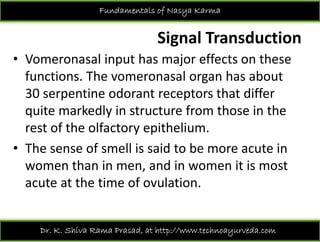
• Vomeronasal input has major effects on theseVomeronasal input has major effects on these 
functions. The vomeronasal organ has about 
30 ti d t t th t diff30 serpentine odorant receptors that differ 
quite markedly in structure from those in the 
rest of the olfactory epithelium. 
• The sense of smell is said to be more acute inThe sense of smell is said to be more acute in 
women than in men, and in women it is most 
acute at the time of ovulationacute at the time of ovulation. 
Dr. K. Shiva Rama Prasad, at http://www.technoayurveda.com/
Fundamentals of Nasya Karma
Signal Transduction
• It is common knowledge that when one isIt is common knowledge that when one is 
continuously exposed to even the most disagreeable 
odor, perception of the odor decreases andodor, perception of the odor decreases and 
eventually ceases. This sometimes beneficent 
phenomenon is due to the fairly rapid adaptation, orphenomenon is due to the fairly rapid adaptation, or 
desensitization, that occurs in the olfactory system. It 
is mediated by Ca2+ acting via calmodulin on cyclicis mediated by Ca acting via calmodulin on cyclic 
nucleotide‐gated (CNG) ion channels. When CNG A4 
is knocked out, adaptation is slowed.is knocked out, adaptation is slowed. 
Dr. K. Shiva Rama Prasad, at http://www.technoayurveda.com/
Fundamentals of Nasya Karma
Conclusion 
Th ll f h lf i h li j i• The nerve cells of the olfactory epithelium project into 
the olfactory bulb of the brain, which provides a direct 
connection between the brain and the externalconnection between the brain and the external 
environment. 
• The transfer of drugs to the brain from the bloodThe transfer of drugs to the brain from the blood 
circulation is normally hindered by the blood–brain 
barrier (BBB), which is virtually impermeable to passive ( ) y p p
diffusion of all but small, lipophilic substances. 
• However, if drug substances can be transferred along 
the olfactory nerve cells, they can bypass the BBB and 
enter the brain directly.
Dr. K. Shiva Rama Prasad, at http://www.technoayurveda.com/
Concl sion
Fundamentals of Nasya Karma
…. Conclusion 
• Olfactory and ophthalmic are inter connected
• Thoracic (T1) is the lower limit of the Nasya Karma effect( ) y
• Lateral, Frontal lobes (Shiras) are connected with nasya
activity y
• hydrophilic drugs comfortable pass through Nasal mucus
• lipophilic drugs with odorant‐binding proteins (OBP) arelipophilic drugs with odorant binding proteins (OBP) are 
required to pass through 
• Another choice is with emotional responses to recover• Another choice is with emotional responses to recover 
olfactory memories  
• Ceasing or desensitization of olfactory is mediated by Ca2+• Ceasing or desensitization of olfactory is mediated by Ca
acting via calmodulin on cyclic nucleotide‐gated (CNG) ion 
channels (vata). Its pacification is through Brumhana Nasya.channels (vata).  Its pacification is through Brumhana Nasya. 
Dr. K. Shiva Rama Prasad, at http://www.technoayurveda.com/
Fundamentals of Nasya Karma
Thank You
• Nasahi shiraso dwaram and Nasya is 
multiracial management of Ayurvedag y
Dr. K. Shiva Rama Prasad, at http://www.technoayurveda.com/

Nasya 1-ksr

  • 1.
    Fundamentals of NasyaKarma Fundamentals of Nasya KarmaNasya Karma BBy  Dr KSR Prasad CME on Panchakarma for AYUSH Doctors  January 9th to 14th 2017 @  Alva’s Ayurveda Medical College, Moodbidri, Karnataka Dr. K. Shiva Rama Prasad, at http://www.technoayurveda.com/
  • 2.
    Fundamentals of NasyaKarma Learning Objectives  R i f N k ith d fi iti• Review of Nasya karma with definition,  classification and advantages of Nasya by  different acharyasdifferent acharyas • Knowledge of Anatomy of nose and para‐nasal  sinusessinuses.  • Pharmacological action of modern drugs  administered through nose.administered through nose.  • Standardization of the dose of various types of  Nasyas. y • Standardization of Bindu Pramana. Dr. K. Shiva Rama Prasad, at http://www.technoayurveda.com/
  • 3.
    Fundamentals of NasyaKarma Introduction • “Nasya” with a synonym “Navana” – is  defined as “Nasa Graahya Aushadham” i.e. y the medicine administered/ received through  nosenose  • For the medicine administration different  b h hroutes are used in Ayurveda but to reach the  “shiras”, the Head it is difficult with other  routes there by the “Nasya” is developed Dr. K. Shiva Rama Prasad, at http://www.technoayurveda.com/
  • 4.
    Fundamentals of NasyaKarma Nasal administration • Nasal administration is a route of administration inNasal administration is a route of administration in  which drugs are insufflated through the nose. It can  be a form of either topical administration orbe a form of either topical administration or  systemic administration, as the drugs thus locally  delivered can go on to have either purely local ordelivered can go on to have either purely local or  systemic effects. • The nasal cavity is covered by a well vascularised thin• The nasal cavity is covered by a well vascularised thin  mucosa,  therefore, a drug molecule can be  transferred quickly across the single epithelial celltransferred quickly across the single epithelial cell  layer directly within 5 min for smaller drug  moleculesmolecules. Dr. K. Shiva Rama Prasad, at http://www.technoayurveda.com/
  • 5.
    Fundamentals of NasyaKarma Routes of Medicine Administration  d d h l• Ayueveda used the most common route – Oral  and the alternative routes are – Rectal,  transurethral, trans‐dermal, Nasal, etc. • The mucosa of either external (Skin) or ( ) internal (GI tract) or even the nasal mucosa  are comfortably used with ionized bioactive y isotonic solutions or nano to micro fined  power dustings as medicines to pacify thepower dustings as medicines to pacify the  pathologic conditions  Dr. K. Shiva Rama Prasad, at http://www.technoayurveda.com/
  • 6.
    Fundamentals of NasyaKarma Synonyms of Nasya • Shiro Virechana • Shiro Vireka Virechana word is used as it  Shiro Vireka • Moordha Virechana is propelling out  Chardana ord is sed as it • Nasthah Prachhardhana • Navana Chardana word is used as it  is spurts out  Navana • Nastha Karma These terms are used as it is  administered per nasa • Nasya karma  p Dr. K. Shiva Rama Prasad, at http://www.technoayurveda.com/
  • 7.
    Fundamentals of NasyaKarma Dr. K. Shiva Rama Prasad, at http://www.technoayurveda.com/
  • 8.
    Fundamentals of NasyaKarma Dr. K. Shiva Rama Prasad, at http://www.technoayurveda.com/
  • 9.
    Fundamentals of NasyaKarma Surface Anatomy P t i i l t l l l th• Posterior superior lateral nasal nerves supply the  nasal cavity lateral wall • Posterior superior medial nasal nerves cross the roofPosterior superior medial nasal nerves cross the roof  to the nasal septum • Nasopalatine nerve, supply to medial wall of the nasal p pp y cavity • Posterior inferior nasal nerves innervate the lateral  wall of the nasal cavitywall of the nasal cavity • a small nasal nerve also originates from the anterior  superior alveolar branch of the infra‐orbital nerve andsuperior alveolar branch of the infra orbital nerve and  supply the lateral wall near the anterior end of the  inferior concha.  Dr. K. Shiva Rama Prasad, at http://www.technoayurveda.com/
  • 10.
    Fundamentals of NasyaKarma Dr. K. Shiva Rama Prasad, at http://www.technoayurveda.com/
  • 11.
    Fundamentals of NasyaKarma Surface Anatomy P th ti i ti i S t t• Parasympathetic innervation – i.e. Secretomotor innervation of glands in the mucosa of the nasal  cavitycavity • Sympathetic innervation (T1), mainly involved  with regulating blood flow in the nasal mucosawith regulating blood flow in the nasal mucosa • Lymph from anterior regions of the nasal cavities  drains and connect with the submandibulardrains and connect with the submandibular nodes • Lymph from posterior regions of the nasal cavity y p p g y and the paranasal sinuses drains into upper deep  cervical nodes.  Dr. K. Shiva Rama Prasad, at http://www.technoayurveda.com/
  • 12.
    Fundamentals of NasyaKarma Applied Physiology S ll d ll l ifi d i l• Smell and taste are generally classified as visceral  senses because of their close association with  t i t ti l f ti Ph i l i ll thgastrointestinal function. Physiologically, they are  related to each other. • Both taste and smell receptors are  chemoreceptors that are stimulated by  l l i l i i i h dmolecules in solution in mucus in the nose and  saliva in the mouth.  • However, these two senses are anatomically  quite different. Dr. K. Shiva Rama Prasad, at http://www.technoayurveda.com/
  • 13.
    Fundamentals of NasyaKarma Applied Physiology Th lf ll l d i i li d• The olfactory receptor cells are located in a specialized  portion of the nasal mucosa, the yellowish‐pigmented  olfactory mucous membraneolfactory mucous membrane • It covers an area of 5 cm2 in the roof of the nasal cavity  near the septum It contains supporting cells andnear the septum. It contains supporting cells and  progenitor cells for the olfactory receptors. • Interspersed between these cells are 10‐20 millionInterspersed between these cells are 10 20 million  receptor cells. Each olfactory receptor is a neuron, and  the olfactory mucous membrane is said to be the place  in the body where the nervous system is closest to the  external world. Dr. K. Shiva Rama Prasad, at http://www.technoayurveda.com/
  • 14.
    Fundamentals of NasyaKarma Applied Physiology • The olfactory neurons, like the taste receptor  cells (see below) but unlike most other ( ) neurons, are constantly being replaced with a  half‐time of a few weeks The olfactoryhalf time of a few weeks. The olfactory  renewal process is carefully regulated, and  there is evidence that in this situation a bonethere is evidence that in this situation, a bone  morphogenic protein (BMP) exerts an  inhibitory effect.  Dr. K. Shiva Rama Prasad, at http://www.technoayurveda.com/
  • 15.
    Fundamentals of NasyaKarma Applied Physiology h lf b i l• The olfactory mucous membrane is constantly  covered by mucus. This mucus is produced by  B ' l d hi h j t d th b lBowman's glands, which are just under the basal  lamina of the membrane.  • The axons of the mitral and tufted cells pass  posteriorly through the intermediate olfactory  i d h l l lf i hstria and the lateral olfactory stria to the  olfactory cortex. • The axons terminate on the apical dendrites of  pyramidal cells in the olfactory cortex.  Dr. K. Shiva Rama Prasad, at http://www.technoayurveda.com/
  • 16.
    Olfactory cortex Fundamentals ofNasya Karma Olfactory cortex • In humans, sniffing activates the piriform cortex, g p but smells with or without sniffing activate the  lateral and anterior orbitofrontal gyri of the  frontal lobe.  • The orbitofrontal activation is generally greater g y g on the right side than the left. Thus, the cortical  representation of olfaction is asymmetric.  • Other fibers project to the amygdala, which is  probably involved with the emotional responses p y p to olfactory stimuli, and to the entorhinal cortex,  which is concerned with olfactory memories. y Dr. K. Shiva Rama Prasad, at http://www.technoayurveda.com/
  • 17.
    Fundamentals of NasyaKarma Dose determination of Sneha Nasya • Snehana Nasya (Sushruta)  – Pradhama Matra (Avara) = 8 Bindu (Drops)( ) ( p ) – Dwiteeya Matra (Madhyama) = 1 Shukti = 32 Bindu Truteeya Matra (Uttama) 1 Pani 64 Bindu– Truteeya Matra (Uttama) = 1 Pani = 64 Bindu • Charaka Nasya (Sneha) ‐ Ardha Pala (2 tola) • Bhoja Nasya (Sneha) – 16 Bindu in progressive  till 64 drops (4 times)till 64 drops (4 times)  Dr. K. Shiva Rama Prasad, at http://www.technoayurveda.com/
  • 18.
    Fundamentals of NasyaKarma Dose determination of Virechanika Nasya h (f i di id l )• Sushruta (for individual nose)  – Heena Matra = 4 Bindu – Madhyama Matra = 6 Bindu – Uttama Matra = 8 Bindu • Duration of Virechana Nasya (Sushruta)  Alternative day or once in two days– Alternative day or once in two days  – 7 – 21 days of total duration or till required with in  F f l t d t i d il ( h h )– For  few selected twice daily (muhurmuhu)  – Restriction of duration 7 days by Arunadatta Dr. K. Shiva Rama Prasad, at http://www.technoayurveda.com/
  • 19.
    Fundamentals of NasyaKarma Dose determination A d N (S h t )• Avapeedana Nasya (Sushruta) – Heena Matra = 4 Bindu Madhyama Matra 6 Bindu– Madhyama Matra = 6 Bindu – Uttama Matra = 8 Bindu – Duration as like Virechana Nasya– Duration as like Virechana Nasya • Dhmapana (churna) Nasya – 1 kola (1/2 tola) = 5 gms– 1 kola (1/2 tola) = 5 gms – Time of usage = in emergency  • Pratimarsha nasya – No specific dose – veryPratimarsha nasya No specific dose  very  minimal of 2 drops (Vagbhata /Bhavamishra) Dr. K. Shiva Rama Prasad, at http://www.technoayurveda.com/
  • 20.
    Fundamentals of NasyaKarma Vagbhata Marsha Nasya dose H M 6 Bi d– Heena Matra =6 Bindu – Madhyama Matra = 8 Bindu – Uttama Matra =10 Bindu • Bhavamishra Tarpani Matra (high dose/nase)p ( g / ) – Heena Matra = 8 Bindu (1 sana) – Madhyama Matra = 32 Bindu (4 sana)Madhyama Matra = 32 Bindu (4 sana) – Uttama Matra =64 Bindu (8 Sana) 2 3 times /day or alternative day for 3 5 or 7– 2 – 3 times /day or alternative day for 3, 5 or 7  days  Dr. K. Shiva Rama Prasad, at http://www.technoayurveda.com/
  • 21.
    Fundamentals of NasyaKarma i l d i iFinal Dose determination Nasya Type Heena Madhyama Uttama Snehana 8 32 64 Rechana 4 6 8 Avapeedana  (Kalka) 4 6 8 ( ) Pratimarsha 2 2 2 Marsha 6 8 10Marsha  6 8 10 Dhmapana  (churna) 125mg (2 gunja) 3gms  (churna) (2 gunja) 1 bindu is defined as the oil collected by dipping the finger till first phalagi Dr. K. Shiva Rama Prasad, at http://www.technoayurveda.com/
  • 22.
    Fundamentals of NasyaKarma Timing & seasons for Nasya Dr. K. Shiva Rama Prasad, at http://www.technoayurveda.com/
  • 23.
    Fundamentals of NasyaKarma Olfactory Thresholds & Discrimination Olf d l b• Olfactory receptors respond only to substances  that are in contact with the olfactory epithelium  d di l d i th thi l f th tand are dissolved in the thin layer of mucus that  covers it.  • Eg: Methyl mercaptan, one of the substances in  garlic, can be smelled at a concentration of less  h 500 /L f ithan 500 pg/L of air. • Olfactory discrimination is remarkable;  • Humans can recognize more than 10,000  different odors.  Dr. K. Shiva Rama Prasad, at http://www.technoayurveda.com/
  • 24.
    Fundamentals of NasyaKarma Signal Transduction • Olfactory mucosa and its brain representation canOlfactory mucosa and its brain representation can  mediate discrimination of more than 10,000 different  odors.  • Question is how 10,000 different odors can be  detected lies in the neural organization of thedetected lies in the neural organization of the  olfactory pathway.  • 2 million olfactory sensory neurons and each• 2 million olfactory sensory neurons, and each  expresses only one of the thousand different odorant  receptorsreceptors. • In the olfactory glomeruli, there is lateral inhibition  mediated by periglomerular cells and granule cellsmediated by periglomerular cells and granule cells. Dr. K. Shiva Rama Prasad, at http://www.technoayurveda.com/
  • 25.
    Fundamentals of NasyaKarma Signal Transduction • Each neuron expressing a given receptor projects to twoEach neuron expressing a given receptor projects to two  of the 1800 glomeruli. This provides a distinct two‐ dimensional map in the olfactory bulb that is unique to p y q the odorant. The mitral cells with their glomeruli project to different parts of the olfactory cortex.  • This sharpens and focuses olfactory signals. In addition,  the extracellular field potential in each glomerulus oscillates, and the granule cells appear to regulate the  frequency of the oscillation. The exact function of the  oscillation is unknown, but it probably also helps to  focus the olfactory signals reaching the cortex.  Dr. K. Shiva Rama Prasad, at http://www.technoayurveda.com/
  • 26.
    Fundamentals of NasyaKarma Signal Transduction • In addition, lipophilic odor‐producing moleculesIn addition, lipophilic odor producing molecules  must traverse the hydrophilic mucus in the nose to  reach the receptors. These facts led to thereach the receptors. These facts led to the  suggestion that the olfactory mucus might contain  one or more odorant‐binding proteins (OBP) thatone or more odorant binding proteins (OBP) that  concentrate the odorants and transfer them to the  receptors.receptors.  • Its receptors project to the accessory olfactory bulb and from there primarily to areas in the amygdalaand from there primarily to areas in the amygdala and hypothalamus that are concerned with  reproduction and ingestive behaviorreproduction and ingestive behavior.  Dr. K. Shiva Rama Prasad, at http://www.technoayurveda.com/
  • 27.
    Fundamentals of NasyaKarma Signal Transduction • Vomeronasal input has major effects on theseVomeronasal input has major effects on these  functions. The vomeronasal organ has about  30 ti d t t th t diff30 serpentine odorant receptors that differ  quite markedly in structure from those in the  rest of the olfactory epithelium.  • The sense of smell is said to be more acute inThe sense of smell is said to be more acute in  women than in men, and in women it is most  acute at the time of ovulationacute at the time of ovulation.  Dr. K. Shiva Rama Prasad, at http://www.technoayurveda.com/
  • 28.
    Fundamentals of NasyaKarma Signal Transduction • It is common knowledge that when one isIt is common knowledge that when one is  continuously exposed to even the most disagreeable  odor, perception of the odor decreases andodor, perception of the odor decreases and  eventually ceases. This sometimes beneficent  phenomenon is due to the fairly rapid adaptation, orphenomenon is due to the fairly rapid adaptation, or  desensitization, that occurs in the olfactory system. It  is mediated by Ca2+ acting via calmodulin on cyclicis mediated by Ca acting via calmodulin on cyclic  nucleotide‐gated (CNG) ion channels. When CNG A4  is knocked out, adaptation is slowed.is knocked out, adaptation is slowed.  Dr. K. Shiva Rama Prasad, at http://www.technoayurveda.com/
  • 29.
    Fundamentals of NasyaKarma Conclusion  Th ll f h lf i h li j i• The nerve cells of the olfactory epithelium project into  the olfactory bulb of the brain, which provides a direct  connection between the brain and the externalconnection between the brain and the external  environment.  • The transfer of drugs to the brain from the bloodThe transfer of drugs to the brain from the blood  circulation is normally hindered by the blood–brain  barrier (BBB), which is virtually impermeable to passive ( ) y p p diffusion of all but small, lipophilic substances.  • However, if drug substances can be transferred along  the olfactory nerve cells, they can bypass the BBB and  enter the brain directly. Dr. K. Shiva Rama Prasad, at http://www.technoayurveda.com/
  • 30.
    Concl sion Fundamentals ofNasya Karma …. Conclusion  • Olfactory and ophthalmic are inter connected • Thoracic (T1) is the lower limit of the Nasya Karma effect( ) y • Lateral, Frontal lobes (Shiras) are connected with nasya activity y • hydrophilic drugs comfortable pass through Nasal mucus • lipophilic drugs with odorant‐binding proteins (OBP) arelipophilic drugs with odorant binding proteins (OBP) are  required to pass through  • Another choice is with emotional responses to recover• Another choice is with emotional responses to recover  olfactory memories   • Ceasing or desensitization of olfactory is mediated by Ca2+• Ceasing or desensitization of olfactory is mediated by Ca acting via calmodulin on cyclic nucleotide‐gated (CNG) ion  channels (vata). Its pacification is through Brumhana Nasya.channels (vata).  Its pacification is through Brumhana Nasya.  Dr. K. Shiva Rama Prasad, at http://www.technoayurveda.com/
  • 31.
    Fundamentals of NasyaKarma Thank You • Nasahi shiraso dwaram and Nasya is  multiracial management of Ayurvedag y Dr. K. Shiva Rama Prasad, at http://www.technoayurveda.com/