FEASIBILITY STUDY
CONTENTS
• WHAT IS FEASIBILITY STUDY?
• WHY DO FEASIBILITY STUDIES?
• DIMENSIONS OF FEASIBILITY STUDY
• MARKETING ANALYSIS
• TECHNICAL ANALYSIS
• FINANCIAL ANALYSIS
• ECONOMIC ANALYSIS
• ECOLOGICAL ANALYSIS
• LEGAL AND ADMINISTRATIVE
FEASIBILITY STUDY
Feasibility study-
• is an analysis of the viability of an idea.
• is an analysis of all possible solutions to a problem and a recommendation on the
best solution to use.
• is a formal study to decide what type of system can be developed,which best the
needs of the organization.
• A feasibility study is essentially a process for determining the viability of a proposed
initiative or service and providing a framework and direction for its development and
delivery
WHY DO
FEASIBILITY
STUDIES?
To find a solution that is cost effective from a business
perspective.
To Find a solution that is well recognized
To find out the probable market for the products
To find out the opportunities and threats as presented
by environment
To determine the probable income of operating the
project
To show the contributions the project can offer to the
society, among others
BENEFITS OF
CONDUCTING
A FEASIBILITY
STUDY
Narrows the business alternatives.
Gives project teams more focus and
provides an alternative outline.
Identifies a valid reason to undertake
the project.
Enhances the success rate by
evaluating multiple parameters.
Aids decision-making on the project
STAGES OF FEASIBILITY STUDIES
A PREFEASIBILITY
STUDY
A FEASIBILITY
STUDY
DIMENSIONS OF FEASIBILITY STUDY
MARKET
ANALYSIS
TECHNICAL
ANALYSIS
FINANCIAL
ANALYSIS
ECONOMIC
ANALYSIS
ECOLOGICAL
ANALYSIS
LEGAL AND
ADMINISTRATIVE
MARKET ANALYSIS
MARKET
ANALYSIS
• Market research is the systematic gathering,
recording and analysing of data about problems
relating to the marketing of goods and services.
• Market research is the means by which those who
provide goods and services keep themselves in touch
with the needs and wants of those who buy these
goods and services.
MARKETING
QUESTIONS
• What is the market?
• Who are the competitors?
• Who is the target audience?
• What do customers want?
• What do competitors offer?
• What is your USP?
• What do customers think you offer them?
METHODS OF
MARKET
RESEARCH
• Field research
• Desk Research
FIELD RESEARCH
• Personal interview
• Telephone
interview
• Postal surveys
• Purchase survey
DESK RESEARCH
• Internal Sources
• osales figures
• oaccounting records
• ocustomers’ comments and complaints
• osales representatives’ reports
• Online Research
• Search Engines
• Newspapers
• University has many useful databases online
• Printed Research
• Business Directories
• Business Statistics
• Industrial Market Research Reports
FINANCIAL ANALYSIS
FINANCIAL
ANALYSIS
• Financial analysis seeks to ascertain whether the proposed
project will be financially viable in the sense of being able to meet
the burden of servicing debt and whether the proposed project
will satisfy the return expectations of those who provide the
capital.The aspects which have to be looked into while conducting
financial appraisal are:
• Investment outlay & cost of project.
• Means of financing
• Project profitability
• Break-even-point
• Cash flows of the project
• Investment worthwhileness judged in terms of various criteria
of merit
• Projected financial position
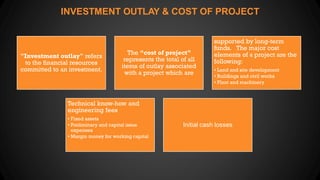
INVESTMENT OUTLAY & COST OF PROJECT
"Investment outlay" refers
to the financial resources
committed to an investment.
The “cost of project”
represents the total of all
items of outlay associated
with a project which are
supported by long-term
funds. The major cost
elements of a project are the
following:
• Land and site development
• Buildings and civil works
• Plant and machinery
Technical know-how and
engineering fees
• Fixed assets
• Preliminary and capital issue
expenses
• Margin money for working capital
Initial cash losses
MEANS OF
FINANCING
• Means by which a budget deficit is financed, or a surplus is used. Means of financing are
not included in the budget totals. The primary means of financing is borrowing from the
public. In general, the cumulative amount borrowed from the public (debt held by the
public) will increase if there is a deficit and decrease if there is a surplus, although other
factors can affect the amount that the government must borrow. Those factors, known as
other means of financing, include reductions (or increases) in the government's cash
balances, changes in outstanding checks, changes in accrued interest costs included in the
budget but not yet paid, and cash flows reflected in credit financing accounts.
• Tomeet the cost of project the following means of finance are available:
• Share capital
• Term loans
• Debenture capital
• Deferred credit
• Incentive sources
• Miscellaneous sources
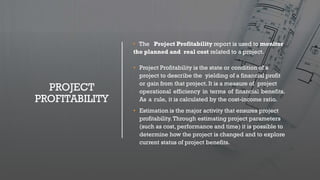
PROJECT
PROFITABILITY
• The Project Profitability report is used to monitor
the planned and real cost related to a project.
• Project Profitability is the state or condition of a
project to describe the yielding of a financial profit
or gain from that project. It is a measure of project
operational efficiency in terms of financial benefits.
As a rule, it is calculated by the cost-income ratio.
• Estimation is the major activity that ensures project
profitability. Through estimating project parameters
(such as cost, performance and time) it is possible to
determine how the project is changed and to explore
current status of project benefits.
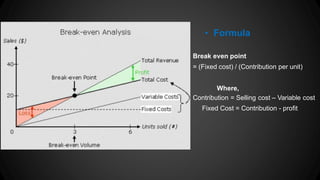
BREAK EVEN
POINT
• Definition At this point the income of the business exactly
equals its expenditure.If production is enhanced beyond this
level, profit shall accrue to the business and if it is decreased
from this level, loss shall be suffered by the business.
• The break even point is :-
• The point where the gains equal the losses.
• The point defines when an investment will generate a
positive return.
• The point where sales or revenues equal expenses.
• The point where total costs equal total revenues.
• There is no profit made or loss incurred at the break even
point.
• It is the lower limit of profit when prices are set and
margins are determined.
• Formula
Break even point
= (Fixed cost) / (Contribution per unit)
Where,
Contribution = Selling cost – Variable cost
Fixed Cost = Contribution - profit

Intro to Feasibility PT1.pdf

  • 1.
  • 2.
    CONTENTS • WHAT ISFEASIBILITY STUDY? • WHY DO FEASIBILITY STUDIES? • DIMENSIONS OF FEASIBILITY STUDY • MARKETING ANALYSIS • TECHNICAL ANALYSIS • FINANCIAL ANALYSIS • ECONOMIC ANALYSIS • ECOLOGICAL ANALYSIS • LEGAL AND ADMINISTRATIVE
  • 3.
    FEASIBILITY STUDY Feasibility study- •is an analysis of the viability of an idea. • is an analysis of all possible solutions to a problem and a recommendation on the best solution to use. • is a formal study to decide what type of system can be developed,which best the needs of the organization. • A feasibility study is essentially a process for determining the viability of a proposed initiative or service and providing a framework and direction for its development and delivery
  • 4.
    WHY DO FEASIBILITY STUDIES? To finda solution that is cost effective from a business perspective. To Find a solution that is well recognized To find out the probable market for the products To find out the opportunities and threats as presented by environment To determine the probable income of operating the project To show the contributions the project can offer to the society, among others
  • 5.
    BENEFITS OF CONDUCTING A FEASIBILITY STUDY Narrowsthe business alternatives. Gives project teams more focus and provides an alternative outline. Identifies a valid reason to undertake the project. Enhances the success rate by evaluating multiple parameters. Aids decision-making on the project
  • 6.
    STAGES OF FEASIBILITYSTUDIES A PREFEASIBILITY STUDY A FEASIBILITY STUDY
  • 7.
    DIMENSIONS OF FEASIBILITYSTUDY MARKET ANALYSIS TECHNICAL ANALYSIS FINANCIAL ANALYSIS ECONOMIC ANALYSIS ECOLOGICAL ANALYSIS LEGAL AND ADMINISTRATIVE
  • 8.
  • 9.
    MARKET ANALYSIS • Market researchis the systematic gathering, recording and analysing of data about problems relating to the marketing of goods and services. • Market research is the means by which those who provide goods and services keep themselves in touch with the needs and wants of those who buy these goods and services.
  • 10.
    MARKETING QUESTIONS • What isthe market? • Who are the competitors? • Who is the target audience? • What do customers want? • What do competitors offer? • What is your USP? • What do customers think you offer them?
  • 11.
    METHODS OF MARKET RESEARCH • Fieldresearch • Desk Research FIELD RESEARCH • Personal interview • Telephone interview • Postal surveys • Purchase survey
  • 12.
    DESK RESEARCH • InternalSources • osales figures • oaccounting records • ocustomers’ comments and complaints • osales representatives’ reports • Online Research • Search Engines • Newspapers • University has many useful databases online • Printed Research • Business Directories • Business Statistics • Industrial Market Research Reports
  • 13.
  • 14.
    FINANCIAL ANALYSIS • Financial analysisseeks to ascertain whether the proposed project will be financially viable in the sense of being able to meet the burden of servicing debt and whether the proposed project will satisfy the return expectations of those who provide the capital.The aspects which have to be looked into while conducting financial appraisal are: • Investment outlay & cost of project. • Means of financing • Project profitability • Break-even-point • Cash flows of the project • Investment worthwhileness judged in terms of various criteria of merit • Projected financial position
  • 15.
    INVESTMENT OUTLAY &COST OF PROJECT "Investment outlay" refers to the financial resources committed to an investment. The “cost of project” represents the total of all items of outlay associated with a project which are supported by long-term funds. The major cost elements of a project are the following: • Land and site development • Buildings and civil works • Plant and machinery Technical know-how and engineering fees • Fixed assets • Preliminary and capital issue expenses • Margin money for working capital Initial cash losses
  • 16.
    MEANS OF FINANCING • Meansby which a budget deficit is financed, or a surplus is used. Means of financing are not included in the budget totals. The primary means of financing is borrowing from the public. In general, the cumulative amount borrowed from the public (debt held by the public) will increase if there is a deficit and decrease if there is a surplus, although other factors can affect the amount that the government must borrow. Those factors, known as other means of financing, include reductions (or increases) in the government's cash balances, changes in outstanding checks, changes in accrued interest costs included in the budget but not yet paid, and cash flows reflected in credit financing accounts. • Tomeet the cost of project the following means of finance are available: • Share capital • Term loans • Debenture capital • Deferred credit • Incentive sources • Miscellaneous sources
  • 17.
    PROJECT PROFITABILITY • The ProjectProfitability report is used to monitor the planned and real cost related to a project. • Project Profitability is the state or condition of a project to describe the yielding of a financial profit or gain from that project. It is a measure of project operational efficiency in terms of financial benefits. As a rule, it is calculated by the cost-income ratio. • Estimation is the major activity that ensures project profitability. Through estimating project parameters (such as cost, performance and time) it is possible to determine how the project is changed and to explore current status of project benefits.
  • 18.
    BREAK EVEN POINT • DefinitionAt this point the income of the business exactly equals its expenditure.If production is enhanced beyond this level, profit shall accrue to the business and if it is decreased from this level, loss shall be suffered by the business. • The break even point is :- • The point where the gains equal the losses. • The point defines when an investment will generate a positive return. • The point where sales or revenues equal expenses. • The point where total costs equal total revenues. • There is no profit made or loss incurred at the break even point. • It is the lower limit of profit when prices are set and margins are determined.
  • 19.
    • Formula Break evenpoint = (Fixed cost) / (Contribution per unit) Where, Contribution = Selling cost – Variable cost Fixed Cost = Contribution - profit