Home Automation, Networking, and Entertainment Lab
Dept. of Computer Science and Information Engineering
National Cheng Kung University, TAIWAN
Chung-Ping Young
楊中平
ADDRESSING MODES
The 8051 Microcontroller and Embedded
Systems: Using Assembly and C
Mazidi, Mazidi and McKinlay
ADDRESSING MODES
Department of Computer Science and Information Engineering
National Cheng Kung University, TAIWAN 2
HANEL
ADDRESSING
MODES
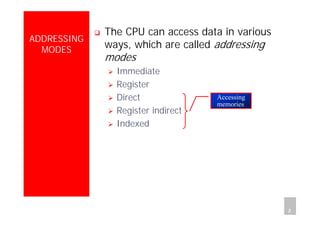
The CPU can access data in various
ways, which are called addressing
modes
Immediate
Register
Direct
Register indirect
Indexed
Accessing
memories
Department of Computer Science and Information Engineering
National Cheng Kung University, TAIWAN 3
HANEL
IMMEDIATE
ADDRESSING
MODE
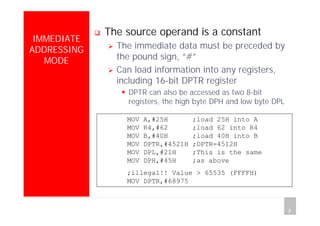
The source operand is a constant
The immediate data must be preceded by
the pound sign, “#”
Can load information into any registers,
including 16-bit DPTR register
DPTR can also be accessed as two 8-bit
registers, the high byte DPH and low byte DPL
MOV A,#25H ;load 25H into A
MOV R4,#62 ;load 62 into R4
MOV B,#40H ;load 40H into B
MOV DPTR,#4521H ;DPTR=4512H
MOV DPL,#21H ;This is the same
MOV DPH,#45H ;as above
;illegal!! Value > 65535 (FFFFH)
MOV DPTR,#68975
Department of Computer Science and Information Engineering
National Cheng Kung University, TAIWAN 4
HANEL
IMMEDIATE
ADDRESSING
MODE
(cont’)
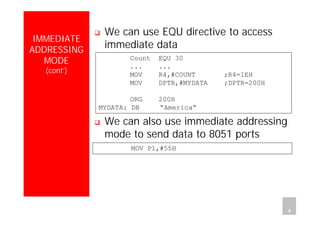
We can use EQU directive to access
immediate data
We can also use immediate addressing
mode to send data to 8051 ports
Count EQU 30
... ...
MOV R4,#COUNT ;R4=1EH
MOV DPTR,#MYDATA ;DPTR=200H
ORG 200H
MYDATA: DB “America”
MOV P1,#55H
Department of Computer Science and Information Engineering
National Cheng Kung University, TAIWAN 5
HANEL
REGISTER
ADDRESSING
MODE
Use registers to hold the data to be
manipulated
The source and destination registers
must match in size
MOV DPTR,A will give an error
The movement of data between Rn
registers is not allowed
MOV R4,R7 is invalid
MOV A,R0 ;copy contents of R0 into A
MOV R2,A ;copy contents of A into R2
ADD A,R5 ;add contents of R5 to A
ADD A,R7 ;add contents of R7 to A
MOV R6,A ;save accumulator in R6
MOV DPTR,#25F5H
MOV R7,DPL
MOV R6,DPH
Department of Computer Science and Information Engineering
National Cheng Kung University, TAIWAN 6
HANEL
ACCESSING
MEMORY
Direct
Addressing
Mode
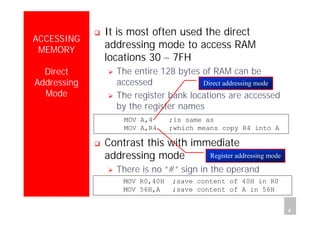
It is most often used the direct
addressing mode to access RAM
locations 30 – 7FH
The entire 128 bytes of RAM can be
accessed
The register bank locations are accessed
by the register names
Contrast this with immediate
addressing mode
There is no “#” sign in the operand
MOV R0,40H ;save content of 40H in R0
MOV 56H,A ;save content of A in 56H
MOV A,4 ;is same as
MOV A,R4 ;which means copy R4 into A
Register addressing mode
Direct addressing mode
Department of Computer Science and Information Engineering
National Cheng Kung University, TAIWAN 7
HANEL
ACCESSING
MEMORY
SFR Registers
and Their
Addresses
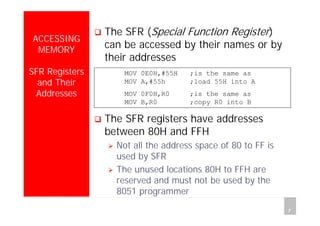
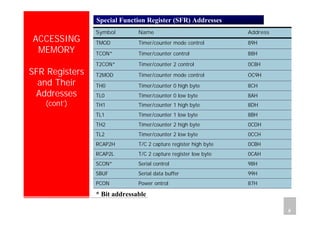
The SFR (Special Function Register)
can be accessed by their names or by
their addresses
The SFR registers have addresses
between 80H and FFH
Not all the address space of 80 to FF is
used by SFR
The unused locations 80H to FFH are
reserved and must not be used by the
8051 programmer
MOV 0E0H,#55H ;is the same as
MOV A,#55h ;load 55H into A
MOV 0F0H,R0 ;is the same as
MOV B,R0 ;copy R0 into B
Department of Computer Science and Information Engineering
National Cheng Kung University, TAIWAN 8
HANEL
ACCESSING
MEMORY
SFR Registers
and Their
Addresses
(cont’)
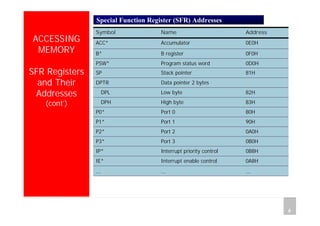
0A8HInterrupt enable controlIE*
………
0B8HInterrupt priority controlIP*
0B0HPort 3P3*
0A0HPort 2P2*
90HPort 1P1*
80HPort 0P0*
83HHigh byteDPH
82HLow byteDPL
Data pointer 2 bytesDPTR
81HStack pointerSP
0D0HProgram status wordPSW*
0F0HB registerB*
0E0HAccumulatorACC*
AddressNameSymbol
Special Function Register (SFR) Addresses
Department of Computer Science and Information Engineering
National Cheng Kung University, TAIWAN 9
HANEL
ACCESSING
MEMORY
SFR Registers
and Their
Addresses
(cont’)
89HTimer/counter mode controlTMOD
88HTimer/counter controlTCON*
0C8HTimer/counter 2 controlT2CON*
87HPower ontrolPCON
* Bit addressable
99HSerial data bufferSBUF
98HSerial controlSCON*
0CAHT/C 2 capture register low byteRCAP2L
0CBHT/C 2 capture register high byteRCAP2H
0CCHTimer/counter 2 low byteTL2
0CDHTimer/counter 2 high byteTH2
8BHTimer/counter 1 low byteTL1
8DHTimer/counter 1 high byteTH1
8AHTimer/counter 0 low byteTL0
8CHTimer/counter 0 high byteTH0
OC9HTimer/counter mode controlT2MOD
AddressNameSymbol
Special Function Register (SFR) Addresses
Department of Computer Science and Information Engineering
National Cheng Kung University, TAIWAN 10
HANEL
ACCESSING
MEMORY
SFR Registers
and Their
Addresses
(cont’)
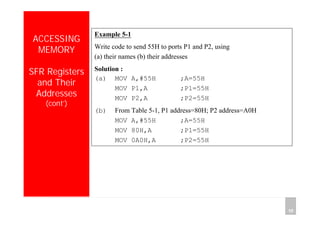
Example 5-1
Write code to send 55H to ports P1 and P2, using
(a) their names (b) their addresses
Solution :
(a) MOV A,#55H ;A=55H
MOV P1,A ;P1=55H
MOV P2,A ;P2=55H
(b) From Table 5-1, P1 address=80H; P2 address=A0H
MOV A,#55H ;A=55H
MOV 80H,A ;P1=55H
MOV 0A0H,A ;P2=55H
Department of Computer Science and Information Engineering
National Cheng Kung University, TAIWAN 11
HANEL
ACCESSING
MEMORY
Stack and
Direct
Addressing
Mode
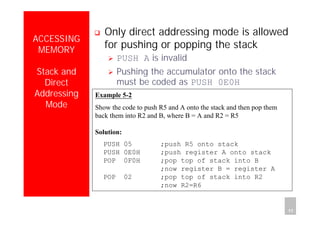
Only direct addressing mode is allowed
for pushing or popping the stack
PUSH A is invalid
Pushing the accumulator onto the stack
must be coded as PUSH 0E0H
Example 5-2
Show the code to push R5 and A onto the stack and then pop them
back them into R2 and B, where B = A and R2 = R5
Solution:
PUSH 05 ;push R5 onto stack
PUSH 0E0H ;push register A onto stack
POP 0F0H ;pop top of stack into B
;now register B = register A
POP 02 ;pop top of stack into R2
;now R2=R6
Department of Computer Science and Information Engineering
National Cheng Kung University, TAIWAN 12
HANEL
ACCESSING
MEMORY
Register
Indirect
Addressing
Mode
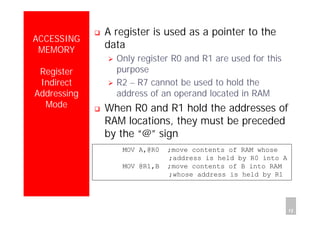
A register is used as a pointer to the
data
Only register R0 and R1 are used for this
purpose
R2 – R7 cannot be used to hold the
address of an operand located in RAM
When R0 and R1 hold the addresses of
RAM locations, they must be preceded
by the “@” sign
MOV A,@R0 ;move contents of RAM whose
;address is held by R0 into A
MOV @R1,B ;move contents of B into RAM
;whose address is held by R1
Department of Computer Science and Information Engineering
National Cheng Kung University, TAIWAN 13
HANEL
ACCESSING
MEMORY
Register
Indirect
Addressing
Mode
(cont’)
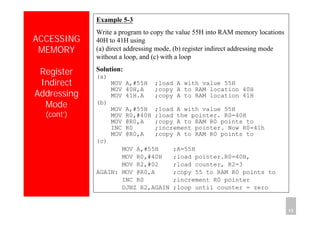
Example 5-3
Write a program to copy the value 55H into RAM memory locations
40H to 41H using
(a) direct addressing mode, (b) register indirect addressing mode
without a loop, and (c) with a loop
Solution:
(a)
MOV A,#55H ;load A with value 55H
MOV 40H,A ;copy A to RAM location 40H
MOV 41H.A ;copy A to RAM location 41H
(b)
MOV A,#55H ;load A with value 55H
MOV R0,#40H ;load the pointer. R0=40H
MOV @R0,A ;copy A to RAM R0 points to
INC R0 ;increment pointer. Now R0=41h
MOV @R0,A ;copy A to RAM R0 points to
(c)
MOV A,#55H ;A=55H
MOV R0,#40H ;load pointer.R0=40H,
MOV R2,#02 ;load counter, R2=3
AGAIN: MOV @R0,A ;copy 55 to RAM R0 points to
INC R0 ;increment R0 pointer
DJNZ R2,AGAIN ;loop until counter = zero
Department of Computer Science and Information Engineering
National Cheng Kung University, TAIWAN 14
HANEL
ACCESSING
MEMORY
Register
Indirect
Addressing
Mode
(cont’)
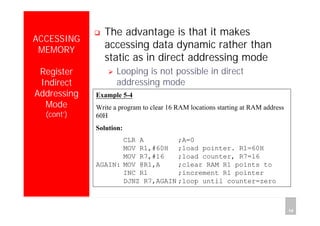
The advantage is that it makes
accessing data dynamic rather than
static as in direct addressing mode
Looping is not possible in direct
addressing mode
Example 5-4
Write a program to clear 16 RAM locations starting at RAM address
60H
Solution:
CLR A ;A=0
MOV R1,#60H ;load pointer. R1=60H
MOV R7,#16 ;load counter, R7=16
AGAIN: MOV @R1,A ;clear RAM R1 points to
INC R1 ;increment R1 pointer
DJNZ R7,AGAIN ;loop until counter=zero
Department of Computer Science and Information Engineering
National Cheng Kung University, TAIWAN 15
HANEL
ACCESSING
MEMORY
Register
Indirect
Addressing
Mode
(cont’)
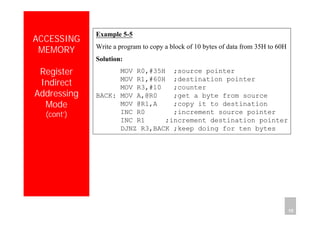
Example 5-5
Write a program to copy a block of 10 bytes of data from 35H to 60H
Solution:
MOV R0,#35H ;source pointer
MOV R1,#60H ;destination pointer
MOV R3,#10 ;counter
BACK: MOV A,@R0 ;get a byte from source
MOV @R1,A ;copy it to destination
INC R0 ;increment source pointer
INC R1 ;increment destination pointer
DJNZ R3,BACK ;keep doing for ten bytes
Department of Computer Science and Information Engineering
National Cheng Kung University, TAIWAN 16
HANEL
ACCESSING
MEMORY
Register
Indirect
Addressing
Mode
(cont’)
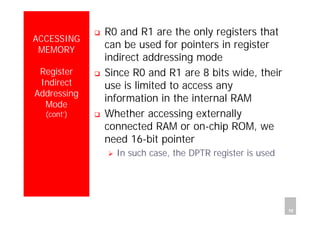
R0 and R1 are the only registers that
can be used for pointers in register
indirect addressing mode
Since R0 and R1 are 8 bits wide, their
use is limited to access any
information in the internal RAM
Whether accessing externally
connected RAM or on-chip ROM, we
need 16-bit pointer
In such case, the DPTR register is used
Department of Computer Science and Information Engineering
National Cheng Kung University, TAIWAN 17
HANEL
ACCESSING
MEMORY
Indexed
Addressing
Mode and
On-chip ROM
Access
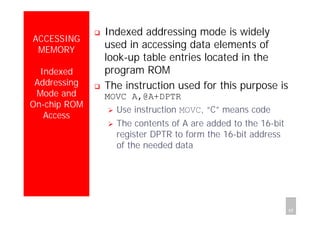
Indexed addressing mode is widely
used in accessing data elements of
look-up table entries located in the
program ROM
The instruction used for this purpose is
MOVC A,@A+DPTR
Use instruction MOVC, “C” means code
The contents of A are added to the 16-bit
register DPTR to form the 16-bit address
of the needed data
Department of Computer Science and Information Engineering
National Cheng Kung University, TAIWAN 18
HANEL
ACCESSING
MEMORY
Indexed
Addressing
Mode and On-
chip ROM
Access
(cont’)
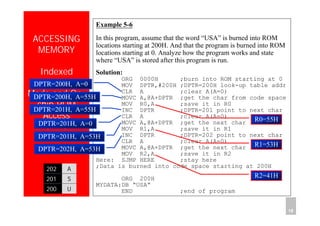
Example 5-6
In this program, assume that the word “USA” is burned into ROM
locations starting at 200H. And that the program is burned into ROM
locations starting at 0. Analyze how the program works and state
where “USA” is stored after this program is run.
Solution:
ORG 0000H ;burn into ROM starting at 0
MOV DPTR,#200H ;DPTR=200H look-up table addr
CLR A ;clear A(A=0)
MOVC A,@A+DPTR ;get the char from code space
MOV R0,A ;save it in R0
INC DPTR ;DPTR=201 point to next char
CLR A ;clear A(A=0)
MOVC A,@A+DPTR ;get the next char
MOV R1,A ;save it in R1
INC DPTR ;DPTR=202 point to next char
CLR A ;clear A(A=0)
MOVC A,@A+DPTR ;get the next char
MOV R2,A ;save it in R2
Here: SJMP HERE ;stay here
;Data is burned into code space starting at 200H
ORG 200H
MYDATA:DB “USA”
END ;end of program
DPTR=200H, A=0
U200
S201
A202
DPTR=200H, A=55H
DPTR=201H, A=55H
DPTR=201H, A=0
DPTR=201H, A=53H
DPTR=202H, A=53H
R0=55H
R1=53H
R2=41H
Department of Computer Science and Information Engineering
National Cheng Kung University, TAIWAN 19
HANEL
ACCESSING
MEMORY
Look-up Table
(cont’)
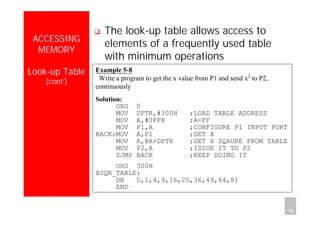
The look-up table allows access to
elements of a frequently used table
with minimum operations
Example 5-8
Write a program to get the x value from P1 and send x2
to P2,
continuously
Solution:
ORG 0
MOV DPTR,#300H ;LOAD TABLE ADDRESS
MOV A,#0FFH ;A=FF
MOV P1,A ;CONFIGURE P1 INPUT PORT
BACK:MOV A,P1 ;GET X
MOV A,@A+DPTR ;GET X SQAURE FROM TABLE
MOV P2,A ;ISSUE IT TO P2
SJMP BACK ;KEEP DOING IT
ORG 300H
XSQR_TABLE:
DB 0,1,4,9,16,25,36,49,64,81
END
Department of Computer Science and Information Engineering
National Cheng Kung University, TAIWAN 20
HANEL
ACCESSING
MEMORY
Indexed
Addressing
Mode and
MOVX
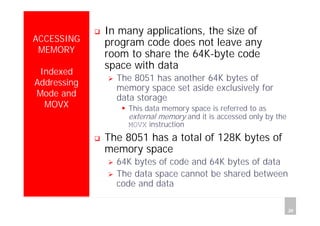
In many applications, the size of
program code does not leave any
room to share the 64K-byte code
space with data
The 8051 has another 64K bytes of
memory space set aside exclusively for
data storage
This data memory space is referred to as
external memory and it is accessed only by the
MOVX instruction
The 8051 has a total of 128K bytes of
memory space
64K bytes of code and 64K bytes of data
The data space cannot be shared between
code and data
Department of Computer Science and Information Engineering
National Cheng Kung University, TAIWAN 21
HANEL
ACCESSING
MEMORY
RAM Locations
30 – 7FH as
Scratch Pad
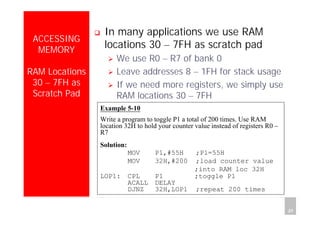
In many applications we use RAM
locations 30 – 7FH as scratch pad
We use R0 – R7 of bank 0
Leave addresses 8 – 1FH for stack usage
If we need more registers, we simply use
RAM locations 30 – 7FH
Example 5-10
Write a program to toggle P1 a total of 200 times. Use RAM
location 32H to hold your counter value instead of registers R0 –
R7
Solution:
MOV P1,#55H ;P1=55H
MOV 32H,#200 ;load counter value
;into RAM loc 32H
LOP1: CPL P1 ;toggle P1
ACALL DELAY
DJNZ 32H,LOP1 ;repeat 200 times
Department of Computer Science and Information Engineering
National Cheng Kung University, TAIWAN 22
HANEL
BIT
ADDRESSES
Many microprocessors allow program
to access registers and I/O ports in
byte size only
However, in many applications we need to
check a single bit
One unique and powerful feature of
the 8051 is single-bit operation
Single-bit instructions allow the
programmer to set, clear, move, and
complement individual bits of a port,
memory, or register
It is registers, RAM, and I/O ports that
need to be bit-addressable
ROM, holding program code for execution, is
not bit-addressable
Department of Computer Science and Information Engineering
National Cheng Kung University, TAIWAN 23
HANEL
BIT
ADDRESSES
Bit-
Addressable
RAM
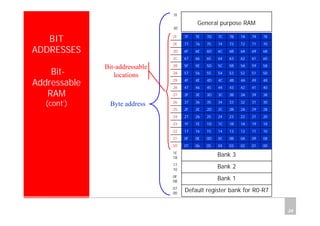
The bit-addressable RAM location are
20H to 2FH
These 16 bytes provide 128 bits of RAM
bit-addressability, since 16 × 8 = 128
0 to 127 (in decimal) or 00 to 7FH
The first byte of internal RAM location 20H
has bit address 0 to 7H
The last byte of 2FH has bit address 78H
to 7FH
Internal RAM locations 20-2FH are
both byte-addressable and bit-
addressable
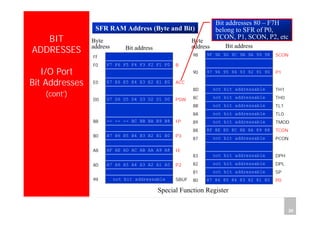
Bit address 00-7FH belong to RAM byte
addresses 20-2FH
Bit address 80-F7H belong to SFR P0,
P1, …
Department of Computer Science and Information Engineering
National Cheng Kung University, TAIWAN 24
HANEL
BIT
ADDRESSES
Bit-
Addressable
RAM
(cont’)
Default register bank for R0-R707
00
Bank 10F
08
Bank 217
10
Bank 31F
18
000102030405060720
08090A0B0C0D0E0F21
101112131415161722
18191A1B1C1D1E1F23
202122232425262724
28292A2B2C2D2E2F25
303132333435363726
38393A3B3C3D3E3F27
404142434445464728
48494A4B4C4D4E4F29
50515253545556572A
58595A5B5C5D5E5F2B
60616263646566672C
68696A6B6C6D6E6F2D
70717273747576772E
78797A7B7C7D7E7F2F
General purpose RAM
7F
30
Byte address
Bit-addressable
locations
Department of Computer Science and Information Engineering
National Cheng Kung University, TAIWAN 25
HANEL
BIT
ADDRESSES
Bit-
Addressable
RAM
(cont’)
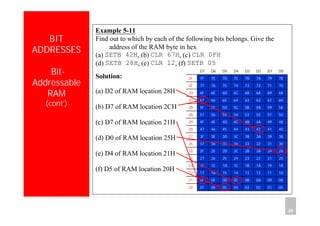
Example 5-11
Find out to which by each of the following bits belongs. Give the
address of the RAM byte in hex
(a) SETB 42H, (b) CLR 67H, (c) CLR 0FH
(d) SETB 28H, (e) CLR 12, (f) SETB 05
Solution:
(a) D2 of RAM location 28H
(b) D7 of RAM location 2CH
(c) D7 of RAM location 21H
(d) D0 of RAM location 25H
(e) D4 of RAM location 21H
(f) D5 of RAM location 20H
D0D1D2D3D4D5D6D7
000102030405060720
08090A0B0C0D0E0F21
101112131415161722
18191A1B1C1D1E1F23
202122232425262724
28292A2B2C2D2E2F25
303132333435363726
38393A3B3C3D3E3F27
404142434445464728
48494A4B4C4D4E4F29
50515253545556572A
58595A5B5C5D5E5F2B
60616263646566672C
68696A6B6C6D6E6F2D
70717273747576772E
78797A7B7C7D7E7F2F
Department of Computer Science and Information Engineering
National Cheng Kung University, TAIWAN 26
HANEL
BIT
ADDRESSES
Bit-
Addressable
RAM
(cont’)
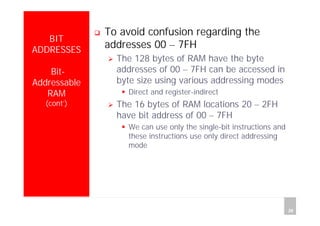
To avoid confusion regarding the
addresses 00 – 7FH
The 128 bytes of RAM have the byte
addresses of 00 – 7FH can be accessed in
byte size using various addressing modes
Direct and register-indirect
The 16 bytes of RAM locations 20 – 2FH
have bit address of 00 – 7FH
We can use only the single-bit instructions and
these instructions use only direct addressing
mode
Department of Computer Science and Information Engineering
National Cheng Kung University, TAIWAN 27
HANEL
BIT
ADDRESSES
Bit-
Addressable
RAM
(cont’)
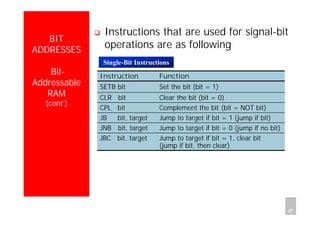
Instructions that are used for signal-bit
operations are as following
Jump to target if bit = 1, clear bit
(jump if bit, then clear)
JBC bit, target
Jump to target if bit = 0 (jump if no bit)JNB bit, target
Jump to target if bit = 1 (jump if bit)JB bit, target
Complement the bit (bit = NOT bit)CPL bit
Clear the bit (bit = 0)CLR bit
Set the bit (bit = 1)SETB bit
FunctionInstruction
Single-Bit Instructions
Department of Computer Science and Information Engineering
National Cheng Kung University, TAIWAN 28
HANEL
BIT
ADDRESSES
I/O Port
Bit Addresses
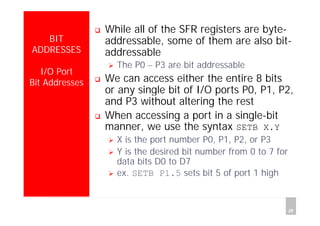
While all of the SFR registers are byte-
addressable, some of them are also bit-
addressable
The P0 – P3 are bit addressable
We can access either the entire 8 bits
or any single bit of I/O ports P0, P1, P2,
and P3 without altering the rest
When accessing a port in a single-bit
manner, we use the syntax SETB X.Y
X is the port number P0, P1, P2, or P3
Y is the desired bit number from 0 to 7 for
data bits D0 to D7
ex. SETB P1.5 sets bit 5 of port 1 high
Department of Computer Science and Information Engineering
National Cheng Kung University, TAIWAN 29
HANEL
BIT
ADDRESSES
I/O Port
Bit Addresses
(cont’)
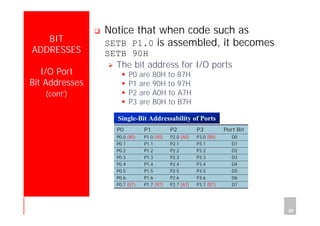
Notice that when code such as
SETB P1.0 is assembled, it becomes
SETB 90H
The bit address for I/O ports
P0 are 80H to 87H
P1 are 90H to 97H
P2 are A0H to A7H
P3 are B0H to B7H
P2.7 (A7)
P2.6
P2.5
P2.4
P2.3
P2.2
P2.1
P2.0 (A0)
P2
P3.7 (B7)
P3.6
P3.5
P3.4
P3.3
P3.2
P3.1
P3.0 (B0)
P3
P1.7 (97)
P1.6
P1.5
P1.4
P1.3
P1.2
P1.1
P1.0 (90)
P1
P0.7 (87)
P0.6
P0.5
P0.4
P0.3
P0.2
P0.1
P0.0 (80)
P0
D7
D6
D5
D4
D3
D2
D1
D0
Port Bit
Single-Bit Addressability of Ports
Department of Computer Science and Information Engineering
National Cheng Kung University, TAIWAN 30
HANEL
BIT
ADDRESSES
I/O Port
Bit Addresses
(cont’)
Special Function Register
Byte
address
SFR RAM Address (Byte and Bit)
99
A0
A8
B0
B8
D0
E0
F0
FF
SBUF
P2
IE
P3
IP
PSW
ACC
B
not bit addressable
A7 A6 A5 A4 A3 A2 A1 A0
AF AE AD AC AB AA A9 A8
B7 B6 B5 B4 B3 B2 B1 B0
-- -- -- BC BB BA B9 B8
D7 D6 D5 D4 D3 D2 D1 D0
E7 E6 E5 E4 E3 E2 E1 E0
F7 F6 F5 F4 F3 F2 F1 F0
Bit address
DPLnot bit addressable82
SPnot bit addressable81
80
83
87
88
89
8A
8B
8C
8D
90
98
P0
DPH
PCON
TCON
TMOD
TL0
TL1
TH0
TH1
P1
SCON
87 86 85 84 83 82 81 80
not bit addressable
not bit addressable
8F 8E 8D 8C 8B 8A 89 88
not bit addressable
not bit addressable
not bit addressable
not bit addressable
not bit addressable
97 96 95 94 93 92 91 90
9F 9E 9D 9C 9B 9A 99 98
Bit address
Byte
address
Bit addresses 80 – F7H
belong to SFR of P0,
TCON, P1, SCON, P2, etc
Department of Computer Science and Information Engineering
National Cheng Kung University, TAIWAN 31
HANEL
BIT
ADDRESSES
Registers
Bit-
Addressability
Only registers A, B, PSW, IP, IE, ACC,
SCON, and TCON are bit-addressable
While all I/O ports are bit-addressable
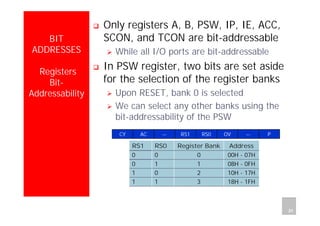
In PSW register, two bits are set aside
for the selection of the register banks
Upon RESET, bank 0 is selected
We can select any other banks using the
bit-addressability of the PSW
P--OVRS0RS1--ACCY
18H - 1FH311
10H - 17H201
08H - 0FH110
00H - 07H000
AddressRegister BankRS0RS1
Department of Computer Science and Information Engineering
National Cheng Kung University, TAIWAN 32
HANEL
BIT
ADDRESSES
Registers
Bit-
Addressability
(cont’)
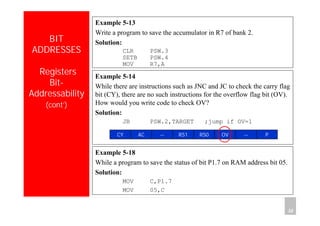
Example 5-13
Write a program to save the accumulator in R7 of bank 2.
Solution:
CLR PSW.3
SETB PSW.4
MOV R7,A
Example 5-14
While there are instructions such as JNC and JC to check the carry flag
bit (CY), there are no such instructions for the overflow flag bit (OV).
How would you write code to check OV?
Solution:
JB PSW.2,TARGET ;jump if OV=1
P--OVRS0RS1--ACCY
Example 5-18
While a program to save the status of bit P1.7 on RAM address bit 05.
Solution:
MOV C,P1.7
MOV 05,C
Department of Computer Science and Information Engineering
National Cheng Kung University, TAIWAN 33
HANEL
BIT
ADDRESSES
Registers
Bit-
Addressability
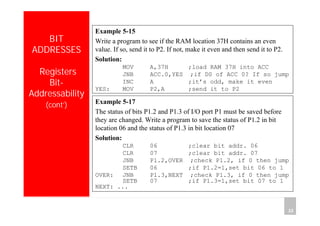
(cont’) Example 5-17
The status of bits P1.2 and P1.3 of I/O port P1 must be saved before
they are changed. Write a program to save the status of P1.2 in bit
location 06 and the status of P1.3 in bit location 07
Solution:
CLR 06 ;clear bit addr. 06
CLR 07 ;clear bit addr. 07
JNB P1.2,OVER ;check P1.2, if 0 then jump
SETB 06 ;if P1.2=1,set bit 06 to 1
OVER: JNB P1.3,NEXT ;check P1.3, if 0 then jump
SETB 07 ;if P1.3=1,set bit 07 to 1
NEXT: ...
Example 5-15
Write a program to see if the RAM location 37H contains an even
value. If so, send it to P2. If not, make it even and then send it to P2.
Solution:
MOV A,37H ;load RAM 37H into ACC
JNB ACC.0,YES ;if D0 of ACC 0? If so jump
INC A ;it’s odd, make it even
YES: MOV P2,A ;send it to P2
Department of Computer Science and Information Engineering
National Cheng Kung University, TAIWAN 34
HANEL
BIT
ADDRESSES
Using BIT
The BIT directive is a widely used
directive to assign the bit-addressable
I/O and RAM locations
Allow a program to assign the I/O or RAM
bit at the beginning of the program,
making it easier to modify them
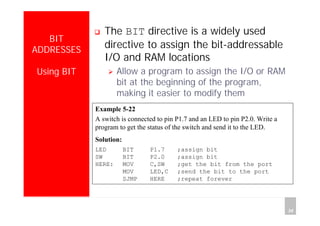
Example 5-22
A switch is connected to pin P1.7 and an LED to pin P2.0. Write a
program to get the status of the switch and send it to the LED.
Solution:
LED BIT P1.7 ;assign bit
SW BIT P2.0 ;assign bit
HERE: MOV C,SW ;get the bit from the port
MOV LED,C ;send the bit to the port
SJMP HERE ;repeat forever
Department of Computer Science and Information Engineering
National Cheng Kung University, TAIWAN 35
HANEL
BIT
ADDRESSES
Using BIT
(cont’)
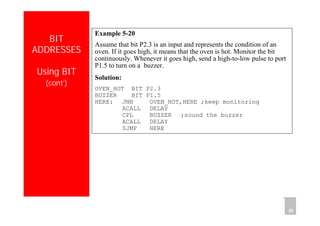
Example 5-20
Assume that bit P2.3 is an input and represents the condition of an
oven. If it goes high, it means that the oven is hot. Monitor the bit
continuously. Whenever it goes high, send a high-to-low pulse to port
P1.5 to turn on a buzzer.
Solution:
OVEN_HOT BIT P2.3
BUZZER BIT P1.5
HERE: JNB OVEN_HOT,HERE ;keep monitoring
ACALL DELAY
CPL BUZZER ;sound the buzzer
ACALL DELAY
SJMP HERE
Department of Computer Science and Information Engineering
National Cheng Kung University, TAIWAN 36
HANEL
BIT
ADDRESSES
Using EQU
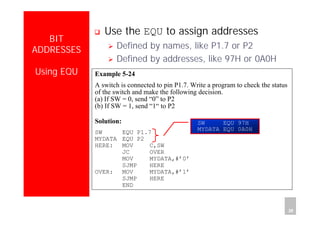
Use the EQU to assign addresses
Defined by names, like P1.7 or P2
Defined by addresses, like 97H or 0A0H
Example 5-24
A switch is connected to pin P1.7. Write a program to check the status
of the switch and make the following decision.
(a) If SW = 0, send “0” to P2
(b) If SW = 1, send “1“ to P2
Solution:
SW EQU P1.7
MYDATA EQU P2
HERE: MOV C,SW
JC OVER
MOV MYDATA,#’0’
SJMP HERE
OVER: MOV MYDATA,#’1’
SJMP HERE
END
SW EQU 97H
MYDATA EQU 0A0H
Department of Computer Science and Information Engineering
National Cheng Kung University, TAIWAN 37
HANEL
EXTRA 128
BYTE ON-CHIP
RAM IN 8052
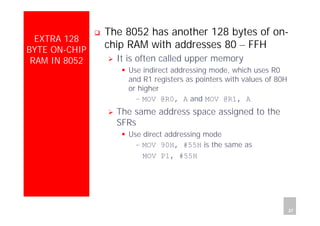
The 8052 has another 128 bytes of on-
chip RAM with addresses 80 – FFH
It is often called upper memory
Use indirect addressing mode, which uses R0
and R1 registers as pointers with values of 80H
or higher
– MOV @R0, A and MOV @R1, A
The same address space assigned to the
SFRs
Use direct addressing mode
– MOV 90H, #55H is the same as
MOV P1, #55H
Department of Computer Science and Information Engineering
National Cheng Kung University, TAIWAN 38
HANEL
EXTRA 128
BYTE ON-CHIP
RAM IN 8052
(cont’)
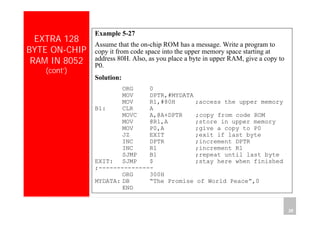
Example 5-27
Assume that the on-chip ROM has a message. Write a program to
copy it from code space into the upper memory space starting at
address 80H. Also, as you place a byte in upper RAM, give a copy to
P0.
Solution:
ORG 0
MOV DPTR,#MYDATA
MOV R1,#80H ;access the upper memory
B1: CLR A
MOVC A,@A+DPTR ;copy from code ROM
MOV @R1,A ;store in upper memory
MOV P0,A ;give a copy to P0
JZ EXIT ;exit if last byte
INC DPTR ;increment DPTR
INC R1 ;increment R1
SJMP B1 ;repeat until last byte
EXIT: SJMP $ ;stay here when finished
;---------------
ORG 300H
MYDATA: DB “The Promise of World Peace”,0
END

5 addressing modes

  • 1.
    Home Automation, Networking,and Entertainment Lab Dept. of Computer Science and Information Engineering National Cheng Kung University, TAIWAN Chung-Ping Young 楊中平 ADDRESSING MODES The 8051 Microcontroller and Embedded Systems: Using Assembly and C Mazidi, Mazidi and McKinlay ADDRESSING MODES
  • 2.
    Department of ComputerScience and Information Engineering National Cheng Kung University, TAIWAN 2 HANEL ADDRESSING MODES The CPU can access data in various ways, which are called addressing modes Immediate Register Direct Register indirect Indexed Accessing memories
  • 3.
    Department of ComputerScience and Information Engineering National Cheng Kung University, TAIWAN 3 HANEL IMMEDIATE ADDRESSING MODE The source operand is a constant The immediate data must be preceded by the pound sign, “#” Can load information into any registers, including 16-bit DPTR register DPTR can also be accessed as two 8-bit registers, the high byte DPH and low byte DPL MOV A,#25H ;load 25H into A MOV R4,#62 ;load 62 into R4 MOV B,#40H ;load 40H into B MOV DPTR,#4521H ;DPTR=4512H MOV DPL,#21H ;This is the same MOV DPH,#45H ;as above ;illegal!! Value > 65535 (FFFFH) MOV DPTR,#68975
  • 4.
    Department of ComputerScience and Information Engineering National Cheng Kung University, TAIWAN 4 HANEL IMMEDIATE ADDRESSING MODE (cont’) We can use EQU directive to access immediate data We can also use immediate addressing mode to send data to 8051 ports Count EQU 30 ... ... MOV R4,#COUNT ;R4=1EH MOV DPTR,#MYDATA ;DPTR=200H ORG 200H MYDATA: DB “America” MOV P1,#55H
  • 5.
    Department of ComputerScience and Information Engineering National Cheng Kung University, TAIWAN 5 HANEL REGISTER ADDRESSING MODE Use registers to hold the data to be manipulated The source and destination registers must match in size MOV DPTR,A will give an error The movement of data between Rn registers is not allowed MOV R4,R7 is invalid MOV A,R0 ;copy contents of R0 into A MOV R2,A ;copy contents of A into R2 ADD A,R5 ;add contents of R5 to A ADD A,R7 ;add contents of R7 to A MOV R6,A ;save accumulator in R6 MOV DPTR,#25F5H MOV R7,DPL MOV R6,DPH
  • 6.
    Department of ComputerScience and Information Engineering National Cheng Kung University, TAIWAN 6 HANEL ACCESSING MEMORY Direct Addressing Mode It is most often used the direct addressing mode to access RAM locations 30 – 7FH The entire 128 bytes of RAM can be accessed The register bank locations are accessed by the register names Contrast this with immediate addressing mode There is no “#” sign in the operand MOV R0,40H ;save content of 40H in R0 MOV 56H,A ;save content of A in 56H MOV A,4 ;is same as MOV A,R4 ;which means copy R4 into A Register addressing mode Direct addressing mode
  • 7.
    Department of ComputerScience and Information Engineering National Cheng Kung University, TAIWAN 7 HANEL ACCESSING MEMORY SFR Registers and Their Addresses The SFR (Special Function Register) can be accessed by their names or by their addresses The SFR registers have addresses between 80H and FFH Not all the address space of 80 to FF is used by SFR The unused locations 80H to FFH are reserved and must not be used by the 8051 programmer MOV 0E0H,#55H ;is the same as MOV A,#55h ;load 55H into A MOV 0F0H,R0 ;is the same as MOV B,R0 ;copy R0 into B
  • 8.
    Department of ComputerScience and Information Engineering National Cheng Kung University, TAIWAN 8 HANEL ACCESSING MEMORY SFR Registers and Their Addresses (cont’) 0A8HInterrupt enable controlIE* ……… 0B8HInterrupt priority controlIP* 0B0HPort 3P3* 0A0HPort 2P2* 90HPort 1P1* 80HPort 0P0* 83HHigh byteDPH 82HLow byteDPL Data pointer 2 bytesDPTR 81HStack pointerSP 0D0HProgram status wordPSW* 0F0HB registerB* 0E0HAccumulatorACC* AddressNameSymbol Special Function Register (SFR) Addresses
  • 9.
    Department of ComputerScience and Information Engineering National Cheng Kung University, TAIWAN 9 HANEL ACCESSING MEMORY SFR Registers and Their Addresses (cont’) 89HTimer/counter mode controlTMOD 88HTimer/counter controlTCON* 0C8HTimer/counter 2 controlT2CON* 87HPower ontrolPCON * Bit addressable 99HSerial data bufferSBUF 98HSerial controlSCON* 0CAHT/C 2 capture register low byteRCAP2L 0CBHT/C 2 capture register high byteRCAP2H 0CCHTimer/counter 2 low byteTL2 0CDHTimer/counter 2 high byteTH2 8BHTimer/counter 1 low byteTL1 8DHTimer/counter 1 high byteTH1 8AHTimer/counter 0 low byteTL0 8CHTimer/counter 0 high byteTH0 OC9HTimer/counter mode controlT2MOD AddressNameSymbol Special Function Register (SFR) Addresses
  • 10.
    Department of ComputerScience and Information Engineering National Cheng Kung University, TAIWAN 10 HANEL ACCESSING MEMORY SFR Registers and Their Addresses (cont’) Example 5-1 Write code to send 55H to ports P1 and P2, using (a) their names (b) their addresses Solution : (a) MOV A,#55H ;A=55H MOV P1,A ;P1=55H MOV P2,A ;P2=55H (b) From Table 5-1, P1 address=80H; P2 address=A0H MOV A,#55H ;A=55H MOV 80H,A ;P1=55H MOV 0A0H,A ;P2=55H
  • 11.
    Department of ComputerScience and Information Engineering National Cheng Kung University, TAIWAN 11 HANEL ACCESSING MEMORY Stack and Direct Addressing Mode Only direct addressing mode is allowed for pushing or popping the stack PUSH A is invalid Pushing the accumulator onto the stack must be coded as PUSH 0E0H Example 5-2 Show the code to push R5 and A onto the stack and then pop them back them into R2 and B, where B = A and R2 = R5 Solution: PUSH 05 ;push R5 onto stack PUSH 0E0H ;push register A onto stack POP 0F0H ;pop top of stack into B ;now register B = register A POP 02 ;pop top of stack into R2 ;now R2=R6
  • 12.
    Department of ComputerScience and Information Engineering National Cheng Kung University, TAIWAN 12 HANEL ACCESSING MEMORY Register Indirect Addressing Mode A register is used as a pointer to the data Only register R0 and R1 are used for this purpose R2 – R7 cannot be used to hold the address of an operand located in RAM When R0 and R1 hold the addresses of RAM locations, they must be preceded by the “@” sign MOV A,@R0 ;move contents of RAM whose ;address is held by R0 into A MOV @R1,B ;move contents of B into RAM ;whose address is held by R1
  • 13.
    Department of ComputerScience and Information Engineering National Cheng Kung University, TAIWAN 13 HANEL ACCESSING MEMORY Register Indirect Addressing Mode (cont’) Example 5-3 Write a program to copy the value 55H into RAM memory locations 40H to 41H using (a) direct addressing mode, (b) register indirect addressing mode without a loop, and (c) with a loop Solution: (a) MOV A,#55H ;load A with value 55H MOV 40H,A ;copy A to RAM location 40H MOV 41H.A ;copy A to RAM location 41H (b) MOV A,#55H ;load A with value 55H MOV R0,#40H ;load the pointer. R0=40H MOV @R0,A ;copy A to RAM R0 points to INC R0 ;increment pointer. Now R0=41h MOV @R0,A ;copy A to RAM R0 points to (c) MOV A,#55H ;A=55H MOV R0,#40H ;load pointer.R0=40H, MOV R2,#02 ;load counter, R2=3 AGAIN: MOV @R0,A ;copy 55 to RAM R0 points to INC R0 ;increment R0 pointer DJNZ R2,AGAIN ;loop until counter = zero
  • 14.
    Department of ComputerScience and Information Engineering National Cheng Kung University, TAIWAN 14 HANEL ACCESSING MEMORY Register Indirect Addressing Mode (cont’) The advantage is that it makes accessing data dynamic rather than static as in direct addressing mode Looping is not possible in direct addressing mode Example 5-4 Write a program to clear 16 RAM locations starting at RAM address 60H Solution: CLR A ;A=0 MOV R1,#60H ;load pointer. R1=60H MOV R7,#16 ;load counter, R7=16 AGAIN: MOV @R1,A ;clear RAM R1 points to INC R1 ;increment R1 pointer DJNZ R7,AGAIN ;loop until counter=zero
  • 15.
    Department of ComputerScience and Information Engineering National Cheng Kung University, TAIWAN 15 HANEL ACCESSING MEMORY Register Indirect Addressing Mode (cont’) Example 5-5 Write a program to copy a block of 10 bytes of data from 35H to 60H Solution: MOV R0,#35H ;source pointer MOV R1,#60H ;destination pointer MOV R3,#10 ;counter BACK: MOV A,@R0 ;get a byte from source MOV @R1,A ;copy it to destination INC R0 ;increment source pointer INC R1 ;increment destination pointer DJNZ R3,BACK ;keep doing for ten bytes
  • 16.
    Department of ComputerScience and Information Engineering National Cheng Kung University, TAIWAN 16 HANEL ACCESSING MEMORY Register Indirect Addressing Mode (cont’) R0 and R1 are the only registers that can be used for pointers in register indirect addressing mode Since R0 and R1 are 8 bits wide, their use is limited to access any information in the internal RAM Whether accessing externally connected RAM or on-chip ROM, we need 16-bit pointer In such case, the DPTR register is used
  • 17.
    Department of ComputerScience and Information Engineering National Cheng Kung University, TAIWAN 17 HANEL ACCESSING MEMORY Indexed Addressing Mode and On-chip ROM Access Indexed addressing mode is widely used in accessing data elements of look-up table entries located in the program ROM The instruction used for this purpose is MOVC A,@A+DPTR Use instruction MOVC, “C” means code The contents of A are added to the 16-bit register DPTR to form the 16-bit address of the needed data
  • 18.
    Department of ComputerScience and Information Engineering National Cheng Kung University, TAIWAN 18 HANEL ACCESSING MEMORY Indexed Addressing Mode and On- chip ROM Access (cont’) Example 5-6 In this program, assume that the word “USA” is burned into ROM locations starting at 200H. And that the program is burned into ROM locations starting at 0. Analyze how the program works and state where “USA” is stored after this program is run. Solution: ORG 0000H ;burn into ROM starting at 0 MOV DPTR,#200H ;DPTR=200H look-up table addr CLR A ;clear A(A=0) MOVC A,@A+DPTR ;get the char from code space MOV R0,A ;save it in R0 INC DPTR ;DPTR=201 point to next char CLR A ;clear A(A=0) MOVC A,@A+DPTR ;get the next char MOV R1,A ;save it in R1 INC DPTR ;DPTR=202 point to next char CLR A ;clear A(A=0) MOVC A,@A+DPTR ;get the next char MOV R2,A ;save it in R2 Here: SJMP HERE ;stay here ;Data is burned into code space starting at 200H ORG 200H MYDATA:DB “USA” END ;end of program DPTR=200H, A=0 U200 S201 A202 DPTR=200H, A=55H DPTR=201H, A=55H DPTR=201H, A=0 DPTR=201H, A=53H DPTR=202H, A=53H R0=55H R1=53H R2=41H
  • 19.
    Department of ComputerScience and Information Engineering National Cheng Kung University, TAIWAN 19 HANEL ACCESSING MEMORY Look-up Table (cont’) The look-up table allows access to elements of a frequently used table with minimum operations Example 5-8 Write a program to get the x value from P1 and send x2 to P2, continuously Solution: ORG 0 MOV DPTR,#300H ;LOAD TABLE ADDRESS MOV A,#0FFH ;A=FF MOV P1,A ;CONFIGURE P1 INPUT PORT BACK:MOV A,P1 ;GET X MOV A,@A+DPTR ;GET X SQAURE FROM TABLE MOV P2,A ;ISSUE IT TO P2 SJMP BACK ;KEEP DOING IT ORG 300H XSQR_TABLE: DB 0,1,4,9,16,25,36,49,64,81 END
  • 20.
    Department of ComputerScience and Information Engineering National Cheng Kung University, TAIWAN 20 HANEL ACCESSING MEMORY Indexed Addressing Mode and MOVX In many applications, the size of program code does not leave any room to share the 64K-byte code space with data The 8051 has another 64K bytes of memory space set aside exclusively for data storage This data memory space is referred to as external memory and it is accessed only by the MOVX instruction The 8051 has a total of 128K bytes of memory space 64K bytes of code and 64K bytes of data The data space cannot be shared between code and data
  • 21.
    Department of ComputerScience and Information Engineering National Cheng Kung University, TAIWAN 21 HANEL ACCESSING MEMORY RAM Locations 30 – 7FH as Scratch Pad In many applications we use RAM locations 30 – 7FH as scratch pad We use R0 – R7 of bank 0 Leave addresses 8 – 1FH for stack usage If we need more registers, we simply use RAM locations 30 – 7FH Example 5-10 Write a program to toggle P1 a total of 200 times. Use RAM location 32H to hold your counter value instead of registers R0 – R7 Solution: MOV P1,#55H ;P1=55H MOV 32H,#200 ;load counter value ;into RAM loc 32H LOP1: CPL P1 ;toggle P1 ACALL DELAY DJNZ 32H,LOP1 ;repeat 200 times
  • 22.
    Department of ComputerScience and Information Engineering National Cheng Kung University, TAIWAN 22 HANEL BIT ADDRESSES Many microprocessors allow program to access registers and I/O ports in byte size only However, in many applications we need to check a single bit One unique and powerful feature of the 8051 is single-bit operation Single-bit instructions allow the programmer to set, clear, move, and complement individual bits of a port, memory, or register It is registers, RAM, and I/O ports that need to be bit-addressable ROM, holding program code for execution, is not bit-addressable
  • 23.
    Department of ComputerScience and Information Engineering National Cheng Kung University, TAIWAN 23 HANEL BIT ADDRESSES Bit- Addressable RAM The bit-addressable RAM location are 20H to 2FH These 16 bytes provide 128 bits of RAM bit-addressability, since 16 × 8 = 128 0 to 127 (in decimal) or 00 to 7FH The first byte of internal RAM location 20H has bit address 0 to 7H The last byte of 2FH has bit address 78H to 7FH Internal RAM locations 20-2FH are both byte-addressable and bit- addressable Bit address 00-7FH belong to RAM byte addresses 20-2FH Bit address 80-F7H belong to SFR P0, P1, …
  • 24.
    Department of ComputerScience and Information Engineering National Cheng Kung University, TAIWAN 24 HANEL BIT ADDRESSES Bit- Addressable RAM (cont’) Default register bank for R0-R707 00 Bank 10F 08 Bank 217 10 Bank 31F 18 000102030405060720 08090A0B0C0D0E0F21 101112131415161722 18191A1B1C1D1E1F23 202122232425262724 28292A2B2C2D2E2F25 303132333435363726 38393A3B3C3D3E3F27 404142434445464728 48494A4B4C4D4E4F29 50515253545556572A 58595A5B5C5D5E5F2B 60616263646566672C 68696A6B6C6D6E6F2D 70717273747576772E 78797A7B7C7D7E7F2F General purpose RAM 7F 30 Byte address Bit-addressable locations
  • 25.
    Department of ComputerScience and Information Engineering National Cheng Kung University, TAIWAN 25 HANEL BIT ADDRESSES Bit- Addressable RAM (cont’) Example 5-11 Find out to which by each of the following bits belongs. Give the address of the RAM byte in hex (a) SETB 42H, (b) CLR 67H, (c) CLR 0FH (d) SETB 28H, (e) CLR 12, (f) SETB 05 Solution: (a) D2 of RAM location 28H (b) D7 of RAM location 2CH (c) D7 of RAM location 21H (d) D0 of RAM location 25H (e) D4 of RAM location 21H (f) D5 of RAM location 20H D0D1D2D3D4D5D6D7 000102030405060720 08090A0B0C0D0E0F21 101112131415161722 18191A1B1C1D1E1F23 202122232425262724 28292A2B2C2D2E2F25 303132333435363726 38393A3B3C3D3E3F27 404142434445464728 48494A4B4C4D4E4F29 50515253545556572A 58595A5B5C5D5E5F2B 60616263646566672C 68696A6B6C6D6E6F2D 70717273747576772E 78797A7B7C7D7E7F2F
  • 26.
    Department of ComputerScience and Information Engineering National Cheng Kung University, TAIWAN 26 HANEL BIT ADDRESSES Bit- Addressable RAM (cont’) To avoid confusion regarding the addresses 00 – 7FH The 128 bytes of RAM have the byte addresses of 00 – 7FH can be accessed in byte size using various addressing modes Direct and register-indirect The 16 bytes of RAM locations 20 – 2FH have bit address of 00 – 7FH We can use only the single-bit instructions and these instructions use only direct addressing mode
  • 27.
    Department of ComputerScience and Information Engineering National Cheng Kung University, TAIWAN 27 HANEL BIT ADDRESSES Bit- Addressable RAM (cont’) Instructions that are used for signal-bit operations are as following Jump to target if bit = 1, clear bit (jump if bit, then clear) JBC bit, target Jump to target if bit = 0 (jump if no bit)JNB bit, target Jump to target if bit = 1 (jump if bit)JB bit, target Complement the bit (bit = NOT bit)CPL bit Clear the bit (bit = 0)CLR bit Set the bit (bit = 1)SETB bit FunctionInstruction Single-Bit Instructions
  • 28.
    Department of ComputerScience and Information Engineering National Cheng Kung University, TAIWAN 28 HANEL BIT ADDRESSES I/O Port Bit Addresses While all of the SFR registers are byte- addressable, some of them are also bit- addressable The P0 – P3 are bit addressable We can access either the entire 8 bits or any single bit of I/O ports P0, P1, P2, and P3 without altering the rest When accessing a port in a single-bit manner, we use the syntax SETB X.Y X is the port number P0, P1, P2, or P3 Y is the desired bit number from 0 to 7 for data bits D0 to D7 ex. SETB P1.5 sets bit 5 of port 1 high
  • 29.
    Department of ComputerScience and Information Engineering National Cheng Kung University, TAIWAN 29 HANEL BIT ADDRESSES I/O Port Bit Addresses (cont’) Notice that when code such as SETB P1.0 is assembled, it becomes SETB 90H The bit address for I/O ports P0 are 80H to 87H P1 are 90H to 97H P2 are A0H to A7H P3 are B0H to B7H P2.7 (A7) P2.6 P2.5 P2.4 P2.3 P2.2 P2.1 P2.0 (A0) P2 P3.7 (B7) P3.6 P3.5 P3.4 P3.3 P3.2 P3.1 P3.0 (B0) P3 P1.7 (97) P1.6 P1.5 P1.4 P1.3 P1.2 P1.1 P1.0 (90) P1 P0.7 (87) P0.6 P0.5 P0.4 P0.3 P0.2 P0.1 P0.0 (80) P0 D7 D6 D5 D4 D3 D2 D1 D0 Port Bit Single-Bit Addressability of Ports
  • 30.
    Department of ComputerScience and Information Engineering National Cheng Kung University, TAIWAN 30 HANEL BIT ADDRESSES I/O Port Bit Addresses (cont’) Special Function Register Byte address SFR RAM Address (Byte and Bit) 99 A0 A8 B0 B8 D0 E0 F0 FF SBUF P2 IE P3 IP PSW ACC B not bit addressable A7 A6 A5 A4 A3 A2 A1 A0 AF AE AD AC AB AA A9 A8 B7 B6 B5 B4 B3 B2 B1 B0 -- -- -- BC BB BA B9 B8 D7 D6 D5 D4 D3 D2 D1 D0 E7 E6 E5 E4 E3 E2 E1 E0 F7 F6 F5 F4 F3 F2 F1 F0 Bit address DPLnot bit addressable82 SPnot bit addressable81 80 83 87 88 89 8A 8B 8C 8D 90 98 P0 DPH PCON TCON TMOD TL0 TL1 TH0 TH1 P1 SCON 87 86 85 84 83 82 81 80 not bit addressable not bit addressable 8F 8E 8D 8C 8B 8A 89 88 not bit addressable not bit addressable not bit addressable not bit addressable not bit addressable 97 96 95 94 93 92 91 90 9F 9E 9D 9C 9B 9A 99 98 Bit address Byte address Bit addresses 80 – F7H belong to SFR of P0, TCON, P1, SCON, P2, etc
  • 31.
    Department of ComputerScience and Information Engineering National Cheng Kung University, TAIWAN 31 HANEL BIT ADDRESSES Registers Bit- Addressability Only registers A, B, PSW, IP, IE, ACC, SCON, and TCON are bit-addressable While all I/O ports are bit-addressable In PSW register, two bits are set aside for the selection of the register banks Upon RESET, bank 0 is selected We can select any other banks using the bit-addressability of the PSW P--OVRS0RS1--ACCY 18H - 1FH311 10H - 17H201 08H - 0FH110 00H - 07H000 AddressRegister BankRS0RS1
  • 32.
    Department of ComputerScience and Information Engineering National Cheng Kung University, TAIWAN 32 HANEL BIT ADDRESSES Registers Bit- Addressability (cont’) Example 5-13 Write a program to save the accumulator in R7 of bank 2. Solution: CLR PSW.3 SETB PSW.4 MOV R7,A Example 5-14 While there are instructions such as JNC and JC to check the carry flag bit (CY), there are no such instructions for the overflow flag bit (OV). How would you write code to check OV? Solution: JB PSW.2,TARGET ;jump if OV=1 P--OVRS0RS1--ACCY Example 5-18 While a program to save the status of bit P1.7 on RAM address bit 05. Solution: MOV C,P1.7 MOV 05,C
  • 33.
    Department of ComputerScience and Information Engineering National Cheng Kung University, TAIWAN 33 HANEL BIT ADDRESSES Registers Bit- Addressability (cont’) Example 5-17 The status of bits P1.2 and P1.3 of I/O port P1 must be saved before they are changed. Write a program to save the status of P1.2 in bit location 06 and the status of P1.3 in bit location 07 Solution: CLR 06 ;clear bit addr. 06 CLR 07 ;clear bit addr. 07 JNB P1.2,OVER ;check P1.2, if 0 then jump SETB 06 ;if P1.2=1,set bit 06 to 1 OVER: JNB P1.3,NEXT ;check P1.3, if 0 then jump SETB 07 ;if P1.3=1,set bit 07 to 1 NEXT: ... Example 5-15 Write a program to see if the RAM location 37H contains an even value. If so, send it to P2. If not, make it even and then send it to P2. Solution: MOV A,37H ;load RAM 37H into ACC JNB ACC.0,YES ;if D0 of ACC 0? If so jump INC A ;it’s odd, make it even YES: MOV P2,A ;send it to P2
  • 34.
    Department of ComputerScience and Information Engineering National Cheng Kung University, TAIWAN 34 HANEL BIT ADDRESSES Using BIT The BIT directive is a widely used directive to assign the bit-addressable I/O and RAM locations Allow a program to assign the I/O or RAM bit at the beginning of the program, making it easier to modify them Example 5-22 A switch is connected to pin P1.7 and an LED to pin P2.0. Write a program to get the status of the switch and send it to the LED. Solution: LED BIT P1.7 ;assign bit SW BIT P2.0 ;assign bit HERE: MOV C,SW ;get the bit from the port MOV LED,C ;send the bit to the port SJMP HERE ;repeat forever
  • 35.
    Department of ComputerScience and Information Engineering National Cheng Kung University, TAIWAN 35 HANEL BIT ADDRESSES Using BIT (cont’) Example 5-20 Assume that bit P2.3 is an input and represents the condition of an oven. If it goes high, it means that the oven is hot. Monitor the bit continuously. Whenever it goes high, send a high-to-low pulse to port P1.5 to turn on a buzzer. Solution: OVEN_HOT BIT P2.3 BUZZER BIT P1.5 HERE: JNB OVEN_HOT,HERE ;keep monitoring ACALL DELAY CPL BUZZER ;sound the buzzer ACALL DELAY SJMP HERE
  • 36.
    Department of ComputerScience and Information Engineering National Cheng Kung University, TAIWAN 36 HANEL BIT ADDRESSES Using EQU Use the EQU to assign addresses Defined by names, like P1.7 or P2 Defined by addresses, like 97H or 0A0H Example 5-24 A switch is connected to pin P1.7. Write a program to check the status of the switch and make the following decision. (a) If SW = 0, send “0” to P2 (b) If SW = 1, send “1“ to P2 Solution: SW EQU P1.7 MYDATA EQU P2 HERE: MOV C,SW JC OVER MOV MYDATA,#’0’ SJMP HERE OVER: MOV MYDATA,#’1’ SJMP HERE END SW EQU 97H MYDATA EQU 0A0H
  • 37.
    Department of ComputerScience and Information Engineering National Cheng Kung University, TAIWAN 37 HANEL EXTRA 128 BYTE ON-CHIP RAM IN 8052 The 8052 has another 128 bytes of on- chip RAM with addresses 80 – FFH It is often called upper memory Use indirect addressing mode, which uses R0 and R1 registers as pointers with values of 80H or higher – MOV @R0, A and MOV @R1, A The same address space assigned to the SFRs Use direct addressing mode – MOV 90H, #55H is the same as MOV P1, #55H
  • 38.
    Department of ComputerScience and Information Engineering National Cheng Kung University, TAIWAN 38 HANEL EXTRA 128 BYTE ON-CHIP RAM IN 8052 (cont’) Example 5-27 Assume that the on-chip ROM has a message. Write a program to copy it from code space into the upper memory space starting at address 80H. Also, as you place a byte in upper RAM, give a copy to P0. Solution: ORG 0 MOV DPTR,#MYDATA MOV R1,#80H ;access the upper memory B1: CLR A MOVC A,@A+DPTR ;copy from code ROM MOV @R1,A ;store in upper memory MOV P0,A ;give a copy to P0 JZ EXIT ;exit if last byte INC DPTR ;increment DPTR INC R1 ;increment R1 SJMP B1 ;repeat until last byte EXIT: SJMP $ ;stay here when finished ;--------------- ORG 300H MYDATA: DB “The Promise of World Peace”,0 END