AE0303 AUTOMOTIVE CHASSIS
CHAPTER 1 – INTRODUCTION
TYPES OF CHASSIS LAYOUT WITH RESPECT TO POWER PLANT AND DRIVE
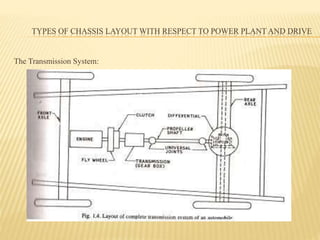
The Transmission System:
 The above figure shows a layout of the transmission system of an automobile.
 The Transmission system consists of
 Clutch
 Gear box (also called Transmission)
 Giving 4, 5 or even 6 different ratio of
torque output
----------------
torque Input
 Propeller shaft:
To transmit the torque output from gear box to the rear axle.
 Differential Gears:
To distribute the final torque equally between the driving wheels.
THE FUNCTION OF A TRANSMISSION SYSTEM:
1. To dis-connect the engine from the road wheels, when desired.
2. To connect the engine to the driving wheels without shocks. (clutch)
3. To vary the leverage between the engine and the driving wheels.
4. To reduce the engine speed permanently in a fixed ratio. (Gear box)
5. To turn the drive through a right angle.
6. To make provision for the flexing of the road springs, which causes a relative movement
between the engine and the driving wheels.
THE VARIOUS COMPONENTS, WHICH PERFORM THESE FUNCTIONS
CLUTCH:
Its purpose is to enable the driver to
 Disconnect the drive from the road wheels instantaneously and
 To engage drive from the engine to the road wheels GRADUALLY, while moving
the vehicle from rest.
GEAR BOX (Transmission):
The gear box or the transmission provides the necessary leverage variation between the
Engine and road wheels.
CROWN WHEELAND TAIL PINION (CWP):
 CWP turns the drive, round through 90o and also
 Provides a permanent reduction in speed.
CLUTCH
GEAR BOX
REVERSE GEAR
 The permanent reduction is necessitated because of the fact that “speed of the engine has
to be maintained at optimum level at all times”.
 Yet, a minimum value of torque has to be made available to the road wheels.
UNIVERSAL JOINTS (UJs):
 UJs provide for the relative movement between the engine and the driving wheels due to
flexing of road springs.
DIFFERENTIAL:
 While taking turns, the driving wheels must turn at different speeds.
 This is done with the help of differential.
WHY WE NEED DIFFERENTIAL?
DOG GEAR
SYNCHROMESH
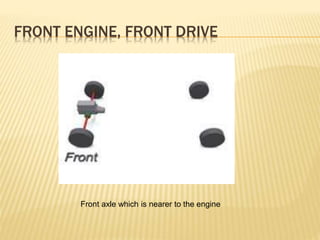
FRONT ENGINE, FRONT DRIVE
Front axle which is nearer to the engine
ADVANTAGES:
 The propeller shaft is eliminated and the linkage for clutch and the transmission is
simplified. This permit a low chassis height.
 The engine pulls the car rather than pushing it, avoiding skidding tendency, thus
providing safety, especially on snow covered roads.
 Better road adhesion is obtained in this case because larger part of the weight of the
automobile is taken on the driving wheels.
 This arrangement tends to produce understeering characteristics which is preferred over
oversteering condition.
DISADVANTAGE:
 The front wheels which are in this case the driving wheels, have to be steered also,
which makes the whole arrangement complicated.
 Two constant velocity joints have to be used in this case, because ordinary universal
joints would give large speed fluctuations.
 Also the component of the automobile weight on the driving wheels is reduced when
going up steep gradients. This results in decrease of tractive effort when it is needed
most.
 Moreover, on level roads increased concentration of weight at the front tends to make
the steering slightly heavier.
REAR ENGINE, REAR DRIVE
Engine at the rear with the rear axle as the live axle.
ADVANTAGE:
 The disadvantage in the front engine with front wheel drive while going up the slopes is
obviated.
 There is increase of weight on the driving wheels while going up, thus giving better
traction through improved road adhesion.
 Front axle construction is simplified which is used for steering only.
 The absence of propeller shaft allows to decrease the chassis height and the front of the
car is amenable to a better design from the point of view of streamlining.
 In this arrangement noise and heat are carried away from the passengers and the front of
the vehicle can be designed for better visibility because of the absence of the engine.
 The silencer system and exhaust pipe in this case need not span the entire length of the
vehicle and can be more compact.
DISADVANTAGE:
 The increased weight of the vehicle in the rear causes the same to become unstable at
high speeds.
 Complicated linkage is required to operate engine, clutch and the transmission.
 Due to the positioning of the engine at the rear, the cooling efficiency is reduced.
 Lighter weight at the front tends to cause oversteering conditions which is very sensitive
to crosswinds and is considered somewhat dangerous.
 The engine and transmission units being relatively more difficult to access, servicing and
repair take longer time.
 As the petrol tank now has to be placed at the front, it may be dangerous in case of a
collision.
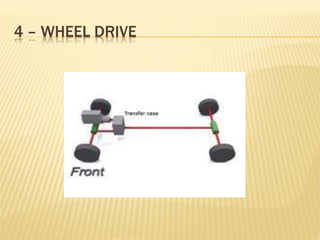
4 – WHEEL DRIVE
In jeeps or military vehicles, which have to operate on rough ground, generally all the four
wheels are the driving wheels.
 There is a Transfer box (or Auxiliary gear box), which divides the torque equally
between the front and rear axles.
In the figure,
A = Universal joints on the propeller shaft.
B = Constant velocity Universal joints (because large angular movements involved
during steering)
 There is a provision in the control of the transfer box so that front wheel drive may be
disengaged when not required.
Lever in position “S” = Rear wheel drive comes into use.
Lever in position “SA” (stand alone)= Four wheel drive comes into use.
ADVANTAGE OF 4 WHEEL DRIVE:
 When front wheel fall into a ditch, they can be driven out, being power driven.
 The possibility of skidding is reduced because of the additional adhesion between the
road and the wheels.
ALL WHEEL DRIVE
FRAMES:

AE0303 chassis - Introduction.pptx

  • 1.
  • 2.
    TYPES OF CHASSISLAYOUT WITH RESPECT TO POWER PLANT AND DRIVE The Transmission System:
  • 4.
     The abovefigure shows a layout of the transmission system of an automobile.  The Transmission system consists of  Clutch  Gear box (also called Transmission)  Giving 4, 5 or even 6 different ratio of torque output ---------------- torque Input
  • 5.
     Propeller shaft: Totransmit the torque output from gear box to the rear axle.  Differential Gears: To distribute the final torque equally between the driving wheels. THE FUNCTION OF A TRANSMISSION SYSTEM: 1. To dis-connect the engine from the road wheels, when desired. 2. To connect the engine to the driving wheels without shocks. (clutch) 3. To vary the leverage between the engine and the driving wheels. 4. To reduce the engine speed permanently in a fixed ratio. (Gear box) 5. To turn the drive through a right angle. 6. To make provision for the flexing of the road springs, which causes a relative movement between the engine and the driving wheels.
  • 6.
    THE VARIOUS COMPONENTS,WHICH PERFORM THESE FUNCTIONS CLUTCH: Its purpose is to enable the driver to  Disconnect the drive from the road wheels instantaneously and  To engage drive from the engine to the road wheels GRADUALLY, while moving the vehicle from rest. GEAR BOX (Transmission): The gear box or the transmission provides the necessary leverage variation between the Engine and road wheels. CROWN WHEELAND TAIL PINION (CWP):  CWP turns the drive, round through 90o and also  Provides a permanent reduction in speed.
  • 7.
  • 9.
  • 10.
  • 11.
     The permanentreduction is necessitated because of the fact that “speed of the engine has to be maintained at optimum level at all times”.  Yet, a minimum value of torque has to be made available to the road wheels. UNIVERSAL JOINTS (UJs):  UJs provide for the relative movement between the engine and the driving wheels due to flexing of road springs. DIFFERENTIAL:  While taking turns, the driving wheels must turn at different speeds.  This is done with the help of differential.
  • 12.
    WHY WE NEEDDIFFERENTIAL?
  • 14.
  • 15.
  • 16.
    FRONT ENGINE, FRONTDRIVE Front axle which is nearer to the engine
  • 17.
    ADVANTAGES:  The propellershaft is eliminated and the linkage for clutch and the transmission is simplified. This permit a low chassis height.  The engine pulls the car rather than pushing it, avoiding skidding tendency, thus providing safety, especially on snow covered roads.  Better road adhesion is obtained in this case because larger part of the weight of the automobile is taken on the driving wheels.  This arrangement tends to produce understeering characteristics which is preferred over oversteering condition.
  • 18.
    DISADVANTAGE:  The frontwheels which are in this case the driving wheels, have to be steered also, which makes the whole arrangement complicated.  Two constant velocity joints have to be used in this case, because ordinary universal joints would give large speed fluctuations.  Also the component of the automobile weight on the driving wheels is reduced when going up steep gradients. This results in decrease of tractive effort when it is needed most.  Moreover, on level roads increased concentration of weight at the front tends to make the steering slightly heavier.
  • 19.
    REAR ENGINE, REARDRIVE Engine at the rear with the rear axle as the live axle. ADVANTAGE:  The disadvantage in the front engine with front wheel drive while going up the slopes is obviated.  There is increase of weight on the driving wheels while going up, thus giving better traction through improved road adhesion.  Front axle construction is simplified which is used for steering only.  The absence of propeller shaft allows to decrease the chassis height and the front of the car is amenable to a better design from the point of view of streamlining.  In this arrangement noise and heat are carried away from the passengers and the front of the vehicle can be designed for better visibility because of the absence of the engine.  The silencer system and exhaust pipe in this case need not span the entire length of the vehicle and can be more compact.
  • 20.
    DISADVANTAGE:  The increasedweight of the vehicle in the rear causes the same to become unstable at high speeds.  Complicated linkage is required to operate engine, clutch and the transmission.  Due to the positioning of the engine at the rear, the cooling efficiency is reduced.  Lighter weight at the front tends to cause oversteering conditions which is very sensitive to crosswinds and is considered somewhat dangerous.  The engine and transmission units being relatively more difficult to access, servicing and repair take longer time.  As the petrol tank now has to be placed at the front, it may be dangerous in case of a collision.
  • 21.
  • 23.
    In jeeps ormilitary vehicles, which have to operate on rough ground, generally all the four wheels are the driving wheels.  There is a Transfer box (or Auxiliary gear box), which divides the torque equally between the front and rear axles. In the figure, A = Universal joints on the propeller shaft. B = Constant velocity Universal joints (because large angular movements involved during steering)  There is a provision in the control of the transfer box so that front wheel drive may be disengaged when not required.
  • 24.
    Lever in position“S” = Rear wheel drive comes into use. Lever in position “SA” (stand alone)= Four wheel drive comes into use. ADVANTAGE OF 4 WHEEL DRIVE:  When front wheel fall into a ditch, they can be driven out, being power driven.  The possibility of skidding is reduced because of the additional adhesion between the road and the wheels.
  • 25.
  • 26.