Four-Wheel-Drive
Why Four-Wheel-Drive?
Advantages
Improved traction and handling
Able to transmit torque to all four wheels
Disadvantages
Higher initial cost and weight
Requires special service and maintenance
4X4 = Four wheeled vehicle, four wheels
can receive torque.
4X2 = Four wheeled vehicle, two wheels
can receive torque.
Definitions
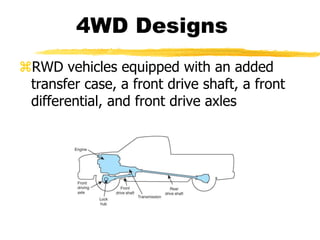
4WD Designs
RWD vehicles equipped with an added
transfer case, a front drive shaft, a front
differential, and front drive axles
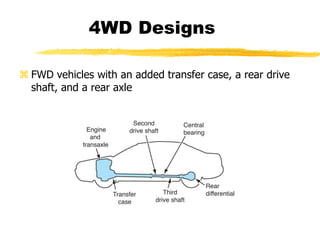
4WD Designs
 FWD vehicles with an added transfer case, a rear drive
shaft, and a rear axle
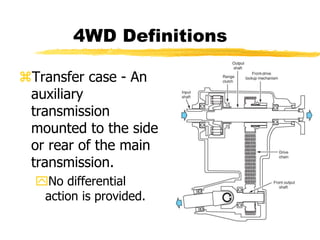
Transfer case - An
auxiliary
transmission
mounted to the side
or rear of the main
transmission.
No differential
action is provided.
4WD Definitions
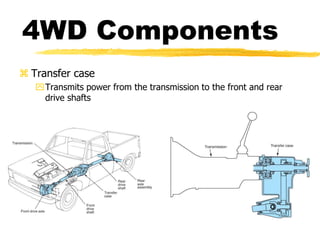
4WD Components
 Transfer case
Transmits power from the transmission to the front and rear
drive shafts
4WD Components
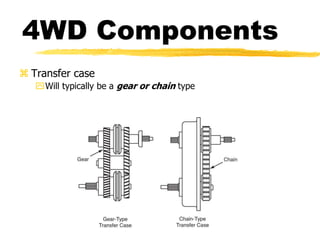
 Transfer case
Will typically be a gear or chain type
Types of Transfer Cases
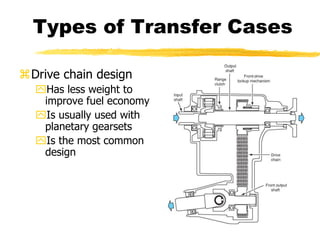
Drive chain design
Has less weight to
improve fuel economy
Is usually used with
planetary gearsets
Is the most common
design
Types of Transfer Cases
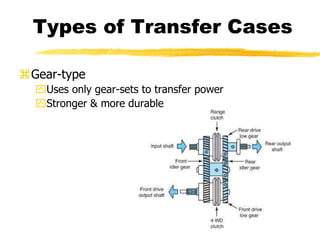
Gear-type
Uses only gear-sets to transfer power
Stronger & more durable
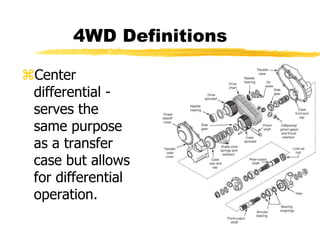
Center
differential -
serves the
same purpose
as a transfer
case but allows
for differential
operation.
4WD Definitions
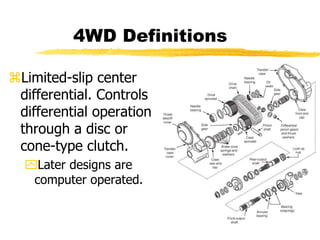
Limited-slip center
differential. Controls
differential operation
through a disc or
cone-type clutch.
Later designs are
computer operated.
4WD Definitions
4WD Components
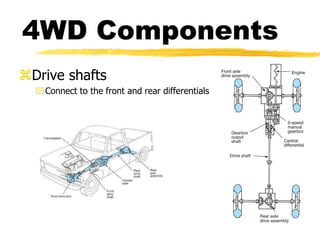
Drive shafts
Connect to the front and rear differentials
4WD Components
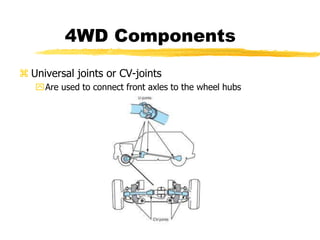
 Universal joints or CV-joints
Are used to connect front axles to the wheel hubs
Part-time 4WD - Typically systems that
operate in two-wheel drive until the driver
commands four-wheel drive operation.
Torque is then divided (50/50 fixed)
between the front and rear drive-shaft.
They do not corner well on dry pavement.
Selection of two- or four-wheel-drive is done
by a shifter, electric switch and/or locking
hubs.
4WD Definitions
Part-Time 4WD Shift Controls
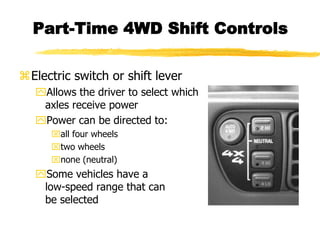
Electric switch or shift lever
Allows the driver to select which
axles receive power
Power can be directed to:
all four wheels
two wheels
none (neutral)
Some vehicles have a
low-speed range that can
be selected
Older designs may have different drive-
axle gear ratios.
This will result in a push-pull type action if
the vehicle is driven on dry pavement.
This phenomenon is called drive-line windup.
Part-Time 4WD
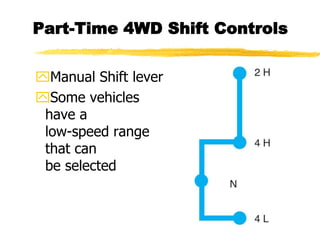
Part-Time 4WD Shift Controls
Manual Shift lever
Some vehicles
have a
low-speed range
that can
be selected
Part-Time 4WD
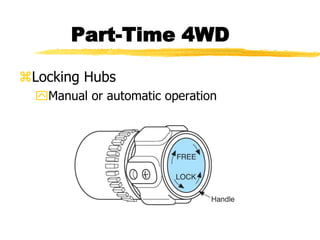
Locking Hubs
Manual or automatic operation
Part-Time 4WD
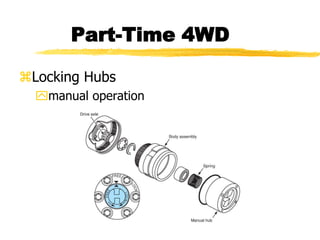
Locking Hubs
manual operation
Part-Time 4WD
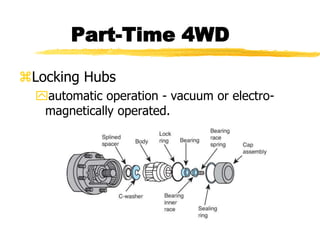
Locking Hubs
automatic operation - vacuum or electro-
magnetically operated.
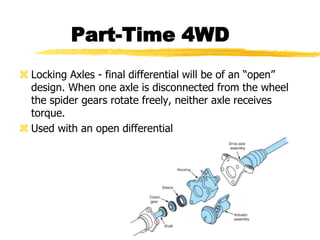
Part-Time 4WD
 Locking Axles - final differential will be of an “open”
design. When one axle is disconnected from the wheel
the spider gears rotate freely, neither axle receives
torque.
 Used with an open differential
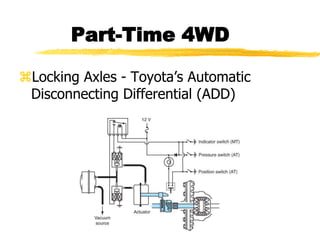
Part-Time 4WD
Locking Axles - Toyota’s Automatic
Disconnecting Differential (ADD)
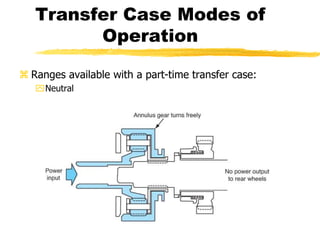
Transfer Case Modes of
Operation
 Ranges available with a part-time transfer case:
Neutral
Transfer Case Modes of
Operation
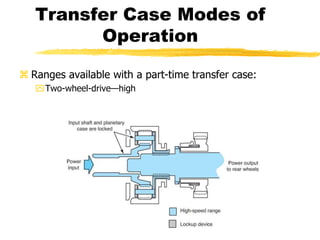
 Ranges available with a part-time transfer case:
Two-wheel-drive—high
Transfer Case Modes of
Operation
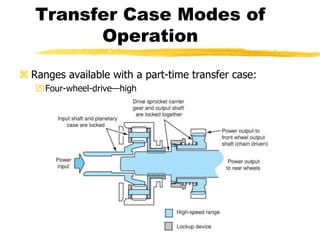
 Ranges available with a part-time transfer case:
Four-wheel-drive—high
Transfer Case Modes of
Operation
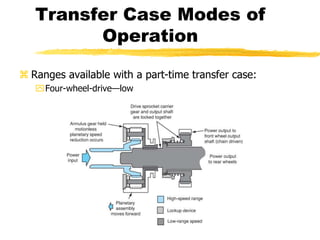
 Ranges available with a part-time transfer case:
Four-wheel-drive—low
Full-time four-wheel drive (4wd) -
Constantly provides power to all four
wheels. These systems typically do NOT
have a provision for “low” operating
range.
Axles and differentials are constantly locked.
Usually equipped with a center “differential”
instead of a transfer-case.
All-wheel drive - see above
4WD Definitions
4WD Systems
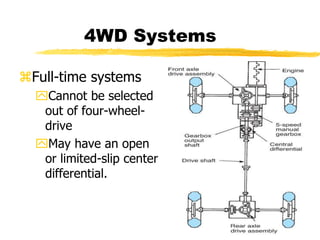
Full-time systems
Cannot be selected
out of four-wheel-
drive
May have an open
or limited-slip center
differential.
Full-time 4WD
Open Center Differential - If the wheels
on either final differential loose traction,
maximum torque is delivered to the axle
with the LEAST traction.
For this reason, limited-slip center
differentials are far more common today.
Full-time 4WD
Newer computer-controlled designs allow
for different operational modes.
Ford Automatic Four-wheel-drive (A4WD)
Navigator and Expedition
4WD AUTO - full power to the rear wheels.
The front wheels receive power as required.
4WD High - Full power to both wheels, no
center gear-reduction.
4WD Low - Low gear ratio in center
differential for (2:1 ratio) for slow, high
torque driving
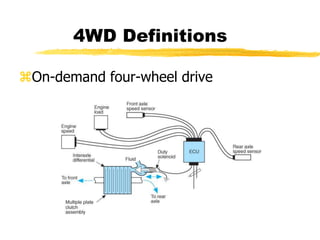
On-demand four-wheel drive -
Automatically controlled 4WD. One axle is
driven until slip is detected or anticipated.
Computer controlled
uses wheel speed sensors and/or axle speed
sensors to detect slippage.
When slippage is detected, torque is sent to
the opposite axle. The amount sent depends
on the amount of slippage.
4WD Definitions
On-demand four-wheel drive
4WD Definitions
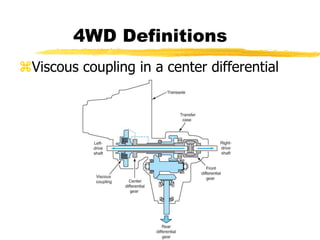
Viscous coupling in a center differential
4WD Definitions
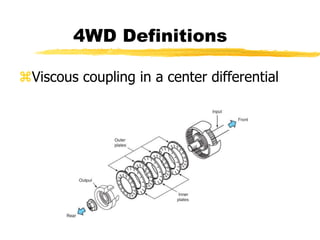
Viscous coupling in a center differential
4WD Definitions
On-demand four-wheel
drive
Ford’s control-trac system
normal operation - 96% of torque is sent to
the rear wheels.
Upon slippage a computer energizes an
electro-magnetic clutch in the transfer case.
Up to 96% of torque can be sent to the front
wheels.
4WD Systems
Four-wheel drive systems without a center
differential.
Tire sizes must all be the same (this holds true for
any 4WD application)
Tread wear must be similar
Tire changes on an all-wheel drive must be done
in sets of four
Gear ratios should be the same in the front and
rear differentials.
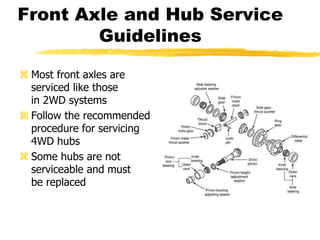
Front Axle and Hub Service
Guidelines
 Most front axles are
serviced like those
in 2WD systems
 Follow the recommended
procedure for servicing
4WD hubs
 Some hubs are not
serviceable and must
be replaced
Effects of Vehicle
Modifications
Installing larger tires and lift kits
Alters vehicle handling by changing unsprung weight
Increases steering effort
Causes a rough ride
May cause vehicle to wander and vibrate
Possible driveshaft working angle issues
Possible Vehicle Speed sensor issues
May necessitate computer programming
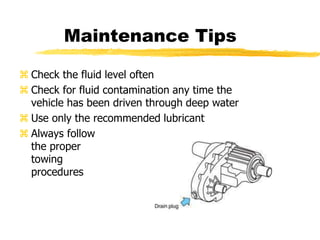
Maintenance Tips
 Check the fluid level often
 Check for fluid contamination any time the
vehicle has been driven through deep water
 Use only the recommended lubricant
 Always follow
the proper
towing
procedures

four-wheeldrive.ppt

  • 1.
  • 2.
    Why Four-Wheel-Drive? Advantages Improved tractionand handling Able to transmit torque to all four wheels Disadvantages Higher initial cost and weight Requires special service and maintenance
  • 3.
    4X4 = Fourwheeled vehicle, four wheels can receive torque. 4X2 = Four wheeled vehicle, two wheels can receive torque. Definitions
  • 4.
    4WD Designs RWD vehiclesequipped with an added transfer case, a front drive shaft, a front differential, and front drive axles
  • 5.
    4WD Designs  FWDvehicles with an added transfer case, a rear drive shaft, and a rear axle
  • 6.
    Transfer case -An auxiliary transmission mounted to the side or rear of the main transmission. No differential action is provided. 4WD Definitions
  • 7.
    4WD Components  Transfercase Transmits power from the transmission to the front and rear drive shafts
  • 8.
    4WD Components  Transfercase Will typically be a gear or chain type
  • 9.
    Types of TransferCases Drive chain design Has less weight to improve fuel economy Is usually used with planetary gearsets Is the most common design
  • 10.
    Types of TransferCases Gear-type Uses only gear-sets to transfer power Stronger & more durable
  • 11.
    Center differential - serves the samepurpose as a transfer case but allows for differential operation. 4WD Definitions
  • 12.
    Limited-slip center differential. Controls differentialoperation through a disc or cone-type clutch. Later designs are computer operated. 4WD Definitions
  • 13.
    4WD Components Drive shafts Connectto the front and rear differentials
  • 14.
    4WD Components  Universaljoints or CV-joints Are used to connect front axles to the wheel hubs
  • 15.
    Part-time 4WD -Typically systems that operate in two-wheel drive until the driver commands four-wheel drive operation. Torque is then divided (50/50 fixed) between the front and rear drive-shaft. They do not corner well on dry pavement. Selection of two- or four-wheel-drive is done by a shifter, electric switch and/or locking hubs. 4WD Definitions
  • 16.
    Part-Time 4WD ShiftControls Electric switch or shift lever Allows the driver to select which axles receive power Power can be directed to: all four wheels two wheels none (neutral) Some vehicles have a low-speed range that can be selected
  • 17.
    Older designs mayhave different drive- axle gear ratios. This will result in a push-pull type action if the vehicle is driven on dry pavement. This phenomenon is called drive-line windup. Part-Time 4WD
  • 18.
    Part-Time 4WD ShiftControls Manual Shift lever Some vehicles have a low-speed range that can be selected
  • 19.
  • 20.
  • 21.
    Part-Time 4WD Locking Hubs automaticoperation - vacuum or electro- magnetically operated.
  • 22.
    Part-Time 4WD  LockingAxles - final differential will be of an “open” design. When one axle is disconnected from the wheel the spider gears rotate freely, neither axle receives torque.  Used with an open differential
  • 23.
    Part-Time 4WD Locking Axles- Toyota’s Automatic Disconnecting Differential (ADD)
  • 24.
    Transfer Case Modesof Operation  Ranges available with a part-time transfer case: Neutral
  • 25.
    Transfer Case Modesof Operation  Ranges available with a part-time transfer case: Two-wheel-drive—high
  • 26.
    Transfer Case Modesof Operation  Ranges available with a part-time transfer case: Four-wheel-drive—high
  • 27.
    Transfer Case Modesof Operation  Ranges available with a part-time transfer case: Four-wheel-drive—low
  • 28.
    Full-time four-wheel drive(4wd) - Constantly provides power to all four wheels. These systems typically do NOT have a provision for “low” operating range. Axles and differentials are constantly locked. Usually equipped with a center “differential” instead of a transfer-case. All-wheel drive - see above 4WD Definitions
  • 29.
    4WD Systems Full-time systems Cannotbe selected out of four-wheel- drive May have an open or limited-slip center differential.
  • 30.
    Full-time 4WD Open CenterDifferential - If the wheels on either final differential loose traction, maximum torque is delivered to the axle with the LEAST traction. For this reason, limited-slip center differentials are far more common today.
  • 31.
    Full-time 4WD Newer computer-controlleddesigns allow for different operational modes. Ford Automatic Four-wheel-drive (A4WD) Navigator and Expedition 4WD AUTO - full power to the rear wheels. The front wheels receive power as required. 4WD High - Full power to both wheels, no center gear-reduction. 4WD Low - Low gear ratio in center differential for (2:1 ratio) for slow, high torque driving
  • 32.
    On-demand four-wheel drive- Automatically controlled 4WD. One axle is driven until slip is detected or anticipated. Computer controlled uses wheel speed sensors and/or axle speed sensors to detect slippage. When slippage is detected, torque is sent to the opposite axle. The amount sent depends on the amount of slippage. 4WD Definitions
  • 33.
  • 34.
    Viscous coupling ina center differential 4WD Definitions
  • 35.
    Viscous coupling ina center differential 4WD Definitions
  • 36.
    On-demand four-wheel drive Ford’s control-tracsystem normal operation - 96% of torque is sent to the rear wheels. Upon slippage a computer energizes an electro-magnetic clutch in the transfer case. Up to 96% of torque can be sent to the front wheels.
  • 37.
    4WD Systems Four-wheel drivesystems without a center differential. Tire sizes must all be the same (this holds true for any 4WD application) Tread wear must be similar Tire changes on an all-wheel drive must be done in sets of four Gear ratios should be the same in the front and rear differentials.
  • 38.
    Front Axle andHub Service Guidelines  Most front axles are serviced like those in 2WD systems  Follow the recommended procedure for servicing 4WD hubs  Some hubs are not serviceable and must be replaced
  • 39.
    Effects of Vehicle Modifications Installinglarger tires and lift kits Alters vehicle handling by changing unsprung weight Increases steering effort Causes a rough ride May cause vehicle to wander and vibrate Possible driveshaft working angle issues Possible Vehicle Speed sensor issues May necessitate computer programming
  • 40.
    Maintenance Tips  Checkthe fluid level often  Check for fluid contamination any time the vehicle has been driven through deep water  Use only the recommended lubricant  Always follow the proper towing procedures