
Prepared by:
Nikhil Kumar
Electronics & Communication Department
5th Semester
NRI Institute of Research & Technology
Bhopal
INTEL 4th GENERATION COMPUTER
SYSTEM
• Introduction To Computer Processor.
• Component of a Processor.
• Introduction To Intel 4TH generation.
• Intel 4th Generation Processor chip.
• First ever system on chip (soc) for PC.
• Enhanced battery life.
• Intel® Iris ™ Graphics.
• Intel® AVX 2.0.
• Security.
• Conclusion.
Introduction To Computer
Processor
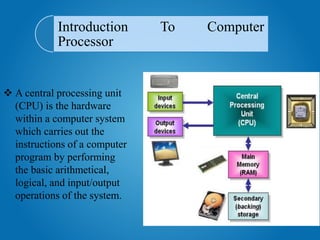
 A central processing unit
(CPU) is the hardware
within a computer system
which carries out the
instructions of a computer
program by performing
the basic arithmetical,
logical, and input/output
operations of the system.
Component of a
Processor
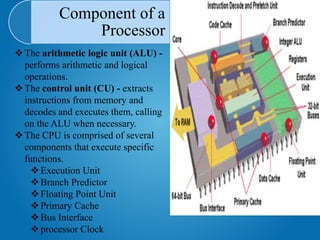
The arithmetic logic unit (ALU) -
performs arithmetic and logical
operations.
The control unit (CU) - extracts
instructions from memory and
decodes and executes them, calling
on the ALU when necessary.
The CPU is comprised of several
components that execute specific
functions.
Execution Unit
Branch Predictor
Floating Point Unit
Primary Cache
Bus Interface
processor Clock
Introduction To Intel 4TH generation
 The 4th generation Intel® Core™ processor, launched by
Intel corporation has code-named Haswell. Its capabilities
build on the 3rd generation Intel® Core™ processor
graphics. The 3rd Generation Processor has code name Ivy
Bridge.
 4th generation processors are based on the 22 nm
Microarchitecture technology where as the 3rd
Generation Processor based on 22 nm Fabrication
Technology.
 The 4th generation Intel processor contributes some of the
features as like Intel® Iris™ graphics, performance
enhancements, low power options, face recognition
capabilities, and more.
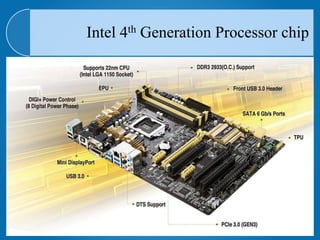
Intel 4th Generation Processor chip
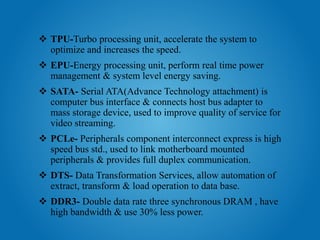
 TPU-Turbo processing unit, accelerate the system to
optimize and increases the speed.
 EPU-Energy processing unit, perform real time power
management & system level energy saving.
 SATA- Serial ATA(Advance Technology attachment) is
computer bus interface & connects host bus adapter to
mass storage device, used to improve quality of service for
video streaming.
 PCLe- Peripherals component interconnect express is high
speed bus std., used to link motherboard mounted
peripherals & provides full duplex communication.
 DTS- Data Transformation Services, allow automation of
extract, transform & load operation to data base.
 DDR3- Double data rate three synchronous DRAM , have
high bandwidth & use 30% less power.
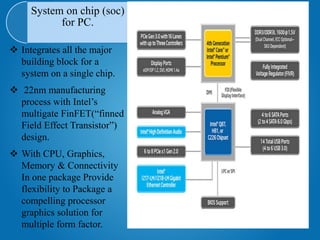
System on chip (soc)
for PC.
 Integrates all the major
building block for a
system on a single chip.
 22nm manufacturing
process with Intel’s
multigate FinFET(“finned
Field Effect Transistor”)
design.
 With CPU, Graphics,
Memory & Connectivity
In one package Provide
flexibility to Package a
compelling processor
graphics solution for
multiple form factor.
Enhanced
Battery Life
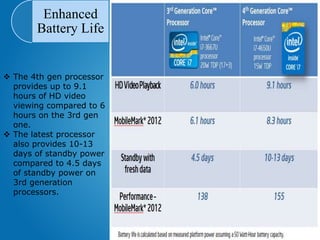
 The 4th gen processor
provides up to 9.1
hours of HD video
viewing compared to 6
hours on the 3rd gen
one.
 The latest processor
also provides 10-13
days of standby power
compared to 4.5 days
of standby power on
3rd generation
processors.
Intel® Iris
™ Graphics.
Graphics Technology
Intel Iris Graphics allows you to play the most graphic
intensive games without the need for an additional graphics
card.
The graphics performance on the 4th gen processor
increases by 32% in 3D graphics over a comparable 3rd
gen system.
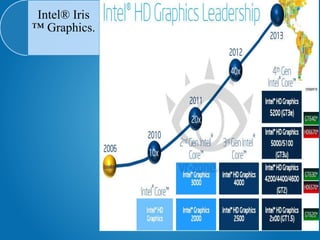
 Integrated graphics now come in GT1,GT2 and GT3
levels with 10, 20 and 40 EUs (execution units),
respectively, each level operating at various GPU speeds
depending on the CPU, and GT3 being further divided into
HD5000, Iris™, and Iris™ Pro versions.
Intel® AVX 2.0
Intel® AVX 2.0 is a 256
bit instruction set.
 Full 256-bit AVX 2.0
means improved parallel
processing, benefitting
tasks such as encryption,
compression, face
detection, high
performance computing,
256 bit instruction SIMD
operation, FMA3 (Fused
Multiply/Add) means
quicker floating point
operations etc.
.
Security
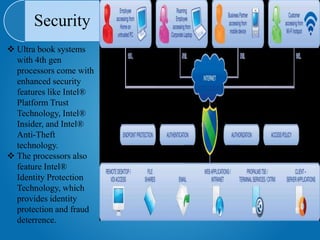
 Ultra book systems
with 4th gen
processors come with
enhanced security
features like Intel®
Platform Trust
Technology, Intel®
Insider, and Intel®
Anti-Theft
technology.
 The processors also
feature Intel®
Identity Protection
Technology, which
provides identity
protection and fraud
deterrence.
Conclusion
The introduction of new and improved processor technologies
continues at a rapid pace, providing opportunity for those who keep up
with new features, products and functionality. So with better
Functionality and Improved Performance move ahead in this modern
era with New INTEL 4TH GENERATION PROCESSOR.
Computer System Specification - 4th Generation

Computer System Specification - 4th Generation

  • 1.
    Prepared by: Nikhil Kumar Electronics& Communication Department 5th Semester NRI Institute of Research & Technology Bhopal
  • 2.
    INTEL 4th GENERATIONCOMPUTER SYSTEM • Introduction To Computer Processor. • Component of a Processor. • Introduction To Intel 4TH generation. • Intel 4th Generation Processor chip. • First ever system on chip (soc) for PC. • Enhanced battery life. • Intel® Iris ™ Graphics. • Intel® AVX 2.0. • Security. • Conclusion.
  • 3.
    Introduction To Computer Processor A central processing unit (CPU) is the hardware within a computer system which carries out the instructions of a computer program by performing the basic arithmetical, logical, and input/output operations of the system.
  • 4.
    Component of a Processor Thearithmetic logic unit (ALU) - performs arithmetic and logical operations. The control unit (CU) - extracts instructions from memory and decodes and executes them, calling on the ALU when necessary. The CPU is comprised of several components that execute specific functions. Execution Unit Branch Predictor Floating Point Unit Primary Cache Bus Interface processor Clock
  • 5.
    Introduction To Intel4TH generation  The 4th generation Intel® Core™ processor, launched by Intel corporation has code-named Haswell. Its capabilities build on the 3rd generation Intel® Core™ processor graphics. The 3rd Generation Processor has code name Ivy Bridge.  4th generation processors are based on the 22 nm Microarchitecture technology where as the 3rd Generation Processor based on 22 nm Fabrication Technology.  The 4th generation Intel processor contributes some of the features as like Intel® Iris™ graphics, performance enhancements, low power options, face recognition capabilities, and more.
  • 6.
    Intel 4th GenerationProcessor chip
  • 7.
     TPU-Turbo processingunit, accelerate the system to optimize and increases the speed.  EPU-Energy processing unit, perform real time power management & system level energy saving.  SATA- Serial ATA(Advance Technology attachment) is computer bus interface & connects host bus adapter to mass storage device, used to improve quality of service for video streaming.  PCLe- Peripherals component interconnect express is high speed bus std., used to link motherboard mounted peripherals & provides full duplex communication.  DTS- Data Transformation Services, allow automation of extract, transform & load operation to data base.  DDR3- Double data rate three synchronous DRAM , have high bandwidth & use 30% less power.
  • 8.
    System on chip(soc) for PC.  Integrates all the major building block for a system on a single chip.  22nm manufacturing process with Intel’s multigate FinFET(“finned Field Effect Transistor”) design.  With CPU, Graphics, Memory & Connectivity In one package Provide flexibility to Package a compelling processor graphics solution for multiple form factor.
  • 9.
    Enhanced Battery Life  The4th gen processor provides up to 9.1 hours of HD video viewing compared to 6 hours on the 3rd gen one.  The latest processor also provides 10-13 days of standby power compared to 4.5 days of standby power on 3rd generation processors.
  • 10.
  • 11.
    Graphics Technology Intel IrisGraphics allows you to play the most graphic intensive games without the need for an additional graphics card. The graphics performance on the 4th gen processor increases by 32% in 3D graphics over a comparable 3rd gen system.  Integrated graphics now come in GT1,GT2 and GT3 levels with 10, 20 and 40 EUs (execution units), respectively, each level operating at various GPU speeds depending on the CPU, and GT3 being further divided into HD5000, Iris™, and Iris™ Pro versions.
  • 12.
    Intel® AVX 2.0 Intel®AVX 2.0 is a 256 bit instruction set.  Full 256-bit AVX 2.0 means improved parallel processing, benefitting tasks such as encryption, compression, face detection, high performance computing, 256 bit instruction SIMD operation, FMA3 (Fused Multiply/Add) means quicker floating point operations etc. .
  • 13.
    Security  Ultra booksystems with 4th gen processors come with enhanced security features like Intel® Platform Trust Technology, Intel® Insider, and Intel® Anti-Theft technology.  The processors also feature Intel® Identity Protection Technology, which provides identity protection and fraud deterrence.
  • 14.
    Conclusion The introduction ofnew and improved processor technologies continues at a rapid pace, providing opportunity for those who keep up with new features, products and functionality. So with better Functionality and Improved Performance move ahead in this modern era with New INTEL 4TH GENERATION PROCESSOR.