4G Communications

     James Kelly, Xianjin Teo,
Daniel Campbell, Shannon Richards
Objectives
•   Evolution of 4G
•   Industry Impact
•   Consumer Impact
•   Business Impact
•   Discussion
    – What’s Next?
    – What You Think?

    Clear WiMax
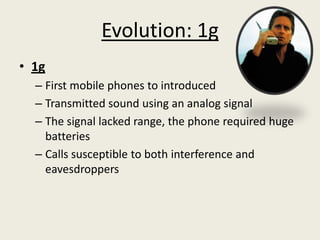
Evolution: 1g
• 1g
  – First mobile phones to introduced
  – Transmitted sound using an analog signal
  – The signal lacked range, the phone required huge
    batteries
  – Calls susceptible to both interference and
    eavesdroppers
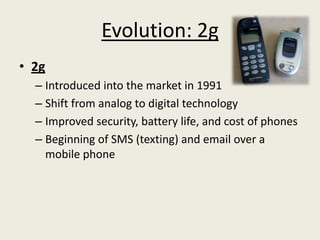
Evolution: 2g
• 2g
  – Introduced into the market in 1991
  – Shift from analog to digital technology
  – Improved security, battery life, and cost of phones
  – Beginning of SMS (texting) and email over a
    mobile phone
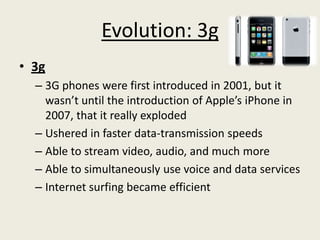
Evolution: 3g
• 3g
  – 3G phones were first introduced in 2001, but it
    wasn’t until the introduction of Apple’s iPhone in
    2007, that it really exploded
  – Ushered in faster data-transmission speeds
  – Able to stream video, audio, and much more
  – Able to simultaneously use voice and data services
  – Internet surfing became efficient
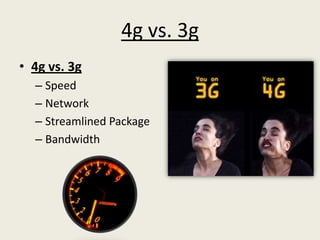
4g vs. 3g
• 4g vs. 3g
  – Speed
  – Network
  – Streamlined Package
  – Bandwidth
Types of “4g” Available
• Different versions of 4g currently on the
  market include:
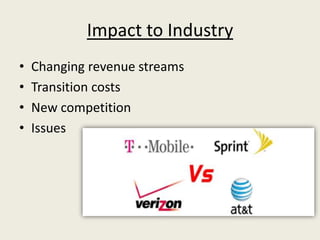
  – Sprint’s WiMax
  – Verizon’s LTE
  – AT&T and T-Mobile’s upgraded HSPA+ networks
• International Telecommunication Union’s (ITU)
  Verdict:
  – No real single 4G standard
Impact to Industry
•   Changing revenue streams
•   Transition costs
•   New competition
•   Issues
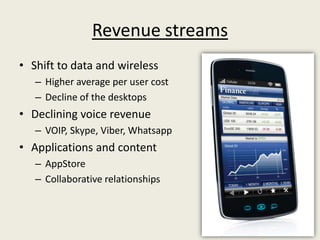
Revenue streams
• Shift to data and wireless
   – Higher average per user cost
   – Decline of the desktops
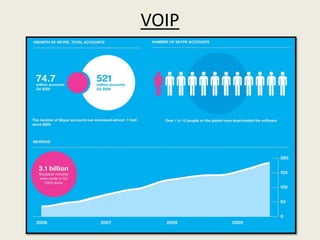
• Declining voice revenue
   – VOIP, Skype, Viber, Whatsapp
• Applications and content
   – AppStore
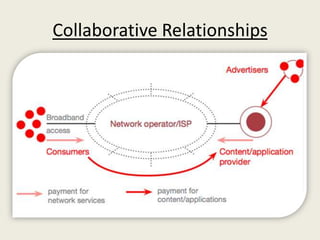
   – Collaborative relationships
VOIP
Revenue streams
• Shift to data and wireless
   – Higher average per user cost
   – Decline of the desktops
• Declining voice revenue
   – VOIP, Skype, Viber, Whatsapp
• Applications and content
   – AppStore
   – Collaborative relationships
“Mobile broadband is being adopted faster than
any computing platform in history. The number
of smartphones and tablets being sold now
exceeds the number of PCs.”

              FCC Chairman Julius Genachowski
Revenue streams
• Shift to data and wireless
   – Higher average per user cost
   – Decline of the desktops
• Declining voice revenue
   – VOIP, Skype, Viber, Whatsapp
• Applications and content
   – AppStore
   – Collaborative relationships
Collaborative Relationships
Transition Costs
• Higher network costs
  – Lower costs of moving data
  – 20-30% of operating expenses
  – 60-70% of CAPEX
• Network sharing
• LTE (ATT, Verizon), WiMax (Sprint)
Issues
• Bandwidth management
• Regulation
• 4G requirements
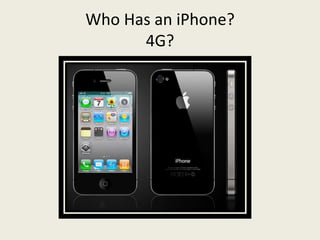
Who Has an iPhone?
      4G?
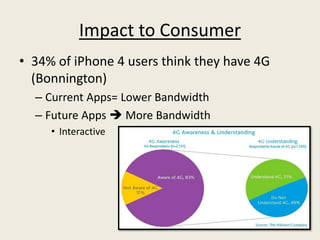
Impact to Consumer
• 34% of iPhone 4 users think they have 4G
  (Bonnington)
  – Current Apps= Lower Bandwidth
  – Future Apps  More Bandwidth
     • Interactive
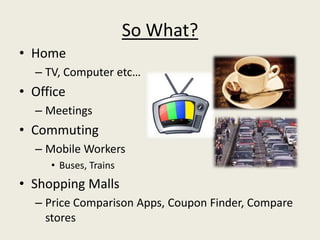
So What?
• Home
  – TV, Computer etc…
• Office
  – Meetings
• Commuting
  – Mobile Workers
     • Buses, Trains
• Shopping Malls
  – Price Comparison Apps, Coupon Finder, Compare
    stores
Implications
• No more unlimited data plans?
  – Carriers will charge more to capitalize on the new
    data capabilities of 4G.
• No more minutes?
  – Just data plans
• Enhanced call quality (at charge)
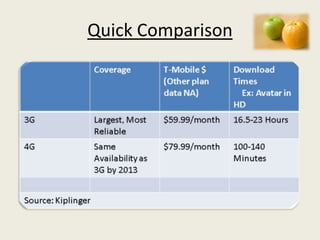
Quick Comparison
Accessibility
• Netflix
  – Now can be streamed to 5 different devices
     • (Mobile Phones, Computers, Blu-Ray DVD players,
       Xbox/PS3 players and etc…
• Verizon FiOS
  – On your mobile device.
• HD streaming video does not operate very
  well with 3G bandwidth.
Business Strategies
• Pervasive (Ubiquitous) Computing
  – Link unexpected products (Sparked)
• Be careful
  – Netflix
• Focus on mobile market
• Go global
  – Videoconferencing
  – Mobile workforce
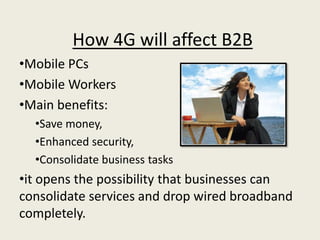
How 4G will affect B2B
•Mobile PCs
•Mobile Workers
•Main benefits:
  •Save money,
  •Enhanced security,
  •Consolidate business tasks
•it opens the possibility that businesses can
consolidate services and drop wired broadband
completely.
Business scenarios using 4G
    – Sprint outlines some business scenarios that are
      made possible by the faster 4G broadband speeds:
•   Real Estate
•   Construction
•   Insurance companies
•   Health care professionals
•   Emergency
•   Photojournalists
Is this a Game Changer?
• Game changers to... the business to business
  connection and the ability of mobile workers
  to connect to their jobs.
What’s Next
• An era of high-speed internet
• Advancement of business software
• Improved streaming of TV and video services
  (even in HD) on mobile phones
• More refined mobile gaming
• Lack of definition of a standard for awhile to
  come
• LTE or WiMax?
Questions?
References
•   Bonnington, Christina. "Consumers Covet 4G, the Tech No One Understands -
    CNN.com." CNN.com - Breaking News, U.S., World, Weather, Entertainment &
    Video News. CNN, 1 Nov. 2011. Web. 28           Nov. 2011.
    <http://www.cnn.com/2011/11/01/tech/mobile/consumers-covet-4g
           wired/index.html>.
•   Gahran, Amy. "Consumers Will Pay For 4G Upgrades - Technology News Story -
    KMGH Denver." Denver News, Colorado News, Denver Weather, Colorado
    Weather and Sports - KMGH Denver's Channel 7.              CNN, 10 Nov. 2011. Web.
    28 Nov. 2011.
           <http://www.thedenverchannel.com/technology/29738426/detail.html>.
•   Gibson, Todd. "4G Promises & Consumer Expectations." WIIE. Wireless Internet
    Industry Executives (WIIE).          Web. 25 Nov. 2011.
    <http://www.wiie.org/wireless/wireless-industry/78-4g-promises-a
           consumers-expectations.html>.
•   "The 4G Revolution - Kiplinger - Kiplinger." Kiplinger - Personal Finance, Business,
    Investing, Retirement,    and Financial Advice. Kiplinger, Feb. 2011. Web. 25 Nov.
    2011. <http://image.kiplinger.com/infographics/the_4g_revolution/map.html>.

4G

  • 1.
    4G Communications James Kelly, Xianjin Teo, Daniel Campbell, Shannon Richards
  • 2.
    Objectives • Evolution of 4G • Industry Impact • Consumer Impact • Business Impact • Discussion – What’s Next? – What You Think? Clear WiMax
  • 3.
    Evolution: 1g • 1g – First mobile phones to introduced – Transmitted sound using an analog signal – The signal lacked range, the phone required huge batteries – Calls susceptible to both interference and eavesdroppers
  • 4.
    Evolution: 2g • 2g – Introduced into the market in 1991 – Shift from analog to digital technology – Improved security, battery life, and cost of phones – Beginning of SMS (texting) and email over a mobile phone
  • 5.
    Evolution: 3g • 3g – 3G phones were first introduced in 2001, but it wasn’t until the introduction of Apple’s iPhone in 2007, that it really exploded – Ushered in faster data-transmission speeds – Able to stream video, audio, and much more – Able to simultaneously use voice and data services – Internet surfing became efficient
  • 6.
    4g vs. 3g •4g vs. 3g – Speed – Network – Streamlined Package – Bandwidth
  • 7.
    Types of “4g”Available • Different versions of 4g currently on the market include: – Sprint’s WiMax – Verizon’s LTE – AT&T and T-Mobile’s upgraded HSPA+ networks • International Telecommunication Union’s (ITU) Verdict: – No real single 4G standard
  • 8.
    Impact to Industry • Changing revenue streams • Transition costs • New competition • Issues
  • 9.
    Revenue streams • Shiftto data and wireless – Higher average per user cost – Decline of the desktops • Declining voice revenue – VOIP, Skype, Viber, Whatsapp • Applications and content – AppStore – Collaborative relationships
  • 10.
  • 11.
    Revenue streams • Shiftto data and wireless – Higher average per user cost – Decline of the desktops • Declining voice revenue – VOIP, Skype, Viber, Whatsapp • Applications and content – AppStore – Collaborative relationships
  • 12.
    “Mobile broadband isbeing adopted faster than any computing platform in history. The number of smartphones and tablets being sold now exceeds the number of PCs.” FCC Chairman Julius Genachowski
  • 13.
    Revenue streams • Shiftto data and wireless – Higher average per user cost – Decline of the desktops • Declining voice revenue – VOIP, Skype, Viber, Whatsapp • Applications and content – AppStore – Collaborative relationships
  • 14.
  • 15.
    Transition Costs • Highernetwork costs – Lower costs of moving data – 20-30% of operating expenses – 60-70% of CAPEX • Network sharing • LTE (ATT, Verizon), WiMax (Sprint)
  • 16.
    Issues • Bandwidth management •Regulation • 4G requirements
  • 17.
    Who Has aniPhone? 4G?
  • 18.
    Impact to Consumer •34% of iPhone 4 users think they have 4G (Bonnington) – Current Apps= Lower Bandwidth – Future Apps  More Bandwidth • Interactive
  • 19.
    So What? • Home – TV, Computer etc… • Office – Meetings • Commuting – Mobile Workers • Buses, Trains • Shopping Malls – Price Comparison Apps, Coupon Finder, Compare stores
  • 20.
    Implications • No moreunlimited data plans? – Carriers will charge more to capitalize on the new data capabilities of 4G. • No more minutes? – Just data plans • Enhanced call quality (at charge)
  • 21.
  • 22.
    Accessibility • Netflix – Now can be streamed to 5 different devices • (Mobile Phones, Computers, Blu-Ray DVD players, Xbox/PS3 players and etc… • Verizon FiOS – On your mobile device. • HD streaming video does not operate very well with 3G bandwidth.
  • 23.
    Business Strategies • Pervasive(Ubiquitous) Computing – Link unexpected products (Sparked) • Be careful – Netflix • Focus on mobile market • Go global – Videoconferencing – Mobile workforce
  • 24.
    How 4G willaffect B2B •Mobile PCs •Mobile Workers •Main benefits: •Save money, •Enhanced security, •Consolidate business tasks •it opens the possibility that businesses can consolidate services and drop wired broadband completely.
  • 25.
    Business scenarios using4G – Sprint outlines some business scenarios that are made possible by the faster 4G broadband speeds: • Real Estate • Construction • Insurance companies • Health care professionals • Emergency • Photojournalists
  • 26.
    Is this aGame Changer? • Game changers to... the business to business connection and the ability of mobile workers to connect to their jobs.
  • 27.
    What’s Next • Anera of high-speed internet • Advancement of business software • Improved streaming of TV and video services (even in HD) on mobile phones • More refined mobile gaming • Lack of definition of a standard for awhile to come • LTE or WiMax?
  • 28.
  • 29.
    References • Bonnington, Christina. "Consumers Covet 4G, the Tech No One Understands - CNN.com." CNN.com - Breaking News, U.S., World, Weather, Entertainment & Video News. CNN, 1 Nov. 2011. Web. 28 Nov. 2011. <http://www.cnn.com/2011/11/01/tech/mobile/consumers-covet-4g wired/index.html>. • Gahran, Amy. "Consumers Will Pay For 4G Upgrades - Technology News Story - KMGH Denver." Denver News, Colorado News, Denver Weather, Colorado Weather and Sports - KMGH Denver's Channel 7. CNN, 10 Nov. 2011. Web. 28 Nov. 2011. <http://www.thedenverchannel.com/technology/29738426/detail.html>. • Gibson, Todd. "4G Promises & Consumer Expectations." WIIE. Wireless Internet Industry Executives (WIIE). Web. 25 Nov. 2011. <http://www.wiie.org/wireless/wireless-industry/78-4g-promises-a consumers-expectations.html>. • "The 4G Revolution - Kiplinger - Kiplinger." Kiplinger - Personal Finance, Business, Investing, Retirement, and Financial Advice. Kiplinger, Feb. 2011. Web. 25 Nov. 2011. <http://image.kiplinger.com/infographics/the_4g_revolution/map.html>.

Editor's Notes

  • #10 Wifi restrictive in house- imagine everywhere
  • #12 Wifi restrictive in house- imagine everywhere
  • #14 Wifi restrictive in house- imagine everywhere
  • #26 Go heavy on this one
  • #30 Possible?