IS 456 : 2000
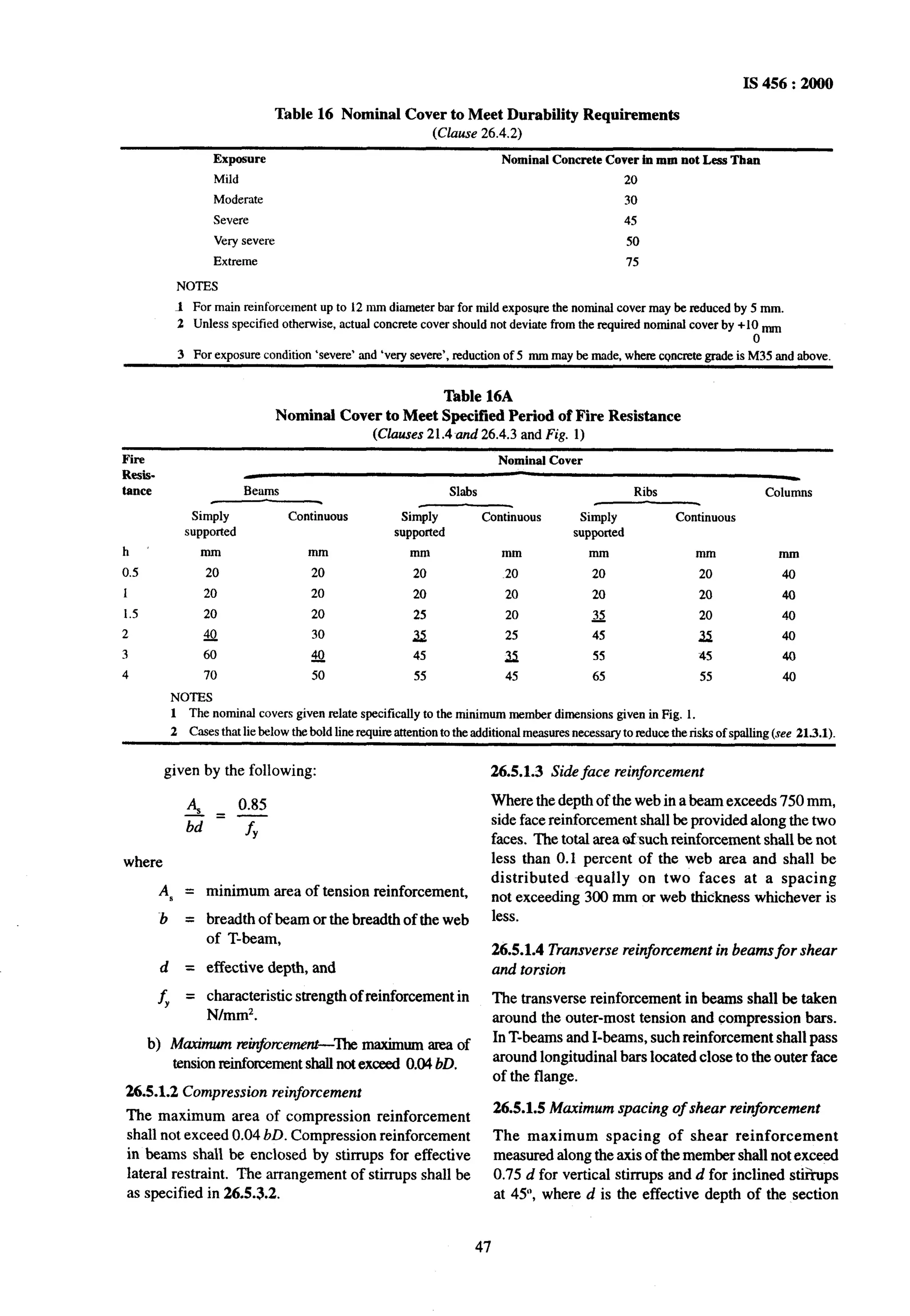
Indian Standard
PLAIN AND REINFORCED CONCRETE -
CODE OF PRACTICE
(Fourth Revision )
ICS 91.100.30
0 BIS 2000
BUREAU OF INDIAN STANDARDS
MANAK BHAVAN, 9 BAHADUR SHAH ZAFAR MARG
NEW DELHI 110002
July 2000 Price Rs 260.00
( Reaffirmed 2005 )
PLAINAND
IS456: 2000
Indian Standard
REINFORCEDCONCRETE-
CODEOFPRACTICE
( Fourth Revision )
FOREWORD
This Indian Standard (Fourth Revision) was adopted by the Bureau of Indian Standards, after the draft finalixed
by the Cement and Concrete Sectional Committee had been approved by the Civil Engineering Division Council.
This standard was first published in 1953 under the title ‘Code of practice for plain and reinforced concrete for
general building construction’ and subsequently revised in 1957. The code was further revised in 1964 and
published under modified title ‘Code of practice for plain and reinforced concrete’, thus enlarging the scope of
use of this code to structures other than general building construction also. The third revision was published in
1978, and it included limit state approach to design. This is the fourth revision of the standard. This revision
was taken up with a view to keeping abreast with the rapid development in the field of concrete technology and
to bring in further modifications/improvements in the light of experience gained while using the earlier version
of the standard.
This revision incorporates a number of important changes. The major thrust in the revision is on the following
lines:
a) In recent years, durability of concrete structures have become the cause of concern to all concrete
technologists. This has led to the need to codify the durability requirements world over. In this revision
of the code, in order to introduce in-built protection from factors affecting a structure, earlier clause on
durability has been elaborated and a detailed clause covering different aspects of design of durable
structure has been incorporated.
b) Sampling and acceptance criteria for concrete have been revised. With tbis revision acceptance criteria
has been simplified in line with the provisions given in BS 5328 (Part 4):1990 ‘Concrete: Part 4
Specification for the procedures to be used in sampling, testing and assessing compliance of concrete’.
Some of the significant changes incorporated in Section 2 are as follows:
a)
b)
cl
d)
e)
0
8)
h)
j)
k)
All the three grades of ordinary Portland cement, namely 33 grade, 43 grade and 53 grade and sulphate
resisting Portland cement have been included in the list of types of cement used (in addition to other
types of cement).
The permissible limits for solids in water have been modified keeping in view the durability requirements.
The clause on admixtures has been modified in view of the availability of new types of admixtures
including superplasticixers.
In Table 2 ‘Grades of Concrete’, grades higher than M 40 have been included.
It has been recommended that minimum grade of concrete shall be not less than M 20 in reinforced
concrete work (see also 6.1.3).
The formula for estimation of modulus of elasticity of concrete has been revised.
In the absenceof proper correlation between compacting factor, vee-bee time and slump, workability
has now been specified only in terms of slump in line with the provisions in BS 5328 (Parts 1 to 4).
Durability clause has been enlarged to include detailed guidanceconcerning the factors affecting durability.
The table on ‘Environmental Exposure Conditions’ has been modified to include ‘very severe’ and
‘extreme’ exposure conditions. This clause also covers requirements for shape and size of member,
depth of concrete cover, concrete quality,requirement againstexposure to aggressive chemical and sulphate
attack, minimum cement requirement and maximum water cement ratio, limits of chloride content, alkali
silica reaction, and importance of compaction, finishing and curing.
A clause on ‘Quality Assurance Measures’ has been incorporated to give due emphasis to good practices
of concreting.
Proper limits have been introduced on the accuracy of measuring equipments to ensure accurate batching
of concrete.
1
IS 456 : 2000
m) The clause on ‘Construction Joints’ has been modified.
n) The clause on ‘Inspection’ has been modified to give more emphasis on quality assurance.
The significant changes incorporated in Section 3 are as follows:
a)
b)
cl
4
e)
0
g)
h)
j)
Requirements for ‘Fire Resistance’ have been further detailed.
The figure for estimation of modification factor for tension reinforcement used in calculation of basic
values of span to effective depth to control the deflection of flexural member has been modified.
Recommendations regarding effective length of cantilever have been added.
Recommendations regarding deflection due to lateral loads have been added.
Recommendations for adjustments of support moments in restrained slabs have been included.
In the detemination of effective length of compression members, stability index has been introduced to
determine sway or no sway conditions.
Recommendations have been made for lap length of hooks for bars in direct tension and flexural tension.
Recommendations regarding strength of welds have been modified.
Recommendations regarding cover to reinforcement have been modified. Cover has been specified
based~ondurability requirements for different exposure conditions. The term ‘nominal cover’ has been
introduced. The cover has now been specified based on durability requirement as well as for fite
requirements.
The significant change incorporated in Section 4 is the modification-of the clause on Walls.The modified clause
includes design of walls against horizontal shear.
In Section 5 on limit state method a new clause has been added for calculation of enhanced shear strength of
sections close to supports. Some modifications have also been made in the clause on Torsion. Formula for
calculation of crack width has been-added (separately given in Annex P).
Working stress method has now been given in Annex B so as to give greater emphasis to limit state design. In
this Annex, modifications regarding torsion and enhanced shear strength on the same lines as in Section 5 have
been made.
Whilst the common methods of design and construction have been covered in this code, special systems of
design and construction of any plain or reinforced concrete structure not covered by this code may be permitted
on production of satisfactory evidence regarding their adequacy and safety by analysis or test or both
(see 19).
In this code it has been assumed that the design of plain and reinforced cement concrete work is entrusted to a
qualified engineer and that the execution of cement concrete work is carried out under the direction of a qualified
and experienced supervisor.
In the formulation of this standard, assistance has been derived from the following publications:
BS 5328-zPart 1 : 1991 Concrete : Part 1 Guide to specifying concrete, British Standards Institution
BS 5328 : Part 2 : 1991 Concrete : Part 2 Methods for specifying concrete mixes, British Standards
Institution
BS 5328 : Part 3 : 1990 Concrete : Part 3 Specification for the procedures to be used in producing and
transporting concrete, British Standards Institution
BS 5328 : Part 4 : 1990 Concrete : Part 4 Specification for the procedures to be used in sampling, testing
and assessing compliance of concrete, British Standards Institution
BS 8110 : Part 1 : 1985 Structural use of concrete : Part 1Code of practice for design and construction,
British Standards Institution
BS 8110 : Part 2 : 1985 Structural use of concrete : Part 2 Code of practice for special circumstances,
British Standards Institution
AC1319 : 1989 Building code requirements for reinforced concrete, American Concrete Institute
AS 3600 : 1988 Concrete structures, Standards Association of Australia
2
IS 456 : 2000
DIN 1045 July 1988 Structural use of concrete, design and construction, Deutsches Institut fur Normung E.V.
CEB-FIP Model code 1990, Comite Euro - International Du Belon
The composition of the technical committee responsible for the formulation of this standard is given in
Annex H.
For the purpose of deciding whether a particular requirement of this standard is complied with, the final value,
observed or calculated, expressing the result of a test or analysis shall be rounded off in accordance with
IS 2 : 1960 ‘Rules for rounding off numerical values (revised)‘. The number of significant places retained in the
rounded off value should be the same as that of~the specified value in this standard.
As in the Original Standard, this Page is Intentionally Left Blank
IS456:2000
CONTENTS
SECTION 1 GENERAL
1 SCOPE
2 REFERENCES
3 TERMINOLOGY
4 SYMBOLS
SECTION 2 -MATERIALS, WORKMANSHIP, INSPECTION AND TESTING
5 MATERIALS
5.1 Cement
5.2 Mineral Admixtures
5.3 Aggregates
5.4 Water
55 Admixtures
5.6 Reinforcement
5.7 Storage of Materials
6 CONCRETE
6.1 Grades
6.2 Properties of Concrete
7 WORKABILITYOFCONCRETE
8 DURABILITYOFCONCRETE
8.1 General
8.2 Requirements for Durability
9
10
11
CONCRETEMrx PROPORTIONING
9.1 Mix Proportion
9.2 Design Mix Concrete
9.3 Nominal Mix Concrete
PRODUCTIONOFCONCRETE
10.1 Quality Assurance Measures
10.2 Batching
10.3 Mixing
FORMWORK
11.1 General
11.2 Cleaning and Treatment of Formwork
1I .3 Stripping Time
12 ASSEMBLYOFREINFORCEMENT
13 TRANSPORTING,PLACING,COMPACTIONANDCURING
13.1 Transporting and Handling
13.2 Placing
13.3 Compaction
PAGE
11
11
11
11
13
13
-13
14
14
15
15
15
15
15
15
17
17
17
18
22
22
22
23
23
23
24
24
25
25
25
25
25
26
26
26
26
IS 456 : 2000
13.4 Construction Joints and Cold Joints
13.5 Curing
13.6 Supervision
14 CONCRERNGUNDERSPECIALCONDITIONS
14.1 Work in Extreme Weather Conditions
14.2 Under-Water Concreting
15 SAMPLINGANDSTRENGTHOFDESIGNEDCONCRETEMrx
15.1 General
15.2 Frequency of Sampling
15.3 Test Specimen
15.4 Test Results of Sample
16 ACCEPTANCECRITERIA
17 INSPECI-IONANDTEFXJNGOFSTRWTURE
SECTION 3 GENERAL DESIGN CONSIDERATION
18 BASESFORDEIGN
18.1 Aim of Design
18.2 Methods of Design
18.3 Durability, Workmanship and Materials
18.4 Design Process
I9 LOADSANDFORCES
19.1’ General
19.2 Dead Loads
19.3 Imposed Loads, Wind Loads and Snow Loads
19;4 Earthquake Forces
19.5 Shrinkage, Creep and Temperature Effects
19.6 Other Forces and Effects
19.7 Combination of Loads
19.8 Dead Load Counteracting Other Loads and Forces
19.9 Design Load
20 STABILITYOFTHESTRUCTURE
20.1 Overturning
20.2 Sliding
20.3 Probable Variation in Dead Load
20.4 Moment Connection
20.5 Lateral Sway
21 FIRERESISTANCE
22 ANALYSIS
22.1 General
22.2 Effective Span
22.3 Stiffness
PAGE
27
27
27
27
27
27
29
29
29
29
29
29
30
32
32
32
32
32
32
32
32
32
32
32
33
33
33
33
33
33
33
33
33
33
33
34
34 -
34
35
6
IS456:2000
PAGE
22.4 Structural Frames
22.5 Moment and Shear Coefficients for Continuous Beams
22.6 Critical Sections for Moment and Shear
22.7 Redistribution of Moments
.
23 BEAMS
23.0 Effective Depth
23.1 T-Beams and L-Beams
23.2 Control of Deflection
23.3 Slenderness Limits for Beams to Ensure Lateral Stability
24 SOLIDSLABS
24.1 General
24.2 Slabs Continuous Over Supports
24.3 Slabs Monolithic with Supports
24.4 Slabs Spanning in Two Directions~at Right Angles
24.5 Loads on Supporting Beams
25 COMPRESSIONMEZMBERS
25.1 Definitions
25.2 Effective Length of Compression Members
25.3 Slenderness Limits for Columns
25.4 Minimum Eccentricity
26 REQUIREMENTSGOVERNINGREINFORCEMENTANDDETAILING
26.1 General
26.2 Development of Stress in Reinforcement
26.3 Spacing of Reinforcement
26.4 Nominal Cover to Reinforcement
26.5 Requirements of Reinforcement for Structural Members
27 EXPANSIONJOMTS
SECTION 4 SPECIAL DESIGN REQUIREMENTS FOR
STRUCTURAL MEMBERS AND SYSTEMS
28 CONCRETECORBELS
28.1 General
28.2 Design
29 DEEPBEAMS
29.1 General
29.2 Lever Arm
29.3 Reinforcement
30 RIBBED,HOLLOWBLOCKORVOIDEDSLAB
30.1 General
30.2 Analysis of Structure
30.3 Shear
30.4 Deflection
35
35
36
36
36
36
36
37
39
39
39
39
39
41
41
41
41
42
42
42
42
42
42
45
46
46
50
51
51
51
51
51
51
51
52
52
52
52
52
IS 456 : 2000
PAGE
30.5 Size and Position of Ribs
30.6 Hollow Blocks and Formers
30.7 Arrangement of Reinforcement
30.8 Precast Joists and Hollow Filler Blocks
31 FLATSLABS
3 1.1 General
31.2 Proportioning
31.3 Determination of Bending Moment
31.4 Direct Design Method
31.5 Equivalent Frame Method
31.6 Shear in Flat Slab
31.7 Slab Reinforcement
31.8 Openings in Flat Slabs
32 WALLS
32.1 General
32.2 Empirical Design Method for Walls Subjected to Inplane Vertical Loads
32.3 Walls Subjected to Combined Horizontal and Vertical Forces
32.4 Design for Horizontal Shear
32.5 Minimum Requirements for Reinforcement in Walls
33 STAIRS
33.1 Effective Span of Stairs
33.2 Distribution of Loading on Stairs
33.3 Depth of Section
34 Foort~~s
34.1 General
34.2 Moments and Forces
34.3 Tensile Reinforcement
34.4 Transfer of Load at the Base of Column
34.5 Nominal Reinforcement
SECTION 5 STRUCTURAL DESIGN (LIMIT STATE METHOD)
35 SAFETYAND SERVKEABlLITYkKNIREMl?N’l’s
35.1 General
35.2 Limit State of Collapse
35.3 Limit States of Serviceability
35.4 Other Limit States
36 CHARACTERISTICANDDESIGNVALUESANDPARTULSAFEI”YFACTORS
36.1 Characteristic Strength of Materials
36.2 Characteristic Loads
36.3 Design Values
36.4 Partial Safety Factors
37 ANALYSIS
37.1 Analysis of Structure
52
52
53
53
53
53
53
53
54
56
57
59
61
61
61
61
62
62
62
63
63
63
63
63
63
64
65
65
66
67
67
67
67
67
67
67
67
68
68
-68
68
8
PAGE
38 LIMITSTATEOFCOLLAPSE :FLEXURE
38.1 Assumptions
39 LIMITSTATEOFCOLLAPSE:COMPRESSION
39.1 Assumptions
39.2 Minimum Eccentricity
39.3 Short Axially Loaded Members in Compression
39.4 Compression Members with Helical Reinforcement
39.5 Members Subjected to Combined Axial Load and Uniaxial Bending
39.6 Members Subjected to Combined Axial Load and Biaxial Bending
39.7 Slender Compression Members
40 LLWTSTATEOF-COLLAPSE: SW
40.1 Nominal Shear Stress
40.2 Design Shear Strength of Concrete
40.3 Minimum Shear Reinforcement
40.4 Design of Shear Reinforcement
40.5 Enhanced Shear Strength of Sections Close to Supports
41 LJMITSTATEOFCOLLAPSE: TORSION
41.1 General
41.2 Critical Section
41.3 Shear and Torsion
41.4 Reinforcement in Members Subjected to Torsion
42 LIMITSTATKOFSERVICEABILITY:DEKIZC~ION
42.1 Flexural Members
43 LIMITSTATEOFSERVICEABILITY:CRACKING
43.1
43.2
4NNEXA
ANNEXB
B-l
B-2
B-3
Flexural Members
Compression Members
LIST OF REFERRED INDIAN STANDARDS
STRUCTURAL DESIGN (WORKING STRESS METHOD)
GENERAL
B-l.1 General Design Requirements
B-1.2 Redistribution of Moments
B-l.3 Assumptions for Design of Members
PEaMIsstBLESTrtEssEs
B-2.1 Permissible Stresses in Concrete
B-2.2 Permissible Stresses in Steel Reinforcement
B-2.3 Increase in Permissible Stresses
I’iuu@ssm~~Lam INCOMPRESSIONMEMBEW
B-3.1 Pedestals and Short Columns with Lateral ‘Des
B-3.2 Short Columns with Helical Reinforcement
B-3.3 Long Columns
B-3.4 Composite Columns
69
69
70
70
71
71
71
71
71
71
72
72
72
72
72
74
74
74
75
75
75
75
75
76
76
76
77
80
80
80
80
80
80
80
80
80
81
81
81
81
81
9
IS 456 : 2ooo
B-4 MYERS SUBJECTEDTOCOMBINEDAxw. LOADANDBENDING
B-4.1
B-4.2
B-43
B-5 SHEAR
B-5.1
B-5.2
B-5.3
B-5.4
B-5.5
Design Based on Untracked Section
Design Based on Cracked Section
Members Subjected to Combined Direct Load and Flexure
Nominal Shear Stress
Design Shear Strength of Concrete
Minimum Shear Reinforcement
Design of Shear Reinforcement
Enhanced Shear Strength of Sections Close to Supports
B-6 TORSION
B-6.1 General
B-6.2 CriticalSection
B-6.3 Shear and Torsion
B-6.4 Reinforcement in Members Subjected to Torsion
ANNEX C CALCULATION OF DEFLECTION
C-l TOTALDEFLECTION
C-2 SHORT-TERMDEFLECTION
C-3 DEFLECI-IONDUETOSHRINKAGE
C-4 DE-ON DUETOCREEP
ANNEX D SLABS SPANNING IN TWO DIRECTIONS
D-l RESTRAINEDSLAIIS
D-2 SIMPLYSIJIWRTEDSLABS
ANNEX E EFFECTIVE LENGTH OF COLUMNS
ANNEX F CALCULATION OF CRACK WIDTH
ANNEX G MOMENTS OF RESISTANCE FOR RECTANGULAR AND T-SECTIONS
G- 1 RECTANGULARSECIIONS
G-1.1 Sections without CompressionReinforcement
G-1.2 Sections with Compression Reinforcement
G-2 FLANGEDSECTION
ANNEX H COMMITTEE COMPOSITION
83
83
83
83
83
83
84
85
85
85
86
86
86
86
86
88
88
88
88
89
90
90
90
92
95
96
96
%
96
96
98
10
SECTION 1 GENERAL
1 SCOPE
k-1This standard deals with the general structural use
of plain and reinforced concrete.
1.1.1For the purpose of this standard, plain concrete
structures are those where reinforcement, if provided
is ignored for~determinationof strength of the structure.
1.2 Special requirements of structures, such as shells,
folded plates, arches, bridges, chimneys, blast resistant
structures, hydraulic structures, liquid retaining
structures and earthquake resistant structures, covered
in respective standards have not been covered in this
standard; these standards shall be used in conjunction
with this standard.
EL -
Es -
J& -
xx -
2 REFERENCES
fa -
fd -
fY -
4 -
Hive-
L -
z -c
The Indian Standards listed in Annex A contain
provisions which through reference in this text,
constitute provisions of this standard. At the time of
publication, the editions indicated were valid. All
standards are subject to revision and parties to
agreements abasedon this standard are encouraged to
investigate the possibility of applying the most recent
editions of the standards indicated in Annex A.
4 -
K -
k -
Ld -
LL-
Lw -
3 TERMINOLOGY 1 -
For the purpose of this standard, the definitions given
in IS 4845 and IS 6461 (Parts 1 to 12) shall generally
apply.
4 SYMBOLS
For the purpose of this standard, the following letter
symbols shall have the meaning indicated againsteach,
where other symbols are used, they are explained at
the appropriate place:
A -
b -
b -ef
bf -
k -
D -
Df -
DL -
d -
d’ -
EC -
Area
Breadth of beam, or shorter dimension
of a rectangular column
Effective width of slab
Effective width of flange
Breadth of web or rib
Overall depth of beam or slab or
diameter of column; dimension of a
rectangular column in the direction
under consideration
Thickness of flange
Dead load
Effective depth of beam or slab
Depth of compression reinforcement
from the highly compressed face
ModuIus of elasticity of concrete
11
4 -
lY -
4 -
4 -
12 -
1’ -
2
M -
m -
n -
P -
4,) -
IS456:2000
Earthquake load
Modulusof elasticity of steel
Eccentricity
characteristic cube compressive
strength of concrete
Modulus of rupture of concrete
(flexural tensile strength)
Splitting tensile strength of concrete
Design strength
Characteristic strength of steel
Unsupported height of wall
Effective height of wall
Effective moment of inertia
Moment of inertia of the gross section
excluding reinforcement
Moment of intertia of cracked section
Stiffness of member
Constant or coefficient or factor
Development length
Live load or imposed load
Horizontal distance between centres of
lateral restraint
Length of a column or beam between
adequate lateral restraints or the
unsupported length of a column
Effective span of beam or slab or
effective length of column
Effective length about x-x axis
Effective length about y-y axis
Clear span, face-to-face of supports
I’,,for shorter of the two spans at right
angles
Length of shorter side of slab
Length of longer side of slab
Distance between points of zero
moments in a beam
Span in the direction in which
moments are determined, centre to
centre of supports
Span transverse to I,, centre to centre
of supports
1z for the shorter of the continuous
spans
Bending moment
Modular ratio
Number of samples
Axial load on a compression member
Calculated maximum bearing pressure
IS 456 : 2000
Yc, - Calculated maximum bearing pressure
of soil
r - Radius
s - Spacing of stirrups or standard
deviation
T - Torsional moment
t - Wall thickness
V - Shear force
W - Total load
WL - Wind load
W - Distributed load per unit area
Wd - Distributed dead load per unit area
WI - Distributed imposed load per unit area
X - Depth of neutral axis
z - Modulus of section
Z - Lever arm
OZ,B - Angle or ratio
r, - Partial safety factor for load
xl - Partial safety factor for material
snl - Percentage reduction in moment
E -UC Creep strain of concrete
(Tchc
- Permissible stress in concrete in
bending compression
OLX - Permissible stress in concrete in direct
compression
<T -
mc
0% -
% -
0,” -
Permissible stress in metal in direct
compression
Permissible stress in steel in
compression
Permissible stress in steel in tension
Permissible tensile stress in shear
reinforcement
Design bond stress
Shear stress in concrete
Maximum shear stress in concrete
with shear reinforcement
Nominal shear stress
Diameter of bar
12
IS456:2000
SECTION 2 MATERIALS, WORKMANSHIP,
INSPECTION AND TESTING
5 MATERIALS
5.1 Cement
The cement used shall be any of the following and the
type selected should be appropriate for the intended
use:
a)
b)
c)
d)
e)
f)
g)
h)
j)
k)
33 Grade ordinary Portland cement
conforming to IS 269
43 Grade ordinary Portland cement
conforming to IS 8112
53 Grade ordinary Portland cement
conforming to IS 12269
Rapid hardening Portland cement conforming
to IS 8~041
Portland slag cement conforming to IS 455
Portland pozzolana cement (fly ash based)
conforming to IS 1489 (Part 1)
Portland pozzolana cement (calcined clay
based) conforming to IS 1489 (Part 2)
Hydrophobic cement conforming to IS 8043
Low heat Portland cement conforming to
IS 12600
Sulphate resisting Portland cement
conforming to IS 12330
Other combinations of Portland cement with mineral
admixtures (see 5.2) of quality conforming with
relevant Indian Standards laid down may also be used
in the manufacture of concrete provided that there are
satisfactory data on their suitability, such as
performance test on concrete containing them.
5.1.1 Low heat Portland cement conforming to
IS 12600 shall be used with adequate precautions with
regard to removal of formwork, etc.
5.1.2 High alumina cement conforming to IS 6452 or
supersulphated cement conforming to IS 6909 may be
used only under special circumstances with the prior
approval of the engineer-in-charge. Specialist literature
may be consulted for guidance regarding the use of
these types of cements.
5.1.3 The attention of the engineers-in-charge and
users of cement is drawn to the fact that quality of
various cements mentioned in 5.1 is to be determined
on the basis of its conformity to the performance
characteristics given in the respective Indian Standard
Specification for thatcement. Any trade-mark or any
trade name indicating any special features not covered
in the standard or any qualification or other special
performance characteristics sometimes claimed/
indicated on the bags or containers or in advertisements
alongside the ‘Statutory Quality Marking’ or otherwise
have no relation whatsoever with the characteristics
guaranteed by the Quality Marking as relevant to that
cement. Consumers are, therefore, advised to go by
the characteristics as given in the corresponding
Indian Standard Specification or seek specialist
advise to avoid any problem in concrete making and
construction.
5.2 Mineral Admiitures
5.2.1 Poz.zolanas
Pozzolanic materials conforming to relevant Indian
Standards may be used with the permission of the
engineer-in-charge, provided uniform blending with
cement is ensured.
5.2.1.1 Fly ash (pulverizedfuel ash)
FIy ash conforming to Grade 1 of IS 3812 may be
use?,as part replacement of ordinary Portland cement
provided uniform blending with cement is ensured.
5.2.1.2 Silicafume
Silica fume conforming to a standard approved by the
deciding authority may be used as part replacement of
cement provided uniform blending with the cement is
ensured.
NOTE-The silica fume (very fine non-crystalline silicon
dioxide)is aby-productofthemanufactmeof silicon,kmxilicon
orthe like, fromquartzandcarbonin electricarcfurnace.It is
usuallyusedinpropoltionof 5’mlOpercentofthecementconbcnt
of a mix.
5.2.1.3Rice husk ash
Rice husk ash giving required performance and
uniformity characteristics -may be used with the
approval of the deciding authority.
NOTE--Rice husk ash is producedby burningrice husk and
containlargepropotion of silica. To achieve amorphousstate,
ricehuskmaybe burntatcontrolledtemperatum.Itis necessary
to evaluatetheproductfromaptuticularsourceforperformnnce
and uniformitysince it can rangefrombeing as dekterious as
silt when incorporatedin concmte. Waterdemnndand drying
&i&age shouldbe studiedbeforeusing ria husk.
5.2.u iuetakaoline
Metakaoline having fineness between 700 to
900 m?/kg may be used as ~pozzolanic material in
concrete.
NOTE-Metaknoline is obtained by calcination of pun or
r&ledkaolinticclnyatatempexatumbetweea6soVand8xPc
followed by grind& to achieve a A of 700 to 900 n?/kg.
Theresultingmaterialhas high pozzolanicity.
5.2.2 Ground Granulated Blast Furnace Slag
Ground granulated blast furnace slag obtained by
grinding granulated blast furnace slag conforming to
IS 12089may be used as part replacement of ordinary
13
IS 456 : 2000
Portland cements provided uniform blending with
cement is ensured.
5.3 Aggregates
Aggregates shall comply with the requirements of
IS 383. As far as possible preference shall be given to
natural aggregates.
5.3.1 Other types of aggregates such as slag and
crushed overbumt brick or tile, which may be found
suitable with regard to strength, durability of concrete
and freedom from harmful effects may be usedfor plain
concrete members, but such aggregates should not
contain more than 0.5 percent of sulphates as SO, and
should not absorb more than 10 percent of their own
mass of water.
5.3.2 Heavy weight aggregates or light weight
aggregates such as bloated clay aggregates and sintered
fly ash aggregates may also be used provided the
engineer-in-charge is satisfied with the data on the
properties of concrete made with them.
NOTE-Some of the provisions of the code would require
moditicationwhentheseaggnzgatesareused;specialistlitemtute
may be consultedfor guidance.
5.3.3 Size of Aggregate
The nominal maximum size of coarse aggregate should
be as large as possible within the limits specified but
in no case greater than one-fourth of the minimum
thickness of the member, provided that the concrete
can be placed without difficulty so as to surround all
reinforcement thoroughly and fill the comers of the
form. For most work, 20 mm aggregate is suitable.
Where there is no restriction to the flow of concrete
into sections, 40 mm or larger size may be permitted.
In concrete elements with thin sections, closely spaced
reinforcement or small cover, consideration should be
given to the use of 10 mm nominal maximum size.
Plums above 160 mm and up to any reasonable size
may be used in plain concrete work up to a maximum
limit of 20 percent by volume of concrete when
specifically permitted by the engineer-in-charge. The
plums shall be distributed evenly and shallbe not closer
than 150 mm from the surface.
5.3.3.1 For heavily reinforced concrete members as
in the case of ribs of main beams, the nominal
maximum size of the aggregate should usually be
restricted to 5 mm less than the minimum clear distance
between the main bars or 5 mm less than the minimum
cover to the reinforcement whichever is smaller.
5.3.4 Coarse and fine aggregate shall be batched
separately. All-in-aggregate may be used only where
specifically permitted by the engineer-in-charge.
5.4 Water
Water used for mixing and curing shall be clean and
free from injurious amounts of oils, acids, alkalis, salts,
sugar, organic materials or other substances that may
be deleterious to concrete or steel.
Potable water is generally considered satisfactory
for mixing concrete. As a guide the following
concentrations represent the maximum permissible
values:
a)
b)
cl
5.4.1
To neutralize 100 ml sample of water, using
phenolphthalein as anindicator, it should not
require more than 5 ml of 0.02 normal NaOH.
The details of test are given in 8.1 of IS
3025 (Part 22).
To neutralize 100 ml sample of water, using
mixed indicator, it should not require more
than 25 ml of 0.02 normal H$O,. The details
of ‘test shall be as given in 8 of IS 3025
(Part 23).
Permissible limits for solids shall be as given
in Table 1.
In case of doubt regarding development of
strength, the suitability of water for making concrete
shall be ascertained by the compressive strength and
initial setting time tests specified in 5.4.1.2 and 5.4.1.3.
5.4.1.1 The sample of water taken for testing shall
represent the water proposed to be used for concreting,
due account being paid to seasonal variation. The
sample shall not receive any treatment before testing
other than that envisaged in the regular supply of water
proposed for use in concrete. The sample shall be stored
in a clean container previously rinsed out with similar
water.
S.4.1.2 Average 28 days compressive strength of at
least three 150mm concrete cubes prepared with water
proposed to be used shall not be less than 90 percent
of the average of strength of three similar concrete
cubes prepared with distilled water. The cubes shall
be prepared, curedand tested in accordance with the
requirements of IS 516.
5.4.1.3 The initial setting time of test block made with
theappropriate cement and the water proposed to be
used shall not be less than 30 min and shall not differ
by& 30min from the initial setting time of control
test block prepared with the same cement and distilled
water. The test blocks shall be preparedand tested in
accordance with the requirements off S 4031 (Part 5).
5.4.2 The pH value of water shall be not less than 6.
5.4.3 Sea Water
Mixing or curing of concrete with sea water is not
recommended because of presence of harmful salts in
sea water. Under unavoidable circumstances sea water
may be used for mixing or curing in plain concrete with
no embedded steel after having given due consideration
to possibledisadvantagesandprecautions including use
of appropriate cement system.
14
‘lhble 1 Permissible Limit for !Wids
(claust?5.4)
lS456:2000
SI -apu Permb?dbleLImlt,
No. Max
i) organic IS 3a25 (Pal-l18) 2(Jomgll
ii) Inorganic IS 3025 (yalt 18) 3ooomo/L
iii) Sulphaki (usSOJ IS302s(Part24) amo/l
iv) Chlorides(as Cl) IS 3025 (part32) 2ooompll
forfxmaetc not Containing
embcd~sti mdsoomg/l
forleInfolced collcntc worlr
v) Suspfmdedmatter IS 3025 (Palt17) 2(xJom%l
5.4.4 Water found satisfactory for mixing is also 5.6.1 All reinforcement shall be free from loose mill
suitable for curing concrete. However, water used for scales, loose rust and coats of paints, oil, mud or any
curing should not produce any objectionable stain or other substances which may destroy or reduce bond.
unsightly deposit on the concrete surface. The presence Sand blasting or other treatment is recommended to
of tannic acid or iron compounds is objectionable. clean reinforcement.
5.5 Admixtures
5.5.1 Admixture, if used shall comply with IS 9103.
Previous experience with and data on such materials
shouldbe considered in relationto thelikely standa& of
supervisionandworkmanshiptotheworkbeingspecified,
55.2 Admixtures should not impair durability of
concrete nor combine with the constituent to form
harmful compounds nor increase the risk of corrosion
of reinforcement.
5.6.2 Special precautions like coating of reinforcement
may be required for reinforced concrete elements in
exceptional cases and for~rehabilitation of structutes.
Specialist literature may be referred to in such cases.
5.6.3 The modulus of elasticity of steel shall be taken
as 200 kN/mm*. The characteristic yield strength of
different steel shall be assumed as the minimum yield
stress/O.2percent proof stress specified in the relevant
Indian Standard.
55.3 The workability, compressive strength and the
slump loss of concrete with and without the use of
admixtures shall be established during the trial mixes
before use of admixtures.
5.7 Storage of Materials
Storage of materials shall be as described in IS 4082.
6 CONCRETE
5.5.4 The relative density of liquid admixtures shall
be checked for each drum containing admixtures and
compared with the specified value before acceptance.
5.5.5 The chloride content of admixtures shall
be independently tested for each batch before
acceptance.
6.1 Grades
The concrete shall be in grades designated as per
Table 2.
6.1.1 The characteristic strength is defined as the
strength of material below which not more than
5 percent of the test results are expectedto fall.
5.5.6 If two or more admixtures are used
simultaneously in the same concrete mix, data should
be obtained to assess their interaction and to ensure
their compatibility.
5.6 -Reinforcement
The reinforcement shall be any of the following:
4
b)
cl
4
6.1.2 The minimum grade of concrete for plain and
reinforced concrete shall be as per Table 5.
61.3 Concrete of grades lower than those given in
Table-5 may be used for plain concrete constructions,
lean concrete, simple foundations, foundation for
masonry walls and other simple or temporary
reinforced concrete construction.
Mild steel and medium tensile steel bars
conforming to IS 432 (Part 1).
High strength deformed steel barsconforming
to IS 1786.
6.2 Properties of Concrete
63.1 Increase of Strength with Age
Hard-drawn steel wire fabric conforming to
IS 1566.
Structural steel conforming to Grade A of
IS 2062.
There is normally a gain of strength beyond 28 days.
The quantum of increase depends upon the gradeand
type of cement, curing and environmental conditions,
etc. The design should be based on 28 days charac-
teristic strengthof concrete unless there is a evidence to
15
IS 456 : 2000
Table 2 Grades cifConcrete
(Clau.re6.1,9.2.2, 15.1.1 and36.1)
Group Grade Designation SpecifiedCharacte~tk
Compressive Streng$bof
150 mm Cube at 28 Days in
N/mmz
(1) (2) (3)
Ordinary M 10 10
Concrete M 15 15
M 20 20
Standard M 25 25
Concrete M 30 30
M 35 35
M40 40
M 45 45
M JO 50
M 55 55
High M60 60
Strength M65 65
Concrete M70 70
M75 75
M 80 80
NOTES
1 Inthedesignationof concretemix Mmfm to themix andthe
numberto the specified compressivestrengthof 150 mm size
cube at28 days, expressedin N/mn?.
2 Forconcreteof compressivestrengthgreata thanM 55,design
parametersgiven in the stand& may not be applicableandthe
values may be obtoined from specialized literatures and
experimentalresults.
justify a higher strength for a particular structure due to
age.
6.2.1.1 For concrete of grade M 30 and above, the
rate of increase of compressive strength with age shall
be based on actual investigations.
6.2.1.2 Where members are subjected to lower direct
load during construction, they should be checked for
stresses resulting from combination of direct load and
bending during construction.
6.2.2 Tensile Strength of Concrete
The flexural and splitting tensile strengths shall be
obtained as described in IS 516 and IS 5816
respectively. When the designer wishes to use an
estimate of the tensile strength from the compressive
strength, the following formula may be used:
Flexural strength, f, = 0.7.& N/mm2
wheref&is the characteristic cube compressive strength
of concrete in N/mmz.
6.2.3 Elastic Deformation
The modulus of elasticity is primarily influenced by
the elastic properties of the aggregate and to a lesser
extent by the conditions of curing qd age of the
concrete, the mix proportions and the type of cement.
The modulus of elasticity is normally related to the
compressive strength of concrete.
6.2.3.1 The modulus of elasticity of concrete can be
assumed as follows:
where
E, is the short term static modulus of elasticity in
N/mm*.
Actual measured values may differ by f 20 percent
from the values dbtained from the above expression.
6.2.4 Shrinkage
The total shrinkage of concrete depends upon the
constituents of concrete, size of the member and
environmental conditions. For a given humidity and
temperature, the total shrinkage of concrete is most
influenced by the total amount of water present in the
concrete at the time of mixing and, to a lesser extent,
by the cement content.
6.2.4.1 In the absence of test data, the approximate
value of the total shrinkage strain for design may be
taken as 0.000 3 (for more information, see-IS 1343).
6.2.5 Cmep of Concrete
Creep of concrete depends,in addition to the factors
listed in 6.2.4, on the stress in the concrete, age at
loading and the duration of loading. As long as the
stress in concrete does not exceed one-third of its
characteristic compressive strength, creep may be
assumed to be proportional to the stress.
6.25.11n the absence of experimental data and detailed
information on the effect of the variables, the ultimate
creep strain may be estimated from the following
valuesof creep coefficient (that is, ultimatecreep strain/
elastic strain at the age of loading); for long span
structure, it is advisable to determine actual creep
strain, likely to take place:
Age at Loading Creep Coeficient
7 days 2.2
28 days 1.6
1year 1.1
NOTE-The ultimatecreepstrain,estimatedasdescribedabove
does not includethe elastic strain.
6.2.6 Thermal Expansion
The coefficient df thermal expansion depends on nature
of cement, the aggregate, the cement content, the
relative humidity and the size of sections-The value
of coefficient of thermal expansion for concrete with
different aggregates may be taken as below:
npe of Aggregate
Quartzite
Sandstone
Granite
Basalt
Limestone
Coeficient of Thermal
Expansionfor CommtePC
1.2 to 1.3 x 10-S
0.9 to 1.2 x 1cP
0.7 to 0.95 x 10-J
O.%to 0.95 x lo5
0.6 t@.9 x 10s
16
IS 456 : 2000
7 WORKABILITY OF CONCRETE
7.1 The concrete mix proportions chosen should be be compacted with the means available. Suggested
such that the concrete is of adequate workability for ranges of workability of concrete measured in
the placing conditions of the concrete and can properly accordance with IS 1199 are given below:
Placing Conditions Degree of Slump
Workability (mm)
(1) (2) (3)
Blinding concrete; Very low See 7.1.1
Shallow sections;
Pavements using pavers I
Mass concrete;
Lightly reinforced
sections in slabs,
beams, walls, columns;
Floors;
Hand placed pavements;
Canal lining;
Strip footings
Low 25-75
MediumHeavily reinforced 50-100
sections in slabs,
beams, walls, columns; 75-100
Slipform work;
Pumped concrete 1
Trench fill; High 100-150
In-situ piling
Tremie concrete I Very high See 7.1.2
NOTE-For most of the placing conditions, internal vibrators (needle vibrators) are suitable. The diameter of tbe needle shall be
determined based on the density and spacing of reinforcement bars and thickness of sections. For tremie concrete, vibrators am not
rewired to be used (see &SO13.3).
7.1.1 In the ‘very low’ category of workability where
strict control is necessary, for example pavement
quality concrete, measurement of workability by
determination of compacting factor will be more
appropriate than slump (see IS 1199) and a value of
compacting factor of 0.75 to 0.80 is suggested. 
7.1.2 In the ‘very high’ category of workability,
measurement of workability by determination of flow
will be appropriate (see IS 9103).
8 DURABILITY OF CONCRETE
8.1 General
A durable concrete is one that performs satisfactorily
in the working environment during its anticipated
exposure conditions during service. The materials and
mix proportions specified and used should be such as
to maintain its integrity and, if applicable, to protect
embedded metal from corrosion.
8.1.1 One of the main characteristics influencing the
durability of concrete is its permeability to the ingress
of water,oxygen, carbon dioxide, chloride, sulphateand
otherpotentiallydeleterioussubstances. Impermeability
is governed by the constituents and workmanship used
in making the concrete. with normal-weight aggregates
a suitably low permeability is achieved by having an
adequate cement content, sufficiently low free water/
cement~ratio,~byensuring complete compaction of the
concrete, and by adequate curing.
The factors influencing durability include:
4
b)
cl
4
d
f)
the environment;
the cover to embedded steel;
the typeand_quality of constituent materials;
the cement content and water/cement ratio of
the concrete;
workmanship, to obtain full compaction and
efficient curing; and
the shape and size of the member.
The degree of exposure anticipated for the concrete
during its service life together with other relevant
factors relating to mix composition, workmanship,
design and detailing should be considered. The
concrete mix to provide adequate durability under these
conditions should be chosen taking account of the
accuracy of current testing regimes for control and
compliance as described in this standard.
17
IS 456 : 2000
8.2 Requirements for Durability
8.2.1 Shape and Size of Member
The shape or design details of exposed structures
should be such as to promote good drainage of water
and to avoid standing pools and rundown of water.
Care should also be taken to minimize any cracks that
may collect or transmit water. Adequate curing is
essential to avoid the harmful effects of early loss of
moisture (see 13S).Member profiles and their
intersections with other members shall be designed and
detailed in a way to ensure easy flow of concrete and
proper compaction during concreting.
Concrete is more vulnerable to deterioration due to
chemical or climatic attack when it is in thin sections,
in sections under hydrostatic pressure from one side
only, in partially immersed sections and at corners and
edges of elements. The life of the strycture can be
lengthened by providing extra cover to steel, by
chamfering the corners or by using circular cross-
sections or by using surface coatings which prevent or
reduce the ingress of water, carbon dioxide or
aggressive chemicals.
8.2.2 Exposure Conditions
8.2.2.1 General environment
The general environment tc, which the concrete will
be exposed during its working life is classified into
five levels of severity, that is, mild, moderate, severe,
very severe and extreme as described in Table 3.
Table 3 Environmental Exposure Conditions
(Chwes 8.2.2.1 and 35.3.2)
Sl No. Environment
(1) (2)
i) Mild
ii) Moderate
iii) Severe
iv) Verysevere
-4 Extreme
Nominal Maximum Size Entrained Air
Aggregate Percentage
WW
20 5fl
40 4fl
Since air entrainment reduces the strength, suitable
adjustments may be made in the mix design for
achieving required strength.
8.2.2.4 Exposure to sulphate attack
Table 4 gives recommendations for the type of cement,
maximum free water/cement ratio and minimum
cement content, which arerequired atdifferent sulphate
concentrations in near-neutral ground water having
pHof6to9.
Exposure Conditions
(3)
Concrete surfaces protected against
weatheror aggressiveconditions,except
those situatedin coastalarea.
Concretesurfacesshelteredfromsevere
rainorfreezingwhilst wet
Concreteexposedtocondensationandrain
Concretecontinuouslyunderwater
Concretein contactorburiedundernon-
aggressivesoil/groundwater
Concrete surfaces sheltered from
saturatedsalt airin coastalarea
Concrete surfaces exposed to severe
rain, alternate wetting and drying or
occasional freezingwhilst wet orsevere
condensation.
For the very high sulphate concentrations in Class 5
conditions, some form of lining such as polyethylene
or polychloroprene sheet; or surface coating based on
asphalt, chlorinated rubber, epoxy; or polyurethane
materials should also be used to prevent access by the
sulphate solution.
8.2.3 Requirement of Concrete Cover
8.2.3.1 The protection of the steel in concrete against
corrosion depends upon an adequate thickness of good
quality concrete.
8.2.3.2 The nominal cover to the reinforcement shall
be provided as per 26.4.
18
Concletecompletelyimmrsedinseawnter
Concreteexposedtocoastalenvironment
Concretesurfacesexposed to sea water
spray,corrosivefumesorseverefreezing
conditions whilst wet
Concrete in contact with or buried
underaggressivesub-soil/groundwater
Surfaceof membersin tidalzone
Membersin direct contact with liquid/
solid aggressivechemicals
8.2.2.2 Abrasive
Specialist literatures may be referred to for durability
requirementsof concrete surfaces exposed to abrasive
action,for example,incaseof machineryandmetaltyres.
8.2.2.3 Freezing and thawing
Where freezing and thawing actions under wet
conditions exist, enhanced durability can be obtained
by the use of suitable air entraining admixtures. When
concrete lower than grade M 50 is used under these
conditions, the mean total air content by volume of
the fresh concrete at the time df delivery into the
construction should be:
0.2.4 Concrete Mix Proportions
8.2.4.1 General
The free water-cement ratio is an important factor in
governing the durability of concrete and should always
be the lowest value. Appropriate values for minimum
cement content and the maximum free water-cement
ratio are given in Table 5 for different exposure
conditions. The minimum cement content and
maximum water-cement ratio apply to 20 mm nominal
maximum size aggregate. For other sizes of aggregate
they should be changed as given in Table 6.
IS 456 : 2000
8.2.4.2 Maximum cement content been given in design to the increased risk of cracking
Cement content not including fly ash and ground due to drying shrinkage in.thin sections, or to early
granulated blast furnace slag in excess of 450 kg/x$ thermal cracking and to the increased risk of damage
should not be used unless special consideration has due to alkali silica reactions.
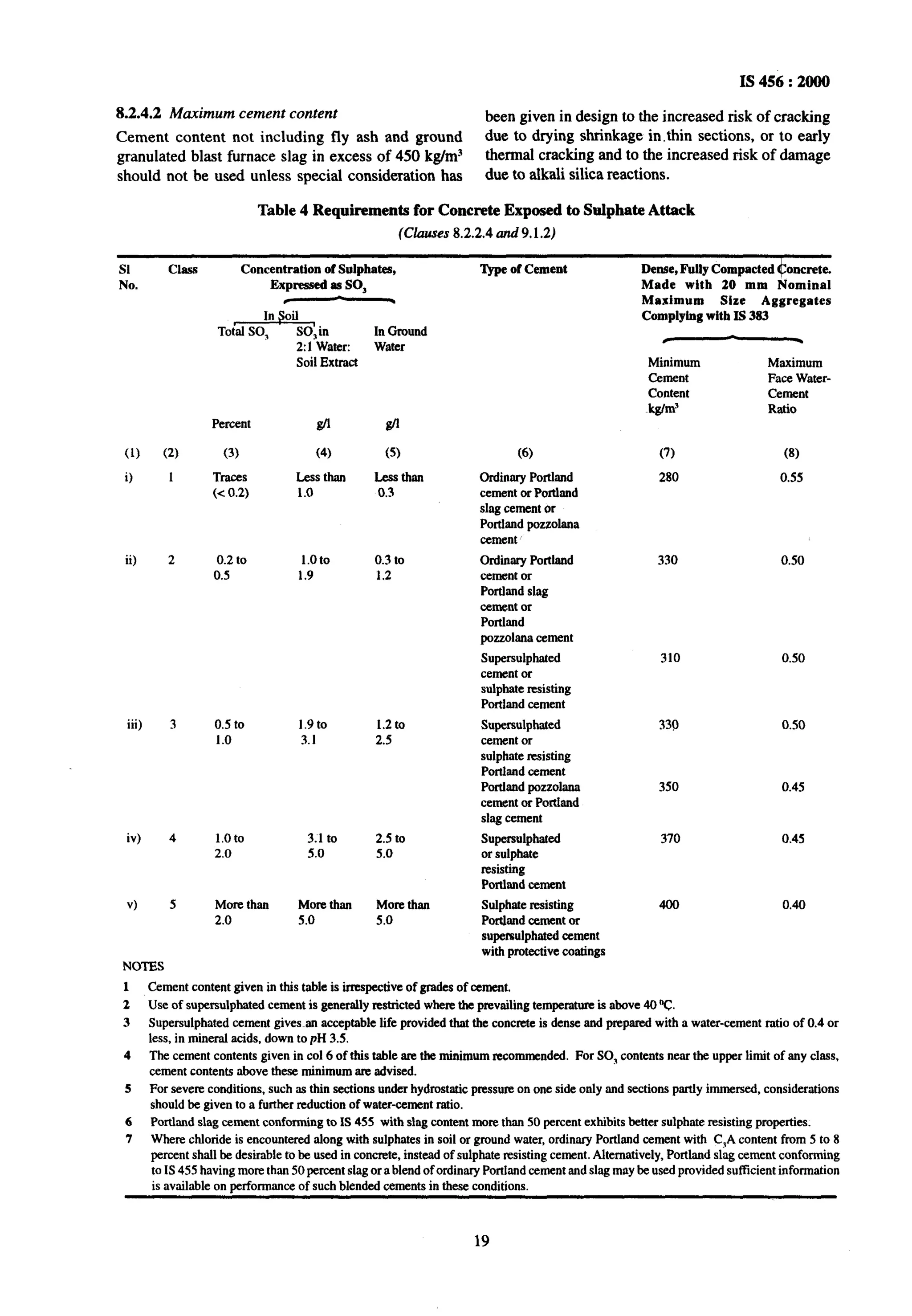
Table 4 Requirements for Concrete Exposed to Sulphate Attack
(Clauses 8.2.2.4 and 9.1.2)
SI
No.
ChSS Concentration ofSulphates,
Expressed a~ SO,
r .
In Soil
Total SO, SO,in In Ground
2:l water: Water
Soil Extract
(1) (2) (3)
0 1 TraCeS
(< 0.2)
ii) 2 0.2 to
0.5
iii) 3 0.5 to
1.0
&d @
(4) (5)
Less than LesSthan
1.0 0.3
1.oto 0.3to
1.9 1.2
1.9 to
3.1
iv) 4 1.0to 3.1 to
2.0 5.0
v) 5 More than More than
2.0 5.0
NOTES
1.2 to
2.5
2.5 to
5.0
Type ofCement Dense, Fully Compacted concrete.
Made with 20 mm Nominal
Maximum Size Aggregates
Complying with IS 383
r .
Minimum Maximum
Cement FaceWater-
Content Cement
~kg/m’ Ratio
(6)
Ordinary Portland
cement or Portland
slag cement or
Portland pozzolana
cement ’
Ordinary Portland
cement or
Portland slag
cement or
Portland
pozzolana cement
Supersulphated
cement or
sulphate resisting
Portland cement
Supersulphated
cement or
sulphate resisting
Portland cement
Portland pozzolana
cement or Podand
slag cement
Supersulphated
or sulphate
resisting
Portland cement
More than
5.0
Sulphate resisting
Portland cement or
superrulphated cement
with protective coatings
(7) (8)
280 0.55
330
310
330
350
370
400
0.50
0.50
0.50
0.45
0.45
0.40
1 Cement content given in this table is irrespective of grades of cement.
2 Use of supersulphated cement is generally restricted where the prevailing temperature is above 40 “c.
3 Supersulphated cement gives~anacceptable life provided that the concrete is dense and prepared with a water-cement mtio of 0.4 or
less, in mineral acids, down to pH 3.5.
4 The cement contents given in co16 of this table are the minimum recommended. For SO, contents near tbe upper limit of any class,
cement contents above these minimum are advised.
5 For severe conditions, such as thin sections under hydrostatic pressure on one side only and sections partly immersed, considerations
should be given to a further reduction of water-cement ratio.
6 Portland slag cement conforming to IS 455 with slag content more than 50 percent exhibits better sulphate resisting properties.
7 Where chloride is encountered along with sulphates in soil or ground water, ordinary Portland cement with C,A content from 5 to 8
percent shall be desirable to be used in concrete, instead of sulphate resisting cement. Alternatively, Portland slag cement conforming
to IS 455 having more than 50percent slag or a blend of ordinary Portland cement andslag may be used provided sufficient information
is available on performance of such blended cements in these conditions.
19
IS 456 : 2000
8.2.5 Mix Constituents
8.2.5.1 General
For concrete to be durable, careful selection of the mix
and materials is necessary, so that deleterious
constituents do not exceed the limits.
8.2.5.2 Chlorides in concrete
Whenever there is chloride in concrete there is an
increased risk of corrosion of embedded metal. The
higher the chloride content, or if subsequently exposed
to warm moist conditions, the greater the risk of
corrosion. All constituents may contain chlorides and
concrete may be contaminated by chlorides from the
external environment. To minimize the chances of
deterioration of concrete from harmful chemical salts,
the levels of such harmful salts in concrete coming
from concrete materials, that is, cement, aggregates
water and admixtures, as well as by diffusion from the
environment should be limited. The total amount of
chloride content (as Cl) in the concrete at the time of
placing shall be as given in Table 7.
The total acid soluble chloride content should be
calculated from the mix proportions and the measured
chloride contents of each of the constituents. Wherever
possible, the total chloride content of the concrete
should be determined.
8.2.5.3 Sulphates in concrete
Sulphates are present in most cements and in some
aggregates; excessive amounts of water-soluble
sulphate from these or other mix constituents can cause
expansion and disruption of concrete. To prevent this,
the total water-soluble sulphate content of the concrete
mix, expressed as SO,, should not exceed 4 percent by
mass of the cement in the mix. The sulphate content
should be calculated as the total from the various
constituents of the mix.
The 4 percent limit does not apply to concrete made
with supersulphated cement complying with IS 6909.
8.2.5.4 Alkali-aggregate reaction
Some aggregates containing particular varieties of
silica may be susceptible to attack by alkalis (N%O
and %O) originating from cement or other sources,
producing an expansive reaction which can cause
cracking and disruption of concrete. Damage to
concrete from this reaction will normally only occur
when .a11the following are present together:
a) A high moisture level, within the concrete;
b) A cement with high alkali content, or another
source of alkali;
c) Aggregate containing an alkali reactive
constituent.
Where the service records of particular cement/
aggregate combination are well established, and do not -
include any instances of cracking due to alkali-
aggregate reaction, no further precautions should be
necessary. When the materials are unfamiliar,
precautions should take one or more of the following
forms:
a) Use of non-reactive aggregate from alternate
sources.
Table 5 Minimum CementContent, Maximum Water-Cement Ratio and Minimum Grade of Concrete
for Different Exposures with Normal Weight Aggregates of 20 mm Nominal Maximum Size
(Clauses 6.1.2, 8.2.4.1 and9.1.2)
SI
No.
1)
0
iii)
iii)
iv)
v)
Exposure Plain Concrete Reinforced Concrete
/ - * -
Minimum Maximum Minimum Minimum Maximum Minimum
Cement Free Water- Grade of Cement Free Water- Grade of
Content Cement Ratio Concrete’ Content Cement Ratio Concrete
kg/m’ kg/m’
(2) (3) (4) (5) (6) (7) 0-9
Mild 220 0.60 300 0.55 M 20
Moderate 240 0.60 M 15 300 0.50 M 25
Severe 250 0.50 M 20 ~320 0.45 M 30
Very severe 260 0.45 M 20 340 0.45) M 35
Extreme 280 0.40 M25 360 0.40 M40
NOTES
1 Cement content prescribed in this table is irrespective of the grades of cement and it is inclusive of ad&ons mentioned in 5.2. The
additions such as fly ash or ground granulated blast furnace slag may be taken into account in the concrete composition with respect to
Ihe cement content and water-cement ratio if the suitability is established and as long as the maximum amounts taken into account do
not exceed the limit of pozzolona and slag specified in IS 1489(Part I) and IS 455 respectively.
2 Minimum gradefor plain concrete under mild exposure condition is not specified.
20
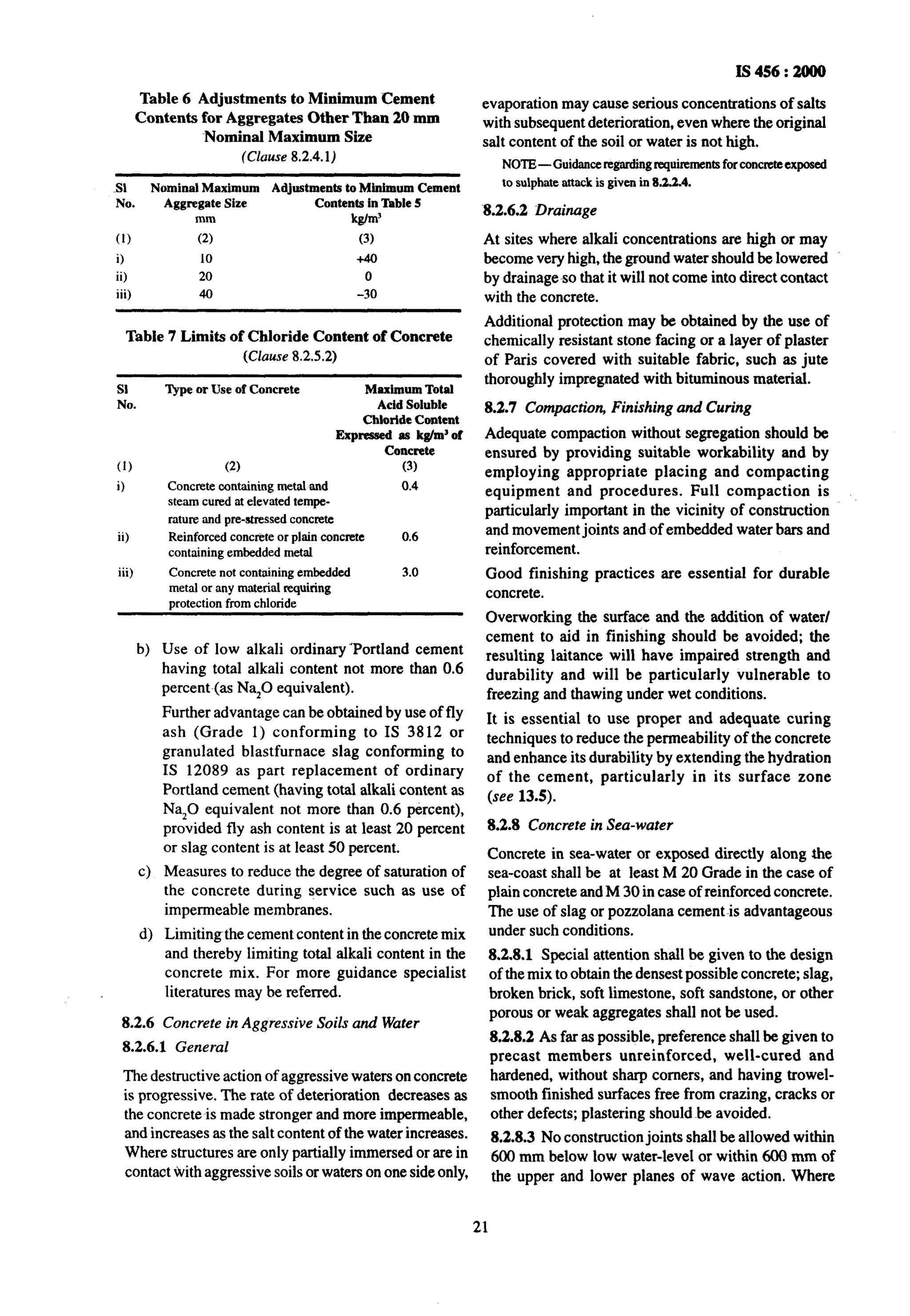
Table 6 Adjustments to Minimum Cement
Contents for Aggregates Other Than 20 mm
Nominal Maximum Size
(Clause 8.2.4.1)
Sl Nominal Maximum Adjustmenk to Minimum Cement
No. Aggregate Size Contents in Table 5
mm Wm’
(1) (2) (3)
i) 10 +40
ii) 20 0
iii) 40 -30
Tabie 7 Limits of Chloride Content of Concrete
(Clause8.2.5.2)
SI
No.
(1)
i)
ii)
iii)
Type or Use of Concrete Maximum Total
Acid Soluble
Chloride Content
Expressed as k&n’ of
concrete
(2) (3)
Concrete containingmetaland 0.4
steam curedntelevatedtempe-
rntureandpre-stressedconcrete
Reinforcedconctite or plainconcrete 0.6
containingembeddedmetal
Concretenot containingembedded 3.0
metal orany materialquiring
protectionfromchloride
b)
c)
d)
Use of low alkali ordinary ‘Portland cement
having total alkali content not more than 0.6
percent~(asNa,O equivalent).
Further advantage can be obtained by use of fly
ash (Grade 1) conforming to IS 3812 or
granulated blastfurnace slag conforming to
IS 12089 as part replacement of ordinary
Portland cement (having total alkali content as
Na,O equivalent not more than 0.6 percent),
provided fly ash content is at least 20 percent
or slag content is at least 50 percent.
Measures to reduce the degree of saturation of
the concrete during service such as use of
impermeable membranes.
Limitingthe cement content in the concrete mix
and thereby limiting total alkali content in the
concrete mix. For more guidance specialist
literatures may be referred.
8.2.6 Concrete in Aggressive Soils and Water
8.2.6.1 General
The destructive action of aggressive waters on concrete
is progressive. The rate of deterioration decreases as
the concrete~ismade stronger and more impermeable,
and increases as the salt content of the water increases.
Where structures are only partially immersed or are in
contact with aggressive soils or waters on one side only,
IS456: 2000
evaporation may cause serious concentrations of salts
with subsequent deterioration, even where the original
salt content of the soil or water is not high.
NOTE- Guidanceregardingrequirementsforconctt%cexposed
to sulphatenttackis given in 8.2.2.4.
8.2.6.2 Drainage
At sites where alkali concentrations are high or may
become very high, the ground water should be lowered
by drainageso that it will not come into direct contact
with the concrete.
Additional protection may be obtained by the use of
chemically resistant stone facing or a layer of plaster
of Paris covered with suitable fabric, such as jute
thoroughly impregnated with bituminous material.
8.2.7 Compaction, Finishing and Curing
Adequate compaction without segregation should be
ensured by providing suitable workability and by
employing appropriate placing and compacting
equipment and procedures. Full compaction is
particularly important in the vicinity of construction
and movement joints and of embedded water bars and
reinforcement.
Good finishing practices are essential for durable
concrete.
Overworking the surface and the addition of water/
cement to aid in finishing should be avoided; the
resulting laitance will have impaired strength and
durability and will be particularly vulnerable to
freezing and thawing under wet conditions.
It is essential to use proper and adequate curing
techniques to reduce the permeability of the concrete
and enhance its durability by extending the hydration
of the cement, particularly in its surface zone
(see 13.5).
8.2.8 Concrete in Sea-water
Concrete in sea-water or exposed directly along the
sea-coast shall be at least M 20 Grade in the case of
plain concrete andM 30 in case of reinforced concrete.
The use of slag or pozzolana cement~isadvantageous
under such conditions.
8.2.8.1 Special attention shall be.given to the design
of the mix to obtain the densest possible concrete; slag,
broken brick, soft limestone, soft sandstone, or other
porous or weak aggregates shall not be used.
8.2.8.2 As far as possible, preference shall be given to
precast members unreinforced, well-cured and
hardened, without sharp comers, and having trowel-
smooth finished surfaces free from crazing, cracks or
other defects; plastering should be avoided.
8.2.8.3 No construction joints shall be allowed within
600 mm below low water-level or within 600 mm of
the upper and lower planes of wave action. Where
21
IS 456 : 2000
unusually severe conditions or abrasion’areanticipated,
such parts of the work shall be protected by bituminous
or silica-fluoride coatings or stone facing bedded with
bitumen.
8.2.8.4 In reinforced concrete structures, care shall be
taken to protect the reinforcement from exposure to
saline atmosphere during storage, fabrication and use.
It may be achieved by treating the surface of
reinforcement with cement wash or by suitable
methods.
9 CONCRETE MIX PROPORTIONING
9.1 Mix Proportion
The mix proportions shall be selected to ensure the
workability of the fresh concrete and when concrete is
hardened, it shall have the required strength, durability
and surface finish.
9.1.1 The determination of the proportions of cement,
aggregates and water to attain the required strengths
shall be made as follows:
a) By designing the concrete mix; such concrete
shall be called ‘Design mix concrete’, or
b) By adopting nominal concrete mix; such
concrete shall be called ‘Nominalmix concrete’.
Design mix concrete is preferred to nominal mix. If
design mix concrete cannot be used for any reason on
the work for grades of M 20 or lower, nominal mixes
may be used with the permission of engineer-in-charge,
which, however, is likely to involve a higher cement
content.
9.1.2 Information Required
In specifying a particular grade of concrete, the
following information shall be included:
4
b)
cl
4
e)
Type of mix, that is, design mix concrete or
nominal mix concrete;
Grade designation;
Type of cement;
Maximum nominal size of aggregate;
Minimum cement content (for design mix
concrete);
0
g)
h)
9
k)
Maximum water-cement ratio;
Workability;
Mix proportion (for nominal mix concrete);
Exposure conditions as per Tables 4 and 5;
Maximum temperature of concrete at the time
of placing;
m>Method of placing; and
n>Degree of supervision.
9.1.2.1 In appropriate circumstances, the following
additional information may be specified:
a)
b)
c)
5pe ofwpga%
Maximum cement content, and
Whether an admixture shall or shall not be
used and the type of admixture and the
condition of use.
9.2 Design Mix Concrete
9.2.1 As the guarantor of quality of concrete used in
the construction, the constructor shall carry out the mix
design and the mix so designed (not the method of
design) shall be approved by the employer within the
limitations of parameters and other stipulations laid
down by this standard.
9.2.2 The mix shall be designed to produce the grade
of concrete having the required workability and a
characteristic strength not less than appropriate values
given in Table 2. The target mean strength of concrete
mix should be equal to the characteristic strength plus
1.65 times the standard deviation.
9.2.3 Mix design done earlier not prior to one year
may be considered adequate for later work provided
there is no change in source and the quality of the
materials.
9.2.4 Standard Deviation
The standarddeviation for each grade of concrete shall
be calculated, separately.
9.2.4.1 Standard deviation based on test strength of
sample
a)
b)
cl
Number of test results of samples-The total
number of test strength of samples required to
constitute an acceptable record for calculation
of standard deviation shall be not less than 30.
Attempts should be made to obtain the 30
samples, as early as possible, when a mix is used
for the first time.
In case of si&icant changes in concrete-
When significant changes are made in the
production of concrete batches (for example
changes in the materials used, mix design.
equipment Drtechnical control), the standard
deviation value shall be separately calculated
for such batches of concrete.
Standard deviation to be btvught up to date-
The calculation of the standard deviation shall
be brought up to date after every change of mix
design.
9.2.4.2 Assumed stanaianldeviation
Where sufficient test results for a particular grade of
concrete are not available, the value of standard
deviation given in Table 8 may be assumed for design
of mix in the first instance. As soon as the results of
samples are available, actual calculated standard
deviation shall be used and the mix designed properly.
22
However, when adequatepast mcordsfor a similargrade
existandjustifytothedesigneravalueof standarddeviation
d&rent fromthatshowninTable 8,itshallbepem&ible
tOllSthZltValue.
Table 8 Assumed Standard Deviation
(Clause 9.2.4.2 and Table 11)
Grade of
concrete
AssumedStnndard
Deviation
N/IlUlI*
M 10
1
3.5
M 15
M20
I
4.0
M 25
M 30
M 35
M40 1 5.0
M45
MS0 )
NOTE-The above values correspondto the site contrdihaving
properstorageof cement;weigh batchingof allmaterials;controlled
addition of ~water;regular checking of all matials. aggregate
gradings and moisture content; and periodical checking of
workability and strength.Wherethereis deviationfromthe above
the values given in the above tableshall be increasedby lN/inm*.
9.3 Nominal Mix Concrete
Nominal mix concrete may be used for concrete of
M 20 or lower. The proportions of materials for
nominal mix concrete shall be in accordance with
Table 9.
9.3.1 The cement content of the mix specified in
Table 9 for any nominal mix shall be proportionately
increased if the quantity of water in a mix has to be
increase&o overcome the difficulties of placement and
compaction, so that the water-cement ratio as specified
is not exceeded.
IS 456 : 2000
10 PRODUCTION OF CONCRETE
10.1 Quality Assurance Measures
10.1.1 In order that the properties of the completed
structure be consistent with the requirements and the
assumptions made during the planning and the design,
adequate quality assurance measures shall be taken.
The construction should result in satisfactory strength,
serviceability and long term durability so as to lower
the overall life-cycle cost. Quality assurance in
construction activity relates to proper design, use of
adequate materials and components to be supplied by
the producers, proper workmanship in the execution
of works by the contractor and ultimately proper care
during the use of structure including timely
maintenance and repair by the owner.
10.1.2 Quality assurance measures are both technical
and organizational. Some common cases should be
specified in a general Quality Assurance Plan which
shall identify the key elements necessary to provide
fitness of the structure and the means by which they
are to be provided and measured with the overall
purpose to provide confidence that the realized project
will work satisfactorily in service fulfilling intended
needs. Thejob of quality control and quality assurance
would involve quality audit of both the inputs as well
as the outputs. Inputs are in the form of materials for
concrete; workmanship in all stages of batching,
mixing, transportation, placing, compaction and
curing; and the related plant, machinery and
equipments; resulting in the output in the form of
concrete in place. To ensure proper performance, it is
necessary that each step in concreting which will be
covered by the next step is inspected as the work
proceeds (see also 17).
Table 9 Proportions for Nominal Mix-Concrete
(Clauses9.3 and 9.3.1)
Grade of
concrete
Total Qua&y of Dry Aggre-
gates by hhc-per SOkg of
Cement, to be Taken at?the Sum
of the Individual Masses of
F’lneand Coarse Aggregates, kg,
Max
Proportion of Fine Quantity of Water per
&gregate to Coarse 50 kg of Cement, Mar
Aggregate (by Mad 1
(1) (2) (3) (4)
M5 800
1
Generally1:2butsubjectto 60
M 7.5 625 anupperlimitof 1:1*/sanda 45
M 10 480 lowerlit of 1:2V, 34
M 15 330 32
M20 250 30
NOTE-The proportionof the fine to coarseaggmgatesshouldbe adjustedfromupperlimitto lowerlimit~progressivelyas the grading
of fine aggregatesbecomes finerandthe maximumsize of coarseaggregatebecomes larger.Gradedcoarseaggregateshall be used.
Exumple
For an averagegradingof tine aggregate(thatis. Zone II of Table4 of IS 383). the proportionsshall be 1:1I/,, I:2 and 1:2’/, for
maximumsize of aggregates10mm, 20 mm and40 mmrespectively.
23
IS 456 :2000
10.1.3 Each party involved in the realization of a
project should establish and implement a Quality
Assurance Plan, for its participation in the project.
Supplier’s and subcontractor’s activities shall be
covered in the plan. The individual Quality Assurance
Plans shall fit into the general Quality Assurance Plan.
A Quality Assurance Plan shall define the tasks and
responsibilities of all persons involved, adequate
control and checking procedures, and the organization
and maintaining adequate documentation of the
building process and its results. Such documentation
should generally include:
4
b)
c)
d)
e>
f)
test reports and manufacturer’s certificate for
materials, concrete mix design details;
pour cards for site organization and clearance
for concrete placement;
record of site inspection of workmanship, field
tests;
non-conformance reports, change orders;
quality control charts; and
statistical analysis.
NOTE-Quality control charts are recommended wherever the
concrete is in continuous production over considerable period.
10.2 Batching
To avoid confusion and error in batching, consideration
should be given to using the smallest practical number
of different concrete mixes on any site or in any one
plant. In batching concrete, the quantity of both cement
and aggregate shall be determined by mass; admixture,
if solid, by mass; liquid admixture may however be
measured in volume or mass; water shall be weighed
or measured by volume in a calibrated tank (see also
IS 4925).
Ready-mixed concrete supplied by ready-mixed
concrete plant shall be preferred. For large and medium
project sites the concrete shall be sourced from ready-
mixed concrete plants or from on site or off site
batching and mixing plants (see IS 4926).
10.2.1 Except where it can be shown to the satisfaction
of the engineer-in-charge that supply of properly
graded aggregate of uniform quality can be maintained
over a period of work, the grading of aggregate should
. be controlled by obtaining the coarse aggregate in
different sizes and blending them in the right
proportions when required, the different sizes being
stocked in separate stock-piles. The material should
be stock-piled for several hours preferably a day before
use. The grading of coarse and fine aggregate should
be checked as frequently as possible, the frequency
for a given job being determined by the engineer-in-
charge to ensure that the specified grading is
maintained.
10.2.2 The accuracy of the measuring equipment shall
Abewithin + 2 percent of the quantity of cement being
measured and within + 3 percent of the quantity of
aggregate, admixtures and water being measured.
10.2.3 Proportion/Type and grading of aggregates shall
be made by trial in such a way so as to obtain densest
possible concrete. All ingredients of the concrete
should be used by mass only.
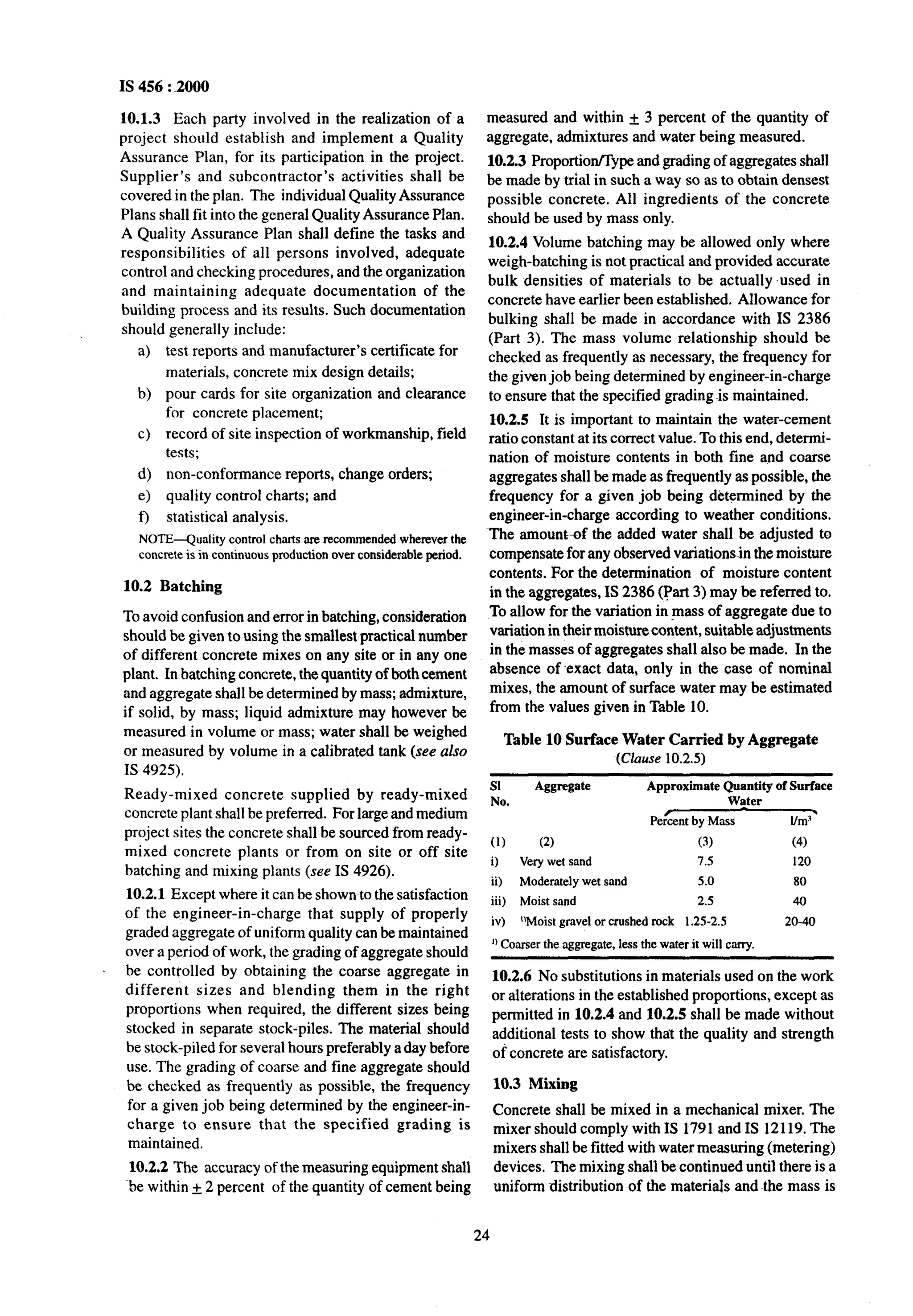
10.2.4 Volume batching may be allowed only where
weigh-batching is not practical and provided accurate
bulk densities of materials to be actually-used in
concrete have earlier been established. Allowance for
bulking shall be made in accordance with IS 2386
(Part 3). The mass volume relationship should be
checked as frequently as necessary, the frequency for
the given job being determined by engineer-in-charge
to ensure that the specified grading is maintained.
N2.5 It is important to maintain the water-cement
ratio constant at its correct value. To this end, determi-
nation of moisture contents in both fine and coarse
aggregates shall be made as frequently as possible, the
frequency for a given job being determined by the
engineer-in-charge according to weather conditions.
The amount-of the added water shall be adjusted to
compensate for any observed variationsin the moisture
contents. For the determination of moisture content
in the aggregates, IS 2386 (Part 3) may be referred to.
To allow for the variation in mass of aggregate due to
variation in their moisture content, suitable adjustments
in the masses of aggregates shall also be made. In the
absence of -exact data, only in the case of nominal
mixes, the amount of surface water may be estimated
from the values given in Table 10.
Table 10 Surface Water Carried by Aggregate
fCZuuse 102.5)
SI Aggregate Approximate Quantity of Surface
No. Water
F .
Percent by Mass l/m3
(1) (2) (3 (4)
0 Very wet sand 1.5 120
ii) Moderately wet sand 5.0 80
iii) Moist sand 2.5 40
iv) ‘Moist gravel or crashed rock 1.25-2.5 20-40
I)Coarser the aggregate, less the water~it will can-y.
10.2.6 No substitutions in materials used on the work
or alterations in the established proportions, except as
permitted in 10.2.4 and 10.2.5 shall be made without
additional tests to show that the quality and strength
of concrete are satisfactory.
10.3 Mixing
Concrete shall be mixed in a mechanical mixer. The
mixer should comply with IS 179 1 and IS 12119. The
mixers shall be fitted with water measuring (metering)
devices. The mixing shall be continued until there is a
uniform distribution of the materials and the mass is
24
uniform in colour and c0nsistenc.y. If there is
segregation after unloading from the mixer, the
concrete should be remixed.
10.3.1 For guidance, the mixing time shall be at least
2 min. For other types of more efficient mixers,
manufacturers recommendations shall be followed;
for hydrophobic cement it may be decided by the
engineer-in-charge.
10.3.2 Workability should be checked at frequent
intervals (see IS 1199).
10.3.3 Dosages of retarders, plasticisers and
superplasticisers shall be restricted to 0.5,l .Oand 2.0
percent respectively by weight of cementitious
materials and unless a higher value is agreed upon
between the manufacturer and the constructor based
on performance test.
11 FORMWORK
11.1 General
The formwork shall be designed and constructed so
as to remain sufficiently rigid during placing and
compaction of concrete, and shall be such as to prevent
loss of slurry from the concrete. For further details
regarding design, detailing, etc. reference may be made
to IS 14687. The tolerances on the shapes, lines and
dimensions shown in the~drawingshall be within the
limits given below:
a) Deviation from specified
dimensions of cross-section
of columns and beams
b) Deviation from dimensions
of footings
1) Dimensions in plan
2) Eccentricity
3) Thickness
+ 12
- 6-
+ 5omm
- 12
0.02 times the
width of the foot-
ing in the direc-
tion of deviation
but not more than
SOmnl
f 0.05 times the
specified thick-
ness
These tolerances apply to concrete dimensionsonly,and
not to positioning of verticalreinforcing steelor dowels.
11.2 Cleaning and ‘lhatment of Formwork
All rubbish, particularly, chippings, shavings and
sawdust shall be removed from the interior of the forms
before the concrete is placed. The face of formwork
in contact with the concrete shallbe cleaned andtreated
with form release agent. Release agents should be
applied so as to provide a thin uniform coating to the
forms without coating the reinforcement.
IS 456 : 2000
11.3 Stripping Time
Forms shall not be released until the concrete has
achieved a strength of at least twice the stress to which
the concrete may be subjected at the time of removal
of formwork. The strength referred to shall be that of
concrete using the same cement and aggregates and
admixture, if any, with the same proportions and cured
under conditions of temperature and moisture similar
to those existing on the work.
11.3.1 -Whilethe above criteria of strength shall be the
guiding factor for removal of formwork, in normal
circumstances where ambient temperature does not fall
below 15°Cand where ordinary Portland cement isused
and adequate curing is done, following striking period
may deem to satisfy the guideline given in 11.3:
Type of Formwork
a)
b)
cl
4
4
Vertical formwork to columns,
walls, beams
Soffit formwork to slabs
(Props to be refixed
immediately after removal
of formwork)
Sofftt formwork to beams
(Props to be refixed
immediately after removal
of formwork)
Props to slabs:
1) Spanning up to 4.5 m
2) Spanning over 4.5 m
Props to beams and arches:
1) Spanning up to 6 m
2) Spanning over 6 m
Minimum Period
Before Striking
Formwork
16-24 h
3 days
7 days
7 days
14 days
14 days
21 days
For other cements and lower temperature, the
stripping time recommended above may be suitably
modified.
11.3.2 The number of props left under, their sizes and
disposition shall be such as to be able to safely carry
the full dead load of the slab, beam or arch as the case
may be together with any live load likely to occur
during curing or further construction.
11.3.3 Where the shape of the element is such that the
formwork has re-entrant angles, the formwork shall be
removed as soon as possible after the concrete has set,
to avoid shrinkage cracking occurring due to the
restraint imposed.
12 ASSEMBLY OF REINFORCEMENT
12.1 Reinforcement shall be bent and fixed in
accordance with procedure specified in IS 2502. The
high strength deformed steel bars should not be re-bent
25
IS 456 : 2000
or straightened without the approval of engineer-in-
charge.
Bar bending schedules shall Abeprepared for all
reinforcement work.
12.2 All reinforcement shall be placed and maintained
in the position shown in the drawings by providing
proper cover blocks, spacers, supporting bars, etc.
12.2.1 Crossing bars should not be tack-welded for
assembly of reinforcement unless permitted by
engineer-in-charge.
12.3 Placing of Reinforcement
Rough handling, shock loading (prior to embedment)
and the dropping of reinforcement from aheight should
be avoided. Reinforcement should be secured against
displacement outside the specified limits.
12.3.1 Tolerances on Placing of Reinforcement
Unless otherwise specified by engineer-in-charge, the
reinforcement shall be placed within the following
tolerances:
a) for effective depth 2oO.mm f 1Omm
or less
b) for effective depth more than f15mm
200 mm
123.2 Tolerance for Cover
Unless specified ~otherwise, actual concrete cover
should not deviate from the required nominal cover
~by +lzmm.
Nominal cover as given in 26.4.1 should be specified
to all steel reinforcement including links. Spacers
between the links (or the bars where no links exist)
and the formwork should be of the same nominal size
as the nominal cover.
Spacers, chairs and other supports detailed on
drawings, together with such other supports as
may be necessary, should be used to maintain the
specified nominal cover to the steel reinforcement.
Spacers or chairs should be placed at a maximum
spacing of lm and closer spacing may sometimes be
necessary.
Spacers, cover blocks should be of concrete of same
strength or PVC.
12.4 Welded JoInta or Mechanical Connections
Welded joints or mechanical connections in
reinforcement may be used but in all cases of important
connections, tests shall be made to prove that thejoints
are of the full strength of bars connected. Welding of
reinforcements shall be done in accordance with the
recommendations of IS 2751 and IS 9417.
12.5 Where reinforcement bars upto 12 mm for high
strength deformed steel bars and up to 16mm for mild
steel bars are bent aside at construction joints and
afterwards bent back into their original positions, care
should be taken to ensure that at no time is the radius
of the bend less than 4 bar diameters for plain mild
steel or 6 bar diameters for deformed bars. Care shall
also be taken when bending back bars, to ensure that
the concrete around the bar is not damaged beyond
the band.
12.6 Reinforcement should be placed and tied in such
a way that concrete placement be possible without
segregation of the mix. Reinforcement placing should
allow compaction by immersion vibrator. Within the
concrete mass, different types of metal in contact
should be avoided to ensure that bimetal corrosion does
not take place.
13 TRANSPORTING, PLACING,
COMPACTION AND CURING
13.1 Transporting and Handling
After mixing, concrete shall be transported to the
formwork asrapidly as possible by methods which will
prevent the segregation or loss of any of the ingredients
or ingress of foreign matter or water and maintaining
the required workability.
13.1.1 During hot or cold weather, concrete shall be
transported in deep containers. Other suitable methods
to reduce the loss of water by evaporation in hot
weather and heat loss in cold weather may also be
adopted.
13.2 Placing
The concrete shall be deposited as nearly as practicable
in its final position to avoid rehandling. The concrete
shall be placed and compacted before initial setting of
concrete commences and should not be subsequently
disturbed. Methods of placing should be such as
to preclude segregaion. Care should be taken to
avoid displacement of reinforcement or movement
of formwork. As a general guidance, the maxi-
mum permissible free fall of concrete may be taken
as 1.5m.
13.3 Compaction
Concrete should be thoroughly compacted and fully
worked around the reinforcement, around embedded
fixtures and into comers of the formwork.
13.3.1 Concrete shall be compacted using mechanical
vibrators complying with IS 2505, IS 2506, IS 2514
and IS 4656. Over vibration and under vibration of
concrete are harmful and should be avoided. Vibration
of very wet mixes should also be avoided.
Whenever vibration has to be applied externally, the
design of formwork and the disposition of vibrators
should receive special consideration to ensure efficient
compaction and to avoid surface blemishes.
26
13.4 Construction Joints and Cold Joints
Joints are acommon source of weakness and, therefore,
it is desirable to avoid them. If this is not possible,
their number shall be minimized. Concreting shall be
carried out continuously up to construction joints,
the position and arrangement of which shall be
indicated by the designer. Construction joints should
comply with IS 11817.
Construction joints shall be placed at accessible
locations to permit cleaning out of laitance, cement
slurry and unsound concrete, in order to create rough/
uneven surface. It is recommended to clean out laitance
and cement slurry by using wire brush on the surface
of joint immediately after initial setting of concrete
and to clean out the same immediately thereafter. The
prepared surface should be in a clean saturated surface
dry condition when fresh concrete is placed, against it.
In the case of construction joints at locations where
the previous pour has been cast against shuttering the
recommended method of obtaining a rough surface for
the previously poured concrete is to expose the
aggregate with a high pressure water jet or any other
appropriate means.
Fresh concrete should be thoroughly vibrated near
construction joints sothat mortar from the new concrete
flows between large aggregates and develop proper
bond with old concrete.
Where high shear resistance is required at the
construction joints, shear keys may be-provided.
Sprayed curing membranes and release agents should
be thoroughly removed from joint surfaces.
13.5 Curing
Curing is the process of preventing the loss of moisture
from the concrete whilst maintaining a satisfactory
temperature regime. The prevention of moisture loss
from the concrete is particularly important if the-water-
cement ratio is low, if the cement has a high rate of
strength development, if the concrete contains
granulated blast furnace slag or pulverised fuel ash.
The curing regime should also prevent the development
of high temperature gradients within the concrete.
The rate of strength development at early ages of
concrete made with supersulphated cement is
significantly reduced at lower temperatures.
Supersulphated cement concrete is seriously affected
by inadequate curing and the surface has to be kept
moist for at least seven days.
135.1 Moist Curing
Exposed surfaces of concrete shall be kept
continuously in a damp or wet condition by ponding
or by covering with a layer of sacking, canvas, hessian
or similar materials and kept constantly wet for at least
seven days from the date of placing concrete in case
IS 456 : 2000
of ordinary Portland Cement-andat least 10days where
mineral admixtures or blended cements are used. The
period of curing shall not be less than 10 days for
concrete exposed to dry and hot weather conditions.
In the case of concrete where mineral admixtures or
blended cements are used, it is recommended that
above minimumperiods may be extended to 14 days.
13.52 Membrane Curing
Approved curing compounds may Abeused in lieu of
moist curing withthe permission of the engineer-in-
charge. Suchcompounds shallbe appliedto all exposed
surfaces of the concrete as soon as possible after the
concrete has set. Impermeable~membranes such as
polyethylene sheeting covering closely the concrete
surface may also be used to provide effective barrier
against evaporation.
135.3 For the concrete containing Portland pouolana
cement, Portland slag cement or mineral admixture,
period of curing may be increased.
13.6 Supervision
It is exceedingly difficult and costly to alter concrete
once placed. Hence, constant and strict supervision of
all the items of the construction is necessary during
the progress of the work, including the proportioning
and mixing of the concrete. Supervision is also of
extreme importance to check the reinforcement and
its placing before being covered.
13.6.1 Before any important operation, such as
concreting or stripping of the formwork is started,
adequate notice shall be given to the construction
supervisor.
14 CONCRETING UNDER SPECIAL
CONDITIONS
14.1 Work in Extreme Weather Conditions
During hot or cold weather, the concreting should be
done as per the procedure set out in IS 7861
(Part 1) or IS 7861 (Part 2).
14.2 Under-Water Concreting
14.2.1 When it is necessary to deposit concrete under.
water, the methods, equipment, materials and
proportions of the mix to be used shall be submitted to
and approved by the engineer-in-charge before the
work is started.
14.2.2 Under-water concrete should have a slump
recommended in 7.1. The water-cement ratio shall not
exceed 0.6 and may need to be smaller, depending on
the grade of concrete or the type of chemical attack.
For aggregates of 40 mm maximum particle size, the
cement content shall be at least 350 kg/m3of concrete.
14.23 Coffer-dams or forms shall be sufftciently tight
27
IS 456 : 2000
to ensure still water if practicable, and in any case to
reduce the flow of water to less than 3 mAninthrough
the space into which concrete is to be deposited.
Coffer-dams or forms in still water shall be sufficiently
tight to prevent loss of mortar through the walls.
De-watering by pumping shall not be done while
concrete is being placed or until 24 h thereafter.
14.2.4 Concrete cast under water should not fall freely
through the water. Otherwise it may be leached and
become segregated. Concrete shall be deposited,
continuously until it is brought to the required height.
While depositing, the top surface shallbe kept as nearly
level as possible and the formation of seams avoided.
The methods to be used for depositing concrete under
water shall be one of the following:
a>Tremie-The concrete is placed through vertical
pipes the lower end of which is always inserted
sufficiently deep into the concrete which has
been placed ~previously but has not set. The
concrete emerging from the pipe pushes the
material that has already been placed to the side
and upwards and thus does not come into direct
contact with water.
When concrete is to be deposited under water
by means of tremie, the top section of the tremie
shall be a hopper large enough to hold one entire
batch of the mix or the entire contents the
transporting bucket, if any. The tremie pipe shall
be not less than 200 mm in diameter and shall
be large enough to allow a free flow of concrete
and strong enough to withstand the external
pressure of the water in which it~issuspended,
even if a partial vacuum develops insidethe pipe.
Preferably, flanged steel pipe of adequate
strength for the job should be used. A separate
lifting device shall be provided for each tremie
pipe with its hopper at the upper end. Unless
the lower end of the pipe is equipped with an
approved automatic check valve, the upper end
of the pipe shall be plugged with a wadding of
the gunny’sacking or other approved material
before delivering the concrete to the tremie pipe
through the hopper, so that when the concrete is
forced down from the hopper to the pipe, it will
force the plug (and along with it any water in
the pipe) down the pipe and out of the bottom
end, thus establishing a continuous stream of
concrete. It will be necessary to raise slowly the
tremie in order to cause a uniform flow of the
concrete, but the tremie shall not be emptied so
that water enters the pipe. At all times after the
placing of concrete is started and until all the
concrete is placed, the lower end of the tremie
pipe shall be below the top surface of the plastic
concrete. This will cause the concrete to build
up from below instead of flowing out over the
b)
surface, and thus avoid formation of laitance
layers. If the charge in the tremie is lost while
depositing, the tremie shall be raised above the
concrete surface, and unless sealed by a check
valve, it shall be re-plugged at the top end, as at
the beginning, before refilling for depositing
concrete.
Direct placement with pumps-As in the case
of the tremie method, the vertical end piece of
the pipe line is always inserted sufficiently deep
into the previously cast concrete and should not
move to the side during pumping.
c) Drop bottombucket -The top of the bucket shall
4
e>
be covered with a canvas flap. The bottom doors
shall open freely downward and outward when
tripped.The bucket shallbe filled completely and
lowered slowly to avoid backwash. The bottom
doors shall not be opened until the bucket rests
on the surface upon which the concrete is to be
deposited and when discharged, shall be
withdrawn slowly until well above the concrete.
Bags - Bags of at least 0.028 m3capacity of
jute or other coarse cloth shall be filled about
two-thirds full of concrete, the spare end turned
under so that bag is square ended and securely
tied. They shall be placed carefully in header
and stretcher courses so that the whole mass is.
interlocked. Bags used for this purpose shall be
free from deleterious materials.
Grouting-A series of round cages made from
50 mm mesh of 6 mm steel and extending over
the full height to be concreted shall be prepared
and laid vertically over the area to~beconcreted
so that the distance between centres of the cages
and also to the faces of the concrete shall not
exceed one metre. Stone aggregate of not less
than 50 mm nor more than 200 mm size shall be
deposited outside the steel cages over the full
area and height to be concreted with due care to
prevent displacement of the cages.
A stable 1:2 cement-sand grout with a water-
cement ratio of not less than 0.6 and not more
than 0.8 shall be prepared in a mechanical mixer
and sent down under pressure (about 0.2 N/mm*)
through 38 to 50 mm diameter pipes terminating
into steel cages, about 50 mm above the bottom ,.
of the concrete. As the grouting proceeds, the
pipe shall be raised gradually up to a height of
not more than 6 000 mm above its starting level
after which it may be withdrawn and placed into
the next cage for further grouting by the same
procedure.
After grouting the whole area for a height of
about 600 mm, the same operation shall be
repeated, if necessary, for the next layer of
28
600 mm and so on.
The amount of grout to be sent down shall be
sufficient to fill all the voids which may be either
ascertained or assumed as 55 percent of the
volume to be concreted.
14.2.5 To minimize the formulation of laitance, great
care shall be exercised not to disturb the concrete as
far as possible while it is being deposited.
15 SAMPLING AND STRENGTH OF
DESIGNED CONCRETE MIX
15.1 General
Samples from fresh concrete shall be taken as per
IS 1199 and cubes shall be made, cured and tested at
28 days in accordance with IS 516.
15.1.1 In order to get a relatively quicker idea of the
quality of concrete, optional tests on beams for
modulus of rupture at 72 + 2 h or at 7 days, or
compressive strength tests at 7 days may be carried
out in addition to 28 days compressive strength test.
For this purpose the values should be arrived at based
on actual testing. In all cases, the 28 days compressive
strength specified in Table 2 shall alone be the criterion
for acceptance or rejection of the concrete.
15.2 Frequency of Sampling
15.2.1 Sampling Procedure
A random sampling procedure shall be adopted to
ensure that each concrete batch shall have a reasonable
chance of being tested that is, the sampling should be
spread over the entire period of concreting and cover
all mixing units.
15.2.2 Frequency
The minimum frequency of sampling of concrete of
each grade shall be in accordance with the following:
Quantity of Concrete in the Number of Samples
Work, m3
I- 5 1
6- 15 2
16- 30 3
31-50 4
5 1 and above 4 plus one
additional sample
for -each additional
50 m3 or part thereof
NOTE-At least one sample shall be taken from each Shift.
Where concrete is produced at continuous production unit, such
as ready-mixed concrete plant, frequency of’sampling may be
agreed upon mutually by suppliers and purchasers.
15.3 Test Specimen
Three test specimens shall be made for each sample
IS 456 : 2000
for testing at 28 days. Additional samples may be
required for various purposes such as to determine the
strength of concrete at 7 days or at the time of striking
the formwork, or to determine the duration of curing,
or to check the testing error. Additional samples may
also be required for testing samples cured by
accelerated methods as described in IS 9103. The
specimen shall be tested as described in IS 516.
15.4 Test Results of Sample
The test results of the sample shall be the average of
the strength of three specimens. The individual
variation should not be more than +15 percent of the
average. If more, the test results of the sample are invalid.
16 ACCEPTANCE CRITERIA
16.1 Compressive Strength
The concrete shall be deemed to comply with the
strength requirements when both the following
condition are met:
a) The mean strength determined from any group
of four consecutive test results compiles with
the appropriate limits in co1 2 of Table 11.
b) Any individual test result complies with the
appropriate limits in co1 3 of Table 11.
16.2 FIexural Strength
When both the following conditions are met, the
concrete complies with the specified flexural strength.
4
b)
The mean strength determined from any group
of four consecutive test results exceeds the
specified characteristic strength by at least 0.3
N/mm2.
The strength determined from any test result is
not less than the specified characteristic strength
less 0.3 N/mmz.
16.3 Quantity of Concrete Represented by
Strength Test Results
The quantity of concrete represented~by a group of
four consecutive test-results shall include the batches
from which the first and last samples were taken
together with all intervening batches.
For the individual test result requirements given in
co1 2 of Table 11 or in item (b) of 16.2, only the
particular batch from which the sample was taken shall
be at risk.
Where the mean rate of sampling is not specified the
maximum quantity of concrete that four consecutive
test results represent shall be limited to 60 m3.
16.4 If the concrete is deemed not to comply persuant
to 16.3, the structural adequacy of the parts affected
shall be investigated (see 17) and any consequential
action as needed shall be taken.
29
IS 456 : 2000
16.5 Concrete of each grade shall be assessed
separately.
e)
16.6 Concrete is liable to be rejected if it is porous
or honey-combed, its placing has been interrupted
without providing a proper construction joint, the
reinforcement has been displaced beyond the
tolerances specified, or construction tolerances have
not been met. However, the hardened concrete
may be accepted after carrying out suitable
remedial measures to the satisfaction of the engineer-
in-charge.
17.2
there is a system to verify that the quality is
satisfactory in individual parts of the structure,
especially the critical ones.
Immediately after stripping the formwork, all
concrete shall be carefully inspected and any defective
work or small defects either removed or made good
before concrete has thoroughly hardened.
17.3 Testing
17 INSPECTION AND TESTING OF
STRUCTURES
In case of doubt regarding the grade of concrete used,
either due to poor workmanship or based on results of
cube strength tests, compressive strength tests of
concrete on the basis of 17.4 and/or load test (see 17.6)
may be carried out.
17.1 Inspection 17.4 Core Test
To ensure that the construction complies with the
design an inspection procedure should be set up
covering materials, records, workmanship and
construction.
17.1.1 Tests should be made on reinforcement and
the constituent materials of concrete in accordance with
the relevant standards. Where applicable, use should
be made of suitable quality assurance schemes.
17.4.1 The points from which cores are to be taken
and the number of cores required shall be at the
discretion of the engineer-in-charge and .shall be
representative of the whole of concrete concerned.
,In no case, however, shall fewer thau three cores be
tested.
17.4.2 Cores shall be prepared and tested as described
in IS 516.
17.1,.2 Care should be taken to see that: 17.4.3 Concrete in the member represented by a core
test shall be considered acceptable if the average
equivalent cube strength of thecores is equal to at least
85 percent of the cube strength of the grade of concrete
specified for the corresponding age and no individual
core has a strength less than 75 percent.
17.5 In case the core test results do not satisfy the
requirements of 17.4.3 or where such tests have not
been done, load test (17.6) may be resorted to.
4
b)
c)
4
design and detail are capable of being executed
to a suitable standard, with due allowance for
dimensional tolerances;
there are clear instructions on inspection
standards;
there are clear instiuctions on permissible
deviations;
elements critical to workmanship, structural
performance, durability and appearance are
identified; and
17.6 Loa+ Tests for Flexural Member
17.6.1 Load tests should be carried out as soon as
Table 11 Characteristic Compressive Strength Compliance Requirement
(Clauses 16.1 Md 16.3)
specified
Grade
(1)
M 15
Mean of the Group of
4 Non-Overlapping
Consecutive
TestResults InN/mm’
(2)
2 fa +0.825Xestablished
stundurddeviation(rounded
off to neatest0.5 N/mm*)
Individual ‘kst
Results InNlmrn’
(3)
2f,-"N/mm*
M 20
Or
above
f, + 3 N/I&,
whicheveris greater
2 fe + 0.825x estublished
standarddeviation(rounded
off to nearest0.5 N/mm*)
f”’+ 4 N/mm*,whichever
iFg*ter
2 f,” Nlmm’
NOTE-In the ubsenceof establishedv&e of standurddeviution,the vuluesgiven inTable8 maybeassumed,andattemptshouldbe
madeto obtainresultsof 30 samplesusearlyuspossible to estublishthe vulueof stundurddeviation.
30
IS 456 : 2000
possible after expiry of 28 days from the time of placing
of concrete.
17.6.2 The structure should be subjected to a load equal
to full dead load of the structure plus 1.25 times the
imposed load for a period of 24 h and then the imposed
load shall be removed.
NOTE-Dead load includes self weight of the structural
members plus weight of finishes and walls or partitions, if -any,
as considered in the design.
17.6.3 The deflection due to imposed load only shall
be recorded. If within 24 h of removal of the imposed
loa< the structure does not recover at least 75 percent
of the deflection under superimposed load, the test may
be repeated after a lapse of 72 h. If the recovery is less
than 80 percent, the structure shall be deemed to be
unacceptable.
17.6.3.1 If the maximum deflection in mm, shown
during 24 h under load is less than 4012/D, where 1is
the effective span in m; and D, the overall depth of the
section in~mm, it is not necessary for the recovery to
be measured and the recovery provisions of 17.6.3 shall
not apply.
17.7 Members Other Than Flexural Members
Members other than flexural members should be
preferably investigated by analysis.
17.8 anon-destructive Tests
Non-destructive tests are used to obtain estimation of
the properties of concrete in the structure. The methods
adopted include ultrasonic pulse velocity [see IS 133 11
(Part l)] and rebound hammer [IS 13311 (Part 2)],
probe penetration, pullout and maturity. Non-
destructive tests provide alternatives to core tests for
estimating the strength of concrete in a structure, or
can supplement the data obtained from a limited
number of cores. These methods are based on
measuring a concrete property that bears some
relationship to strength. The accuracy of these methods,
in part, is determined by the degree of correlation
between strength and the physical quality measured
by the non-destructive tests.
Any of these methods may be adopted, in which case the
acceptance criteria shall be agreed upon prior to testing.
31
IS 456 : 2000
SECTION 3 GENERAL DESIGN CONSIDERATION
18 BASES FOR DESIGN
18.1 Aim of Design
The aim of design is the achievement of an acceptable
probability that structures being designed will perform
satisfactorily during their intended life. With an
appropriate degree of safety, they should sustain all
the loads and deformations of normal construction and
use and have adequate durability and adequate
resistance to the effects of misuse and fire.
18.2 Methods of Design
18.2.1 Structure and structural elements shall normally
be designed by Limit State Method. Account should
be taken of accepted theories, experiment and
experience and the need to design for durability.
Calculations alone do not produce safe, serviceable and
durable structures. Suitable materials, quality control,
adequate detailing and good supervision are equally
important.
18.2.2 Where the Limit State Method can not be
conveniently adopted, Working Stress Method (see
Annex B) may be used.
18.2.3 Design Based on Experimental Basis
Designs based on experimental investigations on
models or full size structure or element may be
accepted if they satisfy the primary requirements
of 18.1 and subject to experimental details and the
analysis connected therewith being approved by the
engineer-in-charge.
18.2.3.1 Where the design is based on experimental
investigation on full size structure or element, load tests
shall be carried out to ensure the following:
a) The structure shall satisfy the requirements for
deflection (see 23.2) and cracking (see 35.3.2)
when subjected to a load for 24 h equal to the
characteristic load multiplied by 1.33 y,, where
y,shall be taken from Table 18,for the limit state
of serviceability. If within 24 h of the removal
of the load, the structure does not show a
recovery of at least 75 percent of the maximum
deflection shown during the 24 h under,the load,
the test loading should be repeated after a lapse
of 72 h. The recovery after the second test should
be at least 75 percent of the maximum deflection
shown during the second test.
NOTE-If the maximum deflection in mm, shown during
24 h underloadis less than40 P/D where1is theeffective span
in m; andD is the overall depthof-the section in mm, it is not
necessaryforthe recoveryto be measured.
b) The structure shall have adequate strength to
sustain for 24 h, a total load equal to the charac-
teristic load multiplied by 1.33y,where y,shall
be taken from Table 18 for the limit state of
collapse.
18.3 Durability, Workmanship and Materials
It is assumed that the quality of concrete, steel and
other materials and of the workmanship, as verified
by inspections, is adequate for safety, serviceability
and durability.
18.4 Design Process
Design, including design for durability, construction
and use in service should be considered as a whole.
The realization of design objectives requires
compliance with clearly defined standards for
materials, production, workmanship and also
maintenance and use of structure in service.
19 LOADS AND FORCES
19.1 General
In structural design, account shall be taken of the dead,
imposed and wind loads and forces such as those
caused by earthquake, and effects due to shrinkage,
creep, temperature, em, where applicable.
19.2 Dead Loads
Dead loads shall be calculated on the basis of unit
weights which shall be established taking into
consideration the materials specified for construction.
19.2.1 Alternatively, the dead loads may be calculated
on the basis of unit weights of materials given in
IS 875 (Part 1).Unless more accurate calculations are
warranted, the unit weights of plain concrete and
reinforced concrete made with sand and gravel or
crushed natural stone aggregate may be taken as
24 kN/m” and 25 kN/m”respectively.
19.3 Imposed Loads, Wind Loads and Snow Loads
Imposed loads, wind loads and snow loads shall be
assumed in accordance with IS 875 (Part 2), IS 875
(Part 3) and IS 875 (Part 4) respectively.
19.4 Earthquake Forces
The earthquake forces shall be calculated in
accordance with IS 1893.
19.5 Shrinkage, Creep and Temperature Effects
If the effects of shrinkage, creep and temperature are
liable to affect materially the safety and serviceability
of the structure, these shall be taken into account in
the calculations (see 6.2.4, 6.2.5 and 6.2.6) and
IS 875 (Part 5).
19.5.1 In ordinary buildings, such as low rise dwellings
whose lateral dimension do not exceed 45 m, the
32
effects due to temperature fluctuations and shrinkage
and creep can be ignored in &sign calculations.
19.6 Other Forces and Effects
In addition, account shall ‘be taken of the following
forces and effects if they are liable to affect materially
the safety and serviceability of the structure:
4
b)
cl
4
4
9
g)
h)
Foundation movement (see IS 1904),
Elastic axial shortening,
Soil and fluid pressures [see IS 875 (Part S)],
Vibration,
Fatigue,
Impact [see IS 875 (Part 5)],
Erection loads [see IS 875 (Part 2)], and
Stress concentration effect due to point load and
the like.
19.7 Combination of Loads
The combination of loads shall be as given in IS 875
(Part 5).
19.8 Dead Load Counteracting Other L,oadsand
Forces
When dead load counteracts the effects due to other
loads and forces in structural member orjoint, special
care shall be exercised by the designer to ensure
adequate safety for possible stress reversal.
19.9 Design Load
Design load is the load to be taken for use in the
appropriate method of design; it is the characteristic
load in case of working stressmethod andcharacteristic
load with appropriate partial safety factors for limit
state design.
20 STABILITY OF THE STRUCTURE
20.1 Overturning
The stability of a structure as a whole against
overturning shall be ensured so that the restoring
moment shall be not less than the sum of 1.2times the
maximum overturning moment due to thecharac&stic
dead load and 1.4 times the maximum overturning
moment due to the characteristic imposed loads. In
cases where dead load provides the restoring moment,
only 0.9 times the characteristic dead load shall be
considered. Restoring moment ilue to imposed loads
shall be ignored.
20.1.1 The anchorages or counterweights provided
for overhanging members (during construction and
service) should be such that static equilibrium
should remain, even when overturning moment is
doubled.
P
IS456:2800
28.2 Sliding
The strucn~eshall have a factor against sliding of not
lessthan 1.4under the most adverse combination of the
appliedcharact&stic forces. In this case only 0.9 times
the characteristicdead load shall be taken into account.
28.3 Probable Variation in Dead Load
To ensure stability at all times, account shall be taken
of probable variations in dead load during construction,
repair or other temporary measures. Wind and seismic
loading shall be treated as imposed loading.
28.4 Moment Connection
In designing the framework of a building provisions
shall be made-by adequate moment connections or by
a system of bracings to effectively transmit all the
horizontal forces to the foundations.
20.5 Lateral Sway
Under transient wind load the lateral sway at the top
should not exceed H/500, where H is the total height
of the building. For seismic.loading, reference should
be made to IS 1893.
21 F’IRBRBSISTANCR
21.1 A structure or structural element required to have
fire resistance should be designed to possess an
appropriate degree of resistance to flame penetration;
heat transmission and failure. The fire resistance of a
structuralelement is expressed in terms of time in hours
in accordance withIS 1641. Fire resistance of concrete
elements depends upondetails of member size, cover
to steel reinforcement detailing and type of aggregate
(normal weight or light weight) used in concrete.
General requirements for fue protection are given in
IS 1642.
21.2 Minimum requirements of concrete cover and
member dimensions for normal-weight aggregate
concrete members so as to have the required fire
resistance shall be in accordance with 26.4.3 and
Fig.1respectively.
21.3 The reinforcement detailing should reflect the
changing pattern of the structural section and ensure
that both individual elements and the structure as a
whole contain adequate support, ties, bonds and
anchorages for the required fire resistance.
21.3.1 Additional measures such as application of tire
resistant finishes, provision of fire resistant false
ceilings and sacrificial steel in tensile zone, should be
adopted in case the nominal cover required exceeds
40 mm for beams and 35 mm for slabs, to give
protection against~spalling.
21.4 Specialist literature may be referred to for
determining fire resistance of the structures which have
not been covered in Fig. 1 or Table 16A.
33
b)
cl
4
22.3
Continuous Beam or Slab - In the case of
continuous beam or slab, if the width of the
support is less than l/12 of the clear span, the
effective span shall be as in 22.2 (a). If the
supports are wider than I/12 of the clear span
or 600 mm whichever is less, the effective span
shall be taken as under:
1) For end span with one end fixed and the
other continuous or for intermediate spans,
the effective span shall Abethe clear span
between supports;
2) For end span with one end free andthe other
continuous, the effective span shall be equal
to the clear span plus half the effective depth
of the beam or slab or the clear span plus
half the width of the discontinuous support,
whichever is less;
3) In the case of spans with roller or rocket
bearings, the effective span shall always be
the distance between the centres of bearings.
Cantilever-The effective length of acantilever
shall betaken as its length to the face of the
support plus half the effective depth except
where it forms the end of a continuous beam
where the length to the centre of support shall
be taken.
Frames-In the analysis of a continuous frame,
centre to centre distance shall be used.
Stiffness
22.3.1 Relative Stlfhess
The relative stiffness of the members may be based on
the moment of inertia of the section determined on
the basis of any one of the following definitions:.
a)
b)
c)
Gross section - The cross-section of. the
member ignoring reinforcement;
Transformed section - The concrete cross-
section plus the area of reinforcement
transformed on the basis of modular ratio (see
B-1.3); or
Cracked section - The area of concrete in
compression plus the area of reinforcement
transformed on the basis of modular ratio.
The assumptions made shall be consistent for all the
members of the structure throughout any analysis.
22.3.2 For deflection calculations, appropriate values
of moment of inertia as specified in Annex C should
be used.
22.4 Structural Frames
The simplifying assumptions as given in 22.41
to 22.4.3 may be used in the analysis of frames.
IS 456 : 2000
22.4.1 Arrungement of Imposed Load
4
b)
Consideration may be limited to combinations
Of:
1)
2)
Design dead load on all spans with full
design imposed load on two adjacent spans;
and
Design dead load on all spans with full
design imposed load on alternate spans.
When design imposed load does not exceed
three-fourths of the design dead load, the load
arrangementmay be design dead load and design
imposed load on all the spans.
NOTE - For beams and slabs continuous over support
22.4.1(a) maybe assumed.
224.2 Substitute Frame
For determining the moments and shears at any floor
or roof level due to gravity loads, the beams at that
level together with columns above and below with their
far ends fixed may be considered to constitute the
frame.
22.4.2.1 Where side sway consideration becomes
critical due to unsymmetry in geometry or loading,
rigorous analysis may be required.
224.3 For lateral loads, simplified methods ~maybe
used to obtain the moments and shears for structures
that are symmetrical. For unsymmetrical or very tall
structures, more rigorous methods should be used.
22.5 Moment and Shear Coeffkients for
Continuous Beams
22.5.1 Unless more exact estimates are made, for
beams of uniform cross-section which support
substantially uniformly distributedloads over three or
more spanswhich do not differ by more than 15percent
of the longest, the bending moments and shear forces
used in design may be obtained using the coefficients
given in Table 12 and Table 13 respectively.
For moments at supports where two unequal spans
meet or in case where the spans are not equally loaded,
the average of the two values for the negative moment
at the support may be taken for design.
Where coefficients given in Table 12 are used for
calculation of bendingmoments, redistribution referred
to in 22.7 shall not be permitted.
22.5.2 Beams and Slabs Over Free End Supports
Where a member is built into a masonry wall which
develops only partial restraint, the member shall be
designed to resist a negative moment at the face of the
support of WU24where W is the total design load
and I is the effective span, or such other restraining
moment as may be shown to be applicable. For such a
condition shear coefficient given in Table 13 at the
end support may be increased by 0.05.
35
IS 456 : 2000
Table 12 Bending Moment Coeffkients
(Cluu&?22.5.1)
-QPeof Load SpanMoments Support Moments
* 4 c 
Near Middle AtMiddle AtSupport AtOther
of EndSpnn of Interior Nexttothe Interior
SPon EndSupport SUPports
(1) (2) (3) (4) (5)
Deadloadandimposed 1 1 .I 1
load (fixed) +i? +iz -?Ti -12
Imposed load (not 1
‘lo
1
+12
I 1
fiXed)
-- --
9 9
NOTE -For obtainingthe bendingmoment,the coefficientshall be multiplied by the total designload andeffective span.
Table 13 Shear for Coeffkients
(Clauses 22.5.1 and 22.52)
TypeofLmd At End At Support Next to the At All Other
SUPport End Support Interior supports
c 4
Outer Side Inner Side
(1) (2) (3) (4) (5)
Dead load and imposed 0.4 0.6 0.55 0.5
load (fixed)
Imposedload (not 0.45 0.6 0.6 0.6
fixed)
NOTE -For obtainingthe shearforce, the coeftkient shall be multiplied by thetotal designload.
22,6 Critical Sections for Moment and Shear 23 BEAMS
22.6.1 For monolithic construction, the moments
computed a%the~face of the supports shall be used in
the design of the members at those sections. Fornon-
monolithicconstructionthedesignof themembershall
be done keeping in view 22.2.
23.0 Effective Depth
22.6.2 Critical Section for Shear
The shears computed at the face of the supportshall
be used in the design of the member at that section
except as in 22.6.2.1.
Effective depth of a beam is the distance between the
centroid of the area of tension reinforcement and the
maximum compression fibre, excluding the thickness
of finishing material not placed monolithically with
the member and the thickness of any concrete provided
to allow for wear. This will not apply to deep beams.
23.1 T-Beams and L-Beams
23.1.1 Gene&
22.6.2.1 When the reaction in the direction of the
applied shear introduces compression into the end
region of the member, sections located at a distance
less than d from the face of the support may be
designed for the same shear as that computed at
distance d (see Fig. 2).
36
NOTE-The abwe clausesare applicablefor beamsgeneral!y
car@inguniformly distributedloador wheretheprincipal load
is locatedfartherthzut2dfromthefaceofthc support.
22.7 Redistribution of Moments
Redistribution of moments may be done in accordance
with 37.1.1 for limit state method and in accordance
withB-l.2 forworking stressmethod. However, where
simplified analysis using coefficients is adopted,
redistribution of moments shall not be done.
A slab which is assumed to act as a compression
flange of a T-beam or L-beam shall satisfy the
following:
a) The slab shall be cast integrally with the web,
or the web and the slab shall be effectively
bonded together in any other manner; and
b) If the mainreinforcementof the slab is parallel
to the beam, transversereinforcement shall be
provided as in Fig. 3; such reinforcementshall
not be less than 60 percent of the main
reinforcementat mid span of the slab.
23.1.2 Effective Width of Flange
In the absence of more accurate determination, the
effective widthof flangemaybe takenasthe following
IS456:2WO
I I
‘r J; ‘cI
f
Ld_ d
(b)
!
I’
llllll1
I
(cl
FIG.2 TYPICALSumxc CONDITIONSFORLOCA~G FACI~REDSHEARFORCE
but in no case greater than the breadth of the web plus
half the sum of the clear distances to the adjacentbeams
on either side.
a) For T-beams, b, b
=-z+bW + 6Df
b) For L-beams, b, b=12+bw+3Df
c) For isolated beams, the effective flange width
shahbe obtained as below but in no case greater
than the actual width:
T-beam,b,=++b,
0
” +4
b
L-beam,b,=++b,
where
b, =
I, =
effective width of flange,
distance between points of zero moments
in the beam,
bw = breadth of the web,
D, = thickness of flange, and
b = actual width of the flange.
NOTE - For continuous beams nndframes.‘I,,’ may be
assumedus0.7times the effective span.
23.2 Control of Deflection
The deflection of a structure or part thereof shall not
adversely affect the appearance or efficiency of the
structure or finishes or partitions. The deflection shall
generally be limited to the following:
a)
b)
The final deflection due to all loads including
the effects of temperature, creep and shrinkage
and measured from the as-cast level of the ,
supports of floors, roofs and all other horizontal
members, should not normally exceed span/250.
The deflection including the effects of
temperahue, creep and shrinkage occurring after
erection of partitions and the application of
finishes should not normally exceed span/350
or 20 mm whichever is less.
23.2.1 The vertical deflection limits may generally be
assumed to be satisfied provided that the span to depth
ratios are not greater than the values obtained as below:
a)
b)
c)
4
Basic values of~span to effective depth ratios
for spans up to 10 m:
Cantilever 7
Simply supported 20
Continuous 26
For spans above 10 m, the values in (a) may be
multiplied by lo/span in metres, except for
cantilever in which case deflection calculations
should be made.
Depending on the area and the stress of
steel for tension reinforcement, the values in (a)
or(b) shall be modified by multiplying with the
modification factor obtained as per Fii. 4.
Depending on the’ area of compression
reinforcement, the value of span to depth ratio
be further modified by multiplying with the
modification factor obtained as per Fig. 5.
37
IS 456 : 2ooo
* L I
. I
----_
I- ---
A
--a -
t
m-e-
SECTION XX
FIG.3 TRANSVERSERJYNWRCEMENTINFLANGEOFT-BFAMWHENMAINREDUOR~EWENTOF
SLABISPARALLELTOTHEBJZAM
e) For flanged beams, the values of (a) or (b) be
modified as per Fig. 6 and the reinforcement
on area of section equal to b, d,
percentage for use in Fig. 4 and5 shouldbe based
NOTE-When ddlcctiona arcrequind to be calculated.the
m&odgiveninAnnexCtnaybcwfd.
0 04 04 1.2 l-6 2-O .24 2-B 30
PERCENTAGE TENSION REINFORCEMENT
f,=O.SE f
Amlofcross-scctionofsteelrcquired
’ Annofcross-@on of steelprovided
FIG.4 MODIFICATTONFA~I-~RFQRTENSIONRHNF~RCEMENT
38
0 040 la00 140 2.00 2-50 MC
PERCENTAOE COMPRESSION REINFORCEMENT
FIG.5 MODIFICATIONFACTORFORCOMPRESSIONREINFORCEMEW
RATIO OF WEB WIDTH
to FLANOE WIDTH
FIG.6 REDUCIIONFACKIRSFORRATIOSOPSPANTOEFPEC~~VBDFPIMFORFLANOEDBUMS
23.3 Slenderness Limits forBeams to9hsure NOTES
Lateral Stability 1 FocsIQkp~panningilrhvodircctions.theshortcrofthehvo
spansshpuldbe used for calculatingthe span to effective
A simply supported or continuous beam shall be so depthratios.
proportioned that the clear distance between thelateral 2 Fortwo-way slabsof shoti spans(upto 3.5m) with mild
250 b2
steel rcinfonxmcnt, the span to overall depthratiosgiven
restraints does not exceed 60 b or - whichever
below may generally be assumed to satisfy vertical
d
deflectionlimits forloadingclass up to 3 kN/m’.
is less, where d is the effective depth of the beam and Simply supportedslabs 35
b thebreadth of the compression face midway between Continuousslabs 40
the lateral restraints. Forhighstmngthdeformedbarsof gradeFe 415. thevalues
For a cantilever, the clear distance from the free end
given above shouldbe multipliedby 0.8.
of the cantilever to the lateral restraint shall not 24.2 Slabs Continuous Over Supports
exceed 25 b or w whichever is less. Slabs spanning in one direction and continuous over
d supports shall be designed according to the provisions
aDDkabk to continuous beams.
24 SOLID SLABS
24.3 Slabs Monolithic with Suuuorts
24.1 General
__
Bendingmomentsin slabs(exceptflat slabs)constructed
The provisions of 23.2 for beams apply to slabs monolithically with the supports shall be calculated by
also. takingsuch slabseither as continuous over supports and
39
IS 456 : 2000
capable of free rotation, or as members of a continuous
framework with the supports, taking into account the
stiffness of such supports. If such supports are formed
due to beams whichjustify fixity at the support of slabs,
then the effects on the supporting beam, such as, the
bending of the web in the transverse direction of the
beam and the torsion in thelongitudinal direction of the
beam, wherever applicable, shall also be considered in
the design of the beam.
24.3.1 For the purpose of calculation of moments in
slabs in a monolithic structure, it will generally be
sufficiently accurate to assume thatmembers connected
to the ends of such slabs are fixed in position and
direction at the ends remote from their connections
with the slabs.
24.3.2 Slabs Carrying Concentrated Load
24.3.2.1 If a solid slab supported on two oppositeedges,
carries concentrated loads the maximum bending
moment caused by the concentrated loads shall be
assumed to be resisted by an effective width of slab
(measured parallel to the supporting edges) asfollows:
a) For a single concentrated load, the effective
width shall be calculated in accordance with the
following equation provided that it shall not
exceed the actual width of the slab:
bef=~
b)
re
b =al effective width of slab,
k = constant having the values given in Table
14depending upon the ratio of the width
of the slab (r-)to the effective span fcl,
X = distance of the centroid of the
concentrated load from nearer support,
1
ef
= effective span, and
a = width of the contact area of the
concentrated load from nearer support
measured parallel to the supported edge.
And provided further that in case of a load near
the unsupported edge of a slab, the effective
width shall not exceed the above value nor half
the above value plus the distanceof theloadfrom
the unsupported edge.
For two or more concentrated loads placed in a
line in the direction of the span, the bending
moment per metre width of slab shall be
calculated separately for each load according to
its appropriate effective width of slab calculated
as in (a) above and added together for design
calculations.
c) For two or more loads not in a line in the
direction of the span, if the effective width of
slabfor one loaddoes not overlap the effective
widthof slabfor another load, both calculated
as in (a) above, then the slabfor each load can
be designed separately.If the effective width
of slabforone loadoverlapstheeffective width
of slab for an adjacent-load, the overlapping
portion of the slab shall be designed for the
combined effect of the two loads.
mble 14 Valws ofk for Siiply Supported antI
continuous slatt6
(C&W X3.2.1)
Old &-forSimply Aforconttnuoua
supportedslaba SlPbS
0.1 0.4 0.4
0.2 0.8 0.8
0.3 1.16 1.16
0.4 1.48 1.44
0.5 1.72 1.68
0.6 l.% 1.84
0.7 2.12 1.96
0.8 2.24 2.08
0.9 2.36 2.16
1.Oand above 2.48 2.24
d) For cantilever solid slabs, the effective width
shall be calculated in accordance with the
following equation:
b,= 1.2 a1 + a
where
bef = effective width,
9 = distanceof the concentrated load from the
face of the cantilever support, and
a = widthof contact area of the concentrated
load measured parallel to the supporting
edge.
Provided thatthe effective width of the cantilever
slab shall not exceed one-third the length of the
cantileverslabmeasuredparallelto thefixed edge.
And provided further that when the concentrated
load isplaced near the extreme ends of the length
of cantilever slab in the direction parallel to the
fixed edge, the effective width shall not exceed
the above value, nor shall it exceed -half the
above value plus the distance of the concentrated
load from the extreme end measured in the
direction parallel to the fixed edge.
24.3.2.2 For slabs other than solid slabs, the effective
width shall depend on the ratio of the transverse and
longitudinal flexural rigidities~ofthe slab. Where this
ratio is one, that is, where the transverse and
longitudinal flexural rigidities are approximately
equal, the value of effective width as found for solid
slabs may be used. But as the ratio decreases,
proportionately smaller value shall be taken.
40
24.3.2.3 Any other recognized method of analysis for
cases of slabs covered by 24.3.2.1 and 24.3.2.2 and
for all other cases of slabs may be used with the
approval of the engineer-in-charge.
24.3.2.4 The critical section for checking shear shall
be as given in 34.2.4.1.
24.4 Slabs Spanning in ‘ho Directions at Right
Angles
The slabs spanning in two directions at right angles
and carrying uniformly distributed load may be
designed by any acceptable theory or by using
coefficients given in Annex D. For determining
-bending moments in slabs spanning in two directions
at right angles and carrying concentrated load, any
accepted method approved by the engineer-in-charge
may be adopted.
NOTE-The most commonly used elastic methodsan based
on Pigeaud’sorWester-guard’stheoryandthe most commonly
usedlimitstateof collupsemethodis basedonJohansen’syield-
line theory.
24.4.~ Restrained Slab with Unequal Conditions at
Adjacent Panels
In some cases the support moments calculated from
Table 26 for adjacent panels may differ significantly.
The following procedure may be adopted to adjust
them:
a)
b)
cl
d)
Calculate the sum of moments at midspan and
supports (neglecting signs).
Treat the values from Table 26 as fixed end
moments.
According to the relative stiffness of adjacent
spans, distribute the fixed end moments across
the supports, giving new support moments.
Adjust midspan moment such that, when added
to the support moments from (c) (neglecting
I$456 : 2000
signs), the total should be equal to that from (a).
If the resulting support moments are signifi-
cantly greater than the value from Table 26, the
tension steel over the supports will need to be
extended further. The procedure should be as
follows:
1)
2)
3)
4)
Takethe spanmoment asparabolic between
supports: its maximum value is as found
from (d).
Determine the points of contraflexure of the
new support moments [from (c)] with the
span moment [from (l)].
Extend half the support tension steel at each
end to at least an effective depth or 12 bar
diameters beyond the nearest point of
contraflexure.
Extend the full area of the support tension
steel at each end to half the distance from
(3).
24.5 Loads on supporting Beams
The loads on beams supporting solid slabs spanning
in two directions at right angles and supporting
uniformly distributed loads, may be assumed to be in
accordance with Fig. 7.
25 COMPRESSION MEMBERS
25.1 Defdtions
25.1.1 Column or strut is a compression member, the
effective length of which exceeds three times the least
lateral dimension.
25.1.2 Short and Slender Compression Members
A compression member may be considered as short
1 1
when both the slenderness ratios Cx and x are less
D b
than 12:
LLOAD
-0
IN THIS SHADED
AREA To BE CARRIED
&Y BEAM ‘6’
-LOAD IN THIS SHADED AREA
TO BE CARRIED By BEAM ‘A’
FIG.7 LoADCAxnranBY !bPPGKl7NGBEAMS
41
IS 456 : 2000
where
I,, = effective length in respect of the major
axis,
D= depth in respect of the major axis,
1 =
eY
effective length in respect of the minor
axis, and
b = width of the member.
It shall otherwise be considered as a slender
compression member.
25.1.3 Unsupported Length
The unsupported length, 1,of a compression member
shall be taken as the clear distance between end
restraints except that:
4 in flat slab construction, it shall be cleardistance
between the floor and the lower extremity of
the capital, the drop panel or slab whichever is
the least.
b) in beam and slab construction, it shall be the
clear distance between the floor and the
underside of the shallower beam framing into
the columns in each direction at the next higher
floor level.
c>in columns restrained laterally by struts, it shall
be the clear distance between consecutive
struts in each vertical plane, provided that to be
an adequate support, two such struts shall
meet the columns at approximately the same
level and the angle between vertical planes
through the struts shall not vary more than 30”
from a right angle. Such struts shall be of
adequate dimensions and shall have sufficient
anchorage to restrain the member against lateral
deflection.
d) in columns restrained laterally by struts or
beams, with brackets used at thejunction, it shall
be the clear distance between the floor and the
lower edge of the bracket, provided that the
bracket width equals that of the beam strut and
is at least half that of the column.
25.2 Effective Length of Compression Members
In the absence of more exact analysis, the effective
length 1, of columns may be obtained as described in
Annex E.
25.3 Slenderness Limits for Columns
25.3.1 The unsupported length between end restraints
shall not exceed 60 times the least lateral dimension
of a column.
25.3.2 If, in any given plane, one end of a column is
unrestrained, its unsupported length, 1,shall not exceed
lOOb*-.
D
where
b = width.of that cross-section, and
D= depth of the cross-section measured in the
plane under consideration.
25.4 Minimum Eccentricity
All columns shall Abedesigned for minimum
eccentricity, equalto the unsupported length of column/
500 plus lateral dimensions/30, subject to a minimum
of 20 mm. Where bi-axial bending is considered, it is
sufficient to ensure that eccentricity exceeds the
minimum about one axis at a time.
26 REQUIREMENTS GOVERNING
REINFORCEMENT AND DETAILING
26.1 General
Reinforcing steel of same type and grade shall be used
as main reinforcement in a structural member.
However, simultaneous use of two different types or
grades of steel for main and secondary reinforcement
respectively is permissible.
26.1.1 Bars may be arranged singly, or in pairs in
contact, or in groups of three or four bars bundled in
contact. Bundled bars shall be enclosed within stirrups
or ties. Bundled bars shall be tied together to ensure
the bars remaining together. Bars larger than 32 mm
diameter shall not be bundled, except in columns.
26.1.2 The recommendations for detailing for
earthquake-resistant construction given in IS 13920
should be taken into consideration, where applicable
(see afso IS 4326).
26.2 DCvelopment of Stress in Reinforcement
The calculated tension or compression in any bar at
any section shall be devel-oped on peachside -of the
section by an appropriate development length or end
anchorage or by a combination thereof.
26.2.1 Development Length of Bars
The development length Ldis given by
Ld AL
4%
where
d = nominal diameter of the bar,
b, = stress in bar at the section considered at design
load, and
t = design bond stress given in 2.6.2.1.1.
NOTES
1 ‘lie developmentlengthincludesmchorngevaluesof hooks
in tensionreinforcement.
2 For barsof sections otherthan circular,the.development
let@ shouldbe sufficientto develop the stressin the bru
by bond.
42
I!3456:2000
26.2.1.1Design bond stress in limit state method for plain bars in tension shall be as below:
Grade of concrete -M20 M 25 M 30 M 35 M40 andabove
Designbondstress, 1.2 1.4 1.5 1.7 1.9
zhd,N/mm2
For deformed bars conforming to IS 1786these values
shall be increased by 60 percent.
For bars in compression, the values of bond stress for
bars in tension shall be increased-by 25 percent.
The values of bond stress in working stress design,
are given in B-2.1.
26.2.1.2 Bars bundled in contact
The development length of each bar of bundled bars
shall be that for the individual bar, increased by 10
percent for~two bars in contact, 20 percent for three
bars in contact and 33 percent for four bars in contact.
26.2.2 Anchoring Reinforcing Bars
26.2.2.1 Anchoring bars in tension
a) Deformed bars may be used without end
anchorages provided development length
requirement is satisfied. Hooks should normally
be provided for plain bars in tension.
lb) Bends and hooks - Bends and hooks shall
conform to IS 2502
1) Bends-The anchorage value of bend shall
be taken as 4 times the diameter of the bar
for each 45”bend subject to a maximum of
16 times~thediameter of the bar.
2) Hooks-The anchorage value of a standard
U-type hook shall be equal to 16 times the
diameter of the bar.
26.2.2.2 Anchoring bars in compression
The anchorage length of straight bar in compression
shall be equal to the development length of bars in
compression as specified in 26.2.1. The projected
length of hooks, bends and straight lengths beyond
bends if provided for a bar incompression, shall only
be considered for development length.
26.2.2.3 Mechanical devices for anchorage
Any mechanical or other device capable of developing
the strength of the bar without damage to concrete may
be used as anchorage withthe approval of the engineer-
in-charge.
26.2.2.4 Anchoring shear reinforcement
a) Inclined bars - The development length shall
be as for bars in tension; this length shall be
measured as under:
1) In tension zone, from the end of the sloping
or inclined portion of the bar, and
2) In the compression zone, from the mid depth
ofthe beam.
b) Stirrups-Notwithstanding any of the
provisions of this standard, in case of secondary
reinforcement, such as stirrups and transverse
ties, complete development lengths and
anchorage shall be deemed to have been
provided when the bar is bent through an angle
of at least 90” round a bar of at least its own
diameter and is continued beyond the end of the
curve for a length of at least eight diameters, or
when the bar is bent through an angle of 135”
and is continued beyond the end of the curve
for alength of atleast six bardiametersorwhen
the baris bent through an angle of 180”and is
continued beyond the end of the curve for a
length of at least four bardiameters.
26.2.2.5 Bearing stresses at be&s
The bearing stress in concrete for bends and hooks
describedin IS2502 neednotbechecked. Thebearing
stressinsideabendin tiy otherbendshallbecalculated
as given below:
Bearing stress = !L
4
where
FM= tensile force due to design loads in a bar
or group of bars,
r = internalradiusof the bend, and
Q = size of the baror,in bundle, the size of bar
of equivalent area.
For limit state method of design, this stress shall not
1.5f,,
exceed -
1+2$/a
where fd is the characteristic cube
strength of concreteanda, foraparticularbarorgroup
of barsin contact shallbe takenas the centreto centre
distancebetween barsor groupsof barsperpendicular
to the plane of the bend; for a bar or group of
bars adjacent to the face of the member a shall be
taken as the cover plus size of bar ( 6). For working
*stress method of design, the bearing stress shall
not exceed A. f
1+2@/a
26.2.2.6 If a change in direction of tension or
compression reinforcementinduces a resultant force
actingoutwardtendingto splittheconcrete,such force
43
IS 456 : 2000
should be taken up by additional links or stirrups. Bent
tension bar at a re-entrant angle should be avoided.
26.2.3 Curtailment of Tension Reinforcement in
Flexural Members
26.2.3.1 For curtailment, reinforcement shall extend
beyond the point at which it is no longer required to
resist flexure for a distance equal to the effective depth
of the member or 12times the bar diameter, whichever
is greater except at simple support or end of cantilever.
In addition 26,2.3.2 to 26.2.3.5 shall also be satisfied.
NOTE-A point ut which reinforcement is no longer required
to resist flexure is where the resistance moment of the section,
considering only the continuing burs. is equal to the design
moment.
26.2.3.2 Flexural reinforcement shallnot be terminated
in a tension zone unless any one of the following
conditions is satisfied:
4
b)
cl
The shear at the cut-off point does not exceed
two-thirds that permitted, including the shear
strength of web reinforcement provided.
Stirrup area in excess of that required for shear
and torsion is provided along each terminated
bar over a distance from the cut-off point equal
to three-fourths the effective depth of the
member. The excess stirrup area shall be not
less than 0.4 bs/fy’ where b is the breadth of
beam, s is the spacing andfy is the characteristic
strength of reinforcement in N/mm*. The
resulting spacing shall not exceed d/8 j$,where
p, is the ratio of the area of bars cut-off to the
total area of bars at the section, and d is the
effective depth.
For 36 mm and smaller bars, the continuing bars
provide double the area required for flexure at
the cut-off point and the shear does not exceed
three-fourths that permitted.
26.2.3.3 Positive moment reinforcement
4
b)
cl
At least one-third the positive moment
reinforcement in simple members and one-
fourth the positive moment reinforcement in
continuous members shallextend alongthe same
face of the member into the support, to a length
equal to L,/3.
When a flexural member is part of the primary
lateral load resisting system, the positive
reinforcement required to be extended into the
support as described in (a) shall be anchored to
develop its design stress in tension at the face
of the support.
At simple supports and at points of inflection,
positive moment tension reinforcement shall be
limited to a diameter such that Ldcomputed for
f, by 26.2.1 does not exceed
4
-+LoV
where
M, = moment of resistance of the section
assumingallreinforcement at the section
to be stressed tofd;
fJ =
v=
L, =
# =
0.87 f, in the case of limit state design
and the permissible stress on in the case
of working stress design;
shear force at the section due to design
loads;
sum of the anchorage beyond the centre
of the support and the equivalent
anchorage value of any hook or
mechanical anchorage at simple support;
and at a point of inflection, L,,is limited
to the effective depth of the members or
124t,whichever is greater; and
diameter of bar.
The value of M,/V in the above expression may be
increased by 30 percent when the ends of the
reinforcement are confined by a compressive reaction.
26.2.3.4 Negative moment reinforcement
At least one-third of the total reinforcement provided
for negative moment at the support shallextend beyond
the point of inflection for a distance not less than the
effective depth of the member of 129 or one-sixteenth
of the clear span whichever is greater.
26.2.3.5 Curtailment of bundled bars
Bars in a bundle shall terminate at different points
spaced apart by not less than 40 times the bar diameter
except for bundles stopping at a support.
26.2.4 Special Members
Adequate end anchorage shall be provided for tension
reinforcement in flexural members where reinforce-
ment stress is not directly proportional to moment,
such as sloped, stepped, or tapered footings; brackets;
deep beams; and members in which the tension
reinforcement is not parallel to the compression face,
26.2.5 Reinforcement Splicing
Where splices are provided in the-reinforcing bars, they ,
shall as far as possible be away from the sections of
maximum stress and be staggered. It is recommended
that splices in flexural members should not be at
sections where the bending moment is more than 50
percent of the moment of resistance; and not more than
half the bars shall be spliced at a section.
Where more than one-half of the bars are spliced at a
section or where splices are made at points of
maximum stress, special precautions shall be taken,
such as increasing the length of lap and/or using spirals
or closely-spaced stirrups around the length of the
splice.
26.2.5.1 Lap splices
a)
W
cl
1)
2)
Lap splices shall not be used for bars larger than
36 mm; for larger diameters, bars ~maybe
welded (see 12.4); in cases where welding-is
not practicable, lapping of bars larger than
36 mm may be permitted, in which case
additional spirals should be provided around the
lapped bars.
Lap splices shall be considered as staggered if
the centre to centre distance of the splices is
not less than 1.3times the lap length calculated
as described in (c).
Lap length including anchorage value of hooks
for bars in flexural tension shall be Ld (see
26.2.1) or 309 whichever is greater
and for direct tension shall be 2L, or 309
whichever is greater. The straight length of the
lap shall not be less than lS$ or 200 mm. The
following provis’mnsshall also apply:
Where lap occurs for a tension bar located at:
top of a section as cast and theminimum cover
is less than twice the diameter of the lapped
bar, the lap length shall be increased by a factor
of 1.4.
comer of a section and the minimum cover to
either face is less than twice the diameter of
the lapped bar or where the clear distance
between adjacent laps is less than 75 mm or 6
times the diameter of lapped bar, whichever is
greater, the lap length should be increased by a
factor of 1.4.
NOTE-Splices in tension members shall be enclosed in
Where both condition (1) and (2) apply, the lap
spiralsmade of bus not less than6 mmdiameter with pitch
not morethan 100mm.
length should be increased by a factor of 2.0.
4
e)
f)
la
The lap length in compression shall be equal to
the development length in compression,
calculated as described in 26.21, but not less
than 24 +
When bars of two different diameters are to be
spliced, the lap length shall be calculated on
the basis of diameter of the smaller bar.
When splicing of welded wire fabric is to be
carried out, lap splices of wires shall be made
so that overlap measured between the extreme
cross wires shall be not less than the spacing of
cross wires plus 100 mm.
In case of bundled bars, lapped splices of
bundled bars shall be made by splicing one bar
lS456:2MlO
at a time; such individual splices within a bundle
shall be staggered.
26.252 #retigth of w&k
The following values may be used where the strength
of the weld has been proved by tests to be at least as
great as that of the parent bar.
a) Splices in compassion - For welded splices
and mechanical connection, 100 percent of the
design strength of joined bars.
b) Splices in tension
1) 80 percent of the &sign strength of welded
2)
bars (100 percent if welding is strictly
supervised and if at any cross-section of the
member not more than 20 percent of the
tensile reinforcement is welded).
100 percent of design strength of mecha-
nical connection.
26.2.5.3 End-bearing splices
End-bearing splices shall be used only for bars in
compression. The ends of the bars shall be square cut
and concentric bearing ensured by suitable devices.
26.3 Spacing of Reinforcement
26.3.1 For the purpose of this clause, the diameter of
a round bar shall be its nominal diameter, and in the
case of bars which are not round or in the case of
deformed bars or crimped bars, the diameter shall be
taken as the diameter of a circle giving an equivalent
effective area. Where spacing limitations and
minimum concrete cover (see 26.4) are based on bar
diameter, a group of bars bundled in contact shall be
treated as a single bar of diameter derived from the
total equivalent area.
The horizontal distance between two parallel
26.3.2 Minimum Distance Between Individual Bars
main reinforcing bars shall usually be not-less
than the greatest of the following:
The following shall apply for spacing of bars:
a)
1)
2)
3)
W
Thediameterofthebarifthediatneteraare
equal,
The diameter of the larger bar if the
diameters are unequaI, and
5 mm more than the nominal maximum size
of coarse aggregate.
NOTE4ldsdwrnutprccludethcuscoflaqex heof
aggregatesbeyondthe congestedteinforcemt in tb
same mcmk, the size of -gates m8y be rsduced
aroundcongested reinforcementto comply with thir
provi8ioll.
Greater horizontal .&&ancethan the minimum
specified in (a) should be provided wherever
possible. However when needle vibrators are
4s
IS 456 : 2000
cl
used the horizontal distance between bars of a
group may be reduced to two-thirds the
nominal maximum size of the coarse aggregate,
provided that sufficient space is left between
groups of bars to enable the vibrator to be
immersed.
Where there are two or more rows of bars, the
bars shall be vertically in line and the minimum
vertical distance between the bars shall be
15 mm, two-thirds the nominal maximum size
of aggregate or the maximum size of bars,
whichever is greater.
26.3.3 Maximum Distance Between Bars in Tension
Unless the calculation of crack widths shows that a
greater spacing is acceptable, thefollowing rules shall
be applied to flexural members in normal internal or
external conditions of exposure.
a) Beams - The horizontal distance between
parallel reinforcement bars, or groups, near the
tension face of a beam shall not be greater
than the value given in Table 15 depending on
the amount of redistribution carried out in
analysis and the characteristic strength of the
reinforcement.
b) Slabs
1)
2)
The horizontaldistancebetweenparallelmain
reinforcementbarsshallnotbemore thanthree
times thl effective depth of solid slab or
300 mm whichever is smaller.
The horizontal distance between parallel
reinforcement bars provided against
shrinkage and temperature shall not be more
than five times the effective depth of a solid
slab or 450 mm whichever is smaller.
26.4 Nominal Cover to Reinforcement
26.4.1 Nominal Cover
Nominal cover is the design depth of concrete cover
to all steel reinforcements, ,including links. It is the
dimensionused in design and indicated in the drawings.
It shall be not less than the diameter of the bar.
26.4.2 Nominal Cover to Meet Durability Requirwnent
Minimum values for the nominal cover of normal-
weight aggregate concrete which should be provided
to all reinforcement, including links depending.on the
condition of exposure described in 8.2.3 shall be as
given in Table 16.
26.4.2.1 However for a longitudinal reinforcing
bar in a column nominal cover shall in any case not
be less than 40 mm, or less than the diameter df
such bar. In the case of columns of minimum
dimension of 200 mm or under, whose reinforcing bars
do not exceed 12mm, a nominal cover of 25 mm may
be used.
26.4.2.2 For footings_minirnumcover shall be 50 mm.
26.4.3 Nominal Cover to Meet S’cified Period of
Fire Resistance
Minimum values of nominal cover of normal-weight
aggregate concrete to be provided to all reinforcement
including links to meet specified period of fire
resistance shall be given in Table %A.
265 Requirements of Reinforcement for
Structural Members
26.5.1 Beams
26.5.1.1 Tension reinforcement
a) Minimum reinfoKement-Theminimum area of
tension reinforcement shall be not less than-that
Table 15 Clear Distance Between Bars
(Clause 26.3.3)
f, mtage ikedIstributIonto or tram Section Gmtddered
- 30 I - 15 I 0 I + 15 I +30
Clew D&awe Behveen Bars
Nhl? mm mm mm
250 215 260 350
415 125 155 180
500 105 130 150
NOTE-The spacingsgiven in thetublenrenotapplicableto memberssubjectedtoparticularly~nggrcssivcenvironment8unlessinthe
calcuhtion of themomentof rtsistunce.f, hasbeenlimitedto 300 Nhnn? inlimitstatedesignund u, limitedto 165N/mm’inwo&ii
stressdesign.
46
IS 456 : 2000
Table 16 Nominal Cover to Meet Durability Requirements
(Clause 26.4.2)
Exposure Nominal Concrete Cover in mm not Less Than
Mild 20
Moderate 30
Severe 45
Very severe 50
Extreme 75
NOTES
1 For main reinforcement up to 12 mm diameter bar for mild exposure the nominal cover may be reduced by 5 mm.
2 Unless specified otherwise, actual concrete cover should not deviate from the required nominal cover by +I0 mm
0
3 For exposure condition ‘severe’ and ‘very severe’, reduction of 5 mm may be made, where cpncrete grade is M35 and above.
Table 16A
Nominal Cover to Meet Specified Period of Fire Resistance
(Clauses 21.4-and 26.4.3 and Fig. 1)
Fire Nominal Cover
ReSiS-
tance Beams Slabs Ribs Columns
Simply Continuous Simply Continuous Simply Continuous
supported supported supported
h mm mm mm mm mm mm mm
0.5 20 20 20 20 20 20 40
1 20 20 20 20 20 20 40
1.5 20 20 25 20 3 20 40
2 40 30 P 25 45 ;tz 40
3 60 40 45 X 55 *5 40
4 70 50 55 45 65 55 40
NOTES
1 The nominal covers given relate specifically to the minimum member dimensions given in Fig. 1.
2 Cases that lie below the bold line require attention to the additional measures necessary to reduce the risks of spalling (see 213.1).
given by the following:
A, 0.85
bd=fy
where
AS =
b =
d =
f, =
minimum area of tension reinforcement,
breadth of beam or the breadth of the web
of T-beam,
effective depth, and
characteristic strength of reinforcement in
N/mmz.
b) Maximum reinfonzement-lhe maximum area of
tensionreinforcementshalInotexceed 0.04bD.
26.5.1.2 Compression reinforcement
The maximum area of compression reinforcement
shall not exceed 0.04 bD. Compression reinforcement
in beams shall be enclosed by stirrups for effective
lateral restraint. The arrangement of stirrups shall be
as specified in 26.5.3.2.
26.5.1.3 Side face reinforcement
Where the depth of the web in a beam exceeds 750 mm,
side face reinforcement shallbe provided along the two
faces. The total area ofsuch reinforcement shall be not
less than 0.1 percent of the web area and shall be
distributed equally on two faces at a spacing
not exceeding 300 mm or web thickness whichever is
less.
26.5.1.4 Transverse reinforcement in beams for shear
and torsion
The transverse reinforcement in beams shall be taken
around the outer-most tension and compression bars.
In T-beams and I-beams, such reinforcement shall pass
around longitudinal bars located close to the outer face
of the flange.
26.5.1.5 Maximum spacing of shear reinfomement
The maximum spacing of shear reinforcement
measured alongthe axis of the member shall not exceed
0.75 d for vertical stirrups and d for inclined sti?rups
at 45”, where d is the effective depth of the section
47
IS 456 : 2ooo
under consideration. In no case shall the spacing
exceed 300 mm.
26.5.1.6 Minimum shear reinforcement
Minimum shear reinforcement in the form of stirrups
shall be provided such that:
4 0.4vz-
bs, 0.87 fy
where
AS” =
s =”
b =
f, =
total cross-sectional area of stirrup legs
effective in shear,
stirrup spacing along the length of the
member,
breadth of the beam or breadth of the
web of flanged beam, and
characteristic strength of the stirrup
reinforcement in N/mm* which shall not
be taken greater than 415 N/mn?.
Where the maximum shear stresscalculated is less than
half the permissible value and in members of minor
structural importance such as lintels, this provision
need not be complied with.
26.5.1.7 Distribution-of torsion reinforcement
When a member is designed for torsion (see 41 or
B-6) torsion reinforcement shall be provided as below:
a)
b)
The transverse reinforcement for torsion shall
be rectangular closed stirrups placed perpen-
dicular to the axis of the member. The spacing
of the stirrups shall not exceed the least of
-5
Xl +Yl- and 300 mm, where xi and y, are
4
respectively the short and long dimensions of
the stirrup.
Longitudinal reinforcement shall be placed as
close as ispracticable to the comers of the cross-
section and in all cases, there shall be at least
one longitudinal bar in each comer of the ties.
When the cross-sectional dimension of the
member exceeds 450 mm, additional
longitudinal bats&all he provided to satisfy the
requirements of minimum reinforcement and
spacing given in 26.5.13.
26.5.1.8 Reinforcement in flanges of T-and L-beams
shall satisfy the requirements in 23.1.1(b). Where
flanges are in tension, a part of the main tension
reinforcement shall be distributed over the effective
flange width or a width equal to one-tenth of the span,
whichever is smaller. If the effective flange width
exceeds one-tenth of the span, nominal longitudinal
reinforcement shall be provided in the outer portions
of the flange.
26.52 sklbs
The rules given in 26.5.2.1 and 26.5.2.2 shall apply
to slabs in addition to those given in the appropriate
clauses.
26.5.2.1 Minimum reinforcement
The mild steel reinforcement in either direction in slabs
shall not be less than 0.15 percent of the total cross-
sectional area. However, this value can be reduced to
0.12 percent when high strength deformed bars or
welded wire fabric are used.
26.5.22 Maximum diameter
The diameter of reinforcing bars shall not exceed one-
eight of the total thickness of the slab.
26.5.3 columns
26.5.3.1 Longitudinal reinforcement
a)
b)
cl
4
e)
f)
8)
h)
The cross-sectional area of longitudinal
reinforcement, shall be not less than 0.8 percent
nor more than 6 percent of the gross cross-
sectional area of the column.
NOTE- The use of 6 percentreinforcementmay involve
practicaldiffkulties inplacingandcompactingof concrete;
hencelowerpercentageis recommended.Wherebarsfrom
the columns below have to be lapped with those in the
column underconsideration,the percentageof steel shall
usuallynotexceed 4 percent.
In any column that has a larger cross-sectional
area than that required to support the load,
the minimum percentage of steel shall be
based upon the area of concrete required to
resist the~direct stress and not upon the actual
area.
The minimum number of longitudinal bars
providedinacolumnshallbefourinrectangular
columns and six in circular columns.
The bars shall not be less than 12 mm in
diameter.
A reinforced concrete column having helical
reinforcement shall have at least six bars of
longitudinal reinforcement within the helical
reinforwment.
In a helically reinforced column, the longitudinal
bars shall be in contact with the helical
reinforcement and equidistant around its inner
circumference.
Spacing of longitudinal bars measured along
the periphery of the column shall not exceed
300 mm.
In case of pedestals in which the longitudinal
reinforcement is not taken in account in strength
calculations, nominallongitudinalreinforcement
not less than0.15 percentof the cross-sexonal
areashall be provided.
48
NOTE - Pedestal is a compression member, the effective
length of which does not exceed three times the least lateral
dimension.
26.5.3.2 Transverse reinforcement
a>General-A reinforced concrete compression
member shall have transverse or helical
reinforcement so disposed that every longitu-
dinal -bar nearest to the compression face
has effective lateral support against buckling
subject to provisions in (b). The effective lateral
support is given by transverse reinforcement
either in the form of circular rings capable of
taking up circumferential tension or by
polygonal links (lateral ties) with internal angles
not exceeding 135’. The ends of the transverse
reinforcement shall be properly anchored
[see 26.2.2.4 (b)].
b) Arrangement of transverse reinforcement
1)
2)
3)
4)
If the longitudinal bars are not spaced more
than 75 mm on either side, transverse
reinforcement need only to go round comer
and alternate bars for the purpose of
providing effective lateral supports
(see Fig. 8).
If the longitudinal bars spaced at a distance
of not exceeding 48 times the diameter of
the tie are effectively tied in two directions,
additional longitudinal bars in between these
bars need to be tied in one direction by open
ties (see Fig. 9).
Where the longitudinal reinforcing bars in
a compression member are placed in more
than one row, effective lateral support to the
longitudinal bars in the inner rows may be
assumed to have been provided if:
i>
ii)
transverse reinforcement is provided for
the outer-most row in accordance with
26.5.3.2, and
no bar of the inner row is closer to the
nearest compression face than three
times the diameter of the largest bar in
the inner row (see Fig. 10).
IS 456 : 2000
reinforcement need not, however, exceed
20 mm (see Fig. 11).
c) Pitch and diameter of lateral ties
1) Pitch-The pitch of transverse reinforce-
ment shall be not more than the least of the
following distances:
i) The least lateral dimension of the
compression members;
ii) Sixteen times the smallest diameter of
the longitudinalreinforcement bar to be
tied; and
iii) 300 mm.
2) Diameter-The diameter of the polygonal
links or lateral ties shall be not less than one-
fourth of the diameter of the largest
longitudinal bar, and in no case less than
16 mm.
d) Helical reinforcement
1) Pitch-Helical reinforcement shall be of
regular formation with the turns of the helix
spaced evenly and its ends shall be anchored
properly by providing one and a half extra
turns of the spiral bar. Where an increased
load on the column on the strength of the
helical reinforcement is allowed for, the pitch
of helical turns shall be not more than 7.5mm,
nor more than one-sixth of the core diameter
of the column, nor less than 25 mm, nor less
than three times the diameter of the steel bar
forming the helix. In other cases, the
requirements of 26.5.3.2 shall be complied
with.
2)
26.5.3.3
The diameter of the helical reinforcement
shall be in accordance with 26.5.3.2 (c) (2).
ln columns where longitudinal bars are offset
Where the longitudinal bars in a com-
pression member are grouped (not in
contact) and each group adequately tied with
transverse reinforcement in accordance with
26.5.3.2, the transverse reinforcement for the
compression member as a whole may be
provided on the assumption that each group
is a single longitudinal bar for purpose of
determining the pitch and diameter of the
transverse reinforcement in accordance with
26.5.3.2. The diameter of such transverse in 26.2.5.1.
at a splice, the slope of the inclined portion of the bar
with the axis of the column shall not exceed 1 in 6,
and the portions of~thebar above and below the offset
shall be parallel to the axis of the column. Adequate
horizontal support at the offset bends shall be treated
as a matter of design, and shall be provided by metal
ties, spirals, or parts of the floor construction. Metal
ties or spirals so designed shall be placed near (not
more than eight-bar diameters from) the point of bend.
The horizontal thrust to be resisted shall be assumed
as one and half times the horizontal components of
the nominal stress in the inclined portion of the bar.
Offset bars shall be bent before they are placed in the
forms. Where column faces are offset 75 mm or more,
splices of vertical bars adjacent to the offset face shall
be made by separate dowels overlapped as specified
49
IS 456 : 2000
27 EXPANSION JOINTS
27.1 Structures in which marked changes in plan
dimensions take~place abruptly shall be provided with
expansion on joints at the section where such changes
occur. Expansion joints shall be so provided that the
necessary movement occurs with a minimum
resistance at the joint. The structures adjacent to the
joint should preferably be supported on separate
columns or walls but not necessarily on separate
foundations. Reinforcement shall not extend across
an expansion joint and the break between the sections
shall be complete.
All dimensions in millimetres.
FIG. ~8
b-1 /DIAMETER (I
All dimensions in millimetms.
FIG. 10
27.2 The details as to the length of a structure where
expansion joints have to be provided can be determined
after taking into consideration various factors, such as
temperature, exposure to weather, the time and season
of the laying of the concrete, etc. Normally structures
exceeding 45 m in length are designed with one nor
more expansion joints. However in view of the large
number of factors involved in deciding the location,
spacing and nature of expansion joints, the provision
of expansion joint in reinforced cement concrete
structures should be left to the discretion of the
designer. IS 3414 gives the design considerations,
which need to be examined and provided for.
All dimensions in millimetres.
FIG. 9
TTRANSVERSE REINFORCEMENT
 I
u INDIVIDUAL GROUPS
FIG. 11
50
IS 456 : 2000
SECTION 4 SPECIAL DESIGN -REQUIREMENTS FOR STRUCTURAL
MEMBERS~AND. SYSTEMS
28 CONCRETE CORBELS
28.1 General
A corbel is a short cantilever projection which supports
a load bearing member and where:
a>
b)
the distance aVbetween the line of the reaction
to the supported load and the root of the corbel
is less than d (the effective depth of the root of
the corbel); and
the depth af the outer edge of the contact area
of the supported load is not less than one-half
of the depth at the root of the corbel.
The depth of the corbel at the face of the support is
determined in accordance with 4O;S.l. PD
28.2 Design
28.2.1 SimplijjGng Assumptions
The concrete and reinforcement may be assumed to
act as elements of a simple strut-and-tie system, with
the following guidelines:
4
b)
The magnitude of the resistance provided to
horizontal force should be not less than one-half
of the design vertical load on the corbel
(see also 28.2.4).
Compatibility of strains between the strut-and-
tie at the corbel root should be ensured.
It should be noted that the horizontal link requirement
described in 28.2.3 will ensure satisfactory service-
ability performance.
28.2.2 Reinforcement Anchorage
At the front face of the corbel, the reinforcement should
be anchored either by:
a>
b)
welding to a transverse bar of equal strength -
in this case the bearing area of the load should
stop short of the face of the support by a distance
equal to the cover of the tie reinforcement, or
bending back the bars to form a loop - in this
case the bearing area of the load should
not project beyond the straight ~portion of
the bars forming the main tension reinforcement.
28.2.3 Shear Reinforcement
Shear reinforcement should be provided in the form
of horizontal links distributed in the upper two-third
of the effective depth of root of the corbel; this
reinforcement should be not less than one-half of the
area of the main tension reinforcement and should be
adequately anchored.
28.2.4 Resistance to Applied Horizontal Force
Additional reinforcement connected to the supported
member should be provided to transmit this force in
its entirety.
29 DEEP BEAMS
29.1
a)
General
A beam shallbe deemed to be adeep beam when
the ratio of effective span to overall depth, i
is less than:
b)
1) 2.0 for a simply supported beam; and
2) 2.5 for a continuous beam.
A deep beam complying with the requirements
of 29.2 and 29.3 shall be deemed to satisfy the
provisions for shear.
29.2 Lever Arm
The lever arm z for a deep beam shall be detemined as
below:
b)
For simply supported beams:
z = 0.2 (1+ 20) whenlS$<2
or
z = 0.6 1
1
when - < 1
D
For continuous beams:
z = 0.2(1+1.5D)
or
when 1 I iS2.5
z = 0.5 1
1
when - < 1
D
where 1is the effective span taken as centm to centre
distancebetweensupportsor 1.15timestheclearspan,
whichever is smaller,and D is the overall depth.
29.3 Reinforcement
29.3.1 Positive Reinforcement
The tensile reinforcement required to resist positive
bending moment in any span of a deep beam~shall:
a) extend without curtailment between supports;
b) be embedded beyond the face of each support,
so that at the face of the support it shall have a
development length not less than 0.8 L,,;where
LJ is the development length (see 26.2.1), for
the design stress in the reinforcement; and
51
IS 456 : 2000
c) be placed within a zone of depth equal to
0.25 D - 0~05 1adjacent to the tension face of
the beam where D is the overall depth and 1is
the effective span.
29.3.2 Negative Reinforcement
4
b)
Termination of reinforcement - For tensile
reinforcement required to resist negative
bending moment over~a support of a deep beam:
1)
2)
It shall be permissible to terminate not more
than half of the reinforcement at a distance
of 0.5 D from the face of the support where
D is as defined in 29.2; and
The remainder shall extend over the full
span.
Distribution-When ratio of clear span to
overall depth is in the range 1.0 to 2.5, tensile
reinforcement over a support of a deep beam
shall be placed in two zones comprising:
1) a zone of depth 0.2 D, adjacent to the tension
face, which shall contain a proportion of the
tension steel given by
0.5 ; - 0.5
( 1where
1 = clear span, and
D = overall depth.
2) a zone measuring 0.3 D on either side of
the mid-depth of the beam, which shall
contain the remainder of the tension steel,
evenly distributed.
For span to depth ratios less than unity, the
steel shall be evenly distributed over a
depth of 0.8 D measured from the tension
face.
29.3.3 Vertical Reinforcement
If forces are applied to a deep beam in such a way that
hanging action is required, bars or suspension stirrups
shall be provided to carry all the forces concerned.
29.3.4 Side Face Reinforcement
Side face reinforcement shall comply with require-
ments of minimum reinforcement of walls (see 32.4).
30 RIBBED, HOLLOW BLOCK ORVOIDED SLAB
30.1 General
This covers the slabs constructed in one of the ways
described below:
a) As a series of concrete ribs with topping cast on
forms which may be removed after the concrete
has set;
~b) As a series of concrete ribs between precast
blocks which remain part of the completed
c)
structure; the top of the ribs may be connected
by a topping of concrete of the same strength as
that used in the ribs; and
With a continuous top and bottom face but
containing voids of rectangular, oval or
other shape.
30.2 Analysis of Structure
The moments and forces due to design loads on
continuous slabs may he obtained by the methods given
in Section 3 for solid slabs. Alternatively, the slabs
may be designed as a series of simply supported spans
provided they are not exposed to weather or corrosive
conditions; wide cracks may develop at the supports
and the engineer shall satisfy himself that these will
not impair finishes or lead to corrosion of the
reinforcement.
30.3 Shear
Where hollow blocks are used, for the purpose
of calculating shear stress, the rib width may be
increased to take account of the wall thickness of the
block on one side of the rib; with narrow precast units,
the width of the jointing mortar or concrete may be
included.
30.4 Deflection
The recommendations for deflection in respect of solid
slabs may be applied to ribbed, hollow block or voided
construction. The span to effective depth ratios given
in 23.2 for a flanged beam are applicable but when
calculating the final reduction factor for web width,
the rib width for hollow block slabs may be assumed
to include the walls of the blocks on both sides of the
rib. For voided slabs and slabs constructed of box or
I-section units, an effective rib widthshall be calculated
assuming all material below the upper flange of the
unit to be concentrated in a rectangular rib having the
same cross-sectional area and depth.
30.5 Size and Position of Ribs
In-situ ribs shall be not less~than 65 mm wide. They
shall be spaced at centres not greater than 1.5 m apart
and their depth, excluding any topping, shall be not
more than four times their width. Generally ribs shall
be formed along each edge parallel to the spanof one
way slabs. When the edge is built into a wall or rests
on a beam, a rib at least as wide as~the bearing shall be
formed along the edge.
30.6 Hollow Blocks and Formers
Blocks and formers may be of any suitable material.
Hollow clay tiles for the filler~type shall conform to
IS 3951 (Part 1). When required to contribute to the
52
.
structural strength of a slab they shall:
a) be~madeof concrete or burnt clay; and
b) have a crushing strength of at least 14 N/mm*
measured on the net section when axially loaded
in the direction of compressive stress in the slab.
30.7 Arrangement of Reinforcement
The recommendations given in 26.3 regarding
maximum distance between bars apply to areas of solid
concrete in this form of construction. The curtailment,
anchorage and cover to reinforcement shall be as
described below:
4
b)
c)
At least 50 percent of the total main
reinforcement shall be carried through at the
bottom on to the bearing and anchored in
accordance with 26.2.3.3.
Where a slab, which is continuous over supports,
has been designed as simply supported,
reinforcement shall be provided over the support
to control cracking. This reinforcement shall
have a cross-sectional area of not less than one-
quarter that required in the middle of the
adjoining spans and shall extend at least one-
tenth of the clear span into adjoining spans.
In slabs with permanent blocks, the side cover
to the reinforcement shall not be less than
10 mm. In all other cases, cover shall be
provided according to 26.4.
30.8 Precasts Joists and Hollow Filler Blocks
The construction with precast joists and hollow
concrete filler blocks shall conform to IS 6061 (Part
1) and precast joist and hollow clay filler blocks shall
conform to IS 6061 (Part 2).
31 FLAT SLABS
-31.1 General
The term flat slab means a reinforced concrete slab
with or without drops, supported generally without
beams, by columns with or without flared column
heads (see Fig. 12). A flat slab~may be solid slab or
may have recesses formed on the soffit so that the soflit
comprises a series of ribs in two directions. The
recesses may be formed~by removable or permanent
filler blocks.
31.1.1 For the purpose of this clause, the following
definitions shall apply:
a) Column strip -Column strip means a design
strip having a width of 0.25 I,, but not greater
than 0.25 1,on each side of the column centre-
line, where I, is the span in the direction
moments are being determined, measured centre
to centre of supports and 1,is the-spantransverse
b)
to 1,,measured centre to centre of supports.
Middlestrip -Middle strip means a design strip
bounded on each of its opposite sides by the
column strip.
cl Panel-Panel means that part of a slab bounded
on-each of its four sides by the centre-line of a
column or centre-lines of adjacent-spans.
31.2 Proportioning
31.2.1 Thickness of Flat Slab
IS 456 : 2000
The thickness of the flat slab shall be generally
controlled by considerations of span to effective depth
ratios given in 23.2.
For slabs with drops conforming to 31.2.2, span to
effective depth ratios given in 23.2 shall be applied
directly; otherwise the span to effective depth ratios
obtained in accordance with provisions in 23.2 shall
be multiplied by 0.9. For this purpose, the longer span
shall be considered. The minimum thickness of slab
shall be 125 mm.
31.2.2 Drop
The drops when provided shall be rectangular in plan,
and have a length in each direction not less than one-
third of the panel length in that direction. For exterior
panels, the width of drops at right angles to the non-
continuous edge and measured from the centre-line of
the columns shall be equal to one-half the width of
drop for interior panels.
31.2.3 Column Heads
Where column heads are provided, that portion of a
column head which lies within the largest right circular
cone or pyramid that has a vertex angle of 90”and can
be included entirely within the outlines of the column
and the column head, shall be considered for design
purposes (see Fig.12).
31.3 Determination of Bending Moment
31.3.1.Methods of Analysis and Design
It shall be permissible to design the slab system by
one of the following methods:
a) The direct design method as specified in 31.4,
and
b) The equivalent frame method as specified
in 31.5.
In each case the applicable limitations given in 31.4
and 31.5 shall be met.
31.3.2 Bending Moments in Panels with Marginal
Beams or Walls
Where the slab is supported by a marginal beam with
a depth greater than 1.5times the thickness of the slab,
or by a wall, then:
53
IS 456 : 2000
.
CRlTlCAL~SECflON CRITICAL SECTION
12A SLAB WITHOUT DROP A COLUMN
WITHOUT COLUMN HEAD
CRITICAL SECTION
FOR SHEAR
12 B SLAB WITH DROP L COLUMN
WITH COLUMN HEAD
ANY CONCRETE IN THIS ARIA
TO BE NEGLECTED IN THE
CALCULATIONS
SLAB WITHOUT DROP & COLUMN
WITH COLUMN HEAD
NOTE - D, is the diameter of column or column head to be considered for design and d is effective depth of slab or drop as
appropriate.
FIG.12 CRITICALSUJI~ONSFOR SHEARINFLATSLABS
a) the total load to be carried by the beam or wall
shall comprise those loads directly on the wall
or beam plus a uniformly distributed load-equal
to one-quarter of the total load on the slab, and
b) the bending moments on the~half-column strip
adjacent to the beam or wall shall be one-quarter
of the bending moments for the first interior
column strip.
31.3.3 Transfer of Bending Moments to Columns
When unbalanced gravity load, wind, earthquake, or
other lateral loads cause transfer of bending moment
between slab and column, the flexural stresses shall
be investigated using a fraction, CLof the moment given
by:
a=.&7 Ql
a2
where
5 = overall dimension of the critical section
for shear in the direction in which
moment acts, and
a2 = overall dimension of the critical section
for shear transverse to the direction in
which moment acts.
A slab width between lines that are one and one-half
slab or drop panel thickness; 1.5 D, on each side of
the column or capital may be considered effective, D
being the size of the column.
Concentration of reinforcement over column head by
closer spacing or additional reinforcement may be used
to resist the moment on this section:
31.4 Direct Design Method
31.4.1 Limitations
Slab system designed by the direct design method shall
fulfil the following conditions:
4
b)
c)
d)
There shall be minimum of three continuous
spans in each direction,
The panels shall be rectangular, and the ratio of
thelonger spanto the shorter span within a panel
shall not be greater than 2.0,
It shall be permissible to offset columns to a
maximum of 10 ~percent of the span in the
direction of the offset notwithstanding the
provision in (b),
The successive span lengths in each direction
shall not differ by more than one-third of the
longer span. The end spans may be shorter but
not longer than the interior spans, and
54
I!S456:2000
Exterior negative design moment:
0.65
l+L
cr,
a, is the ratio of flexural stiffness of the exterior
columns to the flexural stiffness of the slab at a joint
taken in the direction moments are being determined
and is given by
e) The design live load shall not exceed three times
the design dead load.
31.4.2 Total Design Moment for a Span
31.4.2.1 In the direct design method, the total design
moment for a span shall be determined for a strip
bounded laterally by the centre-line of the panel on
each side of the centre-line of the supports.
31.4.2.2 The absolute sum of the positive and average
negative bending moments in each direction shall be
taken as:
4, =
w=
1. =
1, =
1, =
total moment;
design load on an area 1,1";
clear span extending from face to face of
columns, capitals, brackets or walls, but
not less than 0.65 1,;
length of span in the direction of M,,;and
length of span transverse to 1,.
31.4.2.3 Circular supports shall be treated as square
supports having the same area.
3X4.2.4 When the transverse span of the panels on
either side of the centre-line of supports varies, I, shall
be taken as the average of the transverse spans.
31.4.2.5When the span adjacent andparallel to attedge
is being considered, the distance from the edge to the
centre-line of the panel shall be substituted for 1,
ifi 31.4.2.2.
31.4.3 Negative and Positive Design Moments
31.4.3.1 The negative design moment shall be located
at the face of rectangular supports, circular supports
being treated as square supports having the same
area.
31.4.3.2 In an interior span, the total design moment
M,,shall be distributed in the following proportions:
Negative design moment 0.65
Positive design moment 0.35
31.4.3.3 In an end span, the total design moment MO
shall be distributed in the following proportions:
Interior negative design moment:
Positive design moment:
0.28
0.63--
l+’
a,
where
K, =
_K, =
sum of the flexural stiffness of the
columns meeting at the joint; and
flexural stiffness of the slab, expressed
as moment per.unit rotation.
31.4.3.4 It shallbe permissible to modify these design
moments by up to 10 percent, so long as the total design
moment, M,,for the panel in the direction considered
is not less than that required by 31.4.2.2.
31.4.3.5 The negative moment section shall be
designed to resist~thelarger of the two interior negative
design momenta determined for the spans framing into
a common support unless an analysis is made to
distribute the unbalanced moment in accordance with
the stiffness of the adjoining parts.
31.4.4 Distribution of Bending Moments Across the
Panel Wdth
Bending moments at critical cross-section shall -be
distributed to the column strips and middle strips as
specified in 31.55 as applicable.
31.4.5 Moments in Columns
31.4.5.1 Columns built integrally with the slab system
shall be designed to-resistmoments arising from loads
on the slab system.
31.4.5.2 At an interior support, the supporting
members above and below the-slab shall be designed
to resist themoment M given by the following equation,
in direct proportion to their stiffnesses unless a general
analysis is made:
M = 0.08
(W”+0.5w,)1,1.’-w: 1:1:’
1
where
Wd,~W,= design dead and live loads
respectively, per unit area;
1, = length of span transverse to the
direction of M,
55
IS 456 : 2000
1, = length of the clear span in the
direction of M, measured face to face
of supports;
XK
a, = C where K, and KSare asdefined
=KS
in 31.4.3.3; and
w:, l’, and li, refer to the shorter span.
31.4.6 Effects of Pattern-Loading
In the direct design method, when the ratio of live load
to dead load exceeds 0.5 :
4
b)
the sum of the flexural stiffnesses of the columns
above and below the slab, mC, shall be such
that CL,is not less than the appropriate minimum
value aCminspecified in Table 17, or
if the sum of the flexural stiffnesses of the
columns, XC, does not satisfy (a), the positive
design moments for the panel shall be multiplied
by the coefficient /I, given by the following
equation:
01,is the ratio of flexural stiffness of the columns above
and below the slab to the flexural stiffness of the slabs
at a joint taken in the direction moments are being
determined and is given by:
where K, and KSare flexural stiffnesses of column and
slab respectively.
31.5 Equivalent Frame Method
31.5.1 Assumptions
The bending moments and shear forces may be
determined by an analysis of the structure as a
continuous frame and the following assumptions may
be made:
a) The structure shall be considered to be made up
of equivalent frames on column lines taken
longitudinally and transversely through the
building. Each frame consists of a row of
equivalent columns or supports, bounded
laterally by the centre-line of the panel on each
side of the centre-line of the columns or
supports. Frames adjacent’andparallel to an edge
shall be bounded by the edge and the centre-
line of the adjacent panel.
b)
cl
4
Each such frame may be analyzed in its entirety,
or, for vertical loading, each floor thereof and
the roof may be analyzed separately with its
columns being assumed fixed at their remote
ends. Where slabs are thus analyzed separately,
it may be assumed in determining the bending
moment at a given support that the slab is fixed
at any support two panels distant therefrom
provided the slab continues beyond the point.
For the purpose of determining relative stiffness
of members, the moment of inertia of any slab
or column may be assumed to be that of the
gross cross-section of the concrete alone.
Variations of moment of inertia along theaxis
of the slabon account of provision of drops shall
be taken into account. In the case of recessed
or coffered slab which is made solid in the
region of the columns, the stiffening effect may
be ignored provided the solid part of the slab
does not extend more than 0.15 Zti,into the span
measured from the centre-line of the columns.
‘Ihe stiffening effect of flared column headsmay
be ignored.
31.52 Loading Pattern
31.5.2.1 When the loading pattern is known, the
structure shall be analyzed for the load~concerned,
Table 17 Minimum Permissible Values of c1,
(Chue 31.4.6)
ImposedLoad/DeadLoad Ratio + Valueof a=II.
(1) (2) ’ (3)
0.5 0.5 to 2.0 0
1.0 0.5 0.6
1.0 0.8 0.7
1.0 1.0 0.7
1.0 1.25 0.8
1.0 2.0 1.2
2.0 0.5 1.3
2.0 0.8 1.5
2.0 1.0 1.6
2.0 1.25 1.9
2.0 2.0 4.9
3.0 0.5 1.8
3.0 0:8 2.0
3.0 1.0 2.3
3.0 1.25 2.8
3.0 2.0 13.0
31.5.2.2 When the live load is variable but does not
exceed three-quarters of the dead load, or the nature
of the live load is such that all panels will be loaded
simultaneously, the maximum moments may be
assumed to occur at all sections when full design live
load is on the entire slab system.
56
IS456:2000
greater than three-quarters of the value of 1,.the
length of span transverse to the direction
moments are being determined, the exterior
negative moment shall be considered to be
uniformly distributed across the length I,.
31.5.5.3 Column strip : Positive momentfor each span
For each span, the column strip shall be designed to
resist 60 percent of the total positive moment in the
panel.
31.5.5.4 Moments in the middle strip
The middle strip shall be designed on the following
bases:
31.5.2.3 For other conditions of live load/dead load
ratio and when all panels are not loaded simultaneously:
4
b)
maximum positive moment near midspan of a
panel may be assumed to occur when three-
quarters of the full design live load is on the
panel and on alternate panels; and
maximum negative moment in the slab at a
support may be assumed to occur when three-
quarters of the full design live load is on the
adjacent panels only.
3-1.5.2.4 In no case shall design moments be taken to
be less than those occurring with full design live load
on all panels.
31.53 Negative Design Moment
31.5.3.1 At interior supports, the critical section for
negative moment, in both the column strip and middle
strip, shall be taken at the face of rectilinear supports,
but in no case at a distance greater than 0.175 1,from
the centre of the column where 1,is the length of the
span in the direction moments are being determined,
measured centre-to-centre of supports.
31.5.3.2 At exterior supports provided with brackets
or capitals, the critical section for negative moment in
the direction perpendicular to the edge shall be taken
at a distance from the face of the supporting element
not greater than one-half the projection of the bracket
or capital beyond the face of the supporting element.
31.5.3.3 Circular or regular polygon shaped supports
shall be treated as square supports having the same
area.
31.54 Modification of Maximum Moment
Moments determined by means of the equivalent frame
method, for slabs which fulfil the limitations of 31.4
may be reduced in such proportion that the numerical
sum of the positive and average negative moments is
not less than the value of total design moment M,,
specified in 31.4.2.2.
31.55 Distribution of Bending Moment Across the
Panel Width
31.5.5.1 Column strip : Negative moment at an interior
support
At an interior support, the column strip shall be
designed to resist 75 percent of the total negative
moment in the panel at that support.
31.5.5.2 Columnstrip :Negative moment at an exterior
support
4
b)
At an exterior support, the column strip shall be
designed to resist the total negative moment in
the panel at that support.
Where the exterior support consists of a column
or a wall extending for a distance equal to or
4
b)
That portion of-the design moment not resisted
by the column strip shall be assigned to the
adjacent middle strips.
Each middle strip shall be proportioned to resist
the sum of the moments assigned to its two half
middle strips.
cl The middle strip adjacent and parallel to an edge
supported by a wall shall be proportioned, to
resist twice the moment assigned to half the
middle strip corresponding to the first row of
interior columns.
31.6 Shear in Nat Slab
31.6.1 ‘Ike critical section for shear shall be at a
distance d/2 from the periphery of the column/capital/
drop panel, perpendicular to the plane of the slab where
d is the effective depth of the section (see Fig. 12).
The shapein plan is geometrically similarto the support
immediately below the slab (see Fig. 13A and 13B).
NOTE-For columnsectionswithreentrantangles,thecritical
sectionshallbe takenilsindicatedin Fig. 13Cand 13D.
31.6.1.1 In the case of columns near the free edge of
a slab, the critical section shall be taken as shown in
Fig. 14.
31.6.1.2 When openings in flat slabs are located at a
distance less than ten times the thickness of the slab
from a concentrated reaction or when the openings are
located within the column strips, the critical sections
specified in 31.6.1 shall be modified so that the part of
the periphery of the critical section which is enclosed
by radial projections of the openings to the centroid of
the reaction area shall be considered ineffective
(see Fig. 15), and openings shall not encroach upon
column head.
31.6.2 Calculation of Shear Stress
The shear stress 2, shali be the sum of the values
calculated according to 31.6.2.1 and 31.6.2.2.
31.6.2.1 The nominal shear stress in flat slabs shall be
taken as VI b,,dwhere Vis the shear force due to design
load, b,,is the periphery of the critical section and d is
the effective depth.
57
IS 456 : 2000
r--------i r CRITICAL
LSUPPORT SEbTlbN
COLUMN I COLUMN HEAD
13A
SECT
CRITICAL
SECTION-J K%FIT
‘ION
SUPPORT
SECTION
L-- --_-_I df2
13D ,7-
NOTE-d is the effective depth of the flat slab/drop.
FIG.13 CR~TKALSECTIONSINPLANFORSHIZARINFLATSLABS
14 A
FREE
CORNER
FIG.14 Errzcr OFFREEEDGESONCRITICALSK~IONFORSHEAR
31.6.2.2 When unbalanced gravity load, wind, value of a shall be obtained from the equation given
earthquake or other forces cause transfer of bending in 31.3.3.
moment between slab and column, a fraction (1 - o!j
of the moment shall be considered transferred by
31.6.3 Pemissible Shear Stress
eccentricity of the shear about the centroid of the 31.6.3.1 When shear reinforcement is not provided,
critical section. Shear stresses shall be taken as varying the calculated shear stress at the critical section shall
linearly about the centroid of the critical section. The not exceed $T~,
58
IS 456 : 2000
SUBTRACT FROM
OPENING -$--j-- PERIPHERY
15c
LARGE OPENNG+

i i
Y REGARD OPENING
AS FREE EDGE
15D
FIG.15 EFFKTOFOPENINGSONCRITICALSECTIONFORSHEAR
where
k, = (0.5 + &) but not greater than 1, PCbeing the
ratio of short side to long side of the column/
capital; and
r, = 0.25 & in limit state method of design,
and 0.16 & in working stress method of
design.
31.6.3.2 When the shear stress at the critical section
exceeds the value given in 31.6.3.1, but less than
1.52, shear reinforcement shall be provided. If the
shear stress exceeds 1.5 T,, the flat slab shall be
redesigned. Shear stresses shall be investigated at
successive sections more distant from the support and
shear reinforcement shall be provided up to a section
where the shear stress does not exceed 0.5 z,. While
designing the shear reinforcement, the shear stress
carried by the concrete shall be assumed to be 0.5 2,
and reinforcement shall carry the remaining shear.
31.7 Slab Reinforcement
31.7.1 Spacing
The spacing of bars in a flat slab, shall not exceed
2 times the slab thickness, except where a slab is of
cellular or ribbed construction.
31.7.2 Area of Reinforcement
Whendrop panels are used, the thickness of drop panel
for determination of area of~reinforcement shall be the
lesser of the following:
a) Thickness of drop, and
b) Thickness of slab plus one quarter the distance
between edge of drop and edge of capital.
31.7.3 Minimum Length of Reinforcement
a)
b)
cl
Reinforcement in flat slabs shall have the
minimum lengths specified in Fig.16. Larger
lengths of reinforcement shall be provided when
required by analysis.
Where adjacent spans are unequal, the extension
of negative reinforcement beyond each face of
the common column shall be based on the longer
span.
The length of reinforcement for slabs in frames
not braced against sideways and for slabs
resisting lateral loads shall be determined by
analysis but shall not be less than those
prescribed in Fig. 16.
59
IS456:
REMAINOER
REMAINMR
REMAINDER
REMAINDER
(NO S&A8 CONTINUIIYI ICON1INUITY lROVlOEOb INO sLA8 CONTlNUtl
Bar Lengthfrom Face of Support
Mininwn Length MaximumLength
Mark a b C d E f g
Length 0.14 lD 0.20 1, 0.22 1. 0.30 1. 0.33 1. 0.20 la 0.24 l,,
1
* Bentbarsatexteriorsupportsmaybe used if ugeneralanalysisis made.
NOTE- D is the diameterof the columnandthedimensionof the rectangularcolumnin the directionunder
consideration.
FIG. 16 MINIMUMBENDJOINTLOCATIONSANDEXTENSIONSFORRENWRCEMEN
INFLATSLABS
60
31.7.4 Anchoring Reinforcement
a) All slab reinforcement perpendicular to a
discontinuous edge shall have an anchorage
(straight, bent or otherwise anchored) past the
internal face of the spandrel beam, wall or
column, of an amount:
1)
2)
For positive reinforcement - not less than
150 mm except that with fabric reinforce-
ment having a fully welded transverse wire
directly over the support, it shall be
permissible to reduce this length to one-half
of the width of the support or 50 mm,
whichever is greater; and
For negative reinforcement - such that the
design stress is developed at the internal
face, in accordance with Section 3.
b) Where the slab is not supported by a spandrel
beam or wall, or where the slab cantilevers
beyond the support, the anchorage shall be
obtained within the slab.
31.8 Openings in Flat Slabs
Openings of any size may be provided in the flat slab
if it is shown by analysis that the requirements of
strength and serviceability are met. However, for
openings conforming to the following, no special
analysis is required.
4 Openings of any size may be placed within the
middle half of the span in each direction,
provided the total amount of reinforcement
required for the panel without the opening is
maintained.
b)
c>
In the area common to two column strips, not
more than one-eighth of the width of strip in
either span shall be interrupted by the openings.
The equivalent of reinforcement interrupted
shall be added on all sides of~the openings.
In the area common to one column strip and one
middle strip, not more than one-quarter of the
rebforcement in either strip shall be interrupted
by the openings. The equivalent of rein-
forcement interrupted shall be added on all sides
of the openings.
4 The shear requirements of 31.6shall be satisfied.
32 WALLS
32.1 General
Reinforced concrete walls subjected to direct
compression or combined flexure and direct
compression should be designed in accordance with
Section 5 or Annex B provided the vertical
reinforcement is provided in each face. Braced walls
subjected to only vertical compression may be designed
IS 456 : 2000
as per empirical procedure given in 32.2. The minimum
thickness of walls shall be 100 mm.
32.1.1 Guidelines or design -of walls subjected to
horizontal and vertical loads are given in 32.3.
32.2 Empirical Design Method for Walls Subjected
to Inplane Vertical Loads
32.2.1 Braced Walls
Walls shall be assumed to be braced if they are laterally
supported by a structure in which all the following
apply:
a>
b)
c>
4
Walls or vertical braced elements are arranged
in two directions so as to provide lateralstability
to the structure as a whole.
Lateral forces are resisted by shear in the planes
of these walls or by braced elements.
Floor and roof systems are designed to transfer
lateral forces.
Connections between the wall and the lateral
supports are designed to resist a horizontal force
not less than
1) the simple static reactions to the total applied
horizontal forces at the level of lateral
support; and
2) 2.5 percent of the total vertical load that the
wall is designed to carry at the level of lateral
support.
32.2.2 Eccentricityof Vertical Load
The design of a wall shall take account of the actual
eccentricity of the vertical force subject to a minimum
value of 0.05 t.
The vertical load transmitted to a wall by a
discontinuous concrete floor or roof shall be assumed
to act at one-third the depth of the bearing area
measured from the span face of the wall. Where there
is an in-situ concrete floor continuous over the wall,
the load shall be assumed to act at the centre of the
wall.
The resultant eccentricity of the total vertical load on
a braced wall at any level between horizontal lateral
supports, shall be calculated on the assumption that
the resultant eccentricity of all the vertical loads above
the upper support is zero.
32.2.3 Maximum Effective Height to Thickness Ratio
The ratio of effective height to thickness, H,.Jt shall
not exceed 30.
32.2.4 Effective Height
The effective height of a braced wall shall be taken as
follows:
a) Where restrained against rotation at both ends
by
61
IS 456 : 2000
1) floors
2) intersecting walls or
similar members
0.15 H, or
0.75 L,
whichever is the lesser.
b) Where not restrained against rotation at both
ends by
1) floors 1.0 H, or
2) intersecting~walls or 1.0 L,
similar-members
whichever is the lesser.
where
H, = the unsupported height of the wall.
L, = the horizontal distance between centres
of lateral restraint.
32.2.5 Design Axial Strength of Wall
The design axial strength Puwper unit length of a braced
wall in compression may be calculated from the
following equation:
Puw= 0.3 (t - 1.2 e - 2e,)f,,
where
t = thickness of the wall,
e = eccentricity of load measured at right
angles to the plane of the wall determined
in accordance with 32.2.2, and
ea = additional eccentricity due to slen-
derness effect taken as H,,l2 500 t.
32.3 Walls Subjected to Combined Horizontal
and Vertical Forces
32.3.1 When horizontal forces are in the plane of the
wall, it may be designed for vertical forces in
accordance with 32.2 and for horizontal shear in
accordance with 32.3. In plane bending may be
neglected in case a horizontal cross-section of the wall
is always under compression due to combined effect
of horizontal and vertical loads.
32.3.2 Walls subjected to horizontal forces
perpendicular to the wall and for which the design axial
load does not exceed 0.04~“~ As, shall~be designed as
slabs in accordance with the appropriate provisions
under 24, where Ac is gross area of the section.
32.4 Design for Horizontal Shear
32.4.1 Critical Section for Shear
The critical section for maximum shear shall be taken
at a distance from the base of 0.5 Lw or 0.5 H,
whichever is less,
32.4.2 Nominal Shear Stress
The nominal shear stress znu in walls shall be obtained
as follows:
zVw= VuI t.d
where
V” = shear force due to design loads.
t = wall thickness.
d = 0.8 x L, where L, is the length of
the wall.
32.4.2.1 Under no circumstances shall the nominal
shear stress 7Vwin walls exceed 0.17 fck in limit state
method and 0.12 fckin working stress method.
32.4.3 Design Shear Strength of Concrete
The design shear strength of concrete in walls,
zCW’without shear reinforcement shall be taken as
below:
a) For H, IL,+ 1
z,, = (3.0 - &/ LJ K, K
where K, is 0.2 in limit state method and 0.13
in working stress method.
b) For HJLw > 1
Lesser of the values calculated from (a)
above and from
where K, is 0.045 in limit state method and
0.03 in working stress method, but shall be
not less than K3 Jfck in any case, where K,
is 0.15 in limit state method and 0.10 in
working stress method.
32.4.4. Design of Shear Reinforcement
Shear reinforcement shall be provided to carry a shear
equal to Vu- Tcw.t(0.8 LJ. In case of working stress
method Vu is replaced by V. The strength of shear
reinforcement shall be calculated as per 40.4 or B-5.4
with All”defined as below:
AN = P, (0.8 LJ t
where P, is determined as follows:
a)
b)
For walls where H, / LwI 1, P, shall be the
lesser of the ratios of either the vertical
reinforcement area or the horizontal
reinforcement area to the cross-sectional area
of wall in the respective direction.
For walls where H,l Lw> 1, P, shall be the
ratio of the horizontal reinforcement area to
the cross-sectional area of wall per vertical
metre.
32.5 Minimum Requirements for Reinforcement
in Walls
The reinforcement for walls shall be provided as below:
62
b)
cl
4
the minimum ratio of vertical reinforcement to
gross concrete area shall be:
1) 0.001 2 for deformed bars not larger than
16 mm in diameter and with a characteristic
strength of 415 N/mm*or greater.
2) 0.001 5 for other types of bars.
3) 0.0012 for welded wire fabric not larger than
16 mm in diameter.
Vertical reinforcement shall be spaced not
farther apart than three times the wall thickness
nor 450 mm.
The minimum ratio of horizontal reinforcement
to gross concrete area shall be:
1)
2)
3)
0.002 0 for deformed bars not larger than
16mm in diameter and with a characteristic
strength of 415 N/mm* or greater.
0.002 5 for other types of bars.
0.002 0 for welded wire fabric not larger
than 16 mm in diameter.
Horizontal reinforcement shall be spaced not
farther apart than three times the wall thickness
nor 450 mm.
NOTE -The minimum reinforcement mny not slwnys be
sufficient to provide adequate resistance to the effects of
shrinkageandtempemture.
32.5.1 For walls having thickness more than 200 mm,
the vertical and horizontal reinforcement shall
be provided in two grids, one near each face of the
wall.
32.5.2 Vertical reinforcement need not be enclosed
by transverse reinforcement as given in 26.5.3.2 for
column, if the vertical reinforcement is not greater
than 0.01 times the gross sectional area or~wherethe
vertical reinforcement is not required for
compression.
33 STAIRS
33.1 Effective Span of Stairs
The effective span of stairswithout stringer beams shall
IS 456 : 2000
be taken as the following horizontal distances:
a) Where supported at top and bottom risers by
beams spanning parallel with the risers, the
distance centre-to-centre of beams;
b)
c>
Where spanning on to the edge of a landing slab,
which spans parallel, ~withthe risers (see Fig.
17), a distance equal to the going of the stairs
plus at each end either half the width of the
landing or one metre, whichever is smaller; and
Where the landing slab spans in the same
direction as the stairs, they shall be considered
as acting together to form a single slab and the
span determined as the distance centre-to-centre
of the supportingbeams or walls,the going being
measured horizontally.
33.2 Distribution of Loading on Stairs
In the case ofstairs with open wells, where spans partly
crossing at right angles occur, the load on areas
common to any two such spans may be taken as one-
half in each direction as shown in Fig. 18.Where flights
or landings are embedded into walls for a length of
not less than 110mm and are designed to span in the
direction of the flight, a 150mm strip may be deducted
from the loaded area and the effective breadth of the
sectionincreased by75 mm for purposes of design (see
Fig. 19).
33.3 Depth of Section
The depth of section shall be taken as the minimum
thickness perpendicular to the soffit of the staircase.
34 FOOTINGS
34.1 General
Footings shall be designed to sustain the applied loads,
moments and forces and the induced reactions and to
ensure that any settlement which may occur shall be
as nearly uniform as possible, and the safe bearing
capacity of the soil is not exceeded (see IS 1904).
34.1.1 In sloped or stepped footings the effective
FIG.17 EFFEC~~VE SPAN FOR STAIRS SUPPORTED AT EACHEND BY
LANDINGSSPANNING PARALLELWITHTHERISERS
63
IS 456 : 2000
/-BEAM
UPa
00 THE LOAD ON AREAS
COMMON TO TWO
SYSTEMS TO BE
TAKEN AS ONE
HALF IN EACH
DIRECTION
BREADTH
FIG.18 LOADINGONSTAIRSwrrn OPWWELLS FIG.19 LOADINGONSTAIRS
BUILTINTOWALLS
cross-section in compression shall be limited by the
area above the neutral plane, and the angle of slope or
depth and location of steps shall be such that the design
requirements are satisfied at every section. Sloped and
stepped footings that are designed as a unit shall be
constructed to assure action as a unit.
34.1.2 Thickness at the Edge of Footing
In reinforced and plain concrete footings, the thickness
at the edge shall be not less than 150mm for footings
on soils, nor less than 300 mm above the tops of piles
for footings on piles.
34.1.3 In the case of plain concrete pedestals, the angle
between the plane passing through the bottom edge of
the pedestal and the corresponding junction edge of
the column with pedestal and the horizontal plane
(see Fig. 20) shall be governed by the expression:
lo@tanae0.9 A+1
i f,
where
40 = calculated maximum bearing pressure at
the base of the pedestal in N/mmz, and
f-,k = characteristic strength of concrete at
28 days in N/mmz.
34.2 Moments and Forces
34.2.1 In the case of footings on piles, computation
for moments and shears may be based on the
assumption that the reaction from any pile is
concentrated at the centre of the pile.
34.22 For thepurposeof computingstressesin footings
which support a round or octagonal concrete column or
pedestal, the face of the column or pedestal shall be
taken as the side of a square inscribed within the
perimeter of the round or octagonal column or pedestal.
34.2.3 Bending Moment
34.2.3.1 The bending moment at any section shall be
determined by passing through the section a vertical
A
1’ --coLUMN, / ?
/ PLAIN
1’
CONCRE
PEDEST
/
1’
1’
e
t ? t t
1L
FIG.20
64
plane which extends completely across the footing, and
computing the moment of the forces acting over the
entire area of the footing on one side ofthe said plane.
34.2.3.2 The greatest bending moment to be used in
the design of an isolated concrete footing which
supports a column, pedestal or wall, shall be the
moment computed in the manner prescribed in 34.2.3.1
at sections located as follows:
b)
cl
At the face of the column, pedestal or wall, for.
footings supporting a concrete column, pedestal
or wall;
Halfway between the centre-line and the edge
of the wall, for footings under masonry walls;
and
Halfway between the face of the column or
pedestal and the edge of the gussetted base, for
footings under gussetted bases.
34.2.4 Shear and Bond
34.2.4.1 The shear strength of footings is governed by
the more severe of the following two conditions:
a)
b)
The footing acting essentially as a wide beam,
with a potential diagonal crack extending in a
plane across the entire width; the critical section
for this condition shall be assumed as a vertical
section located from the face of the column,
pedestal or wall at a distance equal to the
effective depth of footing for footings on piles.
Wo-way action of the footing, with potential
diagonal cracking along the surface of truncated
cone or pyramid araund the concentrated load;
in this case, the footing shall be designed for
shear in accordance with appropriate provisions
specified in 31.6.
34.2.4.2 In computing the external shear or any section
through a footing supported on piles, the entire reaction
from any pile of diameter DPwhose centre is located
DP/2or more outside the section shall be assumed as
producing shear on the section; the reaction from any
pile whose centre is located Dr/2 or more inside the
section shall be assumed as producing no shear on the
section, For intermediate positions of the pile centre,
the portion of the pile reaction to be assumed as
producing shear on the section shall be based on
straight line interpolation between full value at D,,/2
outside the section and zero value at D,,/2 inside the
section.
34.2.4.3 The critical section for checking the
development length in a footing shall be assumed at
the same planes asthose described for bendingmoment
in 34.2.3 and also at all other vertical planes where
abrupt changes of section occur. If reinforcement is
curtailed, the anchorage requirements shall be checked
in accordance with 262.3.
IS 456 : 2000
34.3 Tensile Reinforcement
The total tensile reinforcement at any section shall
provide a moment of resistance at least equal to the
bending moment on the section calculated in
accordance with 34.2.3.
34.3.1 Total tensile reinforcement shall be distributed
across the corresponding resisting section as given
below:
a)
b)
cl
Inone-way reinforced footing, the-reinforcement
extending in each direction shall be distributed
uniformly across the full width of the footing;
In two-way reinforced square footing, the
reinforcement extending in each direction shall
be distributed uniformly across the full width
of the footing; and
In two-way reinforced rectangular footing, the
reinforcement in the long direction shall be
distributed uniformly across the full width of
the footing. For reinforcement in the short
direction, a central band equal to the width of
the footing shall be marked along the length of
the footing and portion of the reinforcement
determined in accordance with the equation
given below shall be uniformly distributed
across the central band:
Reinforcement in central band width 2
=-
Total reinforcement in short direction p + 1
where /3 is the ratio of the long side to the short
side of the footing. The remainder of the
reinforcement shall be-uniformly distributed in
the outer portions of the footing.
34.4 ‘Ihnsfer of Load at the Base of Column
The compressive stress in concrete at the base of a
column or pedestal shdl be considered as being
transferred by bearing to the top of the supporting
Redestal or footing. The bearing pressure on the loaded
area shall not exceed the permissible bearing stress in
direct compression multiplied by a value equal to
dA
A2
but not greater than 2;
where
A, =
A* =
supporting area for bearing of footing,
which in sloped or stepped footing may
be taken as the area of the lower base of
the largest frustum of a pyramid or cone
contained wholly within the footing and
having for its upper base, the area actually
loaded and having side slope of one
vertical to two horizontal; and
loaded area at the column base.
65
IS 456 : 2000
For working stress method of design the permissible
bearing stress on full area of concrete shall be taken as
0.25tk; for limit state method of design the permissible
bearing stress shall be 0.45 f,.
34.4.1 Where the permissible bearing stress on the
concrete in the supporting or supported member would
be exceeded, reinforcement shall be provided for
developing the excess force, either by extending the
longitudinal bars into the supporting member, or by
dowels (see 34.4.3).
34.4.2 Where transfer of force is accomplished by
, reinforcement, the development length of the
reinforcement shall be sufficient to transfer the
compression or tension to the supporting member in
accordance with 26.2.
34.4.3 Extended longitudinal reinforcement or dowels
of at least 0.5 percent of the cross-sectional area of the
supported column or pedestal and a minimum of four
bars shall be provided. Where dowels are used, their
diameter shall no exceed the diameter of the column
~bars by more than 3 mm.
34.4.4 Column bars of diameters larger than 36 mm,
in compression only can be dowelled at the footings
with bars of smaller size of the necessary area. The
dowel shall extend into the column, a distance equal
to the development length of the column bar and into
the footing, a distance equal to the development length
of the dowel.
34.5 Nominal Reinforcement
34.51 Minimum reinforcement and spacing shall be
as per the requirements of solid slab.
34.52 The nominal reinforcement for concrete
sections of thickness greater than 1 m shall be
360 mm* per metre length in each direction on each
face. This provision does not supersede the requirement
of minimum tensile reinforcement based on the depth
of the section.
66
IS 456 : 2000
SECTION 5 STRUCTURAL DESIGN (LIMIT STATE METHOD)
35 SAFETY AND SERVICEABILITY
REQUIREMENTS
35.1 General
In the method of design based on limit state concept,
the structure shall be designed~to withstand safely all
loads liable to act on it throughout its life; it shall also
satisfy the serviceability requirements, such as
limitations on deflection and cracking. The acceptable
limit for the safety and serviceability requirements
before failure occurs is called a ‘limit state’. The aim
of design is td achieve acceptable probabilities that
the structure will not become unfit for the use for which
it isintended, that is, that it will not reach a limit state.
351.1 All relevant limit states shall be considered in
design to ensure an adequate degree of safety and
serviceability. In general, the structure shall be
designed on the basis of the most critical limit state
and shall be checked for other limit states.
35.1.2 For ensuring the above objective, the design
should be based on characteristic values for material
strengths and applied loads, which take into account
the variations in the material strengths and in the loads
to be supported. The characteristic values should be
based on statistical data if available; where such data
are not available they should be based on experience.
The ‘design values’ are derived from the characteristic
values through the use of partial safety factors, one
for material strengths and the other for loads. In the
absence of special considerations these factors should
have the values given in 36 according to the material,
the type of loading and the limit state being
considered.
35.2 Limit State of Collapse
The limit state of collapse of the structure or part of
the structure could be assessed from rupture of one or
more critical sections and from buckling due to elastic
or plastic instability (including the effects of sway
where appropriate) or overturning. The resistance to
bending, shear, torsion and axial loads at every section
shall not be less than the appropriate value at that
section produced by the probable most unfavourable
combination of loads an the structure using the
appropriate partial safety factors.
35.3 Limit States of Serviceability
35.3.1 Deflection
Limiting values of deflections are given in 23.2.
35.3.2 Cracking
Cracking of concrete should not adversely affect the
appearance or durability of the structure; the acceptable
limits of cracking would vary with the type of structure
and environment. Where specific attention is required
to limit the designed crack width to a particular value,
crack width calculation may be done using formula
given in Annex F.
The practical objective of calculating crack width is
merely to give guidance to the designer in making
appropriate structural arrangements and in avoiding
gross errors in design, which might result in
concentration and excessive width of flexural crack.
The surface width of the cracks should not, in general,
~exceed 0.3 mm in members where cracking is not
harmful and does not have any serious adverse effects
upon the preservation of reinforcing steel nor upon the
durability of the structures.In members where cracking
in the tensile zone is harmful either because they are
exposed to the effects of the weather or continuously
exposed to moisture or in contact soil or ground water,
an upper limit of 0.2 mm is suggested for the maximum
width of cracks. For particularly aggressive
environment, such as the ‘severe’ category in Table 3,
the assessed surface width of cracks should not in
general, exceed 0.1 mm.
35.4 Other Limit States
Structures designed for unusual or special functions
shall comply with any relevant additional limit state
considered appropriate to that structure.
36 CHARACTERISTIC AND DESIGN
VALUES AND PARTIAL SAFETY FACTORS
36.1 Characteristic Strength of Materials
The term ‘characteristic strength’ means that value of
the strength of the material below which not more than
5 percent of the test results are expected to fall. The
characteristic strength for concrete shall be in
accordance with Table 2. Until the relevant Indian
Standard Specifications for reinforcing steel are
modified to include the concept of characteristic
strength, the characteristic value shall be assumed as
the minimum yield stress/O.2 ~percent proof stress
specified intherelevant Indian StandardSpecifications.
36.2 Characteristic Loads
The term ‘characteristic load’ means that value of load
whichhasa95 percentprobability of not beingexceeded
during the life of the structure. Since data are not
available to express loads in statistical terms, for the
purpose of this standard, dead loads given in IS 875
(Part l), imposea loads given in IS 875 (Part 2), wind
loads given in IS 875 (Part 3), snow load as given in
IS 875 (Part 4) and seismic forces given in IS 1893
shall be assumed as the characteristic loads.
67
IS 456 : 2000
36.3 Design Values
36.3.1 Materials
The design strength of-the materials,& is given by
f
ii=-;;-
where
f =
Ym =
lm
characteristic strength of the material
(see 36.1), and
partial safety factor appropriate to the
material and the limit state being
considered.
36.3.2 Loadr
The design load, F, is given by
Fd=FYf
where
F=
Yf =
characteristic load (see 36.2). and
partial safety factor appropriate to the
nature of loading and the limit state being
considered.
36.3.3 Consequences of Attaining Limit State
Where the consequences of a structure attaining a limit
state are of a serious nature such as huge loss of life
and disruption of the economy, higher values for yf
and ym than those given under 36.4.1 and 36.4.2 may
be applied.
36.4 Partial Safety Factors
36.4.1 Partial Safety Factor y f for Loads
The values of yf given in Table 18 shall normally be
used.
36.4.2 Partial Safety Factor y,,, for Mateiral
Strength
36.4.2.1 When assessing the strengthof astructureor
structuralmemberfor the limit state of collapse, the
values of partialsafety factor, us should be taken as
1.5 for concrete and 1.15 for steel.
NOTE - 1~ values are already incorporated in the
equations and tables given in this standard for limit state
design.
36.4.2.2 When assessing the deflection, the material
properties such as modulus of elasticity should be
taken as those associated with the characteristic
strength of the material.
37ANALYsIs
37.1 Analysis of Structure
Methods of analysis as in 22 shall be used, The
material strength to be assumed shall be characteristic
values in the determination of elastic ~properties,of
members irrespective of the limit state being
considered. Redistribution of the calculated moments
may be made as given in 37.1.1.
37.1.1. Redistribution of Moments in Continuous
Beams and Frames
The redistribution of moments may be carried out
satisfying the following conditions:
a) Equilibirumbetween the interalforces and the
externalloads is maintained.
b) The ultimatemomentof resistanceprovided at
any section of a member is not less than 70
percentof the moment at thatsection obtained
from an elastic maximum moment diagram
covering allappropriatecombinations of loads.
c) The elastic moment atany section in amember
due to a particularcombination of loads shall
Table 18 Values of Partial Safe@ Factor y, for Loads
(Ckwe~ 18.2.3.1.36.4.1 umf B4.3)
Load Combination Limit State ef Collapse Limit stated of
c 4.
Serviceability
DL IL WL DL IL WL
(1) (2) (3) (4) (5) (6) (7)
e w
DL+IL 1.5 I.0 1.0 1.0
DL+WL 1.5or 1.5 1.0 1.0
$J”
DL+IL+ WL 1.2 1.0 0.8 0.8
NOTES
1 While consideringearthquakeeffects, substituteEL for WL
2 Forthe limitstatesof serviceability,the valuesof 7rgiven in thistablem applicableforshorttern effects. While assessing the
long termeffects dueto creepthe deadloadandthatpat of the live loadlikely to be permanentmay only be consided.
I) This value is to be consideredwhen stabilityagainstoverturningorstressreversalis critical.
68
4
not be reduced by more than 30 percent of the
numerically largest moment given anywhere by
the elastic maximum moments diagram for the
particular member, covering all appropriate
combination of loads.
At sections where the moment capacity after
redistribution is less than that from the elastic
maximum moment diagram, the following
relationship shall be satisfied:
s+s SO.6
d 100
where
e)
X
d”
= depth of neutral axis,
= effective depth, and
6M = percentage reduction in moment.
In structures in which the structural frame
provides the lateral stability, the reductions in
moment allowed by condition 37.1.1 (c) shall
be restricted to 10 percent for structures over 4
storeys in height.
37.1.2 Analysis of Slabs Spanning in TwoDirections
at Right Angles
Yield line theory or any other acceptable method
may be used. Alternatively the provisions given in
Annex D may be followed.
38 LIMIT STATE OF COLLAPSE : FLEXURE
38.1 Assumptions
Design for the limit state of collapse in flexure shall
be based on the assumptions given below:
a) Plane sections normal to the axis remain plane
after bending.
b)
cl
4
e)
f)
IS 456 : 2000
The maximum strain in concrete at the
outermost compression fibre is taken as 0.003 5
in bending.
The relationship between the compressive stress
distributionin concrete and the strain in concrete
may be assumed to be rectangle, trapezoid,
parabola or any other shape which results in
prediction of strength in substantial agreement
with the results of test. An acceptable stress-
strain curve is given in Fig. 21. For design
purposes, the compressive strength of concrete
in the structure shallbe assumed to be 0.67 times
the characteristic strength. The partial safety
factor y, = 1.5 shall be applied in addition to
this.
NOTE- Forthe stress-stin curvein Fig. 21the design
stressblock pnrnmetersareas follows (see Fig. 22):
Arenof stressblock = 0.36.f,.xU
Depthof centreof compressiveforce = 0.425
fromtheextremefibrein compression
Where
& = characteristiccompressivestrengthof concrete,nnd
zU= depthof neutrnlexis.
The tensile strength of the concrete is ignored.
The stresses in the reinforcement are derived
from representative stress-strain curve for the
type of steel used. Qpical curves are given in
Fig. 23. For design purposes the partial safety
factor Ym,equal to 1.15 shall be applied.
The maximum strain in the tension reinforce-
ment in the section at failure shall not be
less than:
where
f, = characteristic strength of steel, and
E, = modulus of elasticity of steel.
I%67fc,,
T
0.002 0.0035
STRAIN -
FIG. 21 STRESS-STRAINCURVEFORCONCRETE FIG. 22 STRESSI~LOCKPARAMETERS
69
IS 456 : 2000
ES 8200000 N/mm2
fY
fy /I.15
23A Cold Worked Deformed Bar
E, =ZOOOOO N/mm2
STRAIN -
238 STEEL BARWITHDEFINITEYIELDPOINT
FIG.23 REPRESENTATIVESTRESS-STRAINCURVESFORREINFORCEMENT
NOTE - The limiting values of the depthof neutralaxis for
differentgradesof steelbasedonthe assumptionsin 38.1 are.as
follows:
f‘Y *4nulld
250 0.53
415 0.48
500 0.46
The expression for obtaining the moments of resistance for
rectangularnndT-Sections,basedon the assumptionsof 38.1, are
given in Annex G.
39 LIMIT STATE OF COLLAPSE :
COMPRESSION
39.1 Assumptions
In addition to the assumptions given in 38.1 (a) to
38.1 (e) for flexure, the following shall be assumed:
a) The maximum compressive strain in concrete
in axial compression is taken as 0.002.
b) The maximum compressive strain at the highly
compressed extreme fibre in concrete subjected
to axial compression and bending and when *
there is no tension on the section shall be 0.0035
minus 0.75 times the strain at the least
compressed extreme fibre.
39.2 Minimurdccentricity
All members in compression shall be designed for the
minimum eccentricity in accordance with25.4. Where
70
IS 456 : 2000
39.6 Members Subjected to Combined Axial Load
and Biaxial Bending
The resistance of a member subjected to axial force
and biaxial bending shall be obtained on the basis of
assumptions given in 39.1 and 39.2 with neutral axis
so chosen as to satisfy the equilibrium of load and
moments about two axes. Alternatively such members
may be designed bythe following equation:
calculated eccentricity is larger, the minimum
eccentricity should be ignored.
39.3 Short Axially Loaded Members in
Compression
The member shall be designed by considering the
assumptions given in 39.1 and the minimum
eccentricity. When the minimum eccentricity as
per 25.4 does not exceed 0.05 times the lateral
dimension, the members may be designed by the
following equation:
P” =
where
?J” =
f& =
AC =
f, =
As =
0.4 fd .Ac+0.674 .A=
axial load on the member,
characteristic compressive strength of the
concrete,
Area of concrete,
characteristic strength of the compression
reinforcement, and
area of longitudinal reinforcement for
columns.
39.4 Compression Members with Helical
Reinforcement
The strength of compression members with helical
reinforcement satisfying the requirement of 39.4.1shall
be taken as 1.05 times the strength of similar member
with lateral ties.
39.4.1 The ratio of the volume of helical reinforcement
to the volume of the core shall not be less than
Al =
A, =
& =
& =
gross area of the section,
area of the core of the helically reinforced
cc+Iumnmeasured to the outside diameter
of the helix,
characteristic compressive strength of the
concrete, and
characteristic strength of the helical
reinforcement but not exceeding
415 N/mm*.
39.5 Members Subjected to Combined Axial
Load and Uniaxial Bending
A member subjected to axial force anduniaxiaMxmding
shall be designed on the basis of 39.1 and 39.2.
NOTE-The designof membersubjectto canbii axialload
anduniaxial bending will involve lengthy calculationby trial
and error.In orderto overcome these difficulties interaction
diugmmsmay~beused.Thesehavebeenpreparedandpublished
by BIS in ‘SP : 16 Design uids~forreinforced concreteto
IS 456’.
where
MUX,MU, =
KX,, M”Yl =
moments about x and y axes
due to design loads,
maximum uniaxial moment
capacity for an axial load of P,,
bending about x and y axes
respectively, and
01”is related to P;/Puz
where Puz=0.45f, . AC+0.75&A,
For values of P,lp., =0.2 to 0.8, the values of cs,,vary
linearly from 1.Oto 2.0. For values less than 0.2, a, is
1.O;for values greater than 0.8, anis 2.0.
39.7 Slender Compression Members
The design of slender compression members
(see 25.1.1) shall be based on the forces and the
moments determined from an analysis of the structure,
including the effect of deflections on moments and
forces. When the effect of deflections are not taken
into account in the analysis, additional moment given
in 39.7.1 shall be taken into account in the appropriate
direction.
39.7.1 The additional moments M, and My, shall be
calculated by the following formulae:
Ma%
where
P” =
1, =
1 =
o”=
b =
axial load on the member,
effective length in respect of the major
axis,
effective lengthinrespect ofthe minor axis,
depth of the cross-section at right angles
to the major axis, and
width of the member.
For design of section, 39.5 or 39.6 as appropriate shall
apply*
71
IS 456 : 2000
NOTES of the beam.
1 A column may be consideredbracedina givenplaneif lateral
stability to the structureas a whole is providedby walls or
bracingor buttressingdesigned to resistall latexalforcesin
thatplane. It should otherwise be consideredasunbmced.
2 In the case of a bracedcolumn withoutany transverseloads
occurring in its height, the additional moment shall be added
to an initial moment equal to sum of 0.4 My, and 0.6 MB,
where Mu,is the largerend momentandMu,is the smaller
end moment (assumed negative if the column is bent in double
curvature). In no case shall the initial moment be less than
0.4 Mu,nor the total moment including the initial moment be
less than Mm,.For unbraced columns, the additional moment
shall be added to the end moments.
The negative sign in the formula applies when the
bending moment iU”increases numerically in the same
direction as the effective depth d increases, and the
positive sign when the moment decreases numerically
in this direction.
40.2 Design Shear Strength of Concrete
3 Unbraced compression members, at any given level or storey,
subject to lateral load are usually constrained to deflect
equally. In suth cases slenderness ratio for each column may
be taken as the average for all columns acting in the same
direction.
40.2.1 The design shear strength of concrete in beams
without shear reinforcement is given in Table 19.
40.2.1.1 For solid slabs, the design shear strength for
concrete shall be zck, wheie k has the values given
below:
39.7.1.1 The values given by equation 39.7.1 may be
multiplied by the following factor:
k =p,,-P,<l
pu,- 8
OverallDepth 300or 275 250 225 200 175 15Oor
ofS6ab,mm more less
k 1.00 1.05 1.10 I.15 1.20 1.25 1.30
NOTE -This provisionshall not applyto flat slabs forwhich
31.6 shallapply.
40.2.2 Shear Strength of Members under Axial
Compression
where
P* =
P*z =
_Ph =
axial load on compression member,
as defined in 39.6, and
axial load corresponding to the condition
of maximum compressive strain of
0.003 5 in concrete and tensile strain of
0.002 in outer most layer of tension steel.
40 LIMIT STATE OF COLLAPSE : SHEAR
40.1 Nominal Shear Stress
The nominal shear stress in beams of uniform depth
shall be obtained by the following equation:
2, = v,
‘d
where
vu =
b =
d =
shear force due to design loads;
breadth of the member, which for flanged
section shall be taken as the breadth of
the web, bw;and
effective depth.
40.1.1 Beams of Varying Depth
In the case of beams of varying depth the equation
shall be modified as:
where
z, =
v,++tanp
bd
z “, VU,b and d are the same as in 40.1,
M,,= bending moment at the section, and
p = angle between the top and the bottom edges
For members subjected to axial compression P,, the
design shear strength of concrete, given in Table 19,
shall be multiplied by the following factor :
6 = 1 + 2 but-not exceeding 1.5
where
P” = axial compressive force in Newtons,
As
= gross area of the concrete section in mm2,
and
f,l: = characteristic compressive strength of
concrete.
40.2.3 WithShear Reinforcement
Under no circumstances, even with shear
reinforcement, shall the nominal shear stress in beams
z, execed z,_ given in Table 20.
40.2.3.1 For solid slabs, the nominal shear stress
shall not exceed half the appropriate values given in
Table 20.
40.3 Minimum Shear Reinforcement
When z, is less than z, given in Table 19, minimum
shear reinforcement shall -be provided in accordance
with 26.5.1.6.
40.4 Design of Shear Reinforcement
When 7t, ~exceeds ‘5, given in Table 19, shear
reinforcement shall be provided in any of the following
forms:
a) Vertical stirrups,
b) Bent-up bars along with stirrups, and
72
I!3456:2000
Table 19 Design Shear Strength of Concrete, N/mm25, ,
(Clauses40.2.1.40.2.2,40.3,40.4,40.5.3.41.3.2.41.3.3and41.4.3)
(1)
S0.H
0.25
0.50
0.75
1.00
1.25
1.50
1.75
2.00
2.25
2.50
2.75
3.00
and
above
ConcBteGrade
,
M 15 M20 M25 M30 M35
(2) (3) (4) (5) (6)
0.28 0.28 0.29 0.29 0.29
0.35 0.36 0.36 0.37 0.37
0.46 0.48 0.49 0.50 0.50
0.54 0.56 0.57 0.59 0.59
0.60 0.62 0.64 0.66 0.67
0.64 0.67 0.70 0.71 ~0.73
0.68 0.72 0.74 0.76 0.78
0.71 0.75 0.78 0.80 0.82
0.71 0.79 0.82 0.84 0.86
0.71 0.81 0.85 0.88 0.90
0.71 0.82 0.88 0.91 0193
0.7 1 0.82 0.90 0.94 O.%
0.71 0.82 0.92 0.96 0.99

M4Oandabove
(7)
0.30
0.38
0.51
0.60
0.68
0.74
0.79
0.84
0.88
0.92
0.95
0.98
l.Oj
NOTE - The tern A, is the areaof longitudii temioa reinforcementwhich continues at leastone effective depthbeyond the section
being considered except at supportwhete the full ama of tensionreinfotrementmay be used provided thedetailing conforms to 26.23
and X.2.3
able 20 Maximum Shear Stress, ITS_ , N/m&
(C&~es40.2.3.40.2.3.1,40.5.1Md41.3.1)
Concrete
~Grade
T,,,Wmm’
M 15 MU) M 25 M30 M 35
2.5 2.8 3.1 3.5 3.7
M40
aad
above
4.0
c) Inclined stirrups, V, = 0.874 A, sin a
Where bent-up bars are provided, their contribution
towards shear resistance shall not be more than half
that of the total shear reinforcement.
Shear reinforcement shall be provided to carry a shear
equal to Vu- z, bd The strength of shear reinforce-
ment Vu,shall be calculated as below:
where
AS” =
s =Y
totalcross-sectional area of stirrup legs
or bent-up bars within a distance sV.
spacing of the stirrups or bent-up bars
along the length of the member,
nominal shear stress,
a) For vertical stirrups:
0, =
z, =
b =
design shear strength of the concrete,
breadth of the member which for
flanged beams, shall be taken as the
breadth of the web by,
characteristic strength of the stirrup or
bent-up reinforcement which shall not
be taken greater than 415 N/mmz,
angle between the inclined stirrup or
bent- up bar and the axis of the member,
not less than 45”, and
effective depth.
v =
0.87 fy q,d
“I
S”
b) For inclined stirrups or a series of bars bent-up
at different cross-sections:
v =
0.8.7 fybvd
US
S”
(sin 01+ cos a)
c) For single bar or single group of parallel bars,
all bent-up at the same cross-section:
f, =
a =
d =
73
IS 456 : 2000
NOTES
1 Wheremorethaaonetypeof shearreinforcementis used
to reinforcethesameportionof thebeam,thetotalshear
resistanceshallbe computedasthesumof theresistance
forthe varioustypes separately.
2 Theareaofthestim~psshallnotbelessthantheminiium
specified in 265.1.6.
40.5 Enhanced Shear Strength of Sections Close
to supports
40.5.1 General
Shear failure at sections of beams and cantilevers
without shear reinforcement will normally occur on
plane inclined at an angle 30” to the horizontal. If the
angle of failure plane is forced to be inclined more
steeply than this [because the section considered
(X - X) in Fig. 24 is close to a support or for other
reasons], the shear force~requiredto produce failureis
increased.
The enhancement of shear strength may be taken
into account in the design of sections near a support
by increasing design shear strength of concrete to
2d z, /a, provided that design shear stress at the face
of the support remains less than the values given in
Table 20. Account may be taken of the enhancement
in any situation where the section consideredis closer
to theface of a supportorconcentratedloadthantwice
the effective depth, d. To be effective, tension
reinforcementshould extend on each side of the point
whereit is intersectedby a possible failureplane fora
distance at least equal to the,effective depth, or be
provided with an equiv.dent anchorage.
40.52 Shear Reinforcement for Sections Close to
supports
If shear reinforcement is required, the total area of this
X
is given by:
As=avb(zV-2d’tc/aV)10.87fy20.4a,b/0.87fy
This reinforcementshouldbeprovided withinthemiddle
three quarters of a,, where aVis less thand, horizontal
shear reinforcement will be effective than vertical.
40.5.3 Enhanced Shear Strength Near Supports
(Simplified Approach)
The procedure given in 40.51 and 40.5.2 may beused
for all beams. However for beams carrying generally
uniform load or where the principal load is located
farther than 26 from the face of support, the shear
stress maybe calculated at a section a distance d from
the face of support. The value of 2, is calculated in
accordance with Table 19 and appropriate shear
reinforcement is provided at sections closer to the
support,no furthercheck for shearat such sections is
required.
41 LIMlT STATE OF COLLAPSE : TORSION
41.1 General
In structures, where torsion is required to maintain
equilibrium, members shall be designed for torsion in
accordancewith41.2,41.3 and41A. However,forsuch
indeterminatestructureswheretorsioncanbeeliminated
by releasingredundantrestraints,no specific design for
torsion is necessary, provided torsional stiffness is
neglectedinthecalculationof internalforces.Adequate
controlofanytorsionalcrackingis providedby theshear
reinforcementas per 40.
NOTE-The approachto desip in this clause is as follows:
Torsionalreinforcementis not calculatedseparatelyfromthat
requiredfor beading and shear.Insteadthe total longitudinal
reinforcementis determinedfor a fictitious bending moment
which is a function of actual bending moment and torsion;
NOTE-The shearcausingfailureis thatactingon sectionX-X.
FIG.24 SHIMFAILURENEARSIJFWI~~~
74
similarly web reinforcement is determined for a fictitious shear
which is a function of actual shear and torsion.
41.1.1 The design rules laid down in 41.3 and 41.4
shall apply to beams of solid rectangular cross-section.
However, these clauses may also be applied to flanged
beams, by substituting bwfor 6 in which case they are
generally conservative; therefore specialist literature
may be referred to.
41.2 Critical Section
Sections located less than a distance d, from the face
of the support may be designed for the same torsion as
computed at a distance d, where d is the effective depth.
41.3 Shear and Torsion
41.3.1 Equivalent Shear
Equivalent shear, V,, shall be calculated from the
formula:
v, =V, + 1.6 $
where
Y = equivalent shear,
Vu = shear,
q = torsional moment, and
b = breadth of beam.
The equivalent nominal shear stress, 2, in this case
shall be calculated as given in 40.1, except for
substituting Vuby V,.The values of zvcshall not exceed
the values of z, murgiven in Table 20.
41.3.2 If the equivalent nominal shear stress, zvedoes
not exceed zc given in ‘Iable 19, minimum shear
reinforcement shall be provided as per 26.5.1.6.
41.3.3 If zVeexceeds zc given in Table 19, both
longitudinal and transverse reinforcement shall be
provided in accordance with 41.4.
41.4 Reinforcement in Members Subjected to
Torsion
41.4.1 Reinforcement for torsion, when required, shall
consist of longitudinal and transverse reinforcement.
41.4.2 Longitudinal Reinforcement
The longitudinal reinforcement shall be designed to
resist an equivalent bending moment, M,,, given by
Me,=M,,+M,
where
Mu = bending moment at the cross-section, and
MI = T, $!+!
( .
Is456:2000
where
x is the torsional moment, D is the overall depth
ofthe beam and b is the breadth of the beam.
41.4.2.1 If the numerical value of M, as defined
in 41.4.2 exceeds the numerical value of the moment
Mu, longitudinal reinforcement shall be provided on
the flexural compression face, such that the beam
can also withstand an equivalent Me* given by
Me2 = Mt - Mu, the moment M, being taken as acting
in the opposite sense to the moment M,.
41.4.3 Transverse Reinforcement
Two legged closed hoops enclosing the corner
longitudinal bars shall have anarea of cross-section
Aly,given by
q, = TUG v, sv
b, dI (0.87 &,) + 2.5d, (0.87&J ’
but the total transverse reinforcement shall not be less
where
Tu =
V” =
S” =
b, =
d, =
b =
f) =
zw =
fc =
(Ge-Z,)b.S,
0.87 fy
torsional moment,
shear force,
spacing of the stirrup reinforcement,
centre-to-centre distance between corner
bars in the direction of the width,
centre-to-centre distance between comer
bars,
breadth of the member,
characteristic strength of the stirrup
reinforcement,
equivalent shear stress as specified in
41.3.1, and
shearstrengthof the concrete asper Table
19.
42 LIMIT STATE OF SERVICEABILITY:
DEFLECTION
42.1 Flexural Members
In all normal cases, the deflection of a flexural member
will not be excessive if the ratio of its span to its
effective depth is not greater than appropriate ratios
given in 23.2.1. When deflections are calculated
according to Annex C, they shall not exceed the
permissible values given in.23.2.
75
1s 456 : 2000
43 LIMIT STATE OF SERVICEABILITY:
CRACKING
43.1 Flexural Members
In general, compliance with the spacing requirements
of reinforcement given in 26.3.2 should be sufficient
to control flexural cracking. If greater spacing are
required, the expected crack width should be checked
by formula given in Annex F.
43.2 Compression Members
Cracks due to bending in a compression member
subjected to a design axial load greater than 0.2fc, AC,
wheref, is the characteristic compressive strength of
concrete and AEis the area of the gross section of the
member, need not be checked. A mumber subjected to
lesser load than 0.2fckAI: may be considered
as flexural member for the purpose of crack control
(see 43.1).
7G
ISNo.
269 : 1989
383 : 1970
432 (Part 1) :
1982
455 : 1989
516: 1959
875
(Part 1) : 1987
(Part 2) : 1987
(Part 3) : 1987
(Part 4) : 1987
(Part 5) : 1987
1199 : 1959
1343 : 1980
1489
(Part 1) : 1991
(Part 2) : 1991
1566 : 1982
1641 : 1988
ANNEX A
(Clal&&?2)
LIST OF REFERRED INDIAN STANDARDS
Specification for ordinary
Portland cement, 33 grade(fourth
revision)
ISNo.
1642 : 1989
Specification for coarse and fine
aggregates from natural sources
for concrete (second revision)
Specification for mild steel and
medium tensile steel bars and
hard-drawn steel wire for
concrete reinforcement: Part 1
Mild steel and medium tensile
steel bars (third revision)
Specification for Portland slag
cement yburth revision)
Method of test for strength of
concrete
1786 : 1985
1791 : 1968
1893 : 1984
1904 : 1986
Code of practice for design loads
(other than earthquake) for
buildings and structures :
Dead loads - Unit weights of
building material and stored
materials (second revision)
Imposed loads (second revision)
Wind loads (second revision)
Snow loads (second revision)
Special loads and load
combinations (second revision)
Methods of sampling and
analysis of concrete
2062 : 1992
2386 (Part 3) :
1963
2502 : 1963
2505 : 1980
2506 : 1985
Code of practice for prestressed
concrete (first revision)
Specification for Portland
pozzolana cement :
Ply ash based (third revision)
Calcined clay based (third
revision)
Specification for hard-drawn
steel wire fabric for concrete
reinforcement (second revision)
Code of practice for fire safety
of buildings (general): General
principles of fire grading and
classification yirst revision)
7
2514 : 1963
2751 : 1979
(Part 17) : 1984
(Part 18) : 1984
‘7
‘litle
Code of practice for fire safety
of buildings (general) :DeWs of
construction (first revision)
Specification for high strength
&formed steel bars and wires for
concrete reinforcement (third
revision)
Specification for batch type
concrete mixers (second revision)
Criteria for earthquake resistant
design of structures (fourth
revision)
Code of practice for &sign and
construction of foundations in
soils : General requirements
(thin-iFevision)
Steel for general structural
purposes (fourth revision)
Methods of test for aggregatesfor
concrete : Part 3 Specific gravity,
density, voids, absorption and
bulking
Code of practice for bending and
fixing of bars for concrete
reinforcement
Concrete vibrators -Immersion
type - General requirements
General requirements for screed
board concrete vibrators (first
revision)
Specification for concrete
vibrating tables
Recommended practice for
welding of mild steel plain and
deformed bars for reinforced
construction (first revision)
Methods of sampling and test
(physical and chemical) for water
and waste water :
Non-filterable residue (total
suspended solids) (first revision)
Volatile and fixed residue (total
filterable and non-filterable) (first
revision)
IS 456 : 2000
IS No.
(Part 22) : 1986
(Part 23) : 1986
(Part 24) : 1986
(Part 32) : 1988
3414: 1968
3812 : 1981
3951 (Part 1) :
1975
4031(Part 5) :
1988
4082 : 1
4326 : 1
996
993
4656 : 1968
4845 : 1968
4925 : 1968
4926 : 1976
5816 : 1999
606 I
(Part 1) : 1971
(Part 2) : 1971
6452 : 1989
646 1
(Part 1) : 1972
(Part 2) : 1972
Title
Acidity (first revision)
Alkalinity (first revision)
Sulphates (first revision)
Chloride (first revision)
Code of practice for design and
installation of joints in buildings
Specification for fly ash for use
as pozzolana and admixture (first
revision)
Specification for hollow clay tiles
for floors and roofs : Part 1 Filler
type (first revision)
Methods of physical tests for
hydraulic cement : Part 5
Determination of initial and final
setting times yirst revision)
Recommendations on stacking
and storage of construction
materials and components at site
(second revision)
Code of practice for earthquake
resistant design and construction
of buildings (second revision)
Specification for form vibrators
for concrete
Definitions and terminology
relating to hydraulic cement
Specification for concrete
batching and mixing plant
Specification for ready-mixed
concrete (second revision)
Method of test for splitting
tensile strength of concrete
(first revision)
Code of practice for construction
of floor and roof with joists and
filler blocks :
With hollow concrete filler
blocks
With hollow clay filler blocks
(first revision)
Specification for high alumina
cement for structural use
Glossary of terms relating to
cement:
Concrete aggregates
Materials
IS No.
(Part 3) : 1972
(Part 4) : 1972
(Part 5) : 1972
(Part 6) : 1972
(Part 7) : 1973
(Part 8) : 1973
(Part 9) : 1973
(Part 10) : 1973
(Part 11) : 1973
(Part 12) : 1973
6909 : 1990
7861
(Part 1) : 1975
(Part 2) : 1975
8041 : 1990
8043: 1991
8112 : 1989
9013 : 1978
9103: 1999
9417 : 1989
11817 : 1986
12089 : 1987
12119 : 1987
Me
Concrete reinforcement
Types of concrete
Formwork for concrete
Equipment, tool and plant
Mixing, laying, compaction,
curing and other construction
aspect
Properties of concrete
Structural aspects
Tests and testing apparatus
Prestressed concrete
Miscellaneous
Specification for supersulphated
cement
Code of practice for extreme
weather concreting :
Recommended practice for hot
weather concreting
Recommended practice for cold
weather concreting
Specification for rapid hardening
Portland cement (second revision)
Specification for hydrophobic
Portland cement (second revision)
Specification for 43 grade
ordinary Portland cement (first
revision)
Method of making, curing
and determining compressive
strength of accelerated cured
concrete test specimens
Specification for admixtures for
concrete (first revision)
Recommendations for welding
cold worked bars for reinforced
concrete construction (first
revision)
Classification of joints in
buildings for accommodation of
dimensional deviations during
construction
Specification forgranulated slag
for manufacture of Portland slag
cement
General requirements for pan
mixers for concrete
78
IS 456 : 2000
IS No. Title
12269 : 1987
12330: 1988
12600 : 1989
Specification for 53 grade (Part 1) : 1992 Ultrasonic pulse velocity
ordinary Portland cement (Part 2) : 1992 Rebound hammer
Specification for sulphate 13920 : 1993
resisting Portland cement
Code of practice for ductile
detailing of reinforced concrete
Specification for low heat structures subjected to seesmic
Portland cement forces
13311 Methods of non-destructive
testing of concrete :
14687 : 1999 Guidelines for falsework for
concrete structures
IS No. Title
79
IS 456 : 2000
ANNEX B
(Clauses 18.2.2,22.3.1,22.7,26.2.1 and 32.1)
STRUCTURAL DESIGN (WORKING STRESS METHOD)
B-l GENERAL
B- 1.l General Design Requirements
The general design requirements -of Section 3 shall
apply to this Annex.
B-l.2 Redistribution of Momenta
Except where the simplified analysis using coefficients
(see 22.5) is used, the moments over the supports for
any assumed arrangement of loading, including the
dead load moments may each be increased or decreased
by not more than 15 percent, provided that these
modified moments over the supports are used for the
calculation of the corresponding moments in the spans.
B-l.3 Assumptions for Design of Members
In the methods based on elastic theory, the following
assumptions shall be made:
a) At any cross-section, plane sections before
bending remain plain after bending.
b) All tensile stresses are taken up by reinforcement
and none by concrete, except as otherwise
specifically permitted.
c) The stress-strain relationship of steel and
concrete, under working loads, is a straight line.
280
d) The modular ratio m has the value -
30&c
where cCchcis permissible compressive stress due
to bending in~concrete in N/mm2 as specified in
Table 21.
NOTE- Theexpressiongiven for m partially takes into
account long-term effects such as creep. TherefoE this m
is not the same us the modular mtio derived bused on the
value of E, givenin 633.1.
B-2 PERMISSIBLE STRESSES
B-2.1 Permissible Stresses in Concrete
Permissible stresses for the various grades of concrete
shall be taken as those given in Tables 21 and 23.
NOTE - For increase in strength with age 6.2.1 shall be
applicable. The values of permissible stress shall be obtained by
interpolation~between the grades of concrete..
B-2.1.1 Direct Tension
For members in direct tension, when full tension is
taken by the reinforcement alone, the tensile stress shall
be not greater than the values given below:
Grcrde of M 10 M IS M 20 M 25 M 30 M 35 M 40 M45 M 50
Concrerc
Tensile stress, 1.2 2.0 2.8 3.2 3.6 4.0 4.4 4.8 5.2
N/mm2
The tensile stress shall be calculated as
F,
AC+m%,
F, =
Ac =
m =
4 =
total tension on the member minus pre-
tension in steel, if any, before concreting;
cross-sectional area of concrete excluding
any finishing material and reinforcing
steel;
modular ratio; and
cross-sectional area of reinforcing steel
in tension.
B-2.1.2 Bond Stress for Deformed Bars
In the case of deformed bars conforming to IS 1786,
the bond stresses given in Table 21 may be increased
by 60 percent.
B-2.2 Permissible Stresses in Steel Reinforcement
Permissible stresses in steel reinforcement shall not
exceed the values specified in Table 22.
B-2.2.1 In flexural members the value of (T, given in
Table 22 is applicable at the centroid of the tensile
reinforeement subject to the condition that when more
than one layer of tensile reinforcement is provided,
the stress at the centroid of the outermost layer shall
not exceed by more than 10 percent the value given in
Table 22.
B-2.3 Increase in~permissible Stresses
Where stresses due to wind (or earthquake) temperature
and shrinkage effects are combined with those due to
dead, live and impact load, the stresses specified in
Tables 21,22 and 23 may be exceeded upto a limit of
333 percent. Wind and seismic forces need not be
considered as acting simultaneously.
80
Table 21 Permissible Stresses in Concrete IS 456: 2000
(Clauses B-1.3, B-2.1, B-2.1.2, B-2.3 &B-4.2)
All values in N/mm’.
Grade of Permissible Stress in Compression . Permissible Stress
Concrete in Bond (Average) for
Bending Direct Plain Bars in Tension
(1) (2) (3) (4)
QCk 0, ‘N
M 10 3.0 2.5 -
M IS 5.0 4.0 0.6
M 20 7.0 5.0 0.X
M 25 a.5 6.0 0.9
M 30 10.0 8.0 1.0
M 35 11.5 9.0 1.1
M 40 13.0 10.0 1.2
M45 14.5 11.0 1.3
M SO 16.0 12.0 1.4
NOTES ,.
1 The values of permissible shear stress in concrete are given in Table 23.
2 The bond stress givenin co1 4 shall be increased by 25 percent for bars in compression.
B-3 PERMISSIBLE LOADS IN COMPRESSION
MEMBERS
B-3.1 Pedestals and Short Columns with Lateral
Ties
The axial load P permissible on a pedestal or short
column reinforced with longitudinal bars and lateral
ties shall not exceed that given by the following
equation :
where
o,, =
Ac =
ASc=
permissible stress in concrete in direct
compression,
cross-sectional area of concrete
excluding any finishing material and
reinforcing steel,
permissible compressive stress for
column bars, and
cross-sectional area of the longitudinal
steel.
NOTE -The minimum eccentricity mentioned in 25.4 may be
deemed to be incorporated in the above equation.
B-3.2 Short Columns with Helical Reinforcement
The permissible load for columns with helical
reinforcement satisfying the requirement of 39.4.1 shall
be 1.05 times the permissible load for similar member
with lateral ties or rings..
B-3.3 Long Columns
The maximum permissible stress in a reinforced
concrete column or part thereof having a ratio of
effective column length to least lateral dimension above
12 shall not exceed that which results from the
multiplication of the appropriate maximum permissible
stress as specified under B-2.1 and B-2.2 by the
coefficient C, given by the following formula:
c, = 1.25 -lef
486
where
cr = reduction coefficient;
le, = effective length of column; and
b = least lateral dimension of column; for
column with helical reinforcement, b is
the diameter of the core.
For more~exact calculations, the maximum permissible
stresses in a reinforced concrete column or part thereof
having a ratio of effective column length to least lateral
radius of gyration above 40 shall not exceed those
which result from the multiplication of the appropriate
maximum permissible,stresses specified under B-2.1
and B-2.2 by the coefficient C, given by the following
formula:
C,=l.25 -I,f
laOi,,
where i,,,, is the least radius of gyration.
B-3.4 Composite Cohunns
a) Allowable load - The allowable axitil load P
on a composite column consisting of structural
steel or cast-iron column thoroughly encased in
concrete reinforced with both Jongitudinal and
spiral reinforcement, shall not exceed that given
by the following formula:
81
IS 456 : 2000
Table 22 Permissible Stresses in Steel Reinforcement
(ClausesB-2.2,B-2.2.1,B-2.3and B-4.2)
Sl lLpe of Stress in Steel
No. Reinforcement
(1)
i) Tension ( a, or CT,)
a) Up to and including
20 mm
b) Over 20 mm
ii)
iii)
Compression in column
bars ( q)
Compression in bars in a
beam or slab when the com-
pressive resistance of the
concrete is taken into account
iv) Compression in bars in a
beam or slab where the
compressiveresistance
of the concrete is not
taken into account:
a) Up to and including
2omm
b) Over 20 mm
Permissible Stresses in N/mm
-
Mild Steel Bars
Conforming to
Grade 1of
IS 432 (Part 1)
(3)
Medium Tensile
Steel Conform-
ing to IS 432
(Part 1)
(4)
-
High Yield Strength
Deformed Bars Con-
forming to IS 1786
(Grade Fe 415)
(5)
140
130
130
Half the guaranteed
yield stress subject
to a maximum of 190
130
230
230
190
The calculated compressive stress in the surrounding concrete multiplied by 1.5times
the modular ratio or a= whichever is lower
Half the guaranteed
yield stress subject
to a maximum of 190
190
I
190
NOTES
1 For high yield strength deformed bars of Grade Fe 500 the permissible stress in direct tension and flexural tension shall be 0.55,fy.
The permissible stresses for shear and compression reinforcement shall be ilsfor Grade Fe 415.
2 For welded wire fabric conforming to IS 1566,the permissible value in tension 0, is 230 N/mm*.
3 For the purpose of this standard, the yield stress of steels for which there is no clearly defined yield point should be taken to be
0.2 percent proof stress.
4 When mild steel conforming to Grade 11of IS 432 (Part 1)is used, the permissible stresses shall be 90 percent of the permissible
stresses in co13, or if the design detaikhave alreadybeen worked out on the basis of mild steel conforming to Grade 1of IS 432 (Part
I); the area of reinforcement shallbeincreasedby 10percentof that required for-Grade 1steel.
permissible stress in concrete in.direct
compression;
net area of concrete section; which is
equal to the gross area of the concrete
section -AS -Am;
permissible compressive stress for
column bars;
cross-sectional area of longitudinal bar
reinforcement;
allowable unit stress in metal core, ndt to
exceed 125 N/mm* for a steel core, or
70 N/mm* for a cast iron core; and
the cross-sectional area of the steel or cast
iron core.
b) Metal core and reinforcement - The cross-
sectional area of the metal core shall notexceed
c)
20 percent of the gross area of the column. If a
hollow metal core is used, it shall be filled with
concrete. The amount of longitudinal and spiral
reinforcement andthe requirements as to spacing
of bars, details of splices and thickness of
protective shell outside the spiral, shall conform
to require- ments of 26.5.3. A clearance of at
least 75 mm shall be maintained between the
spiral and the metal core at all points, except
that when the core consists of a structural steel
H-column, the minimum clearance may be
reduced to 50 mm.
Splices and connections of metal cores - Metal
cores in composite columns shall be accurately
milled at splices and positive provisions shall
be made for alignment of one core above
another.At the column base, provisions shall be
82
IS 456: 2000
d)
B-4
made to transfer the load to the footing at safe
unit stresses in accordance with 34. The base of
the metal section shall be designed to transfer
the load from the entire composite columns to
the footing, or it may be designed to transfer
the load from the metal section only, provided
it is placed in the pier or pedestal as to leave
ample section of concrete above the base for the
transfer of load from the reinforced concrete
section of the column by means of bond on the
vertical reinforcement and by direct
compression on the concrete, Transfer of loads
to the metal core shall be provided for by the
use of bearing members, such as billets, brackets
or othir positive connections, these shall be
provided at the top of the metal core and at
intermediate floor levels where required. The
column as a whole shall satisfy the requirements
of formula given under (a) at any point; in
addition to this, the reinforced concrete portion
shall be designed to carry, according to B-3.1
or B-3.2 as the case may be, all floor loads
brought into the column at levels between the
metal brackets or connections. In applying the
formulae under B-3.1 or B-3.2 the gross area of
column shall be taken to be the area of the
concrete section outside the metal core, and the
allowable load on the reinforced concrete section
shall be further limited to 0.28 fcktimes gross
sectional area of the column.
Allowable had on Metal Core Only - The
metal core of composite columns shall be
designed to carry safely any construction or
other loads to be placed upon them prior to their
encasement in concrete.
MEMBERS SUBJECTED TO COMBINED
AXIAL LOAD AND BENDING
B-4.1 Design Based on Untracked Section
A member subjected to axial load and bending (due to
eccentricity of load, monolithic construction, lateral
forces, etc) shall be considered safe provided the
following conditions are satisfied:
crcc
where
o‘..,c;ll =
CTcbc
calculated direct compressive stress
in concrete,
permissible axial compressive stress
in~concrete,
calculated bending compressive
stress in concrete, and
permissible bending compressive
stress in concrete.
b) The resultant tension in concrete is not greater
than 35 percent and 25 percent of the resultant
compression for biaxial and uniaxial bending
respectively, or does not exceed three-fourths,
the 7 day modulus of rupture of concrete.
NOTES
1 %,4 =
P
A, +lSmA,
forcolumnswith ties whereP. A, and
A_ definedin B-3.1 and m-isthe modularratio.
M
2 %W* = y where M equals the moment and Z equals
modulusof section. Inthecase.of sectionssubjectto moments
in two directions,the stress shallbe calculatedseparatelyand
addedalgebraically.
B-4.2 Design Based on Cracked Section
If the requirements specified in B-4.1 are not satisfied,
-the stresses in concrete and steel shall be calculated
by the theory of cracked section in which the tensile
resistance of concrete is ignored. If the calculated
stresses are within the permissible stress specified in
Tables 21,22 and 23 the section may be assumed to be
safe.
NOTE - The maximum saess in concreteand steel may be
foundfromtablesandchtis basedonthecrackedsectiontheory
ordirectlybydeterminingtheno-stresslinewhichshouldsatisfy
the following requirements:
The directload shouldbe equalto the algebraicsum of
the forceson concreteandsteel,
The momentof the externalloads aboutany reference
line shouldbeequalto thealgebraicsumof themoment
of the forces in conc=te (ignoringthe tensile force in
concrete)andsteel aboutthe same line, and
The moment of the external loads about any other
referencelines shouldbeequal to the algebraicsum of
themomentof theforcesinconcrete(ignoringthetensile
forcein concrete)andsteel aboutthe same line.
B4.3 Members Subjected to Combined Direct
toad and Flexure
Members subjectedto combined direct load and flexure
and shall be designed by limit state method ti in 39.5
after applying appropriate load factors as given inTable
18.
B-5 SHEAR
B&l Nominal Shear Stress
The nominal shear stress 5 in beams or slabs of
uniform depth shall be calculated by the following
equation:
z, 2
bd
where
V = shear force due to design loads,
83
IS 456 : 2000
b = breadthof themember,which forflanged B-5.2.1.1 For solid slabs the permissible shear stress
sections shall be taken as the breadth of in concrete shall be k’r,where k has the value given
the web, and below:
d = effective depth. Ovemlldepth3CMlar275 250 225 200 175 15Oa
B-5.1.1 Beams of Varying Depth
of slab, mm more less
k 1.00 1.05 1.10 1.15 1.20 1.25 1.30
In the case of beams of varying depth, the equation NOTE-This does not apply to flat slab forwhich 31.6 shall
shall be modified as: a@ly.
v * MtanP
B-5.2.2 Shear Strength of Members Under Axial
d
Compression
7” =
bd For members subjected to axial compression P,
where
the permissible shear stress in concrete tc given
in Table 23, shall be multiplied by the following
zy, V, b and d are the same as in B-5.1, factor:
M = bending moment at the section, and 6=1+5p* but not exceeding 1.5
p = angle between the top and the bottom
Asfck
edges of the beam. where
P = axial compressive force in N,
Al = gross areaof the concrete section id mm2,
and
f, = characteristic compressive strength of
concrete.
The negative sign in the formula applies when the
bending moment M increases numerically in the same
direction as the effective depth d increases, and the
positive sign when the moment decreases numerically
in this direction.
B-5.2.3 WithShear Reinforcement
B-5.2 Design Shear Strength ofConcrete
When shear reinforcement is provided the nominal
1 B-5.2.1 The permissible shear stress in concrete in
beams without shearreinforcement is given in Table23.
shear stress 7, in beams shall not exceed 7, _ given in
Table 24.
Table 23 Permissible Shear Stress in Concrete
(Clauses B-2.1, B-2.3,B-4.2,B-5.2.1,B-5.2.2,B-5.3,B-5.4,B-5.5.1,B.5.5.3,B-6.?.2.B-6.3.3and B-6.4.3andTable 21)
1002 Permissible Shear Stress in Concrete, T@,N/mm’
i Grade of Concrete
(1)
< 0.15
025
0.50
0.75
1.00
1.25
1so
1.75
2.00
2.25
2.50
2.75
3.00 and
above
M 15 M20 M 25 M 30 M 35
(2) (3) (4) (5) (6)
0.18 0.18 0.19 0.20 0.20
0.22 0.22 0.23 0.23 0.23
0.29 0.30 0.31 0.31 0.31
0.34 0.35 0.36 0.37 0.37
0.37 0.39 0.40 0.41 0.42
0.40 0.42 0.44 0.45 0.45
0.42 0.45 : 0.46 0.48 0.49
0.44 0.47. 0.49 0.50 0.52
0.44 0.49 0.51 0.53 0.54
0.44 0.51 0.53 0.55 0.56
0.44 0.51 0.55 0.57 0.58
0.44 0.51 0.56 0.58 0.60
0.44 0.51 0.57 . 0.60 0.62
M40
andabove
(7)
0.20
0.23
0.32
0.38
0.42
0.46
0.49
0.52
0.55
0.57
0.60
0.62
0.63
NOTE- ASis thatam of longitudinal tension reinforcementwhich continues at leastone effectivedepthbeyondthe sectionbeing
consideredexcept at suppotis wherethe full areaof tensionreinforcementmay be used provided% detailiig confom to 26.23 and
26.2.3. r
84
IS 456:2000
B-5.2.3.1 For slabs, Z, shall not exceed half the value
of Z,milxgiven in Table 24.
B-5.3 Minimum Shear Reinforcement
When zv is less than zCgiven in Table 23, minimum
shear reinforcement shall be provided in accordance
with 26.5.1.6.
B-5.4 Design of Shear Reinforcement
When zv exceeds zC given in Table 23, shear
reinforcement shall be provided in any of the following
forms:
a) Vertical stirrups,
b) Bent-up bars along with stirrups, and
c) Inclined stirrups.
Where bent-up bars are provided, their contribution
towards shear resistance shall not be more than half
that of the~totalshear reinforcement.
Shear reinforcement shall be provided to carry a shear
equal to V- zC.bd. The strength of shear reinforcement
V, shall be calculated as-below:
a) For vertical stirrups
b) For inclined stirrups or a series of bars bent-up
at different cross-sections:
v,= as, 4, d
sV
(sina + cosa)
c) For single bar or single group of parallel-bars,
all bent-up at the same cross-section:
V, = 6,” A,, sin 01
where
As” = total cross-sectional area of stirrup legs
or bent-up bars within a distance,
spacing of the stirrups or bent-up bars
along the length of~themember,
design shear strength of the concrete,
breadth of the member which for
flanged beams, shall be taken as the
breadth of the web b,
permissible tensile stress in shear
reinforcement which shall not be taken
a =
d =
greater than 230 N/mmz,
angle between the inclined stirrup or
bent-up bar and the axis of the member,
not less than 45”,and
effective depth.
NOTE -Where more than one type of shear reinforcement is
used to reinforcethe same portion of the beam, the total shear
resistance shall be computed as the sum of the resistance for the ’
varioustypesseparately. The nrea of the stirrups shall not be
less than the minimum specified in 26.5.1.6.
B-5.5 Enhanced Shear Strength of Sections Close
to supports
Be5.5.1 General
Shear failure at sections of beams and cantilevers
without shear reinforcement will normally occur on
plane inclined at an angle 30”to the horizontal. If the
angle of failure plane is forced to be inclined more
steeply than this [because the section considered
(X - X) in Fig. 24 is close to a support or for other
reasons], the shear force required to produce failure is
increased.
The enhancement of shear strength may be taken
into account in the design of sections near a support
by increasing design shear strength of concrete, z,
to 2d zClav provided that the design shear stress at
the face of support remains less than the values
given in Table 23. Account may be taken of the
enhancement in any situation where the section
considered is closer to the face of a support of
concentrated load than twice the effective depth, d.
To be effective, tension reinforcement should extend
on each side of the point where it~isintersected by a
possible failure plane for a distance at least equal to
the effective depth, or be provided with an
equivalent anchorage.
B-5.5.2 Shear Reinforcement for Sections Close to
Supports
If shear reinforcement is required, the total area of this
is given by:
As = avb ( Z, -2d ze/av )/0.87fy 2 0.4avb/0.87fy
This reinforcement should be provided within the
middle three quarters of a”. Where av is less than d,
horizontal shear reinforcement will be more effective
than vertical.
Table 24 Maximum Shear Stress, z, ,_, N/mm*
(CluusesB-52.3, B-5.2.3.1,B-5.5.1 andB-6.3.1)
Concrete Grade M 15
z Nhnzc,,,yx, 1.6
M 20
1.8
M 25
1.9
M 30
2.2
M 35
2.3
M40andabove
2.5
85
IS 456: 2OOQ
B-5.5.3 Erihanced Shear Strength Near Supports
(Simpl$ed Approach)
The procedure given in B-5.5.1 and B-5.5.2 may be
used for all beams. However for beams carrying
generally uniform load or where the principal load is
located further than 2 d from the face of support, the
shear stress may be calculated at a section a~distanced
from the face of support. The value of 2, is calculated
in accordance with Table 23 -and appropriate shear
reinforcement is provided at sections closer to the
support, no further check for such section is required.
B-6 TORSION
B-6.1 General
In structures where torsion is required to maintain
equilibrium, members shall be designed for torsion in
accordance with B-6.2, B-6.3 and B-6.4. However, for
such indeterminate structures where torsion can be
eliminated by releasing redundent restraints, no
specific design for torsion is necessary provided
torsional stiffness is neglected in the calculation of
internal forces. Adequate control of any torsional.
cracking is provided by the shear reinforcement as
per B-5.
NOTE-The approachto design in thisclause fortorsionis as
follows:
Torsionalreinforcementis not calculated separatelyfrom
that required~for bending and shear. Instead the total
longitudinal reinforcement is determined for a fictitious
bending moment which is a function of actual bending
moment and torsion; similarly web reinforcement is
determinedforafictitiousshearwhich is afunctionof actual
shearandtorsion.
B-6.1.1 The design rules laid down in B-6.3
and B-6.4 shall apply to beams of solid rectangular
cross-section. However, these clauses may also be
applied to flanged beams by substituting b, for b, in
which case they are generally conservative; therefore
specialist literature may be referred to.
B-6:2 Critical Section
Sections located less than a distance d, from the face
of the support may be designed for the same torsion as
computed at a distance d, where d is the effective
depth.
B-6.3 Shear and Torsion
B-6.3.1 Equivalent Shear
Equivalent shear, V, shall be calculated from the
formula:
V, = V+1.6$
where
V, = equivalent shear,
V = shear,
T = torsional moment, and
b = breadth of beam.
The equivalent nominal shear stress, ‘t,, in this case
shall be calculated as given in B-5.1, except for
substituting V by Ve.The values of rVcshallnot exceed
the values of T _ given in Table 24.
B-6.3.2 If the equivalent nominal shear stress Z, does
not exceed z,, given in Table 23, minimum shear
reinforcement shall be provided as specified
in 26.5.1.6.
B-6.3.3 If zy, exceeds 2, given in Table 23, both
longitudinal and transverse reinforcement shall be
provided in accordance with B-6.4.
B-6.4 Reinforcement in Members Subjected to
Torsion
B-6.4.1 Reinforcement for torsion, when required,
shall consist of longitudinal and transverse
reinforcement.
B-6.4.2 Longitudinal Reinforcement
The longitudinal reinforcement shall be designed to
resist an equivalent bending moment, Me,,given by
Me,=M+M,
‘where
M = bending moment at the cross-section, and
(l+ D/b)
M,=T 17 , where T is the torsional
moment, D is the overall depth of the
beam and b is the breadth of the beam.
B-6.4.2.1 If the numerical value of M, as defined
in B-6.4.2 exceeds the numerical value of the moment
M, longitudinal reinforcement shall be provided on
the flexural compression face, such that the beam can
also withstand an equivalent moment M, given by
M,= M,- M, the moment Me2being taken as acting in
the opposite sense to the moment M.
B-6.4.3 Transverse Reinforcement
Two legged closed hoops enclosing the corner
longitudinal bars shall have an area of cross-section
Ali,,given by
4, = T.s, + ‘*”
W, Q,, 2.5d, osv
, but the total
transverse reinforcement shall not be less than
(2, - 2,) b.s,
*.w
where
T = torsional moment,
V = shear force,
86
Is 456 : 2000
s =
b: =
spacing of the stirrup reinforcement,
centre-to-centre distance between corner
bars in the direction of the width,
d, = centre-to-centre distance between comer
bars in the direction of the depth,
b = breadth of the member,
dli” = permissible tensile stress in shear
reinforcement,
z =Ye equivalent shear stress as specified in
B-6.3.1, and
z =E shear strength of-the concrete as specified
in Table 23.
87
IS 456 : 2000
ANNEX C
(Ckzuses22.3.2,23.2.1 and 42.1)
CALCULATION OF DEFLECTION
C-l TOTAL DEFLECTION
C-l.1 The total deflection shall be taken as the sum of
the short-term deflection determined in accordance
with C-2 and the long-term deflection, in accordance
with C-3 and C-4.
C-2 SHORT-TERM DEFLECTION
C-2.1 The short-term deflection may be calculated by
the usual methods for elastic deflections using the
short-term modulus of elasticity of concrete, E, and
an effective moment of inertia 5, given by the
following equation:
; but
4
where
I, =
Iv, =
M=
Z =
X
d :
bw =
b =
moment of inertia of the cracked section,
cracking moment, equal to
fcrIgr
- where
Yr
f,, is the modulus of rupture of concrete,
Zgris the moment of inertia of the gross
section about the centroidal axis,
neglecting the reinforcement, and ytis the
distance from centroidal axis of gross
section, neglecting the reinforcement, -to
extreme fibre in tension,
maximum moment under service loads,
lever arm,
depth of neutral axis,
effective depth,
breadth of web, and
breadth of compression face.
For continuous beams, deflection shall be calculated
using the values of Z,,‘,I and M, modified by the
following equation:
where
x, =
X,*X, =
x, =
k, =
x=
X =kc I
modified value of X,
values of X at the supports,
value of X at mid span,
coefficient given in Table 25, and
value of I,, 1, or M, as appropriate.
C-3 DEFLECTION DUE TO SHRINKAGE
C-3.1 The deflection due to shrinkage u_ may be
computed from the following equation:
a, =k3 Ya l2
where
k3 is a constant depending upon the support
conditions,
0.5 for cantilevers,
0.125 for simply supported members,
0.086 for members continuous at one end,
and
0.063 for fully continuous members.
is shrinkagecurvatureequal to k L
‘D
where E,, is the ultimateshrinkagestrainof concrete
(see 6.2.4).
k,=O.72x 8 - &s l;OforO.25~<-PC< 1.0
7
= 0.65 x !?j$* l.OforP,-PC> 1.0
Table 25 Values of Coeffkient, k,
(ClauseC-2.1)
% 0.5 or less 0.6 0.7 0.8 0.9 1.0 1.1 1.2 1.3 1.4
k, 0 0.03 0.08 0.16 0.30 0.50 0.73 0.91 0.97 ,.!j.? 1.0
NOTE - k2 is given by
where
M,, Mz = supportmoments, and
%,, M, = fixed end moments.
88
IS 456: 2000
where
a.
WVMlm)= initial plus creep deflection due to
permanent loads obtained using an
elastic analysis with an effective
modulus of elasticity,
Ece Ec= - ; 8 beingthecreep coefficient,
1+e
and
a.I+3-m)= short-term deflection due to
permanent load using EC.
where P = -I loo 41 and P - loo&
bd ’ bd
and D is the total depth of the section, and 1is the
length of span.
C-4 DEFLECTION DUE TO CREEP
C-4.1 The creep deflection due to permanent loads
a~,perm)may be obtained from the following equation:
aU:@emI)= a.
I.CC@cm~)- ‘i @cm)
89
IS 456 : 2000
ANNEX D
(Clauses 24.4 and 37.1.2)
SLABS SPANNING IN TWO DIRECTIONS
D-l RESTRAINED SLABS
D-1.0 When the comers of a slab are prevented from
lifting, the slab may be designed as specified in D-l.1
to%1.11.
D-l.1 The maximum bending moments per unit width
in a slab are given by the following equations:
Mx=axwl~
M,=a,w1,2
where
axand % are coefficients given in Table 26,
w=
Mx,My =
lx and 1 =
Y
total design load per unit area,
moments on strips of unit width
spanning LXand 1, respectively,
and
lengths of the shorter span and
longer span respectively.
D-l.2 Slabs are considered as divided in each direction
into middle strips and edge strips as shown in Fig. 25
the middle strip being three-quarters of the width and
each edge strip one-eight of the width.
D-l.3 The maximum moments calculated as in D-l.1
apply only to the middle strips and no redistribution
shall be made.
D-l.4 Tension reinforcement provided at mid-span in
the middle strip shall extend in the lower part of the
slab to within 0.25 1of a continuous edge, or 0.15 1of
a discontinuous edge.
D-1.5 Over the continuous edges of a middle strip,
the tension reinforcement shall extend in the upper part
of the slab a distance of 0.15 1from the support, and at
least 50 perccent shall extend a distance of 0.3 1.
D-l.6 At a discontinuous edge, negative moments may
arise. They depend on the degree of fixity at the edge
of the slab but, in general, tension reinforcement equal
to 50 percent of that provided at mid-span extending
0.1 1into the span will be sufftcient.
D-l.7 Reinforcement in edge strip, parallel to that
edge, shall comply with the minimum given in Section
3 and the requirements for torsion given in D-l.8
to D-1.10.
D-l.8 Torsion reinforcement shall be provided at any
corner where the slab is simply supported on both
edges meeting at that corner. It shall consist of top
and bottom reinforcement, each with layers of bars
placed parallel to the sides of the slab and extending
from the edges a minimum distance of one-fifth of
the shorter span. The area of reinforcement in each of
these four layers shall be three-quarters of the area
required for the maximum mid-span moment in the
slab.
D-l.9 Torsion reinforcement equal to half that
described in D-l.8 shall be provided at a corner
contained by edges over only one of which the slab is
continuous.
D-1.10 Torsion reinforcements need not be provided
at any comer contained by edges over both of which
the slab is continuous.
D-l.11 Torsion ly/ 1, is greater than 2, the slabsshall
be designed as spanning one way.
D-2 SIMPLY SUPPORTED SLABS
D-2.1 When simply supported slabs do not have
adequate provision to resist torsion at corners and to
prevent the corners from lifting, the maximum
l----+1
I--+’
I
I
I
T-
J-L
t
EDGE STRIP_--__-____--__-___ alo
I
2 EDGE1
STRlPl MIDDLE STRIP SEDGE 3
-7
ISTRIP MIDDLE STRIP 3
rrh
I
1, ’I i
’ i
w---- - ------ -____l
EDGE STRIP ,4
-+
25A FOR SPAN I, 25B FOR SPAN ly
FIG. 25 DIVISIONOFSLAB INTOMDDLE ANDEDGE STRIPS
on
IS 456 : 2000
Table 26 Bending Moment Coeffuzients for Rectangular PaneIs Supported on
Four Sides with Provision for Torsion at Comers
(ClausesD-l .l and 24.4.1)
Case Type of Panel and
No. Moments Considered
(1)
I
2
3
4
5
6
7
8
9
(2)
1.0 1.1 1.2 1.3
(3) (4) (5) (6)
Interior Punels:
Negative moment at continuous edge 0.032 0.037 0.043 0.047
Positive moment at mid-span 0.024 0.028 0.032 0.036
One Short Edge Continuous:
Negative moment at continuous edge
Positive moment at mid-span
0.037 0.043 0.048 0.051
0.028 0.032 0.036 0.039
One h)ng Edge Discontinuous:
Negative moment at continuous edge
Positive moment at mid-span
0.037 0.044 0.052 0.057
0.028 0.033 0.039 0.044
7klo Adjucent Edges Discontinuous:
Negative moment at continuous edge
Positive moment at mid-span
TwoShort Edges Discontinuous:
Negative moment at continuous edge
Positive moment at mid-span
0.047
0.035
0.053
0.040
0.060
0.045
0.065
0.049
0.045 0.049 0.052 0.056
0.035 0.037 0.040 0.043
TwoL.ong Edges Discontinuous:
Negative moment at continuous edge
Positive moment at mid-span
-
0.035
-
0.043
-
0.05 1
-
0.057
Three Edges Discontinuous
(One Long Edge Continuous):
Negative moment at continuous edge
Positive moment at mid-span
0.057 0.064 0.071 0.076 0.080 0.084 0.091 0.097 -
0.043 0.048 0.053 0.057 0.060 0.064 0.069 0.073 0.043
Three Edges Discrmntinunus
(One Shor? Edge Continuous) :
Negative moment at continuous edge
Positive moment at mid-span
-
0.043
Four-Edges Discontinuous:
Positive moment at mid-span 0.056
-
0.051
0.064
-
0.059
0.072
-
0.065
0.079
,
Short Span Coeffkients a,
(values of I,“,,
1.4
(7)
0.05 1
0.039
0.055
0.041
0.063
0.047
0.071
0.053
0.059
0.044
Long Span
Coefficients
ay for All
. Valuesof
1.5 1.75 2.0 ‘YK
(8) (9) (10) Cl1)
0.053 0.060 0.065 0.032
0.041 0.045 0.049 0.024
0.057 0.064 0.068 0.037
0.044 0.048 0.052 0.028
0.067 0.077 0.085 0.037
0.051 0.059 0.065 0.028
0.075 0.084 0.091 0.047
0.056 0.063 0.069 0.035
0.045
0.065 0.069 -
0.049 0.052 0.035
0.063
-
0.07 1
0.085
- -
0.068 0.080
- -
0.076 0.087
0~089 0.100 0.107
-
0.088
-
0.096
0.045
0.035
0.057
0.043
0.056
moments per unit width are given by the following
equation:
and ax and ay are moment coefficients
given in Table 27
M, = a, w1,2 D-2.1.1 At least 50 percent of the tension
M, =izy wl;
reinforcement provided at mid-span should extend
to the supports. The remaining 50 percent should
where extend to within 0.1 fXor 0.1 f of the support, as
Mx, My, w, lx,I, are same as those in D-1.1, appropriate.
Table 27 Bending Moment Coeffkients for Slabs Spanning in l’ko Directions at
Right Angles, Simply Supported on Four Sides
. (Clause D-2.1)
$4
a x
aY
1.0 1.1 1.2 1.3 1.4 1.5 1.75 2.0 2.5 3.0
0.062 0.074 0.084 0.093 0.099 0.104 0.113 0.118 0.122 0.124
0.062 0.061 0.059 0.055 0.05 1 0.046 0.03; 0.02% 0.020 0.014
91
IS 456 : 2000
ANNEX E
(Chse 25.2)
EFFECTIVE LENGTH OF COLUMNS
E-l In the absence of more exact analysis,the effective
length of columns in framed structures may be obtained
from the ratio of effective length to unsupported length
1,/f given in Fig. 26 when relative displacement of the
ends of the column is prevented and in Fig. 26 when
relative lateral displacement of the -ends is not
prevented. In the latter case, it is recommendded that
the effective length ratio Id/l may not be taken to be
less than 1.2.
NOTES
1 Figures 26 and 27 nre reproducedfrom ‘The Structural
Engineer’ No. 7, Volume 52, July 1974 by the permission
of the Council of the Institutionof StructuralEngineers,
U.K.
2 In Figs. 26 and 27, p, and p, a~ equal to xc
I;K,+=b
where the summation is to be done for the members
fmming into njoint st top nndbottom respectively;nndKc
und K, being the flexural stiffness for column and benm
respectively.
H INGED
FIXED
E-2 To determine whether a column is a no sway or
a sway column, stability index Q may be computed as
given below :
where
VU =
Au =
Hu =
h, =
sum of axial loads on all column in the
storey,
elastically computed fust order lateral
deflection,
total lateral force acting within the Storey,
and
height of the storey.
If Q 5 0.04, then the column in the frame may be taken
as no sway column, otherwise the column will be
considered as sway columnn.
E-3 For normal usage assuming idealizedconditions.
the effective length 1, of in a given
assessed on the basis of Table 28.
plane may be
FIG.26 EFFECIWELENGTHRATIOSFORA COLUMNINA FRAMEWITHNOSWAY
92
IS 456 : 2000
HINGED1.O
0.8
1
0.7
0.6
P, Oa5
0.4
0.3
0.2
0.1
FIXED 0
0 0.1 0.2 0.3 0.4 0.5 0.6 0.7 0.8 0.9 1.0
FIG.27 EFFECTIVELENGTHRATIOSFORA COLUMNTNA
FRAMEWITHOUTRESTRAINTAGAINSTSWAY
93
IS 456 : 2000
Table 28 Effective Length of Compression Members
(Clause E-3)
Degree of End
Restraint of Compre-
ssion Members
Symbol
Effectively held in
position and restrained
against rotation in
both ends
(2)
/
1I ,
Theoretical
Value of
Effective
Length
Recommended
Value of
Effective
Length
(1) (3) (4)
0.50 1 0.65 1
Effectively held in
position at both ends,
restrained against
rotation at one end
Effectively held in
position at both ends,
but not restrained
against rotation
Effectively held in
position and restrained
against rotation at one
end, and at the other
restrained against
rotation but not held
in position
Effectively held in
position and restrained
against rotation in
one end, and at the
other partially restr-
ained against rotation
but not held in position
Effectively held in
position at one end
but not restrained
against rotation, and
at the other end restrained
against rotation
but not held in position
Effectively held in
position and restrained
against rotation at one
end but not held in
position nor restrained
against rotation at the
other end
.1
IlIzI
t
/
r-1
LI’
L//
El
L:
,
/’
4,/
0.70 1 0.80 1
1.001
1.00 1
-
2.00 1
2.00 1
1.00 1
1.20 1
1.50 1
2.00 1
2.00 1
NOTE - 1 is the unsupported length of compression member.
94
IS 456: 2000
ANNEXF
(Clauses 35.3.2 and 43.1)
CALCULATION OFCKACK WIDTH
Provided that the strain in the tension reinforcement
is limited to 0.8 FYIEs, the design surface crack width,
which should not exceed the appropriate value given
in 35.3.2 may be calculated from the following
equation:
Design surface crack width
KY =
where
a =
SC
Cmem=
E, =
h =
x =
3% Em
1 + 2( a,, - Girl )
h-x
distance from the point considered to the
surface of the nearest longitudinal bar,
minimum cover to the longitudinal bar;
averagesteelstrainatthelevel considered,
overall depth of the member, and
depth of the neutral axis.
The average steel strain E, may be calculated on the
basis of the following assumption:
The concrete and the steel are both considered to be
fully elastic in tension and in compression. The elastic
modulus of the steel may be taken as 200 kN/mm2and
the elastic modulus of the concrete is as derived from
the equation given in 6.2.3.1 both in compression and
in tension.
These assumptions are illustrated in Fig. 28,
where
h = the overall depth of the section,
I-
IIItl
0 As 0
X= the depth from the compression face to the
neutral axis,
f,= the maximum compressive stress in the
concrete,
f,= the tensile stress in the reinforcement, and
Es= themodulusof elasticityof thereinforcement
Alternatively, as an approximation, it will normally
be satisfactory to calculate the steel stress on the basis
of a cracked section and then reduce this by an amount
equal to the tensile force generated by the triangular
distributions, having a value of zero at the neutral axis
and a value at the centroid of the tension steel of
1N/mm2instantaneously, reducing to 0.55 N/mm2 in
the long-term, acting over the tension zone divided by
the steel area. For arectangular tension zone, this gives
b (h-x)(a-x)
E, = &I -
3E, A&X)’
where
As =
b =
E, =
a =
d =
area of tension reinforcement,
width of the section at the centroid of the
tension steel,
strain at the level considered, calculated
ignoring the stiffening of the concrete in
the tension zone,
distance from the campression face to the
point at which the crack width is being
calculated, and
effective depth.
STRESS IN CONCRETE
1 N/mm2 IN SHORT TERM
0.SSNlmm2 IN LONO TERM
SECTION CRACKED STRAIN STRESS
FIG.28
95
IS 456 : 2000
ANNEX G
(Clause 38.1)
MOMENTSOF RESISTANCEFORRECTANGULARAM)
T-SECTIONS
G-O The moments of resistance of rectangularand
T-sections based~onthe assumptions of 38.1 are given
exceeds the limiting value, MU ,imcompression
reinforcement may be obtained from the following
in this annex. equation :
G-l RECTANGULARSECTIONS
G-l.1 SectionsWithoutCompression
Reinforcement
where
Mu - Mu,,h=fJlf (d-d’)
The moment of resistance of rectangular sections
without compression reinforcement should be obtained
as follows :
Mu, M,, lirn’d are same as in G-1.1,
f,= ’design stress in compression reinforce-
ment corresponding to a strain of
a)
b)
c>
Determine the depth of netutral axis from the
following equation :
xu= 0.87 fY $t
d 0.36 f,k~b.d
If the value of x,/d is less than the limiting
value (see Note below 3&l), calculate the
moment of resistance by the following
expression :
M”
4t fy
= 0.87 fy bt d 1 --
( 1bd fck
If the value of xu/d is equal to the limiting
value, the moment of resistance of the section
is given by the following expression :
Mu*lim
= 0.36 F 1 -0.42 y bd2 fct
d) If xU/ d is greater than the limiting value, the
section should be redesigned.
In the above equations,
x =
;; =
& =
4 =
f& =
b =
Mu.lim =
x =
u.-
depth of neutral axis,
effective depth,
characteristic strength of reinforce-
ment,
area of tension reinforcement, .
characteristic compressive strength .
of concrete,
width of the compression face,
limiting moment of resistance of
a section without compression
reinforcement, and
limiting value of x, from 39.1.
G-l.2 Sectionwith CompressionReinforcement
Where the ultimate moment of resistance of section
4 =
As,‘=
Ast*=
where
0.003 5 (XII,max-6’)
%I,max
x =u.maa the limiting value of xU_from38.1,
AX = amaof~onreinforcemen~ and
d’ = depth of compression reinforcement
from compression face.
The total area of tension reinforcement shall be
obtained from the following equation :
Ast=Ast* f42
area of the total tensile reinforcement,
area of the tensile reinforcement for a
singly reinforced section for Mu lim,
and
Axfwl 0.87fy.
G-2 FLANGED SECTION
G-2.1 For xU<D, the-moment of resistance may be
calculated from the equation given in G-1.1.
G-2.2Thelimiting value of the moment of resistance
of the section may be obtained by the following
equation when the ratio D, /d does not exceed 0.2 :
where
M”,x”.~*~d andf, are same as in G-1.1,
b, = breadth of the compression face/flange,
bw= breadth of the web, and
D, = thickness of the flange.
96
IS 456: 2000
G-22.1 When the ratio D,/d exceeds 0.2, the moment
~ofresistance of the section may be calculated by the
where yr = (0.15 xU+ 0.65 DJ, but not greater than
following equation :
D, and the other symbols are same as in G-l.1
and G-2.2.
M, ~0.3695
(
l-0.42-
1
fckbwd2
G-2.3 For xUmilx> x, > Q,, the moment of resistance
may be calculated by the equations given in G-2.2
when D,.lx, does not exceed 0.43 and G-2.2.1 when
D/x,, exceeds 0.43; in both cases substituting x,, milx
by x;.
97
IS 456 : 2000
ANNEX H
( Foreword )
COMMITTEE COMPOSITION
Cement and Concrete Sectional Committee, CED 2
Chuirman
DRH. C. V~SWSVARYA
‘Chandrika’, at 15thCross,
63-64, Malleswaram, Bangalore 560 003
Members
DR S. C. AHLUWAL~A
SHRIG. R. BHARTIKAR
SHRIT. N. TIWARI
DR D. GHOSH(Alternute)
CHIEFENGINEER(DESIGN)
SUPERIK~N~INGENGINEER(S&S) (Alternate)
CHIEFENGINEER,NAVAGAMDAM
SUPERIN~NLNNGENGINEER@CC) (Alternate)
CHIEFENGINEER(RE~EAR~WC~M-DIRECTOR)
RESEARCHOFFICER(CONCRETETECHNOLOGY)(Alternate)
DIRECWR
JOINTDIRECXUR(Alternate)
DIRECTOR(CMDD) (N&W)
DEPUTYDIRECWR(CMDD) (NW&S) (Alternate)
SHRIK. H. GANGWAL
SHRIV.PA~ABHI(Altemute)
SHRIV. K. GHANEKAR
SHRIS. GOPMATH
SHRIR. TAMILAKARAN(Alrernu?e)
SHRIS. K. GUHATHAKWRTA
SHRIS. P. SANKARANARAYANAN(Alternate)
SuaiN. S. BHAL
DR IRSHADMASOOD(Alremate)
SHRIN. C. JAIN
JOINTDIREWR STANDARDS(B&S) (CB-I)
JOINTDIRECTORSTANDARDS(B&S) (CB-II) (Akenrate)
SHRIN. G. JOSHI
SHRIP. D. KELKAR(Altemute)
SHRID. K. KANIJNOO
SHRIB.R. MEENA(Alternute)
SHRIP. KRISHNAMIJ~
SHRIS. CHAKRAVARTHY(Alternate)
DR A. G. MADHAVARAO
SHRIK. MANY(Alfemute)
SHRIJ. SARUP
SHRIPRAF~LLAKUMAR
SHRIP. P. NAIR(Afternute)
Representing
OCL India, New Delhi
B. G. Shirke & Construction Technology Ltd. Pune
The Associated Cement Companies Ltd, Mumbai
Central Public WorksDepartment, New Delhi
Sardar Sarovar Narman Nigam Ltd. Gandhinagar
Irrigation and Power Research Institute, Amritsar
A.P.Engineering Research Laboratories, Hyderabad
Central Water Commission, New Delhi
Hyderabad Industries Ltd. Hyderabad
Structural Engineering Research Centte (CSIR), Ghaziabad
The India Cements Ltd, Chennai
Gannon Dunkerley & Co Ltd. Mumbai
Central Building Research Institute (CSIR), Roorkee
Cement Corporation of India, New Delhi
Research,Designs & StandardsOrganization(Ministry of Railway),
Lucknow
Indian Hume Pipes Co Ltd. Mumbai
National Test House, Calcutta
Larsen and ToubroLimited, Mumbai
StructuralEngineering Research Centre (CSIR), Chennai
Hospital Services Consultancy Corporation (India) Ltd,
New Delhi
Ministry of Surface Transport, Department of Surface Transport
(Roads Wing), New Delhi
. (Continued on page 99)
98
IS 456 : 2000
(Conkwed,from puge 98)
Members
MEMBERSECRETARY
DIRECVLIR(CIVIL) (Alternute)
SHRIS. K. NATHANI,SO I
DR A. S. GOEL,EE (A&mute)
SHRIS. S. SEEHRA
SHRISATAN~ERKUMAR(Altemute)
SHRIY.R. PHULL
SHRIA. K. SHARMA(Alterflute)
DR C. RAJKUMM
DR K. MOHAN(Alrernure)
SHRIG. RAMDAS
SHRIR. C. SHARMA(Alrernute)
SHRIS. A. REDDI
SHRIJ. S. SANGANER~A
SHRIL. N. AGARWAL(Alternute)
SHRIVENKATACHALAM
SHRIN. CHANDRASEKARAN(Alternute)
SUPERIIWENDINGENGINEER(DESIGN)
EXECUTWEENGINEER(S.M.R.DWISION)(Altemure)
SHRIA. K. CHADHA
_SHRIJ. R SIL(Alrernule)
DR H. C. VISVESVARAYA
SHRID. C. CHATURVEDI(Alternure)
SHRIVINODKUMAR
Director (Civ Engg)
Convener
DR C. RAJKUMAR
Members
SHRI V. K. GHANEKAR
SHRI S. A. REDDI
SHRIJOSEKURIAN
DR A. K. MITTAL
DR S.C.MAITI
DR ANn KUMAR(Alremute)
PROFA.K. JAIN
DR V.THIRUVENGDAM
Represenhg
Central Board of Irrigation and Power, New Delhi
Engineer-in-Chief’s Branch, Army Headquarters, New Delhi
Central Road Research Institute (CSIR), New Delhi
Indian Roads Congress, New Delhi
National Council for Cement and Building Materials, New Delhi
Directorate General of Supplies and Disposals, New Delhi
Gammon India Ltd. Mumbai
Geological Survey of India, Calcutta
Central Soil and Materials Research Station, New Delhi
Public WorksDepartment, Government of Tamil Nadu, Chennai
Hindustan Prefab Ltd. New Delhi
The Institution of Engineers (India), Calcutta
Director General, BIS (Ex-@icio Member)
Member-Secreluries
SHRIJ. K. PRASAD
Add1Director (Civ Engg), BIS
SHRISAWAYPANT
Deputy Director (Civ Engg), BIS
Panel for Revision of Design Codes
National Council for Cement and Building Materials, Ballabgarh
Structural Engineering Research Centre, Fhaziabad
Gammon India Ltd. Mumbai
Central Public WorksDepartment, New Delhi
National Council for Cement and Building Materials, Ballabgarh
University of Roorkee, Roorkee
School of Planning and Architecture, New Delhi
(Continued on puge 100)
99
IS 456 : 2000
Special Ad-Hoc Group for Revision of IS 456
Convener
DR H.C. VISVESVARYA
‘Chandrika’ at 1~5thCross,
63-64, Malleswamm, Bangalore 560 003
Member.v
SHRI S.A. REDDI
DR C. RAJKUMAR
Gammon India Ltd. Mumbi
National Council for Cement and Buildidg Materials, Ballubgarh
100
Bureau of Indian Standards
BIS is a statutory institution established under the Bureau of Indian Standards Act, 1986 to promote
harmonious development of the activities of standardization, marking and quality certification of goods
and attending to connected matters in the country.
Copyright
BIS has the copyright of all its publications. No part of these publications may be reproduced in any
form without the prior permission in writing of BIS. This does noi. preclude the free use, in the course
of implementing the standard, of necessary details, such as symbols and sizes, type or grade designations.
Enquiries relating to copyright be addressed to the Director (Publications), BIS.
Review of Indian Standards
Amendmerfts are issued to standards as the need arises on the basis of comments. Standards are also
reviewed periodically; a standard along with amendments is reaffirmed when such review indicates
that no changes are needed; if the review indicates that changes are needed, it is taken up for revision.
Users of Indian Standards should ascertain that they are in possession of the latest amendments~or
edition by referring to the latest issue of ‘BIS Catalogue’ and ‘Standards: Monthly Additions’.
This Indian Standard has been developed from Dot: No. CED 2(5525) -
Amendments Issued Since Publication
Amend No. Date of Issue Text Affected
BUREAU OF INDlAN STANDARDS
Headquarters:
Manak Ehavan, 9 Bahadur Shah Zafar Marg, New Delhi 110 002
Telephones : 323 01 3 I, 323 33 75, 323 94 02
Telegrams : Manaksanstha
(Common to all offices)
Regional Offices : Telephone
Central : Manak Bhavan, 9 Bahadur Shah Zafar Marg { 323 76 17
NEW DELHI 11’6.002 323 38 41
Eastern : l/l 4 C. I. T. Scheme VII M, V. I. P. Road, Kankurgachi { 337 84 99,337 85 61
CALCUTTA 700 054 337 86 26,337 9120
Northem : SC0 335-336, Sector 34-A, CHANDIGARH 160 022 { 60 38 43
60 20 25
Southerw : C. I. T. Campus, IV Cross’ Road, CHENNAI 600 113 { 235 02 16,235 04 42
235 15 19,23523 15
Western : Manakalaya, E9 MIDC, Marol, Andheri (East) 832
{ 832
92 95,832 78 58
MUMBAI 400 093 78 91,832 78 92
Branches : AHMADABAD. BANGALORE. BHOPAL. BHUBANESHWAR. COIMBATORE.
FARIDABAD. GHAZIABAD. GUWAHATI. HYDERABAD. JAIPUR. KANPUR.
LUCKNOW. NAGPUR. PATNA. PUNE. RAJKOT. THIRUVANANTHAPURAM.
Rhkd at NCWIndia Rinting Ress, Khurja, India
AMENDMENT NO. 1 JUNE 2001
TO
IS 456:2000 PLAIN AND REINFORCED CONCRETE — CODE OF PRACTICE
(FourthRevision )
(Page 2, Foreword last but one line) — Substitute ‘ACI 318:1995’ for ‘ACI 319:1989’.
(Page 11, clause 4) – Delete the matter ‘L~ – Horizontal distance between centres of lateral restraint’.
(Page 15, clause 5.5, Tide ) — Substitute ‘Chemical Admixtures’ for ‘Admixtures’.
(Page 17, clause 7.1 ) — Substitute the following for the existing informal table:
Placing Conditions Degree of Slump
(1)
Blinding concrete;
Shallow sections;
Pavements using pavera
Mass concretq
Lightly reinforced
sections in slabs,
beams, walls, columns;
Floors;
Hand placed pavements;
Canal lining
Strip footinga
Heavily reinforced
sections in slabs,
beams, walls, columns;
Slipfonn worlq
Pumped concrete
Trench fill;
In-situ piling
Tremie concrete
Wo;kabijity (mm)
(2) (3)
}
Very low See 7.1.1
I Low
‘1
Medium
25-75
50-100
1
Medium 75-1oo
1
High 100-150
Very high See 7.1.2
NOIE — For moat of the placing eonditiona, internal vibrarora (needle vibratota) am suitable. ‘lhe diameter of the oecdle ahatl be
determined based on the density and apaang of reinformment bara and thickness of aectiona. For tremie eoncret%vibratora are not required
to be Used(ace ako 13.3).”
(Page 19, Table 4, column 8, sub-heading ) – Substitute %w’ for ‘FMx’ .
(Page 27, clause 13.S.3 ) — Delete.
(Page 29, clause 15.3 ):
a) Substitute ‘specimens’ for ‘samples’ in lines 2,6 and 7.
b) Substitute ‘1S9013’ for ‘IS 9103’.
( Page 29, clause 16.1) — Substitute ‘conditions’ for ‘condition’ in line 3 and the following matter for the existing
matter against ‘a)’ :
‘a) The mean strength determined from any group of four non-overlapping consecutive teat results mmplies with the
appropriate limits in column 2 of Table 11.’
(Page 29, clause 16.3,para 2 ) — Substitute ‘cd 3’ for ‘cd 2’.
-(Page 29, clause 16.4, line 2) — Substitute ‘16.1 or 16.2 as the case may be’ for ‘16.3’.
(Page 30, Tablk 11, column 3 ) — Substitute %fek -3’ for ‘a~k-3’ and ‘2A, -4’ for ‘a~k-4’
Price Group 3 1
Amend No. 1 to IS 4S6: 2000
(Page 33, clause 21.3, line 2) — Substitute !action’ )lor ‘section’.
[ Page 37, clause 23.1.2(c)] — Substitute ‘L+‘@r ‘b,’, ‘lO’@ ‘l;, ‘b’/br ‘b’ and ‘bW’for ‘bW’m the formulak.
(Page 46, clause 26.4.2 ) – Substitute ‘8.2.2’for ‘8.2.3’.
[Page 49, clause 26.5.3.2 (c) (2), last line ] — Substitute ‘6 mm’ for ’16 mm’.
(Page 62, clause 32.2.5 ) – Substitute ‘H:’ for ‘HW~’in the explamtion of e,.
(Page 62, clause 32.3.1, line 4) – Substitute ‘32.4’for ‘32.3’.
[ Page 62, clause 32.4.3 (b), line 6 ] — Insert ‘~eW’between the words ‘but’ and ‘shall’.
[ Page 65, clause 34.2.4.l(a), last line] — Insert the following after the words ‘depth of footing’:
‘in case of footings on soils, and at a distsnm equal to half the e~fective depth of footing’.
(Page 68, Tab& 18, CO14 ) — Substitute ‘-’ for ‘1.0’ against the Load Combination DL + IL.
(Page 72, clause 40.1 ) – Substitute ‘bd’ for ‘b~’ in the formula.
(Page 83, clause B-4.3, line 2) —Delete the word ‘and’.
(Page 85, clause B-5.5.l,para 2, line 6 ) – Substitute ‘Table 24’ for ‘Table 23’.
(Page 85, clause B-5.5.2 ) — Substitute the following for the existing formula:
‘A, = avb (tv-2d~c I av) /a,v z 0.4 avb / 0.87 fy’
(Page 90, clause D-1.11, line 1 ) — Substitute ‘Where” for ‘Torsion’.
(Page 93, Fig. 27) — Substitute ‘lJ1’ for ‘U’.
(Page 95, Anncw F ):
q
a) The reference to Fig. 28 given in column 1 of the text along with the explanation of the symbols used in the Fig.
28 given thereafter maybe read just before the formula given for the rectangular tension zone.
b) Substitute ‘compression’ for ‘compression’ in the explanation of symbol ‘a ‘ .
(Pages 98 to 100, Annex H) – Substitute the following for the existing Annex:
ANNEX H
(Foreword)
COMMTfTEE COMPOSITION
Cement snd Concrete Sectional Committee, CED 2
Chairman
DR H. C. VWESVARAYA
‘Chandnks’. at 15* Cmaa. 63-64 East park Road.
Medurs
DRS. C. AHLUWAUA
SHRIV. BAIASUSrMWUWAN
SHIUR. P. SINGH(Alternate)
SHFUG. R. BHARtmwtr
SHRIA K CHADHA
SHIUJ.R. !ML(Ahenrute)
CMrrwENGtmeR(DtmoN)
SUFSRNIINDING ENOtNSER&S) (Alternate)
CIMIFENOINSWI@IAVGAMDAMI
SUFSmmNOINGENoumut(QCC) (Alterrrde)
CHIEFthGINSF!JI(RBswRcH)-cuM-IlttecmR
R@sSARCHOFPICaR@ONCREIIi‘kHNOLOGY)
(Akernde)
A4atieawarsmBangalore-560 003 ‘
Reprcssnting
OCL India I& New Delhi
Directorate Geneml of Supplies and Dwpoask New Delhi
B. G. Shirke Construction Technology L@ Puoe
Hindustsn Prefab IJmite4 New Delhi
Central Pubtic WortraDepartment, New Delhi
Sardar Samvar Namrada Nigsm L&t,Gamfhinagar
Irrigation aridPower Research Inatihrte. Amritssr
2
(contimdrmpsge3)
( Continuedfiompage 2 )
Amend No. 1 to IS 456:2000
Madera
SHRIJ.P. DESM
SHRtB. K JAGETIA(Ahernot.)
DRIX.TOR
JOINTDItUKTOR@keMOte)
DtREct_OR(CMDD) (N&W
DEPrnYDIRtXNIR(CMDD) (NW&S) (Af&rnate)
StintK H. GANGWAL
%ltt V. pATrABHl(Ab7@e)
SHIUV.K Gwuwrmrr
SHRIS. GOPtWITH
SttruR. TAMUKAMN(A/krnate)
SHWS.K GUHATHAKURTA
SHRtS.SANKARANARAYANAN(Akrnate)
SNRIN. S. BNAL
DRIRSHADM,SGGD(AktwIot.)
PROFA. K JAIN
SHRtN.C. JAIN
JOttWDtRXTOR@TANDARDS)(B&S) (CB-f)
JomrrIMF.CTGR(STANOAIUW(B&S) (cB-II)
(Alternote)
SHRJN. G. Josra
SmuP. D. IQrumrt (Afterde)
St+trrD.KKANUNoo
SHRJB.R. Mt?ENA(Akernote)
sHRIP.KRlaHN4MuRlHY
Smt S. CHOWDHURY(Akernoti)
DRA. G. MADHAVARAO
Smu K MAM (Akermrte)
St+ruJ.SARW
%lltV. S1.tl@H
SHRID.P. SINGH@&?mate)
SW PtwwrA KUMAR
SHRtp.P. NAIR(AIternate)
MmmtmSF.CRRTARY
D(~R(CML)(A/t=ti&)
SHRIS.KN.AMMNI
DRA S. Gorz (Akmde)
SHRIS.S. SriEHRA
Swtt SATANDERKUMAR(Akerwde)
SHRIY. R. PHUU
SHRtA K SHARMA(Akrurte)
DRC. RAJKUMAR
DR K MOHAN(Aft~)
sHRtS. A Rt3DDI
tiR15E!WAllVB
SHRIJ.S. SANO~
Smt L N. AOARWAL(A/le/?@e)
suPERtNmmN GBNGtNEER(Dt?stGN)
EXKIMVE ENouwER(SMRDtvtsioN)(4ternde)
Stint K K TAPARM
SHRIA K JAN(Akd4
SHRIT. N. TIWARI
DRD. GHOStI@ternute)
DitK VENKATMXUAM
SwuN. CHANDWWXARAN(Alternate)
Jieprcseti”ng
Gujarat Arnbuja Cemenla Ltd, Ahmedabad
AP. EngineeringResearchI.Axxatoris Hyderabad
CentralWater Commission,New Delhi
HyderabadIndustriesLtd, Hyderabad
StructuralEngineeringResrmcb Centre (CSIR),Ghaziabad
TireIndiaCementsLtd, Chennai
GannonDunkerleyand Companyw Mumtil
CentralBuildingResearehInstitute(cSIR), Roorkee
Univemityof Roorkee,Roorkee
Cement Corporation of IndiaUd, New Delhi
Rese.mcb,Designs& StandardaOrganization(Mlniatryof Railways>Luekmw
The IndianHume Pipe CompanyI@ Mumbai
NationalTest HouaGCalcutts
Larsen& TubroM Mumbai
Structurall?ngineeringReseamhCcntre(CSIR> Cbennai
HospitalServi~ ComsuhsncyGwpmation(hdw) m New Ddbi
Housingand Urbsn DevelopmentCorporationLQ New Delhi
Ministryof SurfaceTrsnapo@Departmentof SurfaceTrsnaport(Rnsds WI@ New Delhi
CentralBoardof Irrigation& Power, New Delhi
Engineer-inChiefs Branch, ArmyHeaifquartemNew Delhi
Central RoadResearehInstitute(CSIR),New Delhi
IndmnRoadaCm- New Delhi
NationalCouncilfor Cementand BuildingMaterials Baflabgsrh
GammonIndwL@ Mumbai
Builder’skoeiition of Indw,Mumbai
GeologicalSurvrYyof Indm,Calcutta
PublicWorks Departmen$Guvemmentof Tamil Nadq Cbermai
IndmnRayon sod Industries~ Pune
7% Aaociated ~ment Ckmpaniesw Mumbai
CentralSoil and MaterialsResearebStatioq New Delhi
3
( Continued onpcrge 4 )
Amend No. 1 to IS 456:2000
( Continued fiunpage 3 )
Makers
DRH. C. VtSVESVARAYA
SmuD. C. CHATUItVEOJ(AkUW@
SHRJVtNODKUMAR
Dkector (Civ Engg)
Com.wser
DRA K MUUJCK
Members
sHRtC. R. AuMcHANOAM
Smu S. RANGARAIAN(Altemute)
DR P. C. CHOWDHURY
DR C. S. VtSHWANAITM(Alternate)
SHRSJ.P. DESN
Srab B. K JAGETIA(Alf.rwt.)
DtIGZTOR
SNRIN. CHANDRASmCARAN(Akerrrate)
DtRMXOR(C8CMDD)
DF,PGTYDrrwcmR (C&MDD) (Alternate)
JOtNTD~RSTANDAttOS @8@CB-H
JOSNTDtR@CITIRSTANDARDS(EWS)KB-I
(Alternate)
StJPEWTEHDtNGENGtNEEJt(DI?SIGNS)
EmxrmvEENotN@sR(DEsIGNs)-111(Alt.rnok)
StmtV. K. GHANEKArr
WirrtD. S. PRAKASHIUO(Allerrrote)
SHRSS. K GGHATHAKURTA
sHRrs. P. sANmRmwm YANAN(Alternate)
SHRIJ.S. HINoorwo
stint LKJMN
Smtt M. P. JAtSINGH
DR B. KAMISWARARAO(Alternate)
CHIEFENGtNEeR& JOtNTSGCRSTARY
srJP51uNTmmSNOENOSNSSR(Alternate)
PROFS. KstrsHNAMOORIHY
SHRIK K. NAYAR(Akernute)
DRS. C. Wvn
MANAGINODtREIXIR
.%mtM. KUNDSJ(Alternate)
sHRts. KNNrmNI
LT-COLK S. fXARAK(Alternate)
StintB. V. B. PAI
StrroM. G. DANDVATB(Alternate)
SHWA. B. PHADKB
SHRID. M. SAWR (Alternate)
SHRJY. R PHUU
Wttt S. S. SSSHRA(A/ternofe I)
SW SATANGERKttMAR(Alternate H)
Rep-”ng
llre Institutionof Engineers(India) Calcutta
DirectorGeneral,BtS (Ex-oficio Member)
Member-.%rdark$
SHRIJ. K PRASAO
Additional Dkcctor (Ctv Engg), BIS
SHRISAIWAYPANT
Deputy Dkector (Civ Engg), BIS
Concrete Subeomrnittee,CE1322
Representing
National Council for Cement and Building Materials,.Ballabgarh
Stup Consultants Ltd, Mumbai
Torsteel Research Foundation in India, Calcutta
Gujarat Ambuja Cements Ltd, Ahmcrtabad
Central Soil and Materials Research Station, New Delhi
Central Water Commision, New Delhi
Researc~ Designs and Standards Organintion ( Ministry of Railways), Lucknow
Central Public Works Department New Delhi
Structural Engineering Research Centre (CSIR), Gt@abad
Gannon Dunkedey and Co Ltd, Mwnbai
Assoaated Consulting Services, Mumbai
In personal capacity
Central Building Research Institute (CSIR), Roorkec
Public Works Dcpartmenh MumL-A
Indian Institute of Technology, New Delhi
National Counal for Cement and Building Material%Ballabgsrh
HitsdustanPrefab Limited, New Delhi
Engineer-in-Chief’s Branch, Army Headquarters, New Delhi
The Associated Cement Companies L$4Mumtil
llre Hindustsn Construction Co Lt4 Mumbai
Central Road Research Institute (CSIR),-New Delhi
t
4
(Carthuedonpsrge5)
Amend No. 1 to IS 4S6: 2000
( Contirtwd frcvnpog. 4 )
Stno A. S. PRASADRAO
StlR1K. MAN](Aherrrote)
SHRIK. L PRUrHJ
SHRIJ. R. GAtSR.JEL(A/terrrufe)
SHrtIB. D. RAHALIWR
SHRIU. S. P. VERMA(Alternate)
SHRI HANUMANTHARAO
SHRIG. RAMAKRtStlNAN(Alternate)
SHtoS. A. REDDI
DR N. K. NAYAK (Ahernde)
S}IRI S. C. SAWHNEY
StiRl R. P. MEtlR071r,4(Ahernde)
PROFM. S. SHEtTt
SHRIN. K SINHA
SIIRI B. T. UNWAtJA
Convener
DRC. RAJKUMAR
Members
DRANILKUMAR
SIIRJV. K. GHANEKAR
PROFA. K. JAIN
SHRI L K. JAIN
SHRIJOSE KURtAN
DR S. C. MAtTS
DR A. K MIITAL
S}IR} S. A. REDOI
DR V. THIRWENGDAM
Members
DR C. RAJKUMAR
SIIRI S. A. REDDI
Representing
Structural Engineering Research Centre (cSIR), Chennai
National Building Construction Corporation Ltd. New Delhi
Nuclear Power Corporation Ltd, New Delhi
A.P. Engineering Research Laboratories, Hyderabad
Gammon India Ltd. Mumbai
Engineers India Ltd, New Delhi
Indian Concrete Institute, Cherrnai
Ministry of Surface Transport (Roads Wing), New Delhi
In personal capacity
Panel for Revision of IS 456, CED 2:2/P
Reprwenting
National Council for Cement and Building Materials, Ballabgarh
Structural Engineering Research Cenire (cSIR), Ghaziabsd
University of Roorkee, Roorkee
In personal capacity
Central Public Works Department, New Delhi
National Council for Cement and Building Materials, Ballabgarh
Central Public Works Department, New Delhi
Gammon India I@ Mumbai
School of Planning and Architecture, New Delhi
Special Ad-Hoc Group for Revision of 1S 456
Chairman
DR H. C. VISVESVARAYA
‘Chandrika’, at 15* Cross, 63-64 East Park Road,
Malleswaram, Bangalore-560 003
Representbig
National Council for Cement and Building Materials, Ballabgarh
Gammon India Idd, Mumbai
(CED2)
Printed at New Incha Prmturg Press. KhurJa. India
AMENDMENT NO. 2 SEPTEMBER 2005
TO
1S 456:2000 PLAIN AND REINFORCED CONCRETE —
CODE OF PRACTICE
(Fourth A?eviswn )
( Page 13, clause 5.2.1.1, line 1 ) — Substitute ‘IS 3812 (Part 1)’ for
‘Grade 1 of IS 3812’.
( Page 13, clause 5.2.1.2 and corresponding Note ) — Substitute the
following for the existing
‘Silica fime conforming to IS 15388 maybe used as part replacement of cement
provided uniform blending with the cement is ensured.
NOTE — Silica fume is usually used in proportion of 5 to 10 percent of the cement
content of a mix.’
( Page 13, Note under clause 5.21.3, line 5 ) — Substitute ‘be’ for ‘range
Ikom being’.
( Page 25, clause 10.3.3, line 4 ) — Delete the word ‘an&.
( Page 65, clause 34.2.4.2, line 1 ) — Substitute ‘on’ for ‘or’.
[ Page 65, ckuw 34.3.l(a), line 2 ] — Delete the words ‘extending in eaeh
direction’.
( Page 66, c!ause 34.4.3, line 5 ) — Substitute ‘not’ for ‘no’.
( Page 78, Annex A ) — Substitute the following for the existing entries for
[S 3812:1981:
‘IS No. Title
IS 3812 (Part 1): 2003 Specification for pulverized fuel ash: Part 1 For
use as pozzolana in cement cement mortar and
concrete (second revision)’
( Page 79, Annex A ) — Add the following at the end
‘IS No. Title
1S 15388:2003 Specifkation for silica fume’
1
Amend No. 2 to IS 456:2000
( Page 80, B-2.1.1, informal table) — Insert the following in the table:
‘
M55
5,6
,
( Page 81, Table 21 ) — Insert the following row after the last row:
‘(1) (2)
M55 17.5
( Page 91, Table 26, Case No. 2,
Discontinuous’ for ‘One Short Edge Continuous’.
(3) (4)
13.0 1.5’
CO1 2 ) — Substitute ‘Oue Short Edge
[ Page 96, G1.l(c), formula ] — Substitute ‘kf@ti’ for ‘A4.,lti’.
[ Page 96, G1.l(d), last line] — Substitute ‘38.1’~or ‘39.1’.
.
(CED2)
Reprography UniG BIS, New D@ India
2

456

  • 1.
    IS 456 :2000 Indian Standard PLAIN AND REINFORCED CONCRETE - CODE OF PRACTICE (Fourth Revision ) ICS 91.100.30 0 BIS 2000 BUREAU OF INDIAN STANDARDS MANAK BHAVAN, 9 BAHADUR SHAH ZAFAR MARG NEW DELHI 110002 July 2000 Price Rs 260.00 ( Reaffirmed 2005 )
  • 2.
    PLAINAND IS456: 2000 Indian Standard REINFORCEDCONCRETE- CODEOFPRACTICE (Fourth Revision ) FOREWORD This Indian Standard (Fourth Revision) was adopted by the Bureau of Indian Standards, after the draft finalixed by the Cement and Concrete Sectional Committee had been approved by the Civil Engineering Division Council. This standard was first published in 1953 under the title ‘Code of practice for plain and reinforced concrete for general building construction’ and subsequently revised in 1957. The code was further revised in 1964 and published under modified title ‘Code of practice for plain and reinforced concrete’, thus enlarging the scope of use of this code to structures other than general building construction also. The third revision was published in 1978, and it included limit state approach to design. This is the fourth revision of the standard. This revision was taken up with a view to keeping abreast with the rapid development in the field of concrete technology and to bring in further modifications/improvements in the light of experience gained while using the earlier version of the standard. This revision incorporates a number of important changes. The major thrust in the revision is on the following lines: a) In recent years, durability of concrete structures have become the cause of concern to all concrete technologists. This has led to the need to codify the durability requirements world over. In this revision of the code, in order to introduce in-built protection from factors affecting a structure, earlier clause on durability has been elaborated and a detailed clause covering different aspects of design of durable structure has been incorporated. b) Sampling and acceptance criteria for concrete have been revised. With tbis revision acceptance criteria has been simplified in line with the provisions given in BS 5328 (Part 4):1990 ‘Concrete: Part 4 Specification for the procedures to be used in sampling, testing and assessing compliance of concrete’. Some of the significant changes incorporated in Section 2 are as follows: a) b) cl d) e) 0 8) h) j) k) All the three grades of ordinary Portland cement, namely 33 grade, 43 grade and 53 grade and sulphate resisting Portland cement have been included in the list of types of cement used (in addition to other types of cement). The permissible limits for solids in water have been modified keeping in view the durability requirements. The clause on admixtures has been modified in view of the availability of new types of admixtures including superplasticixers. In Table 2 ‘Grades of Concrete’, grades higher than M 40 have been included. It has been recommended that minimum grade of concrete shall be not less than M 20 in reinforced concrete work (see also 6.1.3). The formula for estimation of modulus of elasticity of concrete has been revised. In the absenceof proper correlation between compacting factor, vee-bee time and slump, workability has now been specified only in terms of slump in line with the provisions in BS 5328 (Parts 1 to 4). Durability clause has been enlarged to include detailed guidanceconcerning the factors affecting durability. The table on ‘Environmental Exposure Conditions’ has been modified to include ‘very severe’ and ‘extreme’ exposure conditions. This clause also covers requirements for shape and size of member, depth of concrete cover, concrete quality,requirement againstexposure to aggressive chemical and sulphate attack, minimum cement requirement and maximum water cement ratio, limits of chloride content, alkali silica reaction, and importance of compaction, finishing and curing. A clause on ‘Quality Assurance Measures’ has been incorporated to give due emphasis to good practices of concreting. Proper limits have been introduced on the accuracy of measuring equipments to ensure accurate batching of concrete. 1
  • 3.
    IS 456 :2000 m) The clause on ‘Construction Joints’ has been modified. n) The clause on ‘Inspection’ has been modified to give more emphasis on quality assurance. The significant changes incorporated in Section 3 are as follows: a) b) cl 4 e) 0 g) h) j) Requirements for ‘Fire Resistance’ have been further detailed. The figure for estimation of modification factor for tension reinforcement used in calculation of basic values of span to effective depth to control the deflection of flexural member has been modified. Recommendations regarding effective length of cantilever have been added. Recommendations regarding deflection due to lateral loads have been added. Recommendations for adjustments of support moments in restrained slabs have been included. In the detemination of effective length of compression members, stability index has been introduced to determine sway or no sway conditions. Recommendations have been made for lap length of hooks for bars in direct tension and flexural tension. Recommendations regarding strength of welds have been modified. Recommendations regarding cover to reinforcement have been modified. Cover has been specified based~ondurability requirements for different exposure conditions. The term ‘nominal cover’ has been introduced. The cover has now been specified based on durability requirement as well as for fite requirements. The significant change incorporated in Section 4 is the modification-of the clause on Walls.The modified clause includes design of walls against horizontal shear. In Section 5 on limit state method a new clause has been added for calculation of enhanced shear strength of sections close to supports. Some modifications have also been made in the clause on Torsion. Formula for calculation of crack width has been-added (separately given in Annex P). Working stress method has now been given in Annex B so as to give greater emphasis to limit state design. In this Annex, modifications regarding torsion and enhanced shear strength on the same lines as in Section 5 have been made. Whilst the common methods of design and construction have been covered in this code, special systems of design and construction of any plain or reinforced concrete structure not covered by this code may be permitted on production of satisfactory evidence regarding their adequacy and safety by analysis or test or both (see 19). In this code it has been assumed that the design of plain and reinforced cement concrete work is entrusted to a qualified engineer and that the execution of cement concrete work is carried out under the direction of a qualified and experienced supervisor. In the formulation of this standard, assistance has been derived from the following publications: BS 5328-zPart 1 : 1991 Concrete : Part 1 Guide to specifying concrete, British Standards Institution BS 5328 : Part 2 : 1991 Concrete : Part 2 Methods for specifying concrete mixes, British Standards Institution BS 5328 : Part 3 : 1990 Concrete : Part 3 Specification for the procedures to be used in producing and transporting concrete, British Standards Institution BS 5328 : Part 4 : 1990 Concrete : Part 4 Specification for the procedures to be used in sampling, testing and assessing compliance of concrete, British Standards Institution BS 8110 : Part 1 : 1985 Structural use of concrete : Part 1Code of practice for design and construction, British Standards Institution BS 8110 : Part 2 : 1985 Structural use of concrete : Part 2 Code of practice for special circumstances, British Standards Institution AC1319 : 1989 Building code requirements for reinforced concrete, American Concrete Institute AS 3600 : 1988 Concrete structures, Standards Association of Australia 2
  • 4.
    IS 456 :2000 DIN 1045 July 1988 Structural use of concrete, design and construction, Deutsches Institut fur Normung E.V. CEB-FIP Model code 1990, Comite Euro - International Du Belon The composition of the technical committee responsible for the formulation of this standard is given in Annex H. For the purpose of deciding whether a particular requirement of this standard is complied with, the final value, observed or calculated, expressing the result of a test or analysis shall be rounded off in accordance with IS 2 : 1960 ‘Rules for rounding off numerical values (revised)‘. The number of significant places retained in the rounded off value should be the same as that of~the specified value in this standard.
  • 5.
    As in theOriginal Standard, this Page is Intentionally Left Blank
  • 6.
    IS456:2000 CONTENTS SECTION 1 GENERAL 1SCOPE 2 REFERENCES 3 TERMINOLOGY 4 SYMBOLS SECTION 2 -MATERIALS, WORKMANSHIP, INSPECTION AND TESTING 5 MATERIALS 5.1 Cement 5.2 Mineral Admixtures 5.3 Aggregates 5.4 Water 55 Admixtures 5.6 Reinforcement 5.7 Storage of Materials 6 CONCRETE 6.1 Grades 6.2 Properties of Concrete 7 WORKABILITYOFCONCRETE 8 DURABILITYOFCONCRETE 8.1 General 8.2 Requirements for Durability 9 10 11 CONCRETEMrx PROPORTIONING 9.1 Mix Proportion 9.2 Design Mix Concrete 9.3 Nominal Mix Concrete PRODUCTIONOFCONCRETE 10.1 Quality Assurance Measures 10.2 Batching 10.3 Mixing FORMWORK 11.1 General 11.2 Cleaning and Treatment of Formwork 1I .3 Stripping Time 12 ASSEMBLYOFREINFORCEMENT 13 TRANSPORTING,PLACING,COMPACTIONANDCURING 13.1 Transporting and Handling 13.2 Placing 13.3 Compaction PAGE 11 11 11 11 13 13 -13 14 14 15 15 15 15 15 15 17 17 17 18 22 22 22 23 23 23 24 24 25 25 25 25 25 26 26 26 26
  • 7.
    IS 456 :2000 13.4 Construction Joints and Cold Joints 13.5 Curing 13.6 Supervision 14 CONCRERNGUNDERSPECIALCONDITIONS 14.1 Work in Extreme Weather Conditions 14.2 Under-Water Concreting 15 SAMPLINGANDSTRENGTHOFDESIGNEDCONCRETEMrx 15.1 General 15.2 Frequency of Sampling 15.3 Test Specimen 15.4 Test Results of Sample 16 ACCEPTANCECRITERIA 17 INSPECI-IONANDTEFXJNGOFSTRWTURE SECTION 3 GENERAL DESIGN CONSIDERATION 18 BASESFORDEIGN 18.1 Aim of Design 18.2 Methods of Design 18.3 Durability, Workmanship and Materials 18.4 Design Process I9 LOADSANDFORCES 19.1’ General 19.2 Dead Loads 19.3 Imposed Loads, Wind Loads and Snow Loads 19;4 Earthquake Forces 19.5 Shrinkage, Creep and Temperature Effects 19.6 Other Forces and Effects 19.7 Combination of Loads 19.8 Dead Load Counteracting Other Loads and Forces 19.9 Design Load 20 STABILITYOFTHESTRUCTURE 20.1 Overturning 20.2 Sliding 20.3 Probable Variation in Dead Load 20.4 Moment Connection 20.5 Lateral Sway 21 FIRERESISTANCE 22 ANALYSIS 22.1 General 22.2 Effective Span 22.3 Stiffness PAGE 27 27 27 27 27 27 29 29 29 29 29 29 30 32 32 32 32 32 32 32 32 32 32 32 33 33 33 33 33 33 33 33 33 33 33 34 34 - 34 35 6
  • 8.
    IS456:2000 PAGE 22.4 Structural Frames 22.5Moment and Shear Coefficients for Continuous Beams 22.6 Critical Sections for Moment and Shear 22.7 Redistribution of Moments . 23 BEAMS 23.0 Effective Depth 23.1 T-Beams and L-Beams 23.2 Control of Deflection 23.3 Slenderness Limits for Beams to Ensure Lateral Stability 24 SOLIDSLABS 24.1 General 24.2 Slabs Continuous Over Supports 24.3 Slabs Monolithic with Supports 24.4 Slabs Spanning in Two Directions~at Right Angles 24.5 Loads on Supporting Beams 25 COMPRESSIONMEZMBERS 25.1 Definitions 25.2 Effective Length of Compression Members 25.3 Slenderness Limits for Columns 25.4 Minimum Eccentricity 26 REQUIREMENTSGOVERNINGREINFORCEMENTANDDETAILING 26.1 General 26.2 Development of Stress in Reinforcement 26.3 Spacing of Reinforcement 26.4 Nominal Cover to Reinforcement 26.5 Requirements of Reinforcement for Structural Members 27 EXPANSIONJOMTS SECTION 4 SPECIAL DESIGN REQUIREMENTS FOR STRUCTURAL MEMBERS AND SYSTEMS 28 CONCRETECORBELS 28.1 General 28.2 Design 29 DEEPBEAMS 29.1 General 29.2 Lever Arm 29.3 Reinforcement 30 RIBBED,HOLLOWBLOCKORVOIDEDSLAB 30.1 General 30.2 Analysis of Structure 30.3 Shear 30.4 Deflection 35 35 36 36 36 36 36 37 39 39 39 39 39 41 41 41 41 42 42 42 42 42 42 45 46 46 50 51 51 51 51 51 51 51 52 52 52 52 52
  • 9.
    IS 456 :2000 PAGE 30.5 Size and Position of Ribs 30.6 Hollow Blocks and Formers 30.7 Arrangement of Reinforcement 30.8 Precast Joists and Hollow Filler Blocks 31 FLATSLABS 3 1.1 General 31.2 Proportioning 31.3 Determination of Bending Moment 31.4 Direct Design Method 31.5 Equivalent Frame Method 31.6 Shear in Flat Slab 31.7 Slab Reinforcement 31.8 Openings in Flat Slabs 32 WALLS 32.1 General 32.2 Empirical Design Method for Walls Subjected to Inplane Vertical Loads 32.3 Walls Subjected to Combined Horizontal and Vertical Forces 32.4 Design for Horizontal Shear 32.5 Minimum Requirements for Reinforcement in Walls 33 STAIRS 33.1 Effective Span of Stairs 33.2 Distribution of Loading on Stairs 33.3 Depth of Section 34 Foort~~s 34.1 General 34.2 Moments and Forces 34.3 Tensile Reinforcement 34.4 Transfer of Load at the Base of Column 34.5 Nominal Reinforcement SECTION 5 STRUCTURAL DESIGN (LIMIT STATE METHOD) 35 SAFETYAND SERVKEABlLITYkKNIREMl?N’l’s 35.1 General 35.2 Limit State of Collapse 35.3 Limit States of Serviceability 35.4 Other Limit States 36 CHARACTERISTICANDDESIGNVALUESANDPARTULSAFEI”YFACTORS 36.1 Characteristic Strength of Materials 36.2 Characteristic Loads 36.3 Design Values 36.4 Partial Safety Factors 37 ANALYSIS 37.1 Analysis of Structure 52 52 53 53 53 53 53 53 54 56 57 59 61 61 61 61 62 62 62 63 63 63 63 63 63 64 65 65 66 67 67 67 67 67 67 67 67 68 68 -68 68 8
  • 10.
    PAGE 38 LIMITSTATEOFCOLLAPSE :FLEXURE 38.1Assumptions 39 LIMITSTATEOFCOLLAPSE:COMPRESSION 39.1 Assumptions 39.2 Minimum Eccentricity 39.3 Short Axially Loaded Members in Compression 39.4 Compression Members with Helical Reinforcement 39.5 Members Subjected to Combined Axial Load and Uniaxial Bending 39.6 Members Subjected to Combined Axial Load and Biaxial Bending 39.7 Slender Compression Members 40 LLWTSTATEOF-COLLAPSE: SW 40.1 Nominal Shear Stress 40.2 Design Shear Strength of Concrete 40.3 Minimum Shear Reinforcement 40.4 Design of Shear Reinforcement 40.5 Enhanced Shear Strength of Sections Close to Supports 41 LJMITSTATEOFCOLLAPSE: TORSION 41.1 General 41.2 Critical Section 41.3 Shear and Torsion 41.4 Reinforcement in Members Subjected to Torsion 42 LIMITSTATKOFSERVICEABILITY:DEKIZC~ION 42.1 Flexural Members 43 LIMITSTATEOFSERVICEABILITY:CRACKING 43.1 43.2 4NNEXA ANNEXB B-l B-2 B-3 Flexural Members Compression Members LIST OF REFERRED INDIAN STANDARDS STRUCTURAL DESIGN (WORKING STRESS METHOD) GENERAL B-l.1 General Design Requirements B-1.2 Redistribution of Moments B-l.3 Assumptions for Design of Members PEaMIsstBLESTrtEssEs B-2.1 Permissible Stresses in Concrete B-2.2 Permissible Stresses in Steel Reinforcement B-2.3 Increase in Permissible Stresses I’iuu@ssm~~Lam INCOMPRESSIONMEMBEW B-3.1 Pedestals and Short Columns with Lateral ‘Des B-3.2 Short Columns with Helical Reinforcement B-3.3 Long Columns B-3.4 Composite Columns 69 69 70 70 71 71 71 71 71 71 72 72 72 72 72 74 74 74 75 75 75 75 75 76 76 76 77 80 80 80 80 80 80 80 80 80 81 81 81 81 81 9
  • 11.
    IS 456 :2ooo B-4 MYERS SUBJECTEDTOCOMBINEDAxw. LOADANDBENDING B-4.1 B-4.2 B-43 B-5 SHEAR B-5.1 B-5.2 B-5.3 B-5.4 B-5.5 Design Based on Untracked Section Design Based on Cracked Section Members Subjected to Combined Direct Load and Flexure Nominal Shear Stress Design Shear Strength of Concrete Minimum Shear Reinforcement Design of Shear Reinforcement Enhanced Shear Strength of Sections Close to Supports B-6 TORSION B-6.1 General B-6.2 CriticalSection B-6.3 Shear and Torsion B-6.4 Reinforcement in Members Subjected to Torsion ANNEX C CALCULATION OF DEFLECTION C-l TOTALDEFLECTION C-2 SHORT-TERMDEFLECTION C-3 DEFLECI-IONDUETOSHRINKAGE C-4 DE-ON DUETOCREEP ANNEX D SLABS SPANNING IN TWO DIRECTIONS D-l RESTRAINEDSLAIIS D-2 SIMPLYSIJIWRTEDSLABS ANNEX E EFFECTIVE LENGTH OF COLUMNS ANNEX F CALCULATION OF CRACK WIDTH ANNEX G MOMENTS OF RESISTANCE FOR RECTANGULAR AND T-SECTIONS G- 1 RECTANGULARSECIIONS G-1.1 Sections without CompressionReinforcement G-1.2 Sections with Compression Reinforcement G-2 FLANGEDSECTION ANNEX H COMMITTEE COMPOSITION 83 83 83 83 83 83 84 85 85 85 86 86 86 86 86 88 88 88 88 89 90 90 90 92 95 96 96 % 96 96 98 10
  • 12.
    SECTION 1 GENERAL 1SCOPE k-1This standard deals with the general structural use of plain and reinforced concrete. 1.1.1For the purpose of this standard, plain concrete structures are those where reinforcement, if provided is ignored for~determinationof strength of the structure. 1.2 Special requirements of structures, such as shells, folded plates, arches, bridges, chimneys, blast resistant structures, hydraulic structures, liquid retaining structures and earthquake resistant structures, covered in respective standards have not been covered in this standard; these standards shall be used in conjunction with this standard. EL - Es - J& - xx - 2 REFERENCES fa - fd - fY - 4 - Hive- L - z -c The Indian Standards listed in Annex A contain provisions which through reference in this text, constitute provisions of this standard. At the time of publication, the editions indicated were valid. All standards are subject to revision and parties to agreements abasedon this standard are encouraged to investigate the possibility of applying the most recent editions of the standards indicated in Annex A. 4 - K - k - Ld - LL- Lw - 3 TERMINOLOGY 1 - For the purpose of this standard, the definitions given in IS 4845 and IS 6461 (Parts 1 to 12) shall generally apply. 4 SYMBOLS For the purpose of this standard, the following letter symbols shall have the meaning indicated againsteach, where other symbols are used, they are explained at the appropriate place: A - b - b -ef bf - k - D - Df - DL - d - d’ - EC - Area Breadth of beam, or shorter dimension of a rectangular column Effective width of slab Effective width of flange Breadth of web or rib Overall depth of beam or slab or diameter of column; dimension of a rectangular column in the direction under consideration Thickness of flange Dead load Effective depth of beam or slab Depth of compression reinforcement from the highly compressed face ModuIus of elasticity of concrete 11 4 - lY - 4 - 4 - 12 - 1’ - 2 M - m - n - P - 4,) - IS456:2000 Earthquake load Modulusof elasticity of steel Eccentricity characteristic cube compressive strength of concrete Modulus of rupture of concrete (flexural tensile strength) Splitting tensile strength of concrete Design strength Characteristic strength of steel Unsupported height of wall Effective height of wall Effective moment of inertia Moment of inertia of the gross section excluding reinforcement Moment of intertia of cracked section Stiffness of member Constant or coefficient or factor Development length Live load or imposed load Horizontal distance between centres of lateral restraint Length of a column or beam between adequate lateral restraints or the unsupported length of a column Effective span of beam or slab or effective length of column Effective length about x-x axis Effective length about y-y axis Clear span, face-to-face of supports I’,,for shorter of the two spans at right angles Length of shorter side of slab Length of longer side of slab Distance between points of zero moments in a beam Span in the direction in which moments are determined, centre to centre of supports Span transverse to I,, centre to centre of supports 1z for the shorter of the continuous spans Bending moment Modular ratio Number of samples Axial load on a compression member Calculated maximum bearing pressure
  • 13.
    IS 456 :2000 Yc, - Calculated maximum bearing pressure of soil r - Radius s - Spacing of stirrups or standard deviation T - Torsional moment t - Wall thickness V - Shear force W - Total load WL - Wind load W - Distributed load per unit area Wd - Distributed dead load per unit area WI - Distributed imposed load per unit area X - Depth of neutral axis z - Modulus of section Z - Lever arm OZ,B - Angle or ratio r, - Partial safety factor for load xl - Partial safety factor for material snl - Percentage reduction in moment E -UC Creep strain of concrete (Tchc - Permissible stress in concrete in bending compression OLX - Permissible stress in concrete in direct compression <T - mc 0% - % - 0,” - Permissible stress in metal in direct compression Permissible stress in steel in compression Permissible stress in steel in tension Permissible tensile stress in shear reinforcement Design bond stress Shear stress in concrete Maximum shear stress in concrete with shear reinforcement Nominal shear stress Diameter of bar 12
  • 14.
    IS456:2000 SECTION 2 MATERIALS,WORKMANSHIP, INSPECTION AND TESTING 5 MATERIALS 5.1 Cement The cement used shall be any of the following and the type selected should be appropriate for the intended use: a) b) c) d) e) f) g) h) j) k) 33 Grade ordinary Portland cement conforming to IS 269 43 Grade ordinary Portland cement conforming to IS 8112 53 Grade ordinary Portland cement conforming to IS 12269 Rapid hardening Portland cement conforming to IS 8~041 Portland slag cement conforming to IS 455 Portland pozzolana cement (fly ash based) conforming to IS 1489 (Part 1) Portland pozzolana cement (calcined clay based) conforming to IS 1489 (Part 2) Hydrophobic cement conforming to IS 8043 Low heat Portland cement conforming to IS 12600 Sulphate resisting Portland cement conforming to IS 12330 Other combinations of Portland cement with mineral admixtures (see 5.2) of quality conforming with relevant Indian Standards laid down may also be used in the manufacture of concrete provided that there are satisfactory data on their suitability, such as performance test on concrete containing them. 5.1.1 Low heat Portland cement conforming to IS 12600 shall be used with adequate precautions with regard to removal of formwork, etc. 5.1.2 High alumina cement conforming to IS 6452 or supersulphated cement conforming to IS 6909 may be used only under special circumstances with the prior approval of the engineer-in-charge. Specialist literature may be consulted for guidance regarding the use of these types of cements. 5.1.3 The attention of the engineers-in-charge and users of cement is drawn to the fact that quality of various cements mentioned in 5.1 is to be determined on the basis of its conformity to the performance characteristics given in the respective Indian Standard Specification for thatcement. Any trade-mark or any trade name indicating any special features not covered in the standard or any qualification or other special performance characteristics sometimes claimed/ indicated on the bags or containers or in advertisements alongside the ‘Statutory Quality Marking’ or otherwise have no relation whatsoever with the characteristics guaranteed by the Quality Marking as relevant to that cement. Consumers are, therefore, advised to go by the characteristics as given in the corresponding Indian Standard Specification or seek specialist advise to avoid any problem in concrete making and construction. 5.2 Mineral Admiitures 5.2.1 Poz.zolanas Pozzolanic materials conforming to relevant Indian Standards may be used with the permission of the engineer-in-charge, provided uniform blending with cement is ensured. 5.2.1.1 Fly ash (pulverizedfuel ash) FIy ash conforming to Grade 1 of IS 3812 may be use?,as part replacement of ordinary Portland cement provided uniform blending with cement is ensured. 5.2.1.2 Silicafume Silica fume conforming to a standard approved by the deciding authority may be used as part replacement of cement provided uniform blending with the cement is ensured. NOTE-The silica fume (very fine non-crystalline silicon dioxide)is aby-productofthemanufactmeof silicon,kmxilicon orthe like, fromquartzandcarbonin electricarcfurnace.It is usuallyusedinpropoltionof 5’mlOpercentofthecementconbcnt of a mix. 5.2.1.3Rice husk ash Rice husk ash giving required performance and uniformity characteristics -may be used with the approval of the deciding authority. NOTE--Rice husk ash is producedby burningrice husk and containlargepropotion of silica. To achieve amorphousstate, ricehuskmaybe burntatcontrolledtemperatum.Itis necessary to evaluatetheproductfromaptuticularsourceforperformnnce and uniformitysince it can rangefrombeing as dekterious as silt when incorporatedin concmte. Waterdemnndand drying &i&age shouldbe studiedbeforeusing ria husk. 5.2.u iuetakaoline Metakaoline having fineness between 700 to 900 m?/kg may be used as ~pozzolanic material in concrete. NOTE-Metaknoline is obtained by calcination of pun or r&ledkaolinticclnyatatempexatumbetweea6soVand8xPc followed by grind& to achieve a A of 700 to 900 n?/kg. Theresultingmaterialhas high pozzolanicity. 5.2.2 Ground Granulated Blast Furnace Slag Ground granulated blast furnace slag obtained by grinding granulated blast furnace slag conforming to IS 12089may be used as part replacement of ordinary 13
  • 15.
    IS 456 :2000 Portland cements provided uniform blending with cement is ensured. 5.3 Aggregates Aggregates shall comply with the requirements of IS 383. As far as possible preference shall be given to natural aggregates. 5.3.1 Other types of aggregates such as slag and crushed overbumt brick or tile, which may be found suitable with regard to strength, durability of concrete and freedom from harmful effects may be usedfor plain concrete members, but such aggregates should not contain more than 0.5 percent of sulphates as SO, and should not absorb more than 10 percent of their own mass of water. 5.3.2 Heavy weight aggregates or light weight aggregates such as bloated clay aggregates and sintered fly ash aggregates may also be used provided the engineer-in-charge is satisfied with the data on the properties of concrete made with them. NOTE-Some of the provisions of the code would require moditicationwhentheseaggnzgatesareused;specialistlitemtute may be consultedfor guidance. 5.3.3 Size of Aggregate The nominal maximum size of coarse aggregate should be as large as possible within the limits specified but in no case greater than one-fourth of the minimum thickness of the member, provided that the concrete can be placed without difficulty so as to surround all reinforcement thoroughly and fill the comers of the form. For most work, 20 mm aggregate is suitable. Where there is no restriction to the flow of concrete into sections, 40 mm or larger size may be permitted. In concrete elements with thin sections, closely spaced reinforcement or small cover, consideration should be given to the use of 10 mm nominal maximum size. Plums above 160 mm and up to any reasonable size may be used in plain concrete work up to a maximum limit of 20 percent by volume of concrete when specifically permitted by the engineer-in-charge. The plums shall be distributed evenly and shallbe not closer than 150 mm from the surface. 5.3.3.1 For heavily reinforced concrete members as in the case of ribs of main beams, the nominal maximum size of the aggregate should usually be restricted to 5 mm less than the minimum clear distance between the main bars or 5 mm less than the minimum cover to the reinforcement whichever is smaller. 5.3.4 Coarse and fine aggregate shall be batched separately. All-in-aggregate may be used only where specifically permitted by the engineer-in-charge. 5.4 Water Water used for mixing and curing shall be clean and free from injurious amounts of oils, acids, alkalis, salts, sugar, organic materials or other substances that may be deleterious to concrete or steel. Potable water is generally considered satisfactory for mixing concrete. As a guide the following concentrations represent the maximum permissible values: a) b) cl 5.4.1 To neutralize 100 ml sample of water, using phenolphthalein as anindicator, it should not require more than 5 ml of 0.02 normal NaOH. The details of test are given in 8.1 of IS 3025 (Part 22). To neutralize 100 ml sample of water, using mixed indicator, it should not require more than 25 ml of 0.02 normal H$O,. The details of ‘test shall be as given in 8 of IS 3025 (Part 23). Permissible limits for solids shall be as given in Table 1. In case of doubt regarding development of strength, the suitability of water for making concrete shall be ascertained by the compressive strength and initial setting time tests specified in 5.4.1.2 and 5.4.1.3. 5.4.1.1 The sample of water taken for testing shall represent the water proposed to be used for concreting, due account being paid to seasonal variation. The sample shall not receive any treatment before testing other than that envisaged in the regular supply of water proposed for use in concrete. The sample shall be stored in a clean container previously rinsed out with similar water. S.4.1.2 Average 28 days compressive strength of at least three 150mm concrete cubes prepared with water proposed to be used shall not be less than 90 percent of the average of strength of three similar concrete cubes prepared with distilled water. The cubes shall be prepared, curedand tested in accordance with the requirements of IS 516. 5.4.1.3 The initial setting time of test block made with theappropriate cement and the water proposed to be used shall not be less than 30 min and shall not differ by& 30min from the initial setting time of control test block prepared with the same cement and distilled water. The test blocks shall be preparedand tested in accordance with the requirements off S 4031 (Part 5). 5.4.2 The pH value of water shall be not less than 6. 5.4.3 Sea Water Mixing or curing of concrete with sea water is not recommended because of presence of harmful salts in sea water. Under unavoidable circumstances sea water may be used for mixing or curing in plain concrete with no embedded steel after having given due consideration to possibledisadvantagesandprecautions including use of appropriate cement system. 14
  • 16.
    ‘lhble 1 PermissibleLimit for !Wids (claust?5.4) lS456:2000 SI -apu Permb?dbleLImlt, No. Max i) organic IS 3a25 (Pal-l18) 2(Jomgll ii) Inorganic IS 3025 (yalt 18) 3ooomo/L iii) Sulphaki (usSOJ IS302s(Part24) amo/l iv) Chlorides(as Cl) IS 3025 (part32) 2ooompll forfxmaetc not Containing embcd~sti mdsoomg/l forleInfolced collcntc worlr v) Suspfmdedmatter IS 3025 (Palt17) 2(xJom%l 5.4.4 Water found satisfactory for mixing is also 5.6.1 All reinforcement shall be free from loose mill suitable for curing concrete. However, water used for scales, loose rust and coats of paints, oil, mud or any curing should not produce any objectionable stain or other substances which may destroy or reduce bond. unsightly deposit on the concrete surface. The presence Sand blasting or other treatment is recommended to of tannic acid or iron compounds is objectionable. clean reinforcement. 5.5 Admixtures 5.5.1 Admixture, if used shall comply with IS 9103. Previous experience with and data on such materials shouldbe considered in relationto thelikely standa& of supervisionandworkmanshiptotheworkbeingspecified, 55.2 Admixtures should not impair durability of concrete nor combine with the constituent to form harmful compounds nor increase the risk of corrosion of reinforcement. 5.6.2 Special precautions like coating of reinforcement may be required for reinforced concrete elements in exceptional cases and for~rehabilitation of structutes. Specialist literature may be referred to in such cases. 5.6.3 The modulus of elasticity of steel shall be taken as 200 kN/mm*. The characteristic yield strength of different steel shall be assumed as the minimum yield stress/O.2percent proof stress specified in the relevant Indian Standard. 55.3 The workability, compressive strength and the slump loss of concrete with and without the use of admixtures shall be established during the trial mixes before use of admixtures. 5.7 Storage of Materials Storage of materials shall be as described in IS 4082. 6 CONCRETE 5.5.4 The relative density of liquid admixtures shall be checked for each drum containing admixtures and compared with the specified value before acceptance. 5.5.5 The chloride content of admixtures shall be independently tested for each batch before acceptance. 6.1 Grades The concrete shall be in grades designated as per Table 2. 6.1.1 The characteristic strength is defined as the strength of material below which not more than 5 percent of the test results are expectedto fall. 5.5.6 If two or more admixtures are used simultaneously in the same concrete mix, data should be obtained to assess their interaction and to ensure their compatibility. 5.6 -Reinforcement The reinforcement shall be any of the following: 4 b) cl 4 6.1.2 The minimum grade of concrete for plain and reinforced concrete shall be as per Table 5. 61.3 Concrete of grades lower than those given in Table-5 may be used for plain concrete constructions, lean concrete, simple foundations, foundation for masonry walls and other simple or temporary reinforced concrete construction. Mild steel and medium tensile steel bars conforming to IS 432 (Part 1). High strength deformed steel barsconforming to IS 1786. 6.2 Properties of Concrete 63.1 Increase of Strength with Age Hard-drawn steel wire fabric conforming to IS 1566. Structural steel conforming to Grade A of IS 2062. There is normally a gain of strength beyond 28 days. The quantum of increase depends upon the gradeand type of cement, curing and environmental conditions, etc. The design should be based on 28 days charac- teristic strengthof concrete unless there is a evidence to 15
  • 17.
    IS 456 :2000 Table 2 Grades cifConcrete (Clau.re6.1,9.2.2, 15.1.1 and36.1) Group Grade Designation SpecifiedCharacte~tk Compressive Streng$bof 150 mm Cube at 28 Days in N/mmz (1) (2) (3) Ordinary M 10 10 Concrete M 15 15 M 20 20 Standard M 25 25 Concrete M 30 30 M 35 35 M40 40 M 45 45 M JO 50 M 55 55 High M60 60 Strength M65 65 Concrete M70 70 M75 75 M 80 80 NOTES 1 Inthedesignationof concretemix Mmfm to themix andthe numberto the specified compressivestrengthof 150 mm size cube at28 days, expressedin N/mn?. 2 Forconcreteof compressivestrengthgreata thanM 55,design parametersgiven in the stand& may not be applicableandthe values may be obtoined from specialized literatures and experimentalresults. justify a higher strength for a particular structure due to age. 6.2.1.1 For concrete of grade M 30 and above, the rate of increase of compressive strength with age shall be based on actual investigations. 6.2.1.2 Where members are subjected to lower direct load during construction, they should be checked for stresses resulting from combination of direct load and bending during construction. 6.2.2 Tensile Strength of Concrete The flexural and splitting tensile strengths shall be obtained as described in IS 516 and IS 5816 respectively. When the designer wishes to use an estimate of the tensile strength from the compressive strength, the following formula may be used: Flexural strength, f, = 0.7.& N/mm2 wheref&is the characteristic cube compressive strength of concrete in N/mmz. 6.2.3 Elastic Deformation The modulus of elasticity is primarily influenced by the elastic properties of the aggregate and to a lesser extent by the conditions of curing qd age of the concrete, the mix proportions and the type of cement. The modulus of elasticity is normally related to the compressive strength of concrete. 6.2.3.1 The modulus of elasticity of concrete can be assumed as follows: where E, is the short term static modulus of elasticity in N/mm*. Actual measured values may differ by f 20 percent from the values dbtained from the above expression. 6.2.4 Shrinkage The total shrinkage of concrete depends upon the constituents of concrete, size of the member and environmental conditions. For a given humidity and temperature, the total shrinkage of concrete is most influenced by the total amount of water present in the concrete at the time of mixing and, to a lesser extent, by the cement content. 6.2.4.1 In the absence of test data, the approximate value of the total shrinkage strain for design may be taken as 0.000 3 (for more information, see-IS 1343). 6.2.5 Cmep of Concrete Creep of concrete depends,in addition to the factors listed in 6.2.4, on the stress in the concrete, age at loading and the duration of loading. As long as the stress in concrete does not exceed one-third of its characteristic compressive strength, creep may be assumed to be proportional to the stress. 6.25.11n the absence of experimental data and detailed information on the effect of the variables, the ultimate creep strain may be estimated from the following valuesof creep coefficient (that is, ultimatecreep strain/ elastic strain at the age of loading); for long span structure, it is advisable to determine actual creep strain, likely to take place: Age at Loading Creep Coeficient 7 days 2.2 28 days 1.6 1year 1.1 NOTE-The ultimatecreepstrain,estimatedasdescribedabove does not includethe elastic strain. 6.2.6 Thermal Expansion The coefficient df thermal expansion depends on nature of cement, the aggregate, the cement content, the relative humidity and the size of sections-The value of coefficient of thermal expansion for concrete with different aggregates may be taken as below: npe of Aggregate Quartzite Sandstone Granite Basalt Limestone Coeficient of Thermal Expansionfor CommtePC 1.2 to 1.3 x 10-S 0.9 to 1.2 x 1cP 0.7 to 0.95 x 10-J O.%to 0.95 x lo5 0.6 t@.9 x 10s 16
  • 18.
    IS 456 :2000 7 WORKABILITY OF CONCRETE 7.1 The concrete mix proportions chosen should be be compacted with the means available. Suggested such that the concrete is of adequate workability for ranges of workability of concrete measured in the placing conditions of the concrete and can properly accordance with IS 1199 are given below: Placing Conditions Degree of Slump Workability (mm) (1) (2) (3) Blinding concrete; Very low See 7.1.1 Shallow sections; Pavements using pavers I Mass concrete; Lightly reinforced sections in slabs, beams, walls, columns; Floors; Hand placed pavements; Canal lining; Strip footings Low 25-75 MediumHeavily reinforced 50-100 sections in slabs, beams, walls, columns; 75-100 Slipform work; Pumped concrete 1 Trench fill; High 100-150 In-situ piling Tremie concrete I Very high See 7.1.2 NOTE-For most of the placing conditions, internal vibrators (needle vibrators) are suitable. The diameter of tbe needle shall be determined based on the density and spacing of reinforcement bars and thickness of sections. For tremie concrete, vibrators am not rewired to be used (see &SO13.3). 7.1.1 In the ‘very low’ category of workability where strict control is necessary, for example pavement quality concrete, measurement of workability by determination of compacting factor will be more appropriate than slump (see IS 1199) and a value of compacting factor of 0.75 to 0.80 is suggested. 7.1.2 In the ‘very high’ category of workability, measurement of workability by determination of flow will be appropriate (see IS 9103). 8 DURABILITY OF CONCRETE 8.1 General A durable concrete is one that performs satisfactorily in the working environment during its anticipated exposure conditions during service. The materials and mix proportions specified and used should be such as to maintain its integrity and, if applicable, to protect embedded metal from corrosion. 8.1.1 One of the main characteristics influencing the durability of concrete is its permeability to the ingress of water,oxygen, carbon dioxide, chloride, sulphateand otherpotentiallydeleterioussubstances. Impermeability is governed by the constituents and workmanship used in making the concrete. with normal-weight aggregates a suitably low permeability is achieved by having an adequate cement content, sufficiently low free water/ cement~ratio,~byensuring complete compaction of the concrete, and by adequate curing. The factors influencing durability include: 4 b) cl 4 d f) the environment; the cover to embedded steel; the typeand_quality of constituent materials; the cement content and water/cement ratio of the concrete; workmanship, to obtain full compaction and efficient curing; and the shape and size of the member. The degree of exposure anticipated for the concrete during its service life together with other relevant factors relating to mix composition, workmanship, design and detailing should be considered. The concrete mix to provide adequate durability under these conditions should be chosen taking account of the accuracy of current testing regimes for control and compliance as described in this standard. 17
  • 19.
    IS 456 :2000 8.2 Requirements for Durability 8.2.1 Shape and Size of Member The shape or design details of exposed structures should be such as to promote good drainage of water and to avoid standing pools and rundown of water. Care should also be taken to minimize any cracks that may collect or transmit water. Adequate curing is essential to avoid the harmful effects of early loss of moisture (see 13S).Member profiles and their intersections with other members shall be designed and detailed in a way to ensure easy flow of concrete and proper compaction during concreting. Concrete is more vulnerable to deterioration due to chemical or climatic attack when it is in thin sections, in sections under hydrostatic pressure from one side only, in partially immersed sections and at corners and edges of elements. The life of the strycture can be lengthened by providing extra cover to steel, by chamfering the corners or by using circular cross- sections or by using surface coatings which prevent or reduce the ingress of water, carbon dioxide or aggressive chemicals. 8.2.2 Exposure Conditions 8.2.2.1 General environment The general environment tc, which the concrete will be exposed during its working life is classified into five levels of severity, that is, mild, moderate, severe, very severe and extreme as described in Table 3. Table 3 Environmental Exposure Conditions (Chwes 8.2.2.1 and 35.3.2) Sl No. Environment (1) (2) i) Mild ii) Moderate iii) Severe iv) Verysevere -4 Extreme Nominal Maximum Size Entrained Air Aggregate Percentage WW 20 5fl 40 4fl Since air entrainment reduces the strength, suitable adjustments may be made in the mix design for achieving required strength. 8.2.2.4 Exposure to sulphate attack Table 4 gives recommendations for the type of cement, maximum free water/cement ratio and minimum cement content, which arerequired atdifferent sulphate concentrations in near-neutral ground water having pHof6to9. Exposure Conditions (3) Concrete surfaces protected against weatheror aggressiveconditions,except those situatedin coastalarea. Concretesurfacesshelteredfromsevere rainorfreezingwhilst wet Concreteexposedtocondensationandrain Concretecontinuouslyunderwater Concretein contactorburiedundernon- aggressivesoil/groundwater Concrete surfaces sheltered from saturatedsalt airin coastalarea Concrete surfaces exposed to severe rain, alternate wetting and drying or occasional freezingwhilst wet orsevere condensation. For the very high sulphate concentrations in Class 5 conditions, some form of lining such as polyethylene or polychloroprene sheet; or surface coating based on asphalt, chlorinated rubber, epoxy; or polyurethane materials should also be used to prevent access by the sulphate solution. 8.2.3 Requirement of Concrete Cover 8.2.3.1 The protection of the steel in concrete against corrosion depends upon an adequate thickness of good quality concrete. 8.2.3.2 The nominal cover to the reinforcement shall be provided as per 26.4. 18 Concletecompletelyimmrsedinseawnter Concreteexposedtocoastalenvironment Concretesurfacesexposed to sea water spray,corrosivefumesorseverefreezing conditions whilst wet Concrete in contact with or buried underaggressivesub-soil/groundwater Surfaceof membersin tidalzone Membersin direct contact with liquid/ solid aggressivechemicals 8.2.2.2 Abrasive Specialist literatures may be referred to for durability requirementsof concrete surfaces exposed to abrasive action,for example,incaseof machineryandmetaltyres. 8.2.2.3 Freezing and thawing Where freezing and thawing actions under wet conditions exist, enhanced durability can be obtained by the use of suitable air entraining admixtures. When concrete lower than grade M 50 is used under these conditions, the mean total air content by volume of the fresh concrete at the time df delivery into the construction should be: 0.2.4 Concrete Mix Proportions 8.2.4.1 General The free water-cement ratio is an important factor in governing the durability of concrete and should always be the lowest value. Appropriate values for minimum cement content and the maximum free water-cement ratio are given in Table 5 for different exposure conditions. The minimum cement content and maximum water-cement ratio apply to 20 mm nominal maximum size aggregate. For other sizes of aggregate they should be changed as given in Table 6.
  • 20.
    IS 456 :2000 8.2.4.2 Maximum cement content been given in design to the increased risk of cracking Cement content not including fly ash and ground due to drying shrinkage in.thin sections, or to early granulated blast furnace slag in excess of 450 kg/x$ thermal cracking and to the increased risk of damage should not be used unless special consideration has due to alkali silica reactions. Table 4 Requirements for Concrete Exposed to Sulphate Attack (Clauses 8.2.2.4 and 9.1.2) SI No. ChSS Concentration ofSulphates, Expressed a~ SO, r . In Soil Total SO, SO,in In Ground 2:l water: Water Soil Extract (1) (2) (3) 0 1 TraCeS (< 0.2) ii) 2 0.2 to 0.5 iii) 3 0.5 to 1.0 &d @ (4) (5) Less than LesSthan 1.0 0.3 1.oto 0.3to 1.9 1.2 1.9 to 3.1 iv) 4 1.0to 3.1 to 2.0 5.0 v) 5 More than More than 2.0 5.0 NOTES 1.2 to 2.5 2.5 to 5.0 Type ofCement Dense, Fully Compacted concrete. Made with 20 mm Nominal Maximum Size Aggregates Complying with IS 383 r . Minimum Maximum Cement FaceWater- Content Cement ~kg/m’ Ratio (6) Ordinary Portland cement or Portland slag cement or Portland pozzolana cement ’ Ordinary Portland cement or Portland slag cement or Portland pozzolana cement Supersulphated cement or sulphate resisting Portland cement Supersulphated cement or sulphate resisting Portland cement Portland pozzolana cement or Podand slag cement Supersulphated or sulphate resisting Portland cement More than 5.0 Sulphate resisting Portland cement or superrulphated cement with protective coatings (7) (8) 280 0.55 330 310 330 350 370 400 0.50 0.50 0.50 0.45 0.45 0.40 1 Cement content given in this table is irrespective of grades of cement. 2 Use of supersulphated cement is generally restricted where the prevailing temperature is above 40 “c. 3 Supersulphated cement gives~anacceptable life provided that the concrete is dense and prepared with a water-cement mtio of 0.4 or less, in mineral acids, down to pH 3.5. 4 The cement contents given in co16 of this table are the minimum recommended. For SO, contents near tbe upper limit of any class, cement contents above these minimum are advised. 5 For severe conditions, such as thin sections under hydrostatic pressure on one side only and sections partly immersed, considerations should be given to a further reduction of water-cement ratio. 6 Portland slag cement conforming to IS 455 with slag content more than 50 percent exhibits better sulphate resisting properties. 7 Where chloride is encountered along with sulphates in soil or ground water, ordinary Portland cement with C,A content from 5 to 8 percent shall be desirable to be used in concrete, instead of sulphate resisting cement. Alternatively, Portland slag cement conforming to IS 455 having more than 50percent slag or a blend of ordinary Portland cement andslag may be used provided sufficient information is available on performance of such blended cements in these conditions. 19
  • 21.
    IS 456 :2000 8.2.5 Mix Constituents 8.2.5.1 General For concrete to be durable, careful selection of the mix and materials is necessary, so that deleterious constituents do not exceed the limits. 8.2.5.2 Chlorides in concrete Whenever there is chloride in concrete there is an increased risk of corrosion of embedded metal. The higher the chloride content, or if subsequently exposed to warm moist conditions, the greater the risk of corrosion. All constituents may contain chlorides and concrete may be contaminated by chlorides from the external environment. To minimize the chances of deterioration of concrete from harmful chemical salts, the levels of such harmful salts in concrete coming from concrete materials, that is, cement, aggregates water and admixtures, as well as by diffusion from the environment should be limited. The total amount of chloride content (as Cl) in the concrete at the time of placing shall be as given in Table 7. The total acid soluble chloride content should be calculated from the mix proportions and the measured chloride contents of each of the constituents. Wherever possible, the total chloride content of the concrete should be determined. 8.2.5.3 Sulphates in concrete Sulphates are present in most cements and in some aggregates; excessive amounts of water-soluble sulphate from these or other mix constituents can cause expansion and disruption of concrete. To prevent this, the total water-soluble sulphate content of the concrete mix, expressed as SO,, should not exceed 4 percent by mass of the cement in the mix. The sulphate content should be calculated as the total from the various constituents of the mix. The 4 percent limit does not apply to concrete made with supersulphated cement complying with IS 6909. 8.2.5.4 Alkali-aggregate reaction Some aggregates containing particular varieties of silica may be susceptible to attack by alkalis (N%O and %O) originating from cement or other sources, producing an expansive reaction which can cause cracking and disruption of concrete. Damage to concrete from this reaction will normally only occur when .a11the following are present together: a) A high moisture level, within the concrete; b) A cement with high alkali content, or another source of alkali; c) Aggregate containing an alkali reactive constituent. Where the service records of particular cement/ aggregate combination are well established, and do not - include any instances of cracking due to alkali- aggregate reaction, no further precautions should be necessary. When the materials are unfamiliar, precautions should take one or more of the following forms: a) Use of non-reactive aggregate from alternate sources. Table 5 Minimum CementContent, Maximum Water-Cement Ratio and Minimum Grade of Concrete for Different Exposures with Normal Weight Aggregates of 20 mm Nominal Maximum Size (Clauses 6.1.2, 8.2.4.1 and9.1.2) SI No. 1) 0 iii) iii) iv) v) Exposure Plain Concrete Reinforced Concrete / - * - Minimum Maximum Minimum Minimum Maximum Minimum Cement Free Water- Grade of Cement Free Water- Grade of Content Cement Ratio Concrete’ Content Cement Ratio Concrete kg/m’ kg/m’ (2) (3) (4) (5) (6) (7) 0-9 Mild 220 0.60 300 0.55 M 20 Moderate 240 0.60 M 15 300 0.50 M 25 Severe 250 0.50 M 20 ~320 0.45 M 30 Very severe 260 0.45 M 20 340 0.45) M 35 Extreme 280 0.40 M25 360 0.40 M40 NOTES 1 Cement content prescribed in this table is irrespective of the grades of cement and it is inclusive of ad&ons mentioned in 5.2. The additions such as fly ash or ground granulated blast furnace slag may be taken into account in the concrete composition with respect to Ihe cement content and water-cement ratio if the suitability is established and as long as the maximum amounts taken into account do not exceed the limit of pozzolona and slag specified in IS 1489(Part I) and IS 455 respectively. 2 Minimum gradefor plain concrete under mild exposure condition is not specified. 20
  • 22.
    Table 6 Adjustmentsto Minimum Cement Contents for Aggregates Other Than 20 mm Nominal Maximum Size (Clause 8.2.4.1) Sl Nominal Maximum Adjustmenk to Minimum Cement No. Aggregate Size Contents in Table 5 mm Wm’ (1) (2) (3) i) 10 +40 ii) 20 0 iii) 40 -30 Tabie 7 Limits of Chloride Content of Concrete (Clause8.2.5.2) SI No. (1) i) ii) iii) Type or Use of Concrete Maximum Total Acid Soluble Chloride Content Expressed as k&n’ of concrete (2) (3) Concrete containingmetaland 0.4 steam curedntelevatedtempe- rntureandpre-stressedconcrete Reinforcedconctite or plainconcrete 0.6 containingembeddedmetal Concretenot containingembedded 3.0 metal orany materialquiring protectionfromchloride b) c) d) Use of low alkali ordinary ‘Portland cement having total alkali content not more than 0.6 percent~(asNa,O equivalent). Further advantage can be obtained by use of fly ash (Grade 1) conforming to IS 3812 or granulated blastfurnace slag conforming to IS 12089 as part replacement of ordinary Portland cement (having total alkali content as Na,O equivalent not more than 0.6 percent), provided fly ash content is at least 20 percent or slag content is at least 50 percent. Measures to reduce the degree of saturation of the concrete during service such as use of impermeable membranes. Limitingthe cement content in the concrete mix and thereby limiting total alkali content in the concrete mix. For more guidance specialist literatures may be referred. 8.2.6 Concrete in Aggressive Soils and Water 8.2.6.1 General The destructive action of aggressive waters on concrete is progressive. The rate of deterioration decreases as the concrete~ismade stronger and more impermeable, and increases as the salt content of the water increases. Where structures are only partially immersed or are in contact with aggressive soils or waters on one side only, IS456: 2000 evaporation may cause serious concentrations of salts with subsequent deterioration, even where the original salt content of the soil or water is not high. NOTE- Guidanceregardingrequirementsforconctt%cexposed to sulphatenttackis given in 8.2.2.4. 8.2.6.2 Drainage At sites where alkali concentrations are high or may become very high, the ground water should be lowered by drainageso that it will not come into direct contact with the concrete. Additional protection may be obtained by the use of chemically resistant stone facing or a layer of plaster of Paris covered with suitable fabric, such as jute thoroughly impregnated with bituminous material. 8.2.7 Compaction, Finishing and Curing Adequate compaction without segregation should be ensured by providing suitable workability and by employing appropriate placing and compacting equipment and procedures. Full compaction is particularly important in the vicinity of construction and movement joints and of embedded water bars and reinforcement. Good finishing practices are essential for durable concrete. Overworking the surface and the addition of water/ cement to aid in finishing should be avoided; the resulting laitance will have impaired strength and durability and will be particularly vulnerable to freezing and thawing under wet conditions. It is essential to use proper and adequate curing techniques to reduce the permeability of the concrete and enhance its durability by extending the hydration of the cement, particularly in its surface zone (see 13.5). 8.2.8 Concrete in Sea-water Concrete in sea-water or exposed directly along the sea-coast shall be at least M 20 Grade in the case of plain concrete andM 30 in case of reinforced concrete. The use of slag or pozzolana cement~isadvantageous under such conditions. 8.2.8.1 Special attention shall be.given to the design of the mix to obtain the densest possible concrete; slag, broken brick, soft limestone, soft sandstone, or other porous or weak aggregates shall not be used. 8.2.8.2 As far as possible, preference shall be given to precast members unreinforced, well-cured and hardened, without sharp comers, and having trowel- smooth finished surfaces free from crazing, cracks or other defects; plastering should be avoided. 8.2.8.3 No construction joints shall be allowed within 600 mm below low water-level or within 600 mm of the upper and lower planes of wave action. Where 21
  • 23.
    IS 456 :2000 unusually severe conditions or abrasion’areanticipated, such parts of the work shall be protected by bituminous or silica-fluoride coatings or stone facing bedded with bitumen. 8.2.8.4 In reinforced concrete structures, care shall be taken to protect the reinforcement from exposure to saline atmosphere during storage, fabrication and use. It may be achieved by treating the surface of reinforcement with cement wash or by suitable methods. 9 CONCRETE MIX PROPORTIONING 9.1 Mix Proportion The mix proportions shall be selected to ensure the workability of the fresh concrete and when concrete is hardened, it shall have the required strength, durability and surface finish. 9.1.1 The determination of the proportions of cement, aggregates and water to attain the required strengths shall be made as follows: a) By designing the concrete mix; such concrete shall be called ‘Design mix concrete’, or b) By adopting nominal concrete mix; such concrete shall be called ‘Nominalmix concrete’. Design mix concrete is preferred to nominal mix. If design mix concrete cannot be used for any reason on the work for grades of M 20 or lower, nominal mixes may be used with the permission of engineer-in-charge, which, however, is likely to involve a higher cement content. 9.1.2 Information Required In specifying a particular grade of concrete, the following information shall be included: 4 b) cl 4 e) Type of mix, that is, design mix concrete or nominal mix concrete; Grade designation; Type of cement; Maximum nominal size of aggregate; Minimum cement content (for design mix concrete); 0 g) h) 9 k) Maximum water-cement ratio; Workability; Mix proportion (for nominal mix concrete); Exposure conditions as per Tables 4 and 5; Maximum temperature of concrete at the time of placing; m>Method of placing; and n>Degree of supervision. 9.1.2.1 In appropriate circumstances, the following additional information may be specified: a) b) c) 5pe ofwpga% Maximum cement content, and Whether an admixture shall or shall not be used and the type of admixture and the condition of use. 9.2 Design Mix Concrete 9.2.1 As the guarantor of quality of concrete used in the construction, the constructor shall carry out the mix design and the mix so designed (not the method of design) shall be approved by the employer within the limitations of parameters and other stipulations laid down by this standard. 9.2.2 The mix shall be designed to produce the grade of concrete having the required workability and a characteristic strength not less than appropriate values given in Table 2. The target mean strength of concrete mix should be equal to the characteristic strength plus 1.65 times the standard deviation. 9.2.3 Mix design done earlier not prior to one year may be considered adequate for later work provided there is no change in source and the quality of the materials. 9.2.4 Standard Deviation The standarddeviation for each grade of concrete shall be calculated, separately. 9.2.4.1 Standard deviation based on test strength of sample a) b) cl Number of test results of samples-The total number of test strength of samples required to constitute an acceptable record for calculation of standard deviation shall be not less than 30. Attempts should be made to obtain the 30 samples, as early as possible, when a mix is used for the first time. In case of si&icant changes in concrete- When significant changes are made in the production of concrete batches (for example changes in the materials used, mix design. equipment Drtechnical control), the standard deviation value shall be separately calculated for such batches of concrete. Standard deviation to be btvught up to date- The calculation of the standard deviation shall be brought up to date after every change of mix design. 9.2.4.2 Assumed stanaianldeviation Where sufficient test results for a particular grade of concrete are not available, the value of standard deviation given in Table 8 may be assumed for design of mix in the first instance. As soon as the results of samples are available, actual calculated standard deviation shall be used and the mix designed properly. 22
  • 24.
    However, when adequatepastmcordsfor a similargrade existandjustifytothedesigneravalueof standarddeviation d&rent fromthatshowninTable 8,itshallbepem&ible tOllSthZltValue. Table 8 Assumed Standard Deviation (Clause 9.2.4.2 and Table 11) Grade of concrete AssumedStnndard Deviation N/IlUlI* M 10 1 3.5 M 15 M20 I 4.0 M 25 M 30 M 35 M40 1 5.0 M45 MS0 ) NOTE-The above values correspondto the site contrdihaving properstorageof cement;weigh batchingof allmaterials;controlled addition of ~water;regular checking of all matials. aggregate gradings and moisture content; and periodical checking of workability and strength.Wherethereis deviationfromthe above the values given in the above tableshall be increasedby lN/inm*. 9.3 Nominal Mix Concrete Nominal mix concrete may be used for concrete of M 20 or lower. The proportions of materials for nominal mix concrete shall be in accordance with Table 9. 9.3.1 The cement content of the mix specified in Table 9 for any nominal mix shall be proportionately increased if the quantity of water in a mix has to be increase&o overcome the difficulties of placement and compaction, so that the water-cement ratio as specified is not exceeded. IS 456 : 2000 10 PRODUCTION OF CONCRETE 10.1 Quality Assurance Measures 10.1.1 In order that the properties of the completed structure be consistent with the requirements and the assumptions made during the planning and the design, adequate quality assurance measures shall be taken. The construction should result in satisfactory strength, serviceability and long term durability so as to lower the overall life-cycle cost. Quality assurance in construction activity relates to proper design, use of adequate materials and components to be supplied by the producers, proper workmanship in the execution of works by the contractor and ultimately proper care during the use of structure including timely maintenance and repair by the owner. 10.1.2 Quality assurance measures are both technical and organizational. Some common cases should be specified in a general Quality Assurance Plan which shall identify the key elements necessary to provide fitness of the structure and the means by which they are to be provided and measured with the overall purpose to provide confidence that the realized project will work satisfactorily in service fulfilling intended needs. Thejob of quality control and quality assurance would involve quality audit of both the inputs as well as the outputs. Inputs are in the form of materials for concrete; workmanship in all stages of batching, mixing, transportation, placing, compaction and curing; and the related plant, machinery and equipments; resulting in the output in the form of concrete in place. To ensure proper performance, it is necessary that each step in concreting which will be covered by the next step is inspected as the work proceeds (see also 17). Table 9 Proportions for Nominal Mix-Concrete (Clauses9.3 and 9.3.1) Grade of concrete Total Qua&y of Dry Aggre- gates by hhc-per SOkg of Cement, to be Taken at?the Sum of the Individual Masses of F’lneand Coarse Aggregates, kg, Max Proportion of Fine Quantity of Water per &gregate to Coarse 50 kg of Cement, Mar Aggregate (by Mad 1 (1) (2) (3) (4) M5 800 1 Generally1:2butsubjectto 60 M 7.5 625 anupperlimitof 1:1*/sanda 45 M 10 480 lowerlit of 1:2V, 34 M 15 330 32 M20 250 30 NOTE-The proportionof the fine to coarseaggmgatesshouldbe adjustedfromupperlimitto lowerlimit~progressivelyas the grading of fine aggregatesbecomes finerandthe maximumsize of coarseaggregatebecomes larger.Gradedcoarseaggregateshall be used. Exumple For an averagegradingof tine aggregate(thatis. Zone II of Table4 of IS 383). the proportionsshall be 1:1I/,, I:2 and 1:2’/, for maximumsize of aggregates10mm, 20 mm and40 mmrespectively. 23
  • 25.
    IS 456 :2000 10.1.3Each party involved in the realization of a project should establish and implement a Quality Assurance Plan, for its participation in the project. Supplier’s and subcontractor’s activities shall be covered in the plan. The individual Quality Assurance Plans shall fit into the general Quality Assurance Plan. A Quality Assurance Plan shall define the tasks and responsibilities of all persons involved, adequate control and checking procedures, and the organization and maintaining adequate documentation of the building process and its results. Such documentation should generally include: 4 b) c) d) e> f) test reports and manufacturer’s certificate for materials, concrete mix design details; pour cards for site organization and clearance for concrete placement; record of site inspection of workmanship, field tests; non-conformance reports, change orders; quality control charts; and statistical analysis. NOTE-Quality control charts are recommended wherever the concrete is in continuous production over considerable period. 10.2 Batching To avoid confusion and error in batching, consideration should be given to using the smallest practical number of different concrete mixes on any site or in any one plant. In batching concrete, the quantity of both cement and aggregate shall be determined by mass; admixture, if solid, by mass; liquid admixture may however be measured in volume or mass; water shall be weighed or measured by volume in a calibrated tank (see also IS 4925). Ready-mixed concrete supplied by ready-mixed concrete plant shall be preferred. For large and medium project sites the concrete shall be sourced from ready- mixed concrete plants or from on site or off site batching and mixing plants (see IS 4926). 10.2.1 Except where it can be shown to the satisfaction of the engineer-in-charge that supply of properly graded aggregate of uniform quality can be maintained over a period of work, the grading of aggregate should . be controlled by obtaining the coarse aggregate in different sizes and blending them in the right proportions when required, the different sizes being stocked in separate stock-piles. The material should be stock-piled for several hours preferably a day before use. The grading of coarse and fine aggregate should be checked as frequently as possible, the frequency for a given job being determined by the engineer-in- charge to ensure that the specified grading is maintained. 10.2.2 The accuracy of the measuring equipment shall Abewithin + 2 percent of the quantity of cement being measured and within + 3 percent of the quantity of aggregate, admixtures and water being measured. 10.2.3 Proportion/Type and grading of aggregates shall be made by trial in such a way so as to obtain densest possible concrete. All ingredients of the concrete should be used by mass only. 10.2.4 Volume batching may be allowed only where weigh-batching is not practical and provided accurate bulk densities of materials to be actually-used in concrete have earlier been established. Allowance for bulking shall be made in accordance with IS 2386 (Part 3). The mass volume relationship should be checked as frequently as necessary, the frequency for the given job being determined by engineer-in-charge to ensure that the specified grading is maintained. N2.5 It is important to maintain the water-cement ratio constant at its correct value. To this end, determi- nation of moisture contents in both fine and coarse aggregates shall be made as frequently as possible, the frequency for a given job being determined by the engineer-in-charge according to weather conditions. The amount-of the added water shall be adjusted to compensate for any observed variationsin the moisture contents. For the determination of moisture content in the aggregates, IS 2386 (Part 3) may be referred to. To allow for the variation in mass of aggregate due to variation in their moisture content, suitable adjustments in the masses of aggregates shall also be made. In the absence of -exact data, only in the case of nominal mixes, the amount of surface water may be estimated from the values given in Table 10. Table 10 Surface Water Carried by Aggregate fCZuuse 102.5) SI Aggregate Approximate Quantity of Surface No. Water F . Percent by Mass l/m3 (1) (2) (3 (4) 0 Very wet sand 1.5 120 ii) Moderately wet sand 5.0 80 iii) Moist sand 2.5 40 iv) ‘Moist gravel or crashed rock 1.25-2.5 20-40 I)Coarser the aggregate, less the water~it will can-y. 10.2.6 No substitutions in materials used on the work or alterations in the established proportions, except as permitted in 10.2.4 and 10.2.5 shall be made without additional tests to show that the quality and strength of concrete are satisfactory. 10.3 Mixing Concrete shall be mixed in a mechanical mixer. The mixer should comply with IS 179 1 and IS 12119. The mixers shall be fitted with water measuring (metering) devices. The mixing shall be continued until there is a uniform distribution of the materials and the mass is 24
  • 26.
    uniform in colourand c0nsistenc.y. If there is segregation after unloading from the mixer, the concrete should be remixed. 10.3.1 For guidance, the mixing time shall be at least 2 min. For other types of more efficient mixers, manufacturers recommendations shall be followed; for hydrophobic cement it may be decided by the engineer-in-charge. 10.3.2 Workability should be checked at frequent intervals (see IS 1199). 10.3.3 Dosages of retarders, plasticisers and superplasticisers shall be restricted to 0.5,l .Oand 2.0 percent respectively by weight of cementitious materials and unless a higher value is agreed upon between the manufacturer and the constructor based on performance test. 11 FORMWORK 11.1 General The formwork shall be designed and constructed so as to remain sufficiently rigid during placing and compaction of concrete, and shall be such as to prevent loss of slurry from the concrete. For further details regarding design, detailing, etc. reference may be made to IS 14687. The tolerances on the shapes, lines and dimensions shown in the~drawingshall be within the limits given below: a) Deviation from specified dimensions of cross-section of columns and beams b) Deviation from dimensions of footings 1) Dimensions in plan 2) Eccentricity 3) Thickness + 12 - 6- + 5omm - 12 0.02 times the width of the foot- ing in the direc- tion of deviation but not more than SOmnl f 0.05 times the specified thick- ness These tolerances apply to concrete dimensionsonly,and not to positioning of verticalreinforcing steelor dowels. 11.2 Cleaning and ‘lhatment of Formwork All rubbish, particularly, chippings, shavings and sawdust shall be removed from the interior of the forms before the concrete is placed. The face of formwork in contact with the concrete shallbe cleaned andtreated with form release agent. Release agents should be applied so as to provide a thin uniform coating to the forms without coating the reinforcement. IS 456 : 2000 11.3 Stripping Time Forms shall not be released until the concrete has achieved a strength of at least twice the stress to which the concrete may be subjected at the time of removal of formwork. The strength referred to shall be that of concrete using the same cement and aggregates and admixture, if any, with the same proportions and cured under conditions of temperature and moisture similar to those existing on the work. 11.3.1 -Whilethe above criteria of strength shall be the guiding factor for removal of formwork, in normal circumstances where ambient temperature does not fall below 15°Cand where ordinary Portland cement isused and adequate curing is done, following striking period may deem to satisfy the guideline given in 11.3: Type of Formwork a) b) cl 4 4 Vertical formwork to columns, walls, beams Soffit formwork to slabs (Props to be refixed immediately after removal of formwork) Sofftt formwork to beams (Props to be refixed immediately after removal of formwork) Props to slabs: 1) Spanning up to 4.5 m 2) Spanning over 4.5 m Props to beams and arches: 1) Spanning up to 6 m 2) Spanning over 6 m Minimum Period Before Striking Formwork 16-24 h 3 days 7 days 7 days 14 days 14 days 21 days For other cements and lower temperature, the stripping time recommended above may be suitably modified. 11.3.2 The number of props left under, their sizes and disposition shall be such as to be able to safely carry the full dead load of the slab, beam or arch as the case may be together with any live load likely to occur during curing or further construction. 11.3.3 Where the shape of the element is such that the formwork has re-entrant angles, the formwork shall be removed as soon as possible after the concrete has set, to avoid shrinkage cracking occurring due to the restraint imposed. 12 ASSEMBLY OF REINFORCEMENT 12.1 Reinforcement shall be bent and fixed in accordance with procedure specified in IS 2502. The high strength deformed steel bars should not be re-bent 25
  • 27.
    IS 456 :2000 or straightened without the approval of engineer-in- charge. Bar bending schedules shall Abeprepared for all reinforcement work. 12.2 All reinforcement shall be placed and maintained in the position shown in the drawings by providing proper cover blocks, spacers, supporting bars, etc. 12.2.1 Crossing bars should not be tack-welded for assembly of reinforcement unless permitted by engineer-in-charge. 12.3 Placing of Reinforcement Rough handling, shock loading (prior to embedment) and the dropping of reinforcement from aheight should be avoided. Reinforcement should be secured against displacement outside the specified limits. 12.3.1 Tolerances on Placing of Reinforcement Unless otherwise specified by engineer-in-charge, the reinforcement shall be placed within the following tolerances: a) for effective depth 2oO.mm f 1Omm or less b) for effective depth more than f15mm 200 mm 123.2 Tolerance for Cover Unless specified ~otherwise, actual concrete cover should not deviate from the required nominal cover ~by +lzmm. Nominal cover as given in 26.4.1 should be specified to all steel reinforcement including links. Spacers between the links (or the bars where no links exist) and the formwork should be of the same nominal size as the nominal cover. Spacers, chairs and other supports detailed on drawings, together with such other supports as may be necessary, should be used to maintain the specified nominal cover to the steel reinforcement. Spacers or chairs should be placed at a maximum spacing of lm and closer spacing may sometimes be necessary. Spacers, cover blocks should be of concrete of same strength or PVC. 12.4 Welded JoInta or Mechanical Connections Welded joints or mechanical connections in reinforcement may be used but in all cases of important connections, tests shall be made to prove that thejoints are of the full strength of bars connected. Welding of reinforcements shall be done in accordance with the recommendations of IS 2751 and IS 9417. 12.5 Where reinforcement bars upto 12 mm for high strength deformed steel bars and up to 16mm for mild steel bars are bent aside at construction joints and afterwards bent back into their original positions, care should be taken to ensure that at no time is the radius of the bend less than 4 bar diameters for plain mild steel or 6 bar diameters for deformed bars. Care shall also be taken when bending back bars, to ensure that the concrete around the bar is not damaged beyond the band. 12.6 Reinforcement should be placed and tied in such a way that concrete placement be possible without segregation of the mix. Reinforcement placing should allow compaction by immersion vibrator. Within the concrete mass, different types of metal in contact should be avoided to ensure that bimetal corrosion does not take place. 13 TRANSPORTING, PLACING, COMPACTION AND CURING 13.1 Transporting and Handling After mixing, concrete shall be transported to the formwork asrapidly as possible by methods which will prevent the segregation or loss of any of the ingredients or ingress of foreign matter or water and maintaining the required workability. 13.1.1 During hot or cold weather, concrete shall be transported in deep containers. Other suitable methods to reduce the loss of water by evaporation in hot weather and heat loss in cold weather may also be adopted. 13.2 Placing The concrete shall be deposited as nearly as practicable in its final position to avoid rehandling. The concrete shall be placed and compacted before initial setting of concrete commences and should not be subsequently disturbed. Methods of placing should be such as to preclude segregaion. Care should be taken to avoid displacement of reinforcement or movement of formwork. As a general guidance, the maxi- mum permissible free fall of concrete may be taken as 1.5m. 13.3 Compaction Concrete should be thoroughly compacted and fully worked around the reinforcement, around embedded fixtures and into comers of the formwork. 13.3.1 Concrete shall be compacted using mechanical vibrators complying with IS 2505, IS 2506, IS 2514 and IS 4656. Over vibration and under vibration of concrete are harmful and should be avoided. Vibration of very wet mixes should also be avoided. Whenever vibration has to be applied externally, the design of formwork and the disposition of vibrators should receive special consideration to ensure efficient compaction and to avoid surface blemishes. 26
  • 28.
    13.4 Construction Jointsand Cold Joints Joints are acommon source of weakness and, therefore, it is desirable to avoid them. If this is not possible, their number shall be minimized. Concreting shall be carried out continuously up to construction joints, the position and arrangement of which shall be indicated by the designer. Construction joints should comply with IS 11817. Construction joints shall be placed at accessible locations to permit cleaning out of laitance, cement slurry and unsound concrete, in order to create rough/ uneven surface. It is recommended to clean out laitance and cement slurry by using wire brush on the surface of joint immediately after initial setting of concrete and to clean out the same immediately thereafter. The prepared surface should be in a clean saturated surface dry condition when fresh concrete is placed, against it. In the case of construction joints at locations where the previous pour has been cast against shuttering the recommended method of obtaining a rough surface for the previously poured concrete is to expose the aggregate with a high pressure water jet or any other appropriate means. Fresh concrete should be thoroughly vibrated near construction joints sothat mortar from the new concrete flows between large aggregates and develop proper bond with old concrete. Where high shear resistance is required at the construction joints, shear keys may be-provided. Sprayed curing membranes and release agents should be thoroughly removed from joint surfaces. 13.5 Curing Curing is the process of preventing the loss of moisture from the concrete whilst maintaining a satisfactory temperature regime. The prevention of moisture loss from the concrete is particularly important if the-water- cement ratio is low, if the cement has a high rate of strength development, if the concrete contains granulated blast furnace slag or pulverised fuel ash. The curing regime should also prevent the development of high temperature gradients within the concrete. The rate of strength development at early ages of concrete made with supersulphated cement is significantly reduced at lower temperatures. Supersulphated cement concrete is seriously affected by inadequate curing and the surface has to be kept moist for at least seven days. 135.1 Moist Curing Exposed surfaces of concrete shall be kept continuously in a damp or wet condition by ponding or by covering with a layer of sacking, canvas, hessian or similar materials and kept constantly wet for at least seven days from the date of placing concrete in case IS 456 : 2000 of ordinary Portland Cement-andat least 10days where mineral admixtures or blended cements are used. The period of curing shall not be less than 10 days for concrete exposed to dry and hot weather conditions. In the case of concrete where mineral admixtures or blended cements are used, it is recommended that above minimumperiods may be extended to 14 days. 13.52 Membrane Curing Approved curing compounds may Abeused in lieu of moist curing withthe permission of the engineer-in- charge. Suchcompounds shallbe appliedto all exposed surfaces of the concrete as soon as possible after the concrete has set. Impermeable~membranes such as polyethylene sheeting covering closely the concrete surface may also be used to provide effective barrier against evaporation. 135.3 For the concrete containing Portland pouolana cement, Portland slag cement or mineral admixture, period of curing may be increased. 13.6 Supervision It is exceedingly difficult and costly to alter concrete once placed. Hence, constant and strict supervision of all the items of the construction is necessary during the progress of the work, including the proportioning and mixing of the concrete. Supervision is also of extreme importance to check the reinforcement and its placing before being covered. 13.6.1 Before any important operation, such as concreting or stripping of the formwork is started, adequate notice shall be given to the construction supervisor. 14 CONCRETING UNDER SPECIAL CONDITIONS 14.1 Work in Extreme Weather Conditions During hot or cold weather, the concreting should be done as per the procedure set out in IS 7861 (Part 1) or IS 7861 (Part 2). 14.2 Under-Water Concreting 14.2.1 When it is necessary to deposit concrete under. water, the methods, equipment, materials and proportions of the mix to be used shall be submitted to and approved by the engineer-in-charge before the work is started. 14.2.2 Under-water concrete should have a slump recommended in 7.1. The water-cement ratio shall not exceed 0.6 and may need to be smaller, depending on the grade of concrete or the type of chemical attack. For aggregates of 40 mm maximum particle size, the cement content shall be at least 350 kg/m3of concrete. 14.23 Coffer-dams or forms shall be sufftciently tight 27
  • 29.
    IS 456 :2000 to ensure still water if practicable, and in any case to reduce the flow of water to less than 3 mAninthrough the space into which concrete is to be deposited. Coffer-dams or forms in still water shall be sufficiently tight to prevent loss of mortar through the walls. De-watering by pumping shall not be done while concrete is being placed or until 24 h thereafter. 14.2.4 Concrete cast under water should not fall freely through the water. Otherwise it may be leached and become segregated. Concrete shall be deposited, continuously until it is brought to the required height. While depositing, the top surface shallbe kept as nearly level as possible and the formation of seams avoided. The methods to be used for depositing concrete under water shall be one of the following: a>Tremie-The concrete is placed through vertical pipes the lower end of which is always inserted sufficiently deep into the concrete which has been placed ~previously but has not set. The concrete emerging from the pipe pushes the material that has already been placed to the side and upwards and thus does not come into direct contact with water. When concrete is to be deposited under water by means of tremie, the top section of the tremie shall be a hopper large enough to hold one entire batch of the mix or the entire contents the transporting bucket, if any. The tremie pipe shall be not less than 200 mm in diameter and shall be large enough to allow a free flow of concrete and strong enough to withstand the external pressure of the water in which it~issuspended, even if a partial vacuum develops insidethe pipe. Preferably, flanged steel pipe of adequate strength for the job should be used. A separate lifting device shall be provided for each tremie pipe with its hopper at the upper end. Unless the lower end of the pipe is equipped with an approved automatic check valve, the upper end of the pipe shall be plugged with a wadding of the gunny’sacking or other approved material before delivering the concrete to the tremie pipe through the hopper, so that when the concrete is forced down from the hopper to the pipe, it will force the plug (and along with it any water in the pipe) down the pipe and out of the bottom end, thus establishing a continuous stream of concrete. It will be necessary to raise slowly the tremie in order to cause a uniform flow of the concrete, but the tremie shall not be emptied so that water enters the pipe. At all times after the placing of concrete is started and until all the concrete is placed, the lower end of the tremie pipe shall be below the top surface of the plastic concrete. This will cause the concrete to build up from below instead of flowing out over the b) surface, and thus avoid formation of laitance layers. If the charge in the tremie is lost while depositing, the tremie shall be raised above the concrete surface, and unless sealed by a check valve, it shall be re-plugged at the top end, as at the beginning, before refilling for depositing concrete. Direct placement with pumps-As in the case of the tremie method, the vertical end piece of the pipe line is always inserted sufficiently deep into the previously cast concrete and should not move to the side during pumping. c) Drop bottombucket -The top of the bucket shall 4 e> be covered with a canvas flap. The bottom doors shall open freely downward and outward when tripped.The bucket shallbe filled completely and lowered slowly to avoid backwash. The bottom doors shall not be opened until the bucket rests on the surface upon which the concrete is to be deposited and when discharged, shall be withdrawn slowly until well above the concrete. Bags - Bags of at least 0.028 m3capacity of jute or other coarse cloth shall be filled about two-thirds full of concrete, the spare end turned under so that bag is square ended and securely tied. They shall be placed carefully in header and stretcher courses so that the whole mass is. interlocked. Bags used for this purpose shall be free from deleterious materials. Grouting-A series of round cages made from 50 mm mesh of 6 mm steel and extending over the full height to be concreted shall be prepared and laid vertically over the area to~beconcreted so that the distance between centres of the cages and also to the faces of the concrete shall not exceed one metre. Stone aggregate of not less than 50 mm nor more than 200 mm size shall be deposited outside the steel cages over the full area and height to be concreted with due care to prevent displacement of the cages. A stable 1:2 cement-sand grout with a water- cement ratio of not less than 0.6 and not more than 0.8 shall be prepared in a mechanical mixer and sent down under pressure (about 0.2 N/mm*) through 38 to 50 mm diameter pipes terminating into steel cages, about 50 mm above the bottom ,. of the concrete. As the grouting proceeds, the pipe shall be raised gradually up to a height of not more than 6 000 mm above its starting level after which it may be withdrawn and placed into the next cage for further grouting by the same procedure. After grouting the whole area for a height of about 600 mm, the same operation shall be repeated, if necessary, for the next layer of 28
  • 30.
    600 mm andso on. The amount of grout to be sent down shall be sufficient to fill all the voids which may be either ascertained or assumed as 55 percent of the volume to be concreted. 14.2.5 To minimize the formulation of laitance, great care shall be exercised not to disturb the concrete as far as possible while it is being deposited. 15 SAMPLING AND STRENGTH OF DESIGNED CONCRETE MIX 15.1 General Samples from fresh concrete shall be taken as per IS 1199 and cubes shall be made, cured and tested at 28 days in accordance with IS 516. 15.1.1 In order to get a relatively quicker idea of the quality of concrete, optional tests on beams for modulus of rupture at 72 + 2 h or at 7 days, or compressive strength tests at 7 days may be carried out in addition to 28 days compressive strength test. For this purpose the values should be arrived at based on actual testing. In all cases, the 28 days compressive strength specified in Table 2 shall alone be the criterion for acceptance or rejection of the concrete. 15.2 Frequency of Sampling 15.2.1 Sampling Procedure A random sampling procedure shall be adopted to ensure that each concrete batch shall have a reasonable chance of being tested that is, the sampling should be spread over the entire period of concreting and cover all mixing units. 15.2.2 Frequency The minimum frequency of sampling of concrete of each grade shall be in accordance with the following: Quantity of Concrete in the Number of Samples Work, m3 I- 5 1 6- 15 2 16- 30 3 31-50 4 5 1 and above 4 plus one additional sample for -each additional 50 m3 or part thereof NOTE-At least one sample shall be taken from each Shift. Where concrete is produced at continuous production unit, such as ready-mixed concrete plant, frequency of’sampling may be agreed upon mutually by suppliers and purchasers. 15.3 Test Specimen Three test specimens shall be made for each sample IS 456 : 2000 for testing at 28 days. Additional samples may be required for various purposes such as to determine the strength of concrete at 7 days or at the time of striking the formwork, or to determine the duration of curing, or to check the testing error. Additional samples may also be required for testing samples cured by accelerated methods as described in IS 9103. The specimen shall be tested as described in IS 516. 15.4 Test Results of Sample The test results of the sample shall be the average of the strength of three specimens. The individual variation should not be more than +15 percent of the average. If more, the test results of the sample are invalid. 16 ACCEPTANCE CRITERIA 16.1 Compressive Strength The concrete shall be deemed to comply with the strength requirements when both the following condition are met: a) The mean strength determined from any group of four consecutive test results compiles with the appropriate limits in co1 2 of Table 11. b) Any individual test result complies with the appropriate limits in co1 3 of Table 11. 16.2 FIexural Strength When both the following conditions are met, the concrete complies with the specified flexural strength. 4 b) The mean strength determined from any group of four consecutive test results exceeds the specified characteristic strength by at least 0.3 N/mm2. The strength determined from any test result is not less than the specified characteristic strength less 0.3 N/mmz. 16.3 Quantity of Concrete Represented by Strength Test Results The quantity of concrete represented~by a group of four consecutive test-results shall include the batches from which the first and last samples were taken together with all intervening batches. For the individual test result requirements given in co1 2 of Table 11 or in item (b) of 16.2, only the particular batch from which the sample was taken shall be at risk. Where the mean rate of sampling is not specified the maximum quantity of concrete that four consecutive test results represent shall be limited to 60 m3. 16.4 If the concrete is deemed not to comply persuant to 16.3, the structural adequacy of the parts affected shall be investigated (see 17) and any consequential action as needed shall be taken. 29
  • 31.
    IS 456 :2000 16.5 Concrete of each grade shall be assessed separately. e) 16.6 Concrete is liable to be rejected if it is porous or honey-combed, its placing has been interrupted without providing a proper construction joint, the reinforcement has been displaced beyond the tolerances specified, or construction tolerances have not been met. However, the hardened concrete may be accepted after carrying out suitable remedial measures to the satisfaction of the engineer- in-charge. 17.2 there is a system to verify that the quality is satisfactory in individual parts of the structure, especially the critical ones. Immediately after stripping the formwork, all concrete shall be carefully inspected and any defective work or small defects either removed or made good before concrete has thoroughly hardened. 17.3 Testing 17 INSPECTION AND TESTING OF STRUCTURES In case of doubt regarding the grade of concrete used, either due to poor workmanship or based on results of cube strength tests, compressive strength tests of concrete on the basis of 17.4 and/or load test (see 17.6) may be carried out. 17.1 Inspection 17.4 Core Test To ensure that the construction complies with the design an inspection procedure should be set up covering materials, records, workmanship and construction. 17.1.1 Tests should be made on reinforcement and the constituent materials of concrete in accordance with the relevant standards. Where applicable, use should be made of suitable quality assurance schemes. 17.4.1 The points from which cores are to be taken and the number of cores required shall be at the discretion of the engineer-in-charge and .shall be representative of the whole of concrete concerned. ,In no case, however, shall fewer thau three cores be tested. 17.4.2 Cores shall be prepared and tested as described in IS 516. 17.1,.2 Care should be taken to see that: 17.4.3 Concrete in the member represented by a core test shall be considered acceptable if the average equivalent cube strength of thecores is equal to at least 85 percent of the cube strength of the grade of concrete specified for the corresponding age and no individual core has a strength less than 75 percent. 17.5 In case the core test results do not satisfy the requirements of 17.4.3 or where such tests have not been done, load test (17.6) may be resorted to. 4 b) c) 4 design and detail are capable of being executed to a suitable standard, with due allowance for dimensional tolerances; there are clear instructions on inspection standards; there are clear instiuctions on permissible deviations; elements critical to workmanship, structural performance, durability and appearance are identified; and 17.6 Loa+ Tests for Flexural Member 17.6.1 Load tests should be carried out as soon as Table 11 Characteristic Compressive Strength Compliance Requirement (Clauses 16.1 Md 16.3) specified Grade (1) M 15 Mean of the Group of 4 Non-Overlapping Consecutive TestResults InN/mm’ (2) 2 fa +0.825Xestablished stundurddeviation(rounded off to neatest0.5 N/mm*) Individual ‘kst Results InNlmrn’ (3) 2f,-"N/mm* M 20 Or above f, + 3 N/I&, whicheveris greater 2 fe + 0.825x estublished standarddeviation(rounded off to nearest0.5 N/mm*) f”’+ 4 N/mm*,whichever iFg*ter 2 f,” Nlmm’ NOTE-In the ubsenceof establishedv&e of standurddeviution,the vuluesgiven inTable8 maybeassumed,andattemptshouldbe madeto obtainresultsof 30 samplesusearlyuspossible to estublishthe vulueof stundurddeviation. 30
  • 32.
    IS 456 :2000 possible after expiry of 28 days from the time of placing of concrete. 17.6.2 The structure should be subjected to a load equal to full dead load of the structure plus 1.25 times the imposed load for a period of 24 h and then the imposed load shall be removed. NOTE-Dead load includes self weight of the structural members plus weight of finishes and walls or partitions, if -any, as considered in the design. 17.6.3 The deflection due to imposed load only shall be recorded. If within 24 h of removal of the imposed loa< the structure does not recover at least 75 percent of the deflection under superimposed load, the test may be repeated after a lapse of 72 h. If the recovery is less than 80 percent, the structure shall be deemed to be unacceptable. 17.6.3.1 If the maximum deflection in mm, shown during 24 h under load is less than 4012/D, where 1is the effective span in m; and D, the overall depth of the section in~mm, it is not necessary for the recovery to be measured and the recovery provisions of 17.6.3 shall not apply. 17.7 Members Other Than Flexural Members Members other than flexural members should be preferably investigated by analysis. 17.8 anon-destructive Tests Non-destructive tests are used to obtain estimation of the properties of concrete in the structure. The methods adopted include ultrasonic pulse velocity [see IS 133 11 (Part l)] and rebound hammer [IS 13311 (Part 2)], probe penetration, pullout and maturity. Non- destructive tests provide alternatives to core tests for estimating the strength of concrete in a structure, or can supplement the data obtained from a limited number of cores. These methods are based on measuring a concrete property that bears some relationship to strength. The accuracy of these methods, in part, is determined by the degree of correlation between strength and the physical quality measured by the non-destructive tests. Any of these methods may be adopted, in which case the acceptance criteria shall be agreed upon prior to testing. 31
  • 33.
    IS 456 :2000 SECTION 3 GENERAL DESIGN CONSIDERATION 18 BASES FOR DESIGN 18.1 Aim of Design The aim of design is the achievement of an acceptable probability that structures being designed will perform satisfactorily during their intended life. With an appropriate degree of safety, they should sustain all the loads and deformations of normal construction and use and have adequate durability and adequate resistance to the effects of misuse and fire. 18.2 Methods of Design 18.2.1 Structure and structural elements shall normally be designed by Limit State Method. Account should be taken of accepted theories, experiment and experience and the need to design for durability. Calculations alone do not produce safe, serviceable and durable structures. Suitable materials, quality control, adequate detailing and good supervision are equally important. 18.2.2 Where the Limit State Method can not be conveniently adopted, Working Stress Method (see Annex B) may be used. 18.2.3 Design Based on Experimental Basis Designs based on experimental investigations on models or full size structure or element may be accepted if they satisfy the primary requirements of 18.1 and subject to experimental details and the analysis connected therewith being approved by the engineer-in-charge. 18.2.3.1 Where the design is based on experimental investigation on full size structure or element, load tests shall be carried out to ensure the following: a) The structure shall satisfy the requirements for deflection (see 23.2) and cracking (see 35.3.2) when subjected to a load for 24 h equal to the characteristic load multiplied by 1.33 y,, where y,shall be taken from Table 18,for the limit state of serviceability. If within 24 h of the removal of the load, the structure does not show a recovery of at least 75 percent of the maximum deflection shown during the 24 h under,the load, the test loading should be repeated after a lapse of 72 h. The recovery after the second test should be at least 75 percent of the maximum deflection shown during the second test. NOTE-If the maximum deflection in mm, shown during 24 h underloadis less than40 P/D where1is theeffective span in m; andD is the overall depthof-the section in mm, it is not necessaryforthe recoveryto be measured. b) The structure shall have adequate strength to sustain for 24 h, a total load equal to the charac- teristic load multiplied by 1.33y,where y,shall be taken from Table 18 for the limit state of collapse. 18.3 Durability, Workmanship and Materials It is assumed that the quality of concrete, steel and other materials and of the workmanship, as verified by inspections, is adequate for safety, serviceability and durability. 18.4 Design Process Design, including design for durability, construction and use in service should be considered as a whole. The realization of design objectives requires compliance with clearly defined standards for materials, production, workmanship and also maintenance and use of structure in service. 19 LOADS AND FORCES 19.1 General In structural design, account shall be taken of the dead, imposed and wind loads and forces such as those caused by earthquake, and effects due to shrinkage, creep, temperature, em, where applicable. 19.2 Dead Loads Dead loads shall be calculated on the basis of unit weights which shall be established taking into consideration the materials specified for construction. 19.2.1 Alternatively, the dead loads may be calculated on the basis of unit weights of materials given in IS 875 (Part 1).Unless more accurate calculations are warranted, the unit weights of plain concrete and reinforced concrete made with sand and gravel or crushed natural stone aggregate may be taken as 24 kN/m” and 25 kN/m”respectively. 19.3 Imposed Loads, Wind Loads and Snow Loads Imposed loads, wind loads and snow loads shall be assumed in accordance with IS 875 (Part 2), IS 875 (Part 3) and IS 875 (Part 4) respectively. 19.4 Earthquake Forces The earthquake forces shall be calculated in accordance with IS 1893. 19.5 Shrinkage, Creep and Temperature Effects If the effects of shrinkage, creep and temperature are liable to affect materially the safety and serviceability of the structure, these shall be taken into account in the calculations (see 6.2.4, 6.2.5 and 6.2.6) and IS 875 (Part 5). 19.5.1 In ordinary buildings, such as low rise dwellings whose lateral dimension do not exceed 45 m, the 32
  • 34.
    effects due totemperature fluctuations and shrinkage and creep can be ignored in &sign calculations. 19.6 Other Forces and Effects In addition, account shall ‘be taken of the following forces and effects if they are liable to affect materially the safety and serviceability of the structure: 4 b) cl 4 4 9 g) h) Foundation movement (see IS 1904), Elastic axial shortening, Soil and fluid pressures [see IS 875 (Part S)], Vibration, Fatigue, Impact [see IS 875 (Part 5)], Erection loads [see IS 875 (Part 2)], and Stress concentration effect due to point load and the like. 19.7 Combination of Loads The combination of loads shall be as given in IS 875 (Part 5). 19.8 Dead Load Counteracting Other L,oadsand Forces When dead load counteracts the effects due to other loads and forces in structural member orjoint, special care shall be exercised by the designer to ensure adequate safety for possible stress reversal. 19.9 Design Load Design load is the load to be taken for use in the appropriate method of design; it is the characteristic load in case of working stressmethod andcharacteristic load with appropriate partial safety factors for limit state design. 20 STABILITY OF THE STRUCTURE 20.1 Overturning The stability of a structure as a whole against overturning shall be ensured so that the restoring moment shall be not less than the sum of 1.2times the maximum overturning moment due to thecharac&stic dead load and 1.4 times the maximum overturning moment due to the characteristic imposed loads. In cases where dead load provides the restoring moment, only 0.9 times the characteristic dead load shall be considered. Restoring moment ilue to imposed loads shall be ignored. 20.1.1 The anchorages or counterweights provided for overhanging members (during construction and service) should be such that static equilibrium should remain, even when overturning moment is doubled. P IS456:2800 28.2 Sliding The strucn~eshall have a factor against sliding of not lessthan 1.4under the most adverse combination of the appliedcharact&stic forces. In this case only 0.9 times the characteristicdead load shall be taken into account. 28.3 Probable Variation in Dead Load To ensure stability at all times, account shall be taken of probable variations in dead load during construction, repair or other temporary measures. Wind and seismic loading shall be treated as imposed loading. 28.4 Moment Connection In designing the framework of a building provisions shall be made-by adequate moment connections or by a system of bracings to effectively transmit all the horizontal forces to the foundations. 20.5 Lateral Sway Under transient wind load the lateral sway at the top should not exceed H/500, where H is the total height of the building. For seismic.loading, reference should be made to IS 1893. 21 F’IRBRBSISTANCR 21.1 A structure or structural element required to have fire resistance should be designed to possess an appropriate degree of resistance to flame penetration; heat transmission and failure. The fire resistance of a structuralelement is expressed in terms of time in hours in accordance withIS 1641. Fire resistance of concrete elements depends upondetails of member size, cover to steel reinforcement detailing and type of aggregate (normal weight or light weight) used in concrete. General requirements for fue protection are given in IS 1642. 21.2 Minimum requirements of concrete cover and member dimensions for normal-weight aggregate concrete members so as to have the required fire resistance shall be in accordance with 26.4.3 and Fig.1respectively. 21.3 The reinforcement detailing should reflect the changing pattern of the structural section and ensure that both individual elements and the structure as a whole contain adequate support, ties, bonds and anchorages for the required fire resistance. 21.3.1 Additional measures such as application of tire resistant finishes, provision of fire resistant false ceilings and sacrificial steel in tensile zone, should be adopted in case the nominal cover required exceeds 40 mm for beams and 35 mm for slabs, to give protection against~spalling. 21.4 Specialist literature may be referred to for determining fire resistance of the structures which have not been covered in Fig. 1 or Table 16A. 33
  • 36.
    b) cl 4 22.3 Continuous Beam orSlab - In the case of continuous beam or slab, if the width of the support is less than l/12 of the clear span, the effective span shall be as in 22.2 (a). If the supports are wider than I/12 of the clear span or 600 mm whichever is less, the effective span shall be taken as under: 1) For end span with one end fixed and the other continuous or for intermediate spans, the effective span shall Abethe clear span between supports; 2) For end span with one end free andthe other continuous, the effective span shall be equal to the clear span plus half the effective depth of the beam or slab or the clear span plus half the width of the discontinuous support, whichever is less; 3) In the case of spans with roller or rocket bearings, the effective span shall always be the distance between the centres of bearings. Cantilever-The effective length of acantilever shall betaken as its length to the face of the support plus half the effective depth except where it forms the end of a continuous beam where the length to the centre of support shall be taken. Frames-In the analysis of a continuous frame, centre to centre distance shall be used. Stiffness 22.3.1 Relative Stlfhess The relative stiffness of the members may be based on the moment of inertia of the section determined on the basis of any one of the following definitions:. a) b) c) Gross section - The cross-section of. the member ignoring reinforcement; Transformed section - The concrete cross- section plus the area of reinforcement transformed on the basis of modular ratio (see B-1.3); or Cracked section - The area of concrete in compression plus the area of reinforcement transformed on the basis of modular ratio. The assumptions made shall be consistent for all the members of the structure throughout any analysis. 22.3.2 For deflection calculations, appropriate values of moment of inertia as specified in Annex C should be used. 22.4 Structural Frames The simplifying assumptions as given in 22.41 to 22.4.3 may be used in the analysis of frames. IS 456 : 2000 22.4.1 Arrungement of Imposed Load 4 b) Consideration may be limited to combinations Of: 1) 2) Design dead load on all spans with full design imposed load on two adjacent spans; and Design dead load on all spans with full design imposed load on alternate spans. When design imposed load does not exceed three-fourths of the design dead load, the load arrangementmay be design dead load and design imposed load on all the spans. NOTE - For beams and slabs continuous over support 22.4.1(a) maybe assumed. 224.2 Substitute Frame For determining the moments and shears at any floor or roof level due to gravity loads, the beams at that level together with columns above and below with their far ends fixed may be considered to constitute the frame. 22.4.2.1 Where side sway consideration becomes critical due to unsymmetry in geometry or loading, rigorous analysis may be required. 224.3 For lateral loads, simplified methods ~maybe used to obtain the moments and shears for structures that are symmetrical. For unsymmetrical or very tall structures, more rigorous methods should be used. 22.5 Moment and Shear Coeffkients for Continuous Beams 22.5.1 Unless more exact estimates are made, for beams of uniform cross-section which support substantially uniformly distributedloads over three or more spanswhich do not differ by more than 15percent of the longest, the bending moments and shear forces used in design may be obtained using the coefficients given in Table 12 and Table 13 respectively. For moments at supports where two unequal spans meet or in case where the spans are not equally loaded, the average of the two values for the negative moment at the support may be taken for design. Where coefficients given in Table 12 are used for calculation of bendingmoments, redistribution referred to in 22.7 shall not be permitted. 22.5.2 Beams and Slabs Over Free End Supports Where a member is built into a masonry wall which develops only partial restraint, the member shall be designed to resist a negative moment at the face of the support of WU24where W is the total design load and I is the effective span, or such other restraining moment as may be shown to be applicable. For such a condition shear coefficient given in Table 13 at the end support may be increased by 0.05. 35
  • 37.
    IS 456 :2000 Table 12 Bending Moment Coeffkients (Cluu&?22.5.1) -QPeof Load SpanMoments Support Moments * 4 c Near Middle AtMiddle AtSupport AtOther of EndSpnn of Interior Nexttothe Interior SPon EndSupport SUPports (1) (2) (3) (4) (5) Deadloadandimposed 1 1 .I 1 load (fixed) +i? +iz -?Ti -12 Imposed load (not 1 ‘lo 1 +12 I 1 fiXed) -- -- 9 9 NOTE -For obtainingthe bendingmoment,the coefficientshall be multiplied by the total designload andeffective span. Table 13 Shear for Coeffkients (Clauses 22.5.1 and 22.52) TypeofLmd At End At Support Next to the At All Other SUPport End Support Interior supports c 4 Outer Side Inner Side (1) (2) (3) (4) (5) Dead load and imposed 0.4 0.6 0.55 0.5 load (fixed) Imposedload (not 0.45 0.6 0.6 0.6 fixed) NOTE -For obtainingthe shearforce, the coeftkient shall be multiplied by thetotal designload. 22,6 Critical Sections for Moment and Shear 23 BEAMS 22.6.1 For monolithic construction, the moments computed a%the~face of the supports shall be used in the design of the members at those sections. Fornon- monolithicconstructionthedesignof themembershall be done keeping in view 22.2. 23.0 Effective Depth 22.6.2 Critical Section for Shear The shears computed at the face of the supportshall be used in the design of the member at that section except as in 22.6.2.1. Effective depth of a beam is the distance between the centroid of the area of tension reinforcement and the maximum compression fibre, excluding the thickness of finishing material not placed monolithically with the member and the thickness of any concrete provided to allow for wear. This will not apply to deep beams. 23.1 T-Beams and L-Beams 23.1.1 Gene& 22.6.2.1 When the reaction in the direction of the applied shear introduces compression into the end region of the member, sections located at a distance less than d from the face of the support may be designed for the same shear as that computed at distance d (see Fig. 2). 36 NOTE-The abwe clausesare applicablefor beamsgeneral!y car@inguniformly distributedloador wheretheprincipal load is locatedfartherthzut2dfromthefaceofthc support. 22.7 Redistribution of Moments Redistribution of moments may be done in accordance with 37.1.1 for limit state method and in accordance withB-l.2 forworking stressmethod. However, where simplified analysis using coefficients is adopted, redistribution of moments shall not be done. A slab which is assumed to act as a compression flange of a T-beam or L-beam shall satisfy the following: a) The slab shall be cast integrally with the web, or the web and the slab shall be effectively bonded together in any other manner; and b) If the mainreinforcementof the slab is parallel to the beam, transversereinforcement shall be provided as in Fig. 3; such reinforcementshall not be less than 60 percent of the main reinforcementat mid span of the slab. 23.1.2 Effective Width of Flange In the absence of more accurate determination, the effective widthof flangemaybe takenasthe following
  • 38.
    IS456:2WO I I ‘r J;‘cI f Ld_ d (b) ! I’ llllll1 I (cl FIG.2 TYPICALSumxc CONDITIONSFORLOCA~G FACI~REDSHEARFORCE but in no case greater than the breadth of the web plus half the sum of the clear distances to the adjacentbeams on either side. a) For T-beams, b, b =-z+bW + 6Df b) For L-beams, b, b=12+bw+3Df c) For isolated beams, the effective flange width shahbe obtained as below but in no case greater than the actual width: T-beam,b,=++b, 0 ” +4 b L-beam,b,=++b, where b, = I, = effective width of flange, distance between points of zero moments in the beam, bw = breadth of the web, D, = thickness of flange, and b = actual width of the flange. NOTE - For continuous beams nndframes.‘I,,’ may be assumedus0.7times the effective span. 23.2 Control of Deflection The deflection of a structure or part thereof shall not adversely affect the appearance or efficiency of the structure or finishes or partitions. The deflection shall generally be limited to the following: a) b) The final deflection due to all loads including the effects of temperature, creep and shrinkage and measured from the as-cast level of the , supports of floors, roofs and all other horizontal members, should not normally exceed span/250. The deflection including the effects of temperahue, creep and shrinkage occurring after erection of partitions and the application of finishes should not normally exceed span/350 or 20 mm whichever is less. 23.2.1 The vertical deflection limits may generally be assumed to be satisfied provided that the span to depth ratios are not greater than the values obtained as below: a) b) c) 4 Basic values of~span to effective depth ratios for spans up to 10 m: Cantilever 7 Simply supported 20 Continuous 26 For spans above 10 m, the values in (a) may be multiplied by lo/span in metres, except for cantilever in which case deflection calculations should be made. Depending on the area and the stress of steel for tension reinforcement, the values in (a) or(b) shall be modified by multiplying with the modification factor obtained as per Fii. 4. Depending on the’ area of compression reinforcement, the value of span to depth ratio be further modified by multiplying with the modification factor obtained as per Fig. 5. 37
  • 39.
    IS 456 :2ooo * L I . I ----_ I- --- A --a - t m-e- SECTION XX FIG.3 TRANSVERSERJYNWRCEMENTINFLANGEOFT-BFAMWHENMAINREDUOR~EWENTOF SLABISPARALLELTOTHEBJZAM e) For flanged beams, the values of (a) or (b) be modified as per Fig. 6 and the reinforcement on area of section equal to b, d, percentage for use in Fig. 4 and5 shouldbe based NOTE-When ddlcctiona arcrequind to be calculated.the m&odgiveninAnnexCtnaybcwfd. 0 04 04 1.2 l-6 2-O .24 2-B 30 PERCENTAGE TENSION REINFORCEMENT f,=O.SE f Amlofcross-scctionofsteelrcquired ’ Annofcross-@on of steelprovided FIG.4 MODIFICATTONFA~I-~RFQRTENSIONRHNF~RCEMENT 38
  • 40.
    0 040 la00140 2.00 2-50 MC PERCENTAOE COMPRESSION REINFORCEMENT FIG.5 MODIFICATIONFACTORFORCOMPRESSIONREINFORCEMEW RATIO OF WEB WIDTH to FLANOE WIDTH FIG.6 REDUCIIONFACKIRSFORRATIOSOPSPANTOEFPEC~~VBDFPIMFORFLANOEDBUMS 23.3 Slenderness Limits forBeams to9hsure NOTES Lateral Stability 1 FocsIQkp~panningilrhvodircctions.theshortcrofthehvo spansshpuldbe used for calculatingthe span to effective A simply supported or continuous beam shall be so depthratios. proportioned that the clear distance between thelateral 2 Fortwo-way slabsof shoti spans(upto 3.5m) with mild 250 b2 steel rcinfonxmcnt, the span to overall depthratiosgiven restraints does not exceed 60 b or - whichever below may generally be assumed to satisfy vertical d deflectionlimits forloadingclass up to 3 kN/m’. is less, where d is the effective depth of the beam and Simply supportedslabs 35 b thebreadth of the compression face midway between Continuousslabs 40 the lateral restraints. Forhighstmngthdeformedbarsof gradeFe 415. thevalues For a cantilever, the clear distance from the free end given above shouldbe multipliedby 0.8. of the cantilever to the lateral restraint shall not 24.2 Slabs Continuous Over Supports exceed 25 b or w whichever is less. Slabs spanning in one direction and continuous over d supports shall be designed according to the provisions aDDkabk to continuous beams. 24 SOLID SLABS 24.3 Slabs Monolithic with Suuuorts 24.1 General __ Bendingmomentsin slabs(exceptflat slabs)constructed The provisions of 23.2 for beams apply to slabs monolithically with the supports shall be calculated by also. takingsuch slabseither as continuous over supports and 39
  • 41.
    IS 456 :2000 capable of free rotation, or as members of a continuous framework with the supports, taking into account the stiffness of such supports. If such supports are formed due to beams whichjustify fixity at the support of slabs, then the effects on the supporting beam, such as, the bending of the web in the transverse direction of the beam and the torsion in thelongitudinal direction of the beam, wherever applicable, shall also be considered in the design of the beam. 24.3.1 For the purpose of calculation of moments in slabs in a monolithic structure, it will generally be sufficiently accurate to assume thatmembers connected to the ends of such slabs are fixed in position and direction at the ends remote from their connections with the slabs. 24.3.2 Slabs Carrying Concentrated Load 24.3.2.1 If a solid slab supported on two oppositeedges, carries concentrated loads the maximum bending moment caused by the concentrated loads shall be assumed to be resisted by an effective width of slab (measured parallel to the supporting edges) asfollows: a) For a single concentrated load, the effective width shall be calculated in accordance with the following equation provided that it shall not exceed the actual width of the slab: bef=~ b) re b =al effective width of slab, k = constant having the values given in Table 14depending upon the ratio of the width of the slab (r-)to the effective span fcl, X = distance of the centroid of the concentrated load from nearer support, 1 ef = effective span, and a = width of the contact area of the concentrated load from nearer support measured parallel to the supported edge. And provided further that in case of a load near the unsupported edge of a slab, the effective width shall not exceed the above value nor half the above value plus the distanceof theloadfrom the unsupported edge. For two or more concentrated loads placed in a line in the direction of the span, the bending moment per metre width of slab shall be calculated separately for each load according to its appropriate effective width of slab calculated as in (a) above and added together for design calculations. c) For two or more loads not in a line in the direction of the span, if the effective width of slabfor one loaddoes not overlap the effective widthof slabfor another load, both calculated as in (a) above, then the slabfor each load can be designed separately.If the effective width of slabforone loadoverlapstheeffective width of slab for an adjacent-load, the overlapping portion of the slab shall be designed for the combined effect of the two loads. mble 14 Valws ofk for Siiply Supported antI continuous slatt6 (C&W X3.2.1) Old &-forSimply Aforconttnuoua supportedslaba SlPbS 0.1 0.4 0.4 0.2 0.8 0.8 0.3 1.16 1.16 0.4 1.48 1.44 0.5 1.72 1.68 0.6 l.% 1.84 0.7 2.12 1.96 0.8 2.24 2.08 0.9 2.36 2.16 1.Oand above 2.48 2.24 d) For cantilever solid slabs, the effective width shall be calculated in accordance with the following equation: b,= 1.2 a1 + a where bef = effective width, 9 = distanceof the concentrated load from the face of the cantilever support, and a = widthof contact area of the concentrated load measured parallel to the supporting edge. Provided thatthe effective width of the cantilever slab shall not exceed one-third the length of the cantileverslabmeasuredparallelto thefixed edge. And provided further that when the concentrated load isplaced near the extreme ends of the length of cantilever slab in the direction parallel to the fixed edge, the effective width shall not exceed the above value, nor shall it exceed -half the above value plus the distance of the concentrated load from the extreme end measured in the direction parallel to the fixed edge. 24.3.2.2 For slabs other than solid slabs, the effective width shall depend on the ratio of the transverse and longitudinal flexural rigidities~ofthe slab. Where this ratio is one, that is, where the transverse and longitudinal flexural rigidities are approximately equal, the value of effective width as found for solid slabs may be used. But as the ratio decreases, proportionately smaller value shall be taken. 40
  • 42.
    24.3.2.3 Any otherrecognized method of analysis for cases of slabs covered by 24.3.2.1 and 24.3.2.2 and for all other cases of slabs may be used with the approval of the engineer-in-charge. 24.3.2.4 The critical section for checking shear shall be as given in 34.2.4.1. 24.4 Slabs Spanning in ‘ho Directions at Right Angles The slabs spanning in two directions at right angles and carrying uniformly distributed load may be designed by any acceptable theory or by using coefficients given in Annex D. For determining -bending moments in slabs spanning in two directions at right angles and carrying concentrated load, any accepted method approved by the engineer-in-charge may be adopted. NOTE-The most commonly used elastic methodsan based on Pigeaud’sorWester-guard’stheoryandthe most commonly usedlimitstateof collupsemethodis basedonJohansen’syield- line theory. 24.4.~ Restrained Slab with Unequal Conditions at Adjacent Panels In some cases the support moments calculated from Table 26 for adjacent panels may differ significantly. The following procedure may be adopted to adjust them: a) b) cl d) Calculate the sum of moments at midspan and supports (neglecting signs). Treat the values from Table 26 as fixed end moments. According to the relative stiffness of adjacent spans, distribute the fixed end moments across the supports, giving new support moments. Adjust midspan moment such that, when added to the support moments from (c) (neglecting I$456 : 2000 signs), the total should be equal to that from (a). If the resulting support moments are signifi- cantly greater than the value from Table 26, the tension steel over the supports will need to be extended further. The procedure should be as follows: 1) 2) 3) 4) Takethe spanmoment asparabolic between supports: its maximum value is as found from (d). Determine the points of contraflexure of the new support moments [from (c)] with the span moment [from (l)]. Extend half the support tension steel at each end to at least an effective depth or 12 bar diameters beyond the nearest point of contraflexure. Extend the full area of the support tension steel at each end to half the distance from (3). 24.5 Loads on supporting Beams The loads on beams supporting solid slabs spanning in two directions at right angles and supporting uniformly distributed loads, may be assumed to be in accordance with Fig. 7. 25 COMPRESSION MEMBERS 25.1 Defdtions 25.1.1 Column or strut is a compression member, the effective length of which exceeds three times the least lateral dimension. 25.1.2 Short and Slender Compression Members A compression member may be considered as short 1 1 when both the slenderness ratios Cx and x are less D b than 12: LLOAD -0 IN THIS SHADED AREA To BE CARRIED &Y BEAM ‘6’ -LOAD IN THIS SHADED AREA TO BE CARRIED By BEAM ‘A’ FIG.7 LoADCAxnranBY !bPPGKl7NGBEAMS 41
  • 43.
    IS 456 :2000 where I,, = effective length in respect of the major axis, D= depth in respect of the major axis, 1 = eY effective length in respect of the minor axis, and b = width of the member. It shall otherwise be considered as a slender compression member. 25.1.3 Unsupported Length The unsupported length, 1,of a compression member shall be taken as the clear distance between end restraints except that: 4 in flat slab construction, it shall be cleardistance between the floor and the lower extremity of the capital, the drop panel or slab whichever is the least. b) in beam and slab construction, it shall be the clear distance between the floor and the underside of the shallower beam framing into the columns in each direction at the next higher floor level. c>in columns restrained laterally by struts, it shall be the clear distance between consecutive struts in each vertical plane, provided that to be an adequate support, two such struts shall meet the columns at approximately the same level and the angle between vertical planes through the struts shall not vary more than 30” from a right angle. Such struts shall be of adequate dimensions and shall have sufficient anchorage to restrain the member against lateral deflection. d) in columns restrained laterally by struts or beams, with brackets used at thejunction, it shall be the clear distance between the floor and the lower edge of the bracket, provided that the bracket width equals that of the beam strut and is at least half that of the column. 25.2 Effective Length of Compression Members In the absence of more exact analysis, the effective length 1, of columns may be obtained as described in Annex E. 25.3 Slenderness Limits for Columns 25.3.1 The unsupported length between end restraints shall not exceed 60 times the least lateral dimension of a column. 25.3.2 If, in any given plane, one end of a column is unrestrained, its unsupported length, 1,shall not exceed lOOb*-. D where b = width.of that cross-section, and D= depth of the cross-section measured in the plane under consideration. 25.4 Minimum Eccentricity All columns shall Abedesigned for minimum eccentricity, equalto the unsupported length of column/ 500 plus lateral dimensions/30, subject to a minimum of 20 mm. Where bi-axial bending is considered, it is sufficient to ensure that eccentricity exceeds the minimum about one axis at a time. 26 REQUIREMENTS GOVERNING REINFORCEMENT AND DETAILING 26.1 General Reinforcing steel of same type and grade shall be used as main reinforcement in a structural member. However, simultaneous use of two different types or grades of steel for main and secondary reinforcement respectively is permissible. 26.1.1 Bars may be arranged singly, or in pairs in contact, or in groups of three or four bars bundled in contact. Bundled bars shall be enclosed within stirrups or ties. Bundled bars shall be tied together to ensure the bars remaining together. Bars larger than 32 mm diameter shall not be bundled, except in columns. 26.1.2 The recommendations for detailing for earthquake-resistant construction given in IS 13920 should be taken into consideration, where applicable (see afso IS 4326). 26.2 DCvelopment of Stress in Reinforcement The calculated tension or compression in any bar at any section shall be devel-oped on peachside -of the section by an appropriate development length or end anchorage or by a combination thereof. 26.2.1 Development Length of Bars The development length Ldis given by Ld AL 4% where d = nominal diameter of the bar, b, = stress in bar at the section considered at design load, and t = design bond stress given in 2.6.2.1.1. NOTES 1 ‘lie developmentlengthincludesmchorngevaluesof hooks in tensionreinforcement. 2 For barsof sections otherthan circular,the.development let@ shouldbe sufficientto develop the stressin the bru by bond. 42
  • 44.
    I!3456:2000 26.2.1.1Design bond stressin limit state method for plain bars in tension shall be as below: Grade of concrete -M20 M 25 M 30 M 35 M40 andabove Designbondstress, 1.2 1.4 1.5 1.7 1.9 zhd,N/mm2 For deformed bars conforming to IS 1786these values shall be increased by 60 percent. For bars in compression, the values of bond stress for bars in tension shall be increased-by 25 percent. The values of bond stress in working stress design, are given in B-2.1. 26.2.1.2 Bars bundled in contact The development length of each bar of bundled bars shall be that for the individual bar, increased by 10 percent for~two bars in contact, 20 percent for three bars in contact and 33 percent for four bars in contact. 26.2.2 Anchoring Reinforcing Bars 26.2.2.1 Anchoring bars in tension a) Deformed bars may be used without end anchorages provided development length requirement is satisfied. Hooks should normally be provided for plain bars in tension. lb) Bends and hooks - Bends and hooks shall conform to IS 2502 1) Bends-The anchorage value of bend shall be taken as 4 times the diameter of the bar for each 45”bend subject to a maximum of 16 times~thediameter of the bar. 2) Hooks-The anchorage value of a standard U-type hook shall be equal to 16 times the diameter of the bar. 26.2.2.2 Anchoring bars in compression The anchorage length of straight bar in compression shall be equal to the development length of bars in compression as specified in 26.2.1. The projected length of hooks, bends and straight lengths beyond bends if provided for a bar incompression, shall only be considered for development length. 26.2.2.3 Mechanical devices for anchorage Any mechanical or other device capable of developing the strength of the bar without damage to concrete may be used as anchorage withthe approval of the engineer- in-charge. 26.2.2.4 Anchoring shear reinforcement a) Inclined bars - The development length shall be as for bars in tension; this length shall be measured as under: 1) In tension zone, from the end of the sloping or inclined portion of the bar, and 2) In the compression zone, from the mid depth ofthe beam. b) Stirrups-Notwithstanding any of the provisions of this standard, in case of secondary reinforcement, such as stirrups and transverse ties, complete development lengths and anchorage shall be deemed to have been provided when the bar is bent through an angle of at least 90” round a bar of at least its own diameter and is continued beyond the end of the curve for a length of at least eight diameters, or when the bar is bent through an angle of 135” and is continued beyond the end of the curve for alength of atleast six bardiametersorwhen the baris bent through an angle of 180”and is continued beyond the end of the curve for a length of at least four bardiameters. 26.2.2.5 Bearing stresses at be&s The bearing stress in concrete for bends and hooks describedin IS2502 neednotbechecked. Thebearing stressinsideabendin tiy otherbendshallbecalculated as given below: Bearing stress = !L 4 where FM= tensile force due to design loads in a bar or group of bars, r = internalradiusof the bend, and Q = size of the baror,in bundle, the size of bar of equivalent area. For limit state method of design, this stress shall not 1.5f,, exceed - 1+2$/a where fd is the characteristic cube strength of concreteanda, foraparticularbarorgroup of barsin contact shallbe takenas the centreto centre distancebetween barsor groupsof barsperpendicular to the plane of the bend; for a bar or group of bars adjacent to the face of the member a shall be taken as the cover plus size of bar ( 6). For working *stress method of design, the bearing stress shall not exceed A. f 1+2@/a 26.2.2.6 If a change in direction of tension or compression reinforcementinduces a resultant force actingoutwardtendingto splittheconcrete,such force 43
  • 45.
    IS 456 :2000 should be taken up by additional links or stirrups. Bent tension bar at a re-entrant angle should be avoided. 26.2.3 Curtailment of Tension Reinforcement in Flexural Members 26.2.3.1 For curtailment, reinforcement shall extend beyond the point at which it is no longer required to resist flexure for a distance equal to the effective depth of the member or 12times the bar diameter, whichever is greater except at simple support or end of cantilever. In addition 26,2.3.2 to 26.2.3.5 shall also be satisfied. NOTE-A point ut which reinforcement is no longer required to resist flexure is where the resistance moment of the section, considering only the continuing burs. is equal to the design moment. 26.2.3.2 Flexural reinforcement shallnot be terminated in a tension zone unless any one of the following conditions is satisfied: 4 b) cl The shear at the cut-off point does not exceed two-thirds that permitted, including the shear strength of web reinforcement provided. Stirrup area in excess of that required for shear and torsion is provided along each terminated bar over a distance from the cut-off point equal to three-fourths the effective depth of the member. The excess stirrup area shall be not less than 0.4 bs/fy’ where b is the breadth of beam, s is the spacing andfy is the characteristic strength of reinforcement in N/mm*. The resulting spacing shall not exceed d/8 j$,where p, is the ratio of the area of bars cut-off to the total area of bars at the section, and d is the effective depth. For 36 mm and smaller bars, the continuing bars provide double the area required for flexure at the cut-off point and the shear does not exceed three-fourths that permitted. 26.2.3.3 Positive moment reinforcement 4 b) cl At least one-third the positive moment reinforcement in simple members and one- fourth the positive moment reinforcement in continuous members shallextend alongthe same face of the member into the support, to a length equal to L,/3. When a flexural member is part of the primary lateral load resisting system, the positive reinforcement required to be extended into the support as described in (a) shall be anchored to develop its design stress in tension at the face of the support. At simple supports and at points of inflection, positive moment tension reinforcement shall be limited to a diameter such that Ldcomputed for f, by 26.2.1 does not exceed 4 -+LoV where M, = moment of resistance of the section assumingallreinforcement at the section to be stressed tofd; fJ = v= L, = # = 0.87 f, in the case of limit state design and the permissible stress on in the case of working stress design; shear force at the section due to design loads; sum of the anchorage beyond the centre of the support and the equivalent anchorage value of any hook or mechanical anchorage at simple support; and at a point of inflection, L,,is limited to the effective depth of the members or 124t,whichever is greater; and diameter of bar. The value of M,/V in the above expression may be increased by 30 percent when the ends of the reinforcement are confined by a compressive reaction. 26.2.3.4 Negative moment reinforcement At least one-third of the total reinforcement provided for negative moment at the support shallextend beyond the point of inflection for a distance not less than the effective depth of the member of 129 or one-sixteenth of the clear span whichever is greater. 26.2.3.5 Curtailment of bundled bars Bars in a bundle shall terminate at different points spaced apart by not less than 40 times the bar diameter except for bundles stopping at a support. 26.2.4 Special Members Adequate end anchorage shall be provided for tension reinforcement in flexural members where reinforce- ment stress is not directly proportional to moment, such as sloped, stepped, or tapered footings; brackets; deep beams; and members in which the tension reinforcement is not parallel to the compression face, 26.2.5 Reinforcement Splicing Where splices are provided in the-reinforcing bars, they , shall as far as possible be away from the sections of maximum stress and be staggered. It is recommended that splices in flexural members should not be at sections where the bending moment is more than 50 percent of the moment of resistance; and not more than half the bars shall be spliced at a section. Where more than one-half of the bars are spliced at a section or where splices are made at points of maximum stress, special precautions shall be taken,
  • 46.
    such as increasingthe length of lap and/or using spirals or closely-spaced stirrups around the length of the splice. 26.2.5.1 Lap splices a) W cl 1) 2) Lap splices shall not be used for bars larger than 36 mm; for larger diameters, bars ~maybe welded (see 12.4); in cases where welding-is not practicable, lapping of bars larger than 36 mm may be permitted, in which case additional spirals should be provided around the lapped bars. Lap splices shall be considered as staggered if the centre to centre distance of the splices is not less than 1.3times the lap length calculated as described in (c). Lap length including anchorage value of hooks for bars in flexural tension shall be Ld (see 26.2.1) or 309 whichever is greater and for direct tension shall be 2L, or 309 whichever is greater. The straight length of the lap shall not be less than lS$ or 200 mm. The following provis’mnsshall also apply: Where lap occurs for a tension bar located at: top of a section as cast and theminimum cover is less than twice the diameter of the lapped bar, the lap length shall be increased by a factor of 1.4. comer of a section and the minimum cover to either face is less than twice the diameter of the lapped bar or where the clear distance between adjacent laps is less than 75 mm or 6 times the diameter of lapped bar, whichever is greater, the lap length should be increased by a factor of 1.4. NOTE-Splices in tension members shall be enclosed in Where both condition (1) and (2) apply, the lap spiralsmade of bus not less than6 mmdiameter with pitch not morethan 100mm. length should be increased by a factor of 2.0. 4 e) f) la The lap length in compression shall be equal to the development length in compression, calculated as described in 26.21, but not less than 24 + When bars of two different diameters are to be spliced, the lap length shall be calculated on the basis of diameter of the smaller bar. When splicing of welded wire fabric is to be carried out, lap splices of wires shall be made so that overlap measured between the extreme cross wires shall be not less than the spacing of cross wires plus 100 mm. In case of bundled bars, lapped splices of bundled bars shall be made by splicing one bar lS456:2MlO at a time; such individual splices within a bundle shall be staggered. 26.252 #retigth of w&k The following values may be used where the strength of the weld has been proved by tests to be at least as great as that of the parent bar. a) Splices in compassion - For welded splices and mechanical connection, 100 percent of the design strength of joined bars. b) Splices in tension 1) 80 percent of the &sign strength of welded 2) bars (100 percent if welding is strictly supervised and if at any cross-section of the member not more than 20 percent of the tensile reinforcement is welded). 100 percent of design strength of mecha- nical connection. 26.2.5.3 End-bearing splices End-bearing splices shall be used only for bars in compression. The ends of the bars shall be square cut and concentric bearing ensured by suitable devices. 26.3 Spacing of Reinforcement 26.3.1 For the purpose of this clause, the diameter of a round bar shall be its nominal diameter, and in the case of bars which are not round or in the case of deformed bars or crimped bars, the diameter shall be taken as the diameter of a circle giving an equivalent effective area. Where spacing limitations and minimum concrete cover (see 26.4) are based on bar diameter, a group of bars bundled in contact shall be treated as a single bar of diameter derived from the total equivalent area. The horizontal distance between two parallel 26.3.2 Minimum Distance Between Individual Bars main reinforcing bars shall usually be not-less than the greatest of the following: The following shall apply for spacing of bars: a) 1) 2) 3) W Thediameterofthebarifthediatneteraare equal, The diameter of the larger bar if the diameters are unequaI, and 5 mm more than the nominal maximum size of coarse aggregate. NOTE4ldsdwrnutprccludethcuscoflaqex heof aggregatesbeyondthe congestedteinforcemt in tb same mcmk, the size of -gates m8y be rsduced aroundcongested reinforcementto comply with thir provi8ioll. Greater horizontal .&&ancethan the minimum specified in (a) should be provided wherever possible. However when needle vibrators are 4s
  • 47.
    IS 456 :2000 cl used the horizontal distance between bars of a group may be reduced to two-thirds the nominal maximum size of the coarse aggregate, provided that sufficient space is left between groups of bars to enable the vibrator to be immersed. Where there are two or more rows of bars, the bars shall be vertically in line and the minimum vertical distance between the bars shall be 15 mm, two-thirds the nominal maximum size of aggregate or the maximum size of bars, whichever is greater. 26.3.3 Maximum Distance Between Bars in Tension Unless the calculation of crack widths shows that a greater spacing is acceptable, thefollowing rules shall be applied to flexural members in normal internal or external conditions of exposure. a) Beams - The horizontal distance between parallel reinforcement bars, or groups, near the tension face of a beam shall not be greater than the value given in Table 15 depending on the amount of redistribution carried out in analysis and the characteristic strength of the reinforcement. b) Slabs 1) 2) The horizontaldistancebetweenparallelmain reinforcementbarsshallnotbemore thanthree times thl effective depth of solid slab or 300 mm whichever is smaller. The horizontal distance between parallel reinforcement bars provided against shrinkage and temperature shall not be more than five times the effective depth of a solid slab or 450 mm whichever is smaller. 26.4 Nominal Cover to Reinforcement 26.4.1 Nominal Cover Nominal cover is the design depth of concrete cover to all steel reinforcements, ,including links. It is the dimensionused in design and indicated in the drawings. It shall be not less than the diameter of the bar. 26.4.2 Nominal Cover to Meet Durability Requirwnent Minimum values for the nominal cover of normal- weight aggregate concrete which should be provided to all reinforcement, including links depending.on the condition of exposure described in 8.2.3 shall be as given in Table 16. 26.4.2.1 However for a longitudinal reinforcing bar in a column nominal cover shall in any case not be less than 40 mm, or less than the diameter df such bar. In the case of columns of minimum dimension of 200 mm or under, whose reinforcing bars do not exceed 12mm, a nominal cover of 25 mm may be used. 26.4.2.2 For footings_minirnumcover shall be 50 mm. 26.4.3 Nominal Cover to Meet S’cified Period of Fire Resistance Minimum values of nominal cover of normal-weight aggregate concrete to be provided to all reinforcement including links to meet specified period of fire resistance shall be given in Table %A. 265 Requirements of Reinforcement for Structural Members 26.5.1 Beams 26.5.1.1 Tension reinforcement a) Minimum reinfoKement-Theminimum area of tension reinforcement shall be not less than-that Table 15 Clear Distance Between Bars (Clause 26.3.3) f, mtage ikedIstributIonto or tram Section Gmtddered - 30 I - 15 I 0 I + 15 I +30 Clew D&awe Behveen Bars Nhl? mm mm mm 250 215 260 350 415 125 155 180 500 105 130 150 NOTE-The spacingsgiven in thetublenrenotapplicableto memberssubjectedtoparticularly~nggrcssivcenvironment8unlessinthe calcuhtion of themomentof rtsistunce.f, hasbeenlimitedto 300 Nhnn? inlimitstatedesignund u, limitedto 165N/mm’inwo&ii stressdesign. 46
  • 48.
    IS 456 :2000 Table 16 Nominal Cover to Meet Durability Requirements (Clause 26.4.2) Exposure Nominal Concrete Cover in mm not Less Than Mild 20 Moderate 30 Severe 45 Very severe 50 Extreme 75 NOTES 1 For main reinforcement up to 12 mm diameter bar for mild exposure the nominal cover may be reduced by 5 mm. 2 Unless specified otherwise, actual concrete cover should not deviate from the required nominal cover by +I0 mm 0 3 For exposure condition ‘severe’ and ‘very severe’, reduction of 5 mm may be made, where cpncrete grade is M35 and above. Table 16A Nominal Cover to Meet Specified Period of Fire Resistance (Clauses 21.4-and 26.4.3 and Fig. 1) Fire Nominal Cover ReSiS- tance Beams Slabs Ribs Columns Simply Continuous Simply Continuous Simply Continuous supported supported supported h mm mm mm mm mm mm mm 0.5 20 20 20 20 20 20 40 1 20 20 20 20 20 20 40 1.5 20 20 25 20 3 20 40 2 40 30 P 25 45 ;tz 40 3 60 40 45 X 55 *5 40 4 70 50 55 45 65 55 40 NOTES 1 The nominal covers given relate specifically to the minimum member dimensions given in Fig. 1. 2 Cases that lie below the bold line require attention to the additional measures necessary to reduce the risks of spalling (see 213.1). given by the following: A, 0.85 bd=fy where AS = b = d = f, = minimum area of tension reinforcement, breadth of beam or the breadth of the web of T-beam, effective depth, and characteristic strength of reinforcement in N/mmz. b) Maximum reinfonzement-lhe maximum area of tensionreinforcementshalInotexceed 0.04bD. 26.5.1.2 Compression reinforcement The maximum area of compression reinforcement shall not exceed 0.04 bD. Compression reinforcement in beams shall be enclosed by stirrups for effective lateral restraint. The arrangement of stirrups shall be as specified in 26.5.3.2. 26.5.1.3 Side face reinforcement Where the depth of the web in a beam exceeds 750 mm, side face reinforcement shallbe provided along the two faces. The total area ofsuch reinforcement shall be not less than 0.1 percent of the web area and shall be distributed equally on two faces at a spacing not exceeding 300 mm or web thickness whichever is less. 26.5.1.4 Transverse reinforcement in beams for shear and torsion The transverse reinforcement in beams shall be taken around the outer-most tension and compression bars. In T-beams and I-beams, such reinforcement shall pass around longitudinal bars located close to the outer face of the flange. 26.5.1.5 Maximum spacing of shear reinfomement The maximum spacing of shear reinforcement measured alongthe axis of the member shall not exceed 0.75 d for vertical stirrups and d for inclined sti?rups at 45”, where d is the effective depth of the section 47
  • 49.
    IS 456 :2ooo under consideration. In no case shall the spacing exceed 300 mm. 26.5.1.6 Minimum shear reinforcement Minimum shear reinforcement in the form of stirrups shall be provided such that: 4 0.4vz- bs, 0.87 fy where AS” = s =” b = f, = total cross-sectional area of stirrup legs effective in shear, stirrup spacing along the length of the member, breadth of the beam or breadth of the web of flanged beam, and characteristic strength of the stirrup reinforcement in N/mm* which shall not be taken greater than 415 N/mn?. Where the maximum shear stresscalculated is less than half the permissible value and in members of minor structural importance such as lintels, this provision need not be complied with. 26.5.1.7 Distribution-of torsion reinforcement When a member is designed for torsion (see 41 or B-6) torsion reinforcement shall be provided as below: a) b) The transverse reinforcement for torsion shall be rectangular closed stirrups placed perpen- dicular to the axis of the member. The spacing of the stirrups shall not exceed the least of -5 Xl +Yl- and 300 mm, where xi and y, are 4 respectively the short and long dimensions of the stirrup. Longitudinal reinforcement shall be placed as close as ispracticable to the comers of the cross- section and in all cases, there shall be at least one longitudinal bar in each comer of the ties. When the cross-sectional dimension of the member exceeds 450 mm, additional longitudinal bats&all he provided to satisfy the requirements of minimum reinforcement and spacing given in 26.5.13. 26.5.1.8 Reinforcement in flanges of T-and L-beams shall satisfy the requirements in 23.1.1(b). Where flanges are in tension, a part of the main tension reinforcement shall be distributed over the effective flange width or a width equal to one-tenth of the span, whichever is smaller. If the effective flange width exceeds one-tenth of the span, nominal longitudinal reinforcement shall be provided in the outer portions of the flange. 26.52 sklbs The rules given in 26.5.2.1 and 26.5.2.2 shall apply to slabs in addition to those given in the appropriate clauses. 26.5.2.1 Minimum reinforcement The mild steel reinforcement in either direction in slabs shall not be less than 0.15 percent of the total cross- sectional area. However, this value can be reduced to 0.12 percent when high strength deformed bars or welded wire fabric are used. 26.5.22 Maximum diameter The diameter of reinforcing bars shall not exceed one- eight of the total thickness of the slab. 26.5.3 columns 26.5.3.1 Longitudinal reinforcement a) b) cl 4 e) f) 8) h) The cross-sectional area of longitudinal reinforcement, shall be not less than 0.8 percent nor more than 6 percent of the gross cross- sectional area of the column. NOTE- The use of 6 percentreinforcementmay involve practicaldiffkulties inplacingandcompactingof concrete; hencelowerpercentageis recommended.Wherebarsfrom the columns below have to be lapped with those in the column underconsideration,the percentageof steel shall usuallynotexceed 4 percent. In any column that has a larger cross-sectional area than that required to support the load, the minimum percentage of steel shall be based upon the area of concrete required to resist the~direct stress and not upon the actual area. The minimum number of longitudinal bars providedinacolumnshallbefourinrectangular columns and six in circular columns. The bars shall not be less than 12 mm in diameter. A reinforced concrete column having helical reinforcement shall have at least six bars of longitudinal reinforcement within the helical reinforwment. In a helically reinforced column, the longitudinal bars shall be in contact with the helical reinforcement and equidistant around its inner circumference. Spacing of longitudinal bars measured along the periphery of the column shall not exceed 300 mm. In case of pedestals in which the longitudinal reinforcement is not taken in account in strength calculations, nominallongitudinalreinforcement not less than0.15 percentof the cross-sexonal areashall be provided. 48
  • 50.
    NOTE - Pedestalis a compression member, the effective length of which does not exceed three times the least lateral dimension. 26.5.3.2 Transverse reinforcement a>General-A reinforced concrete compression member shall have transverse or helical reinforcement so disposed that every longitu- dinal -bar nearest to the compression face has effective lateral support against buckling subject to provisions in (b). The effective lateral support is given by transverse reinforcement either in the form of circular rings capable of taking up circumferential tension or by polygonal links (lateral ties) with internal angles not exceeding 135’. The ends of the transverse reinforcement shall be properly anchored [see 26.2.2.4 (b)]. b) Arrangement of transverse reinforcement 1) 2) 3) 4) If the longitudinal bars are not spaced more than 75 mm on either side, transverse reinforcement need only to go round comer and alternate bars for the purpose of providing effective lateral supports (see Fig. 8). If the longitudinal bars spaced at a distance of not exceeding 48 times the diameter of the tie are effectively tied in two directions, additional longitudinal bars in between these bars need to be tied in one direction by open ties (see Fig. 9). Where the longitudinal reinforcing bars in a compression member are placed in more than one row, effective lateral support to the longitudinal bars in the inner rows may be assumed to have been provided if: i> ii) transverse reinforcement is provided for the outer-most row in accordance with 26.5.3.2, and no bar of the inner row is closer to the nearest compression face than three times the diameter of the largest bar in the inner row (see Fig. 10). IS 456 : 2000 reinforcement need not, however, exceed 20 mm (see Fig. 11). c) Pitch and diameter of lateral ties 1) Pitch-The pitch of transverse reinforce- ment shall be not more than the least of the following distances: i) The least lateral dimension of the compression members; ii) Sixteen times the smallest diameter of the longitudinalreinforcement bar to be tied; and iii) 300 mm. 2) Diameter-The diameter of the polygonal links or lateral ties shall be not less than one- fourth of the diameter of the largest longitudinal bar, and in no case less than 16 mm. d) Helical reinforcement 1) Pitch-Helical reinforcement shall be of regular formation with the turns of the helix spaced evenly and its ends shall be anchored properly by providing one and a half extra turns of the spiral bar. Where an increased load on the column on the strength of the helical reinforcement is allowed for, the pitch of helical turns shall be not more than 7.5mm, nor more than one-sixth of the core diameter of the column, nor less than 25 mm, nor less than three times the diameter of the steel bar forming the helix. In other cases, the requirements of 26.5.3.2 shall be complied with. 2) 26.5.3.3 The diameter of the helical reinforcement shall be in accordance with 26.5.3.2 (c) (2). ln columns where longitudinal bars are offset Where the longitudinal bars in a com- pression member are grouped (not in contact) and each group adequately tied with transverse reinforcement in accordance with 26.5.3.2, the transverse reinforcement for the compression member as a whole may be provided on the assumption that each group is a single longitudinal bar for purpose of determining the pitch and diameter of the transverse reinforcement in accordance with 26.5.3.2. The diameter of such transverse in 26.2.5.1. at a splice, the slope of the inclined portion of the bar with the axis of the column shall not exceed 1 in 6, and the portions of~thebar above and below the offset shall be parallel to the axis of the column. Adequate horizontal support at the offset bends shall be treated as a matter of design, and shall be provided by metal ties, spirals, or parts of the floor construction. Metal ties or spirals so designed shall be placed near (not more than eight-bar diameters from) the point of bend. The horizontal thrust to be resisted shall be assumed as one and half times the horizontal components of the nominal stress in the inclined portion of the bar. Offset bars shall be bent before they are placed in the forms. Where column faces are offset 75 mm or more, splices of vertical bars adjacent to the offset face shall be made by separate dowels overlapped as specified 49
  • 51.
    IS 456 :2000 27 EXPANSION JOINTS 27.1 Structures in which marked changes in plan dimensions take~place abruptly shall be provided with expansion on joints at the section where such changes occur. Expansion joints shall be so provided that the necessary movement occurs with a minimum resistance at the joint. The structures adjacent to the joint should preferably be supported on separate columns or walls but not necessarily on separate foundations. Reinforcement shall not extend across an expansion joint and the break between the sections shall be complete. All dimensions in millimetres. FIG. ~8 b-1 /DIAMETER (I All dimensions in millimetms. FIG. 10 27.2 The details as to the length of a structure where expansion joints have to be provided can be determined after taking into consideration various factors, such as temperature, exposure to weather, the time and season of the laying of the concrete, etc. Normally structures exceeding 45 m in length are designed with one nor more expansion joints. However in view of the large number of factors involved in deciding the location, spacing and nature of expansion joints, the provision of expansion joint in reinforced cement concrete structures should be left to the discretion of the designer. IS 3414 gives the design considerations, which need to be examined and provided for. All dimensions in millimetres. FIG. 9 TTRANSVERSE REINFORCEMENT I u INDIVIDUAL GROUPS FIG. 11 50
  • 52.
    IS 456 :2000 SECTION 4 SPECIAL DESIGN -REQUIREMENTS FOR STRUCTURAL MEMBERS~AND. SYSTEMS 28 CONCRETE CORBELS 28.1 General A corbel is a short cantilever projection which supports a load bearing member and where: a> b) the distance aVbetween the line of the reaction to the supported load and the root of the corbel is less than d (the effective depth of the root of the corbel); and the depth af the outer edge of the contact area of the supported load is not less than one-half of the depth at the root of the corbel. The depth of the corbel at the face of the support is determined in accordance with 4O;S.l. PD 28.2 Design 28.2.1 SimplijjGng Assumptions The concrete and reinforcement may be assumed to act as elements of a simple strut-and-tie system, with the following guidelines: 4 b) The magnitude of the resistance provided to horizontal force should be not less than one-half of the design vertical load on the corbel (see also 28.2.4). Compatibility of strains between the strut-and- tie at the corbel root should be ensured. It should be noted that the horizontal link requirement described in 28.2.3 will ensure satisfactory service- ability performance. 28.2.2 Reinforcement Anchorage At the front face of the corbel, the reinforcement should be anchored either by: a> b) welding to a transverse bar of equal strength - in this case the bearing area of the load should stop short of the face of the support by a distance equal to the cover of the tie reinforcement, or bending back the bars to form a loop - in this case the bearing area of the load should not project beyond the straight ~portion of the bars forming the main tension reinforcement. 28.2.3 Shear Reinforcement Shear reinforcement should be provided in the form of horizontal links distributed in the upper two-third of the effective depth of root of the corbel; this reinforcement should be not less than one-half of the area of the main tension reinforcement and should be adequately anchored. 28.2.4 Resistance to Applied Horizontal Force Additional reinforcement connected to the supported member should be provided to transmit this force in its entirety. 29 DEEP BEAMS 29.1 a) General A beam shallbe deemed to be adeep beam when the ratio of effective span to overall depth, i is less than: b) 1) 2.0 for a simply supported beam; and 2) 2.5 for a continuous beam. A deep beam complying with the requirements of 29.2 and 29.3 shall be deemed to satisfy the provisions for shear. 29.2 Lever Arm The lever arm z for a deep beam shall be detemined as below: b) For simply supported beams: z = 0.2 (1+ 20) whenlS$<2 or z = 0.6 1 1 when - < 1 D For continuous beams: z = 0.2(1+1.5D) or when 1 I iS2.5 z = 0.5 1 1 when - < 1 D where 1is the effective span taken as centm to centre distancebetweensupportsor 1.15timestheclearspan, whichever is smaller,and D is the overall depth. 29.3 Reinforcement 29.3.1 Positive Reinforcement The tensile reinforcement required to resist positive bending moment in any span of a deep beam~shall: a) extend without curtailment between supports; b) be embedded beyond the face of each support, so that at the face of the support it shall have a development length not less than 0.8 L,,;where LJ is the development length (see 26.2.1), for the design stress in the reinforcement; and 51
  • 53.
    IS 456 :2000 c) be placed within a zone of depth equal to 0.25 D - 0~05 1adjacent to the tension face of the beam where D is the overall depth and 1is the effective span. 29.3.2 Negative Reinforcement 4 b) Termination of reinforcement - For tensile reinforcement required to resist negative bending moment over~a support of a deep beam: 1) 2) It shall be permissible to terminate not more than half of the reinforcement at a distance of 0.5 D from the face of the support where D is as defined in 29.2; and The remainder shall extend over the full span. Distribution-When ratio of clear span to overall depth is in the range 1.0 to 2.5, tensile reinforcement over a support of a deep beam shall be placed in two zones comprising: 1) a zone of depth 0.2 D, adjacent to the tension face, which shall contain a proportion of the tension steel given by 0.5 ; - 0.5 ( 1where 1 = clear span, and D = overall depth. 2) a zone measuring 0.3 D on either side of the mid-depth of the beam, which shall contain the remainder of the tension steel, evenly distributed. For span to depth ratios less than unity, the steel shall be evenly distributed over a depth of 0.8 D measured from the tension face. 29.3.3 Vertical Reinforcement If forces are applied to a deep beam in such a way that hanging action is required, bars or suspension stirrups shall be provided to carry all the forces concerned. 29.3.4 Side Face Reinforcement Side face reinforcement shall comply with require- ments of minimum reinforcement of walls (see 32.4). 30 RIBBED, HOLLOW BLOCK ORVOIDED SLAB 30.1 General This covers the slabs constructed in one of the ways described below: a) As a series of concrete ribs with topping cast on forms which may be removed after the concrete has set; ~b) As a series of concrete ribs between precast blocks which remain part of the completed c) structure; the top of the ribs may be connected by a topping of concrete of the same strength as that used in the ribs; and With a continuous top and bottom face but containing voids of rectangular, oval or other shape. 30.2 Analysis of Structure The moments and forces due to design loads on continuous slabs may he obtained by the methods given in Section 3 for solid slabs. Alternatively, the slabs may be designed as a series of simply supported spans provided they are not exposed to weather or corrosive conditions; wide cracks may develop at the supports and the engineer shall satisfy himself that these will not impair finishes or lead to corrosion of the reinforcement. 30.3 Shear Where hollow blocks are used, for the purpose of calculating shear stress, the rib width may be increased to take account of the wall thickness of the block on one side of the rib; with narrow precast units, the width of the jointing mortar or concrete may be included. 30.4 Deflection The recommendations for deflection in respect of solid slabs may be applied to ribbed, hollow block or voided construction. The span to effective depth ratios given in 23.2 for a flanged beam are applicable but when calculating the final reduction factor for web width, the rib width for hollow block slabs may be assumed to include the walls of the blocks on both sides of the rib. For voided slabs and slabs constructed of box or I-section units, an effective rib widthshall be calculated assuming all material below the upper flange of the unit to be concentrated in a rectangular rib having the same cross-sectional area and depth. 30.5 Size and Position of Ribs In-situ ribs shall be not less~than 65 mm wide. They shall be spaced at centres not greater than 1.5 m apart and their depth, excluding any topping, shall be not more than four times their width. Generally ribs shall be formed along each edge parallel to the spanof one way slabs. When the edge is built into a wall or rests on a beam, a rib at least as wide as~the bearing shall be formed along the edge. 30.6 Hollow Blocks and Formers Blocks and formers may be of any suitable material. Hollow clay tiles for the filler~type shall conform to IS 3951 (Part 1). When required to contribute to the 52
  • 54.
    . structural strength ofa slab they shall: a) be~madeof concrete or burnt clay; and b) have a crushing strength of at least 14 N/mm* measured on the net section when axially loaded in the direction of compressive stress in the slab. 30.7 Arrangement of Reinforcement The recommendations given in 26.3 regarding maximum distance between bars apply to areas of solid concrete in this form of construction. The curtailment, anchorage and cover to reinforcement shall be as described below: 4 b) c) At least 50 percent of the total main reinforcement shall be carried through at the bottom on to the bearing and anchored in accordance with 26.2.3.3. Where a slab, which is continuous over supports, has been designed as simply supported, reinforcement shall be provided over the support to control cracking. This reinforcement shall have a cross-sectional area of not less than one- quarter that required in the middle of the adjoining spans and shall extend at least one- tenth of the clear span into adjoining spans. In slabs with permanent blocks, the side cover to the reinforcement shall not be less than 10 mm. In all other cases, cover shall be provided according to 26.4. 30.8 Precasts Joists and Hollow Filler Blocks The construction with precast joists and hollow concrete filler blocks shall conform to IS 6061 (Part 1) and precast joist and hollow clay filler blocks shall conform to IS 6061 (Part 2). 31 FLAT SLABS -31.1 General The term flat slab means a reinforced concrete slab with or without drops, supported generally without beams, by columns with or without flared column heads (see Fig. 12). A flat slab~may be solid slab or may have recesses formed on the soffit so that the soflit comprises a series of ribs in two directions. The recesses may be formed~by removable or permanent filler blocks. 31.1.1 For the purpose of this clause, the following definitions shall apply: a) Column strip -Column strip means a design strip having a width of 0.25 I,, but not greater than 0.25 1,on each side of the column centre- line, where I, is the span in the direction moments are being determined, measured centre to centre of supports and 1,is the-spantransverse b) to 1,,measured centre to centre of supports. Middlestrip -Middle strip means a design strip bounded on each of its opposite sides by the column strip. cl Panel-Panel means that part of a slab bounded on-each of its four sides by the centre-line of a column or centre-lines of adjacent-spans. 31.2 Proportioning 31.2.1 Thickness of Flat Slab IS 456 : 2000 The thickness of the flat slab shall be generally controlled by considerations of span to effective depth ratios given in 23.2. For slabs with drops conforming to 31.2.2, span to effective depth ratios given in 23.2 shall be applied directly; otherwise the span to effective depth ratios obtained in accordance with provisions in 23.2 shall be multiplied by 0.9. For this purpose, the longer span shall be considered. The minimum thickness of slab shall be 125 mm. 31.2.2 Drop The drops when provided shall be rectangular in plan, and have a length in each direction not less than one- third of the panel length in that direction. For exterior panels, the width of drops at right angles to the non- continuous edge and measured from the centre-line of the columns shall be equal to one-half the width of drop for interior panels. 31.2.3 Column Heads Where column heads are provided, that portion of a column head which lies within the largest right circular cone or pyramid that has a vertex angle of 90”and can be included entirely within the outlines of the column and the column head, shall be considered for design purposes (see Fig.12). 31.3 Determination of Bending Moment 31.3.1.Methods of Analysis and Design It shall be permissible to design the slab system by one of the following methods: a) The direct design method as specified in 31.4, and b) The equivalent frame method as specified in 31.5. In each case the applicable limitations given in 31.4 and 31.5 shall be met. 31.3.2 Bending Moments in Panels with Marginal Beams or Walls Where the slab is supported by a marginal beam with a depth greater than 1.5times the thickness of the slab, or by a wall, then: 53
  • 55.
    IS 456 :2000 . CRlTlCAL~SECflON CRITICAL SECTION 12A SLAB WITHOUT DROP A COLUMN WITHOUT COLUMN HEAD CRITICAL SECTION FOR SHEAR 12 B SLAB WITH DROP L COLUMN WITH COLUMN HEAD ANY CONCRETE IN THIS ARIA TO BE NEGLECTED IN THE CALCULATIONS SLAB WITHOUT DROP & COLUMN WITH COLUMN HEAD NOTE - D, is the diameter of column or column head to be considered for design and d is effective depth of slab or drop as appropriate. FIG.12 CRITICALSUJI~ONSFOR SHEARINFLATSLABS a) the total load to be carried by the beam or wall shall comprise those loads directly on the wall or beam plus a uniformly distributed load-equal to one-quarter of the total load on the slab, and b) the bending moments on the~half-column strip adjacent to the beam or wall shall be one-quarter of the bending moments for the first interior column strip. 31.3.3 Transfer of Bending Moments to Columns When unbalanced gravity load, wind, earthquake, or other lateral loads cause transfer of bending moment between slab and column, the flexural stresses shall be investigated using a fraction, CLof the moment given by: a=.&7 Ql a2 where 5 = overall dimension of the critical section for shear in the direction in which moment acts, and a2 = overall dimension of the critical section for shear transverse to the direction in which moment acts. A slab width between lines that are one and one-half slab or drop panel thickness; 1.5 D, on each side of the column or capital may be considered effective, D being the size of the column. Concentration of reinforcement over column head by closer spacing or additional reinforcement may be used to resist the moment on this section: 31.4 Direct Design Method 31.4.1 Limitations Slab system designed by the direct design method shall fulfil the following conditions: 4 b) c) d) There shall be minimum of three continuous spans in each direction, The panels shall be rectangular, and the ratio of thelonger spanto the shorter span within a panel shall not be greater than 2.0, It shall be permissible to offset columns to a maximum of 10 ~percent of the span in the direction of the offset notwithstanding the provision in (b), The successive span lengths in each direction shall not differ by more than one-third of the longer span. The end spans may be shorter but not longer than the interior spans, and 54
  • 56.
    I!S456:2000 Exterior negative designmoment: 0.65 l+L cr, a, is the ratio of flexural stiffness of the exterior columns to the flexural stiffness of the slab at a joint taken in the direction moments are being determined and is given by e) The design live load shall not exceed three times the design dead load. 31.4.2 Total Design Moment for a Span 31.4.2.1 In the direct design method, the total design moment for a span shall be determined for a strip bounded laterally by the centre-line of the panel on each side of the centre-line of the supports. 31.4.2.2 The absolute sum of the positive and average negative bending moments in each direction shall be taken as: 4, = w= 1. = 1, = 1, = total moment; design load on an area 1,1"; clear span extending from face to face of columns, capitals, brackets or walls, but not less than 0.65 1,; length of span in the direction of M,,;and length of span transverse to 1,. 31.4.2.3 Circular supports shall be treated as square supports having the same area. 3X4.2.4 When the transverse span of the panels on either side of the centre-line of supports varies, I, shall be taken as the average of the transverse spans. 31.4.2.5When the span adjacent andparallel to attedge is being considered, the distance from the edge to the centre-line of the panel shall be substituted for 1, ifi 31.4.2.2. 31.4.3 Negative and Positive Design Moments 31.4.3.1 The negative design moment shall be located at the face of rectangular supports, circular supports being treated as square supports having the same area. 31.4.3.2 In an interior span, the total design moment M,,shall be distributed in the following proportions: Negative design moment 0.65 Positive design moment 0.35 31.4.3.3 In an end span, the total design moment MO shall be distributed in the following proportions: Interior negative design moment: Positive design moment: 0.28 0.63-- l+’ a, where K, = _K, = sum of the flexural stiffness of the columns meeting at the joint; and flexural stiffness of the slab, expressed as moment per.unit rotation. 31.4.3.4 It shallbe permissible to modify these design moments by up to 10 percent, so long as the total design moment, M,,for the panel in the direction considered is not less than that required by 31.4.2.2. 31.4.3.5 The negative moment section shall be designed to resist~thelarger of the two interior negative design momenta determined for the spans framing into a common support unless an analysis is made to distribute the unbalanced moment in accordance with the stiffness of the adjoining parts. 31.4.4 Distribution of Bending Moments Across the Panel Wdth Bending moments at critical cross-section shall -be distributed to the column strips and middle strips as specified in 31.55 as applicable. 31.4.5 Moments in Columns 31.4.5.1 Columns built integrally with the slab system shall be designed to-resistmoments arising from loads on the slab system. 31.4.5.2 At an interior support, the supporting members above and below the-slab shall be designed to resist themoment M given by the following equation, in direct proportion to their stiffnesses unless a general analysis is made: M = 0.08 (W”+0.5w,)1,1.’-w: 1:1:’ 1 where Wd,~W,= design dead and live loads respectively, per unit area; 1, = length of span transverse to the direction of M, 55
  • 57.
    IS 456 :2000 1, = length of the clear span in the direction of M, measured face to face of supports; XK a, = C where K, and KSare asdefined =KS in 31.4.3.3; and w:, l’, and li, refer to the shorter span. 31.4.6 Effects of Pattern-Loading In the direct design method, when the ratio of live load to dead load exceeds 0.5 : 4 b) the sum of the flexural stiffnesses of the columns above and below the slab, mC, shall be such that CL,is not less than the appropriate minimum value aCminspecified in Table 17, or if the sum of the flexural stiffnesses of the columns, XC, does not satisfy (a), the positive design moments for the panel shall be multiplied by the coefficient /I, given by the following equation: 01,is the ratio of flexural stiffness of the columns above and below the slab to the flexural stiffness of the slabs at a joint taken in the direction moments are being determined and is given by: where K, and KSare flexural stiffnesses of column and slab respectively. 31.5 Equivalent Frame Method 31.5.1 Assumptions The bending moments and shear forces may be determined by an analysis of the structure as a continuous frame and the following assumptions may be made: a) The structure shall be considered to be made up of equivalent frames on column lines taken longitudinally and transversely through the building. Each frame consists of a row of equivalent columns or supports, bounded laterally by the centre-line of the panel on each side of the centre-line of the columns or supports. Frames adjacent’andparallel to an edge shall be bounded by the edge and the centre- line of the adjacent panel. b) cl 4 Each such frame may be analyzed in its entirety, or, for vertical loading, each floor thereof and the roof may be analyzed separately with its columns being assumed fixed at their remote ends. Where slabs are thus analyzed separately, it may be assumed in determining the bending moment at a given support that the slab is fixed at any support two panels distant therefrom provided the slab continues beyond the point. For the purpose of determining relative stiffness of members, the moment of inertia of any slab or column may be assumed to be that of the gross cross-section of the concrete alone. Variations of moment of inertia along theaxis of the slabon account of provision of drops shall be taken into account. In the case of recessed or coffered slab which is made solid in the region of the columns, the stiffening effect may be ignored provided the solid part of the slab does not extend more than 0.15 Zti,into the span measured from the centre-line of the columns. ‘Ihe stiffening effect of flared column headsmay be ignored. 31.52 Loading Pattern 31.5.2.1 When the loading pattern is known, the structure shall be analyzed for the load~concerned, Table 17 Minimum Permissible Values of c1, (Chue 31.4.6) ImposedLoad/DeadLoad Ratio + Valueof a=II. (1) (2) ’ (3) 0.5 0.5 to 2.0 0 1.0 0.5 0.6 1.0 0.8 0.7 1.0 1.0 0.7 1.0 1.25 0.8 1.0 2.0 1.2 2.0 0.5 1.3 2.0 0.8 1.5 2.0 1.0 1.6 2.0 1.25 1.9 2.0 2.0 4.9 3.0 0.5 1.8 3.0 0:8 2.0 3.0 1.0 2.3 3.0 1.25 2.8 3.0 2.0 13.0 31.5.2.2 When the live load is variable but does not exceed three-quarters of the dead load, or the nature of the live load is such that all panels will be loaded simultaneously, the maximum moments may be assumed to occur at all sections when full design live load is on the entire slab system. 56
  • 58.
    IS456:2000 greater than three-quartersof the value of 1,.the length of span transverse to the direction moments are being determined, the exterior negative moment shall be considered to be uniformly distributed across the length I,. 31.5.5.3 Column strip : Positive momentfor each span For each span, the column strip shall be designed to resist 60 percent of the total positive moment in the panel. 31.5.5.4 Moments in the middle strip The middle strip shall be designed on the following bases: 31.5.2.3 For other conditions of live load/dead load ratio and when all panels are not loaded simultaneously: 4 b) maximum positive moment near midspan of a panel may be assumed to occur when three- quarters of the full design live load is on the panel and on alternate panels; and maximum negative moment in the slab at a support may be assumed to occur when three- quarters of the full design live load is on the adjacent panels only. 3-1.5.2.4 In no case shall design moments be taken to be less than those occurring with full design live load on all panels. 31.53 Negative Design Moment 31.5.3.1 At interior supports, the critical section for negative moment, in both the column strip and middle strip, shall be taken at the face of rectilinear supports, but in no case at a distance greater than 0.175 1,from the centre of the column where 1,is the length of the span in the direction moments are being determined, measured centre-to-centre of supports. 31.5.3.2 At exterior supports provided with brackets or capitals, the critical section for negative moment in the direction perpendicular to the edge shall be taken at a distance from the face of the supporting element not greater than one-half the projection of the bracket or capital beyond the face of the supporting element. 31.5.3.3 Circular or regular polygon shaped supports shall be treated as square supports having the same area. 31.54 Modification of Maximum Moment Moments determined by means of the equivalent frame method, for slabs which fulfil the limitations of 31.4 may be reduced in such proportion that the numerical sum of the positive and average negative moments is not less than the value of total design moment M,, specified in 31.4.2.2. 31.55 Distribution of Bending Moment Across the Panel Width 31.5.5.1 Column strip : Negative moment at an interior support At an interior support, the column strip shall be designed to resist 75 percent of the total negative moment in the panel at that support. 31.5.5.2 Columnstrip :Negative moment at an exterior support 4 b) At an exterior support, the column strip shall be designed to resist the total negative moment in the panel at that support. Where the exterior support consists of a column or a wall extending for a distance equal to or 4 b) That portion of-the design moment not resisted by the column strip shall be assigned to the adjacent middle strips. Each middle strip shall be proportioned to resist the sum of the moments assigned to its two half middle strips. cl The middle strip adjacent and parallel to an edge supported by a wall shall be proportioned, to resist twice the moment assigned to half the middle strip corresponding to the first row of interior columns. 31.6 Shear in Nat Slab 31.6.1 ‘Ike critical section for shear shall be at a distance d/2 from the periphery of the column/capital/ drop panel, perpendicular to the plane of the slab where d is the effective depth of the section (see Fig. 12). The shapein plan is geometrically similarto the support immediately below the slab (see Fig. 13A and 13B). NOTE-For columnsectionswithreentrantangles,thecritical sectionshallbe takenilsindicatedin Fig. 13Cand 13D. 31.6.1.1 In the case of columns near the free edge of a slab, the critical section shall be taken as shown in Fig. 14. 31.6.1.2 When openings in flat slabs are located at a distance less than ten times the thickness of the slab from a concentrated reaction or when the openings are located within the column strips, the critical sections specified in 31.6.1 shall be modified so that the part of the periphery of the critical section which is enclosed by radial projections of the openings to the centroid of the reaction area shall be considered ineffective (see Fig. 15), and openings shall not encroach upon column head. 31.6.2 Calculation of Shear Stress The shear stress 2, shali be the sum of the values calculated according to 31.6.2.1 and 31.6.2.2. 31.6.2.1 The nominal shear stress in flat slabs shall be taken as VI b,,dwhere Vis the shear force due to design load, b,,is the periphery of the critical section and d is the effective depth. 57
  • 59.
    IS 456 :2000 r--------i r CRITICAL LSUPPORT SEbTlbN COLUMN I COLUMN HEAD 13A SECT CRITICAL SECTION-J K%FIT ‘ION SUPPORT SECTION L-- --_-_I df2 13D ,7- NOTE-d is the effective depth of the flat slab/drop. FIG.13 CR~TKALSECTIONSINPLANFORSHIZARINFLATSLABS 14 A FREE CORNER FIG.14 Errzcr OFFREEEDGESONCRITICALSK~IONFORSHEAR 31.6.2.2 When unbalanced gravity load, wind, value of a shall be obtained from the equation given earthquake or other forces cause transfer of bending in 31.3.3. moment between slab and column, a fraction (1 - o!j of the moment shall be considered transferred by 31.6.3 Pemissible Shear Stress eccentricity of the shear about the centroid of the 31.6.3.1 When shear reinforcement is not provided, critical section. Shear stresses shall be taken as varying the calculated shear stress at the critical section shall linearly about the centroid of the critical section. The not exceed $T~, 58
  • 60.
    IS 456 :2000 SUBTRACT FROM OPENING -$--j-- PERIPHERY 15c LARGE OPENNG+ i i Y REGARD OPENING AS FREE EDGE 15D FIG.15 EFFKTOFOPENINGSONCRITICALSECTIONFORSHEAR where k, = (0.5 + &) but not greater than 1, PCbeing the ratio of short side to long side of the column/ capital; and r, = 0.25 & in limit state method of design, and 0.16 & in working stress method of design. 31.6.3.2 When the shear stress at the critical section exceeds the value given in 31.6.3.1, but less than 1.52, shear reinforcement shall be provided. If the shear stress exceeds 1.5 T,, the flat slab shall be redesigned. Shear stresses shall be investigated at successive sections more distant from the support and shear reinforcement shall be provided up to a section where the shear stress does not exceed 0.5 z,. While designing the shear reinforcement, the shear stress carried by the concrete shall be assumed to be 0.5 2, and reinforcement shall carry the remaining shear. 31.7 Slab Reinforcement 31.7.1 Spacing The spacing of bars in a flat slab, shall not exceed 2 times the slab thickness, except where a slab is of cellular or ribbed construction. 31.7.2 Area of Reinforcement Whendrop panels are used, the thickness of drop panel for determination of area of~reinforcement shall be the lesser of the following: a) Thickness of drop, and b) Thickness of slab plus one quarter the distance between edge of drop and edge of capital. 31.7.3 Minimum Length of Reinforcement a) b) cl Reinforcement in flat slabs shall have the minimum lengths specified in Fig.16. Larger lengths of reinforcement shall be provided when required by analysis. Where adjacent spans are unequal, the extension of negative reinforcement beyond each face of the common column shall be based on the longer span. The length of reinforcement for slabs in frames not braced against sideways and for slabs resisting lateral loads shall be determined by analysis but shall not be less than those prescribed in Fig. 16. 59
  • 61.
    IS456: REMAINOER REMAINMR REMAINDER REMAINDER (NO S&A8 CONTINUIIYIICON1INUITY lROVlOEOb INO sLA8 CONTlNUtl Bar Lengthfrom Face of Support Mininwn Length MaximumLength Mark a b C d E f g Length 0.14 lD 0.20 1, 0.22 1. 0.30 1. 0.33 1. 0.20 la 0.24 l,, 1 * Bentbarsatexteriorsupportsmaybe used if ugeneralanalysisis made. NOTE- D is the diameterof the columnandthedimensionof the rectangularcolumnin the directionunder consideration. FIG. 16 MINIMUMBENDJOINTLOCATIONSANDEXTENSIONSFORRENWRCEMEN INFLATSLABS 60
  • 62.
    31.7.4 Anchoring Reinforcement a)All slab reinforcement perpendicular to a discontinuous edge shall have an anchorage (straight, bent or otherwise anchored) past the internal face of the spandrel beam, wall or column, of an amount: 1) 2) For positive reinforcement - not less than 150 mm except that with fabric reinforce- ment having a fully welded transverse wire directly over the support, it shall be permissible to reduce this length to one-half of the width of the support or 50 mm, whichever is greater; and For negative reinforcement - such that the design stress is developed at the internal face, in accordance with Section 3. b) Where the slab is not supported by a spandrel beam or wall, or where the slab cantilevers beyond the support, the anchorage shall be obtained within the slab. 31.8 Openings in Flat Slabs Openings of any size may be provided in the flat slab if it is shown by analysis that the requirements of strength and serviceability are met. However, for openings conforming to the following, no special analysis is required. 4 Openings of any size may be placed within the middle half of the span in each direction, provided the total amount of reinforcement required for the panel without the opening is maintained. b) c> In the area common to two column strips, not more than one-eighth of the width of strip in either span shall be interrupted by the openings. The equivalent of reinforcement interrupted shall be added on all sides of~the openings. In the area common to one column strip and one middle strip, not more than one-quarter of the rebforcement in either strip shall be interrupted by the openings. The equivalent of rein- forcement interrupted shall be added on all sides of the openings. 4 The shear requirements of 31.6shall be satisfied. 32 WALLS 32.1 General Reinforced concrete walls subjected to direct compression or combined flexure and direct compression should be designed in accordance with Section 5 or Annex B provided the vertical reinforcement is provided in each face. Braced walls subjected to only vertical compression may be designed IS 456 : 2000 as per empirical procedure given in 32.2. The minimum thickness of walls shall be 100 mm. 32.1.1 Guidelines or design -of walls subjected to horizontal and vertical loads are given in 32.3. 32.2 Empirical Design Method for Walls Subjected to Inplane Vertical Loads 32.2.1 Braced Walls Walls shall be assumed to be braced if they are laterally supported by a structure in which all the following apply: a> b) c> 4 Walls or vertical braced elements are arranged in two directions so as to provide lateralstability to the structure as a whole. Lateral forces are resisted by shear in the planes of these walls or by braced elements. Floor and roof systems are designed to transfer lateral forces. Connections between the wall and the lateral supports are designed to resist a horizontal force not less than 1) the simple static reactions to the total applied horizontal forces at the level of lateral support; and 2) 2.5 percent of the total vertical load that the wall is designed to carry at the level of lateral support. 32.2.2 Eccentricityof Vertical Load The design of a wall shall take account of the actual eccentricity of the vertical force subject to a minimum value of 0.05 t. The vertical load transmitted to a wall by a discontinuous concrete floor or roof shall be assumed to act at one-third the depth of the bearing area measured from the span face of the wall. Where there is an in-situ concrete floor continuous over the wall, the load shall be assumed to act at the centre of the wall. The resultant eccentricity of the total vertical load on a braced wall at any level between horizontal lateral supports, shall be calculated on the assumption that the resultant eccentricity of all the vertical loads above the upper support is zero. 32.2.3 Maximum Effective Height to Thickness Ratio The ratio of effective height to thickness, H,.Jt shall not exceed 30. 32.2.4 Effective Height The effective height of a braced wall shall be taken as follows: a) Where restrained against rotation at both ends by 61
  • 63.
    IS 456 :2000 1) floors 2) intersecting walls or similar members 0.15 H, or 0.75 L, whichever is the lesser. b) Where not restrained against rotation at both ends by 1) floors 1.0 H, or 2) intersecting~walls or 1.0 L, similar-members whichever is the lesser. where H, = the unsupported height of the wall. L, = the horizontal distance between centres of lateral restraint. 32.2.5 Design Axial Strength of Wall The design axial strength Puwper unit length of a braced wall in compression may be calculated from the following equation: Puw= 0.3 (t - 1.2 e - 2e,)f,, where t = thickness of the wall, e = eccentricity of load measured at right angles to the plane of the wall determined in accordance with 32.2.2, and ea = additional eccentricity due to slen- derness effect taken as H,,l2 500 t. 32.3 Walls Subjected to Combined Horizontal and Vertical Forces 32.3.1 When horizontal forces are in the plane of the wall, it may be designed for vertical forces in accordance with 32.2 and for horizontal shear in accordance with 32.3. In plane bending may be neglected in case a horizontal cross-section of the wall is always under compression due to combined effect of horizontal and vertical loads. 32.3.2 Walls subjected to horizontal forces perpendicular to the wall and for which the design axial load does not exceed 0.04~“~ As, shall~be designed as slabs in accordance with the appropriate provisions under 24, where Ac is gross area of the section. 32.4 Design for Horizontal Shear 32.4.1 Critical Section for Shear The critical section for maximum shear shall be taken at a distance from the base of 0.5 Lw or 0.5 H, whichever is less, 32.4.2 Nominal Shear Stress The nominal shear stress znu in walls shall be obtained as follows: zVw= VuI t.d where V” = shear force due to design loads. t = wall thickness. d = 0.8 x L, where L, is the length of the wall. 32.4.2.1 Under no circumstances shall the nominal shear stress 7Vwin walls exceed 0.17 fck in limit state method and 0.12 fckin working stress method. 32.4.3 Design Shear Strength of Concrete The design shear strength of concrete in walls, zCW’without shear reinforcement shall be taken as below: a) For H, IL,+ 1 z,, = (3.0 - &/ LJ K, K where K, is 0.2 in limit state method and 0.13 in working stress method. b) For HJLw > 1 Lesser of the values calculated from (a) above and from where K, is 0.045 in limit state method and 0.03 in working stress method, but shall be not less than K3 Jfck in any case, where K, is 0.15 in limit state method and 0.10 in working stress method. 32.4.4. Design of Shear Reinforcement Shear reinforcement shall be provided to carry a shear equal to Vu- Tcw.t(0.8 LJ. In case of working stress method Vu is replaced by V. The strength of shear reinforcement shall be calculated as per 40.4 or B-5.4 with All”defined as below: AN = P, (0.8 LJ t where P, is determined as follows: a) b) For walls where H, / LwI 1, P, shall be the lesser of the ratios of either the vertical reinforcement area or the horizontal reinforcement area to the cross-sectional area of wall in the respective direction. For walls where H,l Lw> 1, P, shall be the ratio of the horizontal reinforcement area to the cross-sectional area of wall per vertical metre. 32.5 Minimum Requirements for Reinforcement in Walls The reinforcement for walls shall be provided as below: 62
  • 64.
    b) cl 4 the minimum ratioof vertical reinforcement to gross concrete area shall be: 1) 0.001 2 for deformed bars not larger than 16 mm in diameter and with a characteristic strength of 415 N/mm*or greater. 2) 0.001 5 for other types of bars. 3) 0.0012 for welded wire fabric not larger than 16 mm in diameter. Vertical reinforcement shall be spaced not farther apart than three times the wall thickness nor 450 mm. The minimum ratio of horizontal reinforcement to gross concrete area shall be: 1) 2) 3) 0.002 0 for deformed bars not larger than 16mm in diameter and with a characteristic strength of 415 N/mm* or greater. 0.002 5 for other types of bars. 0.002 0 for welded wire fabric not larger than 16 mm in diameter. Horizontal reinforcement shall be spaced not farther apart than three times the wall thickness nor 450 mm. NOTE -The minimum reinforcement mny not slwnys be sufficient to provide adequate resistance to the effects of shrinkageandtempemture. 32.5.1 For walls having thickness more than 200 mm, the vertical and horizontal reinforcement shall be provided in two grids, one near each face of the wall. 32.5.2 Vertical reinforcement need not be enclosed by transverse reinforcement as given in 26.5.3.2 for column, if the vertical reinforcement is not greater than 0.01 times the gross sectional area or~wherethe vertical reinforcement is not required for compression. 33 STAIRS 33.1 Effective Span of Stairs The effective span of stairswithout stringer beams shall IS 456 : 2000 be taken as the following horizontal distances: a) Where supported at top and bottom risers by beams spanning parallel with the risers, the distance centre-to-centre of beams; b) c> Where spanning on to the edge of a landing slab, which spans parallel, ~withthe risers (see Fig. 17), a distance equal to the going of the stairs plus at each end either half the width of the landing or one metre, whichever is smaller; and Where the landing slab spans in the same direction as the stairs, they shall be considered as acting together to form a single slab and the span determined as the distance centre-to-centre of the supportingbeams or walls,the going being measured horizontally. 33.2 Distribution of Loading on Stairs In the case ofstairs with open wells, where spans partly crossing at right angles occur, the load on areas common to any two such spans may be taken as one- half in each direction as shown in Fig. 18.Where flights or landings are embedded into walls for a length of not less than 110mm and are designed to span in the direction of the flight, a 150mm strip may be deducted from the loaded area and the effective breadth of the sectionincreased by75 mm for purposes of design (see Fig. 19). 33.3 Depth of Section The depth of section shall be taken as the minimum thickness perpendicular to the soffit of the staircase. 34 FOOTINGS 34.1 General Footings shall be designed to sustain the applied loads, moments and forces and the induced reactions and to ensure that any settlement which may occur shall be as nearly uniform as possible, and the safe bearing capacity of the soil is not exceeded (see IS 1904). 34.1.1 In sloped or stepped footings the effective FIG.17 EFFEC~~VE SPAN FOR STAIRS SUPPORTED AT EACHEND BY LANDINGSSPANNING PARALLELWITHTHERISERS 63
  • 65.
    IS 456 :2000 /-BEAM UPa 00 THE LOAD ON AREAS COMMON TO TWO SYSTEMS TO BE TAKEN AS ONE HALF IN EACH DIRECTION BREADTH FIG.18 LOADINGONSTAIRSwrrn OPWWELLS FIG.19 LOADINGONSTAIRS BUILTINTOWALLS cross-section in compression shall be limited by the area above the neutral plane, and the angle of slope or depth and location of steps shall be such that the design requirements are satisfied at every section. Sloped and stepped footings that are designed as a unit shall be constructed to assure action as a unit. 34.1.2 Thickness at the Edge of Footing In reinforced and plain concrete footings, the thickness at the edge shall be not less than 150mm for footings on soils, nor less than 300 mm above the tops of piles for footings on piles. 34.1.3 In the case of plain concrete pedestals, the angle between the plane passing through the bottom edge of the pedestal and the corresponding junction edge of the column with pedestal and the horizontal plane (see Fig. 20) shall be governed by the expression: lo@tanae0.9 A+1 i f, where 40 = calculated maximum bearing pressure at the base of the pedestal in N/mmz, and f-,k = characteristic strength of concrete at 28 days in N/mmz. 34.2 Moments and Forces 34.2.1 In the case of footings on piles, computation for moments and shears may be based on the assumption that the reaction from any pile is concentrated at the centre of the pile. 34.22 For thepurposeof computingstressesin footings which support a round or octagonal concrete column or pedestal, the face of the column or pedestal shall be taken as the side of a square inscribed within the perimeter of the round or octagonal column or pedestal. 34.2.3 Bending Moment 34.2.3.1 The bending moment at any section shall be determined by passing through the section a vertical A 1’ --coLUMN, / ? / PLAIN 1’ CONCRE PEDEST / 1’ 1’ e t ? t t 1L FIG.20 64
  • 66.
    plane which extendscompletely across the footing, and computing the moment of the forces acting over the entire area of the footing on one side ofthe said plane. 34.2.3.2 The greatest bending moment to be used in the design of an isolated concrete footing which supports a column, pedestal or wall, shall be the moment computed in the manner prescribed in 34.2.3.1 at sections located as follows: b) cl At the face of the column, pedestal or wall, for. footings supporting a concrete column, pedestal or wall; Halfway between the centre-line and the edge of the wall, for footings under masonry walls; and Halfway between the face of the column or pedestal and the edge of the gussetted base, for footings under gussetted bases. 34.2.4 Shear and Bond 34.2.4.1 The shear strength of footings is governed by the more severe of the following two conditions: a) b) The footing acting essentially as a wide beam, with a potential diagonal crack extending in a plane across the entire width; the critical section for this condition shall be assumed as a vertical section located from the face of the column, pedestal or wall at a distance equal to the effective depth of footing for footings on piles. Wo-way action of the footing, with potential diagonal cracking along the surface of truncated cone or pyramid araund the concentrated load; in this case, the footing shall be designed for shear in accordance with appropriate provisions specified in 31.6. 34.2.4.2 In computing the external shear or any section through a footing supported on piles, the entire reaction from any pile of diameter DPwhose centre is located DP/2or more outside the section shall be assumed as producing shear on the section; the reaction from any pile whose centre is located Dr/2 or more inside the section shall be assumed as producing no shear on the section, For intermediate positions of the pile centre, the portion of the pile reaction to be assumed as producing shear on the section shall be based on straight line interpolation between full value at D,,/2 outside the section and zero value at D,,/2 inside the section. 34.2.4.3 The critical section for checking the development length in a footing shall be assumed at the same planes asthose described for bendingmoment in 34.2.3 and also at all other vertical planes where abrupt changes of section occur. If reinforcement is curtailed, the anchorage requirements shall be checked in accordance with 262.3. IS 456 : 2000 34.3 Tensile Reinforcement The total tensile reinforcement at any section shall provide a moment of resistance at least equal to the bending moment on the section calculated in accordance with 34.2.3. 34.3.1 Total tensile reinforcement shall be distributed across the corresponding resisting section as given below: a) b) cl Inone-way reinforced footing, the-reinforcement extending in each direction shall be distributed uniformly across the full width of the footing; In two-way reinforced square footing, the reinforcement extending in each direction shall be distributed uniformly across the full width of the footing; and In two-way reinforced rectangular footing, the reinforcement in the long direction shall be distributed uniformly across the full width of the footing. For reinforcement in the short direction, a central band equal to the width of the footing shall be marked along the length of the footing and portion of the reinforcement determined in accordance with the equation given below shall be uniformly distributed across the central band: Reinforcement in central band width 2 =- Total reinforcement in short direction p + 1 where /3 is the ratio of the long side to the short side of the footing. The remainder of the reinforcement shall be-uniformly distributed in the outer portions of the footing. 34.4 ‘Ihnsfer of Load at the Base of Column The compressive stress in concrete at the base of a column or pedestal shdl be considered as being transferred by bearing to the top of the supporting Redestal or footing. The bearing pressure on the loaded area shall not exceed the permissible bearing stress in direct compression multiplied by a value equal to dA A2 but not greater than 2; where A, = A* = supporting area for bearing of footing, which in sloped or stepped footing may be taken as the area of the lower base of the largest frustum of a pyramid or cone contained wholly within the footing and having for its upper base, the area actually loaded and having side slope of one vertical to two horizontal; and loaded area at the column base. 65
  • 67.
    IS 456 :2000 For working stress method of design the permissible bearing stress on full area of concrete shall be taken as 0.25tk; for limit state method of design the permissible bearing stress shall be 0.45 f,. 34.4.1 Where the permissible bearing stress on the concrete in the supporting or supported member would be exceeded, reinforcement shall be provided for developing the excess force, either by extending the longitudinal bars into the supporting member, or by dowels (see 34.4.3). 34.4.2 Where transfer of force is accomplished by , reinforcement, the development length of the reinforcement shall be sufficient to transfer the compression or tension to the supporting member in accordance with 26.2. 34.4.3 Extended longitudinal reinforcement or dowels of at least 0.5 percent of the cross-sectional area of the supported column or pedestal and a minimum of four bars shall be provided. Where dowels are used, their diameter shall no exceed the diameter of the column ~bars by more than 3 mm. 34.4.4 Column bars of diameters larger than 36 mm, in compression only can be dowelled at the footings with bars of smaller size of the necessary area. The dowel shall extend into the column, a distance equal to the development length of the column bar and into the footing, a distance equal to the development length of the dowel. 34.5 Nominal Reinforcement 34.51 Minimum reinforcement and spacing shall be as per the requirements of solid slab. 34.52 The nominal reinforcement for concrete sections of thickness greater than 1 m shall be 360 mm* per metre length in each direction on each face. This provision does not supersede the requirement of minimum tensile reinforcement based on the depth of the section. 66
  • 68.
    IS 456 :2000 SECTION 5 STRUCTURAL DESIGN (LIMIT STATE METHOD) 35 SAFETY AND SERVICEABILITY REQUIREMENTS 35.1 General In the method of design based on limit state concept, the structure shall be designed~to withstand safely all loads liable to act on it throughout its life; it shall also satisfy the serviceability requirements, such as limitations on deflection and cracking. The acceptable limit for the safety and serviceability requirements before failure occurs is called a ‘limit state’. The aim of design is td achieve acceptable probabilities that the structure will not become unfit for the use for which it isintended, that is, that it will not reach a limit state. 351.1 All relevant limit states shall be considered in design to ensure an adequate degree of safety and serviceability. In general, the structure shall be designed on the basis of the most critical limit state and shall be checked for other limit states. 35.1.2 For ensuring the above objective, the design should be based on characteristic values for material strengths and applied loads, which take into account the variations in the material strengths and in the loads to be supported. The characteristic values should be based on statistical data if available; where such data are not available they should be based on experience. The ‘design values’ are derived from the characteristic values through the use of partial safety factors, one for material strengths and the other for loads. In the absence of special considerations these factors should have the values given in 36 according to the material, the type of loading and the limit state being considered. 35.2 Limit State of Collapse The limit state of collapse of the structure or part of the structure could be assessed from rupture of one or more critical sections and from buckling due to elastic or plastic instability (including the effects of sway where appropriate) or overturning. The resistance to bending, shear, torsion and axial loads at every section shall not be less than the appropriate value at that section produced by the probable most unfavourable combination of loads an the structure using the appropriate partial safety factors. 35.3 Limit States of Serviceability 35.3.1 Deflection Limiting values of deflections are given in 23.2. 35.3.2 Cracking Cracking of concrete should not adversely affect the appearance or durability of the structure; the acceptable limits of cracking would vary with the type of structure and environment. Where specific attention is required to limit the designed crack width to a particular value, crack width calculation may be done using formula given in Annex F. The practical objective of calculating crack width is merely to give guidance to the designer in making appropriate structural arrangements and in avoiding gross errors in design, which might result in concentration and excessive width of flexural crack. The surface width of the cracks should not, in general, ~exceed 0.3 mm in members where cracking is not harmful and does not have any serious adverse effects upon the preservation of reinforcing steel nor upon the durability of the structures.In members where cracking in the tensile zone is harmful either because they are exposed to the effects of the weather or continuously exposed to moisture or in contact soil or ground water, an upper limit of 0.2 mm is suggested for the maximum width of cracks. For particularly aggressive environment, such as the ‘severe’ category in Table 3, the assessed surface width of cracks should not in general, exceed 0.1 mm. 35.4 Other Limit States Structures designed for unusual or special functions shall comply with any relevant additional limit state considered appropriate to that structure. 36 CHARACTERISTIC AND DESIGN VALUES AND PARTIAL SAFETY FACTORS 36.1 Characteristic Strength of Materials The term ‘characteristic strength’ means that value of the strength of the material below which not more than 5 percent of the test results are expected to fall. The characteristic strength for concrete shall be in accordance with Table 2. Until the relevant Indian Standard Specifications for reinforcing steel are modified to include the concept of characteristic strength, the characteristic value shall be assumed as the minimum yield stress/O.2 ~percent proof stress specified intherelevant Indian StandardSpecifications. 36.2 Characteristic Loads The term ‘characteristic load’ means that value of load whichhasa95 percentprobability of not beingexceeded during the life of the structure. Since data are not available to express loads in statistical terms, for the purpose of this standard, dead loads given in IS 875 (Part l), imposea loads given in IS 875 (Part 2), wind loads given in IS 875 (Part 3), snow load as given in IS 875 (Part 4) and seismic forces given in IS 1893 shall be assumed as the characteristic loads. 67
  • 69.
    IS 456 :2000 36.3 Design Values 36.3.1 Materials The design strength of-the materials,& is given by f ii=-;;- where f = Ym = lm characteristic strength of the material (see 36.1), and partial safety factor appropriate to the material and the limit state being considered. 36.3.2 Loadr The design load, F, is given by Fd=FYf where F= Yf = characteristic load (see 36.2). and partial safety factor appropriate to the nature of loading and the limit state being considered. 36.3.3 Consequences of Attaining Limit State Where the consequences of a structure attaining a limit state are of a serious nature such as huge loss of life and disruption of the economy, higher values for yf and ym than those given under 36.4.1 and 36.4.2 may be applied. 36.4 Partial Safety Factors 36.4.1 Partial Safety Factor y f for Loads The values of yf given in Table 18 shall normally be used. 36.4.2 Partial Safety Factor y,,, for Mateiral Strength 36.4.2.1 When assessing the strengthof astructureor structuralmemberfor the limit state of collapse, the values of partialsafety factor, us should be taken as 1.5 for concrete and 1.15 for steel. NOTE - 1~ values are already incorporated in the equations and tables given in this standard for limit state design. 36.4.2.2 When assessing the deflection, the material properties such as modulus of elasticity should be taken as those associated with the characteristic strength of the material. 37ANALYsIs 37.1 Analysis of Structure Methods of analysis as in 22 shall be used, The material strength to be assumed shall be characteristic values in the determination of elastic ~properties,of members irrespective of the limit state being considered. Redistribution of the calculated moments may be made as given in 37.1.1. 37.1.1. Redistribution of Moments in Continuous Beams and Frames The redistribution of moments may be carried out satisfying the following conditions: a) Equilibirumbetween the interalforces and the externalloads is maintained. b) The ultimatemomentof resistanceprovided at any section of a member is not less than 70 percentof the moment at thatsection obtained from an elastic maximum moment diagram covering allappropriatecombinations of loads. c) The elastic moment atany section in amember due to a particularcombination of loads shall Table 18 Values of Partial Safe@ Factor y, for Loads (Ckwe~ 18.2.3.1.36.4.1 umf B4.3) Load Combination Limit State ef Collapse Limit stated of c 4. Serviceability DL IL WL DL IL WL (1) (2) (3) (4) (5) (6) (7) e w DL+IL 1.5 I.0 1.0 1.0 DL+WL 1.5or 1.5 1.0 1.0 $J” DL+IL+ WL 1.2 1.0 0.8 0.8 NOTES 1 While consideringearthquakeeffects, substituteEL for WL 2 Forthe limitstatesof serviceability,the valuesof 7rgiven in thistablem applicableforshorttern effects. While assessing the long termeffects dueto creepthe deadloadandthatpat of the live loadlikely to be permanentmay only be consided. I) This value is to be consideredwhen stabilityagainstoverturningorstressreversalis critical. 68
  • 70.
    4 not be reducedby more than 30 percent of the numerically largest moment given anywhere by the elastic maximum moments diagram for the particular member, covering all appropriate combination of loads. At sections where the moment capacity after redistribution is less than that from the elastic maximum moment diagram, the following relationship shall be satisfied: s+s SO.6 d 100 where e) X d” = depth of neutral axis, = effective depth, and 6M = percentage reduction in moment. In structures in which the structural frame provides the lateral stability, the reductions in moment allowed by condition 37.1.1 (c) shall be restricted to 10 percent for structures over 4 storeys in height. 37.1.2 Analysis of Slabs Spanning in TwoDirections at Right Angles Yield line theory or any other acceptable method may be used. Alternatively the provisions given in Annex D may be followed. 38 LIMIT STATE OF COLLAPSE : FLEXURE 38.1 Assumptions Design for the limit state of collapse in flexure shall be based on the assumptions given below: a) Plane sections normal to the axis remain plane after bending. b) cl 4 e) f) IS 456 : 2000 The maximum strain in concrete at the outermost compression fibre is taken as 0.003 5 in bending. The relationship between the compressive stress distributionin concrete and the strain in concrete may be assumed to be rectangle, trapezoid, parabola or any other shape which results in prediction of strength in substantial agreement with the results of test. An acceptable stress- strain curve is given in Fig. 21. For design purposes, the compressive strength of concrete in the structure shallbe assumed to be 0.67 times the characteristic strength. The partial safety factor y, = 1.5 shall be applied in addition to this. NOTE- Forthe stress-stin curvein Fig. 21the design stressblock pnrnmetersareas follows (see Fig. 22): Arenof stressblock = 0.36.f,.xU Depthof centreof compressiveforce = 0.425 fromtheextremefibrein compression Where & = characteristiccompressivestrengthof concrete,nnd zU= depthof neutrnlexis. The tensile strength of the concrete is ignored. The stresses in the reinforcement are derived from representative stress-strain curve for the type of steel used. Qpical curves are given in Fig. 23. For design purposes the partial safety factor Ym,equal to 1.15 shall be applied. The maximum strain in the tension reinforce- ment in the section at failure shall not be less than: where f, = characteristic strength of steel, and E, = modulus of elasticity of steel. I%67fc,, T 0.002 0.0035 STRAIN - FIG. 21 STRESS-STRAINCURVEFORCONCRETE FIG. 22 STRESSI~LOCKPARAMETERS 69
  • 71.
    IS 456 :2000 ES 8200000 N/mm2 fY fy /I.15 23A Cold Worked Deformed Bar E, =ZOOOOO N/mm2 STRAIN - 238 STEEL BARWITHDEFINITEYIELDPOINT FIG.23 REPRESENTATIVESTRESS-STRAINCURVESFORREINFORCEMENT NOTE - The limiting values of the depthof neutralaxis for differentgradesof steelbasedonthe assumptionsin 38.1 are.as follows: f‘Y *4nulld 250 0.53 415 0.48 500 0.46 The expression for obtaining the moments of resistance for rectangularnndT-Sections,basedon the assumptionsof 38.1, are given in Annex G. 39 LIMIT STATE OF COLLAPSE : COMPRESSION 39.1 Assumptions In addition to the assumptions given in 38.1 (a) to 38.1 (e) for flexure, the following shall be assumed: a) The maximum compressive strain in concrete in axial compression is taken as 0.002. b) The maximum compressive strain at the highly compressed extreme fibre in concrete subjected to axial compression and bending and when * there is no tension on the section shall be 0.0035 minus 0.75 times the strain at the least compressed extreme fibre. 39.2 Minimurdccentricity All members in compression shall be designed for the minimum eccentricity in accordance with25.4. Where 70
  • 72.
    IS 456 :2000 39.6 Members Subjected to Combined Axial Load and Biaxial Bending The resistance of a member subjected to axial force and biaxial bending shall be obtained on the basis of assumptions given in 39.1 and 39.2 with neutral axis so chosen as to satisfy the equilibrium of load and moments about two axes. Alternatively such members may be designed bythe following equation: calculated eccentricity is larger, the minimum eccentricity should be ignored. 39.3 Short Axially Loaded Members in Compression The member shall be designed by considering the assumptions given in 39.1 and the minimum eccentricity. When the minimum eccentricity as per 25.4 does not exceed 0.05 times the lateral dimension, the members may be designed by the following equation: P” = where ?J” = f& = AC = f, = As = 0.4 fd .Ac+0.674 .A= axial load on the member, characteristic compressive strength of the concrete, Area of concrete, characteristic strength of the compression reinforcement, and area of longitudinal reinforcement for columns. 39.4 Compression Members with Helical Reinforcement The strength of compression members with helical reinforcement satisfying the requirement of 39.4.1shall be taken as 1.05 times the strength of similar member with lateral ties. 39.4.1 The ratio of the volume of helical reinforcement to the volume of the core shall not be less than Al = A, = & = & = gross area of the section, area of the core of the helically reinforced cc+Iumnmeasured to the outside diameter of the helix, characteristic compressive strength of the concrete, and characteristic strength of the helical reinforcement but not exceeding 415 N/mm*. 39.5 Members Subjected to Combined Axial Load and Uniaxial Bending A member subjected to axial force anduniaxiaMxmding shall be designed on the basis of 39.1 and 39.2. NOTE-The designof membersubjectto canbii axialload anduniaxial bending will involve lengthy calculationby trial and error.In orderto overcome these difficulties interaction diugmmsmay~beused.Thesehavebeenpreparedandpublished by BIS in ‘SP : 16 Design uids~forreinforced concreteto IS 456’. where MUX,MU, = KX,, M”Yl = moments about x and y axes due to design loads, maximum uniaxial moment capacity for an axial load of P,, bending about x and y axes respectively, and 01”is related to P;/Puz where Puz=0.45f, . AC+0.75&A, For values of P,lp., =0.2 to 0.8, the values of cs,,vary linearly from 1.Oto 2.0. For values less than 0.2, a, is 1.O;for values greater than 0.8, anis 2.0. 39.7 Slender Compression Members The design of slender compression members (see 25.1.1) shall be based on the forces and the moments determined from an analysis of the structure, including the effect of deflections on moments and forces. When the effect of deflections are not taken into account in the analysis, additional moment given in 39.7.1 shall be taken into account in the appropriate direction. 39.7.1 The additional moments M, and My, shall be calculated by the following formulae: Ma% where P” = 1, = 1 = o”= b = axial load on the member, effective length in respect of the major axis, effective lengthinrespect ofthe minor axis, depth of the cross-section at right angles to the major axis, and width of the member. For design of section, 39.5 or 39.6 as appropriate shall apply* 71
  • 73.
    IS 456 :2000 NOTES of the beam. 1 A column may be consideredbracedina givenplaneif lateral stability to the structureas a whole is providedby walls or bracingor buttressingdesigned to resistall latexalforcesin thatplane. It should otherwise be consideredasunbmced. 2 In the case of a bracedcolumn withoutany transverseloads occurring in its height, the additional moment shall be added to an initial moment equal to sum of 0.4 My, and 0.6 MB, where Mu,is the largerend momentandMu,is the smaller end moment (assumed negative if the column is bent in double curvature). In no case shall the initial moment be less than 0.4 Mu,nor the total moment including the initial moment be less than Mm,.For unbraced columns, the additional moment shall be added to the end moments. The negative sign in the formula applies when the bending moment iU”increases numerically in the same direction as the effective depth d increases, and the positive sign when the moment decreases numerically in this direction. 40.2 Design Shear Strength of Concrete 3 Unbraced compression members, at any given level or storey, subject to lateral load are usually constrained to deflect equally. In suth cases slenderness ratio for each column may be taken as the average for all columns acting in the same direction. 40.2.1 The design shear strength of concrete in beams without shear reinforcement is given in Table 19. 40.2.1.1 For solid slabs, the design shear strength for concrete shall be zck, wheie k has the values given below: 39.7.1.1 The values given by equation 39.7.1 may be multiplied by the following factor: k =p,,-P,<l pu,- 8 OverallDepth 300or 275 250 225 200 175 15Oor ofS6ab,mm more less k 1.00 1.05 1.10 I.15 1.20 1.25 1.30 NOTE -This provisionshall not applyto flat slabs forwhich 31.6 shallapply. 40.2.2 Shear Strength of Members under Axial Compression where P* = P*z = _Ph = axial load on compression member, as defined in 39.6, and axial load corresponding to the condition of maximum compressive strain of 0.003 5 in concrete and tensile strain of 0.002 in outer most layer of tension steel. 40 LIMIT STATE OF COLLAPSE : SHEAR 40.1 Nominal Shear Stress The nominal shear stress in beams of uniform depth shall be obtained by the following equation: 2, = v, ‘d where vu = b = d = shear force due to design loads; breadth of the member, which for flanged section shall be taken as the breadth of the web, bw;and effective depth. 40.1.1 Beams of Varying Depth In the case of beams of varying depth the equation shall be modified as: where z, = v,++tanp bd z “, VU,b and d are the same as in 40.1, M,,= bending moment at the section, and p = angle between the top and the bottom edges For members subjected to axial compression P,, the design shear strength of concrete, given in Table 19, shall be multiplied by the following factor : 6 = 1 + 2 but-not exceeding 1.5 where P” = axial compressive force in Newtons, As = gross area of the concrete section in mm2, and f,l: = characteristic compressive strength of concrete. 40.2.3 WithShear Reinforcement Under no circumstances, even with shear reinforcement, shall the nominal shear stress in beams z, execed z,_ given in Table 20. 40.2.3.1 For solid slabs, the nominal shear stress shall not exceed half the appropriate values given in Table 20. 40.3 Minimum Shear Reinforcement When z, is less than z, given in Table 19, minimum shear reinforcement shall -be provided in accordance with 26.5.1.6. 40.4 Design of Shear Reinforcement When 7t, ~exceeds ‘5, given in Table 19, shear reinforcement shall be provided in any of the following forms: a) Vertical stirrups, b) Bent-up bars along with stirrups, and 72
  • 74.
    I!3456:2000 Table 19 DesignShear Strength of Concrete, N/mm25, , (Clauses40.2.1.40.2.2,40.3,40.4,40.5.3.41.3.2.41.3.3and41.4.3) (1) S0.H 0.25 0.50 0.75 1.00 1.25 1.50 1.75 2.00 2.25 2.50 2.75 3.00 and above ConcBteGrade , M 15 M20 M25 M30 M35 (2) (3) (4) (5) (6) 0.28 0.28 0.29 0.29 0.29 0.35 0.36 0.36 0.37 0.37 0.46 0.48 0.49 0.50 0.50 0.54 0.56 0.57 0.59 0.59 0.60 0.62 0.64 0.66 0.67 0.64 0.67 0.70 0.71 ~0.73 0.68 0.72 0.74 0.76 0.78 0.71 0.75 0.78 0.80 0.82 0.71 0.79 0.82 0.84 0.86 0.71 0.81 0.85 0.88 0.90 0.71 0.82 0.88 0.91 0193 0.7 1 0.82 0.90 0.94 O.% 0.71 0.82 0.92 0.96 0.99 M4Oandabove (7) 0.30 0.38 0.51 0.60 0.68 0.74 0.79 0.84 0.88 0.92 0.95 0.98 l.Oj NOTE - The tern A, is the areaof longitudii temioa reinforcementwhich continues at leastone effective depthbeyond the section being considered except at supportwhete the full ama of tensionreinfotrementmay be used provided thedetailing conforms to 26.23 and X.2.3 able 20 Maximum Shear Stress, ITS_ , N/m& (C&~es40.2.3.40.2.3.1,40.5.1Md41.3.1) Concrete ~Grade T,,,Wmm’ M 15 MU) M 25 M30 M 35 2.5 2.8 3.1 3.5 3.7 M40 aad above 4.0 c) Inclined stirrups, V, = 0.874 A, sin a Where bent-up bars are provided, their contribution towards shear resistance shall not be more than half that of the total shear reinforcement. Shear reinforcement shall be provided to carry a shear equal to Vu- z, bd The strength of shear reinforce- ment Vu,shall be calculated as below: where AS” = s =Y totalcross-sectional area of stirrup legs or bent-up bars within a distance sV. spacing of the stirrups or bent-up bars along the length of the member, nominal shear stress, a) For vertical stirrups: 0, = z, = b = design shear strength of the concrete, breadth of the member which for flanged beams, shall be taken as the breadth of the web by, characteristic strength of the stirrup or bent-up reinforcement which shall not be taken greater than 415 N/mmz, angle between the inclined stirrup or bent- up bar and the axis of the member, not less than 45”, and effective depth. v = 0.87 fy q,d “I S” b) For inclined stirrups or a series of bars bent-up at different cross-sections: v = 0.8.7 fybvd US S” (sin 01+ cos a) c) For single bar or single group of parallel bars, all bent-up at the same cross-section: f, = a = d = 73
  • 75.
    IS 456 :2000 NOTES 1 Wheremorethaaonetypeof shearreinforcementis used to reinforcethesameportionof thebeam,thetotalshear resistanceshallbe computedasthesumof theresistance forthe varioustypes separately. 2 Theareaofthestim~psshallnotbelessthantheminiium specified in 265.1.6. 40.5 Enhanced Shear Strength of Sections Close to supports 40.5.1 General Shear failure at sections of beams and cantilevers without shear reinforcement will normally occur on plane inclined at an angle 30” to the horizontal. If the angle of failure plane is forced to be inclined more steeply than this [because the section considered (X - X) in Fig. 24 is close to a support or for other reasons], the shear force~requiredto produce failureis increased. The enhancement of shear strength may be taken into account in the design of sections near a support by increasing design shear strength of concrete to 2d z, /a, provided that design shear stress at the face of the support remains less than the values given in Table 20. Account may be taken of the enhancement in any situation where the section consideredis closer to theface of a supportorconcentratedloadthantwice the effective depth, d. To be effective, tension reinforcementshould extend on each side of the point whereit is intersectedby a possible failureplane fora distance at least equal to the,effective depth, or be provided with an equiv.dent anchorage. 40.52 Shear Reinforcement for Sections Close to supports If shear reinforcement is required, the total area of this X is given by: As=avb(zV-2d’tc/aV)10.87fy20.4a,b/0.87fy This reinforcementshouldbeprovided withinthemiddle three quarters of a,, where aVis less thand, horizontal shear reinforcement will be effective than vertical. 40.5.3 Enhanced Shear Strength Near Supports (Simplified Approach) The procedure given in 40.51 and 40.5.2 may beused for all beams. However for beams carrying generally uniform load or where the principal load is located farther than 26 from the face of support, the shear stress maybe calculated at a section a distance d from the face of support. The value of 2, is calculated in accordance with Table 19 and appropriate shear reinforcement is provided at sections closer to the support,no furthercheck for shearat such sections is required. 41 LIMlT STATE OF COLLAPSE : TORSION 41.1 General In structures, where torsion is required to maintain equilibrium, members shall be designed for torsion in accordancewith41.2,41.3 and41A. However,forsuch indeterminatestructureswheretorsioncanbeeliminated by releasingredundantrestraints,no specific design for torsion is necessary, provided torsional stiffness is neglectedinthecalculationof internalforces.Adequate controlofanytorsionalcrackingis providedby theshear reinforcementas per 40. NOTE-The approachto desip in this clause is as follows: Torsionalreinforcementis not calculatedseparatelyfromthat requiredfor beading and shear.Insteadthe total longitudinal reinforcementis determinedfor a fictitious bending moment which is a function of actual bending moment and torsion; NOTE-The shearcausingfailureis thatactingon sectionX-X. FIG.24 SHIMFAILURENEARSIJFWI~~~ 74
  • 76.
    similarly web reinforcementis determined for a fictitious shear which is a function of actual shear and torsion. 41.1.1 The design rules laid down in 41.3 and 41.4 shall apply to beams of solid rectangular cross-section. However, these clauses may also be applied to flanged beams, by substituting bwfor 6 in which case they are generally conservative; therefore specialist literature may be referred to. 41.2 Critical Section Sections located less than a distance d, from the face of the support may be designed for the same torsion as computed at a distance d, where d is the effective depth. 41.3 Shear and Torsion 41.3.1 Equivalent Shear Equivalent shear, V,, shall be calculated from the formula: v, =V, + 1.6 $ where Y = equivalent shear, Vu = shear, q = torsional moment, and b = breadth of beam. The equivalent nominal shear stress, 2, in this case shall be calculated as given in 40.1, except for substituting Vuby V,.The values of zvcshall not exceed the values of z, murgiven in Table 20. 41.3.2 If the equivalent nominal shear stress, zvedoes not exceed zc given in ‘Iable 19, minimum shear reinforcement shall be provided as per 26.5.1.6. 41.3.3 If zVeexceeds zc given in Table 19, both longitudinal and transverse reinforcement shall be provided in accordance with 41.4. 41.4 Reinforcement in Members Subjected to Torsion 41.4.1 Reinforcement for torsion, when required, shall consist of longitudinal and transverse reinforcement. 41.4.2 Longitudinal Reinforcement The longitudinal reinforcement shall be designed to resist an equivalent bending moment, M,,, given by Me,=M,,+M, where Mu = bending moment at the cross-section, and MI = T, $!+! ( . Is456:2000 where x is the torsional moment, D is the overall depth ofthe beam and b is the breadth of the beam. 41.4.2.1 If the numerical value of M, as defined in 41.4.2 exceeds the numerical value of the moment Mu, longitudinal reinforcement shall be provided on the flexural compression face, such that the beam can also withstand an equivalent Me* given by Me2 = Mt - Mu, the moment M, being taken as acting in the opposite sense to the moment M,. 41.4.3 Transverse Reinforcement Two legged closed hoops enclosing the corner longitudinal bars shall have anarea of cross-section Aly,given by q, = TUG v, sv b, dI (0.87 &,) + 2.5d, (0.87&J ’ but the total transverse reinforcement shall not be less where Tu = V” = S” = b, = d, = b = f) = zw = fc = (Ge-Z,)b.S, 0.87 fy torsional moment, shear force, spacing of the stirrup reinforcement, centre-to-centre distance between corner bars in the direction of the width, centre-to-centre distance between comer bars, breadth of the member, characteristic strength of the stirrup reinforcement, equivalent shear stress as specified in 41.3.1, and shearstrengthof the concrete asper Table 19. 42 LIMIT STATE OF SERVICEABILITY: DEFLECTION 42.1 Flexural Members In all normal cases, the deflection of a flexural member will not be excessive if the ratio of its span to its effective depth is not greater than appropriate ratios given in 23.2.1. When deflections are calculated according to Annex C, they shall not exceed the permissible values given in.23.2. 75
  • 77.
    1s 456 :2000 43 LIMIT STATE OF SERVICEABILITY: CRACKING 43.1 Flexural Members In general, compliance with the spacing requirements of reinforcement given in 26.3.2 should be sufficient to control flexural cracking. If greater spacing are required, the expected crack width should be checked by formula given in Annex F. 43.2 Compression Members Cracks due to bending in a compression member subjected to a design axial load greater than 0.2fc, AC, wheref, is the characteristic compressive strength of concrete and AEis the area of the gross section of the member, need not be checked. A mumber subjected to lesser load than 0.2fckAI: may be considered as flexural member for the purpose of crack control (see 43.1). 7G
  • 78.
    ISNo. 269 : 1989 383: 1970 432 (Part 1) : 1982 455 : 1989 516: 1959 875 (Part 1) : 1987 (Part 2) : 1987 (Part 3) : 1987 (Part 4) : 1987 (Part 5) : 1987 1199 : 1959 1343 : 1980 1489 (Part 1) : 1991 (Part 2) : 1991 1566 : 1982 1641 : 1988 ANNEX A (Clal&&?2) LIST OF REFERRED INDIAN STANDARDS Specification for ordinary Portland cement, 33 grade(fourth revision) ISNo. 1642 : 1989 Specification for coarse and fine aggregates from natural sources for concrete (second revision) Specification for mild steel and medium tensile steel bars and hard-drawn steel wire for concrete reinforcement: Part 1 Mild steel and medium tensile steel bars (third revision) Specification for Portland slag cement yburth revision) Method of test for strength of concrete 1786 : 1985 1791 : 1968 1893 : 1984 1904 : 1986 Code of practice for design loads (other than earthquake) for buildings and structures : Dead loads - Unit weights of building material and stored materials (second revision) Imposed loads (second revision) Wind loads (second revision) Snow loads (second revision) Special loads and load combinations (second revision) Methods of sampling and analysis of concrete 2062 : 1992 2386 (Part 3) : 1963 2502 : 1963 2505 : 1980 2506 : 1985 Code of practice for prestressed concrete (first revision) Specification for Portland pozzolana cement : Ply ash based (third revision) Calcined clay based (third revision) Specification for hard-drawn steel wire fabric for concrete reinforcement (second revision) Code of practice for fire safety of buildings (general): General principles of fire grading and classification yirst revision) 7 2514 : 1963 2751 : 1979 (Part 17) : 1984 (Part 18) : 1984 ‘7 ‘litle Code of practice for fire safety of buildings (general) :DeWs of construction (first revision) Specification for high strength &formed steel bars and wires for concrete reinforcement (third revision) Specification for batch type concrete mixers (second revision) Criteria for earthquake resistant design of structures (fourth revision) Code of practice for &sign and construction of foundations in soils : General requirements (thin-iFevision) Steel for general structural purposes (fourth revision) Methods of test for aggregatesfor concrete : Part 3 Specific gravity, density, voids, absorption and bulking Code of practice for bending and fixing of bars for concrete reinforcement Concrete vibrators -Immersion type - General requirements General requirements for screed board concrete vibrators (first revision) Specification for concrete vibrating tables Recommended practice for welding of mild steel plain and deformed bars for reinforced construction (first revision) Methods of sampling and test (physical and chemical) for water and waste water : Non-filterable residue (total suspended solids) (first revision) Volatile and fixed residue (total filterable and non-filterable) (first revision)
  • 79.
    IS 456 :2000 IS No. (Part 22) : 1986 (Part 23) : 1986 (Part 24) : 1986 (Part 32) : 1988 3414: 1968 3812 : 1981 3951 (Part 1) : 1975 4031(Part 5) : 1988 4082 : 1 4326 : 1 996 993 4656 : 1968 4845 : 1968 4925 : 1968 4926 : 1976 5816 : 1999 606 I (Part 1) : 1971 (Part 2) : 1971 6452 : 1989 646 1 (Part 1) : 1972 (Part 2) : 1972 Title Acidity (first revision) Alkalinity (first revision) Sulphates (first revision) Chloride (first revision) Code of practice for design and installation of joints in buildings Specification for fly ash for use as pozzolana and admixture (first revision) Specification for hollow clay tiles for floors and roofs : Part 1 Filler type (first revision) Methods of physical tests for hydraulic cement : Part 5 Determination of initial and final setting times yirst revision) Recommendations on stacking and storage of construction materials and components at site (second revision) Code of practice for earthquake resistant design and construction of buildings (second revision) Specification for form vibrators for concrete Definitions and terminology relating to hydraulic cement Specification for concrete batching and mixing plant Specification for ready-mixed concrete (second revision) Method of test for splitting tensile strength of concrete (first revision) Code of practice for construction of floor and roof with joists and filler blocks : With hollow concrete filler blocks With hollow clay filler blocks (first revision) Specification for high alumina cement for structural use Glossary of terms relating to cement: Concrete aggregates Materials IS No. (Part 3) : 1972 (Part 4) : 1972 (Part 5) : 1972 (Part 6) : 1972 (Part 7) : 1973 (Part 8) : 1973 (Part 9) : 1973 (Part 10) : 1973 (Part 11) : 1973 (Part 12) : 1973 6909 : 1990 7861 (Part 1) : 1975 (Part 2) : 1975 8041 : 1990 8043: 1991 8112 : 1989 9013 : 1978 9103: 1999 9417 : 1989 11817 : 1986 12089 : 1987 12119 : 1987 Me Concrete reinforcement Types of concrete Formwork for concrete Equipment, tool and plant Mixing, laying, compaction, curing and other construction aspect Properties of concrete Structural aspects Tests and testing apparatus Prestressed concrete Miscellaneous Specification for supersulphated cement Code of practice for extreme weather concreting : Recommended practice for hot weather concreting Recommended practice for cold weather concreting Specification for rapid hardening Portland cement (second revision) Specification for hydrophobic Portland cement (second revision) Specification for 43 grade ordinary Portland cement (first revision) Method of making, curing and determining compressive strength of accelerated cured concrete test specimens Specification for admixtures for concrete (first revision) Recommendations for welding cold worked bars for reinforced concrete construction (first revision) Classification of joints in buildings for accommodation of dimensional deviations during construction Specification forgranulated slag for manufacture of Portland slag cement General requirements for pan mixers for concrete 78
  • 80.
    IS 456 :2000 IS No. Title 12269 : 1987 12330: 1988 12600 : 1989 Specification for 53 grade (Part 1) : 1992 Ultrasonic pulse velocity ordinary Portland cement (Part 2) : 1992 Rebound hammer Specification for sulphate 13920 : 1993 resisting Portland cement Code of practice for ductile detailing of reinforced concrete Specification for low heat structures subjected to seesmic Portland cement forces 13311 Methods of non-destructive testing of concrete : 14687 : 1999 Guidelines for falsework for concrete structures IS No. Title 79
  • 81.
    IS 456 :2000 ANNEX B (Clauses 18.2.2,22.3.1,22.7,26.2.1 and 32.1) STRUCTURAL DESIGN (WORKING STRESS METHOD) B-l GENERAL B- 1.l General Design Requirements The general design requirements -of Section 3 shall apply to this Annex. B-l.2 Redistribution of Momenta Except where the simplified analysis using coefficients (see 22.5) is used, the moments over the supports for any assumed arrangement of loading, including the dead load moments may each be increased or decreased by not more than 15 percent, provided that these modified moments over the supports are used for the calculation of the corresponding moments in the spans. B-l.3 Assumptions for Design of Members In the methods based on elastic theory, the following assumptions shall be made: a) At any cross-section, plane sections before bending remain plain after bending. b) All tensile stresses are taken up by reinforcement and none by concrete, except as otherwise specifically permitted. c) The stress-strain relationship of steel and concrete, under working loads, is a straight line. 280 d) The modular ratio m has the value - 30&c where cCchcis permissible compressive stress due to bending in~concrete in N/mm2 as specified in Table 21. NOTE- Theexpressiongiven for m partially takes into account long-term effects such as creep. TherefoE this m is not the same us the modular mtio derived bused on the value of E, givenin 633.1. B-2 PERMISSIBLE STRESSES B-2.1 Permissible Stresses in Concrete Permissible stresses for the various grades of concrete shall be taken as those given in Tables 21 and 23. NOTE - For increase in strength with age 6.2.1 shall be applicable. The values of permissible stress shall be obtained by interpolation~between the grades of concrete.. B-2.1.1 Direct Tension For members in direct tension, when full tension is taken by the reinforcement alone, the tensile stress shall be not greater than the values given below: Grcrde of M 10 M IS M 20 M 25 M 30 M 35 M 40 M45 M 50 Concrerc Tensile stress, 1.2 2.0 2.8 3.2 3.6 4.0 4.4 4.8 5.2 N/mm2 The tensile stress shall be calculated as F, AC+m%, F, = Ac = m = 4 = total tension on the member minus pre- tension in steel, if any, before concreting; cross-sectional area of concrete excluding any finishing material and reinforcing steel; modular ratio; and cross-sectional area of reinforcing steel in tension. B-2.1.2 Bond Stress for Deformed Bars In the case of deformed bars conforming to IS 1786, the bond stresses given in Table 21 may be increased by 60 percent. B-2.2 Permissible Stresses in Steel Reinforcement Permissible stresses in steel reinforcement shall not exceed the values specified in Table 22. B-2.2.1 In flexural members the value of (T, given in Table 22 is applicable at the centroid of the tensile reinforeement subject to the condition that when more than one layer of tensile reinforcement is provided, the stress at the centroid of the outermost layer shall not exceed by more than 10 percent the value given in Table 22. B-2.3 Increase in~permissible Stresses Where stresses due to wind (or earthquake) temperature and shrinkage effects are combined with those due to dead, live and impact load, the stresses specified in Tables 21,22 and 23 may be exceeded upto a limit of 333 percent. Wind and seismic forces need not be considered as acting simultaneously. 80
  • 82.
    Table 21 PermissibleStresses in Concrete IS 456: 2000 (Clauses B-1.3, B-2.1, B-2.1.2, B-2.3 &B-4.2) All values in N/mm’. Grade of Permissible Stress in Compression . Permissible Stress Concrete in Bond (Average) for Bending Direct Plain Bars in Tension (1) (2) (3) (4) QCk 0, ‘N M 10 3.0 2.5 - M IS 5.0 4.0 0.6 M 20 7.0 5.0 0.X M 25 a.5 6.0 0.9 M 30 10.0 8.0 1.0 M 35 11.5 9.0 1.1 M 40 13.0 10.0 1.2 M45 14.5 11.0 1.3 M SO 16.0 12.0 1.4 NOTES ,. 1 The values of permissible shear stress in concrete are given in Table 23. 2 The bond stress givenin co1 4 shall be increased by 25 percent for bars in compression. B-3 PERMISSIBLE LOADS IN COMPRESSION MEMBERS B-3.1 Pedestals and Short Columns with Lateral Ties The axial load P permissible on a pedestal or short column reinforced with longitudinal bars and lateral ties shall not exceed that given by the following equation : where o,, = Ac = ASc= permissible stress in concrete in direct compression, cross-sectional area of concrete excluding any finishing material and reinforcing steel, permissible compressive stress for column bars, and cross-sectional area of the longitudinal steel. NOTE -The minimum eccentricity mentioned in 25.4 may be deemed to be incorporated in the above equation. B-3.2 Short Columns with Helical Reinforcement The permissible load for columns with helical reinforcement satisfying the requirement of 39.4.1 shall be 1.05 times the permissible load for similar member with lateral ties or rings.. B-3.3 Long Columns The maximum permissible stress in a reinforced concrete column or part thereof having a ratio of effective column length to least lateral dimension above 12 shall not exceed that which results from the multiplication of the appropriate maximum permissible stress as specified under B-2.1 and B-2.2 by the coefficient C, given by the following formula: c, = 1.25 -lef 486 where cr = reduction coefficient; le, = effective length of column; and b = least lateral dimension of column; for column with helical reinforcement, b is the diameter of the core. For more~exact calculations, the maximum permissible stresses in a reinforced concrete column or part thereof having a ratio of effective column length to least lateral radius of gyration above 40 shall not exceed those which result from the multiplication of the appropriate maximum permissible,stresses specified under B-2.1 and B-2.2 by the coefficient C, given by the following formula: C,=l.25 -I,f laOi,, where i,,,, is the least radius of gyration. B-3.4 Composite Cohunns a) Allowable load - The allowable axitil load P on a composite column consisting of structural steel or cast-iron column thoroughly encased in concrete reinforced with both Jongitudinal and spiral reinforcement, shall not exceed that given by the following formula: 81
  • 83.
    IS 456 :2000 Table 22 Permissible Stresses in Steel Reinforcement (ClausesB-2.2,B-2.2.1,B-2.3and B-4.2) Sl lLpe of Stress in Steel No. Reinforcement (1) i) Tension ( a, or CT,) a) Up to and including 20 mm b) Over 20 mm ii) iii) Compression in column bars ( q) Compression in bars in a beam or slab when the com- pressive resistance of the concrete is taken into account iv) Compression in bars in a beam or slab where the compressiveresistance of the concrete is not taken into account: a) Up to and including 2omm b) Over 20 mm Permissible Stresses in N/mm - Mild Steel Bars Conforming to Grade 1of IS 432 (Part 1) (3) Medium Tensile Steel Conform- ing to IS 432 (Part 1) (4) - High Yield Strength Deformed Bars Con- forming to IS 1786 (Grade Fe 415) (5) 140 130 130 Half the guaranteed yield stress subject to a maximum of 190 130 230 230 190 The calculated compressive stress in the surrounding concrete multiplied by 1.5times the modular ratio or a= whichever is lower Half the guaranteed yield stress subject to a maximum of 190 190 I 190 NOTES 1 For high yield strength deformed bars of Grade Fe 500 the permissible stress in direct tension and flexural tension shall be 0.55,fy. The permissible stresses for shear and compression reinforcement shall be ilsfor Grade Fe 415. 2 For welded wire fabric conforming to IS 1566,the permissible value in tension 0, is 230 N/mm*. 3 For the purpose of this standard, the yield stress of steels for which there is no clearly defined yield point should be taken to be 0.2 percent proof stress. 4 When mild steel conforming to Grade 11of IS 432 (Part 1)is used, the permissible stresses shall be 90 percent of the permissible stresses in co13, or if the design detaikhave alreadybeen worked out on the basis of mild steel conforming to Grade 1of IS 432 (Part I); the area of reinforcement shallbeincreasedby 10percentof that required for-Grade 1steel. permissible stress in concrete in.direct compression; net area of concrete section; which is equal to the gross area of the concrete section -AS -Am; permissible compressive stress for column bars; cross-sectional area of longitudinal bar reinforcement; allowable unit stress in metal core, ndt to exceed 125 N/mm* for a steel core, or 70 N/mm* for a cast iron core; and the cross-sectional area of the steel or cast iron core. b) Metal core and reinforcement - The cross- sectional area of the metal core shall notexceed c) 20 percent of the gross area of the column. If a hollow metal core is used, it shall be filled with concrete. The amount of longitudinal and spiral reinforcement andthe requirements as to spacing of bars, details of splices and thickness of protective shell outside the spiral, shall conform to require- ments of 26.5.3. A clearance of at least 75 mm shall be maintained between the spiral and the metal core at all points, except that when the core consists of a structural steel H-column, the minimum clearance may be reduced to 50 mm. Splices and connections of metal cores - Metal cores in composite columns shall be accurately milled at splices and positive provisions shall be made for alignment of one core above another.At the column base, provisions shall be 82
  • 84.
    IS 456: 2000 d) B-4 madeto transfer the load to the footing at safe unit stresses in accordance with 34. The base of the metal section shall be designed to transfer the load from the entire composite columns to the footing, or it may be designed to transfer the load from the metal section only, provided it is placed in the pier or pedestal as to leave ample section of concrete above the base for the transfer of load from the reinforced concrete section of the column by means of bond on the vertical reinforcement and by direct compression on the concrete, Transfer of loads to the metal core shall be provided for by the use of bearing members, such as billets, brackets or othir positive connections, these shall be provided at the top of the metal core and at intermediate floor levels where required. The column as a whole shall satisfy the requirements of formula given under (a) at any point; in addition to this, the reinforced concrete portion shall be designed to carry, according to B-3.1 or B-3.2 as the case may be, all floor loads brought into the column at levels between the metal brackets or connections. In applying the formulae under B-3.1 or B-3.2 the gross area of column shall be taken to be the area of the concrete section outside the metal core, and the allowable load on the reinforced concrete section shall be further limited to 0.28 fcktimes gross sectional area of the column. Allowable had on Metal Core Only - The metal core of composite columns shall be designed to carry safely any construction or other loads to be placed upon them prior to their encasement in concrete. MEMBERS SUBJECTED TO COMBINED AXIAL LOAD AND BENDING B-4.1 Design Based on Untracked Section A member subjected to axial load and bending (due to eccentricity of load, monolithic construction, lateral forces, etc) shall be considered safe provided the following conditions are satisfied: crcc where o‘..,c;ll = CTcbc calculated direct compressive stress in concrete, permissible axial compressive stress in~concrete, calculated bending compressive stress in concrete, and permissible bending compressive stress in concrete. b) The resultant tension in concrete is not greater than 35 percent and 25 percent of the resultant compression for biaxial and uniaxial bending respectively, or does not exceed three-fourths, the 7 day modulus of rupture of concrete. NOTES 1 %,4 = P A, +lSmA, forcolumnswith ties whereP. A, and A_ definedin B-3.1 and m-isthe modularratio. M 2 %W* = y where M equals the moment and Z equals modulusof section. Inthecase.of sectionssubjectto moments in two directions,the stress shallbe calculatedseparatelyand addedalgebraically. B-4.2 Design Based on Cracked Section If the requirements specified in B-4.1 are not satisfied, -the stresses in concrete and steel shall be calculated by the theory of cracked section in which the tensile resistance of concrete is ignored. If the calculated stresses are within the permissible stress specified in Tables 21,22 and 23 the section may be assumed to be safe. NOTE - The maximum saess in concreteand steel may be foundfromtablesandchtis basedonthecrackedsectiontheory ordirectlybydeterminingtheno-stresslinewhichshouldsatisfy the following requirements: The directload shouldbe equalto the algebraicsum of the forceson concreteandsteel, The momentof the externalloads aboutany reference line shouldbeequalto thealgebraicsumof themoment of the forces in conc=te (ignoringthe tensile force in concrete)andsteel aboutthe same line, and The moment of the external loads about any other referencelines shouldbeequal to the algebraicsum of themomentof theforcesinconcrete(ignoringthetensile forcein concrete)andsteel aboutthe same line. B4.3 Members Subjected to Combined Direct toad and Flexure Members subjectedto combined direct load and flexure and shall be designed by limit state method ti in 39.5 after applying appropriate load factors as given inTable 18. B-5 SHEAR B&l Nominal Shear Stress The nominal shear stress 5 in beams or slabs of uniform depth shall be calculated by the following equation: z, 2 bd where V = shear force due to design loads, 83
  • 85.
    IS 456 :2000 b = breadthof themember,which forflanged B-5.2.1.1 For solid slabs the permissible shear stress sections shall be taken as the breadth of in concrete shall be k’r,where k has the value given the web, and below: d = effective depth. Ovemlldepth3CMlar275 250 225 200 175 15Oa B-5.1.1 Beams of Varying Depth of slab, mm more less k 1.00 1.05 1.10 1.15 1.20 1.25 1.30 In the case of beams of varying depth, the equation NOTE-This does not apply to flat slab forwhich 31.6 shall shall be modified as: a@ly. v * MtanP B-5.2.2 Shear Strength of Members Under Axial d Compression 7” = bd For members subjected to axial compression P, where the permissible shear stress in concrete tc given in Table 23, shall be multiplied by the following zy, V, b and d are the same as in B-5.1, factor: M = bending moment at the section, and 6=1+5p* but not exceeding 1.5 p = angle between the top and the bottom Asfck edges of the beam. where P = axial compressive force in N, Al = gross areaof the concrete section id mm2, and f, = characteristic compressive strength of concrete. The negative sign in the formula applies when the bending moment M increases numerically in the same direction as the effective depth d increases, and the positive sign when the moment decreases numerically in this direction. B-5.2.3 WithShear Reinforcement B-5.2 Design Shear Strength ofConcrete When shear reinforcement is provided the nominal 1 B-5.2.1 The permissible shear stress in concrete in beams without shearreinforcement is given in Table23. shear stress 7, in beams shall not exceed 7, _ given in Table 24. Table 23 Permissible Shear Stress in Concrete (Clauses B-2.1, B-2.3,B-4.2,B-5.2.1,B-5.2.2,B-5.3,B-5.4,B-5.5.1,B.5.5.3,B-6.?.2.B-6.3.3and B-6.4.3andTable 21) 1002 Permissible Shear Stress in Concrete, T@,N/mm’ i Grade of Concrete (1) < 0.15 025 0.50 0.75 1.00 1.25 1so 1.75 2.00 2.25 2.50 2.75 3.00 and above M 15 M20 M 25 M 30 M 35 (2) (3) (4) (5) (6) 0.18 0.18 0.19 0.20 0.20 0.22 0.22 0.23 0.23 0.23 0.29 0.30 0.31 0.31 0.31 0.34 0.35 0.36 0.37 0.37 0.37 0.39 0.40 0.41 0.42 0.40 0.42 0.44 0.45 0.45 0.42 0.45 : 0.46 0.48 0.49 0.44 0.47. 0.49 0.50 0.52 0.44 0.49 0.51 0.53 0.54 0.44 0.51 0.53 0.55 0.56 0.44 0.51 0.55 0.57 0.58 0.44 0.51 0.56 0.58 0.60 0.44 0.51 0.57 . 0.60 0.62 M40 andabove (7) 0.20 0.23 0.32 0.38 0.42 0.46 0.49 0.52 0.55 0.57 0.60 0.62 0.63 NOTE- ASis thatam of longitudinal tension reinforcementwhich continues at leastone effectivedepthbeyondthe sectionbeing consideredexcept at suppotis wherethe full areaof tensionreinforcementmay be used provided% detailiig confom to 26.23 and 26.2.3. r 84
  • 86.
    IS 456:2000 B-5.2.3.1 Forslabs, Z, shall not exceed half the value of Z,milxgiven in Table 24. B-5.3 Minimum Shear Reinforcement When zv is less than zCgiven in Table 23, minimum shear reinforcement shall be provided in accordance with 26.5.1.6. B-5.4 Design of Shear Reinforcement When zv exceeds zC given in Table 23, shear reinforcement shall be provided in any of the following forms: a) Vertical stirrups, b) Bent-up bars along with stirrups, and c) Inclined stirrups. Where bent-up bars are provided, their contribution towards shear resistance shall not be more than half that of the~totalshear reinforcement. Shear reinforcement shall be provided to carry a shear equal to V- zC.bd. The strength of shear reinforcement V, shall be calculated as-below: a) For vertical stirrups b) For inclined stirrups or a series of bars bent-up at different cross-sections: v,= as, 4, d sV (sina + cosa) c) For single bar or single group of parallel-bars, all bent-up at the same cross-section: V, = 6,” A,, sin 01 where As” = total cross-sectional area of stirrup legs or bent-up bars within a distance, spacing of the stirrups or bent-up bars along the length of~themember, design shear strength of the concrete, breadth of the member which for flanged beams, shall be taken as the breadth of the web b, permissible tensile stress in shear reinforcement which shall not be taken a = d = greater than 230 N/mmz, angle between the inclined stirrup or bent-up bar and the axis of the member, not less than 45”,and effective depth. NOTE -Where more than one type of shear reinforcement is used to reinforcethe same portion of the beam, the total shear resistance shall be computed as the sum of the resistance for the ’ varioustypesseparately. The nrea of the stirrups shall not be less than the minimum specified in 26.5.1.6. B-5.5 Enhanced Shear Strength of Sections Close to supports Be5.5.1 General Shear failure at sections of beams and cantilevers without shear reinforcement will normally occur on plane inclined at an angle 30”to the horizontal. If the angle of failure plane is forced to be inclined more steeply than this [because the section considered (X - X) in Fig. 24 is close to a support or for other reasons], the shear force required to produce failure is increased. The enhancement of shear strength may be taken into account in the design of sections near a support by increasing design shear strength of concrete, z, to 2d zClav provided that the design shear stress at the face of support remains less than the values given in Table 23. Account may be taken of the enhancement in any situation where the section considered is closer to the face of a support of concentrated load than twice the effective depth, d. To be effective, tension reinforcement should extend on each side of the point where it~isintersected by a possible failure plane for a distance at least equal to the effective depth, or be provided with an equivalent anchorage. B-5.5.2 Shear Reinforcement for Sections Close to Supports If shear reinforcement is required, the total area of this is given by: As = avb ( Z, -2d ze/av )/0.87fy 2 0.4avb/0.87fy This reinforcement should be provided within the middle three quarters of a”. Where av is less than d, horizontal shear reinforcement will be more effective than vertical. Table 24 Maximum Shear Stress, z, ,_, N/mm* (CluusesB-52.3, B-5.2.3.1,B-5.5.1 andB-6.3.1) Concrete Grade M 15 z Nhnzc,,,yx, 1.6 M 20 1.8 M 25 1.9 M 30 2.2 M 35 2.3 M40andabove 2.5 85
  • 87.
    IS 456: 2OOQ B-5.5.3Erihanced Shear Strength Near Supports (Simpl$ed Approach) The procedure given in B-5.5.1 and B-5.5.2 may be used for all beams. However for beams carrying generally uniform load or where the principal load is located further than 2 d from the face of support, the shear stress may be calculated at a section a~distanced from the face of support. The value of 2, is calculated in accordance with Table 23 -and appropriate shear reinforcement is provided at sections closer to the support, no further check for such section is required. B-6 TORSION B-6.1 General In structures where torsion is required to maintain equilibrium, members shall be designed for torsion in accordance with B-6.2, B-6.3 and B-6.4. However, for such indeterminate structures where torsion can be eliminated by releasing redundent restraints, no specific design for torsion is necessary provided torsional stiffness is neglected in the calculation of internal forces. Adequate control of any torsional. cracking is provided by the shear reinforcement as per B-5. NOTE-The approachto design in thisclause fortorsionis as follows: Torsionalreinforcementis not calculated separatelyfrom that required~for bending and shear. Instead the total longitudinal reinforcement is determined for a fictitious bending moment which is a function of actual bending moment and torsion; similarly web reinforcement is determinedforafictitiousshearwhich is afunctionof actual shearandtorsion. B-6.1.1 The design rules laid down in B-6.3 and B-6.4 shall apply to beams of solid rectangular cross-section. However, these clauses may also be applied to flanged beams by substituting b, for b, in which case they are generally conservative; therefore specialist literature may be referred to. B-6:2 Critical Section Sections located less than a distance d, from the face of the support may be designed for the same torsion as computed at a distance d, where d is the effective depth. B-6.3 Shear and Torsion B-6.3.1 Equivalent Shear Equivalent shear, V, shall be calculated from the formula: V, = V+1.6$ where V, = equivalent shear, V = shear, T = torsional moment, and b = breadth of beam. The equivalent nominal shear stress, ‘t,, in this case shall be calculated as given in B-5.1, except for substituting V by Ve.The values of rVcshallnot exceed the values of T _ given in Table 24. B-6.3.2 If the equivalent nominal shear stress Z, does not exceed z,, given in Table 23, minimum shear reinforcement shall be provided as specified in 26.5.1.6. B-6.3.3 If zy, exceeds 2, given in Table 23, both longitudinal and transverse reinforcement shall be provided in accordance with B-6.4. B-6.4 Reinforcement in Members Subjected to Torsion B-6.4.1 Reinforcement for torsion, when required, shall consist of longitudinal and transverse reinforcement. B-6.4.2 Longitudinal Reinforcement The longitudinal reinforcement shall be designed to resist an equivalent bending moment, Me,,given by Me,=M+M, ‘where M = bending moment at the cross-section, and (l+ D/b) M,=T 17 , where T is the torsional moment, D is the overall depth of the beam and b is the breadth of the beam. B-6.4.2.1 If the numerical value of M, as defined in B-6.4.2 exceeds the numerical value of the moment M, longitudinal reinforcement shall be provided on the flexural compression face, such that the beam can also withstand an equivalent moment M, given by M,= M,- M, the moment Me2being taken as acting in the opposite sense to the moment M. B-6.4.3 Transverse Reinforcement Two legged closed hoops enclosing the corner longitudinal bars shall have an area of cross-section Ali,,given by 4, = T.s, + ‘*” W, Q,, 2.5d, osv , but the total transverse reinforcement shall not be less than (2, - 2,) b.s, *.w where T = torsional moment, V = shear force, 86
  • 88.
    Is 456 :2000 s = b: = spacing of the stirrup reinforcement, centre-to-centre distance between corner bars in the direction of the width, d, = centre-to-centre distance between comer bars in the direction of the depth, b = breadth of the member, dli” = permissible tensile stress in shear reinforcement, z =Ye equivalent shear stress as specified in B-6.3.1, and z =E shear strength of-the concrete as specified in Table 23. 87
  • 89.
    IS 456 :2000 ANNEX C (Ckzuses22.3.2,23.2.1 and 42.1) CALCULATION OF DEFLECTION C-l TOTAL DEFLECTION C-l.1 The total deflection shall be taken as the sum of the short-term deflection determined in accordance with C-2 and the long-term deflection, in accordance with C-3 and C-4. C-2 SHORT-TERM DEFLECTION C-2.1 The short-term deflection may be calculated by the usual methods for elastic deflections using the short-term modulus of elasticity of concrete, E, and an effective moment of inertia 5, given by the following equation: ; but 4 where I, = Iv, = M= Z = X d : bw = b = moment of inertia of the cracked section, cracking moment, equal to fcrIgr - where Yr f,, is the modulus of rupture of concrete, Zgris the moment of inertia of the gross section about the centroidal axis, neglecting the reinforcement, and ytis the distance from centroidal axis of gross section, neglecting the reinforcement, -to extreme fibre in tension, maximum moment under service loads, lever arm, depth of neutral axis, effective depth, breadth of web, and breadth of compression face. For continuous beams, deflection shall be calculated using the values of Z,,‘,I and M, modified by the following equation: where x, = X,*X, = x, = k, = x= X =kc I modified value of X, values of X at the supports, value of X at mid span, coefficient given in Table 25, and value of I,, 1, or M, as appropriate. C-3 DEFLECTION DUE TO SHRINKAGE C-3.1 The deflection due to shrinkage u_ may be computed from the following equation: a, =k3 Ya l2 where k3 is a constant depending upon the support conditions, 0.5 for cantilevers, 0.125 for simply supported members, 0.086 for members continuous at one end, and 0.063 for fully continuous members. is shrinkagecurvatureequal to k L ‘D where E,, is the ultimateshrinkagestrainof concrete (see 6.2.4). k,=O.72x 8 - &s l;OforO.25~<-PC< 1.0 7 = 0.65 x !?j$* l.OforP,-PC> 1.0 Table 25 Values of Coeffkient, k, (ClauseC-2.1) % 0.5 or less 0.6 0.7 0.8 0.9 1.0 1.1 1.2 1.3 1.4 k, 0 0.03 0.08 0.16 0.30 0.50 0.73 0.91 0.97 ,.!j.? 1.0 NOTE - k2 is given by where M,, Mz = supportmoments, and %,, M, = fixed end moments. 88
  • 90.
    IS 456: 2000 where a. WVMlm)=initial plus creep deflection due to permanent loads obtained using an elastic analysis with an effective modulus of elasticity, Ece Ec= - ; 8 beingthecreep coefficient, 1+e and a.I+3-m)= short-term deflection due to permanent load using EC. where P = -I loo 41 and P - loo& bd ’ bd and D is the total depth of the section, and 1is the length of span. C-4 DEFLECTION DUE TO CREEP C-4.1 The creep deflection due to permanent loads a~,perm)may be obtained from the following equation: aU:@emI)= a. I.CC@cm~)- ‘i @cm) 89
  • 91.
    IS 456 :2000 ANNEX D (Clauses 24.4 and 37.1.2) SLABS SPANNING IN TWO DIRECTIONS D-l RESTRAINED SLABS D-1.0 When the comers of a slab are prevented from lifting, the slab may be designed as specified in D-l.1 to%1.11. D-l.1 The maximum bending moments per unit width in a slab are given by the following equations: Mx=axwl~ M,=a,w1,2 where axand % are coefficients given in Table 26, w= Mx,My = lx and 1 = Y total design load per unit area, moments on strips of unit width spanning LXand 1, respectively, and lengths of the shorter span and longer span respectively. D-l.2 Slabs are considered as divided in each direction into middle strips and edge strips as shown in Fig. 25 the middle strip being three-quarters of the width and each edge strip one-eight of the width. D-l.3 The maximum moments calculated as in D-l.1 apply only to the middle strips and no redistribution shall be made. D-l.4 Tension reinforcement provided at mid-span in the middle strip shall extend in the lower part of the slab to within 0.25 1of a continuous edge, or 0.15 1of a discontinuous edge. D-1.5 Over the continuous edges of a middle strip, the tension reinforcement shall extend in the upper part of the slab a distance of 0.15 1from the support, and at least 50 perccent shall extend a distance of 0.3 1. D-l.6 At a discontinuous edge, negative moments may arise. They depend on the degree of fixity at the edge of the slab but, in general, tension reinforcement equal to 50 percent of that provided at mid-span extending 0.1 1into the span will be sufftcient. D-l.7 Reinforcement in edge strip, parallel to that edge, shall comply with the minimum given in Section 3 and the requirements for torsion given in D-l.8 to D-1.10. D-l.8 Torsion reinforcement shall be provided at any corner where the slab is simply supported on both edges meeting at that corner. It shall consist of top and bottom reinforcement, each with layers of bars placed parallel to the sides of the slab and extending from the edges a minimum distance of one-fifth of the shorter span. The area of reinforcement in each of these four layers shall be three-quarters of the area required for the maximum mid-span moment in the slab. D-l.9 Torsion reinforcement equal to half that described in D-l.8 shall be provided at a corner contained by edges over only one of which the slab is continuous. D-1.10 Torsion reinforcements need not be provided at any comer contained by edges over both of which the slab is continuous. D-l.11 Torsion ly/ 1, is greater than 2, the slabsshall be designed as spanning one way. D-2 SIMPLY SUPPORTED SLABS D-2.1 When simply supported slabs do not have adequate provision to resist torsion at corners and to prevent the corners from lifting, the maximum l----+1 I--+’ I I I T- J-L t EDGE STRIP_--__-____--__-___ alo I 2 EDGE1 STRlPl MIDDLE STRIP SEDGE 3 -7 ISTRIP MIDDLE STRIP 3 rrh I 1, ’I i ’ i w---- - ------ -____l EDGE STRIP ,4 -+ 25A FOR SPAN I, 25B FOR SPAN ly FIG. 25 DIVISIONOFSLAB INTOMDDLE ANDEDGE STRIPS on
  • 92.
    IS 456 :2000 Table 26 Bending Moment Coeffuzients for Rectangular PaneIs Supported on Four Sides with Provision for Torsion at Comers (ClausesD-l .l and 24.4.1) Case Type of Panel and No. Moments Considered (1) I 2 3 4 5 6 7 8 9 (2) 1.0 1.1 1.2 1.3 (3) (4) (5) (6) Interior Punels: Negative moment at continuous edge 0.032 0.037 0.043 0.047 Positive moment at mid-span 0.024 0.028 0.032 0.036 One Short Edge Continuous: Negative moment at continuous edge Positive moment at mid-span 0.037 0.043 0.048 0.051 0.028 0.032 0.036 0.039 One h)ng Edge Discontinuous: Negative moment at continuous edge Positive moment at mid-span 0.037 0.044 0.052 0.057 0.028 0.033 0.039 0.044 7klo Adjucent Edges Discontinuous: Negative moment at continuous edge Positive moment at mid-span TwoShort Edges Discontinuous: Negative moment at continuous edge Positive moment at mid-span 0.047 0.035 0.053 0.040 0.060 0.045 0.065 0.049 0.045 0.049 0.052 0.056 0.035 0.037 0.040 0.043 TwoL.ong Edges Discontinuous: Negative moment at continuous edge Positive moment at mid-span - 0.035 - 0.043 - 0.05 1 - 0.057 Three Edges Discontinuous (One Long Edge Continuous): Negative moment at continuous edge Positive moment at mid-span 0.057 0.064 0.071 0.076 0.080 0.084 0.091 0.097 - 0.043 0.048 0.053 0.057 0.060 0.064 0.069 0.073 0.043 Three Edges Discrmntinunus (One Shor? Edge Continuous) : Negative moment at continuous edge Positive moment at mid-span - 0.043 Four-Edges Discontinuous: Positive moment at mid-span 0.056 - 0.051 0.064 - 0.059 0.072 - 0.065 0.079 , Short Span Coeffkients a, (values of I,“,, 1.4 (7) 0.05 1 0.039 0.055 0.041 0.063 0.047 0.071 0.053 0.059 0.044 Long Span Coefficients ay for All . Valuesof 1.5 1.75 2.0 ‘YK (8) (9) (10) Cl1) 0.053 0.060 0.065 0.032 0.041 0.045 0.049 0.024 0.057 0.064 0.068 0.037 0.044 0.048 0.052 0.028 0.067 0.077 0.085 0.037 0.051 0.059 0.065 0.028 0.075 0.084 0.091 0.047 0.056 0.063 0.069 0.035 0.045 0.065 0.069 - 0.049 0.052 0.035 0.063 - 0.07 1 0.085 - - 0.068 0.080 - - 0.076 0.087 0~089 0.100 0.107 - 0.088 - 0.096 0.045 0.035 0.057 0.043 0.056 moments per unit width are given by the following equation: and ax and ay are moment coefficients given in Table 27 M, = a, w1,2 D-2.1.1 At least 50 percent of the tension M, =izy wl; reinforcement provided at mid-span should extend to the supports. The remaining 50 percent should where extend to within 0.1 fXor 0.1 f of the support, as Mx, My, w, lx,I, are same as those in D-1.1, appropriate. Table 27 Bending Moment Coeffkients for Slabs Spanning in l’ko Directions at Right Angles, Simply Supported on Four Sides . (Clause D-2.1) $4 a x aY 1.0 1.1 1.2 1.3 1.4 1.5 1.75 2.0 2.5 3.0 0.062 0.074 0.084 0.093 0.099 0.104 0.113 0.118 0.122 0.124 0.062 0.061 0.059 0.055 0.05 1 0.046 0.03; 0.02% 0.020 0.014 91
  • 93.
    IS 456 :2000 ANNEX E (Chse 25.2) EFFECTIVE LENGTH OF COLUMNS E-l In the absence of more exact analysis,the effective length of columns in framed structures may be obtained from the ratio of effective length to unsupported length 1,/f given in Fig. 26 when relative displacement of the ends of the column is prevented and in Fig. 26 when relative lateral displacement of the -ends is not prevented. In the latter case, it is recommendded that the effective length ratio Id/l may not be taken to be less than 1.2. NOTES 1 Figures 26 and 27 nre reproducedfrom ‘The Structural Engineer’ No. 7, Volume 52, July 1974 by the permission of the Council of the Institutionof StructuralEngineers, U.K. 2 In Figs. 26 and 27, p, and p, a~ equal to xc I;K,+=b where the summation is to be done for the members fmming into njoint st top nndbottom respectively;nndKc und K, being the flexural stiffness for column and benm respectively. H INGED FIXED E-2 To determine whether a column is a no sway or a sway column, stability index Q may be computed as given below : where VU = Au = Hu = h, = sum of axial loads on all column in the storey, elastically computed fust order lateral deflection, total lateral force acting within the Storey, and height of the storey. If Q 5 0.04, then the column in the frame may be taken as no sway column, otherwise the column will be considered as sway columnn. E-3 For normal usage assuming idealizedconditions. the effective length 1, of in a given assessed on the basis of Table 28. plane may be FIG.26 EFFECIWELENGTHRATIOSFORA COLUMNINA FRAMEWITHNOSWAY 92
  • 94.
    IS 456 :2000 HINGED1.O 0.8 1 0.7 0.6 P, Oa5 0.4 0.3 0.2 0.1 FIXED 0 0 0.1 0.2 0.3 0.4 0.5 0.6 0.7 0.8 0.9 1.0 FIG.27 EFFECTIVELENGTHRATIOSFORA COLUMNTNA FRAMEWITHOUTRESTRAINTAGAINSTSWAY 93
  • 95.
    IS 456 :2000 Table 28 Effective Length of Compression Members (Clause E-3) Degree of End Restraint of Compre- ssion Members Symbol Effectively held in position and restrained against rotation in both ends (2) / 1I , Theoretical Value of Effective Length Recommended Value of Effective Length (1) (3) (4) 0.50 1 0.65 1 Effectively held in position at both ends, restrained against rotation at one end Effectively held in position at both ends, but not restrained against rotation Effectively held in position and restrained against rotation at one end, and at the other restrained against rotation but not held in position Effectively held in position and restrained against rotation in one end, and at the other partially restr- ained against rotation but not held in position Effectively held in position at one end but not restrained against rotation, and at the other end restrained against rotation but not held in position Effectively held in position and restrained against rotation at one end but not held in position nor restrained against rotation at the other end .1 IlIzI t / r-1 LI’ L// El L: , /’ 4,/ 0.70 1 0.80 1 1.001 1.00 1 - 2.00 1 2.00 1 1.00 1 1.20 1 1.50 1 2.00 1 2.00 1 NOTE - 1 is the unsupported length of compression member. 94
  • 96.
    IS 456: 2000 ANNEXF (Clauses35.3.2 and 43.1) CALCULATION OFCKACK WIDTH Provided that the strain in the tension reinforcement is limited to 0.8 FYIEs, the design surface crack width, which should not exceed the appropriate value given in 35.3.2 may be calculated from the following equation: Design surface crack width KY = where a = SC Cmem= E, = h = x = 3% Em 1 + 2( a,, - Girl ) h-x distance from the point considered to the surface of the nearest longitudinal bar, minimum cover to the longitudinal bar; averagesteelstrainatthelevel considered, overall depth of the member, and depth of the neutral axis. The average steel strain E, may be calculated on the basis of the following assumption: The concrete and the steel are both considered to be fully elastic in tension and in compression. The elastic modulus of the steel may be taken as 200 kN/mm2and the elastic modulus of the concrete is as derived from the equation given in 6.2.3.1 both in compression and in tension. These assumptions are illustrated in Fig. 28, where h = the overall depth of the section, I- IIItl 0 As 0 X= the depth from the compression face to the neutral axis, f,= the maximum compressive stress in the concrete, f,= the tensile stress in the reinforcement, and Es= themodulusof elasticityof thereinforcement Alternatively, as an approximation, it will normally be satisfactory to calculate the steel stress on the basis of a cracked section and then reduce this by an amount equal to the tensile force generated by the triangular distributions, having a value of zero at the neutral axis and a value at the centroid of the tension steel of 1N/mm2instantaneously, reducing to 0.55 N/mm2 in the long-term, acting over the tension zone divided by the steel area. For arectangular tension zone, this gives b (h-x)(a-x) E, = &I - 3E, A&X)’ where As = b = E, = a = d = area of tension reinforcement, width of the section at the centroid of the tension steel, strain at the level considered, calculated ignoring the stiffening of the concrete in the tension zone, distance from the campression face to the point at which the crack width is being calculated, and effective depth. STRESS IN CONCRETE 1 N/mm2 IN SHORT TERM 0.SSNlmm2 IN LONO TERM SECTION CRACKED STRAIN STRESS FIG.28 95
  • 97.
    IS 456 :2000 ANNEX G (Clause 38.1) MOMENTSOF RESISTANCEFORRECTANGULARAM) T-SECTIONS G-O The moments of resistance of rectangularand T-sections based~onthe assumptions of 38.1 are given exceeds the limiting value, MU ,imcompression reinforcement may be obtained from the following in this annex. equation : G-l RECTANGULARSECTIONS G-l.1 SectionsWithoutCompression Reinforcement where Mu - Mu,,h=fJlf (d-d’) The moment of resistance of rectangular sections without compression reinforcement should be obtained as follows : Mu, M,, lirn’d are same as in G-1.1, f,= ’design stress in compression reinforce- ment corresponding to a strain of a) b) c> Determine the depth of netutral axis from the following equation : xu= 0.87 fY $t d 0.36 f,k~b.d If the value of x,/d is less than the limiting value (see Note below 3&l), calculate the moment of resistance by the following expression : M” 4t fy = 0.87 fy bt d 1 -- ( 1bd fck If the value of xu/d is equal to the limiting value, the moment of resistance of the section is given by the following expression : Mu*lim = 0.36 F 1 -0.42 y bd2 fct d) If xU/ d is greater than the limiting value, the section should be redesigned. In the above equations, x = ;; = & = 4 = f& = b = Mu.lim = x = u.- depth of neutral axis, effective depth, characteristic strength of reinforce- ment, area of tension reinforcement, . characteristic compressive strength . of concrete, width of the compression face, limiting moment of resistance of a section without compression reinforcement, and limiting value of x, from 39.1. G-l.2 Sectionwith CompressionReinforcement Where the ultimate moment of resistance of section 4 = As,‘= Ast*= where 0.003 5 (XII,max-6’) %I,max x =u.maa the limiting value of xU_from38.1, AX = amaof~onreinforcemen~ and d’ = depth of compression reinforcement from compression face. The total area of tension reinforcement shall be obtained from the following equation : Ast=Ast* f42 area of the total tensile reinforcement, area of the tensile reinforcement for a singly reinforced section for Mu lim, and Axfwl 0.87fy. G-2 FLANGED SECTION G-2.1 For xU<D, the-moment of resistance may be calculated from the equation given in G-1.1. G-2.2Thelimiting value of the moment of resistance of the section may be obtained by the following equation when the ratio D, /d does not exceed 0.2 : where M”,x”.~*~d andf, are same as in G-1.1, b, = breadth of the compression face/flange, bw= breadth of the web, and D, = thickness of the flange. 96
  • 98.
    IS 456: 2000 G-22.1When the ratio D,/d exceeds 0.2, the moment ~ofresistance of the section may be calculated by the where yr = (0.15 xU+ 0.65 DJ, but not greater than following equation : D, and the other symbols are same as in G-l.1 and G-2.2. M, ~0.3695 ( l-0.42- 1 fckbwd2 G-2.3 For xUmilx> x, > Q,, the moment of resistance may be calculated by the equations given in G-2.2 when D,.lx, does not exceed 0.43 and G-2.2.1 when D/x,, exceeds 0.43; in both cases substituting x,, milx by x;. 97
  • 99.
    IS 456 :2000 ANNEX H ( Foreword ) COMMITTEE COMPOSITION Cement and Concrete Sectional Committee, CED 2 Chuirman DRH. C. V~SWSVARYA ‘Chandrika’, at 15thCross, 63-64, Malleswaram, Bangalore 560 003 Members DR S. C. AHLUWAL~A SHRIG. R. BHARTIKAR SHRIT. N. TIWARI DR D. GHOSH(Alternute) CHIEFENGINEER(DESIGN) SUPERIK~N~INGENGINEER(S&S) (Alternate) CHIEFENGINEER,NAVAGAMDAM SUPERIN~NLNNGENGINEER@CC) (Alternate) CHIEFENGINEER(RE~EAR~WC~M-DIRECTOR) RESEARCHOFFICER(CONCRETETECHNOLOGY)(Alternate) DIRECWR JOINTDIRECXUR(Alternate) DIRECTOR(CMDD) (N&W) DEPUTYDIRECWR(CMDD) (NW&S) (Alternate) SHRIK. H. GANGWAL SHRIV.PA~ABHI(Altemute) SHRIV. K. GHANEKAR SHRIS. GOPMATH SHRIR. TAMILAKARAN(Alrernu?e) SHRIS. K. GUHATHAKWRTA SHRIS. P. SANKARANARAYANAN(Alternate) SuaiN. S. BHAL DR IRSHADMASOOD(Alremate) SHRIN. C. JAIN JOINTDIREWR STANDARDS(B&S) (CB-I) JOINTDIRECTORSTANDARDS(B&S) (CB-II) (Akenrate) SHRIN. G. JOSHI SHRIP. D. KELKAR(Altemute) SHRID. K. KANIJNOO SHRIB.R. MEENA(Alternute) SHRIP. KRISHNAMIJ~ SHRIS. CHAKRAVARTHY(Alternate) DR A. G. MADHAVARAO SHRIK. MANY(Alfemute) SHRIJ. SARUP SHRIPRAF~LLAKUMAR SHRIP. P. NAIR(Afternute) Representing OCL India, New Delhi B. G. Shirke & Construction Technology Ltd. Pune The Associated Cement Companies Ltd, Mumbai Central Public WorksDepartment, New Delhi Sardar Sarovar Narman Nigam Ltd. Gandhinagar Irrigation and Power Research Institute, Amritsar A.P.Engineering Research Laboratories, Hyderabad Central Water Commission, New Delhi Hyderabad Industries Ltd. Hyderabad Structural Engineering Research Centte (CSIR), Ghaziabad The India Cements Ltd, Chennai Gannon Dunkerley & Co Ltd. Mumbai Central Building Research Institute (CSIR), Roorkee Cement Corporation of India, New Delhi Research,Designs & StandardsOrganization(Ministry of Railway), Lucknow Indian Hume Pipes Co Ltd. Mumbai National Test House, Calcutta Larsen and ToubroLimited, Mumbai StructuralEngineering Research Centre (CSIR), Chennai Hospital Services Consultancy Corporation (India) Ltd, New Delhi Ministry of Surface Transport, Department of Surface Transport (Roads Wing), New Delhi . (Continued on page 99) 98
  • 100.
    IS 456 :2000 (Conkwed,from puge 98) Members MEMBERSECRETARY DIRECVLIR(CIVIL) (Alternute) SHRIS. K. NATHANI,SO I DR A. S. GOEL,EE (A&mute) SHRIS. S. SEEHRA SHRISATAN~ERKUMAR(Altemute) SHRIY.R. PHULL SHRIA. K. SHARMA(Alterflute) DR C. RAJKUMM DR K. MOHAN(Alrernure) SHRIG. RAMDAS SHRIR. C. SHARMA(Alrernute) SHRIS. A. REDDI SHRIJ. S. SANGANER~A SHRIL. N. AGARWAL(Alternute) SHRIVENKATACHALAM SHRIN. CHANDRASEKARAN(Alternute) SUPERIIWENDINGENGINEER(DESIGN) EXECUTWEENGINEER(S.M.R.DWISION)(Altemure) SHRIA. K. CHADHA _SHRIJ. R SIL(Alrernule) DR H. C. VISVESVARAYA SHRID. C. CHATURVEDI(Alternure) SHRIVINODKUMAR Director (Civ Engg) Convener DR C. RAJKUMAR Members SHRI V. K. GHANEKAR SHRI S. A. REDDI SHRIJOSEKURIAN DR A. K. MITTAL DR S.C.MAITI DR ANn KUMAR(Alremute) PROFA.K. JAIN DR V.THIRUVENGDAM Represenhg Central Board of Irrigation and Power, New Delhi Engineer-in-Chief’s Branch, Army Headquarters, New Delhi Central Road Research Institute (CSIR), New Delhi Indian Roads Congress, New Delhi National Council for Cement and Building Materials, New Delhi Directorate General of Supplies and Disposals, New Delhi Gammon India Ltd. Mumbai Geological Survey of India, Calcutta Central Soil and Materials Research Station, New Delhi Public WorksDepartment, Government of Tamil Nadu, Chennai Hindustan Prefab Ltd. New Delhi The Institution of Engineers (India), Calcutta Director General, BIS (Ex-@icio Member) Member-Secreluries SHRIJ. K. PRASAD Add1Director (Civ Engg), BIS SHRISAWAYPANT Deputy Director (Civ Engg), BIS Panel for Revision of Design Codes National Council for Cement and Building Materials, Ballabgarh Structural Engineering Research Centre, Fhaziabad Gammon India Ltd. Mumbai Central Public WorksDepartment, New Delhi Central Public WorksDepartment, New Delhi National Council for Cement and Building Materials, Ballabgarh University of Roorkee, Roorkee School of Planning and Architecture, New Delhi (Continued on puge 100) 99
  • 101.
    IS 456 :2000 Special Ad-Hoc Group for Revision of IS 456 Convener DR H.C. VISVESVARYA ‘Chandrika’ at 1~5thCross, 63-64, Malleswamm, Bangalore 560 003 Member.v SHRI S.A. REDDI DR C. RAJKUMAR Gammon India Ltd. Mumbi National Council for Cement and Buildidg Materials, Ballubgarh 100
  • 102.
    Bureau of IndianStandards BIS is a statutory institution established under the Bureau of Indian Standards Act, 1986 to promote harmonious development of the activities of standardization, marking and quality certification of goods and attending to connected matters in the country. Copyright BIS has the copyright of all its publications. No part of these publications may be reproduced in any form without the prior permission in writing of BIS. This does noi. preclude the free use, in the course of implementing the standard, of necessary details, such as symbols and sizes, type or grade designations. Enquiries relating to copyright be addressed to the Director (Publications), BIS. Review of Indian Standards Amendmerfts are issued to standards as the need arises on the basis of comments. Standards are also reviewed periodically; a standard along with amendments is reaffirmed when such review indicates that no changes are needed; if the review indicates that changes are needed, it is taken up for revision. Users of Indian Standards should ascertain that they are in possession of the latest amendments~or edition by referring to the latest issue of ‘BIS Catalogue’ and ‘Standards: Monthly Additions’. This Indian Standard has been developed from Dot: No. CED 2(5525) - Amendments Issued Since Publication Amend No. Date of Issue Text Affected BUREAU OF INDlAN STANDARDS Headquarters: Manak Ehavan, 9 Bahadur Shah Zafar Marg, New Delhi 110 002 Telephones : 323 01 3 I, 323 33 75, 323 94 02 Telegrams : Manaksanstha (Common to all offices) Regional Offices : Telephone Central : Manak Bhavan, 9 Bahadur Shah Zafar Marg { 323 76 17 NEW DELHI 11’6.002 323 38 41 Eastern : l/l 4 C. I. T. Scheme VII M, V. I. P. Road, Kankurgachi { 337 84 99,337 85 61 CALCUTTA 700 054 337 86 26,337 9120 Northem : SC0 335-336, Sector 34-A, CHANDIGARH 160 022 { 60 38 43 60 20 25 Southerw : C. I. T. Campus, IV Cross’ Road, CHENNAI 600 113 { 235 02 16,235 04 42 235 15 19,23523 15 Western : Manakalaya, E9 MIDC, Marol, Andheri (East) 832 { 832 92 95,832 78 58 MUMBAI 400 093 78 91,832 78 92 Branches : AHMADABAD. BANGALORE. BHOPAL. BHUBANESHWAR. COIMBATORE. FARIDABAD. GHAZIABAD. GUWAHATI. HYDERABAD. JAIPUR. KANPUR. LUCKNOW. NAGPUR. PATNA. PUNE. RAJKOT. THIRUVANANTHAPURAM. Rhkd at NCWIndia Rinting Ress, Khurja, India
  • 103.
    AMENDMENT NO. 1JUNE 2001 TO IS 456:2000 PLAIN AND REINFORCED CONCRETE — CODE OF PRACTICE (FourthRevision ) (Page 2, Foreword last but one line) — Substitute ‘ACI 318:1995’ for ‘ACI 319:1989’. (Page 11, clause 4) – Delete the matter ‘L~ – Horizontal distance between centres of lateral restraint’. (Page 15, clause 5.5, Tide ) — Substitute ‘Chemical Admixtures’ for ‘Admixtures’. (Page 17, clause 7.1 ) — Substitute the following for the existing informal table: Placing Conditions Degree of Slump (1) Blinding concrete; Shallow sections; Pavements using pavera Mass concretq Lightly reinforced sections in slabs, beams, walls, columns; Floors; Hand placed pavements; Canal lining Strip footinga Heavily reinforced sections in slabs, beams, walls, columns; Slipfonn worlq Pumped concrete Trench fill; In-situ piling Tremie concrete Wo;kabijity (mm) (2) (3) } Very low See 7.1.1 I Low ‘1 Medium 25-75 50-100 1 Medium 75-1oo 1 High 100-150 Very high See 7.1.2 NOIE — For moat of the placing eonditiona, internal vibrarora (needle vibratota) am suitable. ‘lhe diameter of the oecdle ahatl be determined based on the density and apaang of reinformment bara and thickness of aectiona. For tremie eoncret%vibratora are not required to be Used(ace ako 13.3).” (Page 19, Table 4, column 8, sub-heading ) – Substitute %w’ for ‘FMx’ . (Page 27, clause 13.S.3 ) — Delete. (Page 29, clause 15.3 ): a) Substitute ‘specimens’ for ‘samples’ in lines 2,6 and 7. b) Substitute ‘1S9013’ for ‘IS 9103’. ( Page 29, clause 16.1) — Substitute ‘conditions’ for ‘condition’ in line 3 and the following matter for the existing matter against ‘a)’ : ‘a) The mean strength determined from any group of four non-overlapping consecutive teat results mmplies with the appropriate limits in column 2 of Table 11.’ (Page 29, clause 16.3,para 2 ) — Substitute ‘cd 3’ for ‘cd 2’. -(Page 29, clause 16.4, line 2) — Substitute ‘16.1 or 16.2 as the case may be’ for ‘16.3’. (Page 30, Tablk 11, column 3 ) — Substitute %fek -3’ for ‘a~k-3’ and ‘2A, -4’ for ‘a~k-4’ Price Group 3 1
  • 104.
    Amend No. 1to IS 4S6: 2000 (Page 33, clause 21.3, line 2) — Substitute !action’ )lor ‘section’. [ Page 37, clause 23.1.2(c)] — Substitute ‘L+‘@r ‘b,’, ‘lO’@ ‘l;, ‘b’/br ‘b’ and ‘bW’for ‘bW’m the formulak. (Page 46, clause 26.4.2 ) – Substitute ‘8.2.2’for ‘8.2.3’. [Page 49, clause 26.5.3.2 (c) (2), last line ] — Substitute ‘6 mm’ for ’16 mm’. (Page 62, clause 32.2.5 ) – Substitute ‘H:’ for ‘HW~’in the explamtion of e,. (Page 62, clause 32.3.1, line 4) – Substitute ‘32.4’for ‘32.3’. [ Page 62, clause 32.4.3 (b), line 6 ] — Insert ‘~eW’between the words ‘but’ and ‘shall’. [ Page 65, clause 34.2.4.l(a), last line] — Insert the following after the words ‘depth of footing’: ‘in case of footings on soils, and at a distsnm equal to half the e~fective depth of footing’. (Page 68, Tab& 18, CO14 ) — Substitute ‘-’ for ‘1.0’ against the Load Combination DL + IL. (Page 72, clause 40.1 ) – Substitute ‘bd’ for ‘b~’ in the formula. (Page 83, clause B-4.3, line 2) —Delete the word ‘and’. (Page 85, clause B-5.5.l,para 2, line 6 ) – Substitute ‘Table 24’ for ‘Table 23’. (Page 85, clause B-5.5.2 ) — Substitute the following for the existing formula: ‘A, = avb (tv-2d~c I av) /a,v z 0.4 avb / 0.87 fy’ (Page 90, clause D-1.11, line 1 ) — Substitute ‘Where” for ‘Torsion’. (Page 93, Fig. 27) — Substitute ‘lJ1’ for ‘U’. (Page 95, Anncw F ): q a) The reference to Fig. 28 given in column 1 of the text along with the explanation of the symbols used in the Fig. 28 given thereafter maybe read just before the formula given for the rectangular tension zone. b) Substitute ‘compression’ for ‘compression’ in the explanation of symbol ‘a ‘ . (Pages 98 to 100, Annex H) – Substitute the following for the existing Annex: ANNEX H (Foreword) COMMTfTEE COMPOSITION Cement snd Concrete Sectional Committee, CED 2 Chairman DR H. C. VWESVARAYA ‘Chandnks’. at 15* Cmaa. 63-64 East park Road. Medurs DRS. C. AHLUWAUA SHRIV. BAIASUSrMWUWAN SHIUR. P. SINGH(Alternate) SHFUG. R. BHARtmwtr SHRIA K CHADHA SHIUJ.R. !ML(Ahenrute) CMrrwENGtmeR(DtmoN) SUFSRNIINDING ENOtNSER&S) (Alternate) CIMIFENOINSWI@IAVGAMDAMI SUFSmmNOINGENoumut(QCC) (Alterrrde) CHIEFthGINSF!JI(RBswRcH)-cuM-IlttecmR R@sSARCHOFPICaR@ONCREIIi‘kHNOLOGY) (Akernde) A4atieawarsmBangalore-560 003 ‘ Reprcssnting OCL India I& New Delhi Directorate Geneml of Supplies and Dwpoask New Delhi B. G. Shirke Construction Technology L@ Puoe Hindustsn Prefab IJmite4 New Delhi Central Pubtic WortraDepartment, New Delhi Sardar Samvar Namrada Nigsm L&t,Gamfhinagar Irrigation aridPower Research Inatihrte. Amritssr 2 (contimdrmpsge3)
  • 105.
    ( Continuedfiompage 2) Amend No. 1 to IS 456:2000 Madera SHRIJ.P. DESM SHRtB. K JAGETIA(Ahernot.) DRIX.TOR JOINTDItUKTOR@keMOte) DtREct_OR(CMDD) (N&W DEPrnYDIRtXNIR(CMDD) (NW&S) (Af&rnate) StintK H. GANGWAL %ltt V. pATrABHl(Ab7@e) SHIUV.K Gwuwrmrr SHRIS. GOPtWITH SttruR. TAMUKAMN(A/krnate) SHWS.K GUHATHAKURTA SHRtS.SANKARANARAYANAN(Akrnate) SNRIN. S. BNAL DRIRSHADM,SGGD(AktwIot.) PROFA. K JAIN SHRtN.C. JAIN JOttWDtRXTOR@TANDARDS)(B&S) (CB-f) JomrrIMF.CTGR(STANOAIUW(B&S) (cB-II) (Alternote) SHRJN. G. Josra SmuP. D. IQrumrt (Afterde) St+trrD.KKANUNoo SHRJB.R. Mt?ENA(Akernote) sHRIP.KRlaHN4MuRlHY Smt S. CHOWDHURY(Akernoti) DRA. G. MADHAVARAO Smu K MAM (Akermrte) St+ruJ.SARW %lltV. S1.tl@H SHRID.P. SINGH@&?mate) SW PtwwrA KUMAR SHRtp.P. NAIR(AIternate) MmmtmSF.CRRTARY D(~R(CML)(A/t=ti&) SHRIS.KN.AMMNI DRA S. Gorz (Akmde) SHRIS.S. SriEHRA Swtt SATANDERKUMAR(Akerwde) SHRIY. R. PHUU SHRtA K SHARMA(Akrurte) DRC. RAJKUMAR DR K MOHAN(Aft~) sHRtS. A Rt3DDI tiR15E!WAllVB SHRIJ.S. SANO~ Smt L N. AOARWAL(A/le/?@e) suPERtNmmN GBNGtNEER(Dt?stGN) EXKIMVE ENouwER(SMRDtvtsioN)(4ternde) Stint K K TAPARM SHRIA K JAN(Akd4 SHRIT. N. TIWARI DRD. GHOStI@ternute) DitK VENKATMXUAM SwuN. CHANDWWXARAN(Alternate) Jieprcseti”ng Gujarat Arnbuja Cemenla Ltd, Ahmedabad AP. EngineeringResearchI.Axxatoris Hyderabad CentralWater Commission,New Delhi HyderabadIndustriesLtd, Hyderabad StructuralEngineeringResrmcb Centre (CSIR),Ghaziabad TireIndiaCementsLtd, Chennai GannonDunkerleyand Companyw Mumtil CentralBuildingResearehInstitute(cSIR), Roorkee Univemityof Roorkee,Roorkee Cement Corporation of IndiaUd, New Delhi Rese.mcb,Designs& StandardaOrganization(Mlniatryof Railways>Luekmw The IndianHume Pipe CompanyI@ Mumbai NationalTest HouaGCalcutts Larsen& TubroM Mumbai Structurall?ngineeringReseamhCcntre(CSIR> Cbennai HospitalServi~ ComsuhsncyGwpmation(hdw) m New Ddbi Housingand Urbsn DevelopmentCorporationLQ New Delhi Ministryof SurfaceTrsnapo@Departmentof SurfaceTrsnaport(Rnsds WI@ New Delhi CentralBoardof Irrigation& Power, New Delhi Engineer-inChiefs Branch, ArmyHeaifquartemNew Delhi Central RoadResearehInstitute(CSIR),New Delhi IndmnRoadaCm- New Delhi NationalCouncilfor Cementand BuildingMaterials Baflabgsrh GammonIndwL@ Mumbai Builder’skoeiition of Indw,Mumbai GeologicalSurvrYyof Indm,Calcutta PublicWorks Departmen$Guvemmentof Tamil Nadq Cbermai IndmnRayon sod Industries~ Pune 7% Aaociated ~ment Ckmpaniesw Mumbai CentralSoil and MaterialsResearebStatioq New Delhi 3 ( Continued onpcrge 4 )
  • 106.
    Amend No. 1to IS 456:2000 ( Continued fiunpage 3 ) Makers DRH. C. VtSVESVARAYA SmuD. C. CHATUItVEOJ(AkUW@ SHRJVtNODKUMAR Dkector (Civ Engg) Com.wser DRA K MUUJCK Members sHRtC. R. AuMcHANOAM Smu S. RANGARAIAN(Altemute) DR P. C. CHOWDHURY DR C. S. VtSHWANAITM(Alternate) SHRSJ.P. DESN Srab B. K JAGETIA(Alf.rwt.) DtIGZTOR SNRIN. CHANDRASmCARAN(Akerrrate) DtRMXOR(C8CMDD) DF,PGTYDrrwcmR (C&MDD) (Alternate) JOtNTD~RSTANDAttOS @8@CB-H JOSNTDtR@CITIRSTANDARDS(EWS)KB-I (Alternate) StJPEWTEHDtNGENGtNEEJt(DI?SIGNS) EmxrmvEENotN@sR(DEsIGNs)-111(Alt.rnok) StmtV. K. GHANEKArr WirrtD. S. PRAKASHIUO(Allerrrote) SHRSS. K GGHATHAKURTA sHRrs. P. sANmRmwm YANAN(Alternate) SHRIJ.S. HINoorwo stint LKJMN Smtt M. P. JAtSINGH DR B. KAMISWARARAO(Alternate) CHIEFENGtNEeR& JOtNTSGCRSTARY srJP51uNTmmSNOENOSNSSR(Alternate) PROFS. KstrsHNAMOORIHY SHRIK K. NAYAR(Akernute) DRS. C. Wvn MANAGINODtREIXIR .%mtM. KUNDSJ(Alternate) sHRts. KNNrmNI LT-COLK S. fXARAK(Alternate) StintB. V. B. PAI StrroM. G. DANDVATB(Alternate) SHWA. B. PHADKB SHRID. M. SAWR (Alternate) SHRJY. R PHUU Wttt S. S. SSSHRA(A/ternofe I) SW SATANGERKttMAR(Alternate H) Rep-”ng llre Institutionof Engineers(India) Calcutta DirectorGeneral,BtS (Ex-oficio Member) Member-.%rdark$ SHRIJ. K PRASAO Additional Dkcctor (Ctv Engg), BIS SHRISAIWAYPANT Deputy Dkector (Civ Engg), BIS Concrete Subeomrnittee,CE1322 Representing National Council for Cement and Building Materials,.Ballabgarh Stup Consultants Ltd, Mumbai Torsteel Research Foundation in India, Calcutta Gujarat Ambuja Cements Ltd, Ahmcrtabad Central Soil and Materials Research Station, New Delhi Central Water Commision, New Delhi Researc~ Designs and Standards Organintion ( Ministry of Railways), Lucknow Central Public Works Department New Delhi Structural Engineering Research Centre (CSIR), Gt@abad Gannon Dunkedey and Co Ltd, Mwnbai Assoaated Consulting Services, Mumbai In personal capacity Central Building Research Institute (CSIR), Roorkec Public Works Dcpartmenh MumL-A Indian Institute of Technology, New Delhi National Counal for Cement and Building Material%Ballabgsrh HitsdustanPrefab Limited, New Delhi Engineer-in-Chief’s Branch, Army Headquarters, New Delhi The Associated Cement Companies L$4Mumtil llre Hindustsn Construction Co Lt4 Mumbai Central Road Research Institute (CSIR),-New Delhi t 4 (Carthuedonpsrge5)
  • 107.
    Amend No. 1to IS 4S6: 2000 ( Contirtwd frcvnpog. 4 ) Stno A. S. PRASADRAO StlR1K. MAN](Aherrrote) SHRIK. L PRUrHJ SHRIJ. R. GAtSR.JEL(A/terrrufe) SHrtIB. D. RAHALIWR SHRIU. S. P. VERMA(Alternate) SHRI HANUMANTHARAO SHRIG. RAMAKRtStlNAN(Alternate) SHtoS. A. REDDI DR N. K. NAYAK (Ahernde) S}IRI S. C. SAWHNEY StiRl R. P. MEtlR071r,4(Ahernde) PROFM. S. SHEtTt SHRIN. K SINHA SIIRI B. T. UNWAtJA Convener DRC. RAJKUMAR Members DRANILKUMAR SIIRJV. K. GHANEKAR PROFA. K. JAIN SHRI L K. JAIN SHRIJOSE KURtAN DR S. C. MAtTS DR A. K MIITAL S}IR} S. A. REDOI DR V. THIRWENGDAM Members DR C. RAJKUMAR SIIRI S. A. REDDI Representing Structural Engineering Research Centre (cSIR), Chennai National Building Construction Corporation Ltd. New Delhi Nuclear Power Corporation Ltd, New Delhi A.P. Engineering Research Laboratories, Hyderabad Gammon India Ltd. Mumbai Engineers India Ltd, New Delhi Indian Concrete Institute, Cherrnai Ministry of Surface Transport (Roads Wing), New Delhi In personal capacity Panel for Revision of IS 456, CED 2:2/P Reprwenting National Council for Cement and Building Materials, Ballabgarh National Council for Cement and Building Materials, Ballabgarh Structural Engineering Research Cenire (cSIR), Ghaziabsd University of Roorkee, Roorkee In personal capacity Central Public Works Department, New Delhi National Council for Cement and Building Materials, Ballabgarh Central Public Works Department, New Delhi Gammon India I@ Mumbai School of Planning and Architecture, New Delhi Special Ad-Hoc Group for Revision of 1S 456 Chairman DR H. C. VISVESVARAYA ‘Chandrika’, at 15* Cross, 63-64 East Park Road, Malleswaram, Bangalore-560 003 Representbig National Council for Cement and Building Materials, Ballabgarh Gammon India Idd, Mumbai (CED2) Printed at New Incha Prmturg Press. KhurJa. India
  • 108.
    AMENDMENT NO. 2SEPTEMBER 2005 TO 1S 456:2000 PLAIN AND REINFORCED CONCRETE — CODE OF PRACTICE (Fourth A?eviswn ) ( Page 13, clause 5.2.1.1, line 1 ) — Substitute ‘IS 3812 (Part 1)’ for ‘Grade 1 of IS 3812’. ( Page 13, clause 5.2.1.2 and corresponding Note ) — Substitute the following for the existing ‘Silica fime conforming to IS 15388 maybe used as part replacement of cement provided uniform blending with the cement is ensured. NOTE — Silica fume is usually used in proportion of 5 to 10 percent of the cement content of a mix.’ ( Page 13, Note under clause 5.21.3, line 5 ) — Substitute ‘be’ for ‘range Ikom being’. ( Page 25, clause 10.3.3, line 4 ) — Delete the word ‘an&. ( Page 65, clause 34.2.4.2, line 1 ) — Substitute ‘on’ for ‘or’. [ Page 65, ckuw 34.3.l(a), line 2 ] — Delete the words ‘extending in eaeh direction’. ( Page 66, c!ause 34.4.3, line 5 ) — Substitute ‘not’ for ‘no’. ( Page 78, Annex A ) — Substitute the following for the existing entries for [S 3812:1981: ‘IS No. Title IS 3812 (Part 1): 2003 Specification for pulverized fuel ash: Part 1 For use as pozzolana in cement cement mortar and concrete (second revision)’ ( Page 79, Annex A ) — Add the following at the end ‘IS No. Title 1S 15388:2003 Specifkation for silica fume’ 1
  • 109.
    Amend No. 2to IS 456:2000 ( Page 80, B-2.1.1, informal table) — Insert the following in the table: ‘ M55 5,6 , ( Page 81, Table 21 ) — Insert the following row after the last row: ‘(1) (2) M55 17.5 ( Page 91, Table 26, Case No. 2, Discontinuous’ for ‘One Short Edge Continuous’. (3) (4) 13.0 1.5’ CO1 2 ) — Substitute ‘Oue Short Edge [ Page 96, G1.l(c), formula ] — Substitute ‘kf@ti’ for ‘A4.,lti’. [ Page 96, G1.l(d), last line] — Substitute ‘38.1’~or ‘39.1’. . (CED2) Reprography UniG BIS, New D@ India 2