USE ADVERBS IN
NARRATION
EN9G-IIa-19
WHAT ARE ADVERB
S?
•Adverbs are single-wo
rd modifiers.
•They describe verbs, a
djectives, and other ad
verbs.
• Most adverbs describe an action ver
b.
Run is a verb. You could:
run fast
run slow
run backward
run sideways
Fast, slow, backward, sideways – thes
e are all adverbs because they descri
be the action run.
• Some adverbs describe adjectives.
Pretty is an adjective. You could say:
quite pretty
really pretty
not pretty
definitely pretty
Quite, really, not, definitely – these are all a
dverbs because they describe the adjectiv
e pretty.
• Some adverbs also describe other adverb
s.
Cowardly is an adverb. You could say:
very cowardly
never cowardly
always cowardly
thoroughly cowardly
Very, never, always, thoroughly – these are
adverbs because they describe other adve
rbs.
Types of Adverbs
Adverb of Time
•Adverbs of time tell “when?
” an action occurs. They are
usually placed before the ma
in verb or at the end of the s
entence.
Example:
I never saw the movie.
(When did I see it? Never. That means “
never” is an adverb of time.)
Example:
We wrote a story yesterday.
(When did we write it? Yesterday. That
means “yesterday” is an adverb of time.)
Adverbs of time examples:
Soon now tomorrow
Today everyday weekly
Annually quarterly yesterday
Last month last week tonight
Day after tomorrow, etc.
Adverbs of Place
•Adverbs of place tell “where
?” an action occurred. These
adverbs are normally placed
after a sentence’s object or
main verb.
Example:
Did you put your book there on the table?
Where did you put your book? There. That means that the
re is an adverb. “On the table” is a prepositional phrase.
It is not an adverb. Remember that an adverb is a single-
word modifier.
Example:
John looked around but he couldn’t see the monkey.
“There is placed after the object of the sentence, book; while “around
” is placed after the main verb looked.
Adverbs of Place List:
about below indoors
above down inside
abroad downstairs near
anywhere elsewhere nearby
away somewhere towards
over under far
here behind upstairs
Etc.
Adverbs of Degree
•Adverbs of degree tell “how much
?” or “to what degree?” somethin
g occurs.
•Adverbs of degree are often the o
nes that describe adjectives or oth
er adverbs.
•These adverbs are normally positione
d before the word they modify.
Example:
I am very tired.
(To what degree am I tired? Very. “Very” is
an
adverb of degree.)
Example:
We were too sleepy to continue the activity.
(How much were we sleepy? Too. That mea
ns that “too” is
an adverb of degree.)
Adverbs of Degree examples:
•Lots
•Too
•Little
•Well
•Enough
•Pretty
•Fully
•Etc.
Adverbs of Manner
Adverbs of manner tell us “how” t
he action is done. They are usually
placed after the main verb or after
the object. Many adverbs of mann
er end in the letters “ly.”
Example:
We walked slowly down the ha
ll.
(How did we walk? Slowly.
That means “slowly” is an ad
verb of manner.)
He plays the flute beautifully.
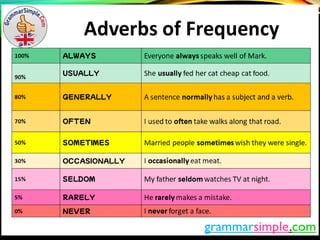
Adverbs of Frequency
Adverbs of frequency describe
s “how often” the action happe
ns.
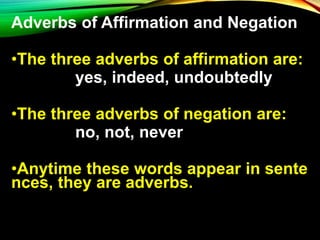
Adverbs of Affirmation and Negation
•The three adverbs of affirmation are:
yes, indeed, undoubtedly
•The three adverbs of negation are:
no, not, never
•Anytime these words appear in sente
nces, they are adverbs.
TROUBLESOME ADJECTIVES AN
D ADVERBS
• An ADVERB modifies verbs, adjectives an
d other adverbs.
• An ADJECTIVE modifies nouns.
 fast
hard
outside
just
low
Etc.
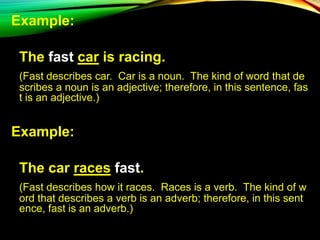
Example:
The fast car is racing.
(Fast describes car. Car is a noun. The kind of word that de
scribes a noun is an adjective; therefore, in this sentence, fas
t is an adjective.)
Example:
The car races fast.
(Fast describes how it races. Races is a verb. The kind of w
ord that describes a verb is an adverb; therefore, in this sent
ence, fast is an adverb.)
Arrange the words to make sentences. Capital
ize the beginning letter, and put the appropriat
e punctuation mark at the end of the sentence
.
1.haven’t / recently / seen / I / him
2./now / are / where / you
3.speaks/John/well/English
4.were / everywhere/we / for / looking / you
5.never/his/forget/face/I
Evaluation:
Write a narration of your most unforgettable experience in life. Mak
e it interesting. Observe the correct capitalization and use of appro
priate punctuation marks.

ADVERBS 9.pptx

  • 1.
  • 2.
    WHAT ARE ADVERB S? •Adverbsare single-wo rd modifiers. •They describe verbs, a djectives, and other ad verbs.
  • 3.
    • Most adverbsdescribe an action ver b. Run is a verb. You could: run fast run slow run backward run sideways Fast, slow, backward, sideways – thes e are all adverbs because they descri be the action run.
  • 4.
    • Some adverbsdescribe adjectives. Pretty is an adjective. You could say: quite pretty really pretty not pretty definitely pretty Quite, really, not, definitely – these are all a dverbs because they describe the adjectiv e pretty.
  • 5.
    • Some adverbsalso describe other adverb s. Cowardly is an adverb. You could say: very cowardly never cowardly always cowardly thoroughly cowardly Very, never, always, thoroughly – these are adverbs because they describe other adve rbs.
  • 6.
  • 7.
    Adverb of Time •Adverbsof time tell “when? ” an action occurs. They are usually placed before the ma in verb or at the end of the s entence.
  • 8.
    Example: I never sawthe movie. (When did I see it? Never. That means “ never” is an adverb of time.) Example: We wrote a story yesterday. (When did we write it? Yesterday. That means “yesterday” is an adverb of time.)
  • 9.
    Adverbs of timeexamples: Soon now tomorrow Today everyday weekly Annually quarterly yesterday Last month last week tonight Day after tomorrow, etc.
  • 10.
    Adverbs of Place •Adverbsof place tell “where ?” an action occurred. These adverbs are normally placed after a sentence’s object or main verb.
  • 11.
    Example: Did you putyour book there on the table? Where did you put your book? There. That means that the re is an adverb. “On the table” is a prepositional phrase. It is not an adverb. Remember that an adverb is a single- word modifier. Example: John looked around but he couldn’t see the monkey. “There is placed after the object of the sentence, book; while “around ” is placed after the main verb looked.
  • 12.
    Adverbs of PlaceList: about below indoors above down inside abroad downstairs near anywhere elsewhere nearby away somewhere towards over under far here behind upstairs Etc.
  • 13.
    Adverbs of Degree •Adverbsof degree tell “how much ?” or “to what degree?” somethin g occurs. •Adverbs of degree are often the o nes that describe adjectives or oth er adverbs. •These adverbs are normally positione d before the word they modify.
  • 14.
    Example: I am verytired. (To what degree am I tired? Very. “Very” is an adverb of degree.) Example: We were too sleepy to continue the activity. (How much were we sleepy? Too. That mea ns that “too” is an adverb of degree.)
  • 15.
    Adverbs of Degreeexamples: •Lots •Too •Little •Well •Enough •Pretty •Fully •Etc.
  • 16.
    Adverbs of Manner Adverbsof manner tell us “how” t he action is done. They are usually placed after the main verb or after the object. Many adverbs of mann er end in the letters “ly.”
  • 17.
    Example: We walked slowlydown the ha ll. (How did we walk? Slowly. That means “slowly” is an ad verb of manner.) He plays the flute beautifully.
  • 18.
    Adverbs of Frequency Adverbsof frequency describe s “how often” the action happe ns.
  • 20.
    Adverbs of Affirmationand Negation •The three adverbs of affirmation are: yes, indeed, undoubtedly •The three adverbs of negation are: no, not, never •Anytime these words appear in sente nces, they are adverbs.
  • 21.
    TROUBLESOME ADJECTIVES AN DADVERBS • An ADVERB modifies verbs, adjectives an d other adverbs. • An ADJECTIVE modifies nouns.  fast hard outside just low Etc.
  • 22.
    Example: The fast caris racing. (Fast describes car. Car is a noun. The kind of word that de scribes a noun is an adjective; therefore, in this sentence, fas t is an adjective.) Example: The car races fast. (Fast describes how it races. Races is a verb. The kind of w ord that describes a verb is an adverb; therefore, in this sent ence, fast is an adverb.)
  • 23.
    Arrange the wordsto make sentences. Capital ize the beginning letter, and put the appropriat e punctuation mark at the end of the sentence . 1.haven’t / recently / seen / I / him 2./now / are / where / you 3.speaks/John/well/English 4.were / everywhere/we / for / looking / you 5.never/his/forget/face/I
  • 24.
    Evaluation: Write a narrationof your most unforgettable experience in life. Mak e it interesting. Observe the correct capitalization and use of appro priate punctuation marks.