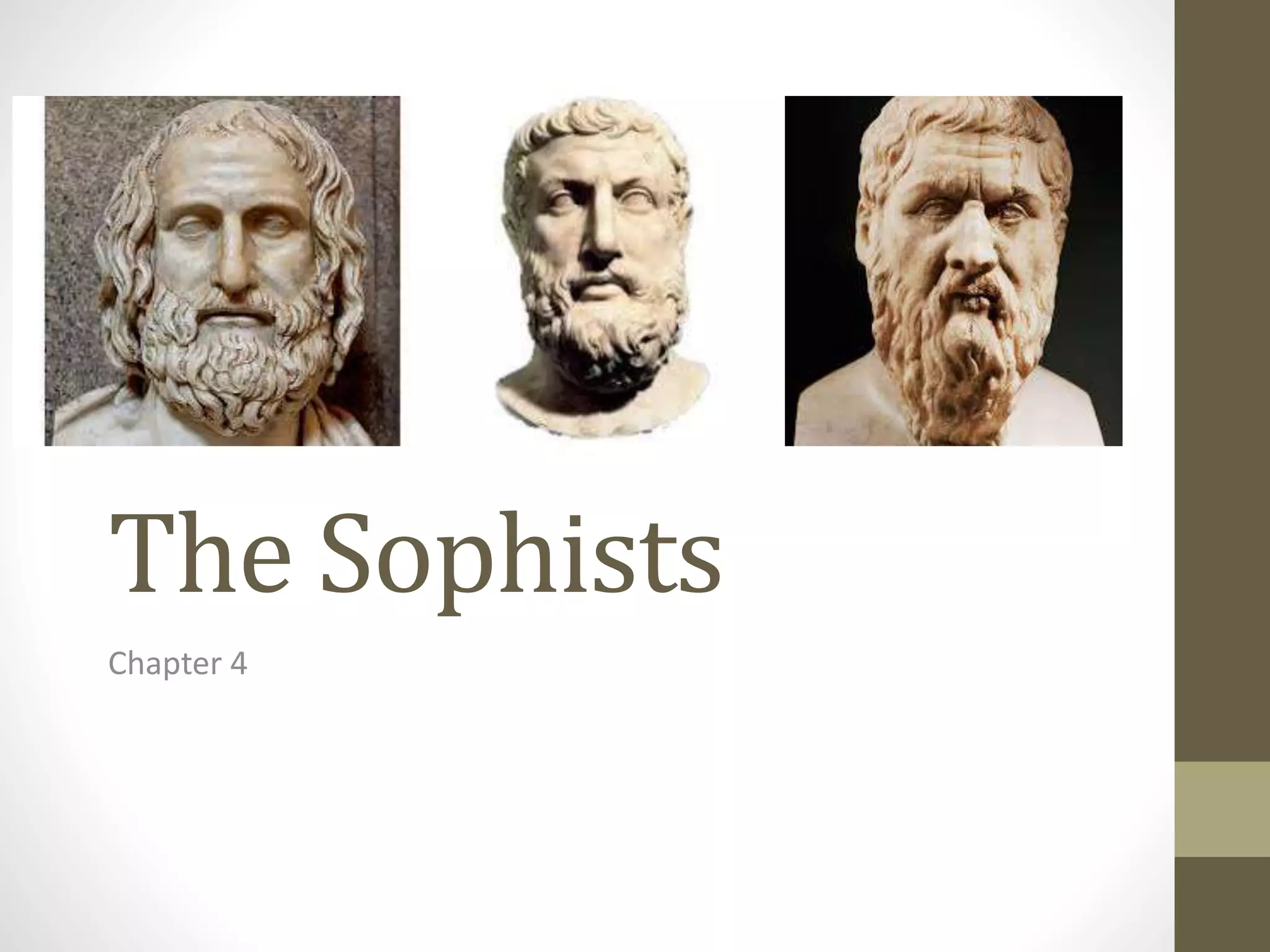
The Sophists were experts who travelled around ancient Greece offering education and training, particularly in public speaking and debating, in exchange for money. The most prominent early Sophist was Protagoras, who lived in the 5th century BC and taught techniques of argumentation. He believed that truth was subjective and relative to each individual's perspective. Another influential Sophist was Gorgias, who emphasized the power of persuasive speech and argued that nothing truly exists or can be known. Callicles, a later Sophist, believed that conventions of morality and law only exist to restrain the strong, and that one's natural strength is a virtue.
The Sophists
• “wisdomexperts”
• People with know-how knowledge travelling and lecturing for
fee
• Offering basic education, even arts and skills.
• Also public speaking
• Became relevant especially in winning a case, and earning money.
• Young sons from rich families were trained by them to shine in
debate and to excel in politics.
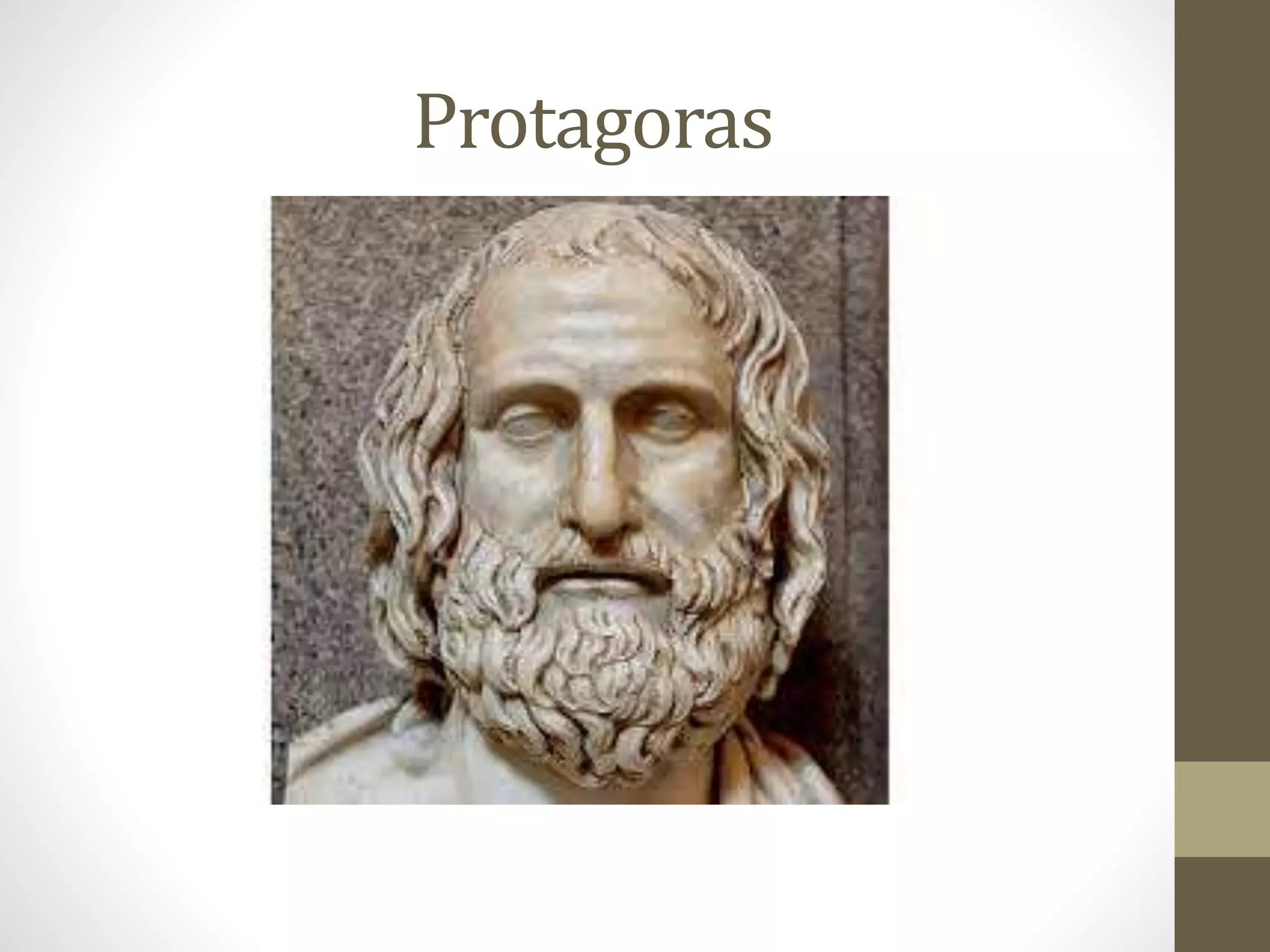
Protagoras
• 1st amongthe Sophists
• Lived from about 490 – 420 B.C.
• Foremost speaker in Athens at his time, earned a lot in his
profession
• Drafted a legal code for one of Athens’ colonies
• Taught political virtue
• Taught techniques of debate
• Antilogiae – pro- and-con arguments, two sides to every issue
• “whatever anyone believes is true”
• None of your beliefs is false
• There is no objective truth
• Two sides to every issue & both of them is right.
5.
Protagoras
• Relativism (individualisticrelativism)
• Reality and truth are relative to individual persons
• “Man is the measure of all things, of the existence of
things that are, and of the nonexistence of things that are
not.”
• “Things are to you such as they appear to you, and to me such as
they appear to me.”
• Moral rightness and political justice, man is the measure.
• In politics, majority are of one opinion and a minority of
another. Both can say that they are right, and has the right.
• All opinions are equally true, some are “better” or “sounder”
or “more expedient” than others, and it is these which a
Sophist offers.
• A Sophist can recommend which is better from weaker.
6.
Protagoras
• The questionof rightness and justness:
• There is “only better and not truer”
• Encourage to live the values , laws and code of conduct. A sophist
can amend and recommend what is effective.
• On religion, he was a skeptic
• “Life is too short, and the subject is too obscure, for him to
know whether the gods exist and, if they do, what they are
like.”
• Although he said that traditional religion is a civilizing force.
• He is said to be drowned because of his impiety.
Gorgias
• Few youngerthan Protagoras and was also famous
• Lived a long life and died at around 380 B.C.
• Free-lance teacher
• He spoke most eloquently, convinced and inspired many, and
earned a lot of money.
• Told people that he could answer any questions asked.
• Never taught or promised to teach “virtues” because there is
no such thing and only the art of rhetoric or oratory.
• The Sophist meant his instruction to be employed for good
ends
9.
Gorgias
• There isno objective truths valid for everyone, what is important is
how to effectively persuade others. power of speech
• He criticized philosophers.
• Truth and reality are relative to the beliefs of each person.
• He believes that nothing exists, that even if anything did exist no one
could comprehend it, and that even if anyone could comprehend it
this comprehension could not be communicated.
• Made a Parody on Parmenides’ poem.
• There is no distinction between knowledge and opinion.
• Argued that nothing exists.
• He is impressive at persuasion
• Stressed the importance of the power of speech and its skillful
composition.
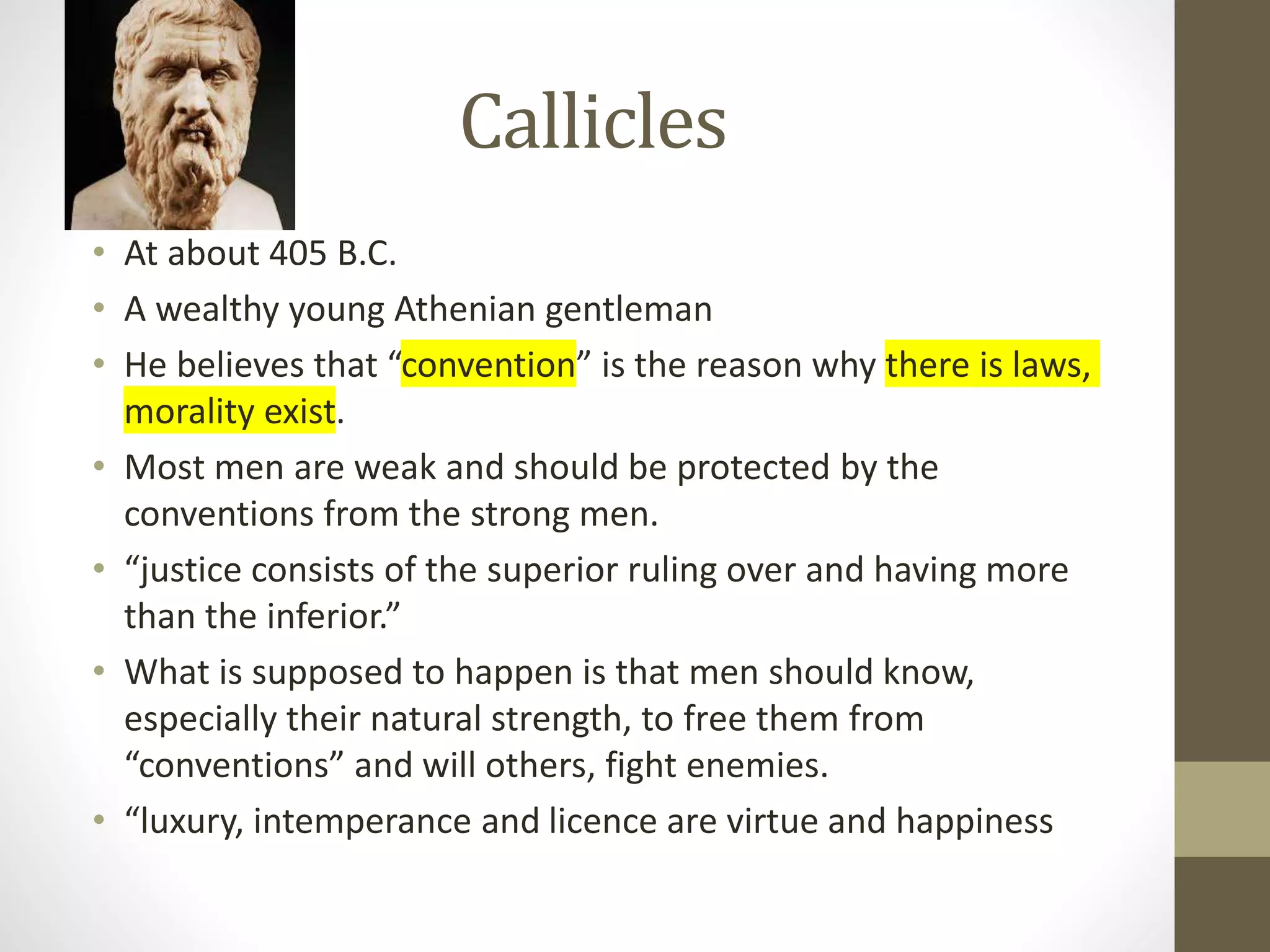
Callicles
• At about405 B.C.
• A wealthy young Athenian gentleman
• He believes that “convention” is the reason why there is laws,
morality exist.
• Most men are weak and should be protected by the
conventions from the strong men.
• “justice consists of the superior ruling over and having more
than the inferior.”
• What is supposed to happen is that men should know,
especially their natural strength, to free them from
“conventions” and will others, fight enemies.
• “luxury, intemperance and licence are virtue and happiness