
Configuration of Authoritative
Nameservice
Advanced DNS
Operations & Security
Recap
● DNS is a distributed database
● Resolver asks Cache for information
● Cache traverses the DNS delegation tree to
find Authoritative nameserver which has the
information requested
● Bad configuration of authoritative servers can
result in broken domains
DNS Replication
● For every domain, we need more than one
authoritative nameserver with the same
information (RFC 2182)
● Data is entered in one server (Master) and
replicated to the others (Slave(s))
● Outside world cannot tell the difference
between master and slave
– NS records are returned in random order for
equal load sharing
● Used to be called "primary" and "secondary"
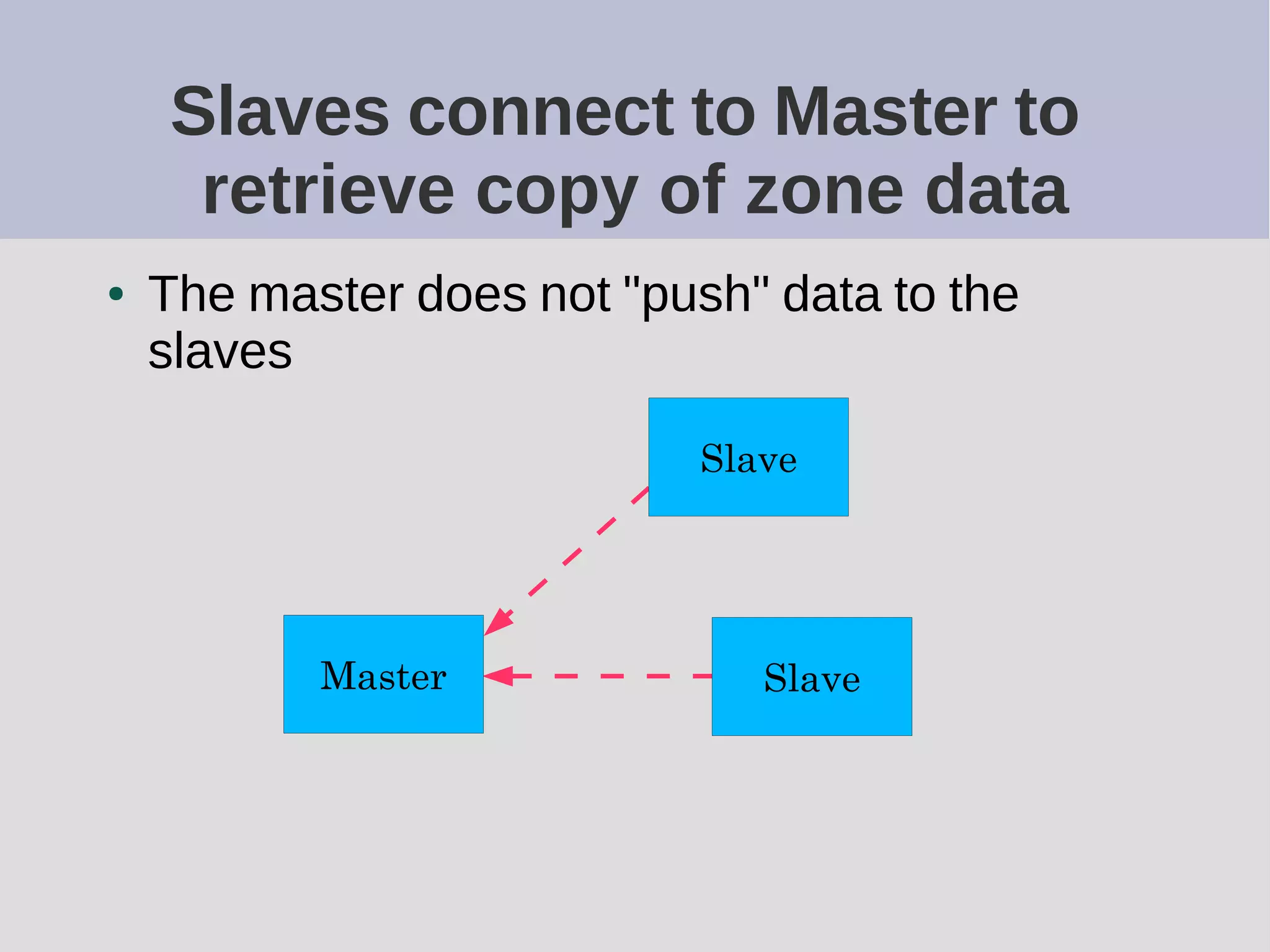
Slaves connect to Master to
retrieve copy of zone data
● The master does not "push" data to the
slaves
Master
Slave
Slave
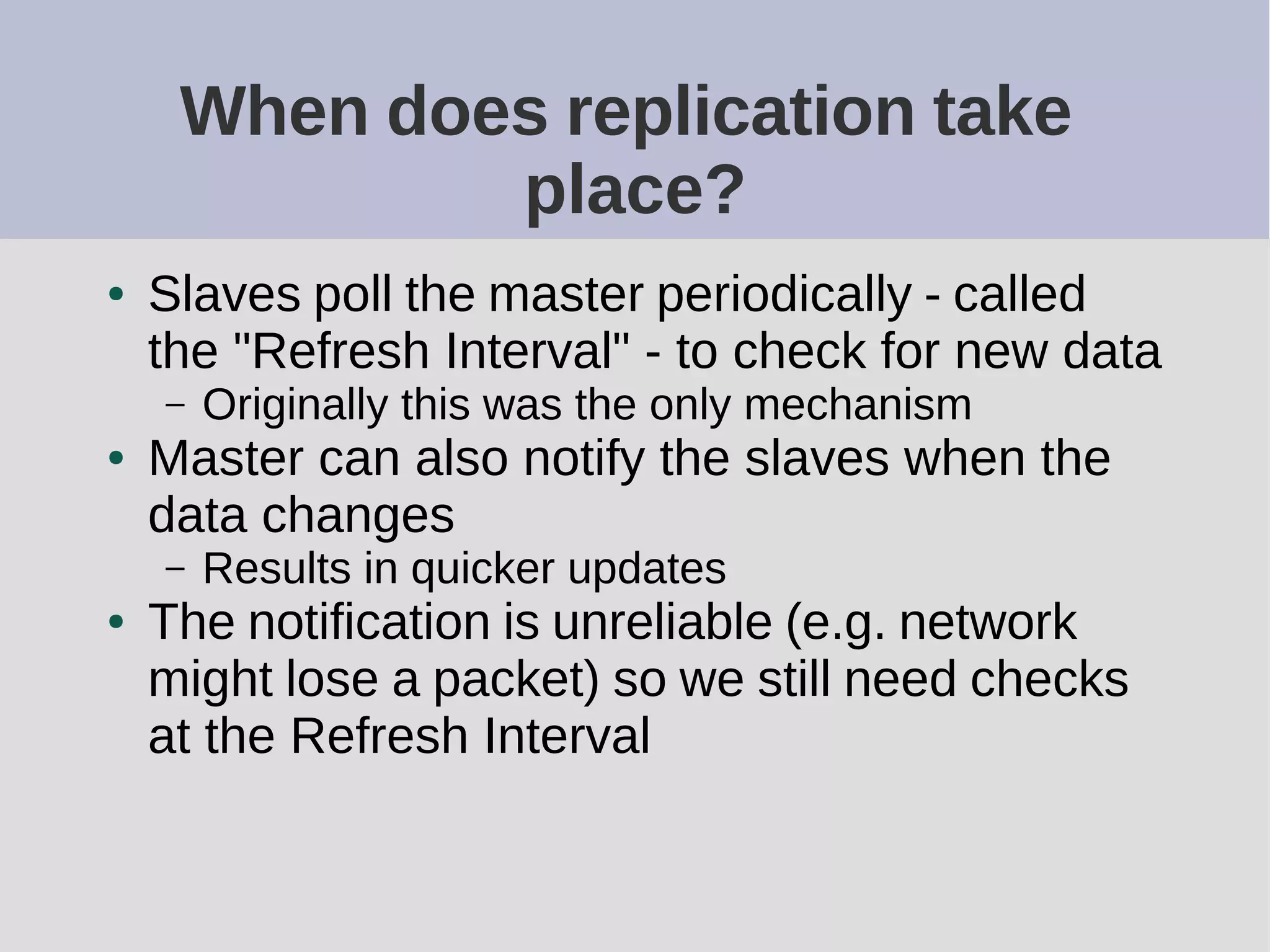
When does replication take
place?
● Slaves poll the master periodically - called
the "Refresh Interval" - to check for new data
– Originally this was the only mechanism
● Master can also notify the slaves when the
data changes
– Results in quicker updates
● The notification is unreliable (e.g. network
might lose a packet) so we still need checks
at the Refresh Interval
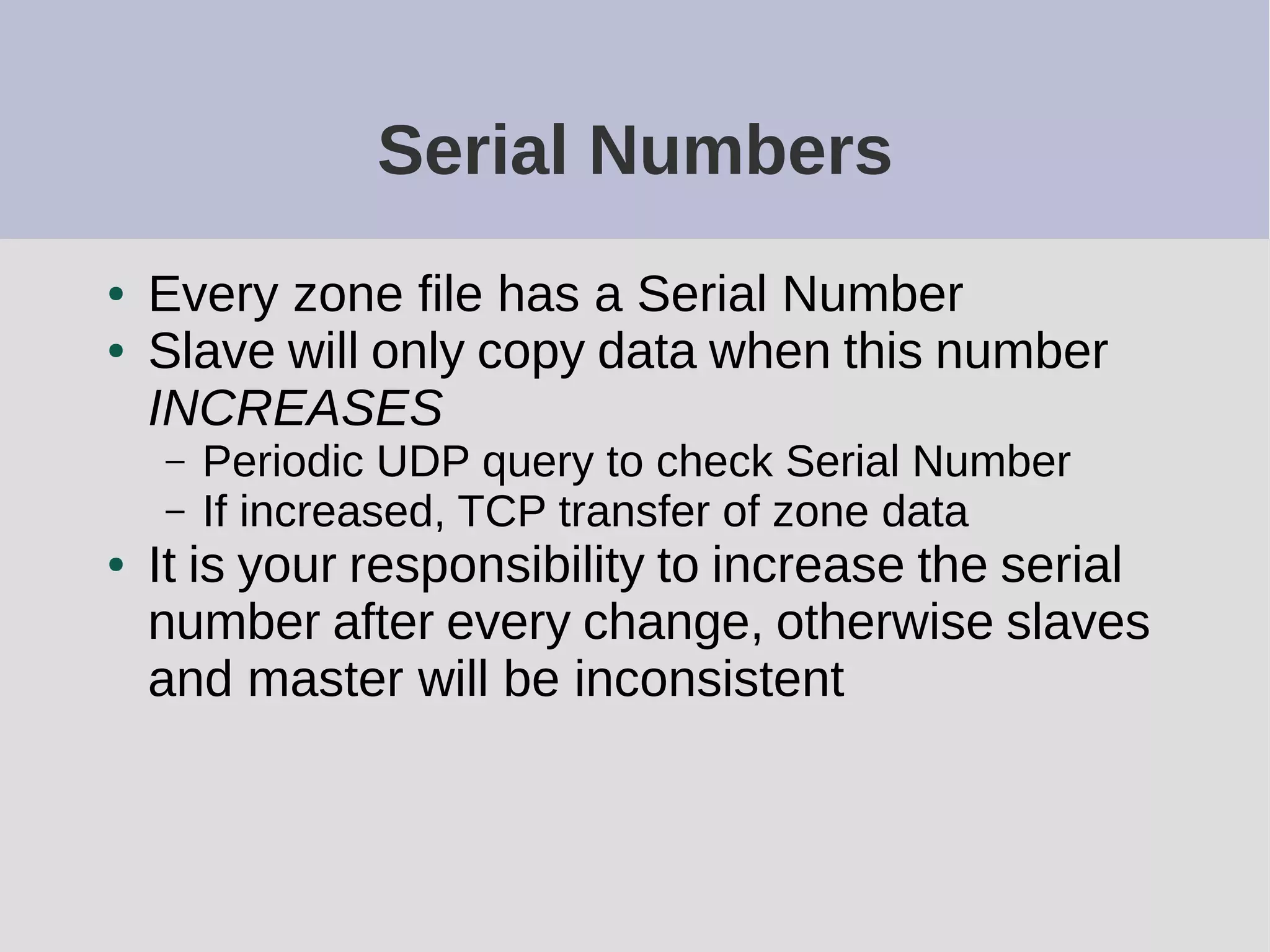
Serial Numbers
● Every zone file has a Serial Number
● Slave will only copy data when this number
INCREASES
– Periodic UDP query to check Serial Number
– If increased, TCP transfer of zone data
● It is your responsibility to increase the serial
number after every change, otherwise slaves
and master will be inconsistent
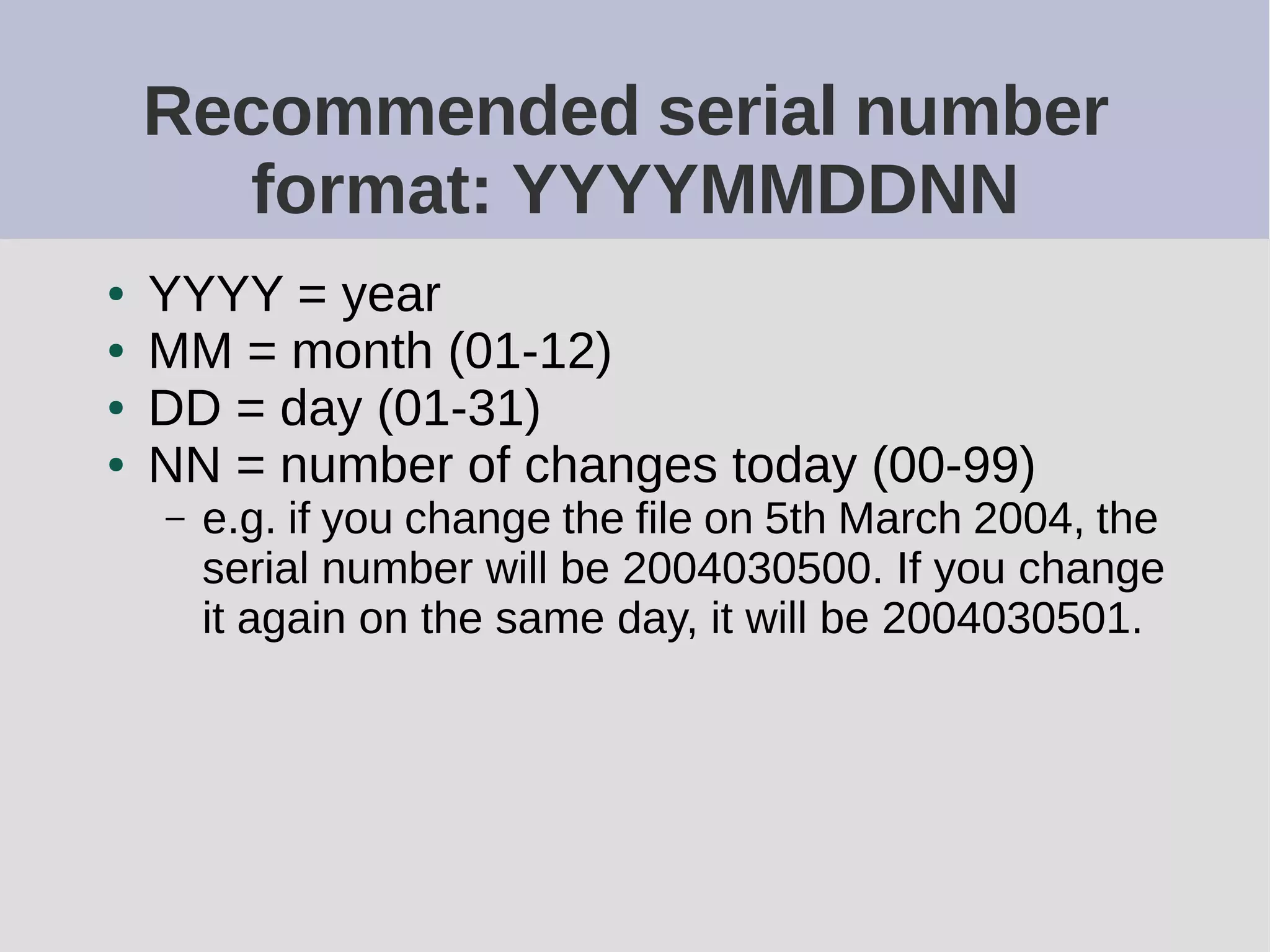
Recommended serial number
format: YYYYMMDDNN
● YYYY = year
● MM = month (01-12)
● DD = day (01-31)
● NN = number of changes today (00-99)
– e.g. if you change the file on 5th March 2004, the
serial number will be 2004030500. If you change
it again on the same day, it will be 2004030501.
Serial Numbers: Danger 1
● If you ever decrease the serial number, the
slaves will never update again until the serial
number goes above its previous value
● RFC1912 section 3.1 explains a method to
fix this problem
● At worst, you can contact all your slaves and
get them to delete their copy of the zone data
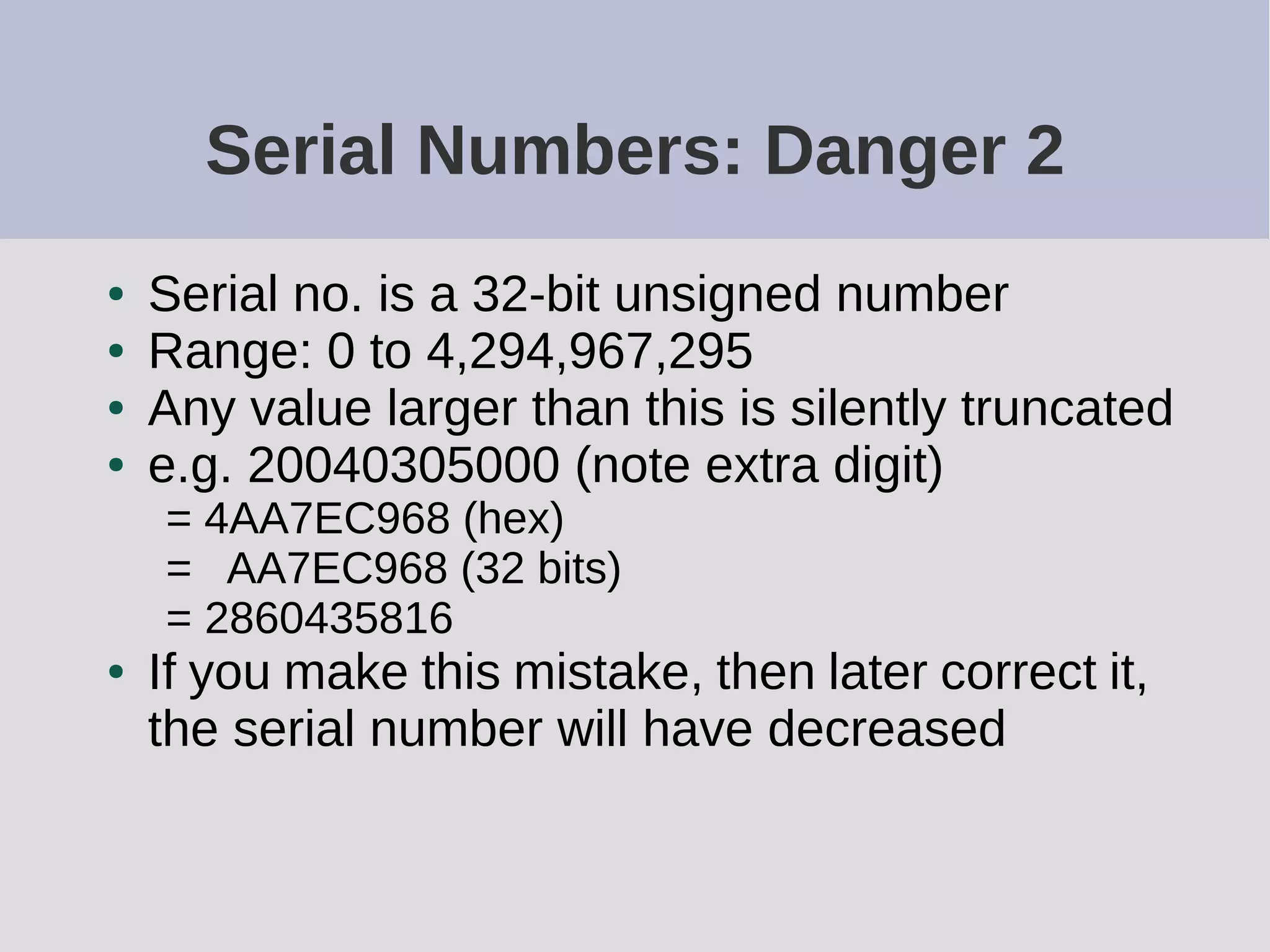
Serial Numbers: Danger 2
● Serial no. is a 32-bit unsigned number
● Range: 0 to 4,294,967,295
● Any value larger than this is silently truncated
● e.g. 20040305000 (note extra digit)
= 4AA7EC968 (hex)
= AA7EC968 (32 bits)
= 2860435816
● If you make this mistake, then later correct it,
the serial number will have decreased
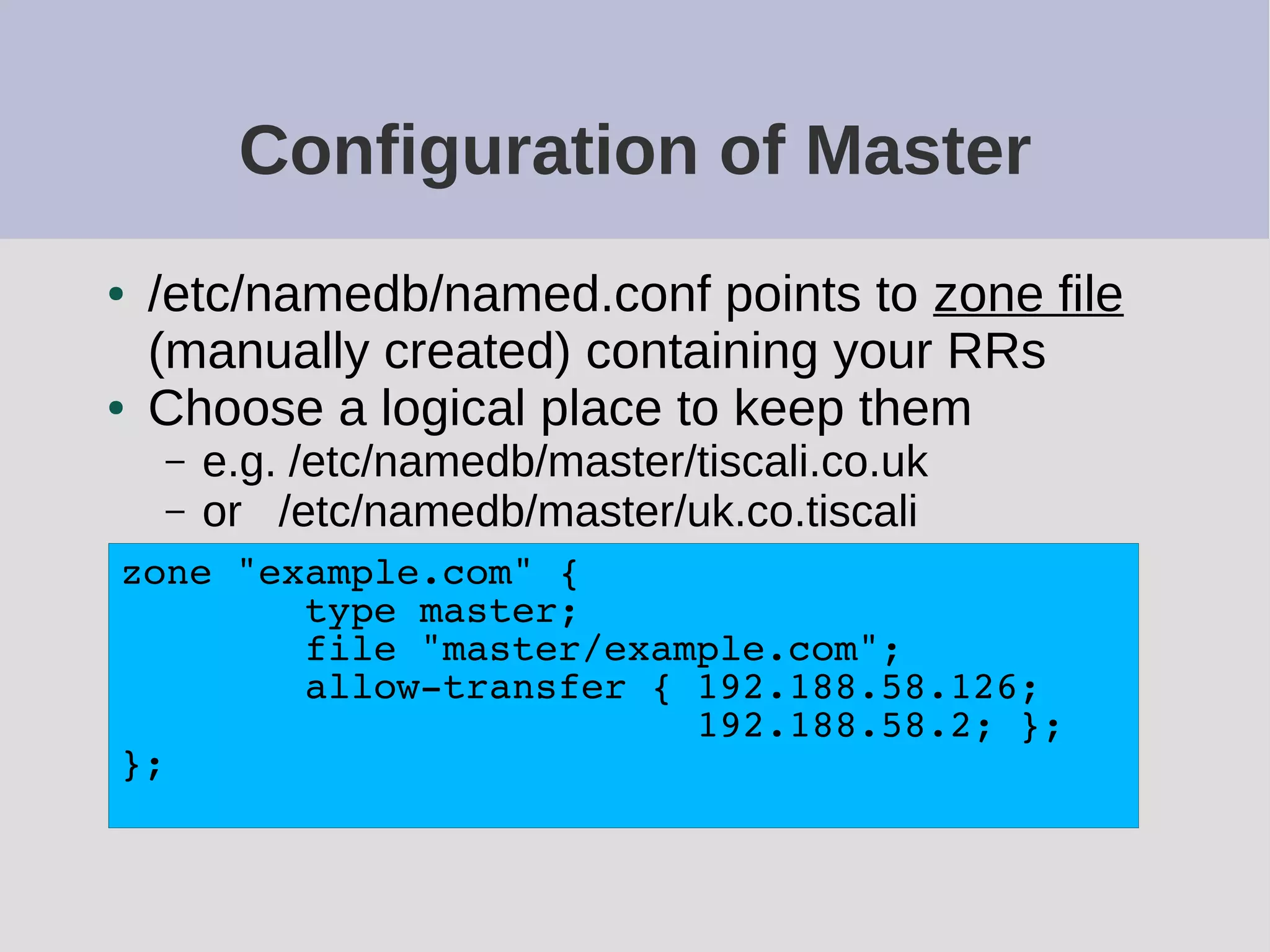
Configuration of Master
● /etc/namedb/named.conf points to zone file
(manually created) containing your RRs
● Choose a logical place to keep them
– e.g. /etc/namedb/master/tiscali.co.uk
– or /etc/namedb/master/uk.co.tiscali
zone "example.com" {
type master;
file "master/example.com";
allow-transfer { 192.188.58.126;
192.188.58.2; };
};
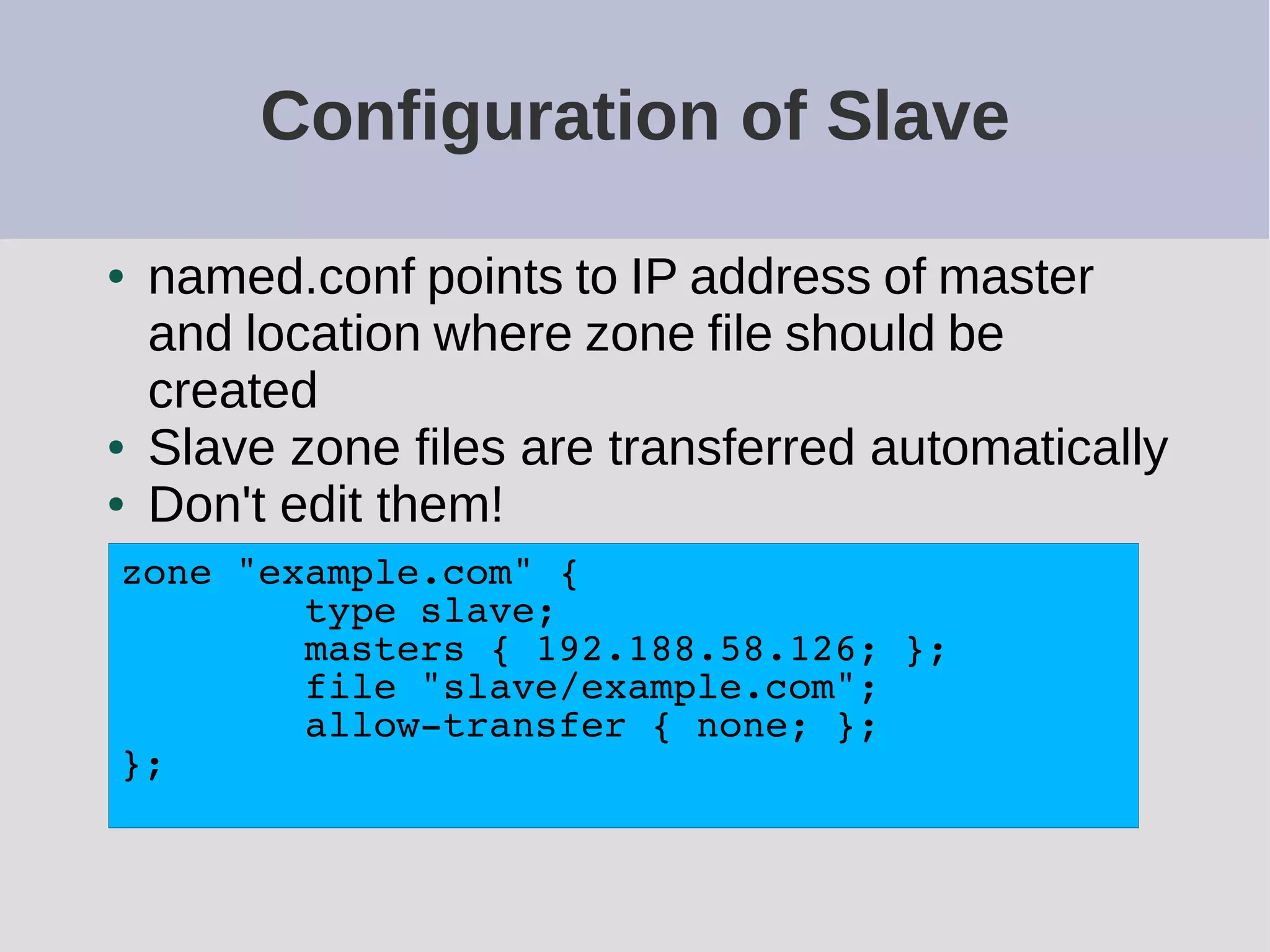
Configuration of Slave
● named.conf points to IP address of master
and location where zone file should be
created
● Slave zone files are transferred automatically
● Don't edit them!
zone "example.com" {
type slave;
masters { 192.188.58.126; };
file "slave/example.com";
allow-transfer { none; };
};
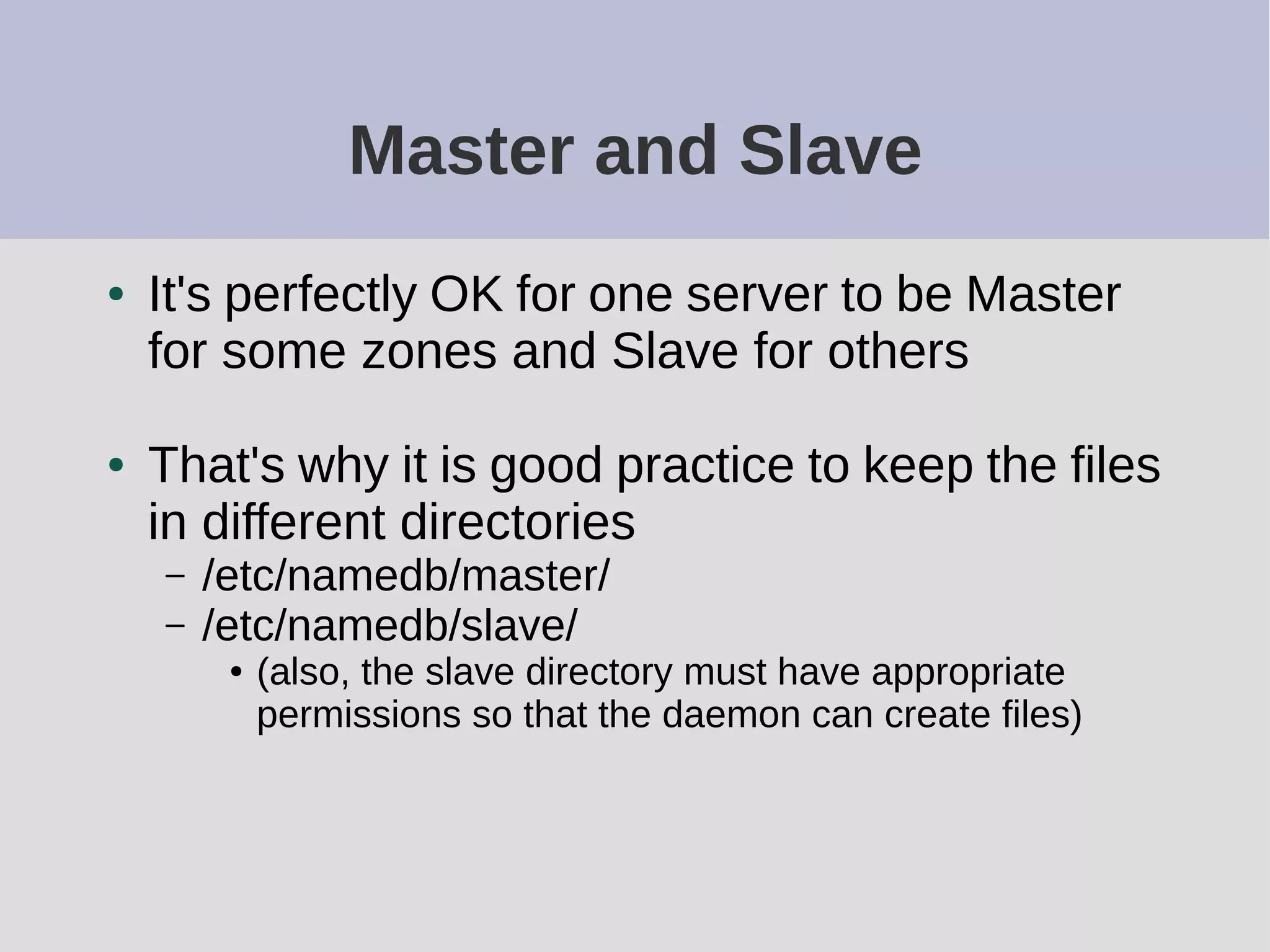
Master and Slave
● It's perfectly OK for one server to be Master
for some zones and Slave for others
● That's why it is good practice to keep the files
in different directories
– /etc/namedb/master/
– /etc/namedb/slave/
● (also, the slave directory must have appropriate
permissions so that the daemon can create files)
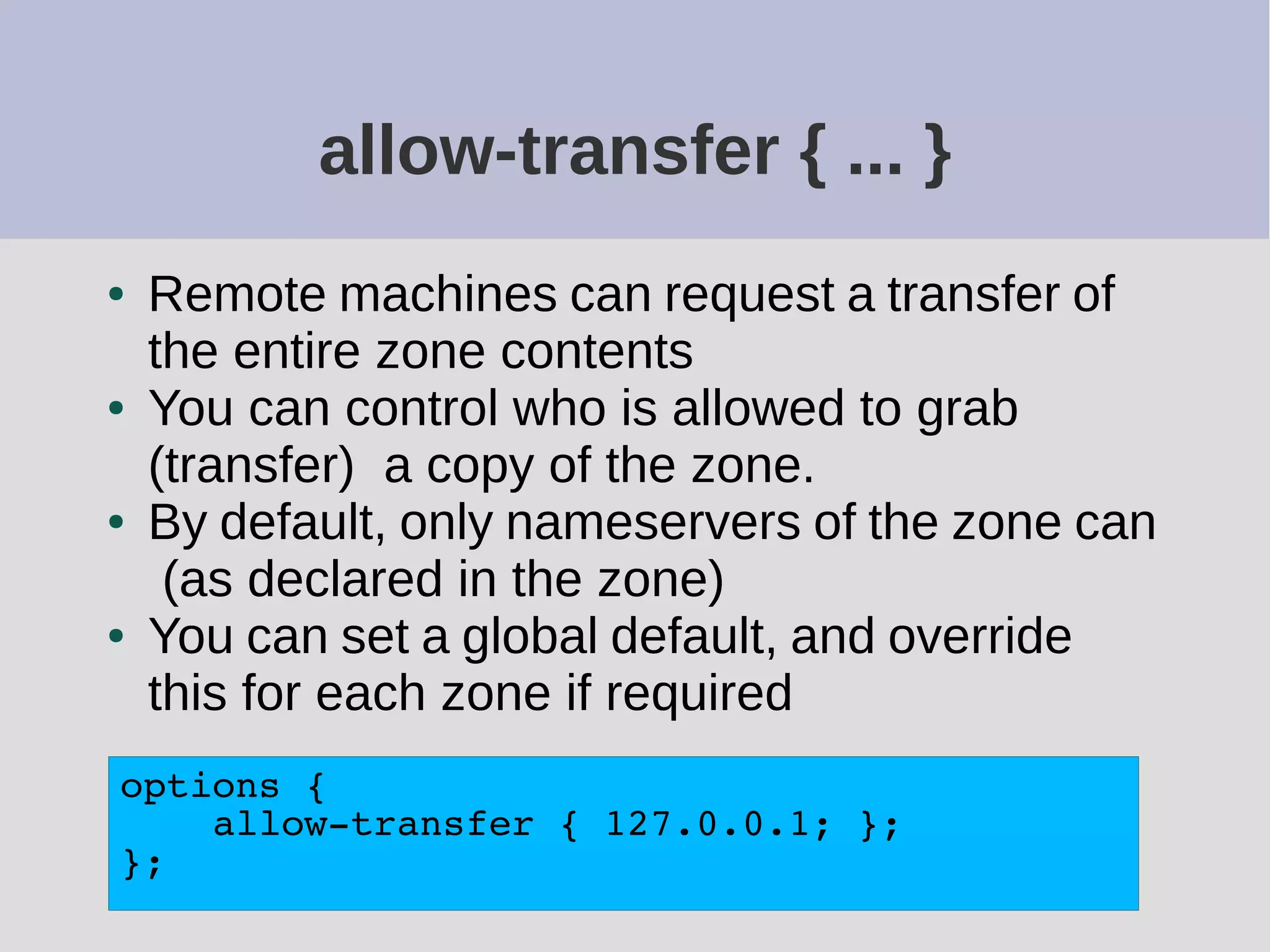
allow-transfer { ... }
● Remote machines can request a transfer of
the entire zone contents
● You can control who is allowed to grab
(transfer) a copy of the zone.
● By default, only nameservers of the zone can
(as declared in the zone)
● You can set a global default, and override
this for each zone if required
options {
allow-transfer { 127.0.0.1; };
};
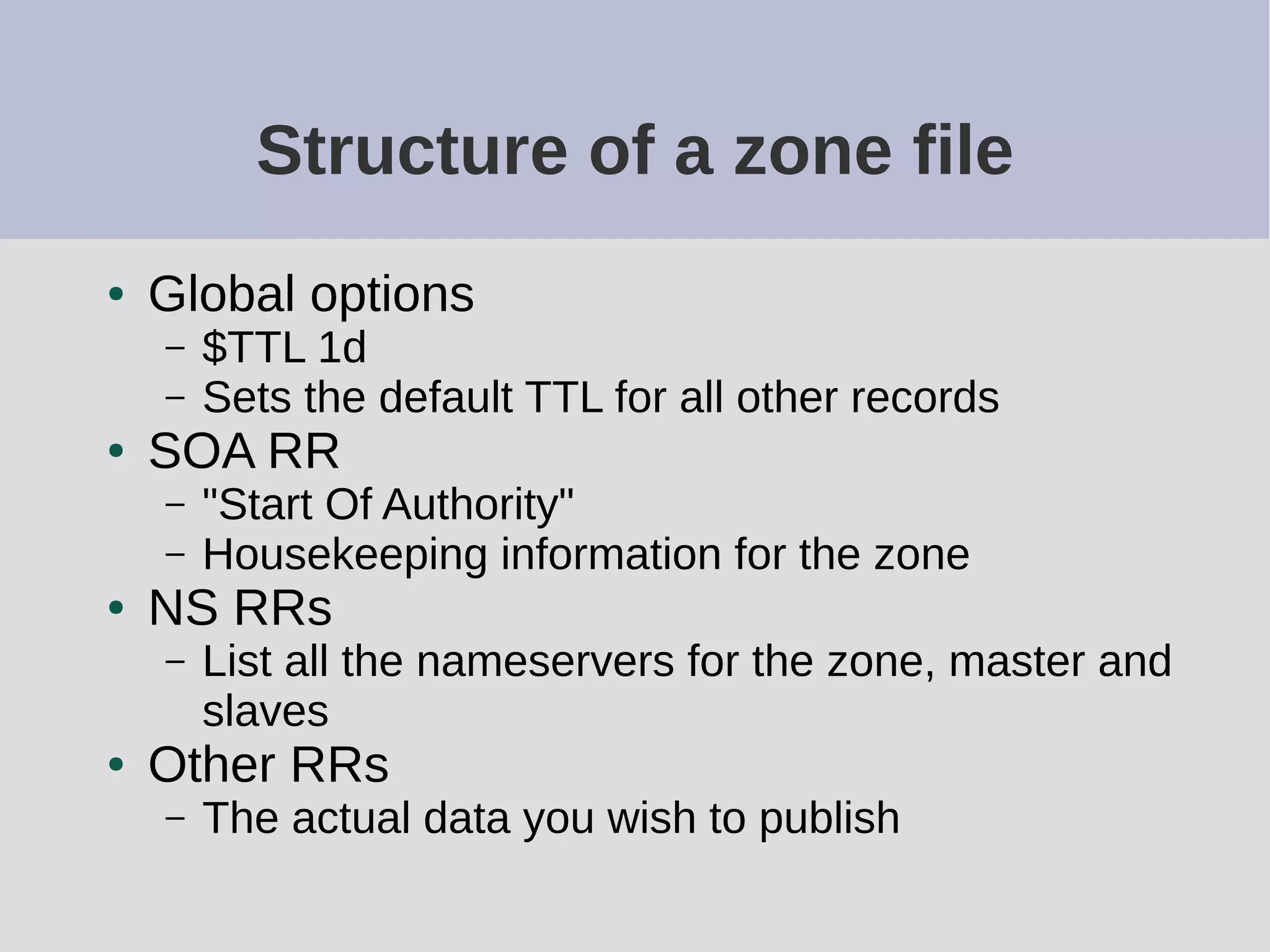
Structure of a zone file
● Global options
– $TTL 1d
– Sets the default TTL for all other records
● SOA RR
– "Start Of Authority"
– Housekeeping information for the zone
● NS RRs
– List all the nameservers for the zone, master and
slaves
● Other RRs
– The actual data you wish to publish
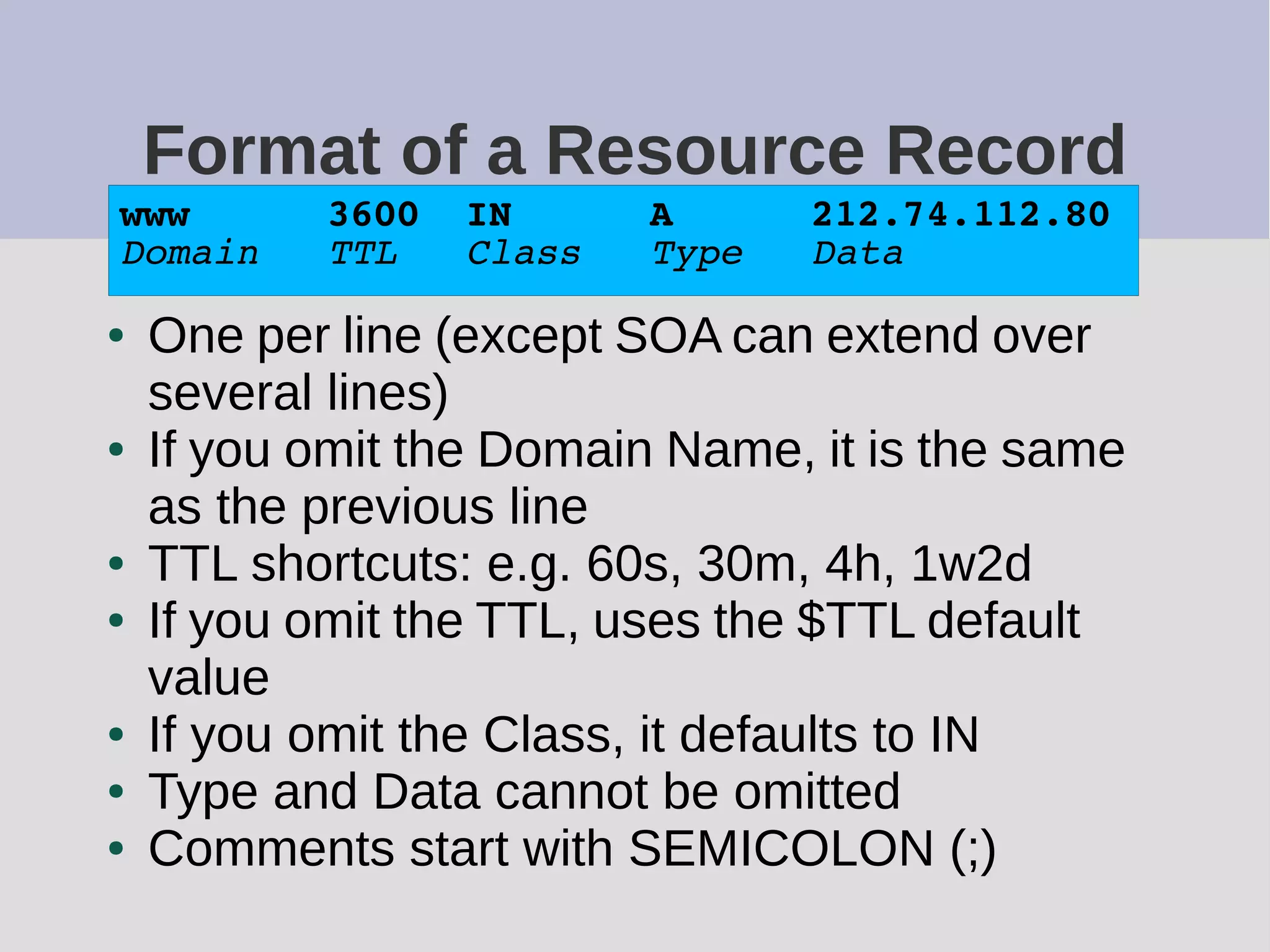
Format of a Resource Record
● One per line (except SOA can extend over
several lines)
● If you omit the Domain Name, it is the same
as the previous line
● TTL shortcuts: e.g. 60s, 30m, 4h, 1w2d
● If you omit the TTL, uses the $TTL default
value
● If you omit the Class, it defaults to IN
● Type and Data cannot be omitted
● Comments start with SEMICOLON (;)
www 3600 IN A 212.74.112.80
Domain TTL Class Type Data
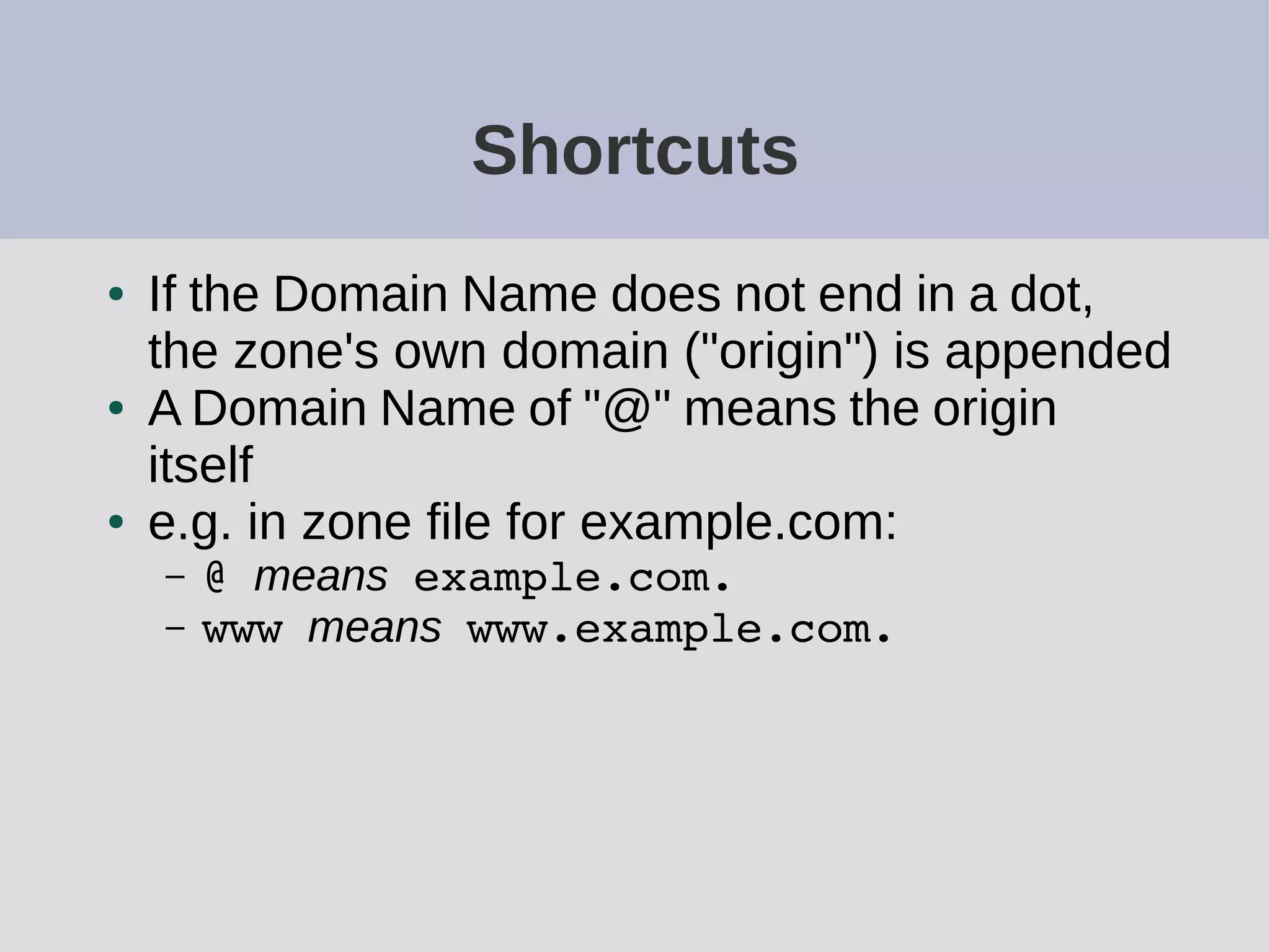
Shortcuts
● If the Domain Name does not end in a dot,
the zone's own domain ("origin") is appended
● A Domain Name of "@" means the origin
itself
● e.g. in zone file for example.com:
– @ means example.com.
– www means www.example.com.
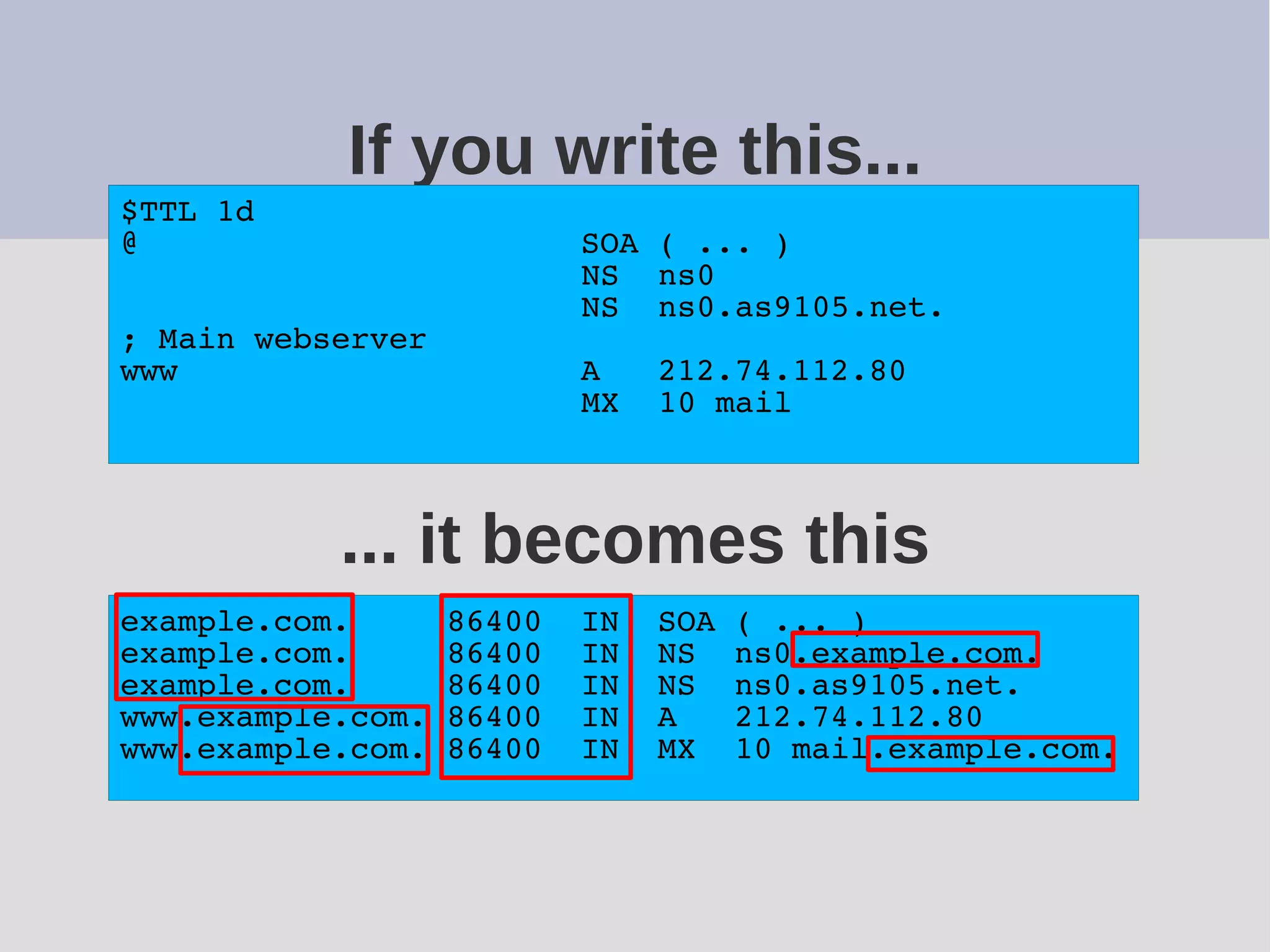
If you write this...
... it becomes this
$TTL 1d
@ SOA ( ... )
NS ns0
NS ns0.as9105.net.
; Main webserver
www A 212.74.112.80
MX 10 mail
example.com. 86400 IN SOA ( ... )
example.com. 86400 IN NS ns0.example.com.
example.com. 86400 IN NS ns0.as9105.net.
www.example.com. 86400 IN A 212.74.112.80
www.example.com. 86400 IN MX 10 mail.example.com.
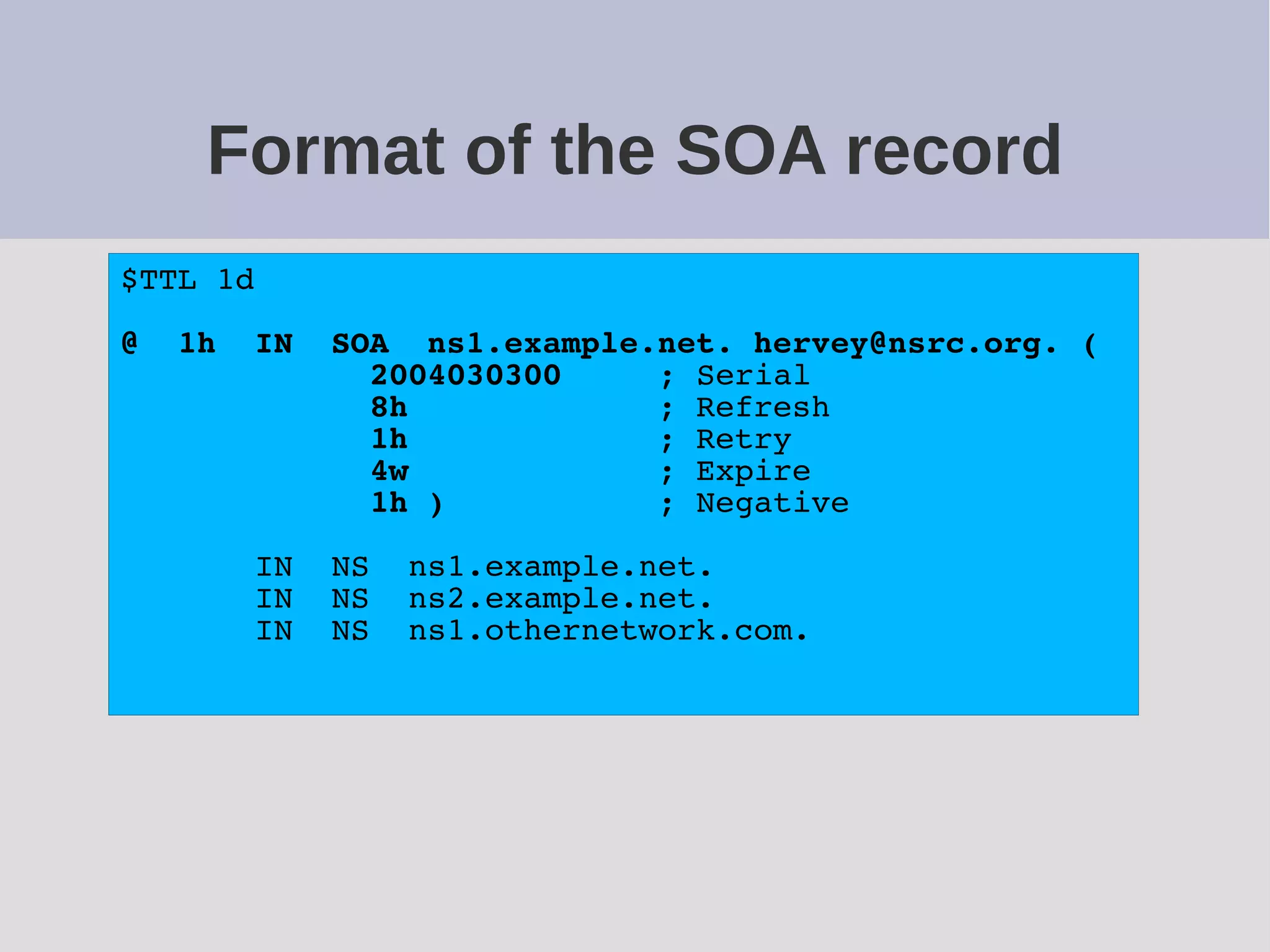
Format of the SOA record
$TTL 1d
@ 1h IN SOA ns1.example.net. hervey@nsrc.org. (
2004030300 ; Serial
8h ; Refresh
1h ; Retry
4w ; Expire
1h ) ; Negative
IN NS ns1.example.net.
IN NS ns2.example.net.
IN NS ns1.othernetwork.com.
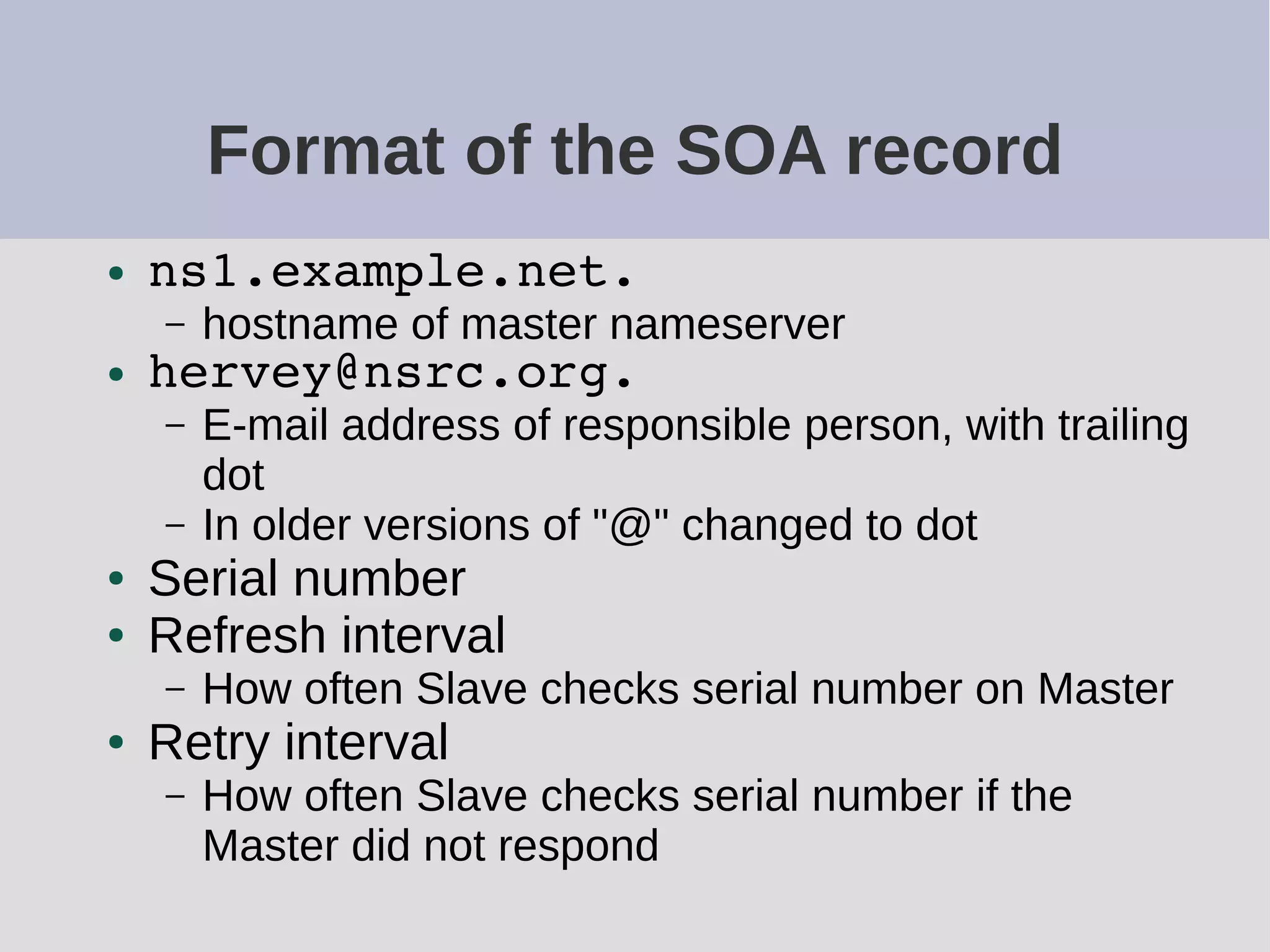
Format of the SOA record
● ns1.example.net.
– hostname of master nameserver
● hervey@nsrc.org.
– E-mail address of responsible person, with trailing
dot
– In older versions of "@" changed to dot
● Serial number
● Refresh interval
– How often Slave checks serial number on Master
● Retry interval
– How often Slave checks serial number if the
Master did not respond
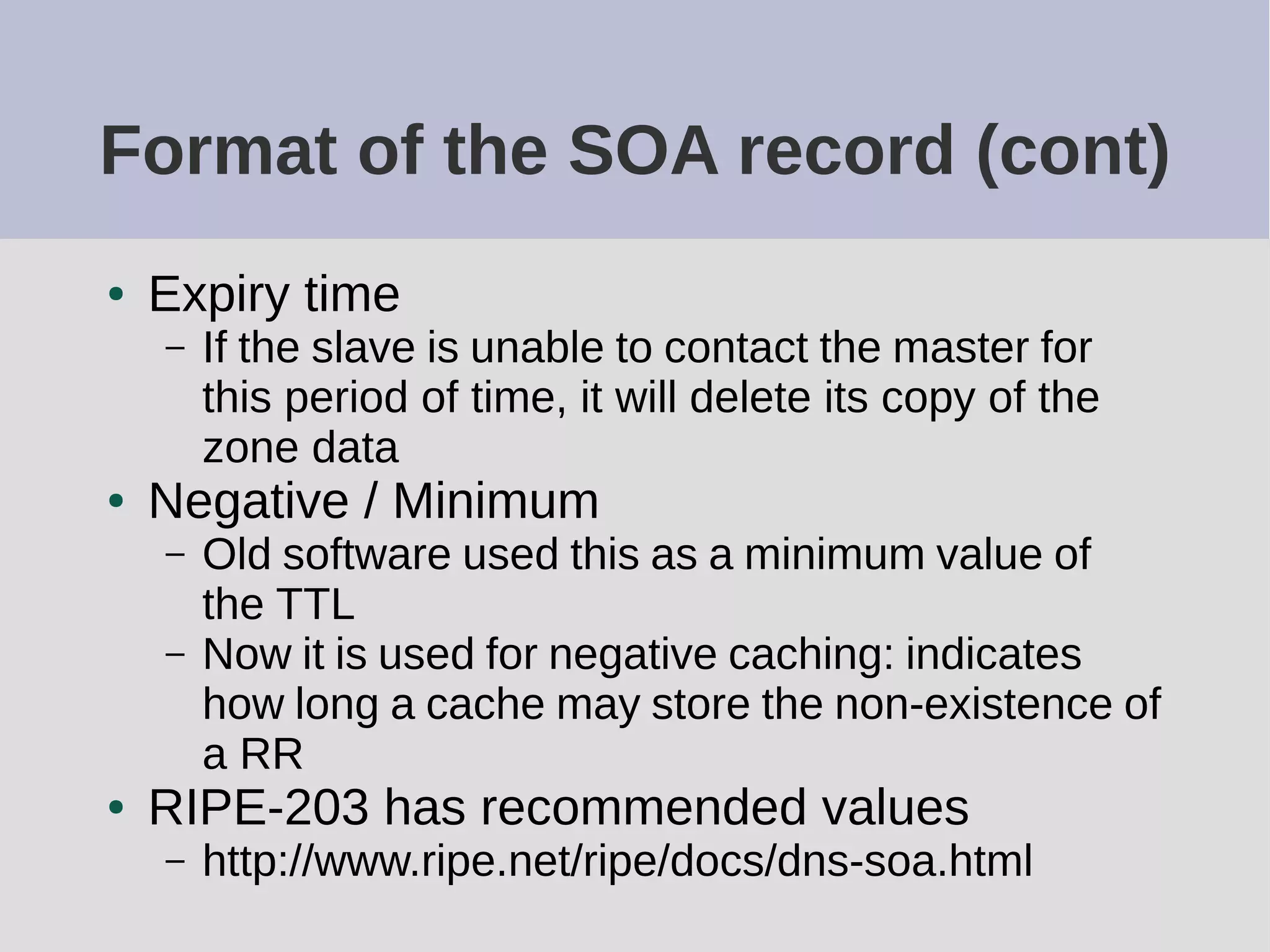
Format of the SOA record (cont)
● Expiry time
– If the slave is unable to contact the master for
this period of time, it will delete its copy of the
zone data
● Negative / Minimum
– Old software used this as a minimum value of
the TTL
– Now it is used for negative caching: indicates
how long a cache may store the non-existence of
a RR
● RIPE-203 has recommended values
– http://www.ripe.net/ripe/docs/dns-soa.html
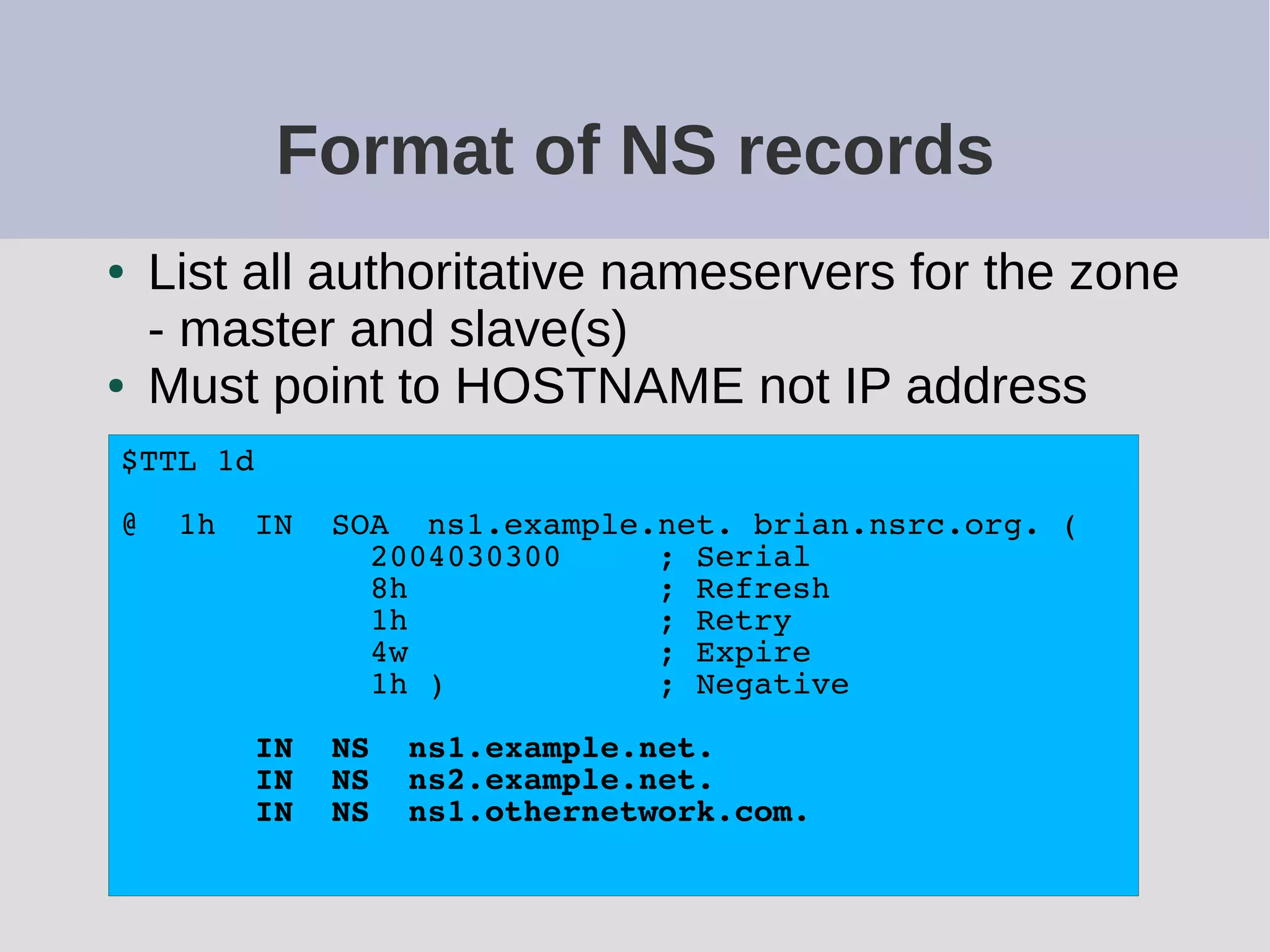
Format of NS records
● List all authoritative nameservers for the zone
- master and slave(s)
● Must point to HOSTNAME not IP address
$TTL 1d
@ 1h IN SOA ns1.example.net. brian.nsrc.org. (
2004030300 ; Serial
8h ; Refresh
1h ; Retry
4w ; Expire
1h ) ; Negative
IN NS ns1.example.net.
IN NS ns2.example.net.
IN NS ns1.othernetwork.com.
Format of other RRs
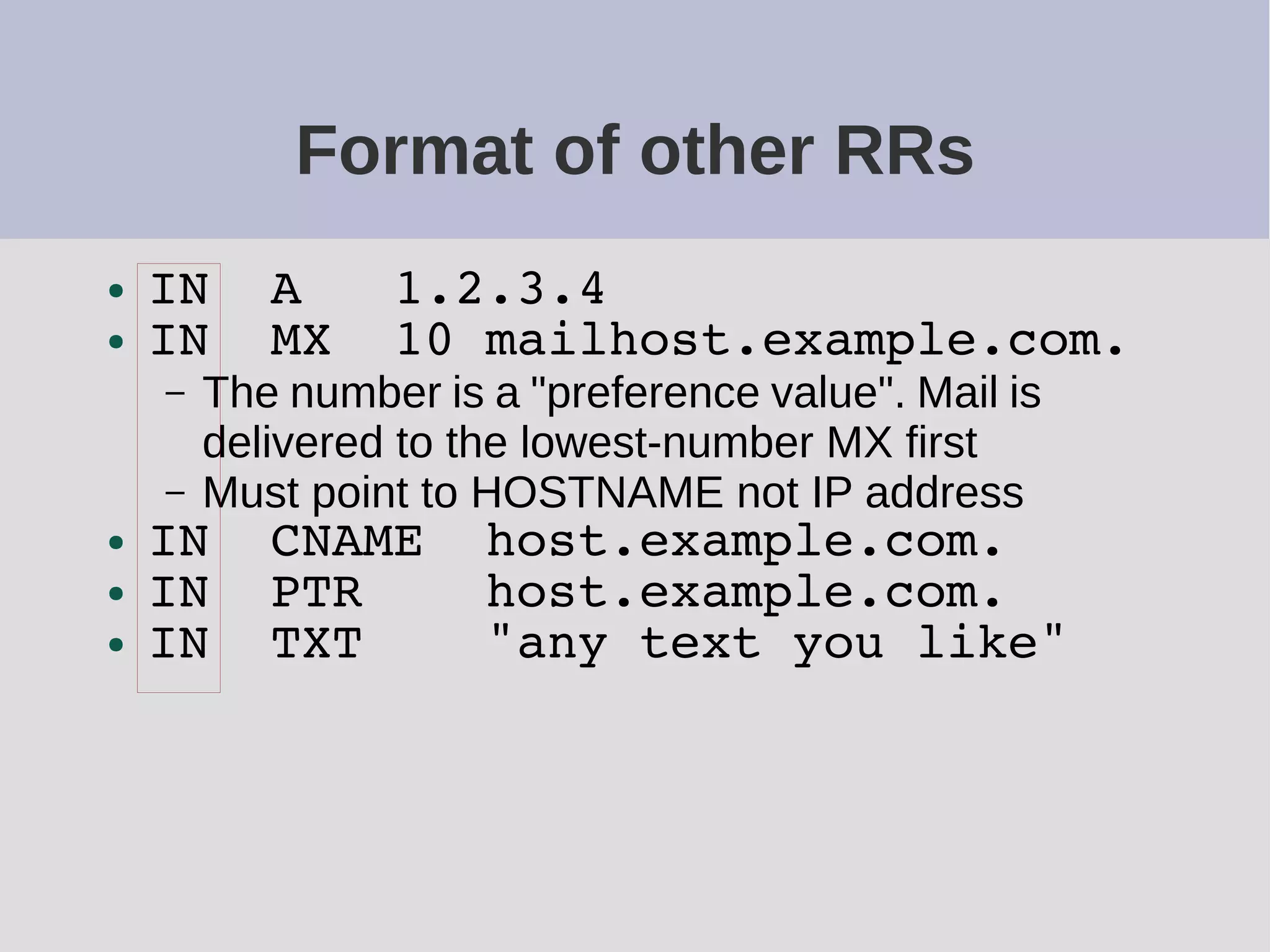
● IN A 1.2.3.4
● IN MX 10 mailhost.example.com.
– The number is a "preference value". Mail is
delivered to the lowest-number MX first
– Must point to HOSTNAME not IP address
● IN CNAME host.example.com.
● IN PTR host.example.com.
● IN TXT "any text you like"
When you have added or
changed a zone file:
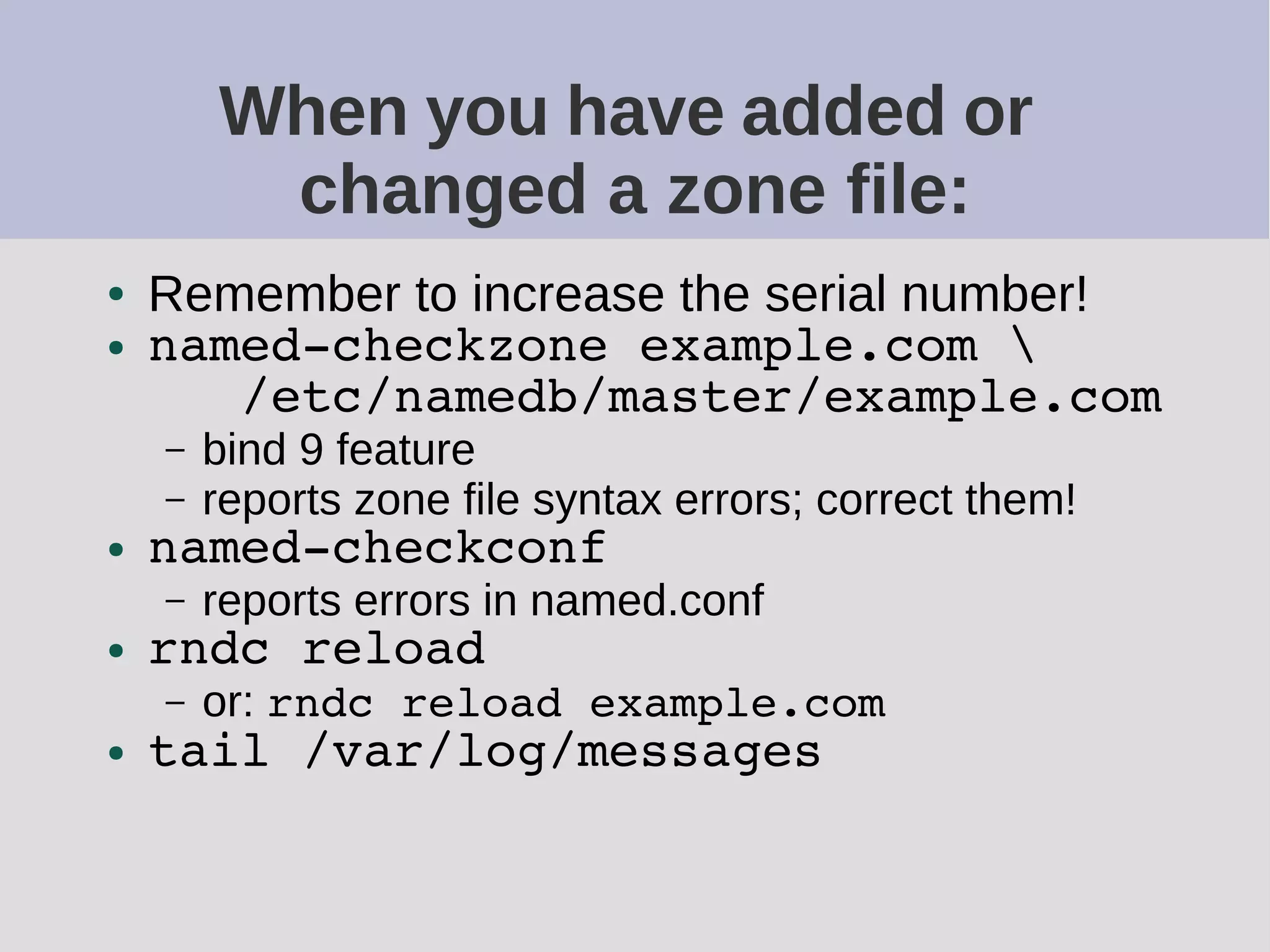
● Remember to increase the serial number!
● named-checkzone example.com 
/etc/namedb/master/example.com
– bind 9 feature
– reports zone file syntax errors; correct them!
● named-checkconf
– reports errors in named.conf
● rndc reload
– or: rndc reload example.com
● tail /var/log/messages
These checks are ESSENTIAL
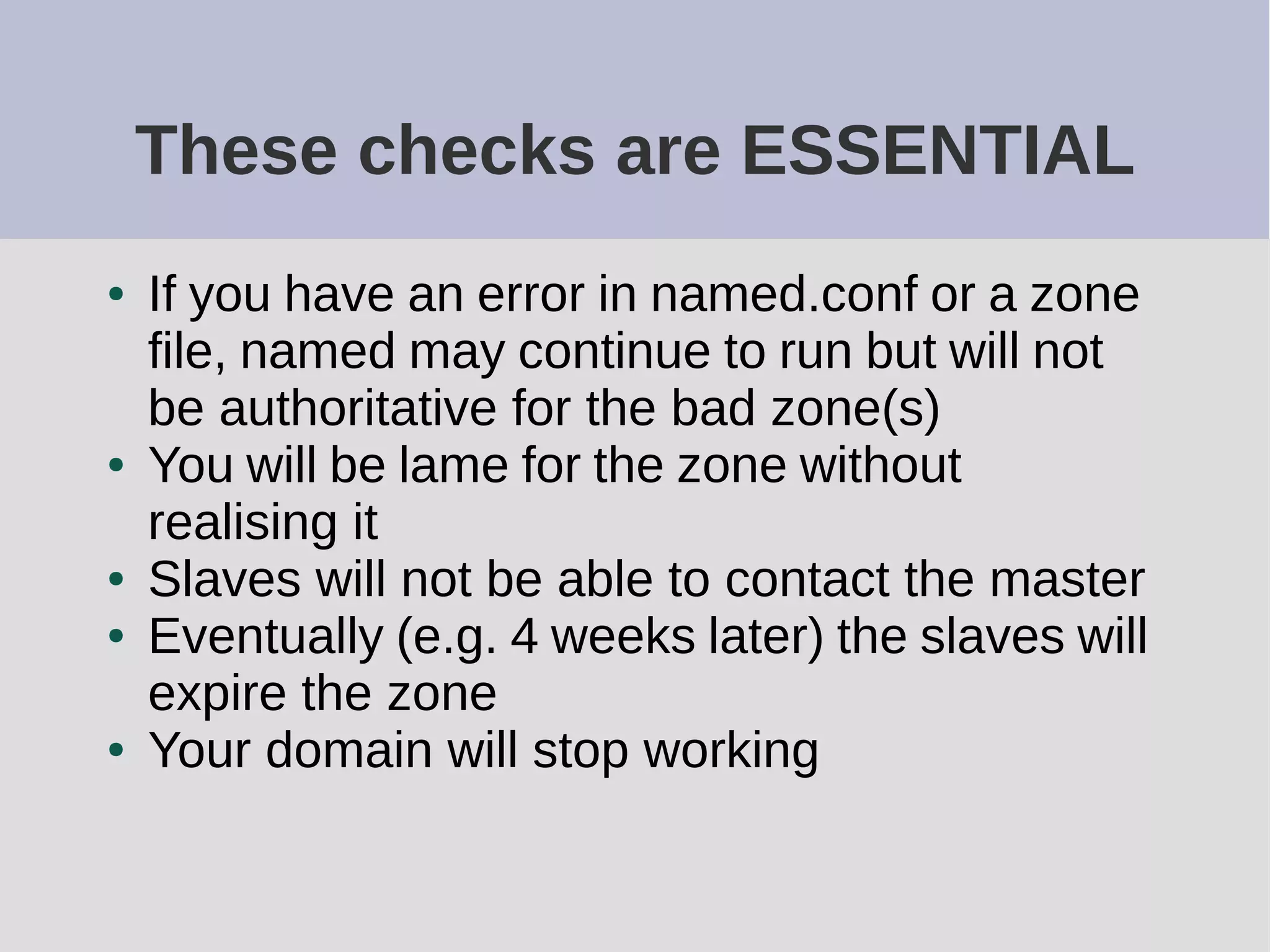
● If you have an error in named.conf or a zone
file, named may continue to run but will not
be authoritative for the bad zone(s)
● You will be lame for the zone without
realising it
● Slaves will not be able to contact the master
● Eventually (e.g. 4 weeks later) the slaves will
expire the zone
● Your domain will stop working
Other checks you can do
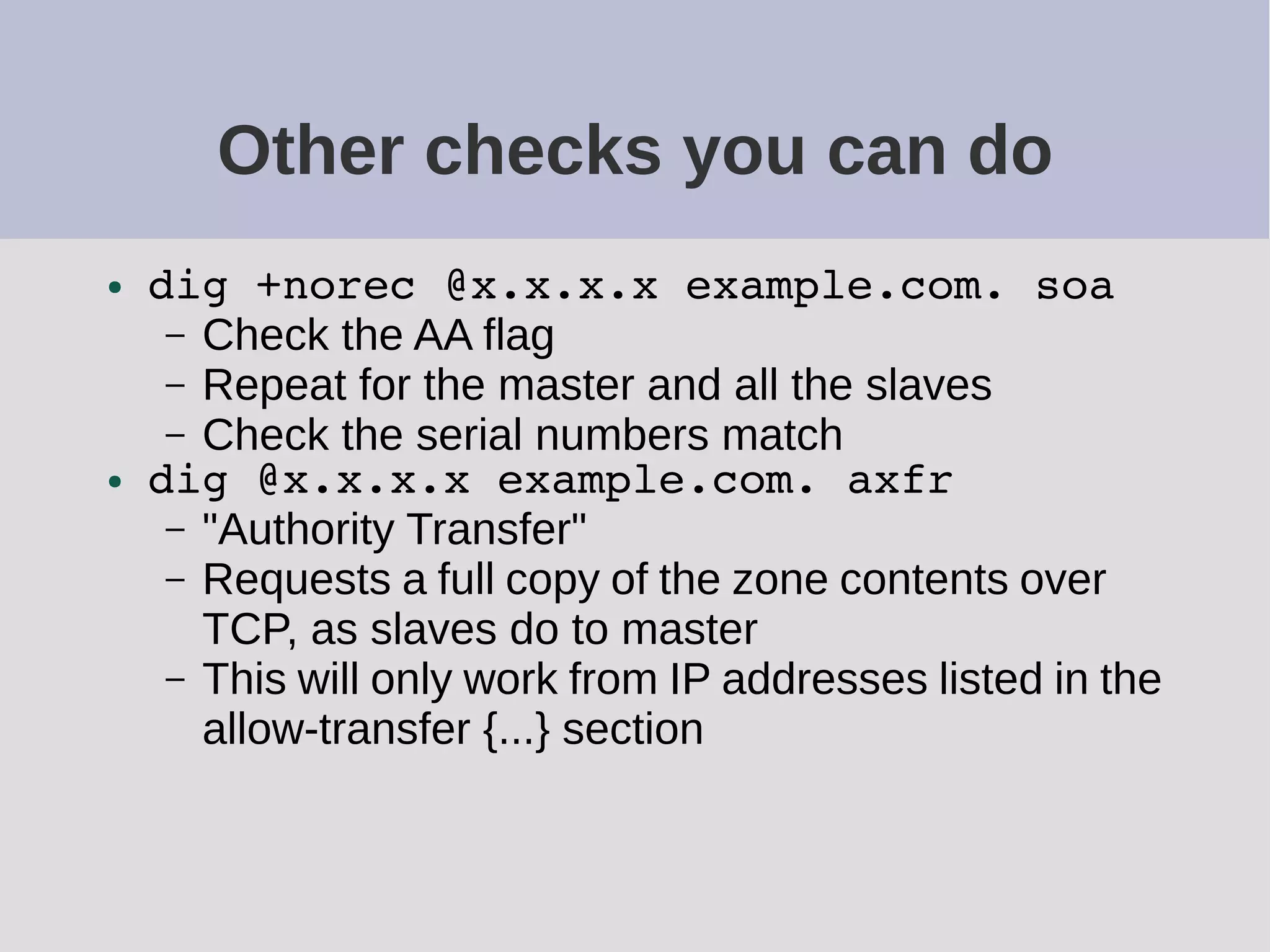
● dig +norec @x.x.x.x example.com. soa
– Check the AA flag
– Repeat for the master and all the slaves
– Check the serial numbers match
● dig @x.x.x.x example.com. axfr
– "Authority Transfer"
– Requests a full copy of the zone contents over
TCP, as slaves do to master
– This will only work from IP addresses listed in the
allow-transfer {...} section
So now you have working
authoritative nameservers!
● But none of this will work until you have
delegation from the domain above
● That is, they put in NS records for your
domain, pointing at your nameservers
● You have also put NS records within the
zone file
● The two sets should match
Any questions?
?
TOP TEN ERRORS in
authoritative nameservers
● All operators of auth nameservers should
read RFC 1912
– Common DNS Operational and Configuration
Errors
● And also RFC 2182
– Selection and Operation of Secondary DNS
servers
1. Serial number errors
● Forgot to increment serial number
● Incremented serial number, then
decremented it
●
Used serial number greater than 232
● Impact:
– Slaves do not update
– Master and slaves have inconsistent data
– Caches will sometimes get the new data and
sometimes old - intermittent problem
2. Comments in zone files
starting '#' instead of ';'
● Syntax error in zone file
● Master is no longer authoritative for the zone
● Slaves cannot check SOA
● Slaves eventually expire the zone, and your
domain stops working entirely
● Use "named-checkzone"
● Use "tail /var/log/messages"
3. Other syntax errors in zone
files
● e.g. omitting the preference value from MX
records
● Same impact
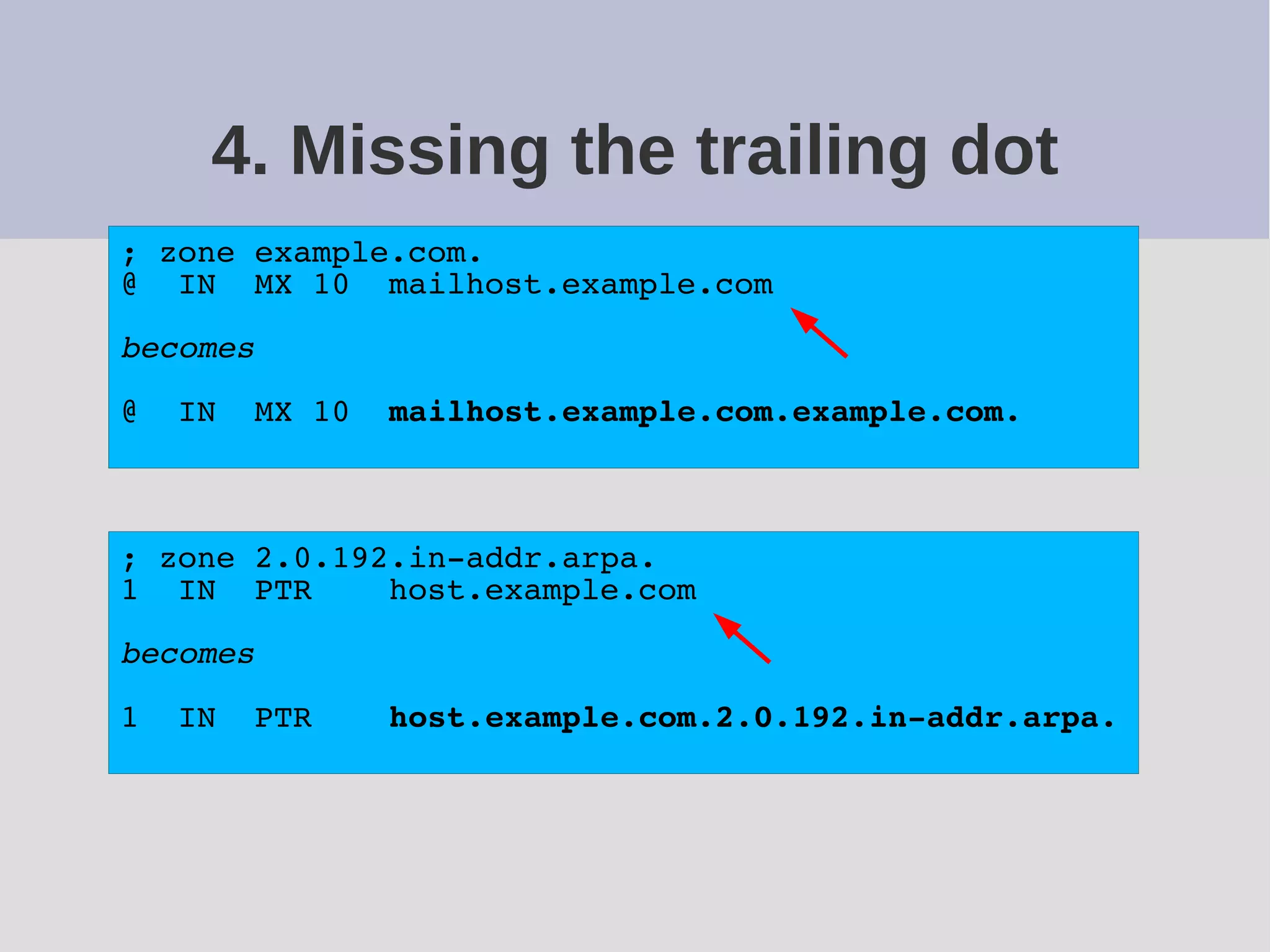
4. Missing the trailing dot
; zone example.com.
@ IN MX 10 mailhost.example.com
becomes
@ IN MX 10 mailhost.example.com.example.com.
; zone 2.0.192.in-addr.arpa.
1 IN PTR host.example.com
becomes
1 IN PTR host.example.com.2.0.192.in-addr.arpa.
5. NS or MX records pointing to
IP addresses
● They must point to hostnames, not IP
addresses
● Unfortunately, a few mail servers do accept
IP addresses in MX records, so you may not
see a problem with all remote sites
6. Slave cannot transfer zone
from master
● Access restricted by allow-transfer {...} and
slave not listed
● Or IP filters not configured correctly
● Slave will be lame (non-authoritative)
7. Lame delegation
● You cannot just list any nameserver in NS
records for your domain
● You must get agreement from the
nameserver operator, and they must
configure it as a slave for your zone
● At best: slower DNS resolution and lack of
resilience
● At worst: intermittent failures to resolve your
domain
8. No delegation at all
● You can configure "example.com" on your
nameservers but the outside world will not
send requests to them until you have
delegation
● The problem is hidden if your nameserver is
acting both as your cache and as
authoritative nameserver
● Your own clients can resolve
www.example.com, but the rest of the world
cannot
9. Out-of-date glue records
● See later
10. Not managing TTL correctly
during changes
● e.g. if you have a 24 hour TTL, and you
swing www.example.com to point to a new
server, then there will be an extended period
when some users hit one machine and some
hit the other
● Follow the procedure:
– Reduce TTL to 10 minutes
– Wait at least 24 hours
– Make the change
– Put the TTL back to 24 hours
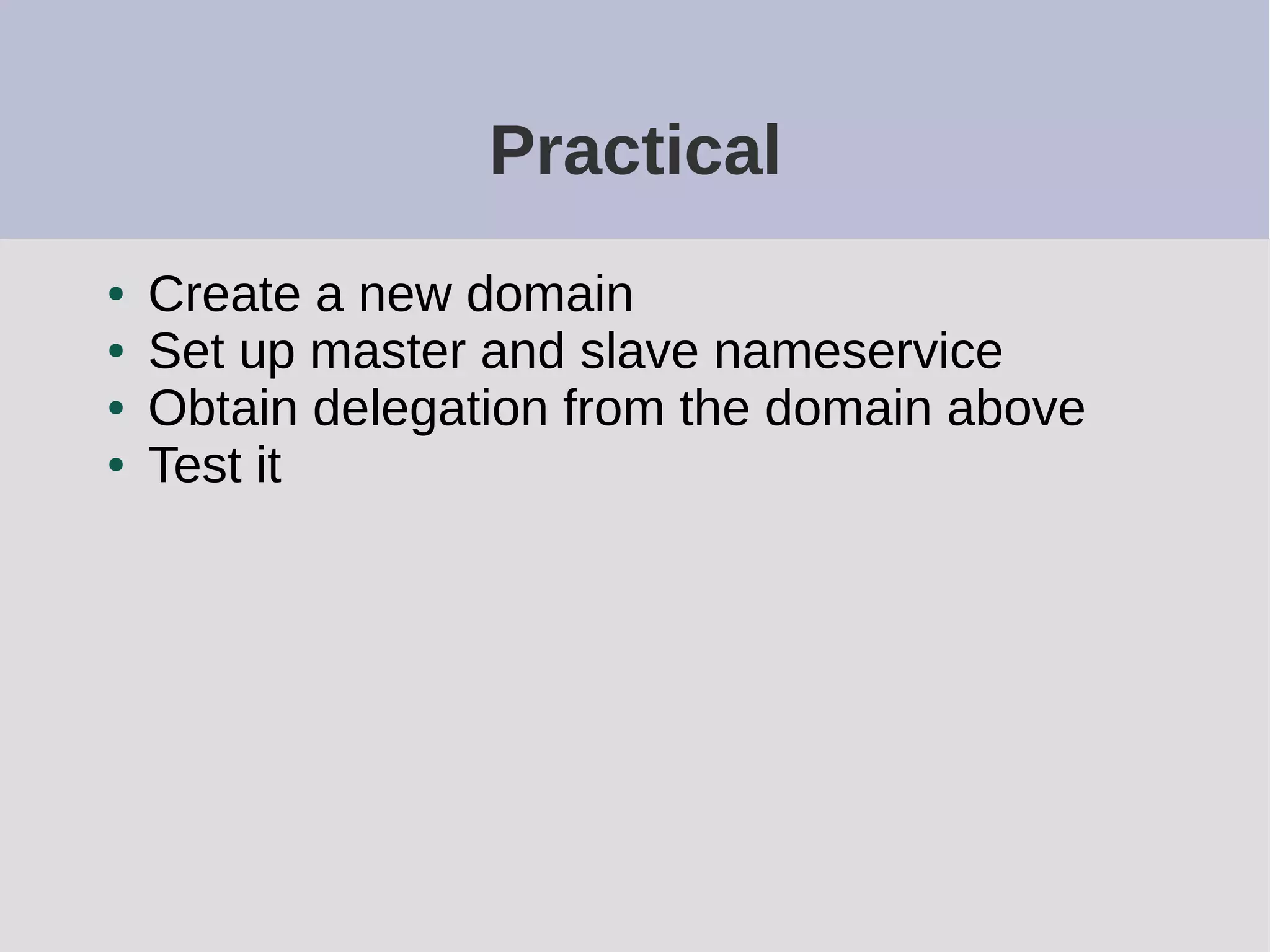
Practical
● Create a new domain
● Set up master and slave nameservice
● Obtain delegation from the domain above
● Test it
Part II – advanced delegation
Advanced DNS
Operations & Security
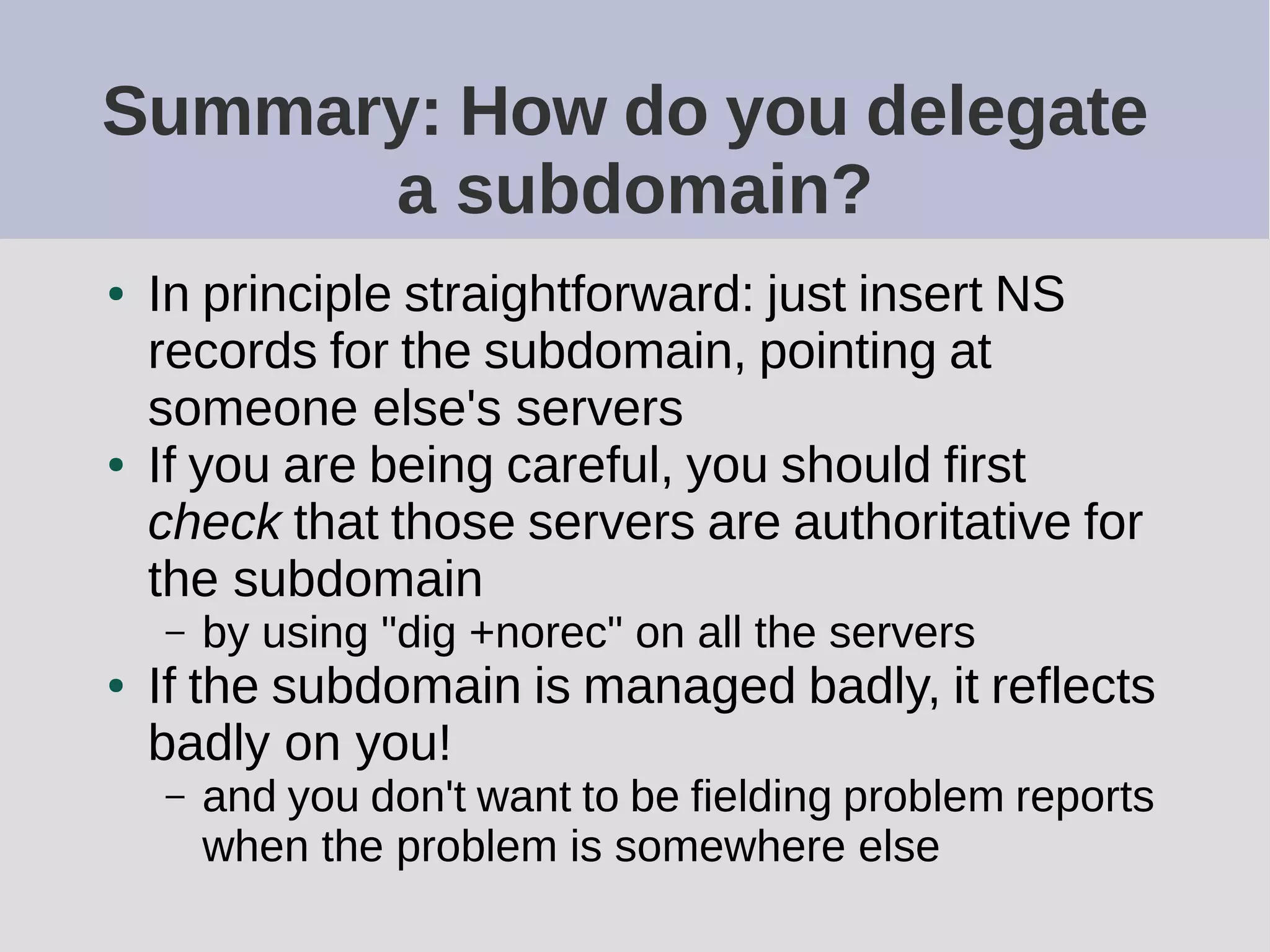
Summary: How do you delegate
a subdomain?
● In principle straightforward: just insert NS
records for the subdomain, pointing at
someone else's servers
● If you are being careful, you should first
check that those servers are authoritative for
the subdomain
– by using "dig +norec" on all the servers
● If the subdomain is managed badly, it reflects
badly on you!
– and you don't want to be fielding problem reports
when the problem is somewhere else
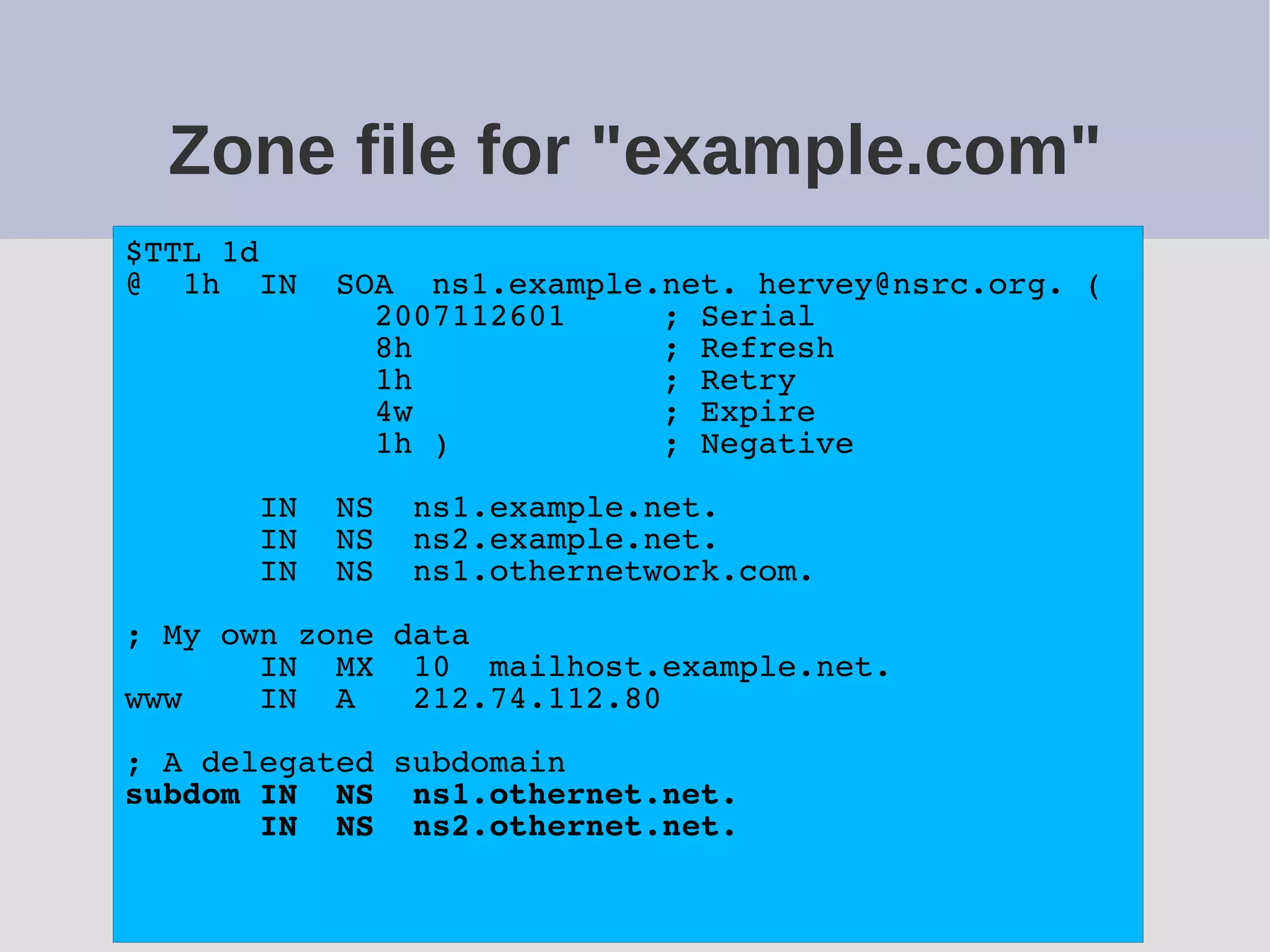
Zone file for "example.com"
$TTL 1d
@ 1h IN SOA ns1.example.net. hervey@nsrc.org. (
2007112601 ; Serial
8h ; Refresh
1h ; Retry
4w ; Expire
1h ) ; Negative
IN NS ns1.example.net.
IN NS ns2.example.net.
IN NS ns1.othernetwork.com.
; My own zone data
IN MX 10 mailhost.example.net.
www IN A 212.74.112.80
; A delegated subdomain
subdom IN NS ns1.othernet.net.
IN NS ns2.othernet.net.
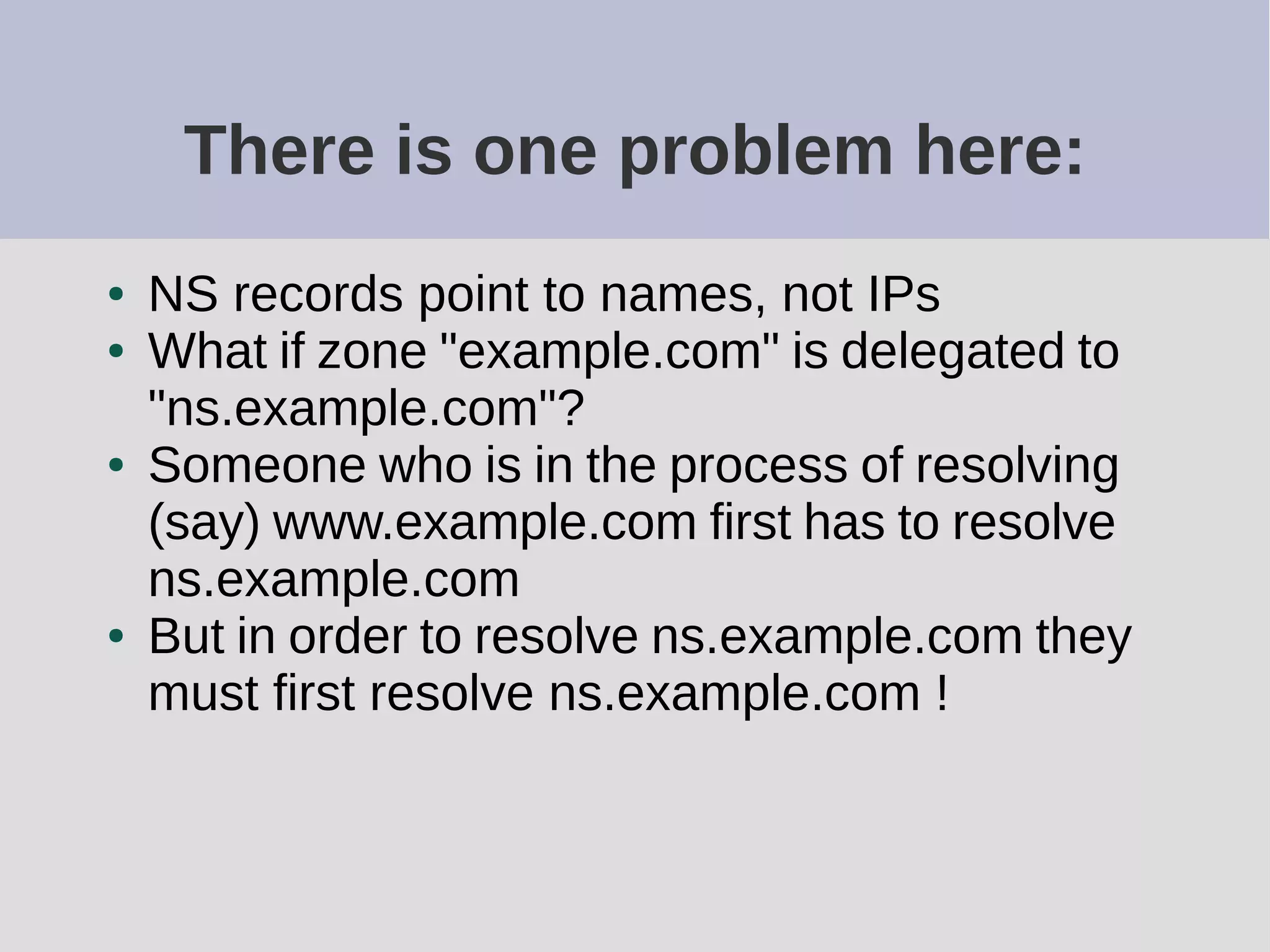
There is one problem here:
● NS records point to names, not IPs
● What if zone "example.com" is delegated to
"ns.example.com"?
● Someone who is in the process of resolving
(say) www.example.com first has to resolve
ns.example.com
● But in order to resolve ns.example.com they
must first resolve ns.example.com !
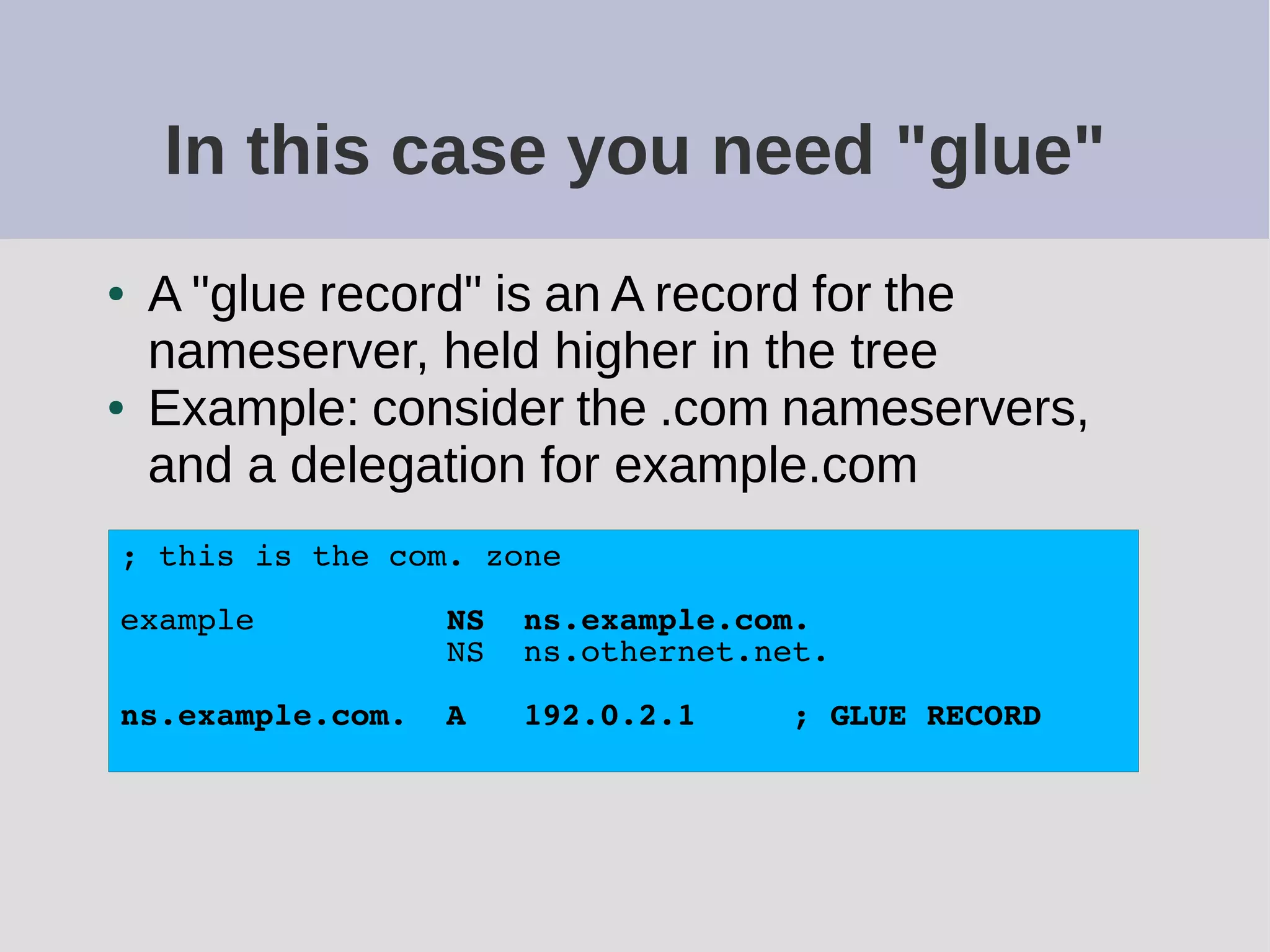
In this case you need "glue"
● A "glue record" is an A record for the
nameserver, held higher in the tree
● Example: consider the .com nameservers,
and a delegation for example.com
; this is the com. zone
example NS ns.example.com.
NS ns.othernet.net.
ns.example.com. A 192.0.2.1 ; GLUE RECORD
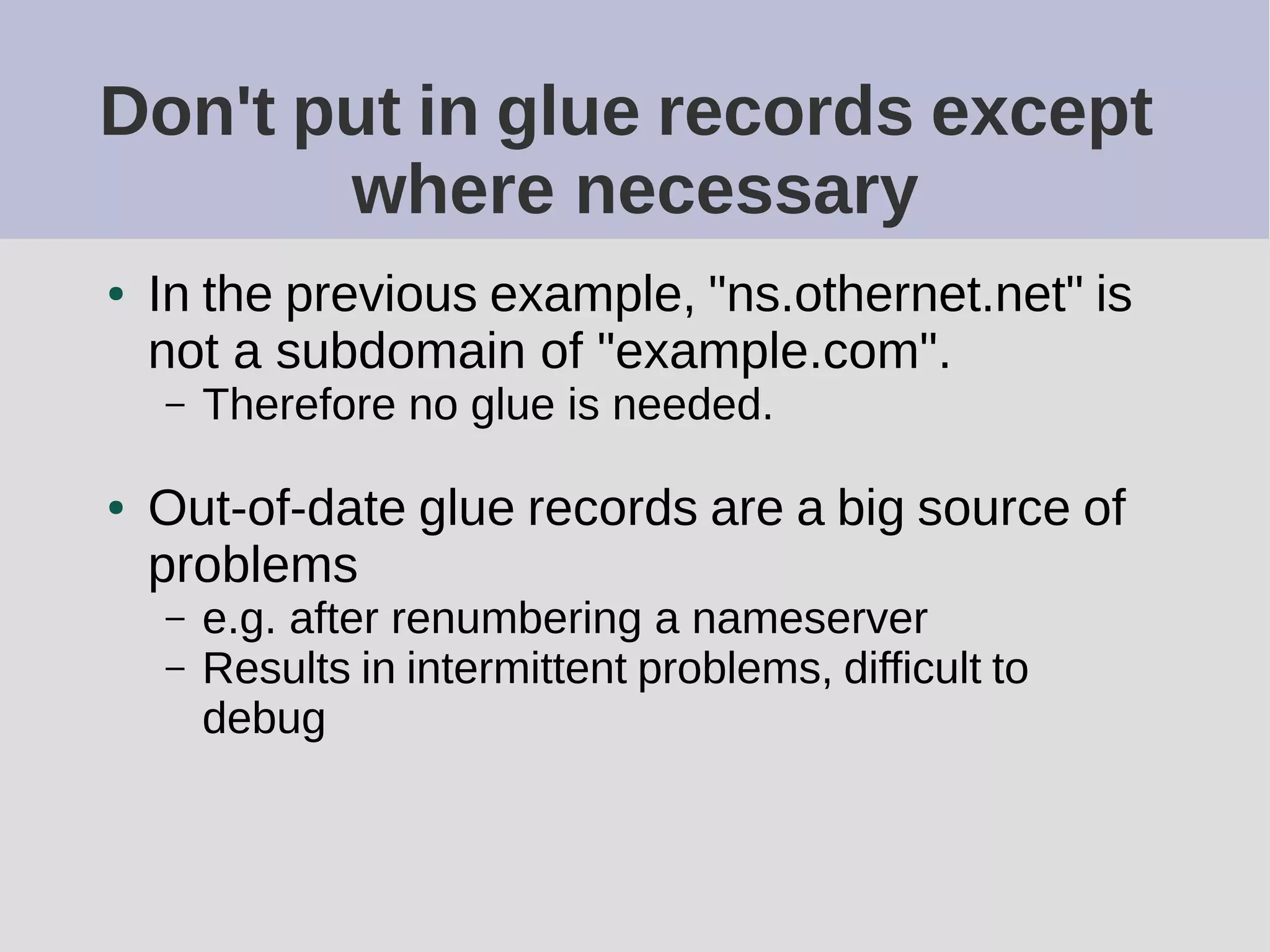
Don't put in glue records except
where necessary
● In the previous example, "ns.othernet.net" is
not a subdomain of "example.com".
– Therefore no glue is needed.
● Out-of-date glue records are a big source of
problems
– e.g. after renumbering a nameserver
– Results in intermittent problems, difficult to
debug
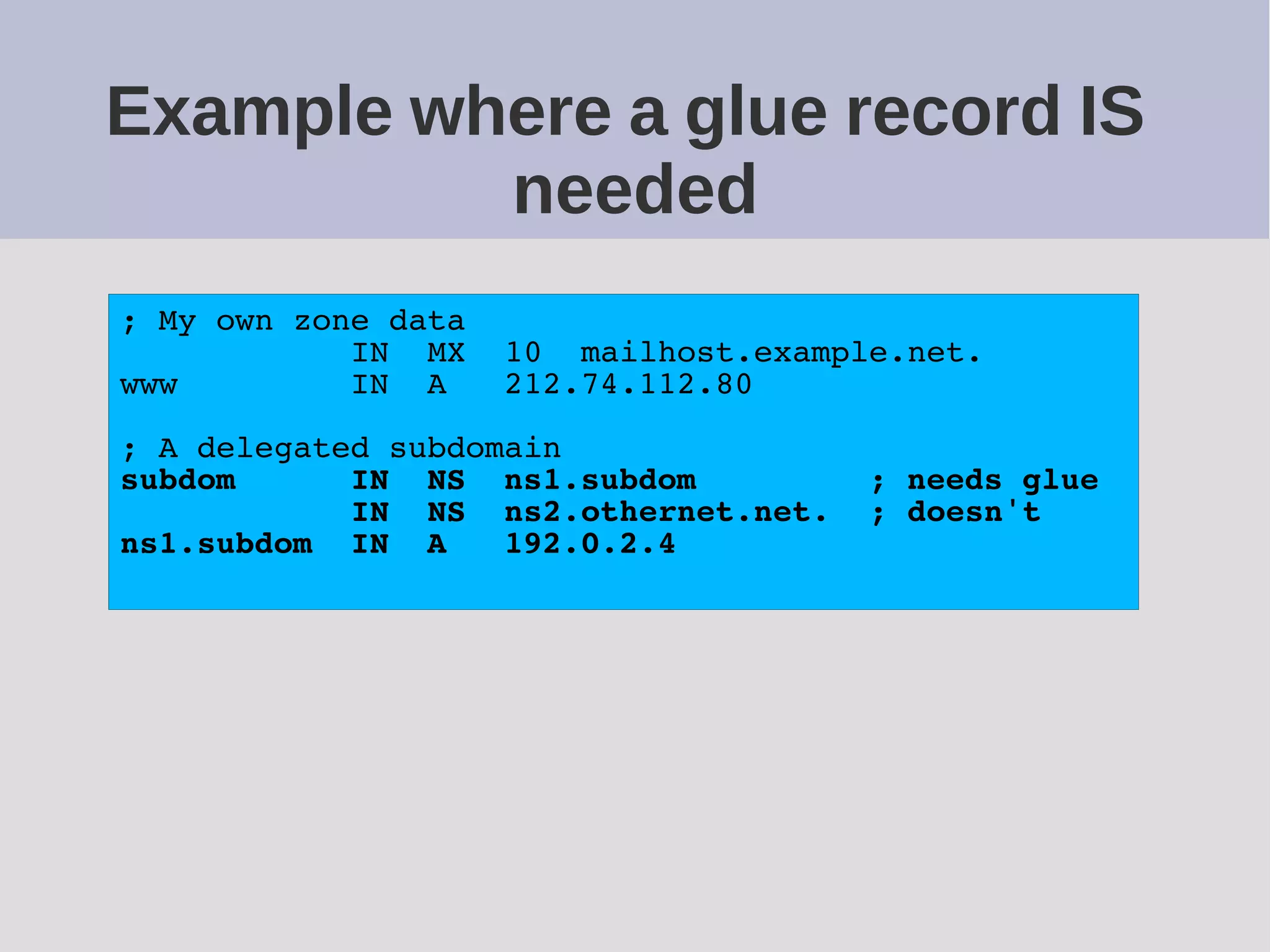
Example where a glue record IS
needed
; My own zone data
IN MX 10 mailhost.example.net.
www IN A 212.74.112.80
; A delegated subdomain
subdom IN NS ns1.subdom ; needs glue
IN NS ns2.othernet.net. ; doesn't
ns1.subdom IN A 192.0.2.4
Checking for glue records
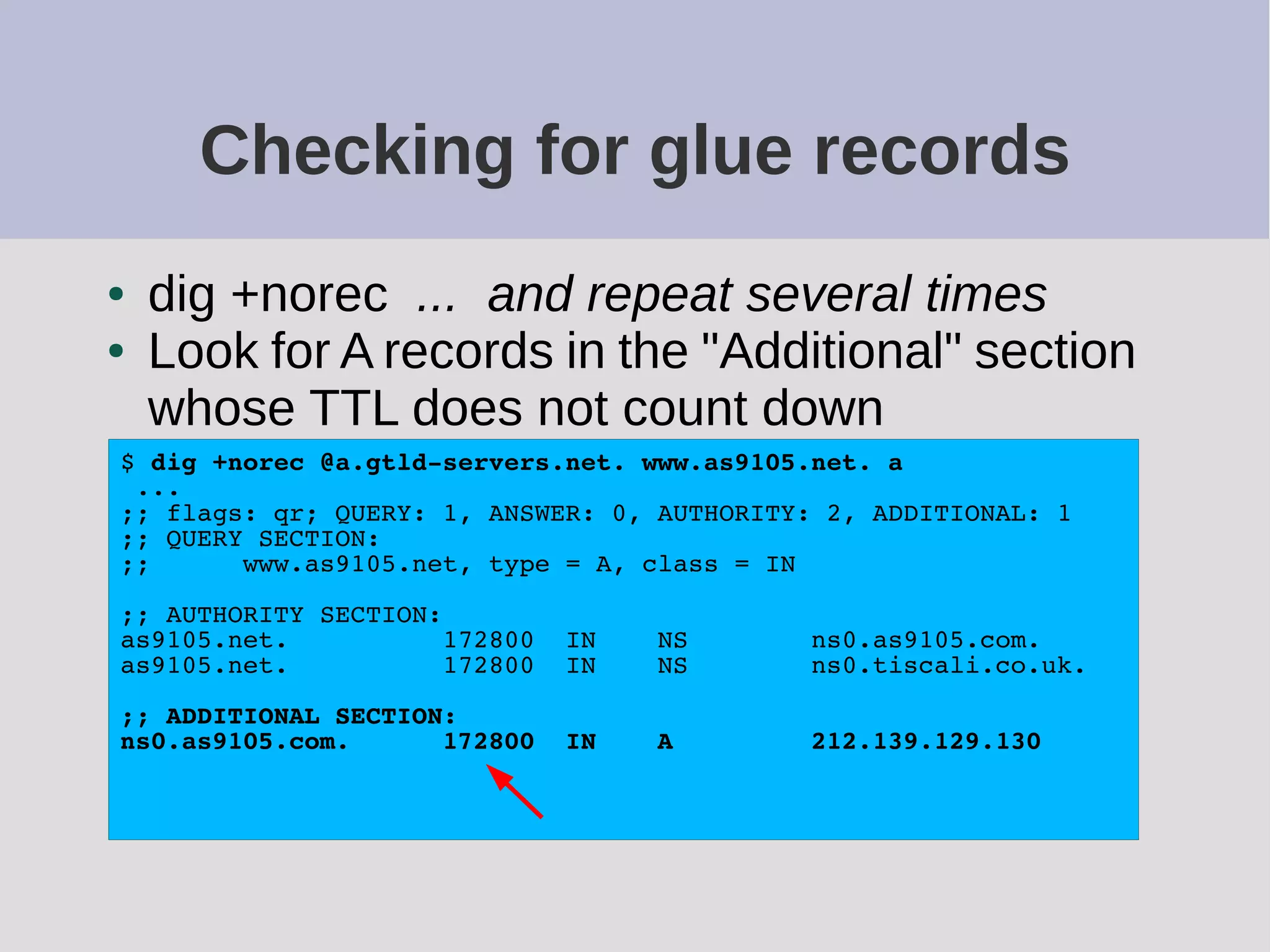
● dig +norec ... and repeat several times
● Look for A records in the "Additional" section
whose TTL does not count down
$ dig +norec @a.gtld-servers.net. www.as9105.net. a
...
;; flags: qr; QUERY: 1, ANSWER: 0, AUTHORITY: 2, ADDITIONAL: 1
;; QUERY SECTION:
;; www.as9105.net, type = A, class = IN
;; AUTHORITY SECTION:
as9105.net. 172800 IN NS ns0.as9105.com.
as9105.net. 172800 IN NS ns0.tiscali.co.uk.
;; ADDITIONAL SECTION:
ns0.as9105.com. 172800 IN A 212.139.129.130
Practical
● Delegating a subdomain
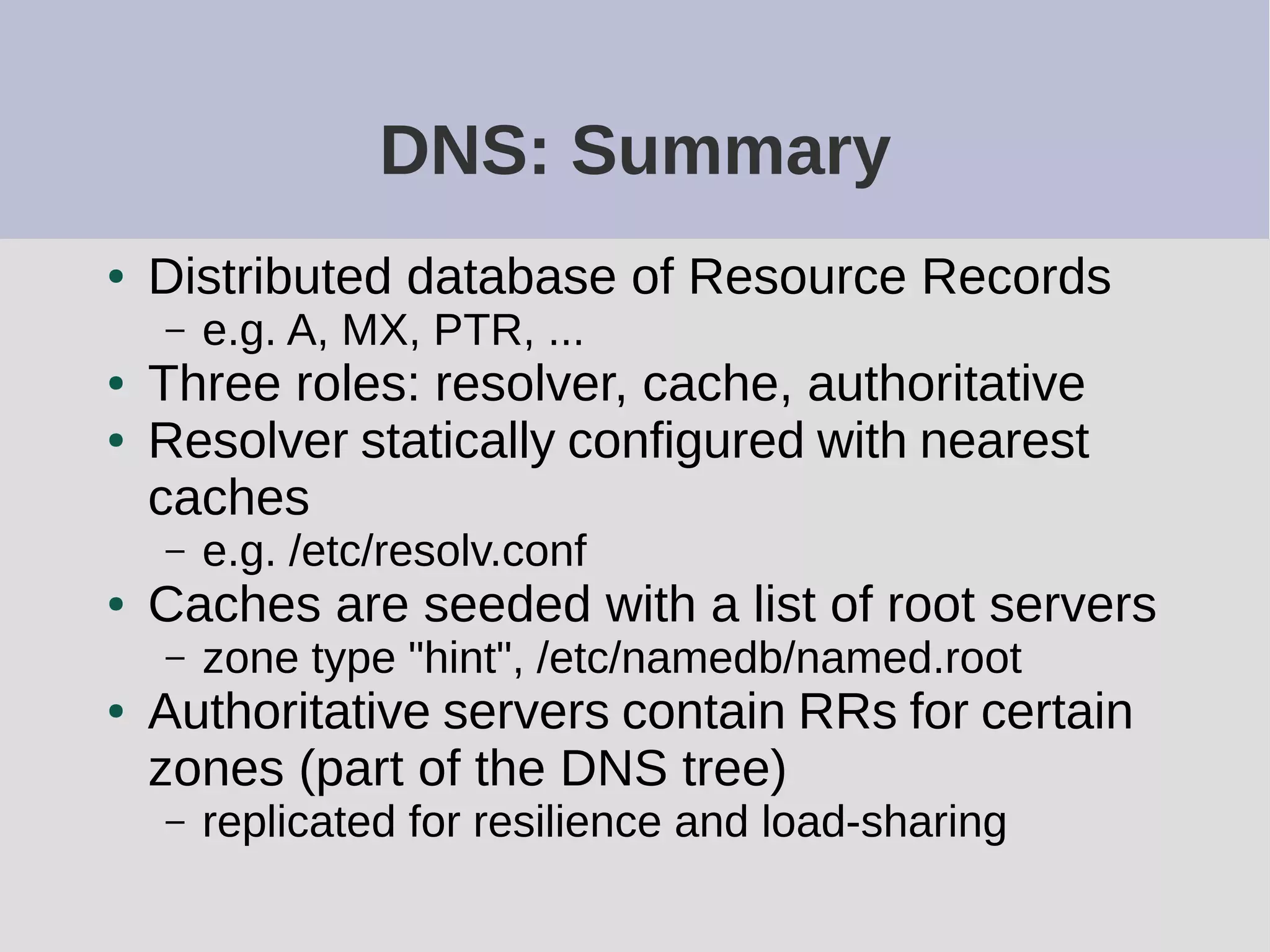
DNS: Summary
● Distributed database of Resource Records
– e.g. A, MX, PTR, ...
● Three roles: resolver, cache, authoritative
● Resolver statically configured with nearest
caches
– e.g. /etc/resolv.conf
● Caches are seeded with a list of root servers
– zone type "hint", /etc/namedb/named.root
● Authoritative servers contain RRs for certain
zones (part of the DNS tree)
– replicated for resilience and load-sharing
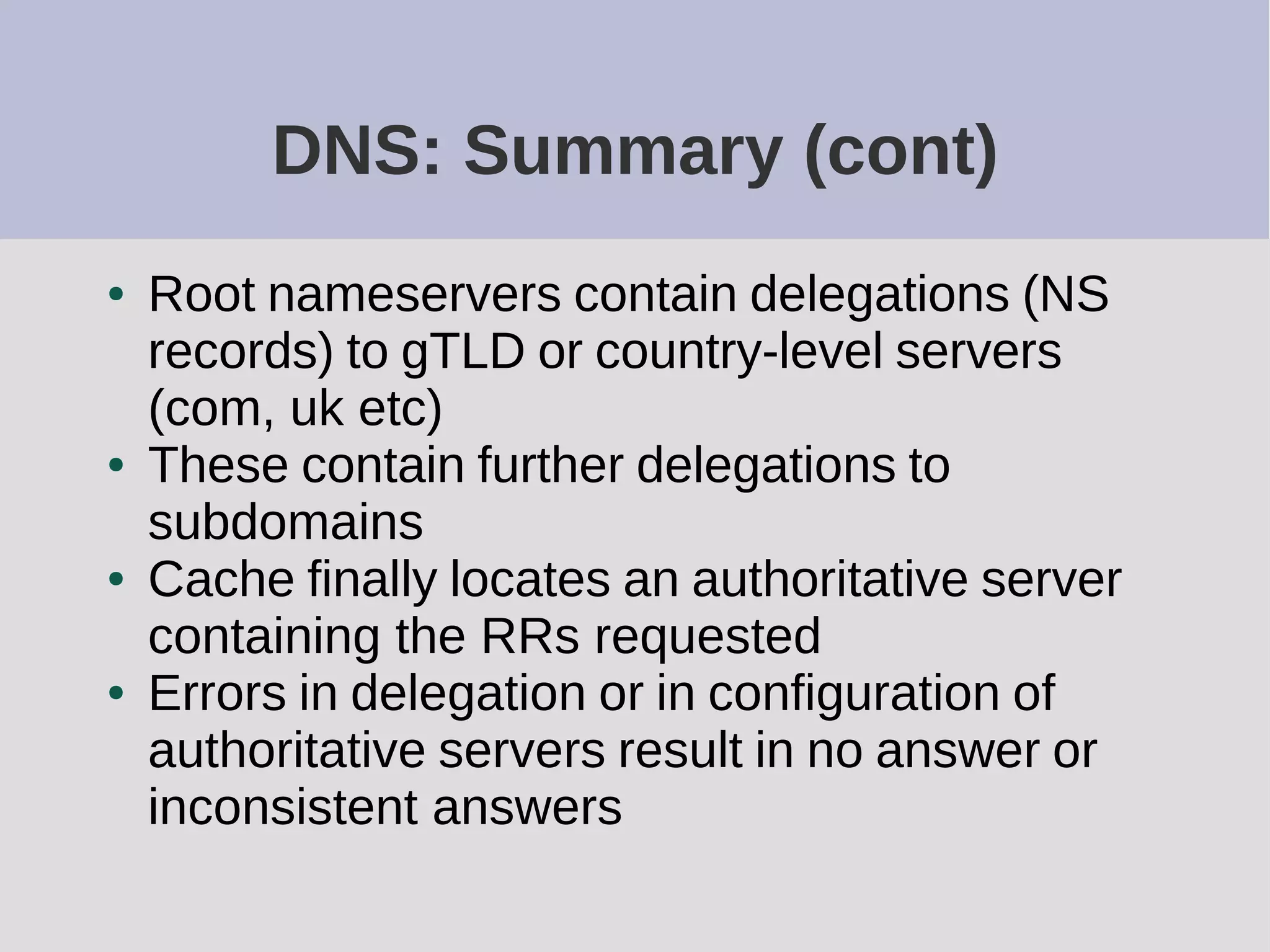
DNS: Summary (cont)
● Root nameservers contain delegations (NS
records) to gTLD or country-level servers
(com, uk etc)
● These contain further delegations to
subdomains
● Cache finally locates an authoritative server
containing the RRs requested
● Errors in delegation or in configuration of
authoritative servers result in no answer or
inconsistent answers
Further reading
● "DNS and BIND" (O'Reilly)
● BIND 9 Administrator Reference Manual
– /usr/share/doc/bind9/arm/Bv9ARM.html
● http://www.isc.org/sw/bind/
– includes FAQ, security alerts
● RFC 1912, RFC 2182
– http://www.rfc-editor.org/

4 technical-dns-workshop-day2

  • 1.
  • 2.
    Recap ● DNS isa distributed database ● Resolver asks Cache for information ● Cache traverses the DNS delegation tree to find Authoritative nameserver which has the information requested ● Bad configuration of authoritative servers can result in broken domains
  • 3.
    DNS Replication ● Forevery domain, we need more than one authoritative nameserver with the same information (RFC 2182) ● Data is entered in one server (Master) and replicated to the others (Slave(s)) ● Outside world cannot tell the difference between master and slave – NS records are returned in random order for equal load sharing ● Used to be called "primary" and "secondary"
  • 4.
    Slaves connect toMaster to retrieve copy of zone data ● The master does not "push" data to the slaves Master Slave Slave
  • 5.
    When does replicationtake place? ● Slaves poll the master periodically - called the "Refresh Interval" - to check for new data – Originally this was the only mechanism ● Master can also notify the slaves when the data changes – Results in quicker updates ● The notification is unreliable (e.g. network might lose a packet) so we still need checks at the Refresh Interval
  • 6.
    Serial Numbers ● Everyzone file has a Serial Number ● Slave will only copy data when this number INCREASES – Periodic UDP query to check Serial Number – If increased, TCP transfer of zone data ● It is your responsibility to increase the serial number after every change, otherwise slaves and master will be inconsistent
  • 7.
    Recommended serial number format:YYYYMMDDNN ● YYYY = year ● MM = month (01-12) ● DD = day (01-31) ● NN = number of changes today (00-99) – e.g. if you change the file on 5th March 2004, the serial number will be 2004030500. If you change it again on the same day, it will be 2004030501.
  • 8.
    Serial Numbers: Danger1 ● If you ever decrease the serial number, the slaves will never update again until the serial number goes above its previous value ● RFC1912 section 3.1 explains a method to fix this problem ● At worst, you can contact all your slaves and get them to delete their copy of the zone data
  • 9.
    Serial Numbers: Danger2 ● Serial no. is a 32-bit unsigned number ● Range: 0 to 4,294,967,295 ● Any value larger than this is silently truncated ● e.g. 20040305000 (note extra digit) = 4AA7EC968 (hex) = AA7EC968 (32 bits) = 2860435816 ● If you make this mistake, then later correct it, the serial number will have decreased
  • 10.
    Configuration of Master ●/etc/namedb/named.conf points to zone file (manually created) containing your RRs ● Choose a logical place to keep them – e.g. /etc/namedb/master/tiscali.co.uk – or /etc/namedb/master/uk.co.tiscali zone "example.com" { type master; file "master/example.com"; allow-transfer { 192.188.58.126; 192.188.58.2; }; };
  • 11.
    Configuration of Slave ●named.conf points to IP address of master and location where zone file should be created ● Slave zone files are transferred automatically ● Don't edit them! zone "example.com" { type slave; masters { 192.188.58.126; }; file "slave/example.com"; allow-transfer { none; }; };
  • 12.
    Master and Slave ●It's perfectly OK for one server to be Master for some zones and Slave for others ● That's why it is good practice to keep the files in different directories – /etc/namedb/master/ – /etc/namedb/slave/ ● (also, the slave directory must have appropriate permissions so that the daemon can create files)
  • 13.
    allow-transfer { ...} ● Remote machines can request a transfer of the entire zone contents ● You can control who is allowed to grab (transfer) a copy of the zone. ● By default, only nameservers of the zone can (as declared in the zone) ● You can set a global default, and override this for each zone if required options { allow-transfer { 127.0.0.1; }; };
  • 14.
    Structure of azone file ● Global options – $TTL 1d – Sets the default TTL for all other records ● SOA RR – "Start Of Authority" – Housekeeping information for the zone ● NS RRs – List all the nameservers for the zone, master and slaves ● Other RRs – The actual data you wish to publish
  • 15.
    Format of aResource Record ● One per line (except SOA can extend over several lines) ● If you omit the Domain Name, it is the same as the previous line ● TTL shortcuts: e.g. 60s, 30m, 4h, 1w2d ● If you omit the TTL, uses the $TTL default value ● If you omit the Class, it defaults to IN ● Type and Data cannot be omitted ● Comments start with SEMICOLON (;) www 3600 IN A 212.74.112.80 Domain TTL Class Type Data
  • 16.
    Shortcuts ● If theDomain Name does not end in a dot, the zone's own domain ("origin") is appended ● A Domain Name of "@" means the origin itself ● e.g. in zone file for example.com: – @ means example.com. – www means www.example.com.
  • 17.
    If you writethis... ... it becomes this $TTL 1d @ SOA ( ... ) NS ns0 NS ns0.as9105.net. ; Main webserver www A 212.74.112.80 MX 10 mail example.com. 86400 IN SOA ( ... ) example.com. 86400 IN NS ns0.example.com. example.com. 86400 IN NS ns0.as9105.net. www.example.com. 86400 IN A 212.74.112.80 www.example.com. 86400 IN MX 10 mail.example.com.
  • 18.
    Format of theSOA record $TTL 1d @ 1h IN SOA ns1.example.net. hervey@nsrc.org. ( 2004030300 ; Serial 8h ; Refresh 1h ; Retry 4w ; Expire 1h ) ; Negative IN NS ns1.example.net. IN NS ns2.example.net. IN NS ns1.othernetwork.com.
  • 19.
    Format of theSOA record ● ns1.example.net. – hostname of master nameserver ● hervey@nsrc.org. – E-mail address of responsible person, with trailing dot – In older versions of "@" changed to dot ● Serial number ● Refresh interval – How often Slave checks serial number on Master ● Retry interval – How often Slave checks serial number if the Master did not respond
  • 20.
    Format of theSOA record (cont) ● Expiry time – If the slave is unable to contact the master for this period of time, it will delete its copy of the zone data ● Negative / Minimum – Old software used this as a minimum value of the TTL – Now it is used for negative caching: indicates how long a cache may store the non-existence of a RR ● RIPE-203 has recommended values – http://www.ripe.net/ripe/docs/dns-soa.html
  • 21.
    Format of NSrecords ● List all authoritative nameservers for the zone - master and slave(s) ● Must point to HOSTNAME not IP address $TTL 1d @ 1h IN SOA ns1.example.net. brian.nsrc.org. ( 2004030300 ; Serial 8h ; Refresh 1h ; Retry 4w ; Expire 1h ) ; Negative IN NS ns1.example.net. IN NS ns2.example.net. IN NS ns1.othernetwork.com.
  • 22.
    Format of otherRRs ● IN A 1.2.3.4 ● IN MX 10 mailhost.example.com. – The number is a "preference value". Mail is delivered to the lowest-number MX first – Must point to HOSTNAME not IP address ● IN CNAME host.example.com. ● IN PTR host.example.com. ● IN TXT "any text you like"
  • 23.
    When you haveadded or changed a zone file: ● Remember to increase the serial number! ● named-checkzone example.com /etc/namedb/master/example.com – bind 9 feature – reports zone file syntax errors; correct them! ● named-checkconf – reports errors in named.conf ● rndc reload – or: rndc reload example.com ● tail /var/log/messages
  • 24.
    These checks areESSENTIAL ● If you have an error in named.conf or a zone file, named may continue to run but will not be authoritative for the bad zone(s) ● You will be lame for the zone without realising it ● Slaves will not be able to contact the master ● Eventually (e.g. 4 weeks later) the slaves will expire the zone ● Your domain will stop working
  • 25.
    Other checks youcan do ● dig +norec @x.x.x.x example.com. soa – Check the AA flag – Repeat for the master and all the slaves – Check the serial numbers match ● dig @x.x.x.x example.com. axfr – "Authority Transfer" – Requests a full copy of the zone contents over TCP, as slaves do to master – This will only work from IP addresses listed in the allow-transfer {...} section
  • 26.
    So now youhave working authoritative nameservers! ● But none of this will work until you have delegation from the domain above ● That is, they put in NS records for your domain, pointing at your nameservers ● You have also put NS records within the zone file ● The two sets should match
  • 27.
  • 28.
    TOP TEN ERRORSin authoritative nameservers ● All operators of auth nameservers should read RFC 1912 – Common DNS Operational and Configuration Errors ● And also RFC 2182 – Selection and Operation of Secondary DNS servers
  • 29.
    1. Serial numbererrors ● Forgot to increment serial number ● Incremented serial number, then decremented it ● Used serial number greater than 232 ● Impact: – Slaves do not update – Master and slaves have inconsistent data – Caches will sometimes get the new data and sometimes old - intermittent problem
  • 30.
    2. Comments inzone files starting '#' instead of ';' ● Syntax error in zone file ● Master is no longer authoritative for the zone ● Slaves cannot check SOA ● Slaves eventually expire the zone, and your domain stops working entirely ● Use "named-checkzone" ● Use "tail /var/log/messages"
  • 31.
    3. Other syntaxerrors in zone files ● e.g. omitting the preference value from MX records ● Same impact
  • 32.
    4. Missing thetrailing dot ; zone example.com. @ IN MX 10 mailhost.example.com becomes @ IN MX 10 mailhost.example.com.example.com. ; zone 2.0.192.in-addr.arpa. 1 IN PTR host.example.com becomes 1 IN PTR host.example.com.2.0.192.in-addr.arpa.
  • 33.
    5. NS orMX records pointing to IP addresses ● They must point to hostnames, not IP addresses ● Unfortunately, a few mail servers do accept IP addresses in MX records, so you may not see a problem with all remote sites
  • 34.
    6. Slave cannottransfer zone from master ● Access restricted by allow-transfer {...} and slave not listed ● Or IP filters not configured correctly ● Slave will be lame (non-authoritative)
  • 35.
    7. Lame delegation ●You cannot just list any nameserver in NS records for your domain ● You must get agreement from the nameserver operator, and they must configure it as a slave for your zone ● At best: slower DNS resolution and lack of resilience ● At worst: intermittent failures to resolve your domain
  • 36.
    8. No delegationat all ● You can configure "example.com" on your nameservers but the outside world will not send requests to them until you have delegation ● The problem is hidden if your nameserver is acting both as your cache and as authoritative nameserver ● Your own clients can resolve www.example.com, but the rest of the world cannot
  • 37.
    9. Out-of-date gluerecords ● See later
  • 38.
    10. Not managingTTL correctly during changes ● e.g. if you have a 24 hour TTL, and you swing www.example.com to point to a new server, then there will be an extended period when some users hit one machine and some hit the other ● Follow the procedure: – Reduce TTL to 10 minutes – Wait at least 24 hours – Make the change – Put the TTL back to 24 hours
  • 39.
    Practical ● Create anew domain ● Set up master and slave nameservice ● Obtain delegation from the domain above ● Test it
  • 40.
    Part II –advanced delegation Advanced DNS Operations & Security
  • 41.
    Summary: How doyou delegate a subdomain? ● In principle straightforward: just insert NS records for the subdomain, pointing at someone else's servers ● If you are being careful, you should first check that those servers are authoritative for the subdomain – by using "dig +norec" on all the servers ● If the subdomain is managed badly, it reflects badly on you! – and you don't want to be fielding problem reports when the problem is somewhere else
  • 42.
    Zone file for"example.com" $TTL 1d @ 1h IN SOA ns1.example.net. hervey@nsrc.org. ( 2007112601 ; Serial 8h ; Refresh 1h ; Retry 4w ; Expire 1h ) ; Negative IN NS ns1.example.net. IN NS ns2.example.net. IN NS ns1.othernetwork.com. ; My own zone data IN MX 10 mailhost.example.net. www IN A 212.74.112.80 ; A delegated subdomain subdom IN NS ns1.othernet.net. IN NS ns2.othernet.net.
  • 43.
    There is oneproblem here: ● NS records point to names, not IPs ● What if zone "example.com" is delegated to "ns.example.com"? ● Someone who is in the process of resolving (say) www.example.com first has to resolve ns.example.com ● But in order to resolve ns.example.com they must first resolve ns.example.com !
  • 44.
    In this caseyou need "glue" ● A "glue record" is an A record for the nameserver, held higher in the tree ● Example: consider the .com nameservers, and a delegation for example.com ; this is the com. zone example NS ns.example.com. NS ns.othernet.net. ns.example.com. A 192.0.2.1 ; GLUE RECORD
  • 45.
    Don't put inglue records except where necessary ● In the previous example, "ns.othernet.net" is not a subdomain of "example.com". – Therefore no glue is needed. ● Out-of-date glue records are a big source of problems – e.g. after renumbering a nameserver – Results in intermittent problems, difficult to debug
  • 46.
    Example where aglue record IS needed ; My own zone data IN MX 10 mailhost.example.net. www IN A 212.74.112.80 ; A delegated subdomain subdom IN NS ns1.subdom ; needs glue IN NS ns2.othernet.net. ; doesn't ns1.subdom IN A 192.0.2.4
  • 47.
    Checking for gluerecords ● dig +norec ... and repeat several times ● Look for A records in the "Additional" section whose TTL does not count down $ dig +norec @a.gtld-servers.net. www.as9105.net. a ... ;; flags: qr; QUERY: 1, ANSWER: 0, AUTHORITY: 2, ADDITIONAL: 1 ;; QUERY SECTION: ;; www.as9105.net, type = A, class = IN ;; AUTHORITY SECTION: as9105.net. 172800 IN NS ns0.as9105.com. as9105.net. 172800 IN NS ns0.tiscali.co.uk. ;; ADDITIONAL SECTION: ns0.as9105.com. 172800 IN A 212.139.129.130
  • 48.
  • 49.
    DNS: Summary ● Distributeddatabase of Resource Records – e.g. A, MX, PTR, ... ● Three roles: resolver, cache, authoritative ● Resolver statically configured with nearest caches – e.g. /etc/resolv.conf ● Caches are seeded with a list of root servers – zone type "hint", /etc/namedb/named.root ● Authoritative servers contain RRs for certain zones (part of the DNS tree) – replicated for resilience and load-sharing
  • 50.
    DNS: Summary (cont) ●Root nameservers contain delegations (NS records) to gTLD or country-level servers (com, uk etc) ● These contain further delegations to subdomains ● Cache finally locates an authoritative server containing the RRs requested ● Errors in delegation or in configuration of authoritative servers result in no answer or inconsistent answers
  • 51.
    Further reading ● "DNSand BIND" (O'Reilly) ● BIND 9 Administrator Reference Manual – /usr/share/doc/bind9/arm/Bv9ARM.html ● http://www.isc.org/sw/bind/ – includes FAQ, security alerts ● RFC 1912, RFC 2182 – http://www.rfc-editor.org/