Engine Components and
4 stroke cycle
What is Engine?
A machine that converts electrical
and chemical energy into
mechanical energy thru internal
combustion.
Components of Engine
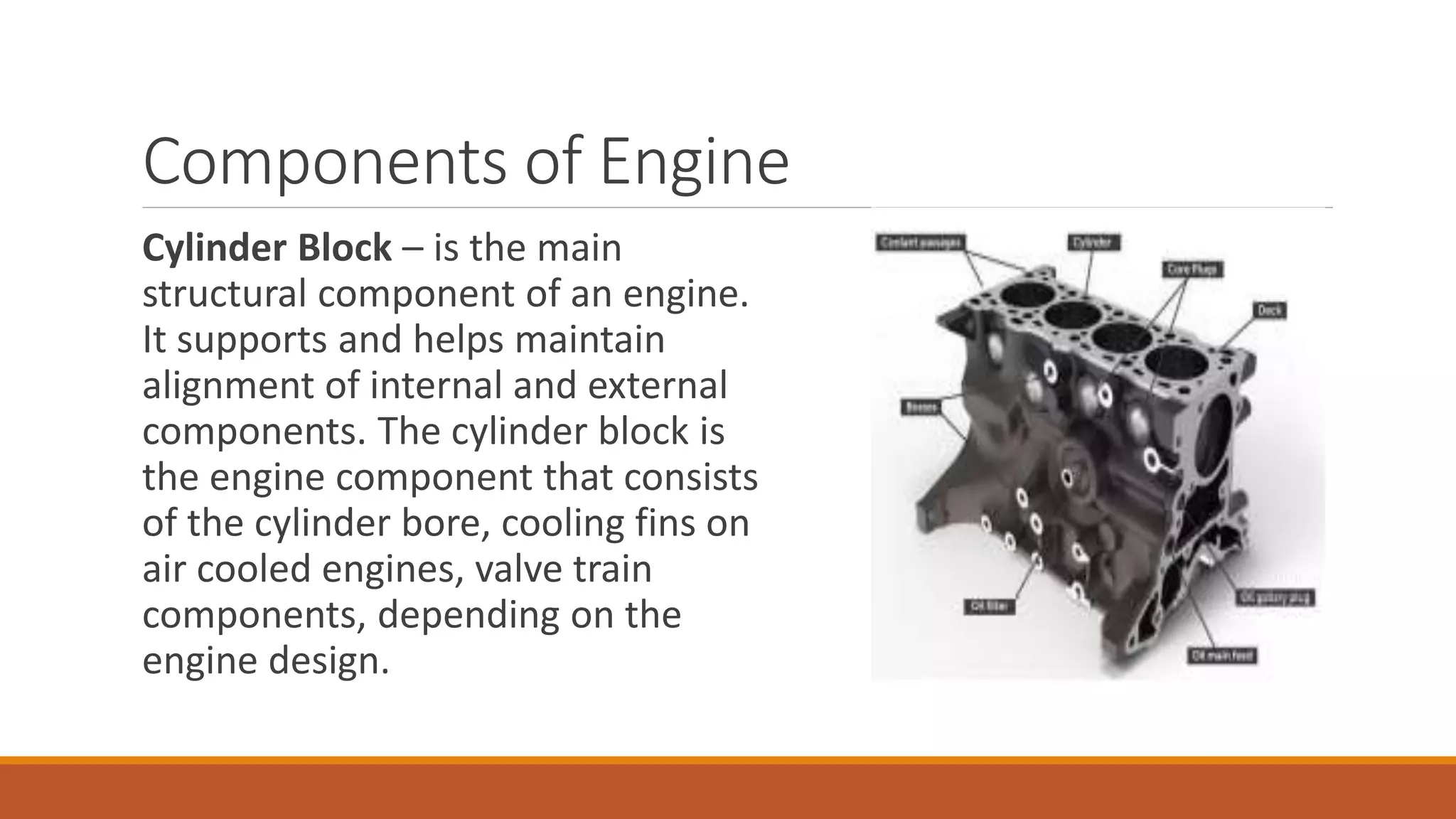
Cylinder Block – is the main
structural component of an engine.
It supports and helps maintain
alignment of internal and external
components. The cylinder block is
the engine component that consists
of the cylinder bore, cooling fins on
air cooled engines, valve train
components, depending on the
engine design.
Components of Engine
Cylinder Head – is a cast aluminum
alloy or cast iron engine component
fastened to the end of the cylinder
block farthest from the crankshaft. A
head gasket is the filler material placed
between the cylinder block and
cylinder head to seal the combustion
chamber. Head gaskets are made from
soft metals and graphite layered
together.
Components of Engine
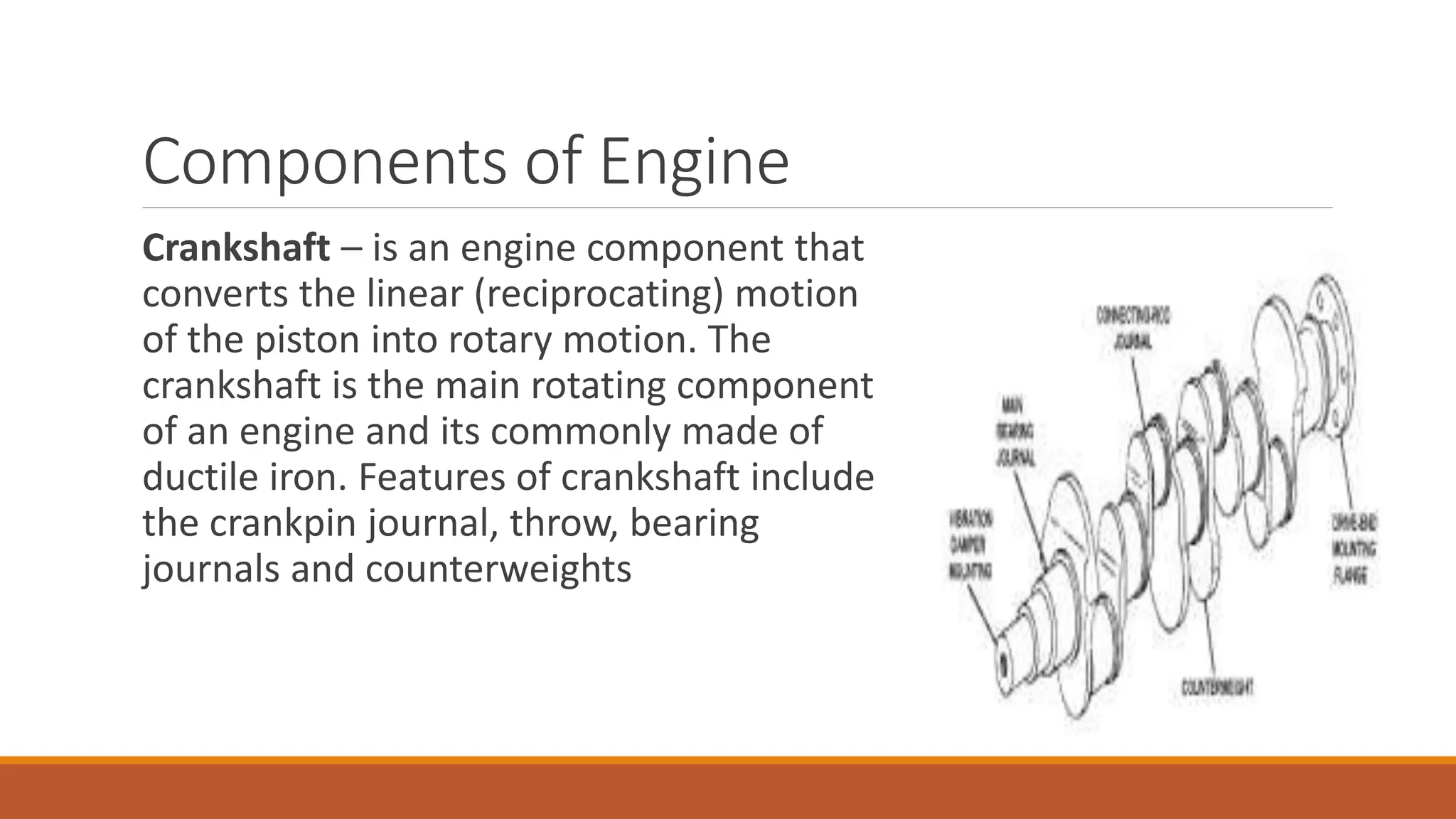
Crankshaft – is an engine component that
converts the linear (reciprocating) motion
of the piston into rotary motion. The
crankshaft is the main rotating component
of an engine and its commonly made of
ductile iron. Features of crankshaft include
the crankpin journal, throw, bearing
journals and counterweights
Components of Engine
Piston and piston rings – a piston is a
cylindrical engine component that
slides back and forth in the cylinder
bore by forces produced during the
combustion process. The piston acts
as a movable end of the combustion
chamber. Pistons are commonly made
of a cast aluminum alloy for excellent
and lightweight thermal conductivity.
Components of Engine
Connecting rod – is an engine component that transfers motion from
the piston to the crankshaft and functions as a lever arm. Connecting
rods are commonly made from cast aluminum alloy and are designed
to withstand dynamic stresses from combustion and piston
movement. The small end of the connecting rod connects to the
piston with a piston pin. The piston pin, or wrist pin, provides a pivot
point between the piston and connecting rod. Spring clips, or piston
pin locks are used to hold the piston pin in place. The big end of the
connecting rod connects to the crankpin journal to provide a pivot
point on the crankshaft.
Components of Engine
Bearings – a bearing is a component used to reduce
friction and to maintain clearance between stationary
and rotating components of the engine. Bearings, or
bearing surfaces are located on the crankshaft,
connecting rod, and camshaft and also in the cylinder
block.
Components of Engine
Flywheel - is a cast iron, aluminum, or zinc disk that is
mounted at one end of the crankshaft to provide inertia
for the engine. Inertia is not a force, it is a property of
matter. During the operation of a reciprocating engine,
combustion occurs at distinct intervals. The flywheel
supplies the inertia required to prevent loss of engine
speed and possible stoppage of crankshaft rotation
between combustion intervals.
Components of
Engine
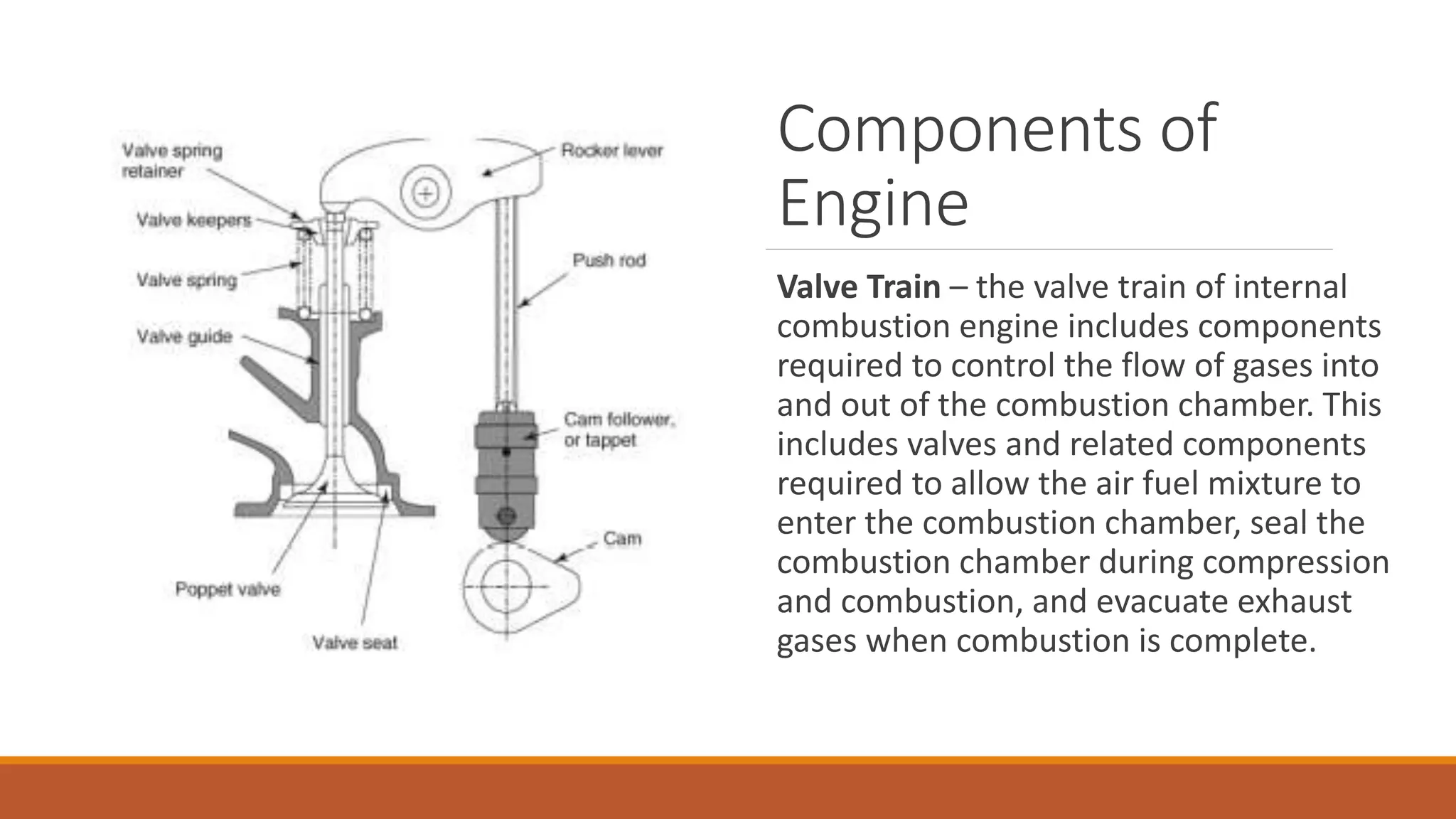
Valve Train – the valve train of internal
combustion engine includes components
required to control the flow of gases into
and out of the combustion chamber. This
includes valves and related components
required to allow the air fuel mixture to
enter the combustion chamber, seal the
combustion chamber during compression
and combustion, and evacuate exhaust
gases when combustion is complete.
Components of
Engine
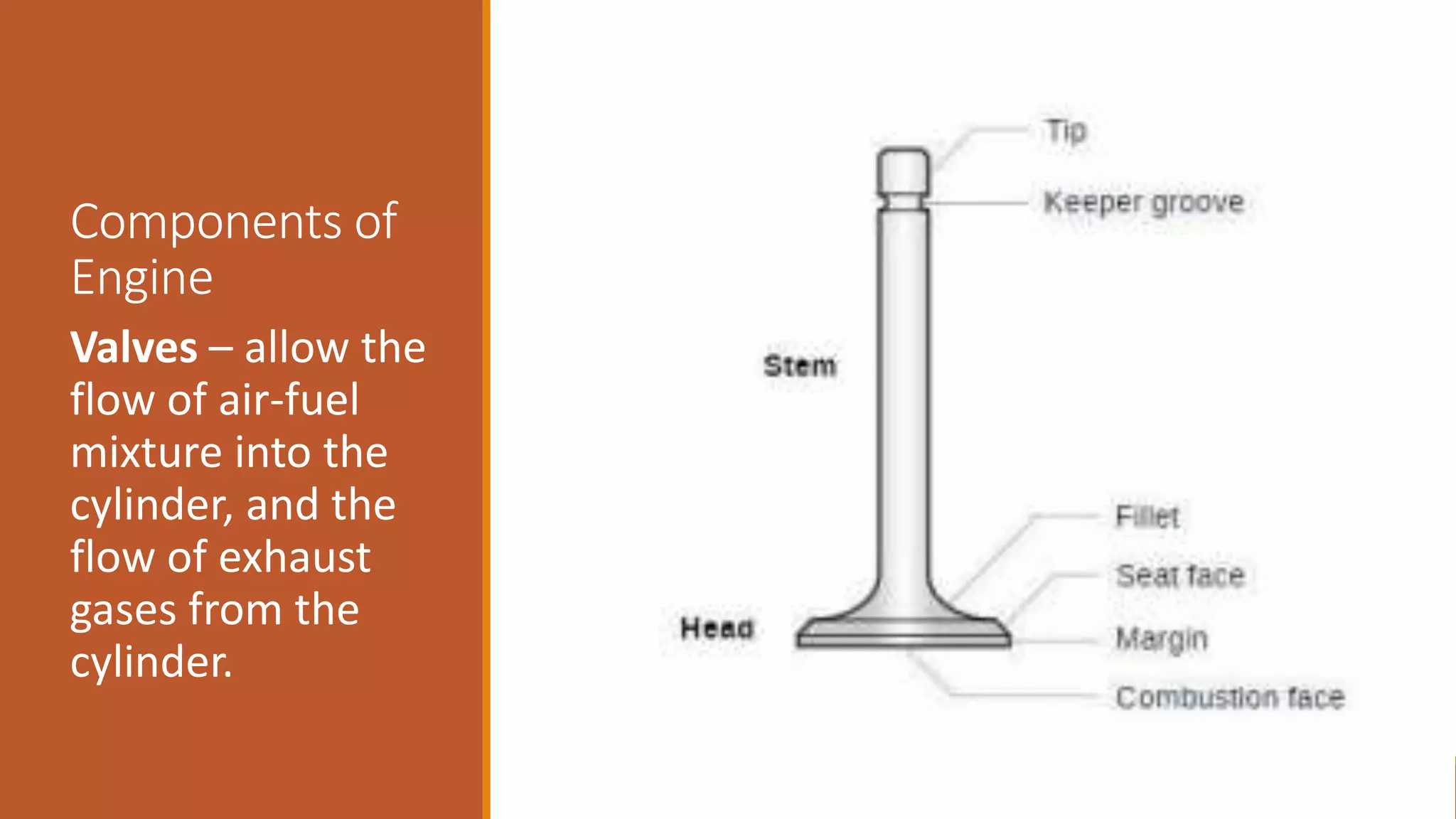
Valves – allow the
flow of air-fuel
mixture into the
cylinder, and the
flow of exhaust
gases from the
cylinder.
What is Cycle?
It is an event happen repeat themselves
In an internal combustion engine there are several
cycle happen and these are:
Intake stroke
Compression stroke
Power stroke
Exhaust stroke
What is stroke?
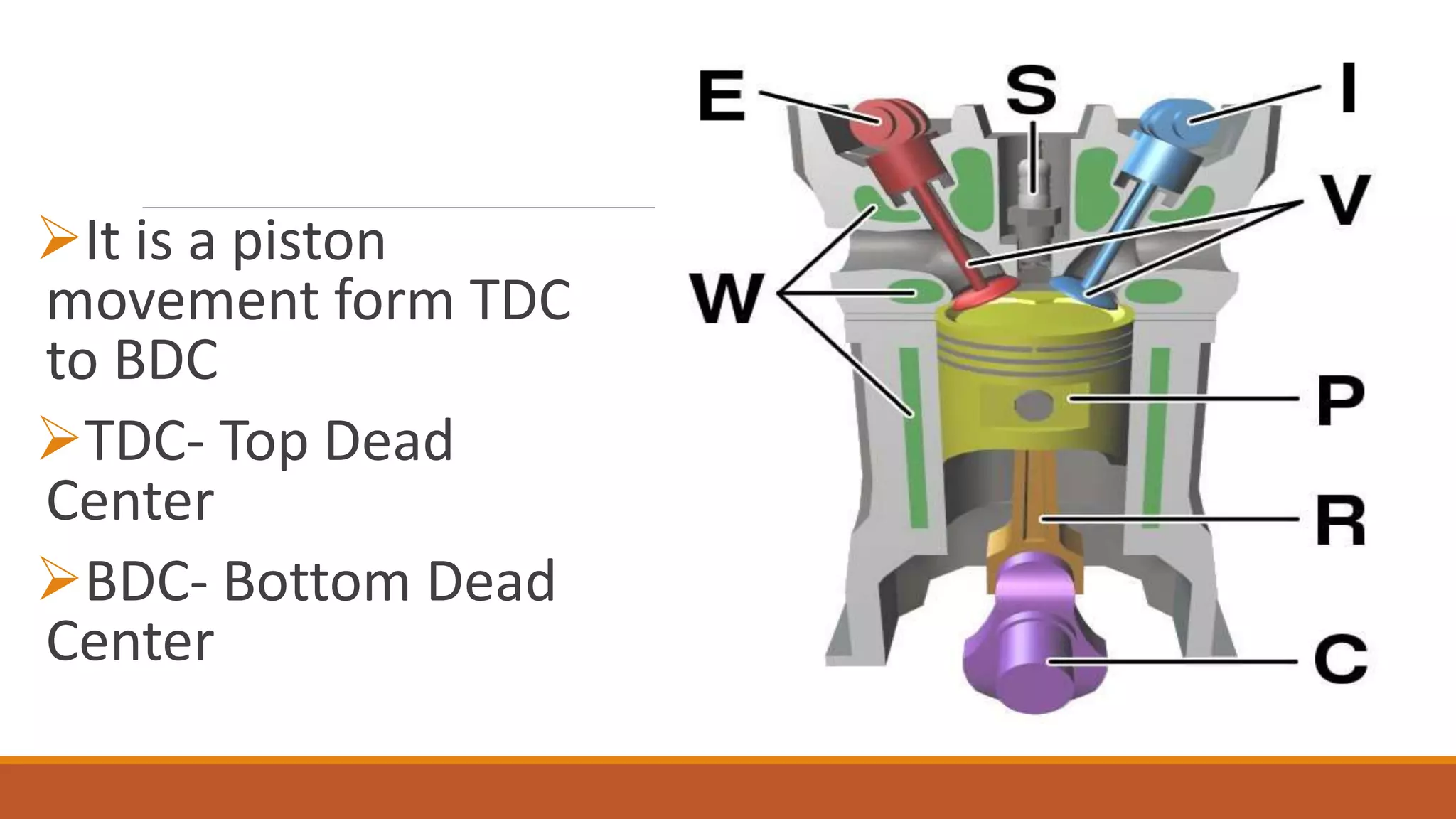
It is a piston
movement form TDC
to BDC
TDC- Top Dead
Center
BDC- Bottom Dead
Center
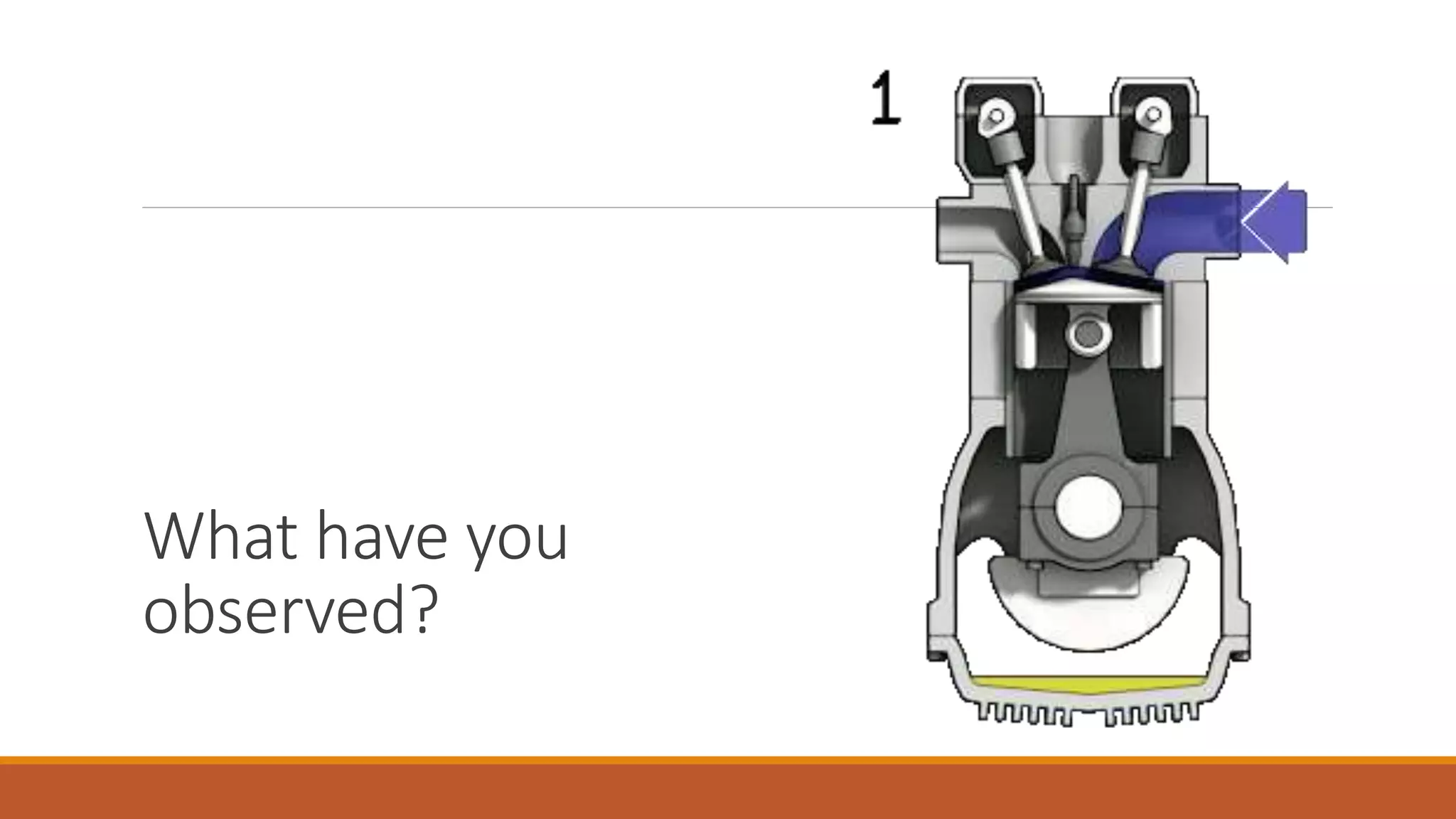
What have you
observed?
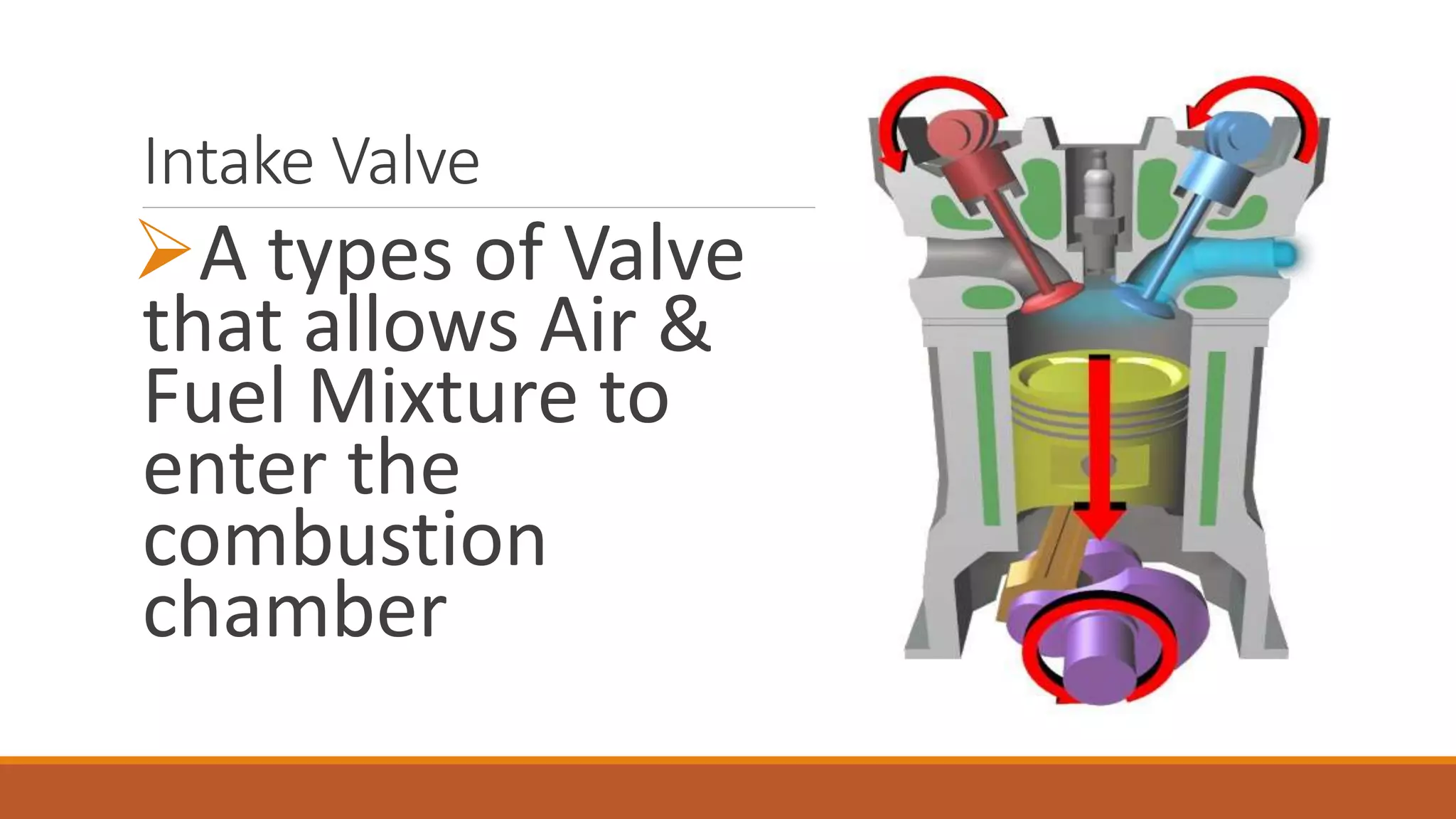
Intake Valve
A types of Valve
that allows Air &
Fuel Mixture to
enter the
combustion
chamber
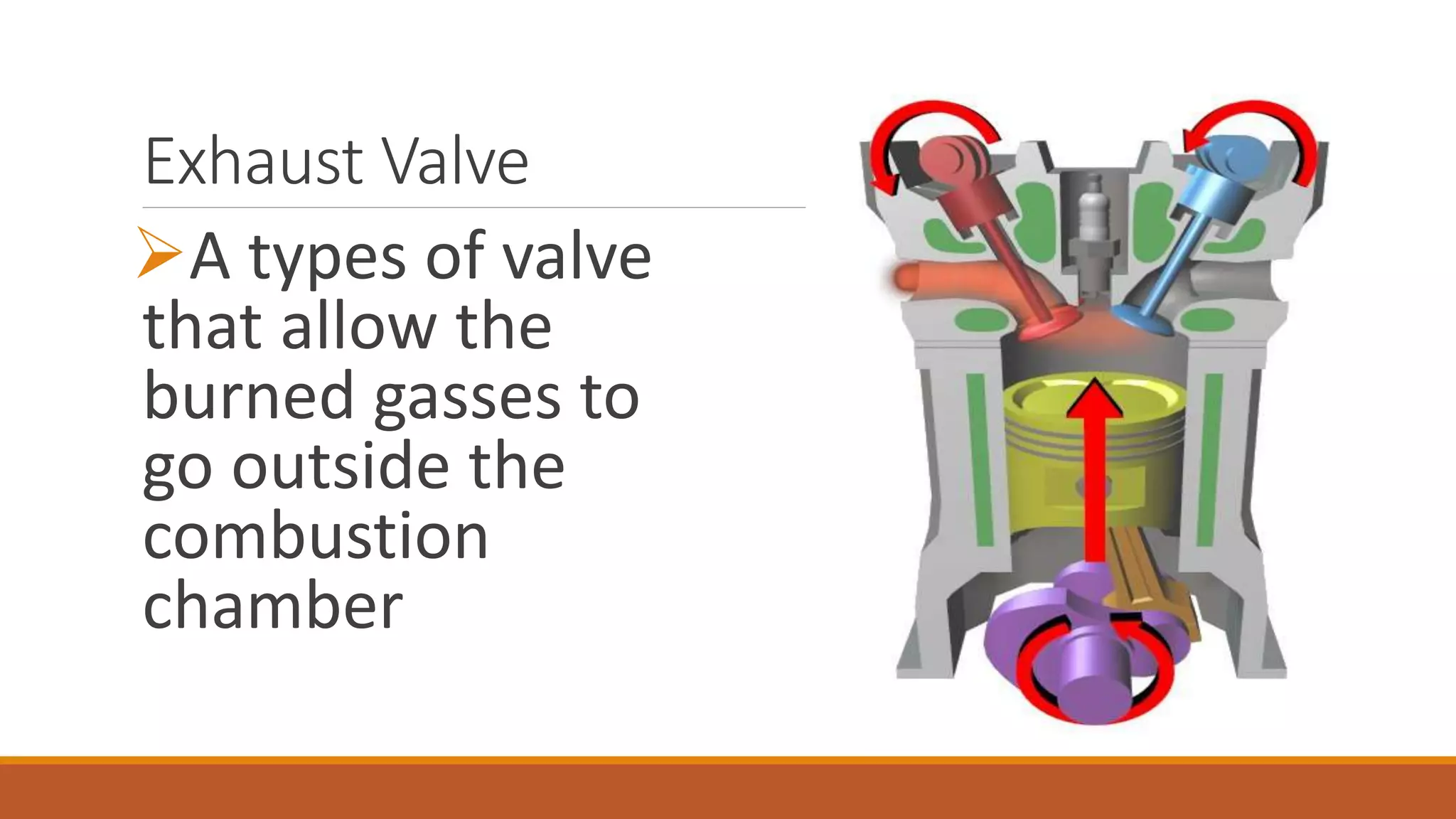
Exhaust Valve
A types of valve
that allow the
burned gasses to
go outside the
combustion
chamber
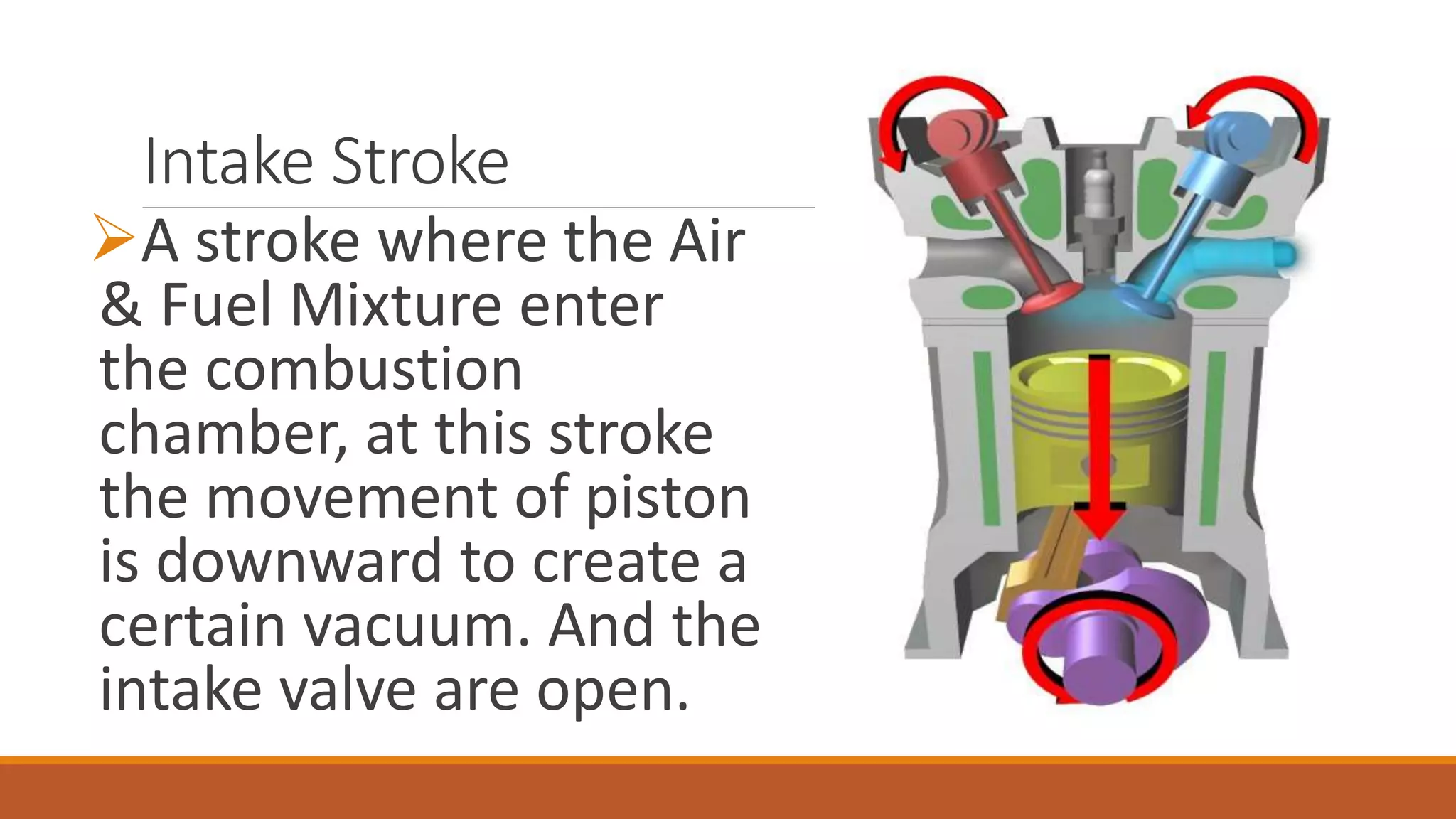
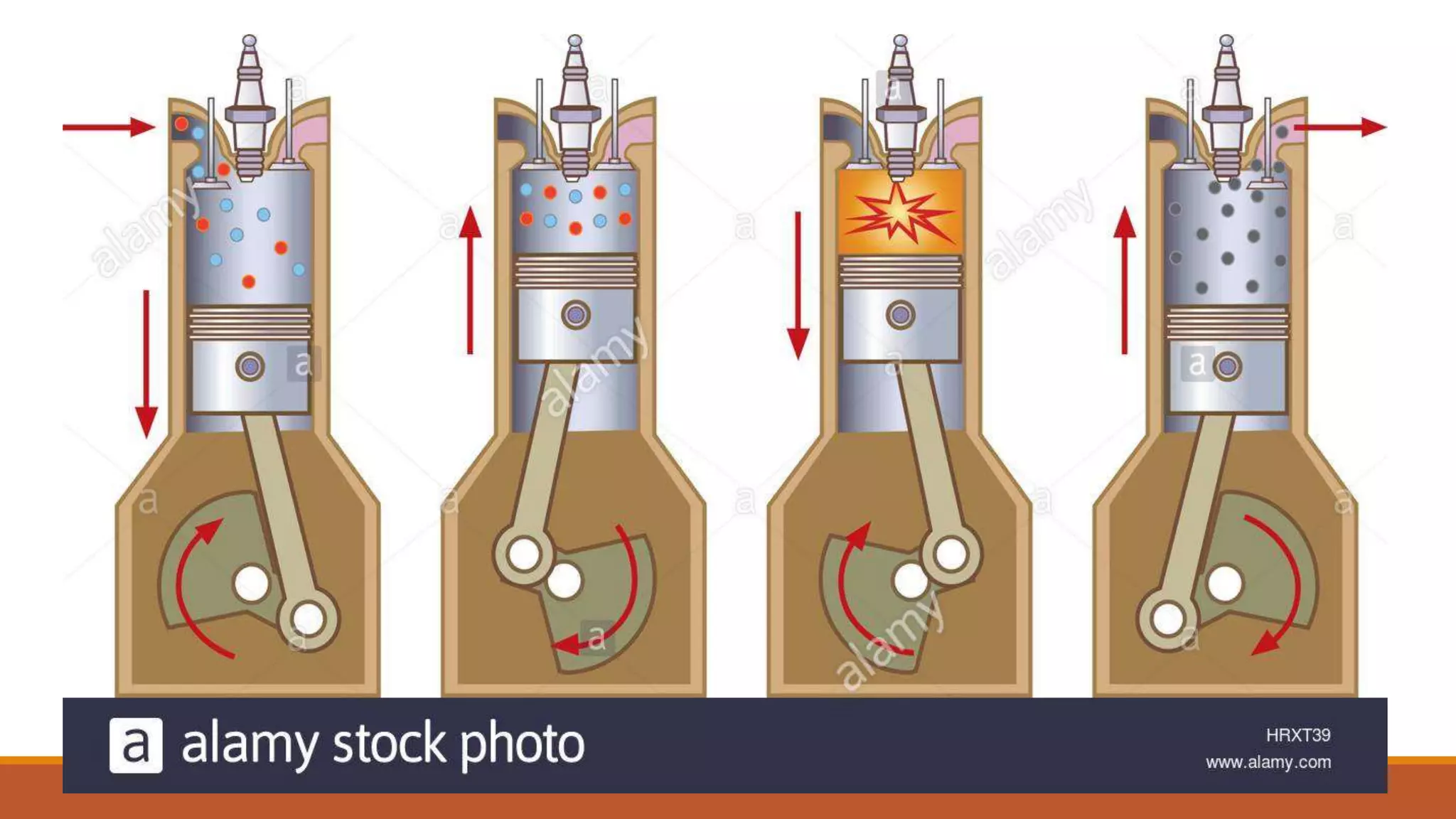
Intake Stroke
A stroke where the Air
& Fuel Mixture enter
the combustion
chamber, at this stroke
the movement of piston
is downward to create a
certain vacuum. And the
intake valve are open.
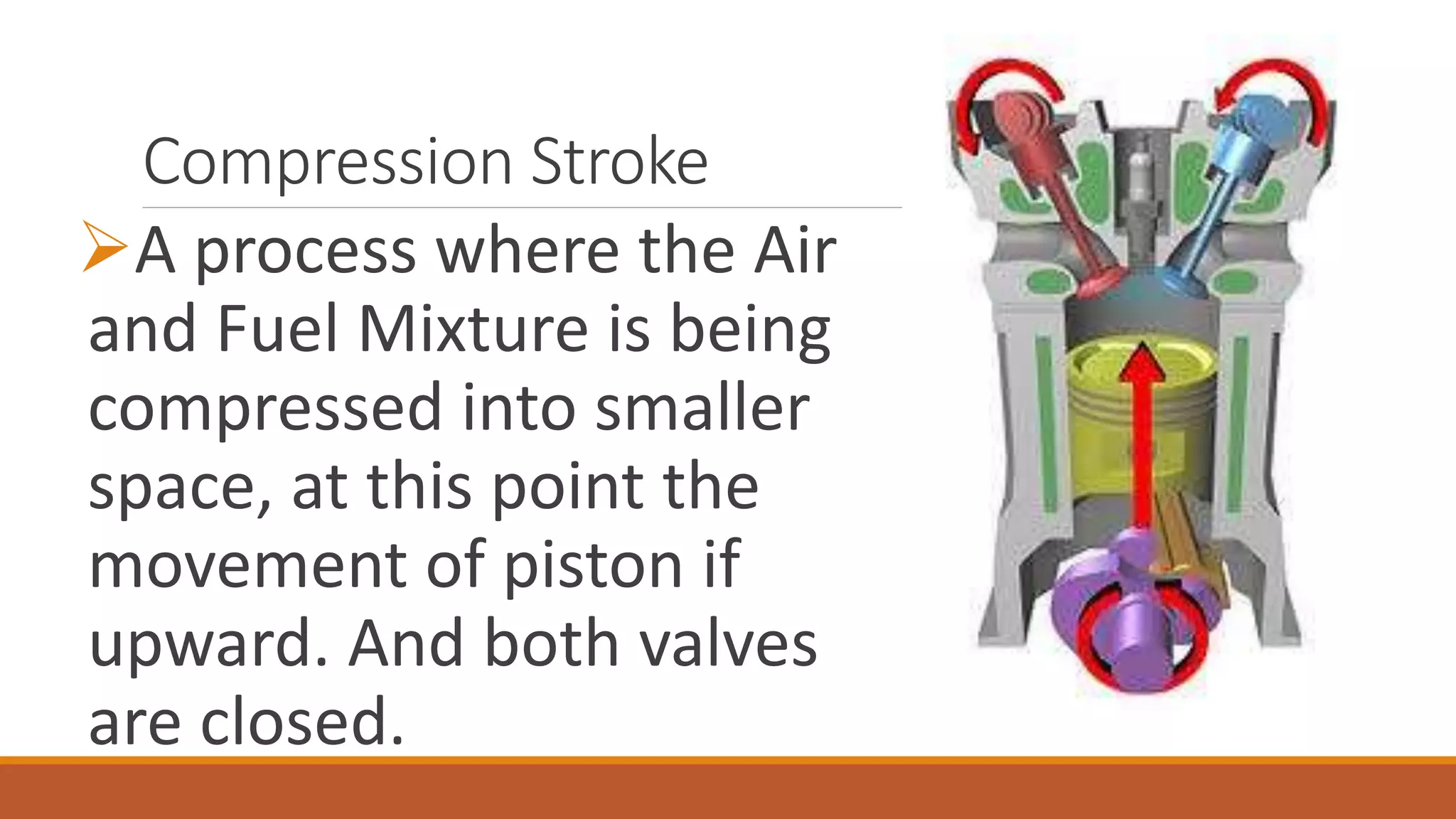
Compression Stroke
A process where the Air
and Fuel Mixture is being
compressed into smaller
space, at this point the
movement of piston if
upward. And both valves
are closed.
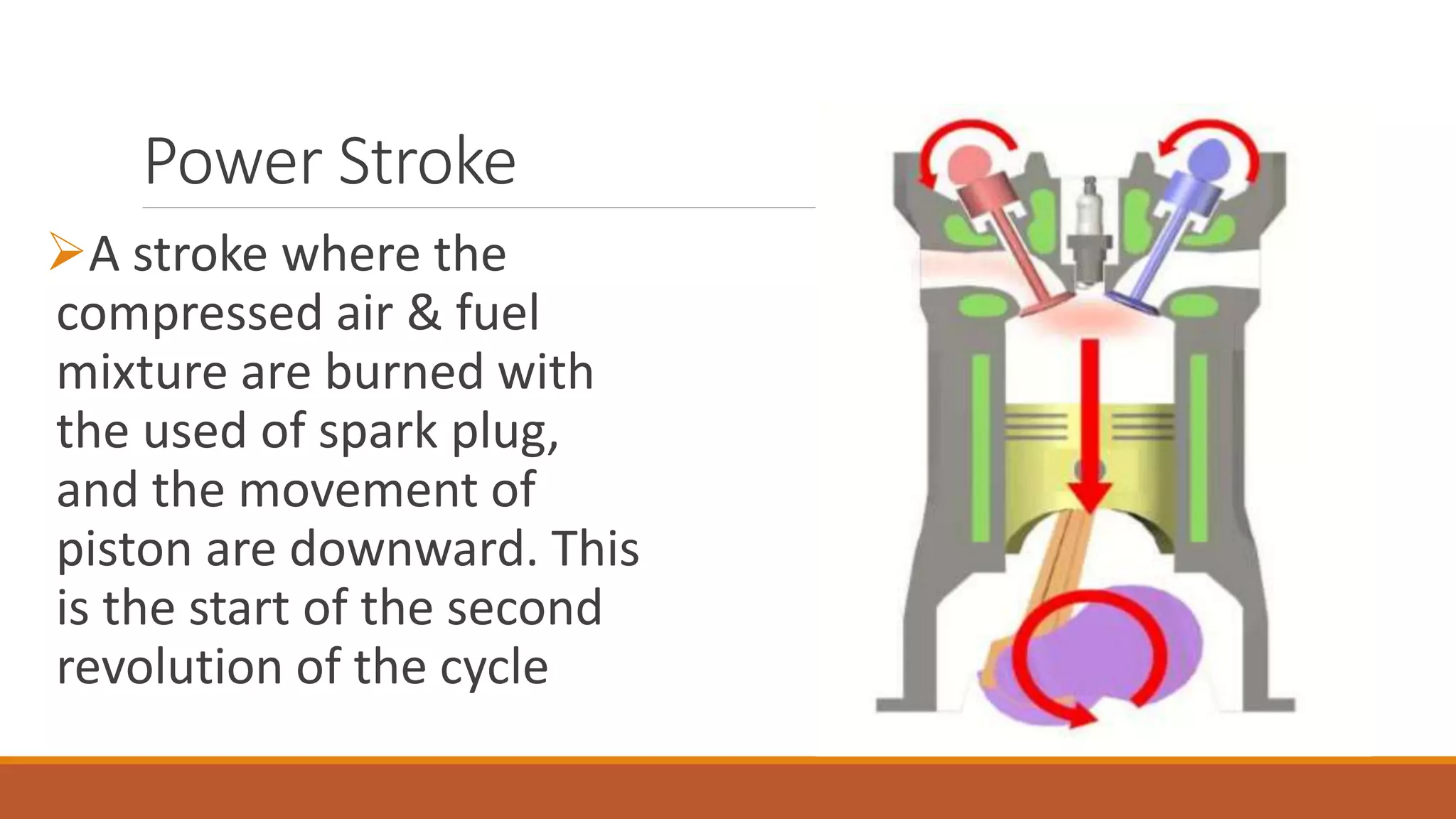
Power Stroke
A stroke where the
compressed air & fuel
mixture are burned with
the used of spark plug,
and the movement of
piston are downward. This
is the start of the second
revolution of the cycle
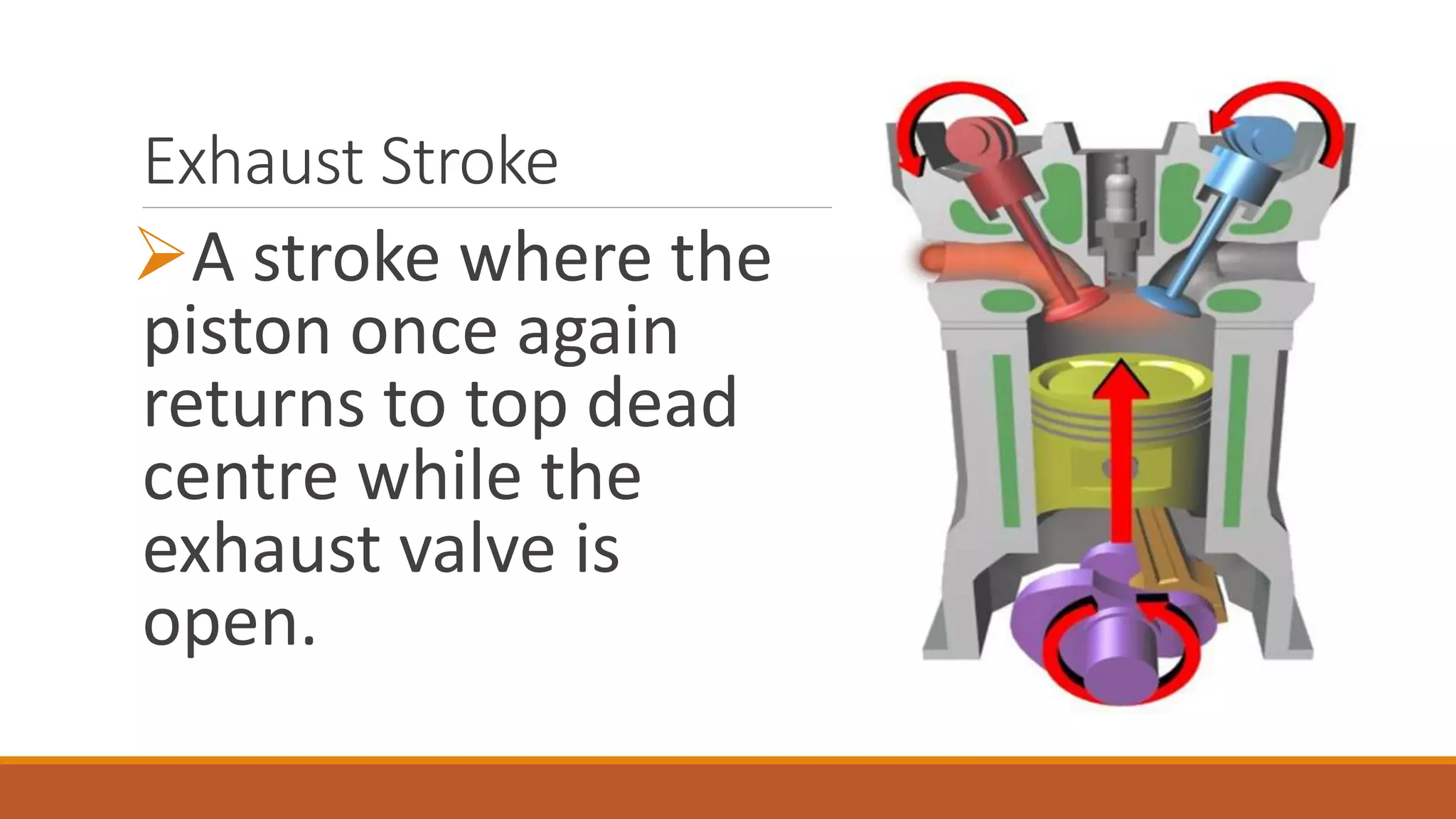
Exhaust Stroke
A stroke where the
piston once again
returns to top dead
centre while the
exhaust valve is
open.
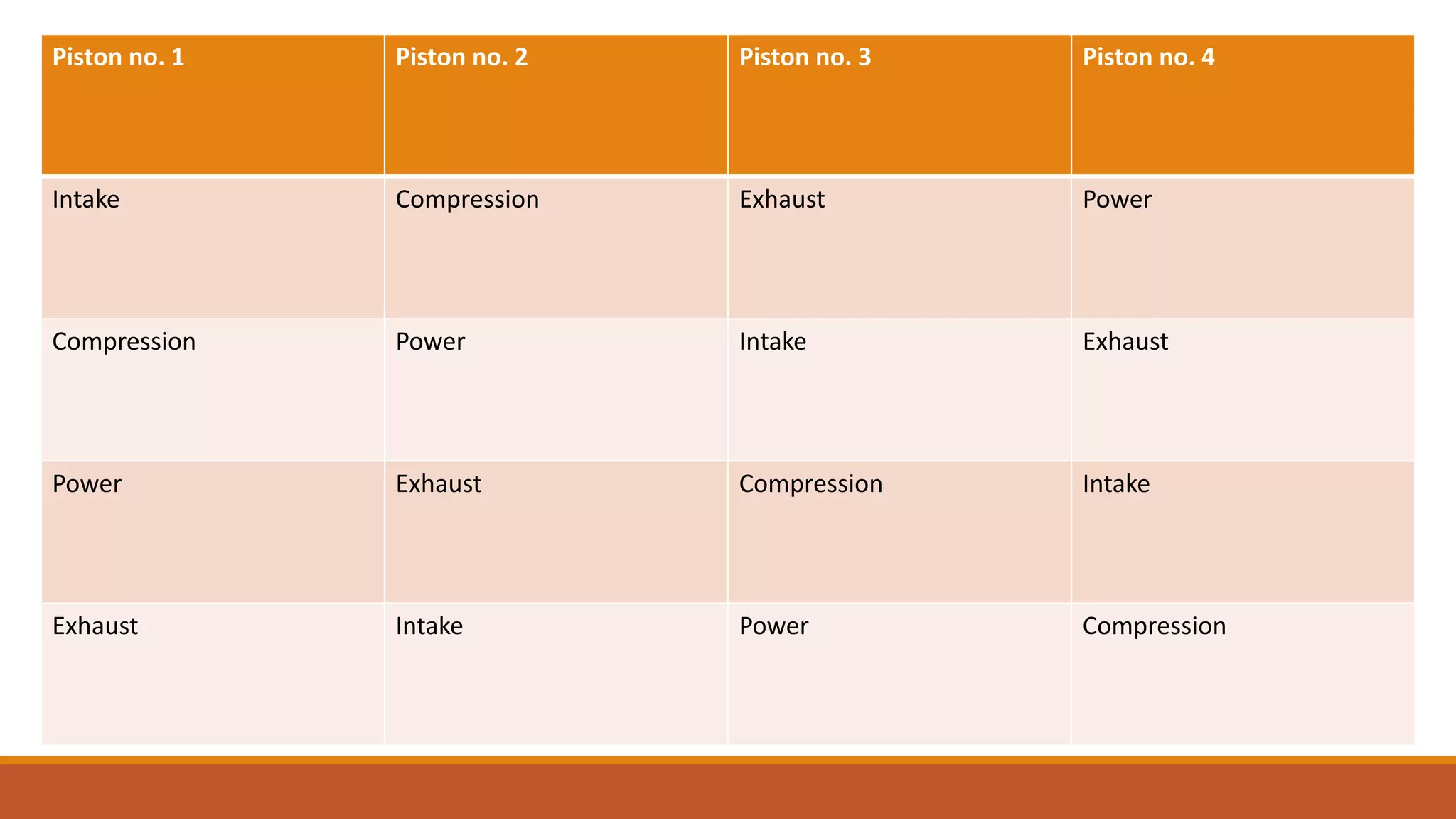
Piston no. 1 Piston no. 2 Piston no. 3 Piston no. 4
Intake Compression Exhaust Power
Compression Power Intake Exhaust
Power Exhaust Compression Intake
Exhaust Intake Power Compression
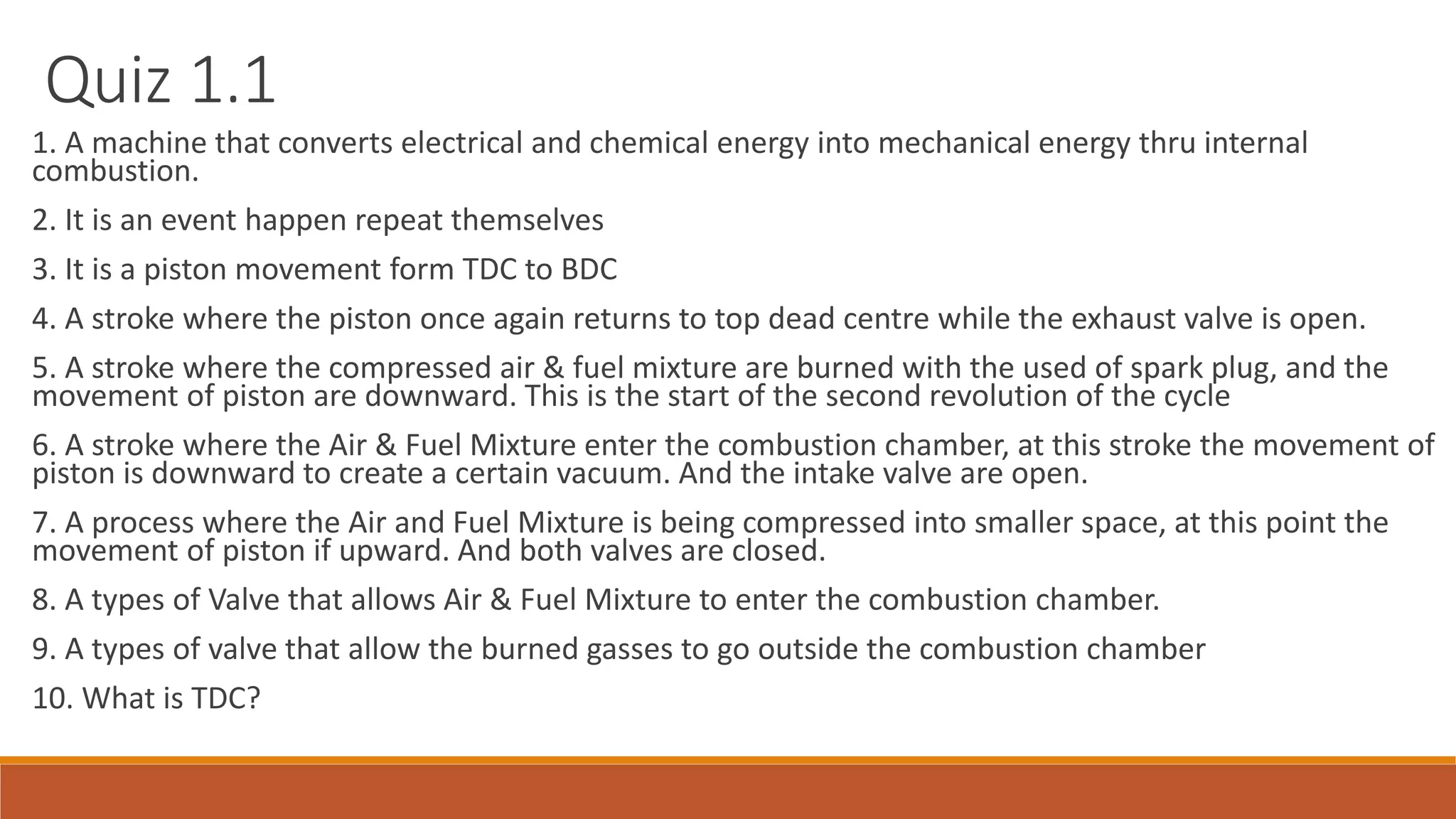
Quiz 1.1
1. A machine that converts electrical and chemical energy into mechanical energy thru internal
combustion.
2. It is an event happen repeat themselves
3. It is a piston movement form TDC to BDC
4. A stroke where the piston once again returns to top dead centre while the exhaust valve is open.
5. A stroke where the compressed air & fuel mixture are burned with the used of spark plug, and the
movement of piston are downward. This is the start of the second revolution of the cycle
6. A stroke where the Air & Fuel Mixture enter the combustion chamber, at this stroke the movement of
piston is downward to create a certain vacuum. And the intake valve are open.
7. A process where the Air and Fuel Mixture is being compressed into smaller space, at this point the
movement of piston if upward. And both valves are closed.
8. A types of Valve that allows Air & Fuel Mixture to enter the combustion chamber.
9. A types of valve that allow the burned gasses to go outside the combustion chamber
10. What is TDC?
Task 1.1 4 Stroke Cycle Engine Operation
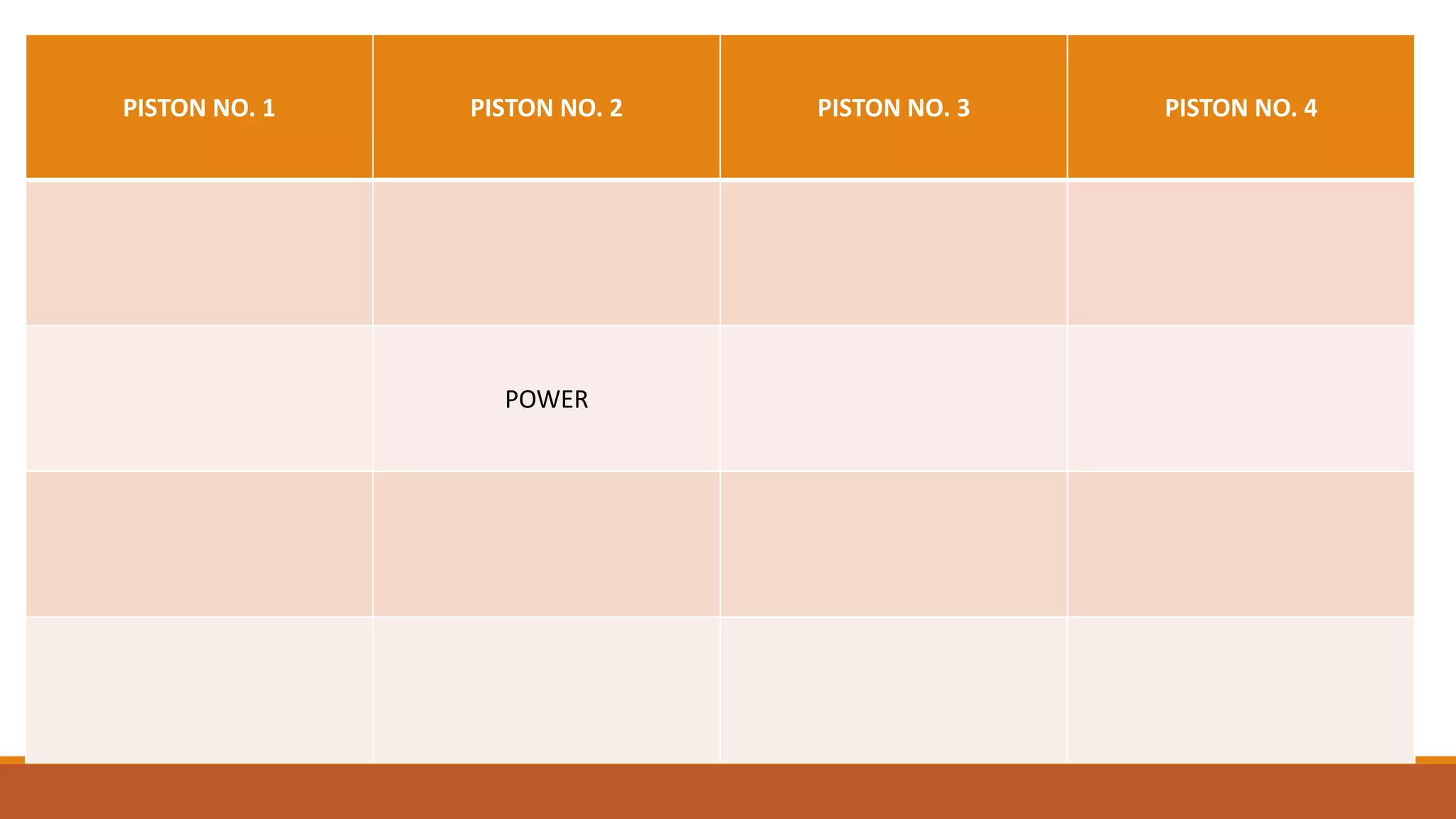
PISTON NO. 1 PISTON NO. 2 PISTON NO. 3 PISTON NO. 4
POWER
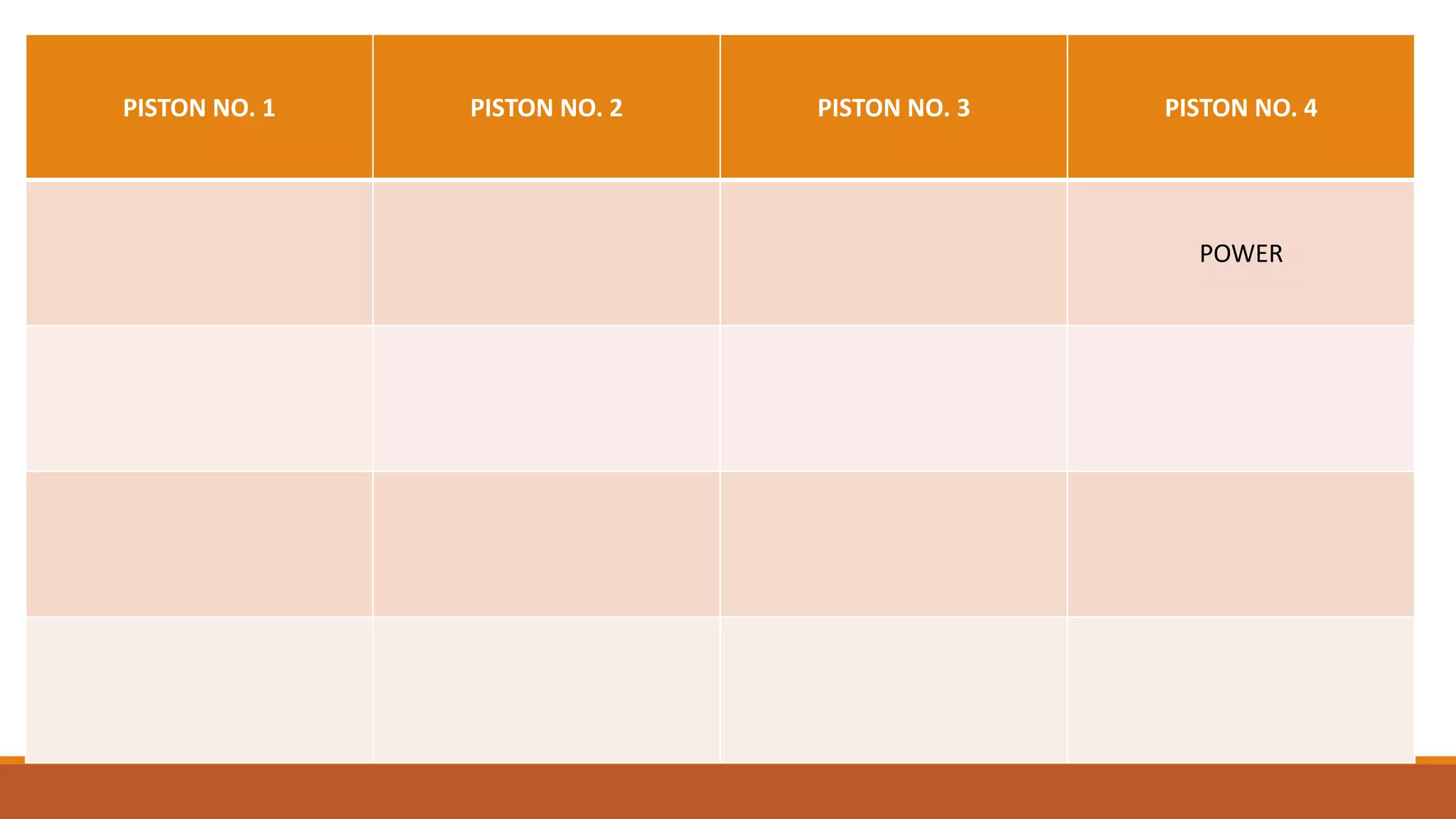
PISTON NO. 1 PISTON NO. 2 PISTON NO. 3 PISTON NO. 4
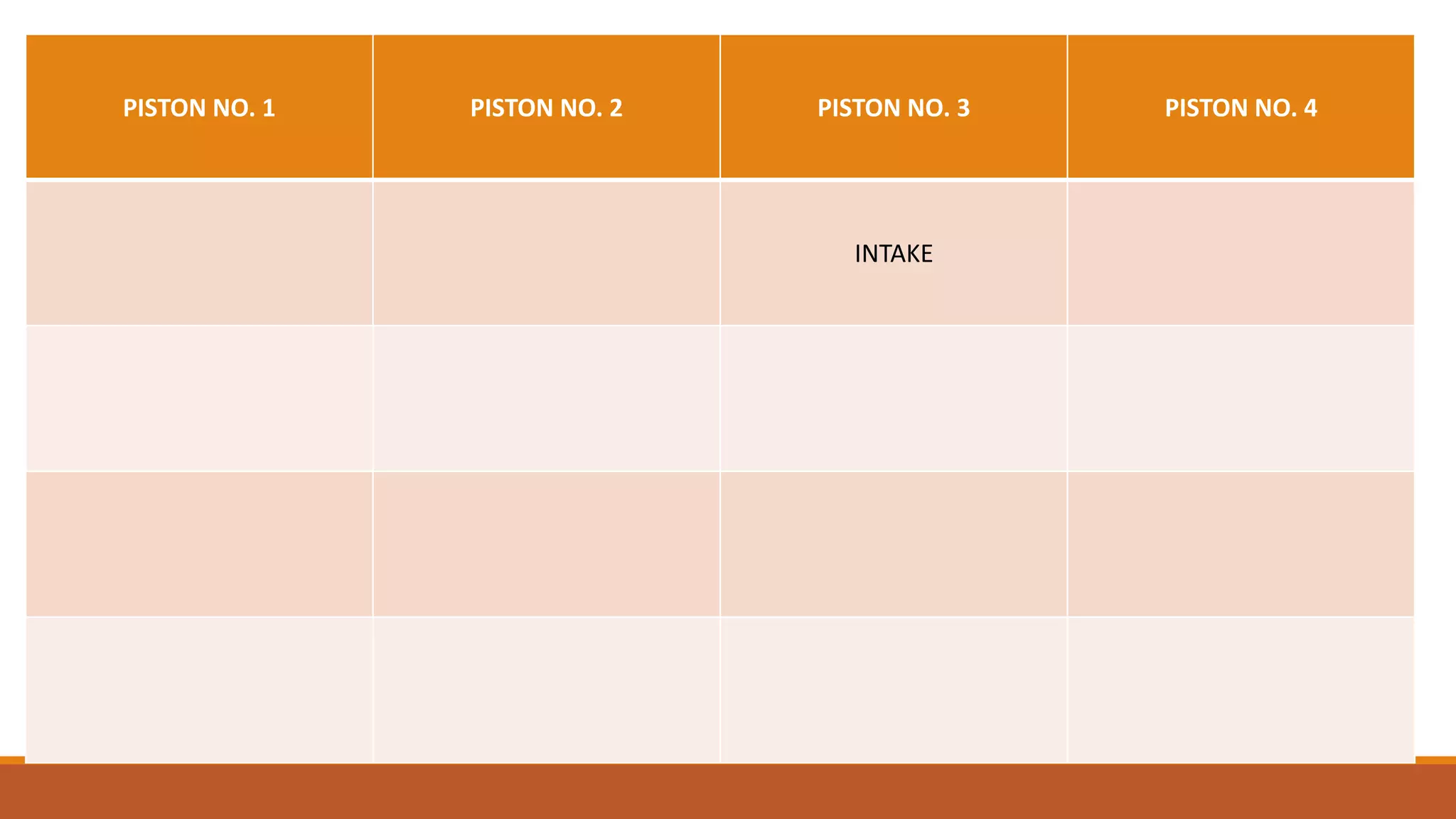
INTAKE
PISTON NO. 1 PISTON NO. 2 PISTON NO. 3 PISTON NO. 4
EXHAUST
PISTON NO. 1 PISTON NO. 2 PISTON NO. 3 PISTON NO. 4
POWER
PISTON NO. 1 PISTON NO. 2 PISTON NO. 3 PISTON NO. 4
COMPRESSION

4 stroke cycle engine operations

  • 1.
  • 2.
    What is Engine? Amachine that converts electrical and chemical energy into mechanical energy thru internal combustion.
  • 3.
    Components of Engine CylinderBlock – is the main structural component of an engine. It supports and helps maintain alignment of internal and external components. The cylinder block is the engine component that consists of the cylinder bore, cooling fins on air cooled engines, valve train components, depending on the engine design.
  • 4.
    Components of Engine CylinderHead – is a cast aluminum alloy or cast iron engine component fastened to the end of the cylinder block farthest from the crankshaft. A head gasket is the filler material placed between the cylinder block and cylinder head to seal the combustion chamber. Head gaskets are made from soft metals and graphite layered together.
  • 5.
    Components of Engine Crankshaft– is an engine component that converts the linear (reciprocating) motion of the piston into rotary motion. The crankshaft is the main rotating component of an engine and its commonly made of ductile iron. Features of crankshaft include the crankpin journal, throw, bearing journals and counterweights
  • 6.
    Components of Engine Pistonand piston rings – a piston is a cylindrical engine component that slides back and forth in the cylinder bore by forces produced during the combustion process. The piston acts as a movable end of the combustion chamber. Pistons are commonly made of a cast aluminum alloy for excellent and lightweight thermal conductivity.
  • 7.
    Components of Engine Connectingrod – is an engine component that transfers motion from the piston to the crankshaft and functions as a lever arm. Connecting rods are commonly made from cast aluminum alloy and are designed to withstand dynamic stresses from combustion and piston movement. The small end of the connecting rod connects to the piston with a piston pin. The piston pin, or wrist pin, provides a pivot point between the piston and connecting rod. Spring clips, or piston pin locks are used to hold the piston pin in place. The big end of the connecting rod connects to the crankpin journal to provide a pivot point on the crankshaft.
  • 8.
    Components of Engine Bearings– a bearing is a component used to reduce friction and to maintain clearance between stationary and rotating components of the engine. Bearings, or bearing surfaces are located on the crankshaft, connecting rod, and camshaft and also in the cylinder block.
  • 9.
    Components of Engine Flywheel- is a cast iron, aluminum, or zinc disk that is mounted at one end of the crankshaft to provide inertia for the engine. Inertia is not a force, it is a property of matter. During the operation of a reciprocating engine, combustion occurs at distinct intervals. The flywheel supplies the inertia required to prevent loss of engine speed and possible stoppage of crankshaft rotation between combustion intervals.
  • 11.
    Components of Engine Valve Train– the valve train of internal combustion engine includes components required to control the flow of gases into and out of the combustion chamber. This includes valves and related components required to allow the air fuel mixture to enter the combustion chamber, seal the combustion chamber during compression and combustion, and evacuate exhaust gases when combustion is complete.
  • 12.
    Components of Engine Valves –allow the flow of air-fuel mixture into the cylinder, and the flow of exhaust gases from the cylinder.
  • 13.
  • 14.
    It is anevent happen repeat themselves In an internal combustion engine there are several cycle happen and these are: Intake stroke Compression stroke Power stroke Exhaust stroke
  • 15.
  • 16.
    It is apiston movement form TDC to BDC TDC- Top Dead Center BDC- Bottom Dead Center
  • 17.
  • 18.
    Intake Valve A typesof Valve that allows Air & Fuel Mixture to enter the combustion chamber
  • 19.
    Exhaust Valve A typesof valve that allow the burned gasses to go outside the combustion chamber
  • 20.
    Intake Stroke A strokewhere the Air & Fuel Mixture enter the combustion chamber, at this stroke the movement of piston is downward to create a certain vacuum. And the intake valve are open.
  • 21.
    Compression Stroke A processwhere the Air and Fuel Mixture is being compressed into smaller space, at this point the movement of piston if upward. And both valves are closed.
  • 22.
    Power Stroke A strokewhere the compressed air & fuel mixture are burned with the used of spark plug, and the movement of piston are downward. This is the start of the second revolution of the cycle
  • 23.
    Exhaust Stroke A strokewhere the piston once again returns to top dead centre while the exhaust valve is open.
  • 24.
    Piston no. 1Piston no. 2 Piston no. 3 Piston no. 4 Intake Compression Exhaust Power Compression Power Intake Exhaust Power Exhaust Compression Intake Exhaust Intake Power Compression
  • 25.
    Quiz 1.1 1. Amachine that converts electrical and chemical energy into mechanical energy thru internal combustion. 2. It is an event happen repeat themselves 3. It is a piston movement form TDC to BDC 4. A stroke where the piston once again returns to top dead centre while the exhaust valve is open. 5. A stroke where the compressed air & fuel mixture are burned with the used of spark plug, and the movement of piston are downward. This is the start of the second revolution of the cycle 6. A stroke where the Air & Fuel Mixture enter the combustion chamber, at this stroke the movement of piston is downward to create a certain vacuum. And the intake valve are open. 7. A process where the Air and Fuel Mixture is being compressed into smaller space, at this point the movement of piston if upward. And both valves are closed. 8. A types of Valve that allows Air & Fuel Mixture to enter the combustion chamber. 9. A types of valve that allow the burned gasses to go outside the combustion chamber 10. What is TDC?
  • 27.
    Task 1.1 4Stroke Cycle Engine Operation
  • 28.
    PISTON NO. 1PISTON NO. 2 PISTON NO. 3 PISTON NO. 4 POWER
  • 29.
    PISTON NO. 1PISTON NO. 2 PISTON NO. 3 PISTON NO. 4 INTAKE
  • 30.
    PISTON NO. 1PISTON NO. 2 PISTON NO. 3 PISTON NO. 4 EXHAUST
  • 31.
    PISTON NO. 1PISTON NO. 2 PISTON NO. 3 PISTON NO. 4 POWER
  • 32.
    PISTON NO. 1PISTON NO. 2 PISTON NO. 3 PISTON NO. 4 COMPRESSION