School of Education
Post Graduate Diploma in Teaching Skills
Arun Kumar Gupta
M.Sc. Food Science & Technology
Pillars of learning
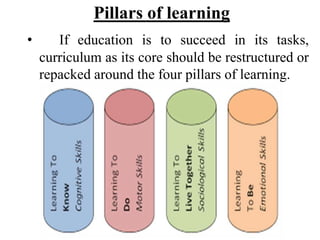
• If education is to succeed in its tasks,
curriculum as its core should be restructured or
repacked around the four pillars of learning.
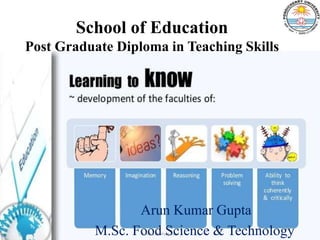
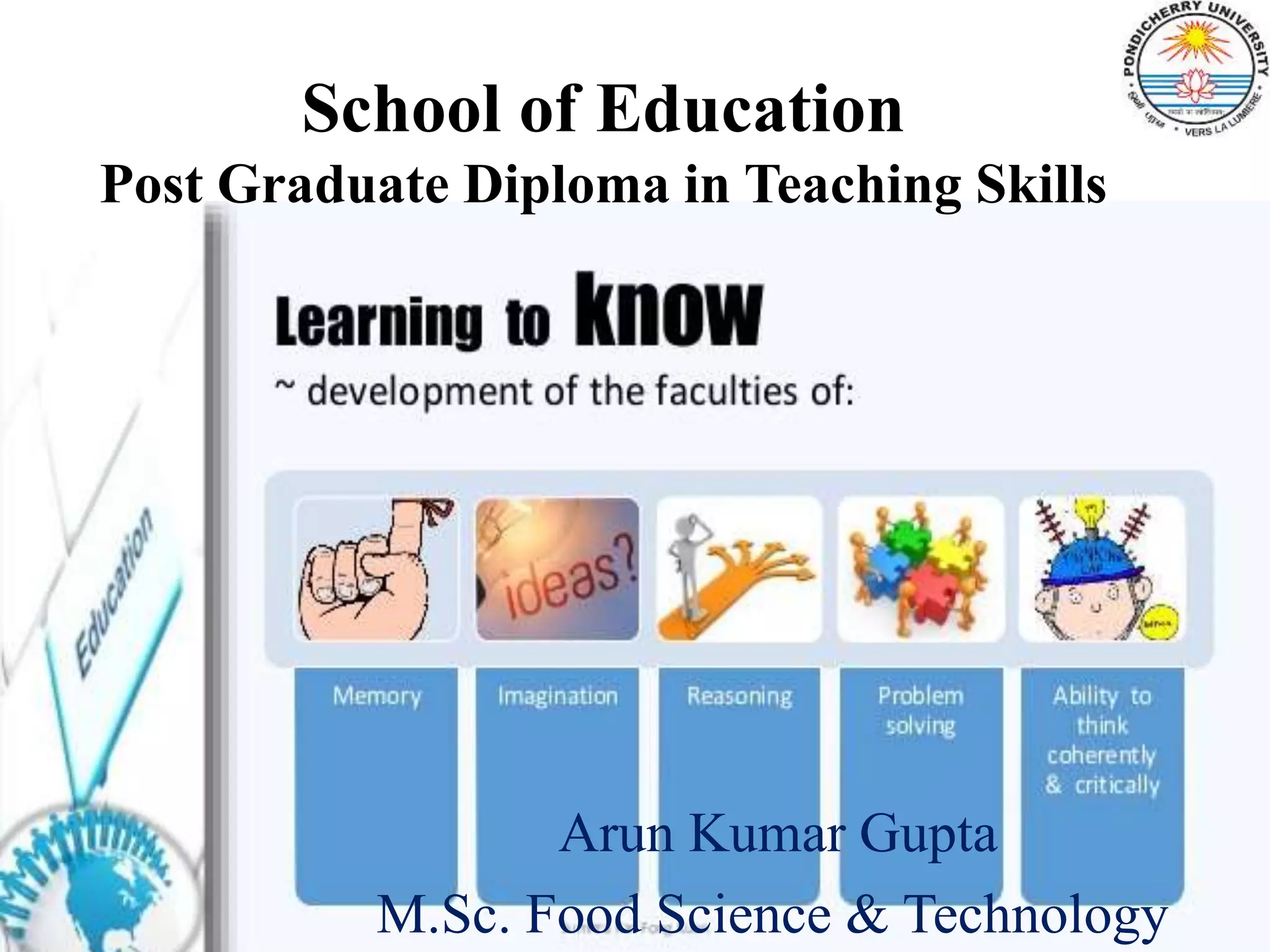
• Development of the faculties of memory,
• Imagination, reasoning,
• Problem-solving
• The ability to think in a coherent and critical way.
• A process of discovery- deep information or
knowledge delivered through subject teaching.
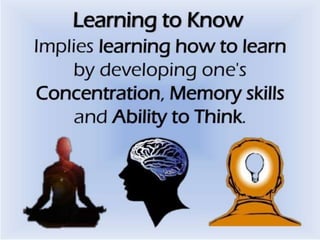
• Learning to learn- power of concentration,
memory and thought.
Cont.
• Learning to know- can be regarded as both a
means and an end in learning itself and in life.
• As a means- enable individual learners to
understand the very least enough.
• As an end- enables the learner to experience the
pleasure of knowing, discovering and
understanding as a process.
Every individual has hidden talents such as
• Memory
• Reasoning
• Imagination
• Physical ability
• Aesthetic sense
• Aptitude to communicate
Reorienting Curriculum Objectives
To provide equal
opportunities for all
pupils to learn and
to achieve, for best
possible progress
and at the highest
attainment.
To promote
learners’ spiritual,
moral, social and
cultural
development and
prepare all pupils
for the world of
work and societal
responsibilities.
Conclusion
Varied Curriculum helps in increase learning
• Subject matter,
• Library activities,
• Laboratory activities,
• Playground activities,
• Co-curricular activities.
References
• Anderson, Jonathan and Weert, tom van, 2002.
Information and communication technology in
education, a curriculum for schools and
programmes of teacher development.

4 pillars of learning

  • 1.
    School of Education PostGraduate Diploma in Teaching Skills Arun Kumar Gupta M.Sc. Food Science & Technology
  • 2.
    Pillars of learning •If education is to succeed in its tasks, curriculum as its core should be restructured or repacked around the four pillars of learning.
  • 4.
    • Development ofthe faculties of memory, • Imagination, reasoning, • Problem-solving • The ability to think in a coherent and critical way. • A process of discovery- deep information or knowledge delivered through subject teaching. • Learning to learn- power of concentration, memory and thought.
  • 5.
    Cont. • Learning toknow- can be regarded as both a means and an end in learning itself and in life. • As a means- enable individual learners to understand the very least enough. • As an end- enables the learner to experience the pleasure of knowing, discovering and understanding as a process.
  • 6.
    Every individual hashidden talents such as • Memory • Reasoning • Imagination • Physical ability • Aesthetic sense • Aptitude to communicate
  • 7.
    Reorienting Curriculum Objectives Toprovide equal opportunities for all pupils to learn and to achieve, for best possible progress and at the highest attainment. To promote learners’ spiritual, moral, social and cultural development and prepare all pupils for the world of work and societal responsibilities.
  • 8.
    Conclusion Varied Curriculum helpsin increase learning • Subject matter, • Library activities, • Laboratory activities, • Playground activities, • Co-curricular activities.
  • 9.
    References • Anderson, Jonathanand Weert, tom van, 2002. Information and communication technology in education, a curriculum for schools and programmes of teacher development.