SEKOLAH TINGGI
P A R I W I S A T A
T R I S A K T I
Welcome to
Market Positioning
Rina Suprina M.Hum, Msi, Par
Ivan Prasetya M.Par
[ ]
Market Positioning
Market Positioning
Perceptual mapping, a research tool, is sometimes
used to measure a brand’s position.
Market Positioning
Two-by-two perceptual maps provide an easy-to-read
picture, but one must often study multiple maps plotting
different attributes to obtain a good feel of the
marketplace.
Market Positioning
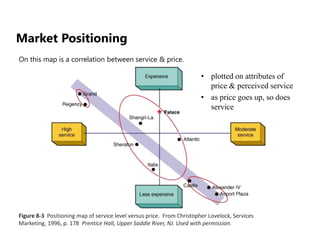
Figure 8-3 Positioning map of service level versus price. From Christopher Lovelock, Services
Marketing, 1996, p. 178 Prentice Hall, Upper Saddle River, NJ. Used with permission.
On this map is a correlation between service & price.
• plotted on attributes of
price & perceived service
• as price goes up, so does
service
Market Positioning
Perceptual maps can be developed using consumer
perceptions of a number of product attributes.
Market Positioning
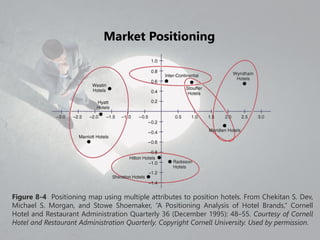
Dev, Morgan, & Shoemaker developed a perceptual map
based on ratings of eight attributes, using a technique
known as probabilistic multidimensional scaling.
to derive the coordinates for the map in figure 8–4
Market Positioning
This technique is useful to identify competitive set and to open
spaces that can represent an opportunity for repositioning away
from the competition.
Figure 8-4 Positioning map using multiple attributes to position hotels. From Chekitan S. Dev,
Michael S. Morgan, and Stowe Shoemaker, “A Positioning Analysis of Hotel Brands,” Cornell
Hotel and Restaurant Administration Quarterly 36 (December 1995): 48–55. Courtesy of Cornell
Hotel and Restaurant Administration Quarterly. Copyright Cornell University. Used by permission.
Market Positioning
Market Positioning
The circles are drawn around clusters of the hotels
not statistically significant distances from each other.
the hotels in the circles can be viewed by the consumer as being similar
Market Positioning
This technique is useful to identify competitive set and to
open spaces that can represent an opportunity for
repositioning away from the competition.
Market Positioning
In this type of map the positions are essentially neutral; one
spot on the map does not inherently have to be better or
worse than another.
Market Positioning
In this type of map the positions are essentially neutral; one
spot on the map does not inherently have to be better or
worse than another.
Market Positioning
Increased competition or an ineffective positioning strategy
can make repositioning necessary.
perceptual maps provide data supporting the need for repositioning

4. market positioning pearson

  • 1.
    SEKOLAH TINGGI P AR I W I S A T A T R I S A K T I Welcome to Market Positioning Rina Suprina M.Hum, Msi, Par Ivan Prasetya M.Par [ ]
  • 2.
  • 3.
    Market Positioning Perceptual mapping,a research tool, is sometimes used to measure a brand’s position.
  • 4.
    Market Positioning Two-by-two perceptualmaps provide an easy-to-read picture, but one must often study multiple maps plotting different attributes to obtain a good feel of the marketplace.
  • 5.
    Market Positioning Figure 8-3Positioning map of service level versus price. From Christopher Lovelock, Services Marketing, 1996, p. 178 Prentice Hall, Upper Saddle River, NJ. Used with permission. On this map is a correlation between service & price. • plotted on attributes of price & perceived service • as price goes up, so does service
  • 6.
    Market Positioning Perceptual mapscan be developed using consumer perceptions of a number of product attributes.
  • 7.
    Market Positioning Dev, Morgan,& Shoemaker developed a perceptual map based on ratings of eight attributes, using a technique known as probabilistic multidimensional scaling. to derive the coordinates for the map in figure 8–4
  • 8.
    Market Positioning This techniqueis useful to identify competitive set and to open spaces that can represent an opportunity for repositioning away from the competition.
  • 9.
    Figure 8-4 Positioningmap using multiple attributes to position hotels. From Chekitan S. Dev, Michael S. Morgan, and Stowe Shoemaker, “A Positioning Analysis of Hotel Brands,” Cornell Hotel and Restaurant Administration Quarterly 36 (December 1995): 48–55. Courtesy of Cornell Hotel and Restaurant Administration Quarterly. Copyright Cornell University. Used by permission. Market Positioning
  • 10.
    Market Positioning The circlesare drawn around clusters of the hotels not statistically significant distances from each other. the hotels in the circles can be viewed by the consumer as being similar
  • 11.
    Market Positioning This techniqueis useful to identify competitive set and to open spaces that can represent an opportunity for repositioning away from the competition.
  • 12.
    Market Positioning In thistype of map the positions are essentially neutral; one spot on the map does not inherently have to be better or worse than another.
  • 13.
    Market Positioning In thistype of map the positions are essentially neutral; one spot on the map does not inherently have to be better or worse than another.
  • 14.
    Market Positioning Increased competitionor an ineffective positioning strategy can make repositioning necessary. perceptual maps provide data supporting the need for repositioning