Slide ©2004 by Christopher Lovelock and Jochen Wirtz Services Marketing 5/E 3 - 1
Chapter 3
Positioning Services in
Competitive Markets
Slide ©2004 by Christopher Lovelock and Jochen Wirtz Services Marketing 5/E 3 - 2
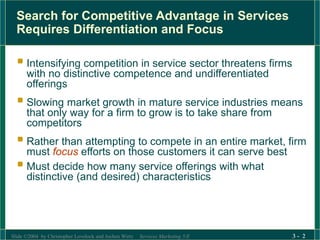
Search for Competitive Advantage in Services
Requires Differentiation and Focus
 Intensifying competition in service sector threatens firms
with no distinctive competence and undifferentiated
offerings
 Slowing market growth in mature service industries means
that only way for a firm to grow is to take share from
competitors
 Rather than attempting to compete in an entire market, firm
must focus efforts on those customers it can serve best
 Must decide how many service offerings with what
distinctive (and desired) characteristics
Slide ©2004 by Christopher Lovelock and Jochen Wirtz Services Marketing 5/E 3 - 3
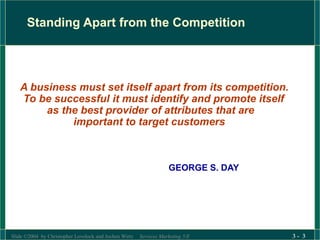
Standing Apart from the Competition
A business must set itself apart from its competition.
To be successful it must identify and promote itself
as the best provider of attributes that are
important to target customers
GEORGE S. DAY
Slide ©2004 by Christopher Lovelock and Jochen Wirtz Services Marketing 5/E 3 - 4
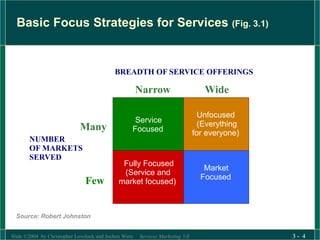
Basic Focus Strategies for Services (Fig. 3.1)
BREADTH OF SERVICE OFFERINGS
NUMBER
OF MARKETS
SERVED
Narrow
Many
Few
Wide
Service
Focused
Unfocused
(Everything
for everyone)
Market
Focused
Fully Focused
(Service and
market focused)
Source: Robert Johnston
Slide ©2004 by Christopher Lovelock and Jochen Wirtz Services Marketing 5/E 3 - 5
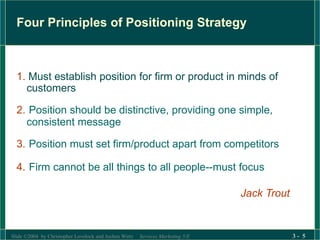
Four Principles of Positioning Strategy
1. Must establish position for firm or product in minds of
customers
2. Position should be distinctive, providing one simple,
consistent message
3. Position must set firm/product apart from competitors
4. Firm cannot be all things to all people--must focus
Jack Trout
Slide ©2004 by Christopher Lovelock and Jochen Wirtz Services Marketing 5/E 3 - 6
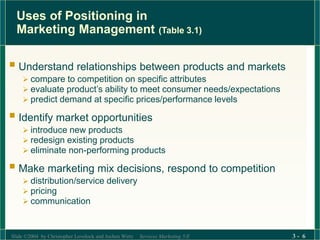
Uses of Positioning in
Marketing Management (Table 3.1)
 Understand relationships between products and markets
 compare to competition on specific attributes
 evaluate product’s ability to meet consumer needs/expectations
 predict demand at specific prices/performance levels
 Identify market opportunities
 introduce new products
 redesign existing products
 eliminate non-performing products
 Make marketing mix decisions, respond to competition
 distribution/service delivery
 pricing
 communication
Slide ©2004 by Christopher Lovelock and Jochen Wirtz Services Marketing 5/E 3 - 7
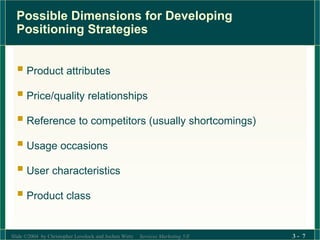
Possible Dimensions for Developing
Positioning Strategies
 Product attributes
 Price/quality relationships
 Reference to competitors (usually shortcomings)
 Usage occasions
 User characteristics
 Product class
Slide ©2004 by Christopher Lovelock and Jochen Wirtz Services Marketing 5/E 3 - 8
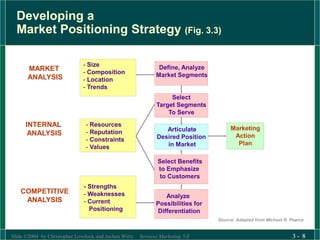
Developing a
Market Positioning Strategy (Fig. 3.3)
- Size
- Composition
- Location
- Trends
Marketing
Action
Plan
MARKET
ANALYSIS
INTERNAL
ANALYSIS
- Resources
- Reputation
- Constraints
- Values
COMPETITIVE
ANALYSIS
- Strengths
- Weaknesses
- Current
Positioning
Define, Analyze
Market Segments
Select
Target Segments
To Serve
Articulate
Desired Position
in Market
Select Benefits
to Emphasize
to Customers
Analyze
Possibilities for
Differentiation
Source: Adapted from Michael R. Pearce
Slide ©2004 by Christopher Lovelock and Jochen Wirtz Services Marketing 5/E 3 - 9
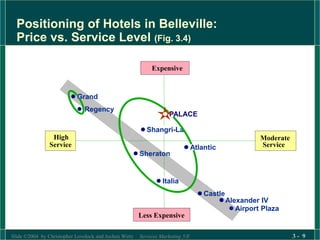
Positioning of Hotels in Belleville:
Price vs. Service Level (Fig. 3.4)
Expensive
Shangri-La
High
Service
Moderate
Service
Grand
Regency
Sheraton
Italia
Castle
Alexander IV
Airport Plaza
PALACE
Atlantic
Less Expensive
Slide ©2004 by Christopher Lovelock and Jochen Wirtz Services Marketing 5/E 3 - 10
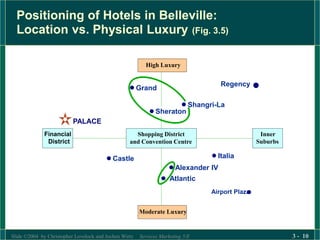
Positioning of Hotels in Belleville:
Location vs. Physical Luxury (Fig. 3.5)
High Luxury
Shopping District
and Convention Centre
Shangri-La
Moderate Luxury
Financial
District
Inner
Suburbs
Grand
Regency
Sheraton
Italia
Castle
Alexander IV
Airport Plaza
PALACE
Atlantic
Slide ©2004 by Christopher Lovelock and Jochen Wirtz Services Marketing 5/E 3 - 11
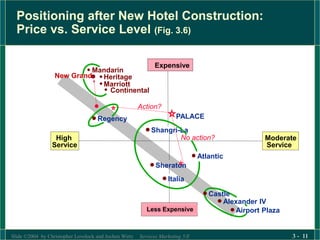
Positioning after New Hotel Construction:
Price vs. Service Level (Fig. 3.6)
Expensive
Shangri-La
High
Service
Moderate
Service
Heritage
Mandarin
New Grand
Marriott
Continental
Regency
Sheraton
Italia
Alexander IV
Airport Plaza
PALACE
Atlantic
No action?
Action?
Less Expensive
Castle
Slide ©2004 by Christopher Lovelock and Jochen Wirtz Services Marketing 5/E 3 - 12
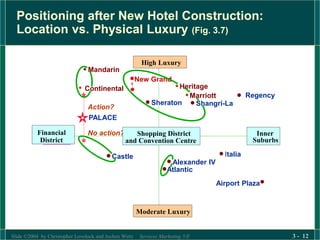
Positioning after New Hotel Construction:
Location vs. Physical Luxury (Fig. 3.7)
High Luxury
Shangri-La
Financial
District
Inner
Suburbs
Heritage
Mandarin
New Grand
Marriott
Continental
Regency
Sheraton
Italia
Alexander IV
Airport Plaza
PALACE
Atlantic
No action?
Action?
Moderate Luxury
Castle
Shopping District
and Convention Centre
Slide ©2004 by Christopher Lovelock and Jochen Wirtz Services Marketing 5/E 3 - 13
Positioning Maps Help Managers to
Visualize Strategy
 Positioning maps display relative performance of competing
firms on key attributes
 Research provides inputs to development of positioning maps
 Challenge is to ensure that
 attributes employed in maps are important to target segments
 performance of individual firms on each attribute accurately
reflects perceptions of customers in target segments
 Predictions can be made of how positions may change in the
light of new developments in the future
 Simple graphic representations are often easier for managers to
grasp than tables of data or paragraphs of prose
 Charts and maps can facilitate a “visual awakening” to threats
and opportunities and suggest alternative strategic directions

3 positioning services for competitive market.ppt

  • 1.
    Slide ©2004 byChristopher Lovelock and Jochen Wirtz Services Marketing 5/E 3 - 1 Chapter 3 Positioning Services in Competitive Markets
  • 2.
    Slide ©2004 byChristopher Lovelock and Jochen Wirtz Services Marketing 5/E 3 - 2 Search for Competitive Advantage in Services Requires Differentiation and Focus  Intensifying competition in service sector threatens firms with no distinctive competence and undifferentiated offerings  Slowing market growth in mature service industries means that only way for a firm to grow is to take share from competitors  Rather than attempting to compete in an entire market, firm must focus efforts on those customers it can serve best  Must decide how many service offerings with what distinctive (and desired) characteristics
  • 3.
    Slide ©2004 byChristopher Lovelock and Jochen Wirtz Services Marketing 5/E 3 - 3 Standing Apart from the Competition A business must set itself apart from its competition. To be successful it must identify and promote itself as the best provider of attributes that are important to target customers GEORGE S. DAY
  • 4.
    Slide ©2004 byChristopher Lovelock and Jochen Wirtz Services Marketing 5/E 3 - 4 Basic Focus Strategies for Services (Fig. 3.1) BREADTH OF SERVICE OFFERINGS NUMBER OF MARKETS SERVED Narrow Many Few Wide Service Focused Unfocused (Everything for everyone) Market Focused Fully Focused (Service and market focused) Source: Robert Johnston
  • 5.
    Slide ©2004 byChristopher Lovelock and Jochen Wirtz Services Marketing 5/E 3 - 5 Four Principles of Positioning Strategy 1. Must establish position for firm or product in minds of customers 2. Position should be distinctive, providing one simple, consistent message 3. Position must set firm/product apart from competitors 4. Firm cannot be all things to all people--must focus Jack Trout
  • 6.
    Slide ©2004 byChristopher Lovelock and Jochen Wirtz Services Marketing 5/E 3 - 6 Uses of Positioning in Marketing Management (Table 3.1)  Understand relationships between products and markets  compare to competition on specific attributes  evaluate product’s ability to meet consumer needs/expectations  predict demand at specific prices/performance levels  Identify market opportunities  introduce new products  redesign existing products  eliminate non-performing products  Make marketing mix decisions, respond to competition  distribution/service delivery  pricing  communication
  • 7.
    Slide ©2004 byChristopher Lovelock and Jochen Wirtz Services Marketing 5/E 3 - 7 Possible Dimensions for Developing Positioning Strategies  Product attributes  Price/quality relationships  Reference to competitors (usually shortcomings)  Usage occasions  User characteristics  Product class
  • 8.
    Slide ©2004 byChristopher Lovelock and Jochen Wirtz Services Marketing 5/E 3 - 8 Developing a Market Positioning Strategy (Fig. 3.3) - Size - Composition - Location - Trends Marketing Action Plan MARKET ANALYSIS INTERNAL ANALYSIS - Resources - Reputation - Constraints - Values COMPETITIVE ANALYSIS - Strengths - Weaknesses - Current Positioning Define, Analyze Market Segments Select Target Segments To Serve Articulate Desired Position in Market Select Benefits to Emphasize to Customers Analyze Possibilities for Differentiation Source: Adapted from Michael R. Pearce
  • 9.
    Slide ©2004 byChristopher Lovelock and Jochen Wirtz Services Marketing 5/E 3 - 9 Positioning of Hotels in Belleville: Price vs. Service Level (Fig. 3.4) Expensive Shangri-La High Service Moderate Service Grand Regency Sheraton Italia Castle Alexander IV Airport Plaza PALACE Atlantic Less Expensive
  • 10.
    Slide ©2004 byChristopher Lovelock and Jochen Wirtz Services Marketing 5/E 3 - 10 Positioning of Hotels in Belleville: Location vs. Physical Luxury (Fig. 3.5) High Luxury Shopping District and Convention Centre Shangri-La Moderate Luxury Financial District Inner Suburbs Grand Regency Sheraton Italia Castle Alexander IV Airport Plaza PALACE Atlantic
  • 11.
    Slide ©2004 byChristopher Lovelock and Jochen Wirtz Services Marketing 5/E 3 - 11 Positioning after New Hotel Construction: Price vs. Service Level (Fig. 3.6) Expensive Shangri-La High Service Moderate Service Heritage Mandarin New Grand Marriott Continental Regency Sheraton Italia Alexander IV Airport Plaza PALACE Atlantic No action? Action? Less Expensive Castle
  • 12.
    Slide ©2004 byChristopher Lovelock and Jochen Wirtz Services Marketing 5/E 3 - 12 Positioning after New Hotel Construction: Location vs. Physical Luxury (Fig. 3.7) High Luxury Shangri-La Financial District Inner Suburbs Heritage Mandarin New Grand Marriott Continental Regency Sheraton Italia Alexander IV Airport Plaza PALACE Atlantic No action? Action? Moderate Luxury Castle Shopping District and Convention Centre
  • 13.
    Slide ©2004 byChristopher Lovelock and Jochen Wirtz Services Marketing 5/E 3 - 13 Positioning Maps Help Managers to Visualize Strategy  Positioning maps display relative performance of competing firms on key attributes  Research provides inputs to development of positioning maps  Challenge is to ensure that  attributes employed in maps are important to target segments  performance of individual firms on each attribute accurately reflects perceptions of customers in target segments  Predictions can be made of how positions may change in the light of new developments in the future  Simple graphic representations are often easier for managers to grasp than tables of data or paragraphs of prose  Charts and maps can facilitate a “visual awakening” to threats and opportunities and suggest alternative strategic directions