Slide to remind
students of
deliverable

• Maybe the schedule of the remaining
work days
Costing & Modeling
Deliver:
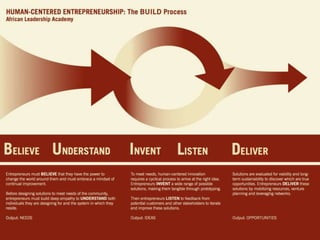
Solutions are evaluated for viability and
long-term sustainability to discover
which are true opportunities.
Entrepreneurs deliver these solutions by
mobilizing resources, venture planning
and leveraging networks.
Deliver:
Solutions are evaluated for viability
and long-term sustainability to
discover which are true opportunities.
Entrepreneurs deliver these solutions by
mobilizing resources, venture planning
and leveraging networks.
Costing:
• Research costs of inputs, labor,
products, transportation, etc. to
determine
Modeling:
• Creating a guesstimate of how much
money you might earn and spend
Costing Basics
There are two basic types of cost that
you need to keep in mind:
• Fixed
• Variable costs
Costing Basics
Fixed costs: Fixed costs don’t vary with
the level of production. A good example
is a lease on a building.
Variable costs: Unlike fixed costs, variable
costs change with
the level of production. For example,
material used in production is a variable
cost. (from Dummies.com)
An Example
Example
Fixed costs: website, office, stencils, some
labor, brooms, cleaning supplies
Variable costs: paint, paint brushes,
transportation costs
Example
Fixed costs:
R1000 (Website)
R1000 (Stencils)
R400 (Cleaning supplies)
R2400 to start

Variable costs:
R100/game (paint)
R15/game (paint brushes)
R50/game (transportation costs)
R165/game (total cost)
Modeling Basics
Look for:
•Size of “market” (potential purchasers)
•Guess number of which could be purchases
• Google is maybe the popular product in
the world and only 65% of people use it
• Only 42% of people drink Coke
• Be conservative
•Guess how much they will pay
•Multiply!
Example
Best guess:
~26,000 schools in SA (“How many
children in SA?”)
x 2% (520) will pay (Guess)
x R200 (Guess—could ask creche)
R104,000 (money we earn)
Example
Fixed costs:
R2400 to start
Variable costs: (520 games)
R165/game (total cost)
X 520 games
I
R85,800
Example
Total costs:
R2400 (website, stencils, cleaning supplies)
R85,000 (cost of paint/brushes/transport)
R87,400
Total money earned:
R104,000
Profit: R104,000 - R87,400 = R16,600
Deliver:
Solutions are evaluated for viability and
long-term sustainability to discover
which are true opportunities.
Entrepreneurs deliver these solutions by
mobilizing resources, venture planning
and leveraging networks.
From Before:
Market Research for your solution(s)
Focus on:
• Competitors
• Complementary Partners/Products
• Costs
• Size of need/market
DO YOUR BEST to Cost and
Model your BUILD Lab solution.
Copyright © African Leadership Academy, 2011

4. costing & modeling

  • 2.
    Slide to remind studentsof deliverable • Maybe the schedule of the remaining work days
  • 3.
  • 5.
    Deliver: Solutions are evaluatedfor viability and long-term sustainability to discover which are true opportunities. Entrepreneurs deliver these solutions by mobilizing resources, venture planning and leveraging networks.
  • 6.
    Deliver: Solutions are evaluatedfor viability and long-term sustainability to discover which are true opportunities. Entrepreneurs deliver these solutions by mobilizing resources, venture planning and leveraging networks.
  • 7.
    Costing: • Research costsof inputs, labor, products, transportation, etc. to determine Modeling: • Creating a guesstimate of how much money you might earn and spend
  • 8.
    Costing Basics There aretwo basic types of cost that you need to keep in mind: • Fixed • Variable costs
  • 9.
    Costing Basics Fixed costs:Fixed costs don’t vary with the level of production. A good example is a lease on a building. Variable costs: Unlike fixed costs, variable costs change with the level of production. For example, material used in production is a variable cost. (from Dummies.com)
  • 10.
  • 12.
    Example Fixed costs: website,office, stencils, some labor, brooms, cleaning supplies Variable costs: paint, paint brushes, transportation costs
  • 13.
    Example Fixed costs: R1000 (Website) R1000(Stencils) R400 (Cleaning supplies) R2400 to start Variable costs: R100/game (paint) R15/game (paint brushes) R50/game (transportation costs) R165/game (total cost)
  • 14.
    Modeling Basics Look for: •Sizeof “market” (potential purchasers) •Guess number of which could be purchases • Google is maybe the popular product in the world and only 65% of people use it • Only 42% of people drink Coke • Be conservative •Guess how much they will pay •Multiply!
  • 16.
    Example Best guess: ~26,000 schoolsin SA (“How many children in SA?”) x 2% (520) will pay (Guess) x R200 (Guess—could ask creche) R104,000 (money we earn)
  • 17.
    Example Fixed costs: R2400 tostart Variable costs: (520 games) R165/game (total cost) X 520 games I R85,800
  • 18.
    Example Total costs: R2400 (website,stencils, cleaning supplies) R85,000 (cost of paint/brushes/transport) R87,400 Total money earned: R104,000 Profit: R104,000 - R87,400 = R16,600
  • 19.
    Deliver: Solutions are evaluatedfor viability and long-term sustainability to discover which are true opportunities. Entrepreneurs deliver these solutions by mobilizing resources, venture planning and leveraging networks.
  • 20.
    From Before: Market Researchfor your solution(s) Focus on: • Competitors • Complementary Partners/Products • Costs • Size of need/market
  • 21.
    DO YOUR BESTto Cost and Model your BUILD Lab solution.
  • 22.
    Copyright © AfricanLeadership Academy, 2011