Personal Responsibility &
Proactivity

Copyright © African Leadership Academy, 2011
Beat My Match
Rules for Beat My Match
• Game played with partner, four in a pod
• All 52 cards are dealt out to entire pod
• Each game has 14 rounds (one for each card in
players’ hands)
• Players will all put down one card at the same time
• Once all cards are down in a round, each team will
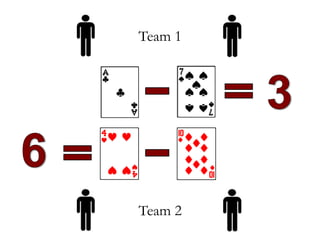
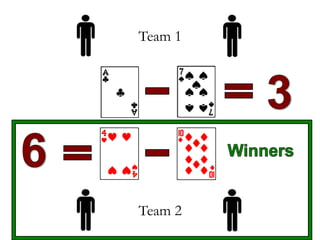
subtract the low card from the high card
• The highest difference wins the round
•

Example:
• Team 1 plays a 10 and a 4, they have 6
• Team 2 plays a 5 and a 2, they have 3

• Who wins?
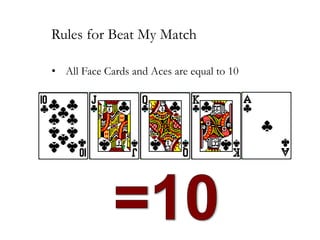
Rules for Beat My Match
• All Face Cards and Aces are equal to 10
The Catch
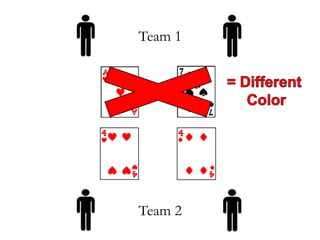
• Teammates cannot communicate in any way
• Teammates must put down a card of the same
color to be eligible
• Hearts and Diamonds together
• Spades and Clubs together

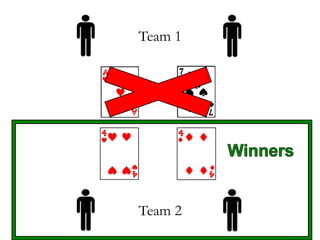
• Winning team takes all of the cards played in
that round and wins a point for each
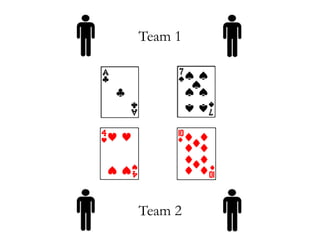
Scenario 1
Team 1

Team 2
Team 1

Team 2
Team 1

Team 2
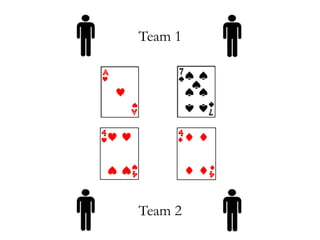
Scenario 2
Team 1

Team 2
Team 1

Team 2
Team 1

Team 2
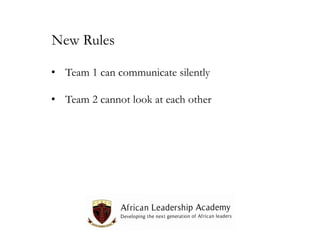
New Rules
• Team 1 can communicate silently
• Team 2 cannot look at each other
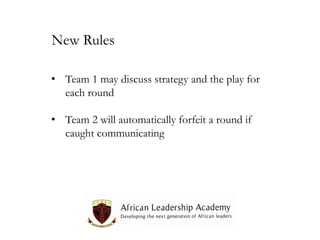
New Rules
• Team 1 may discuss strategy and the play for
each round
• Team 2 will automatically forfeit a round if
caught communicating
Reflect.
•How did you act when the rules changed in
your favor? What was the change from
beginning to end?
•What did you notice in your opponents’
behavior? How did they act/react from start
to finish?
Discuss.
•
•
•
•
•

What is self-awareness?
How does Covey define it?
What is determinism?
How do we tend to use it?
Who is Victor Frankl? What was his
predicament, and how did he respond?
• Why is he proof that conditioning can be
overcome?
“Life is 10% what happens to you and 90%
how you react to it.”
~Charles R. Swindoll
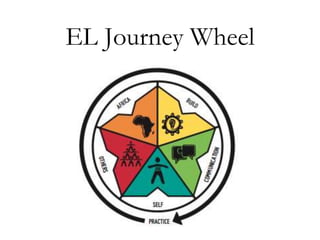
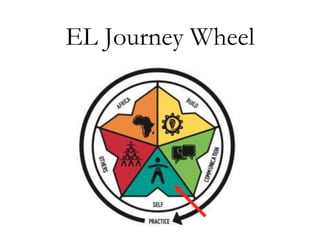
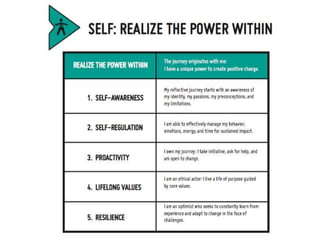
EL Journey Wheel
EL Journey Wheel
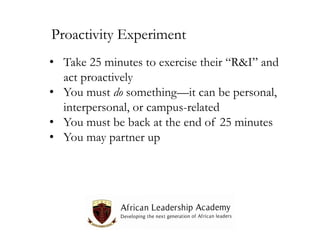
Proactivity Experiment
• Take 25 minutes to exercise their “R&I” and
act proactively
• You must do something—it can be personal,
interpersonal, or campus-related
• You must be back at the end of 25 minutes
• You may partner up
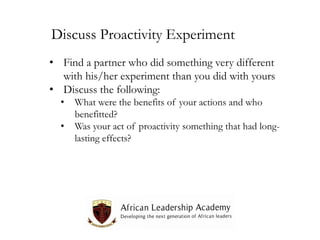
Discuss Proactivity Experiment
• Find a partner who did something very different
with his/her experiment than you did with yours
• Discuss the following:
•
•

What were the benefits of your actions and who
benefitted?
Was your act of proactivity something that had longlasting effects?
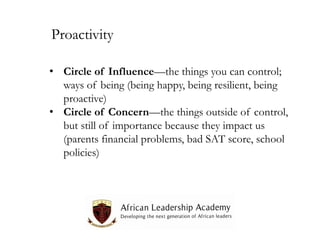
Proactivity
• Circle of Influence—the things you can control;
ways of being (being happy, being resilient, being
proactive)
• Circle of Concern—the things outside of control,
but still of importance because they impact us
(parents financial problems, bad SAT score, school
policies)
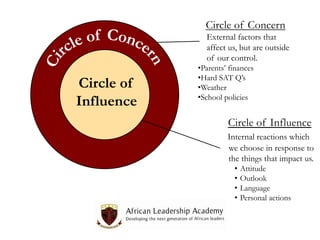
Circle of Concern
External factors that
affect us, but are outside
of our control.
Circle of
Influence

•Parents’ finances
•Hard SAT Q’s
•Weather
•School policies

Circle of Influence
Internal reactions which
we choose in response to
the things that impact us.
•
•
•
•

Attitude
Outlook
Language
Personal actions
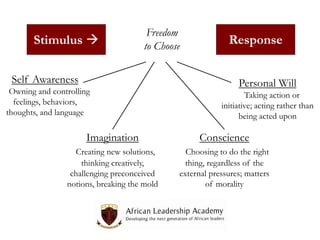
Stimulus 

Freedom
to Choose

Self Awareness
Owning and controlling
feelings, behaviors,
thoughts, and language

Response
Personal Will
Taking action or
initiative; acting rather than
being acted upon

Imagination

Conscience

Creating new solutions,
thinking creatively,
challenging preconceived
notions, breaking the mold

Choosing to do the right
thing, regardless of the
external pressures; matters
of morality
“Life is 10% what happens to you and 90%
how you react to it.”
~Charles R. Swindoll
Homework:
1. Reflect (20 mins suggested)
• What if you were more proactive in
life?
• How might you expand your Circle
of Influence?
• Why is all of this important to
Entrepreneurial Leaders?
Copyright © African Leadership Academy, 2011

3. day 3 (personal responsibility & proactivity)

  • 1.
    Personal Responsibility & Proactivity Copyright© African Leadership Academy, 2011
  • 2.
  • 3.
    Rules for BeatMy Match • Game played with partner, four in a pod • All 52 cards are dealt out to entire pod • Each game has 14 rounds (one for each card in players’ hands) • Players will all put down one card at the same time • Once all cards are down in a round, each team will subtract the low card from the high card • The highest difference wins the round • Example: • Team 1 plays a 10 and a 4, they have 6 • Team 2 plays a 5 and a 2, they have 3 • Who wins?
  • 4.
    Rules for BeatMy Match • All Face Cards and Aces are equal to 10
  • 5.
    The Catch • Teammatescannot communicate in any way • Teammates must put down a card of the same color to be eligible • Hearts and Diamonds together • Spades and Clubs together • Winning team takes all of the cards played in that round and wins a point for each
  • 6.
  • 7.
  • 8.
  • 9.
  • 10.
  • 11.
  • 12.
  • 13.
  • 14.
    New Rules • Team1 can communicate silently • Team 2 cannot look at each other
  • 15.
    New Rules • Team1 may discuss strategy and the play for each round • Team 2 will automatically forfeit a round if caught communicating
  • 16.
    Reflect. •How did youact when the rules changed in your favor? What was the change from beginning to end? •What did you notice in your opponents’ behavior? How did they act/react from start to finish?
  • 17.
    Discuss. • • • • • What is self-awareness? Howdoes Covey define it? What is determinism? How do we tend to use it? Who is Victor Frankl? What was his predicament, and how did he respond? • Why is he proof that conditioning can be overcome?
  • 18.
    “Life is 10%what happens to you and 90% how you react to it.” ~Charles R. Swindoll
  • 20.
  • 21.
  • 23.
    Proactivity Experiment • Take25 minutes to exercise their “R&I” and act proactively • You must do something—it can be personal, interpersonal, or campus-related • You must be back at the end of 25 minutes • You may partner up
  • 24.
    Discuss Proactivity Experiment •Find a partner who did something very different with his/her experiment than you did with yours • Discuss the following: • • What were the benefits of your actions and who benefitted? Was your act of proactivity something that had longlasting effects?
  • 25.
    Proactivity • Circle ofInfluence—the things you can control; ways of being (being happy, being resilient, being proactive) • Circle of Concern—the things outside of control, but still of importance because they impact us (parents financial problems, bad SAT score, school policies)
  • 26.
    Circle of Concern Externalfactors that affect us, but are outside of our control. Circle of Influence •Parents’ finances •Hard SAT Q’s •Weather •School policies Circle of Influence Internal reactions which we choose in response to the things that impact us. • • • • Attitude Outlook Language Personal actions

  • 27.
    Stimulus  Freedom to Choose SelfAwareness Owning and controlling feelings, behaviors, thoughts, and language Response Personal Will Taking action or initiative; acting rather than being acted upon Imagination Conscience Creating new solutions, thinking creatively, challenging preconceived notions, breaking the mold Choosing to do the right thing, regardless of the external pressures; matters of morality
  • 30.
    “Life is 10%what happens to you and 90% how you react to it.” ~Charles R. Swindoll
  • 31.
    Homework: 1. Reflect (20mins suggested) • What if you were more proactive in life? • How might you expand your Circle of Influence? • Why is all of this important to Entrepreneurial Leaders?
  • 32.
    Copyright © AfricanLeadership Academy, 2011