Humanistic Approach
The Third Force

Carl Rogers
&
Abraham Maslow
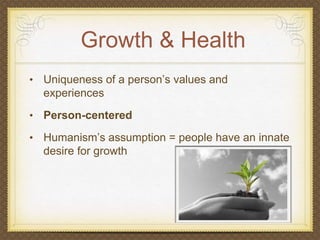
Growth & Health
• Uniqueness of a person’s values and

experiences
• Person-centered
• Humanism’s assumption = people have an innate

desire for growth
Growth perspective
• Freud’s starting point:

•

unconscious desires

• Man’s basic irrationality

• Growth is resolving
• neurotic conflicts
Carl Rogers
• The ‘self’ is our

overall perception of
our abilities
throughout time (how
you see yourself)
• SELF CONCEPT
• This self emerges

from individual
experiences with the
world.
Real Self
Real Self - what a
person is capable of
becoming in an ideal
world
Unconditional positive regard
“I love you no matter what”
Can you say that to yourself and
mean it?
Ideal self
Ideal Self - not
shaped only by
personal desires but
by also by other
people’s desires and
idea of our self worth
Who do you wish
you were?
self-actualized person
Organismic valuing
•

Actualizing tendency

•

We like what we need. If
we trust our instincts, we
will eat and behave in
ways that contribute to
our well being.

•

We evolved to favour
colours because they
indicate ripeness in fruit.
Positive Regard
• We value and need

positive regard from
others but we also
need it from
ourselves-positive
self regard
conditional positive regard
• External

measurement of a
person’s worth are
everywhere
conditions of worth
• Powerful behavioural

shaper.
• We need positive

regard from others,
even if it means
(sometimes) not
conditional positive regard
• Over time, this

conditioning leads to
conditional positive
self-regard.
• “I like myself only

when I measure up to
standards others
have imposed.”
rogers - Ideal Self
Pause the video
• and ask yourself these questions...

• Is it possible to have unconditional positive

regard for others?
• What is the role of boundaries and conditions in

relationships?
• Is it possible to have and give this to yourself?
Abraham Maslow
• Terrible childhood

• Alcoholic father
• Abusive mother

• Both were miserly

and unloving
• Set out to model his

own life against
successful people
Virtues of Self actualized people
• Reality-centered

• Enjoyed solitude
• Autonomous

• Resisted conformity
• Humble

• Respectful
• Value deep

connections
Albert
Einstein
“Few are those who see
with their own eyes and
feel with their own
hearts.”
Eleanor
Roosevelt
Great minds discuss ideas,
average minds discuss
events,
small minds discuss
people.
Portrait of success
•

Open to new experiences

•

Constantly evolving and growing

•

A love of learning
Hierarchy of
Needs
Growth depends on
fulfillment of needs at
every level
growth
orientation
Focus on what you can
do instead of what you
can’t
Rick Hansen’s Man in Motion Tour
Summary
• Rogers > our natural

state is good. Pay
attention to that in
order to become your
true self.
• Maslow > Anyone

can achieve their
potential. Do not
focus on unmet
needs but look at
what you have

Humanistic

  • 1.
    Humanistic Approach The ThirdForce Carl Rogers & Abraham Maslow
  • 2.
    Growth & Health •Uniqueness of a person’s values and experiences • Person-centered • Humanism’s assumption = people have an innate desire for growth
  • 3.
    Growth perspective • Freud’sstarting point: • unconscious desires • Man’s basic irrationality • Growth is resolving • neurotic conflicts
  • 4.
    Carl Rogers • The‘self’ is our overall perception of our abilities throughout time (how you see yourself) • SELF CONCEPT • This self emerges from individual experiences with the world.
  • 5.
    Real Self Real Self- what a person is capable of becoming in an ideal world Unconditional positive regard “I love you no matter what” Can you say that to yourself and mean it?
  • 6.
    Ideal self Ideal Self- not shaped only by personal desires but by also by other people’s desires and idea of our self worth Who do you wish you were?
  • 7.
  • 8.
    Organismic valuing • Actualizing tendency • Welike what we need. If we trust our instincts, we will eat and behave in ways that contribute to our well being. • We evolved to favour colours because they indicate ripeness in fruit.
  • 9.
    Positive Regard • Wevalue and need positive regard from others but we also need it from ourselves-positive self regard
  • 10.
    conditional positive regard •External measurement of a person’s worth are everywhere conditions of worth • Powerful behavioural shaper. • We need positive regard from others, even if it means (sometimes) not
  • 11.
    conditional positive regard •Over time, this conditioning leads to conditional positive self-regard. • “I like myself only when I measure up to standards others have imposed.”
  • 12.
  • 13.
    Pause the video •and ask yourself these questions... • Is it possible to have unconditional positive regard for others? • What is the role of boundaries and conditions in relationships? • Is it possible to have and give this to yourself?
  • 14.
    Abraham Maslow • Terriblechildhood • Alcoholic father • Abusive mother • Both were miserly and unloving • Set out to model his own life against successful people
  • 15.
    Virtues of Selfactualized people • Reality-centered • Enjoyed solitude • Autonomous • Resisted conformity • Humble • Respectful • Value deep connections
  • 16.
    Albert Einstein “Few are thosewho see with their own eyes and feel with their own hearts.”
  • 17.
    Eleanor Roosevelt Great minds discussideas, average minds discuss events, small minds discuss people.
  • 18.
    Portrait of success • Opento new experiences • Constantly evolving and growing • A love of learning
  • 19.
    Hierarchy of Needs Growth dependson fulfillment of needs at every level
  • 20.
    growth orientation Focus on whatyou can do instead of what you can’t Rick Hansen’s Man in Motion Tour
  • 21.
    Summary • Rogers >our natural state is good. Pay attention to that in order to become your true self. • Maslow > Anyone can achieve their potential. Do not focus on unmet needs but look at what you have