Mark Scheme (Results)
January 2015
Pearson Edexcel International GCSE in
Chemistry (4CH0) Paper 2C
Pearson Edexcel Certificate in
Chemistry (4CH0) Paper 2C
Edexcel and BTEC Qualifications
Edexcel and BTEC qualifications come from Pearson, the world’s leading learning
company. We provide a wide range of qualifications including academic,
vocational, occupational and specific programmes for employers. For further
information, please visit our website at www.edexcel.com.
Our website subject pages hold useful resources, support material and live feeds
from our subject advisors giving you access to a portal of information. If you
have any subject specific questions about this specification that require the help
of a subject specialist, you may find our Ask The Expert email service helpful.
www.edexcel.com/contactus
Pearson: helping people progress, everywhere
Pearson aspires to be the world’s leading learning company. Our aim is to help
everyone progress in their lives through education. We believe in every kind of
learning, for all kinds of people, wherever they are in the world. We’ve been involved
in education for over 150 years, and by working across 70 countries, in 100
languages, we have built an international reputation for our commitment to high
standards and raising achievement through innovation in education. Find out more
about how we can help you and your students at: www.pearson.com/uk
January 2015
Publications Code UG040458
All the material in this publication is copyright
© Pearson Education Ltd 2015
General Marking Guidance
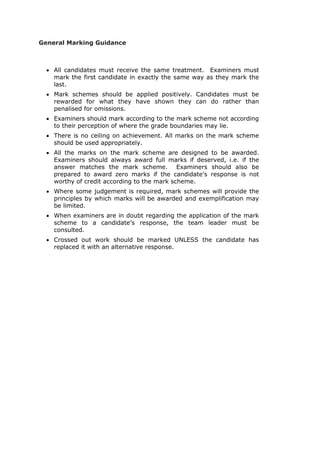
 All candidates must receive the same treatment. Examiners must
mark the first candidate in exactly the same way as they mark the
last.
 Mark schemes should be applied positively. Candidates must be
rewarded for what they have shown they can do rather than
penalised for omissions.
 Examiners should mark according to the mark scheme not according
to their perception of where the grade boundaries may lie.
 There is no ceiling on achievement. All marks on the mark scheme
should be used appropriately.
 All the marks on the mark scheme are designed to be awarded.
Examiners should always award full marks if deserved, i.e. if the
answer matches the mark scheme. Examiners should also be
prepared to award zero marks if the candidate’s response is not
worthy of credit according to the mark scheme.
 Where some judgement is required, mark schemes will provide the
principles by which marks will be awarded and exemplification may
be limited.
 When examiners are in doubt regarding the application of the mark
scheme to a candidate’s response, the team leader must be
consulted.
 Crossed out work should be marked UNLESS the candidate has
replaced it with an alternative response.
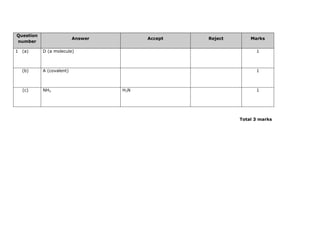
Question
number
Answer Accept Reject Marks
1 (a) D (a molecule) 1
(b) A (covalent) 1
(c) NH3 H3N 1
Total 3 marks
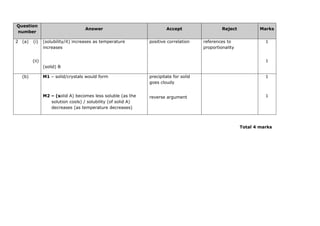
Question
number
Answer Accept Reject Marks
2 (a) (i)
(ii)
(solubility/it) increases as temperature
increases
(solid) B
positive correlation references to
proportionality
1
1
(b) M1 – solid/crystals would form
M2 – (solid A) becomes less soluble (as the
solution cools) / solubility (of solid A)
decreases (as temperature decreases)
precipitate for solid
goes cloudy
reverse argument
1
1
Total 4 marks
Question
number
Expected Answer Accept Reject Marks
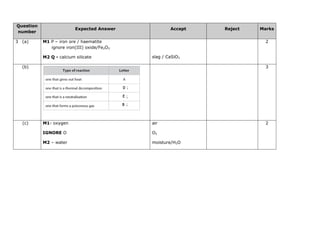
3 (a) M1 P – iron ore / haematite
ignore iron(III) oxide/Fe2O3
M2 Q - calcium silicate slag / CaSiO3
2
(b) 3
(c) M1- oxygen
IGNORE O
M2 – water
air
O2
moisture/H2O
2
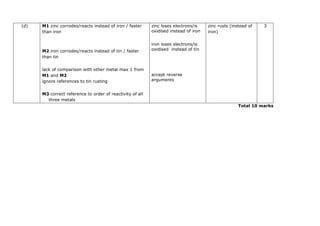
(d) M1 zinc corrodes/reacts instead of iron / faster
than iron
M2 iron corrodes/reacts instead of tin / faster
than tin
lack of comparison with other metal max 1 from
M1 and M2
ignore references to tin rusting
M3 correct reference to order of reactivity of all
three metals
zinc loses electrons/is
oxidised instead of iron
iron loses electrons/is
oxidised instead of tin
accept reverse
arguments
zinc rusts (instead of
iron)
3
Total 10 marks
Question
number
Answer Accept Reject Marks
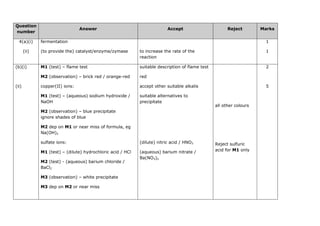
4(a)(i)
(ii)
fermentation
(to provide the) catalyst/enzyme/zymase to increase the rate of the
reaction
1
1
(b)(i)
(ii)
M1 (test) – flame test
M2 (observation) – brick red / orange-red
copper(II) ions:
M1 (test) – (aqueous) sodium hydroxide /
NaOH
M2 (observation) – blue precipitate
ignore shades of blue
M2 dep on M1 or near miss of formula, eg
Na(OH)2
sulfate ions:
M1 (test) – (dilute) hydrochloric acid / HCl
M2 (test) - (aqueous) barium chloride /
BaCl2
M3 (observation) – white precipitate
M3 dep on M2 or near miss
suitable description of flame test
red
accept other suitable alkalis
suitable alternatives to
precipitate
(dilute) nitric acid / HNO3
(aqueous) barium nitrate /
Ba(NO3)2
all other colours
Reject sulfuric
acid for M1 only
2
5
Question
number
Answer Accept Reject
Mark
s
4 (c) M1 (pressure) – 60-70 atm
M2 (catalyst) – phosphoric acid /
H3PO4
ignore references to concentration
any pressure or range within this
range
phosphoric(V) acid
any other oxidation
state
2
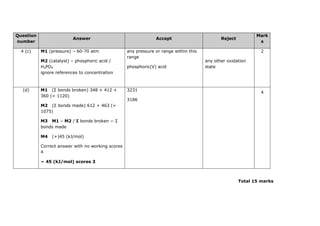
(d) M1 (Ʃ bonds broken) 348 + 412 +
360 (= 1120)
M2 (Ʃ bonds made) 612 + 463 (=
1075)
M3 M1 – M2 / Ʃ bonds broken − Ʃ
bonds made
M4 (+)45 (kJ/mol)
Correct answer with no working scores
4
− 45 (kJ/mol) scores 3
3231
3186
4
Total 15 marks
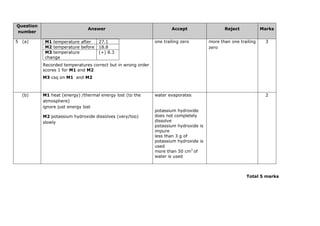
Question
number
Answer Accept Reject Marks
5 (a) M1 temperature after 27.1
M2 temperature before 18.8
M3 temperature
change
(+) 8.3
Recorded temperatures correct but in wrong order
scores 1 for M1 and M2
M3 csq on M1 and M2
one trailing zero more than one trailing
zero
3
(b) M1 heat (energy) /thermal energy lost (to the
atmosphere)
ignore just energy lost
M2 potassium hydroxide dissolves (very/too)
slowly
water evaporates
potassium hydroxide
does not completely
dissolve
potassium hydroxide is
impure
less than 3 g of
potassium hydroxide is
used
more than 50 cm3
of
water is used
2
Total 5 marks
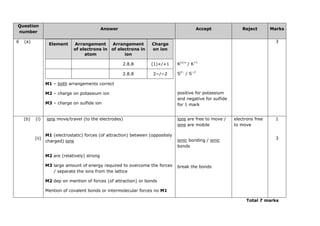
Question
number
Answer Accept Reject Marks
6 (a)
Element Arrangement
of electrons in
atom
Arrangement
of electrons in
ion
Charge
on ion
2.8.8 (1)+/+1
2.8.8 2−/−2
M1 – both arrangements correct
M2 – charge on potassium ion
M3 – charge on sulfide ion
K(1)+
/ K+1
S2−
/ S−2
positive for potassium
and negative for sulfide
for 1 mark
3
(b) (i)
(ii)
ions move/travel (to the electrodes)
M1 (electrostatic) forces (of attraction) between (oppositely
charged) ions
M2 are (relatively) strong
M3 large amount of energy required to overcome the forces
/ separate the ions from the lattice
M2 dep on mention of forces (of attraction) or bonds
Mention of covalent bonds or intermolecular forces no M1
ions are free to move /
ions are mobile
ionic bonding / ionic
bonds
break the bonds
electrons free
to move
1
3
Total 7 marks
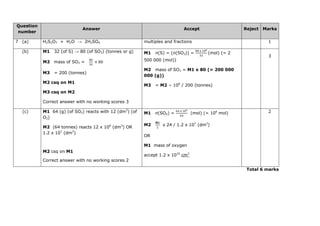
Question
number
Answer Accept Reject Marks
7 (a) H2S2O7 + H2O → 2H2SO4 multiples and fractions 1
(b) M1 32 (of S) → 80 (of SO3) (tonnes or g)
M2 mass of SO3 =
80
32
× 80
M3 = 200 (tonnes)
M2 csq on M1
M3 csq on M2
Correct answer with no working scores 3
M1 n(S) = (n(SO3)) =
80 x 106
32
(mol) (= 2
500 000 (mol))
M2 mass of SO3 = M1 x 80 (= 200 000
000 (g))
M3 = M2 ÷ 106
/ 200 (tonnes)
3
(c) M1 64 (g) (of SO2) reacts with 12 (dm3
) (of
O2)
M2 (64 tonnes) reacts 12 x 106
(dm3
) OR
1.2 x 10⁷
(dm3
)
M2 csq on M1
Correct answer with no working scores 2
M1 n(SO2) =
64 x 106
64
(mol) (= 106
mol)
M2
𝐌𝟏
2
x 24 / 1.2 x 10⁷
(dm3
)
OR
M1 mass of oxygen
accept 1.2 x 10¹⁰
cm3
2
Total 6 marks
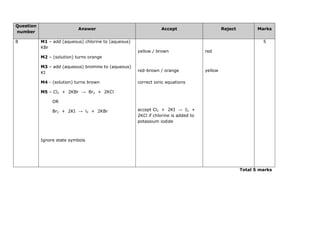
Question
number
Answer Accept Reject Marks
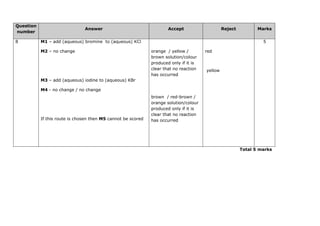
8 M1 – add (aqueous) chlorine to (aqueous)
KBr
M2 – (solution) turns orange
M3 – add (aqueous) bromine to (aqueous)
KI
M4 - (solution) turns brown
M5 – Cl2 + 2KBr → Br2 + 2KCl
OR
Br2 + 2KI → l2 + 2KBr
Ignore state symbols
yellow / brown
red-brown / orange
correct ionic equations
accept Cl2 + 2KI → I2 +
2KCl if chlorine is added to
potassium iodide
red
yellow
5
Total 5 marks
Question
number
Answer Accept Reject Marks
8 M1 – add (aqueous) bromine to (aqueous) KCl
M2 – no change
M3 – add (aqueous) iodine to (aqueous) KBr
M4 - no change / no change
If this route is chosen then M5 cannot be scored
orange / yellow /
brown solution/colour
produced only if it is
clear that no reaction
has occurred
brown / red-brown /
orange solution/colour
produced only if it is
clear that no reaction
has occurred
red
yellow
5
Total 5 marks
Question
number
Answer Accept Reject Marks
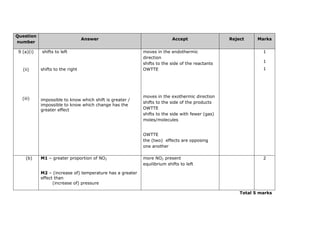
9 (a)(i)
(ii)
(iii)
shifts to left
shifts to the right
impossible to know which shift is greater /
impossible to know which change has the
greater effect
moves in the endothermic
direction
shifts to the side of the reactants
OWTTE
moves in the exothermic direction
shifts to the side of the products
OWTTE
shifts to the side with fewer (gas)
moles/molecules
OWTTE
the (two) effects are opposing
one another
1
1
1
(b) M1 – greater proportion of NO2
M2 – (increase of) temperature has a greater
effect than
(increase of) pressure
more NO2 present
equilibrium shifts to left
2
Total 5 marks
Pearson Education Limited. Registered company number 872828
with its registered office at 80 Strand, London WC2R 0RL

4 ch0 2c_msc_20151501

  • 1.
    Mark Scheme (Results) January2015 Pearson Edexcel International GCSE in Chemistry (4CH0) Paper 2C Pearson Edexcel Certificate in Chemistry (4CH0) Paper 2C
  • 2.
    Edexcel and BTECQualifications Edexcel and BTEC qualifications come from Pearson, the world’s leading learning company. We provide a wide range of qualifications including academic, vocational, occupational and specific programmes for employers. For further information, please visit our website at www.edexcel.com. Our website subject pages hold useful resources, support material and live feeds from our subject advisors giving you access to a portal of information. If you have any subject specific questions about this specification that require the help of a subject specialist, you may find our Ask The Expert email service helpful. www.edexcel.com/contactus Pearson: helping people progress, everywhere Pearson aspires to be the world’s leading learning company. Our aim is to help everyone progress in their lives through education. We believe in every kind of learning, for all kinds of people, wherever they are in the world. We’ve been involved in education for over 150 years, and by working across 70 countries, in 100 languages, we have built an international reputation for our commitment to high standards and raising achievement through innovation in education. Find out more about how we can help you and your students at: www.pearson.com/uk January 2015 Publications Code UG040458 All the material in this publication is copyright © Pearson Education Ltd 2015
  • 3.
    General Marking Guidance All candidates must receive the same treatment. Examiners must mark the first candidate in exactly the same way as they mark the last.  Mark schemes should be applied positively. Candidates must be rewarded for what they have shown they can do rather than penalised for omissions.  Examiners should mark according to the mark scheme not according to their perception of where the grade boundaries may lie.  There is no ceiling on achievement. All marks on the mark scheme should be used appropriately.  All the marks on the mark scheme are designed to be awarded. Examiners should always award full marks if deserved, i.e. if the answer matches the mark scheme. Examiners should also be prepared to award zero marks if the candidate’s response is not worthy of credit according to the mark scheme.  Where some judgement is required, mark schemes will provide the principles by which marks will be awarded and exemplification may be limited.  When examiners are in doubt regarding the application of the mark scheme to a candidate’s response, the team leader must be consulted.  Crossed out work should be marked UNLESS the candidate has replaced it with an alternative response.
  • 4.
    Question number Answer Accept RejectMarks 1 (a) D (a molecule) 1 (b) A (covalent) 1 (c) NH3 H3N 1 Total 3 marks
  • 5.
    Question number Answer Accept RejectMarks 2 (a) (i) (ii) (solubility/it) increases as temperature increases (solid) B positive correlation references to proportionality 1 1 (b) M1 – solid/crystals would form M2 – (solid A) becomes less soluble (as the solution cools) / solubility (of solid A) decreases (as temperature decreases) precipitate for solid goes cloudy reverse argument 1 1 Total 4 marks
  • 6.
    Question number Expected Answer AcceptReject Marks 3 (a) M1 P – iron ore / haematite ignore iron(III) oxide/Fe2O3 M2 Q - calcium silicate slag / CaSiO3 2 (b) 3 (c) M1- oxygen IGNORE O M2 – water air O2 moisture/H2O 2
  • 7.
    (d) M1 zinccorrodes/reacts instead of iron / faster than iron M2 iron corrodes/reacts instead of tin / faster than tin lack of comparison with other metal max 1 from M1 and M2 ignore references to tin rusting M3 correct reference to order of reactivity of all three metals zinc loses electrons/is oxidised instead of iron iron loses electrons/is oxidised instead of tin accept reverse arguments zinc rusts (instead of iron) 3 Total 10 marks
  • 8.
    Question number Answer Accept RejectMarks 4(a)(i) (ii) fermentation (to provide the) catalyst/enzyme/zymase to increase the rate of the reaction 1 1 (b)(i) (ii) M1 (test) – flame test M2 (observation) – brick red / orange-red copper(II) ions: M1 (test) – (aqueous) sodium hydroxide / NaOH M2 (observation) – blue precipitate ignore shades of blue M2 dep on M1 or near miss of formula, eg Na(OH)2 sulfate ions: M1 (test) – (dilute) hydrochloric acid / HCl M2 (test) - (aqueous) barium chloride / BaCl2 M3 (observation) – white precipitate M3 dep on M2 or near miss suitable description of flame test red accept other suitable alkalis suitable alternatives to precipitate (dilute) nitric acid / HNO3 (aqueous) barium nitrate / Ba(NO3)2 all other colours Reject sulfuric acid for M1 only 2 5
  • 9.
    Question number Answer Accept Reject Mark s 4(c) M1 (pressure) – 60-70 atm M2 (catalyst) – phosphoric acid / H3PO4 ignore references to concentration any pressure or range within this range phosphoric(V) acid any other oxidation state 2 (d) M1 (Ʃ bonds broken) 348 + 412 + 360 (= 1120) M2 (Ʃ bonds made) 612 + 463 (= 1075) M3 M1 – M2 / Ʃ bonds broken − Ʃ bonds made M4 (+)45 (kJ/mol) Correct answer with no working scores 4 − 45 (kJ/mol) scores 3 3231 3186 4 Total 15 marks
  • 10.
    Question number Answer Accept RejectMarks 5 (a) M1 temperature after 27.1 M2 temperature before 18.8 M3 temperature change (+) 8.3 Recorded temperatures correct but in wrong order scores 1 for M1 and M2 M3 csq on M1 and M2 one trailing zero more than one trailing zero 3 (b) M1 heat (energy) /thermal energy lost (to the atmosphere) ignore just energy lost M2 potassium hydroxide dissolves (very/too) slowly water evaporates potassium hydroxide does not completely dissolve potassium hydroxide is impure less than 3 g of potassium hydroxide is used more than 50 cm3 of water is used 2 Total 5 marks
  • 11.
    Question number Answer Accept RejectMarks 6 (a) Element Arrangement of electrons in atom Arrangement of electrons in ion Charge on ion 2.8.8 (1)+/+1 2.8.8 2−/−2 M1 – both arrangements correct M2 – charge on potassium ion M3 – charge on sulfide ion K(1)+ / K+1 S2− / S−2 positive for potassium and negative for sulfide for 1 mark 3 (b) (i) (ii) ions move/travel (to the electrodes) M1 (electrostatic) forces (of attraction) between (oppositely charged) ions M2 are (relatively) strong M3 large amount of energy required to overcome the forces / separate the ions from the lattice M2 dep on mention of forces (of attraction) or bonds Mention of covalent bonds or intermolecular forces no M1 ions are free to move / ions are mobile ionic bonding / ionic bonds break the bonds electrons free to move 1 3 Total 7 marks
  • 12.
    Question number Answer Accept RejectMarks 7 (a) H2S2O7 + H2O → 2H2SO4 multiples and fractions 1 (b) M1 32 (of S) → 80 (of SO3) (tonnes or g) M2 mass of SO3 = 80 32 × 80 M3 = 200 (tonnes) M2 csq on M1 M3 csq on M2 Correct answer with no working scores 3 M1 n(S) = (n(SO3)) = 80 x 106 32 (mol) (= 2 500 000 (mol)) M2 mass of SO3 = M1 x 80 (= 200 000 000 (g)) M3 = M2 ÷ 106 / 200 (tonnes) 3 (c) M1 64 (g) (of SO2) reacts with 12 (dm3 ) (of O2) M2 (64 tonnes) reacts 12 x 106 (dm3 ) OR 1.2 x 10⁷ (dm3 ) M2 csq on M1 Correct answer with no working scores 2 M1 n(SO2) = 64 x 106 64 (mol) (= 106 mol) M2 𝐌𝟏 2 x 24 / 1.2 x 10⁷ (dm3 ) OR M1 mass of oxygen accept 1.2 x 1010 cm3 2 Total 6 marks
  • 13.
    Question number Answer Accept RejectMarks 8 M1 – add (aqueous) chlorine to (aqueous) KBr M2 – (solution) turns orange M3 – add (aqueous) bromine to (aqueous) KI M4 - (solution) turns brown M5 – Cl2 + 2KBr → Br2 + 2KCl OR Br2 + 2KI → l2 + 2KBr Ignore state symbols yellow / brown red-brown / orange correct ionic equations accept Cl2 + 2KI → I2 + 2KCl if chlorine is added to potassium iodide red yellow 5 Total 5 marks
  • 14.
    Question number Answer Accept RejectMarks 8 M1 – add (aqueous) bromine to (aqueous) KCl M2 – no change M3 – add (aqueous) iodine to (aqueous) KBr M4 - no change / no change If this route is chosen then M5 cannot be scored orange / yellow / brown solution/colour produced only if it is clear that no reaction has occurred brown / red-brown / orange solution/colour produced only if it is clear that no reaction has occurred red yellow 5 Total 5 marks
  • 15.
    Question number Answer Accept RejectMarks 9 (a)(i) (ii) (iii) shifts to left shifts to the right impossible to know which shift is greater / impossible to know which change has the greater effect moves in the endothermic direction shifts to the side of the reactants OWTTE moves in the exothermic direction shifts to the side of the products OWTTE shifts to the side with fewer (gas) moles/molecules OWTTE the (two) effects are opposing one another 1 1 1 (b) M1 – greater proportion of NO2 M2 – (increase of) temperature has a greater effect than (increase of) pressure more NO2 present equilibrium shifts to left 2 Total 5 marks
  • 16.
    Pearson Education Limited.Registered company number 872828 with its registered office at 80 Strand, London WC2R 0RL