Mark Scheme (Results)
June 2014
Pearson Edexcel International GCSE
Physics (4PH0/2PR)
Edexcel and BTEC Qualifications
Edexcel and BTEC qualifications come from Pearson, the world’s leading learning
company. We provide a wide range of qualifications including academic,
vocational, occupational and specific programmes for employers. For further
information, please visit our website at www.edexcel.com.
Our website subject pages hold useful resources, support material and live feeds
from our subject advisors giving you access to a portal of information. If you
have any subject specific questions about this specification that require the help
of a subject specialist, you may find our Ask The Expert email service helpful.
www.edexcel.com/contactus
Pearson: helping people progress, everywhere
Our aim is to help everyone progress in their lives through education. We believe
in every kind of learning, for all kinds of people, wherever they are in the world.
We’ve been involved in education for over 150 years, and by working across 70
countries, in 100 languages, we have built an international reputation for our
commitment to high standards and raising achievement through innovation in
education. Find out more about how we can help you and your students at:
www.pearson.com/uk
January 2014
Publications Code UG039704
All the material in this publication is copyright
© Pearson Education Ltd 2014
General Marking Guidance
•All candidates must receive the same treatment. Examiners must
mark the first candidate in exactly the same way as they mark
the last.
•Mark schemes should be applied positively. Candidates must be
rewarded for what they have shown they can do rather than
penalised for omissions.
•Examiners should mark according to the mark scheme not according
to their perception of where the grade boundaries may lie.
•There is no ceiling on achievement. All marks on the mark scheme
should be used appropriately.
•All the marks on the mark scheme are designed to be awarded.
Examiners should always award full marks if deserved, i.e. if
the answer matches the mark scheme. Examiners should also
be prepared to award zero marks if the candidate’s response is
not worthy of credit according to the mark scheme.
• Where some judgement is required, mark schemes will provide the
principles by which marks will be awarded and exemplification
may be limited.
• When examiners are in doubt regarding the application of the
mark scheme to a candidate’s response, the team leader must
be consulted.
• Crossed out work should be marked UNLESS the candidate has
replaced it with an alternative response.
Question
number
Answer Notes Marks
1 a A (Joule); 1
b The cell converts Chemical energy into
Electrical energy;;
The lamp converts this energy into Light and
Thermal energy (BOTH needed); either order for the second
sentence
2
1
c (i) 14(J); 1
(ii) Efficiency = (useful) energy output ;
(total) energy input
allow
• x 100(%)
1
(iii) Substitution;
Evaluation;
e.g.
(efficiency =) 36
50
(=) 0.72
do not allow
• inverted substitution
e.g. 50/36 =1.39
Allow
• 72%
• correct answer without
working (bald answer)
for both marks
2
(Total for Question 1 = 8 marks)
(Total for Question 2 = 7 marks)
Question
number
Answer Notes Marks
2 (a) B (hit the walls of the container harder) 1
(b) (average) KE (of particles) decreases ( as the
temperature falls);
AND one of
• (because) they move slower;
• idea that at 0 K the particles have no kinetic
energy;
• idea that at 0 K the particles are not moving;
ignore
• ‘ particles freeze’
• KE is lost
allow
• ‘it’ for average KE
• absolute zero for 0 K
2
2 (c) (i) 300 K; 1
(c) (ii) both temperatures seen in Kelvin;
Substitution;
(Rearrangement and) Evaluation;
e.g.
210 000 = P2 this would get 2 marks if
seen
300 354
210 000 x 354 = P2 this would get 2 marks if
seen
300
(P2) =250(kPa) this is 3 marks
no mark for equation as it
is given on page 2
allow
• 210 000 = P2 for 1
mark 27 81
• 630 (kPa) for 2 marks
• bald answer 248 (kPa)
for 3 marks
• answers which round to
250
Power of Ten error (POT)
=-1
3
Question
number
Answer Notes Marks
3 (a) B; 1
(b) (i) MP1. Axes labelled with units;
MP2. Correct scales (to occupy at least ¼ of the
area of the graph and in sensible intervals);
MP3. Plotting;
MP4. Plotting;
MP5. straight line of best fit which extends beyond
given data points;
• ignore orientation of
graph
• scale intervals on axes
should be 2 or 5 or 10
• points should be less
than 0.5 sq in diameter
• -1 each incorrect plot to
max of -2
• tolerance = +/- ½
square
• if zero is not included,
then line should go
through all points
except 3rd
or 4th
• if zero included, look for
balance of points
5
(ii) Attempt to find slope or gradient of line ;
AND
evaluation of value;
matching unit;
Δ seen
or two lines from same axis
seen
or rise/run seen
e.g.
= 0.6/0.0018
= 333
m/s
value in range of 310-350
allow
0.333 km/s
0.333 m/ms
3
(iii) Any one specific variable from the experiment;
e.g.
hitting the block in the same place
Use the same microphone/timer/wires
Ensure there is no ‘hammer bounce’
These must be specific to
the experiment
Accept same
• temperature
• humidity
• density
• draughts
• force
• block
ignore
• ‘keep everything the
same’
• use control variables
• repeat experiment
1
(iv) Any 2 suggestions from
MP1. repeat the time readings (for each distance);
MP2. measure the distance to the sensor of the
microphone;
MP3. use wider range of distance readings (<0.62
or >1.38);
MP4. use intermediate distances (between points);
ignore imprecise
suggestions e.g.
• ‘be careful with timer’
• ‘change the distance’
2
(Total for Question 3 = 12 marks)
Question
number
Answer Notes Marks
4 (a) (i) Any three from
MP1. parallel field shown inside the core;
MP2. one complete line from a pole and to the
other pole;
MP3. at least three lines at each pole with a
minimum of two correctly curved lines;
MP4. Arrow on any external field line from N or into
S;
Condone
dotted lines
Reject
Crossing field lines for MP3
only
conflicting arrows for MP4
only
3
(ii) idea that strength of magnetic field is increased; allow
concentrates the magnetic
field
ignore
• ‘channels the magnetic
field’/eq
• references to soft iron
• references to easily
magnetised
/demagnetised
1
(b) any two from:-
MP1 Steel is magnetically hard material/eq ;
MP2 Steel becomes (permanently) magnetised;
MP3 Steel remains magnetised (when current
switched off) /paper clips remain attracted to
steel;
NB do not credit repeat of
stem (remain attached is
in the stem)
2
(Total for Question 4= 6 marks)
Question
number
Answer Notes Marks
5 (a) i Step down (transformer); 1
ii (VP/VS) = (NP/NS); Allow
• equation in words
• standard abbreviations
:- s, p, in, out, 1, 2
• N, n or T for number of
turns
• Rearrangements e.g.
(VS/VP) = (NS/NP)
VS= (VP) (NS/NP)
VP= (VS) (NP/NS)
1
iii Substitution;
(rearrangement and) evaluation;
e.g.
230 = primary turns
25 100
920 (Turns)
Do not credit the equation
in words or symbols
bald answer gains full
marks
2
Question
number
Answer Notes Marks
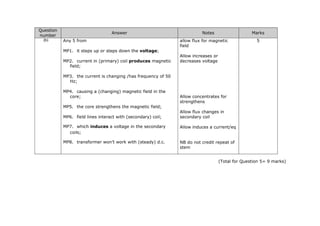
(b) Any 5 from
MP1. it steps up or steps down the voltage;
MP2. current in (primary) coil produces magnetic
field;
MP3. the current is changing /has frequency of 50
Hz;
MP4. causing a (changing) magnetic field in the
core;
MP5. the core strengthens the magnetic field;
MP6. field lines interact with (secondary) coil;
MP7. which induces a voltage in the secondary
coils;
MP8. transformer won’t work with (steady) d.c.
allow flux for magnetic
field
Allow increases or
decreases voltage
Allow concentrates for
strengthens
Allow flux changes in
secondary coil
Allow induces a current/eq
NB do not credit repeat of
stem
5
(Total for Question 5= 9 marks)
Question
number
Answer Notes Marks
6 (a) electrons move;
from balloon to cloth;
Allow
negative charges for
electrons
Ignore all references to
• positive electrons
• explanations in terms
of movement of
positive charge
2
(b) Idea that movement is due to attraction;
between negative charges in the hair and (positive)
balloon (however expressed);
Allow unlike charges
attract
2
(c) The balloon is an insulator; Allow poor conductor 1
(d) A sensible suggestion including movement of
electrons;
e.g.
electrons move from air/water/hair onto balloon
charges move from the hair into the air
water is a conductor so electrons move (into air/from
balloon)
Allow
• ‘charge(s)’ for
electrons
• the charge on the
balloon is neutralised
Ignore all references to
‘positive charge’
1
(Total for Question 6= 6 marks)
Question
number
Answer Notes Marks
7 (a) Any 2 from
air bags;
side impact beams/bars;
crumple zones /collapsible bumpers;
collapsible steering column /wheel;
Allow
references to strong /
laminated / safety glass
ignore
unqualified bumpers
2
(b) (i) Any four from
MP1. same momentum change (with or without a
seatbelt);
MP2. (but) time of impact increases;
MP3. (which) reduces rate of momentum change;
MP4. (therefore) reducing the (average) force;
MP5. the seat belt stretches (during collision);
MP6. (which) increases the area over which the force
acts;
MP7. (hence) pressure on body reduces;
Ignore
• references to
momentum reducing
• word equation
4
(b) (ii) A sensible suggestion;
e.g.
there is a higher momentum (transfer in collision)
there is a larger force during impact
straps have a greater area over which force acts
larger area of straps reduces the pressure
1
(c) Momentum (of car and dummy) reduces to zero;
OR
All momentum is absorbed by the Earth;
1
(Total for Question 7= 8 marks)
Question
number
Answer Notes Marks
8 (a) momentum = mass × velocity; Allow rearrangements
and standard
abbreviations
p = m x v
1
(b) Equation;
Substitution and rearrangement;
Evaluation;
e.g.
m1 x v1 = m2 x v2
10 000 x 4.5 / 1500
30(m/s)
bald answer = 3 marks
POT =-1
3
(Total for Question 8= 4 marks)

4 ph0 2pr_msc_20140821

  • 1.
    Mark Scheme (Results) June2014 Pearson Edexcel International GCSE Physics (4PH0/2PR)
  • 2.
    Edexcel and BTECQualifications Edexcel and BTEC qualifications come from Pearson, the world’s leading learning company. We provide a wide range of qualifications including academic, vocational, occupational and specific programmes for employers. For further information, please visit our website at www.edexcel.com. Our website subject pages hold useful resources, support material and live feeds from our subject advisors giving you access to a portal of information. If you have any subject specific questions about this specification that require the help of a subject specialist, you may find our Ask The Expert email service helpful. www.edexcel.com/contactus Pearson: helping people progress, everywhere Our aim is to help everyone progress in their lives through education. We believe in every kind of learning, for all kinds of people, wherever they are in the world. We’ve been involved in education for over 150 years, and by working across 70 countries, in 100 languages, we have built an international reputation for our commitment to high standards and raising achievement through innovation in education. Find out more about how we can help you and your students at: www.pearson.com/uk January 2014 Publications Code UG039704 All the material in this publication is copyright © Pearson Education Ltd 2014
  • 3.
    General Marking Guidance •Allcandidates must receive the same treatment. Examiners must mark the first candidate in exactly the same way as they mark the last. •Mark schemes should be applied positively. Candidates must be rewarded for what they have shown they can do rather than penalised for omissions. •Examiners should mark according to the mark scheme not according to their perception of where the grade boundaries may lie. •There is no ceiling on achievement. All marks on the mark scheme should be used appropriately. •All the marks on the mark scheme are designed to be awarded. Examiners should always award full marks if deserved, i.e. if the answer matches the mark scheme. Examiners should also be prepared to award zero marks if the candidate’s response is not worthy of credit according to the mark scheme. • Where some judgement is required, mark schemes will provide the principles by which marks will be awarded and exemplification may be limited. • When examiners are in doubt regarding the application of the mark scheme to a candidate’s response, the team leader must be consulted. • Crossed out work should be marked UNLESS the candidate has replaced it with an alternative response.
  • 4.
    Question number Answer Notes Marks 1a A (Joule); 1 b The cell converts Chemical energy into Electrical energy;; The lamp converts this energy into Light and Thermal energy (BOTH needed); either order for the second sentence 2 1 c (i) 14(J); 1 (ii) Efficiency = (useful) energy output ; (total) energy input allow • x 100(%) 1 (iii) Substitution; Evaluation; e.g. (efficiency =) 36 50 (=) 0.72 do not allow • inverted substitution e.g. 50/36 =1.39 Allow • 72% • correct answer without working (bald answer) for both marks 2 (Total for Question 1 = 8 marks)
  • 5.
    (Total for Question2 = 7 marks) Question number Answer Notes Marks 2 (a) B (hit the walls of the container harder) 1 (b) (average) KE (of particles) decreases ( as the temperature falls); AND one of • (because) they move slower; • idea that at 0 K the particles have no kinetic energy; • idea that at 0 K the particles are not moving; ignore • ‘ particles freeze’ • KE is lost allow • ‘it’ for average KE • absolute zero for 0 K 2 2 (c) (i) 300 K; 1 (c) (ii) both temperatures seen in Kelvin; Substitution; (Rearrangement and) Evaluation; e.g. 210 000 = P2 this would get 2 marks if seen 300 354 210 000 x 354 = P2 this would get 2 marks if seen 300 (P2) =250(kPa) this is 3 marks no mark for equation as it is given on page 2 allow • 210 000 = P2 for 1 mark 27 81 • 630 (kPa) for 2 marks • bald answer 248 (kPa) for 3 marks • answers which round to 250 Power of Ten error (POT) =-1 3
  • 6.
    Question number Answer Notes Marks 3(a) B; 1 (b) (i) MP1. Axes labelled with units; MP2. Correct scales (to occupy at least ¼ of the area of the graph and in sensible intervals); MP3. Plotting; MP4. Plotting; MP5. straight line of best fit which extends beyond given data points; • ignore orientation of graph • scale intervals on axes should be 2 or 5 or 10 • points should be less than 0.5 sq in diameter • -1 each incorrect plot to max of -2 • tolerance = +/- ½ square • if zero is not included, then line should go through all points except 3rd or 4th • if zero included, look for balance of points 5
  • 7.
    (ii) Attempt tofind slope or gradient of line ; AND evaluation of value; matching unit; Δ seen or two lines from same axis seen or rise/run seen e.g. = 0.6/0.0018 = 333 m/s value in range of 310-350 allow 0.333 km/s 0.333 m/ms 3 (iii) Any one specific variable from the experiment; e.g. hitting the block in the same place Use the same microphone/timer/wires Ensure there is no ‘hammer bounce’ These must be specific to the experiment Accept same • temperature • humidity • density • draughts • force • block ignore • ‘keep everything the same’ • use control variables • repeat experiment 1 (iv) Any 2 suggestions from MP1. repeat the time readings (for each distance); MP2. measure the distance to the sensor of the microphone; MP3. use wider range of distance readings (<0.62 or >1.38); MP4. use intermediate distances (between points); ignore imprecise suggestions e.g. • ‘be careful with timer’ • ‘change the distance’ 2 (Total for Question 3 = 12 marks)
  • 8.
    Question number Answer Notes Marks 4(a) (i) Any three from MP1. parallel field shown inside the core; MP2. one complete line from a pole and to the other pole; MP3. at least three lines at each pole with a minimum of two correctly curved lines; MP4. Arrow on any external field line from N or into S; Condone dotted lines Reject Crossing field lines for MP3 only conflicting arrows for MP4 only 3 (ii) idea that strength of magnetic field is increased; allow concentrates the magnetic field ignore • ‘channels the magnetic field’/eq • references to soft iron • references to easily magnetised /demagnetised 1
  • 9.
    (b) any twofrom:- MP1 Steel is magnetically hard material/eq ; MP2 Steel becomes (permanently) magnetised; MP3 Steel remains magnetised (when current switched off) /paper clips remain attracted to steel; NB do not credit repeat of stem (remain attached is in the stem) 2 (Total for Question 4= 6 marks)
  • 10.
    Question number Answer Notes Marks 5(a) i Step down (transformer); 1 ii (VP/VS) = (NP/NS); Allow • equation in words • standard abbreviations :- s, p, in, out, 1, 2 • N, n or T for number of turns • Rearrangements e.g. (VS/VP) = (NS/NP) VS= (VP) (NS/NP) VP= (VS) (NP/NS) 1 iii Substitution; (rearrangement and) evaluation; e.g. 230 = primary turns 25 100 920 (Turns) Do not credit the equation in words or symbols bald answer gains full marks 2
  • 11.
    Question number Answer Notes Marks (b)Any 5 from MP1. it steps up or steps down the voltage; MP2. current in (primary) coil produces magnetic field; MP3. the current is changing /has frequency of 50 Hz; MP4. causing a (changing) magnetic field in the core; MP5. the core strengthens the magnetic field; MP6. field lines interact with (secondary) coil; MP7. which induces a voltage in the secondary coils; MP8. transformer won’t work with (steady) d.c. allow flux for magnetic field Allow increases or decreases voltage Allow concentrates for strengthens Allow flux changes in secondary coil Allow induces a current/eq NB do not credit repeat of stem 5 (Total for Question 5= 9 marks)
  • 12.
    Question number Answer Notes Marks 6(a) electrons move; from balloon to cloth; Allow negative charges for electrons Ignore all references to • positive electrons • explanations in terms of movement of positive charge 2 (b) Idea that movement is due to attraction; between negative charges in the hair and (positive) balloon (however expressed); Allow unlike charges attract 2 (c) The balloon is an insulator; Allow poor conductor 1 (d) A sensible suggestion including movement of electrons; e.g. electrons move from air/water/hair onto balloon charges move from the hair into the air water is a conductor so electrons move (into air/from balloon) Allow • ‘charge(s)’ for electrons • the charge on the balloon is neutralised Ignore all references to ‘positive charge’ 1 (Total for Question 6= 6 marks)
  • 13.
    Question number Answer Notes Marks 7(a) Any 2 from air bags; side impact beams/bars; crumple zones /collapsible bumpers; collapsible steering column /wheel; Allow references to strong / laminated / safety glass ignore unqualified bumpers 2 (b) (i) Any four from MP1. same momentum change (with or without a seatbelt); MP2. (but) time of impact increases; MP3. (which) reduces rate of momentum change; MP4. (therefore) reducing the (average) force; MP5. the seat belt stretches (during collision); MP6. (which) increases the area over which the force acts; MP7. (hence) pressure on body reduces; Ignore • references to momentum reducing • word equation 4 (b) (ii) A sensible suggestion; e.g. there is a higher momentum (transfer in collision) there is a larger force during impact straps have a greater area over which force acts larger area of straps reduces the pressure 1
  • 14.
    (c) Momentum (ofcar and dummy) reduces to zero; OR All momentum is absorbed by the Earth; 1 (Total for Question 7= 8 marks)
  • 15.
    Question number Answer Notes Marks 8(a) momentum = mass × velocity; Allow rearrangements and standard abbreviations p = m x v 1 (b) Equation; Substitution and rearrangement; Evaluation; e.g. m1 x v1 = m2 x v2 10 000 x 4.5 / 1500 30(m/s) bald answer = 3 marks POT =-1 3 (Total for Question 8= 4 marks)