Μεταστατικός Καρκίνος Νεφρού
θεραπευτική αντιμετώπιση
Nikolaos Tsoukalas MD, MSc, PhD
Medical Oncologist, MSc in Bioinformatics
Clinical Research Fellow in Oncology
Guy’s & St Thomas’ NHS Cancer Centre
Queen Elizabeth Hospital
London UK
Disclosure
• No actual or potential conflict of interest in relation
to this presentation.
• No real or apparent conflicts of interest to disclose.
Renal cell carcinoma
• Renal cell carcinoma (RCC) accounts for 2%–3% of all
adult malignancies, representing the seventh most
common cancer in men and the ninth most common
cancer in women.
• Worldwide, there are ∼209 000 new cases and 102
000 deaths per year. The incidence of all stages of
RCC has increased over the past several years,
contributing to a steadily increasing mortality rate
per unit population.
Annals of Oncology 25 (Supplement 3): iii49–iii56, 2014
Current targets of therapies for RCC:
VEGF and mTOR
 Inhibition of some other target pathways are under investigation
Transcriptional
activation
VEGF
HIF-1α
VHL
Protein
synthesis
Angiogenesis
Bevacizumab
Growth and
metabolism
mTOR
Growth
factor
receptor
PI3K
PIP2
PIP3
PTEN
AKT
Temsirolimus,
everolimus
Sunitinib,
sorafenib, axitinib,
pazopanib
Tumour
cell
Endothelial cell
VEGFR
EGF, epidermal growth factor; VHL, von Hippel–Lindau
ESMO Academy 2015
Patient outcomes
Therapeutic options
Median PFS
4–5 months
Median PFS
9–11 months
Median PFS
4–5 months
? ?
~40–60%1,2~100% <20%3–5Eligible patients
Sunitinib
Pazopanib
Bevacizumab
+ IFN-α
Temsirolimus
Axitinib
(post-sunitinib/
cytokine)
Everolimus
(post-VEGFR-TKI)
Sunitinib
(post-cytokine)
Pazopanib
(post-cytokine)
Sorafenib
(post-cytokine)
Everolimus
(post-VEGFR-TKI
× 2)
Neoadjuvant Adjuvant First-line Second-line Third-line
Progress in advanced kidney cancer,
2007–2014
Adapted from Larkin. ASCO GU 2014
IFN-α, interferon-alpha; VEGFR-TKI, vascular endothelial growth factor receptor-tyrosine kinase inhibitor
1. Levy et al. Eur J Cancer 2013; 2. Sonpavde et al. Eur Urol 2012; 3. Iacovelli et al.
Eur J Cancer 2013; 4. Pal et al. ASCO GU 2013; 5. Heng et al. ASCO 2013
ESMO Academy 2015
ESMO Academy 2015
ESMO Academy 2015
ESMO Academy 2015
Metastatic Renal Cell Carcinoma:
ESMO Clinical Practice Guidelines
• In the era of immunotherapy, cytoreductive nephrectomy was
recommended in patients with good PS [I, A].
• Whether this recommendation will remain with current targeted
therapies is currently being investigated in two prospective trials.
• In routine practice, cytoreductive nephrectomy is recommended
in patients with good PS and large primary tumours with limited
volumes of metastatic disease, and for patients with a
symptomatic primary lesion. Cytoreductive nephrectomy is not
recommended in patients with poor PS.
Annals of Oncology 25 (Supplement 3): iii49–iii56, 2014
Metastatic Renal Cell Carcinoma:
ESMO Clinical Practice Guidelines
• Metastasectomy can be considered and
performed after multidisciplinary review for
selected patients with solitary or easily
accessible pulmonary metastases, solitary
resectable intraabdominal metastases, a long
disease-free interval after nephrectomy, or a
partial response in metastases to
immunotherapy or targeted therapy.
Annals of Oncology 25 (Supplement 3): iii49–iii56, 2014
ESMO Academy 2015
Targeted agents currently approved for mRCC in Europe
Sorafenib (oral)
Advanced RCC after IFN-α/IL-2
or if unsuitable for IFN-α/IL-22
Bevacizumab
(+IFN-α) (IV)
First-line mRCC3
Everolimus (oral)
Advanced RCC after
VEGF-targeted therapy5
Axitinib (oral)
Advanced RCC after sunitinib
or a cytokine7
Temsirolimus (IV)
Advanced RCC with 3–6
prognostic risk factors4
2006 2007 2008 2009 2010 2011 2012 2013 2014
Pazopanib (oral)
Advanced RCC6
Sunitinib (oral)
Advanced/mRCC1
1. Sunitinib SmPC, Jan 2014; 2. Sorafenib SmPC, Feb 2013; 3. Bevacizumab SmPC, Feb 2014; 4. Temsirolimus SmPC, Oct 2013;
5. Everolimus SmPC, Nov 2013; 6. Pazopanib SmPC, Dec 2013; 7. Axitinib SmPC, Oct 2013.
IFN-α, interferon-alpha; IL-2, interleukin-2; IV, intravenous
ESMO Academy 2015
ESMO Academy 2015
ESMO Academy 2015
ESMO Academy 2015
ESMO Academy 2015
ESMO Academy 2015
ESMO Academy 2015
Pivotal trials in the 2nd line setting
TRIAL TREATMENTS
TARGET Sorafenib vs Placebo
AXIS Axitinib vs Sorafenib
RECORD-1 Everolimus vs Placebo
INTORSECT Temsirolimus vs Sorafenib
METEOR Cabozantinib vs Everolimus
CheckMate-025 Nivolumab vs Everolimus
Axitinib: a next-generation TKI
• Binds to VEGFR-1, -2 and -3
• Fits tightly into the ‘deep pocket’
conformation of the kinase domain of VEGFRs,
resulting in high potency and selectivity in
vitro
Hu-Lowe DD, et al. Clin Cancer Res 2008;14:7272–83; Escudier B and Gore M. Drugs R D 2011;11:113–26;
INLYTA®. Summary of Product Characteristics. 2012. Available at: www.medicines.org.uk/emc/.
Sorafenib
400 mg BD
Eligibility criteria included:
 mRCC with clear-cell
histology
 Failure of one prior first-
line regimen containing:
– Sunitinib
– Bevacizumab + IFN-α
– Temsirolimus
– Or cytokines
 Stratification by prior
regimen and ECOG PS
Phase III study of axitinib versus sorafenib in
second-line treatment of mRCC (AXIS)
Primary endpoints: PFS by independent central review
Secondary endpoints: OS, ORR, safety and tolerability, duration of response, patient-reported outcomes
Axitinib
5 mg BD*
N=723
Treat until PD, unmanageable AE, or
withdrawal of consent
Rini BI, et al. Lancet 2011;378:1931–9.
Sorafenib Summary of Product Characteristics. 2012. Available at: www.medicines.org.uk/emc/.
*Dose increase (to maximum of 10 mg BD) or reduction (to minimum of 2 mg BD) is recommended based on individual safety and tolerability; The dose could
be decreased after initiation. AE=adverse event; ECOG PS=Eastern Cooperative Oncology Group performance status; ORR=objective response rate; OS=overall
survival; PFS=progression-free survival; PD=progressive disease.
1:1
R
A
N
D
O
M
I
S
A
T
I
O
N
AXIS Trial: PFS results
Rini BI, et al. Lancet. 2011;378:1931-1939.
1.0
0.9
0.8
0.7
0.6
0.5
0.4
0.3
0.2
0.1
0
0 2 4 6 8 10 12 14 16 18 20
ProbabilityofPFS
Axitinib
Sorafenib
Median PFS, Mos (95% CI)
6.7 (6.3-8.6)
4.7 (4.6-5.6)
Stratified HR: 0.665
(95% CI: 0.544-0.812;
P < .0001)
Pts at Risk, n
Axitinib
Sorafenib
256
224
361
362
202
157
145
100
96
51
64
28
38
12
20
6
10
3
1
1
0
0
Months
Lenvima
Lenvatinib ± Everolimus in mRCC:
Randomized, Open-Label Phase II Study
• Primary endpoint: PFS with lenvatinib ± everolimus vs everolimus alone
• Secondary endpoints: PFS with combination vs lenvatinib alone, ORR, OS,
safety/tolerability
Lenvatinib 18 mg QD +
Everolimus 5 mg QD
(n = 51)
Measurable metastatic or
advanced RCC;
following progression
≤ 9 mos after 1 prior
VEGF therapy
(N = 153)
Stratified by hemoglobin (low vs
normal) and corrected serum calcium
(≥ vs < 10 mg/dL)
Lenvatinib 24 mg QD
(n = 52)
Motzer R, et al. ASCO 2015. Abstract 4506. Reprinted with permission.
Everolimus 10 mg QD
(n = 50)
Treated until PD or
unacceptable toxicity
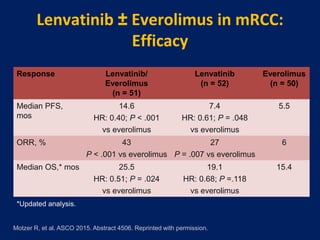
Lenvatinib ± Everolimus in mRCC:
Efficacy
Response Lenvatinib/
Everolimus
(n = 51)
Lenvatinib
(n = 52)
Everolimus
(n = 50)
Median PFS,
mos
14.6
HR: 0.40; P < .001
vs everolimus
7.4
HR: 0.61; P = .048
vs everolimus
5.5
ORR, % 43
P < .001 vs everolimus
27
P = .007 vs everolimus
6
Median OS,* mos 25.5
HR: 0.51; P = .024
vs everolimus
19.1
HR: 0.68; P =.118
vs everolimus
15.4
Motzer R, et al. ASCO 2015. Abstract 4506. Reprinted with permission.
*Updated analysis.
Cabozantinib
Cometriq
METEOR phase III study
Basic characteristics
Choueiri et al. NEJM 2015
Overall survival
Choueiri et al. NEJM 2015
Response rate
Cabozantinib Everolimus
21% 5%
40/187 9/188
P<0.001
Adverse Effects
Choueiri et al. NEJM 2015
Opdivo
Phase 3 trial of Nivolumab vs Everolimus
following VEGF-targeted therapy
Motzer et al. NEJM 2015
Nivolumab produced higher response rates than
everolimus (25% vs. 5%) and median overall survival
was longer (by 5.4 months), to more than 2 years.
Motzer RJ et al. N Engl J Med 2015;373:1803-1813
Baseline Characteristics (1)
Baseline Characteristics (2)
Motzer RJ et al. N Engl J Med 2015;373:1803-1813
Overall Survival
Motzer RJ et al. N Engl J Med 2015;373:1803-1813
Nivolumab Everolimus
24% 5%
103/410 22/411
P<0.001
Response rate
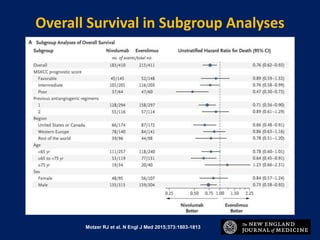
Overall Survival in Subgroup Analyses
Motzer RJ et al. N Engl J Med 2015;373:1803-1813
Progression-free Survival
Motzer RJ et al. N Engl J Med 2015;373:1803-1813
Overall Survival according to PD-L1
Expression Level
Motzer RJ et al. N Engl J Med 2015;373:1803-1813
AEs (≥10%) of treated patients in either group (1)
Motzer RJ et al. N Engl J Med 2015;373:1803-1813
AEs (≥10%) of treated patients in either group (2)
2nd line trials (non-immunotherapy)
Author Agent Phase RR PFS
Pili et al. Abstr 4549 Aflibercept II 2-3% 8-11mo
McKay et al. Abstr 4559 Buparlisib (PI3K) + Bev I 13% 9mo
Keefe et al, Abstr 4543 CRLX101 (HIF) +Bev Ib/IIa 23% 10mo
Voss et al, Abstr 4567 Dalantercept (ALK) +
axitinib
II 25% 8mo
Hainsworth et al, Abstr 4547 LY2510924 (CXCR4) +
sunitinib
II rand 39% 12mo
Peterson et al, Abstr
TPS4580
RX-0201 (AKT1) +
Everolimus
I (ongoing)
Twarowski et al, Abstr 4523 Tivantinib (MET) +/-
Erlotinib
II rand 0% 2-5mo
Dorff et al,
Abstr 4542
Bevacizumab +/-
TRC105 (Endoglin)
II rand 3%
ASCO 2015
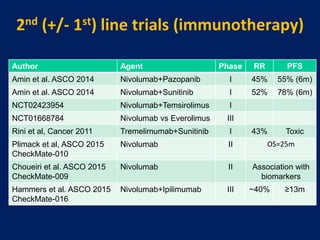
2nd (+/- 1st) line trials (immunotherapy)
Author Agent Phase RR PFS
Amin et al. ASCO 2014 Nivolumab+Pazopanib I 45% 55% (6m)
Amin et al. ASCO 2014 Nivolumab+Sunitinib I 52% 78% (6m)
NCT02423954 Nivolumab+Temsirolimus I
NCT01668784 Nivolumab vs Everolimus III
Rini et al, Cancer 2011 Tremelimumab+Sunitinib I 43% Toxic
Plimack et al, ASCO 2015
CheckMate-010
Nivolumab II OS=25m
Choueiri et al. ASCO 2015
CheckMate-009
Nivolumab II Association with
biomarkers
Hammers et al. ASCO 2015
CheckMate-016
Nivolumab+Ipilimumab III ~40% ≥13m
Metastatic Renal Cell Carcinoma:
ESMO Clinical Practice Guidelines
• Radiotherapy has a limited role in the primary
management of renal cancer. However, it is used
in many different clinical situations particularly
for unresectable local recurrences and metastatic
disease.
Annals of Oncology 25 (Supplement 3): iii49–iii56, 2014
Metastatic Renal Cell Carcinoma:
ESMO Clinical Practice Guidelines
• Bisphosphonate therapy with zoledronic acid has been
shown to reduce skeletal-related events in patients with
bone metastasis due to mRCC and they should be
considered for zoledronic acid treatment, weighting the
potential benefits of the treatment (supposed benefit in
terms of OS) with the potential harms (risk of
osteonecrosis of the jaw) [II, A].
Annals of Oncology 25 (Supplement 3): iii49–iii56, 2014
1 Lipton A et al Zoledronic acid delays the onset of skeletal-related
events and progression of skeletal disease in patients with advanced renal cell
carcinoma. Cancer 2003.
2 Aapro M et al. Guidance on the use of
bisphosphonates in solid tumours: recommendations of an international expert
panel. Ann Oncol 2008.
RCC systemic treatments
1st line
Sunitinib
Pazopanib
IFN-α + Bev
Temsirolimus
HD IL-2
mPFS= 9 mo
2nd line
Everolimus
Axitinib
Sorafenib
Sunitinib
mPFS= 4-5 mo
3rd line
Everolimus
Sorafenib
mPFS= 4-5 mo
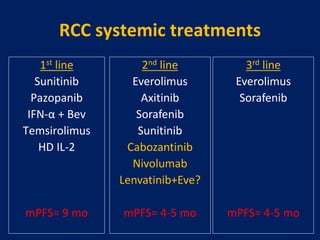
RCC systemic treatments
1st line
Sunitinib
Pazopanib
IFN-α + Bev
Temsirolimus
HD IL-2
mPFS= 9 mo
2nd line
Everolimus
Axitinib
Sorafenib
Sunitinib
Cabozantinib
Nivolumab
Lenvatinib+Eve?
mPFS= 4-5 mo
3rd line
Everolimus
Sorafenib
mPFS= 4-5 mo
2nd line treatment after…
1st line 2nd line
Cytokine
Sorafenib
Sunitinib
Pazopanib
Axitinib
Tivozanib
Bavacizumab
Anti-angiogenic agent
Everolimus
Temsirolimus
Axitinib
Sunitinib
Sorafenib
Cabozantinib
Nivolumab
Lenvatinib+Everolimus
mTOR inhibitor Sunitinib
Treatment decisions in the clinic
 Efficacy is the key factor used to select treatments
 Safety profiles of individual drugs may also impact on treatment decisions
Hypertension
Dysphonia
Hand–foot syndrome
Weight loss
Constipation
Axitinib2
Everolimus1
Stomatitis
Infections
Cough
Rash
Peripheral oedema
Dyspnoea
Pyrexia
Fatigue
Diarrhoea
Nausea
Anorexia
Vomiting
Frequent all-causality AEs (≥20%)*
1. Escudier B, et al. Cancer 2010:4256–65; 2. Rini BI, et al. Lancet 2011;378:1931–9
*Outcomes from different clinical trials should not be compared directly due to differences in trial design and patient populations
Turning mRCC into a chronic disease
Larkin and Gore. Lancet 2010.
Time
Tumourvolume
Untreated
tumour
cells
Treated
tumour cells
Back up slides
ESMO Academy 2015
Metastatic Renal Cell Carcinoma:
ESMO Clinical Practice Guidelines
• Recommendations mainly relate to clear-cell
histology, since most of the pivotal trials have
been done in this common histological
subtype.
Annals of Oncology 25 (Supplement 3): iii49–iii56, 2014
Metastatic Renal Cell Carcinoma:
ESMO Clinical Practice Guidelines
• Patients are stratified according to the presence of six
risk factors [International Metastatic RCC Database
Consortium (IMDC) criteria] 0, 1-2, 3-6:
• Karnofsky performance status (PS) <80%
• Haemoglobin <lower limit of normal
• Time from diagnosis to treatment of <1 year
• Corrected calcium above the upper limit of normal
• Platelets greater than the upper limit of normal
• Neutrophils greater than the upper limit of normal
Annals of Oncology 25 (Supplement 3): iii49–iii56, 2014
Metastatic Renal Cell Carcinoma:
ESMO Clinical Practice Guidelines
first-line treatment of patients with good or intermediate
prognosis
• Because some RCC have a very indolent course, a period of
observation before starting treatment should be considered,
especially in patients with limited tumour burden and few
symptoms.
• 3 treatments have demonstrated efficacy in pivotal phase 3:
bevacizumab (IFN-α), sunitinib and pazopanib [I, A].
• Improvement of PFS over either IFN-α or placebo.
Annals of Oncology 25 (Supplement 3): iii49–iii56, 2014
1 Escudier B et al. Bevacizumab plus interferon alfa-2a
for treatment of metastatic renal cell carcinoma: a randomised, double-blind phase
III trial. Lancet 2007.
2 Motzer R et al. Sunitinib versus interferon alfa in
metastatic renal-cell carcinoma. N Engl J Med 2007.
3 Sternberg CN et al. Pazopanib in locally advanced or
metastatic renal cell carcinoma: results of a randomized phase III trial. J Clin Oncol
2010.
4 Motzer RJ et al. Pazopanib versus sunitinib in metastatic renalcell
carcinoma. N Engl J Med 2013.
Metastatic Renal Cell Carcinoma:
ESMO Clinical Practice Guidelines
first-line treatment of patients with good or
intermediate prognosis
• Sorafenib [II, B], high-dose interleukin-2 [III, C] and
low-dose IFN-α combined with bevacizumab [III, A]
are options.
• Single agent IFN-α, the losing arm of three
randomised, controlled trials, should no longer be
regarded as a standard option [I, D].
Annals of Oncology 25 (Supplement 3): iii49–iii56, 2014
Metastatic Renal Cell Carcinoma:
ESMO Clinical Practice Guidelines
first-line treatment of patients with poor prognosis
• Temsirolimus is currently the only drug with level I evidence of
activity in this patient population [II, A]. The pivotal trial
demonstrated improvement of OS compared with IFN-α or
combination of temsirolimus and IFN-α.
• Based on subgroup analysis from the pivotal trial as well as
expanded access programmes, sunitinib is another reasonable
option in this setting [II, B]. Sorafenib based on expanded access
programmes is another possible alternative [III, B]. It is clear that,
for some poor prognosis patients, best supportive care remains
the only suitable treatment option.
Annals of Oncology 25 (Supplement 3): iii49–iii56, 2014
Hudes G et al. Temsirolimus, interferon alfa, or both for
advanced renal-cell carcinoma. N Engl J Med 2007.
Metastatic Renal Cell Carcinoma:
ESMO Clinical Practice Guidelines
second-line treatment
• Evidence that TKIs are active after cytokines has been
demonstrated with sorafenib [I, A], pazopanib [II, A] and
recently axitinib [I, A]. Sunitinib also has activity in this
setting [III, A].
• However, since VEGF-targeted therapy is now the first-
line standard of care, the number of patients treated
with cytokines is decreasing.
Annals of Oncology 25 (Supplement 3): iii49–iii56, 2014
1 Sternberg CN et al. Pazopanib in locally advanced or
metastatic renal cell carcinoma: results of a randomized phase III trial. J Clin Oncol
2010.
2 Escudier B et al. Sorafenib in advanced clear-cell renal-cell
carcinoma. N Engl J Med 2007.
3 Rini BI et al. Comparative effectiveness of axitinib versus
sorafenib in advanced renal cell carcinoma (AXIS): a randomised phase 3 trial.
Lancet 2011.
Metastatic Renal Cell Carcinoma:
ESMO Clinical Practice Guidelines
second-line treatment
• After first-line treatment with VEGF-targeted therapy
○ Both axitinib [I, B] and everolimus [II, A] are active. Both
drugs have shown significantly improved PFS over
placebo (everolimus) or sorafenib (axitinib), but not OS.
○ Based on recent phase III trials, sorafenib can be used as
an option [II, A].
Annals of Oncology 25 (Supplement 3): iii49–iii56, 2014
1 Rini BI et al. Comparative effectiveness of axitinib versus
sorafenib in advanced renal cell carcinoma (AXIS): a randomised phase 3 trial.
Lancet 2011.
2 Motzer RJ et al. Efficacy of everolimus in advanced renal
cell carcinoma: a double-blind, randomised, placebo-controlled phase III trial.
Lancet 2008.
3 Hutson TE et al. Randomized phase III trial of temsirolimus
versus sorafenib as second-line therapy after sunitinib in patients with metastatic
renal cell carcinoma. J Clin Oncol 2014.
Metastatic Renal Cell Carcinoma:
ESMO Clinical Practice Guidelines
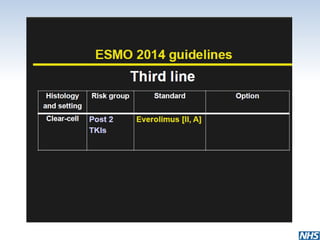
third-line treatment
• Beyond second-line treatment, enrolment into clinical trials is
recommended where possible. However, some recent trials have
been reported, helping to define two different scenarios:
• In patients already treated with two TKIs (or a TKI and
bevacizumab), everolimus is recommended [II, A].
• In patients previously treated with VEGF-targeted
therapy and mTOR inhibitor, sorafenib [I, B] has shown
activity. Another TKI or rechallenge with the same TKI is
considered as an option [IV, B].
Annals of Oncology 25 (Supplement 3): iii49–iii56, 2014
Motzer RJ et al. Dovitinib versus sorafenib for third-line
targeted treatment of patients with metastatic renal cell carcinoma: an open-label,
randomised phase 3 trial. Lancet Oncol 2014.

4 ΟΓΚΟΛΟΓΙΚΟ ΣΥΝΕΔΡΙΟ ΡΟΔΟΥ

  • 1.
    Μεταστατικός Καρκίνος Νεφρού θεραπευτικήαντιμετώπιση Nikolaos Tsoukalas MD, MSc, PhD Medical Oncologist, MSc in Bioinformatics Clinical Research Fellow in Oncology Guy’s & St Thomas’ NHS Cancer Centre Queen Elizabeth Hospital London UK
  • 2.
    Disclosure • No actualor potential conflict of interest in relation to this presentation. • No real or apparent conflicts of interest to disclose.
  • 3.
    Renal cell carcinoma •Renal cell carcinoma (RCC) accounts for 2%–3% of all adult malignancies, representing the seventh most common cancer in men and the ninth most common cancer in women. • Worldwide, there are ∼209 000 new cases and 102 000 deaths per year. The incidence of all stages of RCC has increased over the past several years, contributing to a steadily increasing mortality rate per unit population. Annals of Oncology 25 (Supplement 3): iii49–iii56, 2014
  • 4.
    Current targets oftherapies for RCC: VEGF and mTOR  Inhibition of some other target pathways are under investigation Transcriptional activation VEGF HIF-1α VHL Protein synthesis Angiogenesis Bevacizumab Growth and metabolism mTOR Growth factor receptor PI3K PIP2 PIP3 PTEN AKT Temsirolimus, everolimus Sunitinib, sorafenib, axitinib, pazopanib Tumour cell Endothelial cell VEGFR EGF, epidermal growth factor; VHL, von Hippel–Lindau
  • 5.
  • 6.
    Patient outcomes Therapeutic options MedianPFS 4–5 months Median PFS 9–11 months Median PFS 4–5 months ? ? ~40–60%1,2~100% <20%3–5Eligible patients Sunitinib Pazopanib Bevacizumab + IFN-α Temsirolimus Axitinib (post-sunitinib/ cytokine) Everolimus (post-VEGFR-TKI) Sunitinib (post-cytokine) Pazopanib (post-cytokine) Sorafenib (post-cytokine) Everolimus (post-VEGFR-TKI × 2) Neoadjuvant Adjuvant First-line Second-line Third-line Progress in advanced kidney cancer, 2007–2014 Adapted from Larkin. ASCO GU 2014 IFN-α, interferon-alpha; VEGFR-TKI, vascular endothelial growth factor receptor-tyrosine kinase inhibitor 1. Levy et al. Eur J Cancer 2013; 2. Sonpavde et al. Eur Urol 2012; 3. Iacovelli et al. Eur J Cancer 2013; 4. Pal et al. ASCO GU 2013; 5. Heng et al. ASCO 2013
  • 18.
  • 20.
  • 21.
  • 22.
  • 27.
    Metastatic Renal CellCarcinoma: ESMO Clinical Practice Guidelines • In the era of immunotherapy, cytoreductive nephrectomy was recommended in patients with good PS [I, A]. • Whether this recommendation will remain with current targeted therapies is currently being investigated in two prospective trials. • In routine practice, cytoreductive nephrectomy is recommended in patients with good PS and large primary tumours with limited volumes of metastatic disease, and for patients with a symptomatic primary lesion. Cytoreductive nephrectomy is not recommended in patients with poor PS. Annals of Oncology 25 (Supplement 3): iii49–iii56, 2014
  • 28.
    Metastatic Renal CellCarcinoma: ESMO Clinical Practice Guidelines • Metastasectomy can be considered and performed after multidisciplinary review for selected patients with solitary or easily accessible pulmonary metastases, solitary resectable intraabdominal metastases, a long disease-free interval after nephrectomy, or a partial response in metastases to immunotherapy or targeted therapy. Annals of Oncology 25 (Supplement 3): iii49–iii56, 2014
  • 29.
  • 30.
    Targeted agents currentlyapproved for mRCC in Europe Sorafenib (oral) Advanced RCC after IFN-α/IL-2 or if unsuitable for IFN-α/IL-22 Bevacizumab (+IFN-α) (IV) First-line mRCC3 Everolimus (oral) Advanced RCC after VEGF-targeted therapy5 Axitinib (oral) Advanced RCC after sunitinib or a cytokine7 Temsirolimus (IV) Advanced RCC with 3–6 prognostic risk factors4 2006 2007 2008 2009 2010 2011 2012 2013 2014 Pazopanib (oral) Advanced RCC6 Sunitinib (oral) Advanced/mRCC1 1. Sunitinib SmPC, Jan 2014; 2. Sorafenib SmPC, Feb 2013; 3. Bevacizumab SmPC, Feb 2014; 4. Temsirolimus SmPC, Oct 2013; 5. Everolimus SmPC, Nov 2013; 6. Pazopanib SmPC, Dec 2013; 7. Axitinib SmPC, Oct 2013. IFN-α, interferon-alpha; IL-2, interleukin-2; IV, intravenous
  • 40.
  • 41.
  • 42.
  • 43.
  • 44.
  • 45.
  • 46.
  • 50.
    Pivotal trials inthe 2nd line setting TRIAL TREATMENTS TARGET Sorafenib vs Placebo AXIS Axitinib vs Sorafenib RECORD-1 Everolimus vs Placebo INTORSECT Temsirolimus vs Sorafenib METEOR Cabozantinib vs Everolimus CheckMate-025 Nivolumab vs Everolimus
  • 51.
    Axitinib: a next-generationTKI • Binds to VEGFR-1, -2 and -3 • Fits tightly into the ‘deep pocket’ conformation of the kinase domain of VEGFRs, resulting in high potency and selectivity in vitro Hu-Lowe DD, et al. Clin Cancer Res 2008;14:7272–83; Escudier B and Gore M. Drugs R D 2011;11:113–26; INLYTA®. Summary of Product Characteristics. 2012. Available at: www.medicines.org.uk/emc/.
  • 52.
    Sorafenib 400 mg BD Eligibilitycriteria included:  mRCC with clear-cell histology  Failure of one prior first- line regimen containing: – Sunitinib – Bevacizumab + IFN-α – Temsirolimus – Or cytokines  Stratification by prior regimen and ECOG PS Phase III study of axitinib versus sorafenib in second-line treatment of mRCC (AXIS) Primary endpoints: PFS by independent central review Secondary endpoints: OS, ORR, safety and tolerability, duration of response, patient-reported outcomes Axitinib 5 mg BD* N=723 Treat until PD, unmanageable AE, or withdrawal of consent Rini BI, et al. Lancet 2011;378:1931–9. Sorafenib Summary of Product Characteristics. 2012. Available at: www.medicines.org.uk/emc/. *Dose increase (to maximum of 10 mg BD) or reduction (to minimum of 2 mg BD) is recommended based on individual safety and tolerability; The dose could be decreased after initiation. AE=adverse event; ECOG PS=Eastern Cooperative Oncology Group performance status; ORR=objective response rate; OS=overall survival; PFS=progression-free survival; PD=progressive disease. 1:1 R A N D O M I S A T I O N
  • 53.
    AXIS Trial: PFSresults Rini BI, et al. Lancet. 2011;378:1931-1939. 1.0 0.9 0.8 0.7 0.6 0.5 0.4 0.3 0.2 0.1 0 0 2 4 6 8 10 12 14 16 18 20 ProbabilityofPFS Axitinib Sorafenib Median PFS, Mos (95% CI) 6.7 (6.3-8.6) 4.7 (4.6-5.6) Stratified HR: 0.665 (95% CI: 0.544-0.812; P < .0001) Pts at Risk, n Axitinib Sorafenib 256 224 361 362 202 157 145 100 96 51 64 28 38 12 20 6 10 3 1 1 0 0 Months
  • 54.
  • 55.
    Lenvatinib ± Everolimusin mRCC: Randomized, Open-Label Phase II Study • Primary endpoint: PFS with lenvatinib ± everolimus vs everolimus alone • Secondary endpoints: PFS with combination vs lenvatinib alone, ORR, OS, safety/tolerability Lenvatinib 18 mg QD + Everolimus 5 mg QD (n = 51) Measurable metastatic or advanced RCC; following progression ≤ 9 mos after 1 prior VEGF therapy (N = 153) Stratified by hemoglobin (low vs normal) and corrected serum calcium (≥ vs < 10 mg/dL) Lenvatinib 24 mg QD (n = 52) Motzer R, et al. ASCO 2015. Abstract 4506. Reprinted with permission. Everolimus 10 mg QD (n = 50) Treated until PD or unacceptable toxicity
  • 56.
    Lenvatinib ± Everolimusin mRCC: Efficacy Response Lenvatinib/ Everolimus (n = 51) Lenvatinib (n = 52) Everolimus (n = 50) Median PFS, mos 14.6 HR: 0.40; P < .001 vs everolimus 7.4 HR: 0.61; P = .048 vs everolimus 5.5 ORR, % 43 P < .001 vs everolimus 27 P = .007 vs everolimus 6 Median OS,* mos 25.5 HR: 0.51; P = .024 vs everolimus 19.1 HR: 0.68; P =.118 vs everolimus 15.4 Motzer R, et al. ASCO 2015. Abstract 4506. Reprinted with permission. *Updated analysis.
  • 57.
  • 58.
  • 59.
  • 60.
    Choueiri et al.NEJM 2015
  • 61.
    Overall survival Choueiri etal. NEJM 2015 Response rate Cabozantinib Everolimus 21% 5% 40/187 9/188 P<0.001
  • 62.
  • 63.
  • 64.
    Phase 3 trialof Nivolumab vs Everolimus following VEGF-targeted therapy Motzer et al. NEJM 2015 Nivolumab produced higher response rates than everolimus (25% vs. 5%) and median overall survival was longer (by 5.4 months), to more than 2 years.
  • 65.
    Motzer RJ etal. N Engl J Med 2015;373:1803-1813 Baseline Characteristics (1)
  • 66.
    Baseline Characteristics (2) MotzerRJ et al. N Engl J Med 2015;373:1803-1813
  • 67.
    Overall Survival Motzer RJet al. N Engl J Med 2015;373:1803-1813 Nivolumab Everolimus 24% 5% 103/410 22/411 P<0.001 Response rate
  • 68.
    Overall Survival inSubgroup Analyses Motzer RJ et al. N Engl J Med 2015;373:1803-1813
  • 69.
    Progression-free Survival Motzer RJet al. N Engl J Med 2015;373:1803-1813
  • 70.
    Overall Survival accordingto PD-L1 Expression Level Motzer RJ et al. N Engl J Med 2015;373:1803-1813
  • 71.
    AEs (≥10%) oftreated patients in either group (1) Motzer RJ et al. N Engl J Med 2015;373:1803-1813
  • 72.
    Motzer RJ etal. N Engl J Med 2015;373:1803-1813 AEs (≥10%) of treated patients in either group (2)
  • 73.
    2nd line trials(non-immunotherapy) Author Agent Phase RR PFS Pili et al. Abstr 4549 Aflibercept II 2-3% 8-11mo McKay et al. Abstr 4559 Buparlisib (PI3K) + Bev I 13% 9mo Keefe et al, Abstr 4543 CRLX101 (HIF) +Bev Ib/IIa 23% 10mo Voss et al, Abstr 4567 Dalantercept (ALK) + axitinib II 25% 8mo Hainsworth et al, Abstr 4547 LY2510924 (CXCR4) + sunitinib II rand 39% 12mo Peterson et al, Abstr TPS4580 RX-0201 (AKT1) + Everolimus I (ongoing) Twarowski et al, Abstr 4523 Tivantinib (MET) +/- Erlotinib II rand 0% 2-5mo Dorff et al, Abstr 4542 Bevacizumab +/- TRC105 (Endoglin) II rand 3% ASCO 2015
  • 74.
    2nd (+/- 1st)line trials (immunotherapy) Author Agent Phase RR PFS Amin et al. ASCO 2014 Nivolumab+Pazopanib I 45% 55% (6m) Amin et al. ASCO 2014 Nivolumab+Sunitinib I 52% 78% (6m) NCT02423954 Nivolumab+Temsirolimus I NCT01668784 Nivolumab vs Everolimus III Rini et al, Cancer 2011 Tremelimumab+Sunitinib I 43% Toxic Plimack et al, ASCO 2015 CheckMate-010 Nivolumab II OS=25m Choueiri et al. ASCO 2015 CheckMate-009 Nivolumab II Association with biomarkers Hammers et al. ASCO 2015 CheckMate-016 Nivolumab+Ipilimumab III ~40% ≥13m
  • 75.
    Metastatic Renal CellCarcinoma: ESMO Clinical Practice Guidelines • Radiotherapy has a limited role in the primary management of renal cancer. However, it is used in many different clinical situations particularly for unresectable local recurrences and metastatic disease. Annals of Oncology 25 (Supplement 3): iii49–iii56, 2014
  • 76.
    Metastatic Renal CellCarcinoma: ESMO Clinical Practice Guidelines • Bisphosphonate therapy with zoledronic acid has been shown to reduce skeletal-related events in patients with bone metastasis due to mRCC and they should be considered for zoledronic acid treatment, weighting the potential benefits of the treatment (supposed benefit in terms of OS) with the potential harms (risk of osteonecrosis of the jaw) [II, A]. Annals of Oncology 25 (Supplement 3): iii49–iii56, 2014 1 Lipton A et al Zoledronic acid delays the onset of skeletal-related events and progression of skeletal disease in patients with advanced renal cell carcinoma. Cancer 2003. 2 Aapro M et al. Guidance on the use of bisphosphonates in solid tumours: recommendations of an international expert panel. Ann Oncol 2008.
  • 77.
    RCC systemic treatments 1stline Sunitinib Pazopanib IFN-α + Bev Temsirolimus HD IL-2 mPFS= 9 mo 2nd line Everolimus Axitinib Sorafenib Sunitinib mPFS= 4-5 mo 3rd line Everolimus Sorafenib mPFS= 4-5 mo
  • 78.
    RCC systemic treatments 1stline Sunitinib Pazopanib IFN-α + Bev Temsirolimus HD IL-2 mPFS= 9 mo 2nd line Everolimus Axitinib Sorafenib Sunitinib Cabozantinib Nivolumab Lenvatinib+Eve? mPFS= 4-5 mo 3rd line Everolimus Sorafenib mPFS= 4-5 mo
  • 79.
    2nd line treatmentafter… 1st line 2nd line Cytokine Sorafenib Sunitinib Pazopanib Axitinib Tivozanib Bavacizumab Anti-angiogenic agent Everolimus Temsirolimus Axitinib Sunitinib Sorafenib Cabozantinib Nivolumab Lenvatinib+Everolimus mTOR inhibitor Sunitinib
  • 80.
    Treatment decisions inthe clinic  Efficacy is the key factor used to select treatments  Safety profiles of individual drugs may also impact on treatment decisions Hypertension Dysphonia Hand–foot syndrome Weight loss Constipation Axitinib2 Everolimus1 Stomatitis Infections Cough Rash Peripheral oedema Dyspnoea Pyrexia Fatigue Diarrhoea Nausea Anorexia Vomiting Frequent all-causality AEs (≥20%)* 1. Escudier B, et al. Cancer 2010:4256–65; 2. Rini BI, et al. Lancet 2011;378:1931–9 *Outcomes from different clinical trials should not be compared directly due to differences in trial design and patient populations
  • 82.
    Turning mRCC intoa chronic disease Larkin and Gore. Lancet 2010. Time Tumourvolume Untreated tumour cells Treated tumour cells
  • 85.
  • 86.
  • 87.
    Metastatic Renal CellCarcinoma: ESMO Clinical Practice Guidelines • Recommendations mainly relate to clear-cell histology, since most of the pivotal trials have been done in this common histological subtype. Annals of Oncology 25 (Supplement 3): iii49–iii56, 2014
  • 88.
    Metastatic Renal CellCarcinoma: ESMO Clinical Practice Guidelines • Patients are stratified according to the presence of six risk factors [International Metastatic RCC Database Consortium (IMDC) criteria] 0, 1-2, 3-6: • Karnofsky performance status (PS) <80% • Haemoglobin <lower limit of normal • Time from diagnosis to treatment of <1 year • Corrected calcium above the upper limit of normal • Platelets greater than the upper limit of normal • Neutrophils greater than the upper limit of normal Annals of Oncology 25 (Supplement 3): iii49–iii56, 2014
  • 89.
    Metastatic Renal CellCarcinoma: ESMO Clinical Practice Guidelines first-line treatment of patients with good or intermediate prognosis • Because some RCC have a very indolent course, a period of observation before starting treatment should be considered, especially in patients with limited tumour burden and few symptoms. • 3 treatments have demonstrated efficacy in pivotal phase 3: bevacizumab (IFN-α), sunitinib and pazopanib [I, A]. • Improvement of PFS over either IFN-α or placebo. Annals of Oncology 25 (Supplement 3): iii49–iii56, 2014 1 Escudier B et al. Bevacizumab plus interferon alfa-2a for treatment of metastatic renal cell carcinoma: a randomised, double-blind phase III trial. Lancet 2007. 2 Motzer R et al. Sunitinib versus interferon alfa in metastatic renal-cell carcinoma. N Engl J Med 2007. 3 Sternberg CN et al. Pazopanib in locally advanced or metastatic renal cell carcinoma: results of a randomized phase III trial. J Clin Oncol 2010. 4 Motzer RJ et al. Pazopanib versus sunitinib in metastatic renalcell carcinoma. N Engl J Med 2013.
  • 90.
    Metastatic Renal CellCarcinoma: ESMO Clinical Practice Guidelines first-line treatment of patients with good or intermediate prognosis • Sorafenib [II, B], high-dose interleukin-2 [III, C] and low-dose IFN-α combined with bevacizumab [III, A] are options. • Single agent IFN-α, the losing arm of three randomised, controlled trials, should no longer be regarded as a standard option [I, D]. Annals of Oncology 25 (Supplement 3): iii49–iii56, 2014
  • 91.
    Metastatic Renal CellCarcinoma: ESMO Clinical Practice Guidelines first-line treatment of patients with poor prognosis • Temsirolimus is currently the only drug with level I evidence of activity in this patient population [II, A]. The pivotal trial demonstrated improvement of OS compared with IFN-α or combination of temsirolimus and IFN-α. • Based on subgroup analysis from the pivotal trial as well as expanded access programmes, sunitinib is another reasonable option in this setting [II, B]. Sorafenib based on expanded access programmes is another possible alternative [III, B]. It is clear that, for some poor prognosis patients, best supportive care remains the only suitable treatment option. Annals of Oncology 25 (Supplement 3): iii49–iii56, 2014 Hudes G et al. Temsirolimus, interferon alfa, or both for advanced renal-cell carcinoma. N Engl J Med 2007.
  • 92.
    Metastatic Renal CellCarcinoma: ESMO Clinical Practice Guidelines second-line treatment • Evidence that TKIs are active after cytokines has been demonstrated with sorafenib [I, A], pazopanib [II, A] and recently axitinib [I, A]. Sunitinib also has activity in this setting [III, A]. • However, since VEGF-targeted therapy is now the first- line standard of care, the number of patients treated with cytokines is decreasing. Annals of Oncology 25 (Supplement 3): iii49–iii56, 2014 1 Sternberg CN et al. Pazopanib in locally advanced or metastatic renal cell carcinoma: results of a randomized phase III trial. J Clin Oncol 2010. 2 Escudier B et al. Sorafenib in advanced clear-cell renal-cell carcinoma. N Engl J Med 2007. 3 Rini BI et al. Comparative effectiveness of axitinib versus sorafenib in advanced renal cell carcinoma (AXIS): a randomised phase 3 trial. Lancet 2011.
  • 93.
    Metastatic Renal CellCarcinoma: ESMO Clinical Practice Guidelines second-line treatment • After first-line treatment with VEGF-targeted therapy ○ Both axitinib [I, B] and everolimus [II, A] are active. Both drugs have shown significantly improved PFS over placebo (everolimus) or sorafenib (axitinib), but not OS. ○ Based on recent phase III trials, sorafenib can be used as an option [II, A]. Annals of Oncology 25 (Supplement 3): iii49–iii56, 2014 1 Rini BI et al. Comparative effectiveness of axitinib versus sorafenib in advanced renal cell carcinoma (AXIS): a randomised phase 3 trial. Lancet 2011. 2 Motzer RJ et al. Efficacy of everolimus in advanced renal cell carcinoma: a double-blind, randomised, placebo-controlled phase III trial. Lancet 2008. 3 Hutson TE et al. Randomized phase III trial of temsirolimus versus sorafenib as second-line therapy after sunitinib in patients with metastatic renal cell carcinoma. J Clin Oncol 2014.
  • 94.
    Metastatic Renal CellCarcinoma: ESMO Clinical Practice Guidelines third-line treatment • Beyond second-line treatment, enrolment into clinical trials is recommended where possible. However, some recent trials have been reported, helping to define two different scenarios: • In patients already treated with two TKIs (or a TKI and bevacizumab), everolimus is recommended [II, A]. • In patients previously treated with VEGF-targeted therapy and mTOR inhibitor, sorafenib [I, B] has shown activity. Another TKI or rechallenge with the same TKI is considered as an option [IV, B]. Annals of Oncology 25 (Supplement 3): iii49–iii56, 2014 Motzer RJ et al. Dovitinib versus sorafenib for third-line targeted treatment of patients with metastatic renal cell carcinoma: an open-label, randomised phase 3 trial. Lancet Oncol 2014.