Συστηματικη θεραπεία όγκων
GIST
ΑΛΕΞΗΣ ΣΤΡΙΜΠΑΚΟΣ
Παθολόγος Ογκολόγος
Δ/της Δ’Ογκολογικής Κλινικής
Ευρωκλινική Αθηνών
EPIDEMIOLOGY
 GIST represents a form of sarcoma that comprises
approx. 1% to 3% of all malignant GI tumors.
 GIST occurs predominantly in adults .
 The incidence has been slightly higher in men than
women.
 Small asymptomatic GISTs are found at autopsy in
more than 50 % of individuals over the age of 50
 GIST treatment trials estimate an annual incidence
of 4,500 – 6,000 new cases (USA)
Συστηματική θεραπεία όγκων GIST
 Επικουρική θεραπεία
 Θεραπεία προχωρημένης νόσου
– Unresectable
• ?potentially resectable
– metastatic
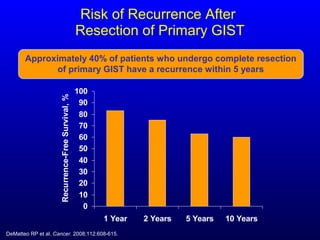
Risk of Recurrence After
Resection of Primary GIST
DeMatteo RP et al. Cancer. 2008;112:608-615.
Approximately 40% of patients who undergo complete resection
of primary GIST have a recurrence within 5 years
0
10
20
30
40
50
60
70
80
90
100
1 Year 2 Years 5 Years 10 Years
Recurrence-FreeSurvival,%
Risk Assessment
 Accurate assessment of risk of aggressive malignant
behaviour in GIST poses a challenge1
 Morphologic features most predictive of outcome1,2
- Mitotic index
- Tumour size
 Tumour site and rupture also affect risk of recurrence and
progression2,3
 Mutational status is useful in predicting treatment
response in the metastatic setting4,5
 ?applicable in the adjuvant setting
1. Fletcher CD et al. Hum Pathol. 2002;33:459-465.
2. Demetri GD et al. J Natl Compr Cancer Netw. 2007;5(suppl 2):S1-S29.
3. Miettinen M, Lasota J. Arch Pathol Lab Med. 2006;130:1466-1478.
4. Debiec-Rychter M et al. Eur J Cancer. 2006;42:1093-1103.
5. Heinrich MC et al. J Clin Oncol. 2003;21:4342-4349.
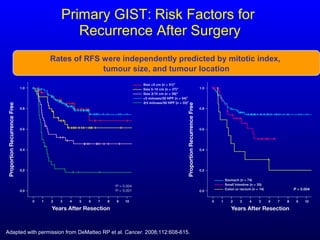
Primary GIST: Risk Factors for
Recurrence After Surgery
Adapted with permission from DeMatteo RP et al. Cancer. 2008;112:608-615.
Rates of RFS were independently predicted by mitotic index,
tumour size, and tumour location
Overall Survival by Risk Group
AFIP, Armed Forces Institute of Pathology.
Adapted with permission from Goh BKP et al. Ann Surg Oncol. 2008;15:2153-2163.
CumulativeSurvival
Specific KIT Mutations Have Prognostic Importance
RFS in 127 patients with completely
resected localized GIST based on mutation type
ProportionRecurrence-Free
Years After Resection
1.0
0.8
0.6
0.4
0.2
0.0
0 1 2 3 4 5 6 7 8 9 10
P<0.001
KIT exon 9 mutation (n=4)
KIT exon 11 DEL557/8 (n=35)
No mutation (n=29)
KIT exon 11 PM/INS (n=32)
Other KIT exon 11 deletion (n=17)
PDGFRA mutation (n=8)
DeMatteo RP et al. Cancer. 2008;112:608-615.
Imatinib: Selective TKI Targeting KIT,
PDGFRA, and Abl
 Approved for treatment of
unresectable, advanced
KIT-positive GIST[33,34]
and
as adjuvant therapy for
resectable GIST[35]
32. Rubin BP, et al. Lancet. 2007;369:1731-1741. 33. Demetri GD, et al. N Engl J Med. 2002;347:472-480.
34. Blanke CD, et al. J Clin Oncol. 2008;26:626-632. 35. DeMatteo RP, et al. Lancet. 2009;373:1097-1104.
Mechanism of action: Imatinib binds to the same site as ATP, thereby preventing
phosphorylation of downstream substrates and inhibiting KIT or PDGFRA signaling[32]
Imatinib Mesylate
N
N
N
H
N
H
N
N
N
O CH3So3H
Inhibition of KIT activated signal
transduction, causing reduced GIST
proliferation or induction of apoptosis
KIT-activated signal transduction
resulting in GIST proliferation
and survival
P
P
ADP P Y Substrate
ADP
P
P
P
IMATY SubstrateADPADP
P
P
P
P
P
P
A B
IMAT
ADP
P
P
P
Y Substrate
Επικουρική θεραπεία
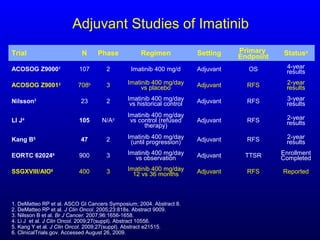
Adjuvant Studies of Imatinib
Trial N Phase Regimen Setting Primary
Endpoint Statusa
ACOSOG Z90001
107 2 Imatinib 400 mg/d Adjuvant OS 4-year
results
ACOSOG Z90012
708b
3 Imatinib 400 mg/day
vs placebo Adjuvant RFS 2-year
results
Nilsson3
23 2 Imatinib 400 mg/day
vs historical control Adjuvant RFS 3-year
results
LI J4
105 N/Ad
Imatinib 400 mg/day
vs control (refused
therapy)
Adjuvant RFS 2-year
results
Kang B5
47 2 Imatinib 400 mg/day
(until progression) Adjuvant RFS 2-year
results
EORTC 620246
900 3 Imatinib 400 mg/day
vs observation Adjuvant TTSR Enrollment
Completed
SSGXVIII/AIO6
400 3 Imatinib 400 mg/day
12 vs 36 months Adjuvant RFS Reported
1. DeMatteo RP et al. ASCO GI Cancers Symposium; 2004. Abstract 8.
2. DeMatteo RP et al. J Clin Oncol. 2005;23:818s. Abstract 9009.
3. Nilsson B et al. Br J Cancer. 2007;96:1656-1658.
4. Li J et al. J Clin Oncol. 2009;27(suppl). Abstract 10556.
5. Kang Y et al. J Clin Oncol. 2009;27(suppl). Abstract e21515.
6. ClinicalTrials.gov. Accessed August 26, 2009.
ACOSOG Z9001: Trial Schema
(Phase III)
778 patients
Placebo
(354 randomised)
(345 treated)
87 discontinued
treatment early
Imatinib
(359 randomised)
(337 treated)
97 discontinued
treatment early
30 events
5 GIST-unrelated deaths
713 patients
randomised
• Phase III, randomised, double-blind, placebo-controlled multi-centre trial
IM 400 mg/day or placebo for 1 yr
70 events
5 GIST-related deaths
3 GIST-unrelated deaths
DeMatteo RP et al. Lancet. 2009; 373: 1097-1104
ACOSOG Z9001: Study Design/Methods
Key Eligibility Criteria:
• Patients ≥18 years with localised and primary GIST
• KIT-positive tumours ≥3 cm
• Complete surgical resection
Endpoints:
• Primary: Recurrence-free Survival (RFS)
• Secondary: Overall Survival (OS) and safety
Other Key Elements:
• Dose modifications upon grade 3 or 4 events
• PD patients unblinded:
- If placebo → IM 400 mg/day or
- If IM 400 mg/day → IM 800 mg/day
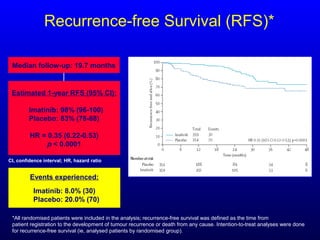
Median follow-up: 19.7 months
Estimated 1-year RFS (95% CI):
Imatinib: 98% (96-100)
Placebo: 83% (78-88)
HR = 0.35 (0.22-0.53)
p < 0.0001
CI, confidence interval; HR, hazard ratio
Events experienced:
Imatinib: 8.0% (30)
Placebo: 20.0% (70)
Recurrence-free Survival (RFS)*
*All randomised patients were included in the analysis; recurrence-free survival was defined as the time from
patient registration to the development of tumour recurrence or death from any cause. Intention-to-treat analyses were done
for recurrence-free survival (ie, analysed patients by randomised group).
• Imatinib adjuvant therapy results in
significantly longer RFS in each of the
tumour size categories compared to
placebo
Recurrence-free Survival (Tumour size)
size >10cm
size >3 and <6 cm size >6cm and <10cm
• No difference in OS between imatinib and placebo adjuvant therapies
Overall Survival (OS)*
*All randomised patients were included in the analysis; Overall survival was defined as the time from patient registration
to death from any cause. Intention-to-treat analyses were done for overall survival (ie, analysed patients by randomised group).
 Imatinib at 400 mg/day is safe and well tolerated when
administered as adjuvant therapy after complete resection of
primary GIST
 Adjuvant imatinib resulted in an improvement in RFS in patients
with all tumour sizes
- Especially relevant for high-risk patients (e.g. tumour size ≥10
cm or high mitotic rate) since this patient population has a 50%
higher chance of recurrence at 2 years without adjuvant
therapy
 OS between imatinib and placebo groups comparable at this time
 A longer follow-up period is likely required to observe
differences
 Ongoing trials in the adjuvant setting are under way to determine
appropriate treatment duration of imatinib and impact on OS
– SSGXVIII/AIO
– EORTC 62024
Summary
Adjuvant Imatinib:
Beyond 1 Year of Treatment
Imatinib
400mg/d for
12 months
An open-label Phase III study
Imatinib 400mg/d for 36
months
Follow-up
Follow-up
SSGXVIII: Study design
Random
assignment
1:1
Stratification:
1) R0 resection, no
tumor rupture
2) R1 resection or
tumor rupture
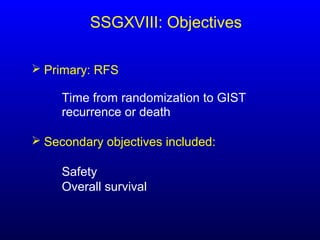
SSGXVIII: Objectives
 Primary: RFS
Time from randomization to GIST
recurrence or death
 Secondary objectives included:
Safety
Overall survival
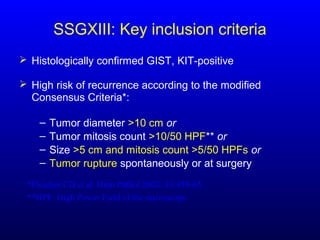
SSGXIII: Key inclusion criteria
 Histologically confirmed GIST, KIT-positive
 High risk of recurrence according to the modified
Consensus Criteria*:
– Tumor diameter >10 cm or
– Tumor mitosis count >10/50 HPF** or
– Size >5 cm and mitosis count >5/50 HPFs or
– Tumor rupture spontaneously or at surgery
*Fletcher CD et al. Hum Pathol 2002; 33:459-65
**HPF, High Power Field of the microscope
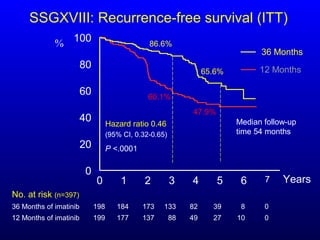
SSGXVIII: Recurrence-free survival (ITT)
No. at risk (n=397)
36 Months of imatinib 198 184 173 133 82 39 8 0
12 Months of imatinib 199 177 137 88 49 27 10 0
60.1%
47.9%
86.6%
65.6%
36 Months
12 Months
Hazard ratio 0.46
(95% CI, 0.32-0.65)
P <.0001
0 1 2 3 4 5 6 7
0
20
40
60
80
100%
Median follow-up
time 54 months
Years
Subgroup No. of patients Hazard ratio (95% CI), RFS P value
Age
≤65 256 0.47 (0.30-0.74) .001
>65 141 0.49 (0.28-0.85) .01
Sex
Male 201 0.46 (0.28-0.76) .002
Female 196 0.46 (0.28-0.76) .002
Tumor site
Stomach 202 0.42 (0.23-0.78) .005
Other 193 0.47 (0.31-0.73) <.001
Tumor size
≤ 10 cm 219 0.40 (0.23-0.69) <.001
>10 cm 176 0.47 (0.29-0.76) .002
Mitoses/50 HPF (local)
≤ 10 mitoses 209 0.76 (0.43-1.32) .33
> 10 mitoses 154 0.29 (0.17-0.49) <.001
Mitoses/50 HPF (central)
≤ 10 mitoses 256 0.58 (0.34-0.99) .04
> 10 mitoses 137 0.37 (0.23-0.61) <.001
Tumor rupture
No 318 0.43 (0.28-0.66) <.001
Yes 79 0.47 (0.25-0.89) .02
Tumor mutation site
KIT exon 9 26 0.61 (0.22-1.68) .34
KIT exon 11 256 0.35 (0.22-0.56) <.001
Wild type 33 0.41 (0.11-1.51) .16
Other 51 0.78 (0.22-2.78) .70
0.1 1.0 10
36 mo better 12 mo better
0.1 1.0 10
Clinical Risk Factors and Risk-Reduction
with 3 Years of Adjuvant Imatinib
Risk Factor No. Patients Hazard Ratio (95% CI,
RFS)
P-Value
TUMOUR SITE
Gastric 202 0.42 (0.23-0.78) 0.006
Non-Gastric 195 0.47(0.31-0.73) <0.001
SIZE
<10 cm. 219 0.40 (0.24-0.69) <0.001
>10 cm. 176 0.47 (0.29-0.76) 0.002
Mitoses/50 HPF
<10 238 0.53 (0.30-0.94) 0.03
>10 133 0.36 (0.22-0.59) <0.001
No. at risk (n=397)
36 Months of imatinib 198 192 184 152 100 56 13 0
12 Months of imatinib 199 188 176 140 87 46 20 0
SSGXVIII: Overall survival (ITT)
Hazard ratio 0.45
(95% CI, 0.22-0.89)
P = .019
96.3% 92.0%
94.0%
81.7%
36 Months
12 Months
0 1 2 3 4 5 6 7
0
20
40
60
80
100%
Years
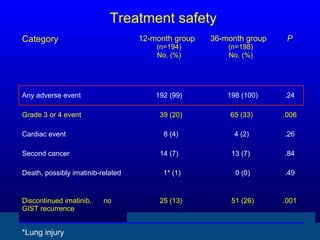
Treatment safety
Category 12-month group
(n=194)
No. (%)
36-month group
(n=198)
No. (%)
P
Any adverse event 192 (99) 198 (100) .24
Grade 3 or 4 event 39 (20) 65 (33) .006
Cardiac event 8 (4) 4 (2) .26
Second cancer 14 (7) 13 (7) .84
Death, possibly imatinib-related 1* (1) 0 (0) .49
Discontinued imatinib, no
GIST recurrence
25 (13) 51 (26) .001
*Lung injury
Most frequent adverse events
Adverse event Any Grade P Grade 3 or 4 P
12 Mo % 36 Mo % 12 Mo % 36 Mo %
Anemia 72 80 .08 1 1 1.00
Periorbital edema 59 74 .002 1 1 1.00
Elevated LDH* 43 60 .001 0 0 -
Fatigue 48 48 1.00 1 1 .62
Nausea 45 51 .23 2 1 .37
Diarrhea 44 54 .044 1 2 .37
Leukopenia 35 47 .014 2 3 .75
Muscle cramps 31 49 <0.001 1 1 1.00
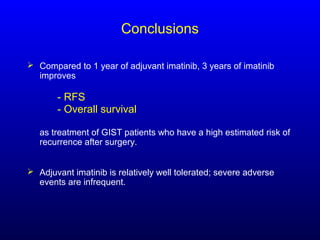
Conclusions
 Compared to 1 year of adjuvant imatinib, 3 years of imatinib
improves
- RFS
- Overall survival
as treatment of GIST patients who have a high estimated risk of
recurrence after surgery.
 Adjuvant imatinib is relatively well tolerated; severe adverse
events are infrequent.
Θεραπεία προχωρημένης νόσου
Beyond imatinib
Sunitinib in GIST: Selective Targeting of
VEGFR and KIT
 Mechanism of action:
Sunitinib binds to the
same site as ATP,
thereby preventing
phosphorylation of
downstream
substrates and
inhibiting VEGFR,
PDGFR, KIT, CSF-1R,
and FLT signaling
 Approved for
treatment of GIST
after disease
progression on or with
intolerance to imatinib
38. Wolter P, et al. Acta Oncol. 2010;49:13-23. 39. Faivre S, et al. Nat Rev Drug Discov. 2007;6:734-745.
PDGFRA PDGFRB KIT FLT3
CSF R
(FMS)
VEGFR
(FLT)
VEGFR2
(FLK)
VEGFR3
(KDR/FLT4)
Regorafenib: Novel Multitargeted TKI
 Regorafenib has a wide spectrum of
target inhibition: KIT; PDGFR; VEGFR-1,
-2, -3; TIE2; RET, fibroblast growth factor
receptor 1; RAF; and p38 MAPK[63]
 Phase II study (N = 33) in metastatic
GIST: 4 PRs, 22 SD ≥ 22 wks, median
PFS: 10 mos[63]
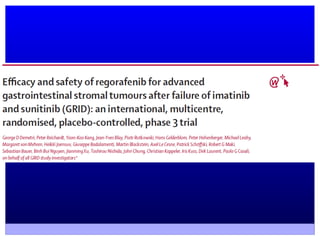
 Phase III GRID study[64]
– Significant PFS improvement vs
placebo in 199 pts with metastatic
or unresectable GIST and
progression on imatinib and
sunitinib
– Most common grade 3/4 events:
hand-foot skin reaction, hypertension,
diarrhea
63. George S, et al. J Clin Oncol. 2012;30:2401-2407.
64. Demetri G, et al. ASCO 2012. Abstract LBA10008.
ProportionWithoutProgression
1.00
0.75
0.50
0.25
0
0 50 100 150 200 250 300
Days From Randomization
Placebo
Regorafenib
HR: 0.27 (95% CI: 0.19-0.39)
1-sided P < .0001
Regorafenib
(n = 133)
Placebo
(n = 66)
Median PFS,
mos (95% CI)
4.8
(4.1-5.8)
0.9
(0.9-1.1)
Events, n (%) 81 (60.9) 63 (95.5)
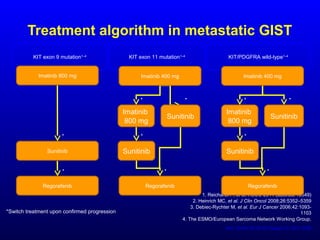
Treatment algorithm in metastatic GIST
KIT exon 9 mutation1–4
KIT/PDGFRA wild-type1–4
KIT exon 11 mutation1–4
1. Reichardt P, et al. ASCO 2014 (abstract 10549)
2. Heinrich MC, et al. J Clin Oncol 2008;26:5352–5359
3. Debiec-Rychter M, et al. Eur J Cancer 2006;42:1093-
1103
4. The ESMO/European Sarcoma Network Working Group.
Ann Oncol 2014;25 (Suppl 3): iii21–iii26
*Switch treatment upon confirmed progression
*
*
*
*
*
*
*
*
*
*
Imatinib 400 mgImatinib 800 mg Imatinib 400 mg
Imatinib
800 mg
Sunitinib
Sunitinib Sunitinib
Regorafenib Regorafenib
Imatinib
800 mg
Sunitinib
Regorafenib
Sunitinib

4 ΣΥΜΠΟΣΙΟ ΚΛΙΝΙΚΗΣ ΟΓΚΟΛΟΓΙΑΣ: Ακτινοθεραπεία στον καρκίνο του τραχήλου της μήτρας.

  • 1.
    Συστηματικη θεραπεία όγκων GIST ΑΛΕΞΗΣΣΤΡΙΜΠΑΚΟΣ Παθολόγος Ογκολόγος Δ/της Δ’Ογκολογικής Κλινικής Ευρωκλινική Αθηνών
  • 2.
    EPIDEMIOLOGY  GIST representsa form of sarcoma that comprises approx. 1% to 3% of all malignant GI tumors.  GIST occurs predominantly in adults .  The incidence has been slightly higher in men than women.  Small asymptomatic GISTs are found at autopsy in more than 50 % of individuals over the age of 50  GIST treatment trials estimate an annual incidence of 4,500 – 6,000 new cases (USA)
  • 4.
    Συστηματική θεραπεία όγκωνGIST  Επικουρική θεραπεία  Θεραπεία προχωρημένης νόσου – Unresectable • ?potentially resectable – metastatic
  • 5.
    Risk of RecurrenceAfter Resection of Primary GIST DeMatteo RP et al. Cancer. 2008;112:608-615. Approximately 40% of patients who undergo complete resection of primary GIST have a recurrence within 5 years 0 10 20 30 40 50 60 70 80 90 100 1 Year 2 Years 5 Years 10 Years Recurrence-FreeSurvival,%
  • 6.
    Risk Assessment  Accurateassessment of risk of aggressive malignant behaviour in GIST poses a challenge1  Morphologic features most predictive of outcome1,2 - Mitotic index - Tumour size  Tumour site and rupture also affect risk of recurrence and progression2,3  Mutational status is useful in predicting treatment response in the metastatic setting4,5  ?applicable in the adjuvant setting 1. Fletcher CD et al. Hum Pathol. 2002;33:459-465. 2. Demetri GD et al. J Natl Compr Cancer Netw. 2007;5(suppl 2):S1-S29. 3. Miettinen M, Lasota J. Arch Pathol Lab Med. 2006;130:1466-1478. 4. Debiec-Rychter M et al. Eur J Cancer. 2006;42:1093-1103. 5. Heinrich MC et al. J Clin Oncol. 2003;21:4342-4349.
  • 7.
    Primary GIST: RiskFactors for Recurrence After Surgery Adapted with permission from DeMatteo RP et al. Cancer. 2008;112:608-615. Rates of RFS were independently predicted by mitotic index, tumour size, and tumour location
  • 8.
    Overall Survival byRisk Group AFIP, Armed Forces Institute of Pathology. Adapted with permission from Goh BKP et al. Ann Surg Oncol. 2008;15:2153-2163. CumulativeSurvival
  • 9.
    Specific KIT MutationsHave Prognostic Importance RFS in 127 patients with completely resected localized GIST based on mutation type ProportionRecurrence-Free Years After Resection 1.0 0.8 0.6 0.4 0.2 0.0 0 1 2 3 4 5 6 7 8 9 10 P<0.001 KIT exon 9 mutation (n=4) KIT exon 11 DEL557/8 (n=35) No mutation (n=29) KIT exon 11 PM/INS (n=32) Other KIT exon 11 deletion (n=17) PDGFRA mutation (n=8) DeMatteo RP et al. Cancer. 2008;112:608-615.
  • 11.
    Imatinib: Selective TKITargeting KIT, PDGFRA, and Abl  Approved for treatment of unresectable, advanced KIT-positive GIST[33,34] and as adjuvant therapy for resectable GIST[35] 32. Rubin BP, et al. Lancet. 2007;369:1731-1741. 33. Demetri GD, et al. N Engl J Med. 2002;347:472-480. 34. Blanke CD, et al. J Clin Oncol. 2008;26:626-632. 35. DeMatteo RP, et al. Lancet. 2009;373:1097-1104. Mechanism of action: Imatinib binds to the same site as ATP, thereby preventing phosphorylation of downstream substrates and inhibiting KIT or PDGFRA signaling[32] Imatinib Mesylate N N N H N H N N N O CH3So3H Inhibition of KIT activated signal transduction, causing reduced GIST proliferation or induction of apoptosis KIT-activated signal transduction resulting in GIST proliferation and survival P P ADP P Y Substrate ADP P P P IMATY SubstrateADPADP P P P P P P A B IMAT ADP P P P Y Substrate
  • 12.
  • 13.
    Adjuvant Studies ofImatinib Trial N Phase Regimen Setting Primary Endpoint Statusa ACOSOG Z90001 107 2 Imatinib 400 mg/d Adjuvant OS 4-year results ACOSOG Z90012 708b 3 Imatinib 400 mg/day vs placebo Adjuvant RFS 2-year results Nilsson3 23 2 Imatinib 400 mg/day vs historical control Adjuvant RFS 3-year results LI J4 105 N/Ad Imatinib 400 mg/day vs control (refused therapy) Adjuvant RFS 2-year results Kang B5 47 2 Imatinib 400 mg/day (until progression) Adjuvant RFS 2-year results EORTC 620246 900 3 Imatinib 400 mg/day vs observation Adjuvant TTSR Enrollment Completed SSGXVIII/AIO6 400 3 Imatinib 400 mg/day 12 vs 36 months Adjuvant RFS Reported 1. DeMatteo RP et al. ASCO GI Cancers Symposium; 2004. Abstract 8. 2. DeMatteo RP et al. J Clin Oncol. 2005;23:818s. Abstract 9009. 3. Nilsson B et al. Br J Cancer. 2007;96:1656-1658. 4. Li J et al. J Clin Oncol. 2009;27(suppl). Abstract 10556. 5. Kang Y et al. J Clin Oncol. 2009;27(suppl). Abstract e21515. 6. ClinicalTrials.gov. Accessed August 26, 2009.
  • 14.
    ACOSOG Z9001: TrialSchema (Phase III) 778 patients Placebo (354 randomised) (345 treated) 87 discontinued treatment early Imatinib (359 randomised) (337 treated) 97 discontinued treatment early 30 events 5 GIST-unrelated deaths 713 patients randomised • Phase III, randomised, double-blind, placebo-controlled multi-centre trial IM 400 mg/day or placebo for 1 yr 70 events 5 GIST-related deaths 3 GIST-unrelated deaths DeMatteo RP et al. Lancet. 2009; 373: 1097-1104
  • 15.
    ACOSOG Z9001: StudyDesign/Methods Key Eligibility Criteria: • Patients ≥18 years with localised and primary GIST • KIT-positive tumours ≥3 cm • Complete surgical resection Endpoints: • Primary: Recurrence-free Survival (RFS) • Secondary: Overall Survival (OS) and safety Other Key Elements: • Dose modifications upon grade 3 or 4 events • PD patients unblinded: - If placebo → IM 400 mg/day or - If IM 400 mg/day → IM 800 mg/day
  • 16.
    Median follow-up: 19.7months Estimated 1-year RFS (95% CI): Imatinib: 98% (96-100) Placebo: 83% (78-88) HR = 0.35 (0.22-0.53) p < 0.0001 CI, confidence interval; HR, hazard ratio Events experienced: Imatinib: 8.0% (30) Placebo: 20.0% (70) Recurrence-free Survival (RFS)* *All randomised patients were included in the analysis; recurrence-free survival was defined as the time from patient registration to the development of tumour recurrence or death from any cause. Intention-to-treat analyses were done for recurrence-free survival (ie, analysed patients by randomised group).
  • 17.
    • Imatinib adjuvanttherapy results in significantly longer RFS in each of the tumour size categories compared to placebo Recurrence-free Survival (Tumour size) size >10cm size >3 and <6 cm size >6cm and <10cm
  • 18.
    • No differencein OS between imatinib and placebo adjuvant therapies Overall Survival (OS)* *All randomised patients were included in the analysis; Overall survival was defined as the time from patient registration to death from any cause. Intention-to-treat analyses were done for overall survival (ie, analysed patients by randomised group).
  • 19.
     Imatinib at400 mg/day is safe and well tolerated when administered as adjuvant therapy after complete resection of primary GIST  Adjuvant imatinib resulted in an improvement in RFS in patients with all tumour sizes - Especially relevant for high-risk patients (e.g. tumour size ≥10 cm or high mitotic rate) since this patient population has a 50% higher chance of recurrence at 2 years without adjuvant therapy  OS between imatinib and placebo groups comparable at this time  A longer follow-up period is likely required to observe differences  Ongoing trials in the adjuvant setting are under way to determine appropriate treatment duration of imatinib and impact on OS – SSGXVIII/AIO – EORTC 62024 Summary
  • 20.
    Adjuvant Imatinib: Beyond 1Year of Treatment
  • 21.
    Imatinib 400mg/d for 12 months Anopen-label Phase III study Imatinib 400mg/d for 36 months Follow-up Follow-up SSGXVIII: Study design Random assignment 1:1 Stratification: 1) R0 resection, no tumor rupture 2) R1 resection or tumor rupture
  • 22.
    SSGXVIII: Objectives  Primary:RFS Time from randomization to GIST recurrence or death  Secondary objectives included: Safety Overall survival
  • 23.
    SSGXIII: Key inclusioncriteria  Histologically confirmed GIST, KIT-positive  High risk of recurrence according to the modified Consensus Criteria*: – Tumor diameter >10 cm or – Tumor mitosis count >10/50 HPF** or – Size >5 cm and mitosis count >5/50 HPFs or – Tumor rupture spontaneously or at surgery *Fletcher CD et al. Hum Pathol 2002; 33:459-65 **HPF, High Power Field of the microscope
  • 24.
    SSGXVIII: Recurrence-free survival(ITT) No. at risk (n=397) 36 Months of imatinib 198 184 173 133 82 39 8 0 12 Months of imatinib 199 177 137 88 49 27 10 0 60.1% 47.9% 86.6% 65.6% 36 Months 12 Months Hazard ratio 0.46 (95% CI, 0.32-0.65) P <.0001 0 1 2 3 4 5 6 7 0 20 40 60 80 100% Median follow-up time 54 months Years
  • 25.
    Subgroup No. ofpatients Hazard ratio (95% CI), RFS P value Age ≤65 256 0.47 (0.30-0.74) .001 >65 141 0.49 (0.28-0.85) .01 Sex Male 201 0.46 (0.28-0.76) .002 Female 196 0.46 (0.28-0.76) .002 Tumor site Stomach 202 0.42 (0.23-0.78) .005 Other 193 0.47 (0.31-0.73) <.001 Tumor size ≤ 10 cm 219 0.40 (0.23-0.69) <.001 >10 cm 176 0.47 (0.29-0.76) .002 Mitoses/50 HPF (local) ≤ 10 mitoses 209 0.76 (0.43-1.32) .33 > 10 mitoses 154 0.29 (0.17-0.49) <.001 Mitoses/50 HPF (central) ≤ 10 mitoses 256 0.58 (0.34-0.99) .04 > 10 mitoses 137 0.37 (0.23-0.61) <.001 Tumor rupture No 318 0.43 (0.28-0.66) <.001 Yes 79 0.47 (0.25-0.89) .02 Tumor mutation site KIT exon 9 26 0.61 (0.22-1.68) .34 KIT exon 11 256 0.35 (0.22-0.56) <.001 Wild type 33 0.41 (0.11-1.51) .16 Other 51 0.78 (0.22-2.78) .70 0.1 1.0 10 36 mo better 12 mo better 0.1 1.0 10
  • 26.
    Clinical Risk Factorsand Risk-Reduction with 3 Years of Adjuvant Imatinib Risk Factor No. Patients Hazard Ratio (95% CI, RFS) P-Value TUMOUR SITE Gastric 202 0.42 (0.23-0.78) 0.006 Non-Gastric 195 0.47(0.31-0.73) <0.001 SIZE <10 cm. 219 0.40 (0.24-0.69) <0.001 >10 cm. 176 0.47 (0.29-0.76) 0.002 Mitoses/50 HPF <10 238 0.53 (0.30-0.94) 0.03 >10 133 0.36 (0.22-0.59) <0.001
  • 27.
    No. at risk(n=397) 36 Months of imatinib 198 192 184 152 100 56 13 0 12 Months of imatinib 199 188 176 140 87 46 20 0 SSGXVIII: Overall survival (ITT) Hazard ratio 0.45 (95% CI, 0.22-0.89) P = .019 96.3% 92.0% 94.0% 81.7% 36 Months 12 Months 0 1 2 3 4 5 6 7 0 20 40 60 80 100% Years
  • 28.
    Treatment safety Category 12-monthgroup (n=194) No. (%) 36-month group (n=198) No. (%) P Any adverse event 192 (99) 198 (100) .24 Grade 3 or 4 event 39 (20) 65 (33) .006 Cardiac event 8 (4) 4 (2) .26 Second cancer 14 (7) 13 (7) .84 Death, possibly imatinib-related 1* (1) 0 (0) .49 Discontinued imatinib, no GIST recurrence 25 (13) 51 (26) .001 *Lung injury
  • 29.
    Most frequent adverseevents Adverse event Any Grade P Grade 3 or 4 P 12 Mo % 36 Mo % 12 Mo % 36 Mo % Anemia 72 80 .08 1 1 1.00 Periorbital edema 59 74 .002 1 1 1.00 Elevated LDH* 43 60 .001 0 0 - Fatigue 48 48 1.00 1 1 .62 Nausea 45 51 .23 2 1 .37 Diarrhea 44 54 .044 1 2 .37 Leukopenia 35 47 .014 2 3 .75 Muscle cramps 31 49 <0.001 1 1 1.00
  • 30.
    Conclusions  Compared to1 year of adjuvant imatinib, 3 years of imatinib improves - RFS - Overall survival as treatment of GIST patients who have a high estimated risk of recurrence after surgery.  Adjuvant imatinib is relatively well tolerated; severe adverse events are infrequent.
  • 31.
  • 34.
  • 35.
    Sunitinib in GIST:Selective Targeting of VEGFR and KIT  Mechanism of action: Sunitinib binds to the same site as ATP, thereby preventing phosphorylation of downstream substrates and inhibiting VEGFR, PDGFR, KIT, CSF-1R, and FLT signaling  Approved for treatment of GIST after disease progression on or with intolerance to imatinib 38. Wolter P, et al. Acta Oncol. 2010;49:13-23. 39. Faivre S, et al. Nat Rev Drug Discov. 2007;6:734-745. PDGFRA PDGFRB KIT FLT3 CSF R (FMS) VEGFR (FLT) VEGFR2 (FLK) VEGFR3 (KDR/FLT4)
  • 38.
    Regorafenib: Novel MultitargetedTKI  Regorafenib has a wide spectrum of target inhibition: KIT; PDGFR; VEGFR-1, -2, -3; TIE2; RET, fibroblast growth factor receptor 1; RAF; and p38 MAPK[63]  Phase II study (N = 33) in metastatic GIST: 4 PRs, 22 SD ≥ 22 wks, median PFS: 10 mos[63]  Phase III GRID study[64] – Significant PFS improvement vs placebo in 199 pts with metastatic or unresectable GIST and progression on imatinib and sunitinib – Most common grade 3/4 events: hand-foot skin reaction, hypertension, diarrhea 63. George S, et al. J Clin Oncol. 2012;30:2401-2407. 64. Demetri G, et al. ASCO 2012. Abstract LBA10008. ProportionWithoutProgression 1.00 0.75 0.50 0.25 0 0 50 100 150 200 250 300 Days From Randomization Placebo Regorafenib HR: 0.27 (95% CI: 0.19-0.39) 1-sided P < .0001 Regorafenib (n = 133) Placebo (n = 66) Median PFS, mos (95% CI) 4.8 (4.1-5.8) 0.9 (0.9-1.1) Events, n (%) 81 (60.9) 63 (95.5)
  • 39.
    Treatment algorithm inmetastatic GIST KIT exon 9 mutation1–4 KIT/PDGFRA wild-type1–4 KIT exon 11 mutation1–4 1. Reichardt P, et al. ASCO 2014 (abstract 10549) 2. Heinrich MC, et al. J Clin Oncol 2008;26:5352–5359 3. Debiec-Rychter M, et al. Eur J Cancer 2006;42:1093- 1103 4. The ESMO/European Sarcoma Network Working Group. Ann Oncol 2014;25 (Suppl 3): iii21–iii26 *Switch treatment upon confirmed progression * * * * * * * * * * Imatinib 400 mgImatinib 800 mg Imatinib 400 mg Imatinib 800 mg Sunitinib Sunitinib Sunitinib Regorafenib Regorafenib Imatinib 800 mg Sunitinib Regorafenib Sunitinib

Editor's Notes

  • #6 Among patients who underwent complete surgical resection of primary GIST, rates of recurrence at 5 years approached 40%1 DeMatteo and colleagues1 examined rates of disease recurrence among 127 patients who underwent complete resection of primary GIST before the availability of imatinib treatment. With median follow-up of 4.7 years, median recurrence-free survival (RFS) rates were 83% at 1 year, 75% at 2 years, 63% at 5 years, and 60% at 10 years Multivariate analysis of risk factors for disease recurrence identified several that adversely affected outcomes after surgery. These risk factors included tumour size ≥10 cm, tumour location in the small bowel or colon/rectum, and mitotic rate ≥5/50 HPF1 Before imatinib, conventional chemotherapy and radiation were largely ineffective in GIST patients. Thus, observation alone was the standard of care after surgical resection2 Comparison of imatinib-treated patients with historical controls (chemotherapy) for advanced GIST has shown the superiority of imatinib; overall survival at 2 years was approximately 80% in the pivotal phase 2 trial of imatinib versus approximately 30% for historical controls in Southwest Oncology Group (SWOG) chemotherapy studies3 These results warranted investigation of imatinib at earlier stages of disease Patients at intermediate to high risk for relapse after surgery may be candidates for adjuvant imatinib4 DeMatteo RP, Gold JS, Saran L, et al. tumour mitotic rate, size, and location independently predict recurrence after resection of primary gastrointestinal stromal tumour (GIST). Cancer. 2008;112:608-615. Gold JS, DeMatteo RP. Combined surgical and molecular therapy: the gastrointestinal stromal tumour model. Ann Surg. 2006;244:176-184. Blanke CD, Rankin C, Demetri GD, et al. Phase III randomized, intergroup trial assessing imatinib mesylate at two dose levels in patients with unresectable or metastatic gastrointestinal stromal tumours expressing the kit receptor tyrosine kinase: S0033. J Clin Oncol. 2008;26:626-632. DeMatteo RP, Ballman KV, Antonescu CR, et al. Adjuvant imatinib mesylate after resection of localised, primary gastrointestinal stromal tumour: a randomised, double-blind, placebo controlled trial. Lancet 2009;373:1097-1104.
  • #7 Certain morphologic features (tumour size and mitotic rate), tumour location, and tumour mutational status are useful in predicting malignant behaviour and risk of progression in GIST cases1–5 The morphologic features that correlate best with risk of malignant behaviour and are most predictive of outcome are mitotic rate and tumour size. However, occasionally, even small lesions (&amp;lt;2 cm) and those with low mitotic rates (&amp;lt;5/50 HPF) can metastasize1,2 tumour site is now recognized as affecting risk of disease recurrence and progression2,3 Mutational status is useful in predicting response to treatment. The presence of a KIT (also known as CD117, steel factor, or stem-cell factor receptor) exon 11 mutation is associated with a higher rate of response to imatinib therapy and longer overall and event-free survival compared with KIT exon 9 mutations or no detectable mutations of KIT or PDGFRA (gene expressing platelet-derived growth factor receptor-alpha)4,5 Fletcher CD, Berman JJ, Corless C, et al. Diagnosis of gastrointestinal stromal tumours: a consensus approach. Hum Pathol. 2002;33:459-465. Demetri GD, Benjamin RS, Blanke CD, et al. NCCN Task Force report: management of patients with gastrointestinal stromal tumour (GIST)—update of the NCCN Clinical Practice Guidelines. J Natl Compr Canc Netw. 2007;5(suppl 2):S1-29. Miettinen M, Lasota J. Gastrointestinal stromal tumours: review on morphology, molecular pathology, prognosis, and differential diagnosis. Arch Pathol Lab Med. 2006;130:1466-1478. Debiec-Rychter M, Sciot R, Le Cesne A, et al. KIT mutations and dose selection for imatinib in patients with advanced gastrointestinal stromal tumours. Eur J Cancer. 2006;42:1093-1103. Heinrich MC, Corless CL, Demetri GD, et al. Kinase mutations and imatinib responses in patients with metastatic gastrointestinal stromal tumour. J Clin Oncol. 2003;21:4342-4349.
  • #8 Large tumour size, high mitotic index, and tumour location in the small intestine or colon/rectum are risk factors for recurrence following surgery for GIST DeMatteo et al1 conducted a clinical and pathologic analysis of completely resected localized GIST in 127 patients With a median follow-up of 4.7 years, RFS was examined against tumour size, mitotic rate, tumour location, mutational status, and other variables1 On both univariate and multivariate analysis, high mitotic index, tumour size, and tumour location were significant predictors of RFS. GIST with mitotic rates &amp;gt;5/50 HPF were more likely to recur than those with mitotic rates &amp;lt;5/50 HPF (P&amp;lt;0.001)1 Patients with tumour sizes ≥10 cm were significantly more likely to experience recurrence than those with tumour sizes &amp;lt;10 cm (P=0.004)1 RFS was significantly greater for patients with gastric tumours versus patients with tumours of the small intestine or colon/rectum (P=0.004)1 Although a correlation between RFS and specific mutations was demonstrated on univariate analysis, multivariate analysis failed to find an independent correlation between mutational status and RFS1 Results from this study are consistent with findings from an earlier study that demonstrated both mitotic index and tumour size as significant independent predictors of RFS2 DeMatteo RP, Gold JS, Saran L, et al. tumour mitotic rate, size, and location independently predict recurrence after resection of primary gastrointestinal stromal tumour (GIST). Cancer. 2008;112:608-615. Singer S, Rubin BP, Lux ML, et al. Prognosis value of KIT mutation type, mitotic activity, and histologic subtype in gastrointestinal stromal tumours. J Clin Oncol. 2002;20:3898-3905.
  • #10 Specific KIT mutations have prognostic importance This study included a total of 127 patients (1983–2002) with localized primary GIST who underwent complete surgical resection of GIST The presence of any mutation or any KIT mutation did not predict recurrence by univariate analysis (P=0.93 and P=0.75, respectively) Nonetheless, the type of mutation was associated with recurrence-free survival Patients with KIT exon 11 point mutations or insertions had a better prognosis than patients whose tumour had no mutation (P=0.02). The four patients with KIT exon 9 mutations each developed recurrent disease within 27 months Patients with a KIT exon 11 deletion other than DEL557/8, a PDGFRA mutation, or no mutation had similar recurrence-free survival (P=0.82). The one patient with a KIT exon 17 mutation was alive without recurrence at 36 months DeMatteo RP et al. tumour mitotic rate, size, and location independently predict recurrence after resection of primary gastrointestinal stromal tumour (GIST). Cancer. 2008;112:608-615.
  • #12 GIST, gastrointestinal stromal tumor; PDGFR, platelet-derived growth factor receptor; TKI, tyrosine kinase inhibitor.   GIST has been a model disease to demonstrate the benefits of targeted therapies because tumor growth and survival depend on constitutively activated mutant KIT and PDGFRA receptors. Imatinib, and then sunitinib, demonstrated efficacy in control of advanced GIST.[33-35] Imatinib is an inhibitor of both KIT and PDGFRA via competing for ATP-binding sites.[32] Its efficacy varies depending on the site of mutation, with the greatest benefit for progression-free survival seen in patients with tumors containing exon 11 mutations.[36]   Typical adverse effects of imatinib (≥ 30% frequency) in GIST include edema, nausea, diarrhea, abdominal pain, myalgia, muscle cramps, anemia, fatigue, and skin rash, but the majority tends to be mild (grade 1 or 2 using the National Cancer Institute common toxicity criteria). References Rubin BP, Heinrich MC, Corless CL. Gastrointestinal stromal tumour. Lancet. 2007;369:1731-1741. Demetri GD, von Mehren M, Blanke CD, et al. Efficacy and safety of imatinib mesylate in advanced gastrointestinal stromal tumors. N Engl J Med. 2002;347:472-480. Blanke CD, Rankin C, Demetri GD, et al. Phase III randomized, intergroup trial assessing imatinib mesylate at two dose levels in patients with unresectable or metastatic gastrointestinal stromal tumors expressing the kit receptor tyrosine kinase: S0033. J Clin Oncol. 2008;26:626-632. DeMatteo RP, Ballman KV, Antonescu CR, et al. Adjuvant imatinib mesylate after resection of localised, primary gastrointestinal stromal tumour: a randomised, double-blind, placebo-controlled trial. Lancet. 2009;373:1097-1104. Judson IR. Prognosis, imatinib dose, and benefit of sunitinib in GIST: knowing the genotype. J Clin Oncol. 2008;26:5322-5325.
  • #14 The use of imatinib in the adjuvant settings is being investigated in clinical trials The ACOSOG Z9000 trial is a phase 2, multicenter, single-arm study determining survival with adjuvant imatinib therapy following resection of GIST. As of January 2008, results at 4 years have been reported1 The ACOSOG Z9001 trial is a phase 3, randomized, double-blind study of adjuvant imatinib versus placebo following resection of primary GIST. Results of this study have been published2 Nilsson and colleagues conducted a consecutive pilot series of 23 patients with high-risk GIST treated with adjuvant imatinib (400 mg/d) for 1 year after R0 resection compared with historical controls from a previous population-based series with matched risk scores with respect to tumour size and maximal proliferative activity. As of May 2008, results at 3 years have been reported3 Li and colleagues conducted a single-center study in which patients (n=105) were treated with adjuvant imatinib (n=56) at a dose of 400 mg/day or refused therapy (control group, n=49); the primary endpoint was RFS4 Kang and colleagues conducted a phase 2 study of imatinib as an adjuvant treatment for patients with curatively resected high-risk localized GIST; Patients with KIT exon 11 mutation and high risk of recurrence were treated with imatinib 400 mg/day for 2 year or until recurrence or toxicity5 The EORTC 62024 trial is a phase 3 randomized study comparing 2 years of adjuvant imatinib therapy with observation only in patients who have undergone surgery for localized GIST and are at intermediate risk or high risk for relapse. The primary endpoint is time to secondary resistance (TTSR)6 The SSGXVIII/AIO trial is evaluating adjuvant imatinib for 1 or 3 years in patients with completely resected GIST who are at high or very high risk for relapse. The endpoints of the study include RFS (primary), GIST-specific survival, and OS6 DeMatteo RP, Owzar K, Antonescu CR, et al. Efficacy of adjuvant imatinib mesylate following complete resection of localized, primary gastrointestinal stromal tumour (GIST) at high risk of recurrence: the U.S. Intergroup phase II trial ACOSOG Z9000. Presented at: ASCO Gastrointestinal Cancers Symposium; January 25-27, 2008; Orlando, FL. Abstract 8. DeMatteo RP, Antonescu CR, Chadaram V, et al. Adjuvant imatinib mesylate in a patients with primary high risk gastrointestinal stromal tumour (GIST) following complete resection: safety results from the US Intergroup phase II trial. J Clin Oncol. 2005;23:818s. Abstract 9009. Nilsson B, Sjolund K, Kindblom LG, et al. Adjuvant imatinib treatment improves recurrence-free survival in patients with high-risk gastrointestinal stromal tumours (GIST). Br J Cancer. 2007;96:1656-1658. Li J, Gong FJ, Li J, Wu WA, Shen L. Adjuvant therapy with imatinib in gastrointestinal stromal tumour (GIST) patients with intermediate or high risk: Analysis from a single-center contrast study. J Clin Oncol. 2009;27(suppl). Abstract 10556. Kang B, Lee J, Rhu S, et al. A phase II study of imatinib mesylate as adjuvant treatment for curatively resected high-risk localized gastrointestinal stromal tumours. J Clin Oncol. 2009;27(suppl). Abstract e21515. ClinicalTrials.gov. http://www.clinicaltrials.gov. August 26, 2009.
  • #15 Overall, 65 patients did not meet all eligibility requirements for the study (33 patients in the placebo arm and 32 patient in the imatinib arm): - 60 patients with randomisation errors 5 patients being registered after April 12, 2007. As a result 713 of the original 778 registered patients were randomised. DeMatteo RP, Ballman KV, Antonescu CR, et al. Randomized trial of adjuvant imatinib mesylate following the resection of localized, primary gastrointestinal stromal tumour (GIST). Lancet. 2009; ;373:1097-1104.
  • #17 Adjuvant imatinib improved 1-year RFS compared with placebo following surgical resection of primary GIST 3 cm in size After a median follow-up of 19.7 months, the estimated 1-year RFS was 98% (95% confidence interval [CI]: 96-100) in the imatinib arm compared with 83% in the placebo arm. The overall hazard ratio was 0.35 (95% CI: 0.22-0.35; P &amp;lt; 0.0001) These findings indicate that imatinib reduced the hazard of tumour recurrence by 65% compared with placebo The rate of recurrence on the imatinib arm appeared to increase after approximately 18 months (ie, 6 months after completion of study treatment). This raises the possibility that treatment with adjuvant imatinib for longer periods may further extend RFS DeMatteo RP, Ballman KV, Antonescu CR, et al. Randomized trial of adjuvant imatinib mesylate following the resection of localized, primary gastrointestinal stromal tumour (GIST). Lancet. 2009; 373:1097-1104.
  • #20 In the phase 3 ACOSOG Z9001 trial, adjuvant imatinib resulted in a significant improvement in RFS, with increased benefit evident in patients with larger tumour volumes Imatinib 400 mg/d is safe and well tolerated when administered as adjuvant therapy after primary resection Adjuvant imatinib improves RFS, with increased benefit evident in patients with larger tumour volumes OS has not been altered at this time; however, the follow-up period is short Currently, there are 2 ongoing randomised trials to identify how imatinib affects OS in an adjuvant setting EORTC 62024 SSGXVIII/AIO DeMatteo RP, Ballman KV, Antonescu CR, et al. Randomized trial of adjuvant imatinib mesylate following the resection of localized, primary gastrointestinal stromal tumour (GIST). Lancet. 2009; ;373:1097-1104.
  • #34 Also, as shown by the survival curves. The duration of clinical benefit becomes significantly increased with imatinib dose increase only in KIT exon 9 mut carriers, but not in exon 11 mut carriers. Therefore, it could be recommended to screen all pts for KIT mutations and treat pts with exon 9 mut with imatinib 800mg/d.
  • #36 GIST, gastrointestinal stromal tumor; mTOR, mammalian target of rapamycin. Sunitinib is approved for second-line therapy of patients with advanced GIST. It has been shown to significantly prolong progression-free and overall survival compared with placebo in phase III testing.[37-39] In patients pretreated with imatinib, progression-free survival is greatest in those with exon 9 KIT mutations or wild-type tumors.[40] With progression, many tumors with exon 11 mutations will be found to have additional mutations; of those, secondary mutations located in exons 13 or 14 are sensitive to sunitinib, whereas those located in the more distal regions of the KIT molecule are not.[41] Limited numbers of PDGFRA tumors make a similar analysis unfeasible. References Demetri GD, van Oosterom AT, Garrett CR, et al. Efficacy and safety of sunitinib in patients with advanced gastrointestinal stromal tumour after failure of imatinib: a randomised controlled trial. Lancet. 2006;368:1329-1338. Wolter P, Schoffski P. Targeted therapies in the treatment of GIST: Adverse events and maximising the benefits of sunitinib through proactive therapy management. Acta Oncol. 2010;49:13-23. Faivre S, Demetri G, Sargent W, et al. Molecular basis for sunitinib efficacy and future clinical development. Nat Rev Drug Discov. 2007;6:734-745. Heinrich MC, Maki RG, Corless CL, et al. Sunitinib (SU) response in imatinib-resistant (IM-R) GIST correlates with KIT and PDGFRA mutation status. Program and abstracts of the 42nd annual meeting of the American Society of Clinical Oncology; June 2-6, 2006; Atlanta, Georgia. Abstract 9502. Corless C. GIST: What exons are predictive and prognostic? Program and abstracts of the 2011 Gastrointestinal Cancers Symposium; January 20-22, 2011; San Francisco, California.
  • #39 CI, confidence interval; GIST, gastrointestinal stromal tumor; PFS, progression-free survival; PR, partial response; SD, stable disease; TKI, tyrosine kinase inhibitor. Regorafenib is a multitargeted tyrosine kinase inhibitor[63] currently under review by the US Food and Drug Administration and the European Medicines Agency for treatment of patients with advanced GIST that have progressed on standard therapy. In a phase III trial, regorafenib, compared with placebo, was associated with significant progression-free survival improvements in patients with metastatic or unresectable GIST who had progressed on imatinib and sunitinib.[64] References 63. George S, Wang Q, Heinrich MC, et al. Efficacy and safety of regorafenib in patients with metastatic and/or unresectable GI stromal tumor after failure of imatinib and sunitinib: a multicenter phase II trial. J Clin Oncol. 2012;30:2401-2407. 64. Demetri G, Reichardt P, Kang YK, et al. Randomized phase III trial of regorafenib in patients (pts) with metastatic and/or unresectable gastrointestinal stromal tumor (GIST) progressing despite prior treatment with at least imatinib (IM) and sunitinib (SU): GRID trial. Program and abstracts of the 2012 Annual Meeting of the American Society of Clinical Oncology; June 1–5, 2012; Chicago, Illinois. Abstract LBA10008.