March 20111Low-Bend Fiber TechnologyRoger Krähenbühl
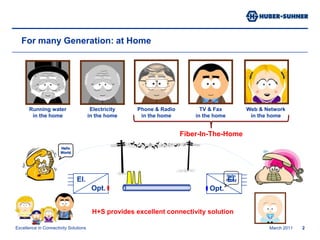
March 20112For many Generation: at HomeEl.Opt.El.Opt.Web & Networkin the homeFiber-In-The-HomeRunning water in the homeElectricityin the homePhone & Radioin the homeTV & Faxin the homeHello WorldHello WorldHello WorldH+S provides excellent connectivity solution
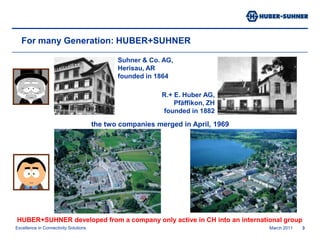
March 20113Suhner & Co. AG, Herisau, AR founded in 1864R.+ E. Huber AG,Pfäffikon, ZH founded in 1882For many Generation: HUBER+SUHNERthe two companies merged in April, 1969HUBER+SUHNER developed from a company only active in CH into an international group
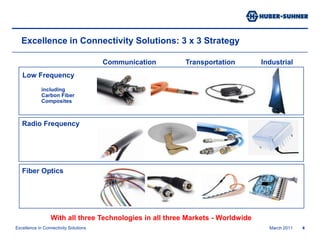
March 20114CommunicationTransportationIndustrialLow Frequency 	including 	Carbon Fiber 	CompositesExcellence in Connectivity Solutions: 3 x 3 StrategyRadio FrequencyFiber OpticsWith all three Technologies in all three Markets - Worldwide
March 20115Fiber Optics Division
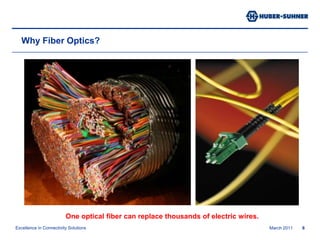
March 20116Why Fiber Optics?One optical fiber can replace thousands of electric wires.
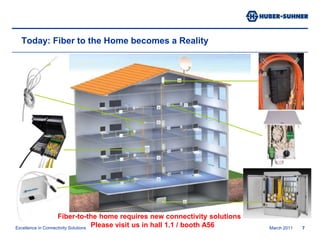
March 20117Today: Fiber to the Home becomes a RealityFiber-to-the home requires new connectivity solutionsPlease visit us in hall 1.1 / booth A56
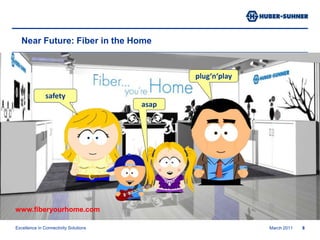
March 20118Near Future: Fiber in the Homeplug‘n‘playsafetyasapwww.fiberyourhome.com
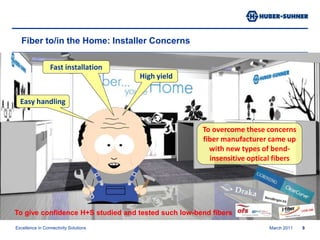
March 20119Fiber to/in the Home: Installer ConcernsFast installationHigh yieldEasy handlingTo overcome these concerns fiber manufacturer came up with new types of bend-insensitive optical fibers To give confidence H+S studied and tested such low-bend fibers
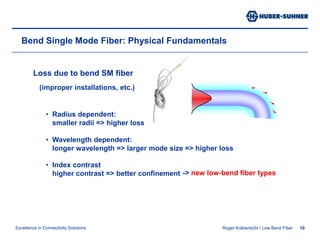
Roger Krähenbühl / Low Bend Fiber10Bend Single Mode Fiber: Physical FundamentalsLoss due to bend SM fiber	(improper installations, etc.) Radius dependent:smaller radii => higher loss
Wavelength dependent:longer wavelength => larger mode size => higher loss
Index contrast higher contrast => better confinement-> new low-bend fiber types
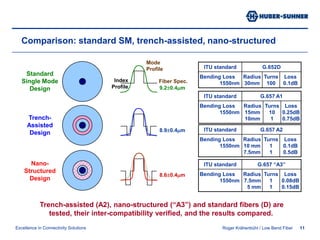
Roger Krähenbühl / Low Bend Fiber11Comparison: standard SM, trench-assisted, nano-structuredMode ProfileStandardSingle Mode DesignIndex ProfileFiber Spec.9.20.4mmTrench-Assisted DesignBend-optimizedDesign8.90.4mmNano-Structured Design8.60.4mmTrench-assisted (A2), nano-structured (“A3”) and standard fibers (D) are tested, their inter-compatibility verified, and the results compared.
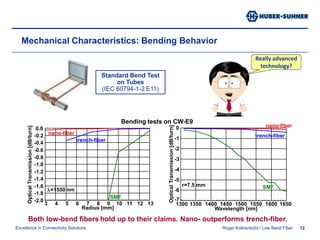
Roger Krähenbühl / Low Bend Fiber12Mechanical Characteristics: Bending Behaviornano-fibernano-fibertrench-fiber0trench-fiber0.0-1-0.2-0.4-2-0.6-3-0.8Optical Transmission [dB/turn]-1.0Optical Transmission [dB/turn]-4r=7.5 mm-1.2SMFl=1550 nm-5-1.4SMF-1.6-6-1.8Wavelength [nm]-7-2.013001350140014501500155016001650345678910111213Radius [mm]Really advanced technology?Bending tests on CW-E9Both low-bend fibershold up to their claims. Nano- outperforms trench-fiber.
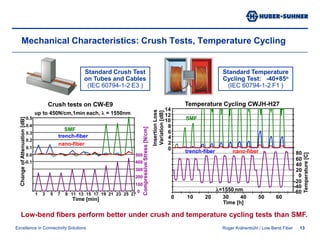
up to 450N/cm,1min each, l = 1550nm0.50.4SMF0.3trench-fiber0.2nano-fiber0.1Change of Attenuation [dB]0.0500Compressive Stress [N/cm]-0.1400300200100013579111315171921232527Time [min]Temperature Cycling CWJH-H27 Crush tests on CW-E91412SMF10Insertion Loss Variation [dB] 8642080trench-fibernano-fiber604020Temperature [C]0-20-40-60l=1550 nm0102030405060Time [h]Roger Krähenbühl / Low Bend Fiber13Mechanical Characteristics: Crush Tests, Temperature CyclingLow-bend fibers perform better under crush and temperature cycling tests than SMF.
Roger Krähenbühl / Low Bend Fiber14Splicing Tests: Performance ComparisonSMF - trench-fiberSMF - nano-fiberEase of Splicing and splice performance testing:  All combinations for SMF, trench-, and nano-structured fiberEasy handling ?Loss Distribution per Splice 60Mean:0.01 dB0.03 dB0.08 dB50SMF - SMF4030%201000.150.010.030.050.070.080.100.120.140.000.020.040.060.090.110.13Splice Loss [dB]Splicing of fibers with low-bend SM fibers needed much more exploration of process parameter than with the standard SM fiber types. They have slightly higher splice losses, maybe due to higher core ex-centricity (less experienced, larger fabrication tolerance chain)Low-bend fibers are well suited as higher splice loss can be over-compensated
SMFtrench-assistednano-structuredRoger Krähenbühl / Low Bend Fiber15Assemby Process: Endface PolishingAssembling using today's process for standard G.652 fiber: SEM: No strange behavior during assembly process except for the visual inspection
Roger Krähenbühl / Low Bend Fiber16Assembling Capabilities: Endface geometryAssembling using today's process for standard G.652 fiber: SMFtrench-assistednano-structuredMeasured endface geometry are well within allowed tolerances (IEC 61755-3-1)
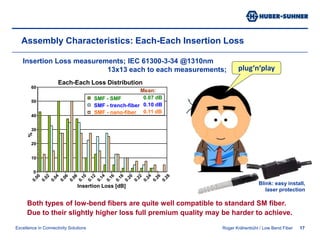
Roger Krähenbühl / Low Bend Fiber17Assembly Characteristics: Each-Each Insertion LossEach-Each Loss Distribution60SMF - SMF50SMF - trench-fiberSMF - nano-fiber4030%201000.000.020.040.060.080.100.120.140.160.180.200.220.240.260.28Insertion Loss [dB]Insertion Loss measurements; IEC 61300-3-34 @1310nm 13x13 each to each measurements; plug‘n‘playMean:0.07 dB0.10 dB0.11 dBBlink: easy install, laser protectionBoth types of low-bend fibers are quite well compatible to standard SM fiber. Due to their slightly higher loss full premium quality may be harder to achieve.
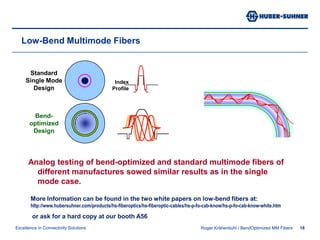
Roger Krähenbühl / BendOptimized MM Fibers18Low-Bend Multimode FibersStandardSingle ModeDesignIndex ProfileStandard MultimodeDesignBend-optimizedDesignAnalog testing of bend-optimized and standard multimode fibers of different manufactures sowed similar results as in the single mode case.More Information can be found in the two white papers on low-bend fibers at:http://www.hubersuhner.com/products/hs-fiberoptics/hs-fiberoptic-cables/hs-p-fo-cab-know/hs-p-fo-cab-know-white.htmor ask for a hard copy at our booth A56
Roger Krähenbühl / Low Bend Fiber19Fiber ReliabilityStress-behavior according to IEC 62048Failure Probability in 20 Years for Different Lengths1.E-08High yield10cm1.E-071.E-0610m1.E-051000mFailure Probability1.E-041.E-031.E-021.E-011.E+002468101214161820222426283032Bend Radius [mm]There is no physical reason for another lifetime behavior for the different types of fiber (stress distribution across fiber is the same).To reach similar reliability as for a LISA fiber management rack (r=30mm, >1000m bend fiber) only 5cm can be bend at r=10mm and only 1cm at r= 5mm.
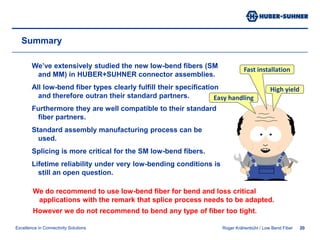
Roger Krähenbühl / Low Bend Fiber20SummaryWe’ve extensively studied the new low-bend fibers (SM and MM) in HUBER+SUHNER connector assemblies.All low-bend fiber types clearly fulfill their specification and therefore outran their standard partners. Furthermore they are well compatible to their standard fiber partners.Standard assembly manufacturing process can be used. Splicing is more critical for the SM low-bend fibers.Lifetime reliability under very low-bending conditions is still an open question.Fast installationHigh yieldEasy handlingWe do recommend to use low-bend fiber for bend and loss critical applications with the remark that splice process needs to be adapted.However we do not recommend to bend any type of fiber too tight.

Low-Bend Fiber Technology

  • 1.
    March 20111Low-Bend FiberTechnologyRoger Krähenbühl
  • 2.
    March 20112For manyGeneration: at HomeEl.Opt.El.Opt.Web & Networkin the homeFiber-In-The-HomeRunning water in the homeElectricityin the homePhone & Radioin the homeTV & Faxin the homeHello WorldHello WorldHello WorldH+S provides excellent connectivity solution
  • 3.
    March 20113Suhner &Co. AG, Herisau, AR founded in 1864R.+ E. Huber AG,Pfäffikon, ZH founded in 1882For many Generation: HUBER+SUHNERthe two companies merged in April, 1969HUBER+SUHNER developed from a company only active in CH into an international group
  • 4.
    March 20114CommunicationTransportationIndustrialLow Frequency including Carbon Fiber CompositesExcellence in Connectivity Solutions: 3 x 3 StrategyRadio FrequencyFiber OpticsWith all three Technologies in all three Markets - Worldwide
  • 5.
  • 6.
    March 20116Why FiberOptics?One optical fiber can replace thousands of electric wires.
  • 7.
    March 20117Today: Fiberto the Home becomes a RealityFiber-to-the home requires new connectivity solutionsPlease visit us in hall 1.1 / booth A56
  • 8.
    March 20118Near Future:Fiber in the Homeplug‘n‘playsafetyasapwww.fiberyourhome.com
  • 9.
    March 20119Fiber to/inthe Home: Installer ConcernsFast installationHigh yieldEasy handlingTo overcome these concerns fiber manufacturer came up with new types of bend-insensitive optical fibers To give confidence H+S studied and tested such low-bend fibers
  • 10.
    Roger Krähenbühl /Low Bend Fiber10Bend Single Mode Fiber: Physical FundamentalsLoss due to bend SM fiber (improper installations, etc.) Radius dependent:smaller radii => higher loss
  • 11.
    Wavelength dependent:longer wavelength=> larger mode size => higher loss
  • 12.
    Index contrast highercontrast => better confinement-> new low-bend fiber types
  • 13.
    Roger Krähenbühl /Low Bend Fiber11Comparison: standard SM, trench-assisted, nano-structuredMode ProfileStandardSingle Mode DesignIndex ProfileFiber Spec.9.20.4mmTrench-Assisted DesignBend-optimizedDesign8.90.4mmNano-Structured Design8.60.4mmTrench-assisted (A2), nano-structured (“A3”) and standard fibers (D) are tested, their inter-compatibility verified, and the results compared.
  • 14.
    Roger Krähenbühl /Low Bend Fiber12Mechanical Characteristics: Bending Behaviornano-fibernano-fibertrench-fiber0trench-fiber0.0-1-0.2-0.4-2-0.6-3-0.8Optical Transmission [dB/turn]-1.0Optical Transmission [dB/turn]-4r=7.5 mm-1.2SMFl=1550 nm-5-1.4SMF-1.6-6-1.8Wavelength [nm]-7-2.013001350140014501500155016001650345678910111213Radius [mm]Really advanced technology?Bending tests on CW-E9Both low-bend fibershold up to their claims. Nano- outperforms trench-fiber.
  • 15.
    up to 450N/cm,1mineach, l = 1550nm0.50.4SMF0.3trench-fiber0.2nano-fiber0.1Change of Attenuation [dB]0.0500Compressive Stress [N/cm]-0.1400300200100013579111315171921232527Time [min]Temperature Cycling CWJH-H27 Crush tests on CW-E91412SMF10Insertion Loss Variation [dB] 8642080trench-fibernano-fiber604020Temperature [C]0-20-40-60l=1550 nm0102030405060Time [h]Roger Krähenbühl / Low Bend Fiber13Mechanical Characteristics: Crush Tests, Temperature CyclingLow-bend fibers perform better under crush and temperature cycling tests than SMF.
  • 16.
    Roger Krähenbühl /Low Bend Fiber14Splicing Tests: Performance ComparisonSMF - trench-fiberSMF - nano-fiberEase of Splicing and splice performance testing: All combinations for SMF, trench-, and nano-structured fiberEasy handling ?Loss Distribution per Splice 60Mean:0.01 dB0.03 dB0.08 dB50SMF - SMF4030%201000.150.010.030.050.070.080.100.120.140.000.020.040.060.090.110.13Splice Loss [dB]Splicing of fibers with low-bend SM fibers needed much more exploration of process parameter than with the standard SM fiber types. They have slightly higher splice losses, maybe due to higher core ex-centricity (less experienced, larger fabrication tolerance chain)Low-bend fibers are well suited as higher splice loss can be over-compensated
  • 17.
    SMFtrench-assistednano-structuredRoger Krähenbühl /Low Bend Fiber15Assemby Process: Endface PolishingAssembling using today's process for standard G.652 fiber: SEM: No strange behavior during assembly process except for the visual inspection
  • 18.
    Roger Krähenbühl /Low Bend Fiber16Assembling Capabilities: Endface geometryAssembling using today's process for standard G.652 fiber: SMFtrench-assistednano-structuredMeasured endface geometry are well within allowed tolerances (IEC 61755-3-1)
  • 19.
    Roger Krähenbühl /Low Bend Fiber17Assembly Characteristics: Each-Each Insertion LossEach-Each Loss Distribution60SMF - SMF50SMF - trench-fiberSMF - nano-fiber4030%201000.000.020.040.060.080.100.120.140.160.180.200.220.240.260.28Insertion Loss [dB]Insertion Loss measurements; IEC 61300-3-34 @1310nm 13x13 each to each measurements; plug‘n‘playMean:0.07 dB0.10 dB0.11 dBBlink: easy install, laser protectionBoth types of low-bend fibers are quite well compatible to standard SM fiber. Due to their slightly higher loss full premium quality may be harder to achieve.
  • 20.
    Roger Krähenbühl /BendOptimized MM Fibers18Low-Bend Multimode FibersStandardSingle ModeDesignIndex ProfileStandard MultimodeDesignBend-optimizedDesignAnalog testing of bend-optimized and standard multimode fibers of different manufactures sowed similar results as in the single mode case.More Information can be found in the two white papers on low-bend fibers at:http://www.hubersuhner.com/products/hs-fiberoptics/hs-fiberoptic-cables/hs-p-fo-cab-know/hs-p-fo-cab-know-white.htmor ask for a hard copy at our booth A56
  • 21.
    Roger Krähenbühl /Low Bend Fiber19Fiber ReliabilityStress-behavior according to IEC 62048Failure Probability in 20 Years for Different Lengths1.E-08High yield10cm1.E-071.E-0610m1.E-051000mFailure Probability1.E-041.E-031.E-021.E-011.E+002468101214161820222426283032Bend Radius [mm]There is no physical reason for another lifetime behavior for the different types of fiber (stress distribution across fiber is the same).To reach similar reliability as for a LISA fiber management rack (r=30mm, >1000m bend fiber) only 5cm can be bend at r=10mm and only 1cm at r= 5mm.
  • 22.
    Roger Krähenbühl /Low Bend Fiber20SummaryWe’ve extensively studied the new low-bend fibers (SM and MM) in HUBER+SUHNER connector assemblies.All low-bend fiber types clearly fulfill their specification and therefore outran their standard partners. Furthermore they are well compatible to their standard fiber partners.Standard assembly manufacturing process can be used. Splicing is more critical for the SM low-bend fibers.Lifetime reliability under very low-bending conditions is still an open question.Fast installationHigh yieldEasy handlingWe do recommend to use low-bend fiber for bend and loss critical applications with the remark that splice process needs to be adapted.However we do not recommend to bend any type of fiber too tight.