Welcome to our
Bible Study
3rd
Sunday in the Ordinary Time A
22 January 2017
In preparation for this Sunday’s Liturgy
As aid in focusing our homilies and sharing
Prepared by Fr. Cielo R. Almazan, OFM
1st
reading: Isaiah 8:23-9:3
 23 First the Lord degraded the land of Zebulun and
the land of Naphtali; but in the end he has glorified
the seaward road, the land West of the Jordan, the
District of the Gentiles. Anguish has taken wing,
dispelled is darkness; for there is no gloom where
but now there was distress. 9:1 The people who
walked in darkness have seen a great light; upon
those who dwelt in the land of gloom a light has
shone. 2 You have brought them abundant joy and
great rejoicing, as they rejoice before you as at the
harvest, as men make merry when dividing spoils. 3
For the yoke that burdened them, the pole on their
shoulder, and the rod of their taskmaster you have
smashed, as on the day of Midian.
The focus is on Zebulun and Naphtali, where there was gloom.
1st
reading: Isaiah 8,23--9,3
The Reversal of the Fate of Zebulun and Naphtali
 23 First the Lord degraded the land of Zebulun and the land of
Naphtali; but in the end he has glorified the seaward road, the land
West of the Jordan, the District of the Gentiles. Anguish has taken
wing, dispelled is darkness; for there is no gloom where but now
there was distress.
The Reversal of the Fate of the People
 9:1 The people who walked in darkness have seen a great light;
upon those who dwelt in the land of gloom a light has shone. 2
You have brought them abundant joy and great rejoicing, as they
rejoice before you as at the harvest, as men make merry when
dividing spoils. 3 For the yoke that burdened them, the pole on
their shoulder, and the rod of their taskmaster you have smashed,
as on the day of Midian.
A simple outline!
1st
reading: Isaiah 8,23-9,3
The Reversal of the Fate of
Zebulun and Naphtali
 23 First the Lord degraded the
land of Zebulun and the land of
Naphtali; but in the end he has
glorified the seaward road, the
land West of the Jordan, the
District of the Gentiles. Anguish
has taken wing, dispelled is
darkness; for there is no gloom
where but now there was
distress.
The Reversal of the Fate of the
People
 9:1 The people who walked in
darkness have seen a great
light; upon those who dwelt in
the land of gloom a light has
shone. 2 You have brought
them abundant joy and great
rejoicing, as they rejoice before
you as at the harvest, as men
make merry when dividing
spoils. 3 For the yoke that
burdened them, the pole on
their shoulder, and the rod of
their taskmaster you have
smashed, as on the day of
Midian.
Commentary
 V.23 is a long verse divided into two
sentences.
 It presents the reversal of the fate of the two
lands, Zebulun and Naphtali (2 tribes of Israel,
during the time of the Judges)
 At first they were degraded, now glorified.
 At first there was anguish and darkness,
now these are dispelled.
 At first there was gloom, now no more.
 9,1 is a continuation of v.23. But now it refers
to people, not land (more or less the same
thing actually).
 At first people walked in darkness, now in
light
 At first people dwelt in gloom, now in light.
 V.2 acknowledges God as the source of
reversal.
 The joy that God brings is not just an ordinary
joy, but abundant joy, great joy.
 V.3 states the reason for rejoicing:
 The yoke, the pole, and the rod, have
been smashed.
Reflections on the 1st
reading
 The reading should encourage those who feel they
are living in the dark.
 They will soon see the light.
 The Lord will soon intervene in their lives.
 Sadness is not the last word.
 Cheer up. God is good.
 God speaks through the prophets and the people
who cheer you up.
Resp. Ps 27:1, 4, 13-14
 R. (1a) The Lord is my light and my salvation.
 1 The LORD is my light and my salvation;
whom should I fear?
The LORD is my life’s refuge;
of whom should I be afraid?
 4 One thing I ask of the LORD;
this I seek:
To dwell in the house of the LORD
all the days of my life,
That I may gaze on the loveliness of the LORD
and contemplate his temple.
 13 I believe that I shall see the bounty of the LORD
in the land of the living.
14 Wait for the LORD with courage;
be stouthearted, and wait for the LORD.
Resp. Ps 27:1, 4, 13-14
 R. (1a) The Lord is my light and my
salvation.
 1 The LORD is my light and my salvation;
whom should I fear?
The LORD is my life’s refuge;
of whom should I be afraid?
 4 One thing I ask of the LORD;
this I seek:
To dwell in the house of the LORD
all the days of my life,
That I may gaze on the loveliness of the
LORD
and contemplate his temple.
 13 I believe that I shall see the bounty of
the LORD
in the land of the living.
14 Wait for the LORD with courage;
be stouthearted, and wait for the LORD.
Commentary
 In v.1, the psalmist
speaks highly of God.
 God calms all his fears.
 In v.4, the psalmist
desires to dwell and pray
in God’s temple, where
one can feel God’s
presence.
 In v.13, the psalmist
expresses his hope to be
benefited (blessed) by
God.
 V.14 encourages patience
and courage for those
who wait for God’s
salvation.
Reflections on the Psalm
 We must acknowledge that God is our light.
 We must know our priority: to seek God and
to dwell in his place.
 We must believe that one day God will pour
out his blessings upon us.
 We don’t give despair a chance.
 Are you easily discouraged?
2nd
reading: 1 Corinthians 1:10-13.17
 10 I urge you, brothers, in the name of our Lord Jesus
Christ, that all of you agree in what you say, and that
there be no divisions among you, but that you be united
in the same mind and in the same purpose. 11 For it
has been reported to me about you, my brothers, by
Chloe's people, that there are rivalries among you. 12 I
mean that each of you is saying, "I belong to Paul," or "I
belong to Apollos," or "I belong to Kephas," or "I belong
to Christ." 13 Is Christ divided? Was Paul crucified for
you? Or were you baptized in the name of Paul? 17 For
Christ did not send me to baptize but to preach the
gospel, and not with the wisdom of human eloquence,
so that the cross of Christ might not be emptied of its
meaning.
The focus is on the unity of Christians.
2nd
reading: 1 Corinthians 1,10-13.17
Exhortation to unite
 10 I urge you, brothers, in the name of our Lord Jesus Christ, that all
of you agree in what you say, and that there be no divisions among
you, but that you be united in the same mind and in the same
purpose.
Report of rivalries
 11 For it has been reported to me about you, my brothers, by Chloe's
people, that there are rivalries among you. 12 I mean that each of
you is saying, "I belong to Paul," or "I belong to Apollos," or "I belong
to Kephas," or "I belong to Christ."
Hypothetical Questions
 13 Is Christ divided? Was Paul crucified for you? Or were you
baptized in the name of Paul?
Vocation of Paul
 17 For Christ did not send me to baptize but to preach the gospel,
and not with the wisdom of human eloquence, so that the cross of
Christ might not be emptied of its meaning.
A simple outline!
2nd
reading: 1 Corinthians 1,10-13.17
Exhortation to unite
 10 I urge you, brothers, in the name of
our Lord Jesus Christ, that all of you
agree in what you say, and that there
be no divisions among you, but that
you be united in the same mind and in
the same purpose.
Report of rivalries
 11 For it has been reported to me
about you, my brothers, by Chloe's
people, that there are rivalries among
you. 12 I mean that each of you is
saying, "I belong to Paul," or "I belong
to Apollos," or "I belong to Kephas," or
"I belong to Christ."
Questions
 13 Is Christ divided? Was Paul
crucified for you? Or were you
baptized in the name of Paul?
Vocation of Paul
 17 For Christ did not send me to
baptize but to preach the gospel, and
not with the wisdom of human
eloquence, so that the cross of Christ
might not be emptied of its meaning.
Commentary
 The reading is about Christian unity.
 In v.10, Paul, the author and organizer
of the Corinthian church, urges his
brethren to be united, not divided.
 The unity that is asked is oneness of
mind and purpose.
 V.11 states the cause of division.
 Rivalry
 V.12 explains further the problem:
 It is more of a fragmentation, not really
rivalry, from the point of view of the
text, because of the false sense of
belongingness.
 In v.13, Paul puts back the divided
Christians into order, by invoking the
oneness of Christ.
 There is only one sense of
belongingness.
 Every baptized Christian belongs to
Christ, not to anyone else.
 Paul, Apollos and Kephas are just
instruments of Christ.
2nd
reading: 1 Corinthians 1,10-13.17
Exhortation to unite
 10 I urge you, brothers, in the name of
our Lord Jesus Christ, that all of you
agree in what you say, and that there
be no divisions among you, but that
you be united in the same mind and in
the same purpose.
Report of rivalries
 11 For it has been reported to me
about you, my brothers, by Chloe's
people, that there are rivalries among
you. 12 I mean that each of you is
saying, "I belong to Paul," or "I belong
to Apollos," or "I belong to Kephas," or
"I belong to Christ."
Questions
 13 Is Christ divided? Was Paul
crucified for you? Or were you
baptized in the name of Paul?
Vocation of Paul
 17 For Christ did not send me to
baptize but to preach the gospel, and
not with the wisdom of human
eloquence, so that the cross of Christ
might not be emptied of its meaning.
 V.17 re-states the vocation of Paul.
 Not to baptize but to preach the
gospel. (problematic)
 Paul also baptized the people, but he
states here his main purpose:
 to evangelize.
 His method of evangelization is not like
those who can speak very well.
 He speaks simply and plainly about
Christ.
 His reason is to preserve the integrity of
the cross of Christ.
 Eloquence can empty the meaning of
the cross of Christ.
 Other preachers might have been
trained to enunciate, to pronounce, to
present the gospel so well that the
method is appreciated better than the
content itself, which is the cross of
Christ.
 Good preachers may preach very well
and are appreciated, but may not
produce committed Christians, who can
take up the cross.
Reflections on the 2nd
reading
 To be a Christian, one must be focused on Christ.
 We do not focus on the persons who baptized and
enlightened us, inspired us, sponsored us and
brought us back to the fold.
 We do not idolize our charismatic groups, our
religious affiliations, our committees or ministries or
our priest-friends.
 What is important is to savor the reality that we now
belong to Christ and that we can also take up our
crosses.
 We now understand what evangelization and sacrifice
are all about.
 Our baptism in Christ should unite us, regardless of
who baptized, catechized, or helped us in our faith.
 Divisions and rivalries have no place in the Christian
communities.
Gospel reading: Matthew 4:12-23
 12 When Jesus heard that John had been arrested, he withdrew to
Galilee. 13 He left Nazareth and went to live in Capernaum by the
sea, in the region of Zebulun and Naphtali, 14 that what had been
said through Isaiah the prophet might be fulfilled: 15 "Land of
Zebulun and land of Naphtali, the way to the sea, beyond the
Jordan, Galilee of the Gentiles, 16 the people who sit in darkness
have seen a great light, on those dwelling in a land overshadowed
by death light has arisen." 17 From that time on, Jesus began to
preach and say, "Repent, for the kingdom of heaven is at hand." 18
As he was walking by the Sea of Galilee, he saw two brothers,
Simon who is called Peter, and his brother Andrew, casting a net
into the sea; they were fishermen. 19 He said to them, "Come after
me, and I will make you fishers of men." 20 At once they left their
nets and followed him. 21 He walked along from there and saw two
other brothers, James, the son of Zebedee, and his brother John.
They were in a boat, with their father Zebedee, mending their nets.
He called them, 22 and immediately they left their boat and their
father and followed him. 23 He went around all of Galilee, teaching
in their synagogues, proclaiming the gospel of the kingdom, and
curing every disease and illness among the people.
The focus is on call of the apostles.
Gospel reading: Matthew 4,12-23
Fulfillment of prophecy
 12 When Jesus heard that John had been arrested, he withdrew to Galilee.
13 He left Nazareth and went to live in Capernaum by the sea, in the
region of Zebulun and Naphtali, 14 that what had been said through Isaiah
the prophet might be fulfilled: 15 "Land of Zebulun and land of Naphtali,
the way to the sea, beyond the Jordan, Galilee of the Gentiles, 16 the
people who sit in darkness have seen a great light, on those dwelling in a
land overshadowed by death light has arisen."
Call of the apostles
 17 From that time on, Jesus began to preach and say, "Repent, for the
kingdom of heaven is at hand." 18 As he was walking by the Sea of
Galilee, he saw two brothers, Simon who is called Peter, and his brother
Andrew, casting a net into the sea; they were fishermen. 19 He said to
them, "Come after me, and I will make you fishers of men." 20 At once
they left their nets and followed him. 21 He walked along from there and
saw two other brothers, James, the son of Zebedee, and his brother John.
They were in a boat, with their father Zebedee, mending their nets. He
called them, 22 and immediately they left their boat and their father and
followed him.
Activities of Jesus
 23 He went around all of Galilee, teaching in their synagogues, proclaiming
the gospel of the kingdom, and curing every disease and illness among the
people.
A simple outline!
Gospel reading: Matthew 4,12-23
Fulfillment of prophecy
 12 When Jesus heard that
John had been arrested, he
withdrew to Galilee. 13 He
left Nazareth and went to
live in Capernaum by the
sea, in the region of
Zebulun and Naphtali, 14
that what had been said
through Isaiah the prophet
might be fulfilled: 15 "Land
of Zebulun and land of
Naphtali, the way to the
sea, beyond the Jordan,
Galilee of the Gentiles, 16
the people who sit in
darkness have seen a
great light, on those
dwelling in a land
overshadowed by death
light has arisen."
Commentary
 Vv.12-16 provide the setting of the
call of the apostles.
 Setting:
 John the Baptist’s arrest
 Jesus withdraws to Galilee
 Jesus leaves Nazareth
 Jesus lives in Capernaum in
Zebulun and Naphtali, west of the
Sea of Galilee.
 V.14 interprets Jesus’ movement
as the fulfillment of Isaiah’s
prophecy in the 1st
reading.
 V.15 describes this region as the
way to the sea (of Galilee).
 The people in this area now see
the light. They were sitting in
darkness, overshadowed by
death.
 What is this light?
Gospel reading: Matthew 4,12-23
Call of the apostles
 17 From that time on, Jesus began
to preach and say, "Repent, for the
kingdom of heaven is at hand."
Peter and Andrew
 18 As he was walking by the Sea of
Galilee, he saw two brothers, Simon
who is called Peter, and his brother
Andrew, casting a net into the sea;
they were fishermen. 19 He said to
them, "Come after me, and I will
make you fishers of men." 20 At
once they left their nets and
followed him.
James and John
 21 He walked along from there and
saw two other brothers, James, the
son of Zebedee, and his brother
John. They were in a boat, with their
father Zebedee, mending their nets.
He called them, 22 and
immediately they left their boat and
their father and followed him.
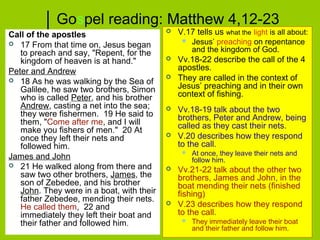
 V.17 tells us what the light is all about:
 Jesus’ preaching on repentance
and the kingdom of God.
 Vv.18-22 describe the call of the 4
apostles.
 They are called in the context of
Jesus’ preaching and in their own
context of fishing.
 Vv.18-19 talk about the two
brothers, Peter and Andrew, being
called as they cast their nets.
 V.20 describes how they respond
to the call.
 At once, they leave their nets and
follow him.
 Vv.21-22 talk about the other two
brothers, James and John, in the
boat mending their nets (finished
fishing)
 V.23 describes how they respond
to the call.
 They immediately leave their boat
and their father and follow him.
Activities of Jesus
 23 He went around all of Galilee,
teaching in their synagogues,
proclaiming the gospel of the
kingdom, and curing every
disease and illness among the
people.
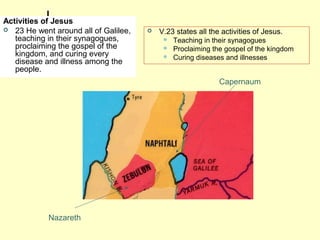
 V.23 states all the activities of Jesus.
 Teaching in their synagogues
 Proclaiming the gospel of the kingdom
 Curing diseases and illnesses
Nazareth
Capernaum
Reflections on the gospel reading
 Jesus is here to bring the light.
 We, who want to see the light, will soon see the
light.
 When we have seen the light, let us be ready to
respond if we have a calling.
 When God calls us, he asks us to leave work and
family behind.
 We become itinerant.
Tying the 3 readings and the Psalm
 The first reading talks about the light in the land
of Zebulun and Naphtali, where there was gloom.
 The psalm acknowledges that God is light.
 The second reading talks about Christian unity in
Corinth, where there was rivalry and division.
They should live in light.
 The gospel reading talks again about the land of
Zebulun and Naphtali, where now there is light.
How to develop your homily / sharing
 Everyone wants to see the light.
 The world teaches that light is having all the
data you need to store in your memory.
 The light is a solution to your technical
problems. The light comes as a result of an
accurate testing and diagnostics.
 We, Christians, see light from a different level.
 The gospel teaches that the inhabitants of Zebulun
and Naphtali now see the light. They were once
degraded.
 With his light, Jesus eradicates their gloom and
sadness, as prophesied in the first reading.
 Jesus preaches repentance “for the kingdom of
heaven is at hand.”
 We see light insofar as we respond to Jesus’
preaching.
 We can never see the light if we are not converted,
if we don’t follow Jesus.
 In the gospel, the 4 fishermen readily answer
the call of Jesus to follow him.
 No questions asked, they leave their nets,
boats and parents right away and follow him.
 As followers, they go where Jesus goes.
 The enlightened disciples follow him and learn
from what he says and does.
 The second reading teaches us, disciples, that we
who have seen the light should not be divisive.
 To live in the light is to be focused on Christ.
 Light unites all believers. It does not encourage
rivalries.
 It promotes the sense of belongingness to the
community.
 If we sow discord (if we live in darkness), we
empty the cross of Christ of its salvific value.
 We render the power of Christ ineffective.
 The first reading teaches us that there is joy,
when we see God’s light.
 We will know right away within our hearts when
we have seen the light.
 There is an abundant joy in our hearts.
 There is a great rejoicing in our community.
 If we don’t have joy and cannot rejoice, we still
have not seen God’s light.
 We must believe that we have seen the light in our
baptism and subsequently in the days of our
formation, in our catechism class, and in the
liturgy.
 The questions that we should ask are the
following:
 What have we given up?
 How much time have we spent to listen to Jesus?
 How much time do we give to share in his mission?
 How faithful have we been in promoting unity
among our ranks in the church?
 Refusal to be formed is a bad sign of
discipleship, preference to live in darkness.
 It is unbecoming of a disciple.
 Not listening to those who know better will
never see the light.
 Sowing intrigues, making comparisons which
are always odious, exaggerations, ignorance
or total disregard of the community’s vision
and mission are sources of division (2nd
reading), and definitely not signs of light.
 In this eucharist, Jesus comes again to us
proclaiming repentance “for the kingdom of heaven
is at hand.”
 Without repentance, we cannot properly respond to
the call of God and to participate in this eucharistic
banquet.
 The eucharist is the sacrament of enlightened
Christian discipleship and unity.
Our Context of Sin and Grace
 Religious intolerance
 Digital divide
 Gap between the rich and the
poor
 Involvement in church based
on loyalty to priests or to some
church members
 Some church people sowing
intrigues to divide the church.
 Kami kami, sila sila,
barkadahan ministry (self-
serving ministries)
 Utang na loob
 Obscurantist
 Sows confusion
 Ability to follow, to obey
 Vocations
 Light
 Ability to give light, to
clarify, to communicate
 Not silent about Christ
 Enlightening lectures and
conferences
 Ongoing Formation
 Integrator
 Works for unity
Suggested Songs
 Peace Prayer of St. Francis
 http://www.youtube.com/watch?v=KJ8TGBB385c
 Light
 http://www.youtube.com/watch?v=x1Bsw3Y5WZ8
 Make Me A Channel of Your Peace
 My Light and My Salvation
 http://www.youtube.com/watch?v=9ekQdpjS4VA
 Dear sisters and brothers,
 As disciples of Christ, let us live in the
light.
 Fr. Cielo

3rd Sunday A

  • 1.
    Welcome to our BibleStudy 3rd Sunday in the Ordinary Time A 22 January 2017 In preparation for this Sunday’s Liturgy As aid in focusing our homilies and sharing Prepared by Fr. Cielo R. Almazan, OFM
  • 2.
    1st reading: Isaiah 8:23-9:3 23 First the Lord degraded the land of Zebulun and the land of Naphtali; but in the end he has glorified the seaward road, the land West of the Jordan, the District of the Gentiles. Anguish has taken wing, dispelled is darkness; for there is no gloom where but now there was distress. 9:1 The people who walked in darkness have seen a great light; upon those who dwelt in the land of gloom a light has shone. 2 You have brought them abundant joy and great rejoicing, as they rejoice before you as at the harvest, as men make merry when dividing spoils. 3 For the yoke that burdened them, the pole on their shoulder, and the rod of their taskmaster you have smashed, as on the day of Midian. The focus is on Zebulun and Naphtali, where there was gloom.
  • 3.
    1st reading: Isaiah 8,23--9,3 TheReversal of the Fate of Zebulun and Naphtali  23 First the Lord degraded the land of Zebulun and the land of Naphtali; but in the end he has glorified the seaward road, the land West of the Jordan, the District of the Gentiles. Anguish has taken wing, dispelled is darkness; for there is no gloom where but now there was distress. The Reversal of the Fate of the People  9:1 The people who walked in darkness have seen a great light; upon those who dwelt in the land of gloom a light has shone. 2 You have brought them abundant joy and great rejoicing, as they rejoice before you as at the harvest, as men make merry when dividing spoils. 3 For the yoke that burdened them, the pole on their shoulder, and the rod of their taskmaster you have smashed, as on the day of Midian. A simple outline!
  • 4.
    1st reading: Isaiah 8,23-9,3 TheReversal of the Fate of Zebulun and Naphtali  23 First the Lord degraded the land of Zebulun and the land of Naphtali; but in the end he has glorified the seaward road, the land West of the Jordan, the District of the Gentiles. Anguish has taken wing, dispelled is darkness; for there is no gloom where but now there was distress. The Reversal of the Fate of the People  9:1 The people who walked in darkness have seen a great light; upon those who dwelt in the land of gloom a light has shone. 2 You have brought them abundant joy and great rejoicing, as they rejoice before you as at the harvest, as men make merry when dividing spoils. 3 For the yoke that burdened them, the pole on their shoulder, and the rod of their taskmaster you have smashed, as on the day of Midian. Commentary  V.23 is a long verse divided into two sentences.  It presents the reversal of the fate of the two lands, Zebulun and Naphtali (2 tribes of Israel, during the time of the Judges)  At first they were degraded, now glorified.  At first there was anguish and darkness, now these are dispelled.  At first there was gloom, now no more.  9,1 is a continuation of v.23. But now it refers to people, not land (more or less the same thing actually).  At first people walked in darkness, now in light  At first people dwelt in gloom, now in light.  V.2 acknowledges God as the source of reversal.  The joy that God brings is not just an ordinary joy, but abundant joy, great joy.  V.3 states the reason for rejoicing:  The yoke, the pole, and the rod, have been smashed.
  • 5.
    Reflections on the1st reading  The reading should encourage those who feel they are living in the dark.  They will soon see the light.  The Lord will soon intervene in their lives.  Sadness is not the last word.  Cheer up. God is good.  God speaks through the prophets and the people who cheer you up.
  • 6.
    Resp. Ps 27:1,4, 13-14  R. (1a) The Lord is my light and my salvation.  1 The LORD is my light and my salvation; whom should I fear? The LORD is my life’s refuge; of whom should I be afraid?  4 One thing I ask of the LORD; this I seek: To dwell in the house of the LORD all the days of my life, That I may gaze on the loveliness of the LORD and contemplate his temple.  13 I believe that I shall see the bounty of the LORD in the land of the living. 14 Wait for the LORD with courage; be stouthearted, and wait for the LORD.
  • 7.
    Resp. Ps 27:1,4, 13-14  R. (1a) The Lord is my light and my salvation.  1 The LORD is my light and my salvation; whom should I fear? The LORD is my life’s refuge; of whom should I be afraid?  4 One thing I ask of the LORD; this I seek: To dwell in the house of the LORD all the days of my life, That I may gaze on the loveliness of the LORD and contemplate his temple.  13 I believe that I shall see the bounty of the LORD in the land of the living. 14 Wait for the LORD with courage; be stouthearted, and wait for the LORD. Commentary  In v.1, the psalmist speaks highly of God.  God calms all his fears.  In v.4, the psalmist desires to dwell and pray in God’s temple, where one can feel God’s presence.  In v.13, the psalmist expresses his hope to be benefited (blessed) by God.  V.14 encourages patience and courage for those who wait for God’s salvation.
  • 8.
    Reflections on thePsalm  We must acknowledge that God is our light.  We must know our priority: to seek God and to dwell in his place.  We must believe that one day God will pour out his blessings upon us.  We don’t give despair a chance.  Are you easily discouraged?
  • 9.
    2nd reading: 1 Corinthians1:10-13.17  10 I urge you, brothers, in the name of our Lord Jesus Christ, that all of you agree in what you say, and that there be no divisions among you, but that you be united in the same mind and in the same purpose. 11 For it has been reported to me about you, my brothers, by Chloe's people, that there are rivalries among you. 12 I mean that each of you is saying, "I belong to Paul," or "I belong to Apollos," or "I belong to Kephas," or "I belong to Christ." 13 Is Christ divided? Was Paul crucified for you? Or were you baptized in the name of Paul? 17 For Christ did not send me to baptize but to preach the gospel, and not with the wisdom of human eloquence, so that the cross of Christ might not be emptied of its meaning. The focus is on the unity of Christians.
  • 10.
    2nd reading: 1 Corinthians1,10-13.17 Exhortation to unite  10 I urge you, brothers, in the name of our Lord Jesus Christ, that all of you agree in what you say, and that there be no divisions among you, but that you be united in the same mind and in the same purpose. Report of rivalries  11 For it has been reported to me about you, my brothers, by Chloe's people, that there are rivalries among you. 12 I mean that each of you is saying, "I belong to Paul," or "I belong to Apollos," or "I belong to Kephas," or "I belong to Christ." Hypothetical Questions  13 Is Christ divided? Was Paul crucified for you? Or were you baptized in the name of Paul? Vocation of Paul  17 For Christ did not send me to baptize but to preach the gospel, and not with the wisdom of human eloquence, so that the cross of Christ might not be emptied of its meaning. A simple outline!
  • 11.
    2nd reading: 1 Corinthians1,10-13.17 Exhortation to unite  10 I urge you, brothers, in the name of our Lord Jesus Christ, that all of you agree in what you say, and that there be no divisions among you, but that you be united in the same mind and in the same purpose. Report of rivalries  11 For it has been reported to me about you, my brothers, by Chloe's people, that there are rivalries among you. 12 I mean that each of you is saying, "I belong to Paul," or "I belong to Apollos," or "I belong to Kephas," or "I belong to Christ." Questions  13 Is Christ divided? Was Paul crucified for you? Or were you baptized in the name of Paul? Vocation of Paul  17 For Christ did not send me to baptize but to preach the gospel, and not with the wisdom of human eloquence, so that the cross of Christ might not be emptied of its meaning. Commentary  The reading is about Christian unity.  In v.10, Paul, the author and organizer of the Corinthian church, urges his brethren to be united, not divided.  The unity that is asked is oneness of mind and purpose.  V.11 states the cause of division.  Rivalry  V.12 explains further the problem:  It is more of a fragmentation, not really rivalry, from the point of view of the text, because of the false sense of belongingness.  In v.13, Paul puts back the divided Christians into order, by invoking the oneness of Christ.  There is only one sense of belongingness.  Every baptized Christian belongs to Christ, not to anyone else.  Paul, Apollos and Kephas are just instruments of Christ.
  • 12.
    2nd reading: 1 Corinthians1,10-13.17 Exhortation to unite  10 I urge you, brothers, in the name of our Lord Jesus Christ, that all of you agree in what you say, and that there be no divisions among you, but that you be united in the same mind and in the same purpose. Report of rivalries  11 For it has been reported to me about you, my brothers, by Chloe's people, that there are rivalries among you. 12 I mean that each of you is saying, "I belong to Paul," or "I belong to Apollos," or "I belong to Kephas," or "I belong to Christ." Questions  13 Is Christ divided? Was Paul crucified for you? Or were you baptized in the name of Paul? Vocation of Paul  17 For Christ did not send me to baptize but to preach the gospel, and not with the wisdom of human eloquence, so that the cross of Christ might not be emptied of its meaning.  V.17 re-states the vocation of Paul.  Not to baptize but to preach the gospel. (problematic)  Paul also baptized the people, but he states here his main purpose:  to evangelize.  His method of evangelization is not like those who can speak very well.  He speaks simply and plainly about Christ.  His reason is to preserve the integrity of the cross of Christ.  Eloquence can empty the meaning of the cross of Christ.  Other preachers might have been trained to enunciate, to pronounce, to present the gospel so well that the method is appreciated better than the content itself, which is the cross of Christ.  Good preachers may preach very well and are appreciated, but may not produce committed Christians, who can take up the cross.
  • 13.
    Reflections on the2nd reading  To be a Christian, one must be focused on Christ.  We do not focus on the persons who baptized and enlightened us, inspired us, sponsored us and brought us back to the fold.  We do not idolize our charismatic groups, our religious affiliations, our committees or ministries or our priest-friends.  What is important is to savor the reality that we now belong to Christ and that we can also take up our crosses.  We now understand what evangelization and sacrifice are all about.  Our baptism in Christ should unite us, regardless of who baptized, catechized, or helped us in our faith.  Divisions and rivalries have no place in the Christian communities.
  • 14.
    Gospel reading: Matthew4:12-23  12 When Jesus heard that John had been arrested, he withdrew to Galilee. 13 He left Nazareth and went to live in Capernaum by the sea, in the region of Zebulun and Naphtali, 14 that what had been said through Isaiah the prophet might be fulfilled: 15 "Land of Zebulun and land of Naphtali, the way to the sea, beyond the Jordan, Galilee of the Gentiles, 16 the people who sit in darkness have seen a great light, on those dwelling in a land overshadowed by death light has arisen." 17 From that time on, Jesus began to preach and say, "Repent, for the kingdom of heaven is at hand." 18 As he was walking by the Sea of Galilee, he saw two brothers, Simon who is called Peter, and his brother Andrew, casting a net into the sea; they were fishermen. 19 He said to them, "Come after me, and I will make you fishers of men." 20 At once they left their nets and followed him. 21 He walked along from there and saw two other brothers, James, the son of Zebedee, and his brother John. They were in a boat, with their father Zebedee, mending their nets. He called them, 22 and immediately they left their boat and their father and followed him. 23 He went around all of Galilee, teaching in their synagogues, proclaiming the gospel of the kingdom, and curing every disease and illness among the people. The focus is on call of the apostles.
  • 15.
    Gospel reading: Matthew4,12-23 Fulfillment of prophecy  12 When Jesus heard that John had been arrested, he withdrew to Galilee. 13 He left Nazareth and went to live in Capernaum by the sea, in the region of Zebulun and Naphtali, 14 that what had been said through Isaiah the prophet might be fulfilled: 15 "Land of Zebulun and land of Naphtali, the way to the sea, beyond the Jordan, Galilee of the Gentiles, 16 the people who sit in darkness have seen a great light, on those dwelling in a land overshadowed by death light has arisen." Call of the apostles  17 From that time on, Jesus began to preach and say, "Repent, for the kingdom of heaven is at hand." 18 As he was walking by the Sea of Galilee, he saw two brothers, Simon who is called Peter, and his brother Andrew, casting a net into the sea; they were fishermen. 19 He said to them, "Come after me, and I will make you fishers of men." 20 At once they left their nets and followed him. 21 He walked along from there and saw two other brothers, James, the son of Zebedee, and his brother John. They were in a boat, with their father Zebedee, mending their nets. He called them, 22 and immediately they left their boat and their father and followed him. Activities of Jesus  23 He went around all of Galilee, teaching in their synagogues, proclaiming the gospel of the kingdom, and curing every disease and illness among the people. A simple outline!
  • 16.
    Gospel reading: Matthew4,12-23 Fulfillment of prophecy  12 When Jesus heard that John had been arrested, he withdrew to Galilee. 13 He left Nazareth and went to live in Capernaum by the sea, in the region of Zebulun and Naphtali, 14 that what had been said through Isaiah the prophet might be fulfilled: 15 "Land of Zebulun and land of Naphtali, the way to the sea, beyond the Jordan, Galilee of the Gentiles, 16 the people who sit in darkness have seen a great light, on those dwelling in a land overshadowed by death light has arisen." Commentary  Vv.12-16 provide the setting of the call of the apostles.  Setting:  John the Baptist’s arrest  Jesus withdraws to Galilee  Jesus leaves Nazareth  Jesus lives in Capernaum in Zebulun and Naphtali, west of the Sea of Galilee.  V.14 interprets Jesus’ movement as the fulfillment of Isaiah’s prophecy in the 1st reading.  V.15 describes this region as the way to the sea (of Galilee).  The people in this area now see the light. They were sitting in darkness, overshadowed by death.  What is this light?
  • 17.
    Gospel reading: Matthew4,12-23 Call of the apostles  17 From that time on, Jesus began to preach and say, "Repent, for the kingdom of heaven is at hand." Peter and Andrew  18 As he was walking by the Sea of Galilee, he saw two brothers, Simon who is called Peter, and his brother Andrew, casting a net into the sea; they were fishermen. 19 He said to them, "Come after me, and I will make you fishers of men." 20 At once they left their nets and followed him. James and John  21 He walked along from there and saw two other brothers, James, the son of Zebedee, and his brother John. They were in a boat, with their father Zebedee, mending their nets. He called them, 22 and immediately they left their boat and their father and followed him.  V.17 tells us what the light is all about:  Jesus’ preaching on repentance and the kingdom of God.  Vv.18-22 describe the call of the 4 apostles.  They are called in the context of Jesus’ preaching and in their own context of fishing.  Vv.18-19 talk about the two brothers, Peter and Andrew, being called as they cast their nets.  V.20 describes how they respond to the call.  At once, they leave their nets and follow him.  Vv.21-22 talk about the other two brothers, James and John, in the boat mending their nets (finished fishing)  V.23 describes how they respond to the call.  They immediately leave their boat and their father and follow him.
  • 18.
    Activities of Jesus 23 He went around all of Galilee, teaching in their synagogues, proclaiming the gospel of the kingdom, and curing every disease and illness among the people.  V.23 states all the activities of Jesus.  Teaching in their synagogues  Proclaiming the gospel of the kingdom  Curing diseases and illnesses Nazareth Capernaum
  • 19.
    Reflections on thegospel reading  Jesus is here to bring the light.  We, who want to see the light, will soon see the light.  When we have seen the light, let us be ready to respond if we have a calling.  When God calls us, he asks us to leave work and family behind.  We become itinerant.
  • 20.
    Tying the 3readings and the Psalm  The first reading talks about the light in the land of Zebulun and Naphtali, where there was gloom.  The psalm acknowledges that God is light.  The second reading talks about Christian unity in Corinth, where there was rivalry and division. They should live in light.  The gospel reading talks again about the land of Zebulun and Naphtali, where now there is light.
  • 21.
    How to developyour homily / sharing  Everyone wants to see the light.  The world teaches that light is having all the data you need to store in your memory.  The light is a solution to your technical problems. The light comes as a result of an accurate testing and diagnostics.  We, Christians, see light from a different level.
  • 22.
     The gospelteaches that the inhabitants of Zebulun and Naphtali now see the light. They were once degraded.  With his light, Jesus eradicates their gloom and sadness, as prophesied in the first reading.  Jesus preaches repentance “for the kingdom of heaven is at hand.”  We see light insofar as we respond to Jesus’ preaching.  We can never see the light if we are not converted, if we don’t follow Jesus.
  • 23.
     In thegospel, the 4 fishermen readily answer the call of Jesus to follow him.  No questions asked, they leave their nets, boats and parents right away and follow him.  As followers, they go where Jesus goes.  The enlightened disciples follow him and learn from what he says and does.
  • 24.
     The secondreading teaches us, disciples, that we who have seen the light should not be divisive.  To live in the light is to be focused on Christ.  Light unites all believers. It does not encourage rivalries.  It promotes the sense of belongingness to the community.  If we sow discord (if we live in darkness), we empty the cross of Christ of its salvific value.  We render the power of Christ ineffective.
  • 25.
     The firstreading teaches us that there is joy, when we see God’s light.  We will know right away within our hearts when we have seen the light.  There is an abundant joy in our hearts.  There is a great rejoicing in our community.  If we don’t have joy and cannot rejoice, we still have not seen God’s light.
  • 26.
     We mustbelieve that we have seen the light in our baptism and subsequently in the days of our formation, in our catechism class, and in the liturgy.  The questions that we should ask are the following:  What have we given up?  How much time have we spent to listen to Jesus?  How much time do we give to share in his mission?  How faithful have we been in promoting unity among our ranks in the church?
  • 27.
     Refusal tobe formed is a bad sign of discipleship, preference to live in darkness.  It is unbecoming of a disciple.  Not listening to those who know better will never see the light.  Sowing intrigues, making comparisons which are always odious, exaggerations, ignorance or total disregard of the community’s vision and mission are sources of division (2nd reading), and definitely not signs of light.
  • 28.
     In thiseucharist, Jesus comes again to us proclaiming repentance “for the kingdom of heaven is at hand.”  Without repentance, we cannot properly respond to the call of God and to participate in this eucharistic banquet.  The eucharist is the sacrament of enlightened Christian discipleship and unity.
  • 29.
    Our Context ofSin and Grace  Religious intolerance  Digital divide  Gap between the rich and the poor  Involvement in church based on loyalty to priests or to some church members  Some church people sowing intrigues to divide the church.  Kami kami, sila sila, barkadahan ministry (self- serving ministries)  Utang na loob  Obscurantist  Sows confusion  Ability to follow, to obey  Vocations  Light  Ability to give light, to clarify, to communicate  Not silent about Christ  Enlightening lectures and conferences  Ongoing Formation  Integrator  Works for unity
  • 30.
    Suggested Songs  PeacePrayer of St. Francis  http://www.youtube.com/watch?v=KJ8TGBB385c  Light  http://www.youtube.com/watch?v=x1Bsw3Y5WZ8  Make Me A Channel of Your Peace  My Light and My Salvation  http://www.youtube.com/watch?v=9ekQdpjS4VA
  • 31.
     Dear sistersand brothers,  As disciples of Christ, let us live in the light.  Fr. Cielo