Welcome to our Bible
Study
3rd
Sunday of Advent C
Gaudete Sunday
13 December 2015
In preparation for this Sunday’s Liturgy
In aid of focusing our homilies and sharing
Prepared by Fr. Cielo R. Almazan, OFM
11stst
reading: Zephaniah 3,14-18areading: Zephaniah 3,14-18a
 14 Shout for joy, O daughter Zion! sing joyfully, O
Israel! Be glad and exult with all your heart, O
daughter Jerusalem! 15 The LORD has removed the
judgment against you, he has turned away your
enemies; The King of Israel, the LORD, is in your
midst, you have no further misfortune to fear. 16 On
that day, it shall be said to Jerusalem: Fear not, O
Zion, be not discouraged! 17 The LORD, your God,
is in your midst, a mighty savior; He will rejoice over
you with gladness, and renew you in his love, He will
sing joyfully because of you, 18 as one sings at
festivals.
The focus is on rejoicing.
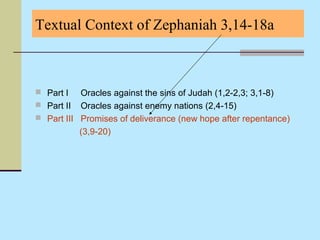
Textual Context of Zephaniah 3,14-18a
 Part I Oracles against the sins of Judah (1,2-2,3; 3,1-8)
 Part II Oracles against enemy nations (2,4-15)
 Part III Promises of deliverance (new hope after repentance)
(3,9-20)
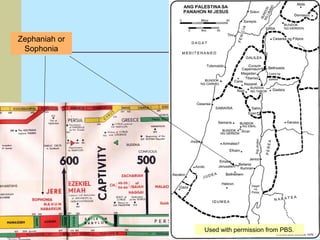
Zephaniah or
Sophonia
Used with permission from PBS.
1st
reading: Zephaniah 3,14-18a
Exhortation to rejoice
 14 Shout for joy, O daughter Zion! sing joyfully, O Israel! Be
glad and exult with all your heart, O daughter Jerusalem!
Reasons for rejoicing
 15 The LORD has removed the judgment against you, he has
turned away your enemies;
 The King of Israel, the LORD, is in your midst, you have no
further misfortune to fear.
Exhortation in another form
 16 On that day, it shall be said to Jerusalem: Fear not, O Zion,
be not discouraged!
Reason to fear not
 17 The LORD, your God, is in your midst, a mighty savior; He
will rejoice over you with gladness, and renew you in his love,
He will sing joyfully because of you, 18 as one sings at
festivals.
A simple outline!
1st
reading: Zephaniah 3,14-18a
Exhortation to rejoice
 14 Shout for joy, O daughter Zion!
sing joyfully, O Israel! Be glad and
exult with all your heart, O daughter
Jerusalem!
Reasons for rejoicing
 15 The LORD has removed the
judgment against you, he has turned
away your enemies;
 The King of Israel, the LORD, is in
your midst, you have no further
misfortune to fear.
Exhortation in another form
 16 On that day, it shall be said to
Jerusalem: Fear not, O Zion, be not
discouraged!
Reason to fear not
 17 The LORD, your God, is in your
midst, a mighty savior; He will rejoice
over you with gladness, and renew
you in his love, He will sing joyfully
because of you, 18 as one sings at
festivals.
Commentary
 Zephaniah prophesied during the
time of Josiah, before the Exile.
 People were worshipping idols (sun,
moon, stars), because of the pagan
Assyrian influence.
 For a pious Israelite, it was not the
proper thing to do; it invited God’s
judgment.
 People were living in fear (vv.15-16)
 For the prophet, in spite of the
sinfulness of the people, God
assures them of his presence and
solidarity.
 God/King/Lord will be in their midst.
 God himself is happy. He will
rejoice… will sing joyfully. (v.17)
 Parallelism is the style in v.14.
Reflections on the 1st
reading
 The message of the prophet is “rejoicing.”
 Not only the Israelites are entitled to rejoice, but also God himself.
Ibang klase ang Diyos natin.
 God is not without feelings.
 The 3rd
Sunday of Advent gives us the reasons to be joyful.
 One reason: God has removed his judgment (punishment).
Enemies (those who destroy our families, properties, our nation, our
identity, our religious beliefs) are no more. God will be the one ruling
us, not our invaders.
 Another reason: though powerful, our God is able to rejoice; he
feels with us; he becomes human for us. He joins in our rejoicing.
 Can we rejoice in the midst of tragedies, catastrophes and
misfortunes?
 Let us listen to the voice of the prophet. If we believe in God, it is
possible.
 Others say it is impossible. Don’t listen to them.
Resp. Psalm: Is 12:2-3, 4, 5-6

R. (6) Cry out with joy and gladness: for among you is the
great and Holy One of Israel.
 2 God indeed is my savior;
I am confident and unafraid.
3 My strength and my courage is the LORD,
and he has been my savior.
With joy you will draw water
at the fountain of salvation.
 4 Give thanks to the LORD, acclaim his name;
among the nations make known his deeds,
proclaim how exalted is his name.
 5 Sing praise to the LORD for his glorious achievement;
let this be known throughout all the earth.
6 Shout with exultation, O city of Zion,
for great in your midst
is the Holy One of Israel!
Resp. Psalm: Is 12:2-3, 4, 5-6

R. (6)  Cry out with joy and
gladness: for among you is
the great and Holy One of
Israel.
 2 God indeed is my savior;
I am confident and unafraid.
3 My strength and my courage is 
the LORD,
and he has been my savior.
With joy you will draw water
at the fountain of salvation.
 4 Give thanks to the LORD, 
acclaim his name;
among the nations make known 
his deeds,
proclaim how exalted is his 
name.
 5 Sing praise to the LORD for his 
glorious achievement;
let this be known throughout all 
the earth. 
6 Shout with exultation, O city of 
Zion,
for great in your midst
is the Holy One of Israel!
Commentary
 The responsorial psalm does not really 
come from the Book of Psalms but from the 
Book of Isaiah.
 It is a thanksgiving song of Israel in the 
language of the Psalms.
 V.2 affirms God as the psalmist’s savior.
 V.3 affirms God as his strength and 
courage, and again the savior.
 V.4 exhorts everyone to be thankful to the 
Lord.
 God’s name should be advertised to all 
nations, including his deeds.
 V.5 exhorts people to praise God for his 
wonderful deeds (achievements, 
accomplishments).
 His deeds must be broadcasted.
 V.6 exhorts the inhabitants of Jerusalem 
(city of Zion, city of David) for God (the Holy 
One) is in their midst.
Reflections on the Resp. Psalm
 The responsorial psalm goes along well with the 
message of the first reading to rejoice.
 Joy comes as a result of our realization that God is 
good.
 We cannot rejoice if we are not aware of God’s 
wonderful deeds in our lives.
 Rejoicing anticipates God’s salvific act when we are 
in trouble.
 The responsorial psalm urges us to burst into joy.
 We accentuate our rejoicing and thanksgiving.
2nd
reading: Philippians 4,4-7
 4 Rejoice in the Lord always. I shall say it 
again: rejoice!  5 Your kindness should be 
known to all. The Lord is near.  6 Have no 
anxiety at all, but in everything, by prayer and 
petition, with thanksgiving, make your 
requests known to God.  7 Then the peace of 
God that surpasses all understanding will 
guard your hearts and minds in Christ Jesus. 
The focus is on rejoicing!
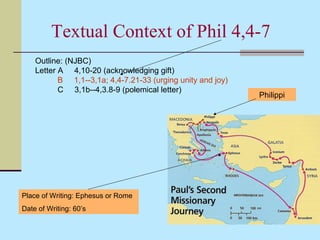
Textual Context of Phil 4,4-7
Outline: (NJBC)
Letter A     4,10-20 (acknowledging gift)
          B     1,1--3,1a; 4,4-7.21-33 (urging unity and joy)
          C     3,1b--4,3.8-9 (polemical letter)
Philippi
Place of Writing: Ephesus or Rome
Date of Writing: 60’s
22ndnd
reading: Philippians 4,4-7reading: Philippians 4,4-7
 4 Rejoice in the Lord 
always. I shall say it again: 
rejoice!  5 Your kindness 
should be known to all. The 
Lord is near.  6 Have no 
anxiety at all, but in 
everything, by prayer and 
petition, with thanksgiving, 
make your requests known 
to God.  7 Then the peace 
of God that surpasses all 
understanding will guard 
your hearts and minds in 
Christ Jesus. 
Commentary
 V.4 sets the mood of the 
reading. In the imperative 
mood: rejoice.
 V.5 gives the reasons for 
rejoicing: 
 kindness should be 
known, 
 the Lord is near.
 V.6 exhorts every Christian to 
pray.
 V.7 expresses the result of 
rejoicing and praying: peace of 
God will guard….
Reflections on the 2nd
reading
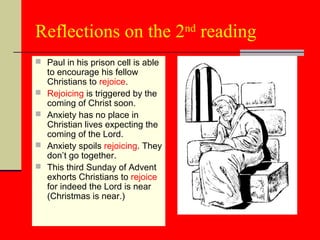
 Paul in his prison cell is able 
to encourage his fellow 
Christians to rejoice.
 Rejoicing is triggered by the 
coming of Christ soon.
 Anxiety has no place in 
Christian lives expecting the 
coming of the Lord.
 Anxiety spoils rejoicing. They 
don’t go together.
 This third Sunday of Advent 
exhorts Christians to rejoice 
for indeed the Lord is near 
(Christmas is near.)
Gospel reading: Luke 3,10-18
 10 And the crowds asked him, "What then should we do?"  11 
He said to them in reply, "Whoever has two cloaks should share 
with the person who has none. And whoever has food should do 
likewise."  12 Even tax collectors came to be baptized and they 
said to him, "Teacher, what should we do?"  13 He answered 
them, "Stop collecting more than what is prescribed."  14 
Soldiers also asked him, "And what is it that we should do?" He 
told them, "Do not practice extortion, do not falsely accuse 
anyone, and be satisfied with your wages."  15 Now the people 
were filled with expectation, and all were asking in their hearts 
whether John might be the Messiah.  16 John answered them 
all, saying, "I am baptizing you with water, but one mightier than 
I is coming. I am not worthy to loosen the thongs of his sandals. 
He will baptize you with the holy Spirit and fire.  17 His 
winnowing fan is in his hand to clear his threshing floor and to 
gather the wheat into his barn, but the chaff he will burn with 
unquenchable fire."  18 Exhorting them in many other ways, he 
preached good news to the people. 
Gospel reading: Luke 3,10-18
Crowds to John
 10 And the crowds asked him, "What then should we do?"  
John’s response
 11 He said to them in reply, "Whoever has two cloaks should share with the person who 
has none. And whoever has food should do likewise."  
Tax collectors to John
 12 Even tax collectors came to be baptized and they said to him, "Teacher, what should we 
do?"  
John’s response
 13 He answered them, "Stop collecting more than what is prescribed."  
Soldiers to John
 14 Soldiers also asked him, "And what is it that we should do?" 
John’s response
 He told them, "Do not practice extortion, do not falsely accuse anyone, and be satisfied with 
your wages."  
People to John
 15 Now the people were filled with expectation, and all were asking in their hearts whether 
John might be the Messiah.  
John’s response
 16 John answered them all, saying, "I am baptizing you with water, but one mightier than I 
is coming. I am not worthy to loosen the thongs of his sandals. He will baptize you with the 
holy Spirit and fire.  17 His winnowing fan is in his hand to clear his threshing floor and to 
gather the wheat into his barn, but the chaff he will burn with unquenchable fire."  18 
Exhorting them in many other ways, he preached good news to the people. 
A simple outline!
The reading focuses on appropriate behavior.
Gospel reading: Luke 3,10-18Gospel reading: Luke 3,10-18
Crowds to John
 10 And the crowds asked him,
"What then should we do?"
John’s response
 11 He said to them in reply,
"Whoever has two cloaks
should share with the person
who has none. And whoever
has food should do likewise."
Tax collectors to John
 12 Even tax collectors came
to be baptized and they said
to him, "Teacher, what should
we do?"
John’s response
 13 He answered them, "Stop
collecting more than what is
prescribed."
Soldiers to John
 14 Soldiers also asked him,
"And what is it that we should
do?"
John’s response
 He told them, "Do not practice
extortion, do not falsely
accuse anyone, and be
satisfied with your wages."
Commentary
 This is the question and answer portion of John’s
ministry.
 All kinds of people consult with John regarding
the concrete application of his teaching on
repentance.
 John is able to identify the sins of each group and
give appropriate solutions.
 His answers have something to do with justice
and charity.
 Baptized Christians should practice justice and
charity to people. V.11
 They should not use their position to extort
money. Vv.12-13 (Take note tax collectors, BIR
and law enforcers.)
 Christians should be able to share from the little
they have (clothing and food).
 The one who has is exhorted to share. It does not
matter how much one has.
 Apportioning, sharing of goods must be part of
the Christian agenda, plan of life.
 Who cannot be happy if there is justice and
charity?
Gospel reading: Luke 3,10-18Gospel reading: Luke 3,10-18People to John
 15 Now the people were
filled with expectation, and
all were asking in their
hearts whether John might
be the Messiah.
John’s response
 16 John answered them
all, saying, "I am baptizing
you with water, but one
mightier than I is coming. I
am not worthy to loosen
the thongs of his sandals.
He will baptize you with the
holy Spirit and fire. 17 His
winnowing fan is in his
hand to clear his threshing
floor and to gather the
wheat into his barn, but the
chaff he will burn with
unquenchable fire." 18
Exhorting them in many
other ways, he preached
good news to the people.
 In v.15, the people approve John’s
preaching, therefore they ask if he is the
Messiah.
 Vv.16-17 clarify who John is and who the
Messiah is.
 John baptizes with water / Jesus
baptizes with holy Spirit and fire
 John is not worthy to loosen… his
sandals / Jesus is mightier than he.
 Jesus comes to separate wheat from
chaff and to judge (punish the wicked).
 In v.18, John continues to exhort his
listeners to reform their lives as he
preaches the good news to them.
Reflections on the gospel reading
 We have summarized the exhortations of John the
Baptist into two: justice and charity.
 Conversion is not just a pietism or something
emotional, but an intelligent commitment to charity and
justice.
 Be warned: Our work/position/power can be a source of
abuses and oppression.
 As we enjoy our employment, we see to it that we don’t
oppress anyone, but give justice and be charitable to
people at all times.
 It is a tangible way of showing our conversion.
 Justice and charity is our response to God’s invitation to
conversion.
 If this is done, we have reasons to rejoice.
Tying the 3 readings and the Psalm
 The first reading exhorts the sorrowing to rejoice. It
enumerates many reasons why we should rejoice:
coming of the savior, no more misfortunes.
 The responsorial psalm backs up the message of the
first reading: to rejoice.
 The second reading likewise exhorts Christians to
rejoice, because the coming of the Lord is near.
 The gospel reading does not explicitly exhort us to
rejoice, but surely, if all of us do what Saint John the
Baptist is telling us, there will be rejoicing, especially
those who have not.
How to develop your homily and sharing
 This third Sunday of Advent accentuates the
message of joy. After one more Sunday, it is
Christmas.
 Ask the congregation: Have you been happy with
your life? Why? (new house, son passed board exams,
found a new friend, etc.)
 Some people can’t be happy because of the many
issues/ problems they are facing: bills to pay, loss of a
loved one, feeling oppressed, feeling abandoned, injustices,
hopelessness, prolonged illness, conflicts with friends and
relatives and employers/employees, etc.
 Don’t we have the right to rejoice (to be happy)
when we are confronted with all kinds of
misfortunes?
 The answer of the readings is in the
affirmative.
 According to the readings, we have no right to
be sad, because there are many more
reasons to be happy.
 The prophet in the first reading exhorts the
people to rejoice because God removes
judgment (punishment).
 We can rejoice even if we are hard up in our
lives.
 We are called to celebrate our hopes and
anticipate God’s promises.
 We rejoice because God accepts us even if we
have fallen into sin.
 Joy comes about when we let God rule over us,
not our enemies.
 Paul in the second reading exhorts the Christians to
rejoice because Christ is coming soon.
 Paul is insistent on rejoicing always in the Lord.
 Paul knows the implications of the nearness of the
Lord Jesus.
 It is the end of misery and the victory of good.
 So rejoice.
 You can’t rejoice if you don’t believe that God is near
and is not coming at all.
 The gospel reading teaches us to be just and
charitable.
 We cannot truly rejoice if we are unjust and
uncharitable.
 Inability to rejoice is the result of being unjust and
uncharitable.
 If we want to stop living miserable lives and making
others miserable, then we should exercise justice and
charity.
 Peace and happiness are the fruits of the communal
practice of justice and charity.
 In our communities, we need people who can give us
energy in the midst of crisis.
 We need people who can celebrate life with us,
 who can increase the little hope that we have,
 and who allow us to die with dignity.
 We have no right to lead our communities, parishes
and companies, if our nature is always to see the
dark side of things.
 It is against justice and charity to look gloomy all the
time. It is un-Christian.
 The eucharist is God’s way of making us
happy.
 He assures us of his presence and his reign
through the tangible consecrated bread and
wine.
 In the eucharist, we dispose ourselves to be
happy even if only at that particular moment.
 In the eucharist, let his message dictate what
we need to do with our lives, not the message
of those who make our lives miserable.
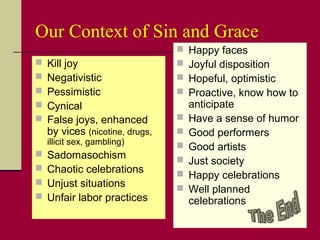
Our Context of Sin and Grace
 Kill joy
 Negativistic
 Pessimistic
 Cynical
 False joys, enhanced
by vices (nicotine, drugs,
illicit sex, gambling)
 Sadomasochism
 Chaotic celebrations
 Unjust situations
 Unfair labor practices
 Happy faces
 Joyful disposition
 Hopeful, optimistic
 Proactive, know how to
anticipate
 Have a sense of humor
 Good performers
 Good artists
 Just society
 Happy celebrations
 Well planned
celebrations
Suggested Songs
 Make Straight the Path
 http://www.youtube.com/watch?v=XWlq2ouoEMg
 Shout with Exultation
 O Come O Come Emmanuel
 Dear brothers and sisters,
 Rejoicing is part of our conversion and
mission in this Year of Faith.

 Fr. Cielo

3rd Advent C

  • 1.
    Welcome to ourBible Study 3rd Sunday of Advent C Gaudete Sunday 13 December 2015 In preparation for this Sunday’s Liturgy In aid of focusing our homilies and sharing Prepared by Fr. Cielo R. Almazan, OFM
  • 2.
    11stst reading: Zephaniah 3,14-18areading:Zephaniah 3,14-18a  14 Shout for joy, O daughter Zion! sing joyfully, O Israel! Be glad and exult with all your heart, O daughter Jerusalem! 15 The LORD has removed the judgment against you, he has turned away your enemies; The King of Israel, the LORD, is in your midst, you have no further misfortune to fear. 16 On that day, it shall be said to Jerusalem: Fear not, O Zion, be not discouraged! 17 The LORD, your God, is in your midst, a mighty savior; He will rejoice over you with gladness, and renew you in his love, He will sing joyfully because of you, 18 as one sings at festivals. The focus is on rejoicing.
  • 3.
    Textual Context ofZephaniah 3,14-18a  Part I Oracles against the sins of Judah (1,2-2,3; 3,1-8)  Part II Oracles against enemy nations (2,4-15)  Part III Promises of deliverance (new hope after repentance) (3,9-20)
  • 4.
    Zephaniah or Sophonia Used withpermission from PBS.
  • 5.
    1st reading: Zephaniah 3,14-18a Exhortationto rejoice  14 Shout for joy, O daughter Zion! sing joyfully, O Israel! Be glad and exult with all your heart, O daughter Jerusalem! Reasons for rejoicing  15 The LORD has removed the judgment against you, he has turned away your enemies;  The King of Israel, the LORD, is in your midst, you have no further misfortune to fear. Exhortation in another form  16 On that day, it shall be said to Jerusalem: Fear not, O Zion, be not discouraged! Reason to fear not  17 The LORD, your God, is in your midst, a mighty savior; He will rejoice over you with gladness, and renew you in his love, He will sing joyfully because of you, 18 as one sings at festivals. A simple outline!
  • 6.
    1st reading: Zephaniah 3,14-18a Exhortationto rejoice  14 Shout for joy, O daughter Zion! sing joyfully, O Israel! Be glad and exult with all your heart, O daughter Jerusalem! Reasons for rejoicing  15 The LORD has removed the judgment against you, he has turned away your enemies;  The King of Israel, the LORD, is in your midst, you have no further misfortune to fear. Exhortation in another form  16 On that day, it shall be said to Jerusalem: Fear not, O Zion, be not discouraged! Reason to fear not  17 The LORD, your God, is in your midst, a mighty savior; He will rejoice over you with gladness, and renew you in his love, He will sing joyfully because of you, 18 as one sings at festivals. Commentary  Zephaniah prophesied during the time of Josiah, before the Exile.  People were worshipping idols (sun, moon, stars), because of the pagan Assyrian influence.  For a pious Israelite, it was not the proper thing to do; it invited God’s judgment.  People were living in fear (vv.15-16)  For the prophet, in spite of the sinfulness of the people, God assures them of his presence and solidarity.  God/King/Lord will be in their midst.  God himself is happy. He will rejoice… will sing joyfully. (v.17)  Parallelism is the style in v.14.
  • 7.
    Reflections on the1st reading  The message of the prophet is “rejoicing.”  Not only the Israelites are entitled to rejoice, but also God himself. Ibang klase ang Diyos natin.  God is not without feelings.  The 3rd Sunday of Advent gives us the reasons to be joyful.  One reason: God has removed his judgment (punishment). Enemies (those who destroy our families, properties, our nation, our identity, our religious beliefs) are no more. God will be the one ruling us, not our invaders.  Another reason: though powerful, our God is able to rejoice; he feels with us; he becomes human for us. He joins in our rejoicing.  Can we rejoice in the midst of tragedies, catastrophes and misfortunes?  Let us listen to the voice of the prophet. If we believe in God, it is possible.  Others say it is impossible. Don’t listen to them.
  • 8.
    Resp. Psalm: Is12:2-3, 4, 5-6  R. (6) Cry out with joy and gladness: for among you is the great and Holy One of Israel.  2 God indeed is my savior; I am confident and unafraid. 3 My strength and my courage is the LORD, and he has been my savior. With joy you will draw water at the fountain of salvation.  4 Give thanks to the LORD, acclaim his name; among the nations make known his deeds, proclaim how exalted is his name.  5 Sing praise to the LORD for his glorious achievement; let this be known throughout all the earth. 6 Shout with exultation, O city of Zion, for great in your midst is the Holy One of Israel!
  • 9.
    Resp. Psalm: Is12:2-3, 4, 5-6  R. (6)  Cry out with joy and gladness: for among you is the great and Holy One of Israel.  2 God indeed is my savior; I am confident and unafraid. 3 My strength and my courage is  the LORD, and he has been my savior. With joy you will draw water at the fountain of salvation.  4 Give thanks to the LORD,  acclaim his name; among the nations make known  his deeds, proclaim how exalted is his  name.  5 Sing praise to the LORD for his  glorious achievement; let this be known throughout all  the earth.  6 Shout with exultation, O city of  Zion, for great in your midst is the Holy One of Israel! Commentary  The responsorial psalm does not really  come from the Book of Psalms but from the  Book of Isaiah.  It is a thanksgiving song of Israel in the  language of the Psalms.  V.2 affirms God as the psalmist’s savior.  V.3 affirms God as his strength and  courage, and again the savior.  V.4 exhorts everyone to be thankful to the  Lord.  God’s name should be advertised to all  nations, including his deeds.  V.5 exhorts people to praise God for his  wonderful deeds (achievements,  accomplishments).  His deeds must be broadcasted.  V.6 exhorts the inhabitants of Jerusalem  (city of Zion, city of David) for God (the Holy  One) is in their midst.
  • 10.
    Reflections on theResp. Psalm  The responsorial psalm goes along well with the  message of the first reading to rejoice.  Joy comes as a result of our realization that God is  good.  We cannot rejoice if we are not aware of God’s  wonderful deeds in our lives.  Rejoicing anticipates God’s salvific act when we are  in trouble.  The responsorial psalm urges us to burst into joy.  We accentuate our rejoicing and thanksgiving.
  • 11.
    2nd reading: Philippians 4,4-7 4 Rejoice in the Lord always. I shall say it  again: rejoice!  5 Your kindness should be  known to all. The Lord is near.  6 Have no  anxiety at all, but in everything, by prayer and  petition, with thanksgiving, make your  requests known to God.  7 Then the peace of  God that surpasses all understanding will  guard your hearts and minds in Christ Jesus.  The focus is on rejoicing!
  • 12.
    Textual Context ofPhil 4,4-7 Outline: (NJBC) Letter A     4,10-20 (acknowledging gift)           B     1,1--3,1a; 4,4-7.21-33 (urging unity and joy)           C     3,1b--4,3.8-9 (polemical letter) Philippi Place of Writing: Ephesus or Rome Date of Writing: 60’s
  • 13.
    22ndnd reading: Philippians 4,4-7reading:Philippians 4,4-7  4 Rejoice in the Lord  always. I shall say it again:  rejoice!  5 Your kindness  should be known to all. The  Lord is near.  6 Have no  anxiety at all, but in  everything, by prayer and  petition, with thanksgiving,  make your requests known  to God.  7 Then the peace  of God that surpasses all  understanding will guard  your hearts and minds in  Christ Jesus.  Commentary  V.4 sets the mood of the  reading. In the imperative  mood: rejoice.  V.5 gives the reasons for  rejoicing:   kindness should be  known,   the Lord is near.  V.6 exhorts every Christian to  pray.  V.7 expresses the result of  rejoicing and praying: peace of  God will guard….
  • 14.
    Reflections on the2nd reading  Paul in his prison cell is able  to encourage his fellow  Christians to rejoice.  Rejoicing is triggered by the  coming of Christ soon.  Anxiety has no place in  Christian lives expecting the  coming of the Lord.  Anxiety spoils rejoicing. They  don’t go together.  This third Sunday of Advent  exhorts Christians to rejoice  for indeed the Lord is near  (Christmas is near.)
  • 15.
    Gospel reading: Luke3,10-18  10 And the crowds asked him, "What then should we do?"  11  He said to them in reply, "Whoever has two cloaks should share  with the person who has none. And whoever has food should do  likewise."  12 Even tax collectors came to be baptized and they  said to him, "Teacher, what should we do?"  13 He answered  them, "Stop collecting more than what is prescribed."  14  Soldiers also asked him, "And what is it that we should do?" He  told them, "Do not practice extortion, do not falsely accuse  anyone, and be satisfied with your wages."  15 Now the people  were filled with expectation, and all were asking in their hearts  whether John might be the Messiah.  16 John answered them  all, saying, "I am baptizing you with water, but one mightier than  I is coming. I am not worthy to loosen the thongs of his sandals.  He will baptize you with the holy Spirit and fire.  17 His  winnowing fan is in his hand to clear his threshing floor and to  gather the wheat into his barn, but the chaff he will burn with  unquenchable fire."  18 Exhorting them in many other ways, he  preached good news to the people. 
  • 16.
    Gospel reading: Luke3,10-18 Crowds to John  10 And the crowds asked him, "What then should we do?"   John’s response  11 He said to them in reply, "Whoever has two cloaks should share with the person who  has none. And whoever has food should do likewise."   Tax collectors to John  12 Even tax collectors came to be baptized and they said to him, "Teacher, what should we  do?"   John’s response  13 He answered them, "Stop collecting more than what is prescribed."   Soldiers to John  14 Soldiers also asked him, "And what is it that we should do?"  John’s response  He told them, "Do not practice extortion, do not falsely accuse anyone, and be satisfied with  your wages."   People to John  15 Now the people were filled with expectation, and all were asking in their hearts whether  John might be the Messiah.   John’s response  16 John answered them all, saying, "I am baptizing you with water, but one mightier than I  is coming. I am not worthy to loosen the thongs of his sandals. He will baptize you with the  holy Spirit and fire.  17 His winnowing fan is in his hand to clear his threshing floor and to  gather the wheat into his barn, but the chaff he will burn with unquenchable fire."  18  Exhorting them in many other ways, he preached good news to the people.  A simple outline! The reading focuses on appropriate behavior.
  • 17.
    Gospel reading: Luke3,10-18Gospel reading: Luke 3,10-18 Crowds to John  10 And the crowds asked him, "What then should we do?" John’s response  11 He said to them in reply, "Whoever has two cloaks should share with the person who has none. And whoever has food should do likewise." Tax collectors to John  12 Even tax collectors came to be baptized and they said to him, "Teacher, what should we do?" John’s response  13 He answered them, "Stop collecting more than what is prescribed." Soldiers to John  14 Soldiers also asked him, "And what is it that we should do?" John’s response  He told them, "Do not practice extortion, do not falsely accuse anyone, and be satisfied with your wages." Commentary  This is the question and answer portion of John’s ministry.  All kinds of people consult with John regarding the concrete application of his teaching on repentance.  John is able to identify the sins of each group and give appropriate solutions.  His answers have something to do with justice and charity.  Baptized Christians should practice justice and charity to people. V.11  They should not use their position to extort money. Vv.12-13 (Take note tax collectors, BIR and law enforcers.)  Christians should be able to share from the little they have (clothing and food).  The one who has is exhorted to share. It does not matter how much one has.  Apportioning, sharing of goods must be part of the Christian agenda, plan of life.  Who cannot be happy if there is justice and charity?
  • 18.
    Gospel reading: Luke3,10-18Gospel reading: Luke 3,10-18People to John  15 Now the people were filled with expectation, and all were asking in their hearts whether John might be the Messiah. John’s response  16 John answered them all, saying, "I am baptizing you with water, but one mightier than I is coming. I am not worthy to loosen the thongs of his sandals. He will baptize you with the holy Spirit and fire. 17 His winnowing fan is in his hand to clear his threshing floor and to gather the wheat into his barn, but the chaff he will burn with unquenchable fire." 18 Exhorting them in many other ways, he preached good news to the people.  In v.15, the people approve John’s preaching, therefore they ask if he is the Messiah.  Vv.16-17 clarify who John is and who the Messiah is.  John baptizes with water / Jesus baptizes with holy Spirit and fire  John is not worthy to loosen… his sandals / Jesus is mightier than he.  Jesus comes to separate wheat from chaff and to judge (punish the wicked).  In v.18, John continues to exhort his listeners to reform their lives as he preaches the good news to them.
  • 19.
    Reflections on thegospel reading  We have summarized the exhortations of John the Baptist into two: justice and charity.  Conversion is not just a pietism or something emotional, but an intelligent commitment to charity and justice.  Be warned: Our work/position/power can be a source of abuses and oppression.  As we enjoy our employment, we see to it that we don’t oppress anyone, but give justice and be charitable to people at all times.  It is a tangible way of showing our conversion.  Justice and charity is our response to God’s invitation to conversion.  If this is done, we have reasons to rejoice.
  • 20.
    Tying the 3readings and the Psalm  The first reading exhorts the sorrowing to rejoice. It enumerates many reasons why we should rejoice: coming of the savior, no more misfortunes.  The responsorial psalm backs up the message of the first reading: to rejoice.  The second reading likewise exhorts Christians to rejoice, because the coming of the Lord is near.  The gospel reading does not explicitly exhort us to rejoice, but surely, if all of us do what Saint John the Baptist is telling us, there will be rejoicing, especially those who have not.
  • 21.
    How to developyour homily and sharing  This third Sunday of Advent accentuates the message of joy. After one more Sunday, it is Christmas.  Ask the congregation: Have you been happy with your life? Why? (new house, son passed board exams, found a new friend, etc.)  Some people can’t be happy because of the many issues/ problems they are facing: bills to pay, loss of a loved one, feeling oppressed, feeling abandoned, injustices, hopelessness, prolonged illness, conflicts with friends and relatives and employers/employees, etc.
  • 22.
     Don’t wehave the right to rejoice (to be happy) when we are confronted with all kinds of misfortunes?  The answer of the readings is in the affirmative.  According to the readings, we have no right to be sad, because there are many more reasons to be happy.
  • 23.
     The prophetin the first reading exhorts the people to rejoice because God removes judgment (punishment).  We can rejoice even if we are hard up in our lives.  We are called to celebrate our hopes and anticipate God’s promises.  We rejoice because God accepts us even if we have fallen into sin.  Joy comes about when we let God rule over us, not our enemies.
  • 24.
     Paul inthe second reading exhorts the Christians to rejoice because Christ is coming soon.  Paul is insistent on rejoicing always in the Lord.  Paul knows the implications of the nearness of the Lord Jesus.  It is the end of misery and the victory of good.  So rejoice.  You can’t rejoice if you don’t believe that God is near and is not coming at all.
  • 25.
     The gospelreading teaches us to be just and charitable.  We cannot truly rejoice if we are unjust and uncharitable.  Inability to rejoice is the result of being unjust and uncharitable.  If we want to stop living miserable lives and making others miserable, then we should exercise justice and charity.  Peace and happiness are the fruits of the communal practice of justice and charity.
  • 26.
     In ourcommunities, we need people who can give us energy in the midst of crisis.  We need people who can celebrate life with us,  who can increase the little hope that we have,  and who allow us to die with dignity.  We have no right to lead our communities, parishes and companies, if our nature is always to see the dark side of things.  It is against justice and charity to look gloomy all the time. It is un-Christian.
  • 27.
     The eucharistis God’s way of making us happy.  He assures us of his presence and his reign through the tangible consecrated bread and wine.  In the eucharist, we dispose ourselves to be happy even if only at that particular moment.  In the eucharist, let his message dictate what we need to do with our lives, not the message of those who make our lives miserable.
  • 28.
    Our Context ofSin and Grace  Kill joy  Negativistic  Pessimistic  Cynical  False joys, enhanced by vices (nicotine, drugs, illicit sex, gambling)  Sadomasochism  Chaotic celebrations  Unjust situations  Unfair labor practices  Happy faces  Joyful disposition  Hopeful, optimistic  Proactive, know how to anticipate  Have a sense of humor  Good performers  Good artists  Just society  Happy celebrations  Well planned celebrations
  • 29.
    Suggested Songs  MakeStraight the Path  http://www.youtube.com/watch?v=XWlq2ouoEMg  Shout with Exultation  O Come O Come Emmanuel
  • 30.
     Dear brothersand sisters,  Rejoicing is part of our conversion and mission in this Year of Faith.   Fr. Cielo