TheThe
ChallengesChallenges
of theof the
EucharistEucharist
We Filipinos are
spiritual
We easily believe in God.
Belief in “Gaba” is very prevalent in
most
We believe in spiritual beings that
are not seen – mga hindi tulad
natin.
But…….
• We tend to separate our spiritual life
from our day-to-day life.
• Our life of worship is not very much
connected with our daily struggles.
• We tend to keep God in his place
while we here below live by our own
rules.
We can view the Eucharist
in four aspects:
• As presence
• As memorial
• As meal
• As sacrifice
Eucharist as Presence
1. We are comfortable with the Sacred
Host.
2. We take comfort in the presence of
the Sacred Host but we are
disturbed by people.
3. We are indifferent to the continuous
presence of Jesus in the Eucharist,
and more so to the presence of Jesus
in the poor and suffering.
Eucharist as
Presence
St. Alphonsus:
“Of all the
devotions, that of adoring
Jesus in the Blessed
Sacrament is the greatest
after the sacraments, the
one dearest to God and the
one most helpful to us.”
Eucharist as Presence
4. Challenge for us priests:
John Paul II:
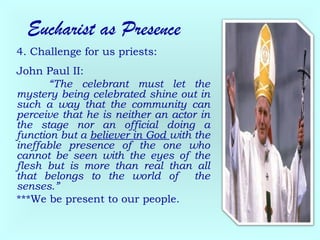
“The celebrant must let the
mystery being celebrated shine out in
such a way that the community can
perceive that he is neither an actor in
the stage nor an official doing a
function but a believer in God with the
ineffable presence of the one who
cannot be seen with the eyes of the
flesh but is more than real than all
that belongs to the world of the
senses.”
***We be present to our people.
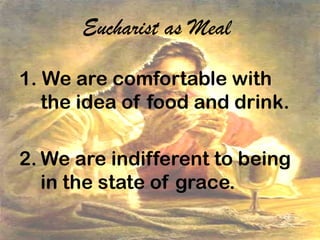
Eucharist as Meal
1. We are comfortable with
the idea of food and drink.
2. We are indifferent to being
in the state of grace.
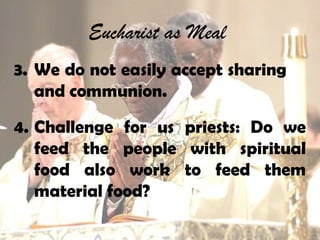
Eucharist as Meal
3. We do not easily accept sharing
and communion.
4. Challenge for us priests: Do we
feed the people with spiritual
food also work to feed them
material food?
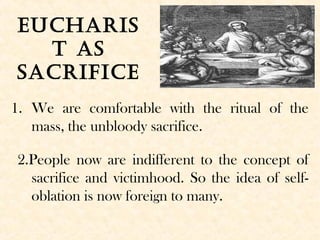
Eucharis
t as
sacrificE
1. We are comfortable with the ritual of the
mass, the unbloody sacrifice.
2.People now are indifferent to the concept of
sacrifice and victimhood. So the idea of self-
oblation is now foreign to many.
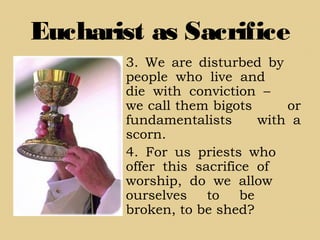
Eucharist as Sacrifice
3. We are disturbed by
people who live and
die with conviction –
we call them bigots or
fundamentalists with a
scorn.
4. For us priests who
offer this sacrifice of
worship, do we allow
ourselves to be
broken, to be shed?
One contribution in the Synod of
Bishops on the Eucharist in
October 2005
“I urge you, then brothers, remembering the
mercies of God, to offer your bodies as a living
sacrifice, dedicated and acceptable to God, that is the
kind of worship for you, as sensible people.” (Rom
12,1.) This Pauline version of the new worship - as a
total offering of one’s person - has definitely overcome
any separation between the sacred and the profane
horizon.
One contribution in the synod of
Bishops on the Eucharist in
October 2005
Neither is it purely a sacrificial and reparatory
act for offenses or distancing from the eyes of
God. New Christian worship becomes the
expression of renewed existence: ‘Whatever you
eat or drink, and whatever else you do, you do it
all for the glory of God.’ (1 Cor 10,31) Every act
of freedom by the Christian is thus a call to be
an act of worship.”
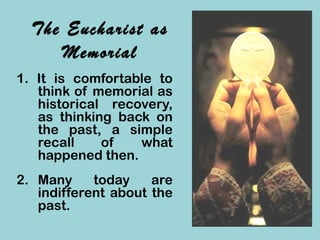
The Eucharist as
Memorial
1. It is comfortable to
think of memorial as
historical recovery,
as thinking back on
the past, a simple
recall of what
happened then.
2. Many today are
indifferent about the
past.
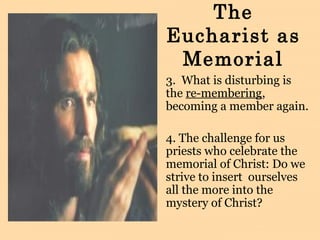
The
Eucharist as
Memorial
3. What is disturbing is
the re-membering,
becoming a member again.
4. The challenge for us
priests who celebrate the
memorial of Christ: Do we
strive to insert ourselves
all the more into the
mystery of Christ?
The Eucharist as Memorial
In the biblical concept of
memorial, we enter another
dimension of time that is not
subject to our measurement, in
which the future, illumined by the
past, is offered to us as the
unchanging present. In this way the
mystery of Christ, Alpha and
Omega, become contemporaneous
to each person in every age and
The Eucharist as an
open challenge to
our contemporary
culture.
1. In our present time when there is an atmosphere of
individual and social selfishness, the Eucharist
reaffirms total self giving.
2. Where there is hatred and terrorism, the Eucharist
emphasizes love.
3. Ours is a time of scientific positivism. The Eucharist
offers mystery.
4. There is an air of hopelessness in many. The
Eucharist offers the pledge of glory.
The Eucharist as an open
challenge to our contemporary
culture.
5. In a time that stresses efficiency and puts a price on
everything – even persons are tagged with a price –
the Eucharist is thanksgiving: seeing the giftedness
of grace and of everything.
6. Our mode of communication connects us with each
other in real time. But the person we are in touch
with is not present – an absent presence. The
Eucharist offers us Real Presence.
7. The world of WTO, of Free Trade is the world of
competition and selfishness. The Eucharist is an
offer of selfless love that others may live.
The Eucharist as an open challenge to
contemporary culture.
8. The world is ruled by those in power. The
Eucharist is lowly service – “wash each other’s
feet”
9. In the world of greater sophistication and
complexity – there is greater sophistication in
our relationships – in masteral and doctoral
studies any small thing is blown up to great
proportions to be worthy of study! The
Eucharist offers us great simplicity – mere
bread and wine.
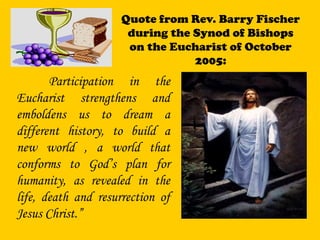
Quote from Rev. Barry Fischer during the Synod of
Bishops on the Eucharist of October 2005:
“The communion achieved in the reconciling
blood of Christ empowers us to be bridge-
builders, truth-tellers and healers of wounds.
Our “Amen” when receiving communion affirms
not only the Real Presence of Christ in the
Eucharist; it invites us to be bread broken and
blood poured out, life given, for the life of the
world. We become, as it were, ‘living chalices’
carrying the Precious Blood of Christ, that
sacred balm,..
Quote from Rev. Barry Fischer
during the Synod of Bishops
on the Eucharist of October
2005:
Participation in the
Eucharist strengthens and
emboldens us to dream a
different history, to build a
new world , a world that
conforms to God’s plan for
humanity, as revealed in the
life, death and resurrection of
Jesus Christ.”
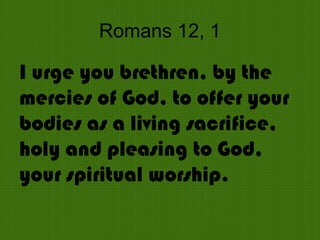
Romans 12, 1
I urge you brethren, by the
mercies of God, to offer your
bodies as a living sacrifice,
holy and pleasing to God,
your spiritual worship.
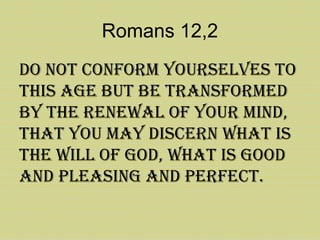
Romans 12,2
Do not conform yourselves to
this age but be transformeD
by the renewal of your minD,
that you may Discern what is
the will of goD, what is gooD
anD pleasing anD perfect.
Maraming
Salamat
Po!

On the Eucharist

  • 2.
  • 3.
    We Filipinos are spiritual Weeasily believe in God. Belief in “Gaba” is very prevalent in most We believe in spiritual beings that are not seen – mga hindi tulad natin.
  • 4.
    But……. • We tendto separate our spiritual life from our day-to-day life. • Our life of worship is not very much connected with our daily struggles. • We tend to keep God in his place while we here below live by our own rules.
  • 5.
    We can viewthe Eucharist in four aspects: • As presence • As memorial • As meal • As sacrifice
  • 6.
    Eucharist as Presence 1.We are comfortable with the Sacred Host. 2. We take comfort in the presence of the Sacred Host but we are disturbed by people. 3. We are indifferent to the continuous presence of Jesus in the Eucharist, and more so to the presence of Jesus in the poor and suffering.
  • 7.
    Eucharist as Presence St. Alphonsus: “Ofall the devotions, that of adoring Jesus in the Blessed Sacrament is the greatest after the sacraments, the one dearest to God and the one most helpful to us.”
  • 8.
    Eucharist as Presence 4.Challenge for us priests: John Paul II: “The celebrant must let the mystery being celebrated shine out in such a way that the community can perceive that he is neither an actor in the stage nor an official doing a function but a believer in God with the ineffable presence of the one who cannot be seen with the eyes of the flesh but is more than real than all that belongs to the world of the senses.” ***We be present to our people.
  • 9.
    Eucharist as Meal 1.We are comfortable with the idea of food and drink. 2. We are indifferent to being in the state of grace.
  • 10.
    Eucharist as Meal 3.We do not easily accept sharing and communion. 4. Challenge for us priests: Do we feed the people with spiritual food also work to feed them material food?
  • 11.
    Eucharis t as sacrificE 1. Weare comfortable with the ritual of the mass, the unbloody sacrifice. 2.People now are indifferent to the concept of sacrifice and victimhood. So the idea of self- oblation is now foreign to many.
  • 12.
    Eucharist as Sacrifice 3.We are disturbed by people who live and die with conviction – we call them bigots or fundamentalists with a scorn. 4. For us priests who offer this sacrifice of worship, do we allow ourselves to be broken, to be shed?
  • 13.
    One contribution inthe Synod of Bishops on the Eucharist in October 2005 “I urge you, then brothers, remembering the mercies of God, to offer your bodies as a living sacrifice, dedicated and acceptable to God, that is the kind of worship for you, as sensible people.” (Rom 12,1.) This Pauline version of the new worship - as a total offering of one’s person - has definitely overcome any separation between the sacred and the profane horizon.
  • 14.
    One contribution inthe synod of Bishops on the Eucharist in October 2005 Neither is it purely a sacrificial and reparatory act for offenses or distancing from the eyes of God. New Christian worship becomes the expression of renewed existence: ‘Whatever you eat or drink, and whatever else you do, you do it all for the glory of God.’ (1 Cor 10,31) Every act of freedom by the Christian is thus a call to be an act of worship.”
  • 15.
    The Eucharist as Memorial 1.It is comfortable to think of memorial as historical recovery, as thinking back on the past, a simple recall of what happened then. 2. Many today are indifferent about the past.
  • 16.
    The Eucharist as Memorial 3. Whatis disturbing is the re-membering, becoming a member again. 4. The challenge for us priests who celebrate the memorial of Christ: Do we strive to insert ourselves all the more into the mystery of Christ?
  • 17.
    The Eucharist asMemorial In the biblical concept of memorial, we enter another dimension of time that is not subject to our measurement, in which the future, illumined by the past, is offered to us as the unchanging present. In this way the mystery of Christ, Alpha and Omega, become contemporaneous to each person in every age and
  • 18.
    The Eucharist asan open challenge to our contemporary culture. 1. In our present time when there is an atmosphere of individual and social selfishness, the Eucharist reaffirms total self giving. 2. Where there is hatred and terrorism, the Eucharist emphasizes love. 3. Ours is a time of scientific positivism. The Eucharist offers mystery. 4. There is an air of hopelessness in many. The Eucharist offers the pledge of glory.
  • 19.
    The Eucharist asan open challenge to our contemporary culture. 5. In a time that stresses efficiency and puts a price on everything – even persons are tagged with a price – the Eucharist is thanksgiving: seeing the giftedness of grace and of everything. 6. Our mode of communication connects us with each other in real time. But the person we are in touch with is not present – an absent presence. The Eucharist offers us Real Presence. 7. The world of WTO, of Free Trade is the world of competition and selfishness. The Eucharist is an offer of selfless love that others may live.
  • 20.
    The Eucharist asan open challenge to contemporary culture. 8. The world is ruled by those in power. The Eucharist is lowly service – “wash each other’s feet” 9. In the world of greater sophistication and complexity – there is greater sophistication in our relationships – in masteral and doctoral studies any small thing is blown up to great proportions to be worthy of study! The Eucharist offers us great simplicity – mere bread and wine.
  • 21.
    Quote from Rev.Barry Fischer during the Synod of Bishops on the Eucharist of October 2005: “The communion achieved in the reconciling blood of Christ empowers us to be bridge- builders, truth-tellers and healers of wounds. Our “Amen” when receiving communion affirms not only the Real Presence of Christ in the Eucharist; it invites us to be bread broken and blood poured out, life given, for the life of the world. We become, as it were, ‘living chalices’ carrying the Precious Blood of Christ, that sacred balm,..
  • 22.
    Quote from Rev.Barry Fischer during the Synod of Bishops on the Eucharist of October 2005: Participation in the Eucharist strengthens and emboldens us to dream a different history, to build a new world , a world that conforms to God’s plan for humanity, as revealed in the life, death and resurrection of Jesus Christ.”
  • 23.
    Romans 12, 1 Iurge you brethren, by the mercies of God, to offer your bodies as a living sacrifice, holy and pleasing to God, your spiritual worship.
  • 24.
    Romans 12,2 Do notconform yourselves to this age but be transformeD by the renewal of your minD, that you may Discern what is the will of goD, what is gooD anD pleasing anD perfect.
  • 25.