3D Artists Meetup
There are many 3D modeling programs out there for creating
stunning 3D designs. But what looks great on a screen isn’t
necessarily ready to be 3D printed. Typically 3D models need
some preparation to be 3D printable.
Printability Issues
▷ Solidity
▷ Flipped Faces
▷ Overlapping / Intersecting objects
▷ Non-Manifold Edges
▷ Wall Thickness
1. Solidity
if your design were filled with water, would it trickle into the any
hidden cracks between the walls? Sometimes, you might be
missing a vertex, or a vertex might not be properly connected.
2. Flipped Faces
Faces that are pointing in the wrong direction
3. Overlapping / Intersecting objects
When two or more objects overlap or intersect, the inside and
outside of the models cannot be properly distinguished. This
will cause either a failure to print, weak areas in the print.
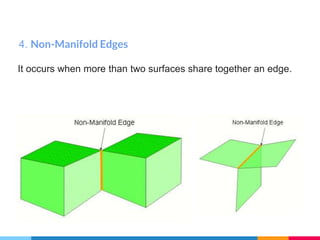
4. Non-Manifold Edges
It occurs when more than two surfaces share together an edge.
5. Wall Thickness
Are the walls of your object thick enough to print? Check your
material’s wall thickness specifications
Materials
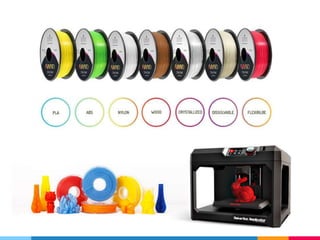
ABS / PLA Plastics
ABS and PLA are great starter materials: affordable, durable
and widely available. They're available in all colors, and well-
suited for prototyping mechanical parts and designs that don’t
have a lot of overhangs.
● Low-cost
● Mechanical parts
● Good for Cases, holders,
adapters
● Games, toys
● Scale models
● Intricate designs
● High detail
What to consider
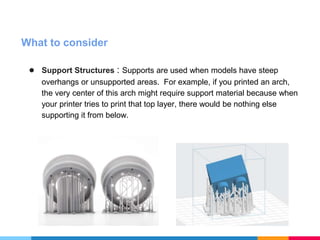
● Support Structures : Supports are used when models have steep
overhangs or unsupported areas. For example, if you printed an arch,
the very center of this arch might require support material because when
your printer tries to print that top layer, there would be nothing else
supporting it from below.
What to consider
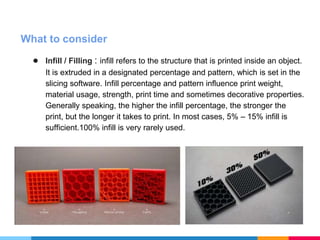
● Infill / Filling : infill refers to the structure that is printed inside an object.
It is extruded in a designated percentage and pattern, which is set in the
slicing software. Infill percentage and pattern influence print weight,
material usage, strength, print time and sometimes decorative properties.
Generally speaking, the higher the infill percentage, the stronger the
print, but the longer it takes to print. In most cases, 5% – 15% infill is
sufficient.100% infill is very rarely used.
High Detail Resin
UV-cured resin prints display fine details, sharp edges and a
smooth finish. Color availability is limited, but it is easily
paintable and can also be semi-translucent.
● Intricate designs and
sculptures
● Small, high detail models
● Jewelry, art
● Investment casting
● Large models
● Post Processing
● Color availability
What to consider
● Support Structures : Supports are used when models have steep
overhangs or unsupported areas. For example, if you printed an arch,
the very center of this arch might require support material because when
your printer tries to print that top layer, there would be nothing else
supporting it from below.
SLS Nylon
it's the perfect all-rounder: easy design rules, strong and
slightly flexible. Nylon allows for functional end products and
complex designs. Its surface is a bit grainy, but it can be
polished for a smooth finish.Nylon prints are laser sintered on
industrial 3D printers. The technology gives you a high degree
of form freedom and you can even print moving parts in one
go.
● Functional prototypes and end
products
● Complex designs with intricate
details
● Moving and assembled parts
● Cases, holders, adapters
● Machine Cost
● Post Processing
What to consider
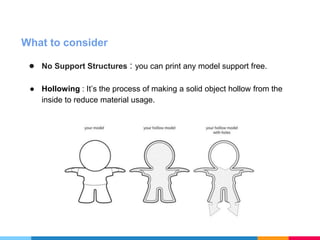
● No Support Structures : you can print any model support free.
● Hollowing : It’s the process of making a solid object hollow from the
inside to reduce material usage.
Full Color Sandstone
Gypsum with a colored texture on the surface. The best choice
for photo-realistic, full color prints. Ideal for professional (scale)
models, architecture, product design and fine arts. Full Color
Sandstone doesn’t allow for protruding features smaller than 3
millimeters because of the brittleness of the material. Also walls
have to be wider than 2 millimeters.
● Architectural models
● sculptures
● Scanned models
● Topographic Models
● Functional parts
● Fragile
● Color will wash out in time
● Machine Cost
● Post Processing
What to consider
● No Support Structures : you can print any model support free.
● Hollowing : It’s the process of making a solid object hollow from the
inside to reduce material usage.
Gold / Silver / Bronze / Brass Printing Process
What to consider
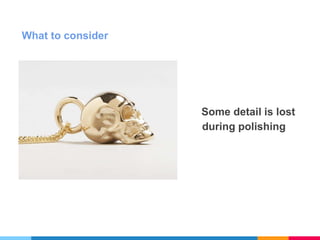
Some detail is lost
during polishing
What to consider
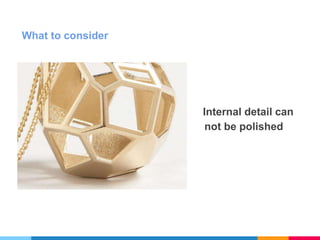
Internal detail can
not be polished
Thank You

3D Artists presentation by Mixed Dimensions

  • 1.
  • 2.
    There are many3D modeling programs out there for creating stunning 3D designs. But what looks great on a screen isn’t necessarily ready to be 3D printed. Typically 3D models need some preparation to be 3D printable.
  • 3.
    Printability Issues ▷ Solidity ▷Flipped Faces ▷ Overlapping / Intersecting objects ▷ Non-Manifold Edges ▷ Wall Thickness
  • 4.
    1. Solidity if yourdesign were filled with water, would it trickle into the any hidden cracks between the walls? Sometimes, you might be missing a vertex, or a vertex might not be properly connected. 2. Flipped Faces Faces that are pointing in the wrong direction
  • 5.
    3. Overlapping /Intersecting objects When two or more objects overlap or intersect, the inside and outside of the models cannot be properly distinguished. This will cause either a failure to print, weak areas in the print.
  • 6.
    4. Non-Manifold Edges Itoccurs when more than two surfaces share together an edge.
  • 7.
    5. Wall Thickness Arethe walls of your object thick enough to print? Check your material’s wall thickness specifications
  • 9.
  • 10.
    ABS / PLAPlastics ABS and PLA are great starter materials: affordable, durable and widely available. They're available in all colors, and well- suited for prototyping mechanical parts and designs that don’t have a lot of overhangs. ● Low-cost ● Mechanical parts ● Good for Cases, holders, adapters ● Games, toys ● Scale models ● Intricate designs ● High detail
  • 13.
    What to consider ●Support Structures : Supports are used when models have steep overhangs or unsupported areas. For example, if you printed an arch, the very center of this arch might require support material because when your printer tries to print that top layer, there would be nothing else supporting it from below.
  • 14.
    What to consider ●Infill / Filling : infill refers to the structure that is printed inside an object. It is extruded in a designated percentage and pattern, which is set in the slicing software. Infill percentage and pattern influence print weight, material usage, strength, print time and sometimes decorative properties. Generally speaking, the higher the infill percentage, the stronger the print, but the longer it takes to print. In most cases, 5% – 15% infill is sufficient.100% infill is very rarely used.
  • 15.
    High Detail Resin UV-curedresin prints display fine details, sharp edges and a smooth finish. Color availability is limited, but it is easily paintable and can also be semi-translucent. ● Intricate designs and sculptures ● Small, high detail models ● Jewelry, art ● Investment casting ● Large models ● Post Processing ● Color availability
  • 17.
    What to consider ●Support Structures : Supports are used when models have steep overhangs or unsupported areas. For example, if you printed an arch, the very center of this arch might require support material because when your printer tries to print that top layer, there would be nothing else supporting it from below.
  • 18.
    SLS Nylon it's theperfect all-rounder: easy design rules, strong and slightly flexible. Nylon allows for functional end products and complex designs. Its surface is a bit grainy, but it can be polished for a smooth finish.Nylon prints are laser sintered on industrial 3D printers. The technology gives you a high degree of form freedom and you can even print moving parts in one go. ● Functional prototypes and end products ● Complex designs with intricate details ● Moving and assembled parts ● Cases, holders, adapters ● Machine Cost ● Post Processing
  • 20.
    What to consider ●No Support Structures : you can print any model support free. ● Hollowing : It’s the process of making a solid object hollow from the inside to reduce material usage.
  • 21.
    Full Color Sandstone Gypsumwith a colored texture on the surface. The best choice for photo-realistic, full color prints. Ideal for professional (scale) models, architecture, product design and fine arts. Full Color Sandstone doesn’t allow for protruding features smaller than 3 millimeters because of the brittleness of the material. Also walls have to be wider than 2 millimeters. ● Architectural models ● sculptures ● Scanned models ● Topographic Models ● Functional parts ● Fragile ● Color will wash out in time ● Machine Cost ● Post Processing
  • 23.
    What to consider ●No Support Structures : you can print any model support free. ● Hollowing : It’s the process of making a solid object hollow from the inside to reduce material usage.
  • 24.
    Gold / Silver/ Bronze / Brass Printing Process
  • 26.
    What to consider Somedetail is lost during polishing
  • 27.
    What to consider Internaldetail can not be polished
  • 29.