By Erick Wolf
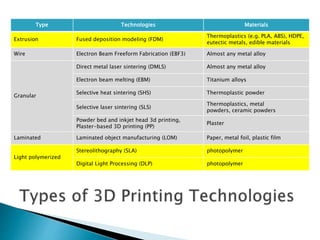
Type Technologies Materials 
Extrusion Fused deposition modeling (FDM) 
Thermoplastics (e.g. PLA, ABS), HDPE, 
eutectic metals, edible materials 
Wire Electron Beam Freeform Fabrication (EBF3) Almost any metal alloy 
Granular 
Direct metal laser sintering (DMLS) Almost any metal alloy 
Electron beam melting (EBM) Titanium alloys 
Selective heat sintering (SHS) Thermoplastic powder 
Selective laser sintering (SLS) 
Thermoplastics, metal 
powders, ceramic powders 
Powder bed and inkjet head 3d printing, 
Plaster-based 3D printing (PP) 
Plaster 
Laminated Laminated object manufacturing (LOM) Paper, metal foil, plastic film 
Light polymerized 
Stereolithography (SLA) photopolymer 
Digital Light Processing (DLP) photopolymer
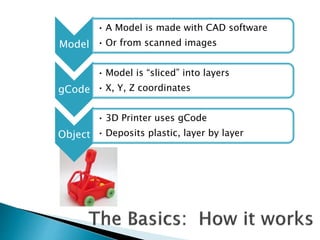
Model 
• A Model is made with CAD software 
• Or from scanned images 
gCode 
• Model is “sliced” into layers 
• X, Y, Z coordinates 
Object 
• 3D Printer uses gCode 
• Deposits plastic, layer by layer
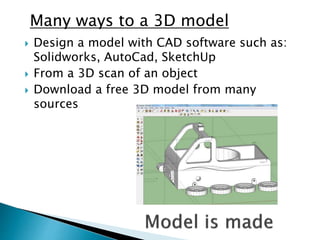
Many ways to a 3D model 
 Design a model with CAD software such as: 
Solidworks, AutoCad, SketchUp 
 From a 3D scan of an object 
 Download a free 3D model from many 
sources
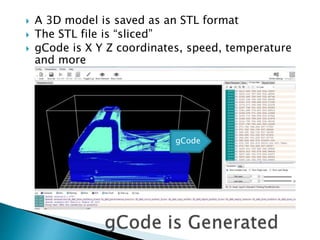
 A 3D model is saved as an STL format 
 The STL file is “sliced” 
 gCode is X Y Z coordinates, speed, temperature 
and more 
gCode
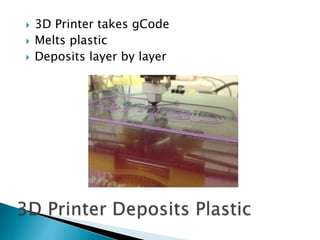
 3D Printer takes gCode 
 Melts plastic 
 Deposits layer by layer
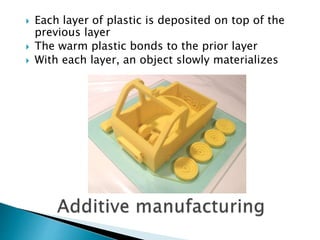
 Each layer of plastic is deposited on top of the 
previous layer 
 The warm plastic bonds to the prior layer 
 With each layer, an object slowly materializes
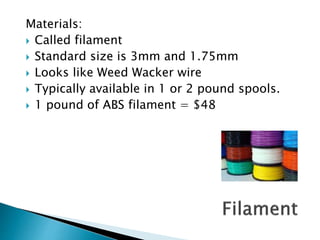
Materials: 
 Called filament 
 Standard size is 3mm and 1.75mm 
 Looks like Weed Wacker wire 
 Typically available in 1 or 2 pound spools. 
 1 pound of ABS filament = $48
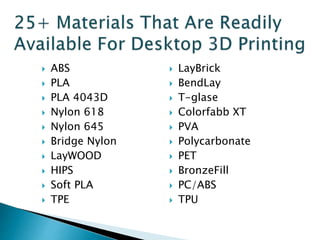
 ABS 
 PLA 
 PLA 4043D 
 Nylon 618 
 Nylon 645 
 Bridge Nylon 
 LayWOOD 
 HIPS 
 Soft PLA 
 TPE 
 LayBrick 
 BendLay 
 T-glase 
 Colorfabb XT 
 PVA 
 Polycarbonate 
 PET 
 BronzeFill 
 PC/ABS 
 TPU
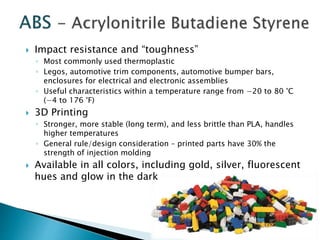
 Impact resistance and “toughness” 
◦ Most commonly used thermoplastic 
◦ Legos, automotive trim components, automotive bumper bars, 
enclosures for electrical and electronic assemblies 
◦ Useful characteristics within a temperature range from −20 to 80 °C 
(−4 to 176 °F) 
 3D Printing 
◦ Stronger, more stable (long term), and less brittle than PLA, handles 
higher temperatures 
◦ General rule/design consideration – printed parts have 30% the 
strength of injection molding 
 Available in all colors, including gold, silver, fluorescent 
hues and glow in the dark
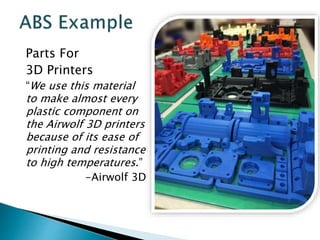
Parts For 
3D Printers 
“We use this material 
to make almost every 
plastic component on 
the Airwolf 3D printers 
because of its ease of 
printing and resistance 
to high temperatures.” 
-Airwolf 3D
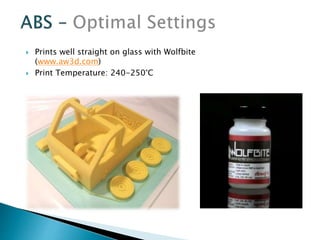
 Prints well straight on glass with Wolfbite 
(www.aw3d.com) 
 Print Temperature: 240-250°C
 Heat bed REQUIRED 
◦ Capable of at least 120C necessary for proper adhesion 
◦ Risk of curling without proper surface preparation 
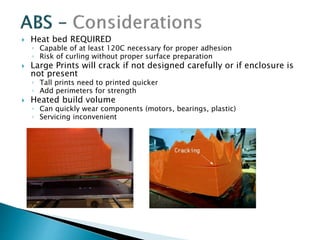
 Large Prints will crack if not designed carefully or if enclosure is 
not present 
◦ Tall prints need to printed quicker 
◦ Add perimeters for strength 
 Heated build volume 
◦ Can quickly wear components (motors, bearings, plastic) 
◦ Servicing inconvenient
 Environmentally friendly 
◦ Made from starch rich plants such as corn, wheat, and sugar 
beets 
 Starch is separated and dextrose goes through fermentation 
process 
◦ Bio-degradable and compostable 
 Commercial compost – 30-45 days 
 Easy to print 
◦ Fun, smells pleasant (like waffles) 
◦ Little-to-no warping 
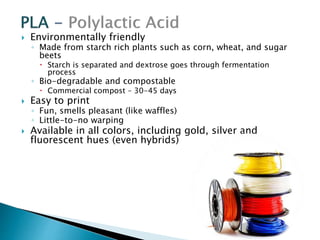
 Available in all colors, including gold, silver and 
fluorescent hues (even hybrids)
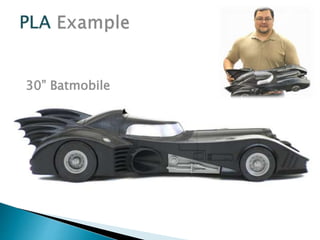
30” Batmobile
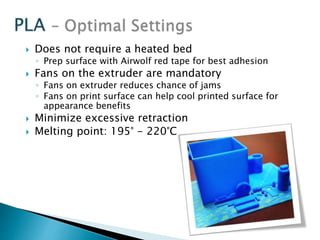
 Does not require a heated bed 
◦ Prep surface with Airwolf red tape for best adhesion 
 Fans on the extruder are mandatory 
◦ Fans on extruder reduces chance of jams 
◦ Fans on print surface can help cool printed surface for 
appearance benefits 
 Minimize excessive retraction 
 Melting point: 195° - 220°C
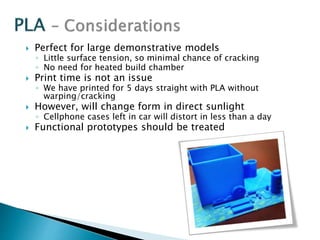
 Perfect for large demonstrative models 
◦ Little surface tension, so minimal chance of cracking 
◦ No need for heated build chamber 
 Print time is not an issue 
◦ We have printed for 5 days straight with PLA without 
warping/cracking 
 However, will change form in direct sunlight 
◦ Cellphone cases left in car will distort in less than a day 
 Functional prototypes should be treated
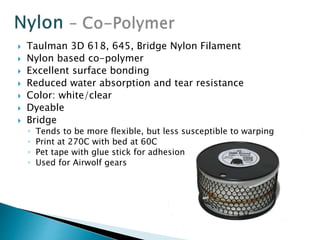
 Taulman 3D 618, 645, Bridge Nylon Filament 
 Nylon based co-polymer 
 Excellent surface bonding 
 Reduced water absorption and tear resistance 
 Color: white/clear 
 Dyeable 
 Bridge 
◦ Tends to be more flexible, but less susceptible to warping 
◦ Print at 270C with bed at 60C 
◦ Pet tape with glue stick for adhesion 
◦ Used for Airwolf gears
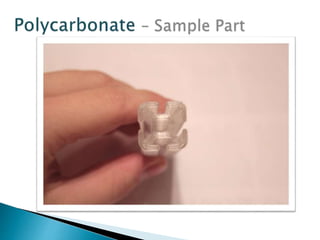
 Polycarbonate is an extremely strong, impact 
resistant thermoplastic 
 Bleeding-edge technology and is currently 
experimental 
 Used in Airwolf extruders for heat resistance 
 Unlike acrylic or plexiglass (they shatter and 
crack), Polycarbonate tends to bend and deform 
and after much effort will eventually stretch like 
very hard rubber until it eventually breaks 
 Hygroscopic and will absorb moisture from the air
 Extruded at or above 300C for best layer-layer 
adhesion 
 Many current 3D printer extruders are not 
compatible with temperatures above 250C Make 
sure your printer is capable of these temperatures 
or your extruder may fail 
 Print surface is PET tape and then glue stick on top 
of that 
 The faster and hotter an object is printed the more 
clear the end results
 Combination of Polycarbonate with ABS 
 Extruded at or above 280C for best layer-layer 
adhesion (advanced extruder needed) 
 High heat distortion is an improvement over ABS 
 Low temperature impact resistance gives it an 
advantage over polycarbonate. 
 Works excellent for small/midsize prototypes that need 
to “function” 
 Heated chamber preferred for large, complex builds 
 Print surface is PET tape and then glue stick on top of 
that
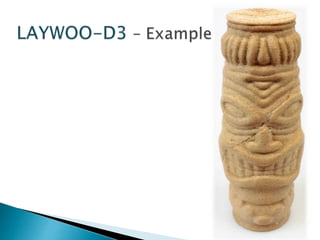
 The printed wood will appear rough, similar to 
MDF (Medium-Density Fiberboard) 
 Paintable, grindable, carvable and stainable 
 Heated bed is not necessary 
 Available in two shades of brown 
 Similar thermal durability as PLA
 Heated bed ideally at 60C 
 Print Temperature: 175°C to 200°C 
 Prep surface with blue painters tape 
 Adding extra extrusion to the beginning of your print will 
help prevent dry extrusion during the initial layers 
 Increasing the retraction setting of your part during 
slicing will reduce 'leakage' while the hotend is moving 
between sections (especially over open areas) 
 LAYWOO-D3 will harden over time, 
for delicate parts allow 30-60 min 
for your print to set 
 Alternating the temperature during 
your print (even by as little as 10 
degrees) will vary the coloration, 
giving it a 'grained' look
 High Impact Polystyrene is very similar to ABS in its 
printing properties, but works with different 
solvents (Limonene for HIPS vs acetone for ABS) 
 Easy to paint and glue 
 When printing, best to keep bed temps at 100C or 
lower, but extrusion at normal ABS temps works 
fine 
 Color: White 
 Use for support material on HD2x and use solution 
to remove support material from part
 Water-soluble synthetic polymer 
 It prints very easily and can be used as wash away 
support structure when using more than one 
extruder 
 Can be used with a dual extruder 3D printer to add 
support materials 
 Best printing comes with a 100C heated bed and 
slightly lower temps than ABS (190-210C) 
 Color: Off white 
 Dissolves in water !!! (quickly) 
 Like Elmer’s glue
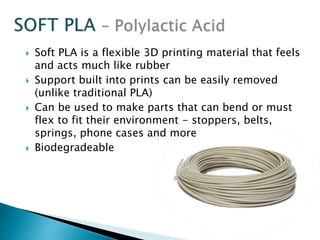
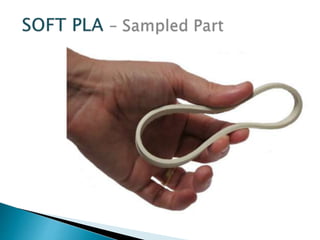
 Soft PLA is a flexible 3D printing material that feels 
and acts much like rubber 
 Support built into prints can be easily removed 
(unlike traditional PLA) 
 Can be used to make parts that can bend or must 
flex to fit their environment - stoppers, belts, 
springs, phone cases and more 
 Biodegradeable
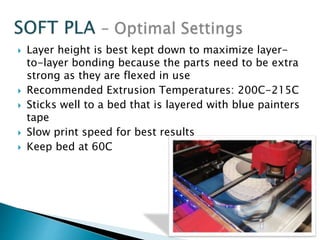
 Layer height is best kept down to maximize layer-to- 
layer bonding because the parts need to be extra 
strong as they are flexed in use 
 Recommended Extrusion Temperatures: 200C-215C 
 Sticks well to a bed that is layered with blue painters 
tape 
 Slow print speed for best results 
 Keep bed at 60C
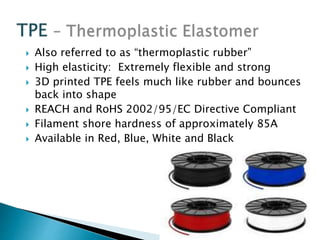
 Also referred to as “thermoplastic rubber” 
 High elasticity: Extremely flexible and strong 
 3D printed TPE feels much like rubber and bounces 
back into shape 
 REACH and RoHS 2002/95/EC Directive Compliant 
 Filament shore hardness of approximately 85A 
 Available in Red, Blue, White and Black
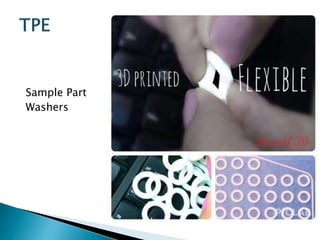
Sample Part 
Washers
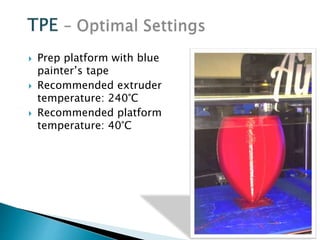
 Prep platform with blue 
painter’s tape 
 Recommended extruder 
temperature: 240°C 
 Recommended platform 
temperature: 40°C
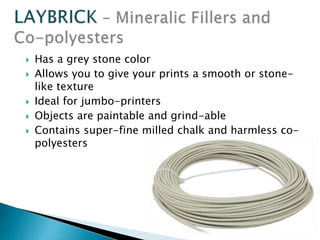
 Has a grey stone color 
 Allows you to give your prints a smooth or stone-like 
texture 
 Ideal for jumbo-printers 
 Objects are paintable and grind-able 
 Contains super-fine milled chalk and harmless co-polyesters
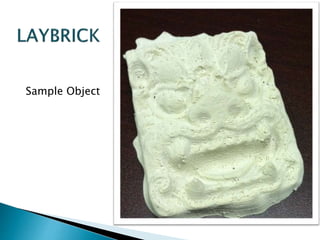
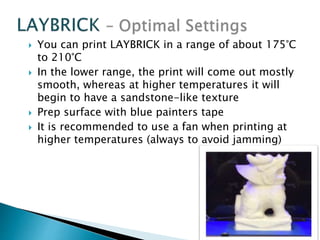
Sample Object
 You can print LAYBRICK in a range of about 175°C 
to 210°C 
 In the lower range, the print will come out mostly 
smooth, whereas at higher temperatures it will 
begin to have a sandstone-like texture 
 Prep surface with blue painters tape 
 It is recommended to use a fan when printing at 
higher temperatures (always to avoid jamming)
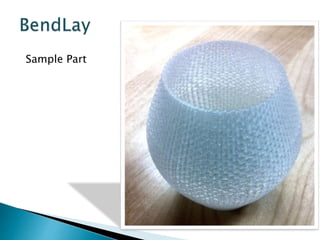
 Extremely translucent (91% of light passes 
through) and is also flexible 
 Print nearly clear items 
 Safe for household and food products 
 Compared to ABS it also absorbs far less moisture 
from the air and thus cuts down on warping 
significantly 
 Soluble in brake cleaner
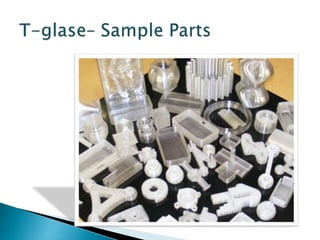
Sample Part
 It sticks great to a bed that is layered with blue 
painter’s tape or on PET film with Elmer’s glue 
stick 
 Print it at a slower speed (around 20-30mm/s) 
than normal materials 
 Compared to ABS it also absorbs far less moisture 
from the air and thus cuts down on warping 
significantly 
 Extrusion Temperatures: 230°C-240°C
 A low temp (212C) industrial 3D printing material 
 Considered “water-clear” and “optically correct” 
 A low TG means that parts printed in T-glase, 
should not be exposed to high temperature use or 
applications. The measured TG of T-glase is 78C 
 Made of FDA approved polymers for direct food 
contact/containers 
 Not biodegradable like PLA however it is a 
considered 100% reclaimable 
 There are supposedly no odors or fumes when 3D 
printing with T-glase
 Optimum temperature is about 212c to 224C, but 
will print down to 210C and up to about 240C 
(depending on speed) 
 T-glase easily sticks to heated acrylic and glass 
print tables (with PET film) for the smoothest 
bottom surface possible 
 Very low shrinkage makes printing large flat 
surfaces a breeze 
 Prints to acrylic, glass, Kapton and other platforms
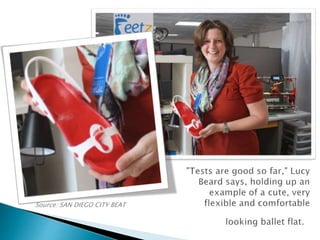
Concept: 
 Photos of your feet are turned into 3D 
models 
 Select FeetZ shoe elements and shoe is 
custom made to form and function 
needed 
 FeetZ 3D prints shoes in TPE
Source: SAN DIEGO CITY BEAT
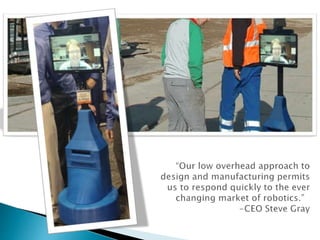
Pioneering intercontinental robotics: 
 Uses 3D printers in its design and 
manufacture of telepresence robots 
 Large build platform of 12” x 8” and 
heated bed enables Orbis to print larger 
parts of the robots with a 3D printer
Erick Wolf 
www.airwolf3d.com 
(949) 478-2933 
?

Inside3DPrintingSantaClara_ErickWolf

  • 1.
  • 2.
    Type Technologies Materials Extrusion Fused deposition modeling (FDM) Thermoplastics (e.g. PLA, ABS), HDPE, eutectic metals, edible materials Wire Electron Beam Freeform Fabrication (EBF3) Almost any metal alloy Granular Direct metal laser sintering (DMLS) Almost any metal alloy Electron beam melting (EBM) Titanium alloys Selective heat sintering (SHS) Thermoplastic powder Selective laser sintering (SLS) Thermoplastics, metal powders, ceramic powders Powder bed and inkjet head 3d printing, Plaster-based 3D printing (PP) Plaster Laminated Laminated object manufacturing (LOM) Paper, metal foil, plastic film Light polymerized Stereolithography (SLA) photopolymer Digital Light Processing (DLP) photopolymer
  • 3.
    Model • AModel is made with CAD software • Or from scanned images gCode • Model is “sliced” into layers • X, Y, Z coordinates Object • 3D Printer uses gCode • Deposits plastic, layer by layer
  • 4.
    Many ways toa 3D model  Design a model with CAD software such as: Solidworks, AutoCad, SketchUp  From a 3D scan of an object  Download a free 3D model from many sources
  • 5.
     A 3Dmodel is saved as an STL format  The STL file is “sliced”  gCode is X Y Z coordinates, speed, temperature and more gCode
  • 6.
     3D Printertakes gCode  Melts plastic  Deposits layer by layer
  • 7.
     Each layerof plastic is deposited on top of the previous layer  The warm plastic bonds to the prior layer  With each layer, an object slowly materializes
  • 8.
    Materials:  Calledfilament  Standard size is 3mm and 1.75mm  Looks like Weed Wacker wire  Typically available in 1 or 2 pound spools.  1 pound of ABS filament = $48
  • 9.
     ABS PLA  PLA 4043D  Nylon 618  Nylon 645  Bridge Nylon  LayWOOD  HIPS  Soft PLA  TPE  LayBrick  BendLay  T-glase  Colorfabb XT  PVA  Polycarbonate  PET  BronzeFill  PC/ABS  TPU
  • 10.
     Impact resistanceand “toughness” ◦ Most commonly used thermoplastic ◦ Legos, automotive trim components, automotive bumper bars, enclosures for electrical and electronic assemblies ◦ Useful characteristics within a temperature range from −20 to 80 °C (−4 to 176 °F)  3D Printing ◦ Stronger, more stable (long term), and less brittle than PLA, handles higher temperatures ◦ General rule/design consideration – printed parts have 30% the strength of injection molding  Available in all colors, including gold, silver, fluorescent hues and glow in the dark
  • 11.
    Parts For 3DPrinters “We use this material to make almost every plastic component on the Airwolf 3D printers because of its ease of printing and resistance to high temperatures.” -Airwolf 3D
  • 13.
     Prints wellstraight on glass with Wolfbite (www.aw3d.com)  Print Temperature: 240-250°C
  • 14.
     Heat bedREQUIRED ◦ Capable of at least 120C necessary for proper adhesion ◦ Risk of curling without proper surface preparation  Large Prints will crack if not designed carefully or if enclosure is not present ◦ Tall prints need to printed quicker ◦ Add perimeters for strength  Heated build volume ◦ Can quickly wear components (motors, bearings, plastic) ◦ Servicing inconvenient
  • 15.
     Environmentally friendly ◦ Made from starch rich plants such as corn, wheat, and sugar beets  Starch is separated and dextrose goes through fermentation process ◦ Bio-degradable and compostable  Commercial compost – 30-45 days  Easy to print ◦ Fun, smells pleasant (like waffles) ◦ Little-to-no warping  Available in all colors, including gold, silver and fluorescent hues (even hybrids)
  • 16.
  • 17.
     Does notrequire a heated bed ◦ Prep surface with Airwolf red tape for best adhesion  Fans on the extruder are mandatory ◦ Fans on extruder reduces chance of jams ◦ Fans on print surface can help cool printed surface for appearance benefits  Minimize excessive retraction  Melting point: 195° - 220°C
  • 18.
     Perfect forlarge demonstrative models ◦ Little surface tension, so minimal chance of cracking ◦ No need for heated build chamber  Print time is not an issue ◦ We have printed for 5 days straight with PLA without warping/cracking  However, will change form in direct sunlight ◦ Cellphone cases left in car will distort in less than a day  Functional prototypes should be treated
  • 19.
     Taulman 3D618, 645, Bridge Nylon Filament  Nylon based co-polymer  Excellent surface bonding  Reduced water absorption and tear resistance  Color: white/clear  Dyeable  Bridge ◦ Tends to be more flexible, but less susceptible to warping ◦ Print at 270C with bed at 60C ◦ Pet tape with glue stick for adhesion ◦ Used for Airwolf gears
  • 20.
     Polycarbonate isan extremely strong, impact resistant thermoplastic  Bleeding-edge technology and is currently experimental  Used in Airwolf extruders for heat resistance  Unlike acrylic or plexiglass (they shatter and crack), Polycarbonate tends to bend and deform and after much effort will eventually stretch like very hard rubber until it eventually breaks  Hygroscopic and will absorb moisture from the air
  • 22.
     Extruded ator above 300C for best layer-layer adhesion  Many current 3D printer extruders are not compatible with temperatures above 250C Make sure your printer is capable of these temperatures or your extruder may fail  Print surface is PET tape and then glue stick on top of that  The faster and hotter an object is printed the more clear the end results
  • 23.
     Combination ofPolycarbonate with ABS  Extruded at or above 280C for best layer-layer adhesion (advanced extruder needed)  High heat distortion is an improvement over ABS  Low temperature impact resistance gives it an advantage over polycarbonate.  Works excellent for small/midsize prototypes that need to “function”  Heated chamber preferred for large, complex builds  Print surface is PET tape and then glue stick on top of that
  • 24.
     The printedwood will appear rough, similar to MDF (Medium-Density Fiberboard)  Paintable, grindable, carvable and stainable  Heated bed is not necessary  Available in two shades of brown  Similar thermal durability as PLA
  • 26.
     Heated bedideally at 60C  Print Temperature: 175°C to 200°C  Prep surface with blue painters tape  Adding extra extrusion to the beginning of your print will help prevent dry extrusion during the initial layers  Increasing the retraction setting of your part during slicing will reduce 'leakage' while the hotend is moving between sections (especially over open areas)  LAYWOO-D3 will harden over time, for delicate parts allow 30-60 min for your print to set  Alternating the temperature during your print (even by as little as 10 degrees) will vary the coloration, giving it a 'grained' look
  • 27.
     High ImpactPolystyrene is very similar to ABS in its printing properties, but works with different solvents (Limonene for HIPS vs acetone for ABS)  Easy to paint and glue  When printing, best to keep bed temps at 100C or lower, but extrusion at normal ABS temps works fine  Color: White  Use for support material on HD2x and use solution to remove support material from part
  • 28.
     Water-soluble syntheticpolymer  It prints very easily and can be used as wash away support structure when using more than one extruder  Can be used with a dual extruder 3D printer to add support materials  Best printing comes with a 100C heated bed and slightly lower temps than ABS (190-210C)  Color: Off white  Dissolves in water !!! (quickly)  Like Elmer’s glue
  • 29.
     Soft PLAis a flexible 3D printing material that feels and acts much like rubber  Support built into prints can be easily removed (unlike traditional PLA)  Can be used to make parts that can bend or must flex to fit their environment - stoppers, belts, springs, phone cases and more  Biodegradeable
  • 31.
     Layer heightis best kept down to maximize layer-to- layer bonding because the parts need to be extra strong as they are flexed in use  Recommended Extrusion Temperatures: 200C-215C  Sticks well to a bed that is layered with blue painters tape  Slow print speed for best results  Keep bed at 60C
  • 32.
     Also referredto as “thermoplastic rubber”  High elasticity: Extremely flexible and strong  3D printed TPE feels much like rubber and bounces back into shape  REACH and RoHS 2002/95/EC Directive Compliant  Filament shore hardness of approximately 85A  Available in Red, Blue, White and Black
  • 33.
  • 34.
     Prep platformwith blue painter’s tape  Recommended extruder temperature: 240°C  Recommended platform temperature: 40°C
  • 35.
     Has agrey stone color  Allows you to give your prints a smooth or stone-like texture  Ideal for jumbo-printers  Objects are paintable and grind-able  Contains super-fine milled chalk and harmless co-polyesters
  • 36.
  • 37.
     You canprint LAYBRICK in a range of about 175°C to 210°C  In the lower range, the print will come out mostly smooth, whereas at higher temperatures it will begin to have a sandstone-like texture  Prep surface with blue painters tape  It is recommended to use a fan when printing at higher temperatures (always to avoid jamming)
  • 38.
     Extremely translucent(91% of light passes through) and is also flexible  Print nearly clear items  Safe for household and food products  Compared to ABS it also absorbs far less moisture from the air and thus cuts down on warping significantly  Soluble in brake cleaner
  • 39.
  • 40.
     It sticksgreat to a bed that is layered with blue painter’s tape or on PET film with Elmer’s glue stick  Print it at a slower speed (around 20-30mm/s) than normal materials  Compared to ABS it also absorbs far less moisture from the air and thus cuts down on warping significantly  Extrusion Temperatures: 230°C-240°C
  • 41.
     A lowtemp (212C) industrial 3D printing material  Considered “water-clear” and “optically correct”  A low TG means that parts printed in T-glase, should not be exposed to high temperature use or applications. The measured TG of T-glase is 78C  Made of FDA approved polymers for direct food contact/containers  Not biodegradable like PLA however it is a considered 100% reclaimable  There are supposedly no odors or fumes when 3D printing with T-glase
  • 43.
     Optimum temperatureis about 212c to 224C, but will print down to 210C and up to about 240C (depending on speed)  T-glase easily sticks to heated acrylic and glass print tables (with PET film) for the smoothest bottom surface possible  Very low shrinkage makes printing large flat surfaces a breeze  Prints to acrylic, glass, Kapton and other platforms
  • 44.
    Concept:  Photosof your feet are turned into 3D models  Select FeetZ shoe elements and shoe is custom made to form and function needed  FeetZ 3D prints shoes in TPE
  • 45.
  • 46.
    Pioneering intercontinental robotics:  Uses 3D printers in its design and manufacture of telepresence robots  Large build platform of 12” x 8” and heated bed enables Orbis to print larger parts of the robots with a 3D printer
  • 48.