PRINT 
By BROOKE MARQUER
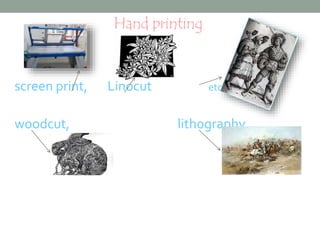
Hand printing 
screen print, Linocut etching 
woodcut, lithography
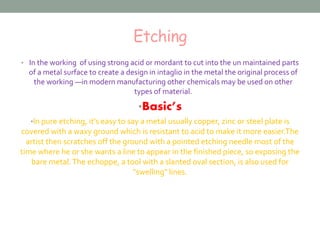
Etching 
• In the working of using strong acid or mordant to cut into the un maintained parts 
of a metal surface to create a design in intaglio in the metal the original process of 
the working —in modern manufacturing other chemicals may be used on other 
types of material. 
•Basic’s 
•In pure etching, it’s easy to say a metal usually copper, zinc or steel plate is 
covered with a waxy ground which is resistant to acid to make it more easier.The 
artist then scratches off the ground with a pointed etching needle most of the 
time where he or she wants a line to appear in the finished piece, so exposing the 
bare metal. The echoppe, a tool with a slanted oval section, is also used for 
"swelling" lines.
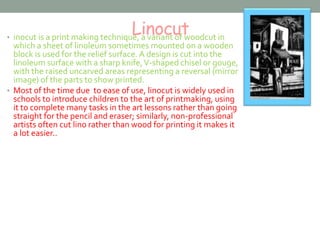
Linocut • inocut is a print making technique, a variant of woodcut in 
which a sheet of linoleum sometimes mounted on a wooden 
block is used for the relief surface. A design is cut into the 
linoleum surface with a sharp knife, V-shaped chisel or gouge, 
with the raised uncarved areas representing a reversal (mirror 
image) of the parts to show printed. 
• Most of the time due to ease of use, linocut is widely used in 
schools to introduce children to the art of printmaking, using 
it to complete many tasks in the art lessons rather than going 
straight for the pencil and eraser; similarly, non-professional 
artists often cut lino rather than wood for printing it makes it 
a lot easier..
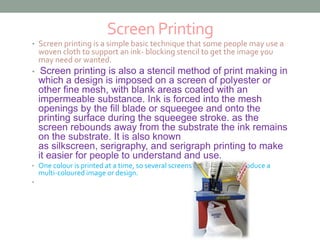
Screen Printing 
• Screen printing is a simple basic technique that some people may use a 
woven cloth to support an ink- blocking stencil to get the image you 
may need or wanted. 
• Screen printing is also a stencil method of print making in 
which a design is imposed on a screen of polyester or 
other fine mesh, with blank areas coated with an 
impermeable substance. Ink is forced into the mesh 
openings by the fill blade or squeegee and onto the 
printing surface during the squeegee stroke. as the 
screen rebounds away from the substrate the ink remains 
on the substrate. It is also known 
as silkscreen, serigraphy, and serigraph printing to make 
it easier for people to understand and use. 
• One colour is printed at a time, so several screens can be used to produce a 
multi-coloured image or design. 
•
Woodcut 
• Originally known as xylography—is a relief printing artistic technique in print-making 
in which an image is carved into the surface of a block of wood, with the 
printing parts remaining level with the surface while the non-printing parts are 
removed, typically with gouges. 
• Lots of different colours doubled also which they did can be printed by keying the 
paper to a frame around the woodblocks where a different block is used for each 
colour. The art of carving the woodcut can be called xylography, but this is rarely 
used in English for images alone, although that and xylographic are used in 
connection with block-books, which are small books containing text and images in 
the same block. Single-leaf woodcut is a term for a woodcut presented as a single 
image or print, as opposed to a book illustration.
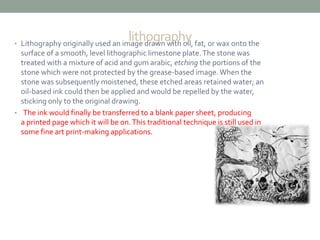
lithography • Lithography originally used an image drawn with oil, fat, or wax onto the 
surface of a smooth, level lithographic limestone plate. The stone was 
treated with a mixture of acid and gum arabic, etching the portions of the 
stone which were not protected by the grease-based image. When the 
stone was subsequently moistened, these etched areas retained water; an 
oil-based ink could then be applied and would be repelled by the water, 
sticking only to the original drawing. 
• The ink would finally be transferred to a blank paper sheet, producing 
a printed page which it will be on. This traditional technique is still used in 
some fine art print-making applications.
Mechanical 
Pr• iTnhist isi wnerge y ou put the paper in the machine then you press print from a 
computer and it will send it straight to the machine and all you have to do is 
collect it. It’s one of the most simplest one you can get and can do it’s very 
easy to understand and it does the job better then some of the others because 
it gets the full picture.
Letter press printing 
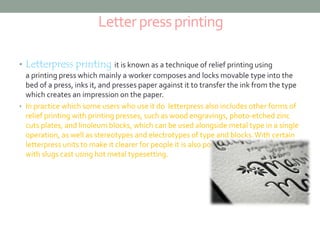
• Letterpress printing it is known as a technique of relief printing using 
a printing press which mainly a worker composes and locks movable type into the 
bed of a press, inks it, and presses paper against it to transfer the ink from the type 
which creates an impression on the paper. 
• In practice which some users who use it do letterpress also includes other forms of 
relief printing with printing presses, such as wood engravings, photo-etched zinc 
cuts plates, and linoleum blocks, which can be used alongside metal type in a single 
operation, as well as stereotypes and electrotypes of type and blocks.With certain 
letterpress units to make it clearer for people it is also possible to join movable type 
with slugs cast using hot metal typesetting.
Gravure 
• Rotogravure (Roto or Gravure for short) is a type of intaglio printing 
process, which involves engraving the image onto an image carrier. In 
gravure printing, the image is engraved onto a cylinder because, like offset 
printing and flexography, it uses a rotary printing press. Once a staple of 
newspaper photo features, the rotogravure process is still used for 
commercial printing of magazines, postcards, and corrugated (cardboard) 
product packaging
Screen printing 
• Screen printing is a printing technique that uses a woven 
mesh to support an ink-blocking stencil to receive a desired 
image. The attached stencil forms open areas of mesh that 
transfer ink or other printable materials which can be pressed 
through the mesh as a sharp-edged image onto a substrate. A fill 
blade or squeegee is moved across the screen stencil, forcing or 
pumping ink through the mesh openings to wet the substrate 
during the squeegee stroke. Basically, it is the process of using a 
mesh-based stencil to apply ink onto a substrate, whether it be t-shirts, 
posters, stickers, vinyl, wood, or other material.
Digital printing 
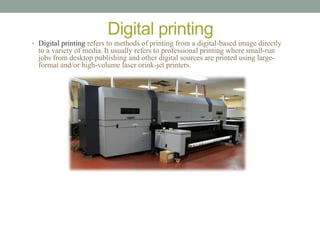
• Digital printing refers to methods of printing from a digital-based image directly 
to a variety of media. It usually refers to professional printing where small-run 
jobs from desktop publishing and other digital sources are printed using large-format 
and/or high-volume laser orink-jet printers.
Photo copier 
• A photocopier (also known as a copier or copy machine) is 
a machine that makes paper copies of documents and other visual 
images quickly and cheaply. Most current photocopiers use a 
technology called xerography, a dry process that uses electrostatic 
charges on a light sensitive photoreceptor to first attract and then 
transfer toner particles (a powder) onto paper in the form of an image.
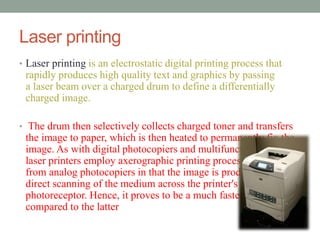
Laser printing 
• Laser printing is an electrostatic digital printing process that 
rapidly produces high quality text and graphics by passing 
a laser beam over a charged drum to define a differentially 
charged image. 
• The drum then selectively collects charged toner and transfers 
the image to paper, which is then heated to permanently fix the 
image. As with digital photocopiers and multifunction printers 
laser printers employ axerographic printing process, but differ 
from analog photocopiers in that the image is produced by the 
direct scanning of the medium across the printer's 
photoreceptor. Hence, it proves to be a much faster process 
compared to the latter
Inkjet printing 
• Inkjet printing is a type of computer printing that creates a digital image by 
propelling droplets of ink onto paper, plastic, or other substrates. Inkjet printers are 
the most commonly used type of printer,[ and range from small inexpensive consumer 
models to very large professional machines that can cost tens of thousands of dollars, 
or more.
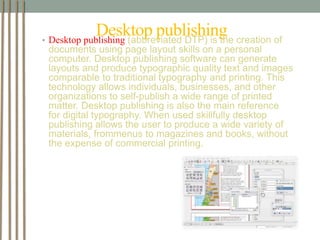
Desktop publishing 
• Desktop publishing (abbreviated DTP) is the creation of 
documents using page layout skills on a personal 
computer. Desktop publishing software can generate 
layouts and produce typographic quality text and images 
comparable to traditional typography and printing. This 
technology allows individuals, businesses, and other 
organizations to self-publish a wide range of printed 
matter. Desktop publishing is also the main reference 
for digital typography. When used skillfully desktop 
publishing allows the user to produce a wide variety of 
materials, frommenus to magazines and books, without 
the expense of commercial printing.

Print

  • 1.
  • 2.
    Hand printing screenprint, Linocut etching woodcut, lithography
  • 3.
    Etching • Inthe working of using strong acid or mordant to cut into the un maintained parts of a metal surface to create a design in intaglio in the metal the original process of the working —in modern manufacturing other chemicals may be used on other types of material. •Basic’s •In pure etching, it’s easy to say a metal usually copper, zinc or steel plate is covered with a waxy ground which is resistant to acid to make it more easier.The artist then scratches off the ground with a pointed etching needle most of the time where he or she wants a line to appear in the finished piece, so exposing the bare metal. The echoppe, a tool with a slanted oval section, is also used for "swelling" lines.
  • 4.
    Linocut • inocutis a print making technique, a variant of woodcut in which a sheet of linoleum sometimes mounted on a wooden block is used for the relief surface. A design is cut into the linoleum surface with a sharp knife, V-shaped chisel or gouge, with the raised uncarved areas representing a reversal (mirror image) of the parts to show printed. • Most of the time due to ease of use, linocut is widely used in schools to introduce children to the art of printmaking, using it to complete many tasks in the art lessons rather than going straight for the pencil and eraser; similarly, non-professional artists often cut lino rather than wood for printing it makes it a lot easier..
  • 5.
    Screen Printing •Screen printing is a simple basic technique that some people may use a woven cloth to support an ink- blocking stencil to get the image you may need or wanted. • Screen printing is also a stencil method of print making in which a design is imposed on a screen of polyester or other fine mesh, with blank areas coated with an impermeable substance. Ink is forced into the mesh openings by the fill blade or squeegee and onto the printing surface during the squeegee stroke. as the screen rebounds away from the substrate the ink remains on the substrate. It is also known as silkscreen, serigraphy, and serigraph printing to make it easier for people to understand and use. • One colour is printed at a time, so several screens can be used to produce a multi-coloured image or design. •
  • 6.
    Woodcut • Originallyknown as xylography—is a relief printing artistic technique in print-making in which an image is carved into the surface of a block of wood, with the printing parts remaining level with the surface while the non-printing parts are removed, typically with gouges. • Lots of different colours doubled also which they did can be printed by keying the paper to a frame around the woodblocks where a different block is used for each colour. The art of carving the woodcut can be called xylography, but this is rarely used in English for images alone, although that and xylographic are used in connection with block-books, which are small books containing text and images in the same block. Single-leaf woodcut is a term for a woodcut presented as a single image or print, as opposed to a book illustration.
  • 7.
    lithography • Lithographyoriginally used an image drawn with oil, fat, or wax onto the surface of a smooth, level lithographic limestone plate. The stone was treated with a mixture of acid and gum arabic, etching the portions of the stone which were not protected by the grease-based image. When the stone was subsequently moistened, these etched areas retained water; an oil-based ink could then be applied and would be repelled by the water, sticking only to the original drawing. • The ink would finally be transferred to a blank paper sheet, producing a printed page which it will be on. This traditional technique is still used in some fine art print-making applications.
  • 8.
    Mechanical Pr• iTnhistisi wnerge y ou put the paper in the machine then you press print from a computer and it will send it straight to the machine and all you have to do is collect it. It’s one of the most simplest one you can get and can do it’s very easy to understand and it does the job better then some of the others because it gets the full picture.
  • 9.
    Letter press printing • Letterpress printing it is known as a technique of relief printing using a printing press which mainly a worker composes and locks movable type into the bed of a press, inks it, and presses paper against it to transfer the ink from the type which creates an impression on the paper. • In practice which some users who use it do letterpress also includes other forms of relief printing with printing presses, such as wood engravings, photo-etched zinc cuts plates, and linoleum blocks, which can be used alongside metal type in a single operation, as well as stereotypes and electrotypes of type and blocks.With certain letterpress units to make it clearer for people it is also possible to join movable type with slugs cast using hot metal typesetting.
  • 10.
    Gravure • Rotogravure(Roto or Gravure for short) is a type of intaglio printing process, which involves engraving the image onto an image carrier. In gravure printing, the image is engraved onto a cylinder because, like offset printing and flexography, it uses a rotary printing press. Once a staple of newspaper photo features, the rotogravure process is still used for commercial printing of magazines, postcards, and corrugated (cardboard) product packaging
  • 11.
    Screen printing •Screen printing is a printing technique that uses a woven mesh to support an ink-blocking stencil to receive a desired image. The attached stencil forms open areas of mesh that transfer ink or other printable materials which can be pressed through the mesh as a sharp-edged image onto a substrate. A fill blade or squeegee is moved across the screen stencil, forcing or pumping ink through the mesh openings to wet the substrate during the squeegee stroke. Basically, it is the process of using a mesh-based stencil to apply ink onto a substrate, whether it be t-shirts, posters, stickers, vinyl, wood, or other material.
  • 12.
    Digital printing •Digital printing refers to methods of printing from a digital-based image directly to a variety of media. It usually refers to professional printing where small-run jobs from desktop publishing and other digital sources are printed using large-format and/or high-volume laser orink-jet printers.
  • 13.
    Photo copier •A photocopier (also known as a copier or copy machine) is a machine that makes paper copies of documents and other visual images quickly and cheaply. Most current photocopiers use a technology called xerography, a dry process that uses electrostatic charges on a light sensitive photoreceptor to first attract and then transfer toner particles (a powder) onto paper in the form of an image.
  • 14.
    Laser printing •Laser printing is an electrostatic digital printing process that rapidly produces high quality text and graphics by passing a laser beam over a charged drum to define a differentially charged image. • The drum then selectively collects charged toner and transfers the image to paper, which is then heated to permanently fix the image. As with digital photocopiers and multifunction printers laser printers employ axerographic printing process, but differ from analog photocopiers in that the image is produced by the direct scanning of the medium across the printer's photoreceptor. Hence, it proves to be a much faster process compared to the latter
  • 15.
    Inkjet printing •Inkjet printing is a type of computer printing that creates a digital image by propelling droplets of ink onto paper, plastic, or other substrates. Inkjet printers are the most commonly used type of printer,[ and range from small inexpensive consumer models to very large professional machines that can cost tens of thousands of dollars, or more.
  • 16.
    Desktop publishing •Desktop publishing (abbreviated DTP) is the creation of documents using page layout skills on a personal computer. Desktop publishing software can generate layouts and produce typographic quality text and images comparable to traditional typography and printing. This technology allows individuals, businesses, and other organizations to self-publish a wide range of printed matter. Desktop publishing is also the main reference for digital typography. When used skillfully desktop publishing allows the user to produce a wide variety of materials, frommenus to magazines and books, without the expense of commercial printing.