Accounting
Principles
Second Canadian Edition
Prepared by:
Mohamed faisal Sa'ed
Weygandt · Kieso · Kimmel ·
Trenholme
ACCOUNTING
INFORMATION SYSTEMS
CHAPTER
7
Accounting Information System
● An accounting information system (AIS)
involves collecting and processing data and
disseminating financial information to
interested parties.
● An AIS may either be manual or
computerized.
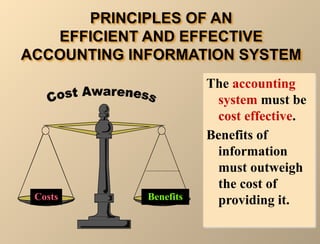
PRINCIPLES OF AN
EFFICIENT AND EFFECTIVE
ACCOUNTING INFORMATION SYSTEM
Costs Benefits
The accounting
system must be
cost effective.
Benefits of
information
must outweigh
the cost of
providing it.
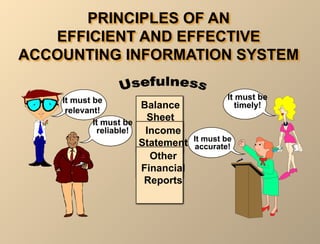
PRINCIPLES OF AN
EFFICIENT AND EFFECTIVE
ACCOUNTING INFORMATION SYSTEM
It must be
relevant!
It must be
reliable!
It must be
accurate!
It must be
timely!
Balance
Sheet
Income
Statement
Other
Financial
Reports
PRINCIPLES OF AN
EFFICIENT AND EFFECTIVE
ACCOUNTING INFORMATION SYSTEM
Government
Regulation and
Deregulation
Organizational
Growth
Increased
Competition
Changing
Accounting
Principles
Technological
Advances
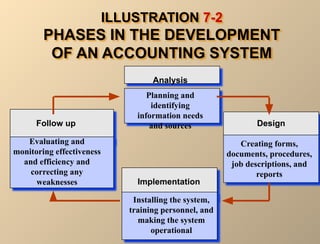
ILLUSTRATION 7-2
PHASES IN THE DEVELOPMENT
OF AN ACCOUNTING SYSTEM
Analysis
Follow up Design
Implementation
Planning and
identifying
information needs
and sources
Evaluating and
monitoring effectiveness
and efficiency and
correcting any
weaknesses
Creating forms,
documents, procedures,
job descriptions, and
reports
Installing the system,
training personnel, and
making the system
operational
● A subsidiary ledger is a group of accounts with a
common characteristic, such as customer
accounts.
● The subsidiary ledger is assembled to facilitate
the recording process by freeing the general
ledger from details concerning individual
balances.
● Two common subsidiary ledgers are the
Accounts Receivable Ledger and the Accounts
Payable Ledger.
SUBSIDIARY LEDGERS
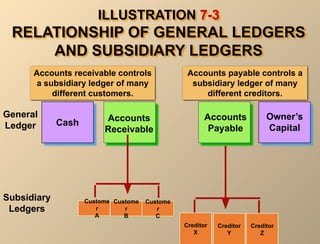
● The general ledger account that
summarizes subsidiary ledger data is called
a control account.
● Each general ledger control account
balance must equal the composite balance
of the individual accounts in the subsidiary
ledger.
CONTROL ACCOUNT
ILLUSTRATION 7-3
RELATIONSHIP OF GENERAL LEDGERS
AND SUBSIDIARY LEDGERS
Accounts receivable controls
a subsidiary ledger of many
different customers.
General
Ledger
Subsidiary
Ledgers
Cash
Owner’s
Capital
Accounts
Receivable
Accounts
Payable
Custome
r
A
Custome
r
B
Custome
r
C
Accounts payable controls a
subsidiary ledger of many
different creditors.
Creditor
X
Creditor
Y
Creditor
Z
Advantages of using subsidiary ledgers are that
they:
1. Show transactions affecting one customer or one
creditor in a single account.
2. Free the general ledger of excessive details.
3. Help locate errors in individual accounts by
reducing the number of accounts combined
in one ledger and by using controlling
accounts.
4. Create a division of labour in posting by allowing
one employee to post to the general ledger and a
SUBSIDIARY LEDGERS
● Special journals are used to group similar
types of transactions.
● If a transaction cannot be recorded in a
special journal, it is recorded in the
general journal.
● Special journals permit greater division of
labour and reduce time necessary to
complete the posting process.
SPECIAL JOURNALS
ILLUSTRATION 7-5
USE OF SPECIAL JOURNALS AND
THE GENERAL JOURNAL
Sales
Journal
Cash
Receipts
Journal
Purchases
Journal
Cash
Payments
Journal
General
Journal
Used for:
All sales
of
merchan-
dise on
account
Used for:
All cash
received
(including
cash
sales)
Used for:
All
purchases
of
merchan-d
ise on
account
Used for:
All cash
paid
(including
cash
purchases)
Used for:
Transactions
that cannot
be entered
in a special
journal,
including
correcting,
adjusting, and
closing entries
The types of special journals used depend largely on the
types of transactions that occur frequently in a
business enterprise.
● Under a perpetual inventory system, one entry at selling price in the Sales
Journal results in a debit to Accounts Receivable and a credit to Sales. Another
entry at cost results in a debit to Cost of Goods Sold and a credit to
Merchandise Inventory.
● Postings are made monthly to the general ledger and daily to the accounts
receivable subsidiary ledger.
JOURNALIZING THE SALES JOURNAL –
PERPETUAL INVENTORY SYSTEM
Karns Wholesale Supply
Sales Journal S1
ILLUSTRATION 7-8
PROVING THE ACCURACY OF THE
ACCOUNTS RECEIVABLE
SUBSIDIARY LEDGER
To prove the accuracy of the ledgers it is necessary to determine
whether the sum of the accounts receivable subsidiary ledger
balances equals the balance in the general ledger’s Accounts
Receivable control account.
General Ledger
Accounts Receivable $90,230
Accounts Receivable
Subsidiary Ledger
Abbot Sisters $26,000
Babson Co. 25,920
Carson Bros. 7,800
Deli Co. 30,510
$90,230
CASH RECEIPTS JOURNAL
PERPETUAL SYSTEM
● The debit columns for cash and cost of goods sold must be
equal to the total of the credit columns for accounts
receivable, sales, inventory, and other accounts.
Karns Wholesale Supply
Cash Receipts Journal
54,550
● Column totals are posted at the end of each
month.
● The total of the Other Accounts column is not
posted. The individual amounts comprising the
total are posted separately to the general ledger
accounts specified in the Accounts Credited
column.
● The individual amounts in the Accounts
Receivable column are posted daily to the
subsidiary ledger account specified in the
Accounts Credited column.
CASH RECEIPTS JOURNAL
ILLUSTRATION 7-11 P
THE LEDGERS AFTER POSTING THE SALES
AND THE CASH RECEIPTS JOURNALS
Accounts Receivable
Subsidiary Ledger
Abbot Sisters $15,400
Babson Co. 14,570
Deli Co. 21,210
$51,180
After the posting of the cash
receipts journal is
completed, it is necessary
to prove the ledgers. The
general ledger totals are in
agreement and the sum of
the subsidiary ledger
balances equals the control
account balance.
General Ledger
Debits
Cash $54,550
Accounts Receivable 51,180
Cost of Goods Sold 65,120
$170,850
Credits
Merchandise Inventory $ 65,120
Notes Payable 6,000
D. A. Karns, Capital 5,000
Sales 94,730
$170,850
PURCHASES JOURNAL
PERPETUAL SYSTEM
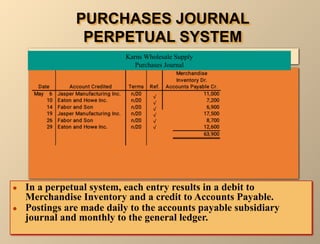
● In a perpetual system, each entry results in a debit to
Merchandise Inventory and a credit to Accounts Payable.
● Postings are made daily to the accounts payable subsidiary
journal and monthly to the general ledger.
√
√
√
√
√
√
Karns Wholesale Supply
Purchases Journal
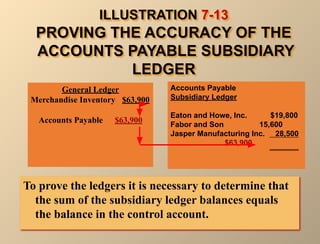
ILLUSTRATION 7-13
PROVING THE ACCURACY OF THE
ACCOUNTS PAYABLE SUBSIDIARY
LEDGER
To prove the ledgers it is necessary to determine that
the sum of the subsidiary ledger balances equals
the balance in the control account.
Accounts Payable
Subsidiary Ledger
Eaton and Howe, Inc. $19,800
Fabor and Son 15,600
Jasper Manufacturing Inc. 28,500
$63,900
General Ledger
Merchandise Inventory $63,900
Accounts Payable $63,900
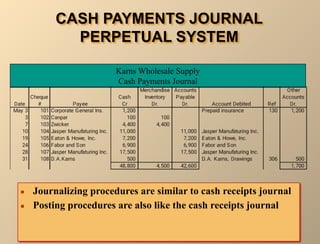
CASH PAYMENTS JOURNAL
PERPETUAL SYSTEM
● Journalizing procedures are similar to cash receipts journal
● Posting procedures are also like the cash receipts journal
Karns Wholesale Supply
Cash Payments Journal
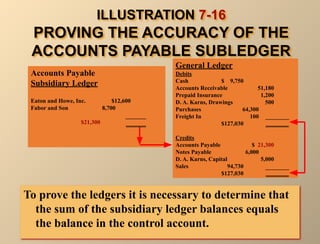
ILLUSTRATION 7-16
PROVING THE ACCURACY OF THE
ACCOUNTS PAYABLE SUBLEDGER
To prove the ledgers it is necessary to determine that
the sum of the subsidiary ledger balances equals
the balance in the control account.
Accounts Payable
Subsidiary Ledger
Eaton and Howe, Inc. $12,600
Fabor and Son 8,700
$21,300
General Ledger
Debits
Cash $ 9,750
Accounts Receivable 51,180
Prepaid Insurance 1,200
D. A. Karns, Drawings 500
Purchases 64,300
Freight In 100
$127,030
Credits
Accounts Payable $ 21,300
Notes Payable 6,000
D. A. Karns, Capital 5,000
Sales 94,730
$127,030
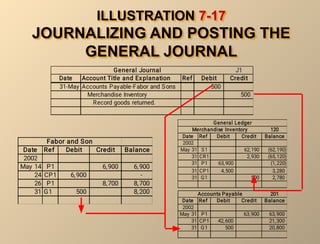
● Only transactions that cannot be recorded
in a special journal are recorded in the
general journal.
● When the entry involves both control and
subsidiary accounts:
1. In journalizing, control and subsidiary
accounts must be identified, and
2. In posting there must be a dual posting
(to the control account and subsidiary
ledger).
EFFECTS ON
GENERAL JOURNAL
ILLUSTRATION 7-17
JOURNALIZING AND POSTING THE
GENERAL JOURNAL

3.chapter 7 accounting information system.pdf

  • 1.
    Accounting Principles Second Canadian Edition Preparedby: Mohamed faisal Sa'ed Weygandt · Kieso · Kimmel · Trenholme
  • 2.
  • 3.
    Accounting Information System ●An accounting information system (AIS) involves collecting and processing data and disseminating financial information to interested parties. ● An AIS may either be manual or computerized.
  • 4.
    PRINCIPLES OF AN EFFICIENTAND EFFECTIVE ACCOUNTING INFORMATION SYSTEM Costs Benefits The accounting system must be cost effective. Benefits of information must outweigh the cost of providing it.
  • 5.
    PRINCIPLES OF AN EFFICIENTAND EFFECTIVE ACCOUNTING INFORMATION SYSTEM It must be relevant! It must be reliable! It must be accurate! It must be timely! Balance Sheet Income Statement Other Financial Reports
  • 6.
    PRINCIPLES OF AN EFFICIENTAND EFFECTIVE ACCOUNTING INFORMATION SYSTEM Government Regulation and Deregulation Organizational Growth Increased Competition Changing Accounting Principles Technological Advances
  • 7.
    ILLUSTRATION 7-2 PHASES INTHE DEVELOPMENT OF AN ACCOUNTING SYSTEM Analysis Follow up Design Implementation Planning and identifying information needs and sources Evaluating and monitoring effectiveness and efficiency and correcting any weaknesses Creating forms, documents, procedures, job descriptions, and reports Installing the system, training personnel, and making the system operational
  • 8.
    ● A subsidiaryledger is a group of accounts with a common characteristic, such as customer accounts. ● The subsidiary ledger is assembled to facilitate the recording process by freeing the general ledger from details concerning individual balances. ● Two common subsidiary ledgers are the Accounts Receivable Ledger and the Accounts Payable Ledger. SUBSIDIARY LEDGERS
  • 9.
    ● The generalledger account that summarizes subsidiary ledger data is called a control account. ● Each general ledger control account balance must equal the composite balance of the individual accounts in the subsidiary ledger. CONTROL ACCOUNT
  • 10.
    ILLUSTRATION 7-3 RELATIONSHIP OFGENERAL LEDGERS AND SUBSIDIARY LEDGERS Accounts receivable controls a subsidiary ledger of many different customers. General Ledger Subsidiary Ledgers Cash Owner’s Capital Accounts Receivable Accounts Payable Custome r A Custome r B Custome r C Accounts payable controls a subsidiary ledger of many different creditors. Creditor X Creditor Y Creditor Z
  • 11.
    Advantages of usingsubsidiary ledgers are that they: 1. Show transactions affecting one customer or one creditor in a single account. 2. Free the general ledger of excessive details. 3. Help locate errors in individual accounts by reducing the number of accounts combined in one ledger and by using controlling accounts. 4. Create a division of labour in posting by allowing one employee to post to the general ledger and a SUBSIDIARY LEDGERS
  • 12.
    ● Special journalsare used to group similar types of transactions. ● If a transaction cannot be recorded in a special journal, it is recorded in the general journal. ● Special journals permit greater division of labour and reduce time necessary to complete the posting process. SPECIAL JOURNALS
  • 13.
    ILLUSTRATION 7-5 USE OFSPECIAL JOURNALS AND THE GENERAL JOURNAL Sales Journal Cash Receipts Journal Purchases Journal Cash Payments Journal General Journal Used for: All sales of merchan- dise on account Used for: All cash received (including cash sales) Used for: All purchases of merchan-d ise on account Used for: All cash paid (including cash purchases) Used for: Transactions that cannot be entered in a special journal, including correcting, adjusting, and closing entries The types of special journals used depend largely on the types of transactions that occur frequently in a business enterprise.
  • 14.
    ● Under aperpetual inventory system, one entry at selling price in the Sales Journal results in a debit to Accounts Receivable and a credit to Sales. Another entry at cost results in a debit to Cost of Goods Sold and a credit to Merchandise Inventory. ● Postings are made monthly to the general ledger and daily to the accounts receivable subsidiary ledger. JOURNALIZING THE SALES JOURNAL – PERPETUAL INVENTORY SYSTEM Karns Wholesale Supply Sales Journal S1
  • 15.
    ILLUSTRATION 7-8 PROVING THEACCURACY OF THE ACCOUNTS RECEIVABLE SUBSIDIARY LEDGER To prove the accuracy of the ledgers it is necessary to determine whether the sum of the accounts receivable subsidiary ledger balances equals the balance in the general ledger’s Accounts Receivable control account. General Ledger Accounts Receivable $90,230 Accounts Receivable Subsidiary Ledger Abbot Sisters $26,000 Babson Co. 25,920 Carson Bros. 7,800 Deli Co. 30,510 $90,230
  • 16.
    CASH RECEIPTS JOURNAL PERPETUALSYSTEM ● The debit columns for cash and cost of goods sold must be equal to the total of the credit columns for accounts receivable, sales, inventory, and other accounts. Karns Wholesale Supply Cash Receipts Journal 54,550
  • 17.
    ● Column totalsare posted at the end of each month. ● The total of the Other Accounts column is not posted. The individual amounts comprising the total are posted separately to the general ledger accounts specified in the Accounts Credited column. ● The individual amounts in the Accounts Receivable column are posted daily to the subsidiary ledger account specified in the Accounts Credited column. CASH RECEIPTS JOURNAL
  • 18.
    ILLUSTRATION 7-11 P THELEDGERS AFTER POSTING THE SALES AND THE CASH RECEIPTS JOURNALS Accounts Receivable Subsidiary Ledger Abbot Sisters $15,400 Babson Co. 14,570 Deli Co. 21,210 $51,180 After the posting of the cash receipts journal is completed, it is necessary to prove the ledgers. The general ledger totals are in agreement and the sum of the subsidiary ledger balances equals the control account balance. General Ledger Debits Cash $54,550 Accounts Receivable 51,180 Cost of Goods Sold 65,120 $170,850 Credits Merchandise Inventory $ 65,120 Notes Payable 6,000 D. A. Karns, Capital 5,000 Sales 94,730 $170,850
  • 19.
    PURCHASES JOURNAL PERPETUAL SYSTEM ●In a perpetual system, each entry results in a debit to Merchandise Inventory and a credit to Accounts Payable. ● Postings are made daily to the accounts payable subsidiary journal and monthly to the general ledger. √ √ √ √ √ √ Karns Wholesale Supply Purchases Journal
  • 20.
    ILLUSTRATION 7-13 PROVING THEACCURACY OF THE ACCOUNTS PAYABLE SUBSIDIARY LEDGER To prove the ledgers it is necessary to determine that the sum of the subsidiary ledger balances equals the balance in the control account. Accounts Payable Subsidiary Ledger Eaton and Howe, Inc. $19,800 Fabor and Son 15,600 Jasper Manufacturing Inc. 28,500 $63,900 General Ledger Merchandise Inventory $63,900 Accounts Payable $63,900
  • 21.
    CASH PAYMENTS JOURNAL PERPETUALSYSTEM ● Journalizing procedures are similar to cash receipts journal ● Posting procedures are also like the cash receipts journal Karns Wholesale Supply Cash Payments Journal
  • 22.
    ILLUSTRATION 7-16 PROVING THEACCURACY OF THE ACCOUNTS PAYABLE SUBLEDGER To prove the ledgers it is necessary to determine that the sum of the subsidiary ledger balances equals the balance in the control account. Accounts Payable Subsidiary Ledger Eaton and Howe, Inc. $12,600 Fabor and Son 8,700 $21,300 General Ledger Debits Cash $ 9,750 Accounts Receivable 51,180 Prepaid Insurance 1,200 D. A. Karns, Drawings 500 Purchases 64,300 Freight In 100 $127,030 Credits Accounts Payable $ 21,300 Notes Payable 6,000 D. A. Karns, Capital 5,000 Sales 94,730 $127,030
  • 23.
    ● Only transactionsthat cannot be recorded in a special journal are recorded in the general journal. ● When the entry involves both control and subsidiary accounts: 1. In journalizing, control and subsidiary accounts must be identified, and 2. In posting there must be a dual posting (to the control account and subsidiary ledger). EFFECTS ON GENERAL JOURNAL
  • 24.
    ILLUSTRATION 7-17 JOURNALIZING ANDPOSTING THE GENERAL JOURNAL