8051
Interrupts
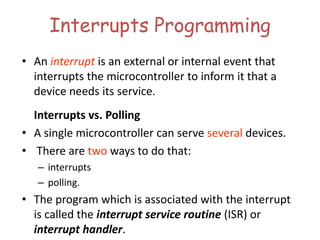
Interrupts Programming
• An interrupt is an external or internal event that
  interrupts the microcontroller to inform it that a
  device needs its service.
  Interrupts vs. Polling
• A single microcontroller can serve several devices.
• There are two ways to do that:
   – interrupts
   – polling.
• The program which is associated with the interrupt
  is called the interrupt service routine (ISR) or
  interrupt handler.
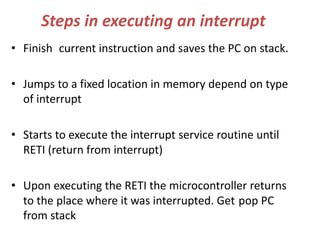
Steps in executing an interrupt
• Finish current instruction and saves the PC on stack.

• Jumps to a fixed location in memory depend on type
  of interrupt

• Starts to execute the interrupt service routine until
  RETI (return from interrupt)

• Upon executing the RETI the microcontroller returns
  to the place where it was interrupted. Get pop PC
  from stack
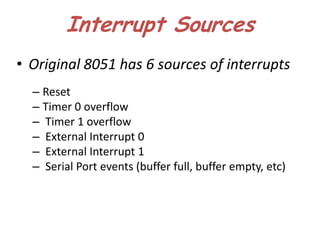
Interrupt Sources
• Original 8051 has 6 sources of interrupts
  – Reset
  – Timer 0 overflow
  – Timer 1 overflow
  – External Interrupt 0
  – External Interrupt 1
  – Serial Port events (buffer full, buffer empty, etc)
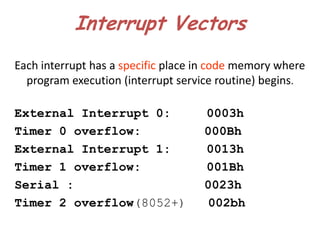
Interrupt Vectors
Each interrupt has a specific place in code memory where
  program execution (interrupt service routine) begins.

External Interrupt 0:               0003h
Timer 0 overflow:                   000Bh
External Interrupt 1:               0013h
Timer 1 overflow:                   001Bh
Serial :                            0023h
Timer 2 overflow(8052+)              002bh
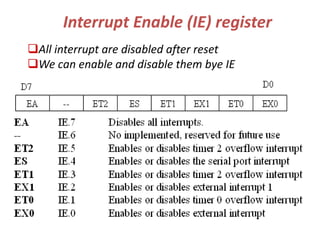
Interrupt Enable (IE) register
All interrupt are disabled after reset
We can enable and disable them bye IE
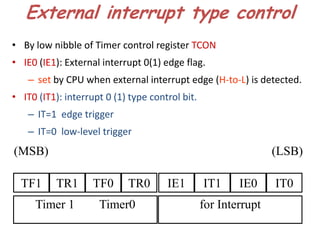
External interrupt type control
• By low nibble of Timer control register TCON
• IE0 (IE1): External interrupt 0(1) edge flag.
   – set by CPU when external interrupt edge (H-to-L) is detected.
• IT0 (IT1): interrupt 0 (1) type control bit.
   – IT=1 edge trigger
   – IT=0 low-level trigger
(MSB)                                                            (LSB)

  TF1      TR1      TF0     TR0       IE1        IT1     IE0     IT0
     Timer 1         Timer0                      for Interrupt
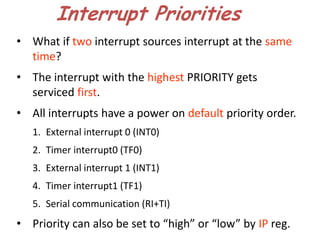
Interrupt Priorities
• What if two interrupt sources interrupt at the same
  time?
• The interrupt with the highest PRIORITY gets
  serviced first.
• All interrupts have a power on default priority order.
   1. External interrupt 0 (INT0)
   2. Timer interrupt0 (TF0)
   3. External interrupt 1 (INT1)
   4. Timer interrupt1 (TF1)
   5. Serial communication (RI+TI)
• Priority can also be set to “high” or “low” by IP reg.
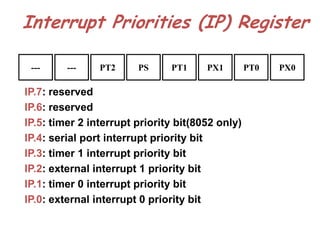
Interrupt Priorities (IP) Register

 ---     ---    PT2     PS     PT1     PX1        PT0   PX0

IP.7: reserved
IP.6: reserved
IP.5: timer 2 interrupt priority bit(8052 only)
IP.4: serial port interrupt priority bit
IP.3: timer 1 interrupt priority bit
IP.2: external interrupt 1 priority bit
IP.1: timer 0 interrupt priority bit
IP.0: external interrupt 0 priority bit
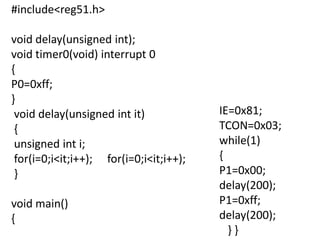
#include<reg51.h>

void delay(unsigned int);
void timer0(void) interrupt 0
{
P0=0xff;
}
 void delay(unsigned int it)             IE=0x81;
 {                                       TCON=0x03;
 unsigned int i;                         while(1)
 for(i=0;i<it;i++); for(i=0;i<it;i++);   {
 }                                       P1=0x00;
                                         delay(200);
void main()                              P1=0xff;
{                                        delay(200);
                                           }}

37471656 interrupts

  • 1.
  • 2.
    Interrupts Programming • Aninterrupt is an external or internal event that interrupts the microcontroller to inform it that a device needs its service. Interrupts vs. Polling • A single microcontroller can serve several devices. • There are two ways to do that: – interrupts – polling. • The program which is associated with the interrupt is called the interrupt service routine (ISR) or interrupt handler.
  • 3.
    Steps in executingan interrupt • Finish current instruction and saves the PC on stack. • Jumps to a fixed location in memory depend on type of interrupt • Starts to execute the interrupt service routine until RETI (return from interrupt) • Upon executing the RETI the microcontroller returns to the place where it was interrupted. Get pop PC from stack
  • 4.
    Interrupt Sources • Original8051 has 6 sources of interrupts – Reset – Timer 0 overflow – Timer 1 overflow – External Interrupt 0 – External Interrupt 1 – Serial Port events (buffer full, buffer empty, etc)
  • 5.
    Interrupt Vectors Each interrupthas a specific place in code memory where program execution (interrupt service routine) begins. External Interrupt 0: 0003h Timer 0 overflow: 000Bh External Interrupt 1: 0013h Timer 1 overflow: 001Bh Serial : 0023h Timer 2 overflow(8052+) 002bh
  • 6.
    Interrupt Enable (IE)register All interrupt are disabled after reset We can enable and disable them bye IE
  • 7.
    External interrupt typecontrol • By low nibble of Timer control register TCON • IE0 (IE1): External interrupt 0(1) edge flag. – set by CPU when external interrupt edge (H-to-L) is detected. • IT0 (IT1): interrupt 0 (1) type control bit. – IT=1 edge trigger – IT=0 low-level trigger (MSB) (LSB) TF1 TR1 TF0 TR0 IE1 IT1 IE0 IT0 Timer 1 Timer0 for Interrupt
  • 8.
    Interrupt Priorities • Whatif two interrupt sources interrupt at the same time? • The interrupt with the highest PRIORITY gets serviced first. • All interrupts have a power on default priority order. 1. External interrupt 0 (INT0) 2. Timer interrupt0 (TF0) 3. External interrupt 1 (INT1) 4. Timer interrupt1 (TF1) 5. Serial communication (RI+TI) • Priority can also be set to “high” or “low” by IP reg.
  • 9.
    Interrupt Priorities (IP)Register --- --- PT2 PS PT1 PX1 PT0 PX0 IP.7: reserved IP.6: reserved IP.5: timer 2 interrupt priority bit(8052 only) IP.4: serial port interrupt priority bit IP.3: timer 1 interrupt priority bit IP.2: external interrupt 1 priority bit IP.1: timer 0 interrupt priority bit IP.0: external interrupt 0 priority bit
  • 10.
    #include<reg51.h> void delay(unsigned int); voidtimer0(void) interrupt 0 { P0=0xff; } void delay(unsigned int it) IE=0x81; { TCON=0x03; unsigned int i; while(1) for(i=0;i<it;i++); for(i=0;i<it;i++); { } P1=0x00; delay(200); void main() P1=0xff; { delay(200); }}