Dr Puneeth K Pai
Physiological variations in
children
• Common cause of parental concern.
Referral by pediatrician, General
Orthopedist, General practitioner.
• Half of all new referrals to pediatric
orthopedic clinic were children with
normal variants of lower limb
development in a study by Molony
et al.
D. Molony, G. Hefferman, et al., “Normal Variants in the Pediatric Orthopedic
Population,” Irish Medical Journal, Vol. 99, No. 1, 2006, pp. 13-14.
The following features suggest a pathological
condition and not a normal variant :
• Abnormal perinatal history.
• Significant family history.
• Abnormal facies .
• Abnormal height for age.
• Asymmetry of limb findings
• Limitation of joint movements
• Leg length discrepancy/hypoplasia/hypertrophy
• Progressive deformity
• NOT normal for age
• Localised/Anglular deformities
What is not normal?
L. T. Staheli, “Lower Limb-Fundamentals of Pediatric Orthopedics,” 4th Edition, Lippincott Williams and Wi- lkins, Philadelphia, 2008.
Lower Limb
Rotational deformities
• Intoeing
• Out-toeing
Coronal deformities
• Genu varum
• Genu valgum
• Metatarsus Primus Varus
• Positional foot deformities- Pes supinates and pes
talus, Calcaneovalgus.
• Accessory bones/Sesamoids
Limb length discrepancy
What is not abnormal?
Upper limb
Carrying angle
General
Hyperlaxity
Rotational deformities
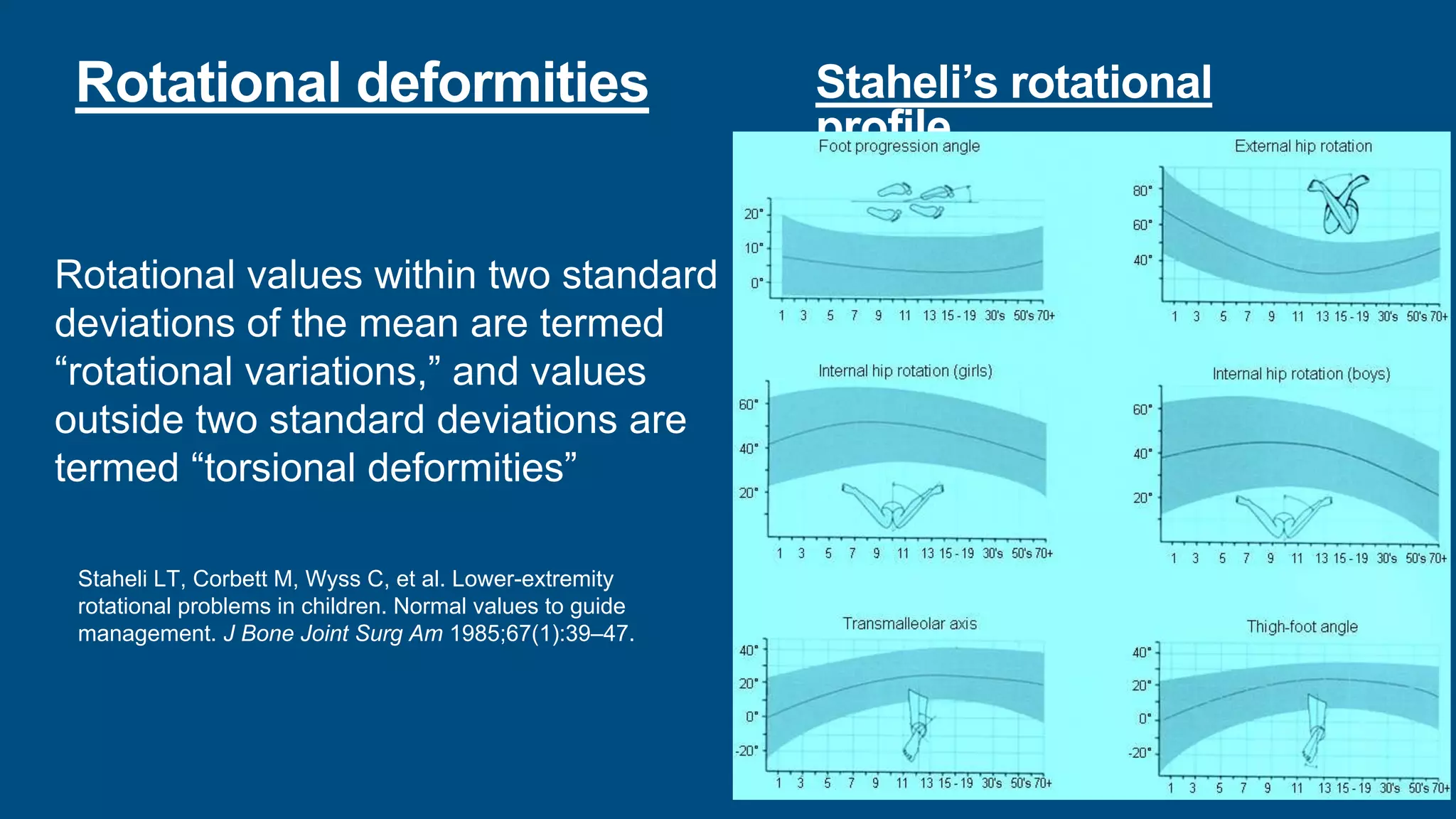
Rotational values within two standard
deviations of the mean are termed
“rotational variations,” and values
outside two standard deviations are
termed “torsional deformities”
Staheli LT, Corbett M, Wyss C, et al. Lower-extremity
rotational problems in children. Normal values to guide
management. J Bone Joint Surg Am 1985;67(1):39–47.
Staheli’s rotational
profile
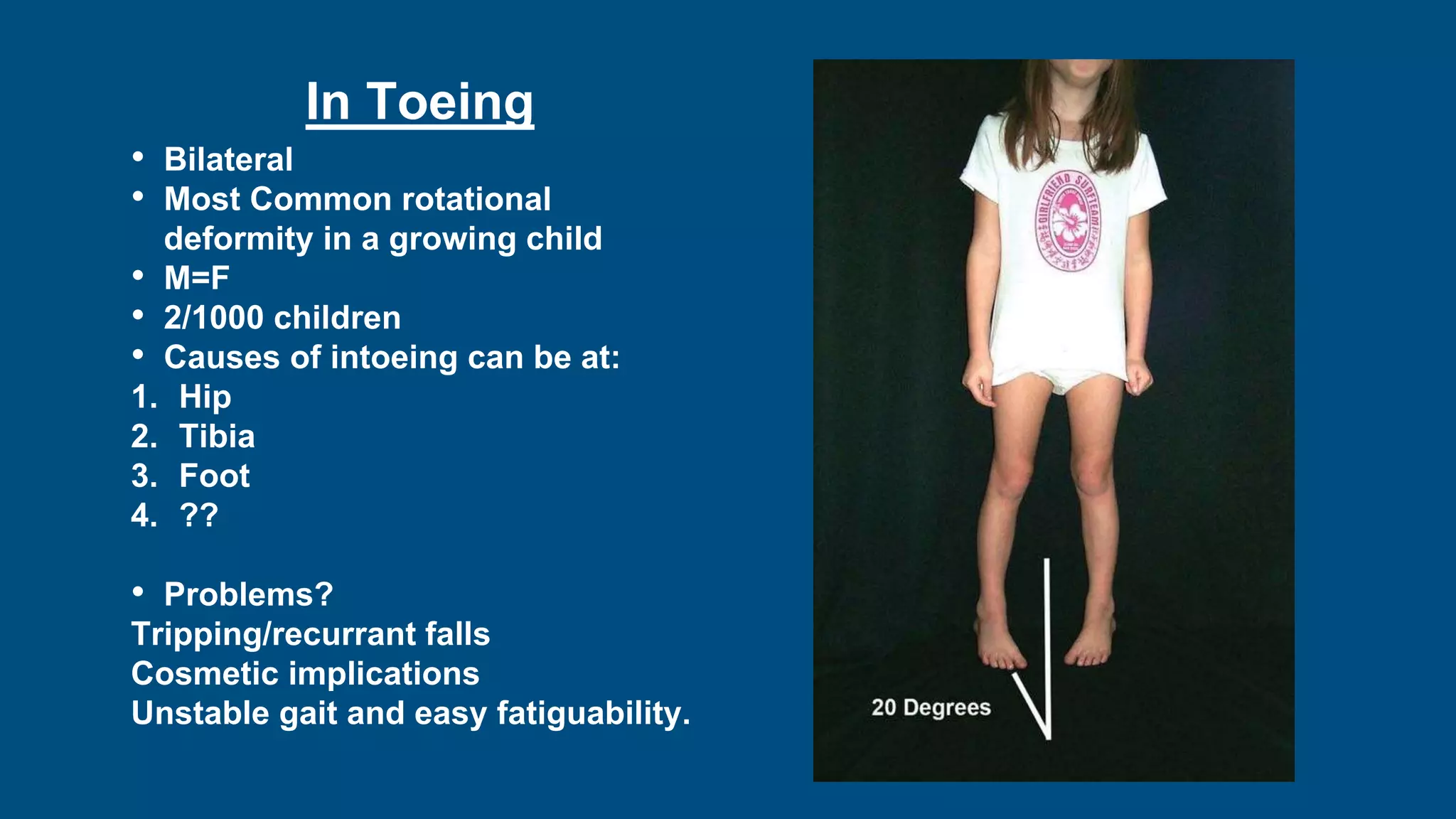
• Bilateral
• Most Common rotational
deformity in a growing child
• M=F
• 2/1000 children
• Causes of intoeing can be at:
1. Hip
2. Tibia
3. Foot
4. ??
• Problems?
Tripping/recurrant falls
Cosmetic implications
Unstable gait and easy fatiguability.
In Toeing
95 % of all intoeing resolves by the age of 8 years
Femoral anteversion
1.5 degrees of correction per year;
more than 80 % of affected children, usually by age 10 years
most pronounced between ages 4 to 6 years
At birth, neonates have an average of 40° of femoral
anteversion.
By age 8 years, average anteversion decreases to the typical
adult value of 15°
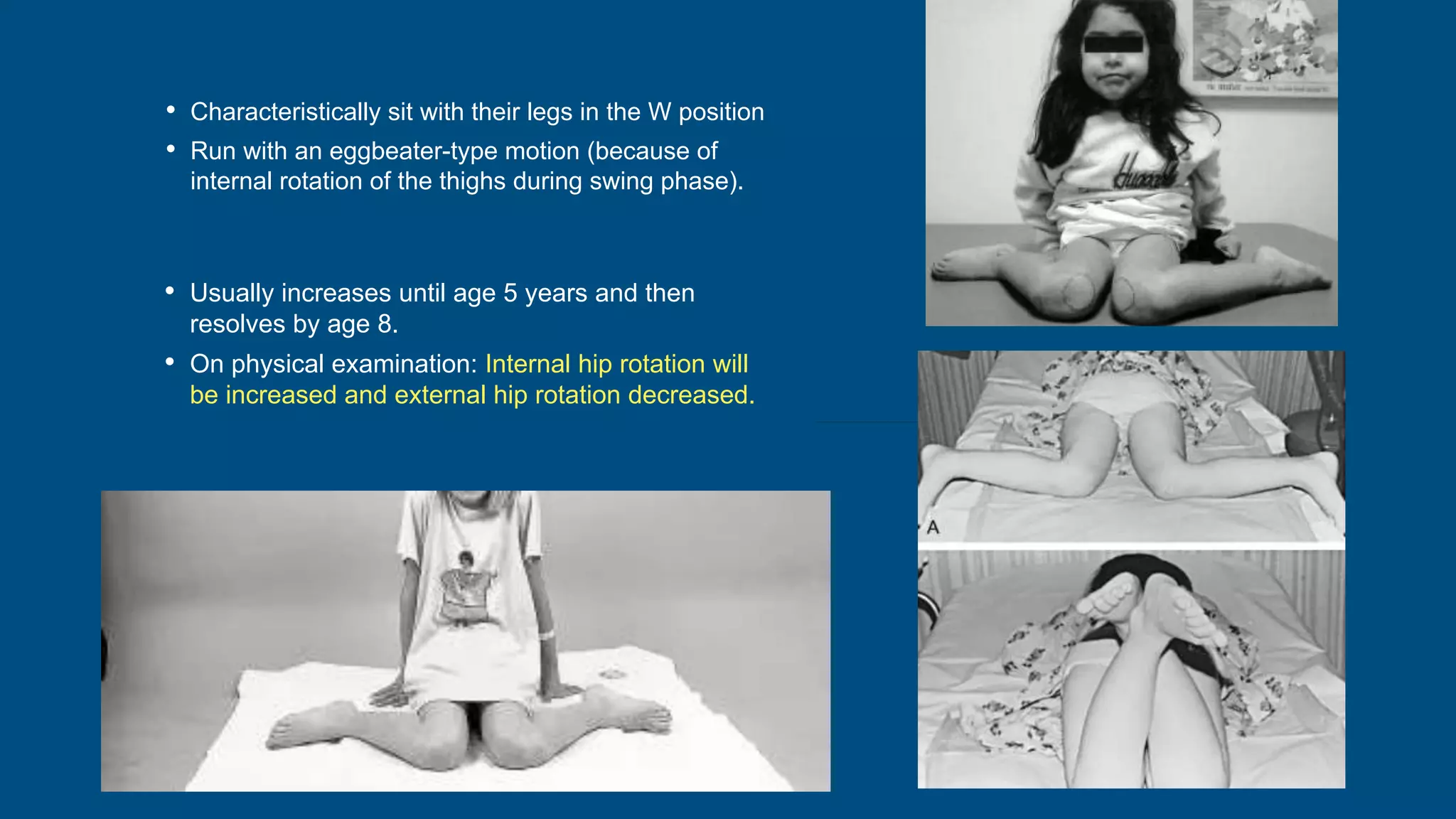
• Characteristically sit with their legs in the W position
• Run with an eggbeater-type motion (because of
internal rotation of the thighs during swing phase).
• Usually increases until age 5 years and then
resolves by age 8.
• On physical examination: Internal hip rotation will
be increased and external hip rotation decreased.
No association between increased femoral ante-version
and degenerative joint disease has been proved, some
association with knee pain has been suggested.
Reikerås O: Patellofemoral characteristics in patients with increased femoral
anteversion. Skeletal Radiol 1992;21:311-313.
Knee pain may be particularly prevalent in children
with concomitantly increased femoral anteversion
and external tibial torsion (so-called miserable
malalignment syndrome).
Delgado ED, Schoenecker PL, Rich MM, Capelli AM: Treatment of severe
torsional malalignment syndrome. J Pediatr Orthop 1996;16:484-488.
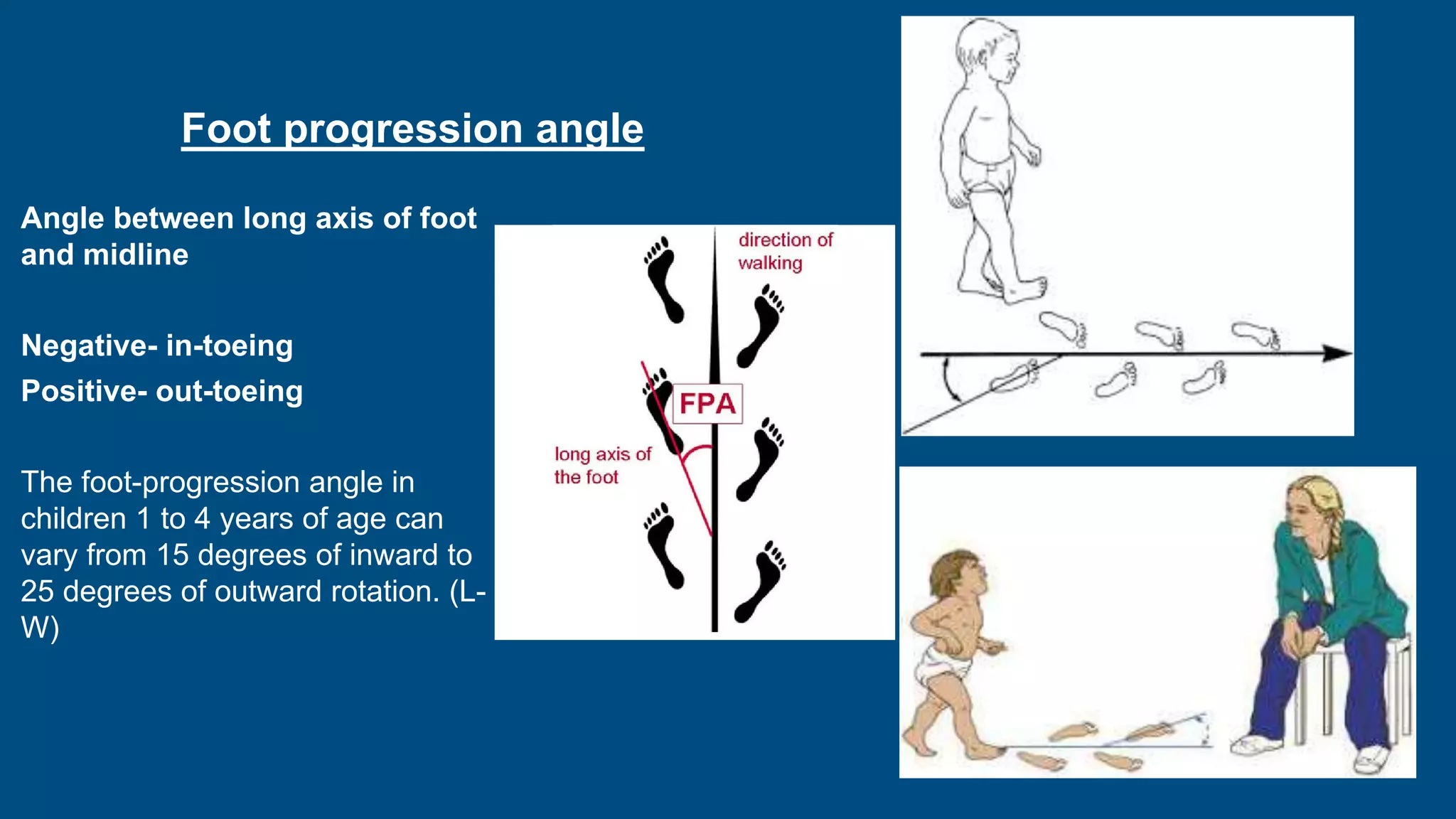
Foot progression angle
Angle between long axis of foot
and midline
Negative- in-toeing
Positive- out-toeing
The foot-progression angle in
children 1 to 4 years of age can
vary from 15 degrees of inward to
25 degrees of outward rotation. (L-
W)
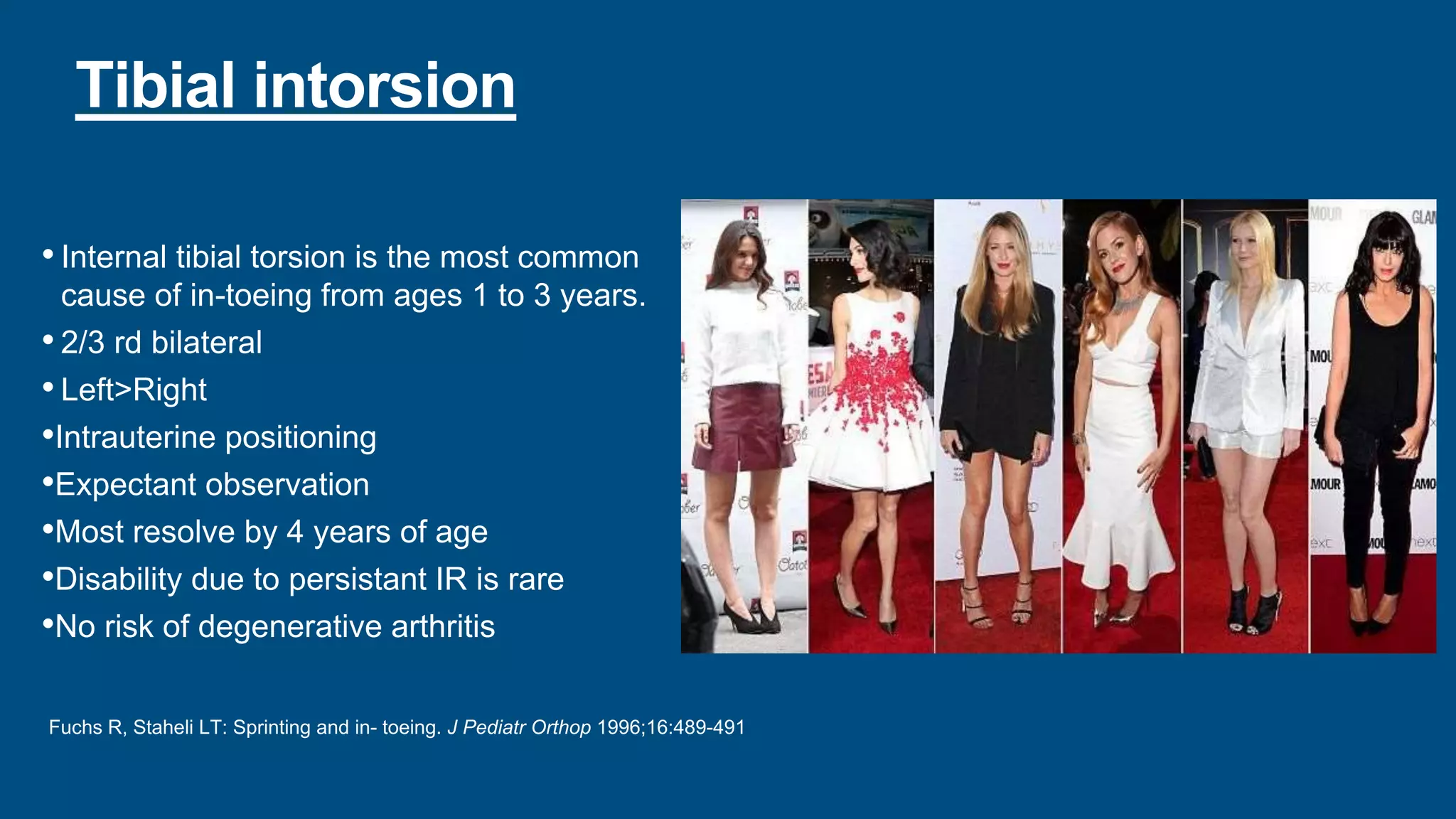
Tibial intorsion
• Internal tibial torsion is the most common
cause of in-toeing from ages 1 to 3 years.
• 2/3 rd bilateral
• Left>Right
•Intrauterine positioning
•Expectant observation
•Most resolve by 4 years of age
•Disability due to persistant IR is rare
•No risk of degenerative arthritis
Fuchs R, Staheli LT: Sprinting and in- toeing. J Pediatr Orthop 1996;16:489-491
In a retrospective review of all intoeing
referrals to a Scottish paediatric
orthopaedic unit, no children required
surgery for their condition, with a 85%
being discharged on their first visit.
Similarly, in a large American series
reviewing 720 intoeing referrals in a
year, only one child required surgery.
Blackmur JP, Murray AW. Do children who in-toe need to be referred to an
orthopaedic clinic? J Pediatr Orthop B 2010;19:415-7.
Karol LA. Rotational deformities in the lower extremities. Curr Opin Pediatr 1997;9:77-80.
Surgical management reserved for :
• Children older than 8 years with
marked functional
• Cosmetic deformity
• Thigh-foot angle greater than
three standard deviations beyond
the mean (eg, thigh-foot angle
>15°).
OUT-TOEING
• Out toeing is less common than in toeing.
• Femoral retroversion is common in early infancy and is
thought to be due to intra-uterine packaging.
• It is also observed commonly in obese children .
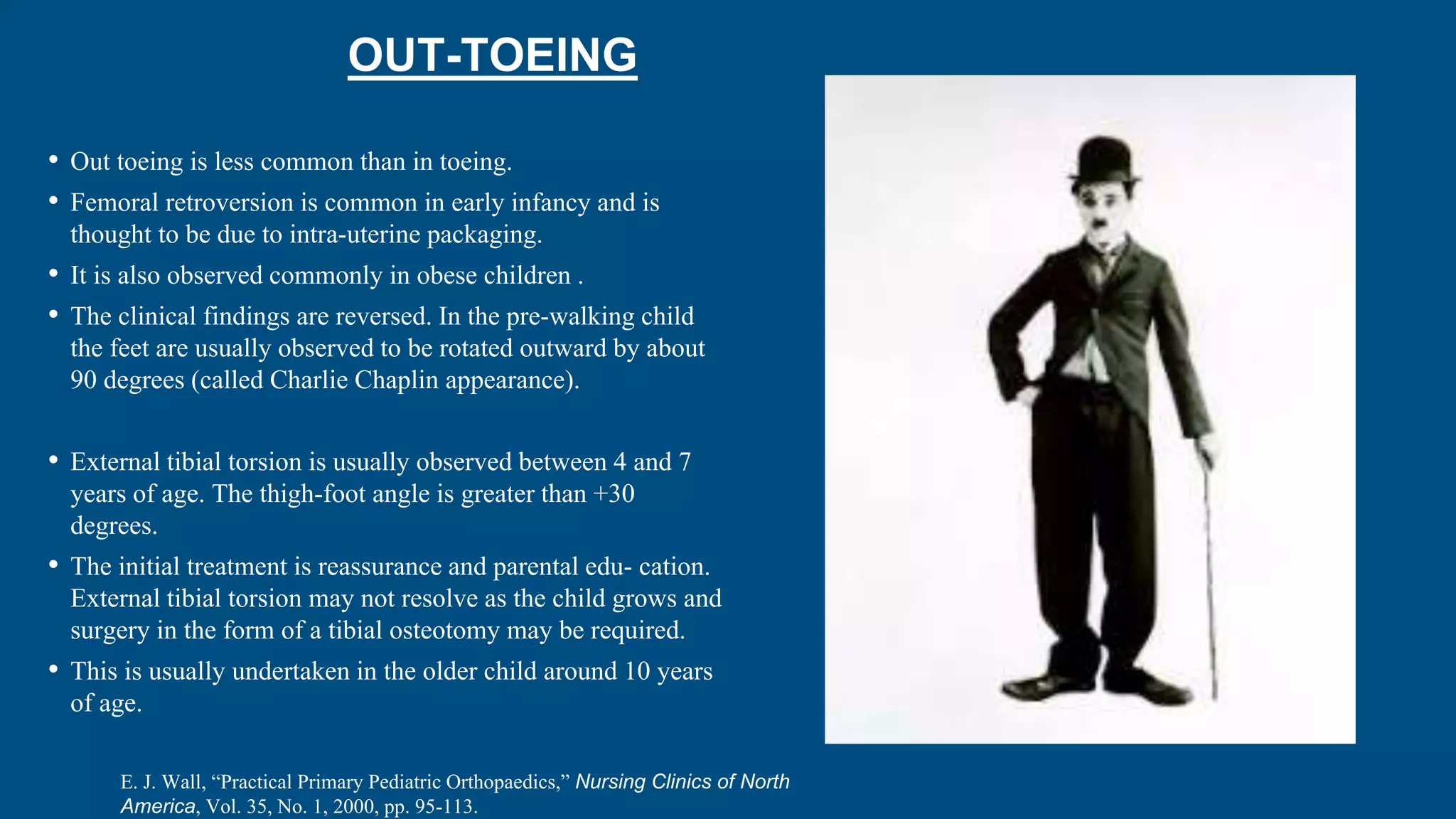
• The clinical findings are reversed. In the pre-walking child
the feet are usually observed to be rotated outward by about
90 degrees (called Charlie Chaplin appearance).
• External tibial torsion is usually observed between 4 and 7
years of age. The thigh-foot angle is greater than +30
degrees.
• The initial treatment is reassurance and parental edu- cation.
External tibial torsion may not resolve as the child grows and
surgery in the form of a tibial osteotomy may be required.
• This is usually undertaken in the older child around 10 years
of age.
E. J. Wall, “Practical Primary Pediatric Orthopaedics,” Nursing Clinics of North
America, Vol. 35, No. 1, 2000, pp. 95-113.
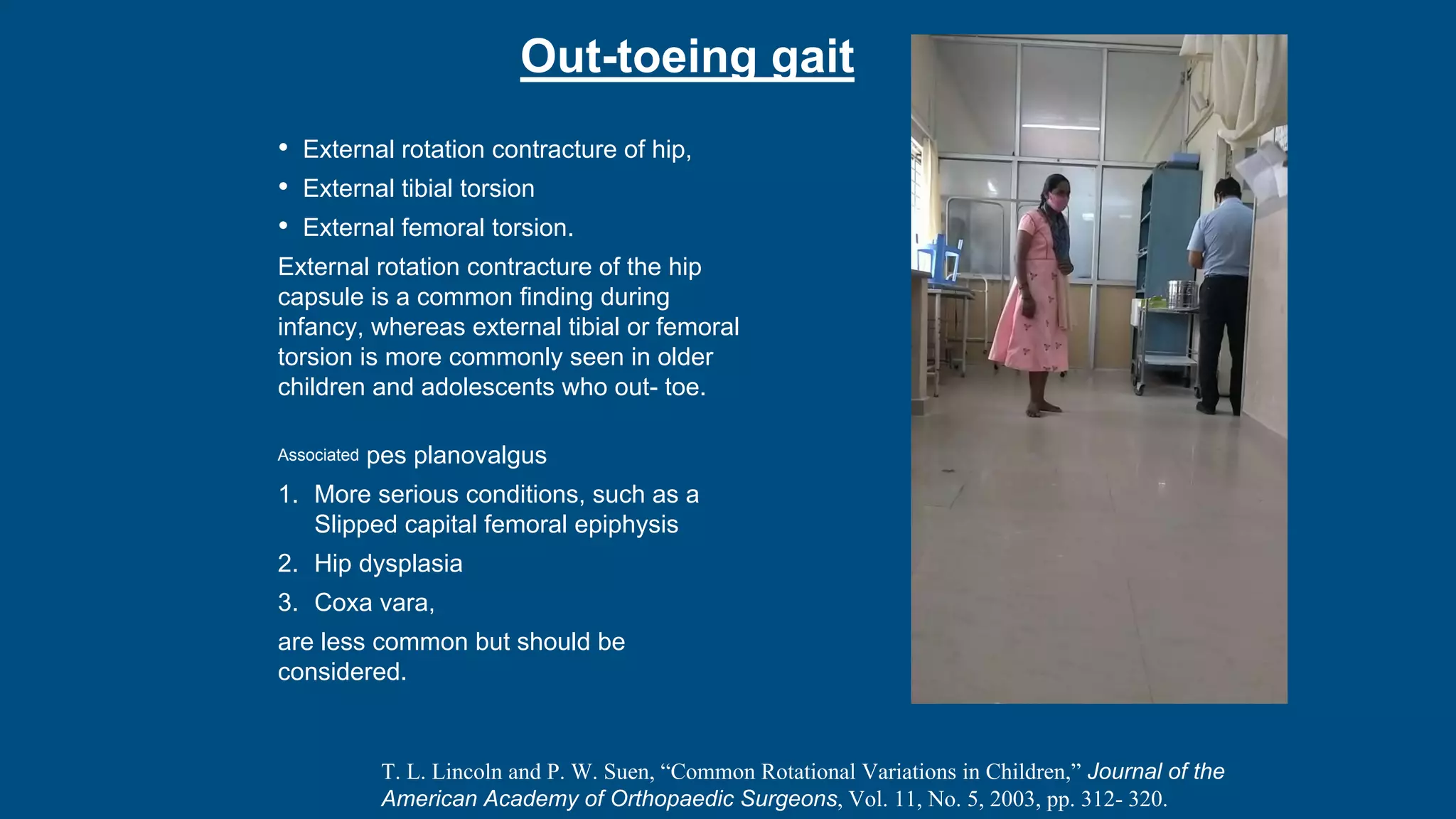
Out-toeing gait
• External rotation contracture of hip,
• External tibial torsion
• External femoral torsion.
External rotation contracture of the hip
capsule is a common finding during
infancy, whereas external tibial or femoral
torsion is more commonly seen in older
children and adolescents who out- toe.
Associated pes planovalgus
1. More serious conditions, such as a
Slipped capital femoral epiphysis
2. Hip dysplasia
3. Coxa vara,
are less common but should be
considered.
T. L. Lincoln and P. W. Suen, “Common Rotational Variations in Children,” Journal of the
American Academy of Orthopaedic Surgeons, Vol. 11, No. 5, 2003, pp. 312- 320.
Coronal plane deformities
Angular alignment refers to the tibiofemoral
angle, which can be clinically assessed by the
intermalleolar and intercondylar distances
Salenius P, Vankka E. The development of the tibiofemoral angle in children. J Bone Joint
Surg Am 1975;57:259-61.
Salenius and Vankka
Landmark study of tibiofemoral angles in 1500 normal
children
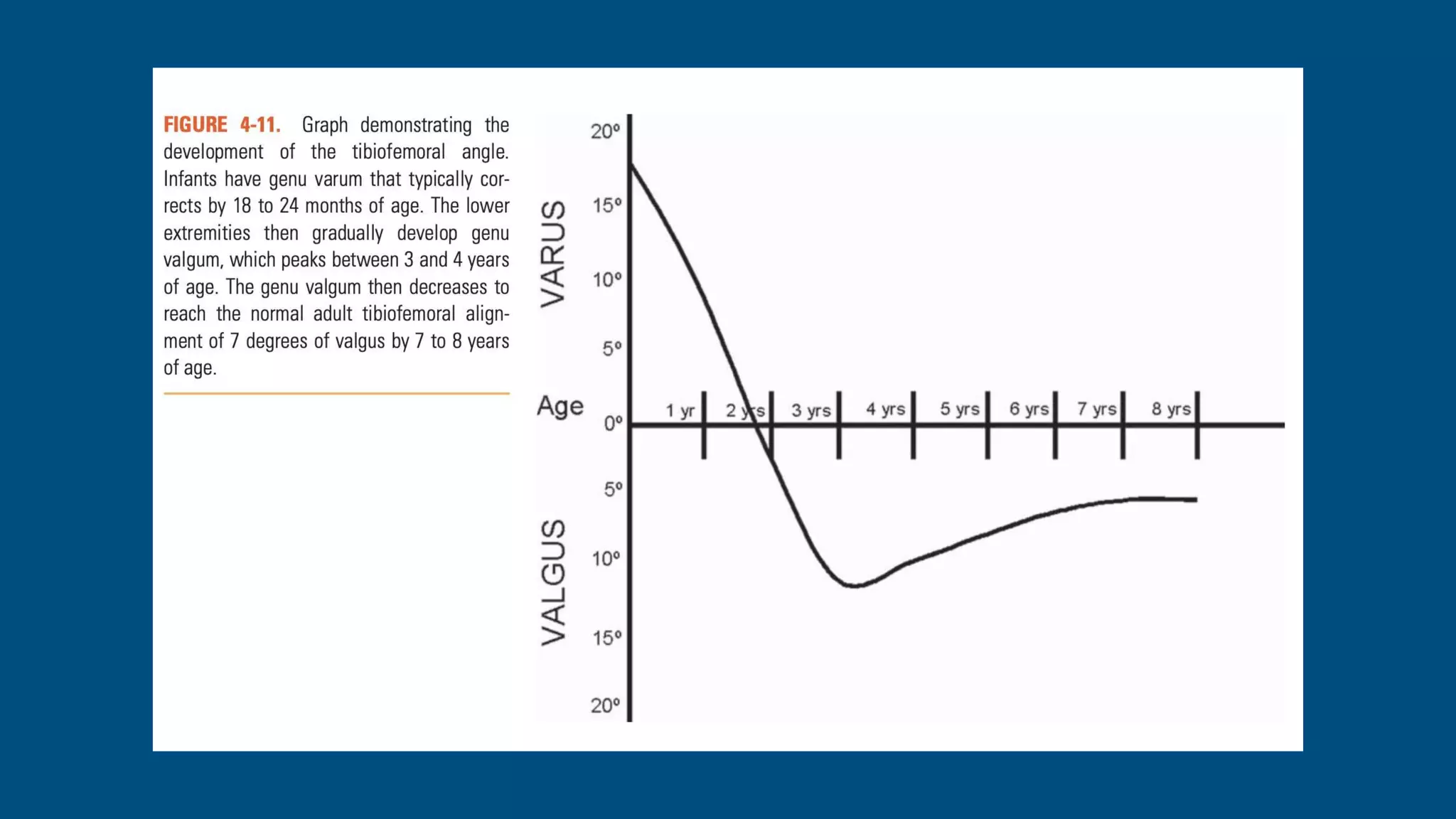
Up to the age of 18 months present with genu varum (bow
legs; mean of 15°)
Genu valgum (knock knees; mean of 12°) deformity
ensues, which subsequently corrects itself to the normal
value in adults (7-8° valgus) by the age of 7 years.
Physiological Genu
varum
Heath CH, Staheli LT. Normal limits of knee angle in white
children:genu varum and genu
valgum. J Pediatr Orthop 1993;13:259-62.
Physiologic genu varum is defined by a tibiofemoral angle of at least 10
degrees of varus, a radiographically normal physis, and apex lateral
bowing of the proximal end of the tibia and often the distal end of the
femur.
• Physiological genu varum is thought to relate to
intrauterine positioning
• Which leads to the contracture of the medial knee
joint capsule.
• This, in addition to the internal tibial torsion
common in this age group, accentuates the
deformity when children weight bear.
• Therefore, referrals for bow legs are common for
children aged between 10 and 14 months, the
average age at which children start to stand and
ambulate.
• The intercondylar distance is measured with the
medial malleoli in contact and should be less than
6 cm.
Physiological Genu
valgum
• Referrals for knock knees are common in children aged
between 3 and 4 years. (Normal b/w 2-8 yrs).
• A skeletally mature femoral-tibial alignment of
approximately 5 to 7 degrees of valgus .
• Accentuated by obesity, ligamentous laxity, and flat feet.
• In addition, torsional deformities such as femoral
anteversion with compensatory external tibial torsion may
make a physiological genu valgum appear more severe.
• The intermalleolar distance is measured with the knees in
contact and should be less than 8 cm.
Indications for Surgical intervention.
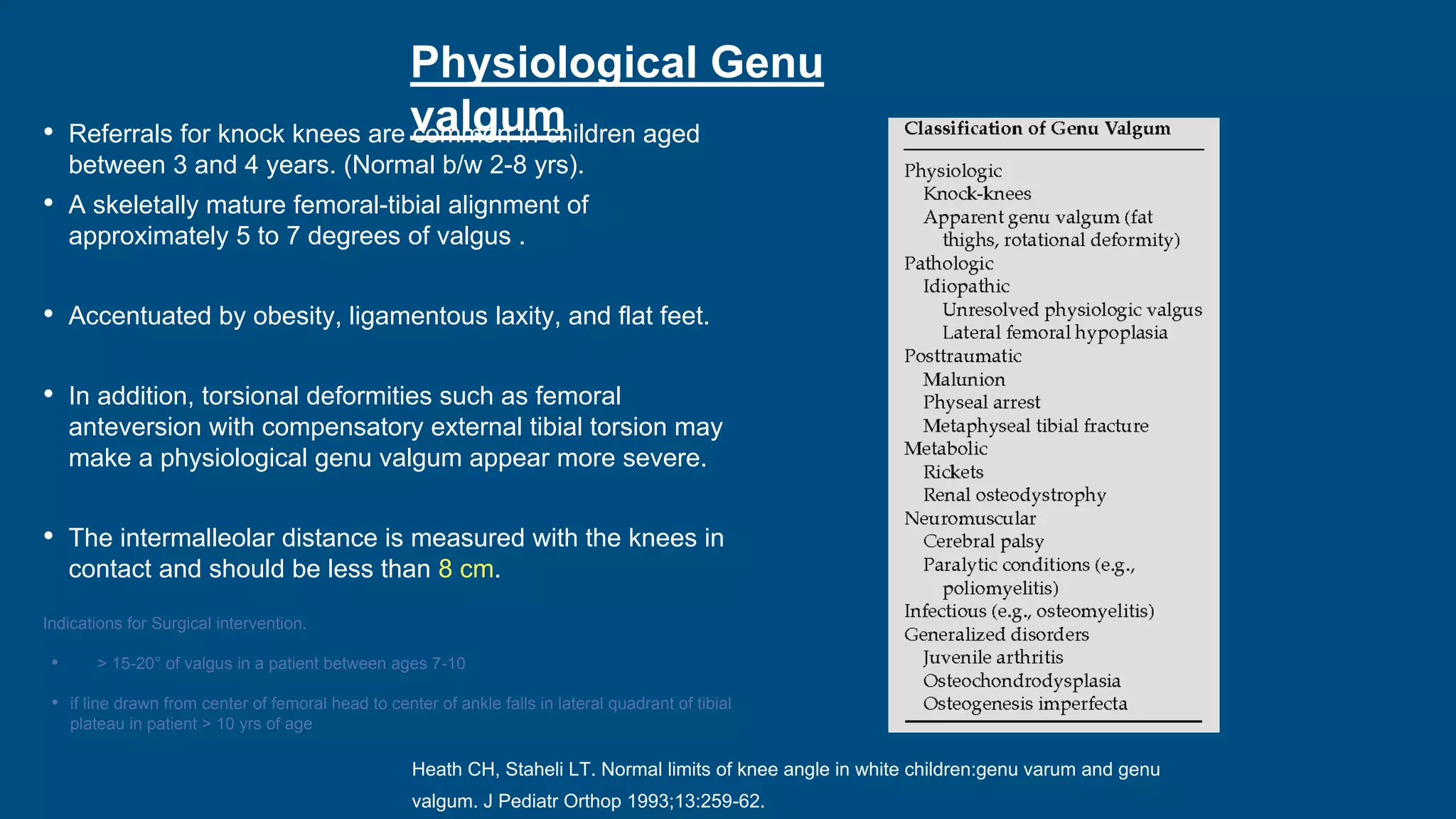
• > 15-20° of valgus in a patient between ages 7-10
• if line drawn from center of femoral head to center of ankle falls in lateral quadrant of tibial
plateau in patient > 10 yrs of age
Heath CH, Staheli LT. Normal limits of knee angle in white children:genu varum and genu
valgum. J Pediatr Orthop 1993;13:259-62.
Metatarsus adducts
• occurs in approximately 1 in 1,000 births
• equal frequency in males and females
• bilateral approximately 50% of cases
Associated conditions
• DDH (15-20%)
• Torticollis
Most common congenital foot deformity
Metatarsus Primus Varus
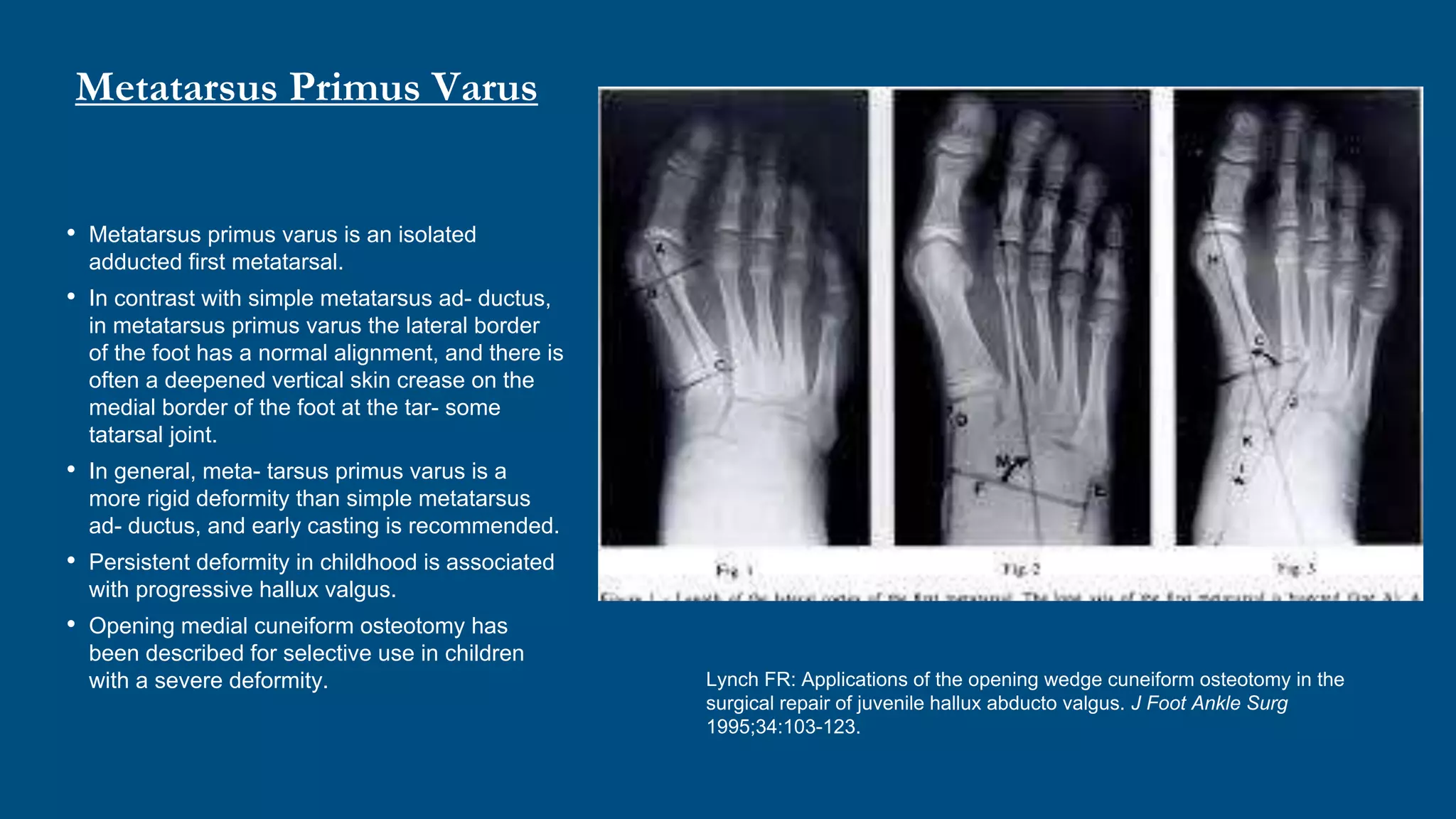
• Metatarsus primus varus is an isolated
adducted first metatarsal.
• In contrast with simple metatarsus ad- ductus,
in metatarsus primus varus the lateral border
of the foot has a normal alignment, and there is
often a deepened vertical skin crease on the
medial border of the foot at the tar- some
tatarsal joint.
• In general, meta- tarsus primus varus is a
more rigid deformity than simple metatarsus
ad- ductus, and early casting is recommended.
• Persistent deformity in childhood is associated
with progressive hallux valgus.
• Opening medial cuneiform osteotomy has
been described for selective use in children
with a severe deformity. Lynch FR: Applications of the opening wedge cuneiform osteotomy in the
surgical repair of juvenile hallux abducto valgus. J Foot Ankle Surg
1995;34:103-123.
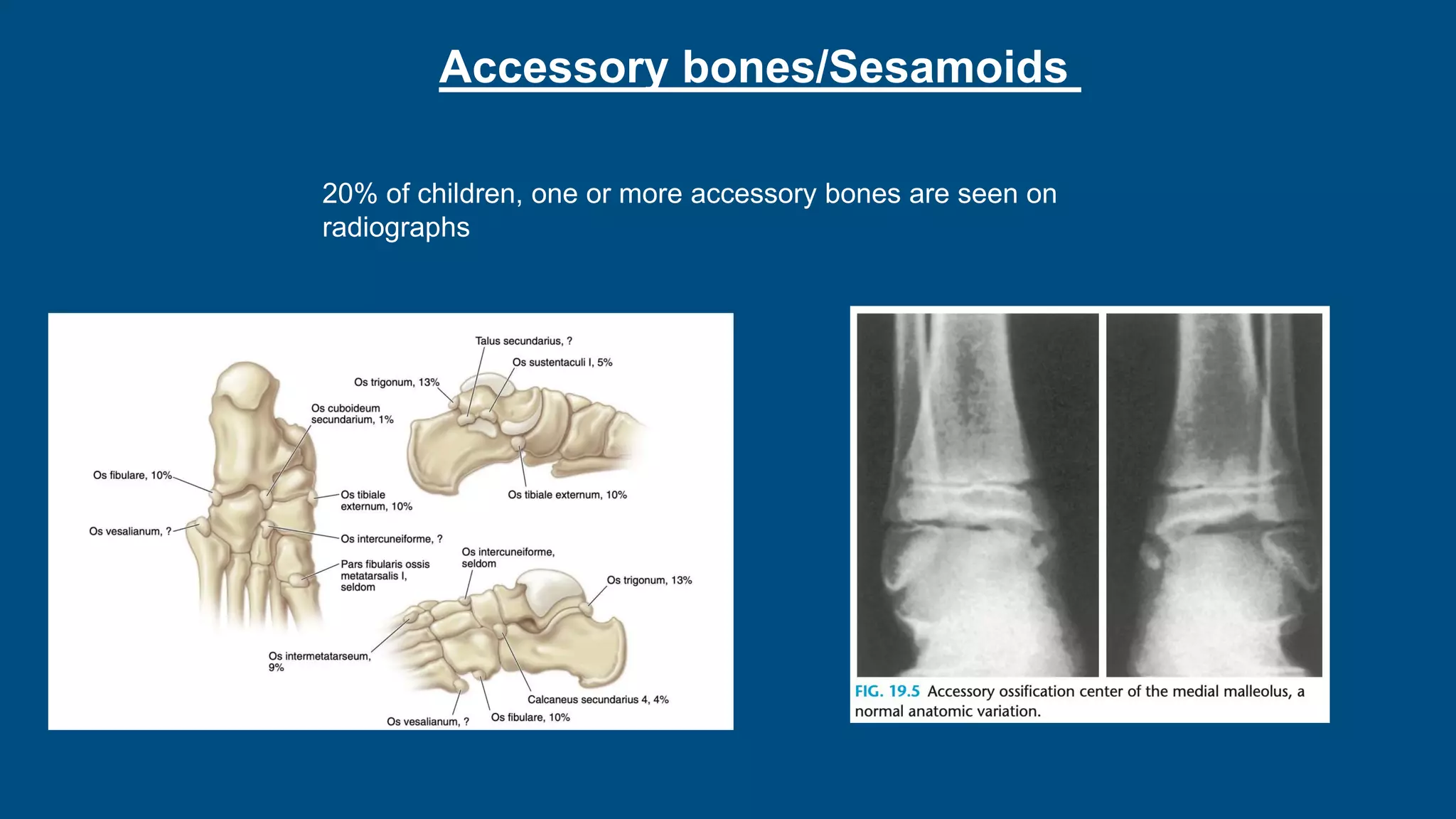
Accessory bones/Sesamoids
20% of children, one or more accessory bones are seen on
radiographs
Os trigonum/trigonal process/the
Stieda process/ posterior process
The os trigonum is formed from the lateral portion of the groove in
the posterior aspect of the talus, through which passes the flexor
hallucis longus .
Between 8 and 11 years old, medial and lateral centers of
ossification appear
• Immobilization
• Steroid injections around the os trigonum.
• Open or arthroscopic excision should be reserved for those in
whom conservative therapy fails
• Marotta and Micheli reported improvement after excision of
the ossicle in a series of ballet dancers in whom conservative
treatment failed.
• Abramowitz and colleagues noted worse results after
resection in patients who had symptoms for longer than 2
years when compared with those who had symptoms of a
shorter duration.
• Wredmark and associates released the flexor hallucis sheath
if thickened at the time of os trigonum removal
Prehallux, Accessory scaphoid, Os tibiale externum, Os naviculare secundarium, Navicular secundum.
Accessory navicular
14% to 26%
Three types of accessory navicular bones have been
described.
Type I (os tibiale externum) is a small ossicle within the
substance of the tibialis tendon.
Type II is an 8- to 12-mm ossicle extending medially and
plantarward from the navicular bone and connected to the
navicular by a cartilaginous synchondrosis.
Type III is a cornuate navicular remaining after fusion of the
accessory navicular with the primary navicular bone.
Positional Foot deformitis
Pes Supinatus
• It is the main differential diagnosis of clubfoot.
• A supination is observed, but with no equinus or adduction of
the forefoot .
• It is also distinguished from clubfoot by its total reductibility.
Pes Talus
• The plantar surface of the foot is against the wall of the uterus,
which forces the foot into dorsiflexion due to intrauterine
constraints.
• The result is excessive dorsiflexion of the foot, which allows its
dorsum to come into contact with the anterior aspect of the lower
leg.
• It is sometimes associated with a valgus mal- position and is also
characterized by total reducibility.
Brasseur‐Daudruy, Marie; Abu Amara, Saad;
Ickowicz‐Onnient, Valentine; Touleimat, Salma;
Verspyck, Eric (2019). Clubfoot Versus Positional
Foot Deformities on Prenatal Ultrasound Imaging.
Journal of Ultrasound in Medicine, (), jum.15136–.
doi:10.1002/jum.15136
• Calcaneovalgus foot is a condition in infants where the
foot is pushed up against the front of the leg.
• It’s caused by a baby being crowded or growing in an
unusual position in the uterus.
• Risk factors
1. First born babies
2. Babies with more birth weight.
3. Oligohydramnios
Positional Calcaneovalgus
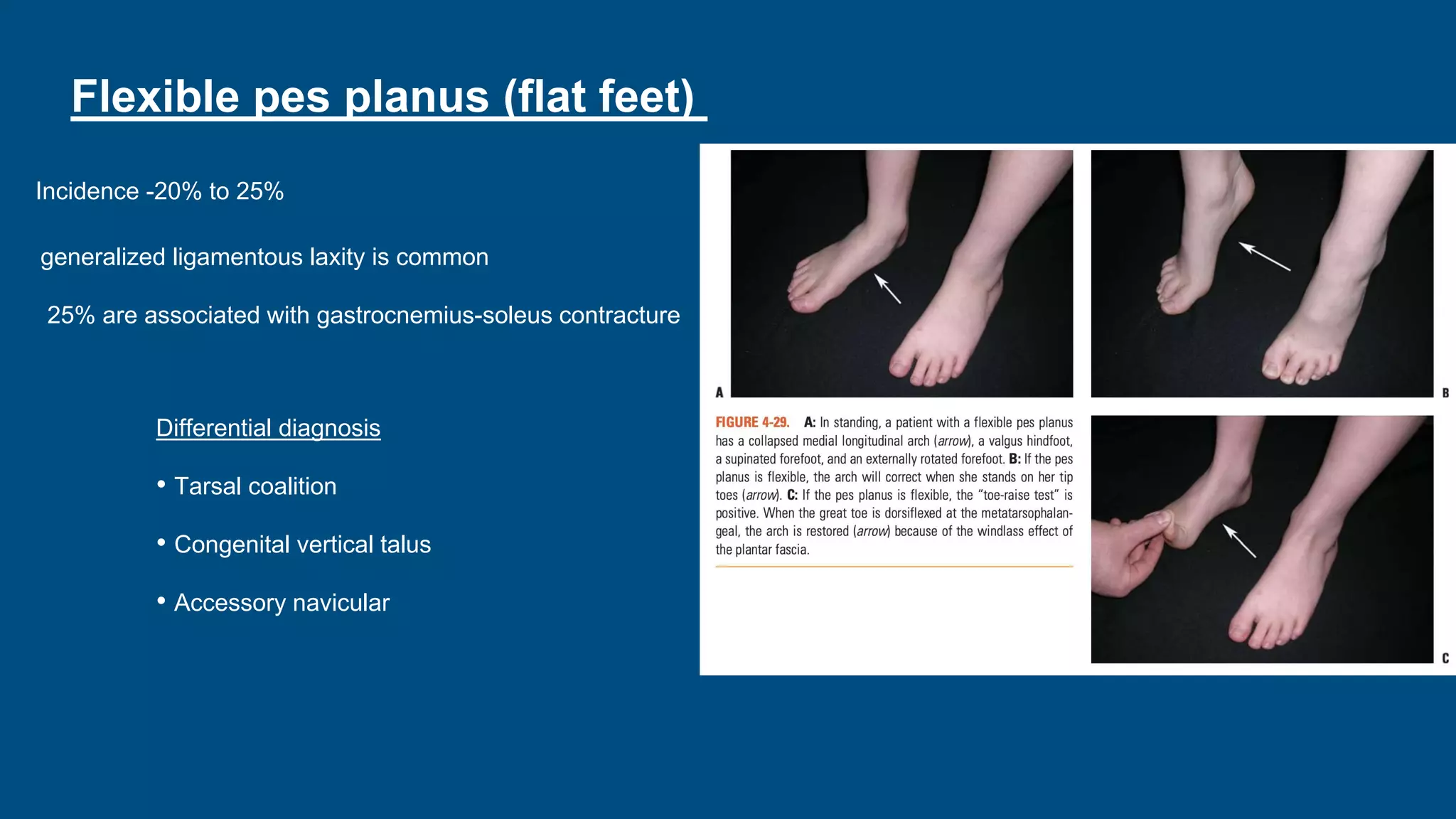
Flexible pes planus (flat feet)
Incidence -20% to 25%
generalized ligamentous laxity is common
25% are associated with gastrocnemius-soleus contracture
Differential diagnosis
• Tarsal coalition
• Congenital vertical talus
• Accessory navicular
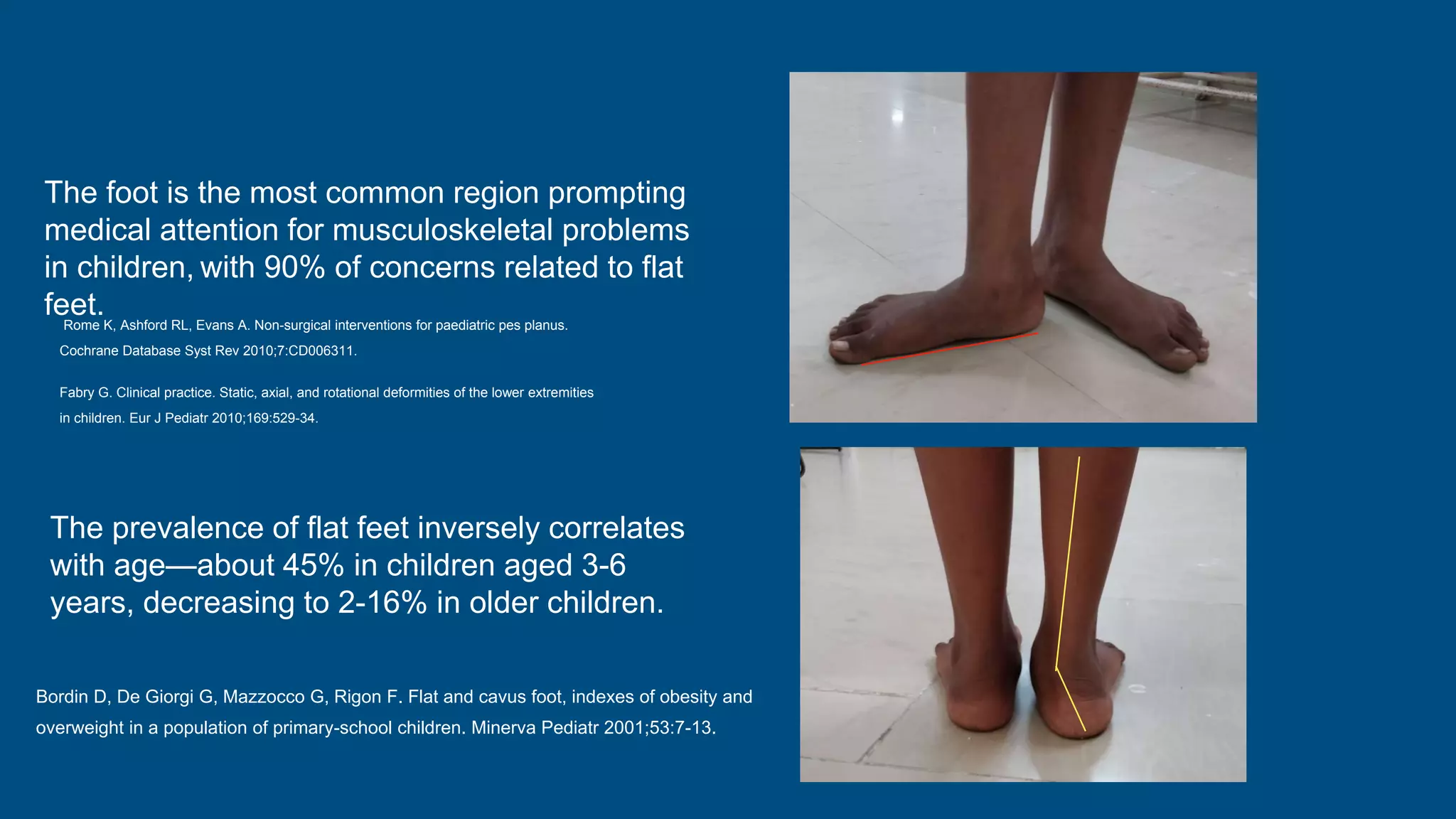
The foot is the most common region prompting
medical attention for musculoskeletal problems
in children, with 90% of concerns related to flat
feet.
Rome K, Ashford RL, Evans A. Non-surgical interventions for paediatric pes planus.
Cochrane Database Syst Rev 2010;7:CD006311.
Fabry G. Clinical practice. Static, axial, and rotational deformities of the lower extremities
in children. Eur J Pediatr 2010;169:529-34.
The prevalence of flat feet inversely correlates
with age—about 45% in children aged 3-6
years, decreasing to 2-16% in older children.
Bordin D, De Giorgi G, Mazzocco G, Rigon F. Flat and cavus foot, indexes of obesity and
overweight in a population of primary-school children. Minerva Pediatr 2001;53:7-13.
Talonavicular joint coverage is a good radiological
criterion for discriminating between symptomatic
and asymptomatic flatfoot
Moraleda and Mubarak reported a mean loss of
talonavicular coverage of 25 ± 8◦ in asymptomatic
patients, 36 ± 9◦ in symptomatic patients managed
non-operatively and 39 ± 11◦ in symptomatic
patients managed surgically
Limb length discrepancy
Approximately 15% of the adult population has a
leg length discrepancy (LLD) measuring greater
than 1 cm.
Most LLDs < 2 cm are idiopathic, due to normal
anatomic variation (asymmetry) of the human
body.
Rush WA, Steiner HA. A study of lower extremity length inequality. Am
J Roentgenol. 1946;56:616-23.
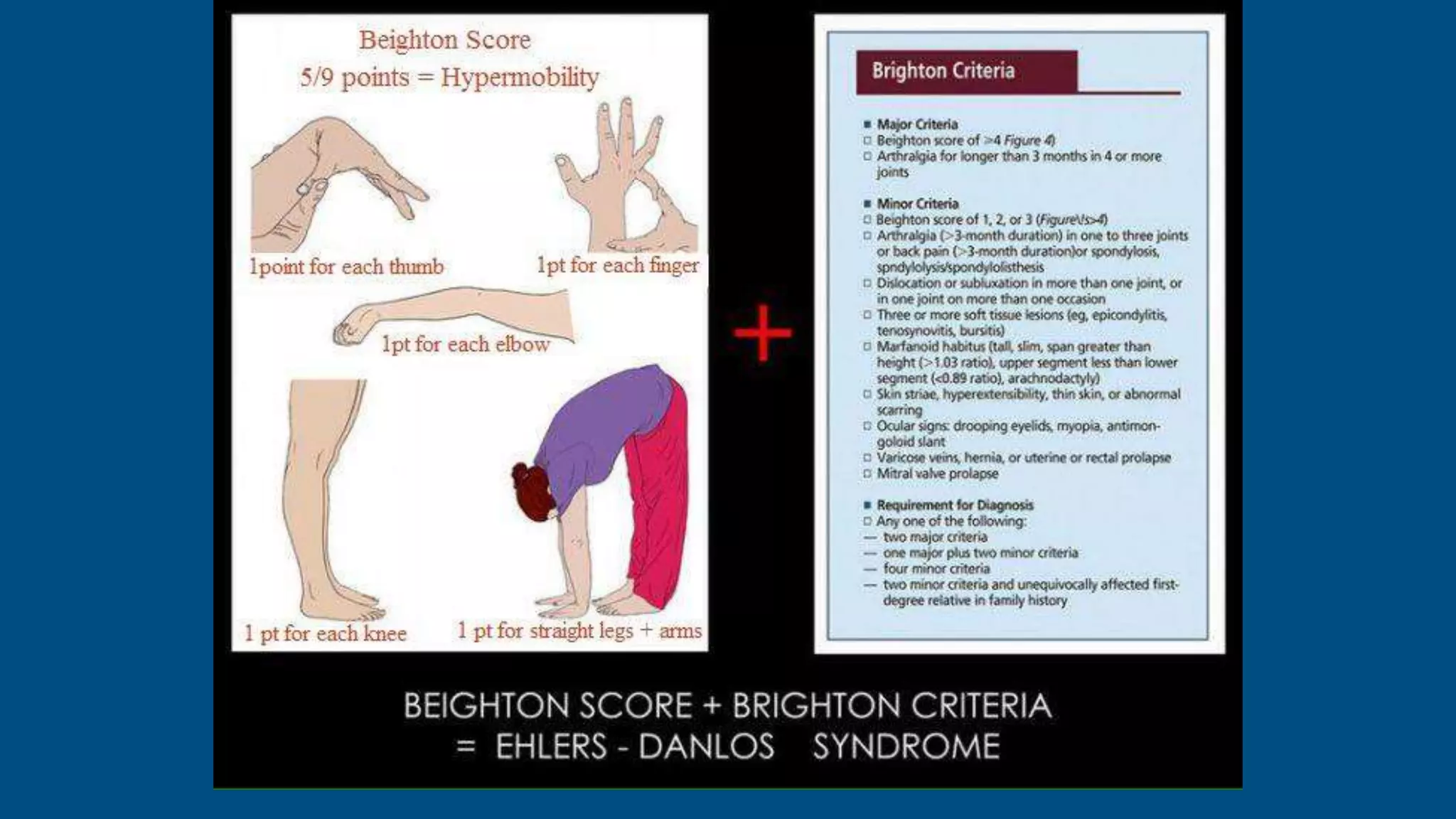
Hypermobility
Hypermobility syndrome (HMS) is a dominant
inherited connective tissue disorder described as
“generalized articular hypermobility, with or without
subluxation or dislocation.”
Ratio of type I to type III collagen is decreased in
skin.
Larsen, Beals, or Ehlers-Danlos syndrome
prevalence of hypermobility in children as a phenomenon [as
opposed to joint hypermobility syndrome (JHS), i.e. symptomatic
hypermobility] depending on the age or ethnicity of the study
population or the inclusion criteria, has been reported to be
between 2.3 and 30%
Numerous extra-articular manifestations of JHS
have been similarly reported in children,
including
• chronic constipation and encopresis, enuresis
and urinary tract infections (UTI)
• higher skin extensibility
• lower systemic blood pressure
• lower bone quantitative ultrasound
measurements
• chronic fatigue syndrome
• temporomandibular joint disease
• fibromyalgia
• gross motor developmental delay
The carrying angle is defined as the angle between the
long axis of the ulna and the long axis of the humerus
Carrying angle
F>M
Angle increases with age
Age-related increase from birth through
adolescence in carrying angle that was most
likely related more to the osseous development
of the elbow joint
Balasubramanian P, Madhuri V, Muliyil J. Carrying angle in children: a
normative study. J Pediatr Orthop B 2006; 15:37–40.
THANK YOU

Normal variations in children

  • 1.
    Dr Puneeth KPai Physiological variations in children
  • 2.
    • Common causeof parental concern. Referral by pediatrician, General Orthopedist, General practitioner. • Half of all new referrals to pediatric orthopedic clinic were children with normal variants of lower limb development in a study by Molony et al. D. Molony, G. Hefferman, et al., “Normal Variants in the Pediatric Orthopedic Population,” Irish Medical Journal, Vol. 99, No. 1, 2006, pp. 13-14.
  • 3.
    The following featuressuggest a pathological condition and not a normal variant : • Abnormal perinatal history. • Significant family history. • Abnormal facies . • Abnormal height for age. • Asymmetry of limb findings • Limitation of joint movements • Leg length discrepancy/hypoplasia/hypertrophy • Progressive deformity • NOT normal for age • Localised/Anglular deformities What is not normal? L. T. Staheli, “Lower Limb-Fundamentals of Pediatric Orthopedics,” 4th Edition, Lippincott Williams and Wi- lkins, Philadelphia, 2008.
  • 4.
    Lower Limb Rotational deformities •Intoeing • Out-toeing Coronal deformities • Genu varum • Genu valgum • Metatarsus Primus Varus • Positional foot deformities- Pes supinates and pes talus, Calcaneovalgus. • Accessory bones/Sesamoids Limb length discrepancy What is not abnormal? Upper limb Carrying angle General Hyperlaxity
  • 5.
    Rotational deformities Rotational valueswithin two standard deviations of the mean are termed “rotational variations,” and values outside two standard deviations are termed “torsional deformities” Staheli LT, Corbett M, Wyss C, et al. Lower-extremity rotational problems in children. Normal values to guide management. J Bone Joint Surg Am 1985;67(1):39–47. Staheli’s rotational profile
  • 6.
    • Bilateral • MostCommon rotational deformity in a growing child • M=F • 2/1000 children • Causes of intoeing can be at: 1. Hip 2. Tibia 3. Foot 4. ?? • Problems? Tripping/recurrant falls Cosmetic implications Unstable gait and easy fatiguability. In Toeing
  • 8.
    95 % ofall intoeing resolves by the age of 8 years
  • 9.
    Femoral anteversion 1.5 degreesof correction per year; more than 80 % of affected children, usually by age 10 years most pronounced between ages 4 to 6 years At birth, neonates have an average of 40° of femoral anteversion. By age 8 years, average anteversion decreases to the typical adult value of 15°
  • 10.
    • Characteristically sitwith their legs in the W position • Run with an eggbeater-type motion (because of internal rotation of the thighs during swing phase). • Usually increases until age 5 years and then resolves by age 8. • On physical examination: Internal hip rotation will be increased and external hip rotation decreased.
  • 11.
    No association betweenincreased femoral ante-version and degenerative joint disease has been proved, some association with knee pain has been suggested. Reikerås O: Patellofemoral characteristics in patients with increased femoral anteversion. Skeletal Radiol 1992;21:311-313. Knee pain may be particularly prevalent in children with concomitantly increased femoral anteversion and external tibial torsion (so-called miserable malalignment syndrome). Delgado ED, Schoenecker PL, Rich MM, Capelli AM: Treatment of severe torsional malalignment syndrome. J Pediatr Orthop 1996;16:484-488.
  • 15.
    Foot progression angle Anglebetween long axis of foot and midline Negative- in-toeing Positive- out-toeing The foot-progression angle in children 1 to 4 years of age can vary from 15 degrees of inward to 25 degrees of outward rotation. (L- W)
  • 16.
    Tibial intorsion • Internaltibial torsion is the most common cause of in-toeing from ages 1 to 3 years. • 2/3 rd bilateral • Left>Right •Intrauterine positioning •Expectant observation •Most resolve by 4 years of age •Disability due to persistant IR is rare •No risk of degenerative arthritis Fuchs R, Staheli LT: Sprinting and in- toeing. J Pediatr Orthop 1996;16:489-491
  • 17.
    In a retrospectivereview of all intoeing referrals to a Scottish paediatric orthopaedic unit, no children required surgery for their condition, with a 85% being discharged on their first visit. Similarly, in a large American series reviewing 720 intoeing referrals in a year, only one child required surgery. Blackmur JP, Murray AW. Do children who in-toe need to be referred to an orthopaedic clinic? J Pediatr Orthop B 2010;19:415-7. Karol LA. Rotational deformities in the lower extremities. Curr Opin Pediatr 1997;9:77-80.
  • 18.
    Surgical management reservedfor : • Children older than 8 years with marked functional • Cosmetic deformity • Thigh-foot angle greater than three standard deviations beyond the mean (eg, thigh-foot angle >15°).
  • 19.
    OUT-TOEING • Out toeingis less common than in toeing. • Femoral retroversion is common in early infancy and is thought to be due to intra-uterine packaging. • It is also observed commonly in obese children . • The clinical findings are reversed. In the pre-walking child the feet are usually observed to be rotated outward by about 90 degrees (called Charlie Chaplin appearance). • External tibial torsion is usually observed between 4 and 7 years of age. The thigh-foot angle is greater than +30 degrees. • The initial treatment is reassurance and parental edu- cation. External tibial torsion may not resolve as the child grows and surgery in the form of a tibial osteotomy may be required. • This is usually undertaken in the older child around 10 years of age. E. J. Wall, “Practical Primary Pediatric Orthopaedics,” Nursing Clinics of North America, Vol. 35, No. 1, 2000, pp. 95-113.
  • 20.
    Out-toeing gait • Externalrotation contracture of hip, • External tibial torsion • External femoral torsion. External rotation contracture of the hip capsule is a common finding during infancy, whereas external tibial or femoral torsion is more commonly seen in older children and adolescents who out- toe. Associated pes planovalgus 1. More serious conditions, such as a Slipped capital femoral epiphysis 2. Hip dysplasia 3. Coxa vara, are less common but should be considered. T. L. Lincoln and P. W. Suen, “Common Rotational Variations in Children,” Journal of the American Academy of Orthopaedic Surgeons, Vol. 11, No. 5, 2003, pp. 312- 320.
  • 21.
    Coronal plane deformities Angularalignment refers to the tibiofemoral angle, which can be clinically assessed by the intermalleolar and intercondylar distances Salenius P, Vankka E. The development of the tibiofemoral angle in children. J Bone Joint Surg Am 1975;57:259-61. Salenius and Vankka Landmark study of tibiofemoral angles in 1500 normal children Up to the age of 18 months present with genu varum (bow legs; mean of 15°) Genu valgum (knock knees; mean of 12°) deformity ensues, which subsequently corrects itself to the normal value in adults (7-8° valgus) by the age of 7 years.
  • 25.
    Physiological Genu varum Heath CH,Staheli LT. Normal limits of knee angle in white children:genu varum and genu valgum. J Pediatr Orthop 1993;13:259-62. Physiologic genu varum is defined by a tibiofemoral angle of at least 10 degrees of varus, a radiographically normal physis, and apex lateral bowing of the proximal end of the tibia and often the distal end of the femur. • Physiological genu varum is thought to relate to intrauterine positioning • Which leads to the contracture of the medial knee joint capsule. • This, in addition to the internal tibial torsion common in this age group, accentuates the deformity when children weight bear. • Therefore, referrals for bow legs are common for children aged between 10 and 14 months, the average age at which children start to stand and ambulate. • The intercondylar distance is measured with the medial malleoli in contact and should be less than 6 cm.
  • 26.
    Physiological Genu valgum • Referralsfor knock knees are common in children aged between 3 and 4 years. (Normal b/w 2-8 yrs). • A skeletally mature femoral-tibial alignment of approximately 5 to 7 degrees of valgus . • Accentuated by obesity, ligamentous laxity, and flat feet. • In addition, torsional deformities such as femoral anteversion with compensatory external tibial torsion may make a physiological genu valgum appear more severe. • The intermalleolar distance is measured with the knees in contact and should be less than 8 cm. Indications for Surgical intervention. • > 15-20° of valgus in a patient between ages 7-10 • if line drawn from center of femoral head to center of ankle falls in lateral quadrant of tibial plateau in patient > 10 yrs of age Heath CH, Staheli LT. Normal limits of knee angle in white children:genu varum and genu valgum. J Pediatr Orthop 1993;13:259-62.
  • 29.
    Metatarsus adducts • occursin approximately 1 in 1,000 births • equal frequency in males and females • bilateral approximately 50% of cases Associated conditions • DDH (15-20%) • Torticollis Most common congenital foot deformity
  • 31.
    Metatarsus Primus Varus •Metatarsus primus varus is an isolated adducted first metatarsal. • In contrast with simple metatarsus ad- ductus, in metatarsus primus varus the lateral border of the foot has a normal alignment, and there is often a deepened vertical skin crease on the medial border of the foot at the tar- some tatarsal joint. • In general, meta- tarsus primus varus is a more rigid deformity than simple metatarsus ad- ductus, and early casting is recommended. • Persistent deformity in childhood is associated with progressive hallux valgus. • Opening medial cuneiform osteotomy has been described for selective use in children with a severe deformity. Lynch FR: Applications of the opening wedge cuneiform osteotomy in the surgical repair of juvenile hallux abducto valgus. J Foot Ankle Surg 1995;34:103-123.
  • 32.
    Accessory bones/Sesamoids 20% ofchildren, one or more accessory bones are seen on radiographs
  • 33.
    Os trigonum/trigonal process/the Stiedaprocess/ posterior process The os trigonum is formed from the lateral portion of the groove in the posterior aspect of the talus, through which passes the flexor hallucis longus . Between 8 and 11 years old, medial and lateral centers of ossification appear • Immobilization • Steroid injections around the os trigonum. • Open or arthroscopic excision should be reserved for those in whom conservative therapy fails • Marotta and Micheli reported improvement after excision of the ossicle in a series of ballet dancers in whom conservative treatment failed. • Abramowitz and colleagues noted worse results after resection in patients who had symptoms for longer than 2 years when compared with those who had symptoms of a shorter duration. • Wredmark and associates released the flexor hallucis sheath if thickened at the time of os trigonum removal
  • 34.
    Prehallux, Accessory scaphoid,Os tibiale externum, Os naviculare secundarium, Navicular secundum. Accessory navicular 14% to 26% Three types of accessory navicular bones have been described. Type I (os tibiale externum) is a small ossicle within the substance of the tibialis tendon. Type II is an 8- to 12-mm ossicle extending medially and plantarward from the navicular bone and connected to the navicular by a cartilaginous synchondrosis. Type III is a cornuate navicular remaining after fusion of the accessory navicular with the primary navicular bone.
  • 35.
    Positional Foot deformitis PesSupinatus • It is the main differential diagnosis of clubfoot. • A supination is observed, but with no equinus or adduction of the forefoot . • It is also distinguished from clubfoot by its total reductibility. Pes Talus • The plantar surface of the foot is against the wall of the uterus, which forces the foot into dorsiflexion due to intrauterine constraints. • The result is excessive dorsiflexion of the foot, which allows its dorsum to come into contact with the anterior aspect of the lower leg. • It is sometimes associated with a valgus mal- position and is also characterized by total reducibility. Brasseur‐Daudruy, Marie; Abu Amara, Saad; Ickowicz‐Onnient, Valentine; Touleimat, Salma; Verspyck, Eric (2019). Clubfoot Versus Positional Foot Deformities on Prenatal Ultrasound Imaging. Journal of Ultrasound in Medicine, (), jum.15136–. doi:10.1002/jum.15136
  • 36.
    • Calcaneovalgus footis a condition in infants where the foot is pushed up against the front of the leg. • It’s caused by a baby being crowded or growing in an unusual position in the uterus. • Risk factors 1. First born babies 2. Babies with more birth weight. 3. Oligohydramnios Positional Calcaneovalgus
  • 37.
    Flexible pes planus(flat feet) Incidence -20% to 25% generalized ligamentous laxity is common 25% are associated with gastrocnemius-soleus contracture Differential diagnosis • Tarsal coalition • Congenital vertical talus • Accessory navicular
  • 38.
    The foot isthe most common region prompting medical attention for musculoskeletal problems in children, with 90% of concerns related to flat feet. Rome K, Ashford RL, Evans A. Non-surgical interventions for paediatric pes planus. Cochrane Database Syst Rev 2010;7:CD006311. Fabry G. Clinical practice. Static, axial, and rotational deformities of the lower extremities in children. Eur J Pediatr 2010;169:529-34. The prevalence of flat feet inversely correlates with age—about 45% in children aged 3-6 years, decreasing to 2-16% in older children. Bordin D, De Giorgi G, Mazzocco G, Rigon F. Flat and cavus foot, indexes of obesity and overweight in a population of primary-school children. Minerva Pediatr 2001;53:7-13.
  • 39.
    Talonavicular joint coverageis a good radiological criterion for discriminating between symptomatic and asymptomatic flatfoot Moraleda and Mubarak reported a mean loss of talonavicular coverage of 25 ± 8◦ in asymptomatic patients, 36 ± 9◦ in symptomatic patients managed non-operatively and 39 ± 11◦ in symptomatic patients managed surgically
  • 41.
    Limb length discrepancy Approximately15% of the adult population has a leg length discrepancy (LLD) measuring greater than 1 cm. Most LLDs < 2 cm are idiopathic, due to normal anatomic variation (asymmetry) of the human body. Rush WA, Steiner HA. A study of lower extremity length inequality. Am J Roentgenol. 1946;56:616-23.
  • 42.
    Hypermobility Hypermobility syndrome (HMS)is a dominant inherited connective tissue disorder described as “generalized articular hypermobility, with or without subluxation or dislocation.” Ratio of type I to type III collagen is decreased in skin. Larsen, Beals, or Ehlers-Danlos syndrome
  • 44.
    prevalence of hypermobilityin children as a phenomenon [as opposed to joint hypermobility syndrome (JHS), i.e. symptomatic hypermobility] depending on the age or ethnicity of the study population or the inclusion criteria, has been reported to be between 2.3 and 30% Numerous extra-articular manifestations of JHS have been similarly reported in children, including • chronic constipation and encopresis, enuresis and urinary tract infections (UTI) • higher skin extensibility • lower systemic blood pressure • lower bone quantitative ultrasound measurements • chronic fatigue syndrome • temporomandibular joint disease • fibromyalgia • gross motor developmental delay
  • 46.
    The carrying angleis defined as the angle between the long axis of the ulna and the long axis of the humerus Carrying angle F>M Angle increases with age Age-related increase from birth through adolescence in carrying angle that was most likely related more to the osseous development of the elbow joint Balasubramanian P, Madhuri V, Muliyil J. Carrying angle in children: a normative study. J Pediatr Orthop B 2006; 15:37–40.
  • 47.