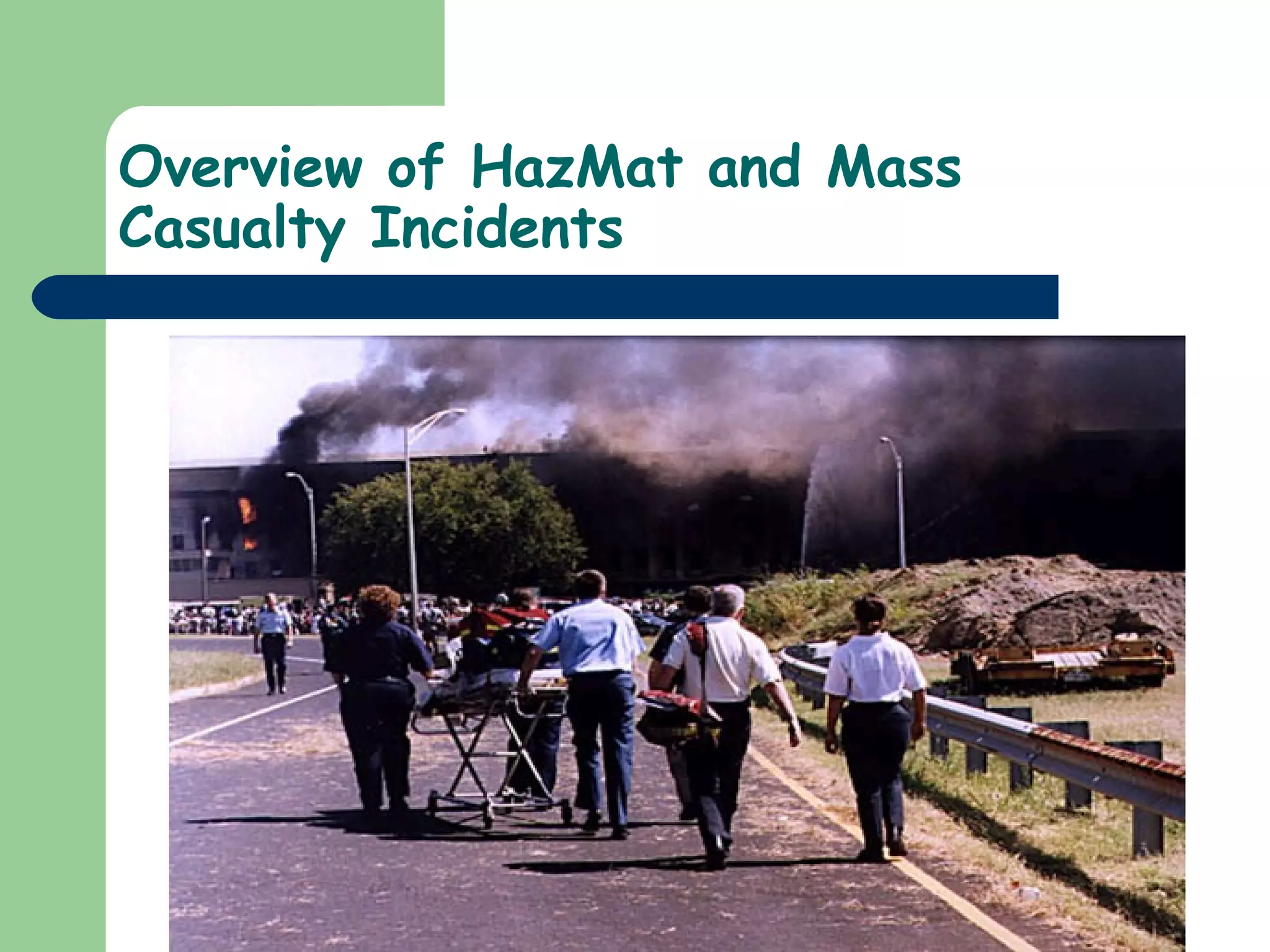
Overview of HazMat and Mass
Casualty Incidents
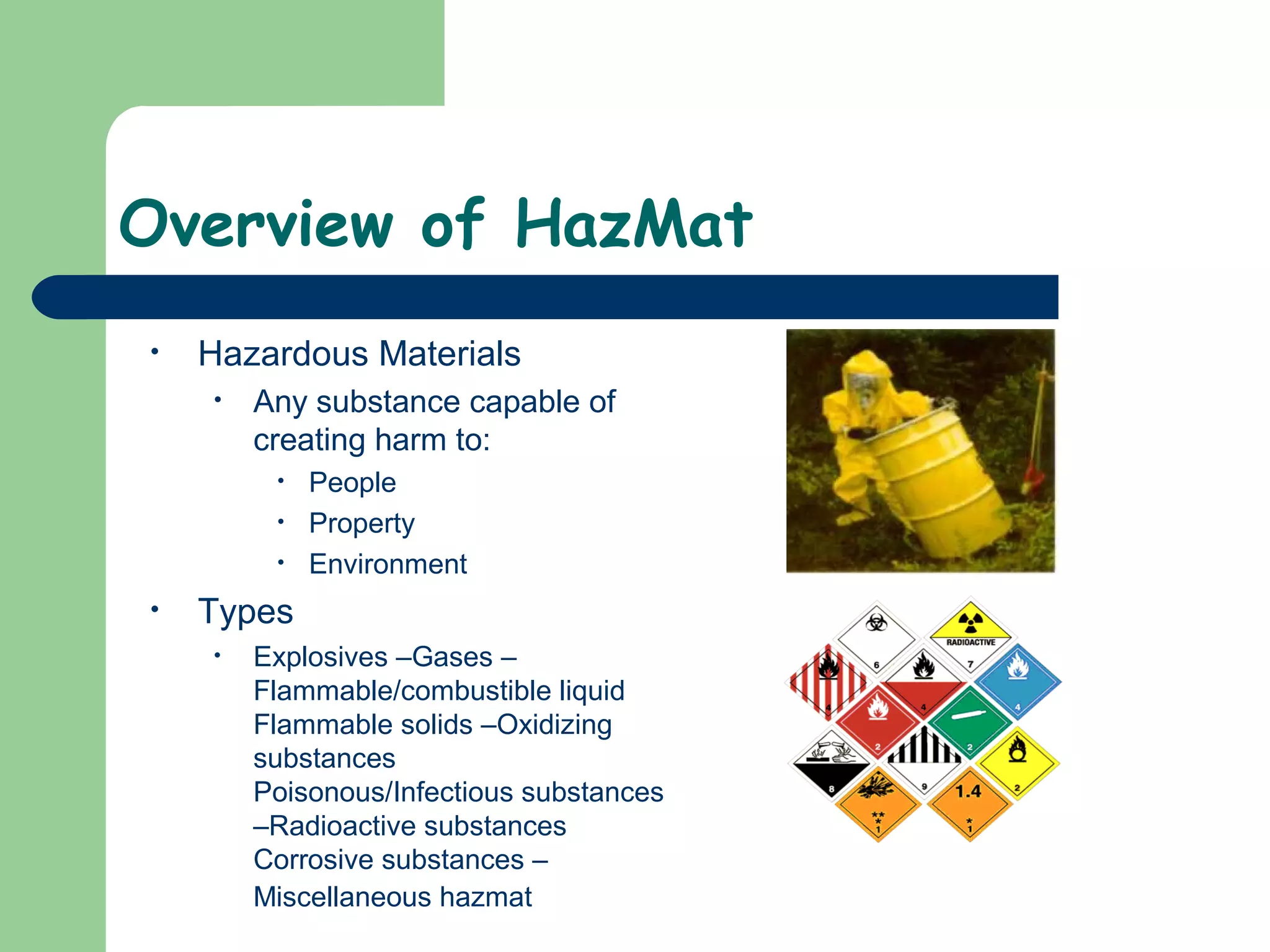
Overview of HazMat
• Hazardous Materials
• Any substance capable of
creating harm to:
• People
• Property
• Environment
• Types
• Explosives –Gases –
Flammable/combustible liquid
Flammable solids –Oxidizing
substances
Poisonous/Infectious substances
–Radioactive substances
Corrosive substances –
Miscellaneous hazmat
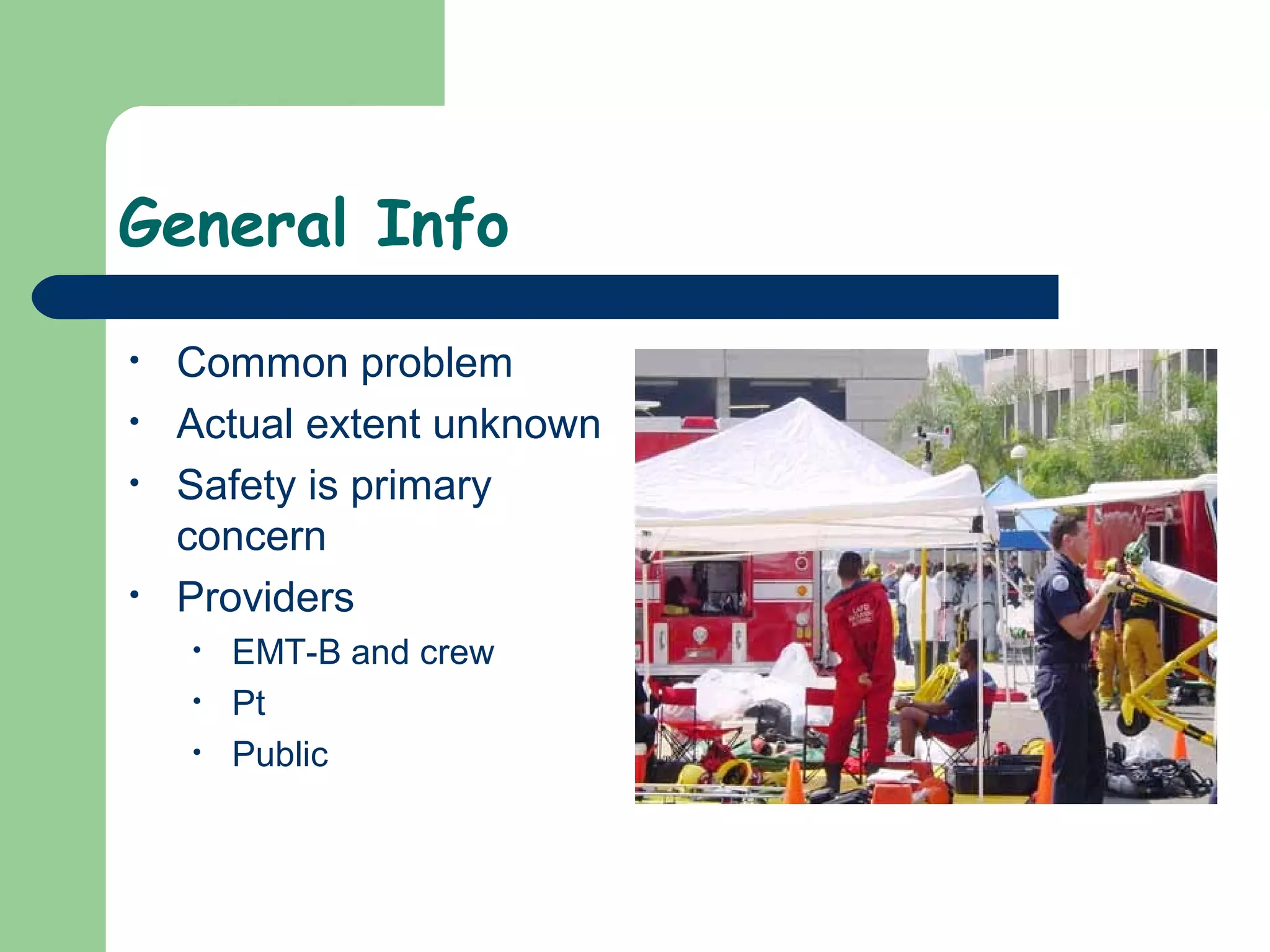
General Info
• Common problem
• Actual extent unknown
• Safety is primary
concern
• Providers
• EMT-B and crew
• Pt
• Public
Approaching the Scene
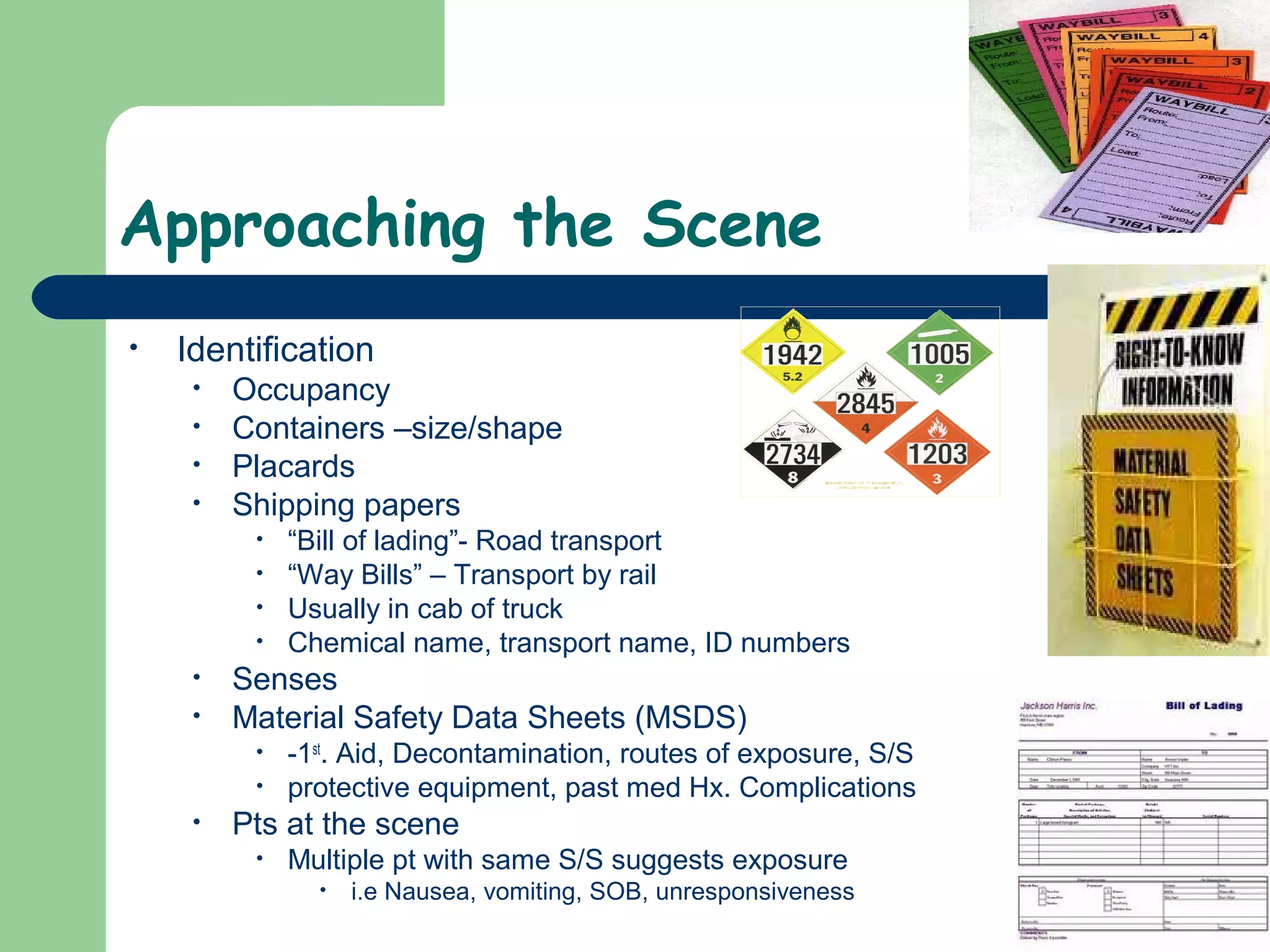
• Identification
• Occupancy
• Containers –size/shape
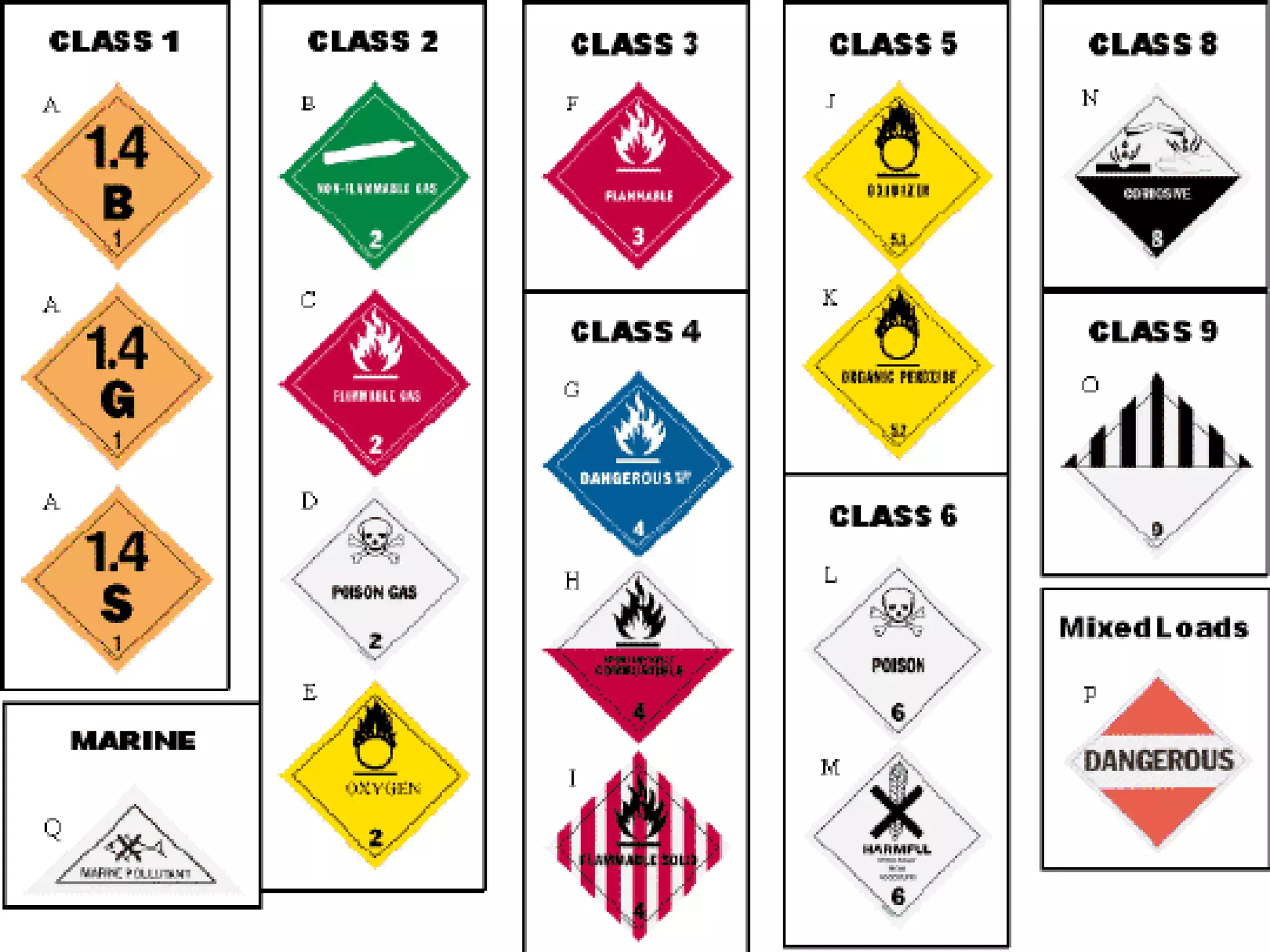
• Placards
• Shipping papers
• “Bill of lading”- Road transport
• “Way Bills” – Transport by rail
• Usually in cab of truck
• Chemical name, transport name, ID numbers
• Senses
• Material Safety Data Sheets (MSDS)
• -1st
. Aid, Decontamination, routes of exposure, S/S
• protective equipment, past med Hx. Complications
• Pts at the scene
• Multiple pt with same S/S suggests exposure
• i.e Nausea, vomiting, SOB, unresponsiveness
Approaching
the Scene
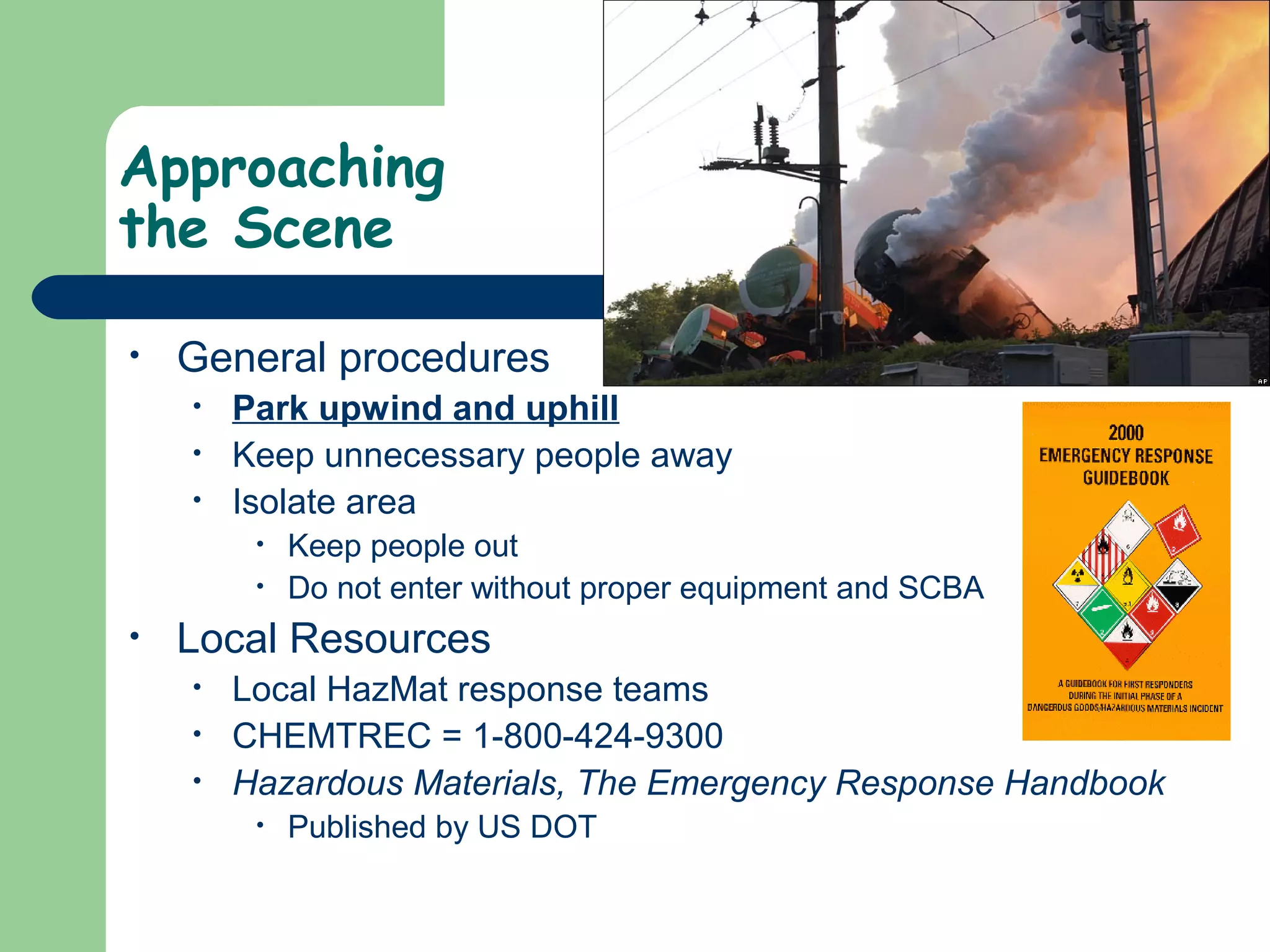
• General procedures
• Park upwind and uphill
• Keep unnecessary people away
• Isolate area
• Keep people out
• Do not enter without proper equipment and SCBA
• Local Resources
• Local HazMat response teams
• CHEMTREC = 1-800-424-9300
• Hazardous Materials, The Emergency Response Handbook
• Published by US DOT
HazMat Zones
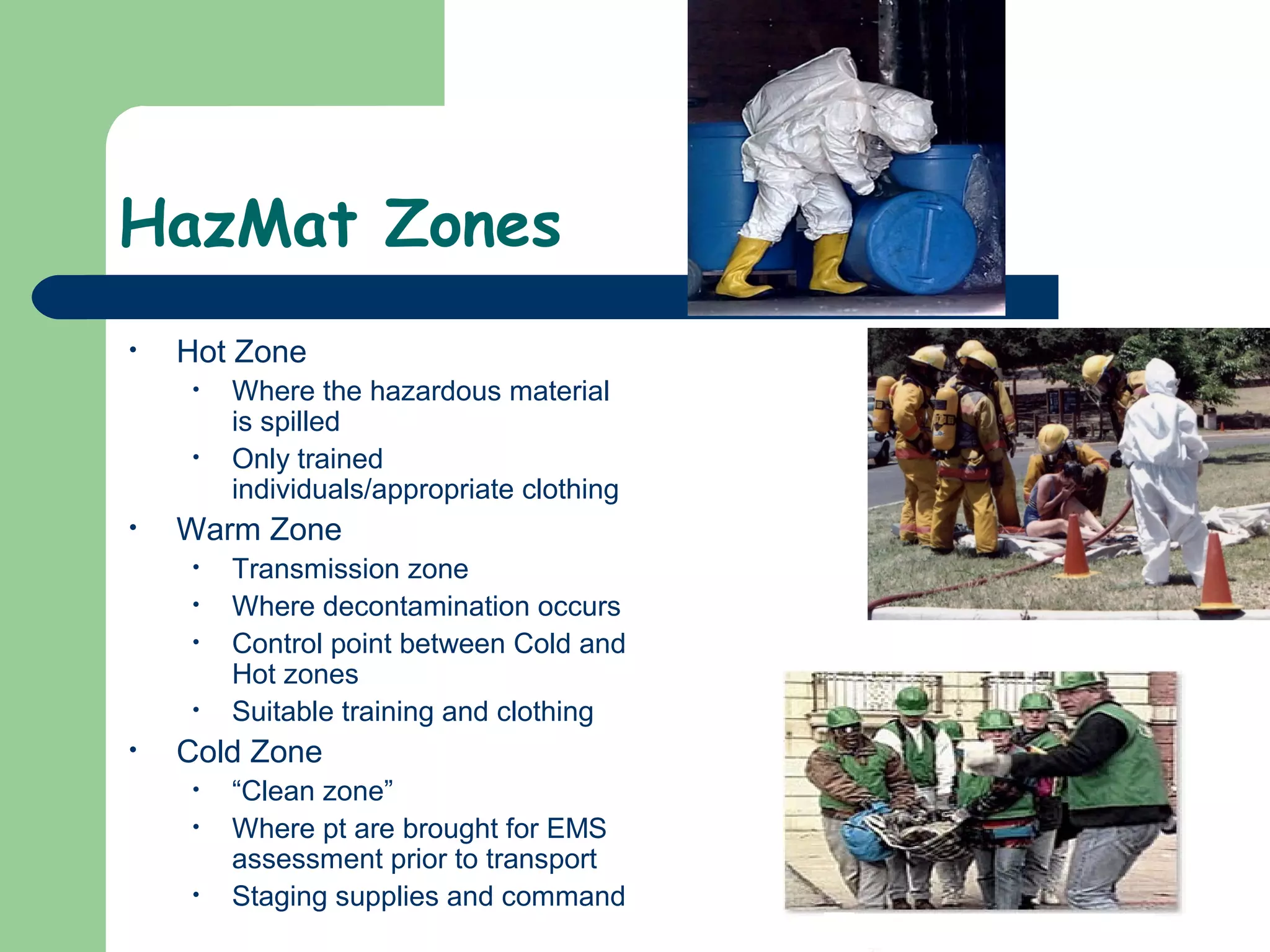
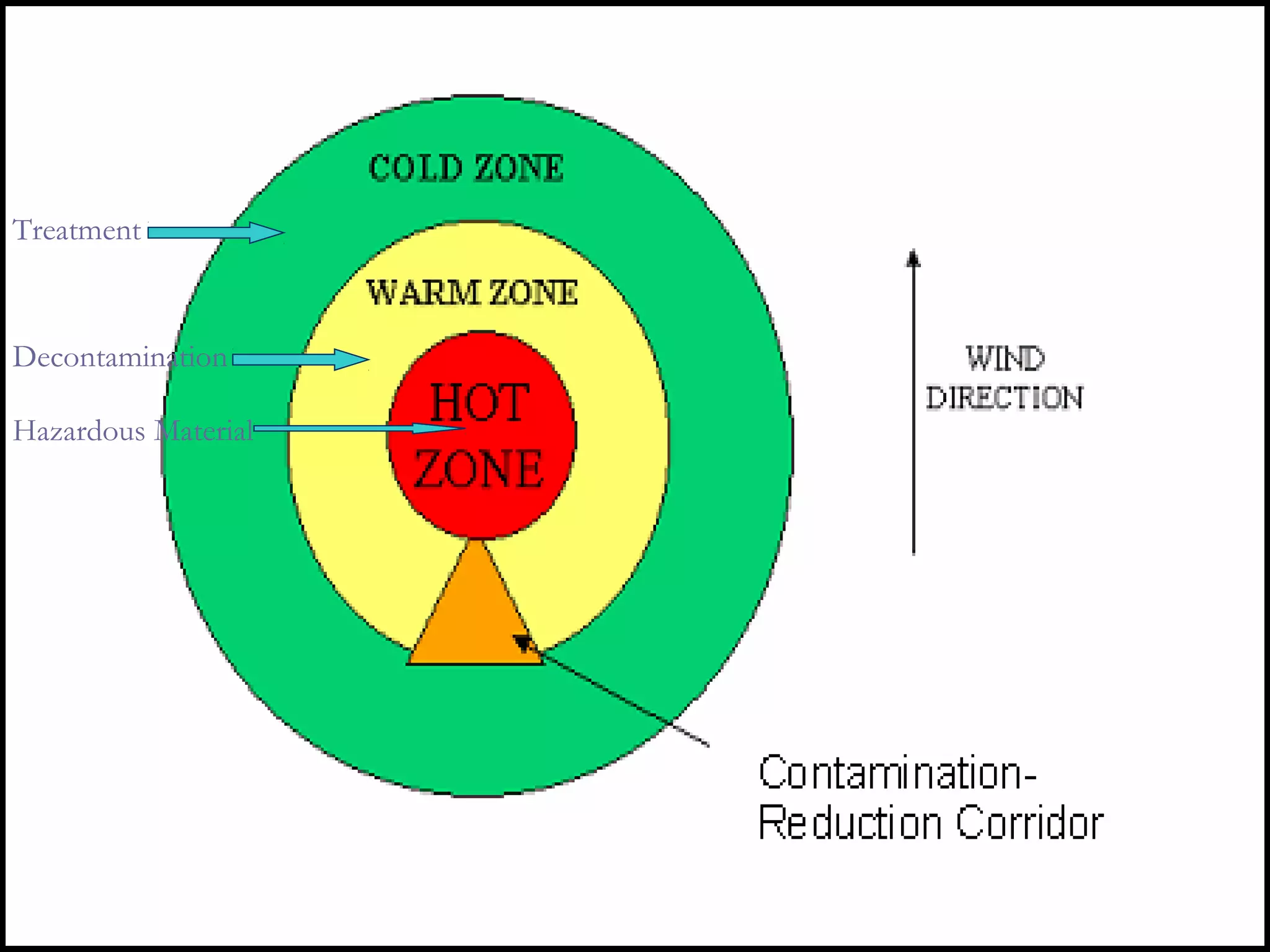
• Hot Zone
• Where the hazardous material
is spilled
• Only trained
individuals/appropriate clothing
• Warm Zone
• Transmission zone
• Where decontamination occurs
• Control point between Cold and
Hot zones
• Suitable training and clothing
• Cold Zone
• “Clean zone”
• Where pt are brought for EMS
assessment prior to transport
• Staging supplies and command
Treatment
Decontamination
Hazardous Material
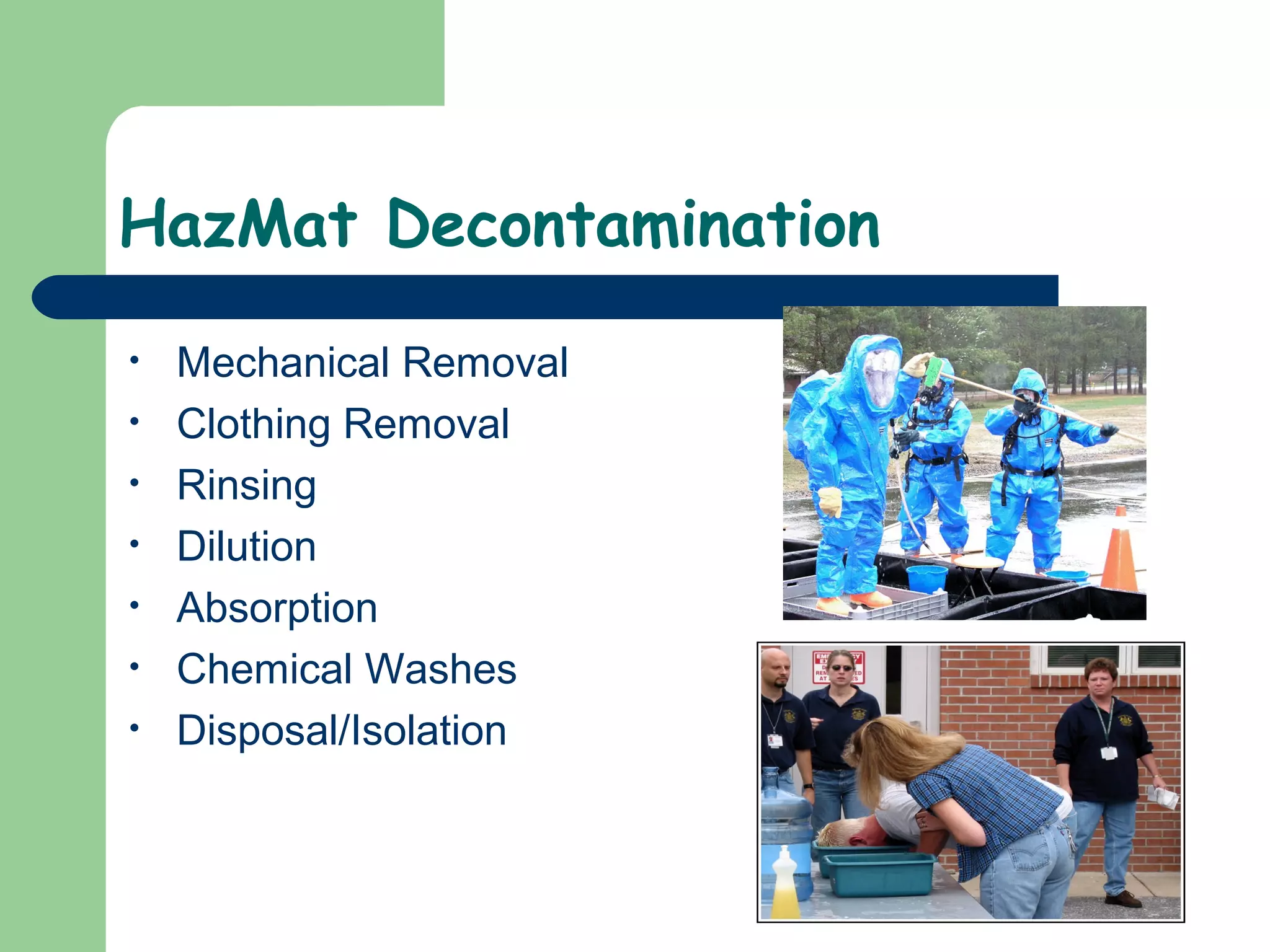
HazMat Decontamination
• Mechanical Removal
• Clothing Removal
• Rinsing
• Dilution
• Absorption
• Chemical Washes
• Disposal/Isolation
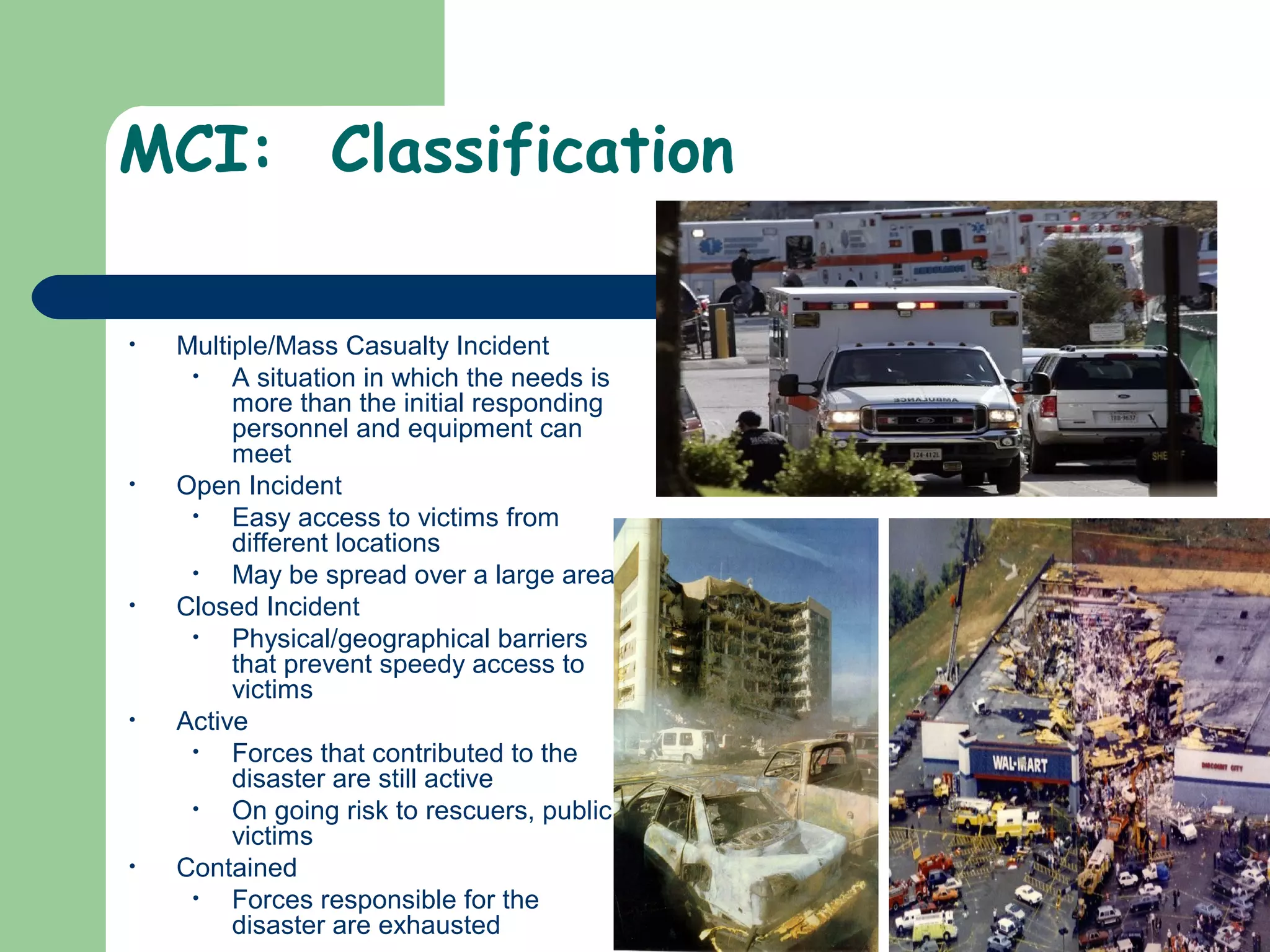
MCI: Classification
• Multiple/Mass Casualty Incident
• A situation in which the needs is
more than the initial responding
personnel and equipment can
meet
• Open Incident
• Easy access to victims from
different locations
• May be spread over a large area
• Closed Incident
• Physical/geographical barriers
that prevent speedy access to
victims
• Active
• Forces that contributed to the
disaster are still active
• On going risk to rescuers, public,
victims
• Contained
• Forces responsible for the
disaster are exhausted
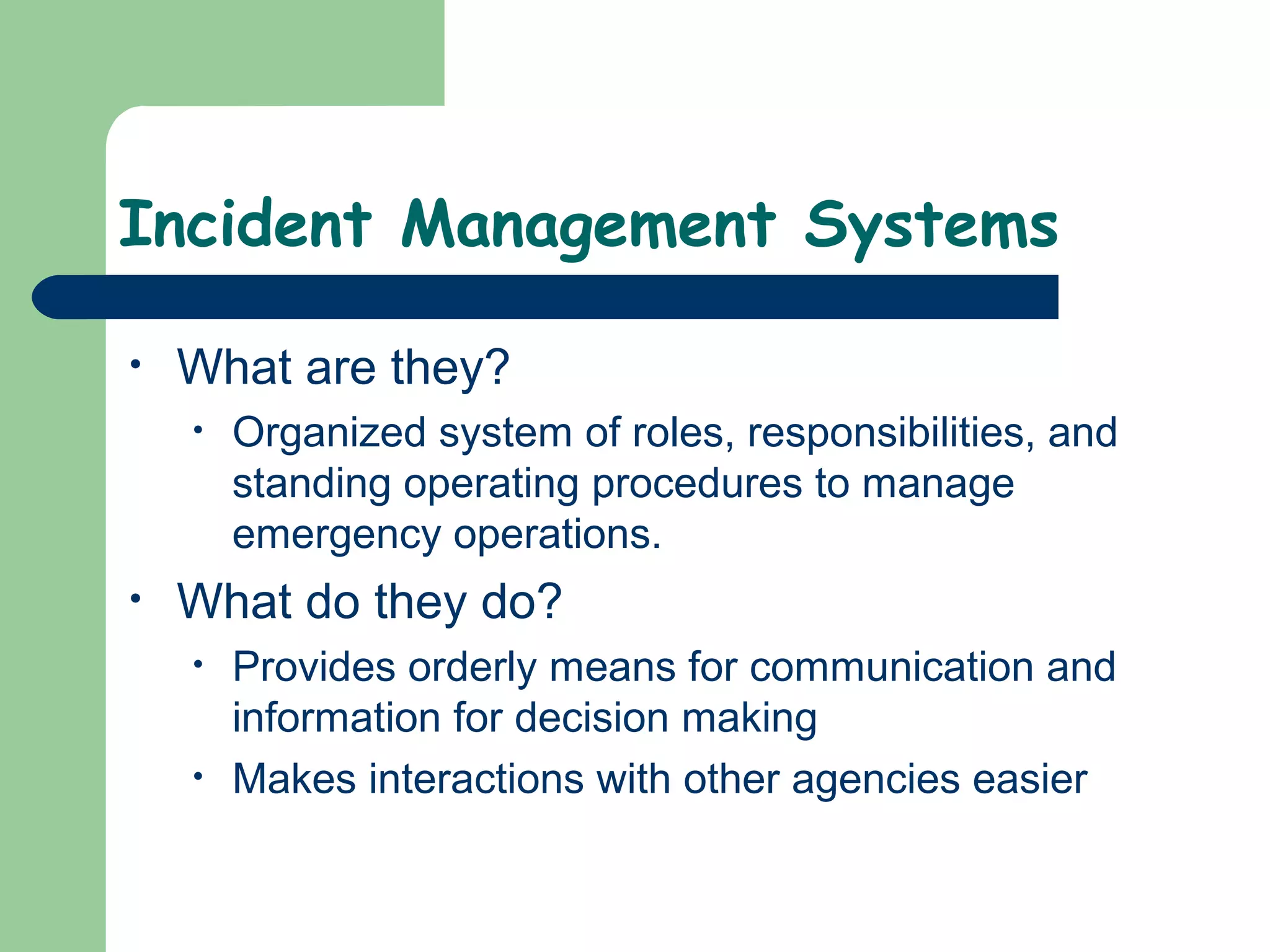
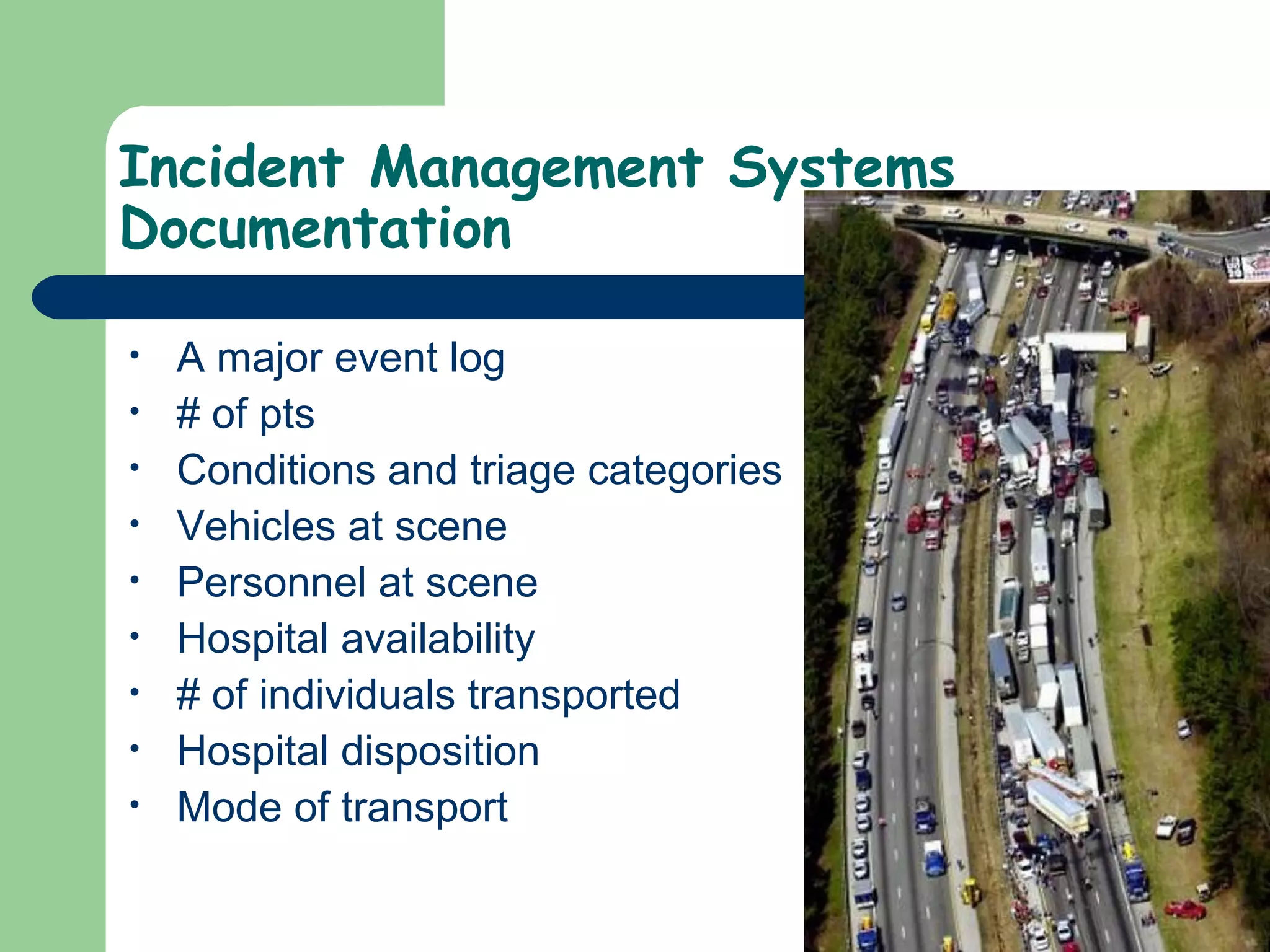
Incident Management Systems
• What are they?
• Organized system of roles, responsibilities, and
standing operating procedures to manage
emergency operations.
• What do they do?
• Provides orderly means for communication and
information for decision making
• Makes interactions with other agencies easier
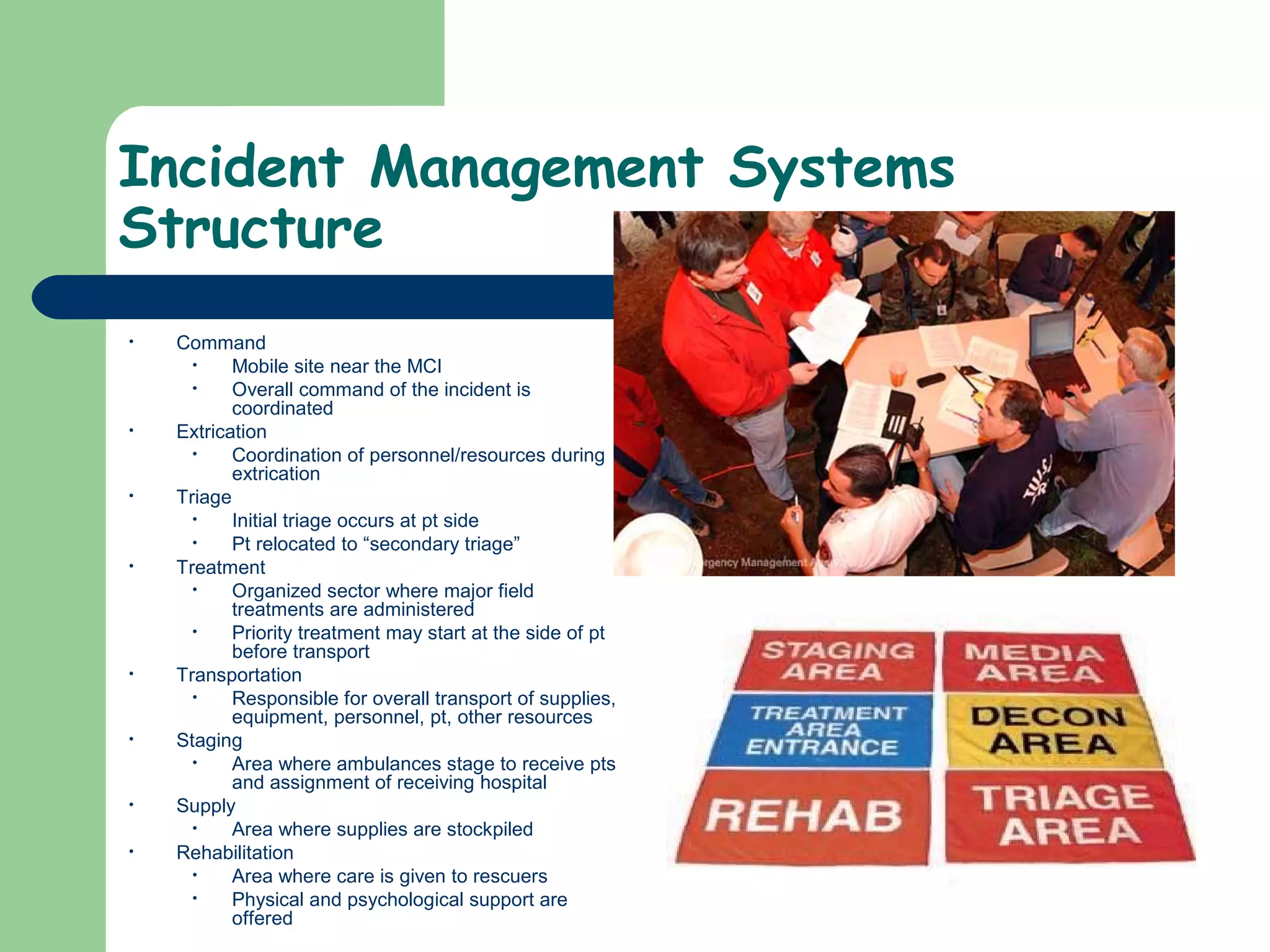
Incident Management Systems
Structure
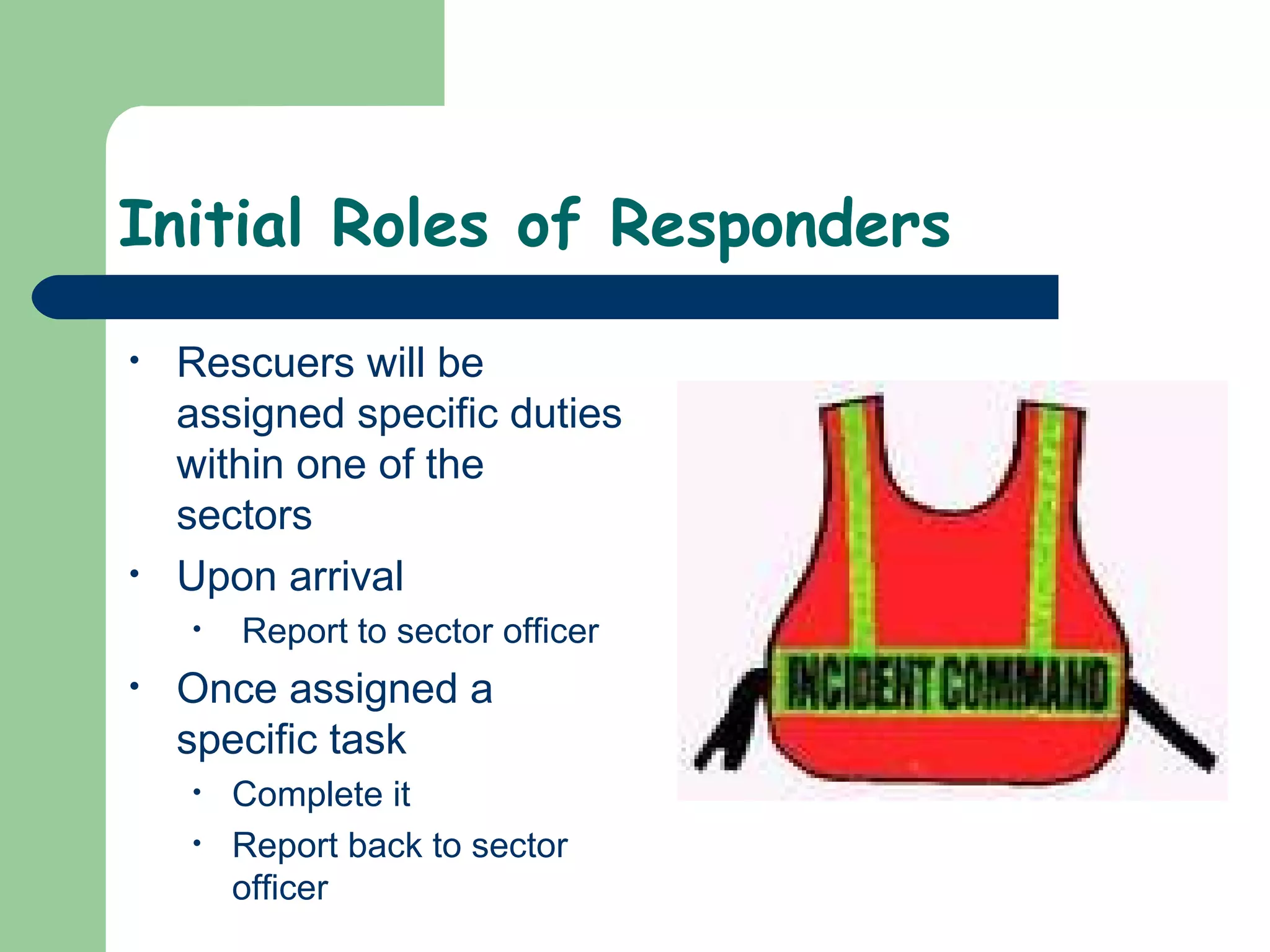
• Command
• Mobile site near the MCI
• Overall command of the incident is
coordinated
• Extrication
• Coordination of personnel/resources during
extrication
• Triage
• Initial triage occurs at pt side
• Pt relocated to “secondary triage”
• Treatment
• Organized sector where major field
treatments are administered
• Priority treatment may start at the side of pt
before transport
• Transportation
• Responsible for overall transport of supplies,
equipment, personnel, pt, other resources
• Staging
• Area where ambulances stage to receive pts
and assignment of receiving hospital
• Supply
• Area where supplies are stockpiled
• Rehabilitation
• Area where care is given to rescuers
• Physical and psychological support are
offered
Incident Management Systems
Documentation
• A major event log
• # of pts
• Conditions and triage categories
• Vehicles at scene
• Personnel at scene
• Hospital availability
• # of individuals transported
• Hospital disposition
• Mode of transport
Initial Roles of Responders
• Rescuers will be
assigned specific duties
within one of the
sectors
• Upon arrival
• Report to sector officer
• Once assigned a
specific task
• Complete it
• Report back to sector
officer
Triage
• Heroic resuscitative efforts NOT appropriate
• Too much time
• Requires equipment used for salvageable patients
• Staffing intensive
• Concentrate on salvageable patients
MCI Procedures
• Est. type of incident
• Determine specific location and ID best access routes
• 1 EMT approaches scene and determines:
• Estimates # of pt
• Estimates injury types
• If incident is open/closed and active/contained
• 2nd
EMT stays with ambulance and determines:
• Possible staging areas
• Traffic routes into area
• Both EMTs should ascertain
• Approx # of pts
• Specific location of incident
• Whether incident is open/closed and active/contained
• Need for special resources
• # of additional ambulances needed
• Potential dangers to public safety and personnel
• IMMEDIATELY relay this info to communications center
MCI Procedures Cont’d
• Most knowledgeable EMT on scene initially assumes Triage
Officer
• Request additional help
• Perform initial assessment of all pts
• START Triage
• Assign available personnel/equipment to critical pts
• Secondary Triage
• In depth assessment of pt
• In treatment area OR en route to ER
• Pt transport is based on:
• Prioritization
• Destination facilities
• Transport resources
• Triage officer remains in scent to:
• Assign/coordinate: Personnel, equipment, vehicles
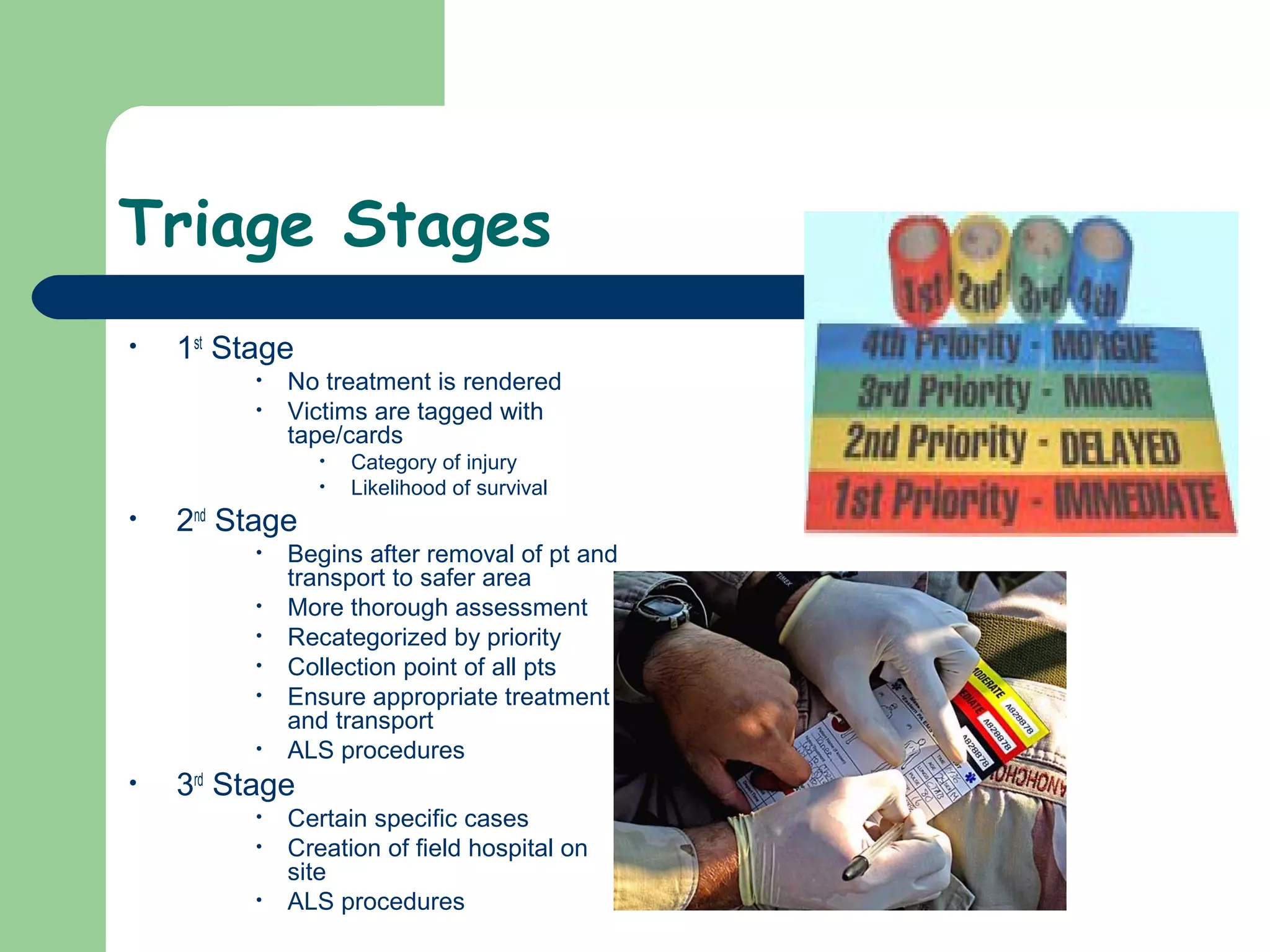
Triage Stages
• 1st
Stage
• No treatment is rendered
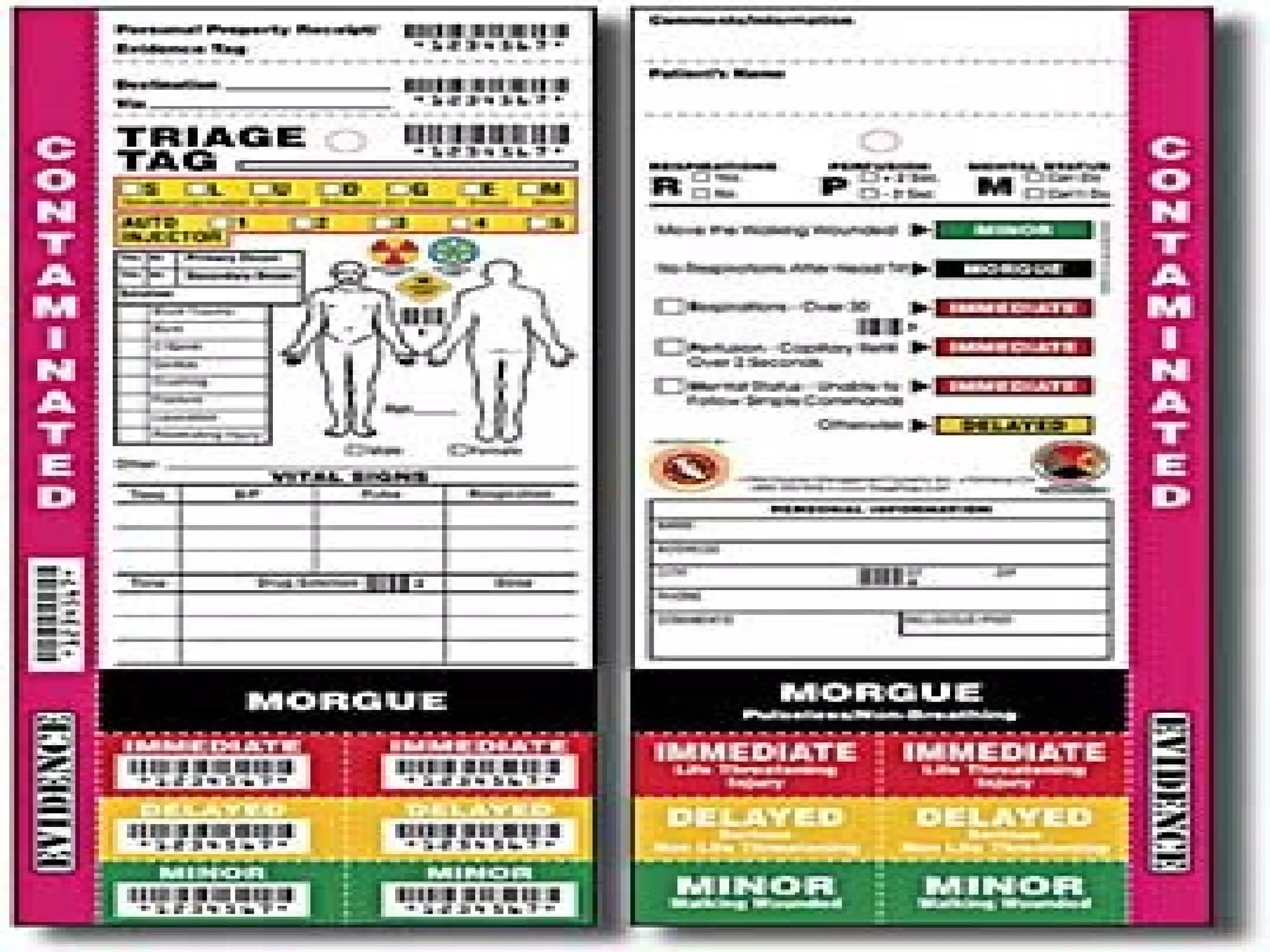
• Victims are tagged with
tape/cards
• Category of injury
• Likelihood of survival
• 2nd
Stage
• Begins after removal of pt and
transport to safer area
• More thorough assessment
• Recategorized by priority
• Collection point of all pts
• Ensure appropriate treatment
and transport
• ALS procedures
• 3rd
Stage
• Certain specific cases
• Creation of field hospital on
site
• ALS procedures
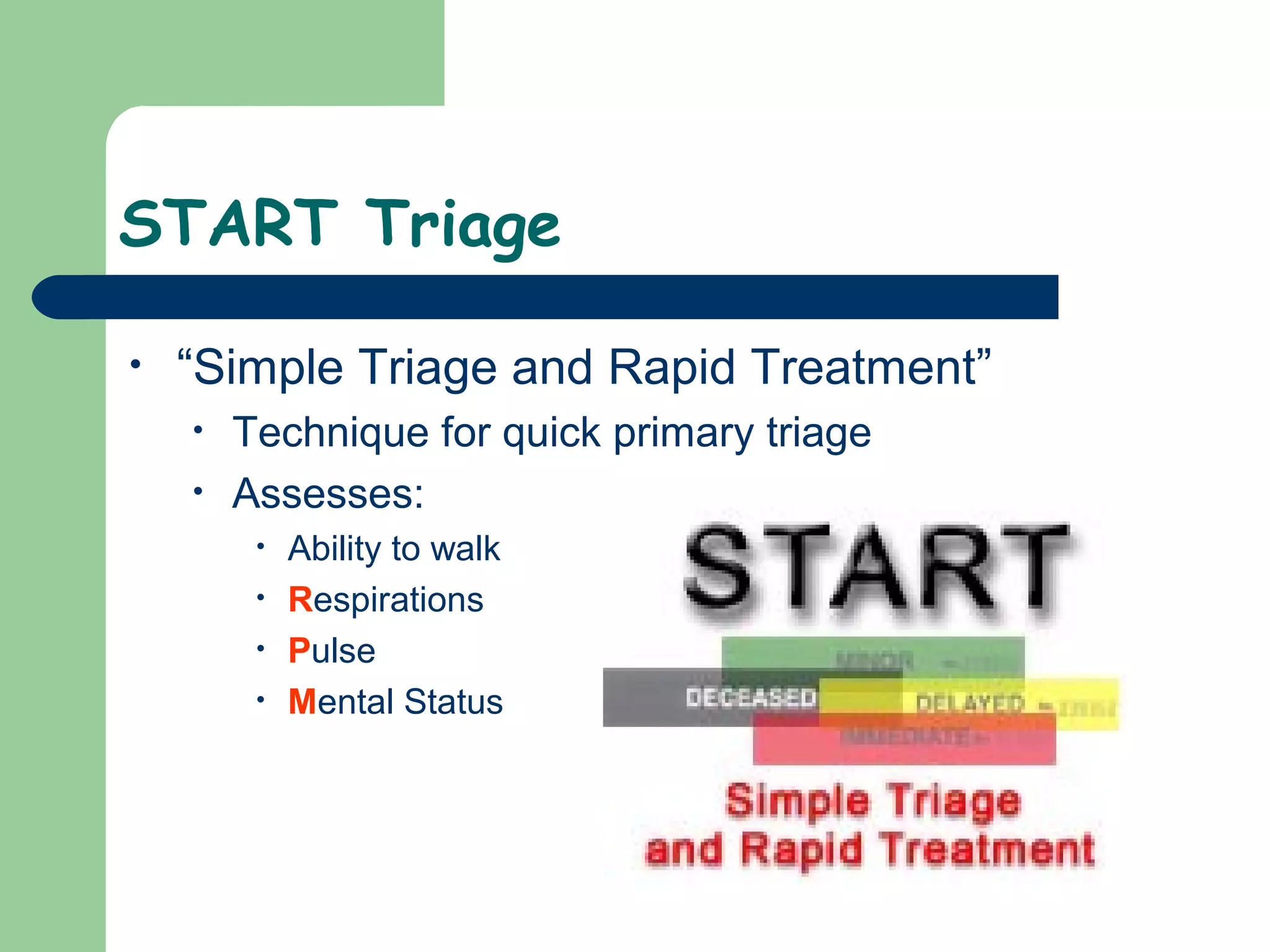
START Triage
• “Simple Triage and Rapid Treatment”
• Technique for quick primary triage
• Assesses:
• Ability to walk
• Respirations
• Pulse
• Mental Status
START Triage:
Minimal Treatment
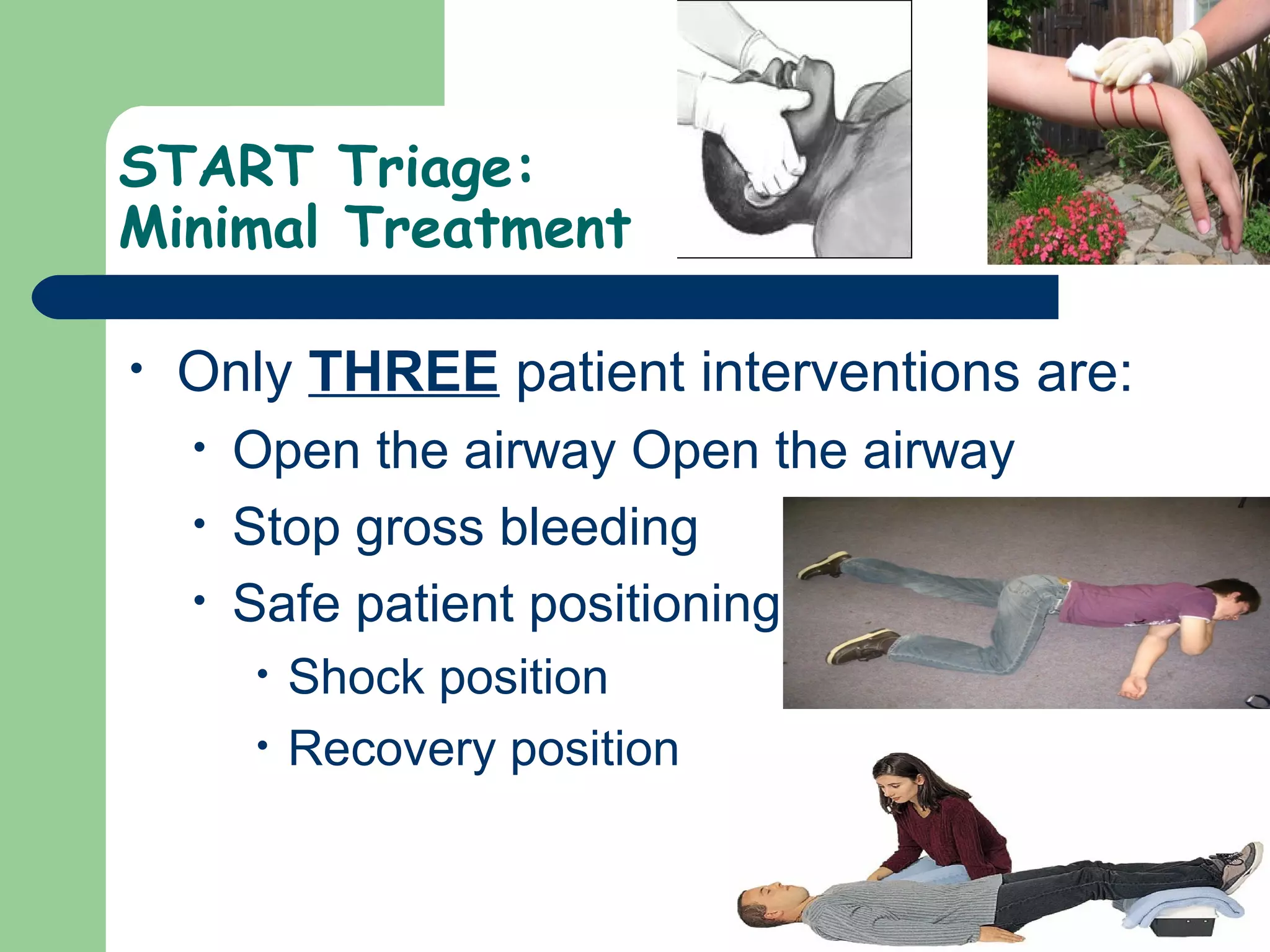
• Only THREE patient interventions are:
• Open the airway Open the airway
• Stop gross bleeding
• Safe patient positioning
• Shock position
• Recovery position
START Triage Procedure
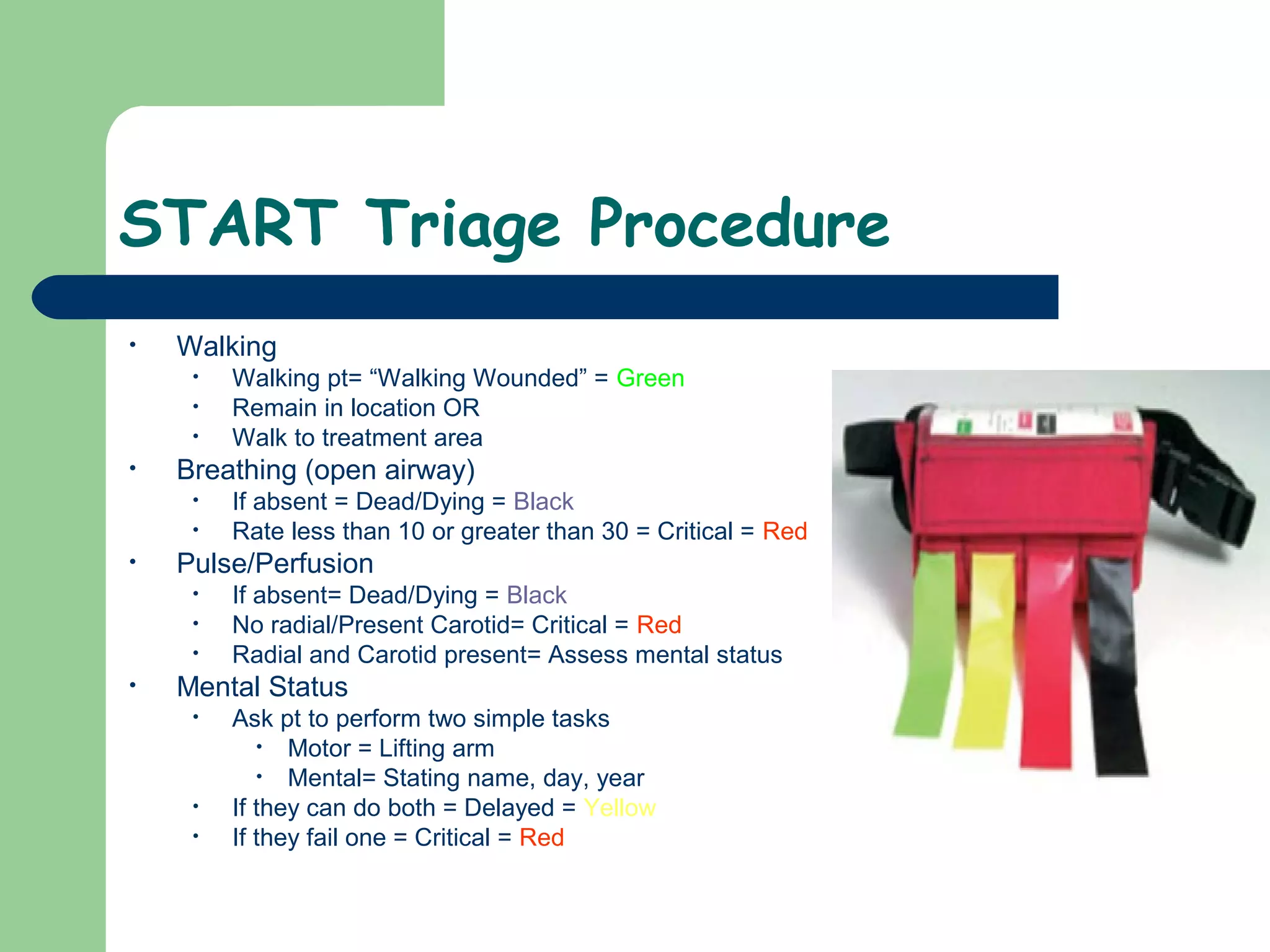
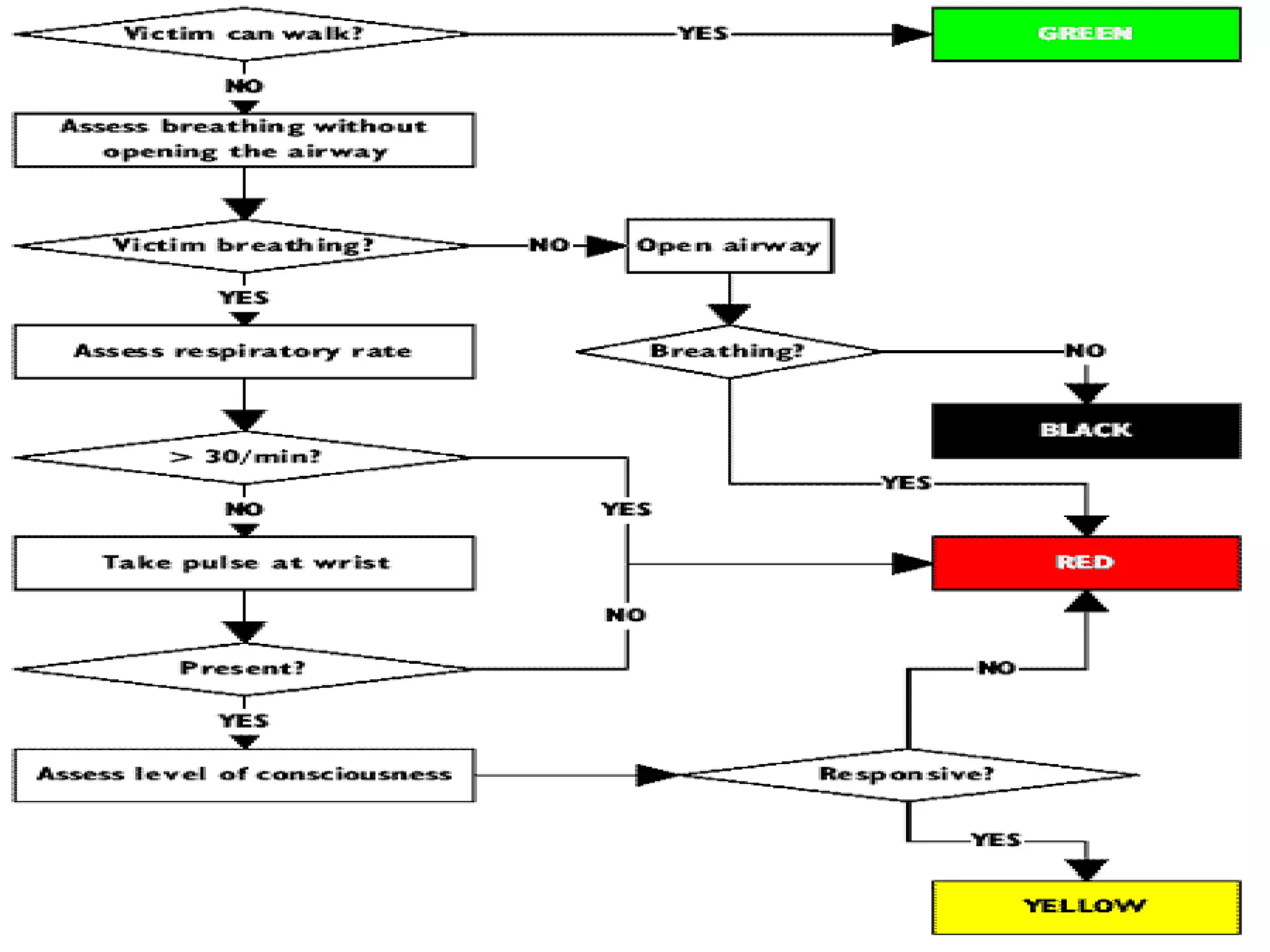
• Walking
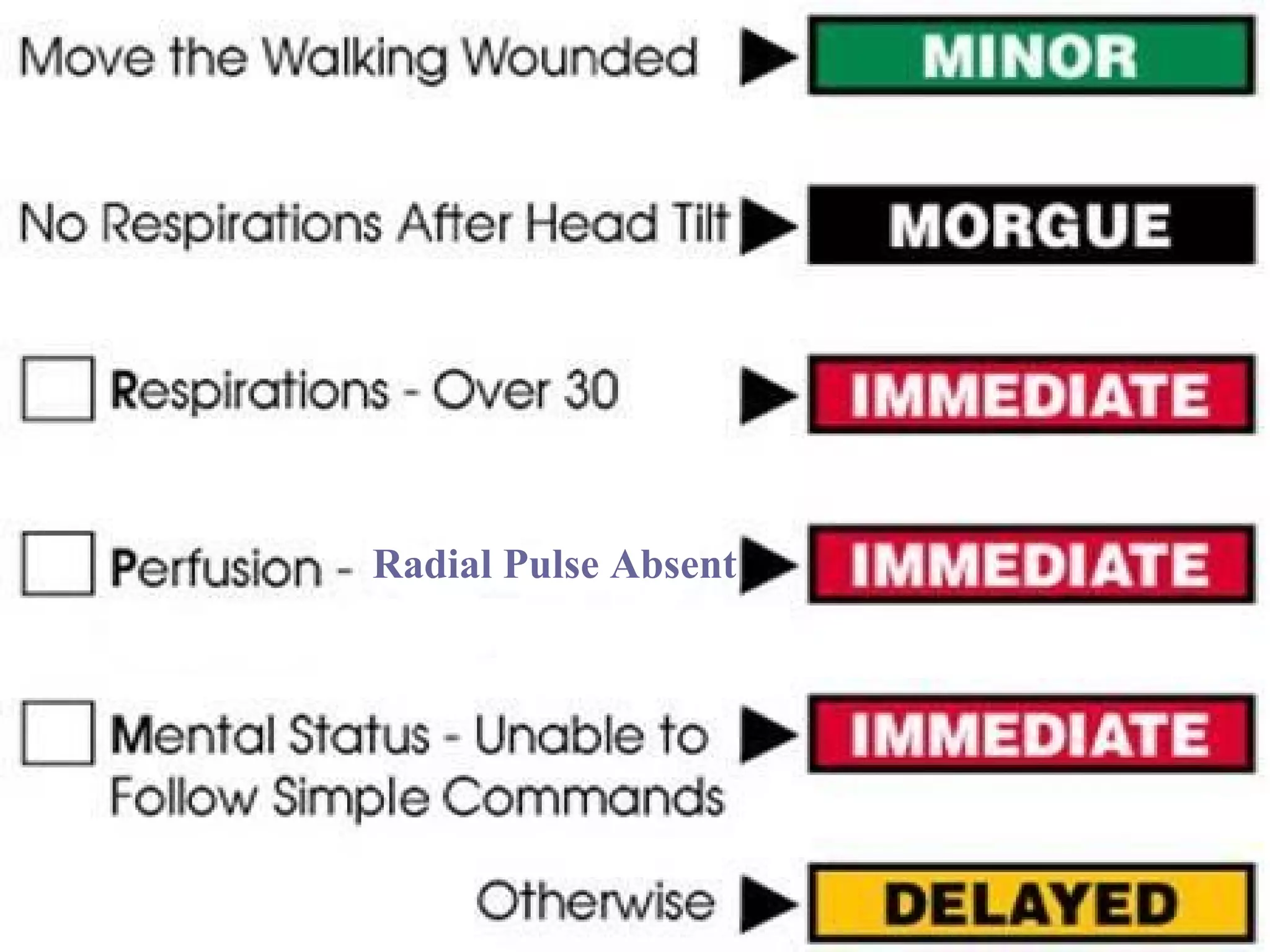
• Walking pt= “Walking Wounded” = Green
• Remain in location OR
• Walk to treatment area
• Breathing (open airway)
• If absent = Dead/Dying = Black
• Rate less than 10 or greater than 30 = Critical = Red
• Pulse/Perfusion
• If absent= Dead/Dying = Black
• No radial/Present Carotid= Critical = Red
• Radial and Carotid present= Assess mental status
• Mental Status
• Ask pt to perform two simple tasks
• Motor = Lifting arm
• Mental= Stating name, day, year
• If they can do both = Delayed = Yellow
• If they fail one = Critical = Red
Radial Pulse Absent
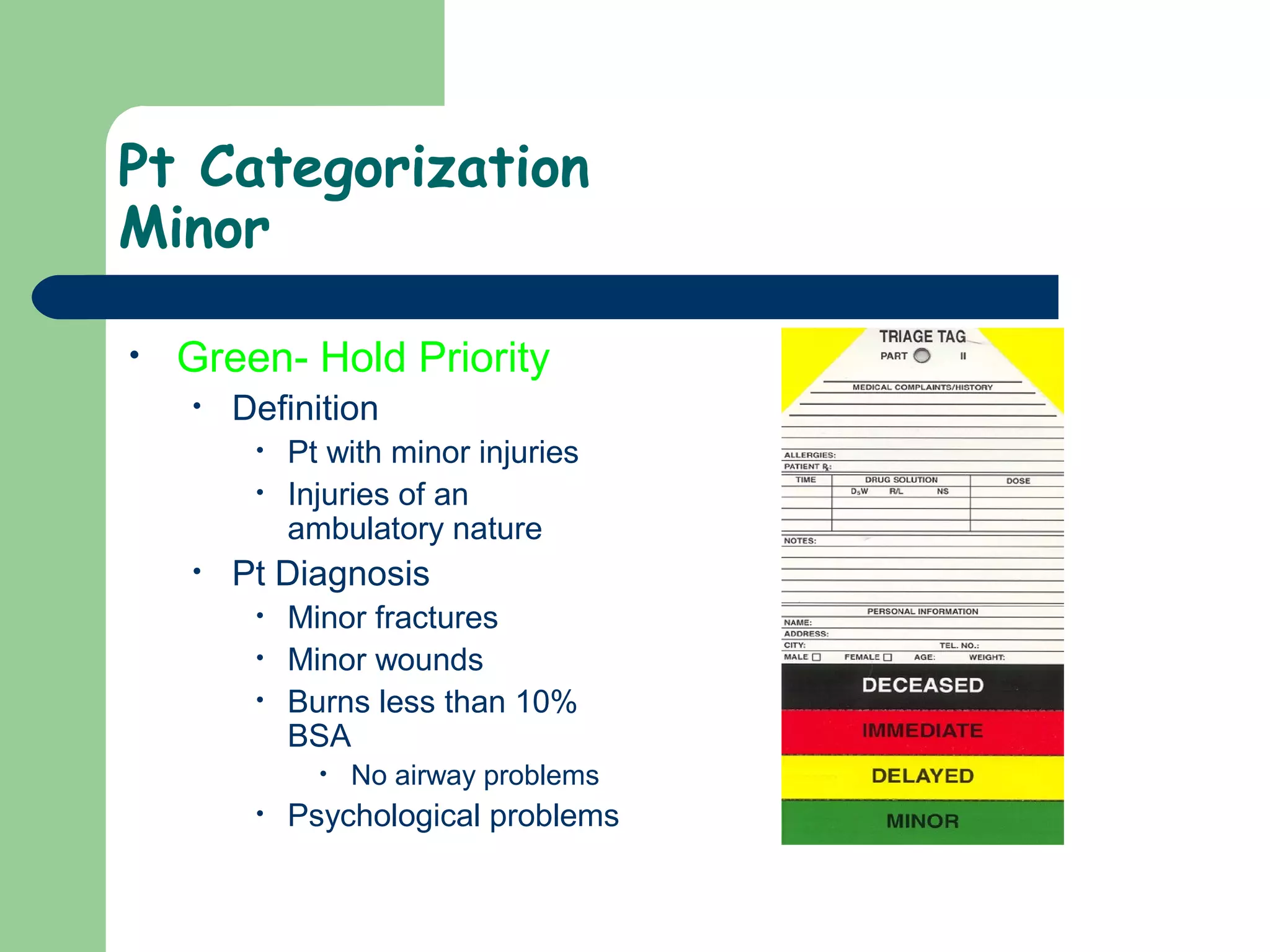
Pt Categorization
Minor
• Green- Hold Priority
• Definition
• Pt with minor injuries
• Injuries of an
ambulatory nature
• Pt Diagnosis
• Minor fractures
• Minor wounds
• Burns less than 10%
BSA
• No airway problems
• Psychological problems
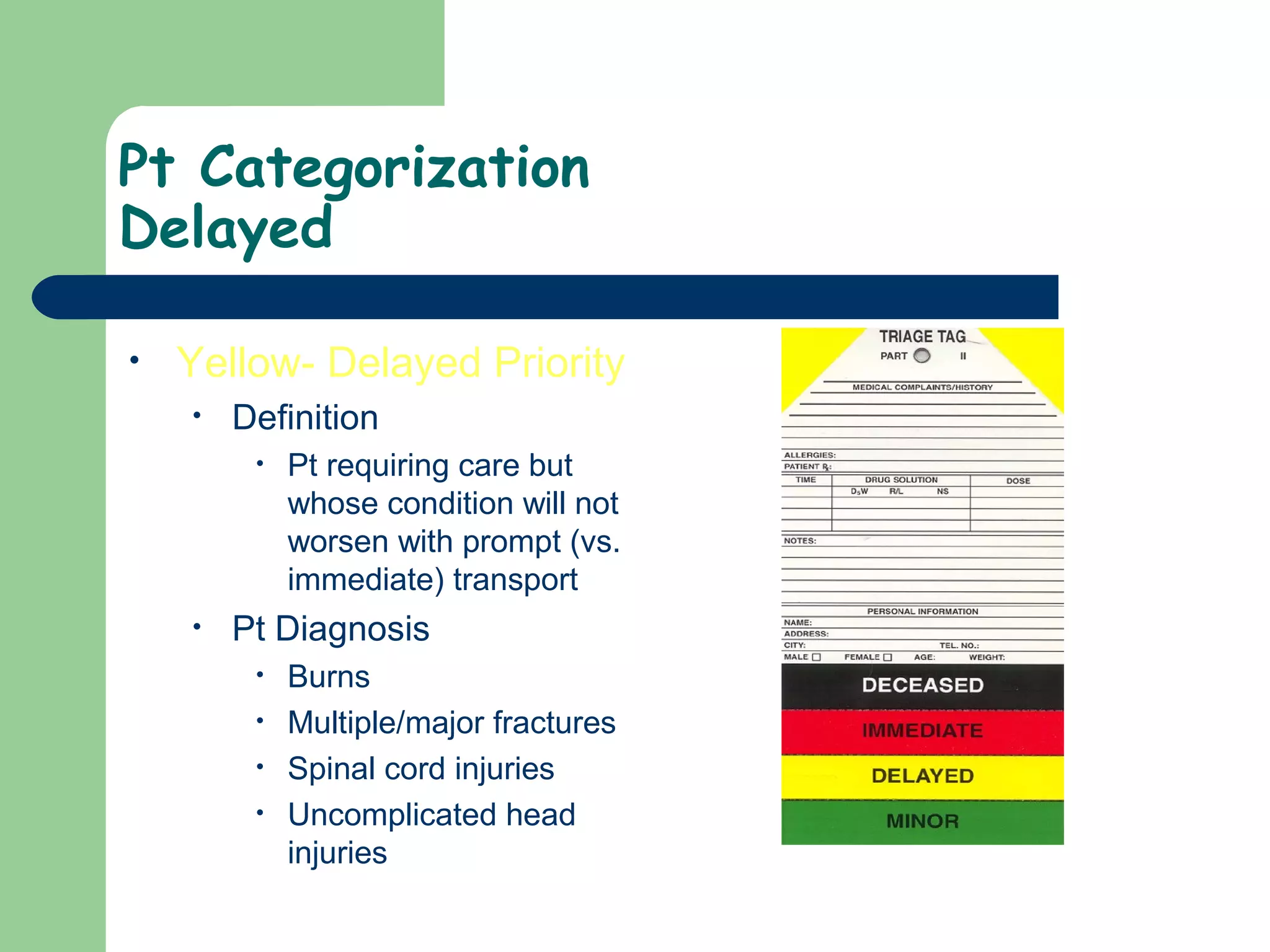
Pt Categorization
Delayed
• Yellow- Delayed Priority
• Definition
• Pt requiring care but
whose condition will not
worsen with prompt (vs.
immediate) transport
• Pt Diagnosis
• Burns
• Multiple/major fractures
• Spinal cord injuries
• Uncomplicated head
injuries
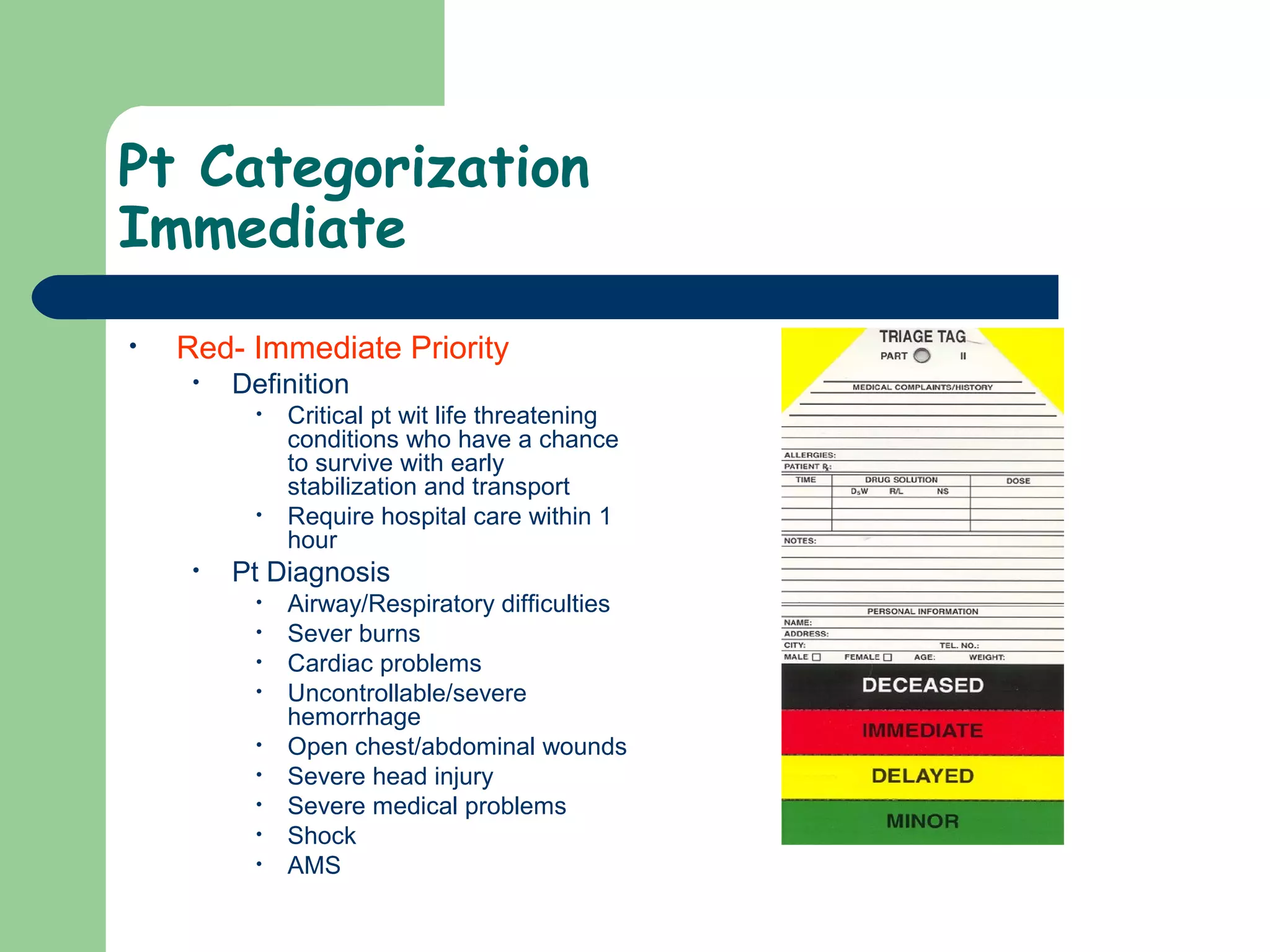
Pt Categorization
Immediate
• Red- Immediate Priority
• Definition
• Critical pt wit life threatening
conditions who have a chance
to survive with early
stabilization and transport
• Require hospital care within 1
hour
• Pt Diagnosis
• Airway/Respiratory difficulties
• Sever burns
• Cardiac problems
• Uncontrollable/severe
hemorrhage
• Open chest/abdominal wounds
• Severe head injury
• Severe medical problems
• Shock
• AMS
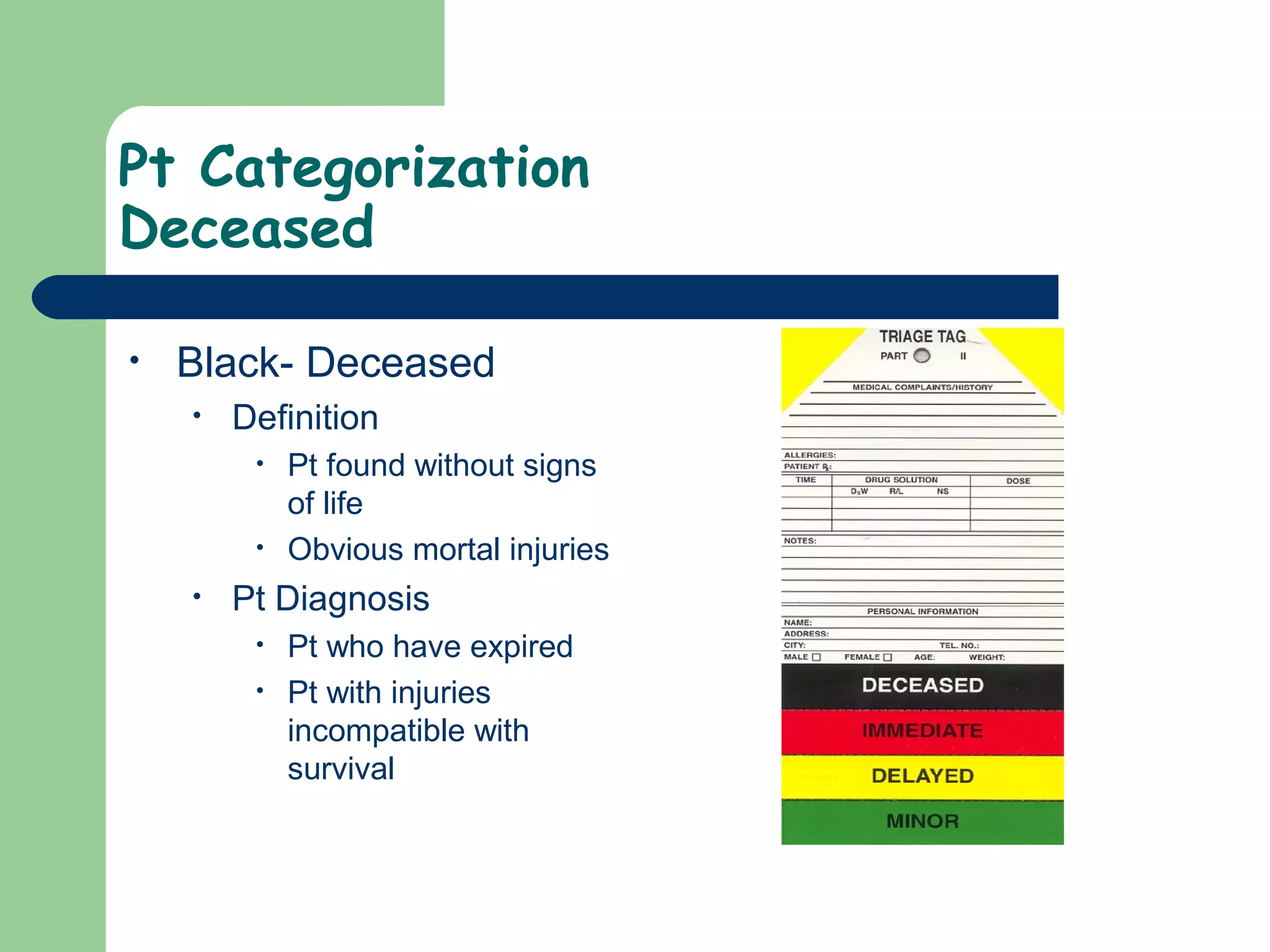
Pt Categorization
Deceased
• Black- Deceased
• Definition
• Pt found without signs
of life
• Obvious mortal injuries
• Pt Diagnosis
• Pt who have expired
• Pt with injuries
incompatible with
survival
Patient 1
• Airway open
• Respirations 20 bpm
• Radial pulses present
• Minor abrasions to arm/hands
• Pt is walking
• Green
Patient 2
• Airway is open
• Reparations 30
• Singed nasal hairs noted
• Absent radial pulses
• Unable to walk
• RED
Patient 3
• Airway open
• Respirations 22
• Radial Pulses Present
• Follows commands
• Cannot walk
• Burns to one arm
• Yellow
Patient 4
• Unresponsive
• Airway closed
• No respirations with jaw thrust
• Absent radial pulses
• BLACK
Patient 5
• Pt responsive
• Airway open
• Respiratory rate 36
• Thready radial pulses
• Unable to walk
• Flail chest noted
• RED
Patient 6
 Unresponsive
 No respirations after jaw thrust
 Thready radial pulse
 Open femur fracture
 BLACK
And so it finally ends…
Welcome to EMS
Random Humorous EMS Sites
• Murphy’s Laws of EMS
• http://www.uvm.edu/~jbettenc/ems1.htm
• Rules of EMS
• http://www.thelunatick.com/ems/rules.html
• You Might be in EMS if…
• http://www.thelunatick.com/ems/mightbe.html
• Realistic Trauma Scores
• http://www.thelunatick.com/ems/trauma_scales.htm
• The Memo
• http://www.thelunatick.com/ems/memo.htm
• EMT Buff Test
• http://www.thelunatick.com/ems/ems_buff_test.htm
32overviewofhazmatandmci 090910172527-phpapp02

32overviewofhazmatandmci 090910172527-phpapp02

  • 1.
    Overview of HazMatand Mass Casualty Incidents
  • 2.
    Overview of HazMat •Hazardous Materials • Any substance capable of creating harm to: • People • Property • Environment • Types • Explosives –Gases – Flammable/combustible liquid Flammable solids –Oxidizing substances Poisonous/Infectious substances –Radioactive substances Corrosive substances – Miscellaneous hazmat
  • 3.
    General Info • Commonproblem • Actual extent unknown • Safety is primary concern • Providers • EMT-B and crew • Pt • Public
  • 4.
    Approaching the Scene •Identification • Occupancy • Containers –size/shape • Placards • Shipping papers • “Bill of lading”- Road transport • “Way Bills” – Transport by rail • Usually in cab of truck • Chemical name, transport name, ID numbers • Senses • Material Safety Data Sheets (MSDS) • -1st . Aid, Decontamination, routes of exposure, S/S • protective equipment, past med Hx. Complications • Pts at the scene • Multiple pt with same S/S suggests exposure • i.e Nausea, vomiting, SOB, unresponsiveness
  • 5.
    Approaching the Scene • Generalprocedures • Park upwind and uphill • Keep unnecessary people away • Isolate area • Keep people out • Do not enter without proper equipment and SCBA • Local Resources • Local HazMat response teams • CHEMTREC = 1-800-424-9300 • Hazardous Materials, The Emergency Response Handbook • Published by US DOT
  • 7.
    HazMat Zones • HotZone • Where the hazardous material is spilled • Only trained individuals/appropriate clothing • Warm Zone • Transmission zone • Where decontamination occurs • Control point between Cold and Hot zones • Suitable training and clothing • Cold Zone • “Clean zone” • Where pt are brought for EMS assessment prior to transport • Staging supplies and command
  • 8.
  • 9.
    HazMat Decontamination • MechanicalRemoval • Clothing Removal • Rinsing • Dilution • Absorption • Chemical Washes • Disposal/Isolation
  • 10.
    MCI: Classification • Multiple/MassCasualty Incident • A situation in which the needs is more than the initial responding personnel and equipment can meet • Open Incident • Easy access to victims from different locations • May be spread over a large area • Closed Incident • Physical/geographical barriers that prevent speedy access to victims • Active • Forces that contributed to the disaster are still active • On going risk to rescuers, public, victims • Contained • Forces responsible for the disaster are exhausted
  • 11.
    Incident Management Systems •What are they? • Organized system of roles, responsibilities, and standing operating procedures to manage emergency operations. • What do they do? • Provides orderly means for communication and information for decision making • Makes interactions with other agencies easier
  • 12.
    Incident Management Systems Structure •Command • Mobile site near the MCI • Overall command of the incident is coordinated • Extrication • Coordination of personnel/resources during extrication • Triage • Initial triage occurs at pt side • Pt relocated to “secondary triage” • Treatment • Organized sector where major field treatments are administered • Priority treatment may start at the side of pt before transport • Transportation • Responsible for overall transport of supplies, equipment, personnel, pt, other resources • Staging • Area where ambulances stage to receive pts and assignment of receiving hospital • Supply • Area where supplies are stockpiled • Rehabilitation • Area where care is given to rescuers • Physical and psychological support are offered
  • 13.
    Incident Management Systems Documentation •A major event log • # of pts • Conditions and triage categories • Vehicles at scene • Personnel at scene • Hospital availability • # of individuals transported • Hospital disposition • Mode of transport
  • 15.
    Initial Roles ofResponders • Rescuers will be assigned specific duties within one of the sectors • Upon arrival • Report to sector officer • Once assigned a specific task • Complete it • Report back to sector officer
  • 16.
    Triage • Heroic resuscitativeefforts NOT appropriate • Too much time • Requires equipment used for salvageable patients • Staffing intensive • Concentrate on salvageable patients
  • 17.
    MCI Procedures • Est.type of incident • Determine specific location and ID best access routes • 1 EMT approaches scene and determines: • Estimates # of pt • Estimates injury types • If incident is open/closed and active/contained • 2nd EMT stays with ambulance and determines: • Possible staging areas • Traffic routes into area • Both EMTs should ascertain • Approx # of pts • Specific location of incident • Whether incident is open/closed and active/contained • Need for special resources • # of additional ambulances needed • Potential dangers to public safety and personnel • IMMEDIATELY relay this info to communications center
  • 18.
    MCI Procedures Cont’d •Most knowledgeable EMT on scene initially assumes Triage Officer • Request additional help • Perform initial assessment of all pts • START Triage • Assign available personnel/equipment to critical pts • Secondary Triage • In depth assessment of pt • In treatment area OR en route to ER • Pt transport is based on: • Prioritization • Destination facilities • Transport resources • Triage officer remains in scent to: • Assign/coordinate: Personnel, equipment, vehicles
  • 19.
    Triage Stages • 1st Stage •No treatment is rendered • Victims are tagged with tape/cards • Category of injury • Likelihood of survival • 2nd Stage • Begins after removal of pt and transport to safer area • More thorough assessment • Recategorized by priority • Collection point of all pts • Ensure appropriate treatment and transport • ALS procedures • 3rd Stage • Certain specific cases • Creation of field hospital on site • ALS procedures
  • 20.
    START Triage • “SimpleTriage and Rapid Treatment” • Technique for quick primary triage • Assesses: • Ability to walk • Respirations • Pulse • Mental Status
  • 21.
    START Triage: Minimal Treatment •Only THREE patient interventions are: • Open the airway Open the airway • Stop gross bleeding • Safe patient positioning • Shock position • Recovery position
  • 22.
    START Triage Procedure •Walking • Walking pt= “Walking Wounded” = Green • Remain in location OR • Walk to treatment area • Breathing (open airway) • If absent = Dead/Dying = Black • Rate less than 10 or greater than 30 = Critical = Red • Pulse/Perfusion • If absent= Dead/Dying = Black • No radial/Present Carotid= Critical = Red • Radial and Carotid present= Assess mental status • Mental Status • Ask pt to perform two simple tasks • Motor = Lifting arm • Mental= Stating name, day, year • If they can do both = Delayed = Yellow • If they fail one = Critical = Red
  • 24.
  • 25.
    Pt Categorization Minor • Green-Hold Priority • Definition • Pt with minor injuries • Injuries of an ambulatory nature • Pt Diagnosis • Minor fractures • Minor wounds • Burns less than 10% BSA • No airway problems • Psychological problems
  • 26.
    Pt Categorization Delayed • Yellow-Delayed Priority • Definition • Pt requiring care but whose condition will not worsen with prompt (vs. immediate) transport • Pt Diagnosis • Burns • Multiple/major fractures • Spinal cord injuries • Uncomplicated head injuries
  • 27.
    Pt Categorization Immediate • Red-Immediate Priority • Definition • Critical pt wit life threatening conditions who have a chance to survive with early stabilization and transport • Require hospital care within 1 hour • Pt Diagnosis • Airway/Respiratory difficulties • Sever burns • Cardiac problems • Uncontrollable/severe hemorrhage • Open chest/abdominal wounds • Severe head injury • Severe medical problems • Shock • AMS
  • 28.
    Pt Categorization Deceased • Black-Deceased • Definition • Pt found without signs of life • Obvious mortal injuries • Pt Diagnosis • Pt who have expired • Pt with injuries incompatible with survival
  • 29.
    Patient 1 • Airwayopen • Respirations 20 bpm • Radial pulses present • Minor abrasions to arm/hands • Pt is walking • Green
  • 30.
    Patient 2 • Airwayis open • Reparations 30 • Singed nasal hairs noted • Absent radial pulses • Unable to walk • RED
  • 31.
    Patient 3 • Airwayopen • Respirations 22 • Radial Pulses Present • Follows commands • Cannot walk • Burns to one arm • Yellow
  • 32.
    Patient 4 • Unresponsive •Airway closed • No respirations with jaw thrust • Absent radial pulses • BLACK
  • 33.
    Patient 5 • Ptresponsive • Airway open • Respiratory rate 36 • Thready radial pulses • Unable to walk • Flail chest noted • RED
  • 34.
    Patient 6  Unresponsive No respirations after jaw thrust  Thready radial pulse  Open femur fracture  BLACK
  • 35.
    And so itfinally ends… Welcome to EMS
  • 36.
    Random Humorous EMSSites • Murphy’s Laws of EMS • http://www.uvm.edu/~jbettenc/ems1.htm • Rules of EMS • http://www.thelunatick.com/ems/rules.html • You Might be in EMS if… • http://www.thelunatick.com/ems/mightbe.html • Realistic Trauma Scores • http://www.thelunatick.com/ems/trauma_scales.htm • The Memo • http://www.thelunatick.com/ems/memo.htm • EMT Buff Test • http://www.thelunatick.com/ems/ems_buff_test.htm

Editor's Notes

  • #17 In normal responses four or more providers may work on a single patient - in mass casualties this ratio is reversed Scarce resource management recognizes that you do not have enough providers, equipment, vehicles, or time to provide the normal level of prehospital care. Therefore you have to use what you have to do the best you can for the greatest number of people. Available personnel must salvage the most patients they can while waiting for additional resources.