ClimDev-Africa


 INTEGRATING RENEWABLE ENERGY AND 
       CLIMATE CHANGE POLICIES: 
    Exploring Policy Options for Africa

Yohannes Hailu, Haruna Gujba, Mulugeta S. Kahsai,
 Tsehai Ataklt Lars J. Nilsson and Yacob Mulugetta


First Climate Change and Development for Africa Conference
                   Addis Ababa, Ethiopia
                     (17-19 Oct, 2011)
                                                                1
Outline

This presentation covers:
 Context
 Opportunities
 Building the case for RES
 Policy Recommendations
Entering a new phase, which calls for a paradigm shift that deals with the issue
of a carbon constrained world – higher level of innovation at energy supply/demand
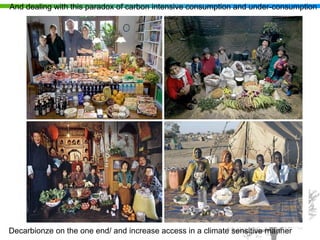
And dealing with this paradox of carbon intensive consumption and under-consumption


Decarbionze on the one end/ and increase access in a climate sensitive manner
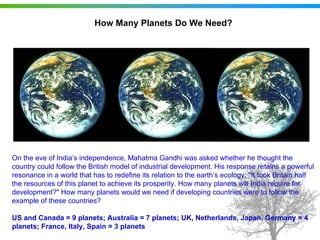
How Many Planets Do We Need?


On the eve of India’s independence, Mahatma Gandhi was asked whether he thought the
country could follow the British model of industrial development. His response retains a powerful
resonance in a world that has to redefine its relation to the earth’s ecology: "It took Britain half
the resources of this planet to achieve its prosperity. How many planets will India require for
development?" How many planets would we need if developing countries were to follow the
example of these countries?

US and Canada = 9 planets; Australia = 7 planets; UK, Netherlands, Japan, Germany = 4
planets; France, Italy, Spain = 3 planets
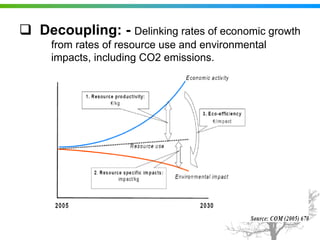
Decoupling: - Delinking rates of economic growth
  from rates of resource use and environmental
  impacts, including CO2 emissions.
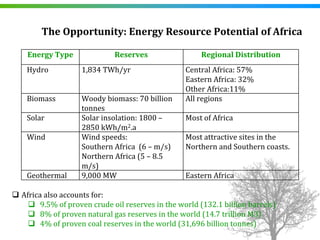
The Opportunity: Energy Resource Potential of Africa

 Energy Type               Reserves                  Regional Distribution
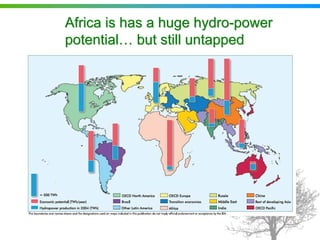
 Hydro           1,834 TWh/yr                    Central Africa: 57%
                                                 Eastern Africa: 32%
                                                 Other Africa:11%
 Biomass         Woody biomass: 70 billion       All regions
                 tonnes
 Solar           Solar insolation: 1800 –        Most of Africa
                 2850 kWh/m2.a
 Wind            Wind speeds:                    Most attractive sites in the 
                 Southern Africa  (6 – m/s)      Northern and Southern coasts.
                 Northern Africa (5 – 8.5 
                 m/s)
 Geothermal      9,000 MW                        Eastern Africa

Africa also accounts for: 
      9.5% of proven crude oil reserves in the world (132.1 billion barrels)
      8% of proven natural gas reserves in the world (14.7 trillion M3)
      4% of proven coal reserves in the world (31,696 billion tonnes)
Africa is has a huge hydro-power
potential… but still untapped
Clean Energy and Climate Change 
The case for renewables:
  Renewables (especially small‐scale renewables) characterized by their 
  modularity ‐ capable of providing modern energy access at relatively lower 
  costs
  Availability of renewable energy sources at national and local levels 
     Energy security and decentralized systems to poor and remote areas
  Renewable energy systems offer the opportunity to reduce the dependence 
  on increasingly expensive (and imported) fossil fuels (B.Faso, Senegal)
     39/54 countries are net oil‐importers
  Renewable energy systems (such as biomass, small hydro, biogas, s.s
  biofuels) provide opportunity to include more people in the energy supply 
  chain as producers/and consumers in the energy system
  Renewable energy systems offer considerable CC mitigation potential for 
  Africa
     Could mean financial resource flow, avoid technology ‘lock‐in’, and participate in 
     S&T innovation
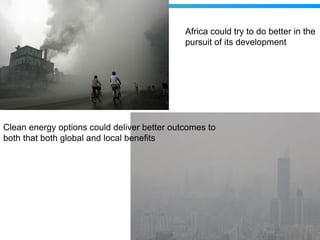
Africa could try to do better in the
                                             pursuit of its development


Clean energy options could deliver better outcomes to
both that both global and local benefits
Clean Energy and Climate Change – The Mitigation Potential
   The carbon emission implicit social cost per kWh energy supply shows the 
   tremendous potential of non‐combustive renewable energy generation 
   options.               Carbon     Emission    Generating  $/t carbon  Reduction 
Power station type               emissions        savings      costs                  avoided   potential to 
                                 (g C/kWh)      (g C/kWh)   (U Sc/kWh)                          2010/2020 
                                                                                                (Mt C/year)
Pulverized coal – as base case     229             0             4.9                 0
Integrated gasification          190­198         31­40         3.6­6.0             ­10­40         49/140
combined cycle (IGCC) – coal
Pulverized coal + CO2 capture     40­50        179­189        7.4­10.6            136­165         10/100
Combined cycle gas turbine       103­122       107­126         4.9­6.9             0­156          38/240
(CCGT) – natural gas
CCGT gas + CO2 capture             14­18       211­215         6.4­8.4             71­165       Uncertain
Hydro                                0           229           4.2­7.8            ­31­127        26/92
Bioenergy IGCC – wood wastes         0           229           2.8­7.6            ­92­117        14/90
Wind – good to medium sites          0           229           3.0­8.0            ­82­135        63/173
Solar thermal and solar PV           0           229          8.7­40.0           175­1400        2.5/28

    The joint environment and economic benefits of these technologies, coupled 
    with scale flexibilities allowing grid and off‐grid applications, should 
    intensify policy interest 
Policy Experiments in Africa – RE Policies
                 REGULATOR POLICIES                           FISCAL INCENTIVES                        PUBLIC FINANCING
  Country      Feed­ Biofuels      Heat    Tradable     Capital    Investment,    Reductions in         Public       Public 
                 in   obligatio obligation renewabl    subsidy,    production     sales, energy,     investment,  competitiv
               tariff     n,    , mandate e energy     grant or     tax credits   VAT or other         loans or    e bidding
                      mandate               credits     rebate                        taxes           financing

Algeria         X
Botswana                                                                                X
Egypt                                                     X                             X                X            X
Ethiopia                 X                                                              X                X
Gambia                                                                                  X
Ghana                                         X                                         X
Kenya           X                                                                       X
Mali                                                                                    X
Mozambiqu                X                                                                               X
e
Morocco                                                                                                  X
Rwanda                                                                                  X                X
South Africa    X                             X           X                                                           X

Tanzania        X                                         X                             X
Tunisia                                                   X                             X                X
Uganda          X                                         X                             X
Zambia                                                                                  X
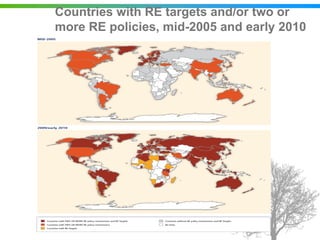
Countries with RE targets and/or two or
more RE policies, mid-2005 and early 2010
Integrating RE and CC Policies ­ Recommendations
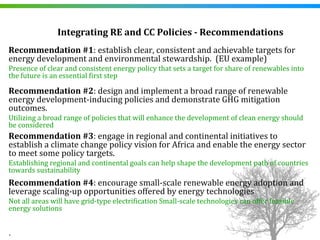
Recommendation #1: establish clear, consistent and achievable targets for 
energy development and environmental stewardship.  (EU example)
Presence of clear and consistent energy policy that sets a target for share of renewables into 
the future is an essential first step

Recommendation #2: design and implement a broad range of renewable 
energy development‐inducing policies and demonstrate GHG mitigation 
outcomes.
Utilizing a broad range of policies that will enhance the development of clean energy should 
be considered
Recommendation #3: engage in regional and continental initiatives to 
establish a climate change policy vision for Africa and enable the energy sector 
to meet some policy targets.
Establishing regional and continental goals can help shape the development path of countries 
towards sustainability
Recommendation #4: encourage small‐scale renewable energy adoption and 
leverage scaling‐up opportunities offered by energy technologies
Not all areas will have grid‐type electrification Small‐scale technologies can offer feasible 
energy solutions


.
Integrating RE and CC Policies ­ Recommendations

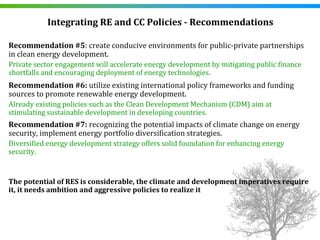
Recommendation #5: create conducive environments for public‐private partnerships 
in clean energy development. 
Private sector engagement will accelerate energy development by mitigating public finance 
shortfalls and encouraging deployment of energy technologies. 
Recommendation #6: utilize existing international policy frameworks and funding 
sources to promote renewable energy development.
Already existing policies such as the Clean Development Mechanism (CDM) aim at 
stimulating sustainable development in developing countries. 
Recommendation #7: recognizing the potential impacts of climate change on energy 
security, implement energy portfolio diversification strategies.
Diversified energy development strategy offers solid foundation for enhancing energy 
security.


The potential of RES is considerable, the climate and development imperatives require 
it, it needs ambition and aggressive policies to realize it
United Nations
                                    Economic Commission for Africa


              Thank you
               Yacob Mulugetta
             YMulugetta@uneca.org


Climate
Change
    Meets
    Policy
Clean Energy and Climate Change – the Nexus
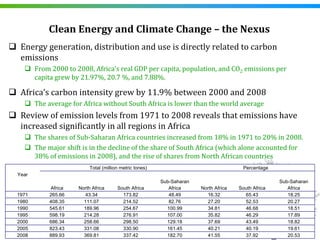
 Energy generation, distribution and use is directly related to carbon 
 emissions
       From 2000 to 2008, Africa’s real GDP per capita, population, and CO2 emissions per 
       capita grew by 21.97%, 20.7 %, and 7.88%. 

 Africa’s carbon intensity grew by 11.9% between 2000 and 2008
       The average for Africa without South Africa is lower than the world average 
 Review of emission levels from 1971 to 2008 reveals that emissions have 
 increased significantly in all regions in Africa
       The shares of Sub‐Saharan Africa countries increased from 18% in 1971 to 20% in 2008.
       The major shift is in the decline of the share of South Africa (which alone accounted for 
       38% of emissions in 2008), and the rise of shares from North African countries
                          Total (million metric tones)                                  Percentage
Year
                                                         Sub-Saharan                                 Sub-Saharan
            Africa   North Africa      South Africa         Africa     North Africa   South Africa      Africa
1971        265.66      43.34            173.82             48.49        16.32          65.43           18.25
1980        408.35     111.07            214.52             82.76        27.20          52.53           20.27
1990        545.61     189.96            254.67            100.99        34.81          46.68           18.51
1995        598.19     214.28            276.91            107.00        35.82          46.29           17.89
2000        686.34     258.66            298.50            129.18        37.69          43.49           18.82
2005        823.43     331.08            330.90            161.45        40.21          40.19           19.61
2008        889.93     369.81            337.42            182.70        41.55          37.92           20.53

2. integrating re and cc policies