Classification
of Law
CRIMINAL AND CIVIL
COURT PROCEDURES
At a glance, court procedures for criminal and civil cases
appear similar, however, there are some key differences.
COURT PROCEDURES
Parties
involved
Standard
of proof
Burden of
proof
Sentencing
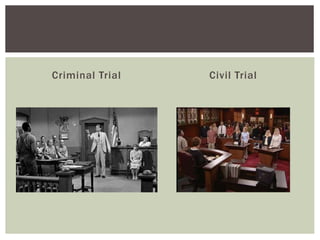
Criminal Trial Civil Trial
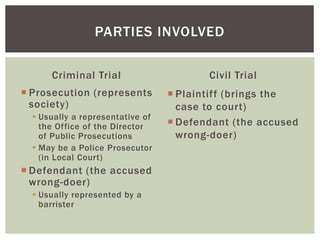
Criminal Trial
 Prosecution (represents
society)
 Usually a representative of
the Office of the Director
of Public Prosecutions
 May be a Police Prosecutor
(in Local Court)
 Defendant (the accused
wrong-doer)
 Usually represented by a
barrister
Civil Trial
 Plaintiff (brings the
case to court)
 Defendant (the accused
wrong-doer)
PARTIES INVOLVED
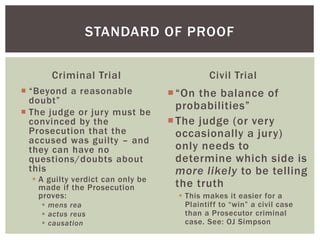
Criminal Trial
 “Beyond a reasonable
doubt”
 The judge or jury must be
convinced by the
Prosecution that the
accused was guilty – and
they can have no
questions/doubts about
this
 A guilty verdict can only be
made if the Prosecution
proves:
 mens rea
 actus reus
 causation
Civil Trial
“On the balance of
probabilities”
The judge (or very
occasionally a jury)
only needs to
determine which side is
more likely to be telling
the truth
 This makes it easier for a
Plaintiff to “win” a civil case
than a Prosecutor criminal
case. See: OJ Simpson
STANDARD OF PROOF
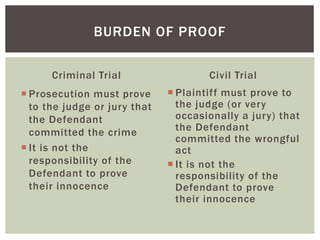
Criminal Trial
 Prosecution must prove
to the judge or jury that
the Defendant
committed the crime
 It is not the
responsibility of the
Defendant to prove
their innocence
Civil Trial
 Plaintiff must prove to
the judge (or very
occasionally a jury) that
the Defendant
committed the wrongful
act
 It is not the
responsibility of the
Defendant to prove
their innocence
BURDEN OF PROOF
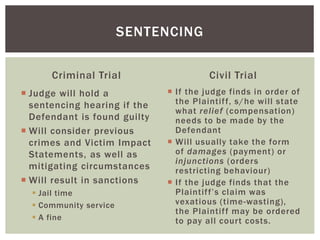
Criminal Trial
 Judge will hold a
sentencing hearing if the
Defendant is found guilty
 Will consider previous
crimes and Victim Impact
Statements, as well as
mitigating circumstances
 Will result in sanctions
 Jail time
 Community service
 A fine
Civil Trial
 If the judge finds in order of
the Plaintiff, s/he will state
what relief (compensation)
needs to be made by the
Defendant
 Will usually take the form
of damages (payment) or
injunctions (orders
restricting behaviour)
 If the judge finds that the
Plaintiff’s claim was
vexatious (time-wasting),
the Plaintiff may be ordered
to pay all court costs.
SENTENCING
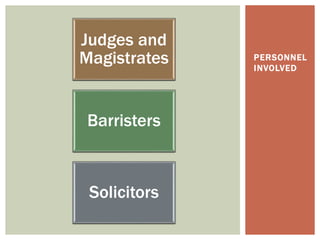
Judges and
Magistrates
Barristers
Solicitors
PERSONNEL
INVOLVED
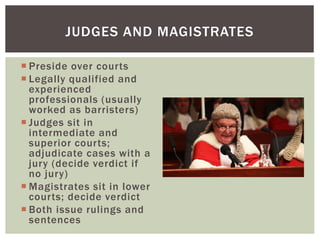
 Preside over courts
 Legally qualified and
experienced
professionals (usually
worked as barristers)
 Judges sit in
intermediate and
superior courts;
adjudicate cases with a
jury (decide verdict if
no jury)
 Magistrates sit in lower
courts; decide verdict
 Both issue rulings and
sentences
JUDGES AND MAGISTRATES
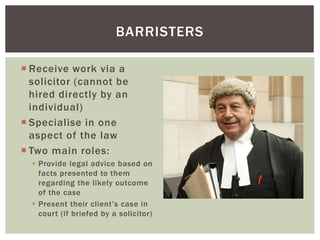
 Receive work via a
solicitor (cannot be
hired directly by an
individual)
 Specialise in one
aspect of the law
 Two main roles:
 Provide legal advice based on
facts presented to them
regarding the likely outcome
of the case
 Present their client’s case in
court (if briefed by a solicitor)
BARRISTERS
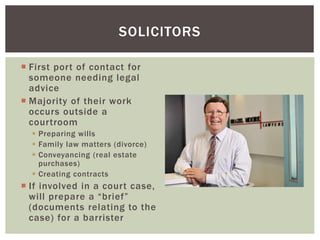
 First port of contact for
someone needing legal
advice
 Majority of their work
occurs outside a
courtroom
 Preparing wills
 Family law matters (divorce)
 Conveyancing (real estate
purchases)
 Creating contracts
 If involved in a court case,
will prepare a “brief”
(documents relating to the
case) for a barrister
SOLICITORS

3.2 court proceedings

  • 1.
    Classification of Law CRIMINAL ANDCIVIL COURT PROCEDURES
  • 2.
    At a glance,court procedures for criminal and civil cases appear similar, however, there are some key differences. COURT PROCEDURES Parties involved Standard of proof Burden of proof Sentencing
  • 3.
  • 4.
    Criminal Trial  Prosecution(represents society)  Usually a representative of the Office of the Director of Public Prosecutions  May be a Police Prosecutor (in Local Court)  Defendant (the accused wrong-doer)  Usually represented by a barrister Civil Trial  Plaintiff (brings the case to court)  Defendant (the accused wrong-doer) PARTIES INVOLVED
  • 5.
    Criminal Trial  “Beyonda reasonable doubt”  The judge or jury must be convinced by the Prosecution that the accused was guilty – and they can have no questions/doubts about this  A guilty verdict can only be made if the Prosecution proves:  mens rea  actus reus  causation Civil Trial “On the balance of probabilities” The judge (or very occasionally a jury) only needs to determine which side is more likely to be telling the truth  This makes it easier for a Plaintiff to “win” a civil case than a Prosecutor criminal case. See: OJ Simpson STANDARD OF PROOF
  • 6.
    Criminal Trial  Prosecutionmust prove to the judge or jury that the Defendant committed the crime  It is not the responsibility of the Defendant to prove their innocence Civil Trial  Plaintiff must prove to the judge (or very occasionally a jury) that the Defendant committed the wrongful act  It is not the responsibility of the Defendant to prove their innocence BURDEN OF PROOF
  • 7.
    Criminal Trial  Judgewill hold a sentencing hearing if the Defendant is found guilty  Will consider previous crimes and Victim Impact Statements, as well as mitigating circumstances  Will result in sanctions  Jail time  Community service  A fine Civil Trial  If the judge finds in order of the Plaintiff, s/he will state what relief (compensation) needs to be made by the Defendant  Will usually take the form of damages (payment) or injunctions (orders restricting behaviour)  If the judge finds that the Plaintiff’s claim was vexatious (time-wasting), the Plaintiff may be ordered to pay all court costs. SENTENCING
  • 8.
  • 9.
     Preside overcourts  Legally qualified and experienced professionals (usually worked as barristers)  Judges sit in intermediate and superior courts; adjudicate cases with a jury (decide verdict if no jury)  Magistrates sit in lower courts; decide verdict  Both issue rulings and sentences JUDGES AND MAGISTRATES
  • 10.
     Receive workvia a solicitor (cannot be hired directly by an individual)  Specialise in one aspect of the law  Two main roles:  Provide legal advice based on facts presented to them regarding the likely outcome of the case  Present their client’s case in court (if briefed by a solicitor) BARRISTERS
  • 11.
     First portof contact for someone needing legal advice  Majority of their work occurs outside a courtroom  Preparing wills  Family law matters (divorce)  Conveyancing (real estate purchases)  Creating contracts  If involved in a court case, will prepare a “brief” (documents relating to the case) for a barrister SOLICITORS