Organisations
Involved in
International
Law
Sources of Contemporary
Australian Law
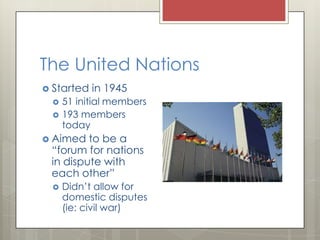
The United Nations
 Started in 1945
 51 initial members
 193 members
today
 Aimed to be a
“forum for nations
in dispute with
each other”
 Didn’t allow for
domestic disputes
(ie: civil war)
Courts and Tribunals
International Court of
Justice
War Crimes Tribunals International Criminal
Court
• Fixed court, in the
Hague,
Netherlands
• Set up on an ad
hoc basis (when
they need to)
• Has existed since
2002
• Won’t hear a case
unless both parties
agree to be bound
by the decision
• Nuremburg
(Germany) was the
first, post WWII
• Rwanda (appeals)
• Fmr Yugoslavia (20)
• 122 member-states
• All trials have
focused on
Africans
Eg: East Timor v
Australia re: oil fields
and spying
Investigate genocide,
crimes against
humanity, war crimes,
breaches of Geneva
Convention
Targets individuals
who have committed
crimes against
humanity, war crimes
and genocide
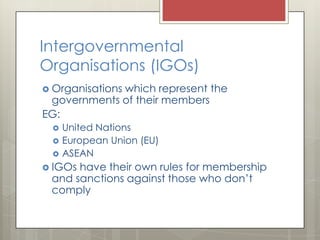
Intergovernmental
Organisations (IGOs)
 Organisations which represent the
governments of their members
EG:
 United Nations
 European Union (EU)
 ASEAN
 IGOs have their own rules for membership
and sanctions against those who don’t
comply
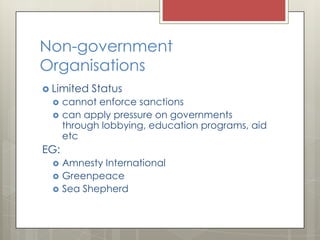
Non-government
Organisations
 Limited Status
 cannot enforce sanctions
 can apply pressure on governments
through lobbying, education programs, aid
etc
EG:
 Amnesty International
 Greenpeace
 Sea Shepherd
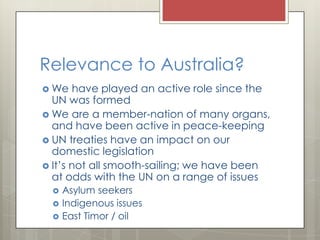
Relevance to Australia?
 We have played an active role since the
UN was formed
 We are a member-nation of many organs,
and have been active in peace-keeping
 UN treaties have an impact on our
domestic legislation
 It’s not all smooth-sailing; we have been
at odds with the UN on a range of issues
 Asylum seekers
 Indigenous issues
 East Timor / oil

6.4 organisations

  • 1.
  • 2.
    The United Nations Started in 1945  51 initial members  193 members today  Aimed to be a “forum for nations in dispute with each other”  Didn’t allow for domestic disputes (ie: civil war)
  • 3.
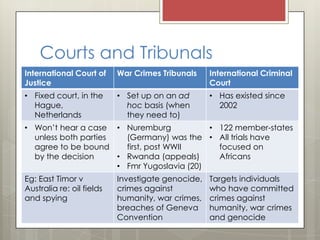
    Courts and Tribunals InternationalCourt of Justice War Crimes Tribunals International Criminal Court • Fixed court, in the Hague, Netherlands • Set up on an ad hoc basis (when they need to) • Has existed since 2002 • Won’t hear a case unless both parties agree to be bound by the decision • Nuremburg (Germany) was the first, post WWII • Rwanda (appeals) • Fmr Yugoslavia (20) • 122 member-states • All trials have focused on Africans Eg: East Timor v Australia re: oil fields and spying Investigate genocide, crimes against humanity, war crimes, breaches of Geneva Convention Targets individuals who have committed crimes against humanity, war crimes and genocide
  • 4.
    Intergovernmental Organisations (IGOs)  Organisationswhich represent the governments of their members EG:  United Nations  European Union (EU)  ASEAN  IGOs have their own rules for membership and sanctions against those who don’t comply
  • 5.
    Non-government Organisations  Limited Status cannot enforce sanctions  can apply pressure on governments through lobbying, education programs, aid etc EG:  Amnesty International  Greenpeace  Sea Shepherd
  • 6.
    Relevance to Australia? We have played an active role since the UN was formed  We are a member-nation of many organs, and have been active in peace-keeping  UN treaties have an impact on our domestic legislation  It’s not all smooth-sailing; we have been at odds with the UN on a range of issues  Asylum seekers  Indigenous issues  East Timor / oil