Civil Procedure Code, 1908
Introduction
• Law is divided into Substantive law and Procedural law.
• Substantive law mentions about rights and liabilities.
• Procedural law mentions about practises, procedures and
machinery to enforce rights and liabilities.
• 158 sections form the 1st part
• Other part contains rules and orders.
6/1/2021 2
Vidya A R
Terminology
• Cause of action: Every fact to be proved by the plaintiff to support
his right to judgement.
• Judgement: Statement of the judge on the grounds of a decree.
• It is the decision of the court based on rights and claims of parties.
• Decree: Formal expression of adjudication
• Conclusive determination of the rights of parties.
• The determination is with regard to matter of contravention in the
suit.
• The adjudication should have been given in the suit.
• Decree comes into existence on pronouncement of judgement
6/1/2021 3
Vidya A R
Types
• Preliminary: Tells what is to be done.
• Final: Result achieved by means of the preliminary decree.
• Final decree is dependent on preliminary.
• When preliminary is set aside, final decree is superceded.
6/1/2021 4
Vidya A R
• Decree holder: Person on whose favour a decree is passed or an
order capable of being performed is given.
• He need not be a party to suit.
• Judgement Debtor: Person against whom a decree has been
given and an order capable of execution has been given
• Judgement: Statement given by the judge on the basis of a
decree or order.
• Order: Formal expression of any decision of a civil court which is
not a decree.
• An order which is not a final order is called an “Interlocutory order”
6/1/2021 5
Vidya A R
• Appeal may lie from a preliminary decree also.
• Every suit is filed in a court of lowest grade.
• Jurisdiction: Limit of authority of a civil court.
• Can be
Over the subject matter.
Place of suing/Territorial (fixed by govt.)
Over persons
Pecuniary based or pecuniary value
6/1/2021 6
Vidya A R
Depending upon Powers
• Jurisdiction:
Original - tries and decides suit filed before it.
Appellate: Hears appeals against decisions/decrees passed by
subordinate courts
Criminal & Appellate: SC, HC and other courts has it.
Civil court tries all civil suits unless barred by some legislation
like giving powers to tribunals in particular matter.
6/1/2021 7
Vidya A R
Stay of Suit
• Doctrine of “Res sub judice” says that courts of concurrent
jurisdiction, cannot try same cases simultaneously.
• During pendency of a suit, same suit cannot be filed in any court.
6/1/2021 8
Vidya A R
Conditions
• Court has inherent powers to stay on conditions of
The matter must be 2 suits instituted at different times
The matter in issue in the latter suit should be directly and
substantially in issue in the earlier suit.
Such suit should be between the same parties.
Earlier suit is pending in the same court/other competent court
but not before a foreign court.
6/1/2021 9
Vidya A R
• When these conditions exist the latter suit is stayed till the
disposal of earlier suit, the finding of which act as res judicata on
the latter suit.
• Finality and conclusiveness of judicial decisions for the final
determination of disputes is in the general interest of the
community as matter of public policy.
• Interest of person should be protected from multiplication of
litigation.
• It is a rule of convenience and not a rule of absolute justice.
6/1/2021 10
Vidya A R
Place of Suing
• The following types of suits in a court within whose local limits of
jurisdiction the property is situated.
Recovery of immovable property with or without rent/profits
For partition of the same ..
Foreclosure of sale/redemption in the case of a mortgage/charge.
For determination of any other right/interest in immovable
property
For compensation for wrongs to immovable property
For the recovery of movable property attached
6/1/2021 11
Vidya A R
• Property means property situated in India.
• When immovable property situated in the jurisdiction of different
courts, any court.
• When jurisdiction is uncertain
• Any court after recording a statement of the uncertainity
• Where wrong done to the person or to the movable property
6/1/2021 12
Vidya A R
Other suits
• Where defendant resides/where cause of action arises.
• Body corporate/Co where the sole office/at the place where cause
of action arises and where it has a subordinate office.
6/1/2021 13
Vidya A R
• Res judicata: No one shall be twice vexed for the same cause.
• Rule of res sub judice: Matter pending judicial enquiry.
• The doctrine of constructive res judicata that matters/issues which
could have been taken as ground of defense or attack in former
suit.
• Based on public policy
6/1/2021 14
Vidya A R
Set off
• Reciprocal acquittal of debts between the plaintiff and defendant
• The effect is extinguishment of the plaintiff's claim to the extent of
the amount claimed by the defendant as a counter claim.
• The defendant file a written statement containing the particulars of
the debt sought to be set off.
• Based on this the court can give a final judgement.
6/1/2021 15
Vidya A R
• Counter claim: Made by defendant related to some damages or
not.
• Equitable set off: Set off regarding an unascertainable money of
the defendant.
6/1/2021 16
Vidya A R
Temporary Injunction
• May be asked by the plaintiff when the property in dispute in a suit
is in danger of being wasted, damaged or alienated by any party
to the suit or wrongfully sold in execution of a decree or
• That the defendant threatens or intends to remove or dispose of
his property to defraud his creditors or
• That the defendant threatens to disposses the plaintiff or
otherwise cause injury to the plaintiff in relation to any property in
dispute in the suit.
6/1/2021 17
Vidya A R
• Plaintiff has to convince the court that substantial or irreparable
harm/injury would be suffered by him if such temporary injunction
till the disposal of the suit is not granted and such loss cannot be
compensated by damages.
6/1/2021 18
Vidya A R
Interlocutory Orders
• Power to order interim sale when the movable property is in
question and it is perishable in nature.
6/1/2021 19
Vidya A R
Institution of Suit
• Suit is a civil action
• Started by presenting a plaint in duplicate to the Court
• Containing concise statement of material facts
• On which the party pleading relies on for his claim/defense
• The facts must be proved by an affidavit
6/1/2021 20
Vidya A R
Essentials
• The opposing parties
• The cause of action
• The subject matter of the suit
• The reliefs claimed
6/1/2021 21
Vidya A R
Plaint
• Plaint has a heading and title
• The body of the palint and the reliefs claimed.
6/1/2021 22
Vidya A R
Misjoinder of parties
• 2 factors essential to avoid misjoinder of parties
• Right to relief must arise out of the same act or transaction
brought by the plaintiffs or against the defendants
• There is a common question of law or fact.
6/1/2021 23
Vidya A R
Cause of action
• Bundle of essential facts which the plaintiff has to prove in order to
sustain his action.
• Antecedent to the institution of the suit.
• It consists of a right and an infringement for which relief is
claimed.
• If the plaiintiffs are not jointly interested in all the causes of action,
there is a misjoinder of causes of action.
6/1/2021 24
Vidya A R
Stages in proceedings
• Institution of Suit
Court issues summons to defendant to appear and answer the
claim and to file a written statement within 30 days from the date
of service of summons.
When defendant comes and admits the claim, no need of
summons.
30 days may be extended to 90 days by the court by writing the
reasons in record.
Defendant may appear himself or by an advocate/pleader
accompanied by some person who can answer alll matrerial
questions related to the suit.
6/1/2021 25
Vidya A R
• Every summons must be signed by the judge/an authorised officer
of the court and sealed with the seal of the court and
accompanied by the copy of the plaint.
• Defense: Written statement of defense by the defendant to be
filed on getting the summons.
6/1/2021 26
Vidya A R
Appearance of parties
• If both parties do not appear when the suit is called on for hearing,
the court may dismiss the suit.
• If the defendant only not appear the court may move ex parte.
• When summons not served on defendan the court may order one
more summons and postpone the hearing to a fresh date.
• The defendant may come thereafter and assign a good cause for
his previous non appearance
• If plaintiff absent during hearing the suit is dismissed.
• An ex parte decree may be set aside by the court when sufficient
cause is shown by the defendant.
6/1/2021 27
Vidya A R
Remedies against an ex parte decree
• File an appeal
• File an application for review of the judgement.
• Apply for setting aside the decree.
• Suit for setting aside the decree obtained by fraud and for non
service of summons.
6/1/2021 28
Vidya A R
Discovery
• Finding out material facts and documents from an adversary to
ascertain the nature of the case of the adversary or material facts
for the adversary's case.
• Obtain admissions of the adversary for supporting party's own
cause or indirectly by impleading or destroying the adversary's
case.
• Narrow the points at issue.
• Avoid expenses and effort in proving admitted facts.
6/1/2021 29
Vidya A R
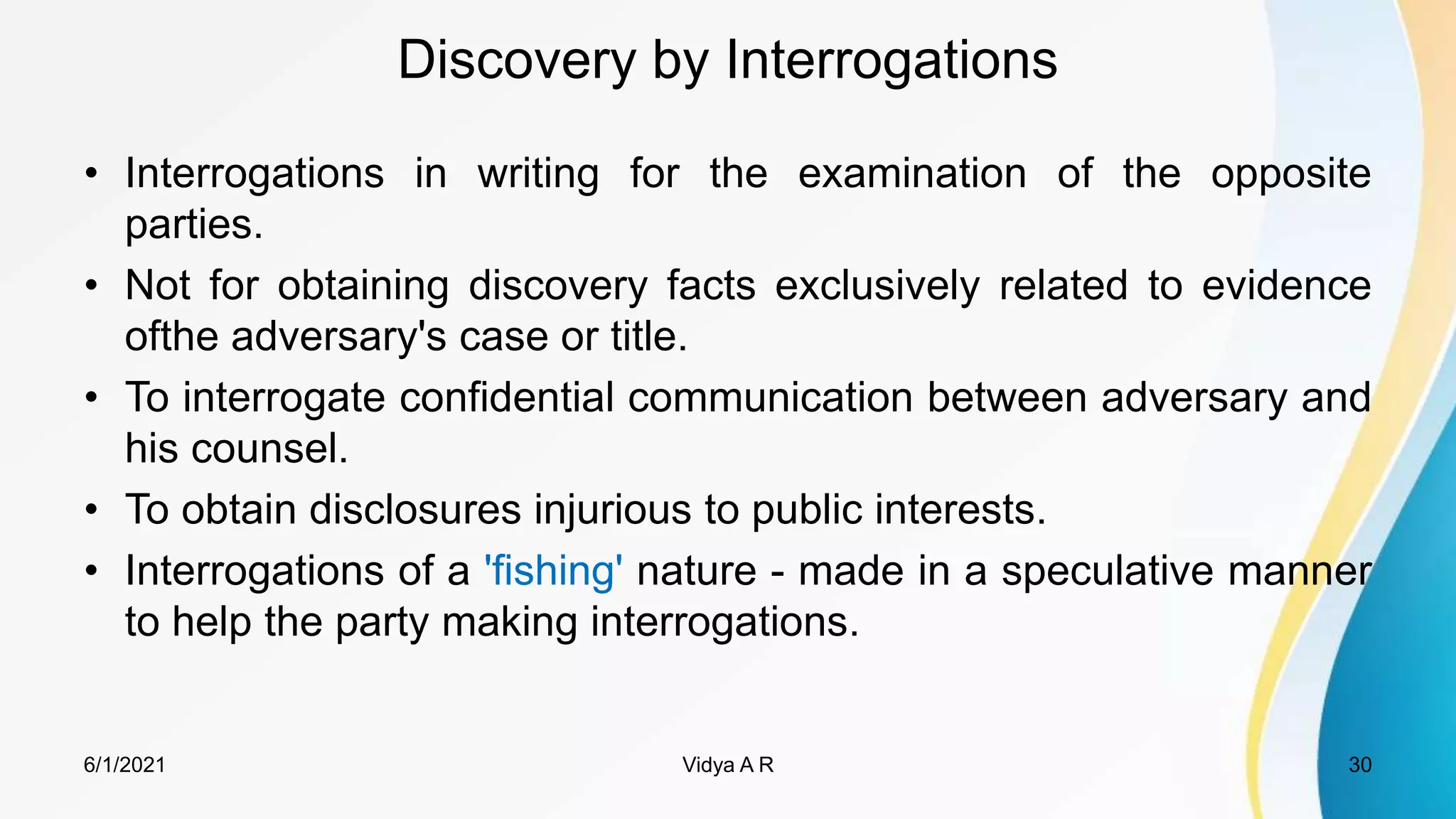
Discovery by Interrogations
• Interrogations in writing for the examination of the opposite
parties.
• Not for obtaining discovery facts exclusively related to evidence
ofthe adversary's case or title.
• To interrogate confidential communication between adversary and
his counsel.
• To obtain disclosures injurious to public interests.
• Interrogations of a 'fishing' nature - made in a speculative manner
to help the party making interrogations.
6/1/2021 30
Vidya A R
Discovery by document
• All documents relating to the matters in issue in the possession or
power of any adversary can be inspected by means of discovery
by documents.
• A party may refuse to produce documents for the reasons
Where it discloses a party's evidence
When it enjoys a legal professional privilege
Whn it is injurious to public interest
Denial of possession of document
6/1/2021 31
Vidya A R
Admission by parties
• One party accepts the case of the other party in whole or in part to
be true.
• May be either in pleadings/by answers to interrogations/by
agreement of the parties/admission by notice
6/1/2021 32
Vidya A R
Issues
• Issues arise when a material proposition of fact or law is affirmed
by one party and denied by other.
• Issues may be of fact/law.
6/1/2021 33
Vidya A R
• Issues are framed on material propositions of fact/law gathered
from
Allegations made in the plaint & in the written statement
Allegations made by the parties/persons present on their behalf
or their pleaders on oath.
Allegations in answer to interrogations
Contents of documents produced by the parties.
Statements made by parties/their representatives when
examined.
From examination of a witness or any documents ordered to be
produced.
6/1/2021 34
Vidya A R
Hearing of the Suit
• The plaintiff has a right to begin.
6/1/2021 35
Vidya A R
Affidavit
• A written statement of the deponent on oath duly affirmed before
any court or Magistrate or any oath Commissioner appointed by
the court or before the notary public.
• Used in the following cases
• Court may on its own motion/by an application of any party order
an affidavit.
• Affidavit of the witness may be read in hearing/he may be
examined.
6/1/2021 36
Vidya A R
Judgement
• Usually a judgement is pronounced by the judge within 30 days of
the hearing conclusion.
• At the most 60 days.
6/1/2021 37
Vidya A R
Decree
• Passed in 15 days of the judgement.
• It contains the
Number of the suit
Names and descriptions of the parties and their registered
addresses
Particulars of the claim
Relief granted or other determination of the suit
Amount of cost incurred and by whom it is to be paid
6/1/2021 38
Vidya A R
Execution
• Enforcement of decrees/orders of the court
• May be executed either by the court which passed it or by the
court to which it is sent for execution.
6/1/2021 39
Vidya A R
Right of Appeal
• Given by statutes
• Kinds of Appeals
From original decrees (from ex parte)
Second Appeal (to HC on a question of law)
Appeals from orders (Defect/irregularity in law)
Appeal to the SC
6/1/2021 40
Vidya A R
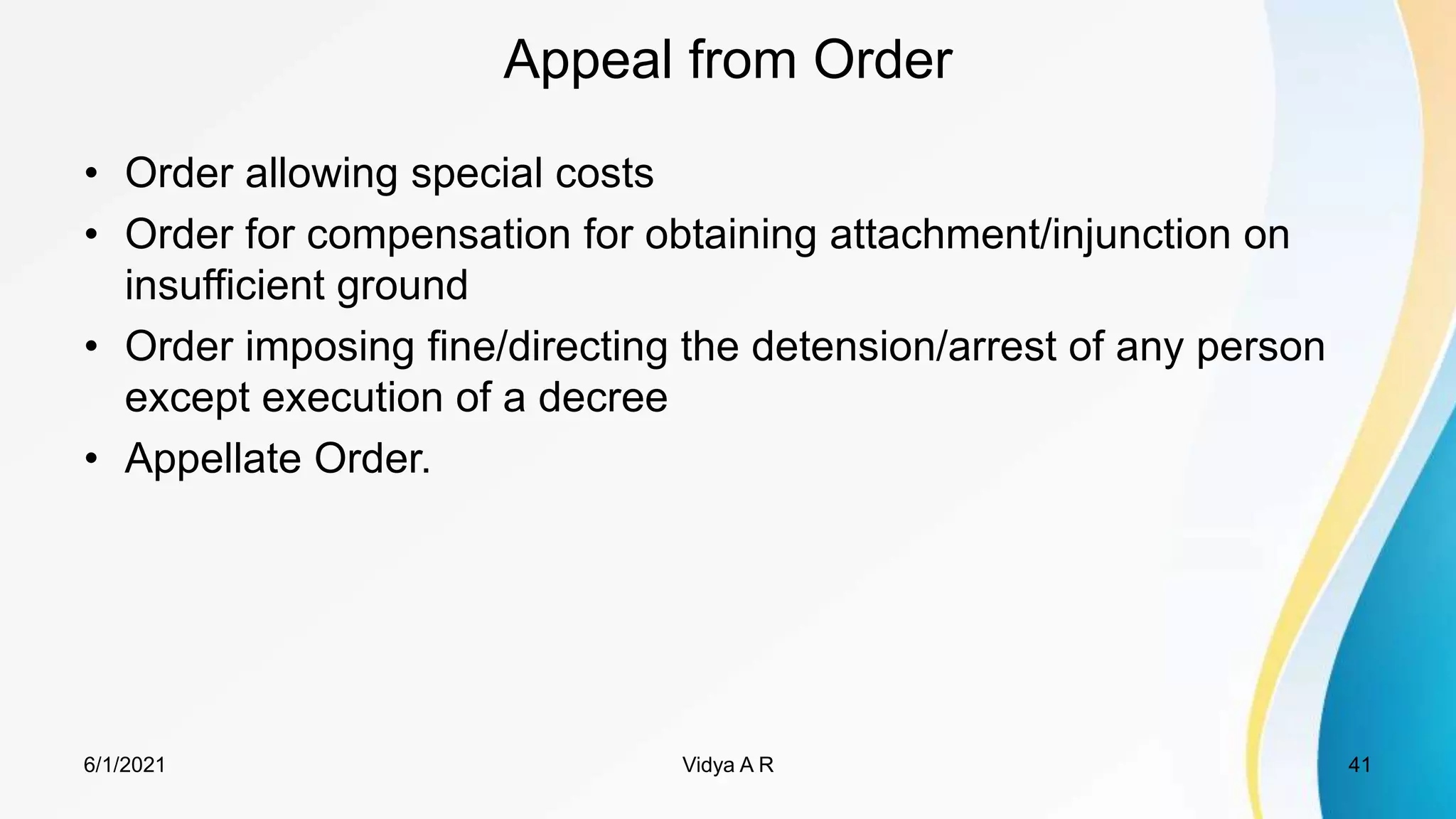
Appeal from Order
• Order allowing special costs
• Order for compensation for obtaining attachment/injunction on
insufficient ground
• Order imposing fine/directing the detension/arrest of any person
except execution of a decree
• Appellate Order.
6/1/2021 41
Vidya A R
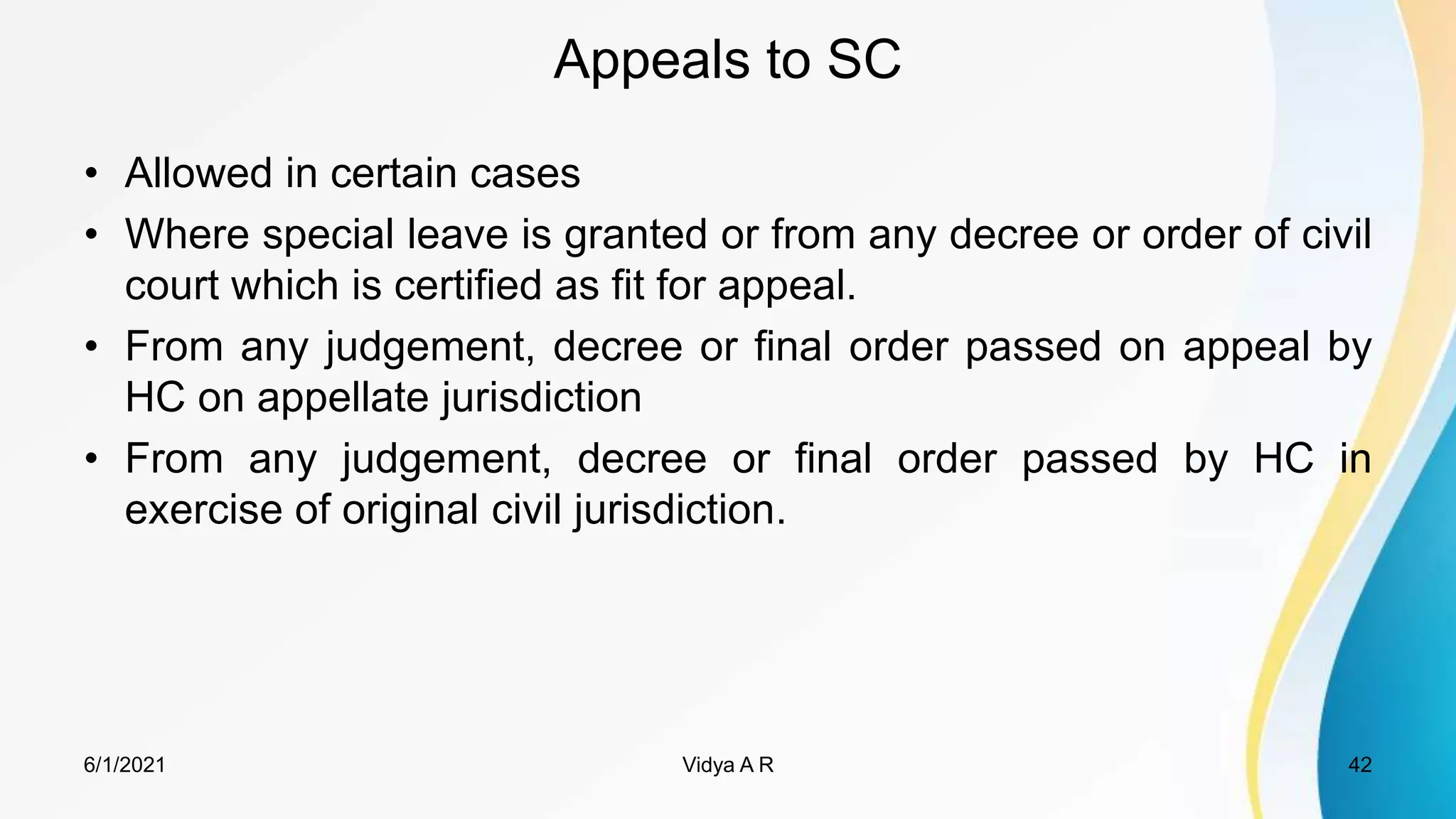
Appeals to SC
• Allowed in certain cases
• Where special leave is granted or from any decree or order of civil
court which is certified as fit for appeal.
• From any judgement, decree or final order passed on appeal by
HC on appellate jurisdiction
• From any judgement, decree or final order passed by HC in
exercise of original civil jurisdiction.
6/1/2021 42
Vidya A R
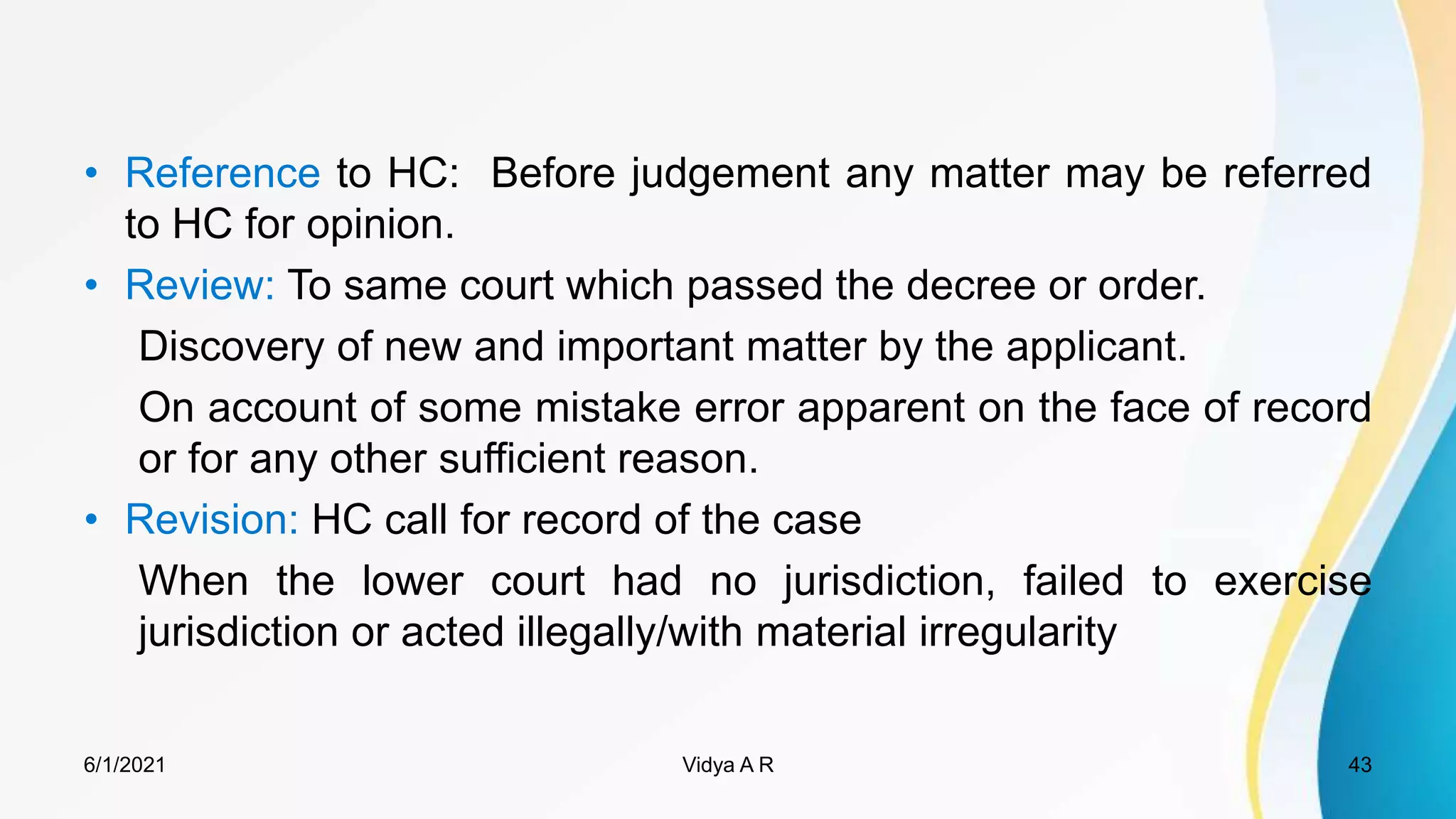
to HC: Before judgement any matter may be referred
to HC for opinion.
To same court which passed the decree or order.
Discovery of new and important matter by the applicant.
On account of some mistake error apparent on the face of record
or for any other sufficient reason.
HC call for record of the case
When the lower court had no jurisdiction, failed to exercise
jurisdiction or acted illegally/with material irregularity
6/1/2021 Vidya A R 43
• Suits by or against a corporation
Secretary/Director/Any other principal officer of the company
• Minor's suits
A guardian appointed by court handles the case.
On attaining majority, he can elect to continue the case or
abandon it resulting in dismissal of the suit.
6/1/2021 Vidya A R 44
Summary Procedure
• For suits upon Bill of Exchange, hundis or promissory notes, 1
year of debt becoming due, suit is to be filed.
6/1/2021 Vidya A R 45

Cpc

  • 1.
  • 2.
    Introduction • Law isdivided into Substantive law and Procedural law. • Substantive law mentions about rights and liabilities. • Procedural law mentions about practises, procedures and machinery to enforce rights and liabilities. • 158 sections form the 1st part • Other part contains rules and orders. 6/1/2021 2 Vidya A R
  • 3.
    Terminology • Cause ofaction: Every fact to be proved by the plaintiff to support his right to judgement. • Judgement: Statement of the judge on the grounds of a decree. • It is the decision of the court based on rights and claims of parties. • Decree: Formal expression of adjudication • Conclusive determination of the rights of parties. • The determination is with regard to matter of contravention in the suit. • The adjudication should have been given in the suit. • Decree comes into existence on pronouncement of judgement 6/1/2021 3 Vidya A R
  • 4.
    Types • Preliminary: Tellswhat is to be done. • Final: Result achieved by means of the preliminary decree. • Final decree is dependent on preliminary. • When preliminary is set aside, final decree is superceded. 6/1/2021 4 Vidya A R
  • 5.
    • Decree holder:Person on whose favour a decree is passed or an order capable of being performed is given. • He need not be a party to suit. • Judgement Debtor: Person against whom a decree has been given and an order capable of execution has been given • Judgement: Statement given by the judge on the basis of a decree or order. • Order: Formal expression of any decision of a civil court which is not a decree. • An order which is not a final order is called an “Interlocutory order” 6/1/2021 5 Vidya A R
  • 6.
    • Appeal maylie from a preliminary decree also. • Every suit is filed in a court of lowest grade. • Jurisdiction: Limit of authority of a civil court. • Can be Over the subject matter. Place of suing/Territorial (fixed by govt.) Over persons Pecuniary based or pecuniary value 6/1/2021 6 Vidya A R
  • 7.
    Depending upon Powers •Jurisdiction: Original - tries and decides suit filed before it. Appellate: Hears appeals against decisions/decrees passed by subordinate courts Criminal & Appellate: SC, HC and other courts has it. Civil court tries all civil suits unless barred by some legislation like giving powers to tribunals in particular matter. 6/1/2021 7 Vidya A R
  • 8.
    Stay of Suit •Doctrine of “Res sub judice” says that courts of concurrent jurisdiction, cannot try same cases simultaneously. • During pendency of a suit, same suit cannot be filed in any court. 6/1/2021 8 Vidya A R
  • 9.
    Conditions • Court hasinherent powers to stay on conditions of The matter must be 2 suits instituted at different times The matter in issue in the latter suit should be directly and substantially in issue in the earlier suit. Such suit should be between the same parties. Earlier suit is pending in the same court/other competent court but not before a foreign court. 6/1/2021 9 Vidya A R
  • 10.
    • When theseconditions exist the latter suit is stayed till the disposal of earlier suit, the finding of which act as res judicata on the latter suit. • Finality and conclusiveness of judicial decisions for the final determination of disputes is in the general interest of the community as matter of public policy. • Interest of person should be protected from multiplication of litigation. • It is a rule of convenience and not a rule of absolute justice. 6/1/2021 10 Vidya A R
  • 11.
    Place of Suing •The following types of suits in a court within whose local limits of jurisdiction the property is situated. Recovery of immovable property with or without rent/profits For partition of the same .. Foreclosure of sale/redemption in the case of a mortgage/charge. For determination of any other right/interest in immovable property For compensation for wrongs to immovable property For the recovery of movable property attached 6/1/2021 11 Vidya A R
  • 12.
    • Property meansproperty situated in India. • When immovable property situated in the jurisdiction of different courts, any court. • When jurisdiction is uncertain • Any court after recording a statement of the uncertainity • Where wrong done to the person or to the movable property 6/1/2021 12 Vidya A R
  • 13.
    Other suits • Wheredefendant resides/where cause of action arises. • Body corporate/Co where the sole office/at the place where cause of action arises and where it has a subordinate office. 6/1/2021 13 Vidya A R
  • 14.
    • Res judicata:No one shall be twice vexed for the same cause. • Rule of res sub judice: Matter pending judicial enquiry. • The doctrine of constructive res judicata that matters/issues which could have been taken as ground of defense or attack in former suit. • Based on public policy 6/1/2021 14 Vidya A R
  • 15.
    Set off • Reciprocalacquittal of debts between the plaintiff and defendant • The effect is extinguishment of the plaintiff's claim to the extent of the amount claimed by the defendant as a counter claim. • The defendant file a written statement containing the particulars of the debt sought to be set off. • Based on this the court can give a final judgement. 6/1/2021 15 Vidya A R
  • 16.
    • Counter claim:Made by defendant related to some damages or not. • Equitable set off: Set off regarding an unascertainable money of the defendant. 6/1/2021 16 Vidya A R
  • 17.
    Temporary Injunction • Maybe asked by the plaintiff when the property in dispute in a suit is in danger of being wasted, damaged or alienated by any party to the suit or wrongfully sold in execution of a decree or • That the defendant threatens or intends to remove or dispose of his property to defraud his creditors or • That the defendant threatens to disposses the plaintiff or otherwise cause injury to the plaintiff in relation to any property in dispute in the suit. 6/1/2021 17 Vidya A R
  • 18.
    • Plaintiff hasto convince the court that substantial or irreparable harm/injury would be suffered by him if such temporary injunction till the disposal of the suit is not granted and such loss cannot be compensated by damages. 6/1/2021 18 Vidya A R
  • 19.
    Interlocutory Orders • Powerto order interim sale when the movable property is in question and it is perishable in nature. 6/1/2021 19 Vidya A R
  • 20.
    Institution of Suit •Suit is a civil action • Started by presenting a plaint in duplicate to the Court • Containing concise statement of material facts • On which the party pleading relies on for his claim/defense • The facts must be proved by an affidavit 6/1/2021 20 Vidya A R
  • 21.
    Essentials • The opposingparties • The cause of action • The subject matter of the suit • The reliefs claimed 6/1/2021 21 Vidya A R
  • 22.
    Plaint • Plaint hasa heading and title • The body of the palint and the reliefs claimed. 6/1/2021 22 Vidya A R
  • 23.
    Misjoinder of parties •2 factors essential to avoid misjoinder of parties • Right to relief must arise out of the same act or transaction brought by the plaintiffs or against the defendants • There is a common question of law or fact. 6/1/2021 23 Vidya A R
  • 24.
    Cause of action •Bundle of essential facts which the plaintiff has to prove in order to sustain his action. • Antecedent to the institution of the suit. • It consists of a right and an infringement for which relief is claimed. • If the plaiintiffs are not jointly interested in all the causes of action, there is a misjoinder of causes of action. 6/1/2021 24 Vidya A R
  • 25.
    Stages in proceedings •Institution of Suit Court issues summons to defendant to appear and answer the claim and to file a written statement within 30 days from the date of service of summons. When defendant comes and admits the claim, no need of summons. 30 days may be extended to 90 days by the court by writing the reasons in record. Defendant may appear himself or by an advocate/pleader accompanied by some person who can answer alll matrerial questions related to the suit. 6/1/2021 25 Vidya A R
  • 26.
    • Every summonsmust be signed by the judge/an authorised officer of the court and sealed with the seal of the court and accompanied by the copy of the plaint. • Defense: Written statement of defense by the defendant to be filed on getting the summons. 6/1/2021 26 Vidya A R
  • 27.
    Appearance of parties •If both parties do not appear when the suit is called on for hearing, the court may dismiss the suit. • If the defendant only not appear the court may move ex parte. • When summons not served on defendan the court may order one more summons and postpone the hearing to a fresh date. • The defendant may come thereafter and assign a good cause for his previous non appearance • If plaintiff absent during hearing the suit is dismissed. • An ex parte decree may be set aside by the court when sufficient cause is shown by the defendant. 6/1/2021 27 Vidya A R
  • 28.
    Remedies against anex parte decree • File an appeal • File an application for review of the judgement. • Apply for setting aside the decree. • Suit for setting aside the decree obtained by fraud and for non service of summons. 6/1/2021 28 Vidya A R
  • 29.
    Discovery • Finding outmaterial facts and documents from an adversary to ascertain the nature of the case of the adversary or material facts for the adversary's case. • Obtain admissions of the adversary for supporting party's own cause or indirectly by impleading or destroying the adversary's case. • Narrow the points at issue. • Avoid expenses and effort in proving admitted facts. 6/1/2021 29 Vidya A R
  • 30.
    Discovery by Interrogations •Interrogations in writing for the examination of the opposite parties. • Not for obtaining discovery facts exclusively related to evidence ofthe adversary's case or title. • To interrogate confidential communication between adversary and his counsel. • To obtain disclosures injurious to public interests. • Interrogations of a 'fishing' nature - made in a speculative manner to help the party making interrogations. 6/1/2021 30 Vidya A R
  • 31.
    Discovery by document •All documents relating to the matters in issue in the possession or power of any adversary can be inspected by means of discovery by documents. • A party may refuse to produce documents for the reasons Where it discloses a party's evidence When it enjoys a legal professional privilege Whn it is injurious to public interest Denial of possession of document 6/1/2021 31 Vidya A R
  • 32.
    Admission by parties •One party accepts the case of the other party in whole or in part to be true. • May be either in pleadings/by answers to interrogations/by agreement of the parties/admission by notice 6/1/2021 32 Vidya A R
  • 33.
    Issues • Issues arisewhen a material proposition of fact or law is affirmed by one party and denied by other. • Issues may be of fact/law. 6/1/2021 33 Vidya A R
  • 34.
    • Issues areframed on material propositions of fact/law gathered from Allegations made in the plaint & in the written statement Allegations made by the parties/persons present on their behalf or their pleaders on oath. Allegations in answer to interrogations Contents of documents produced by the parties. Statements made by parties/their representatives when examined. From examination of a witness or any documents ordered to be produced. 6/1/2021 34 Vidya A R
  • 35.
    Hearing of theSuit • The plaintiff has a right to begin. 6/1/2021 35 Vidya A R
  • 36.
    Affidavit • A writtenstatement of the deponent on oath duly affirmed before any court or Magistrate or any oath Commissioner appointed by the court or before the notary public. • Used in the following cases • Court may on its own motion/by an application of any party order an affidavit. • Affidavit of the witness may be read in hearing/he may be examined. 6/1/2021 36 Vidya A R
  • 37.
    Judgement • Usually ajudgement is pronounced by the judge within 30 days of the hearing conclusion. • At the most 60 days. 6/1/2021 37 Vidya A R
  • 38.
    Decree • Passed in15 days of the judgement. • It contains the Number of the suit Names and descriptions of the parties and their registered addresses Particulars of the claim Relief granted or other determination of the suit Amount of cost incurred and by whom it is to be paid 6/1/2021 38 Vidya A R
  • 39.
    Execution • Enforcement ofdecrees/orders of the court • May be executed either by the court which passed it or by the court to which it is sent for execution. 6/1/2021 39 Vidya A R
  • 40.
    Right of Appeal •Given by statutes • Kinds of Appeals From original decrees (from ex parte) Second Appeal (to HC on a question of law) Appeals from orders (Defect/irregularity in law) Appeal to the SC 6/1/2021 40 Vidya A R
  • 41.
    Appeal from Order •Order allowing special costs • Order for compensation for obtaining attachment/injunction on insufficient ground • Order imposing fine/directing the detension/arrest of any person except execution of a decree • Appellate Order. 6/1/2021 41 Vidya A R
  • 42.
    Appeals to SC •Allowed in certain cases • Where special leave is granted or from any decree or order of civil court which is certified as fit for appeal. • From any judgement, decree or final order passed on appeal by HC on appellate jurisdiction • From any judgement, decree or final order passed by HC in exercise of original civil jurisdiction. 6/1/2021 42 Vidya A R
  • 43.
    to HC: Beforejudgement any matter may be referred to HC for opinion. To same court which passed the decree or order. Discovery of new and important matter by the applicant. On account of some mistake error apparent on the face of record or for any other sufficient reason. HC call for record of the case When the lower court had no jurisdiction, failed to exercise jurisdiction or acted illegally/with material irregularity 6/1/2021 Vidya A R 43
  • 44.
    • Suits byor against a corporation Secretary/Director/Any other principal officer of the company • Minor's suits A guardian appointed by court handles the case. On attaining majority, he can elect to continue the case or abandon it resulting in dismissal of the suit. 6/1/2021 Vidya A R 44
  • 45.
    Summary Procedure • Forsuits upon Bill of Exchange, hundis or promissory notes, 1 year of debt becoming due, suit is to be filed. 6/1/2021 Vidya A R 45