Introduction to Civil Law


       School of Law   An Scoil DlĂ­
Introduction to Civil Law


Dr Suzanne Kingston


       School of Law   An Scoil DlĂ­
Legal Procedure in Civil Law systems


• Fundamental distinction: civil v criminal
  procedure
Overarching distinctions between common law
and civil law approach to procedure
Overarching distinctions between common law
and civil law approach to procedure


• Common law “adversarial” tradition vs civil law
  “inquisitorial” tradition
   – Adversarial: lawyer-driven procedure – relatively
     passive traditional role of judge – lawyer puts
     questions
      • Examination-in-chief
      • Cross-examination
   – Inquisitorial: judge-led procedure – judge puts
     questions
      • http://www.youtube.com/watch?
        v=R_7weUR0oMY&feature=related
Overarching distinctions between common law
and civil law approach to procedure


• Common law “adversarial” tradition vs civil law
  “inquisitorial” tradition
   – Adversarial: lawyer-driven procedure – relatively
     passive traditional role of judge – lawyer puts
     questions
      • Examination-in-chief
      • Cross-examination
   – Inquisitorial: judge-led procedure – judge puts
     questions
      • http://www.youtube.com/watch?
        v=R_7weUR0oMY&feature=related
• Importance of compressed “trial” in common law
Overarching distinctions between common law
and civil law approach to procedure


• Common law “adversarial” tradition vs civil law
  “inquisitorial” tradition
   – Adversarial: lawyer-driven procedure – relatively
     passive traditional role of judge – lawyer puts
     questions
      • Examination-in-chief
      • Cross-examination
   – Inquisitorial: judge-led procedure – judge puts
     questions
      • http://www.youtube.com/watch?
        v=R_7weUR0oMY&feature=related
• Importance of compressed “trial” in common law
• Role of jury in common law
   – This leads to complex evidence rules
Civil procedure
Civil procedure


• Typical procedure in civil law systems: the French
  example
   – Preliminary stage
      • Submission of pleadings
      • Appointment of “instructing judge”
   – Taking of evidence by instructing judge
   – Taking of decision by different judge(s) after
      • Considering instructing judge’s record of the evidence
      • Looking at pleadings and submissions
Civil procedure
Civil procedure


• No compressed “trial”
   – Several smaller hearings, meetings, submissions
   – Less pressure on lawyers
   – No emphasis on “discovery” and less emphasis on
     pre-trial procedures than common law jurisdictions
Civil procedure


• No compressed “trial”
   – Several smaller hearings, meetings, submissions
   – Less pressure on lawyers
   – No emphasis on “discovery” and less emphasis on
     pre-trial procedures than common law jurisdictions
• Less emphasis on initial pleadings than common
  law
Civil procedure


• No compressed “trial”
   – Several smaller hearings, meetings, submissions
   – Less pressure on lawyers
   – No emphasis on “discovery” and less emphasis on
     pre-trial procedures than common law jurisdictions
• Less emphasis on initial pleadings than common
  law
• Importance of division of judicial role
   – Pros and cons?
Civil procedure


• No compressed “trial”
   – Several smaller hearings, meetings, submissions
   – Less pressure on lawyers
   – No emphasis on “discovery” and less emphasis on
     pre-trial procedures than common law jurisdictions
• Less emphasis on initial pleadings than common
  law
• Importance of division of judicial role
   – Pros and cons?
• Civil procedure codes in civil law systems
Civil procedure
Civil procedure


• Differences in rules on costs
   – What is the rule in:
       • Ireland?
       • The UK?
   – This means that costs are “taxed”
   – Contrast the US: each party pays own lawyer
   – Civil law: costs “follow the event”
       • But may be subject to standard fee calculation (eg Germany)
Civil procedure


• Differences in rules on costs
   – What is the rule in:
       • Ireland?
       • The UK?
   – This means that costs are “taxed”
   – Contrast the US: each party pays own lawyer
   – Civil law: costs “follow the event”
       • But may be subject to standard fee calculation (eg Germany)

• Different approach to “contingency fees”
   – Banned in Germany until 2007 Federal Constitutional Court
     judgment
   – Allowed in eg UK (“conditional fee”), Ireland, France
Civil procedure


• Differences in rules on costs
   – What is the rule in:
       • Ireland?
       • The UK?
   – This means that costs are “taxed”
   – Contrast the US: each party pays own lawyer
   – Civil law: costs “follow the event”
       • But may be subject to standard fee calculation (eg Germany)

• Different approach to “contingency fees”
   – Banned in Germany until 2007 Federal Constitutional Court
     judgment
   – Allowed in eg UK (“conditional fee”), Ireland, France
• Different approaches to quantum of damages available
   – IRL, UK approaches?
   – US: multiple, penal damages available
   – Civil law: penal damages rare
Civil procedure
Civil procedure


• Risk of over-exaggerating differences between
  common law and civil law systems
   – Judges increasingly “active” in some common law
     systems – not just in eg juvenile, incapacitated
     persons cases
   – Judges often prompted to ask questions in civil law
     systems by parties
      • Lawyer makes proposal to instructing judge that
        witness be called to testify – “offer of proof”
      • No cross-examination
      • Opposing counsel may make suggestions to
        instructing judge about wording of record
      • Opposing counsel may argue that witness is
        disqualified on basis of bias
Criminal procedure
Criminal procedure


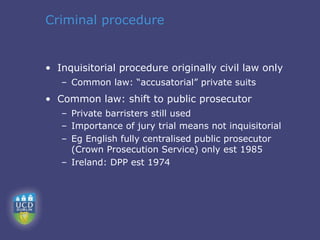
• Inquisitorial procedure originally civil law only
   – Common law: “accusatorial” private suits
Criminal procedure


• Inquisitorial procedure originally civil law only
   – Common law: “accusatorial” private suits
• Common law: shift to public prosecutor
   – Private barristers still used
   – Importance of jury trial means not inquisitorial
   – Eg English fully centralised public prosecutor
     (Crown Prosecution Service) only est 1985
   – Ireland: DPP est 1974
Criminal procedure
Criminal procedure


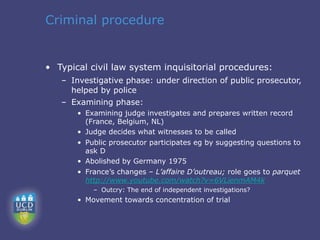
• Typical civil law system inquisitorial procedures:
   – Investigative phase: under direction of public prosecutor,
     helped by police
   – Examining phase:
       • Examining judge investigates and prepares written record
         (France, Belgium, NL)
       • Judge decides what witnesses to be called
       • Public prosecutor participates eg by suggesting questions to
         ask D
       • Abolished by Germany 1975
       • France’s changes – L’affaire D’outreau; role goes to parquet
         http://www.youtube.com/watch?v=6VLienmAM4k
           – Outcry: The end of independent investigations?
       • Movement towards concentration of trial
Criminal procedure


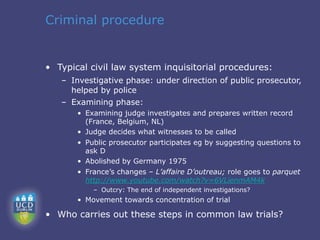
• Typical civil law system inquisitorial procedures:
   – Investigative phase: under direction of public prosecutor,
     helped by police
   – Examining phase:
       • Examining judge investigates and prepares written record
         (France, Belgium, NL)
       • Judge decides what witnesses to be called
       • Public prosecutor participates eg by suggesting questions to
         ask D
       • Abolished by Germany 1975
       • France’s changes – L’affaire D’outreau; role goes to parquet
         http://www.youtube.com/watch?v=6VLienmAM4k
           – Outcry: The end of independent investigations?
       • Movement towards concentration of trial

• Who carries out these steps in common law trials?
Criminal procedure
Criminal procedure


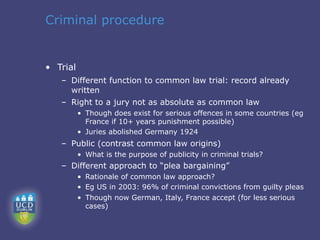
• Trial
   – Different function to common law trial: record already
     written
   – Right to a jury not as absolute as common law
          • Though does exist for serious offences in some countries (eg
            France if 10+ years punishment possible)
          • Juries abolished Germany 1924
   – Public (contrast common law origins)
          • What is the purpose of publicity in criminal trials?
   – Different approach to “plea bargaining”
          • Rationale of common law approach?
          • Eg US in 2003: 96% of criminal convictions from guilty pleas
          • Though now German, Italy, France accept (for less serious
            cases)
Right to a jury
Right to a jury


• No right to a jury
   – Contrast role of jury in common law systems:
      • IRL? What is the function of a jury? UK? US?
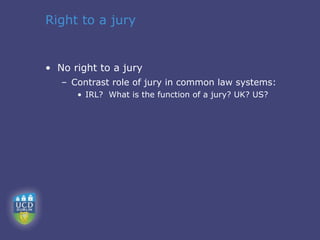
Right to a jury


• No right to a jury
   – Contrast role of jury in common law systems:
      • IRL? What is the function of a jury? UK? US?

• Why the difference? How best to discover the
  truth?
   – Contrast: judicial control of sentencing in common
     law jurisdictions
   – Who sits on juries?
Right to a jury
Right to a jury


• Implications of right to a jury
   – Exclusionary rules of evidence necessary
      • Eg rule against hearsay
   – No similar exclusionary rules in civil law
      • Witnesses may be disqualified on grounds of bias
      • Witness can be asked by other party to swear an oath
        as to his knowledge of the fact at issue (“decisory
        oath”)
   – Sets limits on appeal (only eg error of law,
     evidentiary error etc)
   – No reasons for decision
Criminal procedure
Criminal procedure


• Procedural safeguards:
   – Right to representation
   – Right to inspect examining judge’s file
   – D can refuse to answer questions
Criminal procedure


• Procedural safeguards:
   – Right to representation
   – Right to inspect examining judge’s file
   – D can refuse to answer questions
• Advantages of civil law procedure?
   – Avoids underfunding of criminal defence?
   – More appeals possible?
   – More discretion on hearsay?
Criminal procedure


• Procedural safeguards:
   – Right to representation
   – Right to inspect examining judge’s file
   – D can refuse to answer questions
• Advantages of civil law procedure?
   – Avoids underfunding of criminal defence?
   – More appeals possible?
   – More discretion on hearsay?
• Common misconceptions about civil law systems:
   – No right to a jury trial in criminal matters
   – No presumption of innocence in criminal matters
      • Eg French law 2000
   – No oral procedure

Slides 7

  • 1.
    Introduction to CivilLaw School of Law An Scoil DlĂ­
  • 2.
    Introduction to CivilLaw Dr Suzanne Kingston School of Law An Scoil DlĂ­
  • 3.
    Legal Procedure inCivil Law systems
  • 4.
    Legal Procedure inCivil Law systems • Fundamental distinction: civil v criminal procedure
  • 5.
    Overarching distinctions betweencommon law and civil law approach to procedure
  • 6.
    Overarching distinctions betweencommon law and civil law approach to procedure • Common law “adversarial” tradition vs civil law “inquisitorial” tradition – Adversarial: lawyer-driven procedure – relatively passive traditional role of judge – lawyer puts questions • Examination-in-chief • Cross-examination – Inquisitorial: judge-led procedure – judge puts questions • http://www.youtube.com/watch? v=R_7weUR0oMY&feature=related
  • 7.
    Overarching distinctions betweencommon law and civil law approach to procedure • Common law “adversarial” tradition vs civil law “inquisitorial” tradition – Adversarial: lawyer-driven procedure – relatively passive traditional role of judge – lawyer puts questions • Examination-in-chief • Cross-examination – Inquisitorial: judge-led procedure – judge puts questions • http://www.youtube.com/watch? v=R_7weUR0oMY&feature=related • Importance of compressed “trial” in common law
  • 8.
    Overarching distinctions betweencommon law and civil law approach to procedure • Common law “adversarial” tradition vs civil law “inquisitorial” tradition – Adversarial: lawyer-driven procedure – relatively passive traditional role of judge – lawyer puts questions • Examination-in-chief • Cross-examination – Inquisitorial: judge-led procedure – judge puts questions • http://www.youtube.com/watch? v=R_7weUR0oMY&feature=related • Importance of compressed “trial” in common law • Role of jury in common law – This leads to complex evidence rules
  • 9.
  • 10.
    Civil procedure • Typicalprocedure in civil law systems: the French example – Preliminary stage • Submission of pleadings • Appointment of “instructing judge” – Taking of evidence by instructing judge – Taking of decision by different judge(s) after • Considering instructing judge’s record of the evidence • Looking at pleadings and submissions
  • 11.
  • 12.
    Civil procedure • Nocompressed “trial” – Several smaller hearings, meetings, submissions – Less pressure on lawyers – No emphasis on “discovery” and less emphasis on pre-trial procedures than common law jurisdictions
  • 13.
    Civil procedure • Nocompressed “trial” – Several smaller hearings, meetings, submissions – Less pressure on lawyers – No emphasis on “discovery” and less emphasis on pre-trial procedures than common law jurisdictions • Less emphasis on initial pleadings than common law
  • 14.
    Civil procedure • Nocompressed “trial” – Several smaller hearings, meetings, submissions – Less pressure on lawyers – No emphasis on “discovery” and less emphasis on pre-trial procedures than common law jurisdictions • Less emphasis on initial pleadings than common law • Importance of division of judicial role – Pros and cons?
  • 15.
    Civil procedure • Nocompressed “trial” – Several smaller hearings, meetings, submissions – Less pressure on lawyers – No emphasis on “discovery” and less emphasis on pre-trial procedures than common law jurisdictions • Less emphasis on initial pleadings than common law • Importance of division of judicial role – Pros and cons? • Civil procedure codes in civil law systems
  • 16.
  • 17.
    Civil procedure • Differencesin rules on costs – What is the rule in: • Ireland? • The UK? – This means that costs are “taxed” – Contrast the US: each party pays own lawyer – Civil law: costs “follow the event” • But may be subject to standard fee calculation (eg Germany)
  • 18.
    Civil procedure • Differencesin rules on costs – What is the rule in: • Ireland? • The UK? – This means that costs are “taxed” – Contrast the US: each party pays own lawyer – Civil law: costs “follow the event” • But may be subject to standard fee calculation (eg Germany) • Different approach to “contingency fees” – Banned in Germany until 2007 Federal Constitutional Court judgment – Allowed in eg UK (“conditional fee”), Ireland, France
  • 19.
    Civil procedure • Differencesin rules on costs – What is the rule in: • Ireland? • The UK? – This means that costs are “taxed” – Contrast the US: each party pays own lawyer – Civil law: costs “follow the event” • But may be subject to standard fee calculation (eg Germany) • Different approach to “contingency fees” – Banned in Germany until 2007 Federal Constitutional Court judgment – Allowed in eg UK (“conditional fee”), Ireland, France • Different approaches to quantum of damages available – IRL, UK approaches? – US: multiple, penal damages available – Civil law: penal damages rare
  • 20.
  • 21.
    Civil procedure • Riskof over-exaggerating differences between common law and civil law systems – Judges increasingly “active” in some common law systems – not just in eg juvenile, incapacitated persons cases – Judges often prompted to ask questions in civil law systems by parties • Lawyer makes proposal to instructing judge that witness be called to testify – “offer of proof” • No cross-examination • Opposing counsel may make suggestions to instructing judge about wording of record • Opposing counsel may argue that witness is disqualified on basis of bias
  • 22.
  • 23.
    Criminal procedure • Inquisitorialprocedure originally civil law only – Common law: “accusatorial” private suits
  • 24.
    Criminal procedure • Inquisitorialprocedure originally civil law only – Common law: “accusatorial” private suits • Common law: shift to public prosecutor – Private barristers still used – Importance of jury trial means not inquisitorial – Eg English fully centralised public prosecutor (Crown Prosecution Service) only est 1985 – Ireland: DPP est 1974
  • 25.
  • 26.
    Criminal procedure • Typicalcivil law system inquisitorial procedures: – Investigative phase: under direction of public prosecutor, helped by police – Examining phase: • Examining judge investigates and prepares written record (France, Belgium, NL) • Judge decides what witnesses to be called • Public prosecutor participates eg by suggesting questions to ask D • Abolished by Germany 1975 • France’s changes – L’affaire D’outreau; role goes to parquet http://www.youtube.com/watch?v=6VLienmAM4k – Outcry: The end of independent investigations? • Movement towards concentration of trial
  • 27.
    Criminal procedure • Typicalcivil law system inquisitorial procedures: – Investigative phase: under direction of public prosecutor, helped by police – Examining phase: • Examining judge investigates and prepares written record (France, Belgium, NL) • Judge decides what witnesses to be called • Public prosecutor participates eg by suggesting questions to ask D • Abolished by Germany 1975 • France’s changes – L’affaire D’outreau; role goes to parquet http://www.youtube.com/watch?v=6VLienmAM4k – Outcry: The end of independent investigations? • Movement towards concentration of trial • Who carries out these steps in common law trials?
  • 28.
  • 29.
    Criminal procedure • Trial – Different function to common law trial: record already written – Right to a jury not as absolute as common law • Though does exist for serious offences in some countries (eg France if 10+ years punishment possible) • Juries abolished Germany 1924 – Public (contrast common law origins) • What is the purpose of publicity in criminal trials? – Different approach to “plea bargaining” • Rationale of common law approach? • Eg US in 2003: 96% of criminal convictions from guilty pleas • Though now German, Italy, France accept (for less serious cases)
  • 30.
  • 31.
    Right to ajury • No right to a jury – Contrast role of jury in common law systems: • IRL? What is the function of a jury? UK? US?
  • 32.
    Right to ajury • No right to a jury – Contrast role of jury in common law systems: • IRL? What is the function of a jury? UK? US? • Why the difference? How best to discover the truth? – Contrast: judicial control of sentencing in common law jurisdictions – Who sits on juries?
  • 33.
  • 34.
    Right to ajury • Implications of right to a jury – Exclusionary rules of evidence necessary • Eg rule against hearsay – No similar exclusionary rules in civil law • Witnesses may be disqualified on grounds of bias • Witness can be asked by other party to swear an oath as to his knowledge of the fact at issue (“decisory oath”) – Sets limits on appeal (only eg error of law, evidentiary error etc) – No reasons for decision
  • 35.
  • 36.
    Criminal procedure • Proceduralsafeguards: – Right to representation – Right to inspect examining judge’s file – D can refuse to answer questions
  • 37.
    Criminal procedure • Proceduralsafeguards: – Right to representation – Right to inspect examining judge’s file – D can refuse to answer questions • Advantages of civil law procedure? – Avoids underfunding of criminal defence? – More appeals possible? – More discretion on hearsay?
  • 38.
    Criminal procedure • Proceduralsafeguards: – Right to representation – Right to inspect examining judge’s file – D can refuse to answer questions • Advantages of civil law procedure? – Avoids underfunding of criminal defence? – More appeals possible? – More discretion on hearsay? • Common misconceptions about civil law systems: – No right to a jury trial in criminal matters – No presumption of innocence in criminal matters • Eg French law 2000 – No oral procedure