Criminal Procedure Code in India
Introduction
• Law relating to apprehension of criminals
• Investigating the criminal cases and their trial before the criminal
courts
6/1/2021 2
Vidya A R
Offences
• What the legislature classifies as punishable.
• Mens rea or guilt is an essential ingredient.
• “actus non facit reum nisi mens sit rea”- mens rea is the state of
mind which accompanies and directs the conduct resulting in
actus reus.
6/1/2021 3
Vidya A R
Types of offences
• Bailable: Mentioned as bailable in 1st sch. and other offences are
non bailable.
• Cognizable offences: A police officer can arrest without a warrant.
• In non-cognizable offences, a warrant is required to arrest.
6/1/2021 4
Vidya A R
Complaint
• An allegation made orally or in writing to Magistrate for taking his
action.
• Not include a police report.
• Complaint in criminal case is equal to a plaint in civil cases
6/1/2021 5
Vidya A R
Essentials
• An oral/written allegation
• Some persons committed an offence (known/unknown)
• It must be made to a Magistrate
• Made with a view that an action may be taken.
6/1/2021 6
Vidya A R
Bail
• The release of the accused from the custody of the officers of law
to the private custody of sureties to produce the accused to
answer the charge at the stipulated time or date.
• Anticipatory bail: Granted by HC/Sessions Court to a person who
is facing arrest for having committed a non bailable offence but
has not been arrested.
• An opportunity of hearing is given to opposite party before
granting bail.
6/1/2021 7
Vidya A R
Inquiry
• Wider than trial
• Stops when trial begins
• Conducted by a Magistrate's Court
6/1/2021 8
Vidya A R
Investigation
• All proceedings for the collection of evidence by a police
officer/any other person authorised by a Magistrate.
6/1/2021 9
Vidya A R
Stages of a Criminal Case
• Starts with investigation
• Proceeding with trial or inquiry
• Judicial proceeding includes inquiry and trial
6/1/2021 10
Vidya A R
• Pleader: Authorised to practise in a Court.
• Can be a non legal person appointed with the permission of a
court.
• Public prosecutor conducts case
• Warrant case - Case relating to an offence punishable with death,
imprisonment for life or imprisonment for a term exeeding 2 years.
• Other cases are summons cases.
• The division is based on punishment
• Summons case dealt in Ch XX and warrant case in Ch XIX
6/1/2021 11
Vidya A R
Criminal Courts
• Executive Magistrates
• Judicial Magistrates of the II Class
• Judicial Magistrates of the I Class & Metropolitan Magistrates
• Cheif Judicial Magistrates (CJM/CMM)
• Courts of session
• High Court
• Under any other law special courts can be constituted.
• Appellate power of SC on criminal matters from a High Court
given under Art. 134
6/1/2021 12
Vidya A R
Power of Courts
• Try offences
• Under IPC or any other law
• To pass sentences
(1) HC and Sessions Court can pass any sentence.
Death sentence by Sessions court subjected to confirmation by
HC.
Asst Sessions Judge can't pass death sentences.
(2) Sentences which Magistarte may pass (S.29)
CJM - Imprisonment up to 7 years
6/1/2021 13
Vidya A R
• Magistarte of the I Class - Upto 3 years and fine upto Rs. 5000/
• Magistrate of the II Class - Up to 1 Year and fine upto Rs 1000/
• Chief Metropolitan Magistrate = CJM
• Metropolitan Magistrate = JM, I Class
(3) Sentence of imprisonment in default of fine (S. 30)
Not exeed 1/4 of the term upto which that Magistrate can pass
sentence.
(4) Sentence in case of conviction of several offences at one
trial (S.31)
6/1/2021 14
Vidya A R
Arrest of persons
• Without an order from a Magistrate and without a warrant.
• Arrest on refusal to give name and residence.
• In non-cognizable cases, even when false name and address is
given,
• He is produced before Magistrate within 24 hours.
6/1/2021 15
Vidya A R
Arrest by a private person
• In the case of cognizable cases
• Non bailable cases
• When he is a proclaimed offender
6/1/2021 16
Vidya A R
Arrest by a Magistrate
• Men of Armed forces can be arrested only with the consent of the
CG.
6/1/2021 17
Vidya A R
Arrest how made
• Purpose is to take into custody
• To make him answer a charge or to prevent the commission of a
crime
• Detention to restrain movement.
6/1/2021 18
Vidya A R
General processes to compel appearance
1. Summons:
In writing
In duplicate
Signed by the authorised person
Specifying the court, place, date and time of appearance
To accused
To witness
To Appear
To produce a document
6/1/2021 19
Vidya A R
Service of Summons
• May be served by a police officer, officer of a court or other public
servant
• If the person is not found it is affixed at a conspicuous part of the
house and if the court is satisfied that it is duly served, it may
declare to that effect or release fresh one.
6/1/2021 Vidya A R 20
Summons to Corporate bodies
• To the CS, Manager /Principal officer of the Corporation
• Sent by Regd post to the Chief officer of the Corporation in India.
• Corporation includes a society regd under Societies Act.
6/1/2021 Vidya A R 21
Personal Service
• If personal service cannot be made, an extended service may be
given to some adult male member of his family and not a servant.
• In the case of a government servant, to the Head of the Office.
6/1/2021 Vidya A R 22
Warrant of Arrest
• In writing
• Bear the name and signature of the person who is to execute it.
• Give full name and description of the person to be arrested
• State the offence charged
• Must be signed by the presiding officer
• Must be sealed
6/1/2021 Vidya A R 23
Purpose of Warrant
• For the production of the person before the court concerned.
• Without any delay the person is brought to the court within 24
hours.
• The time taken to travel from the place of arrest to the
Magistrate's Court is excluded.
• Remains in force until it is cancelled by the Concerned court or
until it remains unexecuted
6/1/2021 Vidya A R 24
Proclammation & Attachment
• In the case of a person absconding or concealing himself, the
court may proclaim his presence at a specified place and date not
less than 30 days from the date of proclammation
• The object is to compel presence and not to punish
6/1/2021 Vidya A R 25
Search Warrant
• When court is of the opinion that a document or thing summoned
may not be produced.
• When it is not KNOWN to the court with whom it remains
• When a general inspection is necessary.
• When a person is unlawfully confined, the Dt. Magistrate, Sub -
Divisional Magistrate or I Class Magistrate has power to issue a
search warrant for the search of the person.
6/1/2021 Vidya A R 26
• As a security for keeping peace on conviction, the Magistrate can
order him to execute a bond for 3 years with or without sureties
• Security for keeping peace in other cases the executive
Magistrate may order to execute a bond for 1 year
6/1/2021 Vidya A R 27
Unlawful Assembly
• 5 or more persons assemble
• Executive Magistrate or Person in Charge or in his absence ,
person not below the rank of SI can order dispersal.
• If not disperse, forcefully it can be dispersed and may be the
parties confined.
• The help of the armed forces may be sought
• Police has power to prevent commission of a cognizable offence
by arresting a person and keeping him in custody for 24 hours
and more than that in certain cases.
6/1/2021 Vidya A R .28
• Inspection of weights and measures by the police officer
6/1/2021 Vidya A R 29
FIR
• Information given to the police about the commission of a
cognizable offence
• It sets the criminal law in motion
• After recording it in a book kept at the sattion, a copy is given to
the informant.
• If any officer in charge of the police station do not write down the
information, it may be sent in writing to the Superintendent of
police.
6/1/2021 Vidya A R 30
• In the case of cognizable offences magistarte order an
investigation
• In non cognizable offences, it is mandatory to get an order of the
Magistrate.
• When two/more cases are there and at least one of them
cognizable, the whole case is treated as cognizable.
6/1/2021 Vidya A R 31
Investigation
• Means collecting evidence.
• Search by a police officer, when there is the need of a document
to be collected.
• Reasons recorded in writing.
6/1/2021 Vidya A R 32
Taking Cognizance
• A Magistarte can take cognizance of a case
When a complaint is filed
On the report of a police officer
When informed by any other person or
On his own knowledge
• In the last two instances, the case may be transferred to a
Magistrate as directed by the CJM.
6/1/2021 Vidya A R 33
• Courts of session not take cognizance of an offence.
• Addl and Asst. Sessions Judge may by the case as committed by
a Magistrate.
6/1/2021 Vidya A R 34
Limitation Period
• Limitation Period for taking cognizance of certain offences.
• Specified in the Limitation Act.
• Chapter XXXVI introduced to specify it.
• Punishment fine only - 6 months
• Punishment of imprisonment upto 1 year - 1 year
• Punishment of 1 to 3 years - 3 years
• When more than one offence combined together, gravity of the
offence determines the limitation.
6/1/2021 Vidya A R 35
Commencement of the period of limitation
• From the day offence is committed.
• When it is made known to the aggrieved party or the police officer
which ever is earlier.
• When the identity of the offender is known to the aggrieved
person.
6/1/2021 Vidya A R 36
Exclusions
• When another prosecution executed related to the same facts.
• Period of stay or injunction against the prosecution.
• The period of notice to prosecution.
• When sanction is necessary for prosecution, the period of
sanction.
• When offender absent from India.
• When he is concealing himself or absconding.
• When limitation expires on the closing day of court, it commences
on the date of reopening of the court
6/1/2021 Vidya A R 37
• In the case of continuing offences, every moment at which it
continues.
• Period of limitation may be extended by the court when on
sufficient reasons and when it is necessary in the interests of
justice.
6/1/2021 Vidya A R 38
Summary Trials
• Speedy disposal of cases.
• Procedure simplified.
• Recording of trials done summarily.
• Small offences only tried.
• Complicated ones reserved for summons or warrant trials.
6/1/2021 Vidya A R 39
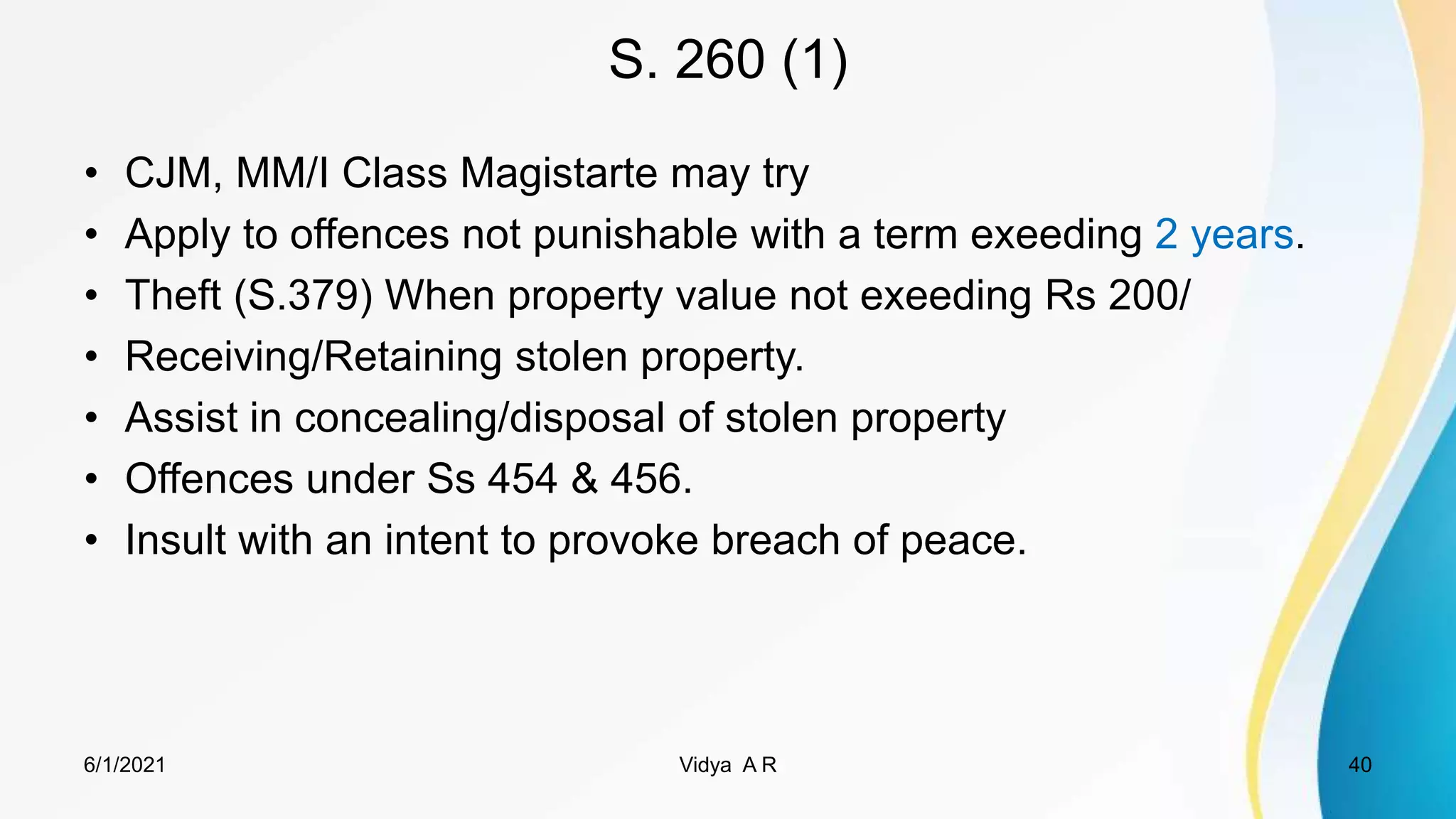
S. 260 (1)
• CJM, MM/I Class Magistarte may try
• Apply to offences not punishable with a term exeeding 2 years.
• Theft (S.379) When property value not exeeding Rs 200/
• Receiving/Retaining stolen property.
• Assist in concealing/disposal of stolen property
• Offences under Ss 454 & 456.
• Insult with an intent to provoke breach of peace.
6/1/2021 Vidya A R 40
• Abetment of any of the above offences
• Attempt to commit any of the offences
• Offences under complaint under S.20, Cattle Trespass Act, 1871.
• Maximum 3 months imprisonment as punishment
6/1/2021 Vidya A R 41
Record of
• Serial number of case
• Date of commission of offence
• Date of report/complaint
• The name of the complainant.
• Name, parentage and residence of the accused.
• Offence complained of and proved, the value of property
under offence.
• Plea of the accused and his examination, if any.
• The findings
6/1/2021 Vidya A R 42
• Sentence or other final order
• The date on which proceedings terminated.
A register containing all this forms the record.
6/1/2021 Vidya A R 43
Judgement
• When accused does not plead guilty, Magistrate record the
substance of evidence and a judgement containing reasons for
such findings
• Sign the record
6/1/2021 Vidya A R 44
Thank You
6/1/2021 Vidya A R 45

Crpc

  • 1.
  • 2.
    Introduction • Law relatingto apprehension of criminals • Investigating the criminal cases and their trial before the criminal courts 6/1/2021 2 Vidya A R
  • 3.
    Offences • What thelegislature classifies as punishable. • Mens rea or guilt is an essential ingredient. • “actus non facit reum nisi mens sit rea”- mens rea is the state of mind which accompanies and directs the conduct resulting in actus reus. 6/1/2021 3 Vidya A R
  • 4.
    Types of offences •Bailable: Mentioned as bailable in 1st sch. and other offences are non bailable. • Cognizable offences: A police officer can arrest without a warrant. • In non-cognizable offences, a warrant is required to arrest. 6/1/2021 4 Vidya A R
  • 5.
    Complaint • An allegationmade orally or in writing to Magistrate for taking his action. • Not include a police report. • Complaint in criminal case is equal to a plaint in civil cases 6/1/2021 5 Vidya A R
  • 6.
    Essentials • An oral/writtenallegation • Some persons committed an offence (known/unknown) • It must be made to a Magistrate • Made with a view that an action may be taken. 6/1/2021 6 Vidya A R
  • 7.
    Bail • The releaseof the accused from the custody of the officers of law to the private custody of sureties to produce the accused to answer the charge at the stipulated time or date. • Anticipatory bail: Granted by HC/Sessions Court to a person who is facing arrest for having committed a non bailable offence but has not been arrested. • An opportunity of hearing is given to opposite party before granting bail. 6/1/2021 7 Vidya A R
  • 8.
    Inquiry • Wider thantrial • Stops when trial begins • Conducted by a Magistrate's Court 6/1/2021 8 Vidya A R
  • 9.
    Investigation • All proceedingsfor the collection of evidence by a police officer/any other person authorised by a Magistrate. 6/1/2021 9 Vidya A R
  • 10.
    Stages of aCriminal Case • Starts with investigation • Proceeding with trial or inquiry • Judicial proceeding includes inquiry and trial 6/1/2021 10 Vidya A R
  • 11.
    • Pleader: Authorisedto practise in a Court. • Can be a non legal person appointed with the permission of a court. • Public prosecutor conducts case • Warrant case - Case relating to an offence punishable with death, imprisonment for life or imprisonment for a term exeeding 2 years. • Other cases are summons cases. • The division is based on punishment • Summons case dealt in Ch XX and warrant case in Ch XIX 6/1/2021 11 Vidya A R
  • 12.
    Criminal Courts • ExecutiveMagistrates • Judicial Magistrates of the II Class • Judicial Magistrates of the I Class & Metropolitan Magistrates • Cheif Judicial Magistrates (CJM/CMM) • Courts of session • High Court • Under any other law special courts can be constituted. • Appellate power of SC on criminal matters from a High Court given under Art. 134 6/1/2021 12 Vidya A R
  • 13.
    Power of Courts •Try offences • Under IPC or any other law • To pass sentences (1) HC and Sessions Court can pass any sentence. Death sentence by Sessions court subjected to confirmation by HC. Asst Sessions Judge can't pass death sentences. (2) Sentences which Magistarte may pass (S.29) CJM - Imprisonment up to 7 years 6/1/2021 13 Vidya A R
  • 14.
    • Magistarte ofthe I Class - Upto 3 years and fine upto Rs. 5000/ • Magistrate of the II Class - Up to 1 Year and fine upto Rs 1000/ • Chief Metropolitan Magistrate = CJM • Metropolitan Magistrate = JM, I Class (3) Sentence of imprisonment in default of fine (S. 30) Not exeed 1/4 of the term upto which that Magistrate can pass sentence. (4) Sentence in case of conviction of several offences at one trial (S.31) 6/1/2021 14 Vidya A R
  • 15.
    Arrest of persons •Without an order from a Magistrate and without a warrant. • Arrest on refusal to give name and residence. • In non-cognizable cases, even when false name and address is given, • He is produced before Magistrate within 24 hours. 6/1/2021 15 Vidya A R
  • 16.
    Arrest by aprivate person • In the case of cognizable cases • Non bailable cases • When he is a proclaimed offender 6/1/2021 16 Vidya A R
  • 17.
    Arrest by aMagistrate • Men of Armed forces can be arrested only with the consent of the CG. 6/1/2021 17 Vidya A R
  • 18.
    Arrest how made •Purpose is to take into custody • To make him answer a charge or to prevent the commission of a crime • Detention to restrain movement. 6/1/2021 18 Vidya A R
  • 19.
    General processes tocompel appearance 1. Summons: In writing In duplicate Signed by the authorised person Specifying the court, place, date and time of appearance To accused To witness To Appear To produce a document 6/1/2021 19 Vidya A R
  • 20.
    Service of Summons •May be served by a police officer, officer of a court or other public servant • If the person is not found it is affixed at a conspicuous part of the house and if the court is satisfied that it is duly served, it may declare to that effect or release fresh one. 6/1/2021 Vidya A R 20
  • 21.
    Summons to Corporatebodies • To the CS, Manager /Principal officer of the Corporation • Sent by Regd post to the Chief officer of the Corporation in India. • Corporation includes a society regd under Societies Act. 6/1/2021 Vidya A R 21
  • 22.
    Personal Service • Ifpersonal service cannot be made, an extended service may be given to some adult male member of his family and not a servant. • In the case of a government servant, to the Head of the Office. 6/1/2021 Vidya A R 22
  • 23.
    Warrant of Arrest •In writing • Bear the name and signature of the person who is to execute it. • Give full name and description of the person to be arrested • State the offence charged • Must be signed by the presiding officer • Must be sealed 6/1/2021 Vidya A R 23
  • 24.
    Purpose of Warrant •For the production of the person before the court concerned. • Without any delay the person is brought to the court within 24 hours. • The time taken to travel from the place of arrest to the Magistrate's Court is excluded. • Remains in force until it is cancelled by the Concerned court or until it remains unexecuted 6/1/2021 Vidya A R 24
  • 25.
    Proclammation & Attachment •In the case of a person absconding or concealing himself, the court may proclaim his presence at a specified place and date not less than 30 days from the date of proclammation • The object is to compel presence and not to punish 6/1/2021 Vidya A R 25
  • 26.
    Search Warrant • Whencourt is of the opinion that a document or thing summoned may not be produced. • When it is not KNOWN to the court with whom it remains • When a general inspection is necessary. • When a person is unlawfully confined, the Dt. Magistrate, Sub - Divisional Magistrate or I Class Magistrate has power to issue a search warrant for the search of the person. 6/1/2021 Vidya A R 26
  • 27.
    • As asecurity for keeping peace on conviction, the Magistrate can order him to execute a bond for 3 years with or without sureties • Security for keeping peace in other cases the executive Magistrate may order to execute a bond for 1 year 6/1/2021 Vidya A R 27
  • 28.
    Unlawful Assembly • 5or more persons assemble • Executive Magistrate or Person in Charge or in his absence , person not below the rank of SI can order dispersal. • If not disperse, forcefully it can be dispersed and may be the parties confined. • The help of the armed forces may be sought • Police has power to prevent commission of a cognizable offence by arresting a person and keeping him in custody for 24 hours and more than that in certain cases. 6/1/2021 Vidya A R .28
  • 29.
    • Inspection ofweights and measures by the police officer 6/1/2021 Vidya A R 29
  • 30.
    FIR • Information givento the police about the commission of a cognizable offence • It sets the criminal law in motion • After recording it in a book kept at the sattion, a copy is given to the informant. • If any officer in charge of the police station do not write down the information, it may be sent in writing to the Superintendent of police. 6/1/2021 Vidya A R 30
  • 31.
    • In thecase of cognizable offences magistarte order an investigation • In non cognizable offences, it is mandatory to get an order of the Magistrate. • When two/more cases are there and at least one of them cognizable, the whole case is treated as cognizable. 6/1/2021 Vidya A R 31
  • 32.
    Investigation • Means collectingevidence. • Search by a police officer, when there is the need of a document to be collected. • Reasons recorded in writing. 6/1/2021 Vidya A R 32
  • 33.
    Taking Cognizance • AMagistarte can take cognizance of a case When a complaint is filed On the report of a police officer When informed by any other person or On his own knowledge • In the last two instances, the case may be transferred to a Magistrate as directed by the CJM. 6/1/2021 Vidya A R 33
  • 34.
    • Courts ofsession not take cognizance of an offence. • Addl and Asst. Sessions Judge may by the case as committed by a Magistrate. 6/1/2021 Vidya A R 34
  • 35.
    Limitation Period • LimitationPeriod for taking cognizance of certain offences. • Specified in the Limitation Act. • Chapter XXXVI introduced to specify it. • Punishment fine only - 6 months • Punishment of imprisonment upto 1 year - 1 year • Punishment of 1 to 3 years - 3 years • When more than one offence combined together, gravity of the offence determines the limitation. 6/1/2021 Vidya A R 35
  • 36.
    Commencement of theperiod of limitation • From the day offence is committed. • When it is made known to the aggrieved party or the police officer which ever is earlier. • When the identity of the offender is known to the aggrieved person. 6/1/2021 Vidya A R 36
  • 37.
    Exclusions • When anotherprosecution executed related to the same facts. • Period of stay or injunction against the prosecution. • The period of notice to prosecution. • When sanction is necessary for prosecution, the period of sanction. • When offender absent from India. • When he is concealing himself or absconding. • When limitation expires on the closing day of court, it commences on the date of reopening of the court 6/1/2021 Vidya A R 37
  • 38.
    • In thecase of continuing offences, every moment at which it continues. • Period of limitation may be extended by the court when on sufficient reasons and when it is necessary in the interests of justice. 6/1/2021 Vidya A R 38
  • 39.
    Summary Trials • Speedydisposal of cases. • Procedure simplified. • Recording of trials done summarily. • Small offences only tried. • Complicated ones reserved for summons or warrant trials. 6/1/2021 Vidya A R 39
  • 40.
    S. 260 (1) •CJM, MM/I Class Magistarte may try • Apply to offences not punishable with a term exeeding 2 years. • Theft (S.379) When property value not exeeding Rs 200/ • Receiving/Retaining stolen property. • Assist in concealing/disposal of stolen property • Offences under Ss 454 & 456. • Insult with an intent to provoke breach of peace. 6/1/2021 Vidya A R 40
  • 41.
    • Abetment ofany of the above offences • Attempt to commit any of the offences • Offences under complaint under S.20, Cattle Trespass Act, 1871. • Maximum 3 months imprisonment as punishment 6/1/2021 Vidya A R 41
  • 42.
    Record of • Serialnumber of case • Date of commission of offence • Date of report/complaint • The name of the complainant. • Name, parentage and residence of the accused. • Offence complained of and proved, the value of property under offence. • Plea of the accused and his examination, if any. • The findings 6/1/2021 Vidya A R 42
  • 43.
    • Sentence orother final order • The date on which proceedings terminated. A register containing all this forms the record. 6/1/2021 Vidya A R 43
  • 44.
    Judgement • When accuseddoes not plead guilty, Magistrate record the substance of evidence and a judgement containing reasons for such findings • Sign the record 6/1/2021 Vidya A R 44
  • 45.