The Steps toward War
        Dr. Bruce Clary
     Monday, January 3, 2011
“There was never a moment during the earliest
years of our national history when the slavery issue
was not a sleeping serpent. The issue lay coiled up
under the table during the deliberations of the
Constitutional Convention in 1787. It was, owing
to the cotton gin, more than half awake at the time
of the Louisiana Purchase in 1803.... Thereafter,
slavery was on everyone's mind, though not always
on his tongue.”
                                ——John Jay Chapman
Northwest Ordinance
         1787
• Most important act of
  the Congress of
  Confederation
• Established territory
  west of the
  Appalachians and
  north of the Ohio
  River as free territory
“Representatives and direct taxes shall be
apportioned among the several states which may be
included within this union, according to their
respective numbers, which shall be determined by
adding to the whole number of free persons,
including those bound to service for a term of
years, and excluding Indians not taxed, three fifths of
all other Persons.”
                                   U.S. Constitution
                                 Article I, Section 1
“No person held to service or labor in one state,
under the laws thereof, escaping into another, shall,
in consequence of any law or regulation therein, be
discharged from such service or labor, but shall be
delivered up on claim of the party to whom such
service or labor may be due.”

                                  U.S. Constitution
                                Article IV, Section 4
“The Migration or Importation of such Persons as
any of the States now existing shall think proper to
admit, shall not be prohibited by the Congress
prior to the Year one thousand eight hundred and
eight, but a tax or duty may be imposed on such
Importation, not exceeding ten dollars for each
Person.”

                                  U.S. Constitution
                                 Article I, Section 9
Slave Trade Act of 1807
                                                                   Abolished the
                                                               international slave
                                                                            trade


This replica of a slave trade ship moored by Tower Bridge in 2007 to commemorate
the 200th anniversary of the Slave Trade Act.
“We the People of the United States, in Order to
form a more perfect Union, establish Justice, insure
domestic Tranquility, provide for the common
defence, promote the general Welfare, and secure
the Blessings of Liberty to ourselves and our
Posterity, do ordain and establish this Constitution
for the United States of America.”

                                  U.S. Constitution
                                         Preamble
Missouri Compromise of 1820
The Nullification Crisis
•  In 1828 and 1832, Congress passes tariffs
   that exacerbate economic difficulties
   plaguing South Carolina.                         “Please give my
•  South Carolina passes an Ordinance of            compliments to my friends
                                                    in your State and say to
   Nullification, claiming that the tariffs shall   them, that if a single drop
   not apply in the state.                          of blood shall be shed
                                                    there in opposition to the
•  President Jackson pushes through the             laws of the United States, I
   Force Bill, which empowers the federal           will hang the first man I can
   government to enforce the tariff, resulting      lay my hand on engaged in
                                                    such treasonable conduct,
   in the Compromise Tariff of 1833.                upon the first tree I can
                                                    reach.”
                                                            —Andrew Jackson
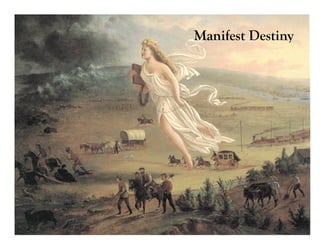
Manifest Destiny
Manifest Destiny

Three Key Themes
•  the virtue of the American people and
   their institutions;
•  the mission to spread these institutions,
   thereby redeeming and remaking the
   world in the image of the U.S.; and
•  the destiny under God to accomplish
   this work.
Mexican-American War 1846-48
Compromise of 1850
Compromise of 1850


     •  Enacts the Fugitive Slave Act
     •  Admits California as a free state
     •  Opens New Mexico and Utah territories
        under popular sovereignty
•  Published in 1852, it
   sold 300,000 copies in
   the U.S. alone in its
   first year.
•  The book’s impact was
   so great that when
   Lincoln met Stowe, he
   allegedly said, “So this
   is the little lady who
   made this big war.”
Kansas-Nebraska Act (1854)

      •  Creates territories of Kansas and
         Nebraska
      •  Repeals the Missouri Compromise
      •  Establishes popular sovereignty,
         empowering territorial settlers to
         determine if they will allow slavery
         within their boundaries
Bleeding Kansas 1854-58
Dred Scott Decision
                                                   1857
                                 U.S. Supreme Court rules that
                                 • No people of African descent could be
The authors of the
Constitution, said Chief           citizens
Justice Roger B. Taney in
his decision, viewed all         • Congress had no authority to prohibit
blacks as “beings of an
inferior order, and
                                   slavery in federal territories and, thus, the
altogether unfit to associate      Missouri Compromise was
with the white race, either
in social or political
                                   unconstitutional
relations, and so far inferior
that they had no rights          • Slaves cannot be taken from owners
which the white man was            without due process
bound to respect.”
John Brown’s Raid
 on Harper’s Ferry
   October 1859
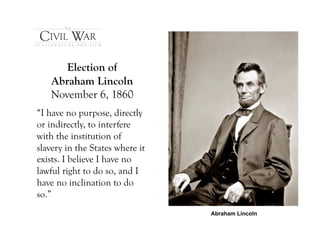
Election of
   Abraham Lincoln
   November 6, 1860
“I have no purpose, directly
or indirectly, to interfere
with the institution of
slavery in the States where it
exists. I believe I have no
lawful right to do so, and I
have no inclination to do
so.”
                                 Abraham Lincoln
Crittenden Compromise
The Crittenden Compromise was a last-ditch effort by a Kentucky
senator to head off the secession crisis. It would have
•  Guaranteed the existence of slavery in the slave states
•  Permanently re-established the Missouri Compromise line:
   slavery would be prohibited north of the 36°30´ parallel and
   guaranteed south of it
The compromise included a clause that it could not be repealed
or amended.
Order of Secession
•  December 20, 1860       South Carolina
•  January 9, 1861         Mississippi
•  January 10, 1861        Florida
•  January 11, 1861        Alabama
•  January 19, 1861        Georgia
•  January 26, 1861        Louisiana
•  February 1, 1861        Texas
Lincoln Inaugural
“In your hands, my dissatisfied fellow-countrymen, and not in
mine, is the momentous issue of civil war. The government
will not assail you. You can have no conflict, without being
yourselves the aggressors.… We are not enemies, but friends.
We must not be enemies. Though passion may have strained,
it must not break our bonds of affection. The mystic chords
of memory, stretching from every battlefield, and patriot
grave, to every living heart and hearth-stone, all over this
broad land, will yet swell the chorus of the Union, when
again touched, as surely they will be, by the better angels of
our nature.”
April 12, 1861
Order of Secession
•  April 17, 1861             Virginia
•  May 6, 1861                Tennessee
•  May 6, 1861                Arkansas
•  May 20, 1861               North Carolina
•  Oct. 31, 1861              Missouri
•  Nov. 20, 1861              Kentucky
The Steps to War

The Steps to War

  • 1.
    The Steps towardWar Dr. Bruce Clary Monday, January 3, 2011
  • 2.
    “There was nevera moment during the earliest years of our national history when the slavery issue was not a sleeping serpent. The issue lay coiled up under the table during the deliberations of the Constitutional Convention in 1787. It was, owing to the cotton gin, more than half awake at the time of the Louisiana Purchase in 1803.... Thereafter, slavery was on everyone's mind, though not always on his tongue.” ——John Jay Chapman
  • 3.
    Northwest Ordinance 1787 • Most important act of the Congress of Confederation • Established territory west of the Appalachians and north of the Ohio River as free territory
  • 4.
    “Representatives and directtaxes shall be apportioned among the several states which may be included within this union, according to their respective numbers, which shall be determined by adding to the whole number of free persons, including those bound to service for a term of years, and excluding Indians not taxed, three fifths of all other Persons.” U.S. Constitution Article I, Section 1
  • 5.
    “No person heldto service or labor in one state, under the laws thereof, escaping into another, shall, in consequence of any law or regulation therein, be discharged from such service or labor, but shall be delivered up on claim of the party to whom such service or labor may be due.” U.S. Constitution Article IV, Section 4
  • 6.
    “The Migration orImportation of such Persons as any of the States now existing shall think proper to admit, shall not be prohibited by the Congress prior to the Year one thousand eight hundred and eight, but a tax or duty may be imposed on such Importation, not exceeding ten dollars for each Person.” U.S. Constitution Article I, Section 9
  • 7.
    Slave Trade Actof 1807 Abolished the international slave trade This replica of a slave trade ship moored by Tower Bridge in 2007 to commemorate the 200th anniversary of the Slave Trade Act.
  • 8.
    “We the Peopleof the United States, in Order to form a more perfect Union, establish Justice, insure domestic Tranquility, provide for the common defence, promote the general Welfare, and secure the Blessings of Liberty to ourselves and our Posterity, do ordain and establish this Constitution for the United States of America.” U.S. Constitution Preamble
  • 9.
  • 10.
    The Nullification Crisis • In 1828 and 1832, Congress passes tariffs that exacerbate economic difficulties plaguing South Carolina. “Please give my •  South Carolina passes an Ordinance of compliments to my friends in your State and say to Nullification, claiming that the tariffs shall them, that if a single drop not apply in the state. of blood shall be shed there in opposition to the •  President Jackson pushes through the laws of the United States, I Force Bill, which empowers the federal will hang the first man I can government to enforce the tariff, resulting lay my hand on engaged in such treasonable conduct, in the Compromise Tariff of 1833. upon the first tree I can reach.” —Andrew Jackson
  • 11.
  • 12.
    Manifest Destiny Three KeyThemes •  the virtue of the American people and their institutions; •  the mission to spread these institutions, thereby redeeming and remaking the world in the image of the U.S.; and •  the destiny under God to accomplish this work.
  • 13.
  • 14.
  • 15.
    Compromise of 1850 •  Enacts the Fugitive Slave Act •  Admits California as a free state •  Opens New Mexico and Utah territories under popular sovereignty
  • 16.
    •  Published in1852, it sold 300,000 copies in the U.S. alone in its first year. •  The book’s impact was so great that when Lincoln met Stowe, he allegedly said, “So this is the little lady who made this big war.”
  • 17.
  • 18.
    Kansas-Nebraska Act (1854) •  Creates territories of Kansas and Nebraska •  Repeals the Missouri Compromise •  Establishes popular sovereignty, empowering territorial settlers to determine if they will allow slavery within their boundaries
  • 19.
  • 20.
    Dred Scott Decision 1857 U.S. Supreme Court rules that • No people of African descent could be The authors of the Constitution, said Chief citizens Justice Roger B. Taney in his decision, viewed all • Congress had no authority to prohibit blacks as “beings of an inferior order, and slavery in federal territories and, thus, the altogether unfit to associate Missouri Compromise was with the white race, either in social or political unconstitutional relations, and so far inferior that they had no rights • Slaves cannot be taken from owners which the white man was without due process bound to respect.”
  • 21.
    John Brown’s Raid on Harper’s Ferry October 1859
  • 22.
    Election of Abraham Lincoln November 6, 1860 “I have no purpose, directly or indirectly, to interfere with the institution of slavery in the States where it exists. I believe I have no lawful right to do so, and I have no inclination to do so.” Abraham Lincoln
  • 23.
    Crittenden Compromise The CrittendenCompromise was a last-ditch effort by a Kentucky senator to head off the secession crisis. It would have •  Guaranteed the existence of slavery in the slave states •  Permanently re-established the Missouri Compromise line: slavery would be prohibited north of the 36°30´ parallel and guaranteed south of it The compromise included a clause that it could not be repealed or amended.
  • 24.
    Order of Secession • December 20, 1860 South Carolina •  January 9, 1861 Mississippi •  January 10, 1861 Florida •  January 11, 1861 Alabama •  January 19, 1861 Georgia •  January 26, 1861 Louisiana •  February 1, 1861 Texas
  • 25.
    Lincoln Inaugural “In yourhands, my dissatisfied fellow-countrymen, and not in mine, is the momentous issue of civil war. The government will not assail you. You can have no conflict, without being yourselves the aggressors.… We are not enemies, but friends. We must not be enemies. Though passion may have strained, it must not break our bonds of affection. The mystic chords of memory, stretching from every battlefield, and patriot grave, to every living heart and hearth-stone, all over this broad land, will yet swell the chorus of the Union, when again touched, as surely they will be, by the better angels of our nature.”
  • 26.
  • 27.
    Order of Secession • April 17, 1861 Virginia •  May 6, 1861 Tennessee •  May 6, 1861 Arkansas •  May 20, 1861 North Carolina •  Oct. 31, 1861 Missouri •  Nov. 20, 1861 Kentucky