DNA BASER AND DARWIN 
SOFTWARE OF BIOINFORMATICS 
Khadija sehar 
Roll no# 3030 
Bs(hons)Botany 3rd semester (E) 
University of Education 
Okara compous
CONTENTS 
DNA BASER 
 History 
 Discription 
 Automation 
 Fuctions 
 Diagram 
DARWIN 
 History 
 Compositin 
I. Libraries 
II. Kernel 
 Functions 
 References
DNA BASER 
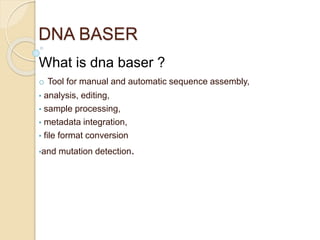
What is dna baser ? 
o Tool for manual and automatic sequence assembly, 
• analysis, editing, 
• sample processing, 
• metadata integration, 
• file format conversion 
•and mutation detection.
History 
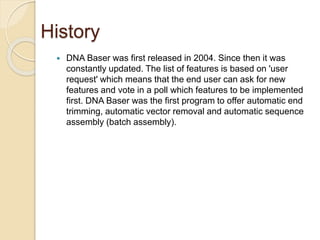
 DNA Baser was first released in 2004. Since then it was 
constantly updated. The list of features is based on 'user 
request' which means that the end user can ask for new 
features and vote in a poll which features to be implemented 
first. DNA Baser was the first program to offer automatic end 
trimming, automatic vector removal and automatic sequence 
assembly (batch assembly).
Description 
 DNA Baser Assembler is unique bioinformatics software for 
manual and automatic DNA sequence assembly, DNA 
sequence analysis, automatic sample processing, contig 
editing, metadata integration, file format conversion and 
mutation detection
Automation 
 The proprietary assembly algorithm is optimized for accuracy and not for 
speed. This is needed in order to allow DNA Baser to automate the 
sequence assembly process. The program automatically removed the 
low quality ends, assemble the input samples, generates the 
contig/consensus then it automatically corrects the ambiguities. The 
data for ambiguity correction is obtain from the quality value assigned to 
each base in the input file. At the end the user-defined vectors are 
automatically removed from the contig and the metadata is added to the 
file. The contig is also automatically saved to disk as FASTA. The 
automation makes user's input unnecessary. 
 This allows DNA Baser to take the sequence assembly to the next level 
through a sophisticated batch assembly module in which thousands of 
contigs can be obtained in minutes instead of days. The user defines the 
folder where the input files are and a pattern. Based on this pattern, the 
program automatically detects sequences belonging to the same 
set/contig and assembles them together. The process described above 
is applied to each set. The contig is automatically saved to disk then the 
program moves to the next set with a speed of about one contig per 
second. The results of the process are written in a detailed log. The 
program highlights the assemblies that requires user input in red.
Functions 
DNA Baser concentrates on automation of sequence assembly 
process. 
With DNA Baser Sequence Assembler, you can: 
 Assemble multiple DNA samples or align to a reference 
sequence 
 Batch assemble or align in groups of sequences by name 
 Automatically clip sample ends (low quality region trimming) 
 Automatically detect and trim recognition (vector/primer) 
sequences 
 Import and analyze sequences from ABI, SCF, FASTA and 
SEQ 
 Preview chromatograms with a single click 
 View and edit sequence traces 
 Mark specific regions (like discrepancies, low-quality areas in 
chromatograms) with visible colors and quickly navigate to 
these regions 
 Convert between different file formats (ABI, SCF, FASTA, 
multi-FASTA, GBK...)
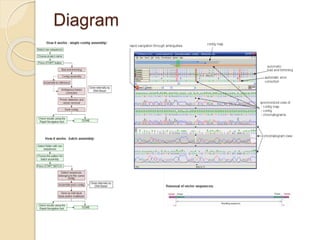
Diagram
DARWIN 
What is Darwin ? 
Darwin is an easy to use interpreted computer language 
especially tailored to research in bioscience. 
Purpose 
Its purpose is to serve as a biochemist’workbench where 
researchers can explore molecular sequence data quickly and 
easily.
History 
 The darwin project began in 1991 and reflects much of 
the research done in the CBRG (computational 
biochemistry research group) at the ETH-Zurich. 
 Composition 
It consist of two parts (1) Libraries (2) 
 Libraries 
The libraries corresponds closely to what one expects from a 
software package: apre-defined set of functions offeresd by the 
system.The libraries reflect current and past trends in our 
research efforts but also incorporate many algorithms from 
litrature,particularly those related to sequnce 
comparison,phylogenetic tree construction,multiple sequence 
alignment and secondary structure prediction.
Kernel 
 The kernel of the darwin is responsible for the lower level 
operations in the systems: executing commands and 
libraries,memory management,input/output,communication with 
operating system,load balancing etc.
Functions 
 Helful in Basic mathematical operations 
 Use in Pairwise alignment 
 Dataset Conversions 
 Peptide transition matrices 
 Protein identification via peptide mass 
 Phylogenetic tree and multiple sequence alignment 
construction 
 Statistics and visualization.
References 
 http://seqanswers.com/wiki/DNA_Baser 
 Bioinformatics’ Darwin v.2.0:an interpreted computer 
language for the bioscience’G.H.,M.T,C and bernardin..vol.16 
no.22000 pages 101-103 
 http:// DNA baser .com

DNA Baser and Darwin

  • 1.
    DNA BASER ANDDARWIN SOFTWARE OF BIOINFORMATICS Khadija sehar Roll no# 3030 Bs(hons)Botany 3rd semester (E) University of Education Okara compous
  • 2.
    CONTENTS DNA BASER  History  Discription  Automation  Fuctions  Diagram DARWIN  History  Compositin I. Libraries II. Kernel  Functions  References
  • 3.
    DNA BASER Whatis dna baser ? o Tool for manual and automatic sequence assembly, • analysis, editing, • sample processing, • metadata integration, • file format conversion •and mutation detection.
  • 4.
    History  DNABaser was first released in 2004. Since then it was constantly updated. The list of features is based on 'user request' which means that the end user can ask for new features and vote in a poll which features to be implemented first. DNA Baser was the first program to offer automatic end trimming, automatic vector removal and automatic sequence assembly (batch assembly).
  • 5.
    Description  DNABaser Assembler is unique bioinformatics software for manual and automatic DNA sequence assembly, DNA sequence analysis, automatic sample processing, contig editing, metadata integration, file format conversion and mutation detection
  • 6.
    Automation  Theproprietary assembly algorithm is optimized for accuracy and not for speed. This is needed in order to allow DNA Baser to automate the sequence assembly process. The program automatically removed the low quality ends, assemble the input samples, generates the contig/consensus then it automatically corrects the ambiguities. The data for ambiguity correction is obtain from the quality value assigned to each base in the input file. At the end the user-defined vectors are automatically removed from the contig and the metadata is added to the file. The contig is also automatically saved to disk as FASTA. The automation makes user's input unnecessary.  This allows DNA Baser to take the sequence assembly to the next level through a sophisticated batch assembly module in which thousands of contigs can be obtained in minutes instead of days. The user defines the folder where the input files are and a pattern. Based on this pattern, the program automatically detects sequences belonging to the same set/contig and assembles them together. The process described above is applied to each set. The contig is automatically saved to disk then the program moves to the next set with a speed of about one contig per second. The results of the process are written in a detailed log. The program highlights the assemblies that requires user input in red.
  • 7.
    Functions DNA Baserconcentrates on automation of sequence assembly process. With DNA Baser Sequence Assembler, you can:  Assemble multiple DNA samples or align to a reference sequence  Batch assemble or align in groups of sequences by name  Automatically clip sample ends (low quality region trimming)  Automatically detect and trim recognition (vector/primer) sequences  Import and analyze sequences from ABI, SCF, FASTA and SEQ  Preview chromatograms with a single click  View and edit sequence traces  Mark specific regions (like discrepancies, low-quality areas in chromatograms) with visible colors and quickly navigate to these regions  Convert between different file formats (ABI, SCF, FASTA, multi-FASTA, GBK...)
  • 8.
  • 9.
    DARWIN What isDarwin ? Darwin is an easy to use interpreted computer language especially tailored to research in bioscience. Purpose Its purpose is to serve as a biochemist’workbench where researchers can explore molecular sequence data quickly and easily.
  • 10.
    History  Thedarwin project began in 1991 and reflects much of the research done in the CBRG (computational biochemistry research group) at the ETH-Zurich.  Composition It consist of two parts (1) Libraries (2)  Libraries The libraries corresponds closely to what one expects from a software package: apre-defined set of functions offeresd by the system.The libraries reflect current and past trends in our research efforts but also incorporate many algorithms from litrature,particularly those related to sequnce comparison,phylogenetic tree construction,multiple sequence alignment and secondary structure prediction.
  • 11.
    Kernel  Thekernel of the darwin is responsible for the lower level operations in the systems: executing commands and libraries,memory management,input/output,communication with operating system,load balancing etc.
  • 12.
    Functions  Helfulin Basic mathematical operations  Use in Pairwise alignment  Dataset Conversions  Peptide transition matrices  Protein identification via peptide mass  Phylogenetic tree and multiple sequence alignment construction  Statistics and visualization.
  • 13.
    References  http://seqanswers.com/wiki/DNA_Baser  Bioinformatics’ Darwin v.2.0:an interpreted computer language for the bioscience’G.H.,M.T,C and bernardin..vol.16 no.22000 pages 101-103  http:// DNA baser .com