INTERNATIONAL JOURNAL OF MECHANICAL ENGINEERING 
International Journal of Mechanical Engineering and Technology (IJMET), ISSN 0976 – 6340(Print), 
ISSN 0976 – 6359(Online), Volume 5, Issue 7, July (2014), pp. 36-41 © IAEME 
AND TECHNOLOGY (IJMET) 
ISSN 0976 – 6340 (Print) 
ISSN 0976 – 6359 (Online) 
Volume 5, Issue 7, July (2014), pp. 36-41 
© IAEME: www.iaeme.com/IJMET.asp 
Journal Impact Factor (2014): 7.5377 (Calculated by GISI) 
www.jifactor.com 
© I A E M E 
ARTICULATED VEHICLE SYSTEMS 
Apoorv Prem 
IJMET 
B.E Automobile Engineer, Manipal Institute of Technology 
36 
ABSTRACT 
Articulated Wheeled Vehicles (AWVs) are a class of wheeled locomotion systems where the 
chassis is connected to a set of ground-contact wheels via actively- or passively-controlled 
articulations, which can regulate wheel placement with respect to chassis during locomotion. In this 
paper the design, development and integration of vibration isolated mobile trailer platform, 
customized to meet the user’s requirements in general and optical requirements in particular is 
discussed. The study also focusses on performance requirements, system requirements and technical 
details of the articulated vehicle system. 
Keywords: Articulated, Trailer. 
I. INTRODUCTION 
An articulated vehicle is a large vehicle made in two separate sections, a tractor and a trailer, 
connected by a pivoted bar. These vehicles can cary heavy loads and can take sharp turns. An 
articulated truck is a vehicle that is most commonly used in construction work. Articulated trucks are 
used to haul heavy loads, sometimes over difficult terrain, and they can be considered a type of 
tractor-trailer unit. 
The main feature of an articulated truck that puts it in a separate driving class is its drive 
system. The drive system is based on the number of wheels on the axles used to pull the truck [1]. 
The most common system is the 6 x 6 system, in which the truck has six wheels on three axles and 
all are used when driving the truck. 
Another system used is the 6 x 4 drive, in which only the rear four wheels are used when 
driving. The original drive system in articulated trucks is the famous 4 x 4 drive. This was designed 
for trucks that drive over the roughest terrain on the planet [2]. The 4 x 4 drive system helps the truck 
maneuver over terrain that could be a potential problem for the goods being carried. 
Wheeled Mobile Platforms/Vehicles comprise of a platform supported by multiple wheels 
which allow for relative motions between the platform and the ground. Wheeled vehicles have
International Journal of Mechanical Engineering and Technology (IJMET), ISSN 0976 – 6340(Print), 
ISSN 0976 – 6359(Online), Volume 5, Issue 7, July (2014), pp. 36-41 © IAEME 
traditionally offered simplicity of mechanical construction and control, very favorable payload-to-weight 
ratio, excellent load and tractive-force distribution, enhanced stability and energy-efficiency, 
making them the architecture of choice for most man-made terrestrial locomotion systems [3]. 
However, despite their incredible versatility, disk wheels impose severe constraints on the 
design and control of the wheeled vehicle to which they may be attached. Multiple disk-wheels 
cannot be arbitrarily attached to a single common platform/chassis without over-constraining the 
system[4]. Kinematic over-constraint (as often seen in various machinery) occurs due to the lack of 
compatibility between the instantaneous motions of all moving parts. However, unlike in traditional 
machines, the violation of the wheel-ground contact-constraints (enforced only by force-closure) is 
possible – and gives rise to undesirable kinematic wheel-slip (skidding/ slipping/scrubbing) seen in 
poorly-designed wheeled vehicles [5]. Such wheel-slip is deleterious both from the perspective of 
reduced efficiency (power is wasted by scrubbing) and poor performance (degraded odometric 
localization, uncontrollable and unpredictable stick-slip behavior). 
Kinematic over-constraint has traditionally been relieved by the addition of mechanical 
compliance (in the form of bushings and couplings) in order to mitigate the undesired stick-slip 
behavior at the wheel-ground contact. A case can be made for the systematic and careful introduction 
of additional mechanical compliance – in the form of small articulated sub-chains with passive 
(springs/dampers) or semi-active (adjustable spring-dampers) or active (motorized) actuation. The 
resulting articulated leg-wheel systems form multiple closed-kinematic loops with the ground that 
serve to constrain and redirect the effective forces and motions on the chassis. 
Thus, viewing wheeled vehicles as yet another class of a parallel-kinematic chains (with 
multiple articulated leg-wheel branches attached to a common chassis) allows the systematic 
application of the rich theory of articulated multibody systems to design, analyze, simulate and 
control of the ensuing systems. The nature and number of both the added wheels, together with the 
intermediate articulations, has a significant influence on the mobility, maneuverability, 
controllability, stability and efficiency of the wheeled vehicle [1]. 
From a design perspective, there is enormous diversity at various levels within selection of: 
(i) the individual components, like the wheels (disk wheels vs Mecanum wheels) and the 
articulations (lower-pair revolutes/prismatics vs higher-pair cam joints); (ii) the topology/number of 
joints of each sub-chain; and (iii) the number of sub-chains/type-of-attachment to the chassis. The 
suitable selection of topology, dimensions and actuation of the individual sub-chains together with 
the selection of the number and attachment location to the common chassis creates enormous choice. 
From the control perspective, the control and reconfiguration of the collaborating leg-wheel 
subsystems to regulate the mobility and maneuverability of the chassis offers other challenges. 
System configurations must be chosen in order to: (i) minimize singular configurations of the 
system; (ii) enhance mutual cooperation (motions and forces) during task performance; and (iii) 
improve robustness to local controller lapses and environmental disturbances [6]. Significant 
freedom for implementation is also available by virtue of the re-configurability and the ability to 
trade-off passive-equilibration versus active-actuation [7]. 
However, articulated wheeled vehicles are highly-constrained systems subjected to both 
holonomic constraints (due to the multiple closed-loops) and non-holonomic constraints (due to 
wheel/ground contacts). Violation of these constraints e.g. typically in terms of slipping and skidding 
at the ground-wheel contacts, results both in energy-dissipation and estimation-uncertainty [5]. 
Hence considerable research has focused on both enhanced-suspension-design (kinematic and 
kinetostatic), to avoid constraint violation without either sacrificing payload capacity or increasing 
power consumption; and active-coordinated-control for enhancing mobility, stability and traction. 
37
International Journal of Mechanical Engineering and Technology (IJMET), ISSN 0976 – 6340(Print), 
ISSN 0976 – 6359(Online), Volume 5, Issue 7, July (2014), pp. 36-41 © IAEME 
II. DESIGN AND DEVELOPMENT OF MOBILE TRAILER PLATFORM 
Following section discusses the design and development of a mobile trailer platform 
38 
undertaken at DRDO for military applications. 
Sub-system of mobile trailor platform: The complete system of mobile trailer platform 
consists of the following sub-systems; 
Well bed full-trailer with Air Bag Suspension 
Auto Leveling System 
EMI shielded A/C control room 
3 Axes alignment system 
Metallic Sliding Canopy 
Vibration Isolation System 
Nitrogen Gas Purging System 
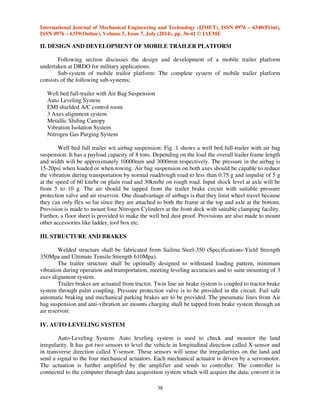
Well bed full trailer wit airbag suspension: Fig. 1 shows a well bed full-trailer with air bag 
suspension. It has a payload capacity of 8 tons. Depending on the load the overall trailer frame length 
and width will be approximately 10000mm and 3000mm respectively. The pressure in the airbag is 
15-20psi when loaded or when towing. Air bag suspension on both axes should be capable to reduce 
the vibration during transportation by normal road/rough road to less than 0.75 g and impulse of 5 g 
at the speed of 60 km/hr on plain road and 30km/hr on rough road. Input shock level at axle will be 
from 5 to 10 g. The air should be tapped from the trailer brake circuit with suitable pressure 
protection valve and air reservoir. One disadvantage of airbags is that they limit wheel travel because 
they can only flex so far since they are attached to both the frame at the top and axle at the bottom. 
Provision is made to mount four Nitrogen Cylinders at the front deck with suitable clamping facility. 
Further, a floor sheet is provided to make the well bed dust proof. Provisions are also made to mount 
other accessories like ladder, tool box etc. 
III. STRUCTURE AND BRAKES 
Welded structure shall be fabricated from Sailma Steel-350 (Specifications-Yield Strength 
350Mpa and Ultimate Tensile Strength 610Mpa). 
The trailer structure shall be optimally designed to withstand loading pattern, minimum 
vibration during operation and transportation, meeting leveling accuracies and to suite mounting of 3 
axes alignment system. 
Trailer brakes are actuated from tractor. Twin line air brake system is coupled to tractor brake 
system through palm coupling. Pressure protection valve is to be provided in the circuit. Fail safe 
automatic braking and mechanical parking brakes are to be provided. The pneumatic lines from Air 
bag suspension and anti-vibration air mounts charging shall be tapped from brake system through an 
air reservoir. 
IV. AUTO LEVELING SYSTEM 
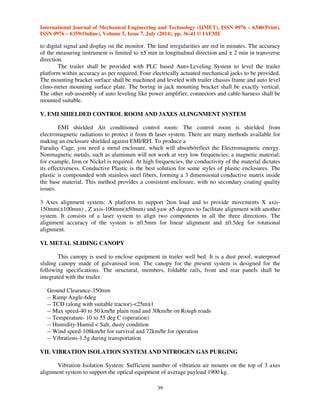
Auto-Leveling System: Auto leveling system is used to check and monitor the land 
irregularity. It has got two sensors to level the vehicle in longitudinal direction called X-sensor and 
in transverse direction called Y-sensor. These sensors will sense the irregularities on the land and 
send a signal to the four mechanical actuators. Each mechanical actuator is driven by a servomotor. 
The actuation is further amplified by the amplifier and sends to controller. The controller is 
connected to the computer through data acquisition system which will acquire the data, convert it in
International Journal of Mechanical Engineering and Technology (IJMET), ISSN 0976 – 6340(Print), 
ISSN 0976 – 6359(Online), Volume 5, Issue 7, July (2014), pp. 36-41 © IAEME 
to digital signal and display on the monitor. The land irregularities are red in minutes. The accuracy 
of the measuring instrument is limited to ±5 min in longitudinal direction and ± 2 min in transverse 
direction. 
The trailer shall be provided with PLC based Auto-Leveling System to level the trailer 
platform within accuracy as per required. Four electrically actuated mechanical jacks to be provided. 
The mounting bracket surface shall be machined and leveled with trailer chassis frame and auto level 
clino-meter mounting surface plate. The boring in jack mounting bracket shall be exactly vertical. 
The other sub-assembly of auto leveling like power amplifier, connectors and cable-harness shall be 
mounted suitable. 
V. EMI SHIELDED CONTROL ROOM AND 3AXES ALINGNMENT SYSTEM 
EMI shielded Air conditioned control room: The control room is shielded from 
electromagnetic radiations to protect it from th laser system. There are many methods available for 
making an enclosure shielded against EMI/RFI. To produce a 
Faraday Cage, you need a metal enclosure, which will absorb/reflect the Electromagnetic energy. 
Nonmagnetic metals, such as aluminum will not work at very low frequencies; a magnetic material; 
for example, Iron or Nickel is required. At high frequencies, the conductivity of the material dictates 
its effectiveness. Conductive Plastic is the best solution for some styles of plastic enclosures. The 
plastic is compounded with stainless steel fibers, forming a 3 dimensional conductive matrix inside 
the base material. This method provides a consistent enclosure, with no secondary coating quality 
issues. 
3 Axes alignment system: A platform to support 2ton load and to provide movements X axis- 
150mm(±100mm) , Z axis-100mm(±50mm) and yaw ±5 degrees to facilitate alignment with another 
system. It consists of a laser system to align two components in all the three directions. The 
alignment accuracy of the system is ±0.5mm for linear alignment and ±0.5deg for rotational 
alignment. 
39 
VI. METAL SLIDING CANOPY 
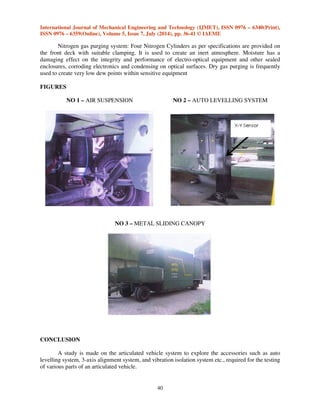
This canopy is used to enclose equipment in trailer well bed. It is a dust proof, waterproof 
sliding canopy made of galvanised iron. The canopy for the present system is designed for the 
following specifications. The structural, members, foldable rails, front and rear panels shall be 
integrated with the trailer. 
Ground Clearance-350mm 
-- Ramp Angle-6deg 
-- TCD (along with suitable tractor)-25m±1 
-- Max speed-40 to 50 km/hr plain road and 30km/hr on Rough roads 
-- Temperature- 10 to 55 deg C (operation) 
-- Humidity-Humid  Salt, dusty condition 
-- Wind speed-108km/hr for survival and 72km/hr for operation 
-- Vibrations-1.5g during transportation 
VII. VIBRATION ISOLATION SYSTEM AND NITROGEN GAS PURGING 
Vibration Isolation System: Sufficient number of vibration air mounts on the top of 3 axes 
alignment system to support the optical equipment of average payload 1900 kg.
International Journal of Mechanical Engineering and Technology (IJMET), ISSN 0976 – 6340(Print), 
ISSN 0976 – 6359(Online), Volume 5, Issue 7, July (2014), pp. 36-41 © IAEME 
Nitrogen gas purging system: Four Nitrogen Cylinders as per specifications are provided on 
the front deck with suitable clamping. It is used to create an inert atmosphere. Moisture has a 
damaging effect on the integrity and performance of electro-optical equipment and other sealed 
enclosures, corroding electronics and condensing on optical surfaces. Dry gas purging is frequently 
used to create very low dew points within sensitive equipment 
40 
FIGURES 
NO 1 – AIR SUSPENSION NO 2 – AUTO LEVELLING SYSTEM 
NO 3 – METAL SLIDING CANOPY 
CONCLUSION 
A study is made on the articulated vehicle system to explore the accessories such as auto 
levelling system, 3-axis alignment system, and vibration isolation system etc., required for the testing 
of various parts of an articulated vehicle.
International Journal of Mechanical Engineering and Technology (IJMET), ISSN 0976 – 6340(Print), 
ISSN 0976 – 6359(Online), Volume 5, Issue 7, July (2014), pp. 36-41 © IAEME 
41 
ACKNOWLEDGMENT 
Special thanks to Mr Raveesh Kumar, my guide, without whose help and valuable 
suggestions this project wouldn’t have been possible. Also to DRDO, for allowing to work on their 
prestigious project. 
REFERENCES 
[1] Jianjun Dong, Wenming Zhang, Boqiang Shi. General of Underground Mining Articulated 
Dump Truck and Market in China. Coal Mine Machinery, vol.28, no.12, pp.1-3, 2007. 
[2] Jinyue Tian, Huixing Jia. Dynamic Simulation of the Overturning of Articulated Vehicles. 
Transactions of the Chinese Society for Agricultural Machinery, vol.37, no.7, pp.26-29, 2006. 
[3] Meirong Zhao, Kai Chang, Xi Yang. Analysis of the Steering Feature for Mine Articulated 
Vehicles. Mechanical Engineering  Automation, no.4, pp.100-104, 2009. 
[4] Jianchun Wang. Dynamical mathematical model of in situ steering of articulated vehicles. 
Construction Machinery, no.6, pp.86-90, 2008. 
[5] Minzhen Ye. Study of steering Procedure of Articulated Frame and Design of Steering 
System. Construction Machinery, no.11, pp.9-11, 1997. 
[6] Hongli zhang. Building of Complicated Non-linear Module in MATLAB. Journal of Xinjiang 
University (Natural Science Edition), no.1, pp.419-222, 2004. 
[7] Zhiguo Zhao, Chuansheng Si Dynamic analysis of steering system of the articulated vehicle in 
the heeled status Procedia Engineering vol 16, pp. 540 – 545, 2011. 
[8] Amrita R.Palaskar and Prof Aruna P.Phatale, “RFID Based Automated Guided Vehicle 
System for Transportation”, International Journal of Electrical Engineering  Technology 
(IJEET), Volume 4, Issue 4, 2013, pp. 56 - 61, ISSN Print : 0976-6545, ISSN Online: 
0976-6553. 
[9] Sanjay H. Sawant and Dr. J. A. Tamboli, “Analysis and Comparison of Vehicle Dynamic 
System with Nonlinear Parameters Subjected to Actual Random Road Excitations”, 
International Journal of Mechanical Engineering  Technology (IJMET), Volume 3, Issue 2, 
2012, pp. 284 - 299, ISSN Print: 0976 – 6340, ISSN Online: 0976 – 6359. 
[10] K. Kishore Kumar, M.Siva Krishna, D.Ravitej and D.Bhavana, “Design of Automatic Guided 
Vehicles”, International Journal of Mechanical Engineering  Technology (IJMET), 
Volume 3, Issue 1, 2012, pp. 24 - 32, ISSN Print: 0976 – 6340, ISSN Online: 0976 – 6359. 
[11] A. D. Lagad and Dr. K. H. Inamdar, “Root Cause Analysis of Field Failure Concern for 
Improvement in Durability of Vehicle System”, International Journal of Mechanical 
Engineering  Technology (IJMET), Volume 4, Issue 3, 2013, pp. 232 - 243, ISSN Print: 
0976 – 6340, ISSN Online: 0976 – 6359.

30120140507004

  • 1.
    INTERNATIONAL JOURNAL OFMECHANICAL ENGINEERING International Journal of Mechanical Engineering and Technology (IJMET), ISSN 0976 – 6340(Print), ISSN 0976 – 6359(Online), Volume 5, Issue 7, July (2014), pp. 36-41 © IAEME AND TECHNOLOGY (IJMET) ISSN 0976 – 6340 (Print) ISSN 0976 – 6359 (Online) Volume 5, Issue 7, July (2014), pp. 36-41 © IAEME: www.iaeme.com/IJMET.asp Journal Impact Factor (2014): 7.5377 (Calculated by GISI) www.jifactor.com © I A E M E ARTICULATED VEHICLE SYSTEMS Apoorv Prem IJMET B.E Automobile Engineer, Manipal Institute of Technology 36 ABSTRACT Articulated Wheeled Vehicles (AWVs) are a class of wheeled locomotion systems where the chassis is connected to a set of ground-contact wheels via actively- or passively-controlled articulations, which can regulate wheel placement with respect to chassis during locomotion. In this paper the design, development and integration of vibration isolated mobile trailer platform, customized to meet the user’s requirements in general and optical requirements in particular is discussed. The study also focusses on performance requirements, system requirements and technical details of the articulated vehicle system. Keywords: Articulated, Trailer. I. INTRODUCTION An articulated vehicle is a large vehicle made in two separate sections, a tractor and a trailer, connected by a pivoted bar. These vehicles can cary heavy loads and can take sharp turns. An articulated truck is a vehicle that is most commonly used in construction work. Articulated trucks are used to haul heavy loads, sometimes over difficult terrain, and they can be considered a type of tractor-trailer unit. The main feature of an articulated truck that puts it in a separate driving class is its drive system. The drive system is based on the number of wheels on the axles used to pull the truck [1]. The most common system is the 6 x 6 system, in which the truck has six wheels on three axles and all are used when driving the truck. Another system used is the 6 x 4 drive, in which only the rear four wheels are used when driving. The original drive system in articulated trucks is the famous 4 x 4 drive. This was designed for trucks that drive over the roughest terrain on the planet [2]. The 4 x 4 drive system helps the truck maneuver over terrain that could be a potential problem for the goods being carried. Wheeled Mobile Platforms/Vehicles comprise of a platform supported by multiple wheels which allow for relative motions between the platform and the ground. Wheeled vehicles have
  • 2.
    International Journal ofMechanical Engineering and Technology (IJMET), ISSN 0976 – 6340(Print), ISSN 0976 – 6359(Online), Volume 5, Issue 7, July (2014), pp. 36-41 © IAEME traditionally offered simplicity of mechanical construction and control, very favorable payload-to-weight ratio, excellent load and tractive-force distribution, enhanced stability and energy-efficiency, making them the architecture of choice for most man-made terrestrial locomotion systems [3]. However, despite their incredible versatility, disk wheels impose severe constraints on the design and control of the wheeled vehicle to which they may be attached. Multiple disk-wheels cannot be arbitrarily attached to a single common platform/chassis without over-constraining the system[4]. Kinematic over-constraint (as often seen in various machinery) occurs due to the lack of compatibility between the instantaneous motions of all moving parts. However, unlike in traditional machines, the violation of the wheel-ground contact-constraints (enforced only by force-closure) is possible – and gives rise to undesirable kinematic wheel-slip (skidding/ slipping/scrubbing) seen in poorly-designed wheeled vehicles [5]. Such wheel-slip is deleterious both from the perspective of reduced efficiency (power is wasted by scrubbing) and poor performance (degraded odometric localization, uncontrollable and unpredictable stick-slip behavior). Kinematic over-constraint has traditionally been relieved by the addition of mechanical compliance (in the form of bushings and couplings) in order to mitigate the undesired stick-slip behavior at the wheel-ground contact. A case can be made for the systematic and careful introduction of additional mechanical compliance – in the form of small articulated sub-chains with passive (springs/dampers) or semi-active (adjustable spring-dampers) or active (motorized) actuation. The resulting articulated leg-wheel systems form multiple closed-kinematic loops with the ground that serve to constrain and redirect the effective forces and motions on the chassis. Thus, viewing wheeled vehicles as yet another class of a parallel-kinematic chains (with multiple articulated leg-wheel branches attached to a common chassis) allows the systematic application of the rich theory of articulated multibody systems to design, analyze, simulate and control of the ensuing systems. The nature and number of both the added wheels, together with the intermediate articulations, has a significant influence on the mobility, maneuverability, controllability, stability and efficiency of the wheeled vehicle [1]. From a design perspective, there is enormous diversity at various levels within selection of: (i) the individual components, like the wheels (disk wheels vs Mecanum wheels) and the articulations (lower-pair revolutes/prismatics vs higher-pair cam joints); (ii) the topology/number of joints of each sub-chain; and (iii) the number of sub-chains/type-of-attachment to the chassis. The suitable selection of topology, dimensions and actuation of the individual sub-chains together with the selection of the number and attachment location to the common chassis creates enormous choice. From the control perspective, the control and reconfiguration of the collaborating leg-wheel subsystems to regulate the mobility and maneuverability of the chassis offers other challenges. System configurations must be chosen in order to: (i) minimize singular configurations of the system; (ii) enhance mutual cooperation (motions and forces) during task performance; and (iii) improve robustness to local controller lapses and environmental disturbances [6]. Significant freedom for implementation is also available by virtue of the re-configurability and the ability to trade-off passive-equilibration versus active-actuation [7]. However, articulated wheeled vehicles are highly-constrained systems subjected to both holonomic constraints (due to the multiple closed-loops) and non-holonomic constraints (due to wheel/ground contacts). Violation of these constraints e.g. typically in terms of slipping and skidding at the ground-wheel contacts, results both in energy-dissipation and estimation-uncertainty [5]. Hence considerable research has focused on both enhanced-suspension-design (kinematic and kinetostatic), to avoid constraint violation without either sacrificing payload capacity or increasing power consumption; and active-coordinated-control for enhancing mobility, stability and traction. 37
  • 3.
    International Journal ofMechanical Engineering and Technology (IJMET), ISSN 0976 – 6340(Print), ISSN 0976 – 6359(Online), Volume 5, Issue 7, July (2014), pp. 36-41 © IAEME II. DESIGN AND DEVELOPMENT OF MOBILE TRAILER PLATFORM Following section discusses the design and development of a mobile trailer platform 38 undertaken at DRDO for military applications. Sub-system of mobile trailor platform: The complete system of mobile trailer platform consists of the following sub-systems; Well bed full-trailer with Air Bag Suspension Auto Leveling System EMI shielded A/C control room 3 Axes alignment system Metallic Sliding Canopy Vibration Isolation System Nitrogen Gas Purging System Well bed full trailer wit airbag suspension: Fig. 1 shows a well bed full-trailer with air bag suspension. It has a payload capacity of 8 tons. Depending on the load the overall trailer frame length and width will be approximately 10000mm and 3000mm respectively. The pressure in the airbag is 15-20psi when loaded or when towing. Air bag suspension on both axes should be capable to reduce the vibration during transportation by normal road/rough road to less than 0.75 g and impulse of 5 g at the speed of 60 km/hr on plain road and 30km/hr on rough road. Input shock level at axle will be from 5 to 10 g. The air should be tapped from the trailer brake circuit with suitable pressure protection valve and air reservoir. One disadvantage of airbags is that they limit wheel travel because they can only flex so far since they are attached to both the frame at the top and axle at the bottom. Provision is made to mount four Nitrogen Cylinders at the front deck with suitable clamping facility. Further, a floor sheet is provided to make the well bed dust proof. Provisions are also made to mount other accessories like ladder, tool box etc. III. STRUCTURE AND BRAKES Welded structure shall be fabricated from Sailma Steel-350 (Specifications-Yield Strength 350Mpa and Ultimate Tensile Strength 610Mpa). The trailer structure shall be optimally designed to withstand loading pattern, minimum vibration during operation and transportation, meeting leveling accuracies and to suite mounting of 3 axes alignment system. Trailer brakes are actuated from tractor. Twin line air brake system is coupled to tractor brake system through palm coupling. Pressure protection valve is to be provided in the circuit. Fail safe automatic braking and mechanical parking brakes are to be provided. The pneumatic lines from Air bag suspension and anti-vibration air mounts charging shall be tapped from brake system through an air reservoir. IV. AUTO LEVELING SYSTEM Auto-Leveling System: Auto leveling system is used to check and monitor the land irregularity. It has got two sensors to level the vehicle in longitudinal direction called X-sensor and in transverse direction called Y-sensor. These sensors will sense the irregularities on the land and send a signal to the four mechanical actuators. Each mechanical actuator is driven by a servomotor. The actuation is further amplified by the amplifier and sends to controller. The controller is connected to the computer through data acquisition system which will acquire the data, convert it in
  • 4.
    International Journal ofMechanical Engineering and Technology (IJMET), ISSN 0976 – 6340(Print), ISSN 0976 – 6359(Online), Volume 5, Issue 7, July (2014), pp. 36-41 © IAEME to digital signal and display on the monitor. The land irregularities are red in minutes. The accuracy of the measuring instrument is limited to ±5 min in longitudinal direction and ± 2 min in transverse direction. The trailer shall be provided with PLC based Auto-Leveling System to level the trailer platform within accuracy as per required. Four electrically actuated mechanical jacks to be provided. The mounting bracket surface shall be machined and leveled with trailer chassis frame and auto level clino-meter mounting surface plate. The boring in jack mounting bracket shall be exactly vertical. The other sub-assembly of auto leveling like power amplifier, connectors and cable-harness shall be mounted suitable. V. EMI SHIELDED CONTROL ROOM AND 3AXES ALINGNMENT SYSTEM EMI shielded Air conditioned control room: The control room is shielded from electromagnetic radiations to protect it from th laser system. There are many methods available for making an enclosure shielded against EMI/RFI. To produce a Faraday Cage, you need a metal enclosure, which will absorb/reflect the Electromagnetic energy. Nonmagnetic metals, such as aluminum will not work at very low frequencies; a magnetic material; for example, Iron or Nickel is required. At high frequencies, the conductivity of the material dictates its effectiveness. Conductive Plastic is the best solution for some styles of plastic enclosures. The plastic is compounded with stainless steel fibers, forming a 3 dimensional conductive matrix inside the base material. This method provides a consistent enclosure, with no secondary coating quality issues. 3 Axes alignment system: A platform to support 2ton load and to provide movements X axis- 150mm(±100mm) , Z axis-100mm(±50mm) and yaw ±5 degrees to facilitate alignment with another system. It consists of a laser system to align two components in all the three directions. The alignment accuracy of the system is ±0.5mm for linear alignment and ±0.5deg for rotational alignment. 39 VI. METAL SLIDING CANOPY This canopy is used to enclose equipment in trailer well bed. It is a dust proof, waterproof sliding canopy made of galvanised iron. The canopy for the present system is designed for the following specifications. The structural, members, foldable rails, front and rear panels shall be integrated with the trailer. Ground Clearance-350mm -- Ramp Angle-6deg -- TCD (along with suitable tractor)-25m±1 -- Max speed-40 to 50 km/hr plain road and 30km/hr on Rough roads -- Temperature- 10 to 55 deg C (operation) -- Humidity-Humid Salt, dusty condition -- Wind speed-108km/hr for survival and 72km/hr for operation -- Vibrations-1.5g during transportation VII. VIBRATION ISOLATION SYSTEM AND NITROGEN GAS PURGING Vibration Isolation System: Sufficient number of vibration air mounts on the top of 3 axes alignment system to support the optical equipment of average payload 1900 kg.
  • 5.
    International Journal ofMechanical Engineering and Technology (IJMET), ISSN 0976 – 6340(Print), ISSN 0976 – 6359(Online), Volume 5, Issue 7, July (2014), pp. 36-41 © IAEME Nitrogen gas purging system: Four Nitrogen Cylinders as per specifications are provided on the front deck with suitable clamping. It is used to create an inert atmosphere. Moisture has a damaging effect on the integrity and performance of electro-optical equipment and other sealed enclosures, corroding electronics and condensing on optical surfaces. Dry gas purging is frequently used to create very low dew points within sensitive equipment 40 FIGURES NO 1 – AIR SUSPENSION NO 2 – AUTO LEVELLING SYSTEM NO 3 – METAL SLIDING CANOPY CONCLUSION A study is made on the articulated vehicle system to explore the accessories such as auto levelling system, 3-axis alignment system, and vibration isolation system etc., required for the testing of various parts of an articulated vehicle.
  • 6.
    International Journal ofMechanical Engineering and Technology (IJMET), ISSN 0976 – 6340(Print), ISSN 0976 – 6359(Online), Volume 5, Issue 7, July (2014), pp. 36-41 © IAEME 41 ACKNOWLEDGMENT Special thanks to Mr Raveesh Kumar, my guide, without whose help and valuable suggestions this project wouldn’t have been possible. Also to DRDO, for allowing to work on their prestigious project. REFERENCES [1] Jianjun Dong, Wenming Zhang, Boqiang Shi. General of Underground Mining Articulated Dump Truck and Market in China. Coal Mine Machinery, vol.28, no.12, pp.1-3, 2007. [2] Jinyue Tian, Huixing Jia. Dynamic Simulation of the Overturning of Articulated Vehicles. Transactions of the Chinese Society for Agricultural Machinery, vol.37, no.7, pp.26-29, 2006. [3] Meirong Zhao, Kai Chang, Xi Yang. Analysis of the Steering Feature for Mine Articulated Vehicles. Mechanical Engineering Automation, no.4, pp.100-104, 2009. [4] Jianchun Wang. Dynamical mathematical model of in situ steering of articulated vehicles. Construction Machinery, no.6, pp.86-90, 2008. [5] Minzhen Ye. Study of steering Procedure of Articulated Frame and Design of Steering System. Construction Machinery, no.11, pp.9-11, 1997. [6] Hongli zhang. Building of Complicated Non-linear Module in MATLAB. Journal of Xinjiang University (Natural Science Edition), no.1, pp.419-222, 2004. [7] Zhiguo Zhao, Chuansheng Si Dynamic analysis of steering system of the articulated vehicle in the heeled status Procedia Engineering vol 16, pp. 540 – 545, 2011. [8] Amrita R.Palaskar and Prof Aruna P.Phatale, “RFID Based Automated Guided Vehicle System for Transportation”, International Journal of Electrical Engineering Technology (IJEET), Volume 4, Issue 4, 2013, pp. 56 - 61, ISSN Print : 0976-6545, ISSN Online: 0976-6553. [9] Sanjay H. Sawant and Dr. J. A. Tamboli, “Analysis and Comparison of Vehicle Dynamic System with Nonlinear Parameters Subjected to Actual Random Road Excitations”, International Journal of Mechanical Engineering Technology (IJMET), Volume 3, Issue 2, 2012, pp. 284 - 299, ISSN Print: 0976 – 6340, ISSN Online: 0976 – 6359. [10] K. Kishore Kumar, M.Siva Krishna, D.Ravitej and D.Bhavana, “Design of Automatic Guided Vehicles”, International Journal of Mechanical Engineering Technology (IJMET), Volume 3, Issue 1, 2012, pp. 24 - 32, ISSN Print: 0976 – 6340, ISSN Online: 0976 – 6359. [11] A. D. Lagad and Dr. K. H. Inamdar, “Root Cause Analysis of Field Failure Concern for Improvement in Durability of Vehicle System”, International Journal of Mechanical Engineering Technology (IJMET), Volume 4, Issue 3, 2013, pp. 232 - 243, ISSN Print: 0976 – 6340, ISSN Online: 0976 – 6359.