ISSN 2393-8471
International Journal of Recent Research in Civil and Mechanical Engineering (IJRRCME)
Vol. 2, Issue 2, pp: (160-165), Month: October 2015 – March 2016, Available at: www.paperpublications.org
Page | 160
Paper Publications
ADVANCE MATERIAL HANDLING
TROLLEY USING TRI-WHEEL
MECHANISM
1
Mulik shriniwas, 2
Salunkhe Rohit, 3
Shaikh Shahrukh, 4
Waghmode Dada,
5
Swipnil Gaikwad
1,2,3,4
B.E Students, 5
prof Mechanical Department, S.B. Patil College of Engineering, Indapur, India
Abstract: This article aims is developing a mechanism for easy transportation of heavy loads over uneven terrain.
The need for such a system arises from day-to-day requirements in our society. Devices such as hand trolleys are
used to relieve the stress of lifting while on flat ground; however, these devices usually fail when it comes to carrying
the load over short height.Several designs were conceived that would allow a non-industrial hand trolley to travel
over stairs, curbs, or uneven terrain while reducing the strain on the user. In our project the trolley is consisting the
tri-wheel or tri-star mechanism eases the movement of trolley in irregular surfaces like holes, bumps, etc
Keywords: Hydraulic Lifting jack, Tri Wheel Arrangement, tri lobe wheel.
I. INTRODUCTION
A typical hand trolley consists of two small wheels located beneath a load-bearing platform, the hand trolley usually has two
handles on its support frame. These handles are used to push, pull and maneuver the device. The handles may extend from
the top rear of the frame, or one handle may curve from the back. An empty hand trolley usually stands upright in an
L-shape, and products are usually stacked on top of the platform. When the goods are in place, it is tilted backward so that
the load is balanced between the platform and the support frame. Especially if heavy or fragile materials are moved, the
person operating the trolley should return it to an upright position carefully, to insure nothing falls off the platform. The
front of the frame may be squared off for boxes or curved for drums and barrels. Sometimes, a hand truck also has straps for
securing loose freight during transport.
We are in the process of development of a tri-wheel trolley that has several new features than existing wheel and track based
industrial trolley. A Tri-wheel functions as an ordinary wheel on flat ground, but has the ability to climb automatically
when an impediment to rolling is encountered. This wheel design consists of three tires, each mounted to a separate shaft.
These shafts are located at the vertices of an equilateral triangle. The three shafts are geared to a fourth, central shaft. When
geared in this quasi-planetary fashion, these triangular sets of wheels can negotiate many types of terrain, including sand and
mud; they can also allow a vehicle to climb over small obstructions such as rocks, holes, and stairs. The wheel assembly
may be gear-driven, with two wheels in rolling contact with the ground. The third wheel idles at the top until the lower front
wheel hits an obstruction. The obstruction prevents the lower front wheel from moving forward but does not affect the
motion of the driving axle. This causes the top wheel to roll forward into position as the new front wheel. This wheel usually
lands on top of the obstruction and allows the rest of the assembly to vault over the obstruction. we are also added the
hydraulic jack to lifting of the material placed on the trolley. This can give the more efficiency to the trolley.
ISSN 2393-8471
International Journal of Recent Research in Civil and Mechanical Engineering (IJRRCME)
Vol. 2, Issue 2, pp: (160-165), Month: October 2015 – March 2016, Available at: www.paperpublications.org
Page | 161
Paper Publications
II. LITERATURE SURVEY
Md. A. Hossain. Nafis studied a new horizon for the transportation of the loads over the stair. Most of the buildings of the
country are structurally congested and unavailing of elevator facility so it is difficult and laborious to lift up heavy loads.
The stair climbing Trolly can play an important role in those areas to lift loads over a short height, like libraries, hospital,
and in construction area. The Trolly, which can move upper level through strain, or run in very rough and rocky surfaces, is
called stair climbing Trolly
Mr. Ravi R. Mishra modified In the first design, the power transmission to the single or double wheel trolley is useless to
climb the stairs due to height factor of stairs creates huge obstacle on the way of vehicle. also The design of the straight
wheel frame became more complicated and was needed modified with its curve- spherical shape to give proper drive, which
create more frictional force. For these reason, three wheel set on each side of vehicle attached with frame was introduced to
provide smooth power transmission in order to climb stairs without obstacles. Frame arrangement is suitable to transmit
exact velocity ratio also. It provided higher efficiency and compact layout with reliable service.
Lauren M. Smith described Driving Mode, two of the three individual wheels in each mechanism are in contact with the
ground and roll across smooth surfaces efficiently and quickly just as a wheeled robot would. The Tri-Wheel’s orientation is
not locked in place relative to the robot body, allowing the wheels to passively pivot about the main drive shaft located at the
centroid of each mechanism. This facilitates effective adaptation to grades and slopes. Figure 2 depicts this ability to pivot
and maintain contact with a smooth, sloped surface. Driving Mode Passive obstacle absorption is also possible in Driving
Mode. As illustrated in Figure 3, when the leading ground wheel impacts an object, it kicks back. The top wheel then
assumes position as the leading ground wheel to continue driving. This behavior is anticipated when encountering either a
positive or negative obstacle. If the Tri-Wheel is lifted completely off the ground in this mode of operation and all reaction
forces from the environment are removed, the frictional forces in the gears effectively lock up the gear set (preventing power
transmission to the wheels) and cause the entire assembly to rotate in the direction of motor output with no individual
wheels spinning.
Kyle A. Johnson, William R. Tuck described Tumbling Mode ,When more precarious obstacles (stairs, debris, loose
terrain, etc.) are encountered, Tumbling Mode provides a powered means to keep a robot moving. In Tumbling Mode, a
braking mechanism is engaged to act upon the gearing system such that it forces the three wheels to rotate around the center
axle of the Tri-Wheel assembly and ―walk‖ like a Whegs robot over obstacles. This tri-spoke rotation intentionally occurs in
the same direction as individual wheel rotation, helping to pull along the robot.
The mechanism inducing Tumbling Mode could be engaged passively, via operator command, or autonomously using
feedback from sensors indicating a stall state, potential slippage, or a particular distance from the obstacle to be overcome.
The braking mechanism on this vehicle is a small cam-operated drum brake, which is actuated through operator command.
Figure 4 depicts the Tri-Wheel in Tumbling Mode ascending stairs. Because of its dual ability to roll and climb, the
Tri-Wheel rotates about its central axle to approach a step and then rolls along the step surface until it reaches an optimal
position to flip over itself once again and continue the climbing process.
III. HISTORY OF TRI WHEEL MECHANISM
The tri-star is a novel wheel design—originally by Robert and John Forsyth, assignors to Lockheed in 1967—in which
three wheels are arranged in an upright triangle with two on the ground and one above them. If either of the wheels in
contact with the ground gets stuck, the whole system rotates over the obstruction. The Landmaster in Damnation alley.Its
most famous application was the Landmaster, a unique armoured personnel carrier (APC) from the film Damnation Alley
Its common application is employed as a stairclimber.Lockheed also modified an M2A2 105mm Light Howitzer from
1969-1977 with a drive unit and tri-star wheel system into an Auxiliary Propelled Howitzer they termed "Terra Star." The
only surviving prototype is located at the Rock Island Arsenal Museum
IV. SELECTION AND FABRICATION OF TRI-WHEEL TROLLEY
MATERIAL SELECTION:
Material selection is a step in the process of designing any physical object. In the context of product design, the main goal of
material selection is to minimize cost while meeting product performance goals. Systematic selection of the best material for
a given application begins with properties and costs of candidate materials.
ISSN 2393-8471
International Journal of Recent Research in Civil and Mechanical Engineering (IJRRCME)
Vol. 2, Issue 2, pp: (160-165), Month: October 2015 – March 2016, Available at: www.paperpublications.org
Page | 162
Paper Publications
Trolley body
Material Used- Mild Steel
Mild Steel
Mild steel, also called as plain-carbon steel, is the most common form of steel because its price is relatively low while it
provides material properties that are acceptable for many applications, more so than iron. Low-carbon steel contains
approximately 0.05–0.3% carbon making it malleable and ductile. Mild steel has a relatively low tensile strength, but it is
cheap and malleable; surface hardness can be increased through carburizing. It is often used when large quantities of steel
are needed, for example as structural steel. The density of mild steel is approximately 7850 kg/cm3
and the Young's modulus
is 210 GPa (30,000,000 psi).
4.1.2 Tri-Star wheel web
Material Used- Stainless Steel Grade 304
Stainless Steel Grade 304:
Steel Type 304 is a variation of the basic 18-8 grade, Type 302, with a higher chromium and lower carbon content. Lower
carbon minimizes chromium carbide precipitation due to welding and its susceptibility to inter-granular corrosion. In many
instances, it can be used in the ―as-welded‖ condition, while Type 302 must be annealed in order to retain adequate
corrosion resistance. Type 304L is an extra low-carbon variation of Type 304 with a 0.03% maximum carbon content that
eliminates carbide precipitation due to welding. As a result, this alloy can be used in the ‖as-welded― condition, even in
severe corrosive conditions. It often eliminates the necessity of annealing weldments except for applications specifying
stress relief. It has slightly lower mechanical properties than Type 304.
BEARING SELECTION:
Ball bearing:
A ball bearing is a type of rolling-element bearing that uses balls to maintain the separation between the bearing races. The
purpose of a ball bearing is to reduce rotational friction and support radial and axial loads. It achieves this by using at least
two races to contain the balls and transmit the loads through the balls. In most applications, one race is stationary and the
other is attached to the rotating assembly. As one of the bearing races rotates it causes the balls to rotate as well. Because the
balls are rolling they have a much lower coefficient of friction than if two flat surfaces were sliding against each other.
Selecting a ball bearing with minimum inner diameter of 30mm, minimum load carrying capacity of 50kg radially and speed
greater than 100rpm
Bearing Selected - SKF 6006 Open Deep Groove Ball Bearing:
30x55x13mm
Inside Diameter: 30mm
Outside Diameter: 55mm
Width:13mm
This 6006-2RS 30x55x13-millimeter sealed ball bearing has deep groove geometry for high speeds and supporting both
radial and axial loads. This bearing has rubber seals on both sides of the bearing to keep lubricant in and contaminants out,
and comes pre-lubricated from the manufacturer so that no additional lubrication is required. This deep groove sealed ball
bearing is for use in applications that involve combined radial and axial loads, and a need for high running accuracy at high
rotational speeds. Such applications include clutches, drives, gearboxes, compressors, pumps, turbines, and printing and
textile machines, among others
ISSN 2393-8471
International Journal of Recent Research in Civil and Mechanical Engineering (IJRRCME)
Vol. 2, Issue 2, pp: (160-165), Month: October 2015 – March 2016, Available at: www.paperpublications.org
Page | 163
Paper Publications
WHEEL SELECTION:
Wheel material selected – Filled rubber:
4.3.1 Types of Wheel Material:
4.3.1.1 Filled rubbers:
In tyres rubbers are usually filled with particles like carbon black or silica. They consist of a tread and a body. The tread is
the part of the tire that comes in contact with the road surface. The portion that is in contact with the road at a given instant
in time is the contact. Treads are often designed to meet specific product marketing positions.
4.3.1.2 Polyurethane:
Polyurethane (PUR and PU) is a polymer composed of a chain
of organic units joined by carbamate (urethane) links. While most polyurethanes are thermosetting polymers that do not
melt when heated, thermoplastic polyurethanes are also available. The main ingredients to make a polyurethane are
isocyanates and polyols. Other materials are added to help processing the polymer or to change the properties of the
polymer.
4.3.1.3 Steel:
Steel is an alloy of iron, with carbon being the primary alloying element, up to 2.1% by weight. Carbon, other elements, and
inclusions within iron act as hardening agents that prevent the movement of dislocations that naturally exist in the iron atom
crystal lattices.
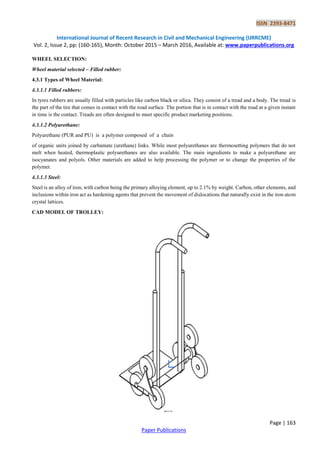
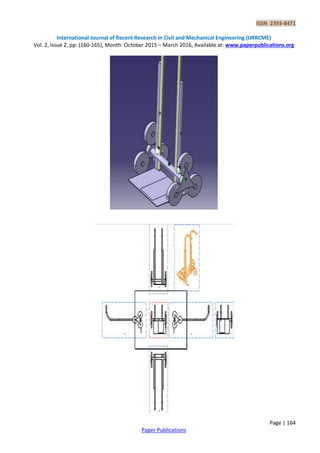
CAD MODEL OF TROLLEY:
ISSN 2393-8471
International Journal of Recent Research in Civil and Mechanical Engineering (IJRRCME)
Vol. 2, Issue 2, pp: (160-165), Month: October 2015 – March 2016, Available at: www.paperpublications.org
Page | 164
Paper Publications
ISSN 2393-8471
International Journal of Recent Research in Civil and Mechanical Engineering (IJRRCME)
Vol. 2, Issue 2, pp: (160-165), Month: October 2015 – March 2016, Available at: www.paperpublications.org
Page | 165
Paper Publications
VI. CONCLUSION
Though this article some limitations regarding the strength and built of the structure, it can be considered to be a small step
forward, as far as Stair Climbing Vehicles are concerned. During the test run of this project, it was realized that it wouldn’t
be a bad idea to consider this design for carrying heavy loads up the stairs. This product will be well acclaimed if it can be
commercialized to suit the needs. Though the initial cost of the project seemed to be higher but more accurate manufacturing
would shorten this.
As far the commercial aspects of this product are concerned, if this product can be fully automated and produced at a lower
cost the acceptance will be unimaginable.
REFERENCES
[1] Siegwart, R., Lauria, M., Mäusli, P., Winnendael, M., ―Design and Implementation of an Innovative Micro- Rover,‖
Proceedings of Robotics 98, the 3rd Conference and Exposition on Robotics in Challenging Environments April 26-30
1998, Albuquerque, New Mexico
[2] Hsueh-Er, C., ―Stair-climbing vehicle, ― Patent No. US2008164665(A1)‖, Jan 24. 2008
[3] Mourikis, A.I., Trawny, N., Roumeliotis, S.I., Helmick, D.M., and Matthies, L., ―Autonomous Stair Climbing for
Tracked Vehicles,‖ International Journal of Computer Vision & International Journal of Robotics Research - Joint
Special Issue on Vision and Robotics, 26(7), pp 737-758.,2007
[4] Helmick, D., Roumeliotis, S., McHenry, M., Matthies, L., ―Multi-sensor, high speed autonomous stair climbing‖,
IEEE/RSJ Conference on Intelligent Robots and Systems (IROS), September 2002,
[5] Schilling, K., Jungius, C., ―Mobile Robots for Planetary Exploration,‖ Control Engineering Practice, Vol. No. 4. 1996

ADVANCE MATERIAL HANDLING TROLLEY USING TRI-WHEEL MECHANISM

  • 1.
    ISSN 2393-8471 International Journalof Recent Research in Civil and Mechanical Engineering (IJRRCME) Vol. 2, Issue 2, pp: (160-165), Month: October 2015 – March 2016, Available at: www.paperpublications.org Page | 160 Paper Publications ADVANCE MATERIAL HANDLING TROLLEY USING TRI-WHEEL MECHANISM 1 Mulik shriniwas, 2 Salunkhe Rohit, 3 Shaikh Shahrukh, 4 Waghmode Dada, 5 Swipnil Gaikwad 1,2,3,4 B.E Students, 5 prof Mechanical Department, S.B. Patil College of Engineering, Indapur, India Abstract: This article aims is developing a mechanism for easy transportation of heavy loads over uneven terrain. The need for such a system arises from day-to-day requirements in our society. Devices such as hand trolleys are used to relieve the stress of lifting while on flat ground; however, these devices usually fail when it comes to carrying the load over short height.Several designs were conceived that would allow a non-industrial hand trolley to travel over stairs, curbs, or uneven terrain while reducing the strain on the user. In our project the trolley is consisting the tri-wheel or tri-star mechanism eases the movement of trolley in irregular surfaces like holes, bumps, etc Keywords: Hydraulic Lifting jack, Tri Wheel Arrangement, tri lobe wheel. I. INTRODUCTION A typical hand trolley consists of two small wheels located beneath a load-bearing platform, the hand trolley usually has two handles on its support frame. These handles are used to push, pull and maneuver the device. The handles may extend from the top rear of the frame, or one handle may curve from the back. An empty hand trolley usually stands upright in an L-shape, and products are usually stacked on top of the platform. When the goods are in place, it is tilted backward so that the load is balanced between the platform and the support frame. Especially if heavy or fragile materials are moved, the person operating the trolley should return it to an upright position carefully, to insure nothing falls off the platform. The front of the frame may be squared off for boxes or curved for drums and barrels. Sometimes, a hand truck also has straps for securing loose freight during transport. We are in the process of development of a tri-wheel trolley that has several new features than existing wheel and track based industrial trolley. A Tri-wheel functions as an ordinary wheel on flat ground, but has the ability to climb automatically when an impediment to rolling is encountered. This wheel design consists of three tires, each mounted to a separate shaft. These shafts are located at the vertices of an equilateral triangle. The three shafts are geared to a fourth, central shaft. When geared in this quasi-planetary fashion, these triangular sets of wheels can negotiate many types of terrain, including sand and mud; they can also allow a vehicle to climb over small obstructions such as rocks, holes, and stairs. The wheel assembly may be gear-driven, with two wheels in rolling contact with the ground. The third wheel idles at the top until the lower front wheel hits an obstruction. The obstruction prevents the lower front wheel from moving forward but does not affect the motion of the driving axle. This causes the top wheel to roll forward into position as the new front wheel. This wheel usually lands on top of the obstruction and allows the rest of the assembly to vault over the obstruction. we are also added the hydraulic jack to lifting of the material placed on the trolley. This can give the more efficiency to the trolley.
  • 2.
    ISSN 2393-8471 International Journalof Recent Research in Civil and Mechanical Engineering (IJRRCME) Vol. 2, Issue 2, pp: (160-165), Month: October 2015 – March 2016, Available at: www.paperpublications.org Page | 161 Paper Publications II. LITERATURE SURVEY Md. A. Hossain. Nafis studied a new horizon for the transportation of the loads over the stair. Most of the buildings of the country are structurally congested and unavailing of elevator facility so it is difficult and laborious to lift up heavy loads. The stair climbing Trolly can play an important role in those areas to lift loads over a short height, like libraries, hospital, and in construction area. The Trolly, which can move upper level through strain, or run in very rough and rocky surfaces, is called stair climbing Trolly Mr. Ravi R. Mishra modified In the first design, the power transmission to the single or double wheel trolley is useless to climb the stairs due to height factor of stairs creates huge obstacle on the way of vehicle. also The design of the straight wheel frame became more complicated and was needed modified with its curve- spherical shape to give proper drive, which create more frictional force. For these reason, three wheel set on each side of vehicle attached with frame was introduced to provide smooth power transmission in order to climb stairs without obstacles. Frame arrangement is suitable to transmit exact velocity ratio also. It provided higher efficiency and compact layout with reliable service. Lauren M. Smith described Driving Mode, two of the three individual wheels in each mechanism are in contact with the ground and roll across smooth surfaces efficiently and quickly just as a wheeled robot would. The Tri-Wheel’s orientation is not locked in place relative to the robot body, allowing the wheels to passively pivot about the main drive shaft located at the centroid of each mechanism. This facilitates effective adaptation to grades and slopes. Figure 2 depicts this ability to pivot and maintain contact with a smooth, sloped surface. Driving Mode Passive obstacle absorption is also possible in Driving Mode. As illustrated in Figure 3, when the leading ground wheel impacts an object, it kicks back. The top wheel then assumes position as the leading ground wheel to continue driving. This behavior is anticipated when encountering either a positive or negative obstacle. If the Tri-Wheel is lifted completely off the ground in this mode of operation and all reaction forces from the environment are removed, the frictional forces in the gears effectively lock up the gear set (preventing power transmission to the wheels) and cause the entire assembly to rotate in the direction of motor output with no individual wheels spinning. Kyle A. Johnson, William R. Tuck described Tumbling Mode ,When more precarious obstacles (stairs, debris, loose terrain, etc.) are encountered, Tumbling Mode provides a powered means to keep a robot moving. In Tumbling Mode, a braking mechanism is engaged to act upon the gearing system such that it forces the three wheels to rotate around the center axle of the Tri-Wheel assembly and ―walk‖ like a Whegs robot over obstacles. This tri-spoke rotation intentionally occurs in the same direction as individual wheel rotation, helping to pull along the robot. The mechanism inducing Tumbling Mode could be engaged passively, via operator command, or autonomously using feedback from sensors indicating a stall state, potential slippage, or a particular distance from the obstacle to be overcome. The braking mechanism on this vehicle is a small cam-operated drum brake, which is actuated through operator command. Figure 4 depicts the Tri-Wheel in Tumbling Mode ascending stairs. Because of its dual ability to roll and climb, the Tri-Wheel rotates about its central axle to approach a step and then rolls along the step surface until it reaches an optimal position to flip over itself once again and continue the climbing process. III. HISTORY OF TRI WHEEL MECHANISM The tri-star is a novel wheel design—originally by Robert and John Forsyth, assignors to Lockheed in 1967—in which three wheels are arranged in an upright triangle with two on the ground and one above them. If either of the wheels in contact with the ground gets stuck, the whole system rotates over the obstruction. The Landmaster in Damnation alley.Its most famous application was the Landmaster, a unique armoured personnel carrier (APC) from the film Damnation Alley Its common application is employed as a stairclimber.Lockheed also modified an M2A2 105mm Light Howitzer from 1969-1977 with a drive unit and tri-star wheel system into an Auxiliary Propelled Howitzer they termed "Terra Star." The only surviving prototype is located at the Rock Island Arsenal Museum IV. SELECTION AND FABRICATION OF TRI-WHEEL TROLLEY MATERIAL SELECTION: Material selection is a step in the process of designing any physical object. In the context of product design, the main goal of material selection is to minimize cost while meeting product performance goals. Systematic selection of the best material for a given application begins with properties and costs of candidate materials.
  • 3.
    ISSN 2393-8471 International Journalof Recent Research in Civil and Mechanical Engineering (IJRRCME) Vol. 2, Issue 2, pp: (160-165), Month: October 2015 – March 2016, Available at: www.paperpublications.org Page | 162 Paper Publications Trolley body Material Used- Mild Steel Mild Steel Mild steel, also called as plain-carbon steel, is the most common form of steel because its price is relatively low while it provides material properties that are acceptable for many applications, more so than iron. Low-carbon steel contains approximately 0.05–0.3% carbon making it malleable and ductile. Mild steel has a relatively low tensile strength, but it is cheap and malleable; surface hardness can be increased through carburizing. It is often used when large quantities of steel are needed, for example as structural steel. The density of mild steel is approximately 7850 kg/cm3 and the Young's modulus is 210 GPa (30,000,000 psi). 4.1.2 Tri-Star wheel web Material Used- Stainless Steel Grade 304 Stainless Steel Grade 304: Steel Type 304 is a variation of the basic 18-8 grade, Type 302, with a higher chromium and lower carbon content. Lower carbon minimizes chromium carbide precipitation due to welding and its susceptibility to inter-granular corrosion. In many instances, it can be used in the ―as-welded‖ condition, while Type 302 must be annealed in order to retain adequate corrosion resistance. Type 304L is an extra low-carbon variation of Type 304 with a 0.03% maximum carbon content that eliminates carbide precipitation due to welding. As a result, this alloy can be used in the ‖as-welded― condition, even in severe corrosive conditions. It often eliminates the necessity of annealing weldments except for applications specifying stress relief. It has slightly lower mechanical properties than Type 304. BEARING SELECTION: Ball bearing: A ball bearing is a type of rolling-element bearing that uses balls to maintain the separation between the bearing races. The purpose of a ball bearing is to reduce rotational friction and support radial and axial loads. It achieves this by using at least two races to contain the balls and transmit the loads through the balls. In most applications, one race is stationary and the other is attached to the rotating assembly. As one of the bearing races rotates it causes the balls to rotate as well. Because the balls are rolling they have a much lower coefficient of friction than if two flat surfaces were sliding against each other. Selecting a ball bearing with minimum inner diameter of 30mm, minimum load carrying capacity of 50kg radially and speed greater than 100rpm Bearing Selected - SKF 6006 Open Deep Groove Ball Bearing: 30x55x13mm Inside Diameter: 30mm Outside Diameter: 55mm Width:13mm This 6006-2RS 30x55x13-millimeter sealed ball bearing has deep groove geometry for high speeds and supporting both radial and axial loads. This bearing has rubber seals on both sides of the bearing to keep lubricant in and contaminants out, and comes pre-lubricated from the manufacturer so that no additional lubrication is required. This deep groove sealed ball bearing is for use in applications that involve combined radial and axial loads, and a need for high running accuracy at high rotational speeds. Such applications include clutches, drives, gearboxes, compressors, pumps, turbines, and printing and textile machines, among others
  • 4.
    ISSN 2393-8471 International Journalof Recent Research in Civil and Mechanical Engineering (IJRRCME) Vol. 2, Issue 2, pp: (160-165), Month: October 2015 – March 2016, Available at: www.paperpublications.org Page | 163 Paper Publications WHEEL SELECTION: Wheel material selected – Filled rubber: 4.3.1 Types of Wheel Material: 4.3.1.1 Filled rubbers: In tyres rubbers are usually filled with particles like carbon black or silica. They consist of a tread and a body. The tread is the part of the tire that comes in contact with the road surface. The portion that is in contact with the road at a given instant in time is the contact. Treads are often designed to meet specific product marketing positions. 4.3.1.2 Polyurethane: Polyurethane (PUR and PU) is a polymer composed of a chain of organic units joined by carbamate (urethane) links. While most polyurethanes are thermosetting polymers that do not melt when heated, thermoplastic polyurethanes are also available. The main ingredients to make a polyurethane are isocyanates and polyols. Other materials are added to help processing the polymer or to change the properties of the polymer. 4.3.1.3 Steel: Steel is an alloy of iron, with carbon being the primary alloying element, up to 2.1% by weight. Carbon, other elements, and inclusions within iron act as hardening agents that prevent the movement of dislocations that naturally exist in the iron atom crystal lattices. CAD MODEL OF TROLLEY:
  • 5.
    ISSN 2393-8471 International Journalof Recent Research in Civil and Mechanical Engineering (IJRRCME) Vol. 2, Issue 2, pp: (160-165), Month: October 2015 – March 2016, Available at: www.paperpublications.org Page | 164 Paper Publications
  • 6.
    ISSN 2393-8471 International Journalof Recent Research in Civil and Mechanical Engineering (IJRRCME) Vol. 2, Issue 2, pp: (160-165), Month: October 2015 – March 2016, Available at: www.paperpublications.org Page | 165 Paper Publications VI. CONCLUSION Though this article some limitations regarding the strength and built of the structure, it can be considered to be a small step forward, as far as Stair Climbing Vehicles are concerned. During the test run of this project, it was realized that it wouldn’t be a bad idea to consider this design for carrying heavy loads up the stairs. This product will be well acclaimed if it can be commercialized to suit the needs. Though the initial cost of the project seemed to be higher but more accurate manufacturing would shorten this. As far the commercial aspects of this product are concerned, if this product can be fully automated and produced at a lower cost the acceptance will be unimaginable. REFERENCES [1] Siegwart, R., Lauria, M., Mäusli, P., Winnendael, M., ―Design and Implementation of an Innovative Micro- Rover,‖ Proceedings of Robotics 98, the 3rd Conference and Exposition on Robotics in Challenging Environments April 26-30 1998, Albuquerque, New Mexico [2] Hsueh-Er, C., ―Stair-climbing vehicle, ― Patent No. US2008164665(A1)‖, Jan 24. 2008 [3] Mourikis, A.I., Trawny, N., Roumeliotis, S.I., Helmick, D.M., and Matthies, L., ―Autonomous Stair Climbing for Tracked Vehicles,‖ International Journal of Computer Vision & International Journal of Robotics Research - Joint Special Issue on Vision and Robotics, 26(7), pp 737-758.,2007 [4] Helmick, D., Roumeliotis, S., McHenry, M., Matthies, L., ―Multi-sensor, high speed autonomous stair climbing‖, IEEE/RSJ Conference on Intelligent Robots and Systems (IROS), September 2002, [5] Schilling, K., Jungius, C., ―Mobile Robots for Planetary Exploration,‖ Control Engineering Practice, Vol. No. 4. 1996