Options in the Treatment of Portal Hypertension Portal Hypertension, itself, is not an indication for treatment Only the complications of Portal Hypertension need treatment
The Complications of Portal Hypertension UPPER DIGESTIVE BLEEDING ASCITIS
UPPER DIGESTIVE BLEEDING The most common and severe complication of portal hypertension Causes – esophagian varices, gastric varices, portal gastropathy
ASCITES Surgical treatment needed in cases with poor respond to medical treatment There are only few forms of portal hypertension associated with ascitis, which have a benefit after surgical treatment   Budd - Chiari syndrome
SPLENOMEGALY Splenectomy is indicated as singular procedure in few instances: Segmentary portal hypertension (splenic vein thrombosis, chronic pancreatitis, arterio-venous fistula) Giant splenomegaly which interfere with a normal growing Severe hypersplenism in the absence of esophageal varices
Surgical procedures used in portal hypertension treatment Direct control of bleeding Suture of esophageal varices (esophageal transection) Eso-gastric resection  Devascularization procedures Indirect control of bleeding: porto-sistemic shunts Porto-caval shunts Mezenterico-caval shunts Spleno-renal shunts
Transgastric suture (esophageal transection) of esophageal varices Easy to performe, practicable in every surgical department Must be performed as the last choice of treatment after all medical  or endoscopic procedures  As singular procedure in emergency Bleeding is controlled in 70% cases Recurrent variceal bleeding in the first year- 35% Mortality (cirrhosis) - 50%
The eso-gastric resection Ablation of esophageal and gastric vari ces A z y go-portal dis junction Usually performed as a polar superior esogastric resection Post operat ive   m ortalit y is too high comparative with the benefits ( 50-70%) Is still indicated in bleeding from gastric varices, if we have no other possibility of surgical treatment.
Operative  Devascularisation Reduce blood flow to varices Interrupt bleeding source Eliminate the complications of splenomegaly (hypersplenism)
Types of operative procedures(1) Hassab operation Splenectomy Devascularization of the upper stomach
Types of operative procedures(2) Sugiura procedure Extensive transthoracic paraoesophageal devascularization and esophageal transection combined with splenectomy, devascularization of the upper stomach,  Disadvantage: thoracic approach Good results especially in Japan Overall mortality - 5,2 %,  Mortality distribution: 4,3% (Child A, B), 17%(Child C) Recurrent variceal bleeding rate < 5 % Sugiura M, Futagawa S. Esophageal transection with paraesophagogastric devascularization in the treatment of esophageal varices. World J Surg 1984;8:673.
Only abdominal approach Same results as Sugiura procedures Procedure Ligation of paraesofageal veins (left and right), devascularization of the stomach with preserving of right gastroepiploic vein Varices ligation or esophageal transection Splenectomy Types of operative procedures(3)
Advantages of  Devascularization Operations Easy technique Low mortality Low recurrent variceal bleeding rate Postoperative encephalopathy is rare    - preserving of portal blood flow - Liver function well preserved Idezucki Y, Sanjo K, Bandai Y, Kawasaki S, Ohashi K Current strategy for oesophageal varices in Japan. American Journal of Surgery 1990 160:98–104
Portasystemic shunt Portacaval shunts End-to-Side Side-to-Side H-graft shunt   Splenorenal Shunts Selective: distal splenorenal shunt   Non-selective: central splenorenal shunt  Mesocaval Shunt  Side-to-Side H-graft shunt
Disadvantages of portasystemic shunts Technically more difficult Because of reducing of portal  blood flow two severe complication can occur: Impaired Liver Function Hepatic Encephalopathy
PORTACAVAL SHUNTS
Portacaval Shunt  End-to-Side Highly effective in splanchnic blood decompression Relatively easy to perform  Produce a sustained fall in portaI pressure and prevent recurrence of hemorrhage Sinusoid vessels are not decompressed and ascitis can appear or exacerbate. A future liver transplant can be impaired
Portacaval Shunt  Side-to-Side   Successful in decompressing the splanchnic system   Low risk of recurrent vertical bleeding High risk of hepatic encephalopathy  Sinusoid vessels are well decompressed  Ascites is diminish or reduced
Portacaval Shunt  Side-to-Side Technically more difficult: Well dissection and mobilization of portal and inferior caval vein Sometimes dissection can be very difficult because of bleeding from pancreatic collateral branches Hypertrophy caudate lobe in cirrhosis and Budd Chiari syndrome need sometimes partial resections of caudate which complicated the operation
Portacaval  H-graft shunt   Interposing a synthetic graft of various diameters between portal and caval vein  Aim – decompress the whole portal venous bed, whilst maintaining a pressure gradient to preserve adequate hepatic portal flow Reduce risk of encephalopathy and liver failure
Portacaval  H-graft shunt 2 Technical Versions Graft diameter - 16 mm Important portacaval flow Graft diameter - 8mm Reasonable portocaval flow Reduce the portal hipertension enough to avoid risk of bleeding Sometimes increase risk of ascitis which often respond on medical treatment Very important: ligation of coronary,right gastroepiploic veins which can compromise the aim of the operation Sarfeh IJ, Rypins EB, Mason GR. A systematic appraisal of portacaval H-graft diameters: clinical and hemodynamic perspectives. Ann Surg 1986;204:356.
SPLENORENAL SHUNTS
Splenorenal central shunt Technique: Splenectomy,  Dissection of splenic vein from posterior surface of the pancreas Dissection of the renal vein  Splenorenal anastomosis end to side Low portal encephalopathy risk High risk of thrombosis when splenic vein diameter < 12mm Recurrent variceal bleeding higher than other portosystemic shunts  Adequate in splenomegaly associated with severe hypersplenism
SPLENORENAL CENTRAL SHUNT splenic vein left renal vein vein Proximal  end to side anastomosis Spleen
Splenorenal distal shunt ( Warren) Selective shunt – divide portal system: High pressure sector mezenteric and portal veins Low pressure sector, gastric and splenic veins  Henderson JM, Warren WD, Millikan WJ, Galloway JR, Kawasaki S, Kutner MH.  Distal splenorenal shunt with splenopancreatic disconnection: a 4-year assessment.  Ann Surg 1989;210:332.
Splenorenal distal shunt ( Warren) Technique The gastroepiploic arcade should be interrupted and taken down from the pylorus to the first short gastric vessels. Dissection of the splenic vein from posterior pancreatic surface with isolation, ligation and division of the thin walled tributaries from the pancreas to the splenic vein
Splenorenal distal shunt (Warren) Dividing the splenic vein before junction with superior mesenteric vein. End to side spleno-renal anastomosis Ligation of left gastric and right gastroepiploic pedicle Henderson JM. Surgical treatment of portal hypertension –  Baillieres Best Pract Res Clin Gastroenterol  - 01-Dec-2000; 14(6): 911-25
SPLENORENAL DISTAL SHUNT
Splenorenal distal shunt Advantages Slow but efficient varices decompresion  Low risk of portal encephalopathy ( <10%) relative to other shunts (32%-50%) Reccurent variceal bleeding: 7%-13% at 5 years Boyer TD, Kokenes DD, Hetzler G, Kutner MH, Henderson JM. Effect of distal splenorenal shunt on survival of patients with primary biliary cirrhosis. Hepatology, 1994, 20(6):1482-1486.
Splenorenal distal shunt Disadvantages : Sometimes very difficult technically because of venous pancreatic branches  Postoperative complications Acute pancreatitis, pancreatic pseudocyst Avoided in presence of ascitis Mortality between 1%-19% according to situation: elective operation or emergency,  liver failure or not
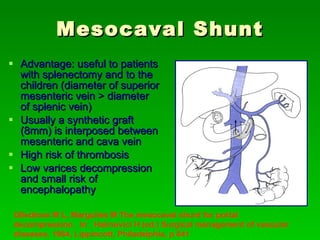
Mesocaval Shunt Advantage: useful to patients with splenectomy and to the children (diameter of superior mesenteric vein > diameter of splenic vein) Usually a synthetic graft (8mm) is interposed between mesenteric and cava vein High risk of thrombosis Low varices decompression and small risk of encephalopathy Gliedman M L, Margulies M The mesocaval shunt for portal decompression.  In:  Haimovici H (ed.) Surgical management of vascular diseases. 1984, Lippincott, Philadelphia, p 841
The aims of the treatment of portal hypertension: Prevent Bleeding Stop the Bleeding Prevent Recurrent Variceal Bleeding
Surgical prevention in portal hypertension The place of surgical prevention is after failure of  medical  and  endoscopic   treatment Surgical procedures are choused by: Efficiency Postoperative complications and mortality Type of  portal hypertension Possibility in future to continue with an other surgical procedure in case of  relapse or failure
Surgical treatment of upper digestive bleeding (1) Indicated after endoscopic and medical treatment, Sengstaken-Blakemore tube, TIPSS  Surgical treatment depending of severity of bleeding and liver dysfunction  For esophageal varices the most indicated treatment is varices ligation or esophageal transection.  In cases of portal gastropathy or gastric varices surgical treatment is operative devascularisation or esogastric resection  Cello J P, Grendell J H, Crass R A, Weber T E, Trunkey D D Endoscopic sclerotherapy versus portacaval shunt in patients with severe cirrhosis and acute variceal hemorrhage. Long-term follow-up. New England Journal of Medicine 1987 316:11–15
Surgical treatment of upper digestive bleeding (2) Portasystemic shunts Not recommended in emergency because of high mortality Mitchell R L, Ignatius J A Distal splenorenal shunt: standard procedure for elective and emergency treatment of bleeding esophageal varices. American Journal of Surgery 1988 156:169–172 Terblanche J, Burroughs A K, Hobbs K E F Controversies in the management of bleeding esophageal varices. New England Journal of Medicine 1989 320:1393–1398, 1469–1475
Prevention of recurrent upper digestive bleeding  Surgical procedures are indicated after failure of endoscopic treatment Gastric varices Portal gastropathy Depending of portal hypertension type and liver resources
Surgical treatment according of portal hypertension (PH) type PRESINUSOIDAL SINUSOIDAL POSTSINUSOIDAL
PRESINUSOIDAL EXTRAHEPATIC  INTRAHEPATIC
Presinusoidal PH Segmentary PH – splenic vein thrombosis or extrinsec compresion (chronic pancreatitis), splenic arteriovenous fistula  Splenectomy +/- distal pancreatectomy Portal vein obstacle Mesocaval shunt Devascularisations procedures Splenoportal   thrombosis Devascularisations procedures Extrahepatic
Presinusoidal PH Most of patients with preserved liver function Splenorenal distal shunt   (Warren) first choice 8 mm graft portacaval shunt  Devascularisation operations   !!!  Also applied on children with spleen preserving when  shunt operations   are planned in the future Intrahepatic
Sinusoidal PH (Cirrhosis) Surgical treatment have to preserve portal blood flow Most of this patients are candidates for liver transplant
Liver function not impaired If is planned a liver transplant in future  splenorenal distal shunt Warren  is the first choice   If not,  portacaval H graft shunt  or  devascularisation operations  are indicated !!! In case of severe hypersplenism are recommended: Splenorenal central shunt  Devascularisation operations Impaired liver function: Liver transplant TIPSS  (waiting list) Devascularisation operations  if a future liver transplant is not feasible Sinusoidal PH
Postsinusoidal PH Liver function well preserved Ascitis – the most common finding Side to side portacaval shunt Successful in decompressing the splanchnic system Hypertrophy of caudate lobe needs some time partial resections of caudate which complicated the operation H graft portacaval shunt Caval vein not obstructed
Postsinusoidal PH with caval vein obstruction Mesoatrial shunt  Postsinusoidal PH with liver failure Liver transplant
Fundeni Clinical institute  Department of General Surgery and Liver Transplant 1990 - 2002 163 Operative devascularisation  54 Portasystemic shunts 25 splenorenal central shunts 16 splenorenal proximal shunts 6 portacaval shunts 3 with 8 mm graft 1 end to side  2 side to side 6 mesocaval: 5 with 8mm graft 1 mesoatrial
Mortality (1) Operative devascularisation 18 patients from163  (10,7%) Causes: Peritonitis: gastric wall necrosis ( 3 ) Hepatic failure ( 15 ) Child B,C
Mortality (1) Portasystemic shunts 8 patients from 54  (14,8%) 4 splenorenal central shunts 2 splenorenal distal shunts 2 mesocaval shunt Causes: hepatic failure  6 intraoperative bleeding
Conclusions (1) Surgical treatment of PH is not standardized  The most common complication of PH treated is   BLEEDING Surgical treatment only in case of failure of endoscopic treatment Surgical treatment is very efficient in prevention of recurrent upper digestive bleeding
Conclusions (2) Portasystemic shunts   are the most efficient treatment in prevention of   recurrent bleeding Splenorenal distal shunt (Warren)   best choice Liver function well preserved  Cirrhosis (Child A) Devascularisation operations Portasistemic shunts not feasible Liver function impaired
Conclusions (3) Impaired liver function: LIVER TRANSPLANT

33

  • 1.
    Options in theTreatment of Portal Hypertension Portal Hypertension, itself, is not an indication for treatment Only the complications of Portal Hypertension need treatment
  • 2.
    The Complications ofPortal Hypertension UPPER DIGESTIVE BLEEDING ASCITIS
  • 3.
    UPPER DIGESTIVE BLEEDINGThe most common and severe complication of portal hypertension Causes – esophagian varices, gastric varices, portal gastropathy
  • 4.
    ASCITES Surgical treatmentneeded in cases with poor respond to medical treatment There are only few forms of portal hypertension associated with ascitis, which have a benefit after surgical treatment Budd - Chiari syndrome
  • 5.
    SPLENOMEGALY Splenectomy isindicated as singular procedure in few instances: Segmentary portal hypertension (splenic vein thrombosis, chronic pancreatitis, arterio-venous fistula) Giant splenomegaly which interfere with a normal growing Severe hypersplenism in the absence of esophageal varices
  • 6.
    Surgical procedures usedin portal hypertension treatment Direct control of bleeding Suture of esophageal varices (esophageal transection) Eso-gastric resection Devascularization procedures Indirect control of bleeding: porto-sistemic shunts Porto-caval shunts Mezenterico-caval shunts Spleno-renal shunts
  • 7.
    Transgastric suture (esophagealtransection) of esophageal varices Easy to performe, practicable in every surgical department Must be performed as the last choice of treatment after all medical or endoscopic procedures As singular procedure in emergency Bleeding is controlled in 70% cases Recurrent variceal bleeding in the first year- 35% Mortality (cirrhosis) - 50%
  • 8.
    The eso-gastric resectionAblation of esophageal and gastric vari ces A z y go-portal dis junction Usually performed as a polar superior esogastric resection Post operat ive m ortalit y is too high comparative with the benefits ( 50-70%) Is still indicated in bleeding from gastric varices, if we have no other possibility of surgical treatment.
  • 9.
    Operative DevascularisationReduce blood flow to varices Interrupt bleeding source Eliminate the complications of splenomegaly (hypersplenism)
  • 10.
    Types of operativeprocedures(1) Hassab operation Splenectomy Devascularization of the upper stomach
  • 11.
    Types of operativeprocedures(2) Sugiura procedure Extensive transthoracic paraoesophageal devascularization and esophageal transection combined with splenectomy, devascularization of the upper stomach, Disadvantage: thoracic approach Good results especially in Japan Overall mortality - 5,2 %, Mortality distribution: 4,3% (Child A, B), 17%(Child C) Recurrent variceal bleeding rate < 5 % Sugiura M, Futagawa S. Esophageal transection with paraesophagogastric devascularization in the treatment of esophageal varices. World J Surg 1984;8:673.
  • 12.
    Only abdominal approachSame results as Sugiura procedures Procedure Ligation of paraesofageal veins (left and right), devascularization of the stomach with preserving of right gastroepiploic vein Varices ligation or esophageal transection Splenectomy Types of operative procedures(3)
  • 13.
    Advantages of Devascularization Operations Easy technique Low mortality Low recurrent variceal bleeding rate Postoperative encephalopathy is rare - preserving of portal blood flow - Liver function well preserved Idezucki Y, Sanjo K, Bandai Y, Kawasaki S, Ohashi K Current strategy for oesophageal varices in Japan. American Journal of Surgery 1990 160:98–104
  • 14.
    Portasystemic shunt Portacavalshunts End-to-Side Side-to-Side H-graft shunt Splenorenal Shunts Selective: distal splenorenal shunt Non-selective: central splenorenal shunt Mesocaval Shunt Side-to-Side H-graft shunt
  • 15.
    Disadvantages of portasystemicshunts Technically more difficult Because of reducing of portal blood flow two severe complication can occur: Impaired Liver Function Hepatic Encephalopathy
  • 16.
  • 17.
    Portacaval Shunt End-to-Side Highly effective in splanchnic blood decompression Relatively easy to perform Produce a sustained fall in portaI pressure and prevent recurrence of hemorrhage Sinusoid vessels are not decompressed and ascitis can appear or exacerbate. A future liver transplant can be impaired
  • 18.
    Portacaval Shunt Side-to-Side Successful in decompressing the splanchnic system Low risk of recurrent vertical bleeding High risk of hepatic encephalopathy Sinusoid vessels are well decompressed Ascites is diminish or reduced
  • 19.
    Portacaval Shunt Side-to-Side Technically more difficult: Well dissection and mobilization of portal and inferior caval vein Sometimes dissection can be very difficult because of bleeding from pancreatic collateral branches Hypertrophy caudate lobe in cirrhosis and Budd Chiari syndrome need sometimes partial resections of caudate which complicated the operation
  • 20.
    Portacaval H-graftshunt Interposing a synthetic graft of various diameters between portal and caval vein Aim – decompress the whole portal venous bed, whilst maintaining a pressure gradient to preserve adequate hepatic portal flow Reduce risk of encephalopathy and liver failure
  • 21.
    Portacaval H-graftshunt 2 Technical Versions Graft diameter - 16 mm Important portacaval flow Graft diameter - 8mm Reasonable portocaval flow Reduce the portal hipertension enough to avoid risk of bleeding Sometimes increase risk of ascitis which often respond on medical treatment Very important: ligation of coronary,right gastroepiploic veins which can compromise the aim of the operation Sarfeh IJ, Rypins EB, Mason GR. A systematic appraisal of portacaval H-graft diameters: clinical and hemodynamic perspectives. Ann Surg 1986;204:356.
  • 22.
  • 23.
    Splenorenal central shuntTechnique: Splenectomy, Dissection of splenic vein from posterior surface of the pancreas Dissection of the renal vein Splenorenal anastomosis end to side Low portal encephalopathy risk High risk of thrombosis when splenic vein diameter < 12mm Recurrent variceal bleeding higher than other portosystemic shunts Adequate in splenomegaly associated with severe hypersplenism
  • 24.
    SPLENORENAL CENTRAL SHUNTsplenic vein left renal vein vein Proximal end to side anastomosis Spleen
  • 25.
    Splenorenal distal shunt( Warren) Selective shunt – divide portal system: High pressure sector mezenteric and portal veins Low pressure sector, gastric and splenic veins Henderson JM, Warren WD, Millikan WJ, Galloway JR, Kawasaki S, Kutner MH. Distal splenorenal shunt with splenopancreatic disconnection: a 4-year assessment. Ann Surg 1989;210:332.
  • 26.
    Splenorenal distal shunt( Warren) Technique The gastroepiploic arcade should be interrupted and taken down from the pylorus to the first short gastric vessels. Dissection of the splenic vein from posterior pancreatic surface with isolation, ligation and division of the thin walled tributaries from the pancreas to the splenic vein
  • 27.
    Splenorenal distal shunt(Warren) Dividing the splenic vein before junction with superior mesenteric vein. End to side spleno-renal anastomosis Ligation of left gastric and right gastroepiploic pedicle Henderson JM. Surgical treatment of portal hypertension – Baillieres Best Pract Res Clin Gastroenterol - 01-Dec-2000; 14(6): 911-25
  • 28.
  • 29.
    Splenorenal distal shuntAdvantages Slow but efficient varices decompresion Low risk of portal encephalopathy ( <10%) relative to other shunts (32%-50%) Reccurent variceal bleeding: 7%-13% at 5 years Boyer TD, Kokenes DD, Hetzler G, Kutner MH, Henderson JM. Effect of distal splenorenal shunt on survival of patients with primary biliary cirrhosis. Hepatology, 1994, 20(6):1482-1486.
  • 30.
    Splenorenal distal shuntDisadvantages : Sometimes very difficult technically because of venous pancreatic branches Postoperative complications Acute pancreatitis, pancreatic pseudocyst Avoided in presence of ascitis Mortality between 1%-19% according to situation: elective operation or emergency, liver failure or not
  • 31.
    Mesocaval Shunt Advantage:useful to patients with splenectomy and to the children (diameter of superior mesenteric vein > diameter of splenic vein) Usually a synthetic graft (8mm) is interposed between mesenteric and cava vein High risk of thrombosis Low varices decompression and small risk of encephalopathy Gliedman M L, Margulies M The mesocaval shunt for portal decompression. In: Haimovici H (ed.) Surgical management of vascular diseases. 1984, Lippincott, Philadelphia, p 841
  • 32.
    The aims ofthe treatment of portal hypertension: Prevent Bleeding Stop the Bleeding Prevent Recurrent Variceal Bleeding
  • 33.
    Surgical prevention inportal hypertension The place of surgical prevention is after failure of medical and endoscopic treatment Surgical procedures are choused by: Efficiency Postoperative complications and mortality Type of portal hypertension Possibility in future to continue with an other surgical procedure in case of relapse or failure
  • 34.
    Surgical treatment ofupper digestive bleeding (1) Indicated after endoscopic and medical treatment, Sengstaken-Blakemore tube, TIPSS Surgical treatment depending of severity of bleeding and liver dysfunction For esophageal varices the most indicated treatment is varices ligation or esophageal transection. In cases of portal gastropathy or gastric varices surgical treatment is operative devascularisation or esogastric resection Cello J P, Grendell J H, Crass R A, Weber T E, Trunkey D D Endoscopic sclerotherapy versus portacaval shunt in patients with severe cirrhosis and acute variceal hemorrhage. Long-term follow-up. New England Journal of Medicine 1987 316:11–15
  • 35.
    Surgical treatment ofupper digestive bleeding (2) Portasystemic shunts Not recommended in emergency because of high mortality Mitchell R L, Ignatius J A Distal splenorenal shunt: standard procedure for elective and emergency treatment of bleeding esophageal varices. American Journal of Surgery 1988 156:169–172 Terblanche J, Burroughs A K, Hobbs K E F Controversies in the management of bleeding esophageal varices. New England Journal of Medicine 1989 320:1393–1398, 1469–1475
  • 36.
    Prevention of recurrentupper digestive bleeding Surgical procedures are indicated after failure of endoscopic treatment Gastric varices Portal gastropathy Depending of portal hypertension type and liver resources
  • 37.
    Surgical treatment accordingof portal hypertension (PH) type PRESINUSOIDAL SINUSOIDAL POSTSINUSOIDAL
  • 38.
  • 39.
    Presinusoidal PH SegmentaryPH – splenic vein thrombosis or extrinsec compresion (chronic pancreatitis), splenic arteriovenous fistula Splenectomy +/- distal pancreatectomy Portal vein obstacle Mesocaval shunt Devascularisations procedures Splenoportal thrombosis Devascularisations procedures Extrahepatic
  • 40.
    Presinusoidal PH Mostof patients with preserved liver function Splenorenal distal shunt (Warren) first choice 8 mm graft portacaval shunt Devascularisation operations !!! Also applied on children with spleen preserving when shunt operations are planned in the future Intrahepatic
  • 41.
    Sinusoidal PH (Cirrhosis)Surgical treatment have to preserve portal blood flow Most of this patients are candidates for liver transplant
  • 42.
    Liver function notimpaired If is planned a liver transplant in future splenorenal distal shunt Warren is the first choice If not, portacaval H graft shunt or devascularisation operations are indicated !!! In case of severe hypersplenism are recommended: Splenorenal central shunt Devascularisation operations Impaired liver function: Liver transplant TIPSS (waiting list) Devascularisation operations if a future liver transplant is not feasible Sinusoidal PH
  • 43.
    Postsinusoidal PH Liverfunction well preserved Ascitis – the most common finding Side to side portacaval shunt Successful in decompressing the splanchnic system Hypertrophy of caudate lobe needs some time partial resections of caudate which complicated the operation H graft portacaval shunt Caval vein not obstructed
  • 44.
    Postsinusoidal PH withcaval vein obstruction Mesoatrial shunt Postsinusoidal PH with liver failure Liver transplant
  • 45.
    Fundeni Clinical institute Department of General Surgery and Liver Transplant 1990 - 2002 163 Operative devascularisation 54 Portasystemic shunts 25 splenorenal central shunts 16 splenorenal proximal shunts 6 portacaval shunts 3 with 8 mm graft 1 end to side 2 side to side 6 mesocaval: 5 with 8mm graft 1 mesoatrial
  • 46.
    Mortality (1) Operativedevascularisation 18 patients from163 (10,7%) Causes: Peritonitis: gastric wall necrosis ( 3 ) Hepatic failure ( 15 ) Child B,C
  • 47.
    Mortality (1) Portasystemicshunts 8 patients from 54 (14,8%) 4 splenorenal central shunts 2 splenorenal distal shunts 2 mesocaval shunt Causes: hepatic failure 6 intraoperative bleeding
  • 48.
    Conclusions (1) Surgicaltreatment of PH is not standardized The most common complication of PH treated is BLEEDING Surgical treatment only in case of failure of endoscopic treatment Surgical treatment is very efficient in prevention of recurrent upper digestive bleeding
  • 49.
    Conclusions (2) Portasystemicshunts are the most efficient treatment in prevention of recurrent bleeding Splenorenal distal shunt (Warren) best choice Liver function well preserved Cirrhosis (Child A) Devascularisation operations Portasistemic shunts not feasible Liver function impaired
  • 50.
    Conclusions (3) Impairedliver function: LIVER TRANSPLANT